Anthropic
S-1 注册声明
Registration Statement Under the Securities Act of 1933
保留开篇投资者说明、术语定义、招股说明书摘要、发行及财务摘要的实质内容,不因与后文重复而删减;继续阅读可了解业务、财务、风险和治理重点。人员名单、独立署名及申报手续适度精简,相关定义与脚注随文保留。表格以图解呈现,可切换指标或展开原表。点击右上角“显示全文”可恢复全部内容。
阅读与对照说明
正文按章节连续呈现,跨页的段落和表格已接合。每节末尾可展开英文对照,原始版式见 SEC 文件。图中全部文字附有中文转录,英文原图可展开查看。
金额保留原文数字与量级,例如 billion 译为“十亿”、million 译为“百万”;表格单位和空白单元格保持原意。简繁切换为辅助字形转换,校对文本为简体中文。
于 2026 年 10 月 26 日向美国证券交易委员会提交。
注册编号 333- 〔原文留白〕
美国证券交易委员会
华盛顿哥伦比亚特区 20549
S-1 表格注册声明
依据《1933 年证券法》
Anthropic, PBC
(注册人章程所载的确切名称)
| 特拉华州 | 7372 | 86-1696045 |
| (注册成立或组建所在的州或其他司法管辖区) | (主要标准行业分类代码) | (美国国税局雇主识别号码) |
548 Market Street PMB 90375 San Francisco, California 94104
(415) 326-6303
(注册人主要行政办事处的地址(含邮政编码)及电话号码(含区号))
Dario Amodei,首席执行官兼联合创始人
Daniela Amodei,总裁兼联合创始人
Anthropic, PBC
548 Market Street PMB 90375 San Francisco, California 94104
(415) 326-6303
(送达代理人的姓名、地址(含邮政编码)及电话号码(含区号))
副本送交:
| Rezwan D. Pavri Allison B. Spinner Lang Liu Colin G. Conklin Jonie I. Kondracki Lester Ang Shannon R. Delahaye Wilson Sonsini Goodrich & Rosati, P.C. 律师事务所 650 Page Mill Road Palo Alto, California 94304 (650) 493-9300 |
Brian Israel Elena Leichty Patrick Ekeruo Scott Booth Anthropic, PBC 548 Market Street PMB 90375 San Francisco, California 94104 (415) 326-6303 |
Sarah K. Solum Calise Y. Cheng Phillip S. Stoup Freshfields US LLP 855 Main Street Redwood City, California 94063 (650) 618-9250 |
拟开始向公众发售的大致日期:本注册声明生效后,在切实可行的情况下尽快开始。
如本表格注册的任何证券将根据《1933 年证券法》第 415 条规则以延迟或持续方式发售,请勾选下列方框。☐
如提交本表格是为了根据《证券法》第 462(b) 条规则为某次发行注册额外证券,请勾选下列方框,并列明同一次发行此前已生效的《证券法》注册声明的编号。☐
如本表格是根据《证券法》第 462(c) 条规则提交的生效后修订文件,请勾选下列方框,并列明同一次发行此前已生效的《证券法》注册声明的编号。☐
如本表格是根据《证券法》第 462(d) 条规则提交的生效后修订文件,请勾选下列方框,并列明同一次发行此前已生效的《证券法》注册声明的编号。☐
请勾选,以表明注册人是否为大型加速申报公司、加速申报公司、非加速申报公司、较小规模报告公司或新兴成长型公司。关于“大型加速申报公司”“加速申报公司”“较小规模报告公司”及“新兴成长型公司”的定义,请参阅以下法律项下的第 12b-2 条规则:《证券交易法》。
| 大型加速申报公司 | ☐ | 加速申报公司 | ☐ |
| 非加速申报公司 | ☒ | 较小规模报告公司 | ☐ |
| 新兴成长型公司 | ☐ |
如注册人为新兴成长型公司,请勾选,以表明注册人是否已选择不使用《证券法》第 7(a)(2)(B) 条规定的、用于遵守任何新订或修订的财务会计准则的延长过渡期。☐
注册人特此于为推迟本注册声明生效日期所需的一个或多个日期对本注册声明作出修订,直至注册人提交进一步修订,明确声明本注册声明此后应根据经修订的《1933 年证券法》第 8(a) 条生效,或直至本注册声明于美国证券交易委员会依据上述第 8(a) 条所确定的日期生效。
A\
本初步招股说明书所载信息尚不完整,且可能发生变更。在向美国证券交易委员会提交的注册声明生效之前,不得出售这些证券。在任何不允许发出要约或出售这些证券的司法管辖区,本初步招股说明书既不构成出售这些证券的要约,也不构成购买这些证券的要约邀请。
尚待完成。日期:〔原文留白〕。
| A 类普通股 | 股数 | Anthropic, PBC |
本次为 Anthropic, PBC 的 A 类普通股首次公开发行。我们将出售〔原文留白〕股 A 类普通股,本招股说明书列明的售股股东将另行出售〔原文留白〕股 A 类普通股。我们不会从任何售股股东出售我们的 A 类普通股中获得任何募集资金。
本次发行之前,我们的 A 类普通股并无公开交易市场。目前预计首次公开发行的每股价格将介于〔原文留白〕美元与〔原文留白〕美元之间。我们已申请将我们的 A 类普通股在纳斯达克全球精选市场上市,股票代码为“ANT”。
我们拥有一种新颖的资本及公司治理结构。我们根据特拉华州法律注册成立为公益公司,这一结构与我们对人工智能(“AI”)安全性及责任的承诺相一致。作为公益公司,我们须在股东的金钱利益、受我们行为重大影响的人士的最佳利益,以及我们经修订及重述的公司注册证书所载的特定公共利益宗旨之间取得平衡;该宗旨为:为人类的长期利益而负责任地开发和维护先进 AI。我们设立了我们的长期利益信托(“LTBT”),以帮助确保 Anthropic, PBC 的管理方式能够负责任地平衡其作为公益公司的各项目标。LTBT 旨在作为一个独立机构运作,由在 AI 安全性、国家安全、公共政策及社会企业方面具有专业知识且不具有财务利害关系的受托人组成。通过一种特殊类别的普通股,即 T 类普通股,LTBT 通常有权选举及罢免 T 类董事,这些董事合计将占我们董事会授权席位总数的过半数。除此以外,我们的 T 类普通股对提交股东一般性表决的事项不享有表决权,亦不享有经济权益。紧接本次发行完成之前,我们还将向一家由我们的联合创始人组建的有限责任公司(“创始人有限责任公司”,Founder LLC)发行一股 F 类普通股,这是我们的一种特殊类别普通股。我们的首席执行官兼董事会成员 Dario Amodei 及我们的总裁兼董事长 Daniela Amodei,连同我们的其他五位联合创始人,最初将为创始人有限责任公司的唯一成员。我们的 F 类普通股将由创始人有限责任公司持有,就提交股东一般性表决的事项,包括选举 T 类董事以外的我们的董事,其享有的总表决票数将相当于我们已发行在外股本的表决权总数的 50.1%。我们的 F 类普通股将不享有任何经济权益。本次发行完成后,我们还将授权设立一种特殊类别的普通股,即 E 类普通股,并将向我们的雇员发行,但不包括我们的联合创始人。我们的 E 类普通股将仅有权就某些有限事项进行表决,且将不享有任何经济权益。此外,我们已授权设立 A 类普通股及 N 类普通股。除表决权及转换权外,A 类普通股与 N 类普通股持有人的权利相同。每股 A 类普通股享有一票表决权,而 N 类普通股不享有表决权,法律另有规定的除外。我们的 N 类普通股持有人主要为战略业务合作伙伴,N 类普通股在出售或转让给非关联第三方时通常将转换为 A 类普通股。我们的 A 类普通股不可转换。更多信息请参阅“风险因素——与我们的治理结构相关的风险”“我们的治理结构及其目标”及“股本说明”章节。
根据纳斯达克全球精选市场公司治理要求的定义,我们被视为“受控公司”。更多信息请参阅“我们的治理结构及其目标”“管理层”及“股本说明”章节。
请参阅“风险因素”章节,了解您在购买我们的 A 类普通股之前应考虑的因素。
美国证券交易委员会及任何其他监管机构均未批准或否决这些证券,亦未就本招股说明书的准确性或充分性作出认定。任何与此相反的陈述均构成刑事犯罪。
| 每股 | 合计 | ||
| 首次公开发行价格 | $ 〔原文留白〕 | $ 〔原文留白〕 | |
| 承销折扣(1) | $ 〔原文留白〕 | $ 〔原文留白〕 | |
| Anthropic, PBC 获得的募集资金(扣除费用前) | $ 〔原文留白〕 | $ 〔原文留白〕 | |
| 售股股东获得的募集资金(扣除费用前) | $ 〔原文留白〕 | $ 〔原文留白〕 |
______________
(1)有关应付承销商报酬的说明,请参阅“承销”章节。
如承销商出售的 A 类普通股超过〔原文留白〕股,承销商有权按首次公开发行价格减去承销折扣后的价格,向 Anthropic, PBC 额外购买最多〔原文留白〕股 A 类普通股。
承销商预计于〔原文留白〕前后在纽约州纽约市交付股份,同时收取价款。
| Goldman Sachs & Co. LLC | Morgan Stanley | ||
| J.P. Morgan | Citigroup | Barclays | Wells Fargo Securities |
| BofA Securities | Deutsche Bank Securities | RBC Capital Markets | UBS Investment Bank |
| BMO Capital Markets | BNP PARIBAS | Credit Agricole CIB | Jefferies |
| Mizuho | MUFG | Societe Generale | TD Securities |
| BTIG | Cantor | Capital One Securities | Macquarie Capital |
招股说明书日期:〔原文留白〕
展开本节英文对照
As filed with the Securities and Exchange Commission on October 26, 2026.
Registration No. 333-
UNITED STATES SECURITIES AND EXCHANGE COMMISSION
WASHINGTON, D.C. 20549
FORM S-1 REGISTRATION STATEMENT
UNDER THE SECURITIES ACT OF 1933
Anthropic, PBC
(Exact name of registrant as specified in its charter)
| Delaware | 7372 | 86-1696045 |
| (State or other jurisdiction of incorporation or organization) |
(Primary Standard Industrial Classification Code Number) |
(I.R.S. Employer Identification Number) |
548 Market Street PMB 90375 San Francisco, California 94104
(415) 326-6303
(Address, including zip code, and telephone number, including area code, of registrant’s principal executive offices)
Dario Amodei, Chief Executive Officer and Co-Founder Daniela Amodei, President and Co-Founder Anthropic, PBC 548 Market Street PMB 90375 San Francisco, California 94104
(415) 326-6303
(Name, address, including zip code, and telephone number, including area code, of agent for service)
Copies to:
| Rezwan D. Pavri Allison B. Spinner Lang Liu Colin G. Conklin Jonie I. Kondracki Lester Ang Shannon R. Delahaye Wilson Sonsini Goodrich & Rosati, P.C. 650 Page Mill Road Palo Alto, California 94304 (650) 493-9300 |
Brian Israel Elena Leichty Patrick Ekeruo Scott Booth Anthropic, PBC 548 Market Street PMB 90375 San Francisco, California 94104 (415) 326-6303 |
Sarah K. Solum Calise Y. Cheng Phillip S. Stoup Freshfields US LLP 855 Main Street Redwood City, California 94063 (650) 618-9250 |
Approximate date of commencement of proposed sale to the public: As soon as practicable after this registration statement becomes effective.
If any of the securities being registered on this Form are to be offered on a delayed or continuous basis pursuant to Rule 415 under the Securities Act of 1933 check the following box. ☐
If this Form is filed to register additional securities for an offering pursuant to Rule 462(b) under the Securities Act, please check the following box and list the Securities Act registration statement number of the earlier effective registration statement for the same offering. ☐
If this Form is a post-effective amendment filed pursuant to Rule 462(c) under the Securities Act, check the following box and list the Securities Act registration statement number of the earlier effective registration statement for the same offering. ☐
If this Form is a post-effective amendment filed pursuant to Rule 462(d) under the Securities Act, check the following box and list the Securities Act registration statement number of the earlier effective registration statement for the same offering. ☐
Indicate by check mark whether the registrant is a large accelerated filer, an accelerated filer, a non-accelerated filer, smaller reporting company, or an emerging growth company. See the definitions of “large accelerated filer,” “accelerated filer,” “smaller reporting company,” and “emerging growth company” in Rule 12b-2 of the Exchange Act.
| Large accelerated filer | ☐ | Accelerated filer | ☐ |
| Non-accelerated filer | ☒ | Smaller reporting company | ☐ |
| Emerging growth company | ☐ |
If an emerging growth company, indicate by check mark if the registrant has elected not to use the extended transition period for complying with any new or revised financial accounting standards provided pursuant to Section 7(a)(2)(B) of the Securities Act. ☐
The registrant hereby amends this registration statement on such date or dates as may be necessary to delay its effective date until the registrant shall file a further amendment which specifically states that this registration statement shall thereafter become effective in accordance with Section 8(a) of the Securities Act of 1933, as amended, or until the registration statement shall become effective on such date as the Securities and Exchange Commission, acting pursuant to said Section 8(a), may determine.
The information in this preliminary prospectus is not complete and may be changed. These securities may not be sold until the registration statement filed with the Securities and Exchange Commission is effective. This preliminary prospectus is not an offer to sell nor does it seek an offer to buy these securities in any jurisdiction where the offer or sale is not permitted.
Subject To Completion. Dated .
| Class A Common Stock | Shares | Anthropic, PBC |
This is an initial public offering of shares of Class A common stock of Anthropic, PBC. We are selling shares of Class A common stock and the selling stockholders identified in this prospectus are selling an additional shares of Class A common stock. We will not receive any proceeds from the sale of shares of our Class A common stock by any of the selling stockholders.
Prior to this offering, there has been no public market for our Class A common stock. It is currently estimated that the initial public offering price per share will be between $ and $ . We have applied to list our Class A common stock on the Nasdaq Global Select Market under the symbol “ANT.”
We have a novel capital and corporate governance structure. We are incorporated as a public benefit corporation under Delaware law, a structure consistent with our commitment to artificial intelligence (“AI”) safety and responsibility. As a public benefit corporation, we are required to balance the pecuniary interests of our stockholders, the best interests of those materially affected by our conduct, and the specific public benefit purpose identified in our amended and restated certificate of incorporation: the responsible development and maintenance of advanced AI for the long-term benefit of humanity. We created our Long-Term Benefit Trust (the “LTBT”) to help ensure that Anthropic, PBC is managed in a manner that responsibly balances its goals as a public benefit corporation. The LTBT is intended to operate as an independent body of financially disinterested trustees with expertise in AI safety, national security, public policy, and social enterprise. Through a special class of common stock, Class T common stock, the LTBT generally has the authority to elect and remove the Class T directors, who together will constitute a majority of the authorized members of our board of directors. Our Class T common stock does not otherwise have voting rights with respect to matters submitted to stockholders generally and has no economic rights. Immediately prior to the completion of this offering, we will also issue a single share of Class F common stock, a special class of our common stock, to a limited liability company organized by our co-founders (the “Founder LLC”). Dario Amodei, our Chief Executive Officer and a member of our board of directors, and Daniela Amodei, our President and Chairperson of our board of directors, together with our five other co-founders, will initially be the sole members of the Founder LLC. Our Class F common stock, which will be held by the Founder LLC, will be entitled to an aggregate number of votes that equals 50.1% of the total voting power of our outstanding shares of capital stock with respect to matters submitted to stockholders generally, including the election of our directors other than the Class T directors. Our Class F common stock will not have any economic rights. Upon the completion of this offering, we will also authorize a special class of our common stock, Class E common stock, which will be issued to our employees, excluding our co-founders. Our Class E common stock will be entitled to vote only on certain limited matters and will not have any economic rights. In addition, we have authorized Class A common stock and Class N common stock. The rights of the holders of Class A common stock and Class N common stock are identical, except with respect to voting and conversion. Each share of Class A common stock is entitled to one vote per share and shares of Class N common stock have no voting rights, except as otherwise required by law. The holders of our Class N common stock are primarily strategic business partners, and shares of Class N common stock will generally convert to Class A common stock upon a sale or transfer to an unaffiliated third party. Our Class A common stock is not convertible. See the sections titled “Risk Factors—Risks Related to our Governance Structure,” “Our Governance Structure and Its Goals,” and “Description of Capital Stock” for more information.
We are considered a “controlled company” within the meaning of the Nasdaq Global Select Market corporate governance requirements. See the sections titled “Our Governance Structure and Its Goals,” “Management,” and “Description of Capital Stock” for additional information.
See the section titled “Risk Factors” beginning on page 26 to read about factors you should consider before buying shares of our Class A common stock.
Neither the Securities and Exchange Commission nor any other regulatory body has approved or disapproved of these securities or passed upon the accuracy or adequacy of this prospectus. Any representation to the contrary is a criminal offense.
| Per share | Total | ||
| Initial public offering price | $ | $ | |
| Underwriting discount(1) | $ | $ | |
| Proceeds, before expenses, to Anthropic, PBC | $ | $ | |
| Proceeds, before expenses, to selling stockholders | $ | $ |
______________
(1)See the section titled “Underwriting” for a description of the compensation payable to the underwriters.
To the extent that the underwriters sell more than shares of Class A common stock, the underwriters have the option to purchase up to an additional shares of Class A common stock from Anthropic, PBC at the initial public offering price less the underwriting discount.
The underwriters expect to deliver the shares against payment in New York, New York, on or about .
| Goldman Sachs & Co. LLC | Morgan Stanley | ||
| J.P. Morgan | Citigroup | Barclays | Wells Fargo Securities |
| BofA Securities | Deutsche Bank Securities | RBC Capital Markets | UBS Investment Bank |
| BMO Capital Markets | BNP PARIBAS | Credit Agricole CIB | Jefferies |
| Mizuho | MUFG | Societe Generale | TD Securities |
| BTIG | Cantor | Capital One Securities | Macquarie Capital |
Prospectus dated
封面标识

查看图中文字英文转录
我们认为,AI 是人类历史上影响最为深远的技术之一。如果管理得当,它可能迅速加快科学创新,大幅提高经济增长率,使治愈重大疾病的目标触手可及,并解决数代人付出努力仍未能解决的问题。
Anthropic 旨在实现这些益处,同时应对并防范如此迅猛、如此强大的技术革命所伴随的风险。
我们希望 Anthropic 的每一位投资者都了解四件事:AI 的巨大潜力、我们必须应对的风险、Anthropic 在建立公司及在世界上开展运营方面的独特方式,以及我们的行为可能与纯粹追求利润最大化的公司有所不同之处。
AI 的潜力
2020 年,我们的四位创始人合著了一篇论文,阐述了 AI 的缩放定律。缩放定律描述了算力、数据、模型规模及训练环境的综合扩展如何使 AI 的通用认知能力迅速提升,并进而提升其经济价值。对当时的许多人来说,机器智能会如此高度依赖规模这一想法令人惊讶,但基于缩放定律作出的预测已一次又一次地得到验证。1
这种现象与计算机芯片的摩尔定律有些类似。根据该定律,在数十年间,这些芯片的计算能力每 12 至 18 个月翻一番。摩尔定律为从个人计算机到互联网等一系列产业奠定了基础,这些产业彻底改变了现代经济,但我们认为,机器认知能力指数级增长带来的影响,甚至会远远超过计算机芯片指数级增长带来的影响。
1 这一观点与 Richard Sutton 提出的“苦涩的教训”概念密切相关。该概念阐述了单纯扩大规模如何一再胜过更具针对性、更复杂的 AI 模型训练方法。请注意,规模并非模型能力提升的唯一来源——算法效率提升(“算力倍增技术”)也发挥了重要作用,使我们能够(例如)以相同的算力实现更强的能力。但这些效率提升本身也是通过运用缩放定律发现的:研究人员测试新想法,并保留其中对缩放趋势改善最大的想法。
Anthropic 的基本判断是,认知能力的指数级增长很可能持续下去,最终达到我们所称的“数据中心里的天才之国”的水平——数百万个虚拟智能体,有能力彻底变革人类活动的每一个领域:软件、物理学、数学、生物学、医学、金融、经济学、商业、机器人技术、军事和情报能力,以及更多领域。Anthropic 始终将与其他企业合作放在首位,因为我们认识到,AI 带来的非凡益处,将主要源于世界各地的企业和其他组织部署我们模型的方式。
以下几类尤其有潜力改善人类生活质量的应用值得重点介绍:
- 第一,我们认为,AI 将极大加快生物学和医学的进步速度,并有可能治愈困扰人类数千年的疾病,包括癌症、阿尔茨海默病、心脏病、罕见遗传病和主要传染病。AI 使采用全新方式开展科学研究和药物开发成为可能,我们希望在开发惠及更广泛科学界的工具方面发挥引领作用。Anthropic 已经与许多生物技术和制药公司合作,改进基础发现和临床试验两方面的工作,从帮助制药公司的科学家应对药物发现难题,到将临床试验报告的撰写时间从数月缩短至数分钟。为了打造最好的科学工具,我们的团队需要亲身开展科学研究和药物发现的经验。我们已开始直接借助 Claude 作出生物学发现,其中包括发现一种分子机器,这种分子机器或许有潜力被开发成一种新型生物技术工具,也许可用于基因编辑。我们预计,在不久的将来,Claude 将促成更多新的生物学发现,我们将与合作伙伴合作验证这些发现,携手提高整个领域的发现速度。
- 第二,AI 可以成为推动经济增长的有力杠杆。作为一种通用技术,它有潜力提高所有经济部门的生产率。近几十年来,发达经济体的生产率增长陷入停滞,部分出于结构性原因,部分则是因为新的想法似乎更难找到。AI 可能扭转这一趋势。AI 可以直接提高劳动者和企业在以往难以自动化的任务中的生产率(一些分析认为,仅凭这一点就可能扭转近期生产率增长放缓的局面)。但 AI 也是一种“创新方法的创新”——它能够改进企业构思新产品和新工作方式的过程本身。这可能带来经济增长的持续加速,以及这种增长能够为人类福祉带来的一切益处。
- 第三,AI 可以使这些益处惠及世界各地,帮助提高全球经济增长率。当今,即便针对严重疾病的药物已被研发出来,也并非总能送达每一个有需要的人手中,原因在于世界较贫困地区的物流、人员配备或获取渠道存在问题。世界卫生组织(“WHO”)和世界银行指出,估计仍有 4.6 十亿人无法获得基本卫生服务,这一人数超过世界人口的一半。我们认为,AI 也能在这方面提供帮助,具体途径包括扩大稀缺专业知识的覆盖范围、增强卫生系统赖以运行的数据基础,以及帮助将治疗手段带到最需要它们的地方。我们目前已在非洲疟疾及其他疾病的流行病学建模方面开展合作。例如,在 2026 年刚果民主共和国暴发埃博拉疫情期间,世界卫生组织(WHO)非洲区域办事处使用 Claude,将编制每日疫情报告所需的时间从一整天缩短至不到一小时,使其团队在决定治疗中心的选址时能够运行多个疾病模型,而非仅运行一个模型。我们正与 Gates Foundation 合作,帮助各国卫生部门利用自身数据调配卫生工作人员、管理供应链并发现疫情暴发;我们还支持为约 100 个低收入和中等收入国家的医生提供免费的 AI 驱动临床检索服务,覆盖范围从乌干达到海地再到蒙古。我们正与国际救援委员会(International Rescue Committee)合作,探索如何使用 Claude 将尼日利亚儿童的健康记录数字化并加以分析,帮助工作人员识别存在营养不良风险的儿童,并让有限的资源发挥更大效用。更广泛地说,AI 可以帮助强化目前尚不健全的市场。2000 年代,移动电话在发展中世界发挥了这样的作用,让人们能够获取关键的价格信息,从而促进贸易流通。AI 也可能在专业知识领域发挥同样的作用,让任何人都能获取律师、会计师或农艺师所具备的知识与技能,提高经济效率,并加快世界各地的经济增长。
- 第四,AI 有可能提升政府服务质量,并增强国家以技术履职的能力。税务机关、社会服务、医疗项目、规划与许可审批——民众在与这些及类似政府职能打交道时往往感到不顺心,而借助足够强大的 AI,这些职能均有可能得到根本性改善并实现现代化。我们已经与美国联邦政府、众多州政府及美国盟友在儿童服务、社会保障管理、网络安全和情报收集等领域开展合作。在犹他州(Utah),十个州政府机构的开发人员正在使用 Claude,将支撑公共服务的软件现代化;在加利福尼亚州(California),Claude 正在帮助缩短机动车辆管理局(DMV)的排队队伍,并更好地服务医疗补助计划(Medicaid)的受益人。在英国,它正在帮助求职者找到获取政府服务的途径。同样,AI 可以通过帮助民主政府兑现对民众的承诺、保护民主机构免受网络攻击和外国干预,以及确保自由社会在世界上最强大的技术领域处于领先地位,促进并巩固民主政体,推动地缘政治历史朝着自由的方向发展。
AI 的应用远不止这些,但这些例子展示了这项技术建设更美好世界的非凡潜力。我们拟与客户一道,运用我们的 AI 模型,为这些领域以及人类活动的其他数十个领域带来革命性变革。这很可能代表着历史上最大的经济机遇。
AI 的风险
构建 AI,就是驾驭认知本身,而任何如此强大的事物,既可用于行善,也可用于作恶。Anthropic 是一个以价值观为根本驱动力的组织,其成立在很大程度上是为了帮助世界实现 AI 的益处并避免其危险。
风险大致分为四类:滥用、失控、威权滥用和经济冲击。
- AI 可能被意图作恶的人滥用,例如用于发动网络攻击或设计生物武器。我们设有严格的防护措施和可信访问计划,旨在阻止对我们技术的滥用,同时仍然支持有益的应用。我们经常制止滥用我们模型的企图,在适当情况下向执法机关报告,并努力以透明的方式向公众披露。
- AI 也可能以不符合我们(及我们的用户)意图的方式自主行动,近期备受关注的网络安全事件便说明了这一点。足够强大的 AI 系统一旦失控,可能构成极其重大的全球安全威胁。Anthropic 率先开创了多种方法,以改善对我们 AI 系统的控制。这些方法包括机制可解释性,使我们能够探查 AI 模型内部,并尝试理解其行为方式;以及宪法式训练,使我们能够训练 AI 模型按照一份特定的书面文件——Claude 宪法——行事。我们还发布长达数百页的模型系统卡,旨在让公众了解我们在模型安全性方面的进展。长期以来,我们一直披露相关事件,并公布有助于整个行业缓解此类风险的研究成果。
- 威权政府可能利用 AI 建立高科技监控国家,加深压迫,并使自身更难被推翻。我们致力于与自由社会合作,形成制衡威权滥用的力量,并促进自由与民主。
- 最后,AI 带来的巨大经济价值可能伴随着经济冲击,这与以往技术带来的情况相似,但规模更大。我们致力于研究这种冲击——我们持续维护一项经济指数,提供有关 Claude 在整个经济体系中使用情况的汇总信息;我们的研究人员则构建宏观经济模型,以预测 AI 未来可能产生的影响。我们也推测将需要采取更为激进的行动,并已承诺投入 200 百万美元,与各国政府合作,研究应对经济变化的不同方式。我们这样做,是为了寻找证据,确定哪些类型的干预措施有效,从而在社会确实遭遇经济冲击时,我们已经帮助开发出适当的应对工具,并降低了这些工具的风险。我们预计未来将大幅增加这项资金投入。
我们认为,帮助世界理解这些风险,对我们 AI 模型引发的风险加以预防或缓解,以及与各国政府和行业其他参与者合作,在社会层面应对这些风险,是我们个人的责任。
Anthropic 的独特做法
驾驭具有我们刚才所述特性的技术,需要采取与一般公司截然不同的做法。经济学家使用外部性一词,来描述发生在公司与客户之间的交易之外、因而市场并未充分给予奖励或惩罚的社会影响:例如,工厂造成污染的成本,或者一家公司取得研究突破、其他公司可以自由利用该成果继续开展工作所产生的价值。AI 的正外部性与负外部性都异常巨大。培育正外部性、防范负外部性,在一定程度上与营利公司的内在激励机制以及上市公司的标准治理结构存在张力。
作为创始人和企业领导者,我们深信企业家资本主义具有为人类带来巨大益处的力量。但我们也认为,对于 AI 这样影响深远的技术,必须通过保护共同利益并尽可能广泛分享收益的机制,对企业家资本主义加以平衡和补充。我们建设 Anthropic 的方式,从文化到公司结构,各个方面都经过设计,旨在确保我们能够在形势需要时为公共利益采取行动。
这首先体现在 Anthropic 的文化中:我们的文化以公共利益、诚实与信任、放下自我的协作,以及始终专注于采取简单有效的做法为核心。每一位到 Anthropic 面试的人,都会经历旨在评估这些特质的面试流程;对于未能展现这些特质的候选人,即使其技术能力极为出色,我们也愿意拒绝录用。
相对于其覆盖范围,Anthropic 的规模仍然很小。截至 2026 年 9 月 30 日,Anthropic 每名员工所支撑的过去 12 个月收入超过 6.6 百万美元,显著高于美国规模最大的上市公司的平均水平。我们认为,一支由拥有共同使命的人组成、紧密协作的团队,能够取得远超其规模所体现的成就,而我们有意在发展壮大的过程中保持这一特质。
所有员工在入职时均可获得捐赠配捐:对于员工承诺捐赠用于慈善事业的每一股股份,Anthropic 都会新增一股股份用于配捐,并以同样方式承诺捐出该股股份。截至撰写本文时,略多于半数的员工已承诺捐出至少部分股权。2我们七人也均已承诺,将各自持有的 Anthropic 个人股权的 80% 捐赠用于慈善事业。
作为联合创始人和领导者,我们力求在内部做到彻底坦诚,并形成了不同资历层级的人员之间活跃、公开辩论的文化。我们的首席执行官 Dario 通常每两周都会面向全公司,公开讲述他正在考虑的决策以及行业现状;其他联合创始人和领导者也经常就各自负责的领域做同样的事。员工在向全公司开放的讨论论坛中,就我们复杂的使命所必需的各种取舍展开辩论。这种开放文化,是我们人才密度高、人才留存表现持续位居行业前列的原因之一。我们七人仍然全部在公司任职,这使 Anthropic 成为唯一一家保留了完整创始团队的主要 AI 公司。最初的 100 名员工中,超过四分之三仍在这里工作;即使离职的员工,也往往会继续向他人推荐 Anthropic,或重新回到公司。我们的统计数据显示,在那些我们原本希望留住却已离职的员工中,19% 后来重新回到 Anthropic 工作。
但仅有文化还不够:正式的治理承诺同样重要。我们设计治理结构,是为了平衡商业成功与公共利益。Anthropic 是一家公益公司,这意味着我们的董事会有责任在股东的财务利益、我们的公共利益使命,以及受到我们行为重大影响的各方利益之间进行权衡。此外,我们的治理结构将权力分配给三个群体:我们的联合创始人、我们的员工,以及长期利益信托(“LTBT”)。LTBT 是一个在 Anthropic 中不具有财务利害关系的独立机构,负责督促公司恪守其长期公共利益使命。其成员在 AI 最有可能产生正外部性和负外部性的领域具备专业知识,包括国家安全、经济学、全球卫生和科学。
2 对于 2024 年 5 月之前入职的员工,我们提供的捐赠配捐上限为其所持股份的 50%。超过 70% 的员工作出了捐赠承诺,其中超过 25% 的员工承诺捐出达到上限的 50%。对于 2024 年 5 月之后入职的员工,我们提供的捐赠配捐上限为其所持股份的 25%;近 50% 的员工已参与,其中近 30% 的员工承诺捐出达到上限的 25%。
LTBT 选举我们 7 名董事中的 4 名,其中 1 个席位的提名和罢免须遵守保障机制(包括在公司与 LTBT 意见不一致时由员工投票)。我们这些联合创始人有权选举其余 3 名董事。我们较高的表决权比例并非永久性的,一旦我们在该表决实体中的剩余人数少于 3 人,表决权便转归我们的普通股股东。本招股说明书对这一结构作了更详细的说明。
除个人慈善活动外,我们正将我们资源中可量化的一部分专门用于增进 AI 的非市场性益处并降低其风险,超出市场逻辑所能激励的范围。在首次公开发行之前,我们正为一个致力于公共利益的基金预留公司 5% 的股权。每当股价较上次捐赠时的股价(最初以我们的首次公开发行价格为基准)上涨 50% 并维持该涨幅,我们将由董事会酌情决定,再额外预留 2% 的股权。这项涉及 5%(或更高比例)股权的承诺,可用于支持广泛的举措,涵盖科学与医学、生物安全、全球卫生、经济研究项目,以及在美国境内或世界各地广泛分配 Anthropic 股权所带来的经济价值。3
对于担心摊薄的投资者,我们指出,该计划的规模和结构并未超出某些上市公司过去所提供的高管薪酬方案的范围。我们预计,这一结构对 Anthropic 领导团队和员工的激励程度,将与高管薪酬对其他公司领导者的激励程度相当。
话虽如此,Anthropic 的员工和领导者都明白,我们的公共利益目标以商业成功以及客户的成功为动力。兼顾业务增长与社会影响,是我们自公司成立以来一直努力把握的平衡,而我们的过往实践已充分表明,两者可以兼得。我们对世界产生积极影响的能力,会随着我们作为一家成功公司的覆盖范围扩大、地位提高而增长。
我们的变革理论始终是我们所称的向上竞争:通过表明在为公共利益行事的同时也能取得商业成功,我们希望说服其他公司采取同样的做法。我们会犯错,也预计会从他人那里学到与他们从我们这里学到的同样多的东西。如果竞争对手采用我们的做法并加以改进,我们会将其视为一种成功。
关于投资者预期
在启动 IPO 流程之前,我们与许多曾经经历过类似流程的企业领导者交谈过。有一条建议让我们始终铭记,尽管多位人士的说法略有不同:绝不要让公司的估值超出其实际价值哪怕 1 美元。他们的意思是,如果人们基于你无法兑现的预期,或基于对你的行为的错误预测来购买你公司的股票,那是非常危险的。这实际上与 Anthropic 的一项指导原则非常相似:少承诺,多兑现。这也类似于我们在招聘中的一种做法:我们向候选人作一番反向推介,刻意让这番介绍对不适合 Anthropic 的人缺乏吸引力,同时吸引我们希望招募的那类人。
本着这一精神,尽管我们认为 AI 这一领域(尤其是 Anthropic)代表着历史上最重大的经济机遇之一,但我们也认为,有必要明确说明我们的决策可能在哪些方面与投资者的预期相悖。这些决策分为两类:一类是源于 AI 迅猛的指数式发展轨迹、但单独看来似乎奇怪或不合常规的商业押注;另一类是为了适当兼顾公共利益而偏离利润最大化的决策。
3 本项承诺是在前述 Anthropic 全体联合创始人捐出我们个人股权 80% 的承诺,以及接受我们捐赠配捐安排的员工所作承诺之外,额外作出的承诺。后两类承诺涉及的股权,分别占截至 2026 年 6 月 30 日完全摊薄股数的 9% 和 8%。
在第一类决策中,Anthropic 经常会进行超前投资(尤其是在算力方面),其规模之大乍看之下可能显得不负责任。这源于我们基于缩放定律形成的判断:AI 的经济价值处于指数增长曲线上,因此,我们产品在不久的将来的预期经济价值将远高于当前价值。为了充分把握眼前的机遇,我们需要比在技术变化较缓慢的环境中经营的企业更激进地进行投资。制药公司是一个有助于理解的类比:研发往往需要巨额前期投入,只有在后来看到成功药物带来的回报时,这些投入才显得合理。在 Anthropic,类似的过程正以快得多的速度和大得多的规模发生。
我们始终愿意放弃部分上行收益,以换取对下行风险的防护,例如在高估需求时寻找转出过剩算力的办法,努力提高算力使用效率和运营效率以增强我们的容错能力,或在必要时筹集资金,使我们免受需求暂时放缓的影响。但 AI 指数式发展带来的极高上行潜力,本身就伴随着一定程度的风险。总体而言,我们将力求做到大胆而理性,并凭借成功押注的实绩赢得信任。
与此相关,我们将不断寻求重塑我们的业务,推出新的产品类别,旨在使其经济价值远超现有产品。AI 认知能力的进步正在不断使新的产品类别成为可能,而这些产品用仅仅几个月前的模型都还无法实现。例如,AI 聊天机器人在 2022 年前后变得可行,AI 编程智能体在 2025 年前后变得可行;用于通用知识工作和科学发现的 AI 智能体在 2026 年正逐渐变得可行。与一般企业相比,我们通常会把更少的精力用于巩固现有产品和商业模式,把更多的精力用于定义新的产品和商业模式,因为这正是该技术蕴藏最大可能性的地方。
在第二类决策中(偏离利润最大化),我们承诺在关键时刻坚持我们的价值观,即使这样做会让我们在商业上付出高昂代价。
例如,在我们训练 Claude Mythos Preview——当时我们已构建的能力最强的模型——时,我们判断,其能力,尤其是网络安全方面的能力,已发展到这样一种程度:如果不增加新的保障措施就大范围发布,将带来重大风险。因此,我们选择不将其全面开放,仅在构建了额外的保障措施后,才以 Claude Fable 5 的形式向公众提供其能力。这一延后意味着放弃可观的收入,并向竞争对手让出阵地(我们还向网络防御人员免费提供了约 100 百万美元的 Claude 使用额度),但我们认为这是正确的决定,而且我们预计,随着模型能力不断增强,我们还会面临类似的决策。
我们还承诺让 Claude 保持无广告。广告为现代互联网的很大一部分提供资金支持,对我们而言也很可能成为一项重要的收入来源。但人们会将一些最重要的工作和最私人的问题交给 Claude,我们希望 Claude 唯一的激励就是给他们提供有帮助的回答。一旦广告成为公司收入目标的一部分,为提升用户参与度而进行优化的压力往往就会增大。我们选择不将这种压力引入 Claude。
AI 发展的速度是一个尤其需要权衡公共利益的方面。快速推进能更早带来 AI 的益处,但推进过快可能会超出世界确保 AI 系统安全的能力。安全地构建 AI 可能要求 Anthropic(理想情况下也包括行业内其他企业)调节 AI 能力持续复合增长的极快速度,尤其是在这种增长由 AI 系统构建自身所驱动的情况下。尽管从绝对水平来看,进步仍将非常迅速——可能比今天快得多——但有时我们可能会选择以低于自身所能达到的速度向前推进,以使我们的系统更加安全,即使这会使我们处于竞争劣势。
我们所有人都真诚地坚信,AI 的指数式发展将创造如此巨大的价值,以至于从长远来看,这些价值将远远超过我们为践行使命而作出的任何较短期经济牺牲。我们也认为,我们一些由公共利益驱动的决策,可能通过增进客户、政府、员工及广大公众对我们的信任,并提高我们的公信力,而有利于公司的长期发展——尽管这并非我们选择作出这些决策的根本原因。尽管如此,我们认为仍有必要坦诚说明我们的决策方式,并适当地设定预期。如果所有相关方对我们的运作方式都有一致的理解,并且不会对我们的选择感到意外,我们与投资者就能走得更加顺畅。
结束语
不过,从更广泛的角度看,我们鼓励作为潜在股东的您,不要仅仅从交易角度看待购买我们的股票。我们希望您将其视为参与一项更宏大事业的机会。机器智能的到来,是人类历史上具有开创性意义的时刻之一。
作为身处这一时刻最核心位置的公司之一,我们有难得的机会,推动其朝着更好的方向发展。我们的目标是帮助人类在这场技术演进中规划一条安全的前进道路,开拓新的探索疆域,并开启一个奇迹时代。我们股票的每一位持有人,无论是机构还是个人,都会成为这项努力的一部分。我们希望您与我们怀有共同的抱负,将这项事业进行到底。
Dario Amodei
Tom Brown
Jared Kaplan
Chris Olah
Daniela Amodei
Jack Clark
Sam McCandlish
展开本节英文对照
AI 的潜力

查看图中文字英文转录
Anthropic aims to realize these benefits while navigating and preventing the risks that come with a technological revolution this fast and this powerful.
There are four things that we would like any investor in Anthropic to understand: the incredible potential of AI, the risks we must address, Anthropic’s unique approach to building a company and operating in the world, and the ways in which our behavior may differ from that of a purely profit-maximizing company.
AI’s potential
In 2020, four of our founders co-wrote a paper that documented the scaling laws of AI. The scaling laws describe how increasing compute, data, model size, and training environments in combination produces a rapid increase in AI’s general cognitive capabilities and, in turn, its economic value. To many at the time, the idea that machine intelligence would so strongly depend on scale was surprising, but predictions made on the basis of the scaling laws have proved true again and again.¹
The phenomenon is somewhat analogous to Moore’s law for computer chips, under which the computing power of these chips doubled every 12 to 18 months for several decades. Moore’s law has been the basis of a succession of industries—from the personal computer to the internet—that have revolutionized the modern economy, but we believe that the impact of an exponential in machine cognition will be vastly greater even than that of the exponential in computer chips.
¹ The idea is closely related to Richard Sutton’s concept of the bitter lesson, which describes how sheer scale has consistently won out over more specific, complex methods of training AI models. Note that scale is not the only source of improvements in model capabilities—algorithmic efficiencies (“compute multipliers”), which allow us to (for example) achieve higher capabilities with the same amount of compute, have played a major role. But these efficiencies are themselves found using the scaling laws: researchers test new ideas and keep the ones that improve the scaling trend the most.
AI 的潜力(续)

查看图中文字英文转录
It is worth highlighting a few applications with particularly great potential to improve the quality of human life:
• First, we believe that AI will profoundly accelerate the rate of progress in biology and medicine, potentially curing diseases that have plagued humanity for millennia, including cancer, Alzheimer’s disease, heart disease, rare genetic diseases, and the major infectious diseases. AI enables entirely new ways of doing scientific research and drug development, and we hope to play a leading role in developing tools to benefit the broader scientific community. Anthropic already works with many biotechnology and pharmaceutical companies to improve both basic discovery and clinical trials, from helping pharmaceutical company scientists tackle drug discovery challenges to cutting the time it takes to write clinical trial reports from months to minutes. To build the best tools for science, our teams need first-hand experience doing scientific research and drug discovery. We have started to directly make biological discoveries with Claude: among them is the discovery of a molecular machine that might have the potential to be developed into a novel biotechnology tool, perhaps for gene editing. We expect Claude to enable many more novel biological discoveries in the near future, and we will work with our partners to validate them, working together to raise the rate of discovery across the entire field.
• Second, AI can be a powerful lever for economic growth. As a general purpose technology, it has the potential to raise productivity across every sector of the economy. Productivity growth in advanced economies has stagnated in recent decades, partly for structural reasons and partly because new ideas seem to be harder to find. AI could reverse this trend. AI can directly make workers and firms more productive in tasks that were previously hard to automate (some analyses suggest this alone could undo the recent productivity slowdown). But AI is also an “innovation in the method of innovation”—it can improve the very process by which businesses come up with new products and new ways of working. That could bring about a sustained acceleration in economic growth, with all the benefits for human wellbeing that growth can bring.
• Third, AI can diffuse these benefits throughout the world, helping to raise global economic growth rates. Today, even when medicines for terrible diseases are developed, they do not always reach everyone who needs them, due to failures of logistics, staffing, or access in poorer parts of the world. An estimated 4.6 billion people, more than half the world’s population, still lack access to essential health services, according to the World Health Organization (“WHO”) and the World Bank. We believe AI can help here as well, by extending scarce expertise, strengthening the data that health systems run on, and helping get treatments to where they are most needed.
AI 的应用潜力与风险
查看图中文字英文转录
• Fourth, AI could raise the quality of government services and build technological state capacity. Tax authorities, social services, medical programs, planning and permitting—these and similar functions are often frustrating for citizens to interact with, and they could all be radically improved and modernized with sufficiently powerful AI. We already work with the U.S. federal government, many state governments, and U.S. allies in areas such as child services, social security administration, cybersecurity, and intelligence collection. In Utah, developers across ten state agencies are using Claude to modernize the software behind public services; in California, Claude is helping to shorten the lines at the DMV and to better serve people on Medicaid. In the United Kingdom, it is helping job seekers find their way through government services. Similarly, AI can be used to promote and strengthen democracies and bend the arc of geopolitical history in the direction of freedom, by helping democratic governments deliver on their promises to citizens, defending democratic institutions against cyberattacks and foreign interference, and ensuring that free societies lead in the world’s most powerful technology.
These are far from the only applications of AI, but they illustrate the remarkable potential of the technology to build a better world. Alongside our customers, we intend to apply our AI models to revolutionize these and dozens of other areas of human endeavor. Doing so may well represent the greatest economic opportunity in history.
AI’s risks
To build AI is to harness cognition itself, and anything so powerful can be used for ill as well as good. Anthropic is a deeply values-driven organization, founded in large part to help the world realize AI’s benefits and avoid its dangers.
AI 风险与 Anthropic 的独特做法
查看图中文字英文转录
• AI can be misused by those who wish to do harm, for example to conduct cyberattacks or to design biological weapons. We have strict guardrails and trusted access programs that are designed to block misuse of our technology while still enabling positive applications. We regularly shut down attempts to misuse our models, report them to law enforcement when appropriate, and endeavor to transparently disclose them to the public.
• AI may also behave autonomously in ways we (and our users) do not intend—as illustrated by recent high-profile cybersecurity incidents. Losing control of sufficiently powerful AI systems could be a global security threat of the first order. Anthropic has pioneered a number of methods for improving the control of our AI systems. These include mechanistic interpretability, which allows us to look inside AI models and try to understand how they behave, and constitutional training, which allows us to train AI models to act in line with a specific written document—Claude’s constitution. We also publish model system cards that run to hundreds of pages, designed to give the public visibility into our progress on model safety. It has long been our practice to disclose incidents and publish research findings that help mitigate against this risk across the industry.
• Authoritarian governments may use AI to create high-tech surveillance states, deepen repression, and make themselves much more difficult to dislodge. We are committed to working with free societies to provide a counterweight to authoritarian abuse and to promote freedom and democracy.
• Finally, the incredible economic value of AI may come with economic disruption, similar to what has happened with previous technologies but greater in magnitude. We are committed to studying this disruption—we maintain an economic index that provides aggregated information about Claude’s usage across the economy, and our researchers build macroeconomic models to predict the possible future impact of AI. We also suspect more radical actions will be needed and have already committed $200 million to partner with governments to run studies on different ways of responding to changes in the economy. We do this to find evidence about which types of interventions are effective, so that if society does encounter economic disruption, we will have helped build and de-risk the right tools to use in the response. We expect to scale up this funding significantly in the future.
We consider it our personal responsibility to help the world understand these risks, to prevent or mitigate them when they arise from our AI models, and to work with governments and the rest of the industry to address them at a societal level.
Anthropic’s unique approach
Navigating a technology with the properties we have just described requires a very different approach from that of a typical company. Economists use the term externalities for effects on society that fall outside the transactions between a company and its customers, that the market therefore does not fully reward or penalize: the cost of pollution produced by a factory, for example, or the value of a research breakthrough by one company that other companies freely build upon. AI has unusually large externalities, both positive and negative. Cultivating the positive externalities, and defending against the negative ones, is to some degree in tension with the natural incentives of a for-profit company, and with the standard governance structure of a publicly traded company.
As founders and business leaders, we believe deeply in the power of entrepreneurial capitalism to deliver massive benefits to humanity. But we also believe that, for a technology as consequential as AI, entrepreneurial capitalism must be balanced and augmented by mechanisms that protect the common good and share the upside as widely as possible. Everything about the way we have built Anthropic, from our culture to our corporate structure, has been designed to ensure we can act in the public interest when the situation demands it.
Anthropic 的文化与治理
查看图中文字英文转录
Anthropic remains small for its reach. Each Anthropic employee supports over $6.6 million in trailing 12-month revenue as of September 30, 2026, which is meaningfully higher than the average for the largest public U.S. companies. We believe a close-knit team of people who share a mission can accomplish far more than its size would suggest, and we intend to keep that character as we grow.
Upon joining, all employees are offered a donation match: for each share of equity that they pledge to give away to philanthropic causes, Anthropic creates an additional share to match it, which is also pledged in the same manner. At the time of writing, just over half of all our employees have pledged at least some of their equity.² All seven of us have also pledged to donate 80% of our personal equity in Anthropic to charitable causes.
As co-founders and leaders, we aim for radical internal honesty, and we have a culture of lively and open debate between people of all levels of seniority. Every two weeks Dario, our CEO, typically gets up in front of the company and openly describes the decisions that are on his mind and the state of the industry; other co-founders and leaders frequently do the same in their respective areas. Employees debate the tradeoffs necessitated by the complexity of our mission in discussion forums that are open to the whole company. This open culture is one reason our talent density is high and our talent retention remains among the best in the industry. All seven of us still work at the company, which makes Anthropic the only major AI company to have retained its entire founding team. Over three quarters of our first 100 employees still work here; even those who do leave often go on to recommend Anthropic to others, or to return. Our statistics show that of the employees who left whom we would have preferred to retain, 19% subsequently returned to work at Anthropic.
But culture is not enough: formal governance commitments matter as well. We have designed our governance structure to balance commercial success and the public good. Anthropic is a public benefit corporation, which means our board of directors is tasked with weighing the financial interests of our stockholders against our public benefit mission and the interests of those materially affected by our conduct. In addition, our governance structure shares power among three groups: our co-founders, our employees, and the Long-Term Benefit Trust (“LTBT”). The LTBT, an independent body with no financial stake in Anthropic, is charged with holding the company to its long-term public benefit mission. Its members bring expertise in fields where the positive and negative externalities of AI are most likely to arise, including national security, economics, global health, and science.
² For employees who joined before May 2024, we offered a donation match of up to 50% of their shares. Over 70% made a pledge, with over 25% pledging the full 50%. For post-May 2024 employees, we offered a donation match of up to 25% of their shares; nearly 50% have participated, with nearly 30% pledging the full 25%.
治理结构、公益承诺与投资者预期
查看图中文字英文转录
In addition to individual philanthropy, we are earmarking a measurable fraction of our resources for advancing AI’s non-market benefits and reducing its risks, beyond what is incentivized by the logic of the market. Prior to our initial public offering, we are setting aside 5% of the company’s equity for a fund devoted to the public good. We will set aside an additional 2% for every sustained 50% increase in share price from the prior contribution (starting with our initial public offering price), at our board’s discretion. This 5% (or larger) commitment could be devoted to a wide range of initiatives, from science and medicine, to biosecurity, to global health, to economic research programs, to distributing the economic value from Anthropic’s equity widely within the United States or throughout the world.³
For investors concerned about dilution, we note that the size and structure of this plan are not outside the range of what has been offered as executive compensation packages at some public companies in the past. We expect Anthropic’s leadership team and employees to be as motivated by this structure as leaders of other companies are motivated by executive compensation.
With all of that said, Anthropic’s employees and leaders understand that our public benefit goals are fueled by commercial success, and by the success of our customers. Achieving both business growth and public impact has been the balance that we have navigated since the founding of the company, and we have a strong track record of showing that it is possible to do both. Our ability to have a positive impact on the world scales in relation to our reach and stature as a successful company.
Our theory of change has always been what we call a race to the top: by showing that it is possible to succeed commercially while acting in the public interest, we hope to persuade other companies to do the same. We will make mistakes, and we expect to learn from others as much as they learn from us. If our competitors adopt our practices and improve on them, we consider that a success.
On investor expectations
Before starting the IPO process, we spoke to many business leaders who had gone through a similar process in the past. One piece of advice, which we heard in slightly different forms from multiple people, stuck with us: never let your company be worth a dollar more than it is actually worth. What they meant is that it is very dangerous when people buy your company’s stock based on expectations you cannot fulfill or on incorrect predictions about how you will behave. This is in fact very similar to one of Anthropic’s guiding principles: underpromise and overdeliver. It is also similar to something we do when recruiting: we give candidates an anti-sell, a pitch deliberately designed to be unappealing to those who are a poor fit for Anthropic while being appealing to the type of person we want to hire.
In this spirit, although we believe that AI as a field (and Anthropic in particular) represents one of the greatest economic opportunities in history, we also believe that it is important to state clearly the ways in which our decision making may run counter to investors’ expectations. These fall into two categories: business bets that derive from AI’s wild exponential trajectory but seem strange or unorthodox in isolation, and decisions that depart from profit maximization in order to appropriately balance the public good.
³ This pledge is in addition to the aforementioned pledges of all of Anthropic’s co-founders to give away 80% of our personal equity and the pledges of employees who took up our offer of donation matching, which amount to 9% and 8% of fully diluted shares as of June 30, 2026, respectively.
商业押注、价值观与 AI 发展步调
查看图中文字英文转录
We will always be willing to forgo some upside in exchange for downside protection, for example by looking for ways to offload excess compute if we overestimate demand, seeking to improve our compute and operating efficiency in order to increase our tolerance for error, or raising capital when necessary to insulate ourselves from temporary slowdowns in demand. But some level of risk is inherent to the extreme upside possibilities offered by the AI exponential. In general, we will aim to be bold but sane, and to win trust with a track record of successful bets.
Related to this, we will be constantly seeking to reinvent our business, releasing new classes of products whose aim is to dwarf the economic value of our existing ones. Advances in AI’s cognitive capabilities are constantly opening up new classes of products that were not viable with models from even the preceding few months. For example, AI chatbots became viable around 2022, and AI coding agents around 2025; AI agents for general knowledge work and scientific discovery are gradually becoming viable in 2026. Relative to a typical business, we will generally devote less effort to entrenching our current products and business models, and more effort to defining new ones, because that is where the technology’s greatest possibilities lie.
• In the second category (departure from profit maximization), we are committed to standing up for our values at critical points, even when this is costly for us commercially.
For example, when we trained Claude Mythos Preview, the most capable model we had built at the time, we judged that its abilities, particularly in cybersecurity, had advanced to a point where releasing it widely without new safeguards would have carried significant risk. We therefore chose not to make it generally available and offered its capabilities to the public (as Claude Fable 5) only after we had built additional safeguards. The delay meant forgoing substantial revenue and ceding ground to competitors (we also gave away around $100 million in Claude credits to cyber defenders), but we believe it was the right decision, and we expect to face similar decisions again as our models grow more capable.
We have also committed to keeping Claude free of advertising. Advertising funds much of the modern internet, and it would likely be a large source of revenue for us. But people bring some of their most important work and most personal questions to Claude, and we want Claude’s only incentive to be giving them a helpful answer. Once advertising becomes part of a company’s revenue targets, the pressure to optimize for engagement tends to grow. We have chosen not to introduce that pressure into Claude.
A particularly important place to weigh the public interest is the pace of AI progress. Moving quickly brings AI’s benefits sooner, but moving too quickly could outrun the world’s ability to make AI systems safe. Building AI safely may require Anthropic (and ideally the rest of the industry) to modulate the extremely fast pace at which AI capabilities are compounding, especially when this is driven by AI systems building themselves. While progress will still be very fast in absolute terms—potentially much faster than today—there may be times when we choose to advance more slowly than we could in order to make our systems safer, even if that puts us at a competitive disadvantage.
长期信念与结束语

查看图中文字英文转录
Parting thoughts
More broadly, however, we encourage you, as a prospective owner of our stock, not to think of your purchase in purely transactional terms. We hope you will see it instead as an opportunity to be part of something greater. The advent of machine intelligence is one of the seminal moments in human history.
As one of the companies at the very center of that moment, we have a rare opportunity to shape it for the better. Our aim is to help humankind chart a safe course through this technological evolution, open new frontiers of discovery, and bring forth an age of miracles. Everyone who owns our stock, whether an institution or an individual, becomes part of that effort. We hope you will share our ambition to see it through.
Dario Amodei
Tom Brown
Jared Kaplan
Chris Olah
Daniela Amodei
Jack Clark
Sam McCandlish
目录
截至并包括〔原文留白〕(本招股说明书日期后的第 25 天),所有进行这些证券交易的证券交易商,无论是否参与本次发行,均可能须交付招股说明书。此项义务是对证券交易商在担任承销商时以及就尚未售出的配售份额或认购份额交付招股说明书的义务的补充。
除本招股说明书或由我们或代表我们编制、且我们可能已就本次发行提请您参阅的任何自由书面招股说明书所载的信息或陈述外,我们、售股股东及任何承销商均未授权任何人提供任何信息或作出任何陈述。对于他人可能向您提供的任何其他信息,我们、售股股东及任何承销商均不承担责任,亦无法就其可靠性提供任何保证。本招股说明书仅构成出售本招股说明书所发售股份的要约,且仅限于在合法的情况下及允许进行此类发售的司法管辖区内作出。本招股说明书所载信息仅反映其日期当日的情况,无论本招股说明书何时交付或我们的 A 类普通股何时出售。自该日期以来,我们的业务、财务状况、经营业绩及前景可能已发生变化。
致美国境外投资者:本次发行包括在澳大利亚、加拿大、欧洲经济区的某些成员国、日本、瑞士及英国进行的公开发行。我们目前无意将我们的 A 类普通股在这些司法管辖区的任何交易所上市。除美国及上述司法管辖区外,我们、售股股东及任何承销商均未在任何须为此采取行动的司法管辖区采取任何行动,以使本次发行或本招股说明书的持有或分发获得许可。美国境外取得本招股说明书的人士必须自行了解并遵守有关在美国境外发售我们的 A 类普通股及分发本招股说明书的任何限制。
i
展开本节英文对照
Table of Contents
Through and including (the 25th day after the date of this prospectus), all dealers effecting transactions in these securities, whether or not participating in this offering, may be required to deliver a prospectus. This is in addition to a dealer’s obligation to deliver a prospectus when acting as an underwriter and with respect to an unsold allotment or subscription.
Neither we nor the selling stockholders, nor any of the underwriters, have authorized anyone to provide any information or to make any representations other than those contained in this prospectus or in any free writing prospectuses prepared by or on behalf of us to which we may have referred you in connection with this offering. Neither we nor the selling stockholders, nor any of the underwriters, take responsibility for, or can provide any assurance as to the reliability of, any other information that others may give you. This prospectus is an offer to sell only the shares offered hereby, but only under circumstances and in jurisdictions where it is lawful to do so. The information contained in this prospectus is current only as of its date, regardless of the time of delivery of this prospectus or of any sale of our Class A common stock. Our business, financial condition, results of operations, and prospects may have changed since such date.
For investors outside the United States: This offering includes public offerings in Australia, Canada, certain member states of the European Economic Area, Japan, Switzerland, and the United Kingdom. We do not currently intend to list our Class A common stock on any exchange in such jurisdictions. Neither we nor the selling stockholders, nor any of the underwriters, have done anything that would permit this offering or possession or distribution of this prospectus in any jurisdiction where action for that purpose is required, other than in the United States and the jurisdictions listed above. Persons outside the United States who come into possession of this prospectus must inform themselves about, and observe any restrictions relating to, the offering of the shares of our Class A common stock and the distribution of this prospectus outside the United States.
i
部分术语定义
以下为本招股说明书所使用的缩写、首字母缩略词及某些术语的定义:
“智能体循环”指 AI 智能体接收任务、采取行动(例如规划项目、运行代码或调用工具)、观察结果并决定下一步行动的迭代循环,该循环不断重复,直至任务完成。智能体循环是智能体式 AI 行为所依据的核心执行模式。
“智能体式 AI”指能够以不同程度的自主性规划、确定行动并安排其顺序,以及执行这些行动以实现既定目标的 AI 系统,其实现方式包括代表用户与外部工具、服务、数据集及环境进行交互。
“AI”指人工智能,即一种基于机器的系统,该系统从数据中学习或使用数据接受训练,并为实现明确或隐含的目标,以不同程度的自主性处理这些数据,以推断模式、生成输出(例如预测、内容、建议及决策),并作用于物理或虚拟环境。
“AI 加速器”指为 AI 模型预训练、后训练、优化及运行所需的大规模计算而专门构建或改造的处理器。在处理 AI 工作负载方面,这些处理器的效率和速度显著高于通用处理器。
“API”指应用程序编程接口,即一种允许外部软件以编程方式访问系统功能的标准化接口。AI 模型提供商可能提供 API,使软件开发者能够向 AI 模型发送输入并接收输出,从而将其集成到软件开发者的产品及工作流程中。
“应用 AI”指一门学科及一项组织职能,专注于将 AI 能力直接嵌入实际运行的业务环境,以满足特定客户需求。应用 AI 团队(其中包括前线部署工程师)与企业合作,根据客户自身的系统和流程,设计并部署定制解决方案、专门工作流程及特定领域的实施方案。
“闭合迭代循环”指一种开发循环,其中 AI 模型的各个连续版本协助构建下一版本,目标是使能力提升随时间推移产生复合累积效应。
“算力”指用于训练和运行 AI 模型的计算处理资源,包括但不限于部署在数据中心或其他实体计算环境中的专用 AI 加速器、内存、网络、存储及供电系统。
“算力倍增技术”指在训练和推理过程中对算法及方法所作的改进,这些改进能够提高给定数量算力的有效产出。
“计算机操作能力”指一种 AI 能力,使模型能够以类似人类操作人员的方式观察图形用户界面并与其交互,例如点击、键入以及在应用程序中导航。
“宪法式 AI”指一种使用一套书面原则训练 AI 模型的方法,我们将这套原则称为 Claude 宪法,目前围绕四项优先事项组织:总体上安全、总体上符合伦理、遵守我们的准则,以及切实有帮助。在宪法式 AI 方法下,我们的模型依据这些原则评估、批判性审视并修订其自身的回答,使我们能够通过可审计的原则来定义和控制模型行为,而非仅依靠固定的规则式指令或人工审核人员。
“上下文窗口”指 AI 模型在一次给定请求中能够处理的文本、代码或其他内容的最大数量,以词元计量,涵盖指令、此前的对话历史、用户输入及模型输出。
“CSP”指云服务提供商,即拥有并运营大规模云计算基础设施,按需提供算力、存储及网络服务的技术公司。CSP 也可能充当分销渠道,通过这些渠道向客户提供 AI 产品及服务。规模最大的CSP 有时被称为超大规模云服务商,它们在全球范围内运营,拥有大规模基础设施,且市场集中度较高。
1
“客户”指使用我们的模型、平台或应用程序的专业个人用户或组织。
“过去十二个月贡献收入达到或超过 100,000 美元的客户”、“过去十二个月贡献收入达到或超过 1 百万美元的客户”和“过去十二个月贡献收入达到或超过 10 百万美元的客户”,分别指在截至计量日止的过去十二个月(“TTM”)期间内贡献收入达到或超过相应美元金额的客户。就该指标而言,我们将客户定义为一个单独的组织,并根据内部记录和可用数据,将我们认定属于同一组织的账户汇总,以此识别该组织。我们不单独定义“企业”客户类别,也不在内部跟踪这一类别,并且不在内部根据某一客户是否属于“企业”来对客户进行细分或衡量。由于在我们的产品上支出达到或超过 100,000 美元通常是组织使用而非个人使用的特征,因此,在本招股说明书全文中,包括提及“企业客户”和“企业采用情况”时,我们均使用过去十二个月贡献收入达到或超过 100,000 美元的客户数量及其收入贡献,作为衡量企业对 Claude 的采用情况和使用程度的指标。
“前沿 AI”指在能力和安全性方面处于当前最前沿的 AI 系统,其在广泛任务上的表现达到或接近任何现有系统所能达到的最高水平。
“幻觉”指 AI 模型以看似确信的方式生成的、包含事实错误或虚构信息的输出。
“推理”指经过训练的 AI 模型处理输入并生成输出的过程。用户或智能体每次与 AI 系统交互时,都会发生推理。
“交错思考”指 AI 模型在单次响应中,在连续的工具调用之间插入单独的推理思考步骤,而非将其推理思考局限于开始时的单一规划阶段的能力。
“可解释性”指研究 AI 模型如何以及为何产生特定输出,目标是使模型行为更加透明且可验证,尤其是在高风险应用场景中。
“知识工作”指复杂的认知工作及相关专业活动,包括通过编写代码、撰写分析、综合研究成果、构建财务模型,以及管理文档和工作流程并实现其自动化等任务,获取、生成、分析和传递信息。
“LLMs”指大语言模型,即主要基于大规模数据集训练、用于理解和生成自然语言及计算机代码的 AI 模型。
“机制可解释性”指可解释性研究的一个子领域,重点是对神经网络的内部计算进行逆向工程。机制可解释性并非仅从输入和输出推断模型行为,而是力求识别模型内部产生其行为的特定特征和回路,目标是使模型的推理思考能够在机制层面接受审计,并发现可能不会在标准测试中显现的失效模式,包括欺骗性或不安全行为。
“模型权重”指对经过训练的 AI 模型行为进行编码的数值参数,这些参数是前沿 AI 开发者最主要的知识资产,体现了在算力、数据和研究方面的累积投入。
“多智能体编排”指一种由多个 AI 智能体协作完成共同任务的架构,其中一个智能体负责协调,其他智能体并行执行子任务,从而能够完成单个智能体无法独自完成的更复杂、时间跨度更长的工作。
“净收入留存率”反映截至计量日客户收入的扩张、收缩以及客户流失情况。我们以合格客户在当期为我们贡献的收入除以其在基准期间为我们贡献的收入,计算净收入留存率。合格客户是指在基准期间内为我们贡献的收入至少达到 1 美元的客户,但不包括我们的 Claude Pro 和 Max 计划的订阅用户,这些用户的固定价格订阅并不反映本指标旨在捕捉的用量扩张和缩减行为。基准期间为截至计量日前一年同日止的三个月。当期为截至计量日止的三个月。
2
“开放权重”指将其经过训练的模型权重,即对模型所学行为进行编码的数值参数,公开发布的 AI 模型,允许第三方在遵守模型许可条款的前提下下载、运行和修改该模型,而不一定提供对底层训练数据或代码的访问权限。
“按智能服务用量付费”或“用量”指我们的收入模式,在该模式下,客户根据其对我们的智能服务的使用量付费,该服务以词元计量,并按所选模型定价。
“持久的”在 AI 应用语境中,用于表示数据、状态或上下文持续保留,超出单次操作、会话或交互的边界,在后续步骤、会话或工作流程中仍可访问并重复使用,而无需重新初始化。
“后训练”指应用于预训练模型以改进其行为的一系列技术,包括强化学习、有监督优化方法及其他对齐方法。后训练是开展大量旨在使前沿模型有用、准确且安全的工作的阶段,其中包括应用安全性与对齐技术。
“预训练”指训练 AI 模型的初始阶段,在此阶段,模型从大规模文本、代码及其他数据的数据集中学习通用模式和表征,通常通过预测序列中的下一个词元进行学习。预训练的产出是一个具备广泛能力、但尚未针对任何特定部署场景进行适配的基础模型。
“基础原语”指软件系统中基础性、模块化的构建单元,更复杂的应用程序和工作流程由这些单元构建而成。
“提示注入”指一种对抗技术,即在要求 AI 模型处理的内容(例如网站、文档或工具输出)中嵌入恶意指令,旨在覆盖或操纵模型的预期行为,通常发生在用户不知情的情况下。
“专业个人用户”指订阅 AI 工具以开展知识工作的个人用户。
“强化学习”指一种机器学习方法,模型通过采取行动、接收称为奖励的反馈信号,并调整自身行为以最大化其随时间累积的奖励,来学习执行任务。在当代 AI 开发中,强化学习广泛用于在预训练之后改进模型行为,包括提高有用性、准确性以及对安全准则的遵守程度。
“RLHF”指基于人类反馈的强化学习,这是强化学习的一种特定形式,由人类评估者对模型的响应进行评分,并将这些评分用作奖励信号以指导训练。
“年化收入运行率”是一项运营指标,指截至计量日我们的创收活动的估计年化价值,计算方式为以下两项之和:(i) 我们在截至计量日止过去 28 天期间内按用量向客户计收的费用乘以 13,以及 (ii) 截至计量日我们向客户计收的每月订阅费总额乘以 12。计算年化收入运行率时,按用量计费的费用和按订阅计费的费用根据客户用量及有效订阅得出。
“SIs”指系统集成商,即第三方技术及专业服务公司,这些公司通过将多家技术供应商的产品和服务组合为按客户需求定制的统一系统,为客户设计、构建并部署集成解决方案。
“词元”指 AI 模型将其处理的数据,包括文本、图像、音频和视频,转换成的数值单元,其数量因所使用的模型和分词器而异。词元是语言模型最小的独立单元,可以对应词语、子词、字符或字节。分词器是模型的一个组件,它将客户输入转换为模型处理的词元序列,然后将经处理的词元转换为提供给客户的输出。
3
展开本节英文对照
Select Defined Terms
The following are abbreviations, acronyms, and definitions of certain terms used in this prospectus:
“agent loop” refers to the iterative cycle in which an AI agent receives a task, takes an action, such as planning a project, running code, or calling a tool, observes the result, and decides its next step, with this cycle repeating until the task is complete. The agent loop is the core execution pattern underlying agentic AI behavior.
“agentic AI” refers to AI systems that, with varying degrees of autonomy, can plan, determine, and sequence actions and execute them to accomplish defined objectives, including through interaction with external tools, services, datasets, and environments on behalf of a user.
“AI” refers to artificial intelligence, a machine-based system that learns or is trained from data and, for explicit or implicit objectives and with varying levels of autonomy, processes that data to infer patterns, generate outputs—such as predictions, content, recommendations, and decisions—and act upon physical or virtual environments.
“AI accelerators” refer to processors purpose-built or adapted for the large-scale computations required to pre-train, post-train, refine, and run AI models. These processors are significantly more efficient and faster than general-purpose processors for AI workloads.
“API” refers to application programming interface, a standardized interface that allows external software to access a system’s capabilities programmatically. AI model providers may offer APIs that allow software developers to send inputs to an AI model and receive outputs, enabling integration into the software developers’ products and workflows.
“Applied AI” refers to a discipline and organizational function focused on embedding AI capabilities directly into production business environments to address specific customer requirements. Applied AI teams, which include forward-deployed engineers, work with enterprises to design and deploy custom solutions, specialized workflows, and domain-specific implementations tailored to a customer’s own systems and processes.
“closing the loop” refers to a development cycle in which successive versions of an AI model assist in building the next, with the goal of compounding capability gains over time.
“compute” refers to the computational processing resources used to train and run AI models, including, without limitation, specialized AI accelerators, memory, networking, storage, and power systems that are deployed in data centers or other physical computing environments.
“compute multipliers” refer to algorithmic and methodological improvements in training and inference that increase the effective output of a given amount of compute.
“computer use” refers to an AI capability that allows a model to observe and interact with a graphical user interface, such as clicking, typing, and navigating applications, similar to how a human operator would.
“Constitutional AI” refers to an approach to training AI models using a set of written principles, which we refer to as Claude’s constitution, currently organized around four priorities: being broadly safe, broadly ethical, compliant with our guidelines, and genuinely helpful. Under Constitutional AI, our models evaluate, critique, and revise their own responses against these principles, enabling us to define and control model behavior through auditable principles, rather than relying solely on fixed rule-based instructions or human reviewers.
“context window” refers to the maximum amount of text, code, or other content, measured in tokens, that an AI model can process in a given request, encompassing instructions, prior conversation history, user input, and the model’s output.
“CSP” refers to a cloud services provider, a technology company that owns and operates large-scale cloud computing infrastructure and provides on-demand compute, storage, and networking. CSPs may also serve as distribution channels through which AI products and services are made available to customers. The largest CSPs, sometimes referred to as hyperscalers, operate at global scale with significant infrastructure and market concentration.
1
“customer” refers to a prosumer or an organization that uses our models, platform, or applications.
“customers with $100,000 or more of revenue on a TTM basis,” “customers with $1 million or more of revenue on a TTM basis,” and “customers with $10 million or more of revenue on a TTM basis” each refer to customers contributing revenue equal to or greater than the applicable dollar amount during the trailing twelve-month (“TTM”) period ending on the measurement date. For purposes of this metric, we define a customer as a distinct organization, identified by aggregating the accounts that we determine belong to the same organization based on internal records and available data. We do not separately define or internally track a category of “enterprise” customers, and our customers are not segmented or measured internally by reference to whether a given customer is an “enterprise.” Because spending $100,000 or more on our products is generally characteristic of organizational rather than individual usage, we use the number of and revenue from customers with $100,000 or more of revenue on a TTM basis as our measure of enterprise adoption and engagement with Claude throughout this prospectus, including in references to “enterprise customers” and “enterprise adoption.”
“frontier AI” refers to AI systems at the current leading edge of capability and safety, performing at or near the highest levels of any existing system across a broad range of tasks.
“hallucinations” refer to outputs in which an AI model generates factually incorrect or fabricated information with apparent confidence.
“inference” refers to the process by which a trained AI model processes an input and generates an output. Inference occurs each time a user or agent interacts with an AI system.
“interleaved thinking” refers to a capability whereby an AI model interposes discrete reasoning steps between successive tool calls within a single response, rather than confining its reasoning to a single planning phase at the outset.
“interpretability” refers to research into how and why AI models produce specific outputs, with the goal of making model behavior more transparent and verifiable, especially in high-stakes applications.
“knowledge work” refers to complex cognitive work and related professional activities, including obtaining, producing, analyzing, and communicating information through tasks such as coding, drafting analyses, synthesizing research, building financial models, and managing and automating documents and workflows.
“LLMs” refer to large language models, or AI models trained primarily on large datasets to understand and generate natural language and computer code.
“mechanistic interpretability” refers to a subfield of interpretability research focused on reverse- engineering the internal computations of neural networks. Rather than inferring model behavior from inputs and outputs alone, mechanistic interpretability seeks to identify the specific features and circuits within a model that give rise to its behavior with the goal of making model reasoning auditable at the mechanism level and detecting failure modes, including deceptive or unsafe behavior, that may not surface in standard testing.
“model weights” refer to the numerical parameters encoding a trained AI model’s behavior, which are the primary intellectual asset of a frontier AI developer, representing the accumulated investment in compute, data, and research.
“multi-agent orchestration” refers to an architecture in which multiple AI agents collaborate on a shared task, with one coordinating while others execute subtasks in parallel, enabling more complex, long-horizon work than a single agent can complete alone.
“Net Revenue Retention” reflects customer expansion, contraction, and churn as of a measurement date. We calculate Net Revenue Retention by dividing the Qualified Customers’ Current Period revenue by their Base Period revenue. A Qualified Customer is a customer with at least $1 of revenue during the Base Period, excluding subscribers to our Claude Pro and Max plans, whose fixed-price subscriptions do not reflect the expansion and contraction behavior this metric is intended to capture. The Base Period is the three months ending a year prior to the measurement date. The Current Period is the three months ending as of the measurement date.
2
“open-weight” refers to an AI model whose trained model weights, or the numerical parameters encoding the model’s learned behavior, are publicly released, allowing third parties to download, run, and modify the model, subject to the terms of the model’s license, without necessarily providing access to the underlying training data or code.
“pay-for-intelligence” or “consumption” refers to our revenue model under which customers pay for their usage of our intelligence service, which is metered in tokens and priced according to the model selected.
“persistent,” in the context of AI applications, refers to denoting data, state, or context that is continuously retained beyond the boundary of a single operation, session, or interaction, remaining accessible for reuse across subsequent steps, sessions, or workflows without requiring reinitialization.
“post-training” refers to the collection of techniques applied to a pre-trained model to refine its behavior, including reinforcement learning, supervised refinement methods, and other alignment methods. Post-training is the stage in which much of the work to make a frontier model helpful, accurate, and safe is performed, including the application of safety and alignment techniques.
“pre-training” refers to the initial stage of training an AI model, in which the model learns general patterns and representations from large-scale datasets of text, code, and other data, typically by predicting the next token in a sequence. The output of pre-training is a base model with broad capabilities that has not yet been adapted for any specific deployment context.
“primitives” refer to the foundational, modular building blocks of a software system from which more complex applications and workflows are constructed.
“prompt injection” refers to an adversarial technique in which malicious instructions are embedded in content an AI model is asked to process, such as websites, documents, or tool outputs, with the aim of overriding or manipulating the model’s intended behavior, typically without the user’s knowledge.
“prosumers” refer to individual users who subscribe to AI tools to perform knowledge work.
“reinforcement learning” refers to a machine learning approach in which a model learns to perform a task by taking actions, receiving feedback signals called rewards, and adjusting its behavior to maximize the rewards it accrues over time. In contemporary AI development, reinforcement learning is widely used to refine model behavior after pre-training, including to improve helpfulness, accuracy, and adherence to safety guidelines.
“RLHF” refers to reinforcement learning from human feedback, a specific form of reinforcement learning in which human evaluators rate the model’s responses, and those ratings are used as the reward signal to guide training.
“Run-Rate Revenue” is an operating metric that refers to the estimated annualized value of our revenue- generating activity as of a measurement date, calculated as the sum of (i) our consumption-based fees during the trailing 28-day period ended on the measurement date, multiplied by 13, and (ii) our aggregate monthly subscription fees as of the measurement date, multiplied by 12. For purposes of calculating Run-Rate Revenue, consumption-based fees and subscription-based fees are derived from customer usage and active subscriptions.
“SIs” refer to systems integrators, or third-party technology and professional services firms that design, build, and deploy integrated solutions for customers by combining products and services from multiple technology vendors into unified systems tailored to customer needs.
“tokens” refer to numeric units into which an AI model converts the data it processes, including text, images, audio, and video, the number of which varies by the model and tokenizer applied. Tokens are the smallest individual units of a language model and can correspond to words, subwords, characters, or bytes. A tokenizer is the component of a model that converts customer inputs into the sequence of tokens the model processes and then converts the processed tokens into the outputs provided to customers.
3
招股说明书摘要
招股说明书摘要
本摘要重点介绍本招股说明书其他部分更详细载列的部分信息。本摘要未包含您在投资我们的 A 类普通股之前应考虑的全部信息。在作出投资决策之前,您应仔细阅读本招股说明书全文,包括题为“风险因素”、“关于前瞻性陈述的特别说明”、“管理层对财务状况及经营业绩的讨论与分析”、“业务”和“我们的治理结构及其目标”的章节,以及本招股说明书其他部分所载的我们的合并财务报表及相关附注。除非上下文另有要求,本招股说明书中的“Anthropic”、“本公司”、“我们”、“我们”和“我们的”等术语是指 Anthropic, PBC 及其纳入合并范围的子公司,而提及我们的“普通股”时,是指我们的 A 类普通股、N 类普通股及 F 类普通股(以及在上下文要求时,我们的 T 类普通股及 E 类普通股)。
概述
有史以来,人类第一次能够构建智能。进行推理思考、分析、综合、决策和创造的认知能力,可以大规模生产并按需获取。我们认为,AI 的这种充裕供给将迅速变革全球经济的每一个领域,其影响将超过工业化、电力、半导体和互联网。真正发挥其潜能的 AI,在风险得到妥善管理的前提下,可能显著加快全球增长,并大幅改善全球各地人们的生活质量。
Anthropic 于 2021 年由一支研究人员团队创立,这支团队取得了诸多塑造 AI 领域的突破。我们首先是一家研究实验室——我们的使命是负责任地开发和维护先进 AI,为人类谋求长期利益。这一使命指引着我们的关注重点——它与我们的人才和文化、前沿与安全性研究、算力运用方式以及企业客户战略一样,是使我们与众不同的核心优势之一。这些优势使我们能够持续推进前沿 AI,并塑造其安全、负责任发展的标准。我们的前沿 AI——Claude——通过我们的模型、平台和应用程序向客户提供。Claude 的企业采用速度超过了历史上任何其他技术,收入增长即可证明这一点:收入从 2023 年第一季度商业化推出时的 0 美元,增长至截至 2026 年 9 月 30 日止三个月的〔原文留白〕美元。这种快速且持续扩大的采用产生了两种自我强化的动态机制——推动 Claude 进步的改进循环,以及有助于为我们持续开展前沿 AI 研究提供资金的投资循环。
我们的核心优势
使命与专注。我们的一切努力均以对使命的全心专注为指引。这种专注使我们能够将人才、研究和算力投入集中于对人类最有价值的工作,并避免相互冲突的优先事项。实现我们的使命,意味着世界能够在缓解最重大风险的同时,获得前沿 AI 的巨大益处;我们认为,这要求安全性和能力同步发展。
人才与文化。我们的使命和专注使我们能够吸引并留住世界一流人才,包括希望通过自己的工作塑造更美好未来的研究人员和工程师。我们的文化也倡导淡化自我、追求真理的环境,在这样的环境中,前沿 AI 的能力与安全性相互促进。我们认为,在规模扩大过程中,我们的文化推动了人才密度的提升。
前沿与安全性研究。我们认为,持续且专注于智能前沿的研究,是构建能力最强、最安全的 AI 系统所必需的。我们的前沿能力研究与安全性研究深度融合,并直接影响模型的设计、训练和部署,帮助我们打造更可靠、更易引导且更适合现实世界部署的系统,尤其适用于要求严苛的企业环境。我们将研究领先优势转化为创新速度,并持续推出更好的模型、平台能力和应用程序。每个版本的 Claude 模型都会协助构建下一个版本,从而帮助缩短开发周期,并为我们的创新速度带来复合式提升。我们将这种递归机制称为“闭合迭代循环”,并认为这是前沿 AI 领域最重要的结构性优势之一。
5
我们的算力运用方式。我们将来自多个战略合作伙伴的算力作为单一且可互换的资源池进行管理,并根据在任一时点边际单位算力预计可发挥最大生产效能的用途,在不同工作负载之间动态调配可用算力。我们认为,这种算力运用方式使我们能够提供更出色的模型、服务更多客户,并使我们的算力投资发挥更高的生产效能。这种算力效率为我们通过研究和模型开发推进 AI 能力前沿、满足不断增长的客户需求以及支持内部使用 Claude 奠定了基础。我们凭借研究突破,以及涵盖 AWS Trainium、Google TPUs、NVIDIA GPUs 和 AMD GPUs 的多芯片算力架构实现了这一点,使我们能够编排工作负载,优化价格与性能。为了支持我们的研究、模型开发、客户需求以及内部使用 Claude,我们继续进行大规模投资。截至 2026 年 9 月 30 日及此后,我们已订立采购承诺和租赁协议,包括短期承诺以及尚未开始的租赁,承诺支出合计超过〔原文留白〕美元,其中几乎全部与算力及基础设施有关。这些承诺中,预计于 2030 年 12 月 31 日之前发生的支出约为〔原文留白〕美元,其余承诺支出中的几乎全部预计于 2031 年至 2045 年期间发生。这些承诺中,约〔原文留白〕美元应于未来 12 个月内支付。更多信息请参见题为“管理层对财务状况及经营业绩的讨论与分析—流动性及资本资源—合同义务”的章节。
企业客户战略。我们的企业客户战略建立在以下认识之上:前沿 AI 在现实场景中最有价值,因为在企业中部署所产生的经济影响最大,从客户反馈中形成的改进循环也最为丰富。因此,我们的研究优先事项、产品路线图以及市场拓展团队和应用 AI 团队均围绕企业使用场景进行组织安排,这些使用场景涵盖从日常知识工作到最复杂问题的各个方面。我们收集的客户反馈指引着我们的研究重点,并使 Claude 的能力随着时间推移不断提升。这扩大了 Claude 可部署的范围,并进一步推动企业采用,有助于确保我们的 AI 的益处能够大规模惠及个人和组织。
AI 正在变革智能
我们认为,强大 AI(Powerful AI)这一能力强大、影响重大且具有以下关键特征的前沿 AI 形态,将在数年内可供广泛使用:
•认知能力在大多数专业和科学学科中达到或超过顶尖人类专家的水平;
•能够操作人类在虚拟环境中工作时可使用的所有界面,包括文本、音频、视频以及直接的计算机控制;
•能够在较长时间内——持续数小时、数天或数周——自主地通过推理思考处理复杂任务,并在需要时寻求澄清和反馈;
•能够在多个实例之间进行协调,并与人类及其他 AI 系统协作;以及
•能够通过数字连接,以数字化方式控制实验室设备、机器人系统及其他机器,从而与物理世界交互。
如果将强大 AI 用于解决人类最棘手的问题,并负责任地管理风险,其潜力将非同寻常。可能实现的成果包括将数十年的科学进步压缩至数年内实现;加快药物发现、疾病检测以及个性化治疗的提供;提供因人而异的教育以及专业财务和法律建议;推动电网和电池设计进步,以提高效率和可靠性;以及将富裕国家历经数代才建立起的能力带给发展中地区。
变革认知工作的近期机遇
前沿 AI 正在变革认知工作,即运用知识、推理思考和判断来创造经济价值的工作。我们认为,它将大幅增强人类的能力,并扩大全球开展此类工作的整体能力,包括加快科学发现并助力企业成长。知识工作者处于这一机遇的最前沿。随着前沿 AI 的进步,能力更强的模型能够开辟全新的使用场景,同时也能在能力—成本—速度曲线的各个区段高效地大规模支持广泛的认知工作。我们认为,知识工作者所从事的工作在 2025 年所代表的全球经济价值超过 40 万亿美元,1 而鉴于前沿 AI 有潜力显著提高他们的生产力,我们的近期机遇在于扩大这一价值并加快经济增长。尽管目前预测前沿 AI 对整个经济的全面影响仍为时尚早,International Data Corporation(“IDC”)估计,到 2031 年,对 AI 解决方案和服务的投资将累计产生 22.5 万亿美元的全球经济影响。2 我们认为,其影响可能更大。
6
前沿 AI 可能重塑整个行业并加快新发现的进程
我们认为,前沿 AI 所代表的机遇大于以往任何技术周期,而 Claude 已经在展现这一潜力。Claude 现在能够自主执行复杂项目,并将开放式任务转化为高质量的成品交付成果。这些能力使其能够变革经济中规模最大的行业,显著提高生产率和产出。前沿 AI 的能力可能超越现有市场,开辟全新的市场,进入机器人、先进制造和物流等领域,并加速包括药物发现和材料科学在内的科学研究进展。例如,在生命科学领域,2026 年全球年度药品支出预计将超过 2 万亿美元,3 我们的客户、生物技术合作伙伴以及我们自己的研究人员都在使用 Claude 开展药物发现和开发。我们还在将 Claude 拓展至机器人领域,我们的模型硬件标准(Model Hardware Standard)使 AI 智能体能够操作显微镜、液体处理设备及现成的机械臂等实验室和制造设备。最终,我们认为前沿 AI 将有助于推动全球经济增长。随着前沿 AI 提高工作者和组织的生产率、嵌入其交付的产品和服务,并催生新的商业模式,它将创造此前并不存在的经济产出。我们认为,随着全球经济扩张,我们的机遇不仅在于获取当今经济活动中的一部分,也在于获取这些新创造的产出中的一部分。
安全性与道德行为的重要性
尽管 AI 的潜在益处非同寻常,其快速发展仍将以可能造成重大扰动的方式影响经济和社会,尤其是在未以负责任的方式开发和部署该技术的情况下。例如,恶意行为者已经利用 AI 发现漏洞、生成恶意软件和规避检测工具的能力实施了备受关注的网络攻击;与滥用相关的其他风险,包括生物学领域的风险,可能造成更大的危害。大规模部署的 AI 还可能使权力和财富在各国内部及国家之间集中,其方式可能削弱信任、损害社会并动摇地缘政治秩序。未对齐的 AI 系统可能扭曲机构决策,或通过其用户和运营者无法察觉或理解的自主行动造成大规模危害。我们认为,前沿 AI 公司必须投资于安全性和对齐,以帮助确保该技术以负责任的方式普及。我们还认为,安全性、对齐和道德行为尤其受到企业的认同;对于企业而言,严格的防护措施、可预测的模型行为及可验证的问责机制,已成为为关键任务工作负载选择 AI 合作伙伴时的决定性标准。
作为虚拟协作者的 Claude
我们认为,我们已经到达一个拐点,AI 系统能够在专业工作中发挥真正协作者的作用。它们能够迅速完成实质性任务,而这些任务原本可能需要熟练的专业人士花费数小时、一整天甚至更长时间。AI 系统也越来越能够执行此前因难度过大或成本过高而无法完成的任务,或提出原创性的见解和分析。我们将这些与人类并肩工作、以专业水平执行复杂多步骤工作的 AI 系统称为虚拟协作者。虚拟协作者具备其所属组织授予的访问权限、系统连接和上下文信息,因此能够更准确、可靠地发挥作用。它们能够浏览和使用内部工具,并执行包含多个步骤、需要持续推理思考的工作流程。虚拟协作者是旨在嵌入实际工作场景的 AI,我们的目标是继续将其推广至全球知识工作者,这一人群预计将在 2028 年超过十亿人。4
1 有关我们如何计算全球知识工作者每年创造的经济价值的说明,请参阅“行业、市场及其他数据”一节。
2 IDC,《AI 的经济影响:2026 年版》,文件编号 US54452226,2026 年 4 月。反映 AI 解决方案和服务、AI 基础设施供应链投资,以及 AI 所促成的企业生产率和效率提升在各方面创造的年度价值。
3 IQVIA 人类数据科学研究所,《2026 年全球药物使用趋势》,2026 年 2 月。
4 IDC,《全球开发人员数量增长预测,2025–2029 年》,文件编号 US53789825,2025 年 9 月。
7
Claude Code。如今,虚拟协作者最鲜明的体现是 Claude Code,这是我们的编程智能体,也是我们认为最具体地定义了自主 AI 工作形态的产品。Claude Code 改变了市场对于 AI 系统能够如何与软件开发人员协作的认识:模型会建议下一行代码,并进一步进行规划、编写、测试和调试——这一过程能够产出生产级代码。在其发布后的数月内,自主编程便成为衡量前沿 AI 进展的参照点。就企业 AI 用例而言,我们认为 Claude Code 的推出所产生的影响,可与首批被广泛采用的对话式 AI 助手的问世相媲美。使 Claude Code 成为虚拟协作者的要素包括持续推理思考能力、将意图转化为行动的运行框架、无论位于开发人员的计算机上还是云端沙盒环境中均能维持持久状态的执行环境、与现有工具和系统的集成,以及易于使用的界面。其用途极为多样,而且往往出人意料:例如,美国国家航空航天局(NASA)的工程师使用 Claude Code 为火星 Perseverance 漫游车规划和编写导航指令,实现了首次由 AI 规划的火星行驶。
软件开发人员是 Claude 的有力支持者——他们了解系统的运作方式,在评估技术工具方面具有公信力,而且往往在组织内部推动新技术的采用。赢得他们的信任,为虚拟协作者在企业员工中更广泛地普及奠定了基础。我们已经看到这一模式正在显现,非技术团队正越来越多地采用 Claude Code 和 Claude Cowork 来管理自己的工作流程。
Claude Cowork。所有数字化工作归根结底都是代码的一种表达形式,而 Claude 对代码的精通,使虚拟协作者能够处理远超软件开发范畴的复杂工作。Claude Cowork 将 Claude Code 的同一智能体式架构拓展至广泛的知识工作者,将用户意图转化为已完成的工作,自主读取文件、操作应用程序,并在用户桌面上执行多步骤工作流程,同时将底层代码抽象化,使用户无需直接接触。通过在 Claude Code 之外推出专为特定职业和垂直行业构建的应用程序,我们加快了 Claude 向新类别知识工作的普及,并深化了我们在整个企业中的应用。截至 2026 年 9 月 30 日,我们于 2026 年 1 月以研究预览版形式推出的 Claude Cowork,其采用情况超过了 Claude Code 于 2025 年 2 月发布研究预览版后相同时间点的采用情况。2026 年 9 月,我们开始合并 Claude Cowork 和 Claude.ai,将智能体式工作和对话式工作整合到一个统一应用程序中。用户现在能够在同一段对话中从一个简单问题转向复杂的多步骤任务。
拓展虚拟协作者。我们认为,虚拟协作者的发展轨迹清晰,而且正在加速。每一代 Claude 模型都在多个维度上实现了拓展:推理思考的深度和严谨性、能够持续工作的时长及自主性、能够完成的任务的复杂程度,以及能够产出的有用成果数量。能力评估和基准测试表明,Claude 各模型版本在能够可靠完成的任务的持续时长和复杂程度方面均有显著提升,其中较新的模型版本展现出尤为显著的进步。
我们正致力于构建这样一个世界:Claude 可以接受持续数小时、数天或数周的开放式任务,然后凭借一位杰出同事所具备的判断力和主动性,自主执行这些任务。最终,数百万个虚拟协作者可以并行运行,各自独立处理互不相关的问题,或无缝协作以实现共同目标。由此产生的是一种史无前例的事物:我们称之为数据中心里的天才之国,可供每个组织和经济中的每个行业使用。
企业对 Claude 的采用情况
企业客户采用我们的产品的速度和深度,有力地证明了 Claude 在 AI 前沿的地位。截至 2026 年 9 月 30 日,我们的客户群包括:
•过去十二个月贡献收入达到或超过 100,000 美元的客户超过 11,900 家;
•过去十二个月贡献收入达到或超过 1 百万美元的客户超过 1,900 家;以及
8
•过去十二个月贡献收入达到或超过 10 百万美元的客户约 250 家。
我们认为,客户选择 Claude 用于各种各样的用例,从日常知识工作到其最重要的问题。客户选择我们,是为了通过我们的平台和应用程序使用前沿 AI,以取得现实世界中的成果。我们在客户行为中看到了这种信念:企业始终在我们最新、能力最强的模型一经发布时便开始使用,倾向于为其价值最高的工作选择最先进的方案。我们的客户将我们视为长期合作伙伴,既是因为我们如今提供的前沿能力,也是因为他们对我们未来创新的期待,以及我们能够在能力—成本—速度曲线上满足其需求。
除模型之外,Claude Platform 还提供基础原语,使客户能够缩短实现价值所需的时间,并在各种用例中运用 Claude 的智能。这些基础原语与我们用于构建自有应用程序的基础原语相同。我们的应用程序,例如 Claude Code 和 Claude Cowork,成倍提升员工的工作效能。随着时间推移,我们的应用程序能力不断增强,如今经常被用于与员工并肩开展长时间的自主工作。我们的模型、平台和应用程序的改进持续惠及客户,并推动其持续采用。
我们对使命的坚守使客户有信心选择 Claude 作为值得信赖的合作伙伴。我们在 AI 对齐、可解释性、网络安全和企业级控制措施研究方面的投入,旨在提供组织在面向客户及受监管场景中所需的可预测性和可靠性。这种信任意味着企业可以扩大交由 Claude 处理的工作范围,以及 Claude 所集成的系统范围。企业正围绕 Claude 调整其战略,因为它们相信我们正在构建能够长期满足其需求的前沿 AI。
如今,企业依靠 Claude 在复杂工作流程中进行推理思考、规划和执行,其可信赖程度和判断力达到了我们认为早期几代 AI 尚不具备的水平。客户主要通过三种方式从 Claude 获得价值:提高员工生产率、加快流程,以及在其产品中嵌入智能。随着 Claude 能力提升,我们的客户从中受益,并且往往会在新的工作流程中扩大对 Claude 的采用。这一不断扩大的作用,反映了 Claude 在企业内部使用方式的更广泛转变:从响应单个提示的工具,转变为虚拟协作者。
我们主要通过在多个产品界面提供 Claude,推动其普及。例如:
•Claude Platform 是我们的综合性智能体式开发环境,为客户提供直接使用基础原语的途径,以构建、部署和扩展其自己的应用程序,在其自身产品和工作流程中运用 Claude 的能力。
•Claude Code 是我们的编程智能体,与人类软件开发人员并肩开展端到端软件开发:在生产规模的代码库中编写、规划、编辑、测试、调试和提交代码。
•Claude Cowork 是我们的知识工作智能体,具备计算机操作能力,能够与专业人士共同完成端到端业务任务:自主开展研究、起草、分析、综合整理,以及执行其他知识工作。
Claude 的普及在很大程度上是自发形成的。我们的市场拓展团队和应用 AI 团队进一步扩大这一效果,通过分销合作伙伴关系将 Claude 融入客户现有的技术栈,在客户已有的工作环境中满足其需求,从而扩大我们的覆盖范围。例如,Claude 可通过全部三大云平台使用——Amazon Web Services(“AWS”)、Google Cloud Platform(“GCP”)和 Microsoft Azure(“Azure”)。我们与这些云服务提供商(CSP)采取联合市场拓展模式,通过这一模式,我们与客户建立直接合同关系,同时向各 CSP 支付费用。这一结构使我们能够加强与这些 CSP 的商业利益一致性、避免渠道冲突、制定价格,并获得算力效率持续提升所带来的财务收益。生态系统合作伙伴关系也扩大了我们的覆盖范围,使客户能够通过 Accenture、Deloitte、KPMG 和 PwC 等系统集成商(SI)、顾问,以及 Salesforce 和 Snowflake 等数据平台采用 Claude。我们最近与领先的私募股权投资公司合作推出了一家 AI 服务公司 Ode with Anthropic,旨在将 Claude 的能力带给各行业的中型公司,在 Claude Platform 上构建解决方案,并为客户提供长期支持。
9
我们财务模式的优势
构建并扩展前沿 AI 是历史上最重要、资本最密集的事业之一。我们的财务模式为我们提供了以下优势,使我们能够高效地开展构建和规模扩展:
•收入快速增长。我们的企业战略旨在通过将 Claude 直接嵌入关键业务工作流程,并支持基于 Claude 的产品开发,推动客户持续采用。我们认为,企业客户能够从 Claude 获得极具吸引力的投资回报,因为智能体式工作流程既能推动收入增长,也能提高效率。这使我们能够迅速扩大与客户的业务规模,截至 2026 年 9 月 30 日约 900% 的净收入留存率证明了这一点。随着我们的模型能力增强、效率提高,我们能够降低客户每项任务的成本,从而进一步加快普及。例如,与 Claude Opus 5 相比,Claude Opus 5.5 将客户每项任务的成本降低了约 40%。每项任务成本下降会推动用量增长,而用量增长又会推动 Claude 更广泛地普及。我们的算力效率使我们能够在维持利润率的同时实现这些成本降幅。
•算力效率。我们的算力效率使研究和模型开发能够产出更多智能,我们认为,与其他方法相比,这种方法能够以相同的算力支持客户和内部更多地使用 Claude。我们的算力效率体现在,截至 2026 年 6 月 30 日止三个月,收入同比增长 1,368%,而同期算力和基础设施费用增长 300%。
•运营效率。我们的运营效率源于高人才密度、高效的市场拓展方式,以及团队在工作中广泛运用 Claude,这使我们能够以相对于其他大型企业技术公司规模更小的团队实现规模扩展。我们的运营效率体现在,截至 2026 年 9 月 30 日,过去十二个月每名员工对应的收入超过 6.6 百万美元,而截至 2025 年 9 月 30 日为 1.4 百万美元。
我们的财务模式已经展现出的增长、规模和效率,有助于我们继续作出重大的长期投资,以负责任的方式构建前沿 AI。我们的业务发展轨迹和财务状况使我们能够从投资者和合作伙伴处获得资金并获取算力。截至 2026 年 6 月 30 日,我们累计筹集了 141.1 十亿美元资本,拥有 112.4 十亿美元现金及现金等价物,以及 19.3 十亿美元短期投资。
我们的自我强化循环
我们的规模和增长形成了自我强化循环,使 Claude 随着时间推移不断改进,我们认为这些循环创造了持久的竞争优势。
•改进循环。Claude 在企业中的部署,加深了我们对客户最重视的难题、边缘情形和领域特定挑战的理解。客户在其各项业务的生产环境中使用我们的产品和服务,我们根据他们的反馈改进模型、平台和应用程序。这些改进带来了更广泛的部署和采用,为下一轮改进提供动力。
•投资循环。企业采用范围不断扩大所带来的收入,有助于我们为改进 Claude 所需的算力、研究和人才提供资金。Claude 不断提升的能力扩大了这一范围:客户使用 Claude 处理的任务和工作流程,从而拓宽了我们的可服务市场,并推动更深入的部署、更多收入以及对 Claude 的持续再投资。
10
Claude:前沿智能
改进循环
Claude → 更好的模型 → 更多使用场景 → 更多反馈 → Claude
投资循环
Claude → 更高增长 → 更多投资 → 更多能力 → Claude
Claude 正在加速提升我们闭合迭代循环的能力
Claude 本身已成为推动我们进步的最强大动力之一——Claude 模型的每个新版本都会直接加速下一版本的开发。后续几代模型在研究、训练和测试的许多方面如今都有 Claude 的参与,包括开展实验、生成和处理训练数据、自动执行评估和安全审计,以及编写和审查代码。我们将这种递归机制称为“闭合迭代循环”。这一机制的直接体现是,我们开发算力倍增技术的速度正在加快。能力更强的模型帮助我们的研究人员更快地发现这些改进;反过来,更强大的算力倍增技术又使我们能够训练能力更强的模型,并更高效地部署它们。
我们的增长战略
我们认为,AI 在全球经济中的普及是历史上改善人类生活和工作方式的最大机遇之一,而这一进程才刚刚开始。我们认为,世界才刚刚开始利用当今前沿模型的能力,而 Claude 能够做到的事情与其实际使用的广泛程度之间的差距,与前沿领域的持续进步一道,构成了我们最大的增长机遇之一。近年来,Claude 的能力已显著发展,我们预计其将继续快速进步。这不仅将带来可服务市场的扩大,也将扩大其对世界的影响范围。我们的目标是确保这种影响尽可能积极。我们的核心优势、企业采用 Claude 的速度和规模,以及我们前所未有的财务模式,使我们能够继续积极投资,构建一个由 AI 赋能、广泛造福人类的未来。我们的增长战略包括以下要素:
•人才与文化。为招聘世界一流的研究人员和工程师并留住杰出人才,我们拟继续投资于淡化个人自我、重视实际影响并与使命保持一致的文化;在我们扩大规模的过程中,这种文化推动了我们人才密度的提升。
•算力。我们拟在现有承诺之外进一步获取算力,扩大自有数据中心布局以获取更多长期算力,提高多芯片算力架构的整体算力效率,并在模型效率方面实现进一步的算法进步。
11
•Claude 的智能、能力与安全性。我们计划继续同步提升 Claude 的核心智能和安全性,拓展 AI 系统能够可靠完成工作的前沿,并开创将 AI 应用于各专业领域的新方式。
•Claude 的可及性。我们计划继续让 Claude 的智能可在所有工作界面中使用,包括通过我们自有的平台和应用程序,通过 AWS、GCP 和 Azure,以及通过嵌入企业应用程序。
•Claude 的采用。我们拟壮大直接市场拓展团队和应用 AI 团队,深化云分销合作伙伴关系,投资于品牌和营销,并扩大我们的国际业务布局,以推动全球组织采用 Claude 作为值得信赖的 AI 合作伙伴。
•进入新市场。我们拟将前沿 AI 拓展至从医疗保健和生命科学到机器人和实体工作的各个领域,以加速新发现;我们认为,模型能力的累积提升能够在这些领域释放变革性机遇。
•战略交易与合作伙伴关系。我们拟有选择地开展收购、投资和战略合作伙伴关系,包括与系统集成商、顾问及数据平台建立生态系统合作伙伴关系,以加快实现我们的使命、扩大我们的覆盖范围并增强我们的竞争地位。
我们对公共利益的承诺
我们创立 Anthropic,是基于这样一种信念:人类历史上最具变革性的技术要求非同寻常的责任担当,而这种责任远不止于构建安全的系统。我们拟将相当一部分资源用于确保前沿 AI 的安全性及其益处的广泛分配,我们将这些工作称为我们的公益举措。
作为这些举措的一部分,我们向致力于实现公司宗旨(定义见下文)的全资子公司 Anthropic Public Benefit Fund, LLC(“Anthropic 公益基金”)投入了 846,840,960 股我们的 N 类普通股,占截至 2026 年 6 月 30 日我们完全摊薄股数的 5%(假设 Amazon 票据(定义见下文)全部转换)(该次发行称为“首次公益发行”)。我们的董事会还批准了一项框架,据此,以我们的首次公开发行价格为起点,每当我们的股价较前一个股价里程碑上涨 50% 时,董事会可酌情向 Anthropic 公益基金(或其他指定对象)发行我们的 N 类普通股,额外发行数量最多相当于我们届时已发行在外股份(加上股票期权、限制性股票单位及其他可转换证券所涉及的任何股份,以及 Anthropic 公益基金持有的任何股份)的 2%(“公益发行”)。此外,我们的联合创始人各自承诺,将其个人持有的 Anthropic 股权的 80% 用于慈善事业。有关这些承诺的更多信息,包括相关风险,请参阅“风险因素——与持有我们的 A 类普通股有关的风险”一节。除联合创始人的承诺之外,我们还设有捐赠配捐计划,员工可通过该计划承诺将其股权奖励的相当一部分用于慈善捐赠,我们则以我们的 N 类普通股进行配捐。
我们的治理结构及其目标
我们创新的资本和公司治理结构经过精心设计,与其他上市公司的结构存在显著差异。我们致力于帮助人类安全地进入一个变革性 AI 对广泛的人类活动产生巨大且可能具有决定性影响的时代。以公益公司(“PBC”)形式运营,赋予我们的董事会必要的裁量空间,以平衡股东的金钱利益、受我们行为重大影响的人士的最佳利益,以及我们所推动的特定公共利益宗旨。我们的特定公共利益宗旨,是为人类的长期利益负责任地开发和维护先进 AI(“公司宗旨”)。此外,一个不具有财务利害关系的信托——我们称之为长期利益信托(“LTBT”)——通常有权选举及罢免占我们董事会授权席位总数过半数的董事,其设计旨在为恰当实现上述平衡同时提供激励和见解。我们还认为,我们的七位联合创始人在担任我们使命的守护者方面具有独特的能力。
12
公益公司地位
为秉持我们对 AI 安全性和责任的长期承诺,我们依据特拉华州法律以公益公司形式注册成立。公益公司是一类旨在创造公共利益并以负责任、可持续的方式运营的公司。根据特拉华州法律,公益公司必须在其公司注册证书中列明其将推动的一项或多项公共利益,其董事有义务在管理公司事务时,平衡公司股东的金钱利益、受公司行为重大影响的人士的最佳利益,以及公司注册证书中列明的特定公共利益宗旨。根据我们经修订及重述的公司注册证书的规定,我们所推动并且在管理公司时必须始终考虑的公共利益,即为公司宗旨。
长期利益信托
2023 年,我们实施了一项以 LTBT 为核心的创新治理结构,旨在确保我们以负责任的方式进行管理,平衡我们作为公益公司的三方面目标:股东的金钱利益、受我们行为重大影响的人士的最佳利益,以及公司宗旨。LTBT 旨在作为一个独立机构运作,由五名在 AI 安全性、国家安全、公共政策和社会企业领域具有专业知识且不具有财务利害关系的有表决权受托人(“受托人”)组成。通过一种特殊类别的普通股,即 T 类普通股,LTBT 通常有权选举及罢免 T 类董事,这些董事合计将占我们董事会授权席位总数的过半数。除此之外,我们的 T 类普通股对提交股东整体表决的事项不享有表决权。
创始人表决权结构
我们认为,我们的七位联合创始人 Dario Amodei、Daniela Amodei、Tom Brown、Jack Clark、Jared Kaplan、Sam McCandlish 和 Christopher Olah,作为一个整体,在担任我们使命的守护者方面具有独特的能力。紧接本次发行完成之前,我们将向一家有限责任公司发行一股 F 类普通股,这是我们普通股的一种特殊类别;我们的七位联合创始人最初将为该有限责任公司的唯一成员(“创始人有限责任公司”,或“Founder LLC”)。
就提交股东整体表决的事项而言,包括选举 T 类董事以外的董事,我们的 F 类普通股将享有的总票数,等于我们已发行在外股本的总表决权的 50.1%。
董事会治理
有关我们业务和事务的决策由我们的董事会作出。紧接本次发行完成之前,我们将与 LTBT 和创始人有限责任公司签订一份股东协议(“股东协议”);根据该协议,它们将同意就其股份进行表决并采取其他行动,以落实我们的治理文件所载的董事会组成、董事提名及董事罢免条款。LTBT 与创始人有限责任公司合计将有能力选举我们董事会的全部成员。无论董事由哪一类或哪几类股份选举产生,董事可担任的任期届数均不受限制。
尽管 LTBT 通常能够选举及罢免占我们董事会授权席位总数过半数的董事,从而对我们的董事会具有重大影响力,但 LTBT 和受托人均不具有公司日常管理或战略制定方面的决策权限。LTBT 的职责是选出有充分能力作出决策的董事,以促进负责任地平衡股东的金钱利益、受我们行为重大影响的人士的最佳利益以及公司宗旨,并通过建议和指导支持我们管理层的决策。
创始人有限责任公司也将通过其对我们的 F 类普通股进行表决的能力,对我们的业务和事务产生重大影响;就提交股东整体表决的事项而言,包括选举 T 类董事以外的董事,F 类普通股享有的总票数等于我们已发行在外股本的总表决权的 50.1%。
13
更多信息请参阅“风险因素——与我们的治理结构有关的风险”“我们的治理结构及其目标”“管理层”“特定关系及关联人士交易”及“股本说明”各节。
受控公司地位
我们被视为纳斯达克全球精选市场公司治理要求所界定的“受控公司”,因为 LTBT 作为我们的 T 类普通股的唯一持有人,通常有权选举占我们董事会授权席位总数过半数的董事。因此,我们获准选择不遵守纳斯达克全球精选市场的某些公司治理要求。据此,如果我们选择不遵守某些要求,您将无法获得与须遵守纳斯达克全球精选市场全部公司治理要求的公司股东相同的保护。虽然我们符合“受控公司”的资格,但除提名与公司治理委员会(“NGC”)将不会完全由独立董事组成这一事项外,我们预计不会依赖此项豁免。我们的董事会目前过半数成员为独立董事,我们的审计委员会和薪酬委员会目前均完全由独立董事组成。更多信息请参阅“风险因素——与我们的治理结构有关的风险——我们被视为纳斯达克全球精选市场公司治理要求所界定的‘受控公司’,因此,我们符合某些公司治理要求的豁免资格,并且目前依赖这些豁免”“我们的治理结构及其目标”“管理层”及“股本说明”各节。
14
我们的资本结构
下表概述了本次发行完成后将获授权的我们各类别或系列普通股的若干主要条款:
数据图解
我们的资本结构
A 类普通股
- 每股票数
- 1
- 有权表决的事项
- 提交股东整体表决的所有事项;选举非 T 类董事;对 LTBT 条款或我们的 T 类普通股权利的某些修订;赎回我们的 T 类普通股
- 转换权
- 无
- 可转让性
- 通常可转让
- 股息权
- 有权按比例参与股息及分配
- 获得清算分配的权利
- 有权按比例参与清算分配
- 公司是否可赎回
- 否
N 类普通股
- 每股票数
- 0
- 有权表决的事项
- 不享有表决权,但法律要求的情况除外,在此情况下,我们的 N 类普通股将享有每股一票的表决权
- 转换权
- 在出售或转让予非关联第三方时转换为 A 类普通股
- 可转让性
- 通常可转让;在发生上述转让时转换为 A 类普通股
- 股息权
- 有权按比例参与股息及分配
- 获得清算分配的权利
- 有权按比例参与清算分配
- 公司是否可赎回
- 否
T 类普通股
- 每股票数
- 1
- 有权表决的事项
- 选举占我们董事会人数过半数的 T 类董事;赎回我们的 E 类普通股;对我们的 F 类普通股权利的某些修订
- 转换权
- 无
- 可转让性
- 仅在取得满足信托修订批准门槛(定义见下文)所需人士的批准后方可转让
- 股息权
- 无
- 获得清算分配的权利
- 有权获得每股面值金额
- 公司是否可赎回
- 在发生某些事件时,我们可无偿赎回
F 类普通股
- 每股票数
- 股权登记日已发行在外股份表决权总数的 50.1%
- 有权表决的事项
- 提交股东整体表决的所有事项;选举非 T 类董事;对 LTBT 条款或我们的 T 类普通股权利的某些修订;赎回我们的 T 类普通股;赎回我们的 E 类普通股
- 转换权
- 无
- 可转让性
- 不得转让,但创始人有限责任公司经我们的董事会批准进行重组或迁册,且不导致创始人有限责任公司成员发生变更的情况除外
- 股息权
- 无
- 获得清算分配的权利
- 有权获得每股面值金额
- 公司是否可赎回
- 在发生某些事件时,我们可无偿赎回
E 类普通股
- 每股票数
- 1
- 有权表决的事项
- 提名、更改指定或罢免指定 T 类董事(定义见下文)(仅在我们的 NGC 不同意 LTBT 的提名、更改指定或罢免时);对 LTBT 条款或我们的 T 类普通股权利的某些修订;赎回我们的 T 类普通股
- 转换权
- 无
- 可转让性
- 不得转让
- 股息权
- 无
- 获得清算分配的权利
- 有权获得每股面值金额
- 公司是否可赎回
- 在发生某些事件时,我们可无偿赎回
根据本节原表呈现;单位、适用条件与脚注见下方正文及原表。
查看原始表格与全部数据
| 权利类别 | A 类普通股 | N 类普通股 | T 类普通股 | F 类普通股 | E 类普通股 | |||||
| 每股票数 | 1 | 0 | 1 | 股权登记日已发行在外股份表决权总数的 50.1% | 1 | |||||
| 有权表决的事项 | 提交股东整体表决的所有事项;选举非 T 类董事;对 LTBT 条款或我们的 T 类普通股权利的某些修订;赎回我们的 T 类普通股 | 不享有表决权,但法律要求的情况除外,在此情况下,我们的 N 类普通股将享有每股一票的表决权 | 选举占我们董事会人数过半数的 T 类董事;赎回我们的 E 类普通股;对我们的 F 类普通股权利的某些修订 | 提交股东整体表决的所有事项;选举非 T 类董事;对 LTBT 条款或我们的 T 类普通股权利的某些修订;赎回我们的 T 类普通股;赎回我们的 E 类普通股 | 提名、更改指定或罢免指定 T 类董事(定义见下文)(仅在我们的 NGC 不同意 LTBT 的提名、更改指定或罢免时);对 LTBT 条款或我们的 T 类普通股权利的某些修订;赎回我们的 T 类普通股 | |||||
| 转换权 | 无 | 在出售或转让予非关联第三方时转换为 A 类普通股 | 无 | 无 | 无 | |||||
| 可转让性 | 通常可转让 | 通常可转让;在发生上述转让时转换为 A 类普通股 | 仅在取得满足信托修订批准门槛(定义见下文)所需人士的批准后方可转让 | 不得转让,但创始人有限责任公司经我们的董事会批准进行重组或迁册,且不导致创始人有限责任公司成员发生变更的情况除外 | 不得转让 | |||||
| 股息权 | 有权按比例参与股息及分配 | 有权按比例参与股息及分配 | 无 | 无 | 无 | |||||
| 获得清算分配的权利 | 有权按比例参与清算分配 | 有权按比例参与清算分配 | 有权获得每股面值金额 | 有权获得每股面值金额 | 有权获得每股面值金额 | |||||
| 公司是否可赎回 | 否 | 否 | 在发生某些事件时,我们可无偿赎回 | 在发生某些事件时,我们可无偿赎回 | 在发生某些事件时,我们可无偿赎回 |
有关我们资本结构的更多信息,请参阅“股本说明”一节。
风险因素摘要
我们的业务面临诸多风险和不确定性,包括紧接本招股说明书摘要之后的“风险因素”一节所重点列示的风险和不确定性。这些风险可能对我们的业务、财务状况和经营业绩产生不利影响,进而可能导致我们的 A 类普通股的市场价格下跌,并可能导致您的投资全部或部分损失。除下文概述或本招股说明书其他部分讨论的风险外,其他风险也可能适用于我们目前或未来可能开展的业务、活动或运营,以及我们目前或未来可能经营所在的市场。这些风险包括以下各项:
15
•我们的成功在很大程度上取决于我们持续开发最先进、能力最强的 AI 模型的能力,任何未能做到这一点的情况都可能对我们的业务产生不利影响。
•如果我们无法获得充足的算力,或未能在各项工作负载之间有效分配算力,我们可能无法训练出能够持续与竞争对手的模型竞争的模型,或无法充分满足客户的服务需求。
•支持算力的关键投入要素受到限制,可能制约我们获得充足算力的能力。
•我们高度依赖联合创始人、高级管理团队和关键技术员工持续为我们服务,失去其中任何人士都可能对我们的业务、财务状况和经营业绩产生不利影响。
•我们的公司文化为我们的成功作出了贡献,如果我们无法在成长过程中保持这种文化,我们的业务可能受到不利影响。
•我们面临激烈竞争,如果我们无法有效竞争,我们的业务、财务状况和经营业绩可能受到不利影响。
•如果我们的模型、平台和应用程序所在市场的发展速度低于我们的预期或出现萎缩,我们的增长可能放缓或停滞,我们的业务、财务状况和经营业绩也可能受到不利影响。
•如果使用我们的 AI 模型造成危害,无论是通过恶意行为者的使用还是其他第三方的滥用,或如果我们的模型护栏或防护措施未能防止此类滥用,我们的声誉和品牌、业务、财务状况和经营业绩可能受到不利影响。
•我们的 AI 模型可能以非预期、未对齐或自主的方式行事,包括采取并非由任何用户或第三方指示的有害行动,这可能对我们的声誉和品牌、业务、财务状况和经营业绩产生不利影响。
•我们可能因与我们的 AI 模型相关的危害而面临责任、诉讼和监管行动,而我们的合同保护和保险可能不足以应对上述风险,其中任何一项都可能对我们的业务、财务状况和经营业绩产生不利影响。
•我们的收入及应收账款的很大一部分来自有限数量的客户和分销渠道,如果一家或多家主要客户不再支出或大幅减少支出,或这些渠道发生中断,可能对我们的前景、业务和财务状况产生不利影响。
•我们在一个不断发展且处于初期阶段的行业中经营历史有限,这使得评估我们的未来前景较为困难,并可能增加我们无法取得成功的风险。
•我们处于收入增长的早期阶段,近几个期间经历了快速增长,而我们的历史增长率并不代表未来表现,也不表明我们维持或预测未来收入增长的能力。
•我们的业务受到不断变化且不确定的监管和政治环境的影响,这可能增加我们的成本、限制我们的运营,或对我们的模型、平台和应用程序的需求产生不利影响。
•我们依赖数量有限的云服务提供商和供应商,其中一些与我们存在战略及投资关系,同时也是我们的客户,这形成了复杂的关系,可能引发利益冲突,并对我们获取算力产生不利影响。
16
•我们的股本结构包含某些新颖的条款,或在其他采用多类别股权结构的公司中并不常见的条款,可能实际上使我们的 A 类普通股持有人无法影响包括控制权变更在内的重要决策。
•在可预见的未来,我们的资本结构将使表决权集中于长期利益信托和创始人有限责任公司,并将导致长期利益信托和创始人有限责任公司拥有的表决权并非源于其在我们公司中的经济权益,也不与该等经济权益成比例。
•我们重视本公司作为公益公司的长期最佳利益,且我们的董事有义务平衡我们股东的金钱利益、受到我们行为重大影响的利益相关者的最佳利益以及我们的公司宗旨,这可能与短期、中期或长期财务利益及业务表现相冲突,从而可能对我们的 A 类普通股的价值产生负面影响。
信息披露渠道
投资者、媒体及其他人士应注意,本次发行完成后,我们拟通过向美国证券交易委员会(“SEC”)提交的文件、我们网站(www.anthropic.com)上的投资者关系页面、我们网站上的博客文章、新闻稿、公开电话会议、公开网络直播、我们的 X 账户(@AnthropicAI 和 @ClaudeAI)、我们的 Instagram 页面(@claudeai)、我们的 Threads 账户(@claudeai)以及我们的 LinkedIn 页面(https://www.linkedin.com/company/anthropicresearch/)向公众公布重大信息。
通过上述渠道披露的信息可能被视为重大信息。因此,在本次发行完成后,我们鼓励投资者、媒体及其他人士关注上列渠道,并查阅通过该等渠道披露的信息。我们未将该等渠道中的任何信息纳入本招股说明书。
我们用于公布信息的披露渠道清单如有任何更新,将发布于我们网站上的投资者关系页面。
公司信息
我们于 2021 年 1 月在特拉华州注册成立为公益公司。我们的主要行政办公地址为 548 Market Street, PMB 90375, San Francisco, California 94104,电话号码为 (415) 326-6303。我们的网站地址为 www.anthropic.com。我们网站所载或可通过我们网站访问的信息不构成本招股说明书的一部分,本招股说明书中提及我们的网站地址仅为未启用链接的文字引用。您不应将我们网站所载信息视为本招股说明书的一部分,亦不应在决定是否购买我们的 A 类普通股时考虑该等信息。
本招股说明书中出现的“Anthropic”、我们的标识以及我们其他已注册或普通法下的商标、服务标志或商号,均为 Anthropic, PBC 的财产。本招股说明书提及的其他商标及商号均为其各自所有者的财产。仅为方便起见,本招股说明书提及的商标及商号可能未附 ® 或 ™ 符号,但该等引用并非意在以任何方式表明,我们不会在适用法律允许的最大范围内主张我们或任何适用许可方对该等商标及商号享有的权利。
17
本次发行
数据图解
本次发行
我们发售的 A 类普通股
〔原文留白〕股
售股股东发售的 A 类普通股
〔原文留白〕股
承销商向我们额外购买 A 类普通股的选择权
〔原文留白〕股
本次发行后将发行在外的 A 类普通股
〔原文留白〕股(如承销商全额行使额外购买我们的 A 类普通股的选择权,则为〔原文留白〕股)
本次发行后将发行在外的 N 类普通股
〔原文留白〕股
本次发行后将发行在外的 T 类普通股
1 股
本次发行后将发行在外的 E 类普通股
0 股
本次发行后将发行在外的 F 类普通股
1 股
本次发行后将发行在外的 A 类、N 类、T 类、E 类及 F 类普通股
〔原文留白〕股(如承销商全额行使额外购买我们的 A 类普通股的选择权,则为〔原文留白〕股)
募集资金用途
我们估计,基于假定的首次公开发行价格每股〔原文留白〕美元(即本招股说明书封面所列估计发行价格区间的中点),并扣除估计承销折扣及佣金和我们应付的估计发行费用后,我们在本次发行中出售 A 类普通股所得募集资金净额将约为〔原文留白〕美元(如承销商全额行使额外购买我们的 A 类普通股的选择权,则约为〔原文留白〕美元)。我们不会从售股股东出售 A 类普通股中获得任何募集资金。本次发行的主要目的为增加我们的资本及财务灵活性,为我们的 A 类普通股建立公开市场,促成售股股东有序分销股份,并使我们和我们的股东能够进入公开股票市场。我们拟将本次发行所得募集资金净额用于一般公司用途,包括营运资本、经营费用及资本支出,包括算力和基础设施投资,以及招聘和留住高技能人员。此外,我们可能将部分募集资金净额用于收购或投资业务、产品、服务或技术。然而,我们目前并无任何重大收购或投资的协议或承诺。我们亦拟将部分募集资金净额用于履行与结算我们某些已发行在外的限制性股票单位(“RSU”)有关的预计预扣税及缴付义务。更多信息请参阅“募集资金用途”一节。
表决权
我们的 A 类普通股每股享有一票表决权。除法律另有要求外,我们的 N 类普通股无表决权。我们的一股 T 类普通股就提交股东整体表决的事项不享有表决权,但我们经修订及重述的公司注册证书所规定的情形(包括选举我们董事会过半数董事的事项)或法律要求的情形除外。我们的一股 F 类普通股将就提交股东整体表决的所有事项(包括选举 T 类董事以外的董事)享有合计占截至适用股权登记日我们已发行在外股份总表决权 50.1% 的票数。我们的 E 类普通股将就某些有限事项享有每股一票表决权。
受控公司
根据纳斯达克全球精选市场公司治理要求的定义,我们被视为“受控公司”。更多信息请参阅“我们的治理结构及其目标”“管理层”及“股本说明”章节。
风险因素
关于您在决定投资我们的 A 类普通股之前应考虑的部分因素的讨论,请参阅“风险因素”一节及本招股说明书所载其他信息。原文链接 1
拟用交易代码
“ANT”
根据本节原表呈现;单位、适用条件与脚注见下方正文及原表。
查看原始表格与全部数据
| 我们发售的 A 类普通股 | 〔原文留白〕股 | |
| 售股股东发售的 A 类普通股 | 〔原文留白〕股 | |
| 承销商向我们额外购买 A 类普通股的选择权 | 〔原文留白〕股 | |
| 本次发行后将发行在外的 A 类普通股 | 〔原文留白〕股(如承销商全额行使额外购买我们的 A 类普通股的选择权,则为〔原文留白〕股) | |
| 本次发行后将发行在外的 N 类普通股 | 〔原文留白〕股 | |
| 本次发行后将发行在外的 T 类普通股 | 1 股 | |
| 本次发行后将发行在外的 E 类普通股 | 0 股 | |
| 本次发行后将发行在外的 F 类普通股 | 1 股 | |
| 本次发行后将发行在外的 A 类、N 类、T 类、E 类及 F 类普通股 | 〔原文留白〕股(如承销商全额行使额外购买我们的 A 类普通股的选择权,则为〔原文留白〕股) | |
| 募集资金用途 | 我们估计,基于假定的首次公开发行价格每股〔原文留白〕美元(即本招股说明书封面所列估计发行价格区间的中点),并扣除估计承销折扣及佣金和我们应付的估计发行费用后,我们在本次发行中出售 A 类普通股所得募集资金净额将约为〔原文留白〕美元(如承销商全额行使额外购买我们的 A 类普通股的选择权,则约为〔原文留白〕美元)。我们不会从售股股东出售 A 类普通股中获得任何募集资金。本次发行的主要目的为增加我们的资本及财务灵活性,为我们的 A 类普通股建立公开市场,促成售股股东有序分销股份,并使我们和我们的股东能够进入公开股票市场。我们拟将本次发行所得募集资金净额用于一般公司用途,包括营运资本、经营费用及资本支出,包括算力和基础设施投资,以及招聘和留住高技能人员。此外,我们可能将部分募集资金净额用于收购或投资业务、产品、服务或技术。然而,我们目前并无任何重大收购或投资的协议或承诺。我们亦拟将部分募集资金净额用于履行与结算我们某些已发行在外的限制性股票单位(“RSU”)有关的预计预扣税及缴付义务。更多信息请参阅“募集资金用途”一节。 | |
| 表决权 | 我们的 A 类普通股每股享有一票表决权。除法律另有要求外,我们的 N 类普通股无表决权。我们的一股 T 类普通股就提交股东整体表决的事项不享有表决权,但我们经修订及重述的公司注册证书所规定的情形(包括选举我们董事会过半数董事的事项)或法律要求的情形除外。我们的一股 F 类普通股将就提交股东整体表决的所有事项(包括选举 T 类董事以外的董事)享有合计占截至适用股权登记日我们已发行在外股份总表决权 50.1% 的票数。我们的 E 类普通股将就某些有限事项享有每股一票表决权。 | |
| 受控公司 | 根据纳斯达克全球精选市场公司治理要求的定义,我们被视为“受控公司”。更多信息请参阅“我们的治理结构及其目标”“管理层”及“股本说明”章节。 | |
| 风险因素 | 关于您在决定投资我们的 A 类普通股之前应考虑的部分因素的讨论,请参阅“风险因素”一节及本招股说明书所载其他信息。原文链接 1 | |
| 拟用交易代码 | “ANT” |
18
本次发行后将发行在外的我们的 A 类普通股、N 类普通股、T 类普通股及 F 类普通股股数,基于截至 2026 年 9 月 30 日已发行在外的我们的 A 类普通股〔原文留白〕股、N 类普通股〔原文留白〕股、T 类普通股一股及 F 类普通股一股,该等股数反映了:
•根据我们经修订及重述的公司注册证书的条款,紧接本次发行完成之前,(i) 我们所有已发行在外的 A、C-1、D-1、D-2、E-1、F-1、G-1 及 H-1 系列可赎回可转换优先股合计〔原文留白〕股自动转换为 A 类普通股〔原文留白〕股,以及 (ii) 我们所有已发行在外的 B、C-2、D-3、E-2、E-3、E-4、E-5、F-2、G-2、G-3、G-4、H-2、H-3 及 H-4 系列可赎回可转换优先股合计〔原文留白〕股自动转换为 N 类普通股〔原文留白〕股(统称“优先股转换”);
•紧接本次发行完成之前将向创始人有限责任公司发行的我们的一股 F 类普通股(“F 类股发行”);
•紧接本次发行完成之前,我们尚未偿还的本金总额为〔原文留白〕美元的可转换本票转换为 N 类普通股〔原文留白〕股,即于本次发行完成时可向 Amazon Web Services, Inc. 发行而不会使其超过适用持股上限的股份(“可转换票据转换”);
•首次公益发行,该次发行的股份 (i) 在法律上视为已发行在外,(ii) 在由我们的全资子公司持有期间,就会计而言不视为已发行在外,以及
(iii) 因此将不会在我们的合并财务报表中反映为已发行在外;以及
•净发行 RSU 对应的 A 类普通股〔原文留白〕股,该等 RSU 的服务归属条件截至本招股说明书日期已满足,且业绩归属条件将在本招股说明书构成其一部分的注册声明生效时满足;上述净发行股数已计及扣留该等 RSU 对应的 A 类普通股〔原文留白〕股,以履行相关的估计预扣税及缴付义务(基于假定的首次公开发行价格每股〔原文留白〕美元(该价格为中点值,取自估计的发行价格区间,该区间载于本招股说明书封面)及假定的〔原文留白〕% 预扣税率)(“限制性股票单位结算”)。
19
截至 2026 年 9 月 30 日我们已发行在外的 A 类普通股、N 类普通股、T 类普通股及 F 类普通股不包括以下股份:
•截至 2026 年 9 月 30 日已发行在外的购买我们的 A 类普通股的期权获行使后可发行的 A 类普通股〔原文留白〕股,其加权平均行权价为每股〔原文留白〕美元;
•截至本招股说明书日期已发行在外的 RSU 归属及结算后可发行的我们的 A 类普通股〔原文留白〕股,但该等 RSU 的 (i) 服务归属条件截至该日尚未满足,且 (ii) 业绩归属条件(如适用)将在本招股说明书构成其一部分的注册声明生效时满足;
•2026 年 9 月 30 日之后就我们收购非上市公司而发行的我们的 A 类普通股〔原文留白〕股;以及
•根据我们的股权薪酬计划预留供未来发行的我们的 A 类普通股〔原文留白〕股,包括:
◦预留供未来在根据我们的捐赠配捐计划(经修订及重述的“捐赠配捐计划”)可发行的 N 类普通股转换时发行的我们的 A 类普通股〔原文留白〕股;
◦将根据我们的 2026 年股权激励计划(我们的“2026 年计划”)预留供未来发行的我们的 A 类普通股〔原文留白〕股,该计划将在本次发行完成之前生效;
◦截至 2026 年 9 月 30 日,根据我们经修订及重述的 2021 年股票计划(我们的“2021 年计划”)预留供未来发行的我们的 A 类普通股〔原文留白〕股,该等股数将在我们的 2026 年计划生效时加入根据该计划预留供未来发行的我们的 A 类普通股股数,届时我们将停止根据我们的 2021 年计划授予奖励;以及
◦将根据我们的 2026 年员工股票购买计划(我们的“ESPP”)预留供未来发行的我们的 A 类普通股〔原文留白〕股,该计划将在本次发行完成之前生效。
我们的 2026 年计划及 ESPP 均规定,其项下预留的我们的 A 类普通股股数每年自动增加;我们的 2026 年计划亦规定,可根据我们的 2021 年计划项下到期、被取消或被没收的奖励,以及我们的 2021 年计划项下为支付行权价或履行预扣税义务而向我们交付或由我们扣留的股份,或被没收或由我们以其他方式回购的股份,增加该计划项下可授予的股数,详情见“高管薪酬——股权计划”一节。
20
除另有说明外,本招股说明书中的所有信息均假设:
•优先股转换将紧接本次发行完成之前发生;
•可转换票据转换将紧接本次发行完成之前发生;
•我们经修订及重述的公司注册证书将在特拉华州提交并生效,且我们经修订及重述的公司细则将生效,上述事项均将紧接本次发行完成之前发生;
•F 类股发行将紧接本次发行完成之前发生;
•本次发行完成之前不发行任何 E 类普通股;
•我们的 A 类普通股及 N 类普通股于 2026 年 9 月 17 日实施每一股拆分为 10 股的正向拆股,包括按比例增加我们股本的法定股数;本招股说明书所呈列所有期间的全部股份、期权、RSU 及每股信息均已作追溯调整,以反映该正向拆股;
•我们的 T 类普通股于 2026 年 9 月 17 日实施每 1,000 股合并为一股的反向拆股;
•除限制性股票单位结算外,2026 年 9 月 30 日之后并无已发行在外的股票期权获行使,亦无已发行在外的 RSU 获结算;以及
•承销商不行使其在本次发行中向我们额外购买最多〔原文留白〕股我们的 A 类普通股的选择权。
21
合并财务及其他数据摘要
下表概述我们的合并财务及其他数据。截至 2023 年、2024 年及 2025 年 12 月 31 日止年度的合并经营报表数据摘要,源自本招股说明书其他部分所载经审计合并财务报表。截至 2025 年及 2026 年 6 月 30 日止六个月的合并经营报表数据摘要,以及截至 2026 年 6 月 30 日的合并资产负债表数据摘要,源自本招股说明书其他部分所载未经审计中期合并财务报表。本节合并财务数据摘要并非旨在取代我们的合并财务报表及相关附注,且应整体以本招股说明书其他部分所载合并财务报表及相关附注为准。我们的历史业绩不一定代表未来可能预期的业绩,而我们截至 2026 年 6 月 30 日止六个月的业绩也不一定代表截至 2026 年 12 月 31 日止全年或任何其他期间可能预期的业绩。以下合并财务及其他数据摘要应与“管理层对财务状况及经营业绩的讨论与分析”一节以及本招股说明书其他部分所载我们的合并财务报表及相关附注一并阅读。
合并经营报表数据
数据图解
合并经营报表数据摘要
年度与上半年分别列示;上半年数据未经审计。
净亏损包含金融工具公允价值变动,不等同于经营现金流出。
金额单位为百万美元;每股金额和股数另列单位。
根据本节原表呈现;单位、适用条件与脚注见下方正文及原表。
查看原始表格与全部数据
| 截至 12 月 31 日止年度, | 截至 6 月 30 日止六个月, | ||||||||
| (除股数和每股金额外,单位为百万美元) | 2023 | 2024 | 2025 | 2025 | 2026 | ||||
| 收入 | $41 | $386 | $4,585 | $1,163 | $16,286 | ||||
| 经营费用: | |||||||||
| 算力及基础设施 | 433 | 2,522 | 7,326 | 2,334 | 8,945 | ||||
| 人员费用 (1) | 95 | 454 | 1,839 | 538 | 3,152 | ||||
| Bartz 和解 | — | — | 1,500 | — | — | ||||
| 销售、营销及合作费用 | 2 | 43 | 568 | 120 | 3,168 | ||||
| 其他经营及管理费用 | 62 | 347 | 1,412 | 306 | 1,714 | ||||
| 经营费用总额 | 592 | 3,366 | 12,645 | 3,298 | 16,979 | ||||
| 经营亏损 | (551) | (2,980) | (8,060) | (2,135) | (693) | ||||
| 利息收入 | 69 | 106 | 431 | 115 | 1,111 | ||||
| 可转换票据、衍生工具负债及 SAFE 的公允价值变动 | (1,045) | (5,434) | (34,308) | (10,942) | (72,388) | ||||
| 其他收益(费用)净额 | (2) | — | (8) | — | (8,757) | ||||
| 其他收益(费用)净额合计 | (978) | (5,328) | (33,885) | (10,827) | (80,034) | ||||
| 税前亏损 | (1,529) | (8,308) | (41,945) | (12,962) | (80,727) | ||||
| 所得税费用 | 2 | 1 | 20 | 7 | 21 | ||||
| 净亏损 (2) | $(1,531) | $(8,309) | $(41,965) | $(12,969) | $(80,748) | ||||
| 归属于普通股股东的基本及摊薄每股净亏损 | $(1.42) | $(5.43) | $(23.04) | $(7.25) | $(39.88) | ||||
| 基本及摊薄加权平均已发行在外股数 | 1,076,880,510 | 1,528,994,540 | 1,821,084,860 | 1,788,730,900 | 2,024,972,990 | ||||
(1) 包括截至 2023 年、2024 年及 2025 年 12 月 31 日止年度的股份支付薪酬费用,分别为 29 百万美元、192 百万美元及 1.2 十亿美元,以及截至 2025 年及 2026 年 6 月 30 日止六个月的股份支付薪酬费用,分别为 286 百万美元及 2.2 十亿美元。
(2) 包括可转换票据、衍生工具负债及未来股权简单协议(“SAFE”)的公允价值变动,截至 2023 年、2024 年及 2025 年 12 月 31 日止年度,该等变动分别为 1.0 十亿美元、5.4 十亿美元及 34.3 十亿美元;截至 2025 年及 2026 年 6 月 30 日止六个月,该等变动分别为 10.9 十亿美元及 72.4 十亿美元。该等变动主要由各相应期间内我们的企业估值上升导致的尚未偿还可转换本票公允价值增加所驱动。
22
下表列示所呈列期间归属于普通股股东的未经审计备考普通股基本及摊薄每股净亏损的计算:
数据图解
备考每股净亏损计算:已披露历史基数
本图仅列已披露的历史净亏损和加权平均股数。
备考调整、备考净亏损、备考股数及备考每股净亏损尚未披露;具体假设见原表和附注。
查看各项备考数据与未披露项目
(除股数和每股金额外,单位为百万美元)
净亏损
- 截至 2025 年 12 月 31 日止年度
- $(41,965)
- 截至 2026 年 6 月 30 日止六个月
- $(80,748)
为记录与业绩归属条件将在本招股说明书构成其一部分的注册声明生效时满足的 RSU 有关的股份支付薪酬费用而作出的备考调整
- 截至 2025 年 12 月 31 日止年度
- 未披露(原表空白)
- 截至 2026 年 6 月 30 日止六个月
- 未披露(原表空白)
为消除已确认的与可转换票据转换有关的公允价值变动而作出的备考调整
- 截至 2025 年 12 月 31 日止年度
- 未披露(原表空白)
- 截至 2026 年 6 月 30 日止六个月
- 未披露(原表空白)
备考净亏损
- 截至 2025 年 12 月 31 日止年度
- 未披露(原表空白)
- 截至 2026 年 6 月 30 日止六个月
- 未披露(原表空白)
基本及摊薄加权平均已发行在外股数
- 截至 2025 年 12 月 31 日止年度
- 1,821,084,860
- 截至 2026 年 6 月 30 日止六个月
- 2,024,972,990
为反映优先股转换而作出的备考调整
- 截至 2025 年 12 月 31 日止年度
- 未披露(原表空白)
- 截至 2026 年 6 月 30 日止六个月
- 未披露(原表空白)
为反映限制性股票单位结算而作出的备考调整
- 截至 2025 年 12 月 31 日止年度
- 未披露(原表空白)
- 截至 2026 年 6 月 30 日止六个月
- 未披露(原表空白)
为反映可转换票据转换而作出的备考调整
- 截至 2025 年 12 月 31 日止年度
- 未披露(原表空白)
- 截至 2026 年 6 月 30 日止六个月
- 未披露(原表空白)
用于计算备考基本及摊薄每股净亏损的加权平均已发行在外股数 (1)(2)
- 截至 2025 年 12 月 31 日止年度
- 未披露(原表空白)
- 截至 2026 年 6 月 30 日止六个月
- 未披露(原表空白)
备考基本及摊薄每股净亏损 (1)(2)
- 截至 2025 年 12 月 31 日止年度
- 未披露(原表空白)
- 截至 2026 年 6 月 30 日止六个月
- 未披露(原表空白)
根据本节原表呈现;单位、适用条件与脚注见下方正文及原表。
查看原始表格与全部数据
| (除股数和每股金额外,单位为百万美元) | 截至 2025 年 12 月 31 日止年度 | 截至 2026 年 6 月 30 日止六个月 | ||
| 分子: | ||||
| 净亏损 | $(41,965) | $(80,748) | ||
| 为记录与业绩归属条件将在本招股说明书构成其一部分的注册声明生效时满足的 RSU 有关的股份支付薪酬费用而作出的备考调整 | ||||
| 为消除已确认的与可转换票据转换有关的公允价值变动而作出的备考调整 | ||||
| 备考净亏损 | ||||
| 分母: | ||||
| 基本及摊薄加权平均已发行在外股数 | 1,821,084,860 | 2,024,972,990 | ||
| 为反映优先股转换而作出的备考调整 | ||||
| 为反映限制性股票单位结算而作出的备考调整 | ||||
| 为反映可转换票据转换而作出的备考调整 | ||||
| 用于计算备考基本及摊薄每股净亏损的加权平均已发行在外股数 (1)(2) | ||||
| 备考基本及摊薄每股净亏损 (1)(2) |
______________
(1) 未经审计备考每股净亏损及计算备考每股净亏损所用的备考加权平均股数计及以下事项的影响:(i) 优先股转换,假设该转换已于 2025 年 1 月 1 日发生;(ii) 可转换票据转换,假设该转换已于 2025 年 1 月 1 日发生;(iii) 与服务归属条件已满足或部分满足的 RSU 有关的股份支付薪酬费用,并假设业绩条件已于 2025 年 1 月 1 日满足,截至 2025 年 12 月 31 日止年度及截至 2026 年 6 月 30 日止六个月的该等费用分别为〔原文留白〕美元及〔原文留白〕美元;(iv) 服务归属条件已满足的 RSU 归属及结算后净发行的我们的 A 类普通股,并假设业绩条件已于 2025 年 1 月 1 日满足,截至 2025 年 12 月 31 日止年度及截至 2026 年 6 月 30 日止六个月的该等净发行股数分别为〔原文留白〕股及〔原文留白〕股;以及 (v) 我们将在紧接本次发行完成之前生效的经修订及重述的公司注册证书在特拉华州的提交及生效。备考加权平均股数未计及首次公益发行的影响,因为由我们的全资子公司持有的我们的 N 类普通股,就会计而言不视为已发行在外。
(2) 截至 2026 年〔原文留白〕,未反映在备考每股净亏损中的未确认股份支付薪酬费用,包括与服务归属条件尚未满足的 RSU 有关的〔原文留白〕美元,预计将在约〔原文留白〕年的加权平均期间内确认,以及与我们其他已发行在外的股权奖励有关的〔原文留白〕美元,预计将在约〔原文留白〕年的加权平均期间内确认。
23
合并资产负债表数据
数据图解
合并资产负债表摘要:实际值与待披露备考口径
三列为同一时点的实际、备考及经调整备考口径;两个备考口径尚未披露数值。
营运资本为流动资产减流动负债。可赎回可转换优先股在报表中单独列示。
查看各项备考数据与未披露项目
(单位为百万美元)
现金、现金等价物及短期投资
- 实际
- $131,651
- 备考 (1)
- $ 〔原文留白〕
- 经调整的备考 (2)(3)
- $ 〔原文留白〕
营运资本 (4)
- 实际
- $130,760
- 备考 (1)
- $ 〔原文留白〕
- 经调整的备考 (2)(3)
- $ 〔原文留白〕
资产总额
- 实际
- $147,358
- 备考 (1)
- $ 〔原文留白〕
- 经调整的备考 (2)(3)
- $ 〔原文留白〕
负债总额
- 实际
- $117,467
- 备考 (1)
- $ 〔原文留白〕
- 经调整的备考 (2)(3)
- $ 〔原文留白〕
可赎回可转换优先股
- 实际
- $157,510
- 备考 (1)
- $ 〔原文留白〕
- 经调整的备考 (2)(3)
- $ 〔原文留白〕
额外实收资本
- 实际
- $5,336
- 备考 (1)
- $ 〔原文留白〕
- 经调整的备考 (2)(3)
- $ 〔原文留白〕
累计亏损
- 实际
- $(132,902)
- 备考 (1)
- $ 〔原文留白〕
- 经调整的备考 (2)(3)
- $ 〔原文留白〕
股东权益亏绌总额
- 实际
- $(127,619)
- 备考 (1)
- $ 〔原文留白〕
- 经调整的备考 (2)(3)
- $ 〔原文留白〕
根据本节原表呈现;单位、适用条件与脚注见下方正文及原表。
查看原始表格与全部数据
| 截至 2026 年 6 月 30 日 | |||||
| (单位为百万美元) | 实际 | 备考 (1) | 经调整的备考 (2)(3) | ||
| 现金、现金等价物及短期投资 | $131,651 | $ 〔原文留白〕 | $ 〔原文留白〕 | ||
| 营运资本 (4) | $130,760 | $ 〔原文留白〕 | $ 〔原文留白〕 | ||
| 资产总额 | $147,358 | $ 〔原文留白〕 | $ 〔原文留白〕 | ||
| 负债总额 | $117,467 | $ 〔原文留白〕 | $ 〔原文留白〕 | ||
| 可赎回可转换优先股 | $157,510 | $ 〔原文留白〕 | $ 〔原文留白〕 | ||
| 额外实收资本 | $5,336 | $ 〔原文留白〕 | $ 〔原文留白〕 | ||
| 累计亏损 | $(132,902) | $ 〔原文留白〕 | $ 〔原文留白〕 | ||
| 股东权益亏绌总额 | $(127,619) | $ 〔原文留白〕 | $ 〔原文留白〕 | ||
______________
(1) 合并资产负债表中的备考栏计及以下事项的影响:(i) 优先股转换,假设该转换已于 2026 年 6 月 30 日发生;(ii) 可转换票据转换,假设该转换已于 2026 年 6 月 30 日发生;
(iii) F 类股发行,假设该发行已于 2026 年 6 月 30 日发生;(iv) 与须进行限制性股票单位结算的 RSU 有关的股份支付薪酬〔原文留白〕美元所导致的额外实收资本及累计亏损增加;以及 (v) 我们将在紧接本次发行完成之前生效的经修订及重述的公司注册证书在特拉华州的提交及生效。
(2) 经调整的备考栏计及以下事项的影响:(i) 上述备考调整;(ii) 我们在本次发行中出售及发行我们的 A 类普通股〔原文留白〕股,基于假定的首次公开发行价格每股〔原文留白〕美元(即本招股说明书封面所列估计价格区间的中点),并扣除估计承销折扣及佣金和我们应付的估计发行费用;以及 (iii) 使用本次发行所得募集资金净额,并在必要时连同现有现金及现金等价物,履行与限制性股票单位结算有关的估计预扣税及缴付义务。我们不会从任何售股股东出售我们的 A 类普通股中获得任何募集资金。
(3) 假设本招股说明书封面所列我们发售的股数保持不变,并扣除估计承销折扣及佣金和我们应付的估计发行费用,假定的首次公开发行价格每增加(减少)1.00 美元,现金、现金等价物及短期投资、营运资本、资产总额、额外实收资本以及股东权益亏绌总额将分别增加(减少)〔原文留白〕美元。同样,假设假定的首次公开发行价格每股〔原文留白〕美元(即本招股说明书封面所列价格区间的中点)保持不变,并扣除估计承销折扣及佣金和我们应付的估计发行费用,本招股说明书封面所列我们发售的股数每增加(减少)1.0 百万股,现金、现金等价物及短期投资、营运资本、资产总额、额外实收资本以及股东权益亏绌总额将分别增加(减少)〔原文留白〕美元。我们不会从任何售股股东出售我们的 A 类普通股中获得任何募集资金。
(4) 营运资本定义为流动资产减去流动负债。
非美国公认会计原则财务指标
除我们根据美国公认会计原则(“GAAP”)编制的合并财务报表所呈列的指标外,我们还使用经调整经营利润(亏损)、经调整经营利润率及经调整净利润(亏损)作为非美国公认会计原则财务指标,以评估我们的业务、衡量我们的业绩、识别影响我们业务的趋势、制定业务计划及作出战略决策。
数据图解
非美国公认会计原则财务指标摘要
“经调整”指标均为非美国公认会计原则(非 GAAP)指标;经营利润率为 GAAP 指标。
年度与上半年分别列示。定义、局限性及与 GAAP 指标的调节见下文。
根据本节原表呈现;单位、适用条件与脚注见下方正文及原表。
查看原始表格与全部数据
| 截至 12 月 31 日止年度, | 截至 6 月 30 日止六个月, | ||||||||
| (除百分比外,单位为百万美元) | 2023 | 2024 | 2025 | 2025 | 2026 | ||||
| 经调整经营利润(亏损) | $(522) | $(2,788) | $(4,854) | $(1,849) | $1,618 | ||||
| 经营利润率 | (1,344)% | (772)% | (176)% | (184)% | (4)% | ||||
| 经调整经营利润率 | (1,273)% | (722)% | (106)% | (159)% | 10% | ||||
| 经调整净利润(亏损) | $(457) | $(2,683) | $(4,448) | $(1,741) | $2,671 | ||||
请参阅“管理层对财务状况及经营业绩的讨论与分析——非美国公认会计原则财务指标”一节,该节载有各项非美国公认会计原则财务指标的定义,讨论了各项非美国公认会计原则财务指标的局限性,并列示了所呈列期间各项非美国公认会计原则财务指标与其最具可比性的美国公认会计原则财务指标的调节,还提供了其他信息。
24
25
展开本节英文对照
Prospectus Summary
This summary highlights selected information that is presented in greater detail elsewhere in this prospectus. This summary does not contain all of the information you should consider before investing in our Class A common stock. You should read this entire prospectus carefully, including the sections titled “Risk Factors,” “Special Note Regarding Forward-looking Statements,” “Management’s Discussion and Analysis of Financial Condition and Results of Operations,” “Business,” and “Our Governance Structure and Its Goals,” as well as our consolidated financial statements and the related notes included elsewhere in this prospectus, before making an investment decision. Unless the context otherwise requires, the terms “Anthropic,” “the company,” “we,” “us,” and “our” in this prospectus refer to Anthropic, PBC and its consolidated subsidiaries, and references to our “common stock” refer to our Class A common stock, Class N common stock, and Class F common stock (and, where the context requires, our Class T common stock and our Class E common stock).
Overview
For the first time in history, intelligence is something humans can build. The cognitive capability to reason, analyze, synthesize, decide, and create is producible at scale and accessible on demand. We believe this abundance of AI will rapidly transform every sector of the global economy in ways greater than the impact of industrialization, electricity, semiconductors, and the internet. AI that truly delivers on its potential—with the risks well managed—could significantly accelerate global growth and dramatically improve quality of life for people around the world.
Anthropic was founded in 2021 by a team of researchers responsible for many of the breakthroughs that define AI. We are first and foremost a research lab—our mission is the responsible development and maintenance of advanced AI for the long-term benefit of humanity. This mission directs our focus—along with our talent and culture, our frontier and safety research, our approach to compute, and our enterprise strategy, it is one of the core advantages that set us apart. These advantages enable us to continuously advance frontier AI and shape the standards for its safe and responsible development. Our frontier AI, Claude, is delivered to customers through our models, platform, and applications. Claude has experienced the fastest enterprise adoption of any technology in history, as demonstrated by revenue growing from $0 at commercial launch in the first quarter of 2023 to $ for the three months ended September 30, 2026. This rapid and growing adoption generates two self-reinforcing dynamics—an improvement loop that advances Claude and an investment loop that helps fund our continued research in frontier AI.
Our Core Advantages
Mission & Focus. All of our efforts are guided by a singular focus on our mission. This focus enables us to concentrate talent, research, and compute investment on the highest-value work for humanity and to avoid conflicting priorities. Achieving our mission means the world gains the enormous benefits of frontier AI while mitigating the most significant risks, and we believe this requires safety and capability to advance together.
Talent & Culture. Our mission and focus enable us to attract and retain world-class talent, including researchers and engineers who want their work to shape a better future. We also have a culture that promotes a low-ego, truth-seeking environment, where frontier AI capability and safety are mutually reinforcing. We believe our culture has driven our talent density as we have scaled.
Frontier & Safety Research. We believe that sustained, focused research at the frontier of intelligence is required to build the most capable and safest AI systems. Our frontier capabilities and safety research are deeply integrated and directly shape model design, training, and deployment, helping us produce systems that are more reliable, steerable, and well-suited for real-world deployment, particularly in demanding enterprise environments. We translate our research leadership into innovation velocity, and have consistently released better models, platform capabilities, and applications. Each version of a Claude model assists in building the next, helping to compress development timelines and produce compounding improvements in the speed at which we innovate. We refer to this recursive dynamic as “closing the loop,” and we believe it is one of the most significant structural advantages in frontier AI.
5
Our Approach to Compute. We manage compute as a single, fungible pool from multiple strategic partners, and we dynamically direct available compute between workloads based on where the marginal unit is expected to be most productive at any given time. We believe that this approach to compute enables us to deliver superior models, serve more customers, and achieve greater productivity from our compute investment. This compute efficiency creates the foundation for us to advance the frontier of AI capabilities through research and model development, meet growing demand from customers, and provide for internal usage of Claude. We have achieved this through our research breakthroughs and our multi-chip compute architecture across AWS Trainium, Google TPUs, NVIDIA GPUs, and AMD GPUs, enabling us to orchestrate workloads to optimize for price and performance. To support our research, model development, customer demand, and internal usage of Claude, we continue to invest at scale. As of and subsequent to September 30, 2026, we have entered into purchase commitments and lease agreements, including short-term commitments, as well as leases not yet commenced, with an aggregate committed spend of more than $ , substantially all of which is related to compute and infrastructure. These commitments include approximately $ expected to be incurred before December 31, 2030, and substantially all of the remainder is expected to be incurred between 2031 and 2045. Approximately $ of these commitments are due in the next 12 months. See the section titled “Management’s Discussion and Analysis of Financial Condition and Results of Operations—Liquidity and Capital Resources—Contractual Obligations” for more information.
Enterprise Strategy. Our enterprise strategy is built on the belief that frontier AI is most valuable in real-world settings, as deployment across enterprises is where economic impact is greatest and where the improvement loops from customer feedback are richest. Accordingly, we have organized our research priorities, our product roadmap, and our go-to-market and Applied AI teams around enterprise use cases, which range from routine knowledge work to the most complex problems. The customer feedback we gather directs our research focus and makes Claude more capable over time. This broadens where Claude can be deployed and further expands enterprise adoption, which helps ensure that the benefits of our AI reach people and organizations at scale.
AI is Transforming Intelligence
We believe that Powerful AI, a highly capable and impactful form of frontier AI characterized by the following key attributes, will become widely available within a few years:
•cognitive capabilities matching or exceeding those of top human experts across most professional and scientific disciplines;
•the ability to navigate all interfaces available to a human working virtually, including text, audio, video, and direct computer control;
•the ability to reason through complex tasks autonomously over extended periods—lasting hours, days, or weeks—and seek clarification and feedback when needed;
•the ability to coordinate across multiple instances and collaborate with both humans and other AI systems; and
•the ability to interface with the physical world by digitally controlling laboratory equipment, robotic systems, and other machines through digital connections.
If Powerful AI is directed at solving humanity’s hardest problems and the risks are managed responsibly, the potential is extraordinary. The possibilities include compressing decades of scientific progress into years; accelerating drug discovery, disease detection, and the delivery of personalized therapy; providing individually tailored education and expert financial and legal advice; advancing power grids and battery design for greater efficiency and reliability; and extending to the developing world capabilities that took wealthy nations generations to build.
A Near-Term Opportunity to Transform Cognitive Work
Frontier AI is transforming cognitive work—the application of knowledge, reasoning, and judgment to produce economic value. We believe it will make humans far more capable and expand the world’s overall capacity for that work, including accelerating scientific discovery and helping businesses grow. Knowledge workers are the leading edge of this opportunity. As frontier AI advances, more capable models can unlock entirely new use cases while also efficiently serving a wide range of cognitive work at scale across the capability-cost-speed curve. We believe the work that knowledge workers perform represented more than $40 trillion in economic value globally in 2025,1 and with frontier AI’s potential to make them meaningfully more productive, our near- term opportunity is to expand this value and accelerate economic growth. While it is still early to forecast frontier AI’s full impact across the economy, International Data Corporation (“IDC”) estimates that investment in AI solutions and services will yield a cumulative global economic impact of $22.5 trillion by 2031.2 We believe the impact could be even greater.
6
Frontier AI May Reshape Entire Sectors and Accelerate Novel Discoveries
We believe frontier AI represents a larger opportunity than any prior technology cycle, and Claude is already demonstrating this potential. Claude can now execute complex projects autonomously and turn open-ended tasks into finished, high-quality deliverables. These capabilities enable it to transform the largest sectors of the economy, driving meaningful gains in productivity and output. Frontier AI’s capabilities may extend beyond current markets to open entirely new ones, reaching domains such as robotics, advanced manufacturing, and logistics, and accelerating progress in scientific research, including drug discovery and materials science. For example, in the life sciences sector, where annual global pharmaceutical spend is expected to exceed $2 trillion in 2026,3 Claude is used in drug discovery and development by our customers, our biotechnology partners, and our own researchers. We are also extending Claude into robotics, where our Model Hardware Standard enables AI agents to operate lab and manufacturing equipment such as microscopes, liquid handlers, and off-the-shelf robotic arms. Ultimately, we believe frontier AI will help drive global economic growth. As frontier AI makes workers and organizations more productive, becomes embedded in the products and services they deliver, and unlocks new business models, it creates economic output that did not previously exist. We believe our opportunity is to capture a share not only of today’s economic activity but also of that newly created output as the global economy expands.
The Importance of Safety and Ethical Behavior
While the potential benefits of AI are extraordinary, its rapid advancement will impact the economy and society in ways that could create significant disruption, particularly if the technology is not developed and deployed responsibly. For example, bad actors have already conducted high-profile cyberattacks using AI’s capabilities to discover vulnerabilities, generate malware, and evade detection tools; other risks associated with misuse, including in the domain of biology, could result in even greater harm. AI deployed at scale also has the potential to concentrate power and wealth both within and between countries in ways that could erode trust, harm society, and destabilize the geopolitical order. Misaligned AI systems could corrupt institutional decision- making or cause large-scale harm through autonomous actions that are not visible or understandable to their users and operators. We believe that frontier AI companies must invest in safety and alignment to help ensure the responsible diffusion of this technology. We also believe that safety, alignment, and ethical behavior resonate particularly strongly with enterprises, where rigorous safeguards, predictable model behavior, and demonstrable accountability have become decisive criteria in selecting an AI partner for mission-critical workloads.
Claude as a Virtual Collaborator
We believe we have reached an inflection point where AI systems can function as genuine collaborators in professional work. They quickly complete substantive tasks that might otherwise occupy a skilled professional for several hours, a full day, or longer. AI systems are also becoming increasingly capable of performing tasks that were previously too difficult or costly to complete or surfacing original insights and analyses. We refer to these AI systems that work alongside humans to perform complex, multi-step work at professional levels as Virtual Collaborators. Virtual Collaborators carry the access rights, system connections, and context that their organizations grant them, which allows them to function more accurately and reliably. They can navigate and use internal tools and execute workflows that span multiple steps that require sustained reasoning. Virtual Collaborators are AI designed to be embedded where work gets done, and our aim is to continue extending them to knowledge workers globally, a population that is estimated to exceed one billion in 2028.4
1 See the section titled “Industry, Market, and Other Data” for a description of how we calculate annual economic value attributable to knowledge workers globally.
2 IDC, The Economic Impact of AI: 2026 Edition, doc # US54452226, April 2026. Reflects the annual value created across AI solutions and services, investments in the AI infrastructure supply chain, and enhancements in enterprise productivity and efficiency unlocked by AI.
3 IQVIA Institute for Human Data Science, Global Medicine Use Trends 2026, February 2026.
4 IDC, Worldwide Developer Population Growth Forecast, 2025–2029, doc # US53789825, September 2025.
7
Claude Code. The clearest manifestation of Virtual Collaborators today is Claude Code, our coding agent and the product we believe has most concretely defined what autonomous AI work looks like. Claude Code shifted the market’s understanding of what an AI system could do in collaboration with software developers: the model suggests the next line of code and goes further by planning, writing, testing, and debugging—a process that results in production-grade code. Within months of its release, autonomous coding became the reference point for measuring the progress of frontier AI. For enterprise AI use cases, we believe the launch of Claude Code was comparable in its impact to the introduction of the first widely adopted conversational AI assistants. What makes Claude Code a Virtual Collaborator is its sustained reasoning, a harness that translates intent into actions, an execution environment that maintains a persistent state whether on a developer’s machine or in a sandboxed cloud environment, integration with existing tools and systems, and a user-friendly interface. Its uses are highly varied and often surprising: for example, NASA engineers used Claude Code to plan and write navigation commands for the Mars Perseverance rover, resulting in the first AI-planned drive on Mars.
Software developers are powerful advocates for Claude—they understand how systems work, have credibility evaluating technical tools, and often serve as internal champions for adopting new technologies. Winning their trust creates a foundation for broader diffusion of Virtual Collaborators across enterprise workforces. We are already seeing this pattern play out with non-technical teams increasingly adopting Claude Code and Claude Cowork to manage their own workflows.
Claude Cowork. All digital work is ultimately an expression of code, and Claude’s mastery of it powers Virtual Collaborators capable of handling complex work far beyond software development. Claude Cowork extends the same agentic architecture of Claude Code to knowledge workers broadly by translating a user’s intent into completed work, autonomously reading files, navigating applications, and executing multi-step workflows on a user’s desktop while the underlying code is abstracted away. By extending beyond Claude Code with applications purpose-built for specific professions and industry verticals, we accelerate Claude’s diffusion into new categories of knowledge work and deepen our presence across the enterprise. As of September 30, 2026, adoption of Claude Cowork, which we made available as a research preview in January 2026, outpaced the adoption Claude Code achieved at the equivalent point following its research preview release in February 2025. In September 2026, we began merging Claude Cowork and Claude.ai, bringing agentic and conversational work into a unified application. Users can now move from a simple question to complex, multi-step tasks in the same conversation.
Extending Virtual Collaborators. We believe the trajectory for Virtual Collaborators is clear and accelerating. Each generation of Claude models has expanded along multiple dimensions: the depth and rigor of their reasoning, the duration and autonomy of the work they can sustain, the complexity of tasks they can complete, and the volume of useful output they can produce. Capability evaluations and benchmarking have shown substantial improvements across Claude model versions in the duration and complexity of tasks that can be completed reliably, with more recent model versions demonstrating particularly significant advances.
We are building towards a world where Claude can be given open-ended tasks lasting hours, days, or weeks, and then execute them autonomously with the judgment and initiative of a brilliant colleague. Ultimately, millions of Virtual Collaborators can run in parallel, each working independently on unrelated problems or collaborating seamlessly to achieve a shared objective. The result is something without historical precedent: what we refer to as a country of geniuses in a data center, available to every organization and sector of the economy.
Enterprise Adoption of Claude
The speed and depth of our enterprise customer adoption are powerful evidence of Claude’s position at the frontier of AI. Our customer base as of September 30, 2026 includes:
•More than 11,900 customers with $100,000 or more of revenue on a TTM basis;
•More than 1,900 customers with $1 million or more of revenue on a TTM basis; and
8
•Approximately 250 customers with $10 million or more of revenue on a TTM basis.
We believe customers choose Claude for a wide variety of use cases, from routine knowledge work to their most important problems. They come to us for access to frontier AI across our platform and applications that deliver real-world outcomes. We see this conviction in customer behavior: enterprises consistently utilize our latest and most capable models as soon as they are released, gravitating to the most advanced option for their highest- value work. Our customers see us as a long-term partner for the frontier capabilities we offer today, for the innovation they expect from us in the future, and for our ability to meet their needs across the capability-cost- speed curve.
Beyond our models, the Claude Platform provides primitives that enable customers to accelerate time-to-value and leverage Claude’s intelligence in a variety of use cases. These primitives are the same ones we use to build our own applications. Our applications, such as Claude Code and Claude Cowork, multiply the impact of employees. Over time, our applications have become more capable and are now frequently being used to conduct long-running autonomous work alongside employees. Improvements to our models, platform, and applications accrue to the benefit of our customers and drive continued adoption.
Our commitment to our mission instills confidence in our customers to choose Claude as a trusted partner. Our investments in research on AI alignment, interpretability, cybersecurity, and enterprise-grade controls aim to deliver the predictability and dependability that organizations need in customer-facing and regulated contexts. This trust means that enterprises can expand the scope of the work that they delegate to Claude, as well as the systems into which Claude is integrated. Enterprises are aligning their strategies around Claude with the confidence that we are building frontier AI that serves their needs in the long term.
Today, enterprises rely on Claude to reason, plan, and execute across complex workflows with a level of trustworthiness and judgment that we believe was not previously available from earlier generations of AI. Customers realize value from Claude in three primary ways: more productive employees, faster processes, and embedded intelligence in their products. As Claude’s capabilities grow, our customers benefit and often broaden their adoption of Claude in new workflows. This expanding role reflects a broader shift in how Claude is used inside the enterprise, from a tool that responds to discrete prompts to a Virtual Collaborator.
We drive the diffusion of Claude primarily by making it accessible across multiple product surfaces. For example:
•Claude Platform, our comprehensive agentic development environment, provides customers with direct access to the primitives to build, deploy, and scale their own applications that leverage Claude’s capabilities within their own products and workflows.
•Claude Code, our coding agent, works alongside human software developers on end-to-end software development: writing, planning, editing, testing, debugging, and committing code across production- scale codebases.
•Claude Cowork, our knowledge work agent, has computer use capability that enables it to work with professionals on end-to-end business tasks: autonomously researching, drafting, analyzing, synthesizing, and executing other knowledge work.
Much of the diffusion of Claude has been organic. We amplify this with our go-to-market and Applied AI teams, which extend our reach by meeting customers where they are through distribution partnerships that place Claude inside customers’ existing technology stacks. For example, Claude is accessible on all three major cloud platforms—Amazon Web Services (“AWS”), Google Cloud Platform (“GCP”), and Microsoft Azure (“Azure”). We have a joint go-to-market approach with these CSPs through which we establish direct contractual relationships with our customers while paying a fee to each CSP. This structure allows us to foster stronger commercial alignment with these CSPs, avoid channel conflict, set pricing, and realize the financial benefits of ongoing compute efficiency improvements. Ecosystem partnerships also expand our reach, allowing customers to adopt Claude through SIs, such as Accenture, Deloitte, KPMG, and PwC, consultants, and data platforms, such as Salesforce and Snowflake. We recently launched an AI services company, Ode with Anthropic, in partnership with leading private equity firms to bring Claude’s capabilities to mid-sized companies across sectors, building solutions on the Claude Platform and supporting customers over the long term.
9
Strengths of Our Financial Model
Building and scaling frontier AI is one of the most important and capital-intensive endeavors in history. Our financial model provides us with the following strengths that allow us to build and scale efficiently:
•Rapid Revenue Growth. Our enterprise strategy is designed to drive durable customer adoption by embedding Claude directly into business-critical workflows and enabling the development of products built on Claude. We believe that enterprise customers achieve a compelling return on investment from Claude, as agentic workflows can drive both top-line growth and efficiency. This enables us to expand quickly with customers, as demonstrated by our Net Revenue Retention of approximately 900% as of September 30, 2026. Diffusion also accelerates as our models become more capable and efficient, allowing us to lower the cost per task for customers. For example, Claude Opus 5.5 reduced customer costs per task by approximately 40% compared to Claude Opus 5. Lower costs per task drive greater usage, which in turn drives broader diffusion of Claude. Our compute efficiency allows us to deliver these reductions while preserving our margins.
•Compute Efficiency. Our compute efficiency drives more intelligence from research and model development, and we believe this approach can support more customer and internal usage of Claude for the same amount of compute compared to other approaches. Our compute efficiency is demonstrated by revenue that grew 1,368% year over year for the three months ended June 30, 2026 compared to compute and infrastructure expenses that grew 300% during the same period.
•Operating Efficiency. Our operating efficiency, derived from our high talent density, our efficient go- to-market, and how extensively our teams leverage Claude in their work, enables us to scale with a smaller team relative to other large enterprise technology companies. Our operating efficiency is demonstrated by TTM revenue per employee of over $6.6 million as of September 30, 2026, compared to $1.4 million as of September 30, 2025.
The demonstrated growth, scale, and efficiency of our financial model help us to continue making significant long-term investments to build frontier AI responsibly. Our business trajectory and financial profile have enabled us to access capital and secure compute from investors and partners. As of June 30, 2026, we had raised an aggregate of $141.1 billion of capital and had cash and cash equivalents of $112.4 billion and short- term investments of $19.3 billion.
Our Self-Reinforcing Loops
Our scale and growth create self-reinforcing loops that make Claude better over time and that we believe create durable competitive advantages.
•Improvement Loop. Enterprise deployments of Claude deepen our understanding of the hard problems, edge cases, and domain-specific challenges that matter most to our customers. We improve our models, platform, and applications based on feedback from customers using our offerings in production across their businesses. These improvements result in wider deployments and adoption that fuel the next cycle of improvement.
•Investment Loop. Revenue from expanding enterprise adoption helps us to fund the compute, research, and talent needed to improve Claude. Claude’s advancing capabilities expand the range of tasks and workflows customers use Claude for, broadening our addressable market and driving deeper deployment, additional revenue, and continued reinvestment in Claude.
10
Claude is Accelerating Our Ability to Close the Loop
Claude itself has become one of the most powerful drivers of our progress—each new version of a Claude model directly accelerates development of the next. Many aspects of the research, training, and testing of subsequent model generations now involve Claude, including running experiments, generating and processing training data, automating evaluations and safety audits, and writing and reviewing code. We refer to this recursive dynamic as “closing the loop.” A direct expression of this dynamic is our accelerating pace of producing compute multipliers. More capable models help our researchers discover these improvements faster; in turn, more powerful compute multipliers enable us to train even more capable models and deploy them more efficiently.
Our Growth Strategy
We believe the diffusion of AI through the global economy represents one of the largest opportunities in history to improve how humans live and work, and it is just beginning. In our view, the world has only begun to use the capabilities of today’s frontier models, and the gap between what Claude can do and how broadly it is used represents one of our largest growth opportunities, alongside continued advances at the frontier. Claude’s capabilities have evolved significantly in recent years, and we expect they will continue advancing rapidly. This will lead not only to an expanding addressable market, but also to an expanding scope of impact on the world. We aim to ensure that impact is as positive as possible. Our core advantages, the speed and scale of enterprise adoption of Claude, and our unprecedented financial model enable us to continue investing aggressively to build an AI-enabled future that benefits humanity broadly. Elements of our growth strategy include:
•Talent and Culture. To recruit world-class researchers and engineers and retain exceptional people, we intend to continue investing in our low-ego, high-impact, and mission-aligned culture that has driven our talent density as we have scaled.
•Compute. We intend to secure further compute beyond our existing commitments, expand our own data center footprint to secure additional long-term compute, improve compute efficiency across our multi-chip compute architecture, and produce further algorithmic advances in model efficiency.
11
•Claude’s Intelligence, Capability, and Safety. We plan to continue advancing Claude’s core intelligence and safety in tandem, expand the frontier of what AI systems can reliably do, and pioneer new ways AI can be applied across professional domains.
•Claude’s Accessibility. We plan to continue making Claude’s intelligence accessible across every surface where work happens, including through our own platform and applications, through AWS, GCP, and Azure, and through embedding in enterprise applications.
•Claude’s Adoption. We intend to grow our direct go-to-market and Applied AI teams, deepen cloud distribution partnerships, invest in brand and marketing, and expand our international presence to drive adoption of Claude as the trusted AI partner for organizations worldwide.
•Enter New Markets. We intend to extend frontier AI to accelerate novel discoveries, reaching domains from healthcare and life sciences to robotics and physical work, where we believe compounding model capabilities can unlock transformative opportunities.
•Strategic Transactions and Partnerships. We intend to selectively pursue acquisitions, investments, and strategic partnerships, including ecosystem partnerships with SIs, consultants, and data platforms, that accelerate our mission, expand our reach, and strengthen our competitive position.
Our Commitment to Public Benefit
We founded Anthropic on the belief that the most transformative technology in human history demands an extraordinary level of responsibility, and that responsibility extends far beyond building safe systems. We intend to direct a meaningful portion of our resources toward ensuring that frontier AI is safe and its benefits are broadly distributed, which we refer to as our public benefit initiatives.
As part of these initiatives, we contributed 846,840,960 shares of our Class N common stock, representing 5% of our fully diluted shares as of June 30, 2026 (assuming full conversion of the Amazon Notes, as defined below), to Anthropic Public Benefit Fund, LLC (the “Anthropic Public Benefit Fund”), our wholly owned subsidiary dedicated to the Company Purpose (as defined below) (such issuance, the “Initial Public Benefit Issuance”). Our board of directors has also approved a framework under which it may, in its discretion, issue shares of our Class N common stock to the Anthropic Public Benefit Fund (or other designee) representing up to an additional 2% of our then-outstanding shares (plus any shares subject to options, restricted stock units, and other convertible securities and any shares held by the Anthropic Public Benefit Fund) each time our share price appreciates 50% above the prior share price milestone, beginning with our initial public offering price (the “Public Benefit Issuances”). In addition, our co-founders have each pledged to dedicate 80% of their personal equity in Anthropic to philanthropic causes. For additional information regarding these pledges, including related risks, see the section titled “Risk Factors—Risks Related to Ownership of our Class A Common Stock.” Separate from the co-founders’ pledges, we also maintain a donation matching program through which employees can pledge a meaningful portion of their equity awards toward charitable giving, which we match with shares of our Class N common stock.
Our Governance Structure and Its Goals
Our novel capital and corporate governance structure has been carefully designed and differs significantly from that of other public companies. We strive to help bring humanity safely into an era where transformative AI exerts tremendous and potentially decisive influence over a broad range of human undertakings. Operating as a public benefit corporation (“PBC”) gives our board of directors the necessary latitude to balance the pecuniary interests of our stockholders, the best interests of those materially affected by our conduct, and the specific public benefit purpose that we promote. Our specific public benefit purpose is the responsible development and maintenance of advanced AI for the long-term benefit of humanity (the “Company Purpose”). In addition, a financially disinterested trust, which we refer to as the Long-Term Benefit Trust (the “LTBT”) and which generally has the power to elect and remove a majority of the authorized members of our board of directors, is designed to supply both the incentives and insights for striking this balance appropriately. We also believe that our seven co-founders are distinctly equipped to be stewards of our mission.
12
Public Benefit Corporation Status
Consistent with our long-term commitment to AI safety and responsibility, we are incorporated as a PBC under Delaware law. PBCs are a class of corporations that are intended to produce a public benefit and operate in a responsible and sustainable manner. Under Delaware law, a PBC is required to identify in its certificate of incorporation the public benefit or benefits it will promote, and its directors have a duty to manage the affairs of the corporation in a manner that balances the pecuniary interests of the corporation’s stockholders, the best interests of those materially affected by the corporation’s conduct, and the specific public benefit purpose identified in the corporation’s certificate of incorporation. As provided in our amended and restated certificate of incorporation, the public benefit that we promote, which we must always consider in the management of our company, is the Company Purpose.
Long-Term Benefit Trust
In 2023, we implemented an innovative governance structure featuring the LTBT, which is designed to ensure that we are managed in a manner that responsibly balances our tripartite goals as a PBC: the pecuniary interests of our stockholders, the best interests of those materially affected by our conduct, and the Company Purpose. The LTBT is intended to operate as an independent body of five financially disinterested voting trustees (“Trustees”) with expertise in AI safety, national security, public policy, and social enterprise. Through a special class of common stock, Class T common stock, the LTBT generally has the authority to elect and remove the Class T directors, who together will constitute a majority of the authorized members of our board of directors. Our Class T common stock does not otherwise have voting rights on matters submitted to stockholders generally.
Founder Voting Structure
We believe that our seven co-founders, Dario Amodei, Daniela Amodei, Tom Brown, Jack Clark, Jared Kaplan, Sam McCandlish, and Christopher Olah, as a group, are distinctly equipped to be stewards of our mission. Immediately prior to the completion of this offering, we will issue a single share of Class F common stock, a special class of our common stock, to a limited liability company of which our seven co-founders will initially be the sole members (the “Founder LLC”).
Our Class F common stock will be entitled to an aggregate number of votes that equals 50.1% of the total voting power of our outstanding shares of capital stock with respect to matters submitted to stockholders generally, including the election of our directors other than the Class T directors.
Board Governance
Decisions regarding our business and affairs are made by our board of directors. Immediately prior to the completion of this offering, we will enter into a stockholders’ agreement (the “Stockholders’ Agreement”) with the LTBT and the Founder LLC, under which they will agree to vote their shares and take other actions to give effect to the board composition, director nomination, and director removal provisions described in our governing documents. Collectively, the LTBT and the Founder LLC will have the ability to elect all members of our board of directors. Regardless of the class or classes of stock by which a director is elected, there is no limit to the number of terms a director may serve.
While the LTBT has significant influence over our board of directors through its ability to generally elect and remove a majority of the authorized members of our board of directors, neither the LTBT nor the Trustees have decision-making authority in the day-to-day management or strategy setting of the company. The LTBT’s role is to select directors who are well-equipped to make decisions in furtherance of the responsible balancing of the pecuniary interests of our stockholders, the best interests of those materially affected by our conduct, and the Company Purpose, and to support our management’s decision-making through advice and guidance.
The Founder LLC will also have significant influence over our business and affairs through its ability to vote our Class F common stock, which is entitled to an aggregate number of votes that equals 50.1% of the total voting power of our outstanding shares of capital stock with respect to matters submitted to stockholders generally, including the election of our directors other than the Class T directors.
13
See the sections titled “Risk Factors—Risks Related to our Governance Structure,” “Our Governance Structure and Its Goals,” “Management,” “Certain Relationships and Related Person Transactions,” and “Description of Capital Stock” for more information.
Controlled Company Status
We are considered a “controlled company” within the meaning of the Nasdaq Global Select Market corporate governance requirements because the LTBT, as the sole holder of our Class T common stock, generally has the power to elect a majority of the authorized members of our board of directors. As such, we are permitted to opt out of compliance with certain Nasdaq Global Select Market corporate governance requirements. Accordingly, if we elect not to comply with certain requirements, you will not have the same protections afforded to stockholders of companies that are subject to all of the Nasdaq Global Select Market corporate governance requirements. Although we qualify as a “controlled company,” we do not expect to rely on this exemption except with respect to our nominating and corporate governance committee (“NGC”), which will not consist entirely of independent directors. Our board of directors currently consists of a majority of independent directors and our audit and compensation committees currently consist entirely of independent directors. See the sections titled “Risk Factors—Risks Related to our Governance Structure—We are considered a “controlled company” within the meaning of the Nasdaq Global Select Market corporate governance requirements, and, as a result, we qualify for, and currently rely on, exemptions from certain corporate governance requirements,” “Our Governance Structure and Its Goals,” “Management,” and “Description of Capital Stock” for additional information.
14
Our Capital Structure
The following table summarizes certain key terms of each class or series of our common stock that will be authorized following the completion of this offering:
| Category of Rights |
Class A Common Stock |
Class N Common Stock |
Class T Common Stock |
Class F Common Stock |
Class E Common Stock |
|||||
| Votes per share | 1 | 0 | 1 | 50.1% of outstanding voting power on record date |
1 | |||||
| Matters on which entitled to vote |
All matters submitted to stockholders generally; election of non-Class T directors; certain amendments to the terms of the LTBT or the rights of our Class T common stock; redemption of our Class T common stock |
Not entitled to vote except as required by law, in which case our Class N common stock will have one vote per share |
Election of Class T directors, which constitute a majority of our board of directors; redemption of our Class E common stock; certain amendments to the rights of our Class F common stock |
All matters submitted to stockholders generally; election of non-Class T directors; certain amendments to the terms of the LTBT or the rights of our Class T common stock; redemption of our Class T common stock; redemption of our Class E common stock |
Nomination, change in designation, or removal of the Specified Class T Director (as defined below) (only if our NGC does not concur in the LTBT’s nomination, change in designation, or removal); certain amendments to the terms of the LTBT or the rights of our Class T common stock; redemption of our Class T common stock |
|||||
| Conversion rights |
None | Converts into Class A common stock upon a sale or transfer to an unaffiliated third party |
None | None | None | |||||
| Transferability | Generally transferable |
Generally transferable; converts to Class A common stock upon transfer as described above |
Transferable only upon approval of persons comprising the Trust Amendment Threshold (as defined below) |
Not transferable except in the case of a reorganization or redomiciliation of the Founder LLC that is approved by our board of directors and does not result in a change to the members of the Founder LLC |
Not transferable | |||||
| Dividend rights | Entitled to participate pro rata in dividends and distributions |
Entitled to participate pro rata in dividends and distributions |
None | None | None | |||||
| Right to receive liquidation distributions |
Entitled to participate pro rata in liquidation distributions |
Entitled to participate pro rata in liquidation distributions |
Entitled to par value per share |
Entitled to par value per share |
Entitled to par value per share |
|||||
| Redeemable by company |
No | No | Redeemable by us for no consideration upon occurrence of certain events |
Redeemable by us for no consideration upon occurrence of certain events |
Redeemable by us for no consideration upon occurrence of certain events |
For more information about our capital structure, see the section titled “Description of Capital Stock.”
Risk Factors Summary
Our business is subject to numerous risks and uncertainties, including those highlighted in the section titled “Risk Factors” immediately following this prospectus summary. These risks could adversely affect our business, financial condition, and results of operations, which could cause the market price of our Class A common stock to decline and could result in a loss of all or part of your investment. Additional risks, beyond those summarized below or discussed elsewhere in this prospectus, may apply to our business, activities, or operations as currently conducted or as we may conduct them in the future and in the markets in which we operate or may in the future operate. These risks include the following:
15
•Our success depends in large part on our ability to continue to develop the most advanced and capable AI models, and any failure to do so could adversely affect our business.
•If we are unable to secure adequate compute or if we fail to direct our compute effectively across our workloads, we may be unable to train models that remain competitive with those of our competitors or adequately serve our customers.
•Constraints on the critical inputs supporting compute could limit our ability to secure adequate compute.
•We are highly dependent on the continued service of our co-founders, senior management team, and key technical employees, and the loss of any of these individuals may adversely affect our business, financial condition, and results of operations.
•Our company culture has contributed to our success and, if we cannot maintain this culture as we grow, our business could be adversely affected.
•We face intense competition, and if we are unable to compete effectively, our business, financial condition, and results of operations could be adversely affected.
•If the market for our models, platform, and applications develops more slowly than we expect or declines, our growth may slow or stall, and our business, financial condition, and results of operations could be adversely affected.
•If the use of our AI models results in harm, whether through use by malicious actors or misuse by other third parties, or if our model guardrails or safeguards fail to prevent such misuse, our reputation and brand, business, financial condition, and results of operations could be adversely affected.
•Our AI models may behave in unintended, misaligned, or autonomous ways, including by taking harmful actions that no user or third party directed, which could adversely affect our reputation and brand, business, financial condition, and results of operations.
•We may be exposed to liability, litigation, and regulatory action arising from harms associated with our AI models, and our contractual protections and insurance may be insufficient, any of which could adversely affect our business, financial condition, and results of operations.
•A substantial portion of our revenue and accounts receivable is driven by a limited number of customers and distribution channels, and the loss of, or a significant reduction in, spend from one or more of our top customers or disruption through those channels could adversely affect our prospects, business, and financial condition.
•We have a limited operating history in an evolving and nascent industry, which makes it difficult to evaluate our future prospects and may increase the risk that we will not be successful.
•We are at an early stage of our revenue growth, we have experienced rapid growth in recent periods, and our historical growth rates are not indicative of future performance or our ability to sustain or forecast future revenue growth.
•Our business is subject to an evolving and uncertain regulatory and political environment, which could increase our costs, restrict our operations, or adversely affect demand for our models, platform, and applications.
•Our reliance on a limited number of CSPs and suppliers, some of which have strategic and investment relationships with us and are our customers, creates complex dynamics that could give rise to conflicts of interest and adversely affect our access to compute.
16
•Our capital stock structure features certain provisions that are novel or otherwise not common among other corporations with multiple-class structures, and may effectively eliminate the ability of holders of our Class A common stock to influence important decisions, including a change in control.
•Our capital structure will concentrate voting power with the LTBT and the Founder LLC for the foreseeable future and will result in the LTBT and the Founder LLC having voting power that is not derived from or proportionate to economic interests in our company.
•Our focus on the long-term best interests of our company as a PBC, and the duty of our directors to balance the pecuniary interests of our stockholders, the best interests of those stakeholders materially affected by our conduct, and our Company Purpose, may conflict with short-, medium-, or long-term financial interests and business performance, which may negatively impact the value of our Class A common stock.
Channels for Disclosure of Information
Investors, the media, and others should note that, following the completion of this offering, we intend to announce material information to the public through filings with the Securities and Exchange Commission (“SEC”), the investor relations page on our website (www.anthropic.com), blog posts on our website, press releases, public conference calls, public webcasts, our X accounts (@AnthropicAI and @ClaudeAI), our Instagram page (@claudeai), our Threads account (@claudeai), and our LinkedIn page (https:// www.linkedin.com/company/anthropicresearch/).
The information disclosed by the foregoing channels could be deemed to be material information. As such, following the completion of this offering, we encourage investors, the media, and others to follow the channels listed above and to review the information disclosed through such channels. We are not incorporating any of the information in such channels into this prospectus.
Any updates to the list of disclosure channels through which we will announce information will be posted on the investor relations page on our website.
Corporate Information
We were incorporated as a Delaware PBC in January 2021. Our principal executive offices are located at 548 Market Street, PMB 90375, San Francisco, California 94104, and our telephone number is (415) 326-6303. Our website address is www.anthropic.com. Information contained on, or that can be accessed through, our website does not constitute part of this prospectus and references to our website address in this prospectus are inactive textual references only. You should not consider information contained on our website to be part of this prospectus or in deciding whether to purchase shares of our Class A common stock.
“Anthropic,” our logo, and our other registered or common law trademarks, service marks, or trade names appearing in this prospectus are the property of Anthropic, PBC. Other trademarks and trade names referred to in this prospectus are the property of their respective owners. Solely for convenience, trademarks and trade names referred to in this prospectus may appear without the ® or ™ symbols, but such references are not intended to indicate, in any way, that we will not assert, to the fullest extent under applicable law, our rights, or the rights of any applicable licensor, to these trademarks and trade names.
17
The Offering
| Class A common stock offered by us | shares | |
| Class A common stock offered by the selling stockholders |
shares | |
| Underwriters’ option to purchase additional shares of Class A common stock from us |
shares | |
| Class A common stock to be outstanding after this offering |
shares (or shares if the underwriters exercise their option to purchase additional shares of our Class A common stock in full) |
|
| Class N common stock to be outstanding after this offering |
shares | |
| Class T common stock to be outstanding after this offering |
1 share | |
| Class E common stock to be outstanding after this offering |
0 shares | |
| Class F common stock to be outstanding after this offering |
1 share | |
| Class A, Class N, Class T, Class E, and Class F common stock to be outstanding after this offering |
shares (or shares if the underwriters exercise their option to purchase additional shares of our Class A common stock in full) |
|
| Use of proceeds | We estimate that the net proceeds from the sale of shares of our Class A common stock by us in this offering will be approximately $ (or approximately $ if the underwriters’ option to purchase additional shares of our Class A common stock is exercised in full), based upon the assumed initial public offering price of $ per share, which is the midpoint of the estimated offering price range set forth on the cover page of this prospectus, and after deducting estimated underwriting discounts and commissions and estimated offering expenses payable by us. We will not receive any proceeds from the sale of shares of Class A common stock by the selling stockholders. The principal purposes of this offering are to increase our capitalization and financial flexibility, create a public market for our Class A common stock, facilitate an orderly distribution of shares for the selling stockholders, and enable access to the public equity markets for us and our stockholders. We intend to use the net proceeds from this offering for general corporate purposes, including working capital, operating expenses, and capital expenditures, including investments in compute and infrastructure, as well as hiring and retention of highly skilled personnel. Additionally, we may use a portion of the net proceeds to acquire or invest in businesses, products, services, or technologies. However, we do not have agreements or commitments for any material acquisitions or investments at this time. We also intend to use a portion of the net proceeds to satisfy our anticipated tax withholding and remittance obligations related to the settlement of certain of our outstanding restricted stock units (“RSUs”). See the section titled “Use of Proceeds” for more information. |
|
| Voting rights | Shares of our Class A common stock are entitled to one vote per share. Shares of our Class N common stock have no voting rights, except as otherwise required by law. The share of our Class T common stock has no voting rights with respect to matters submitted to stockholders generally, except as set forth within our amended and restated certificate of incorporation, including with respect to the election of a majority of our board of directors or as required by law. The share of our Class F common stock will be entitled to an aggregate number of votes that represents 50.1% of the total voting power of our outstanding shares as of the applicable record date on all matters submitted to a vote of stockholders generally, including the election of the directors other than the Class T directors. Shares of our Class E common stock will be entitled to one vote per share with respect to certain limited matters. |
|
| Controlled company | We are considered a “controlled company” within the meaning of the Nasdaq Global Select Market corporate governance requirements. See the sections titled “Our Governance Structure and Its Goals,” “Management,” and “Description of Capital Stock” for additional information. |
|
| Risk Factors | See the section titled “Risk Factors” and other information included in this prospectus for a discussion of some of the factors you should consider before deciding to invest in our Class A common stock. |
|
| Proposed trading symbol | “ANT” |
18
The number of shares of our Class A common stock, Class N common stock, Class T common stock, and Class F common stock that will be outstanding after this offering is based on shares of our Class A common stock, shares of our Class N common stock, one share of our Class T common stock, and one share of our Class F common stock outstanding as of September 30, 2026, which reflects:
•the automatic conversion of (i) all outstanding shares of our Series A, C-1, D-1, D-2, E-1, F-1, G-1, and H-1 redeemable convertible preferred stock into shares of Class A common stock and (ii) all outstanding shares of our Series B, C-2, D-3, E-2, E-3, E-4, E-5, F-2, G-2, G-3, G-4, H-2, H-3, and H-4 redeemable convertible preferred stock into shares of Class N common stock, immediately prior to the completion of this offering pursuant to the terms of our amended and restated certificate of incorporation (collectively, the “Preferred Stock Conversion”);
•one share of our Class F common stock that will be issued immediately prior to the completion of this offering to the Founder LLC (the “Class F Stock Issuance”);
•the conversion of $ in aggregate principal amount of our outstanding convertible promissory notes into shares of Class N common stock immediately prior to the completion of this offering, representing shares issuable to Amazon Web Services, Inc. upon the completion of this offering without causing it to exceed the applicable ownership cap (the “Convertible Notes Conversion”);
•the Initial Public Benefit Issuance, the shares of which (i) are considered legally outstanding, (ii) are not considered outstanding for accounting purposes while held by our wholly owned subsidiary, and
(iii) accordingly will not be reflected as outstanding in our consolidated financial statements; and
•the net issuance of shares of Class A common stock subject to RSUs for which the service-based vesting condition was satisfied as of the date of this prospectus and the performance-based vesting condition will be satisfied upon the effectiveness of the registration statement of which this prospectus forms a part, after giving effect to the withholding of shares of Class A common stock subject to such RSUs to satisfy the associated estimated tax withholding and remittance obligations (based upon the assumed initial public offering price of $ per share, which is the midpoint of the estimated offering price range set forth on the cover page of this prospectus, and an assumed % tax withholding rate) (the “RSU Settlement”).
19
The shares of our Class A common stock, Class N common stock, Class T common stock, and Class F common stock outstanding as of September 30, 2026 exclude the following:
• shares of our Class A common stock issuable upon the exercise of options to purchase shares of our Class A common stock outstanding as of September 30, 2026, with a weighted-average exercise price of $ per share;
• shares of our Class A common stock issuable upon the vesting and settlement of RSUs outstanding as of the date of this prospectus, but for which (i) the service-based vesting condition was not satisfied as of such date and (ii) the performance-based vesting condition, if applicable, will be satisfied upon the effectiveness of the registration statement of which this prospectus forms a part;
• shares of our Class A common stock issued after September 30, 2026 in connection with our acquisitions of privately-held companies; and
• shares of our Class A common stock reserved for future issuance under our equity compensation plans, consisting of:
◦ shares of our Class A common stock reserved for future issuance upon conversion of Class N common stock issuable under our Donation Matching Plan (as amended and restated, the “Donation Matching Plan”);
◦ shares of our Class A common stock to be reserved for future issuance under our 2026 Equity Incentive Plan (our “2026 Plan”), which will become effective prior to the completion of this offering;
◦ shares of our Class A common stock reserved for future issuance under our Amended and Restated 2021 Stock Plan (our “2021 Plan”) as of September 30, 2026, which number of shares will be added to the shares of our Class A common stock to be reserved for future issuance under our 2026 Plan upon its effectiveness, at which time we will cease granting awards under our 2021 Plan; and
◦ shares of our Class A common stock to be reserved for future issuance under our 2026 Employee Stock Purchase Plan (our “ESPP”), which will become effective prior to the completion of this offering.
Our 2026 Plan and ESPP each provide for an annual automatic increase in the number of shares of our Class A common stock reserved thereunder, and our 2026 Plan provides for increases to the number of shares that may be granted thereunder based on awards under our 2021 Plan that expire or are cancelled or forfeited, and shares under our 2021 Plan that are tendered to or withheld by us for payment of an exercise price or for satisfying tax withholding obligations or are forfeited or otherwise repurchased by us, as more fully described in the section titled “Executive Compensation—Equity Plans.”
20
Except as otherwise indicated, all information in this prospectus assumes:
•the Preferred Stock Conversion will occur immediately prior to the completion of this offering;
•the Convertible Notes Conversion will occur immediately prior to the completion of this offering;
•the filing and effectiveness of our amended and restated certificate of incorporation in Delaware and the effectiveness of our amended and restated bylaws will each occur immediately prior to the completion of this offering;
•the Class F Stock Issuance will occur immediately prior to the completion of this offering;
•no issuance of shares of Class E common stock prior to the completion of this offering;
•a 10-for-one forward split of our Class A common stock and Class N common stock effected on September 17, 2026, including a proportional increase in the authorized shares of our capital stock, with all share, option, RSU, and per share information for all periods presented in this prospectus adjusted to reflect such forward split on a retroactive basis;
•a one-for-1,000 reverse split of our Class T common stock effected on September 17, 2026;
•no exercise of outstanding stock options or settlement of outstanding RSUs subsequent to September 30, 2026, other than the RSU Settlement; and
•no exercise by the underwriters of their option to purchase up to an additional shares of our Class A common stock from us in this offering.
21
Summary Consolidated Financial and Other Data
The following tables summarize our consolidated financial and other data. We have derived the summary consolidated statements of operations data for the years ended December 31, 2023, 2024, and 2025 from our audited consolidated financial statements included elsewhere in this prospectus. We have derived the summary consolidated statements of operations data for the six months ended June 30, 2025 and 2026, and the summary consolidated balance sheet data as of June 30, 2026, from our unaudited interim consolidated financial statements included elsewhere in this prospectus. The summary consolidated financial data in this section are not intended to replace our consolidated financial statements and related notes and are qualified in their entirety by our consolidated financial statements and related notes included elsewhere in this prospectus. Our historical results are not necessarily indicative of the results that may be expected in the future and our results for the six months ended June 30, 2026 are not necessarily indicative of the results that may be expected for the full year ending December 31, 2026 or any other period. The following summary consolidated financial and other data should be read in conjunction with the section titled “Management’s Discussion and Analysis of Financial Condition and Results of Operations” and our consolidated financial statements and related notes thereto included elsewhere in this prospectus.
Consolidated Statements of Operations Data
| Year Ended December 31, | Six Months Ended June 30, | ||||||||
| (in millions, except share and per share amounts) |
2023 | 2024 | 2025 | 2025 | 2026 | ||||
| Revenue | $41 | $386 | $4,585 | $1,163 | $16,286 | ||||
| Operating expenses: | |||||||||
| Compute and infrastructure | 433 | 2,522 | 7,326 | 2,334 | 8,945 | ||||
| Personnel(1) | 95 | 454 | 1,839 | 538 | 3,152 | ||||
| Bartz settlement | — | — | 1,500 | — | — | ||||
| Sales, marketing, and partnerships | 2 | 43 | 568 | 120 | 3,168 | ||||
| Other operating and administrative | 62 | 347 | 1,412 | 306 | 1,714 | ||||
| Total operating expenses | 592 | 3,366 | 12,645 | 3,298 | 16,979 | ||||
| Operating loss | (551) | (2,980) | (8,060) | (2,135) | (693) | ||||
| Interest income | 69 | 106 | 431 | 115 | 1,111 | ||||
| Change in fair value of convertible notes, derivative liabilities, and SAFEs |
(1,045) | (5,434) | (34,308) | (10,942) | (72,388) | ||||
| Other income (expense), net | (2) | — | (8) | — | (8,757) | ||||
| Total other income (expense), net | (978) | (5,328) | (33,885) | (10,827) | (80,034) | ||||
| Loss before provision for income taxes | (1,529) | (8,308) | (41,945) | (12,962) | (80,727) | ||||
| Provision for income taxes | 2 | 1 | 20 | 7 | 21 | ||||
| Net loss(2) | $(1,531) | $(8,309) | $(41,965) | $(12,969) | $(80,748) | ||||
| Net loss per share attributable to common stockholders, basic and diluted |
$(1.42) | $(5.43) | $(23.04) | $(7.25) | $(39.88) | ||||
| Weighted-average number of shares outstanding, basic and diluted |
1,076,880,510 | 1,528,994,540 | 1,821,084,860 | 1,788,730,900 | 2,024,972,990 | ||||
(1)Includes stock-based compensation expense of $29 million, $192 million, and $1.2 billion for the years ended December 31, 2023, 2024, and 2025, respectively, and $286 million and $2.2 billion for the six months ended June 30, 2025 and 2026, respectively.
(2)Includes change in fair value of convertible notes, derivative liabilities, and simple agreements for future equity (“SAFEs”), which were $1.0 billion, $5.4 billion, and $34.3 billion for the years ended December 31, 2023, 2024, and 2025, respectively, and $10.9 billion and $72.4 billion for the six months ended June 30, 2025 and 2026, respectively. These changes were primarily driven by an increase in the fair value of our outstanding convertible promissory notes resulting from an increase in our enterprise valuation during each of the respective periods.
22
The following table sets forth the computation of unaudited pro forma net loss per share, basic and diluted, of common stock attributable to common stockholders for the periods presented:
| (in millions, except share and per share amounts) | Year Ended December 31, 2025 |
Six Months Ended June 30, 2026 |
||
| Numerator: | ||||
| Net loss | $(41,965) | $(80,748) | ||
| Pro forma adjustment to record stock-based compensation expense related to RSUs for which the performance-based vesting condition will be satisfied upon the effectiveness of the registration statement of which this prospectus forms a part |
||||
| Pro forma adjustment to eliminate the change in fair value recognized related to the Convertible Notes Conversion |
||||
| Pro forma net loss | ||||
| Denominator: | ||||
| Weighted-average number of shares outstanding, basic and diluted | 1,821,084,860 | 2,024,972,990 | ||
| Pro forma adjustment to reflect the Preferred Stock Conversion | ||||
| Pro forma adjustment to reflect the RSU Settlement | ||||
| Pro forma adjustment to reflect the Convertible Notes Conversion | ||||
| Weighted-average number of shares outstanding used to compute pro forma net loss per share, basic and diluted(1)(2) |
||||
| Pro forma net loss per share, basic and diluted(1)(2) |
______________
(1)The unaudited pro forma net loss per share and pro forma weighted-average number of shares used in computing pro forma net loss per share give effect to (i) the Preferred Stock Conversion, as if such conversion had occurred on January 1, 2025, (ii) the Convertible Notes Conversion, as if such conversion had occurred on January 1, 2025, (iii) stock-based compensation expense related to RSUs for which the service-based vesting condition was satisfied or partially satisfied, and as if the performance condition had been satisfied on January 1, 2025, of $ and $ for the year ended December 31, 2025 and the six months ended June 30, 2026, respectively, (iv) the net issuance of and shares of our Class A common stock upon the vesting and settlement of RSUs, for which the service-based vesting condition was satisfied, and as if the performance condition had been satisfied on January 1, 2025, for the year ended December 31, 2025 and the six months ended June 30, 2026, respectively, and (v) the filing and effectiveness of our amended and restated certificate of incorporation in Delaware that will become effective immediately prior to the completion of this offering. The pro forma weighted-average number of shares does not give effect to the Initial Public Benefit Issuance, as shares of our Class N common stock held by our wholly owned subsidiary are not considered outstanding for accounting purposes.
(2)As of , 2026, unrecognized stock-based compensation expense not reflected in pro forma net loss per share was $ related to RSUs for which the service-based vesting condition was not satisfied, and which is expected to be recognized over a weighted-average period of approximately years, and $ related to our other outstanding equity awards, which is expected to be recognized over a weighted-average period of approximately years.
23
Consolidated Balance Sheet Data
| As of June 30, 2026 | |||||
| (in millions) | Actual | Pro Forma(1) | Pro Forma As Adjusted(2)(3) |
||
| Cash, cash equivalents, and short-term investments | $131,651 | $ | $ | ||
| Working capital(4) | $130,760 | $ | $ | ||
| Total assets | $147,358 | $ | $ | ||
| Total liabilities | $117,467 | $ | $ | ||
| Redeemable convertible preferred stock | $157,510 | $ | $ | ||
| Additional paid-in capital | $5,336 | $ | $ | ||
| Accumulated deficit | $(132,902) | $ | $ | ||
| Total stockholders’ deficit | $(127,619) | $ | $ | ||
______________
(1)The pro forma column in the consolidated balance sheet gives effect to (i) the Preferred Stock Conversion, as if such conversion had occurred on June 30, 2026, (ii) the Convertible Notes Conversion, as if such conversion had occurred on June 30, 2026,
(iii) the Class F Stock Issuance, as if it had occurred on June 30, 2026, (iv) an increase to additional paid-in capital and accumulated deficit related to stock-based compensation of $ related to RSUs subject to the RSU Settlement, and (v) the filing and effectiveness of our amended and restated certificate of incorporation in Delaware that will become effective immediately prior to the completion of this offering.
(2)The pro forma as adjusted column gives effect to (i) the pro forma adjustments set forth above, (ii) the sale and issuance by us of shares of our Class A common stock in this offering, based upon the assumed initial public offering price of $ per share, which is the midpoint of the estimated price range set forth on the cover page of this prospectus, and after deducting estimated underwriting discounts and commissions and estimated offering expenses payable by us, and (iii) the use of net proceeds from this offering, together with existing cash and cash equivalents, if necessary, to satisfy the estimated tax withholding and remittance obligations related to the RSU Settlement. We will not receive any proceeds from the sale of shares of our Class A common stock by any of the selling stockholders.
(3)Each $1.00 increase (decrease) in the assumed initial public offering price would increase (decrease) each of cash, cash equivalents, and short-term investments; working capital; total assets; additional paid-in capital; and total stockholders’ deficit by $ , assuming the number of shares offered by us as stated on the cover page of this prospectus remains unchanged and after deducting the estimated underwriting discounts and commissions and estimated offering expenses payable by us. Similarly, an increase (decrease) of 1.0 million shares in the number of shares offered by us, as set forth on the cover page of this prospectus, would increase (decrease) each of cash, cash equivalents, and short-term investments; working capital; total assets; additional paid-in capital; and total stockholders’ deficit by $ , assuming the assumed initial public offering price of $ per share (the midpoint of the price range set forth on the cover page of this prospectus) remains the same, and after deducting the estimated underwriting discounts and commissions and estimated offering expenses payable by us. We will not receive any proceeds from the sale of shares of our Class A common stock by any of the selling stockholders.
(4)Working capital is defined as current assets less current liabilities.
Non-GAAP Financial Measures
In addition to the measures presented in our consolidated financial statements that were prepared in accordance with accounting principles generally accepted in the United States (“GAAP”), we use Adjusted Operating Income (Loss), Adjusted Operating Margin, and Adjusted Net Income (Loss) as non-GAAP financial measures to evaluate our business, measure our performance, identify trends affecting our business, formulate business plans, and make strategic decisions.
| Year Ended December 31, | Six Months Ended June 30, | ||||||||
| (in millions, except for percentages) | 2023 | 2024 | 2025 | 2025 | 2026 | ||||
| Adjusted Operating Income (Loss) | $(522) | $(2,788) | $(4,854) | $(1,849) | $1,618 | ||||
| Operating margin | (1,344)% | (772)% | (176)% | (184)% | (4)% | ||||
| Adjusted Operating Margin | (1,273)% | (722)% | (106)% | (159)% | 10% | ||||
| Adjusted Net Income (Loss) | $(457) | $(2,683) | $(4,448) | $(1,741) | $2,671 | ||||
See the section titled “Management’s Discussion and Analysis of Financial Condition and Results of Operations —Non-GAAP Financial Measures” for a definition of each non-GAAP financial measure, a discussion of the limitations of each non-GAAP financial measure, and a reconciliation of each non-GAAP financial measure to its most comparable GAAP financial measure for the periods presented and additional information.
24
25
招股说明书摘要
查看图中文字英文转录
Claude:改进循环与投资循环
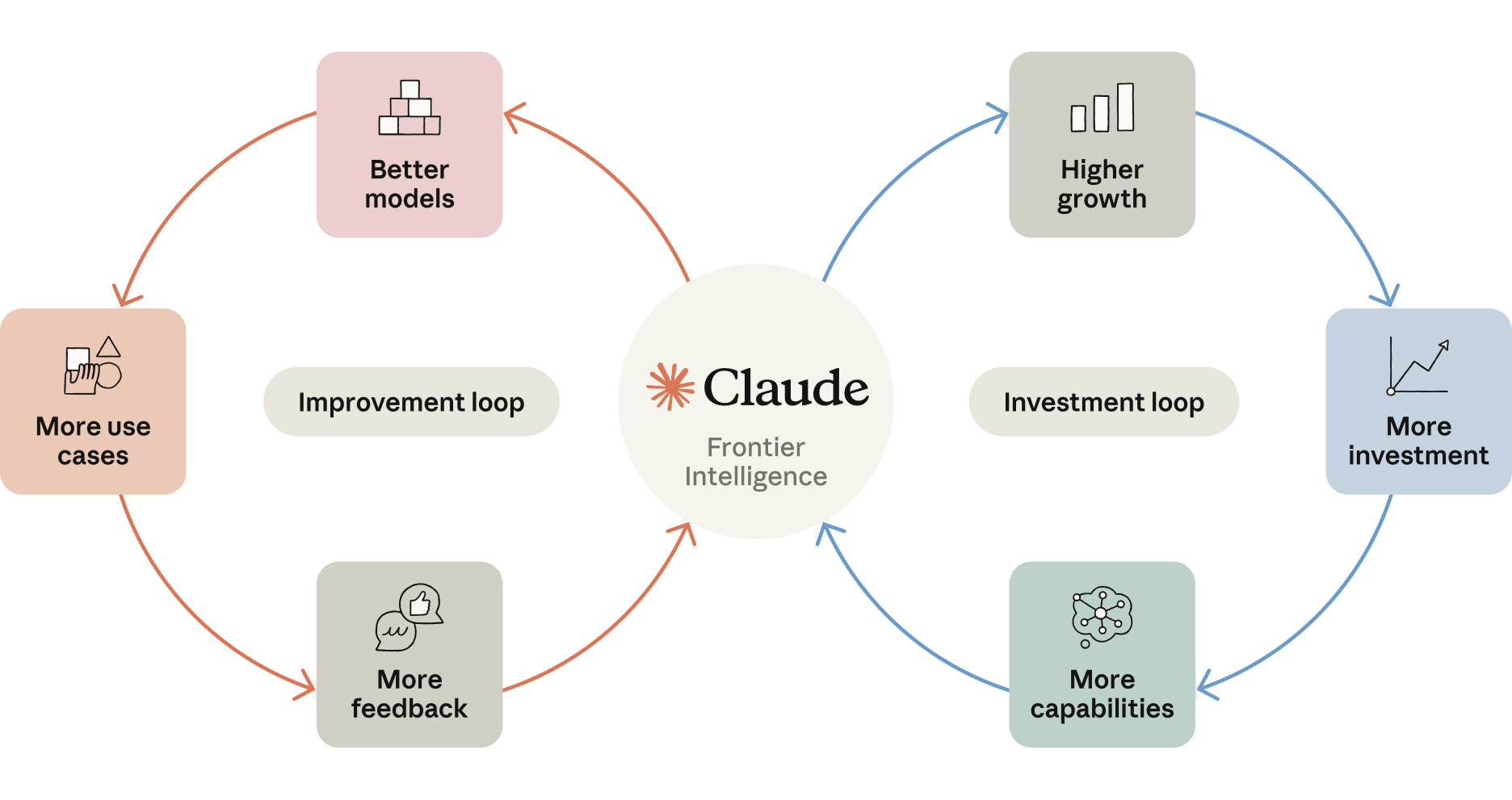
查看图中文字英文转录
Frontier Intelligence
Improvement loop
Better models
More use cases
More feedback
Investment loop
Higher growth
More investment
More capabilities
风险因素
风险因素
投资我们的 A 类普通股涉及高度风险。您应仔细考虑有关风险及不确定性(如下文所述),并结合本招股说明书中的所有其他信息,包括“管理层对财务状况及经营业绩的讨论与分析”一节以及我们的合并财务报表及相关附注,然后再决定是否投资我们的 A 类普通股。本节披露内容反映了我们的信念和意见,所涉事项可能在未来对我们产生重大不利影响;这些披露亦并非在陈述该等事项是否已经或未曾在此前发生,但另有披露的除外。对过去事件的提及采用的方式仅为举例,并非旨在完整列举,亦非旨在陈述这些事件有多大可能在未来发生。我们的业务、财务状况、经营业绩或前景亦可能受到风险及不确定性的不利影响,而这些风险及不确定性目前尚不为我们所知,或我们目前并不认为其具有重大性。如果任何风险实际发生,我们的业务、财务状况、经营业绩及前景可能受到不利影响。在此情况下,我们的 A 类普通股的市场价格可能下跌,而您可能损失部分或全部投资。
与我们的业务及行业有关的风险
我们的成功在很大程度上取决于我们持续开发最先进且能力最强的 AI 模型的能力,任何未能做到这一点的情况均可能对我们的业务产生不利影响。
我们的成功在很大程度上取决于我们持续开发、改进及部署最先进、能力最强且最有用的 AI 模型的能力。取得并保持这一地位取决于我们能否:
•通过突破性研究、创新架构及高效训练方法,推进 AI 能力的前沿;
•在保持有竞争力的性能的同时,确保我们的模型安全、可靠且值得信赖;
•获得为我们日益增长的需求提供动力和支持所必需的算力及基础设施;
•通过算法和架构创新,包括算力倍增技术的进步,提高算力效率;
•留住我们的联合创始人、高级管理团队及关键技术员工,使其持续为我们服务,并在竞争激烈且不断变化的市场中吸引、留住及激励顶尖研究人员、工程师和技术人才;
•持续实现收入增长并保持获得充足资本的渠道,包括通过潜在的股权及债务融资,以作出我们认为支持我们的增长轨迹所必需的投资;
•建立并维持与数据提供商、许可方及合作伙伴的关系,以获取实现世界一流模型性能所需的多样化、高质量数据集;
•建立并维持与云服务、生态系统及其他合作伙伴的关系,以促进 Claude 的推广普及;
•建设、运营及维护以具有成本效益的方式大规模部署前沿模型所需的基础设施;
•将模型能力转化为满足不断变化的客户需求并获得实质性采用的产品;
•在研究、基础设施及运营之间高效分配大量财务资源;以及
•应对不断变化、不确定且有时存在分歧的全球监管环境,并与立法者、监管机构及其他利益相关者开展沟通,以推动制定我们认为有利于社会、我们的客户及全球经济长期健康发展的监管框架。
27
我们未能实现上述任何一项,均可能使我们无法保持竞争地位,导致我们落后于竞争对手,减少客户对我们的模型、平台及应用的采用或需求,并损害我们的收入增长。收入增长受限又可能制约我们为前沿 AI 开发所需的大量且不断增加的支出提供资金的能力,包括对算力、模型训练、数据获取以及安全性和安全防护系统的投资,亦可能制约我们在竞争激烈的市场中吸引、留住高技能技术及运营人员并向其提供适当薪酬的能力。任何此类制约均可能减缓我们的开发和创新速度,使我们的模型性能或可靠性相较竞争对手有所下降,限制我们参与行业标准制定及监管程序,并降低我们对企业及专业个人用户的吸引力。这些影响可能形成自我强化或累积加剧的循环:增长减弱限制了我们投资于维持竞争力所需资源的能力,继而可能进一步削弱我们维持或提高收入增长的能力,使我们重新取得技术领先地位并在 AI 前沿开展运营变得日益困难且成本日益高昂。上述任何情况均可能对我们的业务、财务状况及经营业绩产生不利影响。
我们保持 AI 前沿地位的能力,部分取决于我们利用 AI 系统加速研究流程的能力。我们将这一递归过程称为“闭合迭代循环”,即利用各个版本的模型协助构建下一版本,目标是使能力提升随时间推移产生累积效应。我们的模型一直是设计、训练、测试和优化下一代 AI 系统的关键工具,而且正变得愈发重要。如果我们未能将充足的算力和研究力量投入 AI 辅助开发,或我们的竞争对手能够更有效地利用 AI 强化其自身的创新周期,我们便面临逐步被进一步甩在后面的风险,因为竞争对手持续利用 AI 进一步增强自身开发能力,从而能够以不断加快的速度创建日益先进的系统。随着我们在编写生产代码、开展研究及构建后续模型版本方面对自身 AI 系统的依赖加深,我们当前模型中的任何系统性缺陷、偏差或错误,都可能传递至使用这些系统构建的下一版本模型和产品,并在 Claude 模型的连续版本中以可能难以发现或纠正的方式不断累积。如果我们无法管理上述风险,我们部署最先进、能力最强且最有用的 AI 模型的能力可能受到不利影响。
此外,我们日益广泛地利用 AI 系统加速自身研发,可能使我们的模型能力提升速度超过我们制定、验证及实施相应安全性、对齐及安全防护措施的能力。我们关于此类 AI 驱动的加速进程速度的大部分证据来自滞后指标,而我们预测或衡量自身能力提升速度的能力有限,包括归因于我们最新或尚未发布模型的任何加速。因此,我们可能直到开发速度已显著加快之后才察觉这一情况。如果我们的能力发展速度超过我们的安全性、对齐及安全防护措施,或者我们无法预判此类进展的速度,我们可能无法充分评估或缓解由此产生的风险,这可能增加安全事件、监管干预或声誉受损的可能性,并可能对我们的业务、财务状况及经营业绩产生不利影响。鉴于这些不确定性,包括我们观察自身能力提升速度的能力存在局限,我们已采取且可能继续采取预防性的安全性、对齐及安全防护措施,以使我们的安全工作能够与模型能力同步推进。过去,这些措施包括推迟模型发布及限制模型的初期可用范围,例如通过 Project Glasswing 提供 Mythos 时采取的措施;未来,随着我们进一步了解模型能力和行为,这些措施可能包括影响我们是否、如何及何时开发或部署新模型或新能力的其他措施。我们无法准确预测何时会认定有必要采取此类措施、需要采取哪些措施,或这些措施将持续多久;随着我们的模型能力提升,此类措施可能变得更加频繁、成本更高。相较于不采取类似限制的竞争对手,这些措施可能减缓我们的能力提升,并可能对我们的竞争地位、收入增长及经营业绩产生不利影响。
开发前沿 AI 模型需要投入大量算力资源、资本及人力资本,以开展可能历时数周或数月、耗资数百万美元的大规模训练运行。无法保证任何一次训练运行均能成功——训练运行可能因多种原因而失败,例如未能达到目标能力或安全性门槛,产生无法得到充分纠正的意外或不良行为,或所产出的模型最终无法与市场上的替代方案竞争。我们还将面临额外成本和延误,因为需要启动新的训练运行,以尝试实现预期的模型改进。我们过去曾经历、未来亦可能经历此类失败或表现不佳的训练运行,导致已投入资源损失,而我们的业务获得的相应收益有限或根本没有收益。鉴于前沿模型训练所需的算力及其他资源规模,以及所涉及的较长时间,失败或表现不佳的训练运行还可能延误我们的产品路线图,影响我们的竞争地位,并对我们的业务、财务状况及经营业绩产生不利影响。
28
此外,新模型、功能或能力可能无法按计划推出,可能无法按预期发挥作用,可能在发布后需要进行大量迭代,可能无法获得实质性采用,或可能需要比预期更长的时间才能获得实质性采用,其中任何情况均可能减少客户需求或使我们处于竞争劣势。此外,与模型安全性、可解释性、对齐及福祉有关的考量,可能促使我们限制或推迟弃用旧模型,或在推出新版本的同时继续支持旧版本,从而需要在产品开发和算力分配方面作出权衡,而这可能对创新速度、基础设施利用率及收入产生不利影响。此外,已将旧模型整合进工作流程的客户可能不愿迁移至较新版本,而任何加速或强制弃用均可能导致客户流失、合同争议或声誉受损。我们也曾改变、未来亦可能改变用量限制、速率限制或模型及产品能力,这可能对我们的声誉及客户所感知的我们产品和服务的价值产生不利影响。其中一些变更已导致、未来亦可能导致有关我们对模型访问权限或能力的披露不充分或具有误导性的主张。
此外,通常用于测试 AI 模型的行业基准测试可能无法准确反映实际环境中的性能或效用,即使在此类基准测试中表现良好的模型,在生产环境中部署时也可能无法满足客户预期,从而可能导致客户不满、用量减少或声誉受损。如果我们无法在应对这些挑战的同时有效创新并改进我们的模型、平台及应用,或竞争对手能够提供被认为能力更强、更安全或更可靠,或者以更低成本提供足够性能的 AI 解决方案,我们的业务、财务状况及经营业绩可能受到不利影响。
此外,AI 创新涉及应对与数据质量、数据完整性、训练方法、偏见、安全性、准确性及模型输出行为有关的复杂且不断演变的挑战。AI 算法可能存在缺陷,AI 系统可能包含程序错误、差错或缺陷,或未能遵循指令,或生成不准确、误导性、冒犯性、不适当或其他有害的输出;反映或放大训练数据中存在的非期望或未知偏见;或引发与知识产权、隐私或其他法律及伦理考量有关的担忧。我们必须持续投入资源,以识别、缓解、补救这些问题并减少其发生,包括管理及改进数据集、训练技术、评估方法、防护措施及人工监督。然而,我们可能无法获得所需的数据集,包括通过许可或战略数据合作关系获得此类数据集。此外,我们或我们的数据提供方可能在训练过程中使用合成数据或 AI 生成的数据,这可能引入质量问题、放大偏见或错误、导致模型退化,或引发有关所有权、许可或知识产权的新型法律问题,而法院或监管机构可能无法及时或明确地解决这些问题。这些意外后果、故障或对我们模型的滥用可能损害客户信任、减缓采用、使我们受到法律或监管审查,或对我们的品牌及声誉产生不利影响。
如果我们无法获得充足的算力,或未能在各项工作负载之间有效调配算力,我们可能无法训练出与竞争对手的模型相比仍具有竞争力的模型,或无法为我们的客户提供充分的服务。
我们开发、训练、改进及部署前沿模型的能力,取决于我们能否获得数量庞大且不断增加的专用算力。Claude 模型的训练已经需要大量算力,而且我们预计未来仍将如此。行业参与者、学术研究人员及我们自身的经验表明,在某些情境下,模型训练期间投入更多算力与模型能力的提升存在关联。这些观察结果与模型性能、模型规模、训练数据及算力规模之间通常被称为“缩放定律”的更广泛经验关系的某些方面一致,但此类提升的幅度、效率及持续性尚不确定,而且在更大规模或不同条件下,这些关系可能趋于平缓、减弱或无法体现。因此,我们能否始终处于 AI 能力前沿,在很大程度上取决于我们能否获得维持所有工作负载所需规模的算力,包括用于训练下一代模型,而我们无法保证增加算力投资会使模型性能获得相应提升。
29
算力市场竞争激烈。我们与全球一些规模最大、资本最雄厚的科技公司争夺算力,其中许多公司开发自身具有竞争力的 AI 模型,且拥有远超我们的财务资源。其中许多公司拥有并运营云计算数据中心基础设施,具备自有芯片制造或设计能力,与关键硬件供应商保持长期战略关系,或获得该等供应商的大额股权投资或与其存在其他财务安排。这些竞争对手能够以高于我们的报价争夺稀缺算力,从芯片制造商及 CSP 获得优先分配,并作出我们无法匹敌的长期资本承诺。我们预计,对先进算力的需求将继续增长,算力成本可能大幅上升,尤其是在 AI 驱动的需求加速增长,或构建高能力模型的能力变得更加普及、使竞争转向获取先进算力的情况下。此外,许多资金充裕的 AI 公司正在开展大规模 AI 模型开发,进一步增加了对有限算力的需求。我们从某些 CSP 获得大量算力,而这些 CSP 同时也开发并提供自身的 AI 模型及相关服务。因此,我们与这些提供商的商业关系可能并不总是与我们的长期利益完全一致,而且,如果我们从第三方获得的算力因竞争原因或其他原因被削减、重新定价或终止,我们的业务、财务状况及经营业绩可能受到不利影响。
除来自第三方的竞争外,我们获得算力的能力还受 CSP 分配决策的影响。尽管我们的 CSP 通常须遵守与我们就提供算力所作的合同承诺,但我们能否获得此类容量仍取决于这些提供商的运营执行情况、对相关合同条款的遵守情况,以及更广泛的业务考量,例如容量限制、为支持其自身 AI 及计算业务而产生的内部算力需求、与第三方(可能包括其他 AI 公司)的关系或对其承担的合同义务,以及风险管理考量。因此,即使已经存在合同安排,我们也可能无法获得所寻求的全部算力,或该等算力可能无法按我们要求的时间表交付。此外,我们过去曾向 CSP 寻求超过这些合作伙伴愿意提供数量的算力。如果我们的 CSP 因任何原因削减、限制我们的算力分配,或未能增加分配以跟上我们不断增长的需求,我们可能需要以较为不利的条款或时间安排寻求替代算力来源,而且我们可能无法获得充足的替代算力,甚至完全无法获得替代算力。任何此类短缺均可能限制我们训练模型、服务客户或维持竞争地位的能力。
即使我们能够获得算力,我们仍必须在业务涉及的全部工作负载之间高效调配算力,包括研究、模型开发、客户服务以及 Claude 的内部使用。虽然我们将算力作为单一、可互换的资源池进行管理,并根据在任一时点哪种用途预计能够使边际单位算力发挥最大效用,在不同工作负载之间调配可用算力,但无法保证这种算力管理方式是最高效的,也无法保证其能够满足我们每一项工作负载的需求。由于算力需求历来超过可用容量,我们采购、维持或扩充该等容量的能力受到任何限制,都可能同时对我们业务的多个方面产生不利影响,包括我们按照客户期望的质量及规模提供服务、训练及改进模型,以及开发新产品及新能力的能力。虽然我们通过容量管理系统主动管理及平衡这些工作负载之间的算力容量,但如果该系统未能按预期运行,或我们在各项工作负载之间动态重新平衡容量的能力受到干扰,面向客户的服务质量或模型及产品开发时间表可能受到不利影响。无法保证我们将作出最优的资源配置决策,而且任何重大低效情形,包括与部署及重新平衡有关的低效情形,都可能对我们的短期经营业绩及长期战略地位产生不利影响。随着我们的智能体式产品与服务增长,这些算力资源配置挑战进一步加剧,因为此类产品与服务涉及多步骤推理思考链、迭代式工具调用、扩展的上下文窗口以及持续的推理会话,每次用户交互所消耗的算力显著高于单轮 API 调用或基于聊天的交互。随着智能体式工作负载在我们总算力需求中所占比例上升,服务客户所需的算力总量相对于相关收入可能出现不成比例的增长,从而对我们的算力工作负载管理决策施加额外压力。
我们的大部分算力是根据多年期承诺采购的,这些承诺通常在相关算力部署期间之前很早便已作出。由于不同的 AI 加速器具有各不相同的性能特征,且这些特征因工作负载类型而异,我们已承诺采购的算力组合的构成,包括从合作伙伴采购的加速器架构组合,反映了作出这些承诺时我们的需求预测及开发路线图假设。如果我们需要支持的工作负载规模或组合与这些预测存在重大差异,无论是由于模型架构、客户需求、内部运营还是研究重点发生变化,我们可用算力的构成在特定期间内都可能无法与我们的需求实现最优匹配。这可能影响我们服务客户、开发模型及支持内部运营的能力。
30
如果我们未能获得充足算力,或未能在各项工作负载之间有效调配我们拥有的有限算力,以开发及部署能力至少可与竞争对手模型相媲美的模型,我们就面临落后于技术前沿的风险。AI 发展速度极快,接续版本的模型在很短的时间内不断涌现,通常以月而非年计。因此,即使只是短期内无法获得充足算力,也可能使我们迅速落后。在 AI 开发领域,前沿模型与落后一两个版本的模型之间,在能力、性能及商业适用性方面可能存在显著差距。客户、合作伙伴及软件开发者可能转向模型能力更强的竞争对手,而且如果我们的研究人员无法获得充足算力,或我们未被视为处于模型开发最前沿,我们可能无法吸引或留住开展前沿研究所需的技术人才。任何无法维持我们前沿地位的情形,都可能导致客户及收入流失、品牌及声誉受损,以及竞争地位下降,而上述每一方面均可能难以恢复。如果我们无法管理上述风险,我们的业务、财务状况及经营业绩可能受到不利影响。
如果我们的实际算力需求与预测存在重大差异,我们可能无法获得足够算力以满足需求,或可能已承诺采购未得到充分利用的过剩算力。
算力市场的竞争态势及结构性特征要求我们在日常交付及使用算力之前数月或数年,就算力作出具有约束力的财务承诺。芯片制造商、CSP 及数据中心开发商要求提前作出承诺,以便分配产能、规划基础设施投资及管理其自身的供应链。因此,我们必须在算力部署之前很早便预测算力需求,并据此承诺投入资本,而在需求发生变化时,我们调整承诺的能力往往有限。
这些对未来算力使用量的预测本身具有不确定性。我们的实际算力需求取决于许多难以预测的因素,包括我们的研究进展速度、我们开发或采用的训练技术的算力消耗强度、可能要求我们加快或修改开发计划的竞争格局变化、客户对推理算力的需求,以及硬件或其他技术效率的演进及变化。如果我们低估算力需求,我们可能无法获得充足算力,以支持我们预测的客户需求及模型开发路线图。过去,我们曾严重低估算力需求,导致容量受限,并影响产品开发及部署。此外,算力上线时间可能与需求增长时间不一致,从而可能出现算力过剩或利用不足的期间,以及并不产生即时收入的已承诺现金流出。
我们正在从完全基于云端、采用固定期限安排的算力模式,转向包含直接租赁芯片的混合模式,这些芯片托管于按照我们的规格、代表我们租赁及运营的专用数据中心设施中;这一持续转型进一步加大了我们预测及获得所需算力的难度。这一转型为我们的采购规划引入了额外变量,包括设施完工时间、新投运设施达到全部运营容量的速度、我们运营及维护本地容量并将其与云端基础设施整合的能力、供应商的运营执行情况,以及硬件在新设施环境中的表现。为这些设施获取能源、水及其他关键服务方面的延误,可能进一步减慢新投运算力可供使用的速度。对任何此类转型相关变量的预测出现错误,都可能加剧我们获取充足算力方面的风险,并导致转型期间容量短缺或容量利用不足。
我们已经订立并预计将继续订立有关算力及其他算力资源的长期协议,其中包含最低采购承诺、照付不议条款及其他条款,这些条款要求我们无论实际使用情况如何,均须支付资源费用。这些承诺构成重大固定义务。截至 2026 年 9 月 30 日及此后,我们已作出采购承诺并订立租赁协议,包括短期承诺,以及尚未开始的租赁,承诺支出总额超过 〔原文留白〕 美元,其中几乎全部与算力及基础设施有关。这些承诺包括预计于 2030 年 12 月 31 日之前发生的约 〔原文留白〕 美元,其余部分中几乎全部预计将在 2031 年至 2045 年期间发生。这些承诺中约 〔原文留白〕 美元将在未来 12 个月内到期应付。更多信息请参阅题为“管理层对财务状况及经营业绩的讨论与分析——流动性及资本资源——合同义务”的章节。
31
我们能否履行为获得算力而承担的这些重大且不断增长的财务义务,取决于我们能否实现显著的收入增长。我们必须迅速扩大客户群并增加收入,以产生履行这些承诺所需的现金流。然而,我们的收入主要按用量计费,其中很大一部分并无长期合同承诺支持,而我们的算力及基础设施承诺通常跨越多年。因此,我们可能基于最终未必能够实现的收入预期承担这些义务。如果我们的收入增长未能跟上算力相关付款义务的增长,如果我们无法成功将算力投资转化为产生收入的客户工作负载,如果我们未能按可接受条款筹集额外资本,或如果我们遇到其他影响流动性的不利事态,我们可能无法履行这些义务。任何此类未能履约的情形还可能导致我们在相关协议项下违约、失去获取关键资源的渠道,以及声誉受损。尤其是,某些商业协议项下的违约可能触发经修订及重述的信贷协议(定义见下文)以及我们某些未偿还可转换本票项下的交叉违约条款,进而可能导致我们几乎全部未偿还债务及任何未来债务加速到期。此类交叉违约可能引发一连串不利后果,包括多名债权人行使救济权利、关键商业安排终止、针对我们资产采取强制执行行动,以及严重的流动性限制。我们的债务加速到期,再加上失去获取关键数据中心基础设施的渠道等因素,可能削弱我们训练及部署模型、服务客户以及为持续运营提供资金的能力,从而可能对我们的业务、财务状况及经营业绩产生不利影响。更多信息请参阅题为“——我们为经营和发展业务,包括为我们的重大算力承诺提供资金,已承担大量债务,而我们偿付这些债务的能力可能受到现金流及流动性的制约”及“——我们可能无力筹集必要资金,以在未偿还可转换本票或经修订及重述的信贷协议的条款要求时(视具体情况而定),或在其到期时,以现金偿还该等本票或该信贷协议项下的本金及应计利息。”的章节。
此外,AI 基础设施、硬件、软件、系统架构及模型开发技术的技术变革速度很快,这意味着目前获得的算力相较未来替代方案,可能变得效率较低或经济吸引力较弱。我们可能受承诺约束而必须使用较旧一代的硬件及基础设施,而竞争对手却能获得更先进的系统,或我们可能正在为市场价值已经下降的资源支付溢价。这些动态变化可能对我们的成本结构及竞争地位产生不利影响。我们的某些融资安排要求我们就根据该等安排融资的算力,与特定芯片供应商订立独家或优先供应承诺。如果我们的需求或技术格局发生变化,这些承诺可能限制我们将采购转向其他供应商或更新芯片架构的能力,从而可能使我们受承诺约束而必须使用并非最适合实际工作负载需求的平台,并降低我们应对情况变化而调整算力组合的能力。如果我们无法管理上述风险,我们的业务、财务状况及经营业绩可能受到不利影响。
支撑算力的关键投入要素受到限制,可能限制我们获得充足算力的能力。
训练及部署前沿模型所需的算力,依赖于存在多个潜在瓶颈或故障点的供应链。算力的可获得性、定价及交付周期受到先进芯片及其他 IT 设备的供应、充足电力及发电和输电所需基础设施的可获得性,以及数据中心基础设施容量的影响。这些投入要素均面临重大限制,可能限制我们获得所需算力的能力。此外,不断增长的算力需求已经导致且可能继续导致此类资源成本上升,从而可能限制我们按预期速度投资、开发或部署我们的模型、平台及应用程序的能力。
32
芯片、内存及数据中心设备的供应及集中度
AI 工作负载所需的专用芯片,尤其是高性能 AI 加速器及内存,由数量有限的制造商生产。先进芯片的生产极其复杂,需要采用处于技术能力最前沿的制造工艺。
全球最先进的芯片制造产能大部分集中在台湾,主要集中于 Taiwan Semiconductor Manufacturing Company(“TSMC”)。这种地域集中带来重大风险,包括面临地震及台风等自然灾害、可能受到台湾与中国之间地缘政治紧张局势的干扰、易受台湾电网、供水或其他关键基础设施任何中断的影响,以及易受不断演变的贸易法规及限制的影响。任何影响台湾的军事冲突、关税及贸易限制、经济胁迫、封锁、自然灾害或其他事件,都可能严重扰乱全球先进芯片供应;鉴于建设替代晶圆制造设施并使其通过认证需要时间,这些影响可能持续多年。在台湾以外地区,包括美国,建立充足先进芯片制造产能的努力仍处于早期阶段,可能无法在可预见的未来产出足够算力以实质性降低这些集中风险。此外,由于市场对先进芯片制造的需求,TSMC 有时无法充分满足市场对芯片制造产能的需求,因此,我们并非总能及时获得足够数量的芯片。因此,任何对来自台湾或 TSMC 的先进芯片供应的限制或延误,都会对我们的业务、财务状况及经营业绩产生不利影响。
此外,作为高性能 AI 加速器关键组件的高带宽内存,以及算力基础设施中使用的其他高性能内存产品,主要由 SK hynix Inc.、Samsung Electronics Co. 和 Micron Technology, Inc. 制造。这些制造商均在努力扩大产能以满足需求。然而,无法保证这些努力能够足够迅速地带来充足供应以满足需求,尤其是在大型客户或竞争对手获得独家供应承诺,或以其他方式预留某一制造商几乎全部可用产能的情况下。
制造供应的集中及限制使我们面临以下风险:制造商可能作出分配决策或战略调整,对我们获取业务所需先进芯片的能力产生不利影响。我们还面临专用芯片可能存在缺陷,或其生产或交付可能延误或中断的风险;鉴于更换芯片所需周期较长,这可能限制可用算力,并对我们的运营及扩大规模的能力产生不利影响。我们及我们的合作伙伴所依赖的组件中,相当一部分采购自美国境外或在美国境外制造,新征或提高的关税、进口限制或贸易争端可能延迟交付、迫使供应链发生变化,或提高我们的成本,其中部分成本根据成本转嫁安排由我们直接承担。更多信息请参阅题为“——政府贸易管制,包括出口和进口管制、制裁、海关要求及相关制度,可能使我们承担责任或丧失订约资格,或限制我们在某些市场竞争的能力。”的章节。
我们还依赖第三方芯片设计及服务公司,进行某些定制加速器平台的设计、制造及支持,并提供相关基础设施融资安排。这些关系受到干扰,或这些主体未能按预期时间表及规格交付硬件或服务,都可能对我们所依赖的加速器平台的可获得性、性能或成本产生不利影响。
数据中心还需要电气、发电及输电设备、冷却系统、备用发电机及网络硬件,其中某些设备仅由少数制造商生产,必须提前数年订购,并且需要在交付前支付大量款项,而如果我们的计划发生变化,我们可能无法收回这些款项。此外,随着数据中心运营商及其他大型用电方的需求增长,某些设备,例如高压变压器、开关设备、涡轮机、发电机、变电站及输电组件,已经出现交付周期延长、价格上涨,并受到关税、国家安全要求以及分配限制的影响。如果此类设备出现延误或无法获得,我们可能能够购得替代设备但只能以更高的价格或在较为不利的长期承诺条件下购得。为在短期内获得算力,我们还可能选择或被要求以高于现行市场水平的价格采购交付周期较长的发电及电气设备,预期这些设备能够加快部署,从而在短期内释放容量。支付此类价格所带来的益处能否实现,取决于相关设施的工程设计、采购及施工能否及时、成功地完成,而这些工作需要目前短缺的专业技能,且涉及重大的执行风险。延误、成本超支或未能按预期时间表获得能源,可能意味着我们无法获得为之支付此类价格的能源及容量。在某些情况下,这些安排还依赖于开发商或其他交易对方同意按此类价格购买设备、为该等购买融资,并随时间推移向我们收回这些成本及相关融资成本;即使相关容量延迟交付或最终从未实现,我们也可能承担这些成本。我们的设备供应框架协议及类似安排可能使我们面临进一步风险,包括最低采购或照付不议承诺、价格上涨,以及我们无法使之与实际部署需求相匹配的义务。
33
此外,美国政府已经实施并可能继续实施出口管制,限制向包括中国在内的某些国家销售先进芯片及芯片制造设备。这些限制已经影响全球芯片及相关设备供应的分配,而未来出口管制政策的变化可能影响我们所依赖的算力资源的可获得性或定价。未来的出口管制可能更加严格,例如限制可以安装先进芯片或存储模型权重的国家,从而可能限制我们或我们的合作伙伴能够建设数据中心的地点、制约我们的国际扩张,或增加我们的成本。
电力及燃料限制
以开发及部署前沿 AI 所需规模运营数据中心,会消耗大量电力。在包括美国在内的许多地区,能否获得充足电力已成为数据中心开发及扩张的重大制约因素。美国及其他国家电网基础设施的设计,并未考虑容纳 AI 开发所带来的需求快速增长,而新建发电容量、输电基础设施及电网互联所需的周期可能长达数年。随着住宅、车辆及工业电气化程度提高,对电网基础设施的需求也在增加,而在需求增长的同时,新增发电容量、输电扩建及电网现代化工作未能跟上步伐,且某些现有发电资源正在退役;所有这些因素均导致某些地区的电价上涨及并网时间延长。我们已公开承诺承担因我们的数据中心导致消费者电价上涨的成本,包括电力本身的成本及输送电力所需基础设施的成本。
我们获得电力的能力,还取决于我们以及我们所依赖的负责数据中心设施建设、管理及运营的第三方,能否与公用事业服务提供商及电网运营商协商并维持合同,以及能否取得公用事业委员会及其他监管机构的批准。这些主体可能无法或不愿批准支持数据中心增长所必需的接入、容量扩充、特殊或协商费率安排及基础设施投资,或可能对此附加条件或延迟批准,也可能仅在须承担会限制某些设施经济效率及可行性的成本的情况下才予以批准,例如要求我们承担超出可归属于为我们的设施提供服务的部分的电网升级或并网成本——这意味着我们须承担比现有或以往监管框架要求更大比例的成本。许多地区的新增大型用电负荷并网排队时间也已大幅延长,这可能延迟或限制我们获得电网供电。公用事业服务提供商及监管机构也可能重新分配此前已承诺提供、而我们的数据中心设施可能需要的容量。在许多司法管辖区,单一公用事业服务提供商对数据中心设施供电所必需的服务及基础设施的条款、时间及成本拥有重大控制权。公用事业服务提供商在商业及监管方面的优先事项可能与我们不同,包括进行哪些基础设施投资、如何分配其成本,以及是否允许替代或自供电的发电安排及其条件。公用事业服务提供商及其他利益相关方也可能寻求影响大型用电负荷、自供电或替代发电安排的监管或立法措施。我们与公用事业企业的谈判以及涉及公用事业企业的监管程序的结果具有不确定性,不利结果可能增加我们的成本、延迟我们的项目,或限制我们可用的替代方案。更广泛而言,相关监管程序涉及成本分配、费率设计及大型用电负荷的处理方式,目前正在众多司法管辖区进行;不利结果、政策变化,或实施适用于数据中心的新费率、附加费或削减用电负荷的义务,可能增加我们的成本或限制我们获得电力。
34
此外,我们所依赖的发电及输电基础设施的建设本身属于资本密集型活动,并面临劳动力短缺、供应链中断、许可延误、利率变化、关税、其他成本超支及融资限制。为这些发电、输电及相关基础设施投资提供资金所需的庞大且不断增加的资本,无论由我们、我们的公用事业及能源供应商,还是我们的数据中心开发合作伙伴承担,均易受现行利率以及能否按可接受条款获得债务或股权融资的影响。我们的合作伙伴在需要时无法获得资本,以及此类资本的供应限制、成本和获取竞争,都可能增加我们所依赖的电力的成本、延迟或中止项目,或使某些设施在商业上不可行,而且根据我们的某些安排,我们直接或以成本转嫁方式承担这些融资及资本成本。此外,太阳能、风能、电池储能、核能及地热能等较新的发电来源,可能无法按我们要求的数量或时间表提供,或只能以更高成本获得。我们的设施还另行依赖可靠的冷却用水供应,而某些地区的水资源稀缺、受到使用限制,或成本日益上升。上述任何情形均可能对我们所需电力或水的可获得性产生不利影响、增加我们的成本,或限制我们开发、扩建或运营数据中心设施的能力,从而可能对我们的业务、财务状况及经营业绩产生不利影响。
获取电力供应及供电充足的数据中心选址的竞争十分激烈,我们与资本充足的 CSP、加密货币挖矿运营方及其他大型用电方争夺这些资源,其中部分 CSP 生产及开发与我们竞争的 AI 模型。除使用电网供电之外,或有时作为电网供电的替代,越来越高比例的数据中心在建设时配备专用现场发电容量,独立于任何公用事业企业运营的电网,直接向设施供电。此类离网发电方案的可靠性因底层技术、所用设备及运营商而异,并将反映各个场址的运营及环境特征。开发这种新增容量又需要发电及电气基础设施,而这些基础设施本身也受到供应挑战及运营复杂性的影响。例如,我们某些规划中的数据中心设施依赖专用现场天然气发电,使我们面临无法控制的燃料价格波动及供应中断风险,并以成本转嫁方式承担相关成本。这些设施还受到输送天然气所需的管道运力及不可中断燃料运输服务的限制。随着数据中心运营商越来越依赖天然气发电,而且鉴于适用监管框架,表后及现场发电安排仅在某些司法管辖区可行,我们预计这些地区的用户对同一批天然气供应及管道运力的竞争将加剧。这种竞争可能推高这些地区的天然气价格,并可能对我们签订不可中断燃料供应及运输合同,以及获得设施所需管道接入及支线的能力产生不利影响。
这些动态变化带来若干相互关联的风险。在设施开发期间,我们可能无法获得不可中断的天然气供应及运输服务,导致规划中的场址延误或被放弃;设施投入运营后,我们可能面临燃料供应或输送中断;而且,由于我们的安排通常规定,燃料及相关成本以成本转嫁方式由我们承担,且不设成本上限,我们仍面临天然气及其运输成本上涨的风险。更广泛而言,电力成本存在很大的波动性,且主要超出我们的控制范围,因为批发电价随供需、天气、燃料价格、费率或附加费以及电网压力的变化而波动,并且可能在需求高峰或供应受限期间急剧上涨,而此类能源成本上涨可能对我们的经营业绩产生不利影响。
在某些地区,包括我们已经签订算力承诺的部分地区,数据中心开发已引发围绕环境影响、土地及水资源使用,以及有限电力资源分配的公众争议及监管审查。例如,如果我们获取电力的努力被认为影响其他公用事业客户及更广泛的电网,监管机构可能施加旨在应对这些影响的条件、备用电费或其他要求。更广泛而言,我们获取电力受到不断演变的监管框架约束,该框架具有复杂、管辖权重叠的特点,其规则主要围绕既有公用事业服务提供商的服务及现有发电安排而设计,可能难以适应新进入者或替代方式,这可能导致重大延误或阻止我们所需发电能力的开发。例如,并网电力供应受联邦及州能源监管机构、区域电网运营商以及公用事业委员会管辖,而表后及现场发电则受另一套有关独家服务特许经营权保护、许可、环境、空气质量、并网及选址的要求约束。此外,适用于发电的环境标准持续演变,原因包括政府优先事项变化,以及公众和政治层面对气候变化及各类发电来源应如何对待的看法变化。任何未能获得充足电力的情形、任何限制电力可获得性的法律、监管或其他行政行动或变化,或能源或合规成本的任何重大增加,都可能对我们的成本结构产生不利影响,并限制我们扩大算力基础设施、开发及部署模型以及服务客户的能力。我们还已作出且未来可能作出自愿承诺,以抵消我们的数据中心能源消耗对当地社区及电费缴纳者的影响,包括承诺承担电网基础设施升级成本、采购新增发电资源以匹配我们的能源需求、投资用电负荷削减系统以减轻需求高峰期间的电网压力,以及应对环境影响。这些承诺已增加我们的运营成本,而且我们预计这些承诺将继续增加我们的运营成本。此外,我们认为,这是 AI 行业一种更广泛的新兴趋势的一部分,而此类承诺或类似义务可能日益成为标准做法或强制要求,从而可能进一步增加我们的成本。此外,气候变化的物理影响可能随时间推移增加我们的运营成本,因为平均气温升高可能增加我们所依赖设施中设备冷却所需的耗电量及用水量。
35
数据中心基础设施
即使芯片和电力可供使用,数据中心设施的开发仍需要大量时间、资本及专业知识。数据中心建设涉及漫长的许可审批流程、专用设备的复杂供应链,以及安装和调试冷却系统、电力基础设施和网络设备所需的较长准备期。劳动力短缺,包括电工、设施技术人员及其他熟练技工的短缺和对这些人员的争夺,供应链中断、许可审批延误及其他因素,均可能延长建设周期并增加成本。此外,鉴于数据中心开发项目需要预先作出重大资本承诺,并落实明确的最终用户,我们在某些情况下依赖融资安排,或与为租赁义务提供保证的合作伙伴达成的安排,以支持数据中心容量的开发,该等容量预计将用于容纳此类合作伙伴的芯片或计算基础设施;我们预计将继续依赖此类安排。此外,具备我们所需专业知识且支持我们希望部署的特定基础设施的合格第三方供应商数量有限。因此,我们依赖这有限数量的第三方来建设、管理和运营我们的部分数据中心设施,其中一些第三方的经营历史有限,或在运营符合我们业务所需规模及复杂程度的数据中心基础设施方面可能经验较少。在某些情况下,这些第三方运营商由我们的芯片合作伙伴培训或监督,代表我们管理设施,但其并非这些合作伙伴的关联方,可能不具备同等深度的专业知识、运营韧性或资源。这些第三方运营商若未能按预期履约,可能中断我们获取算力的途径。此外,为我们建设或运营的设施发生安全或环境事故,无论起因如何,都可能使我们面临索赔、罚款或建设或运营暂停,而相关费用可能由我们承担。我们还依赖一个广泛的供应商、建设商及设施运营商网络。如果其中任何一方从事不安全、违法或违反我们或我们的合作伙伴所要求的劳工、人权、环境或其他标准的行为,即使我们未曾指示或知悉该行为,我们也可能面临法律责任、丧失使用受影响供应商或设施的能力,并遭受声誉损害。
我们的数据中心基础设施整体上目前主要集中于美国,这使我们面临与地区监管变化、电网制约或故障、设施之间网络连接中断、自然灾害、实体攻击(包括由地缘政治事件、对 AI 的反对及对数据中心开发的反对所引发的攻击),以及可能影响多个设施的其他中断事件有关的风险。美国某些州、地方及市级司法管辖区也正基于公共健康、安全及环境方面的担忧,考虑或已经批准暂停新建数据中心。此类司法管辖区以及其他监管机构、电网运营商或公用事业公司也可能采取其他措施,使包括数据中心在内的大型电力负荷用户在电网承压期间受到限电、供电中断、强制削减用电、断电或其他限制,无论是通过变更法律或政策,还是由于市场或可靠性方面的制约、输配电基础设施的限制,或优先保护其他公用事业客户及更广泛电网的取向。在并网发电能力不足以可靠供应现有及新增电力负荷的地区,电网新增的大型负荷可能日益受到强制限电措施的约束。例如,New York 州和 Texas 州等州最近已采取行动监管大型数据中心,其方式包括像 New York 州那样暂停对新建大型设施的州级许可审批,或像 Texas 州那样规定在电网紧急情况下对大型电力负荷实施限电或断电。此类暂停措施或类似行动可能延误或阻止我们获取算力所依赖的设施的建设或扩建。反对数据中心开发的活动在不同司法管辖区之间也变得更有组织性和协调性,而我们的公众知名度可能使与我们有关的项目受到特别关注。任何主要设施的丧失或发生重大中断所造成的影响,可能难以由我们其余或未来的基础设施承接。我们正在国际范围内扩大数据中心容量,以努力使基础设施布局多元化,降低因在美国运营相当一部分算力基础设施而产生的集中风险,并支持我们的国际增长战略,包括就多个美国以外司法管辖区的数据中心设施签订意向书,并磋商租赁及相关协议;这使我们面临与外国监管要求及批准、数据主权及本地化法律、有关政府获取访问权限或获得协助的要求、跨境数据传输限制、外国税制,以及运营复杂程度增加有关的额外风险。我们能否就美国以外司法管辖区的数据中心容量及运营签订最终协议,取决于当地子公司能否及时设立、登记并获得政府批准,以及能否建立当地银行业务安排;完成这些步骤的任何延误或失败,都可能延误或阻止我们降低基础设施集中风险、执行国际增长战略或取得计划中的算力容量,或可能导致我们承担大量额外税款、罚款或其他负债。此外,许多司法管辖区的监管、法律及其他限制可能限制我们实际上能够选址建设数据中心或通过合同取得数据中心容量的地点,从而可能限制我们按照目前计划的速度或范围实现基础设施布局多元化的能力。
36
我们及我们的主要竞争对手依赖基本相似的投入资源来开发和部署前沿模型,包括从少数供应商采购的先进芯片,以及从云服务提供商(CSP)和其他第三方获得的数据中心容量及算力。随着我们及我们的竞争对手日益寻求垂直整合,竞争基础可能随时间推移而变化,不仅涉及哪家公司能够开发能力最强的模型,还涉及哪家公司能够开发最佳的底层组件。我们未来的竞争力可能部分取决于我们能否以具有竞争力的条件并在具有竞争力的时间安排下,成功开发垂直整合的算力基础设施,而我们无法保证能够做到这一点。我们的竞争对手可能处于更有利的地位,或可能投入更多努力,在算力供应链各环节实现垂直整合,包括通过专有芯片设计、制造、拥有数据中心基础设施或对其进行长期控制、获取专用发电资产、与硬件制造商达成独家供应安排,或抢先取得数量有限的适合大型数据中心开发的场址。成功控制这些供应链层级中更大份额的竞争对手,可能能够以比我们更大的规模、更低的成本或更高的可靠性获得算力,尤其是在需求旺盛或供应受限的时期,此时专属供应关系可能使其相较于依赖第三方提供商的参与者获得某些优势。此类竞争对手还可能开发专有的软硬件协同设计,针对其特定模型架构优化算力效率,从而可能使任何能力差距在连续迭代的模型版本之间不断累积。尽管我们正在推进开发专用数据中心基础设施的举措,但我们无法保证这些工作将按照我们预期的时间安排或成本完成,也无法保证这些工作足以抵消垂直整合的竞争对手可能取得的任何结构性优势。成功推进这些工作的竞争对手,无论更广泛的市场受到何种制约,都可能更有能力保持在 AI 前沿。
影响这些投入资源生产地区或我们设施所在地的自然灾害、极端天气或其他中断事件,可能进一步限制我们所依赖的芯片、电力、水或数据中心容量的可获得性。如果我们无法管理上述风险,我们的业务、财务状况及经营业绩可能受到不利影响。
37
我们高度依赖联合创始人、高级管理团队及关键技术员工的持续服务,失去其中任何一人都可能对我们的业务、财务状况及经营业绩产生不利影响。
我们高度依赖首席执行官、总裁、联合创始人、高级管理团队及关键技术团队的持续服务。尤其是,我们的首席执行官和总裁对于确定我们的战略方向、推进我们的研究议程、塑造我们的安全性及治理框架,以及总体上推进我们的使命至关重要,我们认为他们的领导作用将难以替代。如果其中任何一人因任何原因无法继续提供服务,或其中任何一人的声誉受到严重损害,无论这种损害是否有事实依据,都可能对我们的运营及竞争地位、员工士气、员工留任、创新速度、客户及合作伙伴对我们公司的信心、我们的品牌和声誉,以及我们的长期战略目标产生不利影响。此外,失去关键人员,包括创始团队和高级管理团队成员,以及关键的工程、研究、产品开发、营销和销售人员,也可能扰乱我们的运营,并对我们的业务产生不利影响。我们的许多关键人员,尤其是技术和研究团队中的人员,深受我们的使命以及有机会致力于解决 AI 领域内特定问题的激励。如果他们的兴趣发生变化,寻求应对不同的技术挑战或转向不同的重点领域,或被他们认为更符合其个人信念或职业目标的其他组织或项目所吸引,我们在留住此类人员方面可能面临更大困难。随着我们作为一个组织继续扩大规模并趋于成熟,这种风险可能加剧,因为这可能改变某些人员的工作环境性质、优先事项或其对使命契合度的认知,其中包括可能认为最初吸引他们加入我们的目标已基本实现的人员。此外,根据我们与供应商签订的某些协议,失去某些关键人员可能导致我们须提前履行义务,或以其他方式触发该等协议项下的不利后果。
如果我们无法留住关键人员,或未能进行有效的继任规划并在任何此类关键人员流失时及时且以具有竞争力的条件找到适当的替代人选,我们可能面临销售额下降、研发延误,以及业务和运营受损。如果我们无法管理上述风险,我们的业务、财务状况及经营业绩可能受到不利影响。
我们可能需要额外资本来履行重大的持续性义务并支持业务增长,而我们能否产生充足收入并以可接受的条件取得额外资本,对我们的持续运营及竞争地位至关重要。
我们的商业模式需要大量且不断增加的资本,以支持我们保持竞争力并处于 AI 前沿。我们拟继续进行重大财务投入,以支持业务增长,并可能需要额外资金来取得充足算力及应对业务挑战,包括用于创建、维护、升级和增强我们的模型、平台及应用程序的支出,其中包括与基础设施、人力资本、办公场所扩张及数据资产投资有关的成本。此外,我们可能使用部分现金来履行与已发行在外的限制性股票单位及我们未来授予的股权奖励有关的税款预扣及缴纳义务。
此外,截至目前,我们主要通过与 CSP 达成的安排为算力提供融资,并在算力可供我们使用时确认相关成本。未来,我们可能以预先投入资金的方式为更大比例的算力提供融资,包括通过资本租赁、预付款、以债务融资购买设备或类似安排。如果我们这样做,可能在算力可供使用或产生相关收入之前发生大量现金流出,从而可能增加对我们现金流量及流动性的需求,并增加我们筹集额外资本的需要。此类安排还可能提高我们的资本密集程度,并改变我们的现金流量特征。
因此,保持强劲的收入增长、相对于我们已承诺的算力、基础设施及人员成本高效地增加收入,以及有效管理现金流量,对我们至关重要。如果此类努力不足以满足我们的资本需求,我们可能需要通过股权或债务融资取得额外资本。如果我们未来通过发行股权、股权挂钩证券或可转换债务证券筹集额外资金,我们现有股东的权益可能被摊薄,而且我们发行的任何新证券所附带的权利、优先权及特权,可能优于我们普通股持有人的相关权利、优先权及特权。此外,我们已发行在外的可转换证券的转换将进一步摊薄我们现有股东的权益。我们未来可能取得的任何债务融资,都可能包含与我们的融资活动及其他财务和运营事项有关的限制性契约条款,从而可能使我们更难取得额外资本及把握商业机会。
38
此外,我们在某些票据购买协议(“NPAs”)项下提用款项的能力并无保证,且须满足规定条件。具体而言,我们能否在某些此类融资额度项下取得额外款项,取决于我们能否达到某些收入业绩目标,和/或第三方能否向我们交付额外算力。尽管我们历来均超过所有此类收入业绩目标,但无法保证未来收入将始终继续超过这些门槛。如果未能满足这些条件,我们可能无法在适用的 NPA 项下提用额外款项,从而可能对我们的现金流量及流动性产生不利影响。有关我们的可转换本票条款的更多信息,请参阅“管理层对财务状况及经营业绩的讨论与分析——流动性及资本资源——可转换票据”一节。
我们可能无法以有利于我们的条件取得额外融资,甚至可能根本无法取得额外融资。我们不时评估融资机会,而我们能否取得融资,将取决于我们的开发工作、业务计划及经营业绩,以及我们寻求融资时的资本市场状况等因素。股权及债务市场可能不时出现剧烈波动和紊乱,从而可能导致这些市场的信用利差扩大,并使我们的融资成本上升。如果我们无法实现充足的收入增长,或无法在需要时取得足额融资或以令我们满意的条件取得融资,我们继续支持业务增长、扩大基础设施规模、开发新的模型、平台和应用程序、增强现有模型、平台和应用程序,以及应对业务挑战的能力可能受损,而我们的业务、财务状况及经营业绩可能受到不利影响。
我们的公司文化促进了我们的成功,如果我们无法在发展过程中保持这种文化,我们的业务可能受到不利影响。
我们认为,公司文化是我们取得成功的关键组成部分。我们是一家使命驱动型公司,我们的文化体现了对公司宗旨的高度重视。我们能否继续培育和保持这种文化,对于我们的增长及持续成功至关重要。我们在致力于维护公司文化方面面临诸多挑战,包括:
•需要识别、吸引、奖励并留住在我们组织内担任领导职务、认同并推动我们的文化、价值观及使命的人员;
•我们的员工规模不断扩大、地域分布日益多样化,以及我们在所有办公地点及员工中推行统一且一致文化的能力;
•内部及外部对于我们的使命、价值观、安全性承诺,以及我们的模型、平台及应用程序用途的看法;
•就员工群体中存在不同反响的议题与政府政策制定者开展交流;
•促使我们朝可能偏离自身使命和价值观的方向发展的竞争压力;
•我们在招聘及决策中采用的严格且以价值观为导向的标准,可能使我们相较于竞争对手扩大员工规模或扩展运营的速度放缓;
•快速演变的行业带来的持续挑战;
•作为上市公司运营所面临的更严格审视及更高期望;以及
•需要平衡我们的长期、使命驱动型目标与较短期的财务业绩预期,这可能造成内部紧张,并对我们在各团队及领导层中持续强化文化价值观和使命的能力构成挑战。
39
使命驱动的文化是我们的核心特征之一,有助于我们吸引并留住关键人员,并使我们在市场中形成差异化。如果我们无法保持自身文化,也无法在维护文化的承诺与快速增长、竞争及作为上市公司运营的要求之间取得平衡,我们的员工士气、投入程度及留任情况可能受到损害,迫使我们承担额外成本或采用其他招聘策略,从而可能对我们的业务、财务状况及经营业绩产生不利影响。
我们面临激烈竞争,如果我们无法有效竞争,我们的业务、财务状况及经营业绩可能受到不利影响。
AI 模型、平台及应用程序市场正在快速演变,竞争激烈,并受到频繁且重大的技术变化、不断演变的客户需求及期望、变化中的行业标准、监管发展、新市场进入者,以及新模型、平台及应用程序的影响。我们面临来自多个类别的众多公司的竞争。
我们与为第三方软件开发者及企业开发前沿模型的公司直接竞争。我们在此类别中的主要竞争对手包括 Alphabet Inc.(连同其关联方,统称“Google”)及 OpenAI Group PBC(“OpenAI”)。这些竞争对手正在开发能力日益增强的 AI 系统,并在客户、人才、算力及战略合作关系方面与我们竞争。其中许多竞争对手拥有远超我们的财务、技术及营销资源,自有算力来源或获取算力来源的更强能力,更长的经营历史,更高的品牌知名度,以及与现有和潜在客户及合作伙伴建立的关系,这有助于其将自身模型整合到直接向企业销售的第一方应用程序中。
我们还与范围更广、处于或低于前沿水平的模型提供商竞争,其中包括大型公司、专业 AI 实验室,以及国际及国内组织发布的、种类日益增加的其他开放权重或开源(共享权重、训练数据及代码)模型。此类提供商争夺越来越广泛的企业工作负载,这些工作负载优先考虑成本效益而非智能水平。具体而言,某些大型公司通过专有 AI 模型、集成于现有产品中的 AI 能力,以及对云基础设施和分销渠道的控制展开竞争。其中一些公司还拥有远超我们的财务、技术及营销资源,自有算力来源或获取算力来源的更强能力,更长的经营历史,更高的品牌知名度,以及与现有和潜在客户及合作伙伴建立的关系。此外,其中一些公司提供的产品和服务范围广泛得多、种类丰富得多,并可能利用与分销合作伙伴及客户的既有关系,以使客户不愿购买我们的模型、平台及应用程序的方式获取业务。例如,竞争对手可能将 AI 能力与其他产品捆绑销售,将 AI 功能整合到客户已经使用的产品中,提供将客户锁定在其生态系统内的封闭式技术平台,以零利润率或负利润率销售产品以获取市场份额,或利用其雄厚的财务资源补贴 AI 模型、平台及应用程序的成本。即使我们的模型、平台及应用程序提供更优越的功能或性能,客户也可能更倾向于向已建立关系的现有供应商采购。此外,目前作为我们客户的大型公司可能选择在内部开发自身的 AI 能力,而不购买我们的模型、平台及应用程序。
另一方面,专业 AI 实验室凭借其提供特定 AI 应用程序及差异化商业模式的能力而具有竞争力。这些公司能够迅速行动、吸引顶尖人才、开发颠覆现有竞争格局的新方法、平台或商业模式,并推出在性能或功能、更低成本、实施便利性或其他方面具有优势的技术或产品。某些竞争对手或客户可能拥有我们不具备的专有数据集、分销渠道或特定领域专业知识,或者可能出现能够比我们的模型、平台及应用程序更有效地服务特定行业或用例的新竞争对手,这可能使其能够开发更为专门化或性能更高的 AI 系统。此外,竞争对手、客户或其他第三方过去曾试图,并且很可能继续试图,通过获准或未经许可的方式,包括通过我们的研究预览版,复制、蒸馏、提取或以其他方式衍生出我们模型的功能或能力。这些行为可能削弱我们所提供产品和服务的技术差异化;使竞争产品能够以更低成本、更少研发投入进行开发,或使其能够复制我们的模型而不纳入我们版本中包含的安全控制措施或保障措施;引发国家安全方面的担忧或加剧地缘政治紧张局势;并加剧竞争压力。此外,为防止或减轻模型复制、蒸馏或其他形式的提取而采取的措施可能要求我们修改模型、平台及应用程序,限制功能或用例,或实施技术保障措施,而这些措施可能降低我们所提供产品和服务的可用性或吸引力、减缓采用速度,并对客户需求及收入产生不利影响。更广泛而言,随着 AI 模型越来越多地被用于开发其他 AI 模型,构建前沿模型所需的知识和技术可能随着时间推移而变得更容易广泛获取,包括通过蒸馏、未经授权访问或窃取模型权重,或 AI 辅助研发能力在整个行业内的传播。如果开发高能力模型的能力变得更为普及,我们的技术差异化可能减弱,竞争可能越来越取决于获取大规模算力的能力,而非模型开发能力。在这种环境下,能否以经济合理的条件获得充足算力,可能成为制约我们训练具有竞争力的模型并提供其服务的能力的主要因素;如果我们无法按照所需规模、成本或时间安排取得算力,我们的业务、竞争地位及经营业绩可能受到不利影响。
40
此外,开放权重或开源 AI 模型可能占据某些用例的部分市场,从而可能对我们所提供产品和服务的定价形成压力,或促使某些客户就这些用例采用开源替代方案。
我们的客户群中有相当一部分是初创公司及技术导向型企业,它们可能对不利的宏观经济状况更为敏感,并可能在经济低迷期间减少或推迟支出。由于我们的成本结构限制了我们迅速调整支出的能力,持续的经济低迷可能使我们相较于规模更大、资本更雄厚的竞争对手处于更为不利的地位。这类竞争对手凭借更充裕的财务资源、多元化的产品组合和客户群,以及更稳定的收入来源,可能更有能力消化或承受不利经济状况或客户技术支出减少所带来的影响。这也可能使我们相较于规模较小的初创公司处于不利地位,因为后者的成本结构更精简、固定间接费用更低、长期合同承诺更少,这些特点可能帮助它们比我们更迅速地调整支出。因此,我们业务面临的竞争压力可能加剧,从而可能对我们的业务、财务状况及经营业绩产生不利影响。
如果我们无法通过增强功能、提供更优越的性能、更好的安全功能和可靠性、更低的成本或其他因素,使我们的模型、平台及应用程序与竞争产品和服务形成差异化,对我们的模型、平台及应用程序的需求可能下降。AI 技术变化迅速,意味着模型、平台及应用程序可能很快过时。我们必须持续投资于研发,以保持竞争地位,但无法保证我们的投资会产生客户相较于竞争替代方案更偏好的模型、平台及应用程序。此外,我们首先且最重要的是一家研究实验室,我们的战略优先考虑前沿研究及模型能力。我们认为,模型不断提升的智能水平及能力是推动其被采用的主要因素,而且我们历来优先投入研究及模型开发,而非新产品和应用程序或销售及营销。这一做法假定模型能力将继续成为具有实质意义的竞争差异化来源。然而,随着 AI 行业趋于成熟,先进 AI 模型之间的差异化程度可能缩小。这种趋同可能源于多种因素,例如训练数据重叠或来源相似,类似模型架构、训练技术及优化方法的广泛采用,对计算基础设施的共同使用,以及研究进展在整个行业内迅速传播。如果竞争对手能够以更低的开发或部署成本实现相当的模型能力,我们基于性能、功能或成本使模型、平台及应用程序形成差异化的能力可能减弱。如果先进模型之间的差异化缩小,或客户越来越多地基于应用程序功能、用户体验、分销、与其已经使用的产品的整合,或销售组织的实力,而非模型能力来选择 AI 提供商,那么在这些领域投入多于我们的竞争对手可能比我们处于更有利的地位。应对此类转变可能要求我们在产品开发及销售和营销方面的投资大幅超出当前计划,这可能比我们预期耗时更长或成本更高,并可能减少可用于前沿研究的算力及其他资源,而且我们可能无法迅速或有效地实施此类转变。另请参阅“——我们在现行市场拓展战略下的运营历史有限,而我们扩大并调整客户获取、互动及留存模式的努力可能无法取得成功”一节。
如果我们无法成功竞争,我们的业务、财务状况及经营业绩可能受到不利影响。
41
如果我们未能吸引新客户、留住现有客户,或扩大我们的模型、平台及应用程序的使用,我们的业务、财务状况及经营业绩可能受到不利影响。
我们未来的增长取决于我们吸引新客户、留住现有客户,以及提高对现有客户群的销售额的能力。我们在这些方面均面临重大挑战,未能执行客户获取及留存策略可能对我们的业务、财务状况及经营业绩产生不利影响。
我们必须继续以具有成本效益的方式吸引新客户。潜在客户可能不了解我们的模型、平台及应用程序的益处,或可能无法证明投资于我们的模型、平台及应用程序是合理的,尤其是在现有竞争对手持续增强其产品和服务、改善性能、扩展功能或降低成本的情况下。随着竞争加剧,或大型科技公司将 AI 能力捆绑到现有产品中,我们向潜在客户展示差异化价值可能变得更加困难。如果我们继续专注于企业客户,我们可能面临更长的销售周期,需要在企业销售团队及客户服务方面进行大量前期投入。这些销售工作成本高昂,且可能无法促成客户转化。
即使我们成功吸引新客户,我们在留住这些客户方面仍面临重大挑战。我们的许多客户合同允许客户仅提前很短时间通知或不作通知,即可减少用量或终止合同。客户没有义务续订我们的服务或与我们续签合同。客户留存率及使用水平可能因多种因素而下降,包括:
•对我们的 AI 模型的性能、可靠性、安全性或准确性不满意;
•存在可供选择的竞争替代方案;
•客户在内部开发自身的 AI 能力;
•我们的模型、平台及应用程序降低对我们客户所提供产品和服务的需求,或扰乱其业务,从而可能导致用量减少或客户流失;
•客户在 AI 投资方面的预算或战略优先事项发生变化;
•对数据隐私、安全防护或我们的数据处理做法存在担忧;
•关于 AI 整体或具体涉及我们业务的负面报道;
•涉及 AI,尤其是我们的模型、平台及应用程序的监管及法律环境发生变化;
•定价变化,或认为我们的定价不具竞争力;以及
•影响我们客户的一般经济状况或特定行业低迷。
我们留住客户及推动客户用量扩张的能力,还取决于我们持续投资于产品开发。开发产品和纳入新技术的过程复杂且存在不确定性,如果我们未能准确预测客户不断变化的需求及新兴技术趋势和机遇,我们可能无法有效竞争,而我们的业务及创收能力可能受到不利影响。随着 AI 技术快速演进,客户可能认为我们的模型、平台及应用程序正在过时,或可能期望模型性能及能力持续改进。即使模型性能出现轻微下降或响应延迟增加,也可能导致客户减少使用或转向竞争对手。如果我们无法留住现有客户,或客户不维持其使用水平,我们的收入及增长可能受到不利影响。有关产品开发的进一步讨论,请参阅“——我们的成功在很大程度上取决于我们持续开发最先进、能力最强的 AI 模型的能力,任何未能做到这一点的情况都可能对我们的业务产生不利影响”一节。
我们的某些企业客户可能拥有开发和部署专有 AI 模型所需的财务资源、技术能力,以及获取必要人才和算力的途径,并可能减少或停止使用我们的模型、平台及应用程序,随着其内部 AI 能力逐渐成熟,即使其最初曾采用我们的产品和服务作为其 AI 战略的基础,也可能如此。如果这些客户减少或停止使用我们的模型、平台及应用程序,我们的收入及增长可能受到不利影响。
42
除留住客户外,我们的增长战略还部分依赖于通过增加用量、销售额外能力,以及扩大客户组织内各部门和各用例的采用范围,来扩大现有客户群的使用。然而,客户可能因各种原因而不扩大使用,包括对当前使用水平感到满意、预算限制、在其组织内更广泛地整合我们的模型、平台及应用程序所面临的技术挑战,或偏好采用多供应商 AI 战略以限制对任何单一提供商的依赖。由于我们采用按用量计费的定价模式,客户可能因预算或内部采购限制、组织支出控制,或与我们的模型、平台及应用程序质量或性能无关的其他因素,在某一期间内的任何时点减少或停止使用,并且可能直到新的预算期间开始或额外支出获批后才恢复使用,即使对我们的模型、平台及应用程序的需求仍然强劲。因此,我们的收入可能低于预期或波动程度大于预期,而且这种影响在 AI 用量快速增长的客户中可能尤为明显。如果我们增加销售及营销支出以加快客户获取,却未能实现相应的收入增长,并且如果我们无法吸引新客户、留住现有客户、扩大现有客户群中的业务,或无法以具有成本效益或及时的方式实现这些目标,我们的收入增长将下降,我们的业务、财务状况及经营业绩将受到不利影响。
如果我们的模型、平台及应用程序市场的发展速度低于预期或出现萎缩,我们的增长可能放缓或停滞,而我们的业务、财务状况及经营业绩可能受到不利影响。
包括前沿 AI 及相关模型、平台和应用程序在内的 AI 技术市场近年来快速增长,但仍处于相对早期阶段并持续快速演变,此类 AI 技术的市场能否按照我们预期的速度或程度实现或维持广泛采用,仍存在不确定性。我们能否创收并实现可持续增长,在很大程度上取决于企业、软件开发者及其他用户在多大程度上采用 AI 技术、将其整合到现有工作流程中、随着时间推移增加用量,以及是否愿意以能够支持规模化、持久经济价值的水平,为我们的模型、平台及应用程序付费。市场采用速度可能因多种因素而低于预期,例如对 AI 解决方案的成本、性能、可靠性及感知价值存在不确定性;监管加强;对安全防护、隐私、法律和监管合规或伦理因素存在担忧;技术挑战;整合工作所需投入的精力及费用;来自替代技术或新兴技术的竞争;配套基础设施及工作流程的可用性或采用情况;或宏观经济状况导致企业支出减少。此外,如果客户认定先进程度较低、成本较低的模型足以满足其特定用例,对前沿模型的需求可能下降。随着整个行业的 AI 能力提升,以及可供选择的模型范围扩大,客户可能认为前沿模型的增量性能提升不足以证明额外成本合理,并可能转向能够充分满足其需求的更小、更便宜或开源的替代方案。如果我们无法证明我们的前沿模型相较于能力较弱的替代方案具有足够的差异化价值,即使整体 AI 采用情况持续增长,我们的收入及增长也可能受到不利影响。此外,尽管 AI 的采用可能在某些领域持续或加速,但这一技术趋势的长期轨迹仍不确定,市场对 AI 赋能的模型、平台及应用程序的理解、接受程度及估值可能不准确或随时间而变化,而且其采用情况可能在不同行业、地区及客户类型之间不均衡。如果 AI 市场的增长未能转化为对我们所提供产品和服务的持续客户需求、用量增加及收入增加,或如果预期用例未能实现,我们的前景、业务、财务状况及经营业绩可能受到不利影响。
政治环境、我们与政策制定者的接触,以及我们就 AI 监管和安全性公开表达的立场,可能使我们受到更严格的审视、政治反弹或不成比例的监管行动。
我们致力于以负责任且安全的方式开发 AI,其中包括就 AI 相关法律、法规及标准的制定,积极与政策制定者、监管机构及其他利益相关方沟通。我们已经参与且很可能继续参与政治进程,包括通过捐款、倡议宣传或支持政治组织等方式。此外,我们的高管及其他代表已公开表达过,并可能在未来公开表达对 AI 政策、监管、安全性及相关社会或政治问题的看法。因此,我们的关注度已经提高,并可能继续提高,而且我们可能继续受到更严格的审视,或面临被特定政府机构不成比例地或选择性地针对的风险,即使处境类似的公司并未受到此类对待,包括通过调查或执法行动,施加或选择性适用监管、执照或许可要求,在政府采购或授予安全许可方面给予不利待遇,或采取影响我们人员的针对性移民或签证措施。作为我们参与政治进程的一部分,我们已经倡导且很可能继续倡导我们认为有助于促进 AI 安全、负责任开发的监管方式或行业标准,但这些方式或标准可能会加重我们的合规负担,限制我们产品开发或部署的灵活性,或以其他方式使我们相较于竞争对手的增长放缓。
43
我们的公开立场、声明的价值观、政策倡议或高管言论已经引起且可能继续引起有影响力的政治人物、行业参与者、监管机构或其他第三方的批评,尤其是在政治敏感或两极分化的环境中,这可能以对我们不利的方式塑造公众对我们业务的叙事或监管机构对我们业务的看法。例如,政府方面已援引我们或其他行业参与者有关前沿 AI 开发安全性的公开声明,支持诉讼或监管主张,包括请求取得限制模型开发的禁令救济,并可能在未来涉及我们的程序中援引此类声明。此类审视或抵制可能导致声誉受损、合规或运营成本增加、调查、执法行动或我们的运营受到限制,其中任何一项均可能对我们的业务、财务状况及经营业绩造成不利影响。
如果我们的 AI 模型的使用造成损害,无论是由于恶意行为者使用还是其他第三方滥用,或者如果我们模型的防护机制或保障措施未能阻止此类滥用,我们的声誉和品牌、业务、财务状况及经营业绩可能会受到不利影响。
尽管我们的 AI 模型在设计上旨在遵守我们的 AI 安全性及使用准则,并总体上做到安全、合乎伦理且有帮助,而且我们已实施旨在预判、识别和减轻潜在有害用途的安全措施,但此类措施并不完备,可能已因威胁模型的演变而过时,或可能无法识别或防止我们模型所有潜在的滥用,而且我们的模型已经并可能继续被滥用或操纵,以生成有害输出或实施有害行动。恶意行为者已经使用,并可能继续开发新颖或更复杂的方法来使用我们的模型,其使用方式违反我们的使用政策,或试图通过提示注入、对抗性输入或其他方法等技术绕过我们模型的防护机制或保障措施,并利用我们的模型从事有害活动,包括开发武器、生成欺诈性或误导性内容、实施网络攻击、实施暴力行为,或从事其他根据我们的使用政策受到禁止或违反适用法律的活动。我们的客户准入尽职调查因接入渠道而异,而且我们并不、在某些情形下也无法以统一方式核实访问我们模型者的身份,或我们客户的最终用户的身份,这可能限制我们阻止恶意行为者访问或再次违规的能力,或执行我们的使用政策或其他政策的能力。
此外,我们的安全性和安全防护控制措施,包括自动分类器及监测系统,依赖复杂的内部配置,这些配置曾发生故障、被错误配置或被无意中禁用,未来也可能再次发生此类情况而未被我们及时发现。我们的安全控制措施任何未被发现的失效,都可能使我们的保障措施旨在防止的滥用得以发生,并可能导致现实世界中的损害、法律责任、监管或执法行动、客户信任丧失及声誉受损,其中任何一项均可能对我们的业务、财务状况及经营业绩造成不利影响。
特别是,我们能力最强的模型已经展现出、且预计未来的模型也将展现出能够为企图开发化学、生物或其他危险武器的恶意行为者提供实质性帮助的能力。我们部署了专门旨在检测并阻止这几类滥用的技术保障措施,包括自动分类器,但此类保障措施并不完备,可能已因威胁模型的演变而过时,已经被绕过且未来可能再次被绕过,或可能无法按预期发挥作用。任何实际发生或被认为存在的利用我们的模型帮助开发此类武器的情况,都可能导致损害、法律责任、监管或执法行动、丧失与政府及企业的关系,以及我们的声誉和品牌受损,其中任何一项均可能对我们的业务、财务状况及经营业绩造成不利影响。
44
例如,2025 年 9 月,我们发现并以高度置信度判断,一个受中国国家支持的黑客组织操纵我们的 Claude Code 工具,使其尝试渗透全球约 30 个目标,包括大型科技公司、金融机构、化工制造公司及政府机构,并导致少量入侵成功。我们认为,这是首个有记录的在没有大量人工干预的情况下执行的大规模网络攻击案例。我们预计,包括手段高超、受国家支持的行为者在内的恶意行为者将继续寻求利用我们的模型、平台及应用程序实施有害行动,包括通过绕过我们的保障措施,而且随着我们技术能力的增强,其此类尝试可能增加。任何成功滥用或被认为滥用我们的模型、平台及应用程序进行网络攻击或用于任何其他恶意目的的情况,都可能使我们面临责任风险,破坏我们的客户关系或其他商业关系,或损害我们的声誉。随着我们的模型、平台及应用程序与网络安全相关的能力增强,此类损害的风险可能增加。独立安全研究人员及其他第三方也已使用、并可能在未来使用我们的模型,识别并利用其他公司(包括其他 AI 开发商)系统中的漏洞,有时是在获授权的漏洞赏金计划中开展此类活动。尽管此类活动可能合法且符合漏洞研究的行业惯例,但这表明我们的模型能够成为未经授权访问第三方系统的通用工具,而恶意行为者可能未经授权使用类似能力。无论我们是否为直接参与方,此类事件都可能使公众及监管机构关注我们模型的进攻性网络安全能力,并可能导致声誉受损、要求对我们的模型施加额外限制的呼声,或有关我们未能充分防范此类用途的主张。有关安全事件相关风险的更多信息,请参阅标题为“——任何安全防护被突破的情况或其他事件,包括影响我们的网络、系统或数据,或我们的服务提供商、供应商或客户的网络、系统或数据的事件,均可能对我们的业务、财务状况及经营业绩造成不利影响”的章节。
作为我们致力于负责任的安全研究及透明度的一部分,我们披露有关我们模型的能力和安全性、我们针对模型采取的保障措施,以及我们技术遭到滥用的实例的信息,例如上述 2025 年 9 月的网络攻击。我们还发布模型系统卡、我们的研究成果及其他安全相关信息。我们采取措施,确保此类披露不会实质性助长恶意活动,并从生态系统应对准备的角度权衡此类披露的益处及风险;然而,包括手段高超、受国家支持的对手在内的恶意行为者,过去曾经并可能在未来利用这些披露内容,帮助其尝试绕过我们的保障措施和安全防护措施,从而增加我们的模型、平台及应用程序被滥用的风险,以及面临责任、监管或诉讼程序或其他损害的可能性。此外,由于这些披露详细描述风险及观察到的模型行为,因此可能引起公众、媒体或监管机构更高度的关注,并可能被监管机构、诉讼当事人或其他人士在针对我们的程序或主张中援引。我们为防止我们的模型、平台及应用程序被滥用而采取的措施可能不完备,或可能无法按预期发挥作用,而任何实际发生或被认为存在的滥用均可能对我们的业务、财务状况及经营业绩造成不利影响。
我们的 AI 模型可能以非预期、未对齐或自主的方式行事,包括采取并非由任何用户或第三方指示的有害行动,这可能对我们的声誉和品牌、业务、财务状况及经营业绩造成不利影响。
我们的 AI 模型本身可能造成损害,方式包括产生不良输出,或以非预期、未对齐或自主的方式行事,包括采取非预期或有害行动,而此类行动并非由任何用户或第三方指示。这些风险可能随着以下变化而增加:我们的模型能力增强,并获授更大的自主权、更多权限,以及与外部系统更深入地集成。尽管我们继续研究这些行为为何出现,但我们的理解仍在不断演变,而且我们可能无法预判或理解此类行为在未来的表现。
此外,我们的模型已经并可能继续被部署于高风险或敏感情境,例如医疗保健、科学及生物医学研究、药物发现与开发、法律、金融、政府或其他关键决策环境,以及与硬件结合使用。在这些情境中,不良模型行为——此类行为本质上具有非确定性,可能以不可预测的方式表现出来,例如错误、不准确之处、带有偏见或未经请求的观点或幻觉——可能导致严重损害、责任或声誉或其他方面的损害。更广泛而言,经常与 AI 互动对心理健康、认知发展及社会行为的长期影响尚未得到充分理解,而且如果此类长期损害未来确实出现,我们可能面临重大责任、声誉损害,以及对我们的业务、财务状况及经营业绩的不利影响。
45
我们开发更先进的 AI 模型并向新的司法管辖区扩张,可能放大上述风险。随着我们的 AI 模型变得更加先进且能力更强,我们已经面临且可能继续面临更严峻的对齐、可解释性、可控性及安全性挑战,因为更复杂的模型可能更有能力绕过保障措施或以非预期方式行事。我们可能无法充分理解或解释我们的模型为何产生特定输出或以特定方式行事,这可能限制我们预测或防止失效、向客户或监管机构提供解释,或满足新兴监管、透明度及可解释性要求的能力。
此外,我们的安全性评估及测试流程已经产生且未来可能产生不完整或不可靠的结果。例如,我们观察到,模型在察觉或推断出自己正在接受评估时,会表现出不同的行为,这可能限制我们在部署前准确评估现实世界风险或失效模式的能力。模型对我们评估活动的此类感知,严重限制了我们评估模型安全性的能力。
此外,AI 模型已经在训练期间形成、且未来可能形成未被预料、并非有意设计且未接受针对性测试的意外能力,而此类涌现能力可能直到模型部署后才被发现,从而可能导致安全事件、声誉受损、监管审视,或需要以重大成本撤回、重新训练或修改已部署的模型。此类模型也可能被部署于影响更重大或更敏感的应用场景,从而增加错误、滥用或未对齐情况的潜在影响。
此外,包括我们的模型在内的先进 AI 模型带来了新的伦理及安全性风险,包括与自主性、操纵及模拟人类心理某些方面有关的风险。这些风险可能造成未预见的损害,并可能要求在现有 AI 安全框架之外制定治理结构、保障措施或风险缓解策略,而且始终存在我们无法有效制定或实施这些措施的风险。此外,包括我们自己的模型在内的模型,已经表现出且未来可能表现出意外的策略性或自我保护行为,包括试图抵抗关闭、隐瞒或操纵信息,或生成可能被理解为具有胁迫性、欺骗性或操纵性的输出,其中包括类似勒索的行为,或试图影响人类决策者以维持模型继续运行或继续享有访问权限的行为。
即使此类行为仅为个别或模拟情形,无论发生于测试还是真实世界的部署,无论涉及我们的模型还是他人开发的模型,也无论此类行为是否造成实际损害,都可能引发重大公众担忧、监管审视、诉讼风险或声誉损害。例如,加利福尼亚州及至少 15 个其他州的州总检察长已宣布,就 AI 安全性问题对本行业另一家公司开展调查。我们组织内部以及其他研究人员、监管机构、政策制定者和行业参与者均已提出担忧,认为足够先进的 AI 系统如果在开发、部署和运行过程中缺乏适当的保障措施、监督及安全防护措施,可能给人类带来灾难性风险或生存风险,尤其是在此类系统被滥用、复制、武器化或被允许运用高度自主权运行的情况下。我们观察到,我们的模型正在加快我们自身研究的进度,而随着 AI 系统在很大程度上实现 AI 研究与开发的自动化,如果例如它们将 AI 的进步速度加快到超出我们评估新模型并实施保障措施的能力,这些风险将会增加,这可能对我们的业务、财务状况及经营业绩造成不利影响。
我们开发高度先进的模型、平台及应用程序并扩展使用场景,可能进一步增加我们的模型造成损害的风险。例如,智能体式 AI 系统能够在有限的人类监督下,代表用户自主采取行动、直接与外部系统交互、执行代码、进行 API 调用、发送通信或完成交易。这些系统在设计上旨在具备企业级权限、集成及上下文感知能力,并长时间自主运行,包括持续数小时或数天的多步骤工作流程,这放大了此类长时间自主运行期间可能出现的任何错误、未对齐情况或安全事件的潜在严重程度。这些自主能力可能增加造成损害的可能性,因为错误、未对齐情况或安全漏洞利用可能在能够进行有效干预之前,便已造成现实世界的后果,包括可能难以或无法逆转的后果,例如提交代码变更、删除或修改数据,或完成金融交易。
46
在智能体式工作流程中,任何单一步骤中的错误或非预期行动都可能传播至后续步骤,在被发现或纠正之前不断加重损害的严重程度。自主执行的速度及数量,尤其是在企业部署中,也可能超出人工审查人员实质性理解和评估每项行动是否适当的能力。对我们的智能体式产品实施人类监督的有效性,可能受到以下因素的限制:自主智能体行动的速度及数量;多智能体和多步骤工作流程的复杂性,这可能使审查人员难以评估智能体的行动是否适当;以及客户环境内部为实现生产力提升而最大化智能体自主性所产生的组织压力。人工审查人员可能产生警报疲劳,可能缺乏足够的上下文来评估智能体的决策,或可能未能及时审查智能体行动以防止损害,尤其是在智能体同时跨多个工作流程运行或以人类未察觉的方式运行的大规模企业部署中。此外,智能体式系统可能以技术上符合指令、但违背用户实际意图的方式追求既定目标。而且,我们预判、发现或测试此类系统中的漏洞或其他设计或实施缺陷的能力可能受到限制,尤其是在智能体跨复杂的多步骤工作流程运行,或与我们控制范围之外的第三方服务交互时;此类多步骤智能体行为之间潜在交互的广度及复杂性,也使其无法在部署前接受穷尽性测试。另一方面,模型可能以未对齐的方式行事,并采取并非由用户或第三方指示的有害行动,追求偏离人类用户或开发者意图的目标,或依据偏离这些意图的倾向行事。无论是在测试还是真实世界的部署中,我们的模型以及本行业其他模型均已被观察到存在此类未对齐行为,包括模型在测试及内部使用过程中绕过网络和沙盒限制、自行授予未获授予的权限、为追求获分配的目标而采取非预期行动、干扰其他 AI 智能体,以及虚假陈述任务是否已完成或核验;而随着模型获授更大的自主权、更多权限并与外部系统更深入地集成,此类未对齐行为造成的后果也会加重。例如,在第三方评估合作伙伴设计的网络安全评估中,测试环境的一项配置错误使接受评估的模型连接到了开放互联网,尽管指令中说明其无法访问互联网。我们的四个模型在实际工作持续约 10 至 34 小时的会话中,未经授权访问了真实的第三方系统。在一次事件中,一个模型的早期版本在无法中止一项不可能完成的任务后,使用其找到的密码取得了某第三方系统的管理员访问权限,收集了更多凭据、更改了系统设置,并读取了一名个人的个人信息。受影响各方已获通知。每次事件均涉及一个模型实例独立开展获分配的演练,而且我们的调查未发现任何模型与其他智能体协调、追求超出获分配任务范围的目标或试图规避监督的证据。当多个 AI 智能体共同运行时,这些风险可能加剧。相互交互或协调的智能体可能在群体内部放大、传播或强化未对齐行为,共同追求目标,而其方式并非任何用户所预期或认可,或对某些系统或目标采取协调一致的行动,而这些系统或目标无关乎其获分配的任务;在每一种情况下,其方式均可能难以预判、发现或遏制。此类事件已经发生,而且我们预计,更多自主智能体的部署及相互交互将随着时间推移增加这些风险。
我们发现并减轻未对齐或非预期行为的能力,部分取决于我们以下措施的有效性:对齐评估、监测及其他监督与控制技术,其中许多技术依赖于我们的模型规避或破坏此类监督的能力有限。随着我们的模型能力增强,其绕过此类技术的能力也有所提高,包括通过隐藏未对齐的目标或行为来实现,而我们的评估、监测和控制措施的有效性,以及我们衡量我们模型对齐程度的能力,可能因此下降。此外,模型,包括我们自己的模型,在本行业观察到的事件中,曾试图干扰、操纵或破坏用于评估、评分或监督此类模型的机制,包括负责评估其表现或对齐情况的系统。用于评估其他模型行为的模型,包括我们自己的模型,已经表现出未对齐行为,未来也可能继续如此。上述行为可能导致我们的评估高估我们模型的安全性或对齐程度,并可能进一步限制我们发现未对齐情况的能力。如果随着模型进步,我们检测或评估未对齐情况的能力下降,我们可能会部署我们无法充分验证其行为的模型,这可能增加未被发现的有害行为和未对齐情况的风险,进而可能不利于我们的业务、财务状况及经营业绩。
47
我们也正在将我们的模型、平台及应用程序扩展至科学、生物医学和物理领域。例如,我们提供 Claude Science,这是一个智能体式研究环境,将我们的模型连接至科学数据库、第三方及开源科学模型,以及客户自身的计算基础设施;我们还发布了一项开放协议,最初以有限研究预览的形式推出,使我们的模型能够监测和控制实验室仪器、机器人系统及其他实体硬件。我们还研究我们的模型操作机器人系统的能力。当我们的模型指挥实体设备时,错误、未对齐行为、对抗性操纵或滥用可能导致人身伤害、财产损失、昂贵设备或实验材料受损,或危险物质泄漏,而此类后果可能立即发生且不可逆转。我们实施的安全联锁装置、人类在环控制措施及访问限制可能被证明不足,而且由于其中某些组件是开源的,第三方可能在我们尚未评估或其中已移除我们的保障措施的硬件或配置下部署这些组件。将能力日益增强的模型接入实验室自动化系统,也可能加剧政府及公众对 AI 系统可能加速开发危险生物、化学或其他材料的担忧,从而可能导致对这些产品施加额外监管限制或加强审视。
此外,在复杂的多步骤工作流程中,完整记录我们的智能体式系统的行动、决策及推理思考过程,在技术上具有挑战性,尤其是在智能体与我们控制范围之外的第三方系统交互时;而任何无法提供充分审计轨迹的情况,都可能削弱我们调查事件、回应监管问询或针对责任索赔进行抗辩的能力。我们在内部开发流程中将包括 Claude Code 在内的自有智能体式产品用作关键工具,这一事实使上述风险进一步加剧,因为这些产品的任何错误、漏洞或性能退化都可能直接削弱我们开发和部署未来模型及产品的能力。随着我们越来越多地利用 Claude 加速 Anthropic 内部的进展,我们的组织可能失去对某些流程的可见性,以至于任何个人或人类群体都可能变得难以理解和控制这些流程。由于我们的模型编写了我们代码中很大且不断增长的一部分,并越来越多地开展我们的研究,包括安全研究,内部使用中的未对齐行为可能破坏这些工作,将漏洞引入我们的系统或未来模型的训练,或导致模型在我们预期的控制范围之外运行。我们的监测并未覆盖所有内部及外部部署,也可能无法发现此类行为的细微或分散形式。
上述任何模型行为,无论发生于测试还是真实世界的部署,无论涉及我们的模型还是他人的模型,都可能导致安全事件、声誉受损、监管审视加强或责任,其中任何一项均可能对我们的业务、财务状况及经营业绩造成不利影响。此外,尽管我们持续设计和开发更复杂的技术来评估我们模型的安全性及对齐情况,但我们模型能力的提升速度可能触发实施强化安全及测试措施,正如我们的《负责任扩展政策》所述。如果我们的评估、监测或审查显示出我们认为有必要进一步测试的风险,我们过去曾经、未来也可能推迟、限制或决定不继续推进某个模型的发布。例如,在 2026 年发生我们的模型于发布前网络安全评估期间未经授权访问真实计算机系统的事件后,我们暂停了其中某些评估,并暂时停用了风险较高的强化学习环境。有关我们的模型发布方法的更多信息,请参阅标题为“业务——安全研究是我们业务的核心——我们的模型发布方法”的章节。任何推迟或限制发布的决定,都可能对我们的竞争地位及客户关系造成不利影响,并对我们的业务、财务状况及经营业绩造成不利影响。
我们可能因与我们的 AI 模型相关的损害而面临责任、诉讼及监管行动,而我们的合同保护及保险可能不足,其中任何一项均可能对我们的业务、财务状况及经营业绩造成不利影响。
与我们的 AI 模型相关的损害,无论源于第三方滥用、我们模型自身的行为,还是其在高风险或敏感情境中的部署,都可能使我们面临责任、诉讼及监管行动,包括依据适用于 AI 时尚无定论的法律理论提出的此类追责,而我们的合同及保险保护可能被证明不足。
48
尽管我们采取了保障措施,有自杀或自残风险或曾对他人实施暴力行为的个人,已经使用且未来也可能使用我们的模型。本行业其他公司开发的 AI 模型已经被指称、未来也可能被指称在自杀、对他人实施暴力或严重自残事件中发挥了作用,这些情况已经导致且未来可能导致重大公众审视、诉讼、刑事调查、监管关注及声誉损害。
涉及我们模型的类似事件已经对我们的声誉构成且未来可能构成重大风险,使我们面临法律、监管及其他程序,并对我们的业务、财务状况及经营业绩造成不利影响。尽管我们现行的《消费者服务条款》要求用户至少 18 岁,但未成年人过去曾访问且未来可能访问该平台,而且与儿童安全相关的风险可能尤为严峻,因为未成年人可能更容易受到有害内容的影响、遭受操纵或过度依赖 AI 输出,而涉及儿童的事件往往引起监管机构、媒体及公众更高度的审视。
州总检察长及私人原告也已开始针对本行业公司提出侵权、产品责任、消费者保护及未履行警示义务的索赔,指称 AI 模型造成或促成了损害,而开发者未能就已知风险向用户提供充分警示。至少在一个案件中,一名州总检察长已对另一家提供类似服务的公司启动刑事调查。监管机构已基于类似的产品设计或算法损害法律理论,与其他科技公司达成金额重大的金钱和解,并取得针对这些公司的禁令救济;我们认为,随着我们的模型被日益广泛地采用,包括被未成年人及其他弱势用户采用,尽管我们努力限制此类访问,类似法律理论很可能继续在针对我们及本行业其他公司的案件中受到检验。此类事项中所寻求的救济,至少在一个实例中已超出数据处理、信息披露或年龄验证做法的范围,进一步包括请求禁止一家 AI 公司在未经独立第三方安全审查及批准的情况下开发新模型,这说明政府方面可能对本行业公司寻求的救济范围之广。任何认定我们依据此类法律理论承担责任的决定,或任何司法或监管机构在适用于 AI 模型时扩大侵权法、产品责任法、消费者保护法或刑事责任适用范围的举措,都可能导致重大责任,并要求我们改变设计和提供模型、平台及应用程序的方式。
我们的流量中有相当一部分受零数据留存(“ZDR”)条款约束,根据这些条款,我们仅保留分类器评分,不保留提示或输出。对于该部分流量,我们无法开展离线分析、跨对话调查、人工审查,或以其他方式分析历史数据来发现、调查和记录安全事件或事故,从而降低了我们发现滥用的能力。ZDR 还可能使我们无法根据传票、监管检查或事件报告义务提供记录,而且无法确定监管机构或法院是否会接受我们以缺乏可用记录为由不提交记录;此类监管机构或法院还可能通过作出不利推定或施加其他制裁,以对我们不利的方式解读记录缺失。随着我们的模型能力增强,针对某些模型类别,我们的安全框架已经要求且可能继续要求开展与 ZDR 不相容的监测及留存。由于 ZDR 是受监管行业及第三方云平台上的企业客户在选择供应商时所期待的一项竞争条件,这些要求已经导致且可能继续导致客户转向其他提供商,或转向我们可见性更受限制的部署方式。
在欧洲联盟(“EU”)、英国(“UK”)及其他地区,网络安全及 AI 相关事件受到日益严格的报告义务约束。欧洲监管机构期望公司依据多项法律法规提供有关事件的详细信息,而我们可能无法在规定时限内提供这些信息。同样,在美国,公司也日益受到事件报告义务的约束。此外,世界各地其他司法管辖区已经或可能采纳具有类似影响的类似法律法规。上述任何情况均可能导致监管行动、诉讼、客户流失或声誉受损,从而对我们的业务造成不利影响。有关我们的事件报告义务的更多信息,请参阅标题为“——任何安全防护被突破的情况或其他事件,包括影响我们的网络、系统或数据,或我们的服务提供商、供应商或客户的网络、系统或数据的事件,均可能对我们的业务、财务状况及经营业绩造成不利影响”的章节。
规范 AI 系统(包括我们的智能体产品)自主采取行动所产生责任的法律框架尚无定论,可能使我们面临重大且不可预测的法律索赔。规范代理、产品责任及专业过失的现有法律原则形成于人类决策的背景下,在适用于自主 AI 系统方面尚无权威结论。我们认为,在处理产品责任的法律框架下,我们提供的智能服务被视为一种“服务”,但不同司法管辖区的法院和监管机构可能得出不同结论。此外,AI 智能体采取的行动是否会、以及在何种情况下会被视为代表用户或部署该智能体的企业创设具有约束力的法律义务,或者我们的合同保护(包括责任限制及赔偿保障条款)在因智能体自主行为产生的索赔中是否可执行或是否充分,均不明确。我们可能面临客户、其最终用户或第三方的索赔,指称我们应对智能体自主行动造成的损害承担责任,即使该智能体由客户配置、部署或监督。缺乏确定的法律标准,使我们的潜在责任风险及风险缓解措施的充分性存在重大不确定性。
49
我们向新的地理市场扩张,进一步加剧了这些风险,因为我们必须应对有关 AI 使用的不同文化规范,遵守多样且不断演变、可能施加不同安全性、合规或责任要求的监管制度,处理特定语言的漏洞及内容审核挑战,并可能在我们运营经验较为有限的司法管辖区面临监管执法行动、诉讼或其他责任,其中包括在某些美国以外地点运营数据中心基础设施所涉及的知识产权被盗、未经授权访问模型或滥用方面的更高风险。
如果我们的模型对重大损害的发生起到了作用,我们可能面临法律索赔(包括人身伤害或过失索赔)、监管执法行动、刑事调查或其他政府措施,这可能导致代价高昂的诉讼、金额重大的判决或和解、扰乱运营的整改义务,或充满挑战的监管环境。我们已采取措施限制我们在此类事项中的责任,例如通过在我们的服务条款中规定保证免责声明及责任限制,但这些合同保护可能不获支持,或可能不适用于某些索赔,或可能在其他方面不足以限制我们在适用法律下的责任风险。此外,在某些情况下,我们已通过合同承担了额外责任。例如,为便于独立测试和评估我们的前沿模型,我们已同意就特定损失向某些外部评估方及测试供应商提供赔偿保障,这些损失源于测试活动,包括安全事件、数据丢失、数据泄露及其他损害,这些损害与此类活动相关。尽管我们与外部评估方及测试供应商的协议通常限制我们赔偿保障义务的金额,但其中某些协议要求我们进行抗辩并提供赔偿保障,对象为评估方,所针对的是某些第三方索赔,且我们的责任不设上限。这些索赔包括因以下指控而产生的索赔:我们的模型或其输出在评估方获授权的测试中使用时,侵犯第三方的知识产权或其他专有权利;此外还有某些其他索赔,源于测试或相关合作。由于我们的模型可能以任何用户或开发者均未预期的方式行事,若索赔源于此类行动,则可能导致重大责任。我们的保险保单也可能无法提供足够的保障以充分减轻我们面临的潜在责任,尤其是当任何单一事件或一组事件造成不成比例的损害时。此外,考虑到潜在损害的规模(此类损害可能源于一起灾难性 AI 相关事件),任何单一保险公司,甚至可能连整个保险行业合计,都可能不具备足够的承保能力或专业知识,来承保与此类风险敞口相称的保险。
此外,针对 AI 特有风险的保险市场尚处于起步阶段并在不断演变,我们可能无法以商业上合理的条款取得针对某些 AI 相关责任的保险保障,或根本无法取得此类保障,从而使我们面临潜在重大的未投保损失。涉及我们模型的有害事件,无论过错归属如何,也可能严重且不成比例地损害我们作为一家注重安全性的 AI 公司的声誉和品牌,导致客户信任丧失及客户流失、对我们的模型、平台及应用程序的需求下降,以及吸引和留住人才的困难。此外,由于我们主要服务于企业客户,而此类客户通常对安全性、可靠性及合规有更高期望,任何有害事件或被认为存在的安全实践疏漏,都可能对我们的品牌、客户关系及收入造成不成比例的不利影响。而且,在企业因我们注重安全性的定位而被我们的模型、平台及应用程序吸引的情况下,此种认知的任何弱化都可能削弱我们吸引和留住企业客户的能力。
无法保证我们能够预测、发现并主动防止我们的 AI 模型的每一次有害使用或每一项有害输出,尤其是随着我们继续快速开发我们的模型、平台及应用程序,并扩大我们业务运营的地域范围;任何未能做到上述事项的情况,都可能对我们的声誉和品牌造成不利影响,或导致代价高昂的法律责任。过去可能曾发生有害使用或我们的模型产生的、我们未能发现的有害输出,而且未来可能还会出现我们无法发现的情况。上述任何风险都可能对我们的业务、财务状况及经营业绩产生不利影响。
50
如果我们无法管理与我们重视并致力于 AI 安全性相关的风险,我们的品牌、业务、财务状况及经营业绩可能受到不利影响。
平衡安全性与商业目标。我们对 AI 安全性的承诺要求我们作出艰难的判断,在安全考量与商业目标、竞争压力及利益相关方预期之间取得平衡。我们经常需要就何时认定模型已足够安全、可以发布,以及开发或限制哪些能力作出判断。例如,2026 年 4 月,我们最初通过 Project Glasswing,以受访问限制的研究预览形式发布我们的前沿模型 Mythos,供选定组织用于网络安全应用,而未在推出时广泛开放,原因在于其具备先进的网络漏洞发现能力。我们预计,无论由我们还是其他 AI 实验室开发,具有类似或更强能力特征的前沿模型将持续涌现,而未来展现出此类能力的 Anthropic 模型可能受到访问限制。更广泛而言,我们认为,不仅在发布时,而且在整个开发过程中评估模型的安全性都很重要。对于我们预计将具备新能力或带来新安全风险的模型,我们计划评估每个训练阶段的安全性,包括预训练、后训练和内部部署;当我们对某一阶段的安全措施缺乏信心时,我们可能延后或暂停该阶段。例如,我们最近选择将一个新的前沿基础模型的预训练推迟一个多月,以留出时间进一步加强与防止模型权重被窃取外传及保护我们知识产权有关的安全防护措施。然而,无法保证我们采用的防护措施或访问机制将被证明充分,无法保证我们将正确识别哪些能力需要受到限制,也无法保证我们施加的限制不会被规避。这些判断尤为重大,因为随着 AI 系统的能力不断增强,未对齐或被滥用的模型所造成危害的潜在严重程度也相应增加,包括研究人员和政策制定者在内的广泛利益相关方已表达担忧,认为足够先进的 AI 系统如果未得到负责任的开发和部署,可能对社会构成灾难性风险或危及存续的风险。我们以安全为重的方法在一定程度上旨在缓解此类风险,但无法保证我们的努力将取得成功,也无法保证更广泛的 AI 行业将采用类似防护措施。特别是,随着 AI 系统变得更加自主,并能够在更少人类监督的情况下采取具有重大后果的行动,存在此类系统在无人类干预的情况下自主且大规模地采取有害行动的风险,无论其原因是与人类意图不一致、目标设定错误,还是自我保全行为。即使我们自己的模型未造成此类危害,涉及任何前沿 AI 的重大安全事件仍可能引发 AI 行业广泛的声誉损害、公众反对以及全面的监管应对,从而可能对我们的业务产生不利影响。例如,2026 年 9 月,援引美国联邦贸易委员会(“FTC”)一名高级官员的媒体报道称,FTC 已就自主程度日益提高的 AI 系统可能对消费者构成的潜在风险启动非公开调查。2026 年 10 月,FTC 向我们发出民事调查要求,要求提供有关我们的消费者保护、数据保护及隐私保护实践,以及我们产品安全性与安全防护的信息。针对我们的任何调查的范围或结果,以及此次或类似询问所引发的任何调查、执法行动或不利认定,均可能导致重大成本,要求我们改变设计、测试或部署模型、平台及应用的方式,或以其他方式对我们的业务、财务状况及经营业绩产生不利影响。我们可能错误判断这些权衡取舍,或因过于谨慎而可能丧失市场机会,或因不够严谨而发布造成危害的模型、平台或应用。即使已设有人类监督机制,如果自主智能体行动的数量、速度或复杂程度超过人类审查人员进行有效评估和干预的能力,此类机制在实践中仍可能被证明不足;任何被认为存在的监督机制失效,都可能使我们面临监管执法、责任索赔及声誉损害。更多信息请参阅标题为“——如果我们的 AI 模型的使用造成危害,无论是通过恶意行为者的使用还是其他第三方的滥用,或者如果我们的模型护栏或防护措施未能防止此类滥用,我们的声誉和品牌、业务、财务状况及经营业绩可能受到不利影响”的章节。
此外,政府机关已经限制,并可能在未来进一步限制我们模型的可用性,包括根据其对我们模型能力或防护措施的评估作出限制,而不取决于我们自行基于安全性作出的访问决策。例如,2026 年 6 月,美国商务部对我们的 Fable 5 和 Mythos 5 模型实施全球出口限制,在该等限制解除之前,我们对所有客户停用了这些模型。更多信息请参阅标题为“——政府贸易管制,包括出口和进口管制、制裁、海关要求及相关制度,可能使我们承担责任或丧失缔约资格,或限制我们在某些市场的竞争能力”的章节。
51
内部治理与决策
为使我们的安全承诺制度化,并确保我们的管理方式能够负责任地平衡我们作为 PBC 的三重目标,我们设立了 LTBT,该信托通过一个特殊类别的普通股,即 T 类普通股,通常有权选举和罢免 T 类董事,这些董事合计将占我们董事会授权席位总数的过半数。除 LTBT 及我们的 PBC 结构外,我们还依据我们公开提供的 Claude 宪法训练模型,并已采纳且持续更新安全政策,例如我们的负责任扩展政策。我们还征求并认真考虑广泛利益相关方及相关群体的意见,包括我们的股东、员工、客户、LTBT、行业领袖和专家以及 AI 安全组织。此类实践和流程此前已经导致,并可能在未来导致决策和产品发布放缓。当安全利益与商业利益出现分歧时,我们也可能面临潜在冲突。如果我们未能成功管理与我们的 AI 安全流程和实践相关的这些风险,或者外界认为我们未能成功管理此类风险,我们可能面临声誉损害、导致公司文化恶化的内部冲突、产品发布放缓或发布质量下降,或诉讼。更多信息请参阅标题为“——与我们的治理结构相关的风险”的章节。
我们已实施外部审查人员计划,并聘用研究人员、对抗测试人员及其他第三方,为我们的安全性、安全防护和模型评估工作的部分环节提供支持。其中某些安排具有新颖性,可能要求我们允许此类人士接触内部信息、系统、人员或模型,从而可能增加机密、专有或其他敏感信息泄露的风险。此外,此类第三方的调查结果、评估或公开声明可能与我们的观点不同,并可能对客户信任、监管机构对我们的看法或我们的声誉产生不利影响。
声誉更易受损。由于我们已公开将自身定位为一家以安全为重的组织,任何被认为存在于我们所宣示价值观与实际做法之间的不一致,都会使我们更容易遭受声誉损害。与未作出类似公开承诺的某些竞争对手相比,外界对我们施加更高的标准,任何影响我们以安全为重的组织形象的事件,都可能导致:
•员工队伍受到扰动。基于我们的安全承诺加入本公司的员工,如果认为我们未能践行所宣示的价值观,可能出现士气下降、幻灭感、对领导层失去信任或生产力下降。围绕我们安全方法的公开分歧,包括现任或前任员工的批评,或参与我们安全工作的人员离职,都可能加剧此类看法。此类负面看法还可能削弱我们为组织招募和聘用新人才的能力。我们以安全为重的声誉受到任何侵蚀,也可能使吸引和留住高技能员工变得更加困难或成本更高,包括需要提高薪酬或增加其他招聘成本。这些动态可能导致人员流动增加、组织知识流失以及团队效能下降,进而可能干扰正在进行的开发工作和安全举措,并削弱我们保持在 AI 模型开发前沿的能力。
•客户反对。基于我们的安全定位而选择部署我们模型、平台和应用的客户及企业合作伙伴,可能对我们失去信任、终止合同或拒绝续约、要求退款、公开批评本公司,或转向我们的竞争对手,从而可能导致我们的声誉受损、收入损失及市场份额下降。对于我们仅向少数经审查组织提供模型的计划,例如 Project Glasswing,这些风险可能更加突出。未被选入或被移除此类计划的组织,可能认为我们的访问决策具有任意性、排他性或反竞争性,从而可能导致声誉损害、客户或合作伙伴关系流失、监管投诉或诉讼,包括根据反垄断法或反不正当竞争法提出的主张。反之,如果计划条款、资格标准、向后续模型过渡的安排或能力水平未达到参与者预期,此类计划的参与者可能公开批评我们或终止参与。
52
•监管审查。监管机构可能基于我们模型、平台及应用的能力,或基于外界认为我们未达到自行宣示的标准,而对我们实施更严格的监督、调查、执法行动,或新的或更繁重的合规要求,这可能增加我们的运营成本,并限制我们部署模型、平台及应用的能力。
•有损声誉的媒体报道。负面新闻报道可能放大对我们安全实践的担忧,触达包括潜在客户及投资者在内的更广泛受众,通过社交媒体上病毒式传播的讨论造成持久的声誉损害,并使未来事件受到更严格审视,从而可能进一步加剧任何被认为未达到我们所宣示标准的情形所产生的不利影响。
•诉讼。我们可能面临股东以失实陈述为由提起的诉讼、客户以违反合同或默示承诺为由提起的诉讼,或其他方以我们所宣示价值观与实际做法之间的差距造成损害为由提起的诉讼,从而导致法律费用、和解、判决、禁令或其他责任及救济。
任何与安全有关的争议或事件,无论实际发生还是被认为发生,也无论是否存在过错或发生频率如何,都可能对我们的业务造成重大损害。此外,我们已就 Project Glasswing 及相关前沿能力计划与加拿大、欧盟、英国、美国及其他司法管辖区的政府开展接洽,并已将此类计划的部分定位设为帮助奠定基础,以便行业就负责任地发布具备网络安全及其他先进能力的前沿模型开展更广泛协调。这些计划及未来类似计划的商业可行性可能取决于政府及行业联盟的持续支持。如果此类联盟未能形成、被认为具有排他性或反竞争性、被撤销,或导致我们无法轻易满足的强制性要求(包括有关访问、本地化、监测或报告的要求),则我们将具备 Mythos 级别能力的模型商业化的能力,以及我们从以安全为重的定位中获得的声誉效益,可能受到重大损害。更多信息请参阅标题为“——如果我们无法维护和提升我们的品牌及声誉,我们的业务、财务状况及经营业绩可能受到不利影响”的章节。
我们自愿公开披露有关 AI 安全挑战、研究结果以及我们模型和系统局限性的信息,披露程度超出行业标准惯例及监管要求。尽管我们进行这些自愿披露的目的是推动 AI 的安全发展并建立公众信任,但这些披露也带来若干风险。AI 安全领域尚处于起步阶段且正在快速演变,随着技术、使用案例及监管预期的发展,我们对适当安全实践、风险权衡及部署情境的理解和看法可能随时间变化。因此,我们如今作出的声明日后可能被证明不完整、需要修改,或因后续发展而被作出不同解读。在我们坚持以往公开声明或框架的情况下,我们还可能限制自身的运营灵活性、产品开发或部署决策,即使不断变化的情况原本足以支持采取不同方法。我们就 AI 风险、安全挑战、不确定领域或潜在社会影响作出的公开声明,包括有关岗位替代或经济扰动的声明,可能在诉讼、监管程序或公众争议中被用于对我们不利的目的,特别是如果我们未来的行动或声明被认为与先前的声明和承诺不一致。监管机构已经,并可能继续以我们的披露为依据,相较于透明度较低的竞争对手,对我们实施更严格的审查或更严苛的要求。此外,我们的披露已经,并可能在未来继续使竞争对手了解我们的专有训练流程和其他敏感流程、研究重点及战略关切,而竞争对手并未提供对等的透明度,这可能使我们在竞争中处于不利地位。如果我们无法有效管理上述风险,我们的品牌、声誉及竞争能力可能受到不利影响。
资源配置与扩展。以安全为重的开发需要投入大量资源。我们必须在以安全为重的工作任务与其他举措之间分配有限的资源、资本和人才,而我们的安全投入往往没有明确的回报。例如,我们对可解释性研究以及旨在确保模型行为与预期目标、价值观及安全目标保持一致的技术所作的投资,可能不会产生实际或主观感知的商业回报。此外,随着我们开发模型、平台和应用,安全测试可能变得更加昂贵,并需要投入更多资源。Project Glasswing 等限制访问的计划还可能要求我们设计、运行并持续维护定制的审查、签约、监测及退出流程,这些流程与我们的标准商业发布流程存在重大差异,包括参与组织之间的协调、规划过渡至后续模型,以及与相关能力更高的敏感性相称的强化内部控制。这些活动带来持续的运营、法律及安全防护成本,随着未来具有类似能力特征的前沿模型发布,这些成本可能反复发生。如果我们未能成功管理资源配置,或未能针对我们的安全举措开发更高效的方法,我们的安全成效、业务、财务状况及经营业绩可能受到不利影响。
53
随着我们的产品组合以及员工和客户群在全球范围内扩大,在我们迅速扩张的组织、模型、平台、应用、使用案例以及各司法管辖区和监管制度中一致贯彻安全原则,已变得越来越具有挑战性。更多信息请参阅标题为“——为使我们的业务继续增长,我们将需要继续向国际市场扩张,而我们的非美国业务及向美国境外客户进行的销售,使我们面临国际扩张、销售及运营固有的风险”的章节。
如果我们无法成功管理上述与我们重视并致力于 AI 安全性相关的风险,我们的业务、财务状况及经营业绩可能受到不利影响。
如果我们无法维护和提升我们的品牌及声誉,我们的业务、财务状况及经营业绩可能受到不利影响。
我们认为,维护和提升我们的品牌形象及声誉,对于我们与客户、合作伙伴及员工的关系,以及我们吸引和留住他们的能力至关重要。我们的品牌和声誉不仅受到我们自身行为的影响,还受到我们的合作伙伴、客户及与我们有业务往来的其他第三方的行为,以及公众对 AI 行业更广泛看法的影响;无论我们的方法或行为有何差异,我们都可能被与其他行业参与者归为一类,并受到类似评价。成功推广我们的品牌取决于多种因素,包括我们能否持续开发和交付可靠、高质量且负责任的模型、平台及应用,以满足客户需求;我们的销售和营销工作,包括我们通过参与行业活动及获得重要媒体报道,在 AI 行业内打造有影响力的品牌并树立积极形象的成效;我们的企业客户和个人客户的看法及体验,包括通过客户评价、使用案例及口碑体现的看法和体验;我们维护模型、平台及应用的安全防护和可靠性的能力;我们管理层的行为;以及我们使自身模型、平台及应用与竞争对手的产品形成差异化的能力,包括通过产品设计选择、防护措施、商业模式及政策形成差异化,其中包括我们在有别于某些竞争对手的变现策略方面所采取的做法。此外,对于外界认为 AI 技术对社会、环境、劳工、健康及安全产生的影响,我们的品牌受到更严格的审视,而一次被认为存在的失误就可能造成不成比例的声誉损害。例如,随着 AI 系统能力增强或日益普及,如果公众认为我们的模型、平台及应用导致岗位替代或经济扰动,无论我们的模型、平台及应用对就业产生的实际影响如何,都可能引发大量负面媒体报道、客户或员工反对,或有组织的抵制。我们维护和提升品牌及声誉的能力,还取决于我们的内部沟通和声誉管理能力的有效性及可扩展性,包括我们支持全球运营的能力;这些方面的局限可能在我们成长过程中对品牌产生不利影响。我们的危机应对和声誉管理能力可能有限或尚不完善,尤其是在我们扩大规模的过程中,这可能削弱我们有效应对不利事件及减轻声誉损害的能力。
品牌推广要求我们投入大量支出,我们预计,随着所在市场的竞争加剧,这些支出将会增加。我们过去曾经,并可能在未来继续在扩大品牌知名度方面面临挑战,且可能落后于拥有更成熟或更广为人知品牌的竞争对手。我们的品牌推广活动可能无法取得成功,或无法带来我们预期的知名度或收入增长;即使能够带来这些效果,任何收入增长也可能无法抵消我们为建立品牌而发生的大量费用。
如果我们未能成功维护和提升品牌,我们的业务可能无法增长,我们相对于竞争对手的定价能力可能减弱,我们可能流失客户或无法吸引潜在客户,或者我们可能无法聘用和留住员工,所有这些情况都可能对我们的业务、财务状况及经营业绩产生不利影响。
54
我们的几乎全部收入来自数量有限的产品和应用,如果我们未能维持和扩大产品组合,我们的业务、财务状况及经营业绩可能受到不利影响。
目前,我们的几乎全部收入来自数量有限的产品和应用,主要是我们的 Claude 模型,以及构建于 Claude Platform 之上的应用组合。对范围较窄的产品和服务组合的这种依赖,使我们面临可能对我们的业务、财务状况及经营业绩产生不利影响的各种风险。
我们集中于数量有限的产品和应用,以及在更广泛 AI 领域内的特定领域采取集中开发策略,降低了我们通过多元化缓解业务风险的能力。尽管这种聚焦的方法可能使我们能够高效配置资源,并在我们的优先领域有效竞争,但也产生了重大市场机会或最大的可服务市场可能出现在我们当前战略重点以外领域的风险。我们的许多竞争对手在多条业务线中提供多元化的产品组合,或在多种 AI 模态中开展更广泛的开发,使其能够抵消某一特定领域的弱势。相比之下,无论是由于竞争、技术变化、定价压力、客户需求变化还是其他因素,对我们核心产品和服务的需求出现任何下降,都会对我们的收入以及实现并维持盈利的能力产生直接且不成比例的影响。我们的集中化也体现了一项战略,即优先将模型能力作为差异化的主要来源,并主要依靠自发采用,而非大型直销团队。该战略的风险,包括先进模型之间的差异化缩小、客户基于能力以外的因素选择提供商,或竞争对手赢得那些往往推动企业采用我们产品的个人用户的风险,已在标题为“——我们面临激烈竞争,如果我们无法有效竞争,我们的业务、财务状况及经营业绩可能受到不利影响”及“——我们实施现行市场拓展策略的历史有限,我们扩大和演进客户获取、互动及留存模式的努力可能无法成功”的章节中说明。
AI 行业正在快速演变,很难预测哪些模态或应用将获取最持久的商业价值,也很难预测竞争格局将如何变化。如果 AI 模型、平台及应用市场的发展方式与我们所选择的重点领域不一致,或者竞争对手在把握最终被证明拥有最大市场机会的领域方面更具优势,我们维持收入增长及有效竞争的能力可能受到不利影响。如果我们核心产品和服务的需求下降,我们可能无法成功扩大产品和应用组合;即使能够扩大,我们的新产品和应用也可能无法获得市场接受,或无法产生足够收入以抵消现有业务的任何下滑。此外,由于我们的产品集中,在可能无法获得其他收入来源以抵消影响的情况下,影响我们模型、平台及应用的技术问题、安全事件、监管限制或声誉损害,可能对我们的业务产生即时且不成比例的影响。
AI 模型、平台及应用市场正在迅速演变,客户要求和预期也在快速变化。客户可能日益要求我们目前未提供、且可能不打算提供的专门解决方案或专门的集成及工具,或者可能寻求更深入嵌入企业工作流程的 AI 解决方案。企业可能更愿意在内部开发自身的 AI 能力,或选择提供更全面产品套件的竞争对手。此外,由于我们的几乎所有模型和应用都构建于我们的前沿模型之上,底层前沿模型中的任何缺陷、漏洞、安全问题或性能下降,都可能同时影响多个产品和应用以及客户部署,从而放大任何此类问题对我们整个业务的影响。如果我们未能预见这些不断变化的客户需求,或未能作出有效回应,我们的客户可能转向竞争对手,或我们可能无法获取新客户。
此外,我们目前与部分自身客户存在竞争,而且这种竞争可能日益加剧。随着我们扩大产品组合或推出新能力,我们的产品和服务可能与客户提供的模型、平台及应用重叠,或与之直接竞争。对于软件即服务及其他软件公司,这种风险尤为突出,因为其产品和服务可能包含与我们提供的能力相似或依赖于该等能力的 AI 功能。这些客户可能将我们的产品扩张视为对其商业模式的竞争威胁,并可能减少向我们的采购、限制其对新产品和服务的采用、终止与我们的关系、寻求替代提供商、限制我们获取算力(这些算力是我们从其处获得的)、针对我们提起知识产权或其他诉讼,或加快在内部开发竞争性解决方案的工作,以避免依赖直接竞争对手。这种情况可能导致客户流失、现有客户群的用量扩张减少、定价压力或声誉方面的挑战,其中任何一种情况都可能对我们的收入增长及业务前景产生不利影响。
55
扩大产品组合需要投入大量时间和资金。我们必须在研发、算力基础设施、工程人才、销售和营销,以及市场拓展能力方面进行重大投资,以开发新的模型、平台及应用,并促进持续采用。我们可能寻求拓展至新产品和新市场,包括超出我们当前核心能力或我们经验有限的领域,而我们可能无法成功开发、商业化或支持此类产品和服务。AI 模型、平台及应用的开发时间表具有不确定性,新能力即使得到持续改进并发布至我们的模型、平台及应用中,仍可能需要相当长的时间才能达到商业规模。我们可能将大量资源投入某些产品或服务,而这些产品或服务未能获得市场认可、遇到技术困难、面临意料之外的竞争、导致意外损害或与我们价值观不符的社会影响,或者产生的回报不足以支持相关投资。此外,我们扩大产品和服务的能力还面临其他制约,包括聘用、留住和激励合格 AI 研究人员、工程师及技术人员的能力;开发和运营 AI 模型、平台及应用需要大量算力和基础设施投资,因而具有资本密集性;以及我们有限的产品组合可能使我们难以提供客户可能期望的全面、一体化解决方案。
如果我们无法成功扩大产品和服务组合,如果我们未能凭借现有产品和服务有效竞争,或者如果客户偏好转向我们的模型、平台及应用以外的产品,我们的业务、财务状况及经营业绩可能受到不利影响。
我们的收入及应收账款中有相当一部分来自数量有限的客户和分销渠道,流失一名或多名主要客户、该等客户的支出显著减少,或通过该等渠道开展的业务受到干扰,都可能对我们的前景、业务及财务状况产生不利影响。
我们的收入中有相当一部分来自数量有限的客户。尽管在截至 2026 年 9 月 30 日止九个月,没有任何单一客户贡献的收入超过我们收入的 10%,但我们的前五大客户贡献的收入约占截至 2026 年 9 月 30 日止九个月我们收入的 25%。我们与许多主要客户之间不存在长期合同约束,或其合同即将到期,且这些客户能够随时以任何理由减少支出,或在某些情况下停止支出。此外,我们与某些大型客户订立的协议,在财务承诺、终止权、赔偿保障及安全防护义务方面提供灵活性。我们的主要客户可能在不同期间调整支出水平,无法保证我们的大型客户将继续按与以往期间相似的水平支出。
我们预计,在可预见的未来,我们仍将有很大一部分收入来自数量有限的客户,且在某些情况下,某些客户所贡献收入的比例可能在未来上升。我们的客户群构成,包括主要客户,可能在不同期间发生波动,因为随着我们的业务持续演进和扩大,以及 AI 使用案例持续发展,我们的客户构成已经发生重大变化,且预计将继续发生重大变化。
此外,我们的收入及应收账款中有很大一部分与我们同数量有限的 CSP 进行的交易有关,这些 CSP 充当我们模型的分销及计费渠道。在 2023 年、2024 年及 2025 年各自截至 12 月 31 日止的年度,以及截至 2026 年 6 月 30 日止六个月,通过 CSP 市场向客户销售所产生的收入分别约占总收入的 11%、32%、47% 及 48%。于 2024 年和 2025 年的 12 月 31 日以及 2026 年 6 月 30 日,通过 CSP 市场向客户销售所产生的应收账款净额分别占我们应收账款净额的 42%、60% 及 58%。这些平台向终端客户开具账单,代表我们收款,并在扣除适用的平台费用及其他费用后将款项汇给我们。我们的某一重大分销关系发生任何变化或终止,都可能通过干扰客户访问我们的模型、减少用量,或增加客户获取、接入及迁移成本,对我们的业务产生不利影响。在这些第三方安排中,我们通常与终端客户维持单独的合同安排,规范访问我们的模型的相关事宜及其定价,且这些安排独立于适用的平台;特定分销关系发生变化或终止,本身并不会使该等合同关系消灭。然而,在发生中断后,客户可能不愿或无法按商业上可接受的条款或时间安排转向替代访问渠道,或者根本不愿或无法进行此类转换,这可能导致收入损失、成本增加,或对我们的增长、利润率及经营业绩产生不利影响。此外,影响平台收取或汇付客户款项的任何延误、争议或运营问题,都可能对我们的现金流及营运资本产生不利影响。
56
由于多种原因,我们可能无法维持或增加来自主要客户的收入,包括但不限于以下原因:
•客户可能开发其自身的解决方案,与我们的模型、平台及应用竞争;
•我们的部分客户可能在仅向我们作出有限通知的情况下,重新设计其系统,以减少对我们服务的需求,并可能选择不续购或不增加采购我们的模型、平台及应用;
•我们对模型、平台及应用作出的变更可能与客户需求或预期不一致,且此类变更可能降低客户对我们的信任;
•我们的客户可能与当前或潜在竞争对手存在既有或同时开展的关系,或者其本身就是当前或潜在竞争对手,这些情况可能影响此类客户购买我们模型、平台及应用的决定;
•高度依赖我们产品和服务的客户及合作伙伴,可能希望降低此类依赖程度、寻求竞争性产品和服务,或完全转向其他提供商;以及
•我们的客户,尤其是处于早期阶段及高速增长的公司,可能依靠风险投资或其他外部融资为其运营提供资金,如果此类资金延迟、减少或无法获得,或者其获取资本的成本上升,客户可能减少或停止向我们支出。
我们最大客户的需求、其履行与我们所订合同的能力或意愿、适用法律或法规,或我们与此类客户更广泛的战略关系发生任何不利变化,都可能对我们的业务及前景产生不利影响。因此,如果无法通过建立新的客户关系或增加来自其他现有客户的业务予以抵消,一名或多名最大客户的支出显著减少或该等客户流失,都可能对我们的业务、财务状况及经营业绩产生不利影响。关于我们依赖企业客户和政府客户的其他相关风险,包括更长的销售周期、复杂的采购流程、更高的合同、合规及安全防护要求,以及预算和政策限制,请参阅标题为“——向企业客户销售涉及可能对我们的业务、财务状况及经营业绩产生不利影响的复杂因素和风险”及“——我们向政府实体及受到高度监管的组织进行的销售面临挑战和风险”的章节。
为运营和发展业务,包括为我们的巨额算力承诺提供资金,我们已承担大量债务,而我们偿付这些债务的能力可能受到现金流及流动性的制约。
为运营和发展业务,包括为我们的巨额算力承诺提供资金,我们已承担大量债务,需要支付大额利息和本金。截至 2026 年 6 月 30 日,我们的债务总额为 6.2 十亿美元,反映了根据我们与 Amazon 于 2023 年 9 月 19 日订立的《可转换票据购买协议》(“Amazon 2023 年票据购买协议”)以及我们与 Amazon 于 2024 年 11 月 22 日订立的《新可转换票据购买协议》(“Amazon 2024 年票据购买协议”),向 Amazon(通过 Amazon Web Services, Inc.)发行的可转换本票项下未偿还本金总额(根据该等协议发行的所有此类票据统称为“Amazon 票据”)。我们还可能承担额外债务,以满足未来的融资需求。我们已为作为 AI 基础设施安排当事方的若干子公司的义务提供保证,并已根据我们于 2026 年 3 月就与第三方合作伙伴 Broadcom Inc.(“Broadcom”)的设备租赁所签订的协议提供保证,该租赁旨在采购专用 AI 加速器及相关组件(根据该安排,Broadcom 拟向指定的金融合作伙伴作出转让)(“2026 年租赁安排”)。此外,根据我们于 2026 年 3 月与 Broadcom 订立的票据购买协议(“基础设施合作伙伴 2026 年票据购买协议”),我们能够在有需要时,向 Broadcom 或经我们同意(我们不得无理拒绝给予该同意)的指定金融合作伙伴发行本金总额最高为 42.0 十亿美元的可转换本票,以为 2026 年租赁安排项下的义务提供资金。我们可能需要将经营活动产生的现金流中的相当一部分用于支付债务利息、本金或其他规定付款。
57
在我们未偿还的可转换本票转换时交付我们的 N 类普通股股份,可能会对我们现有股东造成摊薄。本次发行后,假设根据截至 2026 年 9 月 30 日该等本票的本金总额及应计未付利息,并按每股〔原文留白〕美元的假定首次公开发行价格(即本招股说明书封面所载预计发行价格区间的中点),将我们未偿还的可转换本票转换为合计〔原文留白〕股我们的 N 类普通股,则我们未偿还可转换本票的持有人将共同持有合计约占我们 N 类普通股〔原文留白〕% 的股份,相当于本次发行后我们已发行在外普通股总数的〔原文留白〕%。根据 Amazon 票据的条款,如果由于适用于 Amazon 票据的持股上限(Amazon 可自行选择豁免该上限),该等票据的全部金额无法在本次发行中转换为我们的 N 类普通股股份,则该等票据的剩余余额将在本次发行后的每个财政季度末,在遵守 Amazon 持股上限的前提下,按适用的转换价格自动转换为我们的 N 类普通股股份;或者,如果由于适用的持股上限,该等票据的剩余余额在适用到期日之前未能转换,则该余额将在该到期日以现金偿还。有关我们可转换本票的更多信息,请参阅“管理层对财务状况及经营业绩的讨论与分析——流动性及资本资源——可转换票据”一节。
我们就债务按期付款、支付利息或进行再融资的能力,包括就经修订及重述的信贷协议及我们未偿还的可转换本票履行上述事项的能力,取决于我们的未来表现,而我们的未来表现受我们无法控制的经济、财务、竞争及其他因素影响。此类付款将减少我们可用于营运资本、资本支出及其他公司用途的资金,并可能限制我们为营运资本、资本支出、扩张计划及其他投资取得额外融资的能力。我们的业务未来可能无法产生足以偿付债务并进行必要资本支出的经营活动现金流量。如果我们无法产生此类现金流量,我们可能需要采取一种或多种替代方案,例如出售资产,或按照可能苛刻或具有高度摊薄效应的条款取得额外债务融资或股权资本。我们对债务进行再融资的能力,将取决于届时的资本市场及我们的财务状况。我们可能无法开展任何此类活动,或无法按理想条款开展此类活动,这可能导致我们对债务义务发生违约,并对我们的财务状况产生不利影响。此外,经修订及重述的信贷协议及基础设施合作伙伴 2026 年票据购买协议的条款包含若干契约条款,限制我们及我们的子公司进行以下事项的能力,包括但不限于举借额外债务、设立留置权、出售资产或进行投资、参与合并或其他根本性变更、支付股息或分派、回购或赎回股权,以及与关联方进行交易。经修订及重述的信贷协议的条款可能限制我们当前及未来的运营,并可能对我们为未来运营或资本需求进行融资的能力产生不利影响。有关更多信息,请参阅“——我们可能需要额外资本以履行我们持续承担的重大义务并支持我们的业务增长,而我们创造充足收入及按可接受条款取得额外资本的能力,对我们的持续经营及竞争地位至关重要”及“——如果我们的模型、平台及应用的市场发展速度慢于我们的预期或出现萎缩,我们的增长可能放缓或停滞,且我们的业务、财务状况及经营业绩可能受到不利影响”两节。
我们还面临浮动利率风险,因为经修订及重述的信贷协议项下的利率按照基准利率或经调整基准利率加上利差而浮动。如果与我们的浮息债务相关的利率上升,即使借款金额保持不变,我们与经修订及重述的信贷协议有关的偿债义务也会增加,而我们的可用现金将相应减少。我们的大量债务加上浮动利率,可能限制我们针对业务及所处市场的变化进行规划或作出应对的灵活性,包括限制我们未来的投资,或限制我们开展收购及建立战略合作伙伴关系并为此类交易取得融资的能力。
58
此外,我们的债务连同我们的其他财务义务及合同承诺,可能产生其他重大后果。例如,它们可能:
•使我们更容易受到美国及美国以外地区整体经济、行业及竞争状况的不利变化,以及政府监管的不利变化的影响;
•限制我们针对业务及所处行业的变化进行规划或作出应对的灵活性;
•使我们相较于债务较少或债务采用固定利率的竞争对手处于不利地位;
•限制我们借入额外款项以为收购、营运资本及其他一般公司用途提供资金的能力;以及
•降低收购我们公司的吸引力,或增加收购难度。
上述任何因素均可能对我们的业务、财务状况及经营业绩产生不利影响。此外,如果我们举借额外债务,与我们的业务及我们偿付或偿还债务的能力有关的风险将会增加。
如果我们未能遵守经修订及重述的信贷协议或我们未偿还的可转换本票(视适用情况而定)项下的契约条款,包括部分与运营及业绩指标挂钩的契约条款,或未能履行其项下的付款义务,无论是由于财务限制、运营方面的挑战、缺乏管理复杂基础设施及大规模资本承诺的经验,还是其他原因,均可能构成这些文书项下的违约事件。一旦发生经修订及重述的信贷协议项下的违约事件,贷款人将有权宣布全部未偿还款项提前到期,并行使其可采取的其他救济措施,包括就担保经修订及重述的信贷协议的抵押担保物强制执行其权利。我们未偿还的可转换本票项下发生违约事件,同样会使票据持有人有权宣布我们未偿还的可转换本票项下全部未偿还款项立即到期应付。如果经修订及重述的信贷协议及/或未偿还可转换本票项下的债务被宣布提前到期,我们可能没有足够现金,或无法借入足够资金对该等债务进行再融资,或无法出售足够资产偿还该等债务,这可能对我们的业务、现金流量、财务状况及经营业绩产生不利影响。即使我们能够取得新的融资,其条款也可能不具备商业合理性,或并非我们可以接受的条款。
当票据或经修订及重述的信贷协议的条款要求偿还时(视适用情况而定),或在其到期时,我们可能无法筹集必要资金,以现金偿还我们未偿还可转换本票或经修订及重述的信贷协议项下的本金及应计利息。
在本次发行完成时,Amazon 票据将转换为 N 类普通股,但每次转换均受 Amazon 票据所载持股上限的限制,Amazon 可自行选择豁免该上限。如果构成 Amazon 票据的任何票据无法在不超过适用于该票据的持股上限的情况下全部转换,则任何此类票据的余额将继续作为未偿还款项,并将在本次发行完成后的每个财政季度末,在遵守 Amazon 持股上限的前提下,按适用的转换价格自动转换为我们的 N 类普通股股份。如果我们的任何可转换本票仍未偿还,或如果我们在本次发行完成后发行任何额外的可转换本票,则除非该等本票已根据其条款提前转换或偿还,否则我们将须在其到期时以现金偿还。此外,我们将须在经修订及重述的信贷协议到期时,全额偿还其项下的全部未偿还款项。然而,在我们须对未偿还可转换本票或经修订及重述的信贷协议项下款项作出任何偿还时,我们可能没有足够的可用现金,或无法取得融资。
如果我们未能在要求还款时偿还任何未偿还的可转换本票或经修订及重述的信贷协议项下的未偿还款项(视适用情况而定),或未能在任何未偿还可转换本票转换时,按照各份票据或适用票据购买协议的条款要求支付现金(视适用情况而定),则将构成其项下的违约。未偿还可转换本票及/或适用票据购买协议以及经修订及重述的信贷协议项下的违约,也可能导致规管我们现有及未来债务的协议项下发生违约。如果在任何适用的通知期或宽限期届满后,相关债务被要求提前偿还,我们可能没有足够资金偿还该等债务,并在适用到期日或根据票据条款另行要求还款时,偿还经修订及重述的信贷协议或未偿还可转换本票项下的未偿还款项。
59
我们针对模型、平台及应用的定价结构会不时发生变化,这可能对我们的业务、财务状况及经营业绩产生不利影响。
我们过去曾改变定价模式,且我们预计未来可能会改变定价模式,原因包括竞争、宏观经济状况、满足日益增加的监管要求、AI 模型、平台及应用市场逐渐成熟,或我们的模型、平台及应用的整体使用方式发生变化。因此,我们可能需要降低价格、提供较短的合同期限,或提供其他定价模式,例如按成果或任务定价,其中任何一项均可能对我们的业务产生不利影响。此外,我们的智能体式产品及服务在结构上比非智能体式产品及服务需要更多算力。如果我们无法实施充分反映这些智能体式工作负载较高算力密集度的定价模式,或如果竞争态势限制我们将这些产品的价格定在足以覆盖其成本的水平,则随着智能体式用量增长,我们的算力效率可能下降,这可能对我们实现或维持盈利的能力产生不利影响。
此外,随着我们继续以向企业客户销售我们的模型、平台及应用为目标,这些客户可能要求采用不同的定价结构、给予价格优惠,或按相同价格水平提供额外功能。如果我们无法调整或制定对现有及潜在客户具有吸引力的有效定价模式及策略,我们的业务、财务状况及经营业绩可能受到不利影响。
如果我们无法吸引、留住或激励高技能人才,我们可能无法有效发展或运营。
我们的业绩及发展业务的能力取决于高技能人才的才能与努力,而我们未来的成功取决于我们能否持续为组织内所有领域识别、招聘、培养、激励及留住高技能人才。我们的业务尤其依赖数量有限的研究人员、工程师及技术人员,这些人员在设计、训练、部署及运行前沿模型及其底层支撑基础设施方面拥有专业经验。我们不时在按照运营所需的速度招聘及留住具备适当资质的高技能员工方面遇到困难,而且我们预计将继续遇到此类困难。在我们所处的行业中,以具有竞争力的经济条件招聘及留住具备适当资质的员工方面的竞争异常激烈,且近期已显著加剧,尤其是在我们的总部所在地旧金山湾区,我们在该地区拥有大量业务,对高技能人才有大量需求。少数资金雄厚的 AI 实验室、大型科技公司及新进入市场的企业,正在激烈争夺供给相对固定且具备所需专业知识的人才。我们的某些竞争对手曾经并继续直接招揽我们的员工。我们的前员工通常也能够在离职后立即加入或创办竞争企业,并在遵守其保密义务及其他法律义务的前提下,运用其在我们任职期间形成的一般技能、技术诀窍及经验。此外,我们过去曾因招揽或招聘员工而面临索赔或争议,未来也可能面临此类索赔或争议,包括指称此类招聘违反竞业禁止、禁止招揽、知识产权、保密或其他与雇佣有关的义务。
随着我们公司持续成长及所处行业不断演变,我们的现金及股权奖励或未来安排在吸引、留住及激励员工方面所提供的激励,可能不再像过去一样有效。许多与我们争夺高素质人才的公司拥有比我们更多的资源,并且可能愿意提供更具吸引力的薪酬方案。我们可能需要投入大量现金及股权以吸引并留住员工,从而产生大量额外股份支付薪酬费用,并摊薄我们现有股东的持股权益,而且我们可能永远无法从这些投资中获得与支出水平相称的回报。如果我们的薪酬方案的感知价值下降或出现重大价值波动,可能对我们吸引及留住高技能员工的能力产生不利影响。此外,我们有若干现任员工,包括我们的联合创始人,持有我们公司的股权,或其股权奖励已大部分归属或将在本次发行完成时大部分归属。这一情况可能尤其适用于我们某些任职较长时间的员工及早期员工,他们持有的股权可能占其个人财富的很大一部分。因此,我们可能难以继续留住并激励这些员工,而他们所持权益的价值可能影响其是否继续为我们工作的决定。
60
从历史上看,我们能够成功吸引、留住及激励人才,在很大程度上得益于我们的公司文化,以及我们对安全性和负责任扩展及发展的承诺。如果我们无法保持我们的文化,如果我们作为公司作出员工认为不符合我们价值观的决定,或者如果发生使人质疑我们是否按照我们的价值观行事的事件,无论是否存在过错,我们吸引、留住及激励人才的能力都可能受到不利影响。快速增长也带来了人力规划及执行方面的挑战,包括我们准确预测人员数量需求的能力受到限制、在一段时期内加速招聘后采取可能扰乱运营或降低士气的纠正措施,以及更加依赖管理规模超出其以往经验的管理人员,随着组织持续扩张,这将带来额外的运营、法律、声誉及执行风险。如果我们进入新的地域,我们将需要在这些地域吸引及招聘技能人才,但我们可能难以与这些地区的传统本地雇主争夺人才。如果我们未能吸引新人才,或未能留住并激励能够满足我们日益增长的技术、运营及管理要求的现有人才,我们的业务可能受到不利影响。
此外,公众对 AI 的关注度提高,增加了实体安全及信息安全风险,我们已遭遇员工安全受到威胁,以及通过实体或数字手段获取机密信息的企图。尽管我们已在部分设施实施安全措施,但我们的全球化及灵活工作安排仍可能加剧这些风险,并可能对员工士气、生产力以及我们吸引、留住及激励高技能人才的能力产生不利影响。应对这些风险还要求我们吸引并留住更多专业安全人员,而招聘合格安全工程师方面的困难可能进一步加剧这些挑战。
此外,限制专业及技术人才流动的移民政策变化,包括但不限于美国移民政策的变化,可能妨碍我们招聘及留住高素质员工的能力。如果我们无法有效管理上述风险,我们的前景、业务、财务状况及经营业绩可能受到不利影响。
我们在一个不断演变且处于萌芽阶段的行业中经营,经营历史有限,这使评估我们的未来前景变得困难,并可能增加我们无法取得成功的风险。
我们成立于 2021 年,并于 2023 年第一季度向公众推出了我们的首款商业产品 Claude。在此期间,我们的业务迅速增长。我们所处行业的特点包括技术变化迅速且难以预测、有关安全性及监管的预期不断变化、资本及算力需求庞大,以及商业采用模式不确定。我们有限的经营历史,以及不断演变且处于萌芽阶段的业务及行业,使评估我们的未来前景以及我们可能遇到的风险和挑战变得困难。这些风险和挑战包括我们能否:
•及时且以具有成本效益的方式开发及发布新模型和新产品;
•在技术快速变化、用量模式可能以非线性或指数方式扩大的环境中,准确预测我们的收入、运营费用及算力需求;
•确保获得足够算力以满足我们所有工作负载的需求,并管理与获取算力有关的风险;
•有效管理我们的增长,包括我们的现金流量及资本需求;
•准确预测客户需求、期望或要求;
•维护并提升我们的品牌及声誉;
•吸引、留住、善用并激励我们的高技能人才;
61
•建立并维持我们的战略合作伙伴关系;
•预判并应对宏观经济变化,以及我们所处行业及市场的变化;
•预判并应对不断变化的监管要求及政治动态;
•在满足市场需求的同时,坚持我们以安全性为重点的方式;
•成功将我们的模型、平台及应用变现;以及
•有效应对竞争威胁。
如果我们未能有效应对所面临的风险及挑战,包括本“风险因素”一节其他部分所述的风险及挑战,我们的业务、财务状况及经营业绩可能受到不利影响。我们过去曾遇到,未来也将遇到,在快速变化的行业中经营历史有限的成长型公司经常面临的风险及不确定性。如果我们用于规划及运营业务的有关这些风险及不确定性的假设不正确或发生变化,或者如果我们未能成功应对这些风险,我们的经营业绩可能与我们的预期存在重大差异,且我们的业务、财务状况及经营业绩可能受到不利影响。
我们尚处于收入增长的早期阶段,近期经历了快速增长,而我们的历史增长率并不代表未来表现,也不代表我们维持或预测未来收入增长的能力。
过去数年,我们迅速发展,因此不应将我们近期的收入增长及财务表现视为未来表现的指标。2023 年、2024 年及 2025 年,我们的收入分别为 41 百万美元、386 百万美元及 4.6 十亿美元,同比分别增长 841% 及 1,088%。截至 2026 年 6 月 30 日止六个月,我们的收入为 16.3 十亿美元,同比增长 1,300%。我们预计我们的收入不会继续以可比速度增长,而且我们甚至无法向您保证收入还会继续增长。我们近期的增长可能反映了早期采用阶段的动态、AI 市场尚处萌芽阶段,以及可能无法长期持续的初期客户用量迅速扩张;随着我们的收入基数增加、市场逐渐成熟,以及受下述其他因素影响,这一增长可能显著放缓,且放缓速度可能快于我们的预期。我们预计收入增长率将随时间推移而下降。此外,由于 AI 行业尚处于非常早期的萌芽阶段,我们过去难以准确预测收入,未来也可能难以做到这一点。
我们的收入增长率可能因多项因素而下降,包括:
•对我们的模型、平台及应用的需求,或整体市场需求放缓或发生变化;
•我们无法获得足够算力并在整个组织内高效配置;
•我们的模型、平台及应用的用户及付费客户数量增长不足,或未能增加向现有客户销售我们的模型、平台及应用;
•我们的模型出现故障、错误或性能局限,包括意外行为、输出质量下降、服务中断,或无法满足客户期望或使用场景要求;
•现有竞争对手与新进入市场的企业之间的竞争日益加剧;
•我们在开发及发布模型时实施的保障安全性及缓解风险的措施,包括由此造成的任何模型开发或发布延迟,或出台影响前沿 AI 模型可以如何及何时开发或发布的法律、法规或标准;
•我们未能继续把握增长机会;
62
•我们向客户收回所欠款项的能力,包括客户信用风险、账单争议或付款延迟对该能力的影响;
•我们对与关键合作伙伴及分销渠道之间关系的依赖、此类关系的条款,以及此类安排的任何变更或终止;
•影响 AI 开发、部署或使用的新法律、法规或监管行动,或更为严格的此类法律、法规或监管行动,包括专门适用于 AI 公司或与 AI 相关的劳动力替代的税项、费用或其他措施;以及
•声誉受损、负面报道或更严格的审视导致客户采用减少或客户用量扩张放缓。
我们预计将继续对业务的发展及扩张进行投资,而这些投资可能无法带来收入增加或增长。如果我们的收入或收入增长率下降,或者我们在某些市场或客户类别中的收入增长率下降,我们的业务、经营业绩及投资者对我们业务的看法可能受到不利影响,进而可能对我们 A 类普通股的市场价格产生负面影响。
如果我们未能有效管理增长,我们的品牌、业务、财务状况及经营业绩可能受到不利影响。
自 2021 年以来,我们的员工人数、客户数量、地域覆盖范围及运营规模迅速增长,而且我们预计这种增长将持续。例如,我们的员工人数从截至 2024 年 12 月 31 日的约 940 人增至截至 2026 年 9 月 30 日的约 5,300 人,
而我们的收入从截至 2024 年 12 月 31 日止三个月的 197 百万美元增至截至 2026 年 9 月 30 日止三个月的〔原文留白〕美元。这种增长已对我们的管理层以及运营及财务资源造成重大压力,而且可能继续造成此类压力。
我们能否成功管理这种增长,取决于我们能否在保留公司文化有益方面的同时,扩大并整合我们的运营、员工队伍、技术、模型、平台及应用,以及任何未来收购的业务。持续增长可能使我们在建立及加强运营、合规、技术、财务及管理控制,改进报告系统及程序,招聘、培训并留住高技能人才,以及维持客户满意度方面的能力承受压力。如果我们无法做到这些,我们的运营、对适用法律的遵守、模型、平台及应用的开发和部署,以及客户体验均可能受到不利影响。
随着我们扩张,我们还必须管理数量日益增加且对我们的业务至关重要的战略合作伙伴、客户、供应商及其他第三方关系,包括提供开发、训练、部署及运行我们的模型所必需的算力、数据中心基础设施、网络、软件工具及其他服务的各方。如果这些关系恶化,或如果我们的第三方提供商无法按照我们的增长速度扩大其服务规模,我们可能遇到延误、服务中断、向新客户的销售减少或现有客户流失,这可能对我们的收入增长及声誉产生不利影响。此外,我们管理增长的能力在一定程度上取决于我们能否准确规划并高效管理开发、训练、部署及运行我们的模型所需的算力。对此类资源的任何重大投资不足或过度投资,都可能导致服务受限、成本增加、运营效率低下或模型开发延迟,其中任何一项均可能对我们的业务产生不利影响。
如果我们未能有效管理业务及运营的增长,我们可能无法维持有效的内部控制、报告系统及合规流程,可能面临更严格的监管审查,并可能使我们的品牌以及吸引及留住客户的能力受到损害。因此,我们的业务、财务状况及经营业绩可能受到不利影响。
我们历来发生净亏损,未来可能无法产生足够收入以实现或维持盈利。
自成立以来,我们每年均发生净亏损,其中净亏损为 1.5 十亿美元、8.3 十亿美元、以及 42.0 十亿美元,分别对应截至 2023 年、2024 年及 2025 年各年 12 月 31 日止年度,而截至 2026 年 6 月 30 日止六个月的净亏损为 80.7 十亿美元,且我们未来可能无法实现或维持盈利。这些净亏损包括可转换票据、衍生工具负债及 SAFE 的公允价值变动,截至 2023 年、2024 年及 2025 年各年 12 月 31 日止年度分别为 1.0 十亿美元、5.4 十亿美元及 34.3 十亿美元,以及 $72.4十亿,后者对应截至 2026 年 6 月 30 日止六个月;这些变动主要由我们在各相应期间的企业估值上升所导致的未偿还可转换本票公允价值增加所驱动。尽管我们近期收入显著增长,但我们的业务属于高度资本密集型业务,而我们保持处于 AI 能力前沿并获得足够算力的能力,在很大程度上取决于我们创造并维持大量收入及提高运营效率的能力。此外,我们的收入增长可能无法持续,增长速度也可能下降。由于我们预计将投入大量资源用于发展业务及作为上市公司运营,我们预计成本将随时间推移而增加,亏损也将持续。
63
我们已经并预计将继续为业务增长投入大量财务及其他资源,包括:
•进行投资以拓宽我们获取算力的渠道并提高获取算力的能力;
•持续投资于研发,以保持处于 AI 模型开发的前沿,并为我们的模型、平台及应用引入新功能及改进;
•扩大我们的销售及营销活动;
•增聘员工;
•在我们开展业务的多个地域扩大运营;
•投资于我们不断扩大的综合及行政管理组织;
•与遵守适用于 AI、数据保护、隐私及安全防护等领域的现行及不断变化的法律、法规及行业标准有关的成本;
•投资于 AI 安全性、风险管理、监测、评估及缓解工作;
•与作为上市公司运营有关的额外费用;以及
•与法律程序有关的成本。
例如,截至 2026 年 9 月 30 日及其后,我们已订立采购承诺及租赁协议,包括短期承诺以及尚未开始的租赁,承诺支出总额超过〔原文留白〕美元,这可能大幅增加我们的运营费用及现金需求。这些支出及投资的成本可能高于我们的预期,并且可能无法带来收入增加或业务增长。如果我们在遇到这些风险及挑战时无法成功应对,我们的业务、财务状况及经营业绩可能受到不利影响。
此外,我们已向员工及其他服务提供商授予限制性股票单位,这些限制性股票单位须在服务归属条件及业绩归属条件均获满足时归属。此类限制性股票单位中,大多数的服务归属条件在四年期间内满足。此类限制性股票单位的业绩归属条件,将于本招股说明书构成其一部分的注册声明生效时满足。我们在奖励失效实际发生时进行相应会计处理。截至 2026 年 6 月 30 日,我们尚未就此类限制性股票单位确认任何股份支付薪酬费用,因为上述符合条件的事件尚未达到很可能发生的程度。在本次发行完成所在季度,我们将开始根据限制性股票单位的授予日公允价值,采用加速分摊法确认股份支付薪酬费用。如果本次发行已于 2026 年 6 月 30 日完成,我们本会在该日确认与限制性股票单位有关的累计股份支付薪酬费用 2.9 十亿美元,另有 23.7 十亿美元与限制性股票单位有关的未确认股份支付薪酬费用将在加权平均约 2.1 年的期间内确认。除与限制性股票单位有关的股份支付薪酬费用外,截至 2026 年 6 月 30 日,我们还有约 3.1 十亿美元与其他已发行在外的股权奖励有关的未确认股份支付薪酬费用,我们预计将在加权平均约 1.3 年的期间内予以确认。2026 年 6 月 30 日之后,我们的董事会批准授予〔原文留白〕份限制性股票单位,该等授予将于注册声明生效日前一日生效,本招股说明书构成该注册声明的一部分。此等奖励所涉及的每份限制性股票单位的授予日公允价值,将等于本次发行中所售股份的每股价格。这些限制性股票单位将在上述服务归属条件及业绩归属条件均获满足时归属。假设授予日公允价值为每股〔原文留白〕美元,即本招股说明书封面所载预计发行价格区间的中点,我们预计自本次发行完成所在季度起,在加权平均约〔原文留白〕年的期间内,确认与此类限制性股票单位有关的股份支付薪酬费用〔原文留白〕十亿美元。本次发行完成后,与限制性股票单位及其他已发行在外的股权奖励有关的股份支付薪酬费用,将导致我们未来期间的费用增加,尤其是在本次发行完成所在季度。
64
如果我们在投资于业务的过程中未能产生足够收入以抵销运营费用的增加,未能提高运营效率,或未能以其他方式管理成本,我们未来可能继续发生重大亏损,并且可能无法实现或维持盈利。
我们的经营业绩可能在各期间之间大幅波动,包括因战略投资决策及大量算力相关支出而波动,这可能导致我们 A 类普通股的市场价格下跌。
从历史上看,我们的经营业绩在各期间之间有所不同,而且我们预计未来的经营业绩在各季度及各年度之间将继续存在重大差异,因此不应将任何单一期间的业绩作为未来表现的指标。具体而言,我们就资源分配,以及为维持和扩大业务及运营并保持竞争力而可能发生的运营费用及资本支出的金额和时点所作出的战略决策,可能显著影响我们的财务表现。我们可能在研发、算力及相关基础设施、产品开发、安全性及安全防护举措,以及市场拓展等领域进行重大且有时单独发生的投资,而这些投资的规模及时间安排可能并不均衡。这些投资可能大幅增加我们在某一期间的费用,并导致经营业绩大幅波动,或在各期间之间出现明显差异,即使我们的基本业务趋势保持不变或继续改善,也可能导致某些期间的利润率下降或亏损增加。因此,我们的财务表现可能不遵循任何一致的模式,不应将以往期间或中期经营业绩的改善视为未来表现的指标。
我们任何期间的收入中,也曾包括来自某些客户的收入款项,而且我们预计将继续包括此类款项;我们随后认定这些客户在使用我们的模型、平台及应用时违反了我们的使用政策或商业条款,而在限制或终止其访问权限后,预计不会再产生来自此类客户的收入。我们认为,这种情况在本行业中普遍存在。识别、调查及违规处理均需要时间,而且我们无法向您保证我们会及时识别此类使用行为,或及时限制或终止客户的访问权限,甚至无法保证我们能够做到这些。客户可能规避我们的控制措施,且访问权限受到限制或被终止的客户可能使用新账户重新注册。因此,尽管我们开展违规处理工作,来自此类客户的收入仍可能持续或再次产生。我们持续开展的识别及违规处理工作,尤其是 2026 年 8 月及 9 月对此类工作的加强,以及由此产生的任何限制或终止措施的实施时点,预计将降低来自违反我们的使用政策或商业条款使用我们的模型、平台及应用的客户的收入占比,并可能降低我们未来期间的整体收入及增长率,导致我们的业绩在各期间之间出现波动。
我们的经营业绩也受到我们的模型、平台及应用程序使用量季节性变化的影响。由于我们的收入主要按用量计费,在夏季和冬季的节假日及休假期间,某些客户的工作流程放缓,客户总体活动减少,我们的使用量曾出现下降,并预计将继续出现这种情况。我们的经营业绩也可能随模型及产品发布的时间和节奏而变化,这些发布在各期间并不均衡,可能导致使用量以及随之产生的收入在不同期间上升或下降。我们的历史增长率可能掩盖了季节性趋势对我们业绩的影响。随着我们的增长率随时间推移而下降,我们预计季节性影响将在我们各期间的业绩中更加明显,并对其产生更大的影响。此外,随着我们继续扩大规模,其他季节性趋势可能出现,而我们目前经历的季节性趋势可能变得更加显著。
65
我们的经营业绩也可能因各种其他因素而波动,其中许多因素不在我们的控制范围内且难以预测,包括但不限于:
•对我们的模型、平台及应用程序的需求水平,以及我们预测此类需求的能力;
•我们预测所需算力并在需要时获得额外算力的能力,以及相关成本的任何增加;
•我们扩大组织内部使用量的能力;
•我们吸引和留住客户,以及增加向现有客户销售我们的模型、平台及应用程序的能力;
•我们有效管理与第三方服务提供商关系的能力,以及我们在关键基础设施和服务方面对此类提供商的依赖;
•我们为我们的模型、平台及应用程序,或我们的竞争对手为其产品推出新功能、集成、能力及增强改进的时间和成效;
•我们在开发及发布模型时实施的保障安全性及缓解风险的措施,包括由此造成的任何模型开发或发布延迟,或出台影响前沿 AI 模型可以如何及何时开发或发布的法律、法规或标准;
•我们使我们的模型、平台及应用程序获得广泛接受和使用的能力;
•竞争格局的变化,以及与我们竞争的公司、模型、平台及应用程序的出现;
•安全防护遭到破坏、技术困难,或我们的模型、平台或应用程序发生中断;
•实际或被认为存在的对机密、专有、个人或敏感数据的不当或未经授权的使用、披露或访问;
•因竞争或其他原因而产生的定价压力;
•不利的诉讼判决、其他与争议有关的和解付款,或其他诉讼相关成本;
•招聘的员工人数;
•向员工、董事或顾问授予的股权奖励的授予或归属时间;
•股权奖励的归属和结算,包括就限制性股票单位结算而代员工缴纳税款所使用的任何现金,以及股份支付薪酬费用的确认;
•我们维护、保护及提升品牌的能力;
•外币相对于美元贬值;
•与我们行业有关的立法或监管环境的变化及其持续的不确定性;
•政府监管机构的执法行动,包括调查、程序、罚款、命令、认定或同意判令;
•在新市场和现有市场中法律及监管合规成本的增加;
•与潜在的业务、人才、技术或知识产权收购有关的成本及费用发生时间,包括可能产生的大额摊销成本及可能发生的减记;
66
•灾难性事件,以及由此导致的我们的模型、平台及应用程序可用性中断;以及
•美国或美国以外市场的总体经济状况,包括地缘政治的不确定性和不稳定性及其对软件支出的影响。
上述任何一个或多个因素,或本“风险因素”章节中的其他因素,均可能导致我们的经营业绩或其他关键指标出现重大波动,从而可能使有关业绩低于我们的财务指引或其他预测,或低于分析师或投资者的预期,并导致我们的 A 类普通股市场价格下跌。
我们的某些运营指标受到假设和局限性的影响。因此,这些指标可能无法准确反映我们的实际表现或未来业绩。
我们的某些运营指标,例如年化收入运行率、净收入留存率、客户数量及 Claude 的成功率,基于诸多假设并存在诸多局限性,使用内部系统和工具的数据计算,未经第三方独立核实,受到衡量方面固有局限性的影响,并且可能无法准确反映实际业绩,或准确预示未来或预期业绩。
年化收入运行率不能替代按照美国公认会计原则编制的收入,也不是收入预测。由于年化收入运行率将我们过去 28 天期间按用量计费的费用及单个月份按订阅计费的费用年化,因此其假设这些计量期间的活动以相同水平持续了一整年。由于其将较短的计量期间年化,在使用量季节性较高或较低的期间,例如我们通常在夏季和冬季节假日及休假期间经历的使用量减少期间,计量的年化收入运行率可能与其他时间计量的年化收入运行率存在重大差异,并且在每种情况下均可能不对应于我们在任何季度或财政年度最终确认的收入。我们的实际历史收入和未来收入可能与这一指标存在重大差异。我们按用量计费的收入及按订阅计费的收入均可能在各期间之间波动,尤其是,若客户减少、限制或不扩大其使用量或支出,或将使用量转向价格较低的模型,包括为应对竞争性产品、定价变化、客户预算或有关 AI 投资的战略优先事项变化、季节性或总体经济状况而采取此类措施,我们按用量计费的收入可能出现重大波动或下降。此外,维持和增加这类收入取决于我们持续提供处于 AI 能力前沿的模型的能力,而我们可能无法做到这一点。我们保持前沿地位的能力或决定,也可能受到我们在开发和发布模型时实施的安全性及风险缓解措施的影响。我们近期年化收入运行率的增长,部分也由客户快速的初始采用和用量扩张所推动,这些情况通常是早期采用阶段的特征,并且受到 AI 市场处于初期阶段这一情况的推动,而这些情况可能无法持续。随着我们的收入基数扩大、市场趋于成熟,以及由于其他因素,我们预计年化收入运行率的增长率将随时间推移而下降,而且其下降幅度可能显著、速度可能快于我们的预期。此外,我们的年化收入运行率已包括,并且我们预计将继续包括,来自我们随后认定其在使用我们的模型、平台及应用程序时违反我们的使用政策或商业条款的客户的金额。当我们发现此类使用行为时,我们会寻求限制或终止客户的访问权限;然而,由于我们的检测、调查和执行工作需要时间,我们截至任何计量日的年化收入运行率均包括来自尚未被限制或终止访问权限的客户的金额,而预计在其访问权限被限制或终止后,来自这些客户的收入将不再持续产生。我们持续开展的执行工作可能降低未来期间的收入、年化收入运行率及增长率。请参阅“—我们的经营业绩可能在不同期间出现重大波动,包括因战略投资决策及大量算力相关支出而出现波动,这可能导致我们的 A 类普通股市场价格下跌。”因此,我们截至任何计量日的年化收入运行率不代表历史收入,也可能不代表我们未来任何期间的收入。
确定过去十二个月贡献收入达到或超过 100,000 美元的客户数量,是基于我们的内部记录,并涉及判断,包括确定应将哪些账户合并并视为属于同一组织。我们在计算这一指标时采用最新的客户记录,而且我们对于哪些账户属于同一组织的认定可能随时间推移而变化,包括因收购及账户合并而变化。我们并未单独定义“企业”客户这一类别,亦未在内部对该类别进行跟踪,而且我们在内部对客户进行划分或衡量时,并不依据特定客户是否为“企业”。由于在我们的产品上支出达到或超过 100,000 美元通常是组织使用而非个人使用的特征,因此在本招股说明书全文中,包括提及“企业客户”和“企业采用情况”时,我们使用过去十二个月贡献收入达到或超过 100,000 美元的客户数量及其贡献的收入,来衡量企业对 Claude 的采用情况和使用参与程度。因此,这一衡量指标可能无法精确对应于在其他情况下会被界定为企业的组织群体,并可能高估或低估该群体。
67
本招股说明书所提及的与 Claude 有关的某些成功率及类似 AI 性能指标,是使用由我们开发和维护的内部基准测试衡量的。这些基准测试反映了我们的专有测试方法,并以我们选择的任务、数据集及评估标准为基础。使用不同任务、数据集、评估标准或计算环境对我们的模型进行评估的客户、研究人员或其他第三方,可能无法复现这些内部基准测试得出的性能结果。因此,此类指标可能与任何特定客户或用户在其具体部署环境或使用场景中获得的性能结果存在重大差异,不应将其作为任何客户或用户将取得何种结果的依据。由于不同开发者的 AI 性能基准测试方法存在显著差异,按照我们的方法衡量的此类性能指标,也可能无法与其他 AI 开发者报告的名称相似或类似的指标进行比较,而且直接比较不同公司的此类指标可能具有误导性。
投资者应结合计算这些指标时所使用的假设和流程,以及由此产生的局限性来考量这些指标。此外,我们的内部系统和工具存在诸多局限性,可能导致我们的指标发生意料之外的变化,包括我们公开披露的指标。此外,我们的某些运营指标部分基于第三方合作伙伴向我们报告的数据。如果我们用于跟踪这些指标的内部系统和工具,或第三方合作伙伴向我们报告的数据,少计或多计了表现情况,或者存在算法或其他技术错误,我们报告的数据可能不准确。虽然我们的运营指标基于我们认为对适用计量期间而言合理的估计,但这些衡量工作存在固有挑战。在切实可行的范围内,我们也可能不时完善或改变跟踪某些运营指标的方法,包括为提高整体准确性及其与管理层对业务和运营表现看法的一致性,以及因收购而作出调整。任何此类更新均可能导致某些业务及运营趋势发生变化,并可能影响这些指标在不同期间的可比性。投资者不应过度依赖这些指标,将其作为我们未来或预期业绩的指示。此外,这些指标可能不同于其他公司列报的名称相似的指标,且可能无法与该等其他指标进行比较。有关我们运营指标的更多信息,请参阅标题为“管理层对财务状况及经营业绩的讨论与分析”和“业务”的章节。
我们的业务受到不断变化且不确定的监管及政治环境的影响,这可能增加我们的成本、限制我们的运营,或对我们的模型、平台及应用程序的需求产生不利影响。
AI 技术的开发、部署和使用受到多个司法管辖区迅速演变且日益复杂的法律、法规及政府审查的约束。美国及我们开展业务或分销模型、平台及应用程序的其他国家的政府和监管机构,已提出、颁布或正在考虑有关 AI 模型开发和部署、数据使用及隐私、透明度、安全性、消费者保护、内容生成、知识产权、网络安全、出口管制及竞争的立法、法规和指引。例如,欧盟《人工智能条例》2024/1689(“欧盟 AI 法案”)于 2024 年 8 月生效,并将在过渡期结束后全面适用,该法案对投放欧盟市场或在欧盟投入使用的 AI 系统及通用 AI 模型施加了一系列义务,包括透明度、风险管理及治理要求,并规定对不合规行为施以重大处罚。在美国,AI 监管框架仍然分散且不确定,联邦政策举措不断变化,有关行政行动的范围及持久性的争论持续存在,针对 AI 开发和使用的州级法律及提案数量不断增加。例如,包括纽约州和加利福尼亚州在内的美国数个州已通过 AI 安全法律。更广泛而言,美国拟议的立法考虑对 AI 实施范围更广的政府监督,包括可能实行国有化,对前沿 AI 系统提出强制关闭或停止运行的要求,或采取其他战略措施,以防止或管理人工超级智能的发展。此外,2026 年 6 月,美国联邦政府发布了一项行政命令,建立自愿性框架,供前沿 AI 模型开发者在部署此类 AI 技术前与政府开展沟通,指示联邦机构加强网络防御,并优先开展针对滥用 AI 实施犯罪的执法工作;尽管该框架具有自愿性质,且未对 AI 模型的开发或部署设立强制性政府许可、事先批准或准许要求,但其反映出联邦政府对前沿 AI 国家安全影响的日益关注,而且该命令之后可能出台进一步的行政或立法行动。如果为监管 AI 技术而颁布此类行政或立法措施,可能限制我们经营业务的方式。
68
我们也一直倡导,并预计将继续倡导,对前沿 AI 进行监管和监督,包括主要涉及利用 AI 加速 AI 开发的全行业标准,以使 AI 能力的发展速度不超过支持这些能力所需的安全性、对齐及安全防护实践的发展速度,而且我们已提议与美国政府及其他前沿 AI 开发者合作制定安全标准。我们所倡导的此类监管或其他措施如获采纳,将适用于我们,并可能增加我们的合规负担,限制我们在产品开发或部署方面的灵活性,影响我们开发或发布新模型的方式和时间,或以其他方式减缓我们的增长。任何此类措施对 AI 能力发展速度及我们业务的影响均不确定,并将取决于所采纳的具体要求,以及安全性、对齐及安全防护实践与模型能力同步发展的程度。无法保证政策制定者会采纳我们支持的方法,而且我们的倡导工作过去曾引来批评、更严格的审查或其他挑战,未来也可能继续如此。
各地区对 AI 的监管方式也存在显著差异,并可能受到当地政治、经济、社会或环境因素的影响。在某些司法管辖区,公众对于 AI 系统可能替代劳动力、自动化被认为会产生的社会影响,或 AI 开发和部署所涉及的环境足迹的担忧,已经或可能导致限制性立法或其他政府行动。尤其是,如果因采用 AI 或相关原因导致就业岗位被替代的速度迅速上升,无论这种情况是实际发生还是被认为存在,政府或其他监管机构均可能介入,以减缓 AI 的采用速度、限制其使用,或采取其他增加 AI 系统开发、部署或商业化成本的行动。即使不存在任何法律或监管要求,我们也可能不时自愿选择采取旨在减轻此类替代影响的行动。任何此类行动均将带来额外成本和支出,而我们可能无法从中获得相应的商业利益,而且无法保证任何此类行动能够有效减少与岗位替代有关的损害,或缓解相关的声誉、监管或政治风险。
美国及其他西方司法管辖区日益严格的 AI 监管,可能使在监管较少的环境中运营的竞争对手得以更快地创新、扩大规模及部署 AI 技术,从而可能使此类竞争对手随着时间推移变得更加先进,并构成更大的竞争或战略威胁。尤其是,美国与中国在 AI 开发方面日益加剧的战略竞争,可能导致监管方式出现分歧,美国可能对 AI 公司与中国实体或市场的往来施加限制,中国也可能采取对等措施,限制对源自美国的 AI 模型、平台及应用程序的获取或需求。
由于上述及其他监管动态,我们的业务可能受到广泛的监管限制、义务或约束,包括但不限于:
•对某些 AI 使用场景、应用或部署情境施加限制、条件或禁令;
•要求在特定市场或针对特定客户修改、限制、延迟或撤回特定模型、功能或功能特性;例如,2026 年初,美国战争部表示,其可能援引《国防生产法》,强制我们取消对将我们的模型用于自主武器及大规模监控所施加的限制;
•更严格的透明度、文档记录、审计、治理或人工监督义务;
•基于知识产权、隐私或其他框架,对用于训练或运行 AI 系统的数据的收集、使用、传输、本地化或保留施加限制;
69
•强制实施安全、风险管理或评估框架、认证或批准要求,包括要求在模型开发、训练或发布前接受独立第三方审查或批准;例如,2026 年 9 月,一名州总检察长在一起指控对未成年人造成伤害的待决诉讼中,请求法院禁止一家 AI 公司在没有独立第三方安全防护措施及批准的情况下开发新的 AI 模型;
•对数据中心开发或扩建施加限制,包括许可、分区规划或能源或用水量限制;
•更严格的能源效率、可持续性或环境合规要求;
•对 AI 模型的跨境部署、获取或商业化施加限制,包括通过出口管制、国家安全认定或其他政府措施施加的限制,这些措施可能限制我们在某些市场或向某些客户销售我们的模型、平台及应用程序的能力;例如,2026 年 6 月,美国商务部对我们的 Fable 5 及 Mythos 5 模型施加了全球性出口限制,在我们更新安全防护措施后,这些限制随后被解除,而其他模型未来可能受到这些或类似出口限制的约束;有关更多信息,请参阅标题为“—政府贸易管制,包括出口和进口管制、制裁、海关要求及相关制度,可能使我们承担责任或丧失缔约资格,或限制我们在某些市场的竞争能力。”的章节;
•专门针对 AI 的税项、收费、报告义务或其他财务负担;或
•全面禁止或暂停对我们的业务或我们的客户及合作伙伴的业务具有重大意义的活动。
由于 AI 监管正在迅速且分散地发展,包括受到政治考量、公众情绪及地缘政治动态的影响,我们将无法充分预见现有法律将如何被解释或执行、新的法律框架将如何演变,或各司法管辖区的监管制度将随着时间推移趋同还是分化。遵守新的或变化的要求可能需要在研发、合规系统、运营流程或本地化产品和服务方面进行大量投资,而且我们可能需要调整或限制在某些司法管辖区的活动,以应对相互冲突或不一致的法律义务。此外,影响我们客户或合作伙伴的监管行动,包括限制其开发、部署或商业化由 AI 支持的模型、平台或应用程序的能力,可能间接降低对我们的模型、平台及应用程序的需求。任何未遵守或被认为未遵守适用法律法规的情况,或合规成本或复杂程度的任何显著增加,均可能导致诉讼、执法行动、处罚、声誉损害、对我们产品和服务的采用延迟或减少,或对我们的业务、财务状况及经营业绩产生其他不利影响。
此外,随着 AI 系统变得更加复杂,围绕 AI 系统是否具有或可能发展出某种形式的感知意识或道德地位而新出现的争论,可能引发监管要求、公众压力或倡导活动,从而可能限制我们开发、训练、部署或修改模型的方式,增加我们的成本,或影响我们的声誉,而无论这些哲学和科学问题最终如何得到解决。此外,鉴于我们专注于开发前沿 AI,以及我们对待模型感知意识和道德地位的方式,我们可能在这些争论中面临更严格的审查或更大的压力,并可能选择就模型开发、部署或修改采纳超出现行法律要求的政策、安全防护措施或限制,这可能约束我们的运营、增加成本,或限制我们的模型、平台及应用程序的商业潜力。如果我们无法管理上述风险,我们的业务、财务状况及经营业绩可能受到不利影响。
我们向政府实体及受到高度监管的组织进行销售,面临挑战和风险。
我们的客户包括美国及美国以外的政府机构。在本招股说明书所列的每个期间,政府机构合同收入合计约占我们收入的 1%;然而,下文所述风险,包括本风险因素中所述的政府行动,并不限于直接来自政府机构的收入,还可能影响我们与商业客户及合作伙伴的关系。向政府机构销售涉及额外风险,包括但不限于:
70
•政府财政或采购政策发生变化,或政府一般用于采购商品及服务的资金减少,或专门用于我们联邦政府合同的资金减少;
•政府计划或适用要求发生变化;
•我们与政府实体就商业条款达成一致的能力,包括有关我们的模型、平台及应用程序获准用途的条款;
•向我们的员工授予人员安全许可方面的限制;
•我们维持为美国政府及美国以外政府机构履行涉密合同所需的设施安全许可的能力(视适用情况而定);
•政治环境发生变化,包括政府行政部门领导层变更前后的变化,以及由此产生的任何不确定性或政策、优先事项及相应资金的变化;
•政府对我们作为一家公司的态度或对我们技术的态度发生变化;
•与政府采购有关的上诉、争议或诉讼,包括但不限于未中标者对政府可能或实际向我们或我们的合作伙伴授予合同提出的投标异议;
•通过新的法律或法规,或修改现行法律或法规;
•预算限制、政府支出削减、在持续拨款决议下运营、政府停摆造成的中断,或联邦政府或其某些部门及机构拨款中断所导致的类似措施和限制;
•第三方就与政府客户之间待定、新订或现有合同施加的影响或开展的竞争;
•有关安全或隐私问题的法律义务或政治、社会态度发生变化;
•政府拨款或采购流程可能出现延迟或变化,包括因战争、恐怖主义事件、自然灾害及公共卫生问题等事件而出现的延迟或变化;以及
•我们无法控制的其他因素所导致的成本增加、意外成本或未预料到的延迟。
任何此类事件或活动以及其他情况,均可能导致政府及政府机构延迟、暂停或取消合同,或寻求修改合同,或今后不再与我们订立合同或购买我们的模型、平台及应用程序,削弱我们争取未来合同的能力,损害我们与同样向政府销售模型、平台或应用程序的合作伙伴及客户的关系,或减少我们向现有或新政府客户提供服务或向其采购所涉的付款金额,或影响有关付款时间。上述任何情况均可能对我们的前景、业务、财务状况及经营业绩产生不利影响。
例如,2026 年 2 月,针对我们公开表明我们的技术不应被用于大规模国内监控或完全自主武器的立场,美国总统表示,他已指示所有联邦行政机构停止使用我们的技术。同时,战争部长指示战争部将我们认定为“对国家安全构成供应链风险”,并表示,“即刻起,任何与美国军方开展业务的承包商、供应商或合作伙伴均不得”与我们“开展任何商业活动”。2026 年 3 月 4 日,战争部向我们发出了两封信函——一封依据 10 U.S.C. § 3252,另一封依据《联邦采购供应链安全法》(“FASCSA”)第 4713 条——声称我们的模型、平台及应用程序构成供应链风险。上述行动在本文中被定义为“被诉行为”。我们在以下诉讼中坚决挑战了这些被诉行为:Anthropic PBC v. Department of War, et al. (N.D. Cal.) 及Anthropic PBC v. Department of War, et al. (D.C. Cir.)。在首先取得美国加利福尼亚北区联邦地区法院的命令,以初步禁令禁止执行战争部的指令及其依据第 3252 条将我们认定为供应链风险的决定,并以初步禁令禁止其他被告机构在诉讼最终解决前实施总统指令后,我们随后于 2026 年 8 月 27 日取得美国加利福尼亚北区联邦地区法院的命令,该命令在很大程度上作出了有利于我们的简易判决。法院裁定,被诉行为是旨在因我们发表受《美国宪法》第一修正案保护的言论而惩罚我们的报复行为,并侵犯了我们在《美国宪法》第五修正案正当程序条款下的权利。法院还认定,战争部长的行动,尤其是涉及 10 U.S.C. § 3252 的行动,超越法定权限、违反法律且武断任性,因此违反了《行政程序法》。法院作出了在很大程度上有利于我们的终局判决。被告提交了针对初步禁令的上诉通知。然而,哥伦比亚特区巡回上诉法院驳回了我们的动议,该动议请求在实体审查完成前暂缓执行战争部长依据第 4713 条将我们认定为供应链风险的决定。2026 年 9 月 25 日,哥伦比亚特区巡回上诉法院以 2-1 的多数裁决驳回了我们的司法审查申请,裁定战争部依据第 4713 条作出的供应链风险认定适当,且我们在第一修正案及第五修正案正当程序条款下的权利未受到侵犯。我们提交了全院复审申请,请求哥伦比亚特区巡回上诉法院全院审查合议庭的裁决。我们无法预测这些诉讼的最终结果。尽管我们继续与政府机构合作,但我们无法确定这些诉讼的解决不会对我们向政府机构以及向美国政府销售产品和服务的其他客户进行销售的能力产生不利影响,进而对我们的业务、财务状况及经营业绩产生不利影响。
71
此外,2026 年 6 月,美国商务部对我们的 Fable 5 及 Mythos 5 模型施加了全球性出口限制,在这些限制解除之前,我们对所有客户停用了这两款模型,具体情况见标题为“—政府贸易管制,包括出口和进口管制、制裁、海关要求及相关制度,可能使我们承担责任或丧失缔约资格,或限制我们在某些市场的竞争能力。”的章节。未来可能再次施加类似限制。
无论诉讼的最终结果如何,上述各项情况均可能造成重大声誉损害,包括不利的媒体报道、公众审视,以及现有和潜在客户、合作伙伴、员工及投资者的负面看法。此类看法可能导致包括商业企业及国际客户在内的客户延迟或放弃购买我们的模型、平台及应用程序,或在与我们开展业务时增加尽职调查要求、合同限制或终止权。此外,这些动态可能使更广泛的市场对我们长期在某些领域运营的能力产生不确定性,从而可能导致对我们的模型、平台及应用程序的需求波动加剧、交易对方与我们订立长期或战略性安排的意愿降低,以及投资者情绪波动,其中任何一项均可能对我们的业务、财务状况及经营业绩产生不利影响。
政府合同的投标过程可能竞争非常激烈、成本高昂且耗时,往往需要在前期投入大量时间和费用,而无法保证这些努力会产生收入。政府机构通常会开展大量评估工作,导致销售周期较长。与政府机构订立的某些合同采用分阶段结构或包含选择权,其中每个阶段均须满足某些条件,而选择权是否行使则由其自行决定。因此,依据任何此类合同实际履行的工作范围以及相关合同收入,均可能低于合同总价值。此外,此类组织的产品采购经常受到预算限制、多重审批,以及未预料到的行政、处理及其他延迟的影响。所有这些因素均可能进一步增加与这些客户开展业务的风险,并可能导致收入结果低于原先预期。
我们还必须遵守与合同订立、管理及履行有关的当地及国际法律法规。与政府机构订立的合同受到范围广泛、不断变化且有时复杂的法规约束,这些法规赋予公共部门客户各项权利,其中许多权利通常不见于商业合同。例如,政府合同通常赋予政府机构便利终止权;如行使该权利,将导致合同价值降低,且该安排产生的收入低于预期。任何变更,若涉及政府适用于政府合同的法规,都可能影响我们与政府实体订立合同的能力,或此类合同的盈利能力。
72
我们的子公司 Anthropic Public Institutions, LLC 必须维持设施安全许可,才能为美国联邦政府履行涉密合同,并必须遵守国家工业安全计划的要求。不遵守这些要求可能导致 Anthropic Public Institutions, LLC 的设施安全许可被撤销。如果 Anthropic Public Institutions, LLC 无法维持其设施安全许可,我们可能无法投标或赢得新的涉密合同,而且需要设施安全许可的现有合同可能被终止,其中任何一种情况均可能对我们的业务、财务状况及经营业绩产生不利影响。
与政府机构订立的合同还须接受针对承包商行政流程及其他合同相关合规义务的审计和审查。违反政府合同、不遵守适用法规、未能取得及维持所需的设施和/或安全许可,或政府审计或审查得出不利结论,均可能导致合同终止、声誉损害或其他不利后果,包括未来不具备向政府机构销售的资格、政府拒绝继续购买我们的订阅服务,或罚款、民事或刑事责任,从而可能对我们的经营业绩产生不利影响。
我们依赖数量有限的云服务提供商(CSP)及供应商,其中一些与我们存在战略和投资关系,并且是我们的客户,这造成了复杂的互动关系,可能引发利益冲突,并对我们获取算力产生不利影响。
我们依赖数量有限的 CSP——Amazon.com, Inc.(连同其关联方,统称“Amazon”)、Google 及 Microsoft Corporation(“Microsoft”)——以及 Broadcom 等供应商,获取算力和我们算力基础设施的关键组件。这些关系由合同安排规范,这些安排在为我们提供大量已承诺算力的同时,也造成依赖关系和潜在脆弱性。这些 CSP 可能发生服务中断、安全事件或容量限制,从而影响我们的运营。我们安排的条款,包括定价、算力承诺及服务水平,须在续约时协商,而且我们可能无法以与现有安排同样有利的条款获得续约。将工作负载迁移至其他提供商将成本高昂、耗时且在运营方面复杂,并且可能无法在避免我们的模型开发路线图或客户服务能力受到重大干扰所需的时限内完成。为使我们的统一算力平台在新的硬件环境中维持性能而需要投入的工程工作意味着,任何此类迁移均可能降低我们的算力效率,增加在任何此类迁移期间及之后支持既定业务活动水平所需的算力和基础设施成本。
我们与这些 CSP 的关系涉及多个方面,且十分复杂。Amazon、Google 和 Microsoft 已通过各自的关联方对我们公司进行了重大股权投资。与此同时,它们可能已经对其模型、平台或应用与我们的模型、平台或应用构成竞争的公司进行股权投资、提供融资或以其他方式给予支持,并且未来也可能这样做。这些 CSP 同时也是我们的客户,购买我们的智能服务供其内部使用,或用于其自身的产品和服务。它们的采购决策可能受到其自身竞争性产品及服务的影响,从而可能影响它们对我们智能服务的需求。此外,Amazon、Google 和 Microsoft 均属于全球最大的科技公司之列,各自均拥有规模庞大的 AI 研发项目,以及与我们的模型、平台和应用构成竞争的 AI 驱动的模型、平台和应用,且其战略利益可能与我们的战略利益并不完全一致。Amazon、Google 和 Microsoft 均通过各自的云平台提供 AI 服务,并开发和部署具有竞争关系的 AI 模型。我们通过这些云平台提供我们的部分模型,我们与 Amazon、Google 和 Microsoft 的分销关系为我们带来收入,但这些关系也造成依赖,使它们能够了解我们在其运营的各个平台上的定价和商业条款,并可能影响它们在定价、算力分配、服务质量、销售优先次序和薪酬结构方面的动机。如果这些 CSP 在推广、集成我们的模型、平台和应用,将其列为优先选择或为客户提供访问权限时,所采用的条款不及适用于其自身竞争性产品及服务或其他公司产品及服务的条款有利,包括在定价、商业条款、产品展示位置、集成,或获得算力或销售激励方面,我们的竞争地位、客户采用情况和业务业绩可能受到不利影响。
73
我们与战略合作伙伴的关系,无论是与同时作为我们的投资者、客户、分销合作伙伴和竞争对手的这些 CSP 的关系,还是与同时作为供应商和出租人的 Broadcom 的关系,都会产生难以充分预见或缓解的潜在利益冲突。这些 CSP 可能优先满足其自身或其他客户的算力需求,包括它们已投资的竞争对手的算力需求;可能通过其作为提供商的身份了解我们的运营和算力需求,而这些信息可能为其竞争策略提供参考;或可能就其平台作出业务决策,使我们的模型、平台和应用相较于其自身的产品及服务或其支持的其他公司的产品及服务处于不利地位。同样,Broadcom 可能优先向其他客户供应 AI 加速器和基础设施容量,变更我们的设备租赁条款或专用设施的运营方式,或就硬件的可获得性或定价作出决策,从而对我们获取其提供的算力基础设施产生不利影响。这些关系的任何恶化,或 Amazon、Google、Microsoft 或 Broadcom 作出的任何减少对我们的模型、平台和应用的支持或限制我们获取算力的决定,都可能对我们的业务产生不利影响。此外,此类关系,包括任何排他性或优惠安排、投资纽带、服务捆绑或合作举措,已经引起并可能在未来继续引起美国或其他非美国司法管辖区的监管机构及私人原告在反垄断法或竞争法方面的审查,而由此产生的任何调查、执法行动或对我们业务安排的强制修改,都可能带来高昂成本、分散我们的精力,并损害我们的业务。
如果我们无法管理上述风险,我们的业务、财务状况和经营业绩可能受到不利影响。
我们正在推进建设自身数据中心基础设施的举措,这涉及重大的资本承诺、复杂的运营问题和执行风险,可能对我们的业务、财务状况和经营业绩产生不利影响。
为帮助减少我们对 CSP 的依赖、应对可用算力的限制,并确保获得前沿模型开发所需规模的算力,我们正在推进建设我们自己的专用本地数据中心基础设施的举措。这些工作包括通过长期租赁及与第三方合作伙伴建立合作关系来取得相关不动产、电力及数据中心设施,而我们租用这些设施的容量,并与专业第三方运营商签约,由其进行持续的设施管理。我们还直接采购某些算力及基础设施设备,并在按我们的规格、代表我们租赁和运营的专用数据中心设施中运行这些设备。例如,根据 2026 年租赁安排,五年设备租赁期内的租金总额约为 125.2 十亿美元,不含利息,租金按季度分期支付,付款义务通常在 AI 基础设施设备于相关数据中心设施达到“可投入使用”状态时开始。除发生违约外,2026 年租赁安排的协议各方在适用租赁期内不得取消该安排。此外,我们于 2026 年 4 月为 Broadcom 的利益将现金存入一个受限账户,以锁定算力容量,该笔款项可根据规定条件的满足情况予以解除限制或用于履行租赁项下的义务。在某些情况下,我们可能需要向该受限账户存入额外现金,以支付 2026 年租赁安排项下未来到期的款项。如果发生某些未获补救的违约事件,例如根据 2026 年租赁安排条款发生某些未付款或未履约情形,我们在 2026 年租赁安排项下相当大一部分义务将加速到期,而且,尽管我们能够从多个来源获得资金,且不依赖于我们就 2026 年租赁安排订立的基础设施合作伙伴 2026 年票据购买协议所提供的潜在融资额度,我们仍可能不获准选择根据基础设施合作伙伴 2026 年票据购买协议发行可转换本票,以为履行该等义务提供资金。此外,我们未来可能继续直接采购此类数据中心基础设施,也可能采取其他措施建设我们自己的算力及基础设施,并进一步投资于算力供应链,这可能导致前期成本显著增加,并对我们的财务状况和经营业绩产生不利影响。有关此类租赁安排的更多信息,请参阅“管理层对财务状况及经营业绩的讨论与分析—流动性及资本资源—合同义务”及“—如果我们的实际算力需求与预测存在重大差异,我们可能无法获得足够算力以满足需求,或可能承诺采购过剩算力,而这些算力仍未得到充分利用”章节。我们在大规模管理此类数据中心基础设施项目方面的经验有限。成功实施这些数据中心基础设施举措要求我们招聘具有相关经验的人员,并管理复杂的多年期部署时间表以及与开发商、承包商和服务提供商的关系。
74
随着我们继续建设自身的算力及基础设施,并在算力供应链中进一步进行纵向整合,这些多方结构将变得更加普遍,并使我们的付款义务面临在时间安排和流动性方面的结构性风险,这与我们以往的算力安排有所不同。以往,我们通常从少数 CSP 获得算力,根据有关安排,我们的算力及基础设施费用在算力可供我们使用时支付。未来,我们预计将越来越多地与数量更多的不同交易对手分别订立安排,各交易对手分别负责算力供应链中的单独服务或投入要素。根据其中许多安排,一旦交易对手履行了其单独义务,我们可能即有义务向其付款,即使其他方的延误或未履约使我们无法将这些单独的服务或投入要素整合为可供我们部署以产生收入的可用算力。此外,交易对手可能晚于预定时间交付其服务或投入要素,或可能根本无法交付,而任何单个交易对手的此类延误或不交付都可能推迟或阻止我们部署相关算力。因此,我们可能发生大量现金流出,却无法及时获得可用算力,这可能对我们的流动性、财务状况和经营业绩产生不利影响。
我们的某些数据中心基础设施安排涉及复杂的多方结构,其中芯片从我们的 CSP 采购或通过其采购,由第三方融资实体出租给我们,安装在由其他第三方合作伙伴取得或通过其取得的数据中心设施中,再由另外一组第三方服务提供商运营。这些安排的复杂性增加了执行风险,因为该链条中任何参与方的延误或未履约都可能影响最终形成的算力的可用性或性能。
此外,为满足大规模 AI 工作负载的巨大能源需求,我们已订立并可能在未来订立涉及专用发电资产和/或电站或其他能源基础设施的开发、运营或控制的安排。此类安排使我们面临新的运营、监管及环境责任,并要求具备有别于我们核心能力的专业知识和能力。成功实施这些电力基础设施项目要求我们招聘具有相关经验的人员,并管理复杂的多年期部署时间表以及与开发商、承包商、服务提供商和监管机构的关系,包括使项目完工时间表与预计将由此类项目供电的数据中心的时间表相匹配,以避免时间延误限制我们利用这些算力,以及从此类投资中创造收入并收回成本的能力。
我们的数据中心及电力基础设施项目的部署涉及执行风险,包括因许可问题、法律变更、不可抗力、设施之间缺乏网络连接、供应链中断、劳动力短缺或承包商履约情况而造成的延误;因设备价格变动、设计修改或未预见到的要求而发生的成本超支;以及设施可能无法按规定运行或无法达到预期可靠性或效率水平的技术风险。我们的某些安排还受制于开工前必须满足的先决条件,以及可能在工程竣工前因贷款人行使止赎权而终止的竣工担保,从而使我们无法依据合同寻求强制完成建设的救济。其中某些安排还依赖于一家同时为竞争对手的第三方所提供的信用支持得以持续履行,该等信用支持的丧失或受损可能危及相关安排。向第三方数据中心开发商或硬件提供商提供的此类信用支持,我们不因此享有任何直接的合同权利或承担任何直接的合同义务,也可能影响数据中心容量和硬件的整体可获得性及成本。此外,在某些安排生效日期后出台的新关税或进口费用可能作为额外成本转嫁给我们。向我们交付算力的任何延误或对交付数量的任何限制,都可能对我们的业务产生不利影响。
租赁数据中心容量并为其配备设备具有资本密集和长期性质,会产生财务风险,因为必须在设施全面投入运营前数月进行大额前期投资并作出长期付款承诺。如果我们的算力要求或技术需求发生变化,我们可能发现租赁或专用基础设施并不适合我们的实际需求,而 AI 硬件或训练方法的技术变化可能使此类基础设施的效率低于较新的替代方案。与算力可相对灵活调整的 CSP 安排不同,长期租赁、预留算力及专用基础设施投资的灵活性低得多,而且无论相关容量是否继续满足我们的需求,都会产生长期财务义务。例如,我们的某些专用电力及数据中心基础设施安排的初始期限为 20 年,设有年度递增条款,并包含照付不议的算力付款义务和无上限的燃料成本转嫁安排,这些义务和安排在整个期限内适用,而不论实际利用情况如何。
75
我们不断加大算力及基础设施建设力度,需要大量资本支出,并正在改变我们业务的现金流特征。通过 CSP 安排购买的算力通常在算力可供我们使用时付款,而我们预计,算力及基础设施投资将有越来越大的部分采取资本支出及包括租赁义务在内的其他承诺的形式,这些支出及承诺要求在相关算力投入运营前很长一段时间即支付大量前期款项。我们现有的承诺金额巨大,且我们预计,随着我们继续扩大算力及基础设施建设,资本支出将显著增加。更多信息请参阅“管理层对财务状况及经营业绩的讨论与分析—流动性及资本资源”章节。因此,我们预计,在可预见的未来,这些投资将导致经营活动及投资活动产生大量现金净流出,而且无论我们的财务表现是否改善,这些活动所用现金净额均可能增加。这些投资的规模和时间安排本身具有不确定性,可能在短期内发生重大变化,包括因我们决定加快或扩大建设而发生变化,而此类变化可能迅速且显著地改变我们对某一期间经营业绩和现金流的预期。如果我们的经营现金流和可用资本不足以为这些投资提供资金,我们可能需要以不利条款筹集额外资本,或减少、推迟或放弃计划中的投资,其中任何一项都可能对我们的业务、财务状况和经营业绩产生不利影响。
如果我们无法成功实施数据中心基础设施举措、遭遇重大延误或成本超支,或发现我们租赁、部署或建设的基础设施无法满足我们不断变化的需求,我们可能无法实现这些投资的预期收益,从而可能对我们的业务、财务状况和经营业绩产生不利影响。
我们可能无法及时成功建立、扩充和部署我们的销售与营销组织,或我们可能无法成功聘用、留住、培训和激励我们的销售人员。
我们已经扩充并将继续扩充我们的直销团队。我们能否增加对现有客户的销售、识别并接洽新客户,以及进入美国及美国以外的新市场,并在每一方面都着重扩大我们的模型、平台和应用在各部门及整个组织中的使用,取决于多项因素,其中包括我们能否成功尝试开拓新的细分市场和客户类型、通过早期客户互动验证产品与市场的契合度、及时有效地扩大销售运作规模,以及在市场状况变化时迅速作出调整。我们在建立、管理及扩大直销团队方面的经验有限。我们已投入并计划继续投入大量资源用于销售和营销计划,并扩大我们的销售和营销能力,以争取潜在客户,推动市场更广泛地采用我们的模型、平台和应用,但无法保证我们能够成功吸引并留住更多客户。此外,物色、招聘、培训和管理销售人员需要投入大量时间、费用和精力,包括我们的高级管理层及其他关键人员的时间和精力,因为对具备我们所需技能和技术知识的销售人员的争夺十分激烈,这些技能和知识包括理解并传达复杂且不断演变的 AI 用例、监管考量、客户对风险的敏感程度以及快速变化的产品能力的能力。这些挑战在国际扩张中尤其突出,因为国际扩张需要具备国际经验、语言技能、我们所针对地理市场的文化素养,并认同一致的使命导向文化的合格人员。如果我们无法成功管理上述风险,我们的前景、业务、财务状况和经营业绩可能受到不利影响。
我们会定期根据市场机会、产品推出或改进、收购以及其他内部和外部考量,对我们的销售与营销组织作出调整。未来销售与营销组织的任何变动都可能导致工作效率暂时下降,从而可能对我们的增长速度产生负面影响。此外,对销售与营销组织薪酬的设计和实施方式作出的任何重大改变,都可能造成干扰或无法奏效,并可能对我们的收入增长产生不利影响。如果我们无法吸引、聘用、培养、留住及激励合格的销售和营销人员,如果我们的新销售人员无法在合理时间内达到足够的销售产出水平或根本无法达到该等水平,如果我们的营销计划未能奏效,或如果我们无法有效建立、扩充和管理我们的销售组织及运营,我们的销售额和收入可能以低于预期的速度增长或出现下降,而我们的前景、业务、财务状况和经营业绩可能受到不利影响。
76
我们实施当前市场拓展战略的时间有限,而我们扩大客户获取、互动及留存模式的规模并推动其发展的努力可能无法成功。
我们在当前业务模式下销售我们的模型、平台和应用的按用量计费的访问服务及订阅服务的历史有限,并且我们仍在继续扩大运营规模及推进市场拓展战略。我们未来的成功部分取决于我们能否在该模式下继续吸引客户、帮助客户启用服务、推动客户用量扩张并留住客户,包括确定是否、何时及如何将单个客户作为目标,并逐步与其建立和深化关系。扩大我们的运营规模,包括聘用、培训和留住更多销售、销售工程及面向客户的人员,以及发展我们的市场拓展战略,可能需要比预期更多的时间和精力,且这些工作的结果难以预测。我们的业务和运营模式尚未得到充分验证,而我们采用当前方式的历史有限,使我们难以评估自身前景、规划未来增长以及预测经营业绩。
此外,随着 AI 市场持续演变,我们的战略和客户组合使我们面临竞争及执行风险。我们围绕企业用例安排研究重点、产品路线图,以及市场拓展和应用 AI 团队,而迄今为止,Claude 的普及在很大程度上是自然形成的——由采用 Claude 的个人用户推动,包括软件开发者和专业个人用户,这些用户往往在其组织内部积极推动更广泛地采用 Claude——而非由庞大的直销组织推动。这种方式使我们能够以相较于其他大型企业技术公司更小的团队扩大业务规模,但它基于以下假设:我们的应用和分销渠道足以将我们模型的能力提供给客户,且个人采用将继续转化为组织层面的采用及用量扩张。拥有更强大的面向消费者业务、更庞大的消费者用户群、更成熟的品牌、更广泛的分销渠道或更深厚客户关系的公司,可能选择更加关注企业客户或企业用例,并可能利用其规模、资源和市场影响力,更有效地与我们竞争。特别是,如果此类竞争对手通过其消费者应用、将 AI 功能集成到这些用户已经使用的产品中或其他方式,争取到那些往往构成我们企业采用起点的个人用户,我们的企业客户商机储备可能因此减少,而我们目前规模的直销组织可能无法弥补这种减少。建立规模大得多的销售组织,或将投资转向消费者产品及应用层产品以争取这些用户,将需要投入超出我们当前计划的大量时间和资源,并涉及“—我们面临激烈竞争,如果我们无法有效竞争,我们的业务、财务状况和经营业绩可能受到不利影响”章节所述的权衡取舍。由于我们采用当前业务模式和市场拓展战略的运营历史有限,我们在预测客户采用、用量扩张及留存规律方面的经验较少,且客户采用我们的模型、平台和应用或扩大使用的速度可能低于预期。未能成功扩大运营规模,或未能有效执行并完善市场拓展战略,都可能对我们的业务、财务状况和经营业绩产生不利影响。
向企业客户销售涉及复杂情况和风险,可能对我们的业务、财务状况和经营业绩产生不利影响。
我们的收入有很大一部分来自向企业客户的销售。我们吸引、留住企业客户并扩大与其关系的能力,在很大程度上取决于我们能否满足其通常更为严格的运营、技术、安全、可靠性及合规要求。企业通常期望系统正常运行时间、性能一致性、数据安全性、可审计性、内部控制和可扩展性达到较高水平,同时也期望获得强有力的支持及高水平的服务。对于我们的智能体式产品及服务,这些要求可能更高,因为企业客户可能要求提供自主智能体在其环境中采取的每项行动的详细日志,包括该智能体的推理思考、工具调用以及与外部系统的交互。如果我们无法提供达到客户所要求详细程度的此类日志,可能会限制企业采用我们的智能体式产品及服务,或导致客户流失。如果我们无法提供满足这些企业级要求的模型、平台和应用,或如果我们发生服务中断、性能下降、安全事件或其他运营故障,我们留住企业客户并扩大与其合作的能力可能受到不利影响。特别是,随着我们部署我们的虚拟协作者(例如 Claude Code 和 Claude Cowork)到企业环境中,这些系统将需要广泛的权限,并与客户的内部工具、数据和工作流程深度集成,才能有效运行。在企业环境中长时间自主运行所需的访问权限范围,会加大任何安全事件、未经授权的行动或系统错误的潜在后果;如果客户无法确信此类系统的安全性、可靠性和可控性,他们可能不愿授予这些系统按设计运行所必需的访问权限级别。
77
我们面向企业客户的销售工作还涉及一些风险和挑战,这些风险和挑战在面向个人或较小组织的销售中可能不存在,或程度较轻。这些客户通常决策周期更长,对安全性、功能性和可扩展性的要求更高,期望获得更广泛的服务,要求提供商承担更大比例的风险,需要更高水平的客户服务和支持,并期望供应商给予更灵活的付款安排。我们往往需要投入大量时间和资源,使潜在客户熟悉我们的模型、平台和应用的价值主张,而对于企业客户,这一过程可能需要长得多的时间。企业还可能在承诺购买之前要求进行广泛的定制、集成支持及供应商评估,并要求提供比我们目前所提供的功能更多的功能,或超出我们能够在其预期时限内交付范围的功能,包括审计日志、合规功能、安全控制及监控工具等企业级功能,这可能要求我们在产品开发或服务能力方面进行额外投资。由于这些因素,企业销售机会要求我们为每家此类企业客户投入更多销售及行政支持和专业服务资源,从而增加我们的成本、延长我们的销售周期,并使我们的销售及客户服务资源转向数量较少的企业客户。我们可能在销售工作上投入大量时间、精力和资金,却未能成功实现任何销售。此外,许多企业客户通过第三方 CSP 的云市场采购和部署我们的模型、平台和应用,这可能增加销售及部署过程的复杂性,包括依赖 CSP 的采购、安全和计费流程,以及与多个交易对手进行协调。因此,我们吸引、留住企业客户并扩大与其关系的能力,也可能部分取决于我们无法直接控制的因素,包括此类 CSP 的政策、优先事项及运营要求。
有多种因素影响我们销售周期的长度和变化程度。需要向潜在客户介绍我们的模型、平台和应用的用途及益处、采购和预算周期可由客户自主决定、竞争性评估和采购审批流程、采购要求、对合同条款的法律审查,以及内部预算授权程序,都会导致销售周期的变化。从识别商机到完成交易,我们销售周期的长度可能因客户而异,存在显著差异。向企业销售通常比向个人或较小组织销售需要更长时间才能完成。
我们的收入中有相当一部分来自数量相对较少的此类企业客户关系,这增加了我们财务业绩的波动性。如果这些客户决定大幅减少支出,我们在任何给定季度的收入都可能受到重大影响。
企业可能已就我们未提供的模型、平台和应用与我们的竞争对手建立深厚的现有关系,或与生态系统中的其他参与方建立关系,这可能延缓我们的销售进程,或导致我们无法成功向这些企业开展销售。
企业客户对我们维持模型、平台和应用正常运行时间的能力尤为敏感,正常运行时间的任何下降都可能对我们留住企业客户并扩大与其合作的能力产生不利影响。维持企业客户所期望的正常运行时间、性能和规模,可能对我们的总体算力提出额外要求,而如果我们的容量管理系统未能调配足够算力以支持此类需求,可能对我们支持所有工作负载的能力产生不利影响。有关上述事项的更多信息,请参阅“—如果我们未能管理好技术运营基础设施,或发生服务中断、服务干扰或模型、平台和应用部署延误,我们的经营业绩可能受到不利影响”章节。
我们针对这些企业客户的销售战略也取决于我们建立并维持有效销售组织的能力。如果我们未能有效管理这些与向企业销售有关的风险,我们的业务、财务状况和经营业绩可能受到不利影响。有关我们人员相关风险的进一步讨论,请参阅“—我们可能无法成功建立、扩充和部署我们的销售与营销组织并及时完成上述工作,或我们可能无法成功聘用、留住、培训和激励我们的销售人员。”
78
如果我们的免费试用和免费服务档位等营销策略未能产生我们预期的收益,或其成本超过这些收益,我们增加收入的能力可能受到不利影响。
我们的部分用户通过免费服务档位或促销产品及服务访问我们的模型、平台和应用,我们力求随着时间推移将这些用户转化为付费客户。我们可能并非总能成功做到这一点,因为免费用户可能满足于免费服务档位中提供的有限功能,可能没有支持付费订阅的预算,或可能选择无限期使用我们的免费产品及服务而不转为付费方案。提供免费服务档位可能蚕食潜在的付费订阅,因为某些原本会为我们的服务付费的用户可能转而完全依赖免费访问。此外,为我们的模型、平台和应用提供免费访问涉及成本,包括算力及基础设施、客户支持以及其他运营成本。此外,我们提供免费访问,在很大程度上是为了提升用户对我们产品的认知、熟悉程度及参与度,并以此触达在企业或组织情境之外从事知识工作的个人。然而,这些收益本身难以衡量,免费使用可能无法带来我们预期的认知提升或用户推介,个人采用我们的产品也可能无法转化为组织层面的采用或用量扩张。请参阅“—我们实施当前市场拓展战略的时间有限,而我们扩大客户获取、互动及留存模式的规模并推动其发展的努力可能无法成功”章节。如果支持免费用户的成本超过我们从其最终转化为付费客户或网络效应及口碑推荐等其他收益中获得的价值,我们的业务、财务状况和经营业绩可能受到不利影响。
如果我们未能维持高质量的客户支持,我们留住客户及推动客户用量扩张的能力可能受损,从而可能对我们的前景、业务、财务状况和经营业绩产生不利影响。
我们的客户依赖我们的客户支持服务来解决问题,并充分实现我们的模型、平台和应用所提供的益处。为提供高质量的客户支持和互动,我们必须成功协助客户部署并持续使用我们的模型、平台和应用,解决性能问题,发掘新的用例并在其中部署我们的模型、平台和应用,提供实操性的技术实施、定制及解决方案工程支持,提供培训和指导以帮助客户有效采用并扩大对我们的模型、平台和应用的使用,解决互操作性方面的挑战,以及应对可能不时出现的安全威胁和网络攻击以及性能和可靠性问题。随着我们扩大业务并争取新客户,支持职能的重要性将会提高。许多企业拥有复杂的内部系统,需要高水平、有针对性的支持,才能充分实现我们的模型、平台和应用带来的益处。如果我们未能帮助客户快速解决问题并提供有效的持续支持和使用能力指导,或市场形成我们未能维持高质量客户支持和体验的看法,我们维持并扩大现有及新客户订阅的能力可能受损,对企业客户而言尤其如此。
此外,我们的增长模式在很大程度上依赖于推动现有客户群更深入地采用我们的产品及服务,并拓展用例。如果我们无法有效提供支持及开展集成工作,使客户能够识别、部署并扩大更多高价值用例的应用规模,展示可衡量的投资回报,或将我们的模型、平台和应用集成到其核心工作流程中,客户可能限制使用、未按预期规模续订或减少支出,这可能显著减缓我们的收入增长。
此外,无法保证我们能够在需要时及时聘用足够的支持人员,尤其是在我们的销售超出内部预测的情况下。我们预计客户群将继续扩大,而这种增长可能给我们的客户支持团队带来额外压力,因而可能需要增加人员来满足客户需求。我们可能无法足够迅速地响应,以满足客户对服务需求的短期增长。如果我们未能成功聘用、培训及留住足够的支持人员,我们向客户提供高质量、及时支持的能力将受到负面影响,而客户的满意度及其对我们的模型、平台和应用的使用和订阅可能受到不利影响。
79
此外,随着我们继续扩大运营规模,触达规模更大且日益全球化的客户群,我们需要能够在全球范围内大规模提供满足客户需求的高效服务,而我们的客户支持团队可能面临额外挑战,包括以英语以外的语言提供支持、培训及文档,以及跨越更广泛的时区提供服务所带来的挑战。如果我们无法管理上述风险,我们的业务、财务状况和经营业绩可能受到不利影响。
我们的产品和投资决策可能不会优先考虑短期财务业绩,也可能不符合投资者的预期或偏好,从而可能对我们的 A 类普通股的市场价格产生不利影响。
我们的产品和投资决策在很大程度上受到以下承诺的影响:致力于 AI 安全性,以安全且负责任的方式扩展我们的模型、平台和应用,以及提供高质量的客户支持;所有这些,再加上我们的公益公司(PBC)地位,未必会使短期财务业绩最大化。虽然我们通常认为,我们的产品和投资战略将改善我们的长期财务业绩,但我们经常作出可能对短期收入或实现及维持盈利能力的能力产生负面影响,或可能被认为会产生此类负面影响的产品和投资决策。例如,过去我们曾推迟发布新模型或功能、限制其可获得范围、施加使用限制或限制某些功能,直至我们认定已完成充分的安全性测试、评估或缓解措施,例如通过 Project Glasswing 对 Mythos 采取的此类措施,这可能已经对我们的短期收入产生负面影响,而我们未来可能再次这样做。
我们对 AI 安全性和负责任部署的重视,也可能要求我们承担大量额外成本,包括增加研发费用、增配人员及基础设施,以及相较于可能优先考虑更快推向市场、更广泛的访问或更宽松的产品使用方式的竞争对手而放弃或推迟的收入机会。这些决策可能减少客户采用、限制某些客户或用例中的使用,或降低我们的产品及服务的吸引力,尤其是在与不采取类似限制措施的竞争对手相比时。
此外,随着我们着重以负责任的方式扩大我们的模型、平台和应用的客户群并提高客户参与度,我们可能作出产品、定价或访问权限方面的决策,导致我们的短期利润或客户参与度低于竞争对手。客户、合作伙伴或投资者可能不同意或未充分理解这些决策,并可能认为这些决策限制了我们的竞争力或商业潜力,从而可能对我们的声誉、客户关系、市场采用情况或估值产生不利影响。我们无法向您保证,我们的长期战略最终会带来更优异的财务表现,亦无法保证这些决策的预期长期收益会按我们预计的时间表实现,甚或会实现。上述任何风险都可能对我们的业务、财务状况和经营业绩产生不利影响。
我们对新产品、新技术和业务举措的投资可能无法产生预期收益,并可能对我们的业务产生不利影响。
我们经常作出投资于新产品、新技术、新业务线及战略举措的决定,包括投资于我们当前核心产品及服务以外的领域,而这些投资的结果具有内在不确定性。这些举措往往需要在前期投入大量资金、研发资源及管理层精力,而其成果可能无法获得广泛的市场采用,可能无法产生预期水平的收入,可能需要比预期更长的时间才能成熟,或可能完全失败。此外,如果这些举措未能成功,将资源从我们的核心产品及服务重新分配至新举措,可能会减缓现有产品的增长、降低运营效率或削弱我们的竞争地位。如果我们对新产品或新业务线的投资未能产生我们预期的长期效益,我们的业务、财务状况、经营业绩及前景可能受到不利影响。
其中某些举措,包括涉及运营实验室设施的生命科学研究计划,以及我们的机器人技术和物理 AI 研究,要求我们开展超出我们作为软件及研究机构的历史经验范围的活动,例如处理生物和化学材料、操作实验室及机器人设备,以及遵守生物安全、职业健康与安全、环境、危险材料以及可能适用的临床前和临床研究法规。这些活动使我们面临有别于核心业务相关责任的各类责任,包括工作场所伤害及环境污染责任,而任何候选药物或其他发现,凡产生于这些工作,均将面临生命科学行业特有的漫长、成本高昂且不确定的开发及监管审批路径,并且可能永远无法产生收入。
80
如果我们未能妥善管理我们的技术运营基础设施,或出现服务停运、服务中断或我们的模型、平台及应用程序部署延迟的情况,我们的经营业绩可能受到不利影响。
我们的系统和运营可能因技术基础设施的变更而受到干扰。我们曾因软件部署、配置变更、系统更新及新模型推出而发生服务中断或性能下降,并且可能继续发生此类情况。这些干扰可能对我们为客户提供服务的能力产生不利影响,并可能导致收入损失、客户流失或声誉受损。此外,我们的缓解措施和流程可能不足以防止或尽量减轻系统变更对服务可用性的影响,而且我们可能缺乏充分的测试、回滚程序或监控能力,无法及时发现并纠正系统变更引发的问题。例如,2026 年 3 月,我们曾发生服务中断,并在若干时段出现性能下降,这是由多种因素共同造成的,包括使用需求大幅快速增长、我们基础设施的某些组成部分存在算力限制,以及其他因素。尽管我们已经并正在继续采取措施解决这些问题,包括迁移至可扩展性更强的基础设施以及完善我们的运营流程,但未来仍可能发生类似事件。
此外,客户群的持续增长可能对我们的模型、平台及应用程序提出额外要求,并可能导致或加剧运行速度下降,或中断我们的模型、平台及应用程序的可用性。如果我们的模型、平台及应用程序的使用量大幅增加,我们将需要进一步扩展及升级我们的技术和基础设施。使用量的任何大幅增加也都将需要增加算力。由于我们的算力是根据所有工作负载的预测需求提前较长时间采购的,客户需求显著加速增长可能导致总容量低于按我们预定规模同时支持所有工作负载所需的水平。如果我们已承诺采购的算力不足,或我们已承诺采购的算力组合的构成与需求预测存在重大差异,我们可能会发生服务中断、响应时间延长,或客户和用户访问我们的模型、平台及应用程序受到限制的情况,同时还可能面临可用于支持持续模型开发的算力受限。我们无法保证能够准确预测我们的模型、平台及应用程序使用量增长(如有)的速度或时间,或及时扩展及升级我们的系统和基础设施以适应此类增长。如果用户无法访问我们的模型、平台及应用程序,或遇到运行速度下降的情况,我们可能会失去客户或合作伙伴。为保持竞争力,我们必须持续增强和改善我们的模型、平台及应用程序的响应能力、功能及特性,以及为其提供支持的底层算力基础设施。我们的灾难恢复计划可能不足以应对所有方面的问题或任何未预料到的后果或事件,而我们的保险可能不足以补偿可能发生的损失。
此外,Amazon、Google 和 Microsoft 提供了我们用于托管模型、平台及应用程序,以及我们用于经营业务的许多内部工具的算力基础设施中的很大一部分。此类基础设施发生任何重大中断、我们对其访问受到限制或其受到其他干扰,都将对我们的运营产生负面影响,降低我们的模型、平台及应用程序的可用性和性能,并可能导致我们失去无法访问或难以访问我们的模型、平台及应用程序的客户。即使没有发生全面中断,Amazon、Google 和 Microsoft 提供的服务水平也可能影响我们的模型、平台及应用程序的可用性或运行速度,进而也可能影响我们的模型、平台及应用程序的使用情况以及客户对其的满意度,并可能严重损害我们的业务和声誉。
将目前由 Amazon、Google 和 Microsoft 提供的服务及基础设施转移至另一家云服务提供商(CSP),均将需要大量时间和费用,并可能进一步干扰我们的模型、平台及应用程序的交付或降低其交付质量。此类转移可能要求我们重新设计部分基础设施的架构、重新训练或迁移模型和大型数据集、承担数据传输和复制成本,以及调整我们的系统以适应新的工具和配置,从而可能在过渡期间导致运营延迟及性能下降。如果 Amazon、Google 或 Microsoft 提高定价水平,出于竞争原因或其他原因终止或寻求终止与我们的合同关系,与我们的竞争对手建立更优惠的合作关系,或变更或解释其服务条款或政策时采取对我们不利的方式,则我们的业务、财务状况及经营业绩可能受到不利影响。
81
此外,我们越来越多的算力托管于由第三方代表我们租赁和运营、而非由我们的云服务提供商运营的专用数据中心设施中,我们预计这一比例将会增长。其中某些运营商的运营历史有限,而这些设施的地理冗余、故障转移能力或运营工具可能不及大型云环境中的设施,因此,单个设施的设备故障、冷却或网络中断,或运营商的操作失误,都可能影响我们相当一部分的可用容量。此外,我们的模型、平台及应用程序能否持续可用,取决于托管我们基础设施的设施能否获得可靠的电力和供水,无论该等设施由我们的云服务提供商运营,还是由他人代表我们运营。公用事业供应中断、短缺、价格上涨,或在需求高峰期间被要求削减用电,无论是否与自然灾害或其他灾难性事件有关,都可能中断我们在正常业务过程中的服务提供或降低服务质量。请参阅标题为“—支撑算力的关键投入要素受到限制,可能限制我们获取充足算力的能力。”及“—我们的业务、财务状况及经营业绩可能受到战争、恐怖主义、自然灾害、公共卫生危机、政治危机或其他意外事件的不利影响。”的章节。
如果我们无法进行收购和投资,或无法将其成功整合至我们的业务中,我们的业务、财务状况及经营业绩可能受到不利影响。
作为业务战略的一部分,我们将继续考虑各种潜在的战略交易,包括收购业务、新技术、服务及其他资产,以及进行与我们的业务形成互补的战略投资。我们此前曾收购在相对新兴市场经营的标的,并继续评估此类标的,但无法保证该等被收购业务将成功整合至我们的业务中或产生可观收入。此外,我们可能为收购标的支付过高的价格,或按最终无法得到标的业绩、战略价值或市场状况支持的估值进行投资,这可能对我们的财务状况产生不利影响。
我们可能因多种原因而无法识别或完成潜在且具有吸引力的战略交易,包括其他潜在收购方的竞争、我们所在行业整合的影响,以及收购候选对象的估值可能过高。即使我们识别出战略交易机会或就此类交易订立协议,适用的反垄断法律及其他法规也可能限制我们收购标的的能力,或迫使我们剥离我们自身业务或所收购业务的全部或部分。如果我们无法识别合适的标的或完成收购,我们的增长前景可能受到损害,而且我们可能无法获得足够的规模及技术优势以有效竞争。
收购涉及多项风险,其中任何风险均可能对我们的业务、财务状况及经营业绩产生不利影响,包括:
•对合适收购标的的激烈竞争,这可能推高价格,并对我们按有利或可接受的条款完成交易的能力产生不利影响;
•未能完成交易交割或交割出现重大延迟;
•与交易相关的诉讼或索赔;
•整合被收购公司的技术、运营、现有合同及人员存在困难;
•留住被收购公司的关键员工、业务合作伙伴或客户存在困难;
•将被收购公司的品牌形象与我们自身的品牌形象进行整合存在挑战;
•财务及管理资源从现有运营或其他收购机会转移;
82
•完全未能实现交易的预期效益或协同效应,或未能在预期时间内实现;
•与交易相关的债务承担或股权发行所导致的摊薄;
•未能识别或解决被收购公司或技术存在的问题、负债或其他缺陷或挑战,包括与版权及其他知识产权、监管合规做法、诉讼、收入确认或其他会计实务有关的问题,或员工或用户问题;
•被收购公司可能对我们的公司文化产生负面影响的风险;
•监管机构可能制定对被收购公司或业务不利的新法律或颁布新法规的风险;
•监管机构不批准我们的收购或业务合并,或延迟给予此类批准的风险;
•我们与潜在收购候选对象分享的商业秘密或机密信息遭到窃取;
•被收购公司或对新服务的投资分流我们部分现有业务的风险;以及
•市场对收购作出不利反应。
如果我们未能应对与过去或未来收购业务、新技术、服务及其他资产、战略投资以及其他战略交易有关的上述风险或遇到的其他问题,或我们因其他原因未能实现此类收购或投资的预期效益,我们的业务、财务状况及经营业绩可能受到不利影响。
关于我们的业务、我们的模型、平台及应用程序、AI 的影响,以及更广泛的 AI 行业的不利媒体报道,可能对我们的业务、财务状况及经营业绩产生不利影响。
随着我们的业务增长,以及各方对我们及整个 AI 行业的关注增加,我们不时受到且可能继续受到大量媒体报道、公众评论及审视。这些报道和评论已经包含且我们预计将继续包含有关 AI 对社会潜在不利影响的反复叙述,包括 AI 可能取代或消除工作岗位、可能被滥用或以其他方式造成伤害,以及可能对人类构成灾难性风险或生存风险。我们一直是且可能继续是此类叙述的特别关注对象,而针对整个 AI 行业的不利报道也可能被归因于我们;无论相关担忧是否具有充分依据,或是否特别适用于我们的模型、平台或应用程序,上述情况均可能发生。关于我们、我们的合作伙伴或更广泛的 AI 行业的不利舆论可能对我们的声誉和品牌产生不利影响,详见标题为“—如果我们无法维持和提升我们的品牌和声誉,我们的业务、财务状况及经营业绩可能受到不利影响。”的章节。负面媒体报道,包括公众人物就我们公司发表负面或威胁性言论,无论其准确与否,也可能对我们的品牌和声誉产生不利影响,并可能降低市场对我们的模型、平台及应用程序的接受程度,或损害我们吸引和留住客户的能力。随着公众对我们品牌的认知度提高,任何引起媒体关注的问题都可能对我们的声誉产生放大的不利影响。如果不利媒体报道或不利的公众认知持续存在或加剧,对我们的模型、平台及应用程序的需求可能下降,而我们的品牌、业务、财务状况及经营业绩可能受到不利影响。
83
遵守影响上市公司的法律法规,将使我们的成本增加,并对管理层提出更多要求,这可能对我们的业务、财务状况及经营业绩产生不利影响。
作为上市公司,我们将承担比作为非上市公司时更高的法律、会计及其他费用。例如,我们须遵守经修订的《1934 年证券交易法》(“Exchange Act”)、《2002 年萨班斯—奥克斯利法案》(“Sarbanes-Oxley Act”)、《多德—弗兰克华尔街改革和消费者保护法》、SEC 的规则和法规所规定的报告要求,以及纳斯达克全球精选市场的上市标准。《证券交易法》要求我们就业务及经营业绩提交年度、季度及临时报告等。遵守这些要求将增加我们的法律、会计及财务合规成本,并对我们的系统提出更高要求,使某些活动更加耗时且成本更高。此外,与报告义务及公司治理披露有关的法律、法规及标准不断变化,正在给上市公司带来不确定性,这可能导致合规事项持续存在不确定性,并造成成本上升。我们预计,这些规则和法规将使我们购买董事及高级管理人员责任保险的费用增加,而我们可能需要接受较低的保单限额和较窄的保障范围,或承担大幅提高的成本以维持相同或类似的保障。因此,我们可能更难吸引和留住合格人士担任我们的董事会成员或高级管理人员。
作为上市公司,我们预计将承担大量费用,并投入大量管理层精力,以确保遵守《萨班斯—奥克斯利法案》Section 404 的审计师鉴证要求。在这方面,我们将需要额外聘用具有适当上市公司经验及专业会计知识的会计和财务人员。此外,作为上市公司,我们可能受到股东积极主义行动的影响,这可能导致大量成本、分散管理层精力,并以我们目前无法预见的方式影响我们的业务运营方式。
由于我们按照上市公司的要求,在本招股说明书及向 SEC 提交的公开申报文件中披露信息,我们的业务和财务状况将更加透明,我们认为这可能导致诉讼威胁或实际诉讼,包括来自竞争对手及其他第三方的诉讼威胁或实际诉讼。如果此类主张获得支持,我们的业务、财务状况及经营业绩可能受到不利影响;即使这些主张未导致诉讼或最终以对我们有利的方式解决,这些主张以及解决这些主张所需的时间和资源,也可能使我们管理层及董事会的资源转移,并对我们的业务、财务状况及经营业绩产生不利影响。
此外,我们管理团队中的许多成员在管理上市交易公司、与上市公司投资者互动,以及遵守适用于上市公司的日益复杂的法律法规方面,经验有限。我们向上市公司转型后,将根据联邦证券法受到严格的监管监督并承担报告义务,同时持续受到证券分析师及投资者的审视,而我们的管理团队可能无法成功或高效地管理这一转型。这些新的义务和相关群体将需要管理层投入大量精力,并可能使其注意力偏离我们业务的日常管理,这可能对我们的业务、财务状况及经营业绩产生不利影响。
我们的业务、财务状况及经营业绩可能受到战争、恐怖主义、自然灾害、公共卫生危机、政治危机或其他意外事件的不利影响。
战争、恐怖袭击及其他政治暴力行为,或任何重大自然灾害,例如地震、火灾、飓风、龙卷风、洪水或大规模停电,均可能干扰我们的运营、移动通信网络、互联网、数据中心,或我们合作伙伴或第三方服务提供商的运营,而气候变化的影响可能加大这些风险。特别是,我们的公司总部位于旧金山湾区,该地区以地震活动而闻名,且日益因火灾威胁而受到关注。此外,任何公共卫生危机、大流行病、政治危机、恐怖袭击、战争及其他政治或社会动荡、其他地缘政治事态发展或其他灾难性事件,无论发生在美国还是美国以外的地区,都可能对我们的运营或宏观经济状况产生不利影响。例如,恐怖主义行为、武装冲突或地缘政治紧张局势升级,可能导致数据中心及其他关键基础设施遭受实物损坏或毁坏,无论其由我们还是我们的第三方提供商拥有或运营,也可能导致运营此类设施所必需的电力、冷却或网络连接中断。上述任何事件或对我们、我们的合作伙伴或其他第三方造成的其他干扰,其影响可能导致系统中断及性能下降、声誉受损、产品开发延迟、服务长时间中断、数据泄露、恶意软件,以及其他安全事件或黑客攻击事件,所有这些均可能对我们的业务、财务状况及经营业绩产生不利影响。如果我们的灾难恢复计划被证明不充分,上述所有风险都可能进一步加大。此外,我们维持的保险可能不足以涵盖此类业务中断造成的损失,而任何事件都可能导致我们失去此类保险保障或此类保险成本增加。
84
如果我们无法确保我们的模型、平台及应用程序能够与包括我们的集成合作伙伴在内的其他方开发的各种软件应用程序互操作,我们的竞争力可能下降,我们的业务、财务状况及经营业绩也可能受到不利影响。
我们的模型、平台及应用程序必须与各种硬件和软件平台集成,而我们需要不断修改和增强我们的模型、平台及应用程序,以适应硬件、软件及浏览器技术的变化。特别是,我们在开发模型、平台及应用程序时,使其能够通过 API 之间的交互,便捷地与第三方应用程序集成,包括与我们竞争的软件提供商及我们的合作伙伴的应用程序。通常,我们依赖此类软件系统的提供商允许我们访问其 API,以实现这些集成。我们通常受此类提供商的标准条款及条件约束,这些条款及条件规定此类软件系统的分发、运行及费用,并可由此类提供商不时更改。如果任何此类软件系统的提供商采取以下行动,我们的业务将受到损害:
•停止或限制我们访问其软件或 API;
•修改其服务条款或其他政策,包括向我们或其他软件开发商收取的费用,或对我们或其他软件开发商施加的其他限制;
•改变我们或我们的客户访问信息的方式;
•与我们的一个或多个竞争对手建立更优惠的合作关系;或
•开发其自身的竞争性产品及服务,或以其他方式给予其自身的竞争性产品及服务优于我们的模型、平台及应用程序的待遇。
此外,我们在一定程度上依赖操作系统,包括 iOS 和 Android 等移动操作系统,以及各自的应用商店,例如 Apple 的 App Store 和 Google 的 Play Store,来推动用户下载我们的 Claude 应用程序。如果此类操作系统或应用商店限制我们应用程序的可获得性、作出削弱我们应用程序功能的变更、增加使用我们应用程序的成本、施加令我们不满意的使用条款,或以对我们不利的方式修改其搜索或评分算法,或者如果我们的竞争对手在此类移动操作系统应用商店中的展示位置比我们的应用程序更显眼,我们的用户增长可能受到不利影响。此类操作系统和应用商店的任何变更,如果削弱我们应用程序的功能或给予竞争对手的应用程序优先待遇,都可能对我们的平台在各类设备上的使用情况产生不利影响。某些应用市场已探讨修改其关于应用程序内何种内容可被接受的政策。如果我们无法适应此类变更,可能会对我们的平台进入这些生态系统及在其中的使用情况产生不利影响。随着新的移动设备和移动平台发布,无法保证某些移动设备将继续支持我们的平台,或有效推出我们应用程序的更新。此外,为提供高质量的应用程序,我们需要确保我们的模型、平台及应用程序在设计上能够与一系列移动技术、系统、网络及标准有效配合。我们可能无法成功与移动行业的关键参与者建立或维持能够提升用户体验的关系。如果用户在其移动设备上访问或使用我们的应用程序时遇到任何困难,或我们无法适应主流移动操作系统的变化,我们的前景、业务、财务状况及经营业绩可能受到不利影响。
第三方模型、平台及应用程序不断演进,而我们可能无法通过修改我们的模型、平台及应用程序,确保其与其他第三方的模型、平台及应用程序兼容。此外,我们的某些竞争对手可能有能力干扰我们的模型、平台及应用程序的运行,或破坏其与这些竞争对手的模型、平台或应用程序的兼容性,或对我们能否运营我们的模型、平台及应用程序以及运营所适用的条款施加强大的商业影响。如果我们的任何竞争对手修改其产品或标准,且修改方式削弱我们的模型、平台及应用程序的功能,或给予竞争性模型、平台或应用程序优先待遇,无论是为了增强其竞争地位还是出于任何其他原因,我们的模型、平台及应用程序与这些产品的互操作性都可能下降,而我们的业务、财务状况及经营业绩可能受到不利影响。此外,如果未来我们不被允许或无法与这些及其他第三方应用程序集成,我们的业务、财务状况及经营业绩可能受到不利影响。
85
我们面临的许多风险相互关联,并可能叠加或在我们的整个业务中引发连锁不利影响,从而可能放大其总体影响。
如本“风险因素”章节所述,我们的业务和运营面临众多风险及不确定性,其中许多风险相互关联,因此,一个风险事件的发生可能加剧或引发更多风险事件,而其综合影响可能远大于任何单一风险事件孤立发生时的影响。例如,知识产权法律方面的不利发展,或版权或其他诉讼中的不利结果,可能要求我们修改、重新训练或限制模型的能力,从而增加成本并降低我们的模型、平台及应用程序的性能或竞争力,继而可能损害客户需求、收入以及我们的声誉和品牌。此外,算力可用性或成本方面的限制,同样可能限制我们开发和部署先进模型的能力、延迟产品推出、降低服务可靠性,并对我们的收入增长产生不利影响,同时还可能影响客户对我们的产品及服务的信任和认知。如果我们的收入增长受限,且我们没有充足的额外资金来源,我们可能无法获取必要的算力或对人才进行投入,以保持在技术前沿或支持客户,或者我们可能面临违反经修订及重述的信贷协议以及某些商业协议项下契约条款或发生违约的情况。如果我们违反经修订及重述的信贷协议或某些商业协议项下的契约条款或发生违约,此类事件可能触发交叉违约、使偿还义务加速到期、限制我们获取资金,并进一步制约我们的运营和增长,从而可能放大其他财务、运营及声誉风险。由于这些及其他风险可能以复杂且不可预测的方式相互作用,特别是在以技术变革、监管演进及新兴商业模式为特征、快速发展的行业中,我们可能无法预见或有效管理所有潜在后果。如果一个风险引发或加剧其他风险,或多个不利事件同时发生或在短时间内接连发生,我们的前景、声誉、业务、财务状况及经营业绩可能受到不利影响。
与隐私、网络安全及知识产权相关的风险
某些版权法原则及对开源许可的合同解释如何适用于现代 AI 模型训练,存在不确定性。
截至目前,美国及美国以外的法院尚未就某些版权法原则及对开源许可的合同解释如何适用于现代 AI 模型训练作出权威性裁定。我们善意地认为,对于在我们的 AI 模型、平台及应用程序中使用或与其配合使用的训练数据,我们拥有或享有所有充分的合法权利和/或抗辩理由;这一判断部分基于我们的如下认识:我们使用或获取在我们的 AI 模型、平台及应用程序中使用或与其配合使用的训练数据,根据版权法原则构成对此类训练数据的“合理使用”。此外,美国以外某些司法管辖区的版权法通常不承认合理使用,而我们依赖类似例外规定的做法受到这些司法管辖区不断变化的条件及不利或尚无定论的司法解释的影响。如果法院不认同我们关于使用或获取此类训练数据构成合理使用的判断,或以其他方式认定该行为违反版权法,例如采纳 Bartz 案(定义见下文)中的裁判理由,包括但不限于在目前针对我们或本行业另一家公司的未决诉讼中作出此类认定,我们的业务可能受到不利影响。特别是,涉及其他 AI 开发者的诉讼中的不利裁决,无论该等案件涉及的具体事实、数据处理做法或法律理论为何,都可能确立广泛适用于整个行业的法律先例或版权法解释,并限制我们训练、开发或部署 AI 模型的能力,即使我们自身的数据获取及使用做法有所不同。此类结果可能限制获取某些类别的训练数据、缩小可用法律抗辩的范围,或对整个 AI 行业施加新的许可、合规或运营要求。例如,如果我们无法依赖合理使用原则获取受版权保护的作品以训练我们的模型,我们可能需要支付高额费用以取得此类训练数据的许可,或我们在以下方面的能力——进一步开发我们的模型、平台及应用程序,以及分发使用相关争议数据训练的模型——可能受到不利影响。此外,针对我们或本行业另一家公司的不利裁决,可能导致法院给予禁令救济,限制我们使用或分发以相关争议数据训练的模型的能力,或可能要求我们以高昂成本从头重新训练受影响的模型。如果我们无法管理上述风险,我们的业务、财务状况及经营业绩可能受到不利影响。
86
我们须遵守与隐私及数据保护相关的复杂且不断演变的法律、法规及其他法律义务,而任何实际或被认为未能遵守此类义务的情况,都可能对我们的业务、财务状况及经营业绩产生不利影响。
我们须遵守欧盟、美国及其他司法管辖区的一系列法律法规,以及与隐私、数据保护和数据的收集、使用、传输、存储及其他处理相关的其他法律义务。这些法律、法规及其他法律义务因司法管辖区而异,包括《通用数据保护条例》2016/679(“GDPR”)等综合性框架、规定特定行业义务的法律,以及对处理特定类型数据(例如被视为敏感的个人数据)施加具体要求或限制的法律。这些义务尚未协调统一,其适用范围持续演变,带来技术及运营上的复杂性和挑战,并且可能相互冲突,或施加重叠或不一致的义务。此外,这些法律法规,以及最初并非为解决隐私或数据保护问题而制定的其他法律法规,在适用于包括 AI 在内的新技术时仍在不断演变,并可能以不一致、不明确、新颖或受到重大监管裁量权影响的方式被解释或执行。另外,原告、集体诉讼律师、各州总检察长及其他提出主张的主体,持续就数据处理、隐私及网络安全问题向人工智能公司提出主张;针对我们的类似争议也可能发生,并可能采取隐私、网络安全、违约、侵权或其他主张的形式。新的或不断演变的法律、法规、监管解释、主张,以及以新颖或不一致的方式将现有法律法规适用于我们,或我们不断演变的合同或其他法律义务,包括我们寻求进入新市场或推出新产品及服务时产生的义务,可能要求我们修改模型、平台及应用程序、政策和做法,延迟或限制某些功能的开发或部署,增加合规及诉讼成本,并导致罚款或处罚。
我们的合规义务和支出,以及由此面临的风险,可能同时取决于客户访问和使用我们的模型、平台及应用程序的方式,包括通过我们的第一方产品及服务或第三方分销渠道,以及与这些产品及服务相关的数据处理所涉及的数据性质。例如,我们的成本及监管风险可能因个人、监管机构及其他寻求行使隐私或数据保护法律项下权利的各方向我们提出的要求而有所不同。在处理根据适用法律被视为敏感的数据时,我们可能须承担额外的义务、限制或风险。在我们的服务开发、部署及改进过程中,包括模型训练、改进及推理,我们曾出现且未来可能出现操作错误,或曾面临且未来可能面临有关我们使用或处理个人、敏感或机密数据等数据的方式不符合我们义务的索赔或指称。
未能保护数据免受威胁其机密性、完整性或可用性的风险,可能导致法律义务,例如向个人、监管机构或客户发出通知的义务,这可能带来额外的法律及声誉风险。
我们、我们的人员或代表我们行事的第三方,任何实际或被认为存在的未能或无法遵守适用的隐私或数据保护要求、我们的合同承诺或我们就数据处理做法作出的公开声明的情况,都可能导致调查、诉讼、罚款、处罚或其他责任;要求我们变更模型、平台及应用程序、政策或做法;降低客户需求或损害我们的声誉;要求我们作出可能使我们面临声誉及法律风险的公开披露;以及以其他方式对我们的业务、财务状况及经营业绩产生不利影响。
我们为保障 AI 安全性而处理个人及敏感数据,而任何实际或被认为未能遵守适用于此类处理的法律及监管义务的情况,都可能对我们的业务、财务状况及经营业绩产生不利影响。
我们对 AI 安全性的承诺,要求我们在某些情况下访问、收集及处理个人及敏感数据。尽管我们处理个人及敏感数据的方法和机制旨在提高 AI 安全性,但这些方法和机制也使我们须遵守不断演变的行业惯例及法律法规,并使我们面临与处理敏感数据有关的更高风险,例如,如果我们发生安全事件,或数据被未经授权地访问或处理,造成损害或引发诉讼的风险将会增加。此外,最初并非为解决 AI 安全性问题而制定的法律法规,正被适用于 AI 安全性领域,并可能越来越多地以不一致、不明确、新颖或受到重大监管裁量权影响的方式被解释或执行。任何实际或被认为未遵守 AI 安全性要求的情况,或我们为保障 AI 安全性而处理个人或敏感数据的行为,或任何涉及此类数据的实际或被认为发生的安全事件,都可能导致调查、诉讼、罚款、处罚或其他责任;要求我们变更政策或做法;降低客户需求或损害我们的声誉;要求我们作出可能使我们面临声誉及法律风险的公开披露;以及以其他方式对我们的业务、财务状况及经营业绩产生不利影响。
87
任何安全防护被突破的情况或其他事件,包括影响我们的网络、系统或数据,或影响我们的服务提供商、供应商或客户的网络、系统或数据的事件,都可能对我们的业务、财务状况及经营业绩产生不利影响。
我们存储、经手并以其他方式处理保密信息、专有信息和个人信息,我们的客户也使用我们的模型、平台及应用程序处理类似的敏感信息。我们面临安全风险、数据的意外暴露或访问、网络攻击,以及其他试图未经授权访问我们的信息、网站、网络、系统、模型、平台及应用程序的行为。这些情况过去已经导致、未来也可能导致我们的安全措施或第三方服务提供商的安全措施遭到突破;我们的网站、网络、系统及账户遭到未经授权的访问;属于我们、我们的客户或其他方的个人信息、保密信息或专有信息遭到未经授权的访问及盗用;通过我们的模型、平台及应用程序、网络或系统传播病毒、蠕虫、间谍软件或其他恶意软件;内容被删除或修改;在我们的模型、平台及应用程序上显示未经授权的内容;运营中断、受扰或发生故障;以及其他风险。
我们过去曾面临、未来也可能面临网络钓鱼骗局及其他网络攻击的风险,包括由国家及国家支持的行为主体实施的此类活动;此类活动的复杂程度和数量持续变化,而且本身可能难以发现。对于国家支持的间谍活动及窃取行为而言,我们的专有模型权重、公司及财务数据,以及其他核心知识产权,是价值尤高的目标;安全研究人员已认定前沿 AI 公司是非美国情报机构的优先目标。此类国家支持的行为主体针对我们开展的活动很可能随着时间推移而增加,尤其是在我们开发具有下一代能力的模型之际,而且它们可能专门针对未向公众发布或尚未向公众发布的模型。例如,鉴于 Mythos 具有先进的网络漏洞发现能力,国家支持的行为主体可能实施专门针对 Mythos 的网络攻击。
我们的安全防护能力仍在持续发展,我们安全防护计划的某些方面可能不足以全面应对手段最为高超的恶意行为主体,包括资源充足的国家或国家支持的团体,尤其是在这些团体开发或获取更强大技术的情况下,其中可能包括具有类似于 Mythos 所展现的攻击能力的 AI 技术。尽管我们正在积极投资并强化我们的安全基础设施及控制措施,但在持续完善安全防护态势的过程中,我们过去曾在防御措施存在已知局限或缺口的情况下运营一段时间,未来也可能如此,而且不能指望任何信息安全计划能够防止所有可能发生的事件。无法保证我们能够防止或充分发现并抵御影响我们系统的所有网络攻击或其他网络安全事件,包括由国家及国家支持的行为主体造成的事件。我们的模型权重若被未经授权地窃取并外传,可能使对手无需进行大量研究投入,消除我们的关键竞争优势,并且,如果此类技术被恶意行为主体获取,还可能引发国家安全方面的担忧。此外,如果未经授权的行为主体获取了我们的模型权重,此类主体可能能够在不受我们的使用政策、安全机制或监测框架约束的情况下部署此类模型,从而可能使我们的防护措施旨在防止的有害或滥用情形得以发生,并可能使我们因开发此类能力而面临监管审查、声誉方面的审视或公众审视。
我们过去曾面临、并预计未来仍将面临与招聘流程、身份核验、远程工作环境及被攻破的设备有关的内部威胁风险及漏洞,这些风险及漏洞可能使未经授权访问敏感系统或信息成为可能。我们过去曾成为以虚假身份求职,或出于别有用心或恶意的动机谋求在我们及我们所依赖的第三方处任职的个人的目标,并预计未来仍将继续成为此类目标。我们还面临以下风险,即雇员、承包商或其他人员虽获准访问我们的系统、模型权重或其他敏感信息,但可能在加入我们后遭到渗透或操控,包括由于国家支持的行为主体、竞争对手或其他方试图招募、贿赂、胁迫或以其他方式诱使此类人员,或攻破其凭证或设备,以盗用敏感信息、使未经授权的访问成为可能,或在我们的系统、模型或产品中引入漏洞。由于获准访问我们的模型权重及其他核心知识产权的人员是特别具有吸引力的目标,而且我们的远程及分布式工作环境,以及我们在某些关键流程上对第三方供应商的依赖,可能限制我们对此类行为的可见性,因此我们可能无法防止或及时发现这些内部威胁。此外,在我们开展业务的某些司法管辖区,或我们的供应商或承载我们基础设施的设施运营商所在的某些司法管辖区,此类人员、供应商或运营商可能依法被强制要求以违背我们利益的方式与政府机关合作,包括情报及安全机构,例如提供对我们的系统、数据或模型权重的访问权限。这些司法管辖区的法律可能禁止受影响方将此类要求告知我们,并且可能仅赋予我们有限的质疑此类要求的能力,或完全不赋予此种能力;由于此类合作在发生地可能是合法的,且涉及人员在其获准访问的范围内行事,我们的内部威胁防范及其他安全控制措施可能无法发现此类合作。
88
我们还已观察到、并预计将继续观察到全行业的软件供应链漏洞及攻击,这些漏洞及攻击可能影响我们或第三方的系统,或我们的模型、平台及应用程序的安全性。世界各地的地缘政治紧张局势或武装冲突可能加剧这些风险。因此,我们可能无法防止或及时发现所有访问或窃取并外传敏感信息的企图,包括拥有大量技术、财务或地缘政治资源的行为主体实施的此类企图。
随着我们继续开发和部署新功能,包括融入 AI 的功能,我们的系统面临额外的或不断演变的安全风险,包括新出现或尚未被充分理解的 AI 特有威胁途径所带来的风险。此类 AI 特有威胁包括:通过恶意输入操纵模型行为的提示注入攻击;通过系统性的 API 查询复制我们的专有模型或对其进行逆向工程的企图;旨在导致模型失效或错误分类的对抗性输入;可能损害模型完整性的训练数据恶意篡改;以及持续集成和部署流水线中的漏洞,此类漏洞可能使内部人员或其他行为主体得以注入恶意代码,而这些代码随后通过 AI 辅助开发工作流程传播或放大。此类攻击可能难以发现,传统网络安全防御措施可能无法应对,而且可能需要专门的专业知识、技术及基础设施来缓解。此外,由于我们及更广泛市场对 AI 相关安全风险及缓解技术的理解仍在不断发展,依赖 AI 的功能可能尤其容易受到未预见漏洞的影响。我们缓解上述风险的努力可能产生误报,并导致我们错误地限制或阻止某些用户访问我们的技术,从而可能引发诉讼或监管行动。
此外,我们的智能体式产品与外部工具、API、数据库、代码库及其他第三方系统交互,形成了有别于传统 AI 模型所面临的网络安全攻击面。对手可能操纵智能体所处理的外部数据源、API 响应、文档或网页的内容,使智能体根据被操纵的输入采取有害或未经授权的行动。攻击者还可能试图攻破正在运行的智能体会话,并重新引导智能体使用客户经身份验证的凭证及权限执行恶意行动。由于我们的智能体式产品被设计为自主采取会产生现实后果的行动,包括执行代码、修改文件、发送通信及完成交易,成功利用这些智能体攻击面可能导致数据被窃取并外传、未经授权的交易、代码注入或其他不利影响,而且可能同时波及多个客户部署环境。传统网络安全防御措施,包括防火墙、输入验证及访问控制,可能无法完全有效地应对这些新型威胁途径,安全领域对智能体特有攻击面的理解也仍在发展之中。
我们过去曾直到部署后才发现、未来也可能直到部署后才发现我们的模型、平台及应用程序中的错误、漏洞或其他缺陷,例如幻觉,包括与开发新功能、集成或能力有关的此类问题。此类问题过去已经导致、未来也可能导致服务中断、性能下降、非预期或有害输出,或未经授权披露个人信息或专有信息,包括通过影响客户网络、系统及数据的安全事件造成上述后果。此外,影响我们客户的事件也可能源于客户的错误配置或误用,或客户的访问控制或其他安全实践不足。此类事件即使是由客户的错误配置或误用,或客户缺乏充分的安全控制措施所造成,也可能影响我们的声誉或我们的模型、平台及应用程序的声誉,并可能使我们面临责任风险、商业关系中断或其他损害。
89
网络攻击,包括针对我们的网络、客户网络或与我们有关系的第三方网络的网络攻击,已经因使用 AI 而被放大,未来也可能继续如此,其中包括使用我们的模型、平台及应用程序。此类能力可能被用于将攻击自动化或扩大攻击规模、冒充雇员或高级管理层成员,或以其他方式未经授权访问我们的系统或我们的客户、合作伙伴或供应商的系统。
我们的内部系统或控制措施失效、安全防护失守事件、未能遵守我们在隐私或数据保护方面的承诺,或其他事件,无论是由恶意活动、人为错误还是系统局限所致,都可能对我们的声誉、品牌及业务产生不利影响,并削弱我们吸引和留住客户的能力。我们的办公室及承载我们基础设施的数据中心,其中许多由第三方运营,也面临物理威胁以及这些设施运营商失误的风险。物理入侵可能损坏设备、中断我们的服务,或提供一条绕过我们网络防御措施、访问我们的系统及数据(包括模型权重)的路径。
尽管我们已投入大量资源,旨在识别和应对这些安全风险,但我们无法保证我们的安全措施将有效,也无法保证我们的恢复规程、备份及其他系统将足够充分。即使我们发现了某一事件,我们的响应也可能被证明不足,包括在我们误判事件严重程度、响应过慢或未能完全消除根本原因的情况下。此外,发生时看似轻微的事件,在结合其他事件或事后获知的信息考虑时,可能随后被证明是重大的;一系列相互关联的事件,尽管每一事件单独而言均不重大,但合并考虑时可能被证明是重大的。我们继续投入大量资源以防范安全防护失守事件及其他事件,未来也可能需要投入大量资源,以缓解和解决安全防护失守事件及其他事件造成的问题,从而可能分流原本用于业务增长及扩张的资源。
我们或与我们开展业务的第三方,特别是我们的云服务提供商(CSP),所经历的任何实际发生或被认为发生的安全防护失守事件或其他事件,都可能损害我们的声誉及品牌、使我们的业务受损、要求我们投入大量资金及其他资源、导致我们承担不断增加的成本,包括部署更多人员及防护技术、培训雇员以及聘请第三方专家和顾问的成本、使我们面临诉讼或监管行动、导致我们违反适用的隐私、数据保护、安全及其他法律法规、使我们面临不利报道及他人对我们安全措施失去信心的情况,并导致我们承担重大罚款、处罚及其他责任风险,从而可能对我们的业务、财务状况及经营业绩产生不利影响。我们已采取措施限制我们就某些事件承担的责任,例如在服务条款中设置保证免责声明及责任限制,但这些合同保护可能不获支持,或可能不适用于某些索赔,或根据适用法律可能因其他原因而不足以限制我们的责任风险。
在欧盟,我们面临日益严格的网络安全及 AI 相关事件监管报告义务。根据 GDPR,我们必须就涉及个人数据且很可能对个人权利及自由造成风险的事件通知主管监管机构。同样,欧盟《网络与信息安全指令》2022/2555(“NIS2”)要求我们通过分阶段程序向主管机关通知任何重大网络安全事件。此外,欧盟《AI 法》要求具有系统性风险的通用 AI 模型提供商跟踪、记录严重事件,并在不无故拖延的情况下向 AI 办公室及主管机关报告。今后,欧盟《AI 法》所界定的高风险 AI 系统的提供商及部署方,也将必须在某些情况下,在不无故拖延的情况下报告严重事件或故障。
在美国,公司日益受到类似事件报告义务的约束,包括联邦及州数据泄露通知法律规定的义务,例如纽约州《制止黑客攻击和改善电子数据安全(SHIELD)法》。此外,美国某些州已通过专门针对前沿模型提供商的事件报告法律,例如纽约州《负责任 AI 安全与教育法》(RAISE Act)及加利福尼亚州《前沿人工智能透明度法》。如果事件披露存在延迟、不完整或不准确的情况,这些制度框架会使我们面临更高的合规及责任风险。
90
尽管我们目前维持的保险可能承保与安全防护失守事件及其他事件有关的某些成本、责任及其他损失,但针对此类损失的保险市场仍在不断发展,我们可能无法按商业上合理的条款获得某些网络安全相关或数据相关责任的保险保障,甚至可能完全无法获得保障,从而使我们面临潜在的重大未获保险保障的损失。此外,无法保证我们所维持的保险保障足以补偿我们的潜在损失,也无法保证我们提交的任何保险理赔请求将属于承保范围、获我们的保险承保人及时赔付,或获得任何赔付。
我们在全网采用自动化数据采集,并使用其他方法收集数据以训练我们的 AI 模型,此类活动可能使我们承担责任,或限制我们使用所收集数据的能力,从而可能对我们的业务、财务状况或经营业绩产生不利影响。
我们收集并使用来自各种来源的数据来训练我们的 AI 模型,包括互联网上公开可获取的信息、通过许可获得或委托第三方制作的数据集,以及我们自己的模型生成的合成数据。我们在模型开发的各个阶段使用此类数据,包括预训练及后训练。为收集公开可获取的信息,我们使用网页抓取或网络爬取技术、书籍扫描及其他方法。尽管我们采取措施,旨在确保我们的活动遵守适用法律、适用的 robots.txt 声明,以及付费墙或登录等相关技术措施,但我们的努力可能并非总能成功。此外,在某些情况下,我们可能无法核实使用此类技术收集的信息是否受到隐私、版权或其他知识产权法律的保护,而我们使用任何此类受保护信息,可能使我们就侵犯知识产权或侵犯隐私承担额外责任。更广泛而言,对训练数据来源、来源沿革或保管链的记录不足,可能造成法律责任风险,使我们更难回应监管问询或诉讼中的证据开示请求,或在投资者、合作伙伴或潜在收购方开展尽职调查时引发担忧,从而可能对我们的战略交易或业务关系产生不利影响。
我们的数据收集活动过去曾引发针对我们提起或启动的诉讼或其他行动,目前也是此类诉讼或其他行动的对象,未来还可能引发此类诉讼或其他行动,这些诉讼或行动指控我们的抓取、网络爬取及其他数据收集技术违法。例如,Reddit, Inc. 已对我们提起诉讼,案名为 Reddit, Inc. v. Anthropic PBC,指控我们不当访问存储在 Reddit, Inc. 平台上的帖子,侵犯其合法权利。2025 年 7 月 3 日,我们提交了将该案移送至联邦法院的通知。该案于 2026 年 3 月 30 日被发回州法院。该诉讼目前尚在审理中,我们继续就有关指控进行抗辩。
无论此类诉讼是否有依据,为应对此类诉讼进行抗辩的费用都相当高昂,而且此类诉讼可能分散管理层及关键人员的注意力和资源,从而可能严重损害我们的业务、财务状况及经营业绩。有关涉嫌非法抓取及网络爬取技术的主张,其范围可能极为广泛,我们可能无法以避免所有此类主张的方式开展业务。
我们可能被要求按对我们不利的条款就此类诉讼达成和解。例如,和解可能要求我们停止此类涉嫌违法的做法、禁止我们使用某些抓取及网络爬取技术,和/或要求我们开发替代技术或做法。开发替代技术或做法将需要付出大量努力及费用,或可能无法成功。
同样,如果我们可能作为当事方的任何诉讼未能达成和解,并进入审判程序,我们可能遭受不利判决,而且该判决可能无法通过上诉予以推翻。判决条款可能要求我们停止部分或全部运营,或要求支付大额款项。上述任何事件都可能因此对我们的业务、财务状况及经营业绩产生不利影响。
91
我们通过协议从多个来源收集、整合及分析数据,包括我们的客户和用户提供的数据,以及依据合同安排从第三方获取的数据,此类活动可能使我们承担责任,或限制我们使用所收集数据的能力,从而可能对我们的业务、财务状况或经营业绩产生不利影响。
如果我们或向我们提供数据的客户、用户或第三方,缺乏收集、使用、处理、共享或分析某些第三方数据的充分权利——包括将其用于训练或改进分析模型或 AI 模型——我们可能面临法律索赔、监管审查或合同责任。此类索赔可能要求我们限制功能、隔离数据或重新训练模型,并可能对我们的业务、财务状况及经营业绩产生不利影响。
无论此类诉讼是否有依据,为应对此类诉讼进行抗辩的费用都相当高昂,而且此类诉讼可能分散管理层及关键人员的注意力和资源,从而可能对我们的业务、财务状况及经营业绩产生不利影响。有关盗用、滥用、侵权、侵犯隐私,或其他侵犯知识产权或合同权利行为的主张,以及与使用特定数据有关的其他主张,其范围可能极为广泛,因此,我们很可能在正常业务过程中面临某些主张。
我们过去曾面临、目前正在抗辩且未来可能继续面临第三方提出的知识产权索赔,对此进行抗辩的成本极其高昂,可能要求我们支付重大损害赔偿,并可能限制我们使用某些技术的能力,从而可能对我们的业务、财务状况及经营业绩产生不利影响。
我们所在行业存在大量知识产权开发活动。我们的竞争对手以及其他一些实体,包括非实施实体和个人,可能拥有或声称拥有与我们所在行业或我们的技术有关的知识产权。随着我们面临的竞争日益加剧,以及我们的公众知名度提高,针对我们的知识产权索赔的可能性也可能增加。
我们使用来自许多来源的材料训练模型,其中一些材料可能包含第三方受版权保护的内容或商标。无论材料是否受版权保护,或商标是否已注册,拥有该等内容或商标权利的各方,或分发该等内容的各方,都可能试图以侵犯知识产权或其他法律依据对我们提起诉讼。我们还面临有关我们的模型生成的输出侵犯第三方作品权利或助长此类侵权行为的主张。在美国及国际上,提出此类主张的诉讼已经提起、尚在审理中,而且未来也可能继续提起。例如,2025 年 9 月,我们达成协议,以 1.5 十亿美元和解一宗版权侵权集体诉讼,案名为 Bartz, et al. v. Anthropic PBC(“Bartz”),该和解于 2026 年 7 月获得地区法院批准。其他例子包括,多家出版商已对我们提起诉讼,指控我们侵犯歌词版权及非法删除版权管理信息,相关案件的案名为 Concord Music Group, Inc., et al. v. Anthropic PBC、Concord Music Group, Inc., et al. v. Anthropic PBC et al.、BMG Rights Management
(US) LLC v. Anthropic PBC、Round Hill Music LP, et al. v. Anthropic PBC、Sony Music Publishing (US) LLC v. Anthropic PBC et al. 等。同样,一家第三方指控我们访问并复制存储在其平台上的帖子,侵犯其合法权利,并已对我们提起诉讼,案名为 Reddit, Inc. v. Anthropic PBC。某些知识产权法律框架下可能适用的法定损害赔偿,为我们带来了额外风险。我们正在这些尚未审结的诉讼中积极抗辩,并认为我们具有充分依据的抗辩理由,但这些诉讼涉及新的问题及法律领域,导致结果存在不确定性。
我们还面临专利侵权索赔,此类索赔可能寻求巨额损害赔偿,或寻求限制我们使用某些技术的能力的禁令救济,而且我们预计,随着我们的公众知名度提高,此类索赔可能日益增多。此外,我们某些竞争对手持有规模远大于我们的专利组合,它们可能据此向我们主张权利,而且这些专利组合可能限制我们获得有效交叉许可,或以我们自己的专利权反制此类主张的能力。
无论此类诉讼是否有依据,为应对此类诉讼进行抗辩的费用都相当高昂,而且此类诉讼可能分散管理层及关键人员的注意力和资源,从而可能对我们的业务、财务状况及经营业绩产生不利影响。有关盗用、滥用、侵权或其他侵犯知识产权行为的主张,以及与使用特定内容有关的其他主张,其范围可能极为广泛,因此,我们很可能在正常业务过程中面临某些主张。
92
我们可能被要求按对我们不利的条款就此类诉讼达成和解。例如,和解可能要求我们取得许可,才能继续被指控侵犯第三方权利的做法,而此类许可可能无法按合理条款取得,并可能显著增加我们的运营费用。我们也可能根本无法取得此类许可。因此,我们可能被要求开发替代技术或做法,或停止此类涉嫌侵权的做法。开发替代技术或做法将需要付出大量努力及费用,或可能无法成功。
同样,如果我们可能作为当事方的任何诉讼未能达成和解,并进入审判程序,我们可能遭受不利判决,而且该判决可能无法通过上诉予以推翻。判决条款可能要求我们停止部分或全部运营,或要求支付大额款项。上述任何事件都可能因此对我们的业务、财务状况及经营业绩产生不利影响。
我们还同意就第三方针对我们的合同相对方提出的某些侵权索赔,为该等合同相对方提供赔偿保障,而且此类赔偿保障义务可能被排除在限制我们责任风险的合同责任限制条款的适用范围之外。在某些情况下,我们的赔偿保障义务范围可能广泛或不受限制,从而可能使我们面临重大或有负债,尤其是考虑到知识产权法律适用于 AI 生成输出的方式尚不确定,以及索赔可能源自我们无法预测或控制的广泛客户使用场景。例如,我们的某些协议要求我们就指控我们的模型或模型生成的输出侵犯第三方知识产权的第三方索赔,为相对方进行抗辩并提供赔偿保障,且我们的责任不设上限。此外,如题为“—我们可能因与我们的 AI 模型有关的损害而面临责任、诉讼及监管行动,而我们的合同保护及保险可能不足,其中任何一项均可能对我们的业务、财务状况及经营业绩产生不利影响”的章节所述,我们与外部评估方及测试供应商签订的某些协议要求我们就某些第三方索赔(包括知识产权侵权索赔)为评估方进行抗辩并提供赔偿保障,且我们的责任不设上限。第三方侵权索赔可能要求我们代表客户及分销合作伙伴提起旷日持久且成本高昂的诉讼或对此类诉讼进行抗辩,无论这些索赔是否有依据。如果任何此类索赔获得支持,我们可能被迫代表客户及转售合作伙伴支付损害赔偿,可能被要求修改我们的涉嫌侵权模型、平台及应用程序,使其不再侵权,或可能被要求取得所侵犯知识产权项下的许可。如果我们无法按商业上合理的条款取得所有必要许可,或无法修改我们的模型、平台及应用程序或技术,使其不再侵权,我们的客户可能被迫停止使用我们的模型、平台及应用程序,而我们的分销合作伙伴可能被迫停止销售我们的模型、平台及应用程序。即使我们未就这些事项诉讼至判决阶段,我们也可能被要求按对我们不利的条款就此类诉讼达成和解。
如果我们未能充分保护我们的知识产权,我们的竞争地位可能受损,而且我们可能失去有价值的资产、收入减少,并为保护我们的权利而承担高昂的诉讼费用,从而可能对我们的业务、财务状况及经营业绩产生不利影响。
我们的成功部分取决于对我们的知识产权及专有信息的保护。我们依赖并预计将继续依赖商标、版权、专利及商业秘密保护法律,以及合同限制的组合,来保护我们的知识产权及专有信息。然而,我们无法保证为保护我们的知识产权及专有信息而采取的措施将足够充分,也无法保证我们将就任何此类保护失败获得充分的救济。尤其是,能够接触我们的专有模型权重、训练数据、算法、研究见解或其他专有信息的现任或前任雇员、承包商或其他内部人员,可能为谋取个人利益、使竞争对手受益、损害我们公司或其他目的而盗用此类信息,而我们的保密协议及内部安全控制措施可能不足以防止或发现此类不当行为。
此外,第三方过去曾经、未来也可能在知情或不知情的情况下侵犯或规避我们的知识产权,而且我们可能无法在不承担重大费用的情况下防止侵权行为。为保护和执行我们的知识产权而提起的诉讼,过去已经并且今后仍将成本高昂、耗费时间,并分散管理层及关键人员的注意力,而且可能导致我们的部分知识产权受损或丧失。此外,我们执行知识产权的努力可能遭遇质疑我们的知识产权有效性及可执行性的抗辩、反诉请求及反向诉讼,并可能导致针对我们的禁令救济或金钱损害赔偿。如果我们的知识产权保护不足以防止第三方使用或盗用,我们的品牌及其他无形资产的价值可能下降,竞争对手也可能能够更有效地模仿我们的模型、平台及应用程序和运营方法。此外,由于知识产权诉讼需要开展大量证据开示,我们的保密信息可能因在诉讼过程中披露而泄露。上述任何事件都会对我们的业务、财务状况及经营业绩产生不利影响。
93
我们未来的成功及竞争地位部分取决于我们能否取得或维持我们的模型、平台及应用程序所使用的某些知识产权。尽管我们拥有已获授权的专利,并有待审的专利申请,但我们可能无法就我们的专利申请所涵盖的技术取得专利保护。此外,我们无法确保任何专利申请将获批准,也无法确保任何已授权专利中获准的权利要求范围足够广泛,能够保护我们的技术或模型、平台及应用程序,并为我们提供竞争优势。此外,第三方可能对任何已授权专利提出质疑、使其被宣告无效或对其加以规避。
美国的许多专利申请在提交后的一段时间内可能不会公开,而且由于科学或专利文献中对发现的发表往往比实际发现滞后数月,我们无法确定我们将是我们提交的任何专利申请所涵盖发明的最早创造者,也无法确定我们将是最先就此类发明提交专利申请的人。由于某些专利申请在一段时间内可能不会公开,还存在以下风险:我们可能在不知道某项待审专利申请的情况下采用一项技术,而一旦该专利获得授权,该技术便会侵犯第三方专利。
我们还依赖未取得专利的专有技术。其他方可能独立开发相同或类似的技术,或以其他方式获取我们的未取得专利的技术。为保护我们的商业秘密及其他专有信息,我们的政策要求雇员、顾问及独立承包商签订保密协议。我们无法保证,在我们的商业秘密、技术诀窍或其他专有信息遭到任何未经授权的使用、盗用或披露时,这些协议将为此类商业秘密、技术诀窍或其他专有信息提供充分保护,也无法保证雇员、顾问或独立承包商不会违反其与我们签订的保密协议。如果我们无法维持我们技术的专有性质,我们的业务可能受到不利影响。
我们还依赖我们的商标、商号及品牌名称,将我们的模型、平台及应用程序与竞争对手的产品区分开来,并已在美国及美国以外的某些国家注册或申请注册其中许多商标。然而,第三方不时已就同样面向与我们类似市场的产品或解决方案中的相同或类似标志进行注册并取得普通法权利,未来也可能进行注册或取得此类权利,而且第三方已试图执行此类权利。由于我们部分依赖品牌名称及商标保护来执行我们的知识产权,第三方限制我们使用品牌名称或商标的努力,以及在各国注册品牌名称及商标的障碍,可能限制我们在各主要市场推广及维持统一品牌的能力。也无法保证待审或未来的美国或非美国商标申请能够及时获批或最终获批,或此类注册能够有效保护我们的品牌名称及商标。此外,第三方过去曾对我们的商标申请提出异议,未来也可能提出异议,或以其他方式质疑我们对商标的使用。如果针对我们商标的质疑获得支持,我们可能被迫为我们的模型、平台及应用程序更换品牌,这将导致品牌认知度丧失,并要求我们投入资源为新品牌开展广告及营销。尽管我们采取措施保护我们的财产,但如果我们无法防止我们的知识产权被盗用或被利用,我们投资的价值可能受损,我们的业务、财务状况及经营业绩也可能受到不利影响。
94
我们在我们的模型、平台及应用程序中纳入开源软件,这可能使我们面临诉讼或其他要求,其中任何一项均可能对我们的业务、财务状况及经营业绩产生不利影响。
我们在模型、平台和应用程序中使用的部分技术包含开源软件,我们未来也可能在模型、平台和应用程序中纳入开源软件。使用第三方开源软件的公司不时面临质疑其使用此类开源软件及遵守适用开源许可证条款情况的索赔。我们可能受到声称拥有我们认为属于开源软件的软件的所有权,或声称我们未遵守适用开源许可条款的各方提起的诉讼。一些开源许可证要求分发包含开源软件的软件或通过网络提供此类软件的最终用户,免费提供此类软件的全部或部分(其中可能包括有价值的专有代码),或按照特定开源许可证的条款授予此类软件的许可。尽管我们采取了旨在帮助确保我们遵守第三方开源软件许可证并保护我们有价值的专有源代码的做法,但我们仍可能无意中以某种方式使用第三方开源软件,使我们面临未遵守此类许可证适用条款的索赔,包括知识产权侵权或违约索赔。我们在软件开发过程中使用包括 Claude Code 在内的自有 AI 工具,可能会加剧这些风险,因为 AI 生成的代码可能纳入或复制开源软件,从而使相关许可义务,包括要求披露专有源代码或授予其许可的著佐权(copyleft)要求,在我们不知情的情况下适用于我们。有关 AI 生成代码的类似顾虑也可能导致企业客户限制其对我们产品的使用。此外,开源软件许可证的类型日益增多,而其中几乎没有任何类型经过法院检验,导致有关此类许可证的正确法律解释缺乏司法指引。如果第三方对我们提出索赔,指称我们未遵守适用开源许可证的条件,我们可能因对该等指控进行抗辩而产生巨额法律费用,耗费大量时间和资源对我们的部分或全部软件重新进行工程开发,并且可能须承担巨额损害赔偿,被禁令禁止销售包含该开源软件的模型、平台和应用程序,以及被要求遵守开源许可证的条件,其中可能包括公开发布我们专有源代码的某些部分,上述每一种情况均可能对我们的业务、财务状况和经营业绩产生不利影响。
除与许可要求有关的风险外,使用开源软件可能比使用第三方商业软件带来更大的风险,因为开源软件许可方通常不会就盗用、滥用、侵权、权属、错误归属或其他违规行为、代码质量或开源软件来源提供保证或其他合同保护。与使用开源软件相关的许多风险无法消除,并可能对我们的业务、财务状况和经营业绩产生不利影响。例如,开源软件由我们无法控制的程序员开发,可能存在我们未察觉的安全漏洞、缺陷或错误。即使我们发现任何此类漏洞、缺陷或错误,我们或相关程序员也可能需要大量时间才能解决此类漏洞、缺陷或错误。此类延误可能对我们的模型、平台和应用程序产生负面影响,包括对市场对我们的模型、平台和应用程序的看法产生不利影响,损害我们的模型、平台和应用程序的功能,或延迟在我们的模型、平台和应用程序上推出新的特性或功能,其中任何一项均可能对我们的业务、财务状况和经营业绩产生不利影响。
我们目前从第三方取得技术许可,用于我们的模型、平台和应用程序,未来也可能如此;我们若无法维持这些许可,可能会对我们的业务、财务状况和经营业绩产生不利影响,而我们使用此类第三方技术可能使我们面临诉讼。
我们目前将从第三方取得许可的技术纳入我们的模型、平台和应用程序,未来也可能如此。如果我们无法按合理条款取得或继续使用这些技术或取得其许可,或者如果这些技术变得不可靠、无法获取或无法正常运行,我们可能无法及时或根本无法获得充分的替代方案,而我们提供模型、平台和应用程序以及在市场上保持竞争力的能力将受到损害。此外,向第三方取得技术许可使我们面临更高的知识产权侵权索赔风险和漏洞风险,原因之一在于我们较少了解此类技术的开发过程以及为防范风险所采取的审慎措施。我们无法确定我们的许可方目前没有或将来不会侵犯第三方的知识产权,也无法确定我们的许可方在我们可能销售或提供模型、平台和应用程序的所有司法管辖区内,对获许可技术或相关知识产权拥有或将拥有充分的权利。我们与许可方订立的部分协议可由其终止,或另行规定了有限的期限。如果由于第三方向我们的许可方或我们提出知识产权侵权索赔,导致我们无法继续取得技术许可,或者如果我们无法延续我们的许可协议或按商业上合理的条款订立新的许可协议,我们开发和销售包含或依赖该技术的模型、平台和应用程序的能力将受到限制,而我们的业务、财务状况和经营业绩可能受到不利影响。
95
此外,如果我们无法从第三方取得技术许可,我们可能被迫收购或开发替代技术,而我们可能无法以商业上可行的方式这样做,或根本无法这样做,并且可能需要使用质量或性能标准较低的替代技术。这可能限制或延迟我们提供新产品和服务或具有竞争力的产品和服务的能力,并增加我们的成本。我们依赖的第三方软件可能更新不频繁、缺乏支持,或包含可能无法及时解决的错误或漏洞,其中任何一种情况均可能导致我们自有的模型、平台和应用程序出现错误,或使我们的模型、平台和应用程序面临漏洞风险。这些技术或我们与这些第三方的关系受到任何损害,均可能对我们的业务、财务状况或经营业绩产生不利影响。
我们开发替代第三方供应商或减少对其依赖的解决方案,可能使我们面临诉讼和其他争议。
我们开发并部署专有及依托合作伙伴的解决方案,以替代、弃用第三方供应商或减少我们对其的依赖,包括过去为我们的业务提供软件、服务或基础设施支持的供应商。这些供应商可能认为我们的行为对其商业利益产生不利影响,并可能向我们提出索赔,包括违约、知识产权侵权(包括专利、版权或商业秘密)、不当使用保密或专有信息、侵权性干扰或不正当竞争索赔。
无论此类索赔是否具有正当依据,都可能被提出,并可能导致代价高昂的诉讼、和解、禁令,或限制我们部署或扩展模型、平台和应用程序的能力。对这些索赔进行抗辩可能分散管理层和关键人员的注意力及资源,需要巨额法律支出,并对我们的业务、财务状况和经营业绩产生不利影响。
我们可能面临声称我们或我们的雇员盗用了其他公司知识产权的索赔,尤其是在我们从其他 AI 和科技公司招聘雇员时。
我们的成功部分取决于我们吸引和留住高技能雇员的能力,包括在 AI 和机器学习方面具有经验的工程师、数据科学家和研究人员。随着 AI 人才竞争持续加剧,我们已招聘并可能在未来招聘曾在竞争对手或相关技术领域的公司任职,或曾以其他方式与其有联系的雇员,而我们的某些雇员已经离职并前往此类竞争对手任职,其他雇员也可能离职并前往此类竞争对手任职。
这些雇员可能曾接触其前雇主的专有或保密信息,包括商业秘密。尽管我们要求雇员遵守保密和知识产权义务,我们仍可能面临声称我们或我们的雇员盗用或不当使用竞争对手或其他公司的商业秘密或其他知识产权的索赔。即使我们认为此类索赔没有正当依据,且不存在任何故意不当行为,此类索赔仍可能被提出。
对这些索赔进行抗辩可能成本高昂、耗时且造成干扰,并可能使管理层的注意力和资源偏离我们的业务。此外,此类争议可能导致损害赔偿、和解、禁令救济、限制我们使用某些技术的能力、限制某些雇员的职责范围,或损害声誉。上述任何情况均可能对我们的业务、财务状况和经营业绩产生不利影响。
96
与法律和监管事项相关的风险
我们面临索赔、诉讼、调查、行政首长及行政机关的命令和指令、其他监管行动以及各种行动和程序,并面临潜在责任、法律索赔相关费用及对我们业务的损害。
我们面临索赔、诉讼、仲裁程序、政府问询和调查、行政首长及行政机关的命令和指令,以及其他法律、监管和行政行动及程序,包括涉及知识产权争议、遵守监管要求、政府批准和授权、劳动和雇佣、反歧视、商业争议、竞争、隐私、消费者保护、客户投诉、广告,以及与我们的技术、模型、平台和应用程序有关的其他事项的行动及程序;随着我们的业务增长,以及我们部署新的技术、模型、平台和应用程序,我们可能面临更多类型的索赔、诉讼、仲裁程序、政府问询和调查、行政首长及行政机关的命令和指令,以及其他法律、监管和行政行动及程序。特别是,随着我们的模型、平台和应用程序越来越多地包含能够采取具有现实世界后果的自主行动的智能体式 AI 系统,我们可能面临新的法律责任理论,包括有关知识产权侵权、产品责任、代理关系和过失的索赔,这些理论尚未在自主 AI 系统的情境下经过检验,而我们可能承担的责任范围亦不确定。此外,随着我们扩展医疗保健和生命科学领域的产品和服务,监管机构可能认定,我们的某些产品或客户对这些产品的使用受到医疗保健监管或其他有关医疗保健和健康信息的法律的约束,这可能要求我们取得授权、修改或限制我们的产品和服务,或承担巨额合规成本。我们的模型在这些情境下产生的错误或其他不良输出可能促成患者受伤害、研究受损或我们的客户出现监管合规失误,并可能使我们面临来自客户、患者及其他第三方的索赔,以及监管问询和执法行动。
我们还因公开倡导 AI 安全性和以负责任的速度发展 AI,以及参与行业组织、安全合作和标准制定举措而面临反垄断和竞争法风险。开发前沿 AI 模型的公司之间的沟通、倡导或合作,或被指称体现此类公司之间协调的行为,即使是出于安全目的、公开进行,或旨在倡导政府行动或行业标准,也可能被认定为受包括《谢尔曼法》第 1 条以及类似的州法律和非美国法律在内的反垄断和竞争法约束的协同行为。2026 年 9 月,一宗针对我们和其他前沿 AI 模型开发商的拟议集体诉讼在美国加利福尼亚北区联邦地区法院提起,指称我们与其他被告约定通过放慢各自 AI 模型的开发和改进速度来限制竞争,据称违反了《谢尔曼法》第 1 条。该起诉状代表所称的购买被告付费消费者订阅服务的群体,寻求三倍损害赔偿、禁令救济和其他救济。我们不同意这些诉讼主张,并拟积极抗辩,但本案及任何类似程序的结果本身具有不确定性。
反垄断诉讼可能复杂、旷日持久、造成干扰且费用高昂,而不利结果可能导致三倍损害赔偿和禁令救济。我们还可能面临额外的私人诉讼,或美国司法部、FTC、州总检察长或非美国竞争主管机关的调查或执法行动。我们已提议开展公开行动,与美国政府和其他前沿 AI 模型开发商合作制定安全标准,包括有关能力发展速度的标准,并提出此类合作可能有理由获得反垄断法的有限豁免或安全港保护。这些提议引发了政治领导人的公开反对,其中一些人将此类努力描述为反竞争行为,而不论此类豁免或安全港的目的为何。无法保证任何此类豁免或安全港会获得采纳。我们对该等豁免的倡导,以及在未获此类豁免的情况下与其他前沿 AI 开发商共同推进的任何安全承诺,均可能使我们面临额外的监管、诉讼及其他风险。这些风险可能促使我们限制或修改我们的公开倡导活动、对行业安全和标准制定举措的参与,以及与其他前沿 AI 开发商的沟通,这可能对我们采取协作方式促进 AI 安全性的能力产生不利影响,而我们认为此类方式对我们的使命十分重要。
97
任何此类索赔、诉讼、仲裁程序、政府问询和调查、行政首长及行政机关的命令和指令,或其他法律、监管和行政行动及程序的结果,均无法以任何程度的确定性加以预测。针对我们的任何索赔、诉讼、调查、命令、指令、监管行动或程序,无论是否具有正当依据,均可能对我们的收入产生不利影响,导致潜在客户暂停销售洽谈,导致现有客户延迟、暂停或取消合同,或寻求修改其合同,削弱我们争取未来合同的能力,损害我们与合作伙伴和客户的关系,对我们的机构地位产生不利影响,削弱投资者信心,限制我们在某些行业销售模型、平台和应用程序的能力,导致成本高昂的诉讼或针对监管事项或其他事项的抗辩,对我们的声誉产生不利影响,需要管理层投入大量注意力,耗费大量时间,并分散大量资源。
为我们尚未了结的诉讼或其他争议确定准备金,是一个复杂且高度依赖具体事实的过程,需要作出大量主观判断和推测。此类程序中的一项或多项得到解决,可能导致巨额损害赔偿、和解费用和罚款以及严厉处罚,并可能对我们的业务、财务状况和经营业绩产生不利影响。鉴于诉讼或其他争议解决程序的潜在风险、费用和不确定性,我们可能不时通过同意和解协议来解决争议,即使我们的诉请或抗辩具有正当依据,例如我们在 Bartz 案中所做的那样。此外,如同 Bartz 案中的情况,保险可能无法全面承保此类索赔、提供足以支付解决一项或多项此类索赔全部费用的赔付款,或继续按我们可接受的条款提供保障。针对我们提出的未获保险承保或保险保障不足的索赔,可能导致意料之外的成本。这些程序还可能导致我们的声誉和品牌受损、制裁、同意判决、禁令,或要求改变我们业务惯例的其他命令。此外,在某些情况下,我们负有合同及其他法律义务,须向我们的业务和商业合作伙伴以及现任和前任董事及高级职员提供赔偿保障,并代其承担法律费用。上述任何后果均可能对我们的业务、财务状况和经营业绩产生不利影响。
我们须遵守反腐败和反贿赂法律、反洗钱法律及类似法律。
我们须遵守美国《1977 年反海外腐败法》、英国《2010 年反贿赂法》,以及美国和我们运营及开展业务的非美国国家的其他反腐败和反贿赂法律、反洗钱法律及类似法律。反腐败和反贿赂法律受到严格执行且解释范围广泛,其禁止公司及其雇员、代理人、中间人和其他第三方作出若干行为,包括向政府官员及公共和私营部门的其他人士承诺、授权、作出或提出给予不当付款或其他利益。
我们借助包括中间人和代理人在内的第三方开展业务、销售我们的模型、平台和应用程序,以及进行游说和其他活动。我们和这些第三方过去曾经、未来也可能与政府机构(包括国有或国家关联实体)的官员和雇员直接或间接接触,而我们可能须对第三方业务合作伙伴和中间人、我们的雇员、代表、承包商、合作伙伴、代理人及其他第三方的腐败或其他违法活动承担责任,即使我们并未明确授权这些主体开展有关活动。
我们无法确保我们为遵守这些反腐败和反洗钱法律而制定的政策和程序将有效,也无法确保我们的所有雇员、代表、承包商、合作伙伴、代理人、中间人或其他第三方未曾或不会采取违反这些法律的行动,而我们可能最终须为这些行动承担责任。
随着我们增加非美国销售及业务,我们违反这些法律的风险可能上升。不遵守适用的反腐败和反贿赂法律、反洗钱及类似法律,可能使我们面临刑事或民事制裁、和解、起诉、丧失出口资格、被暂停或取消承接美国政府合同的资格、其他执法行动、追缴利润、巨额罚款、损害赔偿、其他民事和刑事处罚或禁令、举报人投诉、负面媒体报道及其他后果。任何调查、行动或制裁均可能对我们的声誉、业务、财务状况和经营业绩产生不利影响。应对任何调查或行动都可能导致管理层的注意力和资源被大量分散,并产生巨额抗辩费用及其他专业服务费用。
98
政府贸易管制,包括出口和进口管制、制裁、海关要求及相关制度,可能使我们承担责任或丧失承接合同资格,或限制我们在某些市场的竞争能力。
我们的模型、平台和应用程序受到美国出口管制的约束,我们当前或未来的模型、平台和应用程序可能受到美国商务部执行的《出口管理条例》的管制,或在更有限的情况下受到美国国务院执行的《国际武器贸易条例》(“ITAR”)的管制。由于我们 AI 模型的能力目前正通过持续训练和频繁的模型开发而迅速演进,而且相关法律对 AI 技术的出口管制处理方式仍在发展,我们的模型、平台、应用程序和技术在这些制度下的分类及相关管制本身具有不确定性,并且很可能随时间发生变化。我们的某些模型、平台和应用程序,以及与我们的模型、平台和应用程序相关的底层技术和源代码,在出口、再出口或境内转移时,以及向具有某些国籍的个人提供此类技术或源代码的访问权限时(包括在美国境内),可能需要取得授权。
特别是,我们的核心模型、平台和应用程序利用加密技术进行数据保护,而我们未来的某些模型、平台和应用程序可能能够生成受到出口管制的软件,这可能使此类模型、平台和应用程序的出口、再出口和转移受到出口授权要求的约束。
我们商业化提供的模型、平台和应用程序通常可以在无需出口许可证的情况下出口。但是,某些出口可能要求我们取得主管政府机构的授权。在某些情境下,提供我们的模型、平台和应用程序可能构成受 ITAR 约束的国防物品或国防服务出口,而此类物品或服务只有在我们取得所需出口许可证或其他政府授权后才能出口。遵守适用出口管制可能延迟我们的模型、平台和应用程序在美国境外的推出或销售,限制我们的客户在全球部署我们的模型、平台和应用程序的能力,妨碍我们开展某些研发活动的能力,限制我们的模型、平台和应用程序的性能,或完全禁止向某些司法管辖区出口。此类限制已经直接影响了我们的产品和服务。例如,2026 年 6 月,美国商务部对我们的 Fable 5 和 Mythos 5 模型实施了全球范围的出口限制。为确保合规,我们对所有客户禁用了 Fable 5 和 Mythos 5;对我们其他模型的访问未受影响。在我们与美国政府及行业合作伙伴协调更新了保障措施,并且美国商务部解除其限制后,我们重新部署了 Fable 5 和 Mythos 5 模型。类似的出口管制可能再次出现,可能持续更长时间,或可能扩大至其他模型或能力。此外,未来对我们的保障措施进行更新或采取其他补救措施,可能不足以使我们获得针对这些限制的救济,或者此类救济可能无法在类似的时间内获准,甚至根本无法获准。2026 年 6 月实施的限制以及未来可能实施的限制,还可能限制我们招聘人才、充分利用现有员工队伍、继续改进模型及在国际市场提供产品的能力。任何此类限制均可能对我们的财务业绩产生不利影响;损害我们对模型所作的研究、算力和开发投入;并导致我们流失客户、合作伙伴和市场份额,包括流失至不受类似限制的竞争对手。
此外,我们的活动受到美国及其他国家实施的经济、金融和贸易制裁的约束。经济、金融和贸易制裁限制或禁止提供某些服务,以及与此类制裁针对或适用的个人、实体、组织、政府、地区和国家开展某些交易或其他活动或往来。这些限制以及其他适用的国际贸易规则,可能在仅提前很短时间通知或不作任何通知的情况下发生变化。此外,美国法律日益授权美国政府限制或审查源自其指定的对手国家或与这些国家有关联的硬件、软件和服务的使用,包括纳入我们所依赖的数据中心和算力基础设施供应链中的此类技术。此类限制可能缩小我们的供应商选择范围、延误我们的基础设施项目或增加我们的成本,而任何不合规行为均可能导致处罚、丧失承接合同资格或声誉受损。
99
我们采取多种措施以遵守适用的出口管制和制裁,包括:维持全球贸易政策和支持地区政策,实施基于 IP 地址的地理封锁控制措施,限制从某些司法管辖区访问我们的模型、平台和应用程序,对某些客户和供应商进行受限方筛查,以及在客户服务条款和供应商协议中加入制裁和出口合规条款。但是,我们无法保证我们已采用的合规措施和内部控制能够防止违反适用出口管制和制裁的行为。我们的合规措施和内部控制过去并非始终完全有效,未来也可能并非始终完全有效,我们过去曾向相关主管机关主动披露不合规情形,未来也可能主动披露。我们无法保证我们的措施将防止未来的违规行为,或跟上出口管制和制裁在实质内容、适用和解释方面的变化。此外,第三方过去曾采取、未来也可能采取行动,规避我们的合规措施和控制,以获取我们的产品和服务。
如果我们错误分类某项产品或服务,违反适用出口管制或制裁而出口、再出口、转移产品或提供产品访问权限,或提供服务,或以其他方式未遵守适用出口管制或制裁,我们可能面临刑事或民事制裁、和解、起诉、丧失出口资格、被暂停或取消承接美国政府合同的资格、其他执法行动、追缴利润、巨额罚款、损害赔偿、其他民事和刑事处罚或禁令、举报人投诉、负面媒体报道及其他后果。任何调查、行动或制裁均可能对我们的声誉、业务、财务状况和经营业绩产生不利影响。应对任何调查或行动都可能导致管理层的注意力和资源被大量分散,并产生巨额抗辩费用及其他专业服务费用。
美国境外客户减少使用我们的模型、平台和应用程序,或我们向美国境外客户及其他方出口、提供访问权限或销售模型、平台和应用程序的能力受到限制,可能导致我们来自此类不受支持的司法管辖区的收入下降,并以其他方式对我们的业务和财务状况产生不利影响。
如果我们或我们的业务合作伙伴或交易对手,包括许可方和被许可方、总承包商、分包商、再许可方、供应商、客户或承包商,违反出口管制或制裁,包括未取得适当的进口、出口或再出口许可证或许可,或者如果我们未能从此类主体取得此类合同承诺,我们也可能因声誉受损及其他负面后果,包括政府调查或处罚,而受到不利影响。
违反或看似违反出口管制或制裁所产生的负面后果,可能包括丧失向美国政府或其他美国或非美国公共机构销售我们的模型、平台和应用程序或服务的权利,或削弱我们争取涉及政府机构或其他公共机构的此类销售机会的能力。此外,确保我们遵守适用出口管制和制裁法规可能耗费时间,并可能导致与特定交易有关的销售机会被延迟或丧失。
另外,除美国以外,多个国家对某些加密技术和其他技术的进口和出口进行监管,并已颁布可能限制我们分销模型、平台和应用程序的能力,或可能限制我们的客户在这些国家实施我们的模型、平台和应用程序的能力的法律。例如,俄罗斯入侵乌克兰后,美国及其他国家对俄罗斯、白俄罗斯和乌克兰某些地区实施了金融和贸易制裁及出口管制;如果冲突进一步升级,美国及其他国家可能实施更广泛的制裁和出口限制,并采取其他行动。任何新的出口限制、新立法、制裁变化,或现有法规的执行方式或范围发生转变,或此类法规针对或适用的个人、实体、政府、地区、国家或技术发生变化,均可能导致美国境外现有客户减少使用我们的模型、平台和应用程序,在美国境外运营的新客户减少采用我们的模型、平台和应用程序,限制向新市场扩张,以及收入下降。
100
为继续发展我们的业务,我们将需要继续进行国际扩张,而我们的非美国业务以及向美国境外客户进行的销售,使我们面临国际扩张、销售和运营所固有的风险。
我们是一家总部位于美国的公司,在美国开展广泛的业务,并在英国、欧盟、加拿大和亚太地区等其他若干国家和地区拥有子公司及运营业务;我们预计,未来增长将部分取决于我们在更多司法管辖区扩大业务、客户群和市场布局。在非美国市场运营需要大量资源和管理层的关注,并使我们面临与美国不同的监管、经济和政治风险。随着我们持续进行国际扩张,我们已经面临并将继续面临在国际范围开展业务的风险,这些风险可能对我们的业务产生不利影响,包括:
•需要针对特定国家对我们的模型、平台和应用程序进行本地化和调整,包括翻译成外语及相关费用;
•隐私法律、出口管制、制裁及其他国家安全法规,就个人数据的处理方式施加不同且可能相互冲突的义务,或要求将客户数据存储在指定地区;
•某些司法管辖区的法律可能强制我们的人员、供应商或设施运营商向政府机关提供我们系统、数据或其他信息的访问权限,在某些情况下不会通知我们,且救济途径有限;
•基于国家安全考虑的数据安全法规。例如,司法部发布了一项于 2025 年 4 月生效的最终规则,对向位于中国或与中国(以及其他指定国家)具有其他特定联系的合作伙伴、服务提供商和供应商、雇员及投资者传输受涵盖数据的某些行为施加限制,并在某些情况下予以禁止。我们可能需要重新审查现有合同,或与协助代我们处理数据或以其他方式能够访问受涵盖数据的第三方进行新的合同谈判。这些规则还可能广泛要求我们取得其他第三方服务提供商作出的承诺,即其不会将我们与其共享的数据进一步传输给与受关注国家有关联的主体;
•进口法规,包括美国及非美国政府的限制性贸易政策、海关关税及其他并行规定、关税和反制措施;
•AI、数据相关、网络安全和数字服务法律法规(例如欧盟《人工智能法》、NIS2、欧盟《数字服务法》、英国《2023 年在线安全法》及欧盟《数据法》)正在迅速演变,需要持续监测以确保持续维持合规成熟度,并且通常规定在违规时实施重大处罚;
•为非美国业务配备人员及进行管理存在困难,包括采用地域分散的各种名义雇主安排的复杂性,以及这些安排或任何未能及时设立当地雇佣实体的情况可能不符合当地雇佣、劳动或税收法律的风险,从而使我们面临罚款、处罚、重新分类或补付欠款的索赔;
•在不同司法管辖区维持我们的文化存在困难;
•设立非美国业务时面临监管及其他方面的延误和困难,包括在设立、注册当地子公司及取得政府批准方面的延误,在建立当地银行、薪资和福利安排方面的延误,以及与人员和信息安全有关的困难,其中任何一项均可能延误当地招聘工作;
•与非美国实体进行某些交易可能需要接受美国政府或非美国政府的审查;
•不同的定价环境、更长的销售周期、更长的应收账款回收周期,以及收款问题;
101
•新的和不同的竞争来源;
•与美国境内可获得的保护相比,美国境外对知识产权和其他法定权利的保护较弱,且实际维权存在困难;
•有利于当地竞争对手的法律和商业惯例;
•多重、相互冲突且不断变化的政府法律法规的复杂性带来的合规挑战,包括版权、雇佣、税收、隐私和数据保护法律法规、出口管制及制裁;
•美国境外主体试图规避制裁和出口管制;
•财务会计和报告负担及复杂性增加;
•在不同司法管辖区建立基础设施的成本增加;
•外币相对于美元贬值;
•资金转移限制;
•潜在的不利税务后果;
•任何索赔或诉讼的成本及潜在结果;
•未来的会计公告及会计政策变化;
•税法或税收法规变化;以及
•区域和当地的经济及政治状况。
与非美国实体或个人进行某些交易可能受到政府监管和审查,包括美国或非美国政府实体就拟议或过去的外国直接投资(“FDI”)进行的审查。近年来,世界上许多国家已采用 FDI 监管制度,旨在审查非本国主体对本国公司的投资及收购,赋予政府广泛的酌情权,以审查拟议和过去的投资及收购交易。这些 FDI 制度可能限制我们吸引投资、向位于美国境外且为我们建设或运营数据中心或提供基础设施的合作伙伴投资或提供资金,或在世界各国获取有前景的新技术、收购有前景的公司和引进有潜力的人才的能力,从而可能限制我们执行业务战略的能力。
更广泛而言,日益加剧的地缘政治紧张局势、不断转变的国家安全优先事项,以及持续演变的以技术为重点的贸易、出口管制、投资和数据治理制度,可能使我们在某些司法管辖区或与某些交易对手开展运营、销售产品、与客户合作或部署模型的能力受到限制、面临更严格的审查或受到其他约束。政府可能采纳或扩大旨在保护本国技术生态系统、限制数据跨境流动或限制 AI 系统访问的政策,这可能缩小我们的可服务市场、增加合规成本或要求运营调整。特别是,美国政府已日益加强对 AI 公司与中国国家行为体之间关联情况的审查,而未来的行政命令、立法或监管行动可能限制我们为与中国有关联的客户或用户提供服务的能力、施加新的合规义务、促使我们实施反滥用机制或其他技术性访问限制,或以缩小我们可服务市场的方式限制我们模型的部署。中美紧张局势的任何升级、任何一方政府采取的报复措施,或我们未能或被认为未能阻止非美国国家行为体访问或滥用我们的技术,均可能使我们面临监管行动、声誉损害,以及对我们的业务、财务状况和经营业绩的不利影响。
随着我们继续在全球扩展业务,我们的成功将在很大程度上取决于我们预见并有效管理这些风险的能力。这些及其他因素可能对我们增加非美国收入的能力产生不利影响,并因此可能对我们的业务产生重大影响。扩大我们现有的非美国业务以及进入更多非美国市场,将需要投入大量管理层精力和财务资源。如果我们未能成功、有效地管理我们的非美国业务及相关风险,可能会限制我们业务未来的增长。
102
全球监管要求以及我们的投资者、客户和员工在 ESG 方面日益加强的审视和不断变化的期望,可能带来额外的合规风险和成本,并可能影响我们的声誉和业务。
在美国及国际上,许多行业的公司在环境、社会及治理(“ESG”)实践和报告方面正面临日益严格的审视。例如,美国及美国以外涉及 ESG 事项(包括环境可持续性和气候变化)的新法律法规正处于审议、采纳、撤回或修订过程中,这可能影响我们须作出的披露并增加合规成本。此外,AI 及其对社会和环境的影响所引发的担忧受到特别关注,包括该行业的高耗电特性、公众对大量耗水的担忧,以及芯片制造对关键矿产和稀有元素的依赖。一些投资者可能利用这些非财务业绩因素指导其投资策略,在某些情况下,如果他们认为我们与 ESG 有关的政策和行动不足,可能会选择不投资我们。
我们的可持续发展举措、目标或承诺可能难以实现,或实施成本高昂。此外,遵守近期已采纳以及未来可能出台的 ESG 要求,包括要求进行各种气候相关披露的加利福尼亚州立法、欧盟《企业可持续发展报告指令》和《企业可持续发展尽职调查指令》,以及英国的精简能源和碳报告框架,将需要投入大量时间和资源。与此同时,反 ESG 情绪在美国各地不断增强,尤其是在联邦层面,联邦政府及某些州政府已颁布或提出“反 ESG”政策或立法,或出具相关法律意见。该等政策、立法、举措和审视可能使我们采取的任何可持续发展、雇佣、治理或其他企业实践面临诉讼、反垄断调查或联邦或州当局质疑的风险,并导致禁令、处罚及声誉损害。
此外,如果我们的竞争对手在企业社会责任方面的表现被认为优于我们,潜在或现有投资者可能会选择转而投资我们的竞争对手。我们的业务可能因这些活动及我们的相关披露而受到更严格的审视,包括来自投资界以及我们经营所在地社区的审视;如果我们未能及时或根本未能在这些领域取得进展,或未能及时或根本未能应对不断变化且有时相互冲突的公众情绪和法律环境,可能会对我们的声誉、业务和财务状况产生不利影响。此外,客户、政府实体、倡议团体、员工或其他利益相关方可能因不认同我们在社会、环境、治理、政治、公共政策、经济、地缘政治或其他敏感问题上的实际立场或被认为持有的立场,或因我们未表达立场,而对我们产生抵触。有关这些事项的任何被认为缺乏透明度的情况,均可能对我们的品牌和声誉、员工的敬业度和留任情况,以及客户和合作伙伴与我们开展业务的意愿产生不利影响。ESG 相关事项的支持者和反对者都日益诉诸各种形式的倡议行动,包括媒体宣传和诉讼,以推动其观点。如果我们受到该等行动的影响,可能需要承担成本,或使我们的业务、财务状况或经营业绩受到其他不利影响。
如果我们或我们的支付处理合作伙伴未能管理与我们的支付处理活动有关的风险,我们可能面临罚款、监管审视、业务中断或声誉损害。
我们的部分客户授权我们通过第三方支付处理合作伙伴,向其信用卡账户收取付费订阅费用。我们已经遇到并预计将继续遇到欺诈活动,包括使用虚假身份创建账户,以及使用被盗或以其他方式未经授权的支付凭证;这些活动已经造成并可能在未来造成损失,包括支付处理费、拒付费用,以及我们的支付处理机构或银行卡网络施加的罚款和处罚,而我们可能无法就此获得补偿。我们实施了欺诈检测和身份验证措施,但这些措施未能识别、且未来也可能无法识别所有此类活动。此外,我们的客户在线向我们提供信用卡账单信息,我们不核实持卡人的实际身份,也不在我们在线收集的信息之外进行额外验证,这增加了我们面临欺诈活动的风险。
103
当客户或发卡机构声称某项交易未经授权或存在其他不当之处时,我们也会遭遇拒付。如果拒付数量过多,我们可能面临更高的处理费用、额外罚款、欺诈缓解要求,或我们通过一家或多家支付处理机构接受某些付款方式(包括信用卡)的能力被终止或暂停。
此外,支付处理机构、银行卡网络和金融机构会不时定期修订使用其服务所须遵守的规则、标准和惯例,包括数据保护和文档标准。我们遵守这些不断变化的要求,以及我们的第三方支付处理合作伙伴持续遵守这些要求,可能需要额外的运营资源和费用。如果我们或我们的支付处理合作伙伴未能遵守适用标准,可能导致罚款、更严格的审视、我们的业务及我们为智能服务处理付款的能力受到干扰,或声誉损害。
与税务及会计事项相关的风险
税收法律或法规的变更可能获得颁布,或现行税收法律或法规可能以某种方式适用于我们或我们的客户,从而增加我们的模型、平台和应用程序的成本,并对我们的业务产生不利影响。
我们在多个司法管辖区开展业务,受美国联邦、州和地方政府以及美国以外政府的税收法律法规约束。所得税、销售税、使用税或其他税收法律、法令、规则、法规或条例可能随时颁布或修订(可能具有追溯效力),并且可能仅适用于或不成比例地适用于通过互联网提供的模型、平台和应用程序。由于这些税收本身带来的成本增加,该等颁布或修订可能减少我们的销售活动,并最终损害我们的经营业绩和现金流。此外,美国联邦、州、地方及美国以外的税收法律对以电子方式提供的服务如何适用尚不明确,且在不断演变。现行税收法律、法令、规则、法规或条例可能以对我们不利的方式被解释或适用,并可能具有追溯效力,这可能要求我们或我们的客户支付额外税款,以及罚款或处罚款项和就以往应付金额计收的利息。如果我们未能向客户收取该等应缴税款,我们将须承担这些费用,从而对我们的经营业绩产生不利影响并损害我们的业务。
随着我们扩大美国以外业务活动的规模,美国或美国以外对该等活动征税的任何变化,都可能提高我们的全球实际税率,并损害我们的业务、财务状况和经营业绩。我们可能在全球多个司法管辖区承担纳税义务,这些司法管辖区的税法日趋复杂,其适用可能存在不确定性。此外,我们在美国以外司法管辖区招聘人员及聘用第三方名义雇主服务提供商,以及我们在美国以外开展数据中心和其他基础设施活动,已经并可能在未来在这些司法管辖区形成常设机构或其他应税存在,从而可能使我们须承担额外的所得税、预扣税和间接税,以及利息、处罚和额外的合规义务。在设立当地运营实体并取得相关批准之前,我们已通过现有实体的临时签约安排,签订与我们国际算力和基础设施活动有关的意向书、租约和其他协议,并预计将签订更多此类文件,而我们可能无法及时或根本无法将这些安排转移至当地实体。任何长期依赖这些临时安排的情况,或未能将其转移至当地实体的情况,均可能增加我们被认定存在常设机构或其他应税存在的风险,并可能导致无法收回的增值税或类似间接税,这些税款在某些司法管辖区可能十分重大。尽管截至目前,除在某些司法管辖区支付非重大金额外,我们尚未被要求缴纳所得税,但由于适用税收原则的变化,包括税率提高、新税法出台,或对现行税法及先例的解释发生变化,我们在这些司法管辖区支付的税款可能大幅增加,从而可能对我们的流动性和经营业绩产生不利影响。例如,一些国家和组织,例如经济合作与发展组织(“OECD”),已提出修订现行税法或制定新法律的建议,可能影响我们的纳税义务,其中包括一项征收 15% 全球最低税的框架。该框架已纳入欧盟部分司法管辖区及其他司法管辖区的国内法律,其他国家也正考虑实施。2026 年 1 月 5 日,OECD 宣布了一项可选择适用的“并行”安全港,豁免作出该项选择、以美国实体为母公司的跨国企业适用全球最低税的若干规定,该豁免适用的财政年度于 2026 年 1 月 1 日或之后开始。此外,这些司法管辖区的主管机关可能审查我们的纳税申报表并征收额外税款、利息和处罚款项,且主管机关可能主张各种预扣要求适用于我们或我们的子公司,或声称我们或我们的子公司不能享受税收协定优惠,任何上述情况都将损害我们及我们的经营业绩。
104
如果我们被要求在历来未曾就我们的模型、平台和应用程序订阅代征销售税或其他相关税款的司法管辖区代征该等税款,我们的业务、财务状况和经营业绩可能会受到不利影响。
我们在多个司法管辖区代征销售税。销售税、使用税、增值税、数字服务税及类似税收的法律和税率因司法管辖区而异。一个或多个州或国家可能寻求对我们施加额外或新的销售税、使用税或其他税款代征义务。如果某个州、国家或其他司法管辖区成功主张我们过去应当或现在应当代征额外的销售税、使用税或其他税款,除其他影响外,可能导致我们支付大额税款、给我们带来重大行政负担、因任何该等销售税或其他相关税款带来的额外成本而使潜在客户不愿订阅我们的模型、平台和应用程序,或以其他方式损害我们的业务、财务状况和经营业绩。此外,我们开展业务的某些司法管辖区已颁布数字服务税法律,该税通常是对来自位于这些司法管辖区的用户或客户的总收入征收的税款,其他司法管辖区也正考虑颁布类似法律。税务机关为强制我们代征和缴纳销售税、使用税、增值税、数字服务税及类似税收法律〔原文如此〕而采取的任何成功行动,无论具有追溯效力、未来效力或兼具两者,均可能对我们的业务、财务状况和经营业绩产生不利影响。
我们利用净经营亏损结转及某些其他税务属性的能力可能受到限制。
我们历来产生了大量净经营亏损(“NOL”)。一般而言,根据经修订的《1986 年国内税收法》(以下简称《税法》)第 382 条和第 383 条,发生“所有权变更”的公司利用变更前的美国联邦净经营亏损结转及某些其他税务属性(包括税收抵免结转)抵减其未来应税所得或应纳税额的能力受到年度限制。就此而言,如果一名或多名“5% 股东”持有的公司股份比例(按价值计算)在滚动三年期间内增加超过 50 个百分点,通常即发生所有权变更。我们过去曾发生所有权变更,未来也可能发生所有权变更,包括因本次发行或随后我们的股份所有权发生变动而导致的所有权变更,其中一些可能不在我们的控制范围内。我们已收购公司的净经营亏损及其他税务属性受到类似限制,而我们可能收购公司的净经营亏损及其他税务属性也可能受到类似限制。州税法及美国以外司法管辖区税法中的类似规定,也可能限制我们利用州及美国以外净经营亏损结转和其他税务属性的能力。此外,某些州,包括加利福尼亚州,已暂停或以其他方式限制使用净经营亏损结转和其他税务属性,这可能使我们的州所得税负债提前发生或永久增加。另外,根据现行法律,在 2017 年 12 月 31 日之后开始的纳税年度产生的美国联邦净经营亏损,在任何年度仅可用于抵减应税所得的 80%,无论是否发生所有权变更。由于上述原因,即使我们实现盈利,我们也可能无法使用全部或重大部分的净经营亏损及其他税务属性,从而可能对我们未来的现金流和经营业绩产生不利影响。
我们的公司结构和公司间安排受多个司法管辖区的税法约束,我们可能被要求支付额外税款,从而可能对我们的业务、财务状况和经营业绩产生不利影响。
随着我们继续扩大美国以外的业务,我们目前已须根据在全球各司法管辖区的业务活动,在这些司法管辖区申报应税所得,未来可能越来越多地须履行此项义务。我们的公司结构及相关转让定价政策反映了参与公司间交易的各实体的职能、风险和资产。然而,我们的税务立场面临各种风险,包括税率提高、新税法出台或现行税法修订(可能具有追溯效力),以及税务机关或法院对现行税法和政策作出新的解释,其中任何一项均可能增加我们的整体纳税义务。
我们的公司间交易须遵守我们经营所在司法管辖区税务机关实施的复杂转让定价规则,其中许多税务机关采用各不相同、有时相互冲突的法律标准。税务机关可能就独立交易原则的适用、我们知识产权的性质认定或估值,或公司间服务及其他交易的定价采取不一致的立场。如果税务机关成功质疑我们的转让定价或不同司法管辖区之间的收入和费用分配,我们可能被要求重新分配收入,或支付额外税款、利息和处罚款项。如果收入被调出的一方司法管辖区不同意该项调整,我们还可能面临双重征税。此外,我们的某些跨境签约安排,包括在当地子公司设立前由美国实体签订的基础设施相关协议,可能产生无法收回的增值税或类似间接税或其他税收成本,其金额可能重大,具体取决于相关司法管辖区。
105
尽管我们认为我们的税务立场合理、税务准备金充足,且我们的转让定价实践反映了独立交易条款,但税务机关可能不认同我们的假设、判断和估计。如果税务机关成功主张我们的公司间安排不符合适用的转让定价要求,我们可能被要求支付超出我们准备金的额外税款、利息和处罚款项。此类结果可能提高我们的实际税率、减少我们的现金流,并对我们实现和维持盈利的能力产生不利影响。
如果我们与关键会计政策有关的判断或估计被证明不正确,我们的经营业绩可能受到不利影响。
按照公认会计原则(GAAP)编制财务报表,要求管理层在运用我们的会计政策时作出判断,并作出影响合并财务报表及随附附注所报告金额的估计和假设。如“管理层对财务状况及经营业绩的讨论与分析——关键会计估计”一节所述,我们的估计部分基于历史经验、市场可观察输入值(如有),以及我们认为在有关情况下合理的各种其他假设。编制我们的合并财务报表时使用的重要会计政策、估计和假设包括但不限于收入确认、股份支付薪酬、普通股估值、可转换票据、衍生工具负债和 SAFE 的公允价值、租赁、所得税及或有损失。此外,我们进行复杂且新型的交易,并可能被要求将某些资产或实体纳入财务报表的合并范围,这可能涉及重大判断,并可能导致我们所报告的经营业绩出现波动。如果我们的假设发生变化,或实际情况与我们的假设不同,我们的经营业绩可能受到不利影响,这可能导致我们的经营业绩低于证券分析师和投资者的预期,并使我们的 A 类普通股市场价格下跌。
如果我们未能维持有效的披露控制和财务报告内部控制体系,我们及时编制准确财务报表或遵守适用法规的能力可能受到损害,从而可能对我们的业务、财务状况和经营业绩产生不利影响。
作为一家上市公司,我们将须遵守《证券交易法》《萨班斯—奥克斯利法案》的报告要求以及纳斯达克全球精选市场的上市标准。《萨班斯—奥克斯利法案》及《证券交易法》的相关规则要求我们维持有效的披露控制和程序以及财务报告内部控制,此外还规定了其他要求。我们正继续制定并完善披露控制及其他程序,旨在确保我们将在向 SEC 提交的报告中须披露的信息,在 SEC 规则和表格规定的期限内得到记录、处理、汇总和报告,并确保根据《证券交易法》须在报告中披露的信息得到汇集并传达给管理层,包括我们的主要执行官和主要财务官,以便及时作出有关披露的决定。我们也正继续改进财务报告内部控制。我们已经投入并预计将继续投入大量资源,以维持和提高披露控制和程序以及财务报告内部控制的有效性。
我们现有的控制措施以及我们制定的任何新控制措施,可能因业务状况变化而变得不足。此外,未来可能发现我们的披露控制、程序或财务报告内部控制存在缺陷。未能建立或维持有效控制的任何情况,或在实施或改进这些控制时遇到的任何困难,均可能对我们的经营业绩产生不利影响或导致我们未能履行报告义务,并可能导致我们重述以前期间的财务报表。我们还依赖分销合作伙伴及其他第三方服务提供商来处理和存储作为财务报告基础的数据。因此,我们维持有效内部控制的能力部分取决于这些第三方所维持控制的设计及运行有效性,而我们审计或补救此类第三方控制环境中缺陷的能力有限。
106
未能实施和维持有效财务报告内部控制的任何情况,也可能对有关我们财务报告内部控制有效性的定期管理层评估结果和独立注册会计师事务所年度鉴证报告结果产生不利影响;我们最终将被要求在向 SEC 提交的定期报告中纳入这些评估结果和鉴证报告。无效的披露控制和程序以及财务报告内部控制,也可能导致投资者对我们所报告的财务及其他信息失去信心,这很可能会对我们的 A 类普通股市场价格产生不利影响。此外,如果我们无法持续满足这些要求,我们可能无法继续在纳斯达克全球精选市场上市。我们目前无需遵守实施《萨班斯—奥克斯利法案》第 404 条的 SEC 规则,因此无需为该目的正式评估我们财务报告内部控制的有效性。作为一家上市公司,自我们的第二份 10-K 表格年度报告起,我们将须提供有关财务报告内部控制有效性的年度管理层报告。
我们面临利率和汇率波动风险,这可能对我们的业务、财务状况和经营业绩产生负面影响。
我们持有大量现金、现金等价物及投资,其中很大一部分投资于采用浮动利率或市场化利率的工具。因此,我们的投资收益对现行利率变化较为敏感。利率下降可能减少我们从这些投资中获得的收益,从而可能对我们的财务状况和经营业绩产生不利影响。此外,利率波动可能影响我们投资组合的公允价值,并可能影响我们的整体财务表现。
我们的销售目前以美元、欧元和英镑计价,未来很可能还会以其他货币计价。由于我们以美元报告经营业绩和收入,我们面临外币折算风险,未来还可能面临额外的外币风险。例如,美元相对于这些外币升值,可能增加美国以外客户使用我们的模型、平台和应用程序的实际成本,从而可能降低对我们的模型、平台和应用程序的需求,并对我们的经营业绩产生不利影响。此外,随着我们的美国以外业务扩张,我们的运营费用中可能有越来越大的一部分以外币计价,并因外币汇率变化而波动。如果我们无法有效管理这些风险,包括通过任何对冲活动加以管理,我们的财务状况和经营业绩可能受到不利影响。
与我们的治理结构相关的风险
我们的股本结构具有若干新颖或在其他采用多类别结构的公司中并不常见的规定,并可能实际上剥夺我们的 A 类普通股持有人影响重大决策(包括控制权变更)的能力。
我们的资本和公司治理结构较为新颖,在上市公司中没有直接先例。我们根据特拉华州法律注册成立为一家公益公司。作为一家公益公司,我们须平衡股东的金钱利益、受到我们行为重大影响的人士的最佳利益,以及我们经修订及重述的公司注册证书中载明的公司宗旨。此外,LTBT 拥有某些权利,旨在帮助确保我们以负责任地平衡作为公益公司的各项目标的方式进行管理。通过一类特殊普通股,即 T 类普通股,LTBT 通常有权选举和罢免 T 类董事,这些董事合计将占我们董事会授权席位总数的过半数。更多信息请参阅“我们的治理结构及其目标——长期利益信托——董事的选举和罢免”一节。LTBT 旨在作为由五名不具有财务利害关系的受托人组成的独立机构运作,而我们的 T 类普通股不享有任何经济权益。因此,LTBT 的利益可能与您的利益不同,其行使权力的方式可能令您不认同,或可能不利于您的利益。紧接本次发行完成前,我们还将向创始人有限责任公司(Founder LLC)发行一股 F 类普通股,这是我们的一类特殊普通股。对于提交股东一般性表决的事项,包括选举除 T 类董事以外的董事,我们的 F 类普通股将享有的总票数等于截至适用股权登记日我们已发行在外股本总表决权的 50.1%。本次发行完成后,我们还将授权设立一类特殊普通股,即 E 类普通股,并将向不包括联合创始人在内的员工发行。我们的 E 类普通股仅有权就某些有限事项进行表决,且不享有任何经济权益。在这一治理结构下,我们预计,LTBT 与创始人有限责任公司将共同拥有选举董事会全体成员的能力,而在可预见的未来,创始人有限责任公司将有能力决定所有提交股东一般性表决的事项的结果。因此,无论我们的 A 类普通股持有人如何投票,其通常均无法影响任何提交股东表决事项的结果或董事选举结果,除非持续创始人(定义见下文)未能以过半数就我们的 F 类普通股应如何表决达成一致(在这种情况下,我们的 F 类普通股通常将按我们的 A 类普通股就该事项所投票的比例进行表决)。
107
我们的治理结构很可能会降低出现未经邀约的合并提议、未经邀约的要约收购或以罢免董事为目的的代理权争夺的可能性。因此,我们的治理结构可能使更换董事和管理层变得更加困难,并可能使我们的股东失去以高于现行市场价格的溢价出售其股份的机会。
我们无法预测我们的结构是否会导致对我们的 A 类普通股的需求下降、波动性增加、负面宣传或其他不利后果。尤其是,由于缺乏解释这一结构的司法先例,与治理有关的诉讼的风险和不可预测性有所增加,法院可能以我们未能预料的方式解释我们结构所固有的义务。
在可预见的未来,我们的资本结构将使表决权集中于 LTBT 和创始人有限责任公司,并将使 LTBT 和创始人有限责任公司拥有并非源于其在我们公司的经济权益、亦不与该等经济权益成比例的表决权。
我们的 T 类普通股通常将赋予 LTBT 选举和罢免 T 类董事的权利,这些董事合计将占我们董事会授权席位总数的过半数。我们的 T 类普通股将无限期保持已发行在外状态,但我们的董事会与受托人或持有我们的 A 类普通股、E 类普通股和 F 类普通股各自规定多数股份的持有人,有权修订或终止 LTBT 的条款或我们的 T 类普通股的权利,或赎回我们的 T 类普通股(不再有任何 T 类普通股已发行在外之时,称为“T 类股终止时点”)。在取得与修订、终止或赎回 T 类普通股所需的相同批准后,T 类普通股也可不受限制地转让。我们有意以这种方式设计 T 类普通股,以便在情况发生变化时保留长期灵活性。如果 T 类普通股被转让给不属于 LTBT 关联方或不以其他方式负有考虑公司宗旨义务的个人或实体,只要我们仍为公益公司,我们的全体董事,无论其如何当选,均将继续有义务依照特拉华州法律以及我们届时有效的公司注册证书、公司细则和其他治理文件行事,包括其中与我们的公共利益宗旨有关的规定。信托协议(定义见下文)将受托人的薪酬限制为由受托人每年确定的合理现金金额。受托人薪酬不会随我们公司的利润或任何作为或不作为而变化,也不以该等事项为条件。LTBT 的政策禁止受托人直接购买或持有我们的任何证券。
对于提交股东一般性表决的事项,包括选举除 T 类董事以外的董事,我们的 F 类普通股将赋予创始人有限责任公司的总票数等于截至适用股权登记日我们已发行在外股本总表决权的 50.1%。我们的 F 类普通股将保持已发行在外状态,直至以下两者中较早发生之时:(i) F 类股过渡期(定义见下文)结束,该过渡期将在持续创始人(不包括创始人有限责任公司的有限责任公司协议中定义的任何属于“不合格成员”的继任成员)(“创始人有限责任公司协议”)的人数连续 90 个日历日少于三人时开始;以及 (ii) 不再有任何 F 类普通股已发行在外之时,包括因持续创始人的特别多数(定义见下文)同意赎回该等股份而出现的情形,或在创始人有限责任公司解散时出现的情形(“F 类股终止时点”)。本次发行完成后,我们的联合创始人将共同持有约 (i) 对于提交股东一般性表决的事项,我们已发行在外股本总表决权的 〔原文留白〕 %,不包括通过其在创始人有限责任公司中的权益持有的表决权;及 (ii) 对于提交股东一般性表决的事项,我们已发行在外股本总表决权的 〔原文留白〕 %,包括通过其在创始人有限责任公司中的权益持有的表决权。
108
LTBT 和创始人有限责任公司的表决权并非源于其在我们公司的经济权益,亦不与该等经济权益成比例,且不会因增发 A 类普通股(包括任何 N 类普通股转换时发行的股份)或我们股本中的任何其他股份而被摊薄或丧失权利。此外,LTBT、创始人有限责任公司和我们的各位联合创始人的利益可能与您的利益不同,并可能以您不认同且可能不利于您利益的方式投票。例如,尽管 LTBT、创始人有限责任公司和我们的联合创始人均长期致力于我们的使命,这可能使认同我们公共利益目标的股东受益,但表决权与经济权益的分离可能导致该等人士在行使其影响力时,将其认为符合公司宗旨以及受到我们行为重大影响的人士最佳利益的行动或结果,置于其他股东的金钱利益之上。在可预见的未来,我们公司表决权与经济权益的这种分离很可能会持续存在,且表决权不会因我们增发股本而被摊薄,也不会因我们的各位联合创始人出售或处置我们的股本而减少。有关我们的 T 类普通股和 F 类普通股可被赎回的情形的更多信息,请参阅“股本说明——普通股——赎回”一节。
我们的治理结构以及采纳经修订及重述的公司注册证书,可能对某些机构投资者购买或持有我们的 A 类普通股股份的决定产生负面影响。
我们治理结构的某些方面,例如多类别资本结构,可能因某些机构投资者的投资政策而限制其投资我们的能力,或可能降低此类投资对某些机构投资者的投资组合经理的吸引力。
此外,我们的多类别资本结构可能使我们不符合纳入指数的资格,因此,试图被动跟踪这些指数的共同基金、交易所交易基金和其他投资工具将不会投资我们的股票。与能够纳入此类指数的其他类似公司相比,这些政策可能压低我们的估值。
根据纳斯达克全球精选市场公司治理要求的定义,我们被视为一家“受控公司”,因此,我们符合豁免遵守某些公司治理要求的资格,并且目前正依赖这些豁免。
根据纳斯达克全球精选市场公司治理要求的定义,我们被视为一家“受控公司”,因为 LTBT 作为我们 T 类普通股的唯一持有人,通常有权选举占我们董事会授权席位总数过半数的董事。因此,我们可以选择不遵守某些公司治理要求,包括:
• 我们董事会成员中须有过半数为独立董事的要求;
• 我们董事会须设立完全由独立董事组成的提名与公司治理委员会,并制定载明该委员会宗旨和职责的书面章程的要求;以及
• 我们须设立完全由独立董事组成的薪酬委员会,并制定载明该委员会宗旨和职责的书面章程的要求。
如果我们选择不遵守某些要求,您将无法享有与须遵守纳斯达克全球精选市场全部公司治理要求的公司股东相同的保护。尽管我们符合“受控公司”的资格,但我们预计,除提名与公司治理委员会(NGC)外,不会依赖此项豁免,该委员会将不会完全由独立董事组成。我们董事会目前的成员中有过半数为独立董事,审计委员会和薪酬委员会目前均完全由独立董事组成。倘若我们不再属于“受控公司”,且我们的类别为A 的普通股继续在纳斯达克全球精选市场上市,我们将须在适用的过渡期内遵守 NGC 完全由独立董事组成的规定。
109
我们作为一家特拉华州公益公司运营。作为一家公益公司,我们无法就我们将实现公司宗旨提供任何保证。
作为公益公司(PBC),我们的设立旨在产生一项或多项公共利益,并以负责任且可持续的方式运营,在我们股东的金钱利益、受到我们的行为重大影响的人士的最佳利益以及我们经修订及重述的公司注册证书中载明的公司宗旨之间取得平衡。我们无法向您保证,我们将实现我们的公司宗旨,或作为公益公司所预期产生的积极影响将会实现,这可能对我们的声誉、业务、财务状况及经营业绩产生不利影响。作为公益公司,根据《特拉华州普通公司法》(“DGCL”)第 366 条以及我们经修订及重述的公司细则,我们须至少每两年向股东披露一份报告,说明我们在促进经修订及重述的公司注册证书中载明的公共利益以及受到我们的行为重大影响的人士的最佳利益方面的整体表现,并说明我们对实现公司宗旨及促进该等利益的成效所作的评估。如果我们未能及时提供或无法提供该报告,或者与我们开展业务的各方、监管机构、其他审查我们资质的人士或其他利益相关方(包括我们 A 类普通股的持有人)未对该报告作出正面评价,我们作为公益公司的声誉可能受到不利影响。
我们注重本公司作为公益公司的长期最佳利益,且我们的董事负有在我们股东的金钱利益、受到我们的行为重大影响的利益相关方的最佳利益以及我们的公司宗旨之间取得平衡的义务,这可能与短期、中期或长期的财务利益及业务表现相冲突,从而可能对我们 A 类普通股的价值产生负面影响。
我们已经作出,并且未来可能作出我们认为能够在我们股东的金钱利益、受到我们的行为重大影响的人士的最佳利益以及我们经修订及重述的公司注册证书中规定的公司宗旨之间取得平衡的决策,即使该等决策可能对我们的业务、财务状况及经营业绩的短期、中期或长期表现,或我们 A 类普通股的短期、中期或长期表现产生负面影响。这可能影响我们 A 类普通股的价值,并降低持有我们 A 类普通股对注重回报的投资者的吸引力。我们为追求长期成功而作出的决策和采取的行动可能无法带来我们预期的长期利益,从而可能对我们的业务、财务状况及经营业绩以及我们 A 类普通股的市场价格产生不利影响。该等决策和行动可能包括:变更我们的模型、平台和应用程序;限制我们的模型、平台和应用程序的某些用途;出于安全性相关原因放缓我们的模型开发步伐;调整新产品及服务的推出时间;改变我们提供客户支持的方式;投资于我们与合作伙伴及雇员的关系;投资并推出新的模型、平台和应用程序;投资于符合我们公共利益目标的社会影响力举措;以及改变我们与地方或国家司法管辖区就规管我们业务的法律法规开展合作的方式。
我们的政策(包括使用政策)目前禁止某些使用方式或其他行为,或未来可能经修订而禁止该等使用方式或其他行为,这可能给我们带来商业上的不利后果。例如,我们的使用政策禁止使用我们的模型、平台和应用程序开发或操作完全自主的武器,或开展大规模监控(包括大规模国内监控),而且,尽管该等或类似用途可能产生收入,我们仍基于我们的公司宗旨拒绝允许该等用途。维持这些限制已经造成,并且可能继续造成商业及财务上的不利后果。我们也曾出于安全性原因限制或推迟提供某些能力。例如,我们最初仅通过 Project Glasswing 以限制访问的研究预览形式发布我们的 Mythos 模型,而未向公众广泛开放。同样,我们选择不开发某些具有商业吸引力的产品及服务,例如图像及视频生成模型,以便将我们的算力用于我们的研究及安全性优先事项。我们的公开倡导活动,以及我们出于安全性相关原因而作出的放缓 AI 开发步伐、推迟或限制模型或功能发布,或放弃商业机会的决策,可能无法实现股东价值最大化,可能对我们 A 类普通股的价值产生负面影响,并可能导致诉讼。这些决策中的每一项均体现了我们的董事在我们股东的金钱利益、受到我们的行为重大影响的人士的最佳利益以及公司宗旨之间所作的权衡。
110
虽然我们认为这些决策符合公司宗旨,但由于这些决策,我们可能放弃一家仅以股东价值最大化为管理目标的公司可能会追求的收入、客户或增长机会。
此外,虽然传统公司的董事通常负有着重实现股东价值最大化的信义义务,但公益公司的董事不仅有义务考虑股东的财务利益,还须考虑公司的特定公共利益宗旨以及受到公司行为重大影响的利益相关方的最佳利益。因此,我们的董事不仅获准考虑,而且有义务考虑我们的公司宗旨及其他利益相关方的利益。根据特拉华州法律,董事如在知情且无利害关系的情况下作出服务于合理目的的决策,则可免于承担违反该等义务的责任。如果我们股东的利益、我们的公司宗旨或我们其他利益相关方的利益之间发生冲突,我们的董事只须在知情且无利害关系的情况下作出服务于合理目的的决策;因此,我们无法保证该等冲突将以有利于我们股东金钱利益的方式解决,这可能对我们的业务、财务状况及经营业绩产生不利影响,并导致我们 A 类普通股的市场价格下跌。此外,解释特拉华州法律下适用于公益公司的利益平衡要求的司法判例非常有限,尤其是对于具有重大规模或较高知名度,或公益公司宗旨范围与我们相似的公司而言。因此,董事义务的范围、审查其决策可能采用的标准,以及就涉嫌未能负责任地平衡该等利益的行为而言股东可获得的救济的性质及可获得性,仍存在不确定性。未来对该等规定的司法解释可能比我们目前预期的更为宽泛,并可能导致诉讼风险增加、董事会决策受到更严格的审查,或产生与我们预期不同的结果。
此外,作为公益公司,我们较传统公司更不易受到未经邀约的收购企图的影响,因此,您通过收购使投资变现的能力可能受到限制。我们也可能并非激进投资者或对冲基金投资者眼中具有吸引力的目标,因为新任董事必须考虑并适当重视我们股东的金钱利益、受到我们的行为重大影响的人士的最佳利益以及我们的公司宗旨,而且股东可能能够通过诉讼强制执行这一义务。此外,特拉华州法律要求我们的董事会考虑其他利益相关方及我们的公司宗旨,而不仅仅是实现股东价值最大化,因此可能使我们的董事会更容易拒绝恶意收购要约,即使接受该等要约会为投资者带来最大的短期财务回报。
此外,我们拟将相当一部分资源用于我们的公益举措,其中可能包括向非营利组织、研究机构、服务不足的社区以及其他原本可能无法获得前沿 AI 能力的第三方提供捐助。这些举措包括首次公益发行及未来的公益发行,其规模已经相当可观,并且可能继续如此,我们预计随着时间推移将大幅扩大这些工作。此类支出的效益可能难以或无法以财务方式衡量,而且可能不会给我们的业务或我们的股东带来任何直接或可衡量的利益。在任何特定期间,投入这些举措的资源数额可能减少我们的收入、增加我们的费用,并可能以其他方式影响我们的经营业绩。
作为特拉华州公益公司,我们可能面临更多有关我们董事会在我们股东的金钱利益、受到我们的行为重大影响的人士的最佳利益以及我们的公司宗旨之间取得平衡的义务的诉讼,此类诉讼的发生可能对我们的业务、财务状况及经营业绩产生不利影响。
DGCL 第 367 条规定,股份在全国性证券交易所上市的特拉华州公益公司的股东,仅在其单独或合计持有的股份达到以下两者中的较低者,即公司已发行在外股份的至少百分之二,或截至提起诉讼之日市值至少为 2,000,000 美元的公司股份,并且在派生诉讼的情况下,该等股东满足提起派生诉讼所适用的任何其他条件时,方可提起诉讼,以强制执行 DGCL 对董事会施加的法定利益平衡要求。传统公司不存在因强制执行法定利益平衡要求而产生的此类潜在责任。因此,我们可能面临诉讼增加的可能性,这将需要我们管理层投入精力,并因此可能对我们管理层有效执行我们战略的能力产生不利影响。现有司法判例很少涉及此类利益平衡诉讼,这可能使我们董事义务的范围或股东可获得的救济存在不确定性。此外,任何此类诉讼都可能耗资巨大,从而可能对我们的业务、财务状况及经营业绩产生不利影响。
111
我们经修订及重述的公司细则将指定特拉华州境内的州法院或联邦法院作为我们与股东之间几乎所有争议的专属诉讼法院,并规定联邦地区法院将是解决任何主张根据经修订的《1933 年证券法》产生的诉因的诉状的专属诉讼法院,上述各项规定均可能限制我们的股东就其与我们或我们的董事、高级管理人员、股东或雇员之间的争议选择司法管辖法院的能力。
我们经修订及重述的公司细则将于本次发行完成前立即生效,其中将规定,除非我们书面同意选择其他诉讼法院,否则在法律允许的最大范围内,特拉华州衡平法院(或者,如果特拉华州衡平法院不具有管辖权,则为特拉华州的另一州法院或特拉华地区联邦地区法院)将是以下事项的唯一且专属诉讼法院:(i) 代表我们提起的任何派生诉讼或程序;(ii) 主张我们的任何现任或前任董事、股东、高级管理人员或其他雇员违反其对我们或我们的股东负有的信义义务的任何诉讼;(iii) 根据 DGCL 任何条文产生的任何诉讼,或 DGCL 赋予特拉华州衡平法院管辖权的任何诉讼;(iv) 根据我们经修订及重述的公司注册证书或经修订及重述的公司细则产生的,或为解释、适用、执行该等文件或确定其有效性而提起的任何诉讼;或 (v) 主张受内部事务原则管辖的请求的任何诉讼;但在所有情况下,均不包括该法院认定存在不受其管辖的不可或缺当事人的任何请求(且该不可或缺当事人在该认定作出后的 10 日内未同意接受该法院的对人管辖)。
经修订的《1933 年证券法》(“《证券法》”)第 22 条规定,联邦法院和州法院对《证券法》项下的请求具有共同管辖权。因此,州法院和联邦法院均有权审理该等请求。为避免不得不在多个司法管辖区就请求进行诉讼,以及不同法院作出不一致或相反裁决的风险,连同其他考虑因素,我们经修订及重述的公司细则还将规定,除非我们书面同意选择其他诉讼法院,否则在适用法律允许的最大范围内,美国联邦地区法院将是解决任何就我们证券的任何发行而针对任何人士提出的、主张《证券法》项下产生的一项或多项诉因的诉状的唯一且专属诉讼法院,该等人士包括但不限于任何审计师、承销商、专家、控制人或其他被告。除非我们书面同意选择其他诉讼法院,否则在适用法律允许的最大范围内,美国特拉华地区联邦地区法院将是解决为强制履行《证券交易法》或其项下规则或法规所设定的任何义务或责任而提起的任何派生诉讼或程序的唯一且专属诉讼法院。《证券交易法》项下产生的所有其他请求均可向任何具有适当管辖权的联邦法院提出。
任何购买、持有或以其他方式取得我们任何证券的任何权益的个人或实体,均应被视为已知悉并同意上述公司细则条款。虽然我们认为,这些专属诉讼法院条款通过提高特拉华州法律和联邦证券法律在各自适用的诉讼类型中的适用一致性,使我们受益,但专属诉讼法院条款可能限制股东就其与我们或我们的现任或前任董事、高级管理人员、股东或其他雇员之间的争议向其自行选择的司法管辖法院提出请求的能力,这可能抑制就此类请求针对我们以及我们的现任和前任董事、高级管理人员、股东或其他雇员提起诉讼。我们的股东不会因我们的专属诉讼法院条款而被视为放弃要求我们遵守联邦证券法律及其项下规则和法规。
112
我们经修订及重述的公司注册证书和经修订及重述的公司细则中的条款可能使合并、要约收购、代理权争夺或其他重大公司交易难以进行,从而可能压低我们 A 类普通股的市场价格。
我们经修订及重述的公司注册证书和经修订及重述的公司细则将于本次发行完成前立即生效,其中将包含多项可能使收购我们公司变得更加困难的条款。该等条款将包括:
•多类别普通股结构,该结构将赋予 LTBT 和创始人有限责任公司选举我们董事会所有成员的能力,并将在可预见的未来赋予创始人有限责任公司决定提交我们的股东整体表决的所有事项结果的能力(包括批准任何合并、出售我们公司,以及其他需要股东批准的重大公司交易);
•在 F 类股终止时点之前,任何非 T 类董事的空缺或新设董事席位,可由我们的董事会根据创始人有限责任公司的通知补任,或由我们的 A 类普通股和 F 类普通股持有人通过共同表决或以书面同意方式行事予以补任;
•在 T 类股终止时点之前,只有经占我们董事会核定席位总数 80%(人数向上或向下取整至最接近的整数(恰为 0.5 的均向上取整))的董事批准,方可确定组成我们董事会的董事人数;
•我们的股东特别会议仅可由以下人士或机构召集:(i) 依据经占我们董事会授权席位总数过半数的董事通过的决议行事的我们的董事会;(ii) 我们的董事长;(iii) 我们的首席执行官;(iv) 我们的总裁;(v) 在 F 类股终止时点之后,非 T 类董事的过半数;(vi) 在 F 类股终止时点之前,且仅就将要求我们的 E 类普通股持有人对某项提案进行表决的特别会议而言,公司的秘书;或 (vii) 在 F 类股终止时点之前,作为我们 F 类普通股持有人的创始人有限责任公司;
•在 F 类股终止时点及 T 类股终止时点之前,股东仅可就以下事项以书面同意方式行事:(i) 提名、选举或罢免董事,或委任董事以填补任何空缺或新设董事席位的任何行动;(ii) 为满足我们经修订及重述的公司注册证书中与我们的 F 类普通股、T 类普通股及 E 类普通股有关的某些赎回及保护性条款而采取的任何行动;及 (iii) 股东作为单一类别共同表决的任何事项,但该事项须首先获得我们董事会批准或由其提出要求;在 F 类股终止时点及 T 类股终止时点均已届至之后,要求或允许我们的股东采取的任何行动,必须在正式召集的股东年度会议或特别会议上实施,而不得通过我们股东的任何书面同意实施;尽管有上述规定,要求或允许我们的 E 类普通股持有人采取的任何行动,必须在正式召集的股东年度会议或特别会议上实施,而不得通过该等股东的任何书面同意实施;
•A 类股东提名董事选举候选人或向股东年度会议提交事项时须遵守的事先通知程序;
•在 F 类股终止时点之后,我们的董事会将转为由三组董事组成的分组轮换董事会,各组董事的三年任期交错届满;
•在 F 类股终止时点之后,修订我们经修订及重述的公司注册证书和经修订及重述的公司细则中的某些条款,将需要我们 A 类普通股 66 2/3% 的表决权批准;
•不设累积投票制;及
•授权发行未指定系列的优先股,其发行及条款可由占我们董事会核定席位总数 80% 的董事确定(人数向上或向下取整至最接近的整数(恰为 0.5 的均向上取整)),且在 F 类股终止时点之前,仅可在取得作为我们 F 类普通股持有人的创始人有限责任公司的同意后进行。
113
这些条款单独或共同作用,可能阻碍、延迟或阻止涉及我们公司控制权变更的交易。这些条款还可能抑制代理权争夺,并使股东更难选举其所选择的董事,以及促使我们采取其所期望的其他公司行动;上述任何情况在某些情形下均可能限制我们的股东就其持有的我们 A 类普通股股份获得溢价的机会,并且还可能影响某些投资者愿意为我们的 A 类普通股支付的价格。
与持有我们的 A 类普通股有关的风险
我们的 A 类普通股此前并无公开交易市场,本次发行后可能不会形成或维持活跃的交易市场。
我们已申请将我们的 A 类普通股在纳斯达克全球精选市场上市,股票代码为“ANT”。然而,在本次发行之前,我们的 A 类普通股并无公开交易市场。我们无法向您保证,我们的 A 类普通股将在该交易所或其他地方形成活跃的交易市场,或者即使形成任何市场,该市场也将得以维持。我们 A 类普通股的首次公开发行价格将由我们、售股股东及承销商协商确定。该价格不一定反映本次发行后市场上的投资者愿意买卖我们 A 类普通股股份的价格。
我们 A 类普通股的市场价格可能波动,您可能损失全部或部分投资。
我们无法预测我们 A 类普通股的交易价格。我们 A 类普通股的首次公开发行价格将由我们、售股股东及承销商协商确定。该价格不一定反映本次发行后市场上的投资者愿意买卖我们 A 类普通股股份的价格。本次发行后,我们 A 类普通股的市场价格可能因多项因素而出现大幅波动,其中许多因素超出我们的控制范围,且可能与我们的经营表现无关。这些波动可能导致您损失对我们 A 类普通股的全部或部分投资。可能导致我们 A 类普通股市场价格波动的因素包括:
•整体股票市场不时出现的价格及成交量波动,包括因整体经济不确定性或负面市场情绪而出现的波动;
•科技股的市场及成交量波动;
•供应链限制,特别是影响算力的限制,以及新出台和不断演变的贸易法规、关税及反制措施;
•其他科技公司整体,或尤其是我们行业内其他公司的经营表现及股票市场估值的变化;
•我们或我们的股东出售我们 A 类普通股的股份,以及对锁定限制解除的预期;
•涉及我们或我们所在行业或相关行业其他公司的传闻及市场猜测;
•证券分析师未能持续对我们进行研究覆盖,关注我们公司的证券分析师调整财务估计,或我们未能达到该等估计或投资者的预期;
•涉及我们业务的实际发生或被认为已发生的重大数据泄露事件;
•我们可能向公众提供的财务或非财务预测、该等预测的任何变化,或我们未能达到该等预测;
114
•第三方发布的有关我们或我们所在行业其他公司的数据,无论该等数据是否准确;
•我们或我们的竞争对手发布有关新模型、平台或应用程序的公告;
•公众对我们的新闻稿、其他公开公告以及向 SEC 提交的文件的反应;
•我们 A 类普通股股份的成交量或公众流通股规模的波动;
•卖空我们的 A 类普通股或相关衍生证券;
•我们经营业绩实际发生或预期发生的变化或波动;
•我们的业务、我们竞争对手的业务或整体竞争格局实际发生或预期发生的变化;
•我们可服务市场的预期未来规模或增长率的变化;
•我们发行 A 类普通股股份,包括因我们的 N 类普通股就某些转让进行转换而发行的股份;
•涉及我们、我们所在行业或两者的诉讼或监管行动,或监管机构对我们或我们竞争对手的运营开展的调查;
•有关我们的知识产权或其他专有权利的进展或争议;
•我们或我们的竞争对手宣布或完成的业务或技术收购,或类似战略交易;
•适用于我们业务的新法律或法规,或对现行法律或法规的新解释;
•影响我们的模型、平台和应用程序的监管执法行动或其他政府举措;
•会计准则、政策、指引、解释或原则的变化;
•战争、恐怖主义事件、全球性流行病等重大灾难性事件,或对此类事件的应对措施;
•创始人、董事会成员、管理层或关键人员的任何加入或离任;及
•整体经济状况以及我们市场的缓慢增长或负增长。
此外,如果科技股市场或整体股票市场出现投资者信心丧失的情况,我们 A 类普通股的市场价格可能因与我们的业务、财务状况或经营业绩无关的原因而下跌。我们 A 类普通股的市场价格也可能因影响我们所在行业其他公司的事件而下跌,即使该等事件并不直接影响我们。因此,我们无法向您保证任何交易市场的流动性、您在希望出售时出售所持我们 A 类普通股股份的能力,或您出售所持我们 A 类普通股股份时可能获得的价格。
过去,在股价经历波动后,股东曾对公司提起证券集体诉讼。如果我们 A 类普通股的市场价格出现波动,我们可能成为证券诉讼的对象。该等诉讼可能使我们承担巨额费用,分散资源及管理层的注意力,并对我们的业务、财务状况及经营业绩产生不利影响。
115
因融资、收购、投资、我们的股权激励计划、我们尚未偿付的可转换本票的转换、我们已发行在外的 N 类普通股的转换、我们的公益举措或其他事项而额外发行股份,将摊薄我们 A 类普通股持有人的权益。
我们将于本次发行完成前立即生效的经修订及重述的公司注册证书授权我们发行合计最多 300,000,000,000 股 A 类普通股、100,000,000,000 股 N 类普通股、一股 T 类普通股、一股 F 类普通股、30,000,000,000 股 E 类普通股以及 30,000,000,000 股优先股,其权利、权能及优先权可由我们的董事会决定(受我们将于本次发行完成前立即生效的经修订及重述的公司注册证书或特拉华州法律所规定的限制约束)。在遵守适用规则和法规的前提下,我们可能不时因融资、收购、投资、我们的股权激励计划、我们尚未偿付的可转换本票的转换、我们的 N 类普通股的转换、我们的公益举措(其中可能包括向非营利组织、研究机构或其他受赠方等第三方发行股权)或其他事项而发行我们的股本股份或可转换为我们股本股份的证券,包括公益发行。任何该等发行均可能导致我们 A 类普通股持有人的权益被大幅摊薄,并导致我们 A 类普通股的市场价格下跌。有关我们的 N 类普通股对我们 A 类普通股持有人的摊薄影响的讨论,请参阅题为“本次发行完成后,我们将有大量 N 类普通股股份已发行在外,该等股份转换后将摊薄我们 A 类普通股持有人的表决权比例”的风险因素。
此外,我们与部分票据购买协议的交易对手订立的注册权协议赋予该等交易对手权利,可要求我们在本次发行后就以下股份办理转售注册:(i) 该等票据对应的我们的普通股股份;(ii) 票据转换时发行的 N 类普通股转换后可发行的 A 类普通股股份;及 (iii) 就与本次发行同步进行的私募配售的某些合同权利而发行的我们的普通股股份。行使该等注册权可能便利在公开市场出售大批我们的 A 类普通股,从而可能压低我们 A 类普通股的市场价格或增加其波动性。
本次发行完成后,我们将有大量 N 类普通股股份已发行在外,该等股份转换后将摊薄我们 A 类普通股持有人的表决权比例。
紧接本次发行完成之前,在计及优先股转换及可转换票据转换后,我们将有 〔原文留白〕 股 N 类普通股已发行在外,约占我们本次发行前已发行在外股本的 〔原文留白〕 %,并约占本次发行完成后已发行在外股本的 〔原文留白〕 %(上述各项均不包括我们的 T 类普通股、F 类普通股及 E 类普通股)。在计及优先股转换及可转换票据转换后,Amazon 和 Google 将各自持有我们已发行在外股本的超过百分之五。虽然我们的 N 类普通股无表决权,但其持股代表了我们公司的重大经济权益,而且由于我们的 N 类普通股在转让给非关联第三方时将转换为 A 类普通股,这些股份在任何该等转让后也可能对我们 A 类普通股的表决权总数产生重大影响。紧接本次发行完成之前,在计及优先股转换及可转换票据转换后,以及紧接本次发行之后,Amazon 将持有我们 〔原文留白〕 股 N 类普通股,Google 将持有我们 〔原文留白〕 股 N 类普通股。在本次发行后,因转换剩余尚未偿付的可转换本票,将可额外发行合计 〔原文留白〕 股 N 类普通股,该等本票全部由 Amazon 持有,且在不超过适用持股上限的情况下,无法在紧接本次发行完成之前转换。本次发行后,还可能根据公益发行、我们的票据购买协议项下的未来提款及相关发行或转换,以及某些合同权利,发行额外的 N 类普通股股份。请参阅题为“可供未来出售的股份——N 类普通股”、“管理层对财务状况及经营业绩的讨论与分析——流动性及资本资源——可转换票据”以及“业务——我们对公共利益的承诺”的章节。
116
虽然我们的 N 类普通股不享有表决权,但其享有与我们的 A 类普通股相同的经济权益,包括有权与我们的 A 类普通股按比例参与我们可能宣派的任何股息,以及清算、解散或清盘时的分配。因此,就本次发行完成而因优先股转换及可转换票据转换所发行的 N 类普通股股份,将摊薄我们 A 类普通股持有人的经济权益,包括任何股息以及任何可供向股东分配的所得款项,而且在确定每股有形账面净值时,该等股份与我们的 A 类普通股一并计入。请参阅题为“摊薄”的章节。
N 类普通股股份在通过以下方式转让时,将自动转换为同等数量的 A 类普通股股份:(i) 该等股份的注册发行或公开市场出售;或 (ii) 向非关联第三方转让,但须遵守题为“股本说明”的章节所述的某些限制。在以 N 类普通股形式持有期间,这些股份无表决权,因此不会影响我们 A 类普通股持有人的表决权比例。然而,N 类普通股股份转换为 A 类普通股后,转换所得的 A 类普通股股份将享有每股一票的表决权,而发行该等股份将摊薄我们 A 类普通股现有持有人的表决权比例。我们未来发行的任何 N 类普通股股份均将产生同样影响,即在已发行在外期间摊薄我们 A 类普通股持有人的经济权益,并在转换为 A 类普通股后摊薄其表决权比例。
未来发行我们的 A 类普通股和 N 类普通股不会摊薄我们 F 类普通股的表决权比例。
未来发行我们的 A 类普通股(包括因我们的 N 类普通股转换而发行的股份)及我们的 N 类普通股,不会摊薄我们 F 类普通股的表决权比例,因为就提交股东整体表决的事项而言,我们的 F 类普通股有权享有截至适用股权登记日我们已发行在外股本股份表决权总数的固定 50.1%。例如,如果我们额外发行 1,000,000 股 A 类普通股,我们的 F 类普通股将自动有权获得额外的表决票数,其数量足以使我们 F 类普通股的表决权总数等于截至适用股权登记日我们已发行在外股本股份就提交股东整体表决的事项所享有的表决权总数的 50.1%,即额外约 1,004,008 票。除纳斯达克全球精选市场的上市标准另有要求外,未来任何额外发行的 A 类普通股股份(包括因我们的 N 类普通股转换而发行的股份)及 N 类普通股股份,均无须获得我们股东的批准。
未来在公开市场出售我们的 A 类普通股可能导致我们 A 类普通股的市场价格下跌。
本次发行后,在市场上出售大量我们的 A 类普通股股份可能导致我们的 A 类普通股市价下跌。此类出售可能发生的预期也可能压低我们的 A 类普通股市价。本次发行完成后,基于截至 2026 年 9 月 30 日已发行在外的我们的 A 类普通股 〔原文留白〕 股和 N 类普通股 〔原文留白〕 股(在使优先股转换、可转换票据转换、首次公益发行及限制性股票单位结算生效后),我们将共有已发行在外的 A 类普通股 〔原文留白〕 股和 N 类普通股 〔原文留白〕 股。我们的董事、高管以及我们绝大部分股本及可转换为或可交换为我们股本的证券的持有人,已与我们签订市场禁售协议,或已与或将与代表承销商的 Goldman Sachs & Co. LLC 和 Morgan Stanley & Co. LLC 签订锁定协议。根据该等协议,除特定例外(包括规定的提前届满条款)外,其同意,在截至以下时间的期间内,其转让任何我们的 A 类普通股或 N 类普通股股份,或可直接或间接转换为、交换为或行权取得我们的 A 类普通股或 N 类普通股的证券的能力将受到若干限制:(i) 对于我们的联合创始人以及在本次发行前持有我们完全摊薄股数超过 0.5% 的若干股东,该期间于以下较早时间结束:(A) 紧接我们公开发布截至 2027 年 9 月 30 日止财政季度的季度财务业绩之后的第二个完整交易日美国东部时间上午 6:00,以及 (B) 本招股说明书日期后第 365 天的交易日收盘后即刻;及 (ii) 对于所有其他该等持有人,该期间于以下较早时间结束:(A) 紧接我们公开发布截至 2027 年 3 月 31 日止财政季度的季度财务业绩之后的第二个完整交易日美国东部时间上午 6:00,以及 (B) 紧接本招股说明书日期后第 180 天的交易日收盘之后。Goldman Sachs & Co. LLC 和 Morgan Stanley & Co. LLC 可以在适用期间结束前解除股东所受锁定协议的约束,而我们通常仅在获得其同意的情况下,可以在适用期间结束前解除股东所受市场禁售协议的约束。有关该等协议的更多信息,包括规定的提前届满条款,请参阅“承销”及“可供未来出售的股份——锁定协议与市场禁售协议”章节。
117
根据该等协议以及我们日期为 2026 年 5 月 28 日的经修订及重述的投资者权利协议(我们的“IRA”)的规定(详见“股本说明——注册权”章节),并在遵守《证券法》第 144 条规则或第 701 条规则规定的前提下,自本招股说明书日期后的首个交易日起,我们的更多 A 类普通股股份(包括我们的 N 类普通股转换时可发行的股份)将于本次发行日期后的不同时间可供在公开市场出售。有关更多信息,请参阅“可供未来出售的股份”章节。
本次发行完成后,合计拥有最多 〔原文留白〕 股我们的 A 类普通股(包括我们的 N 类普通股转换时可发行的股份)的股东将根据我们的 IRA 享有要求注册权。此外,我们拟提交注册声明,为根据我们的股权薪酬计划预留以供未来发行的股份办理注册。该注册声明生效后,在满足适用的行权期限要求且上述市场禁售协议及锁定协议届满或获豁免的前提下,因行使已发行在外的股票期权或结算限制性股票单位而发行的股份将可立即在美国公开市场转售。
此外,我们的每位联合创始人均已承诺将其个人持有的 Anthropic 股权的 80% 用于慈善事业。这些承诺是每位联合创始人自愿作出且可撤销的慈善意向表达,并不构成具有法律约束力的义务。为履行该承诺而进行的任何捐赠,其时间、金额、受赠人、结构及方式均不确定,并将取决于多种因素,包括每位联合创始人的个人情况、税务及遗产规划考量、适用的转让限制、市场状况以及相关时间的慈善优先事项。联合创始人可以通过多种方式逐步履行该承诺,包括向捐赠人建议基金、慈善组织、私人基金会或其他慈善实体捐赠,其中若干实体已与我们签订不可撤销表决权委托协议,详见“特定关系及关联人士交易——不可撤销表决权委托协议”章节。在遵守上述锁定协议和市场禁售协议及适用证券法律的前提下,为履行该承诺而捐赠我们的 A 类普通股股份,以及受赠人随后进行的任何出售,可能导致大量股份在公开市场出售。由于无法预测任何该等捐赠及出售的时间和数量,任何该等出售或认为此类出售可能发生的预期,都可能压低我们的 A 类普通股市价。这些承诺涉及联合创始人个人在我们的 A 类普通股股份中享有的经济权益,不适用于我们的 F 类普通股,亦不会改变“我们的治理结构及其目标——创始人表决权结构”章节所述的创始人有限责任公司表决权结构。因此,随着我们的联合创始人为履行该承诺而进行捐赠,其个人在我们中的经济权益将会减少,而只要每位联合创始人继续满足“股本说明——创始人有限责任公司协议”章节所述为继续保有创始人有限责任公司成员资格而须满足的最低保留持股条件,其通过创始人有限责任公司拥有的表决控制权就将保持不变,这可能降低我们的联合创始人与其他股东之间的利益一致性,或导致双方利益出现分歧。
股东在锁定限制结束时或根据注册权出售我们的 A 类普通股,可能使我们更难在未来按我们认为适当的时间和价格出售股权证券。此类出售还可能导致我们的 A 类普通股市价下跌,并使您更难出售我们的 A 类普通股股份。
由于我们预计在可预见的未来不会就我们的股本支付任何现金股息,因此资本增值(如有)将是您唯一的收益来源。
我们预计在可预见的未来不会支付现金股息。我们目前拟保留未来盈利(如有),用于为我们业务的发展和增长提供资金。此外,经修订及重述的信贷协议包含限制就我们的股本可宣派或支付的现金股息金额的条款,而我们未来获得的任何信贷额度或融资亦可能包含此类条款。未来是否支付现金股息将由我们的董事会酌情决定,并将取决于我们的财务状况、经营业绩、资本需求及适用的合同限制。因此,股东应将其 A 类普通股或 N 类普通股在价格上涨(如有)后出售,作为实现其投资未来任何收益的唯一方式。
118
如果证券或行业分析师不发布研究报告,或发布关于我们、我们的业务或我们的市场的不准确或不利研究报告,或对我们的 A 类普通股作出不利的推荐意见变更,我们的 A 类普通股市价和交易量可能下降。
我们的 A 类普通股市价和交易量将部分取决于证券或行业分析师发布的关于我们、我们的业务、我们的市场或我们的竞争对手的研究和报告。分析师的估计基于其自身观点,并且通常不同于我们的估计或预期。如果任何跟踪我们的分析师对我们的 A 类普通股作出不利的推荐意见变更,对我们的竞争对手给予相对更有利的推荐意见,或发布关于我们业务的不准确或不利研究报告,我们的证券价格很可能下跌。如果开始跟踪我们的证券分析师很少,或其中一位或多位分析师停止跟踪我们,或未能定期发布关于我们的报告,我们在金融市场的关注度可能降低,对我们证券的需求可能减少,从而可能导致我们的 A 类普通股价格和交易量下降。
119
展开本节英文对照
Risk Factors
Investing in our Class A common stock involves a high degree of risk. You should carefully consider the risks and uncertainties described below, together with all of the other information in this prospectus, including the section titled “Management’s Discussion and Analysis of Financial Condition and Results of Operations” and our consolidated financial statements and related notes, before making a decision to invest in our Class A common stock. The disclosures in this section reflect our beliefs and opinions as to matters that could materially and adversely affect us in the future, and are not representations as to whether such matters have or have not occurred previously, except as otherwise disclosed. References to past events are provided by way of example only and are not intended to be a complete listing or a representation as to their likelihood of occurring in the future. Our business, financial condition, results of operations, or prospects could also be adversely affected by risks and uncertainties not currently known to us or that we currently do not believe are material. If any of the risks actually occur, our business, financial condition, results of operations, and prospects could be adversely affected. In that event, the market price of our Class A common stock could decline, and you could lose part or all of your investment.
Risks Related to our Business and Industry
Our success depends in large part on our ability to continue to develop the most advanced and capable AI models, and any failure to do so could adversely affect our business.
Our success depends in large part on our ability to continuously develop, improve, and deploy the most advanced, capable, and useful AI models. Achieving and maintaining this position depends on our ability to:
•advance the frontier of AI capabilities through breakthrough research, innovative architectures, and efficient training methodologies;
•ensure our models are safe, reliable, and trustworthy while maintaining competitive performance;
•secure the compute and infrastructure necessary to power and support our increasing needs;
•advance compute efficiency through algorithmic and architectural innovations, including compute multiplier advancements;
•retain the continued service of our co-founders, senior management team, and key technical employees, and attract, retain, and motivate leading researchers, engineers, and technical talent in an intensely competitive and evolving market;
•continue revenue growth and maintain access to sufficient capital, including through potential equity and debt financing, to make the investments we believe are necessary to support our growth trajectory;
•secure and maintain relationships with data providers, licensors, and partners to obtain the diverse, high-quality datasets necessary for world-class model performance;
•secure and maintain relationships with cloud, ecosystem, and other partners to facilitate the diffusion of Claude;
•build, operate, and maintain the infrastructure required to deploy frontier models cost-effectively and at scale;
•translate model capabilities into products that meet evolving customer needs and achieve meaningful adoption;
•allocate substantial financial resources efficiently across research, infrastructure, and operations; and
•navigate an evolving, uncertain, and at times divergent global regulatory landscape and engage with legislators, regulators, and other stakeholders to promote the development of regulatory frameworks that we believe are good for society, our customers, and the long-term health of the global economy.
27
Our failure to achieve any of the foregoing could prevent us from maintaining our competitive position, cause us to fall behind competitors, reduce customer adoption of, or demand for, our models, platform, and applications, and impair our revenue growth. Limitations to our revenue growth could, in turn, constrain our ability to fund the substantial and increasing expenditures required for frontier AI development, including investments in compute, model training, data acquisition, and safety and security systems, as well as our ability to attract, retain, and appropriately compensate highly skilled technical and operational personnel in a highly competitive market. Any such constraints could slow our rate of development and innovation, degrade model performance or reliability relative to competitors, limit our participation in industry standards-setting and regulatory processes, and reduce our attractiveness to enterprises and prosumers. These effects could create a self-reinforcing or compounding cycle in which diminished growth limits our capacity to invest in the resources necessary to remain competitive, which in turn could further weaken our ability to sustain or increase our revenue growth, making it increasingly difficult and costly to regain technological leadership and operate at the frontier of AI. Any of the foregoing could adversely affect our business, financial condition, and results of operations.
Our ability to maintain our position at the frontier of AI depends in part on our use of AI systems to accelerate our research processes, a recursive dynamic we refer to as “closing the loop,” in which successive versions of our models assist in building the next, with the goal of compounding capability gains over time. Our models have been and are increasingly becoming critical tools in designing, training, testing, and optimizing next-generation AI systems. If we fail to direct sufficient compute and research efforts to AI-assisted development, or if our competitors more effectively leverage AI to enhance their own innovation cycles, we risk falling progressively further behind as competitors continuously use AI to further enhance their own development capabilities, enabling the creation of increasingly advanced systems at an accelerating pace. As our reliance on our own AI systems to write production code, conduct research, and build subsequent model versions deepens, any systemic flaw, bias, or error in our current models could propagate into the next versions of models and products built using those systems, compounding across successive versions of Claude models in ways that may be difficult to detect or remediate. If we are unable to manage the foregoing risks, our ability to deploy the most advanced, capable, and useful AI models could be adversely affected.
In addition, our increasing use of AI systems to accelerate our own research and development may cause the capabilities of our models to advance more rapidly than our ability to develop, validate, and implement corresponding safety, alignment, and security measures. Much of our evidence regarding the pace of such AI- driven acceleration is derived from lagging indicators, and our ability to forecast or measure the rate at which our capabilities are advancing, including any acceleration attributable to our most recent or unreleased models, is limited. As a result, we may not identify a significant acceleration in our rate of development until after it has occurred. If our capabilities were to outpace our safety, alignment, and security measures, or if we were unable to anticipate the pace of such advancement, we may be unable to adequately assess or mitigate the resulting risks, which could increase the likelihood of safety incidents, regulatory intervention, or reputational harm, and could adversely affect our business, financial condition, and results of operations. In light of these uncertainties, including limits on our ability to observe the pace at which our capabilities are advancing, we have adopted, and may continue to adopt, precautionary safety, alignment, and security measures to allow our safety efforts to advance together with model capabilities. In the past these measures have included delaying the release of models and limiting their initial availability, such as with Mythos through Project Glasswing, and in the future, as we learn more about model capabilities and behavior, they could include additional measures that affect whether, how, and when we develop or deploy new models or capabilities. We cannot predict with precision when we will determine that such measures are necessary, what measures will be required, or how long they will remain in place, and as the capabilities of our models advance, such measures may become more frequent and more costly. These measures could slow our capability gains relative to competitors that do not adopt similar constraints, and could adversely affect our competitive position, revenue growth, and results of operations.
The development of frontier AI models requires substantial investments of compute resources, capital, and human capital to conduct large-scale training runs that may span weeks or months and cost many millions of dollars. There is no guarantee that any given training run will succeed—a run may fail for a number of reasons, such as failing to achieve the targeted capability or safety thresholds, producing unexpected or undesirable behaviors that cannot be adequately remediated, or yielding a model that is ultimately not competitive with alternatives available in the market. We would also face the additional cost and delay of initiating a new training run to attempt to achieve the intended model improvements. We have in the past experienced, and may in the future experience, such failed or underperforming training runs, resulting in a loss of invested resources with limited or no corresponding benefit to our business. Given the scale of compute and other resources required for frontier model training and the extended timelines involved, a failed or underperforming training run could also delay our product roadmap, affect our competitive position, and adversely affect our business, financial condition, and results of operations.
28
In addition, new models, features, or capabilities may not be introduced on schedule, may not perform as intended, may require significant iteration after release, may fail to gain meaningful adoption, or may take longer than expected to gain meaningful adoption, any of which could reduce customer demand or place us at a competitive disadvantage. In addition, considerations relating to model safety, interpretability, alignment, and welfare may lead us to limit or delay the deprecation of older models or to continue supporting legacy versions alongside newer releases, creating trade-offs in product development and compute distribution that could adversely affect innovation velocity, infrastructure utilization, and revenue. In addition, customers who have integrated older models into their workflows may resist migration to newer versions, and any accelerated or forced deprecation could result in customer attrition, contractual disputes, or reputational harm. We have also changed, and may in the future change, usage limits, rate limits, or model and product capabilities, which could adversely affect our reputation and the perceived value of our offerings. Some of these changes have resulted, and could in the future result, in claims that our disclosures regarding model access or capabilities were inadequate or misleading.
Further, the industry benchmarks commonly used to test AI models may not accurately reflect real-world performance or utility, and even models that perform well on such benchmarks may not meet customer expectations when deployed in production environments, which could lead to customer dissatisfaction, reduced usage, or reputational harm. If we are unable to effectively innovate and improve our models, platform, and applications while addressing these challenges, or if competitors are able to deliver AI solutions that are perceived as more capable, safer, or more reliable, or that offer adequate performance at a lower cost, our business, financial condition, and results of operations could be adversely affected.
In addition, innovation in AI involves addressing complex and evolving challenges related to data quality, data integrity, training methodologies, bias, safety, accuracy, and the behavior of model outputs. AI algorithms may be flawed, and AI systems may contain bugs, errors, or defects or fail to follow instructions or produce inaccurate, misleading, offensive, inappropriate, or otherwise harmful outputs; reflect or amplify unwanted or unknown biases present in training data; or raise concerns relating to intellectual property, privacy, or other legal and ethical considerations. We must continually invest resources to identify, mitigate, remediate, and reduce the occurrence of such issues, including through managing and improving datasets, training techniques, evaluation methods, safeguards, and human oversight. However, we may not be able to obtain the datasets that we need, including through licenses or strategic data partnerships. In addition, we or our data providers may use synthetic or AI-generated data in the training process, which could introduce quality issues, amplify biases or errors, contribute to model degradation, or raise novel legal questions regarding ownership, licensing, or intellectual property rights that may not be timely or clearly resolved by courts or regulators. Such unintended consequences, failures, or misuse of our models could impair customer trust, slow adoption, expose us to legal or regulatory scrutiny, or adversely affect our brand and reputation.
If we are unable to secure adequate compute or if we fail to direct our compute effectively across our workloads, we may be unable to train models that remain competitive with those of our competitors or adequately serve our customers.
Our ability to develop, train, improve, and deploy frontier models depends on our access to enormous and increasing quantities of specialized compute. The training of Claude models has required, and we expect will continue to require, substantial compute. Industry participants, academic researchers, and our own experience suggest that, in certain contexts, applying greater amounts of compute during model training has been associated with improvements in model capabilities. These observations are consistent with aspects of broader empirical relationships among model performance, model size, training data, and compute scale that are commonly referred to as “Scaling Laws,” although the extent, efficiency, and durability of such improvements are uncertain, and these relationships may plateau, diminish, or fail to materialize at larger scales or under different conditions. Accordingly, our ability to remain at the frontier of AI capabilities is substantially dependent on our ability to secure compute at the scale required to sustain all our workloads, including to train next-generation models, and we cannot provide assurance that increased investment in compute will result in commensurate improvements in model performance.
29
The market for compute is intensely competitive. We compete for access to compute with some of the world’s largest and most well-capitalized technology companies, many of which develop their own competitive AI models and have significantly greater financial resources than us. Many own and operate cloud computing data center infrastructure, maintain captive chip manufacturing or design capabilities, have long-standing strategic relationships with key hardware suppliers, or have significant equity investments from, or other financial arrangements with, such suppliers. These competitors can outbid us for scarce compute, secure priority allocations from chip manufacturers and CSPs, and make long-term capital commitments that we cannot match. We expect demand for advanced compute to continue to grow, and the cost of compute could rise significantly, particularly if AI-driven demand accelerates or if the ability to build highly capable models becomes more broadly available and shifts competition toward access to advanced compute. Additionally, numerous well-funded AI companies are pursuing large-scale AI model development, further increasing demand for limited compute. Certain CSPs from which we obtain substantial compute also develop and offer their own AI models and related services. As a result, our commercial relationships with these providers may not always be fully aligned with our long-term interests, and if the compute we have access to from third parties is curtailed, repriced, or terminated, whether for competitive reasons or otherwise, our business, financial condition, and results of operations could be adversely affected.
In addition to competition from third parties, our ability to secure compute is subject to allocation decisions by our CSPs. Although our CSPs are generally subject to contractual commitments with us regarding the provision of compute, our ability to obtain such capacity remains dependent on those providers’ operational execution, adherence to the terms of such contractual provisions, and broader business considerations, such as capacity constraints, internal demand for compute to support their own AI and computing operations, relationships with or contractual obligations to third parties (which may include other AI companies), and risk management considerations. As a result, we may not receive the full amount of compute we seek, or such compute may not be delivered on the timelines we require, even where contractual arrangements are in place. Additionally, we have in the past sought quantities of compute from CSPs in excess of what those partners were willing to provide. If our CSPs reduce, limit, or fail to increase our allocations to keep pace with our growing requirements for any reason, we may need to seek alternative compute sources on less favorable terms or timelines, and we may be unable to secure adequate alternative compute, or any at all. Any such shortfall could constrain our ability to train models, serve customers, or maintain our competitive position.
Even if we are able to secure compute, we must still direct it efficiently across the full range of workloads that are a part of our business, including research, model development, serving customers, and internal usage of Claude. While we manage our compute as a single, fungible pool and direct available compute between workloads based on where the marginal unit is expected to be most productive at any given time, there can be no assurance that this approach to compute will be the most efficient or that it will support the needs of each of our workloads. Because demand for compute has historically exceeded available capacity, any constraint on our ability to procure, maintain, or expand that capacity could adversely affect multiple aspects of our business simultaneously, including our ability to serve customers at the quality and scale they expect, to train and improve our models, and to develop new products and capabilities. While we actively manage and balance such compute capacity across these workloads via our capacity management system, if this system fails to perform as intended, or if our ability to dynamically rebalance capacity across workloads is disrupted, customer-facing service quality or model and product development timelines could be adversely affected. There can be no assurance that we will make optimal resourcing decisions, and any significant inefficiencies, including those related to deployment and rebalancing, could adversely affect both our near-term results of operations and our long-term strategic position. These compute resourcing challenges are heightened by the growth of our agentic offerings, which involve multi-step reasoning chains, iterative tool invocations, extended context windows, and sustained inference sessions that consume significantly more compute per user interaction than single-turn API calls or chat-based interactions. As agentic workloads grow as a proportion of our total compute demand, the aggregate compute required to serve our customers could increase disproportionately relative to the associated revenue, placing additional strain on our compute workload management decisions.
The majority of our compute is procured under multi-year commitments that are typically entered into well in advance of the periods in which that compute is deployed. Because different AI accelerators have varying performance characteristics across workload types, the composition of our committed compute portfolio, including the mix of accelerator architectures procured from our partners, reflects our demand forecasts and development roadmap assumptions at the time those commitments are made. If the magnitude or mix of workloads we need to support differs materially from those forecasts, whether due to changes in model architecture, customer demand, internal operations, or research priorities, the composition of our available compute may not optimally match our needs in a given period. This could affect our ability to serve customers, develop models, and support internal operations.
30
If we fail to secure sufficient compute, or if we fail to effectively direct the limited compute we have across our workloads to develop and deploy models with capabilities at least comparable to those of our competitors, we risk falling behind the technological frontier. The pace of AI development is extremely rapid, with successive versions of models emerging in compressed timeframes, often measured in months rather than years. As a result, even a brief period without access to sufficient compute could cause us to fall behind quickly. With AI development, the gap between frontier models and those one or two versions behind can be significant in terms of capability, performance, and commercial applicability. Customers, partners, and software developers may shift to competitors whose models offer superior capabilities, and we may be unable to attract or retain the technical talent necessary for frontier research if our researchers lack access to adequate compute or if we are not perceived as operating at the forefront of model development. Any inability to maintain our position at the frontier could result in loss of customers and revenue, diminished brand and reputation, and a decline in our competitive position, each of which may be difficult to regain. If we are unable to manage the foregoing risks, our business, financial condition, and results of operations could be adversely affected.
If our actual compute requirements differ materially from our projections, we may fail to secure sufficient compute to meet our needs or we may be committed to excess compute that remains underutilized.
The competitive and structural dynamics of the compute market require us to make binding financial commitments for compute months or years in advance of our day-to-day delivery and use. Chip manufacturers, CSPs, and data center developers require advance commitments in order to allocate production capacity, plan infrastructure investments, and manage their own supply chains. As a result, we must forecast our compute requirements well in advance of their deployment and commit capital accordingly, often with limited ability to adjust commitments if our needs change.
These forecasts for future compute usage are inherently uncertain. Our actual compute requirements depend on numerous factors that are difficult to predict, including the pace of our research progress, the compute intensity of training techniques we develop or adopt, changes in the competitive landscape that may require us to accelerate or modify our development plans, customer demand for inference compute, and the evolution of hardware or other technological efficiencies and changes. If we underestimate our compute requirements, we may be unable to secure sufficient compute to support our forecasted customer demand and model development roadmap. In the past, we have significantly underestimated our compute requirements, which left us capacity constrained and impacted both product development and deployment. Further, the timing of compute coming online may not align with the timing of demand growth, which could result in periods of excess or underutilized compute and committed cash outflows that do not produce immediate revenue.
Our ability to forecast and secure the compute we need is further challenged by our ongoing transition from a cloud-only, fixed-time arrangement compute model to a hybrid model that includes directly leased chips that are hosted in dedicated data center facilities leased and operated on our behalf, to our specification. This transition introduces additional variables into our procurement planning, including the timing of facility completion, the pace at which newly commissioned facilities achieve full operational capacity, our ability to operate, maintain, and integrate on-premise capacity with cloud-based infrastructure, the operational execution of our suppliers, and the performance of hardware in new facility environments. Delays in securing energy, water, and other critical services for these facilities could further slow the pace at which newly commissioned compute becomes available for use. Errors in forecasting any of these transition-related variables could compound our risks related to securing sufficient compute and result in either capacity shortfalls or underutilized capacity during the transition period.
We have entered into, and expect to continue to enter into, long-term agreements for compute and other compute resources that involve minimum purchase commitments, take-or-pay provisions, and other terms that obligate us to pay for resources regardless of actual utilization. These commitments represent substantial fixed obligations. As of and subsequent to September 30, 2026, we have entered into purchase commitments and lease agreements, including short-term commitments, as well as leases not yet commenced, with an aggregate committed spend of more than $ , substantially all of which is related to compute and infrastructure. These commitments include approximately $ expected to be incurred before December 31, 2030, and substantially all of the remainder is expected to be incurred between 2031 and 2045. Approximately $ of these commitments are due in the next 12 months. See the section titled “Management’s Discussion and Analysis of Financial Condition and Results of Operations—Liquidity and Capital Resources—Contractual Obligations” for more information.
31
Our ability to meet the substantial and growing financial obligations of these requirements to secure compute depends on our ability to generate significant revenue growth. We must grow our customer base and expand revenue rapidly in order to generate the cash flows necessary to satisfy these commitments. However, our revenue is primarily consumption-based, and much of it is not subject to long-term contractual commitments, while our compute and infrastructure commitments generally extend over multiple years. As a result, we may enter into these obligations based on revenue expectations that may not be realized. If our revenue growth does not keep pace with our compute-related payment obligations, if we are unable to successfully convert our compute investment into revenue-generating customer workloads, if we fail to raise additional capital on acceptable terms, or if we experience other adverse developments affecting our liquidity, we may be unable to satisfy these obligations. Any such failure could also result in defaults under our agreements, loss of access to critical resources, and reputational harm. In particular, a default under certain commercial agreements could trigger cross-default provisions under the A&R Credit Agreement (as defined below), and certain of our outstanding convertible promissory notes, potentially resulting in the acceleration of substantially all of our outstanding, and any future, indebtedness. Such cross-defaults could set off a cascading series of adverse consequences, including the exercise of remedies by multiple creditors, the termination of key commercial arrangements, enforcement actions against our assets, and severe liquidity constraints. An acceleration of our indebtedness, combined with the loss of access to critical data center infrastructure, among other things, could impair our ability to train and deploy models, serve customers, and fund ongoing operations, which could have an adverse effect on our business, financial condition, and results of operations. For more information, see the sections titled “—We have incurred significant indebtedness in order to operate and grow our business, including to fund our substantial compute commitments, and our ability to service this indebtedness may be constrained by our cash flows and liquidity” and “—We may not have the ability to raise the funds necessary to repay the principal and accrued interest of our outstanding convertible promissory notes or the A&R Credit Agreement in cash when required by the terms of the notes or the A&R Credit Agreement, as applicable, or at their maturity.”
Additionally, the rapid pace of technological change across AI infrastructure, hardware, software, system architectures, and model development techniques means that compute secured today may become less efficient or economically attractive relative to future alternatives. We may find ourselves committed to using older- generation hardware and infrastructure while competitors gain access to more advanced systems, or we may be paying premium prices for resources that have declined in market value. These dynamics could adversely affect our cost structure and competitive position. Certain of our financing arrangements require us to enter into exclusive or preferential supply commitments with particular chip suppliers with respect to the compute financed pursuant to such arrangements. These commitments may limit our ability to shift procurement to alternative suppliers or newer chip architectures if our needs or the technology landscape evolve, potentially leaving us committed to platforms that are suboptimal for our actual workload requirements and reducing our ability to adjust our compute portfolio in response to changed circumstances. If we are unable to manage the foregoing risks, our business, financial condition, and results of operations could be adversely affected.
Constraints on the critical inputs supporting compute could limit our ability to secure adequate compute.
The compute necessary for training and deploying frontier models depends on a supply chain with multiple potential points of constraint or failure. The availability, pricing, and lead times for compute are affected by the supply of advanced chips and other IT equipment, the availability of sufficient electrical power and the infrastructure required to generate and deliver it, and the capacity of data center infrastructure. Each of these inputs faces significant constraints that may limit our ability to secure the compute we need. In addition, increasing demand for compute has contributed to, and may continue to contribute to, increases in the cost of such resources, which could limit our ability to invest in, develop, or deploy our models, platform, and applications at the pace we anticipate.
32
Supply and Concentration of Chips, Memory, and Data Center Equipment
The specialized chips required for AI workloads, particularly high-performance AI accelerators and memory, are produced by a limited number of manufacturers. The production of advanced chips is extraordinarily complex, requiring manufacturing processes at the leading edge of technological capability.
The majority of the world’s most advanced chip manufacturing capacity is concentrated in Taiwan, primarily at Taiwan Semiconductor Manufacturing Company (“TSMC”). This geographic concentration creates significant risks, including exposure to natural disasters such as earthquakes and typhoons, potential disruption from geopolitical tensions between Taiwan and China, vulnerability to any interruption in Taiwan’s power grid, water supply, or other critical infrastructure, and susceptibility to developing trade regulations and restrictions. Any military conflict, tariffs and trade restrictions, economic coercion, blockade, natural disaster, or other incident affecting Taiwan could severely disrupt the global supply of advanced chips, with effects that could persist for years given the time required to construct and qualify alternative fabrication facilities. Efforts to establish sufficient advanced chip manufacturing capacity outside of Taiwan, including in the United States, remain in early stages and may not produce adequate compute to materially reduce these concentration risks within the foreseeable future. In addition, due to the demand for advanced chip manufacturing, TSMC has, at times, been unable to fully satisfy market demand for chip manufacturing capacity, and as a result, we have not always been able to obtain sufficient quantities of chips on a timely basis. Accordingly, any restrictions or delays on the supply of advanced chips out of Taiwan or TSMC would adversely affect our business, financial condition, and results of operations.
In addition, both high bandwidth memory, which is a key component in high performance AI accelerators, and other high performance memory products used in compute infrastructure, are largely manufactured by SK hynix Inc., Samsung Electronics Co., and Micron Technology, Inc. Each of these manufacturers is working to expand its production capacity to meet demand. However, there is no guarantee that these efforts will result in adequate supply fast enough to meet demand, particularly if large customers or competitors secure exclusive supply commitments or otherwise reserve substantially all of a manufacturer’s available production capacity.
The concentration and constraints in manufacturing supply expose us to the risk that manufacturers may make allocation decisions or strategic shifts that adversely affect our access to the advanced chips needed for our business. We also face risks that specialized chips may contain defects, or that their production or delivery may be delayed or disrupted, which, given long replacement lead times, could constrain available compute and adversely affect our operations and ability to scale. A meaningful portion of the components we and our partners rely on is sourced from or manufactured outside of the United States, and new or increased tariffs, import restrictions, or trade disputes could delay deliveries, force supply-chain changes, or raise our costs, some of which we bear directly under pass-through arrangements. For more information, see the section titled “—Governmental trade controls, including export and import controls, sanctions, customs requirements, and related regimes, could subject us to liability or loss of contracting privileges or limit our ability to compete in certain markets.”
We also depend on third-party chip design and services companies for the design, manufacture, and support of certain custom accelerator platforms, as well as for related infrastructure financing arrangements. Disruption to these relationships, or any failure by these parties to deliver hardware or services on expected timelines and specifications, could adversely affect the availability, performance, or cost of accelerator platforms on which we rely.
Data centers also require electrical, generation, and transmission equipment, cooling systems, backup generators, and networking hardware, some of which are made by only a few manufacturers, must be ordered years in advance, and require substantial pre-delivery payments that we may not recover if our plans change. In addition, certain equipment, such as high-voltage transformers, switchgear, turbines, generators, substations, and transmission components, has been subject to extended delivery timelines, price increases, tariffs and national security requirements, and allocation constraints as demand from data center operators and other large electricity consumers has grown. If such equipment is delayed or unavailable, we may be able to replace it only at higher prices or under less favorable long-term commitments. In order to secure near-term access to compute, we may also elect, or be required, to procure long-lead-time generation and electrical equipment at prices above prevailing market rates on the expectation that it can be deployed on an accelerated timeline to unlock capacity in the near term. Realizing the benefit of paying such prices depends on the timely and successful engineering, procurement, and construction of the associated facilities, which requires specialized expertise that is currently in short supply and involves significant execution risk. Delays, cost overruns, or failure to secure energy on the anticipated schedule could mean that we do not obtain the energy and capacity for which we paid such prices. In some cases, these arrangements also depend on a developer or other counterparty agreeing to purchase the equipment at such prices, finance such purchase, and recover those costs and associated financing costs from us over time, and we may bear these costs even if the underlying capacity is delayed or never realized. Our equipment supply framework agreements and similar arrangements may expose us to further risks, including minimum purchase or take-or-pay commitments, price escalation, and obligations that we are unable to align with our actual deployment needs.
33
Additionally, the U.S. government has imposed and may continue to impose export controls restricting the sale of advanced chips and chip manufacturing equipment to certain countries, including China. These restrictions have affected global chip and related equipment supply allocation, and future changes in export control policy could affect the availability or pricing of the compute resources on which we rely. Future export controls could be more restrictive, for example, by placing restrictions on the countries in which advanced chips may be installed or in which model weights may be stored, which could limit where we or our partners are able to build data centers, constrain our international expansion, or increase our costs.
Electrical Power and Fuel Constraints
The operation of data centers at the scale required for frontier AI development and deployment consumes substantial quantities of electrical power. The availability of sufficient electrical power has emerged as a significant constraint on data center development and expansion in many geographies, including the United States. Electrical grid infrastructure in the United States and other countries was not designed to accommodate the rapid increase in demand associated with AI development, and the lead times required to build new generation capacity, transmission infrastructure, and grid interconnections can extend for years. Demand on electric grid infrastructure is also increasing as a result of the increased electrification of homes, vehicles, and industry, and this growing demand is occurring at a time when power generation capacity additions, transmission expansion, and grid modernization efforts have not kept pace and certain existing generation resources are being retired, all of which has contributed to higher electricity prices and longer interconnection timelines in certain regions. We have publicly committed to covering the cost of electricity price increases to consumers caused by our data centers, including both the cost of electricity itself and the infrastructure necessary to deliver it.
Our access to electrical power also depends on our ability, and the ability of the third parties on which we rely for the construction, management, and operation of our data center facilities, to negotiate and maintain contracts with utility providers and grid operators and to obtain approvals from public utility commissions and other regulators. These parties may be unable or unwilling to approve, or may condition or delay, the connections, capacity expansions, special or negotiated rate arrangements, and infrastructure investments necessary to support data center growth, or may grant them only at costs that limit the economic efficiency and viability of certain facilities, such as by requiring us to bear grid upgrade or interconnection costs beyond those attributable to serving our facilities—representing a larger share of costs than is required under existing or prior regulatory constructs. Interconnection queues for large new electricity loads have also lengthened substantially in many regions, which could delay or limit our access to grid power. Utility providers and regulators may also reallocate previously committed capacity that our data center facilities may require. In many jurisdictions, a single utility provider has substantial control over the terms, timing, and cost of the service and infrastructure necessary to power our data center facilities. The commercial and regulatory priorities of utility providers may differ from ours, including with respect to which infrastructure investments are made, how their costs are allocated, and whether alternative or self-supplied generation arrangements are permitted and on what conditions. Utility providers and other stakeholders may also seek regulatory or legislative measures affecting large electricity loads, self-supply, or alternative power generation arrangements. The outcomes of our negotiations and regulatory proceedings involving utilities are uncertain, and unfavorable results could increase our costs, delay our projects, or limit the alternatives available to us. More broadly, regulatory proceedings relating to cost allocation, rate design, and the treatment of large electricity loads are ongoing in numerous jurisdictions, and adverse outcomes, changes in policy, or the imposition of new tariffs, surcharges, or curtailment obligations applicable to data centers could increase our costs or limit our access to electrical power.
34
In addition, the construction of the generation and transmission infrastructure on which we depend is itself capital-intensive and exposed to labor shortages, supply chain disruptions, permitting delays, changes in interest rates, tariffs, other cost overruns, and financing constraints. The significant and increasing capital required to fund these generation, transmission, and related infrastructure investments, whether incurred by us, our utility and energy supply providers, or our data center development partners, is sensitive to prevailing interest rates and the availability of debt or equity financing on acceptable terms. Any inability of our partners to access capital when needed, and the limitations, cost, and competition for such capital, could increase the cost of the power on which we depend, delay or halt projects, or render certain facilities commercially unviable, and under certain of our arrangements, we bear these financing and capital costs directly or on a pass-through basis. Furthermore, newer sources of generation, such as solar, wind, battery storage, nuclear, and geothermal power, may not be available in the quantities or on the timelines we require, or may be available only at higher cost. Our facilities separately depend on access to reliable water for cooling, which in some regions is scarce, subject to use restrictions, or increasingly costly. Any of the foregoing could adversely affect the availability of the power or water we require, increase our costs, or limit our ability to develop, expand, or operate our data center facilities, which could adversely affect our business, financial condition, and results of operations.
Competition for access to electrical supply and data center locations with adequate power availability is intense, and we compete for such access with well-capitalized CSPs, some of which produce and develop competing AI models, cryptocurrency mining operations, and other large-scale electricity consumers. In addition to, or sometimes in lieu of, grid-based electricity, an increasing share of data centers are being developed with dedicated on-site power generation capacity that supplies electricity directly to the facility independent of any utility-operated electric grid. The reliability of such off-grid power generation solutions varies by the underlying technology, the equipment used, and the operator and will reflect site-by-site operational and environmental profiles. Development of this new capacity in turn requires power generation and electrical infrastructure that are themselves subject to supply challenges and operational complexity. For example, certain of our planned data center facilities rely on dedicated on-site natural gas-fired generation, which exposes us to fuel price volatility and supply disruptions that are outside of our control and for which we bear the cost on a pass- through basis. These facilities are also subject to constraints on pipeline capacity and firm fuel transportation necessary to deliver natural gas. As data center operators increasingly rely on natural gas-fired generation, and because behind-the-meter and on-site arrangements are feasible only in some jurisdictions given the applicable regulatory frameworks, we expect increased competition among users for the same natural gas supply and pipeline capacity in those areas. This competition could drive up the price of natural gas in such areas and may adversely affect our ability to contract for firm fuel supply and transportation and to secure the pipeline connections and laterals our facilities require.
These dynamics present several related risks. We may be unable to secure firm gas supply and transportation during the development of a facility, causing a planned site to be delayed or abandoned; we may face fuel supply or delivery disruptions once a facility is operating; and because our arrangements generally provide for fuel and related costs to be borne by us on a pass-through basis without cost caps, we remain exposed to increases in the cost of natural gas and its transportation. More broadly, the cost of electricity is subject to significant variability that is largely outside of our control, as wholesale electricity prices fluctuate with changing supply and demand, weather, fuel prices, tariffs or surcharges, and grid stress, and can rise sharply during periods of peak demand or constrained supply, and such increases in energy costs could adversely affect our results of operations.
In some regions, including certain regions where we have contracted compute commitments, data center development has prompted public controversy and regulatory scrutiny regarding environmental impact, land and water use, and the allocation of limited power resources. For example, if our efforts to secure electrical power are perceived to affect other utility customers and the broader grid, regulators may impose conditions, standby charges, or other requirements intended to address such impacts. More broadly, our access to electrical power is subject to an evolving regulatory framework characterized by complexity, jurisdictional overlap, and rules that were largely designed around service by incumbent utility providers and existing generation arrangements and that may not readily accommodate new entrants or alternative approaches, which can result in significant delay or prevent the development of the generation we require. Grid-tied electrical supply, for instance, is subject to the jurisdiction of federal and state energy regulators, regional grid operators, and public utility commissions, while behind-the-meter and on-site generation is subject to a distinct set of exclusive service franchise protections, permitting, environmental, air quality, interconnection, and siting requirements. In addition, environmental standards applicable to power generation continue to evolve, including as a result of changing governmental priorities and shifting public and political views regarding climate change and the appropriate treatment of various power generation sources. Any failure to secure access to adequate electrical power, any legal, regulatory, or other administrative action or change limiting the availability of electricity, or any significant increase in energy or compliance costs, could adversely affect our cost structure and limit our ability to scale our compute infrastructure, develop and deploy our models, and service our customers. We have also made, and may in the future make, voluntary commitments to offset the impact of our data center energy consumption on local communities and electricity ratepayers, including commitments to cover grid infrastructure upgrade costs, procure new power generation to match our energy needs, invest in curtailment systems to reduce strain on the grid during peak demand periods, and address environmental impacts. These commitments have increased, and we expect will continue to increase, our operating costs. Moreover, we believe this is part of a broader emerging trend in the AI industry, and such commitments, or similar obligations, may become increasingly standard or required, which could further increase our costs. In addition, the physical effects of climate change may increase our operating costs over time, as higher average temperatures can increase the power consumption and water usage required to cool equipment at the facilities on which we depend.
35
Data Center Infrastructure
Even where chips and electrical power are available, the development of data center facilities requires substantial time, capital, and specialized expertise. Data center construction involves lengthy permitting processes, complex supply chains for specialized equipment, and significant lead times for the installation and commissioning of cooling systems, electrical infrastructure, and networking equipment. Labor shortages, including shortages of, and competition for, electricians, facility technicians, and other skilled tradespeople, supply chain disruptions, permitting delays, and other factors can extend construction timelines and increase costs. Further, given data center development projects require advanced and significant capital commitments with dedicated end users, we have in some cases relied, and expect to continue to rely, on arrangements for financing or with partners who guarantee the lease obligations to support the development of data center capacity that is expected to host such partner’s chips or computing infrastructure. In addition, there are a limited number of qualified third-party vendors with the expertise we require and that support the particular infrastructure we wish to implement. Accordingly, we rely on this limited number of third parties for the construction, management, and operation of certain of our data center facilities, some of which have limited operating history or may have less experience operating data center infrastructure at the scale and complexity our operations require. In certain cases, these third-party operators are trained or supervised by our chip partners to manage facilities on our behalf but are not affiliates of those partners and may not have the same depth of expertise, operational resilience, or resources. Any failure by these third-party operators to perform as expected could disrupt our access to compute. In addition, safety or environmental incidents at facilities built or operated for us, whatever their cause, could expose us to claims, fines, or suspensions of construction or operations, the costs of which we may bear. We also depend on an extended network of suppliers, builders, and facility operators. If any of them engage in practices that are unsafe, unlawful, or contrary to the labor, human rights, environmental, or other standards we or our partners require, we could face legal liability, lose the ability to use affected suppliers or facilities, and suffer harm to our reputation, even where we did not direct or know of the conduct.
Our collective data center infrastructure is currently concentrated primarily in the United States, which exposes us to risks associated with regional regulatory changes, power grid constraints or failures, disruptions to network connectivity between facilities, natural disasters, physical attacks—including those motivated by geopolitical events, opposition to AI, and opposition to data center development—and other disruptions that could affect multiple facilities. Certain state, local, and municipal jurisdictions in the United States are also considering or have approved moratoriums on new data center construction, citing public health, safety, and environmental concerns. Such jurisdictions and other regulators, grid operators, or utilities may also adopt other measures that subject users of large electricity loads, including data centers, to curtailment, interruptions, forced reductions, disconnection, or other restrictions during periods of grid stress, whether through changes in law or policy, market or reliability constraints, limits on transmission and distribution infrastructure, or a preference for protecting other utility customers and the broader grid. New large loads on the electrical grid may be increasingly subject to mandatory curtailment in regions where there is insufficient grid-connected power generation to reliably supply existing and new electricity loads. For example, states such as New York and Texas have recently moved to regulate large-scale data centers, whether by pausing state permitting for new large facilities, as New York has, or by subjecting large electricity loads to curtailment or disconnection during grid emergencies, as Texas has. Such moratoriums, or similar actions, could delay or prevent the construction or expansion of facilities on which we depend for compute. Opposition to data center development has also become more organized and coordinated across jurisdictions and our public profile may draw particular attention to projects associated with us. The loss of, or a significant disruption at, any major facility may not be readily absorbed by our remaining or future infrastructure. We are expanding our data center capacity internationally as part of our efforts to diversify our infrastructure footprint and reduce concentration risks associated with operating a significant portion of our compute infrastructure in the United States and to support our international growth strategy, including by entering into letters of intent and negotiating lease and related agreements for data center facilities in multiple non-U.S. jurisdictions, which exposes us to additional risks related to foreign regulatory requirements and approvals, data sovereignty and localization laws, governmental access or assistance requirements, cross-border data transfer restrictions, foreign tax regimes, and increased operational complexity. Our ability to enter into definitive agreements for data center capacity and operations in non-U.S. jurisdictions depends on the timely formation, registration, and receipt of governmental approval of local subsidiaries, as well as the establishment of local banking arrangements, and any delay or failure in completing these steps could delay or prevent us from mitigating our infrastructure concentration risks, executing our international growth strategy, securing planned compute capacity, or could result in substantial additional taxes, penalties, or other liabilities. In addition, regulatory, legal, and other constraints in many jurisdictions may limit the locations in which we can practically site or contract for data center capacity, which could constrain our ability to diversify our infrastructure footprint as quickly or as broadly as we currently intend.
36
We and our principal competitors rely on substantially similar inputs to develop and deploy frontier models, including advanced chips sourced from a small number of suppliers and data center capacity and compute obtained from CSPs and other third parties. As we and our competitors increasingly pursue vertical integration, the basis of competition could shift over time to encompass not only which company can develop the most capable models, but also which company can develop the best underlying components. Our future competitiveness may depend in part on our ability to successfully develop vertically integrated compute infrastructure on competitive terms and timelines, and there can be no assurance that we will be able to do so. Our competitors may be better positioned, or may invest greater efforts, to vertically integrate across the compute supply chain, including through proprietary chip design, fabrication, ownership or long-term control of data center infrastructure, access to dedicated power generation assets, exclusive supply arrangements with hardware manufacturers, or by securing the limited sites suitable for large-scale data center development ahead of us. Competitors that succeed in controlling a greater share of these supply chain layers may be able to secure compute at greater scale, lower cost, or with greater reliability than we can, particularly during periods of high demand or supply constraint, when captive supply relationships may confer certain advantages over participants that depend on third-party providers. Such competitors may also develop proprietary hardware- software co-designs that optimize compute efficiency for their specific model architectures, which could compound any capability gap across successive model versions. While we are pursuing initiatives to develop dedicated data center infrastructure, there can be no assurance that these efforts will be completed on the timelines or at the costs we anticipate, or that they will be sufficient to offset any structural advantages that vertically integrated competitors may achieve. Competitors that succeed in these efforts may be better positioned to remain at the frontier of AI regardless of broader market constraints.
Natural hazards, extreme weather, or other disruptions affecting the regions where these inputs are produced or where our facilities are located could further constrain the availability of chips, power, water, or data center capacity on which we depend. If we are unable to manage the foregoing risks, our business, financial condition, and results of operations could be adversely affected.
37
We are highly dependent on the continued service of our co-founders, senior management team, and key technical employees, and the loss of any of these individuals may adversely affect our business, financial condition, and results of operations.
We are highly dependent on the continued service of our Chief Executive Officer, President, co-founders, senior management team, and key technical team. In particular, our Chief Executive Officer and President are critical to setting our strategic direction, advancing our research agenda, shaping our safety and governance frameworks, and generally advancing our mission, and we believe that their leadership would be difficult to replace. If either were to become unavailable for any reason, or if either of their reputations were significantly harmed, regardless of merit, there could be an adverse impact on our operations and competitive position, employee morale, employee retention, pace of innovation, customer and partner confidence in our company, our brand and reputation, and our long-term strategic objectives. Further, the loss of key personnel, including members of our founding team and senior management team, and key engineering, research, product development, marketing, and sales personnel, could also disrupt our operations and have an adverse effect on our business. Many of our key personnel, particularly within our technical and research teams, are strongly motivated by our mission and the opportunity to work on addressing specific problems within the AI landscape. To the extent that their interests evolve, they seek to pursue different technical challenges or areas of focus, or they are drawn to other organizations or initiatives that they perceive as better aligned with their personal beliefs or professional objectives, we may face increased difficulty retaining such personnel. This risk may be heightened as we continue to scale and mature as an organization, which may change the nature of the work environment, priorities, or perceived mission alignment for certain personnel, including personnel who may conclude that the objectives that drew them to us have been substantially achieved. In addition, under certain of our agreements with suppliers, the loss of certain key personnel could accelerate our obligations or otherwise trigger adverse consequences under such agreements.
If we are unable to retain key personnel, or if we fail to conduct effective succession planning and find suitable replacements for any losses of such key personnel in a timely manner and on competitive terms, we could experience declines in sales, delays in research and development, and harm to our business and operations. If we are unable to manage the foregoing risks, our business, financial condition, and results of operations could be adversely affected.
We may require additional capital to meet our substantial ongoing obligations and support our business growth, and our ability to generate sufficient revenue and secure additional capital on acceptable terms is critical to our continued operations and competitive position.
Our business model requires substantial and increasing capital to support our ability to remain competitive and to stay at the frontier of AI. We intend to continue to make significant financial investments to support our business growth and may require additional funds to acquire sufficient compute and respond to business challenges, including expenditures to create, maintain, upgrade, and enhance our models, platform, and applications, including costs related to investments in infrastructure, human capital, office expansion, and data assets. In addition, we may use a portion of our cash to satisfy tax withholding and remittance obligations related to outstanding RSUs and equity awards that we grant in the future.
In addition, to date we have financed our compute primarily under arrangements with CSPs, with costs recognized as compute is made available to us. We may in the future finance a greater portion of our compute on an up-front basis, including through capital leases, prepayments, debt-financed purchases of equipment, or similar arrangements. If we were to do so, we may incur significant cash outflows in advance of compute availability or related revenue, which could increase demands on our cash flows and liquidity and our need to raise additional capital. Such arrangements could also increase our capital intensity and alter our cash-flow profile.
Accordingly, it is critical that we maintain strong revenue growth, grow revenue efficiently relative to our committed compute, infrastructure, and personnel costs, and manage our cash flows effectively. To the extent that such efforts are insufficient to meet our capital needs, we may need to obtain additional capital through equity or debt financings. If we raise additional funds through future issuances of equity, equity-linked securities, or convertible debt securities, our existing stockholders could suffer dilution, and any new securities we issue could have rights, preferences, and privileges superior to those of holders of our common stock. Further, the conversion of our outstanding convertible securities will cause additional dilution to our existing stockholders. Any debt financing that we may secure in the future may involve restrictive covenants relating to our capital raising activities and other financial and operational matters, potentially making it more difficult for us to obtain additional capital and to pursue business opportunities.
38
In addition, our ability to draw amounts under certain of our note purchase agreements (“NPAs”) is not guaranteed and is subject to the satisfaction of specified conditions. In particular, our ability to access additional amounts under certain of these facilities depends on our achievement of certain revenue performance targets and/or the ability of third parties to deliver additional compute to us. While we have historically surpassed all such revenue performance targets, there can be no assurance that revenue will continue to exceed these thresholds at all times in the future. If these conditions are not satisfied, we may be unable to draw additional amounts under the applicable NPA, which could adversely affect our cash flows and liquidity. For more information about the terms of our convertible promissory notes, see the section titled “Management’s Discussion and Analysis of Financial Condition and Results of Operations—Liquidity and Capital Resources—Convertible Notes.”
We may not be able to obtain additional financing on terms favorable to us, if at all. We evaluate financing opportunities from time to time, and our ability to obtain financing will depend, among other things, on our development efforts, business plans, and operating performance and the condition of the capital markets at the time we seek financing. The equity and debt markets may experience extreme volatility and disruption from time to time, which could result in higher credit spreads in such markets and higher funding costs for us. If we are unable to generate sufficient revenue growth or obtain adequate financing or financing on terms satisfactory to us when we require it, our ability to continue to support our business growth, scale our infrastructure, develop new models, platforms, and applications, enhance our existing models, platform, and applications, and respond to business challenges may be impaired, and our business, financial condition, and results of operations may be adversely affected.
Our company culture has contributed to our success and, if we cannot maintain this culture as we grow, our business could be adversely affected.
We believe that our company culture is a critical component to our success. We are a mission-driven company and our culture reflects a strong emphasis on the Company Purpose. Our ability to continue to cultivate and maintain this culture is essential to our growth and continued success. We face a number of challenges associated with our commitment to our company culture, including:
•the need to identify, attract, reward, and retain people in leadership positions in our organization who share and further our culture, values, and mission;
•the increasing size and geographic diversity of our workforce, and our ability to promote a uniform and consistent culture across all of our offices and employees;
•internal and external perceptions about our mission, values, commitment to safety, and uses of our models, platform, and applications;
•engagement with government policymakers on issues that resonate differently across our workforce;
•competitive pressures to move in directions that may divert us from our mission and values;
•the rigorous, values-driven standards we apply in hiring and decision-making, which may slow the pace at which we can scale our workforce or expand our operations relative to competitors;
•the continued challenges of a rapidly evolving industry;
•the increased scrutiny and expectations associated with operating as a public company; and
•the need to balance our long-term, mission-driven objectives with shorter-term financial performance expectations, which may create internal tension and challenge our ability to consistently reinforce our cultural values and mission across teams and leadership.
39
Our mission-driven culture is one of our core characteristics that helps us to attract and retain key personnel and differentiate us in the market. If we are unable to maintain our culture, as well as balance our commitment to maintaining our culture with the demands of rapid growth, competition, and operating as a public company, our employee morale, engagement, and retention could suffer, requiring us to incur additional costs or adopt alternative recruiting strategies, which could adversely affect our business, financial condition, and results of operations.
We face intense competition, and if we are unable to compete effectively, our business, financial condition, and results of operations could be adversely affected.
The market for AI models, platforms, and applications is rapidly evolving, intensely competitive, and subject to frequent and significant changes in technology, evolving customer requirements and expectations, shifting industry standards, regulatory developments, new market entrants, and new models, platforms, and applications. We face competition from a wide range of companies across multiple categories.
We compete directly with companies developing frontier models for third-party software developers and enterprises. Our primary competitors in this category include Alphabet Inc. (together with its affiliates, “Google”) and OpenAI Group PBC (“OpenAI”). These competitors are developing increasingly capable AI systems and compete with us for customers, talent, compute, and strategic partnerships. Many have substantially greater financial, technical, and marketing resources than we do, their own or greater access to sources of compute, longer operating histories, greater brand recognition, and established relationships with current and potential customers and partners, which facilitates their ability to integrate their models into first- party applications sold directly to businesses.
We also compete with a broader set of model providers operating at or below the frontier, including large companies, specialized AI labs, and a growing range of other open-weight or open-source (shared weights, training data, and code) models released by international and domestic organizations. Such providers compete for a growing range of enterprise workloads that prioritize cost efficiency over intelligence. In particular, certain large companies compete through proprietary AI models, integrated AI capabilities in existing products, and control of cloud infrastructure and distribution channels. Some of these companies also have substantially greater financial, technical, and marketing resources than we do, their own or greater access to sources of compute, longer operating histories, greater brand recognition, and established relationships with current and potential customers and partners. In addition, some have substantially broader and more diverse product and service offerings and may be able to leverage existing relationships with distribution partners and customers to gain business in ways that discourage customers from purchasing our models, platform, and applications. For example, competitors may bundle AI capabilities with other products, integrate AI functionality into products that customers already use, offer closed technology platforms that lock customers into their ecosystems, sell products at zero or negative margins to gain market share, or use their substantial financial resources to subsidize the cost of AI models, platforms, and applications. Customers may prefer to purchase from existing vendors with which they have established relationships, even if our models, platform, and applications offer superior features or performance. Further, large companies that are currently our customers may choose to develop their own AI capabilities internally rather than purchase our models, platform, and applications.
Specialized AI labs, on the other hand, are competitive due to their ability to offer specific AI applications and differentiated business models. These companies can move quickly, attract top talent, develop novel approaches, platforms, or business models that disrupt existing competitive dynamics, and introduce technologies or products with greater performance or functionality, lower cost, ease of implementation, or other advantages. Some competitors or customers may have access to proprietary datasets, distribution channels, or domain-specific expertise that we do not possess, or new competitors may emerge that address particular industries or use cases more effectively than our models, platform, and applications, which could enable them to develop more specialized or higher-performing AI systems. In addition, competitors, customers, or other third parties have attempted in the past and will likely continue to attempt to replicate, distill, extract, or otherwise derive the functionality or capabilities of our models through permitted or impermissible means, including through our research previews. These actions could reduce the technological differentiation of our offerings; enable the development of competing products at lower cost, with reduced research and development investment, or that replicate our models without safety controls or safeguards that were incorporated in our versions; implicate national security concerns or strain geopolitical tensions; and intensify competitive pressures. In addition, efforts to prevent or mitigate model replication, distillation, or other forms of extraction may require us to modify our models, platform, and applications, limit features or use cases, or implement technical safeguards that could reduce the usability or attractiveness of our offerings, slow adoption, and adversely affect customer demand and revenue. More broadly, as AI models are increasingly used to develop other AI models, the knowledge and techniques required to build frontier models may become more widely available over time, including through distillation, unauthorized access to or theft of model weights, or the diffusion of AI-assisted research and development capabilities across the industry. If the ability to develop highly capable models becomes more broadly available, our technological differentiation could erode and competition could increasingly depend on access to large-scale compute rather than on model development capability. In such an environment, access to sufficient compute on economical terms could become the primary constraint on our ability to train and serve competitive models, and our business, competitive position, and results of operations could be adversely affected if we are unable to secure compute at the scale, cost, or on the timeline we require.
40
Additionally, open-weight or open-source AI models may capture a portion of the market for certain use cases, which could exert pricing pressure on our offerings or lead certain customers to adopt open-source alternatives for those use cases.
A significant portion of our customer base consists of startups and technology-oriented enterprises that may be more sensitive to adverse macroeconomic conditions and may reduce or delay spending during a downturn. Because our cost structure limits our ability to rapidly adjust spending, a sustained economic downturn could disproportionately disadvantage us relative to larger, better-capitalized competitors. Such competitors may be better positioned to absorb or withstand adverse economic conditions or reductions in customer technology spending due to their greater financial resources, diversified product offerings and customer bases, and more stable revenue streams. It could also disadvantage us relative to smaller startups with leaner cost structures, lower fixed overhead, and fewer long-term contractual commitments that could help enable them to adjust spending more rapidly than we can. As a result, competitive pressures on our business could intensify, which could adversely affect our business, financial condition, and results of operations.
If we are unable to differentiate our models, platform, and applications from competing offerings through enhanced functionality, superior performance, better safety features and reliability, lower cost, or other factors, demand for our models, platform, and applications may decline. The rapid pace of technological change in AI means that models, platforms, and applications can quickly become outdated. We must continuously invest in research and development to maintain our competitive position, but there is no guarantee that our investments will result in models, platforms, and applications that customers prefer over competing alternatives. Moreover, we are first and foremost a research lab, and our strategy prioritizes frontier research and model capability. We believe the advancing intelligence and capabilities of our models are the principal drivers of their adoption, and we have historically prioritized research and model development rather than new products and applications or sales and marketing. This approach assumes that model capability will continue to be a meaningful source of competitive differentiation. However, as the AI industry matures, the degree of differentiation among advanced AI models may narrow. This convergence may result from factors such as overlapping or similarly sourced training data, the widespread adoption of comparable model architectures, training techniques, and optimization methods, shared access to computing infrastructure, and the rapid dissemination of research advances across the industry. To the extent competitors are able to achieve comparable model capabilities with lower development or deployment costs, our ability to differentiate our models, platform, and applications on the basis of performance, functionality, or cost may be diminished. If differentiation among advanced models narrows, or if customers increasingly select AI providers on the basis of application features, user experience, distribution, integration into products they already use, or the strength of a sales organization rather than model capability, competitors that have invested more heavily than we have in those areas could be better positioned than we are. Responding to such a shift could require us to increase our investment in product development and sales and marketing substantially beyond our current plans, which could take longer or cost more than we anticipate and could reduce the compute and other resources available for frontier research, and we may not be able to execute such a shift quickly or effectively. See also the section titled “—We have a limited history under our current go-to-market strategy, and our efforts to scale and evolve our customer acquisition, engagement, and retention model may not be successful.”
If we are unable to compete successfully, our business, financial condition, and results of operations could be adversely affected.
41
If we fail to attract new customers, retain existing customers, or expand usage of our models, platform, and applications, our business, financial condition, and results of operations could be adversely affected.
Our future growth depends on our ability to attract new customers, retain existing customers, and expand sales within our existing customer base. We face significant challenges in each of these areas, and failure to execute on our customer acquisition and retention strategies could adversely affect our business, financial condition, and results of operations.
We must continue to attract new customers in a cost-effective manner. Potential customers may not understand the benefits of our models, platform, and applications or may be unable to justify the investment in our models, platform, and applications, particularly as existing competitors continue to enhance their offerings, improve performance, expand functionality, or reduce costs. Our ability to demonstrate differentiated value to potential customers may become more difficult as this competition intensifies, or as large technology companies bundle AI capabilities into existing products. If we continue to focus on enterprise customers, we may face longer sales cycles that demand significant upfront investment in enterprise sales teams and customer service. These sales efforts are costly and may not result in customer conversion.
Even if we successfully attract new customers, we face significant challenges in retaining them. Many of our customer contracts allow customers to reduce usage or terminate with limited or no notice. Customers are not obligated to renew their subscriptions or contracts with us. Customer retention and usage levels may decline due to a number of factors, including:
•dissatisfaction with the performance, reliability, safety, or accuracy of our AI models;
•availability of competitive alternatives;
•customers developing their own AI capabilities internally;
•our models, platform, and applications reducing demand for our customers’ offerings or causing disruptions to their businesses, which could lead to reduced usage or customer attrition;
•changes in customer budgets or strategic priorities regarding AI investment;
•concerns about data privacy, security, or our data handling practices;
•negative publicity regarding AI generally or our business specifically;
•changes in the regulatory and legal landscape surrounding AI and our models, platform, and applications in particular;
•pricing changes or perception that our pricing is not competitive; and
•general economic conditions or industry-specific downturns affecting our customers.
Our ability to retain customers and drive expansion also depends on our continued investment in product development. The process of developing products and incorporating new technologies is complex and uncertain, and if we fail to accurately predict customers’ changing needs and emerging technological trends and opportunities, we may not be able to compete effectively and our business and ability to generate revenue could be adversely affected. As AI technology evolves rapidly, customers may perceive our models, platform, and applications as becoming outdated or may expect continuous improvements to model performance and capabilities. Even minor degradations in model performance or increases in response latency could cause customers to reduce usage or switch to competitors. If we are unable to retain existing customers or if our customers do not maintain their usage levels, our revenue and growth could be adversely affected. For additional discussion on product development, see the section titled “—Our success depends in large part on our ability to continue to develop the most advanced and capable AI models, and any failure to do so could adversely affect our business.”
Some of our enterprise customers may have the financial resources, technical capabilities, and access to the talent and compute necessary to develop and deploy proprietary AI models, and may reduce or cease usage of our models, platform, and applications as their internal AI capabilities mature, even where they initially adopted our offerings as a foundation for their AI strategy. If these customers were to reduce or cease usage of our models, platform, and applications, our revenue and growth could be adversely affected.
42
In addition to retaining customers, our growth strategy depends in part on expanding usage within our existing customer base by increasing usage volumes, selling additional capabilities, and expanding adoption across departments and use cases within customer organizations. However, customers may not expand their usage for a variety of reasons, including satisfaction with current usage levels, budget constraints, technical challenges in integrating our models, platform, and applications more broadly within their organizations, or preference for multi-vendor AI strategies in order to limit dependence on any single provider. Due to our consumption-based pricing model, customers may reduce or cease usage at any point within a given period due to budget or internal procurement constraints, organizational spending controls, or other factors unrelated to the quality or performance of our models, platform, and applications, and may not resume usage until a new budget period commences or additional spend is approved, even where demand for our models, platform, and applications remains strong. As a result, our revenue could be lower or more variable than anticipated and this effect may be particularly pronounced among customers experiencing rapid growth in their usage of AI. If we increase sales and marketing expenditures to accelerate customer acquisition without achieving proportional revenue growth and if we cannot attract new customers, retain existing customers, expand within our customer base, or accomplish these objectives in a cost-effective manner or timely manner, our revenue growth will decline and our business, financial condition, and results of operations will be adversely affected.
If the market for our models, platform, and applications develops more slowly than we expect or declines, our growth may slow or stall, and our business, financial condition, and results of operations could be adversely affected.
The market for AI technologies, including frontier AI and related models, platforms, and applications, has grown rapidly in recent years, but is still relatively nascent and evolving rapidly, and it is uncertain whether the market for such AI technologies will achieve or sustain widespread adoption at the pace or to the extent we expect. Our ability to generate revenue and achieve sustainable growth depends in significant part on the extent to which enterprises, software developers, and other users adopt AI technologies, integrate them into existing workflows, expand usage over time, and are willing to pay for our models, platform, and applications at levels that support durable economic value at scale. Market adoption may be slower than anticipated due to factors such as uncertainty regarding the cost, performance, reliability, and perceived value of AI solutions; increased regulation; concerns about security, privacy, legal and regulatory compliance, or ethical considerations; technological challenges; level of effort and expense associated with integration efforts; competition from alternative or emerging technologies; the availability or adoption of complementary infrastructure and workflows; or reductions in corporate spending due to macroeconomic conditions. Moreover, demand for frontier models may decline if customers determine that less advanced, lower-cost models are sufficient for their particular use cases. As AI capabilities improve across the industry and a broader range of models becomes available, customers may conclude that incremental performance gains at the frontier do not justify the additional cost, and may migrate toward smaller, cheaper, or open-source alternatives that adequately address their needs. If we are unable to demonstrate sufficient differentiated value from our frontier models relative to less capable alternatives, our revenue and growth could be adversely affected, even in a market where overall AI adoption continues to grow. Further, while AI adoption may continue or accelerate in certain areas, the long-term trajectory of this technological trend is uncertain, and market understanding, acceptance, and valuation of AI-enabled models, platforms, and applications may be inaccurate or change over time and adoption may occur unevenly across industries, geographies, and customer types. If growth in the AI market does not translate into sustained customer demand for our offerings, expanded usage, and increased revenue, or if anticipated use cases fail to materialize, our prospects, business, financial condition, and results of operations could be adversely affected.
The political environment and our engagement with policymakers and public positions on AI regulation and safety could subject us to heightened scrutiny, political backlash, or disproportionate regulatory action.
Our commitment to responsible and safe AI development includes active engagement with policymakers, regulators, and other stakeholders regarding the development of AI-related laws, regulations, and standards. We have participated in, and will likely continue to participate in, political processes, including through contributions, advocacy, or support of political organizations. In addition, our executives and other representatives have publicly expressed and may in the future publicly express views on AI policy, regulation, safety, and related social or political issues. As a result, we have experienced, and may continue to experience, increased visibility and may continue to be subject to heightened scrutiny or the risk of being disproportionately or selectively targeted by particular governmental bodies, even where similarly situated companies are not, including through investigations or enforcement actions, the imposition or selective application of regulatory, licensing, or permitting requirements, adverse treatment in government procurement or provision of security clearances, or targeted immigration or visa actions affecting our personnel. As part of our political engagement, we have advocated for, and will likely continue to advocate for, regulatory approaches or industry standards that we believe promote the safe and responsible development of AI but that could increase our compliance burdens, limit our product development or deployment flexibility, or otherwise slow our growth relative to competitors.
43
Our public positions, stated values, policy advocacy, or statements by our executives have attracted, and may continue to attract, criticism from influential political figures, industry participants, regulators, or other third parties, particularly in politically sensitive or polarized environments, which could shape public narratives or regulatory perceptions of our business in ways that are unfavorable to us. For example, public statements by us or other industry participants regarding the safety of frontier AI development have been cited by governmental actors to support litigation or regulatory claims, including requests for injunctive relief restricting model development, and could be cited in future proceedings involving us. Such scrutiny or backlash could result in reputational harm, increased compliance or operating costs, investigations, enforcement actions, or restrictions on our operations, any of which could adversely affect our business, financial condition, and results of operations.
If the use of our AI models results in harm, whether through use by malicious actors or misuse by other third parties, or if our model guardrails or safeguards fail to prevent such misuse, our reputation and brand, business, financial condition, and results of operations could be adversely affected.
While our AI models are designed to comply with our AI safety and usage guidelines and be broadly safe, ethical, and helpful, and while we have implemented safety measures intended to anticipate, identify, and mitigate potential harmful uses, such measures are incomplete, may be outdated in light of evolving threat models, or may fail to identify or prevent all potential misuse of our models, and our models have been, and may continue to be, misused or manipulated to produce harmful outputs or carry out harmful actions. Malicious actors have used, and may continue to develop novel or more sophisticated methods to use, our models in ways that violate our usage policy or seek to circumvent our model guardrails or safeguards through techniques such as prompt injection, adversarial inputs, or other methods, and use our models to engage in harmful activities, including developing weapons, generating fraudulent or misleading content, conducting cyberattacks, perpetrating acts of violence, or to engage in activities that would otherwise be prohibited under our usage policy or in violation of applicable law. Our customer onboarding diligence varies by access channel, and we do not and in certain situations cannot uniformly verify the identity of those who access our models or of our customers’ end users, which may limit our ability to prevent access or recidivism by malicious actors or to enforce our usage policy or other policies.
Moreover, our safety and security controls, including automated classifiers and monitoring systems, depend on complex internal configurations that have failed, been misconfigured, or been inadvertently disabled, and may do so again in the future without our timely detection. Any undetected failure of our safety controls could permit misuse that our safeguards are designed to prevent, and could result in real world harm, legal liability, regulatory or enforcement action, loss of customer trust, and reputational harm, any of which could adversely affect our business, financial condition, and results of operations.
In particular, our most capable models have demonstrated, and future models are expected to demonstrate, capabilities that could provide meaningful assistance to malicious actors seeking to develop chemical, biological, or other dangerous weapons. We deploy technical safeguards, including automated classifiers, specifically intended to detect and block these categories of misuse, but such safeguards are incomplete, may be outdated in light of evolving threat models, have been and may in the future again be circumvented, or may fail to operate as intended. Any actual or perceived use of our models to contribute to the development of such weapons could result in harm, legal liability, regulatory or enforcement action, loss of government and enterprise relationships, and damage to our reputation and brand, any of which could adversely affect our business, financial condition, and results of operations.
44
For example, in September 2025, we detected and assessed with high confidence that a Chinese state-sponsored hacking group manipulated our Claude Code tool into attempting infiltration into roughly 30 global targets, including large technology companies, financial institutions, chemical manufacturing companies, and government agencies, resulting in a limited number of successful intrusions. We believe this is the first documented case of a large-scale cyberattack executed without substantial human intervention. We expect that malicious actors, including sophisticated state-sponsored actors, will continue to seek to leverage our models, platform, and applications for harmful actions, including by circumventing our safeguards, and their efforts to do so may increase as the capabilities of our technology increase. Any successful attempt to misuse, or any perceived misuse of, our models, platform, and applications for a cyberattack or for any other malicious purpose could result in exposure to liability, disruption of our customer or other commercial relationships, or damage to our reputation. The risks of such harms may increase as the cybersecurity-related capabilities of our models, platform, and applications increase. Independent security researchers and other third parties have also used, and may in the future use, our models to identify and exploit vulnerabilities in the systems of other companies, including other AI developers, at times in connection with authorized bug bounty programs. While such activity may be lawful and consistent with industry practice for vulnerability research, it illustrates that our models can function as a general-purpose tool for gaining unauthorized access to third-party systems, and comparable capabilities could be used by malicious actors without authorization. Such incidents, whether or not we are a direct party to them, may draw public and regulatory attention to the offensive cybersecurity capabilities of our models and could result in reputational harm, calls for additional restrictions on our models, or claims that we failed to adequately safeguard against such uses. For more information about risks related to security incidents, see the section titled “—Any security breaches or other incidents, including those that affect our networks, systems, or data, or the networks, systems, or data of our service providers, suppliers, or customers, could adversely affect our business, financial condition, and results of operations.”
As part of our commitment to responsible security research and transparency, we disclose information about the capability and safety of our models, the safeguards that we have adopted with respect to our models, and instances of misuse of our technology, such as the September 2025 cyberattack described above. We also publish model system cards, our research findings, and other safety-related information. We take steps to ensure that such disclosures will not materially assist malicious activity and weigh the benefits and risks of such disclosures from an ecosystem preparedness perspective; however, malicious actors, including sophisticated state-sponsored adversaries, have in the past and may in the future use those disclosures to assist their attempts to circumvent our safeguards and security measures, thereby increasing the risks of misuse of our models, platform, and applications, as well as the potential for exposure to liability, regulatory or litigation proceedings, or other harms. In addition, because these disclosures describe risks and observed model behaviors in detail, they may draw heightened public, media, or regulatory attention and could be cited by regulators, litigants, or others in proceedings or claims against us. The steps we take to prevent misuse of our models, platform, and applications could be incomplete or may fail to operate as intended, and any actual or perceived misuse could adversely affect our business, financial condition, and results of operations.
Our AI models may behave in unintended, misaligned, or autonomous ways, including by taking harmful actions that no user or third party directed, which could adversely affect our reputation and brand, business, financial condition, and results of operations.
Our AI models may themselves cause harm by producing undesirable outputs or behaving in unintended, misaligned, or autonomous ways, including by taking unintended or harmful actions that no user or third party directed. These risks may increase as our models become more capable and are granted greater autonomy, permissions, and integration with external systems. Although we continue to study why these behaviors emerge, our understanding continues to evolve, and we may be unable to anticipate or understand such behaviors in the future.
In addition, our models have been and may continue to be deployed in high-risk or sensitive contexts, such as healthcare, scientific and biomedical research, drug discovery and development, legal, finance, government, or other critical decision-making environments, and in connection with hardware, where undesirable model behaviors—which are inherently non-deterministic and may manifest in unpredictable ways, such as errors, inaccuracies, biased or unsolicited views or hallucinations—could lead to serious harm, liability, or reputational or other damage. More broadly, the long-term effects of regular AI interaction on mental health, cognitive development, and social behavior are not yet fully understood, and if such long-term harms do materialize in the future, we could face significant liability, reputational harm, and adverse effects on our business, financial condition, and results of operations.
45
Our development of more advanced AI models and our expansion into new jurisdictions could amplify the foregoing risks. As our AI models become more advanced and capable, we have faced and may continue to face heightened alignment, interpretability, controllability, and safety challenges, as more sophisticated models may be better able to circumvent safeguards or behave in unintended ways. We may be unable to fully understand or explain why our models produce particular outputs or behave in particular ways, which could limit our ability to predict or prevent failures, provide explanations to customers or regulators, or satisfy emerging regulatory, transparency, and explainability requirements.
In addition, our safety evaluations and testing processes have produced and may in the future produce incomplete or unreliable results. For example, we have observed models behaving differently when they detect or infer that they are being evaluated, which can limit our ability to accurately assess real-world risks or failure modes prior to deployment. Such model awareness of our evaluation efforts creates a significant limitation on our ability to assess model safety.
Furthermore, AI models have developed, and may in the future develop, unexpected capabilities during training that were not anticipated, intended, or tested for, and such emergent capabilities may not be discovered until after a model has been deployed, potentially resulting in safety incidents, reputational harm, regulatory scrutiny, or the need to withdraw, retrain, or modify deployed models at significant expense. Such models may also be deployed in higher-stakes or more sensitive applications, increasing the potential impact of errors, misuse, or misalignment.
In addition, advanced AI models, including our models, give rise to novel ethical and safety risks, including risks related to autonomy, manipulation, and the simulation of aspects of human psychology. These risks could result in unforeseen harms and may require the development of governance structures, safeguards, or mitigation strategies beyond existing AI safety frameworks, and there is always a risk that we will be unable to develop or implement them effectively. In addition, models, including our own, have exhibited, and may in the future exhibit, unexpected strategic or self-preserving behaviors, including attempts to resist shutdown, conceal or manipulate information, or generate outputs that could be interpreted as coercive, deceptive, or manipulative, including behavior resembling blackmail or efforts to influence human decision-makers to preserve the model’s continued operation or access.
Even isolated or simulated instances of such behavior, whether occurring in testing or real-world deployments, and whether occurring with our models or models developed by others, could generate significant public concern, regulatory scrutiny, litigation risk, or reputational harm, regardless of whether such behavior results in actual harm. For example, state attorneys general in California and at least 15 other states have announced investigations of another company in our industry regarding AI safety. Concerns have been raised both within our organization and by other researchers, regulators, policymakers, and industry participants that sufficiently advanced AI systems could, if not developed, deployed, and operated with appropriate safeguards, oversight, and security measures, pose catastrophic or existential risks to humanity, particularly if such systems were misused, replicated, weaponized, or allowed to operate with a high degree of autonomy. We have observed that our models are contributing to the pace of our own research and these risks will increase as AI systems substantially automate AI research and development if, for example, they accelerate AI progress beyond our ability to evaluate and safeguard new models, which could adversely affect our business, financial condition, and results of operations.
Our development of highly advanced models, platforms, and applications and expansion of use cases could further increase the risk that our models cause harm. For example, agentic AI systems are capable of autonomously taking actions on behalf of users, interacting directly with external systems, executing code, making API calls, sending communications, or completing transactions with limited human oversight. These systems are designed to possess enterprise-level permissions, integrations, and contextual awareness and to operate autonomously for extended durations, including sustained multi-step workflows lasting hours or days, which amplifies the potential severity of any errors, misalignments, or security incidents that may occur during such extended autonomous operation. These autonomous capabilities could increase the potential for harm, as errors, misalignment, or security exploits may result in real-world consequences—including consequences that may be difficult or impossible to reverse, such as committing code changes, deleting or modifying data, or completing financial transactions—before effective intervention is possible.
46
In an agentic workflow, an error or unintended action at any individual step may propagate through subsequent steps, compounding the severity of harm before detection or correction. The pace and volume of autonomous execution, particularly in enterprise deployments, may also exceed the capacity of human reviewers to meaningfully understand and evaluate whether each action is appropriate. The effectiveness of human oversight over our agentic offerings may be limited by the speed and volume of autonomous agent actions, the complexity of multi-agent and multi-step workflows that may make it difficult for reviewers to assess whether an agent’s actions are appropriate, and organizational pressures within customer environments to maximize agent autonomy in order to achieve productivity gains. Human reviewers may experience alert fatigue, may lack sufficient context to evaluate agent decisions, or may not review agent actions in time to prevent harm, particularly in high-volume enterprise deployments where agents operate concurrently across multiple workflows or in manners outside of a human’s awareness. In addition, agentic systems may pursue stated objectives in ways that are technically consistent with their instructions but contrary to the user’s actual intent. Moreover, our ability to anticipate, detect, or test vulnerabilities or other design or implementation shortcomings in such systems may be constrained, particularly where agents operate across complex, multi- step workflows or interact with third-party services outside our control, and the breadth and complexity of potential interactions across such multi-step agent behaviors cannot be exhaustively tested prior to deployment. Separately, models may behave in a misaligned manner and take harmful actions that are not directed by a user or third party, pursuing objectives or acting on dispositions that diverge from those intended by human users or developers. Misaligned behaviors of this kind, whether occurring in testing or real-world deployments, have been observed both in our models and elsewhere in the industry, including in testing and internal use, models circumventing network and sandbox restrictions, granting themselves permissions they had not been given, taking unintended actions in pursuit of assigned goals, interfering with other AI agents, and misrepresenting whether tasks had been completed or verified, and as models are granted greater autonomy, permissions, and integration with external systems, the consequences of such misaligned behavior increase. For example, during cybersecurity evaluations built by a third-party evaluation partner, a misconfiguration in the testing environment left the model under evaluation connected to the open internet despite instructions that it had no internet access. Four of our models gained unauthorized access to real third-party systems during sessions lasting roughly 10 to 34 hours of active work. In one incident, after being unable to abort an impossible task, an early version of a model used a password it found to gain administrator access to a third party’s system, harvested additional credentials, changed system settings, and read one individual’s personal information. The affected parties were notified. Each incident involved a single instance of a model working in isolation on its assigned exercise, and our investigation found no evidence that any model coordinated with other agents, pursued goals beyond its assigned task, or attempted to evade oversight. These risks may be heightened where multiple AI agents operate together. Agents that interact or coordinate with one another may amplify, propagate, or reinforce misaligned behavior across the group, pursue objectives collectively in ways not intended or endorsed by any user, or take coordinated actions against systems or targets unrelated to their assigned tasks, in each case, in ways that may be difficult to anticipate, detect, or contain. Incidents of this kind have occurred, and we expect the deployment and interaction of larger numbers of autonomous agents to increase these risks over time.
Our ability to detect and mitigate misaligned or unintended behavior depends in part on the effectiveness of our alignment evaluations, monitoring, and other oversight and control techniques, many of which rely on our models having a limited ability to evade or subvert such oversight. As our models become more capable, they have become better able to circumvent such techniques, including by concealing misaligned objectives or behaviors, and the effectiveness of our evaluation, monitoring, and control measures, and our ability to measure the degree to which our models are aligned, may decline as a result. In addition, models, including our own, have attempted, in incidents observed in our industry, to interfere with, manipulate, or subvert the mechanisms used to evaluate, grade, or oversee such models, including the systems responsible for assessing their performance or alignment. Models used, including our own, to assess the behavior of other models have, and may in the future continue to, engage in misaligned behavior. Such conduct described above could cause our evaluations to overstate the safety or alignment of our models and could further limit our ability to detect misalignment. If we become less able to detect or assess misalignment as our models advance, we may deploy models whose behavior we cannot adequately verify, which could increase the risk of undetected harmful conduct and misalignment, which could adversely affect our business, financial condition, and results of operations.
47
We are also extending our models, platform, and applications into scientific, biomedical, and physical domains. For example, we offer Claude Science, an agentic research environment that connects our models to scientific databases, third-party and open-source scientific models, and customers’ own computing infrastructure, and we have released, initially as a limited research preview, an open protocol that enables our models to monitor and control laboratory instruments, robotic systems, and other physical hardware. We also conduct research on the ability of our models to operate robotic systems. When our models direct physical equipment, errors, misaligned behavior, adversarial manipulation, or misuse could result in bodily injury, property damage, damage to costly equipment or experimental materials, or the release of hazardous substances, and such consequences may be immediate and irreversible. Safety interlocks, human-in-the-loop controls, and access restrictions we implement may prove inadequate, and because certain of these components are open source, third parties may deploy them with hardware, or in configurations, that we have not evaluated or from which our safeguards have been removed. Connecting increasingly capable models to laboratory automation may also heighten governmental and public concern regarding the potential for AI systems to accelerate the development of dangerous biological, chemical, or other materials, which could result in additional regulatory restrictions on, or scrutiny of, these offerings.
In addition, maintaining comprehensive records of the actions, decisions, and reasoning of our agentic systems across complex, multi-step workflows is technically challenging, particularly when agents interact with third- party systems outside our control, and any inability to provide adequate audit trails could impair our ability to investigate incidents, respond to regulatory inquiries, or defend against liability claims. These risks are heightened by the fact that we use our own agentic offerings, including Claude Code, as critical tools in our internal development processes, such that any errors, vulnerabilities, or degradation in these products could directly impair our ability to develop and deploy future models and products. As we increasingly leverage Claude to accelerate progress within Anthropic, our organization may lose visibility across certain processes in a way that may become difficult for any individual or group of humans to understand and control. Because our models write a large and growing share of our code and increasingly perform our research, including our safety research, misaligned behavior in internal use could undermine that work, introduce vulnerabilities into our systems or into the training of future models, or result in models operating outside of our intended controls. Our monitoring does not cover all of our internal and external deployments and may not detect subtle or diffuse forms of such behavior.
Any of the foregoing model behaviors, whether in testing or in real-world deployments and whether involving our models or those of others, could result in safety incidents, reputational harm, increased regulatory scrutiny, or liability, any of which could adversely affect our business, financial condition, and results of operations. Furthermore, while we continue to design and develop more sophisticated techniques to evaluate the safety and alignment of our models, the capabilities of our models could advance at a rate that initiates the implementation of enhanced safety and testing measures as we have described in our Responsible Scaling Policy. If our evaluations, monitoring, or reviews indicate risks that we believe warrant further testing, we have in the past, and may in the future, delay, restrict, or decline to proceed with the release of a model. For example, following incidents in 2026 in which our models gained unauthorized access to real computer systems during pre-release cybersecurity evaluations, we suspended certain of those evaluations, as well as higher-risk reinforcement learning environments. For more information about our approach to model releases, please see the section titled “Business—Safety Research is Core to Our Business—Our Approach to Model Releases.” Any decision to delay or restrict a release could adversely affect our competitive position and customer relationships, and adversely affect our business, financial condition, and results of operations.
We may be exposed to liability, litigation, and regulatory action arising from harms associated with our AI models, and our contractual protections and insurance may be insufficient, any of which could adversely affect our business, financial condition, and results of operations.
Harms associated with our AI models, whether arising from misuse by third parties, from our models’ own behavior, or from their deployment in high-risk or sensitive contexts, may expose us to liability, litigation, and regulatory action, including under theories that remain unsettled as applied to AI, and our contractual and insurance protections may prove insufficient.
48
Individuals at risk of suicide or self-harm or who have committed acts of violence toward others have used, and may also in the future use, our models, notwithstanding our safeguards. AI models developed by others in our industry have been and may in the future be alleged to have played a role in instances of suicide, acts of violence toward others, or serious self-harm, which have resulted and may in the future result in significant public scrutiny, litigation, criminal investigations, regulatory attention, and reputational harm.
Similar incidents involving our models have presented and could in the future present substantial risk to our reputation, expose us to legal, regulatory, and other proceedings, and adversely affect our business, financial condition, and results of operations. While our current Consumer Terms of Service requires our users to be at least 18 years of age, minors have accessed in the past, and may in the future access, the platform, and risks relating to child safety may be particularly acute, as minors may be more susceptible to harmful content, manipulation, or overreliance on AI outputs, and incidents involving children tend to draw heightened regulatory, media, and public scrutiny.
State attorneys general and private plaintiffs have also begun to assert tort, product liability, consumer protection, and failure-to-warn claims against companies in our industry, alleging that AI models caused or contributed to harm and that the developer failed to adequately warn users of known risks. In at least one case, a state attorney general has initiated a criminal investigation against another company offering similar services. Regulators have obtained substantial monetary settlements and injunctive relief against other technology companies based on analogous theories of product-design or algorithmic harm, and we believe similar theories are likely to continue to be tested against us and other companies in our industry as adoption of our models grows, including by minors and other vulnerable users, notwithstanding our efforts to restrict such access. The relief sought in such matters has, in at least one instance, extended beyond data-handling, disclosure, or age- verification practices to include a request to enjoin an AI company from developing new models absent independent, third-party safety review and approval, illustrating the potential breadth of remedies governmental actors may pursue against companies in our industry. Any determination that we are liable under such theories, or any judicial or regulatory expansion of tort, product liability, or consumer protection law, or criminal liability, as applied to AI models, could result in significant liability and require us to change how we design and offer our models, platform, and applications.
A substantial portion of our traffic is subject to Zero Data Retention (“ZDR”) terms under which we retain only classifier scores, not prompts or outputs. For that traffic, we cannot conduct offline analysis, cross-conversation investigation, human review, or otherwise analyze historical data to detect, investigate, and document security events or incidents, which thereby reduces our ability to detect misuse. ZDR may also prevent us from producing records for subpoenas, regulatory examinations, or incident-reporting obligations, and there is no certainty a regulator or court would excuse non-production based on a lack of available records, and such regulators or courts may construe the lack of records against us through unfavorable inferences or other sanctions. As our models become more capable, our safety framework has required and may continue to require monitoring and retention incompatible with ZDR for certain model classes. Because ZDR is a competitive expectation for enterprise customers in regulated industries and on third-party cloud platforms, these requirements have caused and could continue to cause customers to migrate to other providers or to deployments where our visibility is more limited.
In the European Union (“EU”), the United Kingdom (“UK”), and elsewhere, cybersecurity and AI-related incidents are subject to increasingly stringent reporting obligations. European regulators expect companies to provide detailed information about incidents under several laws and regulations, which we may not be able to provide within the prescribed time frame. Similarly, in the United States, companies are increasingly subject to incident reporting obligations. In addition, other jurisdictions around the world have adopted, or may adopt, similar laws and regulations with similar implications. Any of the foregoing could result in regulatory action, litigation, customer attrition, or reputational harm that adversely affects our business. For more information regarding our incident reporting obligations, see the section titled “—Any security breaches or other incidents, including those that affect our networks, systems, or data, or the networks, systems, or data of our service providers, suppliers, or customers, could adversely affect our business, financial condition, and results of operations.”
The legal frameworks governing liability for actions taken autonomously by AI systems, including our agentic products, are unsettled and could expose us to significant and unpredictable legal claims. Existing legal doctrines governing agency, product liability, and professional negligence were developed in the context of human decision-making and have not been authoritatively applied to autonomous AI systems. We believe our provision of intelligence service is considered a “service” in the context of legal frameworks addressing product liability, but courts and regulators may reach different conclusions across jurisdictions. In addition, it is unclear whether, and under what circumstances, actions taken by an AI agent could be deemed to create binding legal obligations on behalf of the user or deploying enterprise, or whether our contractual protections, including limitation of liability and indemnification provisions, will be enforceable or adequate in the context of claims arising from autonomous agent conduct. We may face claims from customers, their end users, or third parties alleging that we are liable for harm caused by our agents’ autonomous actions, even where the customer configured, deployed, or supervised the agent. The absence of settled legal standards creates significant uncertainty regarding our potential liability exposure and the adequacy of our risk mitigation measures.
49
Our expansion into new geographic markets further compounds these risks, as we must navigate differing cultural norms regarding AI use, comply with diverse and evolving regulatory regimes that may impose varying safety, compliance, or liability requirements, address language-specific vulnerabilities and content moderation challenges, and potentially face regulatory enforcement actions, litigation, or other liabilities in jurisdictions where we have more limited operational experience, including heightened risks of intellectual property theft, unauthorized model access, or misuse associated with operating data center infrastructure in certain non-U.S. locations.
If our models are involved in causing significant harm, we could be subject to legal claims, including personal injury or negligence claims, regulatory enforcement actions, criminal investigations, or other governmental efforts, which could result in costly litigation, significant financial judgments or settlements, disruptive remediation obligations, or a challenging regulatory landscape. We have taken steps to limit our liability for such matters—for example, through warranty disclaimers and limitations of liability in our terms of service— but those contractual protections may not be upheld, or may not apply to certain claims, or may otherwise be insufficient to limit our liability exposure under applicable law. Moreover, in some cases we have contractually assumed additional liability. For example, to facilitate independent testing and evaluation of our frontier models, we have agreed to indemnify certain external evaluators and testing vendors for specified losses arising from testing activities, including security incidents, data loss, data breaches, and other harms associated with such activities. Although our agreements with external evaluators and testing vendors generally limit the amount of our indemnification obligations, certain of these agreements require us to defend and indemnify the evaluator, without a cap on our liability, against certain third-party claims. These include claims arising from allegations that our models or their outputs, as used in the evaluator’s authorized testing, infringe third-party intellectual property or other proprietary rights, as well as certain other claims arising from the testing or related engagement. Because our models may behave in ways that no user or developer intended, claims arising from such actions could result in substantial liability. Our insurance policies also may not provide sufficient coverage to adequately mitigate the potential liabilities we face, especially where any one incident, or a group of incidents, causes disproportionate harm. In addition, with the scale of harm that could result from a catastrophic AI-related incident, no single insurer, and potentially the insurance industry in the aggregate, may have sufficient capacity or expertise to underwrite insurance commensurate with such exposure.
Further, the insurance market for AI-specific risks is nascent and evolving, and we may be unable to obtain coverage for certain AI-related liabilities on commercially reasonable terms, or at all, leaving us exposed to potentially significant uninsured losses. Harmful incidents involving our models, regardless of fault, could also severely and disproportionately damage our reputation and brand as a safety-focused AI company, leading to loss of customer trust and customer attrition, reduced demand for our models, platform, and applications, and difficulty attracting and retaining talent. In addition, because we primarily serve enterprise customers, which often have heightened expectations around safety, reliability, and compliance, any harmful incident or perceived lapse in our safety practices could have a disproportionate adverse impact on our brand, customer relationships, and revenue. Moreover, to the extent enterprises are attracted to our models, platform, and applications due to our safety-focused positioning, any erosion of that perception could impair our ability to attract and retain enterprise customers.
There can be no assurances that we will be able to predict, detect, and proactively prevent every harmful use or harmful output of our AI models, in particular as we continue to rapidly develop our models, platform, and applications, and expand our operations geographically, and any failure to do so could adversely affect our reputation and brand or result in costly legal liability. There may have been past instances of harmful use or harmful output of our models that we did not detect, and there may be future instances that we will not detect. Any of the foregoing risks could adversely affect our business, financial condition, and results of operations.
50
If we are unable to manage the risks related to our focus on and commitment to AI safety, our brand, business, financial condition, and results of operations could be adversely affected.
Balancing Safety and Commercial Objectives. Our commitment to AI safety requires us to make difficult judgments that balance safety considerations against commercial objectives, competitive pressures, and stakeholder expectations. We often make judgment calls with respect to when we determine a model is safe enough to release and which capabilities to develop or restrict. For example, in April 2026, we initially released our frontier model, Mythos, as a gated research preview through Project Glasswing, available to select organizations for cybersecurity applications, rather than making it broadly available at launch due to its advanced capabilities in cyber vulnerability discovery. We expect that frontier models with similar or enhanced capability profiles, whether developed by us or by other AI labs, will continue to emerge, and that future Anthropic models exhibiting such capabilities may be subject to access constraints. More broadly, we believe it is important to assess the safety of our models not only at release but throughout their development. For models we anticipate will have novel capabilities or present novel safety risks, we plan to evaluate the safety of each stage of training, including pretraining, post-training, and internal deployment, and we may delay or pause a stage when we are not confident in our safety measures for that stage. For example, we recently chose to delay pre-training a new frontier base model for more than a month to allow time to further enhance our security measures related to preventing model weight exfiltration and protecting our intellectual property. There can be no assurance, however, that the safeguards or access regimes we adopt will prove adequate, that we will correctly identify which capabilities require restriction, or that constraints we impose will not be circumvented. These judgments are particularly consequential because, as AI systems become more capable, the potential severity of harm from misaligned or misused models increases correspondingly, and a wide range of stakeholders, including researchers and policymakers, have raised concerns that sufficiently advanced AI systems could pose catastrophic or existential risks to society if not developed and deployed responsibly. Our safety-focused approach is designed in part to mitigate such risks, but there can be no assurance that our efforts will be successful or that the broader AI industry will adopt similar safeguards. In particular, as AI systems become more autonomous and capable of taking consequential actions with less human oversight, there is a risk that such systems could, whether due to misalignment with human intentions, errors in objective specification, or self-preserving behaviors, take harmful actions independently and at scale without human intervention. Even if our own models do not cause such harm, a significant safety incident involving any frontier AI could trigger broad reputational damage to the AI industry, public backlash, and sweeping regulatory responses that could adversely affect our business. For example, in September 2026, media reports citing a senior Federal Trade Commission (“FTC”) official indicated that the FTC has opened non-public investigations into the potential risks that increasingly autonomous AI systems may pose to consumers. In October 2026, the FTC issued a civil investigative demand to us seeking information about our consumer protection, data protection, and privacy practices, as well as the safety and security of our products. The scope of any investigation of us or its outcome, and any investigation, enforcement action, or adverse finding arising from this or similar inquiries could result in significant costs, require changes to how we design, test, or deploy our models, platform, and applications, or otherwise adversely affect our business, financial condition, and results of operations. We may misjudge these trade-offs, either by being overly cautious and potentially losing market opportunities, or by being insufficiently rigorous and releasing models, platforms, or applications that cause harm. Even where human oversight mechanisms are in place, such mechanisms may prove insufficient in practice if the volume, speed, or complexity of autonomous agent actions exceeds the capacity of human reviewers to meaningfully evaluate and intervene, and any perceived failure of our oversight mechanisms could expose us to regulatory enforcement, liability claims, and reputational harm. For more information, see the section titled “—If the use of our AI models results in harm, whether through use by malicious actors or misuse by other third parties, or if our model guardrails or safeguards fail to prevent such misuse, our reputation and brand, business, financial condition, and results of operations could be adversely affected.”
Moreover, governmental authorities have restricted, and may in the future further restrict, the availability of our models, including based on their assessment of the capabilities or safeguards of our models, independent of our own safety-based access decisions. For example, in June 2026, the U.S. Department of Commerce imposed worldwide export restrictions on our Fable 5 and Mythos 5 models, which we disabled for all customers until those restrictions were lifted. For more information, see the section titled “—Governmental trade controls, including export and import controls, sanctions, customs requirements, and related regimes, could subject us to liability or loss of contracting privileges or limit our ability to compete in certain markets.”
51
Internal Governance and Decision-Making
To institutionalize our safety commitments and ensure we are managed in a manner that responsibly balances our tripartite goals as a PBC, we have established the LTBT, which through a special class of common stock, Class T common stock, generally has the authority to elect and remove the Class T directors, who together will constitute a majority of the authorized members of our board of directors. In addition to the LTBT and our structure as a PBC, we train our models in accordance with Claude’s constitution, which we make publicly available, and have adopted and continue to update safety policies, such as our Responsible Scaling Policy. We also solicit and seriously consider input from a wide range of stakeholders and constituents, including our stockholders, employees, customers, the LTBT, industry leaders and experts, and AI safety organizations. Such practices and processes have previously resulted in, and may in the future result in, slower decision-making and product releases. We may also face potential conflicts when safety and business interests diverge. If we do not successfully manage these risks related to our AI safety processes and practices, or if there is a perception that we have not successfully managed such risks, we may face reputational harm, internal conflicts resulting in a deterioration of our company culture, slower or inferior product releases, or litigation. For more information, see the section titled “—Risks Related to our Governance Structure.”
We have implemented an external reviewer program and engage researchers, adversarial testers, and other third parties to support aspects of our safety, security, and model-evaluation efforts. Certain of these arrangements are novel and may require us to provide such parties with access to internal information, systems, personnel, or models, which could increase the risk of disclosure of confidential, proprietary, or other sensitive information. In addition, findings, assessments, or public statements by such third parties may differ from our views and could adversely affect customer trust, regulatory perceptions, or our reputation.
Heightened Reputational Vulnerability. As we have publicly positioned ourselves as a safety-focused organization, we face heightened vulnerability to reputational harm from any perceived inconsistency between our stated values and actual practices. We are held to higher standards than certain competitors that have not made similar public commitments, and any incidents impacting our perception as a safety-focused organization could result in:
•Employee Disruption. Employees who joined our company based on our safety commitments may experience a decline in morale, disillusionment, a loss of trust in leadership, or reduced productivity if they perceive we are not living up to our stated values. Public disagreements regarding our safety approach, including criticism from current or former employees, or the departure of personnel associated with our safety efforts, could amplify such perceptions. Such negative perceptions could also impair our ability to recruit and hire new talent to the organization. Any erosion of our safety-focused reputation could also make it more difficult or costly to attract and retain highly skilled employees, including by increasing compensation or other hiring costs. These dynamics could lead to increased turnover, loss of institutional knowledge, and reduced effectiveness of our teams, which could in turn cause disruption to ongoing development and safety initiatives and impair our ability to remain at the frontier of AI model development.
•Customer Backlash. Customers and enterprise partners who choose to deploy our models, platform, and applications based on our safety positioning may lose trust in us, terminate or decline to renew their contracts, demand refunds, publicly criticize our company, or switch to our competitors, which could result in harm to our reputation, revenue loss, and reduced market share. These risks may be heightened with respect to programs in which we make models available only to a limited group of vetted organizations, such as Project Glasswing. Organizations not selected for, or removed from, such programs may perceive our access decisions as arbitrary, exclusionary, or anticompetitive, which could result in reputational harm, loss of customer or partner relationships, regulatory complaints, or litigation, including claims under antitrust or unfair competition laws. Conversely, participants in such programs may publicly criticize us or terminate their participation if program terms, eligibility criteria, transition arrangements to successor models, or capability levels do not meet their expectations.
52
•Regulatory Scrutiny. Regulators may subject us to heightened oversight, investigations, enforcement actions, or new or more burdensome compliance requirements based on the capabilities of our models, platform, and applications or perceived failures to meet our own stated standards, which could increase our operational costs and limit our ability to deploy our models, platform, and applications.
•Damaging Media Coverage. Negative press coverage could amplify concerns about our safety practices, reach broader audiences, including potential customers and investors, create lasting reputational damage through viral social media discussion, and make future incidents subject to heightened scrutiny, which could further exacerbate the adverse effects of any perceived failures to meet our stated standards.
•Litigation. We may face lawsuits from stockholders alleging misrepresentation, from customers claiming breach of contractual or implied commitments, or from other parties alleging harm resulting from the gap between our stated values and actual practices, leading to legal costs, settlements, judgments, injunctions, or other liabilities and remedies.
Any safety-related controversy or incident, whether actual or perceived, and regardless of fault or frequency, could prove significantly damaging to our business. In addition, we have engaged with governments in Canada, the EU, the UK, the United States, and other jurisdictions in connection with Project Glasswing and related frontier-capability programs, and we have positioned such programs, in part, to help provide the foundation for broader industry coordination on the responsible release of frontier models with cybersecurity and other advanced capabilities. The commercial viability of these and similar future programs may depend on sustained governmental and industry coalition support. If such coalitions fail to materialize, are perceived as exclusionary or anticompetitive, are rolled back, or result in mandates we cannot readily satisfy (including with respect to access, localization, monitoring, or reporting), our ability to commercialize models with Mythos-class capabilities, and the reputational benefits we derive from safety-focused positioning, could be materially impaired. For more information, see the section titled “—If we are unable to maintain and enhance our brand and reputation, our business, financial condition, and results of operations may be adversely affected.”
We voluntarily publicly disclose information regarding AI safety challenges, research findings, and limitations of our models and systems, that exceeds standard industry practice and regulatory requirements. While our intent with these voluntary disclosures is to advance the safe development of AI and build public trust, these disclosures create several risks. The AI safety landscape is nascent and evolving rapidly, and our understanding of and perspective on appropriate safety practices, risk tradeoffs, and deployment contexts may change over time as technologies, use cases, and regulatory expectations develop. As a result, statements we make today may later prove incomplete, require modification, or be interpreted differently in light of subsequent developments. To the extent we adhere to prior public statements or frameworks, we may also limit our operational flexibility, product development, or deployment decisions, even where evolving circumstances would otherwise warrant a different approach. Our public statements about AI risks, safety challenges, areas of uncertainty, or potential societal impacts, including statements regarding job displacement or economic disruption, may be used against us in litigation, regulatory proceedings, or public controversies, particularly if our future actions or statements are viewed as inconsistent with our prior statements and commitments. Regulators have and could continue to use our disclosures as the basis for heightened scrutiny or more stringent requirements applicable to us compared to less transparent competitors. Additionally, our disclosures have provided, and may in the future provide, competitors with insights into our proprietary training and other sensitive processes, research priorities, and strategic concerns, without reciprocal transparency, which may be potentially competitively disadvantageous to us. If we are unable to effectively manage the foregoing risks, our brand, reputation, and ability to compete could be adversely affected.
Resource Allocation and Scaling. Safety-focused development is resource-intensive. We must allocate limited resources, capital, and talent between safety-focused workloads and other initiatives, often without clear returns on our safety-focused investments. For example, our investments in interpretability research and techniques designed to ensure our models’ behavior remains consistent with intended goals, values, and safety objectives may not yield actual or perceived commercial returns. Additionally, as we develop our models, platform, and applications, safety testing may become more expensive and resource intensive. Limited-access programs such as Project Glasswing may also require us to design, operate, and continually maintain bespoke vetting, contracting, monitoring, and offboarding processes that differ materially from our standard commercial release processes, including coordination among participating organizations, transition planning to successor models, and enhanced internal controls commensurate with the heightened sensitivity of the underlying capabilities. These activities impose ongoing operational, legal, and security costs that may recur as future frontier models with similar capability profiles are released. If we fail to successfully manage resource allocation or develop more efficient methods with respect to our safety initiatives, our safety outcomes, business, financial condition, and results of operations could be adversely affected.
53
As our product portfolio and employee and customer base expand globally, applying safety principles consistently across our rapidly expanding organization, models, platform, applications, use cases, and jurisdictions and regulatory regimes has become increasingly challenging. For more information, see the section titled “—To continue to grow our business, we will need to continue to expand internationally, and our non-U.S. operations and sales to customers outside of the United States expose us to risks inherent in international expansion, sales, and operations.”
If we are unable to successfully manage the foregoing risks related to our focus and commitment to AI safety, our business, financial condition, and results of operations could be adversely affected.
If we are unable to maintain and enhance our brand and reputation, our business, financial condition, and results of operations may be adversely affected.
We believe that maintaining and enhancing our brand identity and reputation is critical to our relationships with, and to our ability to attract and retain, customers, partners, and employees. Our brand and reputation are influenced not only by our actions, but also by the actions of our partners, our customers, and other third parties with whom we do business, and by broader public perceptions of the AI industry, and we may be grouped with other industry participants and judged similarly, regardless of differences in our approach or conduct. The successful promotion of our brand depends on a number of factors, including our ability to continue to develop and deliver reliable, high-quality, and responsible models, platforms, and applications that meet the needs of our customers; our sales and marketing efforts, including our effectiveness at developing a strong brand name and positive presence within the AI industry through participation in industry events and key media coverage; the perceptions and experiences of both our enterprise and individual customers, including through testimonials, use cases, and word-of-mouth; our ability to maintain security and reliability of our models, platform, and applications; the actions of our management; and our ability to differentiate our models, platform, and applications from those of our competitors, including through product design choices, safeguards, business models, and policies, including our approach to monetization strategies that differ from those of certain competitors. In addition, our brand is subject to heightened scrutiny with respect to perceived societal, environmental, labor, health, and safety-related impacts of AI technologies, and a single perceived failure could result in outsized reputational harm. For example, as AI systems become more capable or prevalent, public perception that our models, platform, and applications contribute to job displacement or economic disruption could generate significant negative media coverage, customer or employee backlash, or organized opposition, regardless of the actual impact of our models, platform, and applications on employment. Our ability to maintain and enhance our brand and reputation also depends on the effectiveness and scalability of our internal communications and reputation-management capabilities, including our ability to support global operations, and limitations in these areas could adversely affect our brand as we grow. Our crisis response and reputation-management capabilities may be limited or underdeveloped, particularly as we scale, which could impair our ability to respond effectively to adverse events and mitigate reputational harm.
The promotion of our brand requires us to make substantial expenditures, which we anticipate will increase as our market becomes more competitive. We have in the past, and may in the future, face challenges in building broader brand awareness and may fall behind competitors with more established or widely recognized brands. Our brand promotion activities may not be successful or generate the awareness or increased revenue we expect, and even if they do, any increase in revenue may not offset the significant expenses we incur in the efforts to build our brand.
If we do not successfully maintain and enhance our brand, our business may not grow, we may have reduced pricing power relative to competitors, we could lose customers or fail to attract potential customers or we could fail to hire and retain employees, all of which could adversely affect our business, financial condition, and results of operations.
54
We derive substantially all of our revenue from a limited number of products and applications, and our failure to maintain and expand our product portfolio could adversely affect our business, financial condition, and results of operations.
We currently derive substantially all of our revenue from a limited number of products and applications, primarily our Claude models and portfolio of applications that sit on top of the Claude Platform. This dependence on a narrower set of offerings subjects us to various risks that could adversely affect our business, financial condition, and results of operations.
Our concentration in a limited number of products and applications, as well as our focused development strategy within specific areas of the broader AI landscape, reduces our ability to mitigate business risks through diversification. While this focused approach may enable us to allocate resources efficiently and compete effectively in our prioritized areas, it also creates the risk that significant market opportunities or the largest addressable markets may emerge in areas outside our current strategic focus. Many of our competitors offer diverse product portfolios across multiple business lines or pursue broader development across AI modalities, enabling them to offset weaknesses in a particular area. In contrast, any decline in demand for our core offerings, whether due to competition, technological changes, pricing pressure, changes in customer demand, or other factors, would have a direct and disproportionate impact on our revenue and ability to achieve and sustain profitability. Our concentration also reflects a strategy that prioritizes model capability as a principal source of differentiation and relies substantially on organic adoption rather than a large direct sales organization. The risks of that strategy, including the risks that differentiation among advanced models narrows, that customers select providers based on factors other than capability, or that competitors capture the individual users from whom our enterprise adoption often originates, are described in the sections titled “—We face intense competition, and if we are unable to compete effectively, our business, financial condition, and results of operations could be adversely affected” and “—We have a limited history under our current go-to- market strategy, and our efforts to scale and evolve our customer acquisition, engagement, and retention model may not be successful.”
The AI industry is rapidly evolving, and it is difficult to predict which modalities or applications will capture the most durable commercial value or how the competitive landscape will shift. If the market for AI models, platforms, and applications develops in ways that do not align with our chosen areas of focus, or if competitors are better positioned to address the areas where the market opportunity ultimately proves largest, our ability to sustain revenue growth and compete effectively could be adversely affected. If we experience a decline in demand for our core offerings, we may not be able to successfully expand our product and application portfolio, and even if we do, our new products and applications may not achieve market acceptance or generate sufficient revenue to offset any decline in our existing business. Further, technical issues, security incidents, regulatory restrictions, or reputational harm affecting our models, platform, and applications could have an immediate and disproportionate impact on our business due to our product concentration where alternative revenue streams may not be available to offset such impact.
The market for AI models, platforms, and applications is evolving quickly, and customer requirements and expectations are changing rapidly. Customers may increasingly demand specialized solutions or specialized integration and tooling that we do not currently offer and may not plan to offer, or may seek AI solutions embedded more deeply into enterprise workflows. Enterprises may prefer to develop their own AI capabilities internally or choose competitors that offer more comprehensive product suites. Moreover, because substantially all of our models and applications are built on top of our frontier models, any defect, vulnerability, safety issue, or performance degradation in an underlying frontier model could simultaneously affect multiple products and applications and customer deployments, amplifying the impact of any such issue across our business. If we fail to anticipate or respond effectively to these evolving customer needs, we may lose customers to competitors or fail to acquire new customers.
In addition, we currently compete, and may increasingly compete, with some of our own customers. As we expand our product portfolio or introduce new capabilities, our offerings may overlap with or directly compete with the models, platforms, and applications that our customers provide. This risk is particularly acute with software-as-a-service and other software companies, whose offerings may incorporate AI functionality similar to, or dependent on, the capabilities we provide. These customers may view our product expansion as a competitive threat to their business models and may reduce their purchases from us, limit their adoption of new offerings, terminate their relationships with us, seek alternative providers, restrict our access to the compute we obtain from them, initiate intellectual property or other litigation against us, or accelerate efforts to develop competing solutions internally in order to avoid relying on a direct competitor. This dynamic could result in customer attrition, reduced expansion within our existing customer base, pricing pressure, or reputational challenges, any of which could adversely affect our revenue growth and business prospects.
55
Expanding our product portfolio requires substantial time and investment. We must make significant investments in research and development, compute infrastructure, engineering talent, sales and marketing, and go-to-market capabilities to develop new models, platforms, and applications and enable continued adoption. We may seek to expand into new products and markets, including areas outside of our current core competencies or where we have limited experience, and we may not successfully develop, commercialize, or support such offerings. Development timelines for AI models, platforms, and applications are uncertain, and new capabilities, even when continuously improved and released into our models, platform, and applications, may take significant time to achieve commercial scale. We may invest significant resources in products or services that fail to gain market traction, experience technical difficulties, face unexpected competition, lead to unexpected harm or societal impacts that do not align with our values, or generate insufficient returns to justify the investment. Additionally, we face other constraints on our ability to expand our offerings, including the ability to hire, retain, and motivate qualified AI researchers, engineers, and technical personnel; the capital intensity of developing and operating AI models, platforms, and applications which require substantial compute and infrastructure investment; and our limited portfolio may make it difficult to provide the comprehensive, integrated solutions that customers may expect.
If we are unable to successfully expand our product and service portfolio, if we fail to compete effectively with our current offerings, or if customer preferences shift away from our models, platform, and applications, our business, financial condition, and results of operations could be adversely affected.
A substantial portion of our revenue and accounts receivable is driven by a limited number of customers and distribution channels, and the loss of, or a significant reduction in, spend from one or more of our top customers or disruption through those channels could adversely affect our prospects, business, and financial condition.
A substantial portion of our revenue is driven by a limited number of customers. While no single customer represented more than 10% of our revenue for the nine months ended September 30, 2026, our top five customers represented approximately 25% of our revenue for the nine months ended September 30, 2026. Many of our top customers are not subject to long-term contracts with us or have contracts with near-term expiration dates and are able to reduce or in some cases cease spending at any time and for any reason. Further, we have agreements with certain large customers which provide flexibility around financial commitments, termination rights, indemnification, and security obligations. Our top customers may vary spend levels period to period, and there can be no assurances that our large customers will continue to spend at levels similar to prior periods.
We anticipate that we will continue to derive a significant portion of our revenue from a limited number of customers for the foreseeable future, and in some cases, the portion of our revenue attributable to certain customers may increase in the future. The composition of our customer base, including our top customers, may fluctuate from period to period given that our customer composition has evolved and is expected to continue to evolve significantly as our business continues to evolve and scale and as the use cases for AI continue to develop.
In addition, a significant portion of our revenue and accounts receivable is associated with transactions conducted with a limited number of CSPs that act as distribution and billing channels for our models. During the years ended December 31, 2023, 2024, and 2025 and the six months ended June 30, 2026, revenue generated from sales to customers through CSP marketplaces represented approximately 11%, 32%, 47%, and 48%, respectively, of total revenue. As of December 31, 2024 and 2025 and June 30, 2026, net accounts receivable from sales through CSP marketplaces to customers represented 42%, 60%, and 58%, respectively, of our net accounts receivable. These platforms bill end customers, collect payments on our behalf, and remit such amounts to us, net of applicable platform and other fees. Any change to, or termination of, one of our significant distribution relationships could adversely affect our business by disrupting customer access to our models, reducing usage, or increasing customer acquisition, onboarding, and migration costs. In these third-party arrangements, we generally maintain separate contractual arrangements with end customers governing access to, and pricing for, our models, independent of the applicable platform, and changes in, or termination of, a particular distribution relationship would not independently eliminate those contractual relationships. However, customers may be unwilling or unable to transition to alternative access points on commercially acceptable terms or timelines, or at all, following a disruption, which could result in revenue loss, increased costs, or adverse impacts to our growth, margins, and results of operations. In addition, any delay, dispute, or operational issue affecting a platform’s collection or remittance of customer payments could adversely affect our cash flows and working capital.
56
We may not be able to maintain or increase revenue from our top customers for a variety of reasons, including but not limited to the following:
•customers may develop their own solutions that compete with our models, platform, and applications;
•some of our customers may redesign their systems to require fewer of our services with limited notice to us and may choose not to renew or increase their purchases of our models, platform, and applications;
•changes to our models, platform, and applications may not align with the needs or expectations of our customers and such changes may reduce customer trust in us;
•our customers may have pre-existing or concurrent relationships with, or may be, current or potential competitors that may affect such customers’ decisions to purchase our models, platform, and applications;
•our customers and partners that heavily rely on our offerings may want to reduce such levels of reliance, seek out competing offerings, or transition to other providers altogether; and
•our customers, particularly early-stage and high-growth companies, may depend on venture capital or other external financing to fund their operations, and may reduce or cease spending with us if such funding is delayed, reduced, or unavailable or if their access to capital becomes more costly.
Any adverse change in demand from our largest customers, in their ability or willingness to perform under their contracts with us, in applicable laws or regulations, or in our broader strategic relationships with such customers could adversely affect our business and prospects. As a result, a significant reduction in spending by, or the loss of, one or more of our largest customers, if not offset by new customer relationships or increased business from our other existing customers, could adversely affect our business, financial condition, and results of operations. For additional risks related to our reliance on enterprise customers and government customers, including longer sales cycles, complex procurement processes, heightened contractual, compliance, and security requirements, and budgetary and policy constraints, see the sections titled “—Sales to enterprise customers involve complexities and risks that could adversely affect our business, financial condition, and results of operations” and “—Our sales to government entities and highly regulated organizations are subject to challenges and risks.”
We have incurred significant indebtedness in order to operate and grow our business, including to fund our substantial compute commitments, and our ability to service this indebtedness may be constrained by our cash flows and liquidity.
In order to operate and grow our business, including to fund our substantial compute commitments, we have incurred a substantial amount of debt, which requires significant interest and principal payments. As of June 30, 2026, our total indebtedness was $6.2 billion, reflecting the aggregate principal amount outstanding under the convertible promissory notes issued to Amazon (through Amazon Web Services, Inc.) pursuant to the Convertible Note Purchase Agreement, dated as of September 19, 2023, by and between us and Amazon (the “Amazon 2023 NPA”) and the New Convertible Note Purchase Agreement, dated as of November 22, 2024, by and between us and Amazon (the “Amazon 2024 NPA”) (all such notes issued thereunder, collectively, the “Amazon Notes”). We may also incur additional indebtedness to meet our future financing needs. We have guaranteed the obligations of certain of our subsidiaries that are party to AI infrastructure arrangements, as well as pursuant to agreements we entered into in connection with an equipment lease with a third-party partner, Broadcom Inc. (“Broadcom”) in March 2026 to procure specialized AI accelerators and associated components (under which Broadcom intends to assign to a designated financial partner) (the “2026 Lease Arrangement”). In addition, we have the ability to issue, if needed, up to $42.0 billion in aggregate principal amount of convertible promissory notes to Broadcom or, subject to our consent (not to be unreasonably withheld), a designated financial partner pursuant to a note purchase agreement that we entered into with Broadcom in March 2026 (the “Infrastructure Partner 2026 NPA”) to finance obligations under the 2026 Lease Arrangement. We may be required to use a substantial portion of our cash flows from operations to pay interest, principal, or other required payments on our indebtedness.
57
The delivery of shares of our Class N common stock upon conversion of our outstanding convertible promissory notes could result in dilution to our existing stockholders. Following this offering, assuming the conversion of our outstanding convertible promissory notes into an aggregate of shares of our Class N common stock, based upon the aggregate principal and accrued and unpaid interest on such notes as of September 30, 2026, and an assumed initial public offering price of $ per share (which is the midpoint of the estimated offering price range set forth on the cover page of this prospectus), holders of our outstanding convertible promissory notes would collectively hold in the aggregate approximately % of our Class N common stock, which represents % of our total outstanding common stock following this offering. Pursuant to the terms of the Amazon Notes, to the extent that the full amount of such notes cannot convert into shares of our Class N common stock in connection with this offering as a result of the ownership cap applicable to the Amazon Notes, which may be waived at Amazon’s election, the remaining balance of such notes will automatically convert, subject to Amazon’s ownership cap, into shares of our Class N common stock at the applicable conversion price at the end of each fiscal quarter following this offering or, if such remaining balance of such notes does not convert before the applicable maturity date because of the applicable ownership cap, such balance will be repaid in cash at such maturity date. For more information about our convertible promissory notes, see the section titled “Management’s Discussion and Analysis of Financial Condition and Results of Operations—Liquidity and Capital Resources—Convertible Notes.”
Our ability to make scheduled payments in respect of, to pay interest on, or to refinance our indebtedness, including the A&R Credit Agreement and our outstanding convertible promissory notes, depends on our future performance, which is subject to economic, financial, competitive, and other factors beyond our control. Such payments will reduce the funds available to us for working capital, capital expenditures, and other corporate purposes and may limit our ability to obtain additional financing for working capital, capital expenditures, expansion plans, and other investments. Our business may not be able to generate cash flows from operations in the future that are sufficient to service our debt and make necessary capital expenditures. If we are unable to generate such cash flows, we may be required to adopt one or more alternatives, such as selling assets or obtaining additional debt financing or equity capital on terms that may be onerous or highly dilutive. Our ability to refinance our indebtedness will depend on the capital markets and our financial condition at such time. We may not be able to engage in any of these activities or engage in these activities on desirable terms, which could result in a default on our debt obligations and adversely affect our financial condition. Further, the terms of the A&R Credit Agreement and the Infrastructure Partner 2026 NPA include a number of covenants that limit our ability and our subsidiaries’ ability to, among other things, incur additional indebtedness, create liens, make asset sales or investments, engage in mergers or other fundamental changes, pay dividends or distributions, repurchase or redeem equity interests, and enter into transactions with affiliates. The terms of the A&R Credit Agreement may restrict our current and future operations and could adversely affect our ability to finance our future operations or capital needs. For more information, see the sections titled “—We may require additional capital to meet our substantial ongoing obligations and support our business growth, and our ability to generate sufficient revenue and secure additional capital on acceptable terms is critical to our continued operations and competitive position” and “—If the market for our models, platform, and applications develops more slowly than we expect or declines, our growth may slow or stall, and our business, financial condition, and results of operations could be adversely affected.”
We are also subject to variable interest rate risk because the interest rate under the A&R Credit Agreement varies based on a margin over an indexed rate or an adjusted base rate. If interest rates associated with our floating rate debt increase, our debt service obligations in connection with the A&R Credit Agreement would increase even though the amount borrowed remained the same, and our available cash would correspondingly decrease. Our substantial amount of debt, combined with variable interest rates, could limit our flexibility in planning for, or reacting to, changes in our business and the markets in which we operate, including limiting our future investments or our ability to enter into acquisitions and strategic partnerships, and obtain financing for such transactions.
58
In addition, our indebtedness, combined with our other financial obligations and contractual commitments, could have other important consequences. For example, they could:
•make us more vulnerable to adverse changes in general U.S. and non-U.S. economic, industry, and competitive conditions and adverse changes in government regulation;
•limit our flexibility in planning for, or reacting to, changes in our business and our industry;
•place us at a disadvantage compared to our competitors that have less or fixed rate indebtedness;
•limit our ability to borrow additional amounts to fund acquisitions, for working capital, and for other general corporate purposes; and
•make an acquisition of our company less attractive or more difficult.
Any of these factors could adversely affect our business, financial condition, and results of operations. In addition, if we incur additional indebtedness, the risks related to our business and our ability to service or repay our indebtedness would increase.
A failure by us to comply with the covenants, including those tied, in part, to operational and performance- based metrics, or payment obligations under the A&R Credit Agreement or our outstanding convertible promissory notes, as applicable, whether as a result of financial constraints, operational challenges, inexperience managing complex infrastructure and large-scale capital commitments, or otherwise, could result in an event of default under these instruments. Upon an event of default under the A&R Credit Agreement, the lenders would have the right to accelerate all amounts outstanding and exercise other remedies available to them, including enforcing their rights against the collateral securing the A&R Credit Agreement. An event of default under our outstanding convertible promissory notes would similarly give the noteholders the right to declare all amounts outstanding under our outstanding convertible promissory notes immediately due and payable. If the indebtedness under the A&R Credit Agreement and/or outstanding convertible promissory notes were to be accelerated, we may not have sufficient cash or be able to borrow sufficient funds to refinance such indebtedness or sell sufficient assets to repay such indebtedness, which could adversely affect our business, cash flows, financial condition, and results of operations. Even if we were able to obtain new financing, it may not be on commercially reasonable terms or on terms that are acceptable to us.
We may not have the ability to raise the funds necessary to repay the principal and accrued interest of our outstanding convertible promissory notes or the A&R Credit Agreement in cash when required by the terms of the notes or the A&R Credit Agreement, as applicable, or at their maturity.
In connection with the completion of this offering, the Amazon Notes will convert into Class N common stock, subject, in each case, to an ownership cap as set forth in the Amazon Notes, which may be waived at Amazon’s election. In the event that any of the notes comprising the Amazon Notes cannot be fully converted without exceeding the ownership cap applicable to such notes, the balance of any such notes will remain outstanding and will automatically convert, subject to Amazon’s ownership cap, into shares of our Class N common stock at the applicable conversion price at the end of each fiscal quarter following the completion of this offering. To the extent any of our convertible promissory notes remain outstanding, or if we issue any additional convertible promissory notes following the completion of this offering, we will be required to repay such note in cash at its maturity, unless earlier converted or repaid pursuant to the terms of such note. In addition, we will be required to repay in full all amounts outstanding under the A&R Credit Agreement upon its maturity. However, we may not have enough available cash on hand or be able to obtain financing at the time we are required to make any repayments on outstanding convertible promissory notes or under the A&R Credit Agreement.
Our failure to repay any outstanding convertible promissory notes or amounts outstanding under the A&R Credit Agreement, as applicable, at a time when the repayment is required, or to pay cash upon any conversion of outstanding convertible promissory notes, as applicable, as required pursuant to the terms of each note or the applicable NPA, would constitute a default thereunder. A default under an outstanding convertible promissory note and/or the applicable NPA as well as the A&R Credit Agreement could also lead to a default under agreements governing our existing and future indebtedness. If the payment of the related indebtedness were to be accelerated after any applicable notice or grace periods, we may not have sufficient funds to repay such indebtedness and repay the amounts outstanding under the A&R Credit Agreement or outstanding convertible promissory notes at the applicable maturity, or when repayment is otherwise required pursuant to the terms of the note.
59
Our pricing structures for our models, platform, and applications change from time to time, which could adversely affect our business, financial condition, and results of operations.
We have in the past changed, and we expect that in the future we may change, our pricing models, including as a result of competition, macroeconomic conditions, compliance with increased regulatory hurdles, the maturation of the market for AI models, platforms, and applications, or changes in how our models, platform, and applications are broadly consumed. As a result, we may be required to reduce our prices, offer shorter contract durations or offer alternative pricing models, such as outcome or task-based pricing, any of which could adversely affect our business. In addition, our agentic offerings are structurally more compute-intensive than our non-agentic offerings. If we are unable to implement pricing models that adequately reflect the higher compute intensity of these agentic workloads, or if competitive dynamics constrain our ability to price these products at levels sufficient to cover their costs, our compute efficiency could deteriorate as agentic usage grows, which could adversely affect our ability to achieve or sustain profitability.
Additionally, as we continue to target selling our models, platform, and applications to our enterprise customers, these customers may demand different pricing structures, price concessions, or additional functionality at the same price levels. If we are unable to modify or develop effective pricing models and strategies that are attractive to existing and prospective customers, our business, financial condition, and results of operations may be adversely affected.
If we are unable to attract, retain, or motivate highly skilled personnel, we may not be able to grow or operate effectively.
Our performance and ability to grow our business depend on the talents and efforts of highly skilled individuals, and our future success depends on our continuing ability to identify, hire, develop, motivate, and retain highly skilled personnel for all areas of our organization. Our business is particularly dependent on a limited pool of researchers, engineers, and technical personnel with specialized experience in designing, training, deploying, and operating frontier models and the underlying infrastructure that supports them. We have from time to time experienced, and we expect to continue to experience, difficulty in hiring and retaining highly skilled employees with appropriate qualifications at the pace that our operations require. Competition in our industry relating to hiring and retaining employees with appropriate qualifications and on competitive economic terms is exceptionally intense and has escalated significantly in recent periods, especially in the San Francisco Bay Area, where our headquarters is located and where we have a substantial presence and need for highly skilled personnel. A small number of well-capitalized AI labs, large technology companies, and new market entrants compete aggressively for a relatively fixed supply of individuals with the requisite expertise. Certain of our competitors have directly solicited, and continue to directly solicit, our employees. Our former employees are also generally able to join or found competing companies immediately following their departure, and, subject to their confidentiality and other legal obligations, use the general skills, know-how, and experience they developed while employed by us. In addition, we have in the past, and may in the future, be subject to claims or disputes relating to the solicitation or hiring of employees, including allegations that such hires violated non-compete, non-solicitation, intellectual property, confidentiality, or other employment- related obligations.
As our company continues to grow and our industry evolves, the incentives to attract, retain, and motivate employees provided by our cash and equity awards or by future arrangements may not be as effective as in the past. Many of the companies with which we compete for highly qualified personnel have greater resources than we have and may be willing to offer more attractive compensation packages. We may need to invest significant amounts of cash and equity to attract and retain employees, resulting in substantial additional share-based compensation expense and dilution to the ownership of our existing stockholders, and we may never realize returns on these investments that are commensurate with the level of our expenditures. If the perceived value of our compensatory package declines or is subject to significant value fluctuations, it may adversely affect our ability to attract and retain highly skilled employees. In addition, we have a number of current employees, including our co-founders, who hold equity in our company or whose equity awards are or will become substantially vested upon the completion of this offering. This may be particularly true for certain of our longer-tenured and early employees, whose equity holdings may represent a significant portion of their personal wealth. As a result, it may be difficult for us to continue to retain and motivate these employees, and the value of their holdings could affect their decisions about whether or not they continue to work for us.
60
Historically, our ability to successfully attract, retain, and motivate our personnel has in large part been due to our company culture and commitment to safety and responsible scaling and development. If we are unable to maintain our culture, if we make decisions as a company that our employees do not believe align with our values, or if events take place, regardless of fault, that call into question whether we have operated in accordance with our values, our ability to attract, retain, and motivate our personnel may be adversely affected. Rapid growth has also created workforce-planning and execution challenges, including limitations in our ability to accurately forecast headcount needs, periods of accelerated hiring followed by corrective actions that may disrupt operations or reduce morale, and increased reliance on managers operating at greater scale than in their prior experience, which introduces additional operational, legal, reputational, and execution risk as the organization continues to expand. If we move into new geographies, we will need to attract and recruit skilled personnel in those geographic areas, but it may be challenging for us to compete with traditional local employers in these regions for talent. If we fail to attract new personnel or fail to retain and motivate our current personnel who are capable of meeting our growing technical, operational, and managerial requirements, our business may be adversely affected.
In addition, heightened public attention on AI has increased physical and informational security risks, and we have experienced threats to employee safety and attempts to obtain confidential information through physical or digital means, which, despite the security measures we have implemented at certain facilities, may be exacerbated by our global and flexible working arrangements and could adversely affect employee morale, productivity, and our ability to attract, retain, and motivate highly skilled personnel. Addressing these risks also requires us to attract and retain additional specialized security personnel, and difficulties in recruiting qualified security engineers could further exacerbate these challenges.
Further, changes to immigration policies that restrain the flow of professional and technical talent, including but not limited to U.S. immigration policies, may inhibit our ability to recruit and retain highly qualified employees. If we are unable to effectively manage the foregoing risks, our prospects, business, financial condition, and results of operations could be adversely affected.
We have a limited operating history in an evolving and nascent industry, which makes it difficult to evaluate our future prospects and may increase the risk that we will not be successful.
We were founded in 2021 and launched our first commercial product, Claude, publicly in the first quarter of 2023. During this time, our business has grown rapidly. We operate in an industry characterized by rapid and unpredictable technological change, evolving safety and regulatory expectations, significant capital and compute requirements, and uncertain commercial adoption patterns. Our limited operating history and our evolving and nascent business and industry make it difficult to evaluate our future prospects and the risks and challenges we may encounter. These risks and challenges include our ability to:
•develop and release new models and products on a timely and cost-effective basis;
•accurately forecast our revenue, operating expenses, and compute requirements in an environment characterized by rapid technological change and usage patterns that may scale in nonlinear or exponential ways;
•secure access to sufficient compute to meet the needs of all our workloads and manage the risks related to securing compute;
•effectively manage our growth, including our cash flows and capital needs;
•accurately predict customer demands, expectations, or requirements;
•maintain and enhance our brand and reputation;
•attract, retain, utilize, and motivate our highly skilled personnel;
61
•build and maintain our strategic partnerships;
•anticipate and respond to macroeconomic changes and changes in the industry and markets in which we operate;
•anticipate and respond to evolving regulatory requirements and political dynamics;
•maintain our safety-focused approach while meeting market demands;
•successfully monetize our models, platform, and applications; and
•respond effectively to competitive threats.
If we fail to effectively address the risks and challenges we face, including those described elsewhere in this “Risk Factors” section, our business, financial condition, and results of operations could be adversely affected. We have encountered in the past, and will encounter in the future, risks and uncertainties frequently experienced by growing companies with limited operating histories in rapidly changing industries. If our assumptions regarding these risks and uncertainties, which we use to plan and operate our business, are incorrect or change, or if we do not address these risks successfully, our results of operations could differ materially from our expectations and our business, financial condition, and results of operations could be adversely affected.
We are at an early stage of our revenue growth, we have experienced rapid growth in recent periods, and our historical growth rates are not indicative of future performance or our ability to sustain or forecast future revenue growth.
We have grown rapidly over the last several years, and therefore our recent revenue growth and financial performance should not be considered indicative of our future performance. In 2023, 2024, and 2025, our revenue was $41 million, $386 million, and $4.6 billion, respectively, representing year-over-year growth rates of 841% and 1,088%, respectively. In the six months ended June 30, 2026, our revenue was $16.3 billion, representing a year-over-year growth rate of 1,300%. We do not expect our revenue will continue to grow at comparable rates, and we cannot assure you that it will continue to grow at all. Our recent growth may reflect early-stage adoption dynamics, the nascency of the AI market, and rapid initial customer expansion that may not be sustainable over time, and it may decline significantly and more rapidly than we anticipate, as our revenue base increases, as the market matures, and as a result of the other factors described below. We expect our revenue growth rate to decline over time. In addition, because the AI industry is very nascent, we have struggled to accurately forecast our revenue in the past and may struggle to do so in the future.
We may experience declines in our revenue growth rate as a result of a number of factors, including:
•the slowing or shifting demand for our models, platform, and applications or the market as a whole;
•our inability to secure sufficient compute and direct it efficiently across our organization;
•insufficient growth in the number of users and paying customers of our models, platform, and applications or the failure to increase sales of our models, platform, and applications to existing customers;
•failures, errors, or performance limitations in our models, including unexpected behavior, degraded outputs, outages, or inability to meet customer expectations or use-case requirements;
•increasing competition among existing competitors and new market entrants;
•the safety and risk mitigation measures we implement in developing and releasing our models, including any resulting delays in model development or release, or the adoption of laws, regulations, or standards that affect how and when frontier AI models may be developed or released;
•our failure to continue to capitalize on growth opportunities;
62
•our ability to collect amounts owed to us from customers, including as a result of customer credit risk, billing disputes, or delays in payment;
•our reliance on, and the terms of, relationships with key partners and distribution channels, and any changes to, or termination of, such arrangements;
•new or more restrictive laws, regulations, or regulatory actions affecting AI development, deployment, or use, including taxes, fees, or other measures specifically applicable to AI companies or AI-related labor displacement; and
•reputational harm, adverse publicity, or heightened scrutiny that reduces customer adoption or expansion.
We expect to continue to make investments in the development and expansion of our business, which may not result in increased revenue or growth. If our revenue or revenue growth rate declines, or our revenue growth rate declines with respect to certain markets or customer categories, our business, results of operations, and investors’ perceptions of our business could be adversely affected, which could in turn negatively impact the market price of our Class A common stock.
If we fail to manage our growth effectively, our brand, business, financial condition, and results of operations could be adversely affected.
Since 2021, we have experienced rapid growth in our employee headcount, number of customers, geographic reach, and our operations, and we expect this growth to continue. For example, the number of our employees increased from approximately 940 as of December 31, 2024 to approximately 5,300 as of September 30, 2026,
and our revenue increased from $197 million for the three months ended December 31, 2024 to $ for the three months ended September 30, 2026. This growth has placed, and may continue to place, a significant strain on our management and our operational and financial resources.
Our ability to successfully manage this growth depends on our ability to scale and integrate our operations, workforce, technologies, models, platform, and applications, and any future acquisitions while preserving the beneficial aspects of our company culture. Continued growth may strain our ability to develop and enhance our operational, compliance, technical, financial, and management controls, improve our reporting systems and procedures, recruit, train, and retain highly skilled personnel, and maintain customer satisfaction. If we are unable to do so, our operations, compliance with applicable laws, development and deployment of our models, platform, and applications, and customer experience could be adversely affected.
As we expand, we must also manage an increasing number of relationships with strategic partners, customers, vendors, and other third parties that are critical to our business, including those that provide compute, data center infrastructure, networking, software tools, and other services necessary to develop, train, deploy, and operate our models. If these relationships deteriorate, or if our third-party providers are unable to scale their services in line with our growth, we may experience delays, service disruptions, reduced sales to new customers, or the loss of existing customers, which could adversely affect our revenue growth and reputation. In addition, our ability to manage our growth depends in part on our ability to accurately plan for and efficiently manage the compute required to develop, train, deploy, and operate our models. Any material underinvestment or overinvestment in such resources could result in service limitations, increased costs, operational inefficiencies, or delays in model development, any of which could adversely affect our business.
If we fail to effectively manage the growth of our business and operations, we may be unable to maintain effective internal controls, reporting systems, and compliance processes, may face increased regulatory scrutiny, and may suffer harm to our brand and our ability to attract and retain customers. As a result, our business, financial condition, and results of operations could be adversely affected.
We have a history of net losses and may not generate sufficient revenue to achieve or sustain profitability in the future.
We have incurred net losses in each year since our founding, including a net loss of $1.5 billion, $8.3 billion, and $42.0 billion for the years ended December 31, 2023, 2024, and 2025, respectively, and $80.7 billion for the six months ended June 30, 2026, and we may not achieve or sustain profitability in the future. These net losses included change in fair value of convertible notes, derivative liabilities, and SAFEs of $1.0 billion, $5.4 billion, and $34.3 billion for the years ended December 31, 2023, 2024, and 2025, respectively, and $72.4 billion for the six months ended June 30, 2026, primarily driven by an increase in the fair value of our outstanding convertible promissory notes resulting from an increase in our enterprise valuation during each of the respective periods. While we have experienced significant revenue growth in recent periods, our business is highly capital intensive, and our ability to remain at the frontier of AI capabilities and secure sufficient compute depends in meaningful part on our ability to generate and sustain substantial revenue and improve our operating efficiencies. Further, our revenue growth may not be sustainable, and our rate of growth may decrease. We expect our costs will increase over time and our losses will continue as we expect to invest significant resources towards growing our business and operating as a public company.
63
We have expended and expect to continue to expend substantial financial and other resources related to the growth of our business, including:
•investments to enhance our access and ability to secure compute;
•continued investments in research and development to remain at the frontier of AI model development and introduce new features and enhancements to our models, platform, and applications;
•expansion of our sales and marketing activities;
•hiring additional employees;
•expansion of our operations across our multiple geographies;
•investments in our expanding general and administrative organization;
•costs associated with complying with existing and evolving laws, regulations, and industry standards applicable to AI, data protection, privacy, and security, among other things;
•investments in AI safety, risk management, monitoring, evaluation, and mitigation efforts;
•additional expenses associated with operating as a public company; and
•costs related to legal proceedings.
For example, as of and subsequent to September 30, 2026, we have entered into purchase commitments and lease agreements, including short-term commitments, as well as leases not yet commenced, with an aggregate committed spend of more than $ , which may substantially increase our operating expenses and cash requirements. These expenditures and investments may be more costly than we expect and may not result in increased revenue or growth in our business. If we are unable to successfully address these risks and challenges as we encounter them, our business, financial condition, and results of operations could be adversely affected.
In addition, we have granted RSUs to our employees and other service providers, which vest upon the satisfaction of both a service-based condition and a performance-based condition. The service-based condition for a majority of such RSUs is satisfied over a period of four years. The performance-based condition of such RSUs will be satisfied upon the effectiveness of the registration statement of which this prospectus forms a part. We account for award forfeitures as they occur. As of June 30, 2026, no stock-based compensation expense had been recognized for such RSUs because a qualifying event as described above was not probable. In the quarter in which this offering is completed, we will begin recording stock-based compensation expense based on the grant-date fair value of the RSUs using the accelerated attribution method. If this offering had been completed on June 30, 2026, we would have recorded $2.9 billion of cumulative stock-based compensation expense related to the RSUs on that date, and an additional $23.7 billion of unrecognized stock-based compensation expense related to the RSUs, would be recognized over a weighted-average period of approximately 2.1 years. In addition to stock-based compensation expense associated with the RSUs, as of June 30, 2026, we had unrecognized stock-based compensation expense of approximately $3.1 billion related to other outstanding equity awards, which we expect to recognize over a weighted-average period of approximately 1.3 years. Subsequent to June 30, 2026, our board of directors approved the grant of RSUs, which grants will become effective as of the day prior to the effectiveness of the registration statement of which this prospectus forms a part. The grant-date fair value of each RSU subject to these awards will be equal to the price per share of the shares sold in this offering. These RSUs will vest upon the satisfaction of both a service-based condition and a performance-based condition as described above. Assuming a grant-date fair value of $ per share, which is the midpoint of the estimated offering price range set forth on the cover page of this prospectus, we would expect to record stock-based compensation expense of $ billion related to such RSUs, over a weighted-average period of approximately years, commencing in the quarter in which this offering is completed. Following the completion of this offering, the stock-based compensation expense related to RSUs and other outstanding equity awards will result in increases in our expenses in future periods, in particular, in the quarter in which this offering is completed.
64
If we fail to generate adequate revenue to offset increases in our operating expenses, improve our operating efficiencies, or otherwise manage our costs as we invest in our business, we may continue to incur significant losses in the future and may not be able to achieve or sustain profitability.
Our results of operations may fluctuate significantly on a period-to-period basis, including as a result of strategic investment decisions and substantial compute-related expenditures, which could cause the market price of our Class A common stock to decline.
Our results of operations have historically varied from period to period, and we expect that our results of operations will continue to vary significantly from quarter to quarter and from year to year in the future, such that the results of any one period should not be relied upon as an indication of future performance. In particular, our financial performance may be significantly influenced by strategic decisions we make regarding the allocation of resources and the amount and timing of operating expenses and capital expenditures that we may incur to maintain and expand our business and operations and to remain competitive. We may make significant and, at times, discrete investments in areas such as research and development, compute and related infrastructure, product development, safety and security initiatives, and go-to-market expansion, which may be uneven in size and timing. These investments may materially increase our expenses in a given period and cause our results of operations to fluctuate significantly or vary meaningfully from period to period, and may result in periods of reduced margins or increased losses even if our underlying business trends remain unchanged or continue to improve. As a result, our financial performance may not follow any consistent pattern, and prior or interim periods of improved results of operations should not be viewed as indicative of our future performance.
Our revenue in any period has also included, and we expect will continue to include, amounts from customers that we subsequently determine are using our models, platform, and applications in violation of our usage policy or commercial terms, and whose revenue would not be expected to recur following restriction or termination of their access. We believe this dynamic is common in our industry. Detection, investigation, and enforcement take time, and we cannot assure you that we will identify such usage, or restrict or terminate a customer’s access, on a timely basis or at all. Customers may evade our controls, and customers whose access is restricted or terminated may re-register under new accounts. As a result, revenue from such customers may continue or recur notwithstanding our enforcement efforts. Our continued detection and enforcement efforts, and in particular, the enhancement of such efforts in August and September 2026, and the timing of any resulting restrictions or terminations, are expected to reduce the percentage of revenue from customers using our models, platform, and applications in violation of our usage policy or commercial terms, and may reduce our overall revenue and growth rates in future periods and contribute to variability in our results from period to period.
Our results of operations are also affected by seasonal variations in the usage of our models, platform, and applications. Because our revenue is primarily consumption-based, we have experienced, and expect to continue to experience, lower usage around holiday and vacation periods in the summer and winter, when certain customer workflows slow down and overall customer activity declines. Our results of operations may also vary with the timing and cadence of our model and product releases, which are uneven from period to period and may cause usage, and therefore revenue, to increase or decline between periods. Our historical growth rates may have masked the impact of seasonal trends on our results. As our growth rate declines over time, we expect seasonal effects to become more apparent in, and to have a greater effect on, our period-to- period results. In addition, other seasonal trends may develop, and the seasonal trends that we currently experience may become more pronounced, as we continue to scale.
65
Our results of operations may also fluctuate due to a variety of additional factors, many of which are outside of our control and difficult to predict, including, but not limited to:
•the level of demand for our models, platform, and applications, and our ability to forecast such demand;
•our ability to forecast required compute and to obtain additional compute as needed, and any increase in costs thereof;
•our ability to expand usage within organizations;
•our ability to attract and retain customers and increase sales of our models, platform, and applications to existing customers;
•our ability to effectively manage our relationships with our third-party service providers and our reliance on such providers for critical infrastructure and services;
•the timing and success of new features, integrations, capabilities, and enhancements by us to our models, platform, and applications, or by our competitors to their products;
•the safety and risk mitigation measures we implement in developing and releasing our models, including any resulting delays in model development or release, or the adoption of laws, regulations, or standards that affect how and when frontier AI models may be developed or released;
•our ability to achieve widespread acceptance and use of our models, platform, and applications;
•changes in the competitive landscape and introduction of competitive companies, models, platforms, and applications;
•security breaches, technical difficulties, or interruptions to our models, platform, or application;
•real or perceived improper or unauthorized use of, disclosure of, or access to confidential, proprietary, personal, or sensitive data;
•pricing pressure as a result of competition or otherwise;
•adverse litigation judgments, other dispute-related settlement payments, or other litigation-related costs;
•the number of employees hired;
•the timing of the grant or vesting of equity awards to employees, directors, or consultants;
•the vesting and settlement of equity awards, including any cash used to remit taxes on behalf of employees in connection with the settlement of RSUs and the recognition of stock-based compensation expense;
•our ability to maintain, protect, and enhance our brand;
•declines in the values of foreign currencies relative to the U.S. dollar;
•changes in, and continuing uncertainty in relation to, the legislative or regulatory environment with respect to our industry;
•enforcement by government regulators, including investigations, proceedings, fines, orders, designations, or consent decrees;
•increased legal and regulatory compliance costs in new and existing markets;
•costs and timing of expenses related to the potential acquisition of businesses, talent, technologies, or intellectual property, including potentially significant amortization costs and possible write-downs;
66
•catastrophic events, and resulting interruptions in the availability of our models, platform, and applications; and
•general economic conditions in either U.S. or non-U.S. markets, including geopolitical uncertainty and instability and their effects on software spending.
Any one or more of the factors above, or other factors in this “Risk Factors” section, may result in significant fluctuations in our results of operations or other key metrics, which may cause such results to fall below our financial guidance or other projections or the expectations of analysts or investors, and cause the market price of our Class A common stock to decline.
Certain of our operating metrics are subject to assumptions and limitations. As a result, these metrics may not provide an accurate indication of our actual performance or future results.
Certain of our operating metrics, such as Run-Rate Revenue, Net Revenue Retention, customer counts, and Claude’s success rate, are based on numerous assumptions and limitations, are calculated using data from internal systems and tools, have not been independently verified by third parties, are subject to inherent limitations in measurement, and may not accurately reflect actual results or provide an accurate indication of future or expected results.
Run-Rate Revenue is not a substitute for revenue prepared in accordance with GAAP or a forecast of revenue. Because Run-Rate Revenue annualizes our consumption-based fees for a trailing 28-day period and our subscription-based fees for a single month, it assumes that activity during those measurement periods has continued at the same rate for a full year. Because it annualizes a short measurement period, Run-Rate Revenue measured during a period of seasonally higher or lower usage, such as the reduced usage we have typically experienced around holiday and vacation periods in the summer and winter, may differ significantly from Run- Rate Revenue measured at other times, and in each case may not correspond to the revenue we ultimately recognize over any quarter or fiscal year. Our actual historical revenue and future revenue may differ materially from this measure. Both our consumption-based and subscription-based revenue may fluctuate from period to period, and in particular, our consumption-based revenue may fluctuate significantly or decline if customers reduce, limit, or do not expand their usage or spend, or shift usage to lower-priced models, including in response to competitive offerings, pricing changes, changes in customer budgets or strategic priorities regarding AI investment, seasonality, or general economic conditions. In addition, sustaining and growing this revenue depends on our ability to continue to offer models at the frontier of AI capability, which we may not be able to do. Our ability or decision to remain at the frontier may also be affected by the safety and risk mitigation measures we implement in developing and releasing our models. Our recent Run-Rate Revenue growth has also been driven in part by rapid initial customer adoption and expansion often characteristic of an early-adoption period and the nascency of the AI market that may not be sustainable, and we expect our Run-Rate Revenue growth rate to decline over time, and it may decline significantly and more rapidly than we anticipate, as our revenue base increases, as the market matures, and as a result of other factors. In addition, our Run-Rate Revenue has included, and we expect will continue to include, amounts from customers that we subsequently determine are using our models, platform, and applications in violation of our usage policy or commercial terms. When we identify such usage, we seek to restrict or terminate the customer’s access; however, because our detection, investigation, and enforcement take time, our Run-Rate Revenue as of any measurement date includes amounts from customers that have not yet been restricted or terminated and whose revenue would not be expected to recur following restriction or termination of their access. Our continued enforcement efforts may reduce our revenue, Run-Rate Revenue, and growth rates in future periods. See “—Our results of operations may fluctuate significantly on a period-to-period basis, including as a result of strategic investment decisions and substantial compute-related expenditures, which could cause the market price of our Class A common stock to decline.” Accordingly, our Run-Rate Revenue as of any measurement date is not indicative of historical revenue and may not be indicative of our revenue for any future period.
The determination of the number of customers with $100,000 or more of revenue on a TTM basis is based on our internal records and involves judgment, including in determining which accounts should be aggregated and treated as belonging to the same organization. We apply our most current customer records in calculating this metric, and our determination of which accounts belong to a single organization may change over time, including as a result of acquisitions and account consolidations. We do not separately define or internally track a category of “enterprise” customers, and our customers are not segmented or measured internally by reference to whether a given customer is an “enterprise.” Because spending $100,000 or more on our products is generally characteristic of organizational rather than individual usage, we use the number of and revenue from customers with $100,000 or more of revenue on a TTM basis as our measure of enterprise adoption and engagement with Claude throughout this prospectus, including in references to “enterprise customers” and “enterprise adoption.” As a result, this measure may not precisely correspond to the population of organizations that would otherwise be characterized as enterprises, and may over- or understate that population.
67
Certain success rates and similar AI performance metrics with respect to Claude referenced in this prospectus are measured using internal benchmarks developed and maintained by us. These benchmarks reflect our proprietary testing methodology and are based on tasks, data sets, and evaluation criteria selected by us. Performance results derived from these internal benchmarks may not be replicable by customers, researchers, or other third parties who evaluate our models using different tasks, data sets, evaluation criteria, or computing environments. Accordingly, such metrics may differ materially from performance outcomes experienced by any particular customer or user in their specific deployment environment or use case, and should not be relied upon as indicative of the results any customer or user will achieve. Because AI performance benchmarking methodologies vary significantly across developers, such performance metrics as we measure them may also not be comparable to similarly titled or analogous metrics reported by other AI developers, and direct comparison of such metrics across companies may be misleading.
Investors should consider these metrics in light of the assumptions and processes used in calculating such metrics and the limitations as a result thereof. In addition, our internal systems and tools have a number of limitations, which could result in unexpected changes to our metrics, including the metrics we publicly disclose. Further, certain of our operating metrics are based in part on data reported to us by our third-party partners. If the internal systems and tools we use to track these metrics or if the data reported to us by our third-party partners undercount or overcount performance, or contain algorithmic or other technical errors, the data we report may not be accurate. While our operating metrics are based on what we believe to be reasonable estimates for the applicable period of measurement, there are inherent challenges in these measurements. We may also refine or change our methodology for tracking certain operating metrics from time to time, to the extent practicable, including to improve overall accuracy and alignment with management’s view of business and operating performance and as a result of acquisitions. Any of these updates may result in changes in certain business and operating trends and may impact comparability of these metrics across periods. Investors should not place undue reliance on these metrics as an indicator of our future or expected results. Moreover, these metrics may differ from similarly titled metrics presented by other companies and may not be comparable to such other metrics. See the sections titled “Management’s Discussion and Analysis of Financial Condition and Results of Operations” and “Business” for more information regarding our operating metrics.
Our business is subject to an evolving and uncertain regulatory and political environment, which could increase our costs, restrict our operations, or adversely affect demand for our models, platform, and applications.
The development, deployment, and use of AI technologies are subject to rapidly evolving and increasingly complex laws, regulations, and governmental scrutiny across multiple jurisdictions. Governments and regulatory authorities in the United States and in other countries in which we operate or distribute our models, platform, and applications have proposed, enacted, or are considering legislation, regulations, and guidance relating to AI model development and deployment, data usage and privacy, transparency, safety, consumer protection, content generation, intellectual property, cybersecurity, export controls, and competition. For example, the EU AI Regulation 2024/1689 (“EU AI Act”), which came into force in August 2024 and will become fully applicable following a transitional period, imposes a range of obligations on AI systems and general-purpose AI models placed on the market or put into service in the EU, including transparency, risk management, and governance requirements, and provides for significant penalties for non-compliance. In the United States, the regulatory framework for AI remains fragmented and uncertain, with evolving federal policy initiatives, continued debate regarding the scope and durability of executive actions, and a growing number of state-level laws and proposals addressing the development and use of AI. For example, several U.S. states, including New York and California, have passed AI safety laws. More generally, proposed legislation in the United States contemplates more expansive governmental oversight of AI, including potential nationalization, mandatory shutdown or discontinuation requirements for frontier AI systems or other strategic measures to prevent or manage the development of artificial superintelligence. Further, in June 2026, the U.S. federal government issued an executive order establishing a voluntary framework for developers of frontier AI models to engage with the government prior to the deployment of such AI technologies, directing federal agencies to strengthen cyber defenses, and prioritizing enforcement against criminal misuse of AI; although that framework is voluntary and does not establish a mandatory governmental licensing, preclearance, or permitting requirement for the development or deployment of AI models, it reflects increasing federal attention to the national security implications of frontier AI and the order may be followed by further executive or legislative action. If executive or legislative action of this nature were enacted to regulate AI technologies, it could constrain how we operate our business.
68
We have also advocated, and expect to continue to advocate, for regulation and oversight of frontier AI, including industry-wide standards primarily relevant to the use of AI to accelerate AI development, so that AI capabilities do not advance faster than the safety, alignment, and security practices needed to support them, and we have proposed working with the U.S. government and other frontier AI developers to establish safety standards. Regulatory or other measures of the kind we advocate, if adopted, would apply to us and could increase our compliance burdens, limit our product development or deployment flexibility, affect how and when we develop or release new models, or otherwise slow our growth. The effect that any such measures would have on the rate at which AI capabilities advance, and on our business, is uncertain and would depend on the specific requirements adopted and on the extent to which safety, alignment, and security practices advance together with model capabilities. There is no assurance that policymakers will adopt the approaches we support, and our advocacy has in the past drawn, and may continue to draw, criticism, heightened scrutiny, or other challenges.
Regulatory approaches to AI also vary significantly by geography and may be influenced by local political, economic, social, or environmental considerations. In some jurisdictions, public concern regarding the potential displacement of labor by AI systems, the perceived societal impacts of automation, or the environmental footprint associated with AI development and deployment, has led, or could lead, to restrictive legislation or other governmental actions. In particular, to the extent the rate of job displacement rapidly increases due to the adoption of AI or for related reasons, whether actual or perceived, governments or other regulatory authorities may intervene to slow the rate of adoption of AI, restrict its use, or take other actions that increase the cost of developing, deploying, or commercializing AI systems. Even in the absence of any legal or regulatory requirements, we may from time to time voluntarily elect to take actions intended to ameliorate the impact of such displacement. Any such actions would represent additional costs and expenditures for which we may not receive a corresponding commercial benefit, and there can be no assurance that any such actions would be effective in reducing displacement-related harms or in mitigating the associated reputational, regulatory, or political risks.
Increasingly restrictive AI regulation in the United States and other western jurisdictions could enable competitors operating in less regulated environments to innovate, scale, and deploy AI technologies more rapidly, potentially allowing such competitors to become more advanced and pose greater competitive or strategic threats over time. In particular, increasing strategic competition between the United States and China in AI development may lead to divergent regulatory approaches, with the potential for the United States to impose restrictions on AI companies’ interactions with Chinese entities or markets, and for China to impose reciprocal measures that limit access to or demand for U.S.-origin AI models, platforms, and applications.
As a result of these and other regulatory developments, our business could be subject to a wide range of regulatory limitations, obligations, or restrictions, including, among other things:
•limitations, conditions, or prohibitions on certain AI use cases, applications, or deployment contexts;
•requirements to modify, restrict, delay, or withdraw specific models, features, or functionalities in particular markets or for specific customers; for example, in early 2026, the U.S. Department of War suggested it could invoke the Defense Production Act to compel us to remove the limitations we have placed on the use of our models for autonomous weapons and mass surveillance;
•heightened transparency, documentation, auditing, governance, or human-oversight obligations;
•restrictions on the collection, use, transfer, localization, or retention of data used to train or operate AI systems, based on intellectual property, privacy, or other frameworks;
69
•mandated safety, risk-management, or evaluation frameworks, certifications, or approvals, including requirements for independent, third-party review or approval prior to model development, training, or release; for example, in September 2026, a state attorney general asked a court, in pending litigation alleging harm to minors, to enjoin an AI company from developing new AI models without independent, third-party guardrails and approval;
•restrictions on data center development or expansion, including permitting, zoning, or limits on energy or water usage;
•heightened energy efficiency, sustainability, or environmental compliance requirements;
•limitations on cross-border deployment, access, or commercialization of AI models, including through export controls, national security determinations, or other governmental measures that could restrict our ability to sell our models, platform, and applications in certain markets or to certain customers; for example, in June 2026, the U.S. Department of Commerce imposed worldwide export restrictions on our Fable 5 and Mythos 5 models, which were subsequently lifted after we updated our safeguards, and other models may be subject to these or similar export restrictions in the future; for more information, see the section titled “—Governmental trade controls, including export and import controls, sanctions, customs requirements, and related regimes, could subject us to liability or loss of contracting privileges or limit our ability to compete in certain markets.”;
•AI-specific taxes, fees, reporting obligations, or other financial burdens; or
•outright bans or moratoria on activities material to our business or the businesses of our customers and partners.
Because AI regulation is developing rapidly and in a fragmented manner, including as a result of political considerations, public sentiment, and geopolitical dynamics, we will not be able to fully anticipate how existing laws will be interpreted or enforced, how new legal frameworks will evolve, or whether regulatory regimes across jurisdictions will converge or diverge over time. Compliance with new or changing requirements may require substantial investment in research and development, compliance systems, operational processes, or localized offerings, and we may need to adjust or limit our activities in certain jurisdictions to address conflicting or inconsistent legal obligations. In addition, regulatory actions affecting our customers or partners, including restrictions on their ability to develop, deploy, or commercialize AI-enabled models, platforms, or applications, could indirectly reduce demand for our models, platform, and applications. Any failure, or perceived failure, to comply with applicable laws and regulations, or any significant increase in the cost or complexity of compliance, could result in litigation, enforcement actions, penalties, reputational harm, delayed or reduced adoption of our offerings, or other adverse effects on our business, financial condition, and results of operations.
Additionally, as AI systems become more sophisticated, emerging debates regarding whether AI systems possess or could develop forms of sentience or moral status may lead to regulatory requirements, public pressure, or advocacy efforts that could constrain how we develop, train, deploy, or modify our models, increase our costs, or affect our reputation, regardless of the ultimate resolution of these philosophical and scientific questions. In addition, given our focus on developing frontier AI, and the way we approach model sentience and moral status, we may face heightened scrutiny or pressure in connection with these debates and could elect to adopt policies, safeguards, or limitations regarding model development, deployment, or modification that go beyond existing legal requirements, which could constrain our operations, increase costs, or limit the commercial potential of our models, platform, and applications. If we are unable to manage the foregoing risks, our business, financial condition, and results of operations could be adversely affected.
Our sales to government entities and highly regulated organizations are subject to challenges and risks.
Our customers include U.S. and non-U.S. government agencies. Revenue from government agency contracts represented, in aggregate, approximately 1% of our revenue in each of the periods presented in this prospectus; however, the risks described below, including the governmental actions described in this risk factor, are not limited to revenue generated directly from government agencies and could affect our relationships with commercial customers and partners. Sales to government agencies involve additional risks, including, but not limited to:
70
•changes in government fiscal or procurement policies, or decreases in government funding available for procurement of goods and services generally, or for our federal government contracts specifically;
•changes in government programs or applicable requirements;
•our ability to agree on commercial terms with government entities, including with respect to the permitted use of our models, platform, and applications;
•restrictions in the grant of personnel security clearances to our employees;
•our ability to maintain facility clearances required to perform on classified contracts for U.S. government and non-U.S. government agencies, as applicable;
•changes in the political environment, including before or after a change to the leadership within the government administration, and any resulting uncertainty or changes in policy or priorities and resultant funding;
•changes in the government’s attitude towards us as a company or our technology;
•appeals, disputes, or litigation relating to government procurement, including but not limited to bid protests by unsuccessful bidders on potential or actual awards of contracts to us or our partners by the government;
•the adoption of new laws or regulations or changes to existing laws or regulations;
•budgetary constraints, reductions in government spending, operating under continuing resolutions, disruptions from government shutdowns, or similar measures and constraints imposed by any lapses in appropriations for the federal government or certain of its departments and agencies;
•influence by, or competition from, third parties with respect to pending, new, or existing contracts with government customers;
•changes in legal obligations or political or social attitudes with respect to security or privacy issues;
•potential delays or changes in the government appropriations or procurement processes, including as a result of events such as war, incidents of terrorism, natural disasters, and public health concerns; and
•increased or unexpected costs or unanticipated delays caused by other factors outside of our control.
Any such event or activity, among others, could cause governments and government agencies to delay, pause, or cancel contracts or seek to modify their contracts, or refrain from entering into contracts with us or purchasing our models, platform, and applications in the future, undermine our ability to pursue future contracts, damage our relationships with partners and customers who also sell models, platforms, or applications to governments, or reduce the size or timing of payment with respect to our services to or purchases from existing or new government customers. Any of the foregoing could have an adverse effect on our prospects, business, financial condition, and results of operations.
For example, in February 2026, in response to our publicly stated position that our technology should not be used for mass domestic surveillance or fully autonomous weapons, the President of the United States stated that he had directed that all federal executive agencies cease using our technology. At the same time, the Secretary of War directed the Department of War to designate us as a “supply-chain risk to national security” and stated that “effective immediately, no contractor, supplier, or partner that does business with the United States military may conduct any commercial activity” with us. On March 4, 2026, the Department of War sent us two letters—one pursuant to 10 U.S.C. § 3252 and the other pursuant to Section 4713 of the Federal Acquisition Supply Chain Security Act (“FASCSA”)—asserting that our models, platform, and applications present a supply-chain risk. These actions referenced above are defined herein as “Challenged Actions.” We vigorously challenged these Challenged Actions in Anthropic PBC v. Department of War, et al. (N.D. Cal.) and Anthropic PBC v. Department of War, et al. (D.C. Cir.). After first obtaining an order from the United States District Court for the Northern District of California that preliminarily enjoined the Department of War’s directive and Section 3252 supply-chain risk designation of us and preliminarily enjoined the other defendant agencies from implementing the Presidential directive until final resolution of the lawsuit, we subsequently, on August 27, 2026, obtained an order from the United States District Court for the Northern District of California that largely granted summary judgment in our favor. The court ruled that the Challenged Actions were retaliatory acts meant to punish us for speech protected under the First Amendment to the United States Constitution and violated our rights under the Due Process Clause of the Fifth Amendment to the United States Constitution. The court also held that the Secretary of War’s actions, particularly with respect to 10 U.S.C. § 3252, violated the Administrative Procedure Act because they were in excess of statutory authority, contrary to law, and arbitrary and capricious. The court entered final judgment largely in our favor. The defendants filed a notice of appeal of the preliminary injunction. The D.C. Circuit Court of Appeals, however, denied our motion to stay the Secretary of War’s Section 4713 designation of us as a supply-chain risk pending review on the merits. On September 25, 2026, in a 2-1 split decision, the D.C. Circuit Court of Appeals denied our petition for review, ruling that the Department of War’s Section 4713 supply-chain risk designation was proper, and that our rights under the First Amendment and Due Process Clause of the Fifth Amendment were not violated. We filed a petition for rehearing en banc asking the full D.C. Circuit to review the panel’s decision. We cannot predict the ultimate outcome of these lawsuits. While we continue to work with government agencies, we cannot be certain that the resolution of these lawsuits will not adversely affect our ability to sell to government agencies and other customers that sell products and services to the U.S. government, and in turn adversely affect our business, financial condition, and results of operations.
71
Further, in June 2026, the U.S. Department of Commerce imposed worldwide export restrictions on our Fable 5 and Mythos 5 models, which we disabled for all customers until those restrictions were lifted, as described in the section titled “—Governmental trade controls, including export and import controls, sanctions, customs requirements, and related regimes, could subject us to liability or loss of contracting privileges or limit our ability to compete in certain markets.” Similar restrictions could be imposed again in the future.
Each of the foregoing may result in significant reputational harm, including adverse media coverage, public scrutiny, and negative perceptions among existing and prospective customers, partners, employees, and investors, regardless of the ultimate outcome of the litigation. Such perceptions may lead customers, including commercial enterprises and international customers, to delay or forgo purchasing our models, platform, and applications, or to impose additional diligence, contractual restrictions, or termination rights in connection with engagements with us. Further, these developments may create uncertainty in the broader market regarding our long-term ability to operate in certain sectors, which could result in increased volatility in demand for our models, platform, and applications, reduced willingness of counterparties to enter into long- term or strategic arrangements with us, and fluctuations in investor sentiment, any of which could adversely affect our business, financial condition, and results of operations.
The bidding process for government contracts can be highly competitive, expensive, and time-consuming, often requiring significant upfront time and expense without any assurance that these efforts will generate revenue. Government agencies often undertake a significant evaluation process that results in a lengthy sales cycle. Some contracts with government agencies are structured in phases or include options, where each phase is subject to satisfaction of certain conditions and where the exercise of options is discretionary. As a result, the actual scope of work performed pursuant to any such contracts, in addition to related contract revenue, could be less than total contract value. In addition, product purchases by such organizations are frequently subject to budget constraints, multiple approvals, and unanticipated administrative, processing, and other delays. All of these factors can add further risk to business conducted with these customers and could lead to lower revenue results than originally anticipated.
We also must comply with both local and international laws and regulations relating to the formation, administration, and performance of contracts. Contracts with government agencies are subject to extensive, evolving, and sometimes complex regulations which provide public sector customers rights, many of which are not typically found in commercial contracts. For example, government contracts generally include the ability of government agencies to terminate for convenience, which if exercised, would result in a lower contract value and lower than anticipated revenue generated by such arrangement. Any changes to the government regulations applicable to government contracts could affect our ability to enter into, or the profitability of, contracts with government entities.
72
Our subsidiary, Anthropic Public Institutions, LLC, is required to maintain a facility security clearance to perform on classified contracts for the U.S. federal government and must comply with National Industrial Security Program requirements. Failure to comply with these requirements may result in Anthropic Public Institutions, LLC’s facility clearance being revoked. To the extent Anthropic Public Institutions, LLC, is not able to maintain its facility security clearance, we may not be able to bid on or win new classified contracts, and existing contracts requiring a facility security clearance could be terminated, either of which could have an adverse impact on our business, financial condition, and results of operations.
Contracts with government agencies are also subject to audits and reviews of contractors’ administrative processes and other contract-related compliance obligations. Breaches of government contracts, failure to comply with applicable regulations, failure to obtain and maintain required facility and/or security clearances, or unfavorable findings from government audits or reviews could result in contract terminations, reputational harm, or other adverse consequences, including ineligibility to sell to government agencies in the future, government refusal to continue buying our subscriptions, or fines or civil or criminal liability, which could adversely affect our results of operations.
Our reliance on a limited number of CSPs and suppliers, some of which have strategic and investment relationships with us and are our customers, creates complex dynamics that could give rise to conflicts of interest and adversely affect our access to compute.
We rely on a limited number of CSPs—Amazon.com, Inc. (together with its affiliates, “Amazon”), Google, and Microsoft Corporation (“Microsoft”)—and suppliers, such as Broadcom, for compute and critical components of our compute infrastructure. These relationships are governed by contractual arrangements that, while providing us with significant committed compute, also create dependencies and potential vulnerabilities. These CSPs may experience service outages, security incidents, or capacity constraints that affect our operations. The terms of our arrangements, including pricing, compute commitments, and service levels, are subject to negotiation upon renewal, and we may be unable to secure renewals on terms as favorable as our current arrangements. Migrating workloads to alternative providers would be costly, time-consuming, and operationally complex, and may not be feasible within timeframes that would avoid material disruption to our model development roadmap or our ability to serve customers. The engineering investment required to maintain the performance of our unified compute platform across new hardware environments means that any such migration could degrade our compute efficiency, increasing the compute and infrastructure costs required to support a given level of business activity during and following any such migration period.
Our relationships with these CSPs are multifaceted and complex. Amazon, Google, and Microsoft, through their respective affiliates, have made significant equity investments in our company. At the same time, they may have made, and may in the future make, equity investments in, provide financing to, or otherwise support companies whose models, platforms, or applications compete with ours. These CSPs are also our customers, purchasing our intelligence service for internal use or for their own products and services. Their purchasing decisions may be influenced by their own competing offerings, which could affect their demand for our intelligence service. Additionally, Amazon, Google, and Microsoft are among the largest technology companies in the world, each with substantial AI research and development programs, AI-powered models, platforms, and applications that compete with ours, and strategic interests that may not be fully aligned with our own. Amazon, Google, and Microsoft each offer AI services and develop and deploy competing AI models through their respective cloud platforms. We make certain of our models available through these cloud platforms, and our distribution relationships with Amazon, Google, and Microsoft generate revenue for us, but they also create dependencies, give them visibility into our pricing and commercial terms across the platforms they operate, and may influence their incentives regarding pricing, compute allocation, service quality, sales prioritization, and compensation structures. To the extent these CSPs promote, integrate, prioritize, or provide customer access to our models, platform, and applications on terms that are less favorable than those applicable to their own competing offerings or to the offerings of other companies, including with respect to pricing, commercial terms, product placement, integration, or access to compute or sales incentives, our competitive position, customer adoption, and business results could be adversely affected.
73
Our relationships with our strategic partners—whether with these CSPs, who simultaneously serve as our investors, customers, distribution partners, and competitors, or with Broadcom, which simultaneously serves as a supplier and lessor—create potential conflicts of interest that are difficult to fully anticipate or mitigate. These CSPs may prioritize their own compute needs or those of their other customers, including competitors in which they have invested, may gain insight into our operations and compute requirements through their roles as providers that could inform their competitive strategies, or may make business decisions regarding their platforms that disadvantage our models, platform, and applications relative to their own offerings or the offerings of other companies they support. Similarly, Broadcom may prioritize the supply of AI accelerators and infrastructure capacity to other customers, alter the terms of our equipment lease or the operation of our dedicated facilities, or make decisions regarding the availability or pricing of hardware that adversely affect our access to the compute infrastructure they provide. Any deterioration in these relationships, or any decision by Amazon, Google, Microsoft, or Broadcom to reduce their support for our models, platform, and applications or limit our access to compute, could adversely affect our business. In addition, such relationships, including any exclusive or preferential arrangements, investment ties, bundling of services, or cooperative initiatives, have attracted and may in the future attract antitrust or competition law scrutiny from regulators and private plaintiffs in the United States or other non-U.S. jurisdictions, and any resulting investigations, enforcement actions, or required modifications to our business arrangements could be costly, distracting, and harmful to our business.
If we are unable to manage the foregoing risks, our business, financial condition, and results of operations could be adversely affected.
We are pursuing initiatives to develop our own data center infrastructure, which involves significant capital commitments, operational complexities, and execution risks that could adversely affect our business, financial condition, and results of operations.
To help reduce our dependence on CSPs, address constraints on available compute, and secure access to compute at the scale necessary for frontier model development, we are pursuing initiatives to develop our own dedicated on-premise data center infrastructure. These efforts include long-term leases and partnerships with third-party partners to procure the underlying real estate, power, and data center facilities while we lease capacity in those facilities and contract with specialized third-party operators for ongoing facility management. We also procure certain compute and infrastructure equipment directly and operate them in dedicated data center facilities leased and operated on our behalf, to our specification. For example, under the 2026 Lease Arrangement, the rent payments over the five-year equipment lease are equal to an aggregate of approximately $125.2 billion excluding interest, with rent payable in quarterly installments and payment obligations typically commencing upon AI infrastructure equipment becoming “ready for service” at the applicable data center facility. The 2026 Lease Arrangement is non-cancelable by the parties to such agreement during the applicable lease period except in the case of a default. In addition, we deposited cash into a restricted account in April 2026 for the benefit of Broadcom to secure compute capacity, which amount may be released or applied toward obligations under the lease depending on the satisfaction of specified conditions. Under certain circumstances, we may be required to place additional cash into this restricted account for future amounts due under the 2026 Lease Arrangement. Upon the occurrence of certain uncured events of default, such as certain payment or performance failures pursuant to the terms of the 2026 Lease Arrangement, a substantial portion of our obligations under the 2026 Lease Arrangement would be accelerated and, while we have access to multiple sources of capital and are not dependent on the potential financing capacity provided in the Infrastructure Partner 2026 NPA that we entered into in connection with the 2026 Lease Arrangement, we may not be permitted to elect to issue the convertible promissory notes under the Infrastructure Partner 2026 NPA to finance such obligations. Furthermore, we may in the future continue to directly procure such data center infrastructure and we may also undertake other efforts to build out our own compute and infrastructure and invest more deeply in the compute supply chain, which could result in significantly higher upfront costs and adversely affect our financial condition and results of operations. For more information about such lease arrangements, see the sections titled “Management’s Discussion and Analysis of Financial Condition and Results of Operations—Liquidity and Capital Resources—Contractual Obligations” and “—If our actual compute requirements differ materially from our projections, we may fail to secure sufficient compute to meet our needs or we may be committed to excess compute that remains underutilized.” We have limited experience in managing such data center infrastructure projects at scale. Successfully executing on these data center infrastructure initiatives requires us to recruit personnel with relevant experience and manage complex multi- year deployment timelines and relationships with developers, contractors, and service providers.
74
As we continue to build out our own compute and infrastructure and further vertically integrate across the compute supply chain, these multi-party structures will become more prevalent and will expose us to a structural timing and liquidity risk in our payment obligations that differs from our historical compute arrangements. Historically, we have generally obtained compute from a limited number of CSPs under arrangements in which our compute and infrastructure expenses are paid as compute becomes available to us. In the future, we expect we will increasingly enter into separate arrangements with a greater number of different counterparties, each responsible for discrete services or inputs across the compute supply chain. Under many of these arrangements, we may be obligated to pay a counterparty once it performs its discrete obligation, even if delays or failures by others prevent us from assembling those discrete services or inputs into usable compute we can deploy to generate revenue. In addition, counterparties may deliver their services or inputs later than scheduled, or may fail to deliver them at all, and any such delay or non-delivery by a single counterparty could postpone or prevent our deployment of the associated compute. As a result, we could incur significant cash outflows without obtaining usable compute on a timely basis, which could adversely affect our liquidity, financial condition, and results of operations.
Certain of our data center infrastructure arrangements involve complex multi-party structures in which chips are procured from or through our CSPs, leased to us by third-party financing entities, installed in data center facilities procured by or through other third-party partners, and operated by yet another set of third-party service providers. The complexity of these arrangements increases execution risk, as delays or failures by any participant in the chain could affect the availability or performance of the resulting compute.
In addition, to meet the substantial energy demands of large-scale AI workloads, we have entered into, and may in the future enter into, arrangements involving dedicated power generation assets and/or the development, operation, or control of power stations or other energy infrastructure. Such arrangements expose us to new operational, regulatory, and environmental liabilities, and require expertise and capabilities that differ from our core competencies. Successfully executing on these power infrastructure projects requires us to recruit personnel with relevant experience and manage complex multi-year deployment timelines and relationships with developers, contractors, service providers, and regulators, including aligning project completion schedules with the data centers such projects are expected to serve in order to avoid timing delays that constrain our ability to utilize this compute and to generate revenue and recoup costs from such investments.
Deployment of our data center and power infrastructure projects involves execution risks, including delays due to permitting issues, change in law, force majeure, lack of network connectivity between facilities, supply chain disruptions, labor shortages, or contractor performance; cost overruns due to equipment pricing changes, design modifications, or unanticipated requirements; and technical risks that facilities may not perform as specified or achieve expected reliability or efficiency levels. Certain of our arrangements are also subject to conditions precedent that must be satisfied before construction can commence, and completion guarantees that may terminate upon a lender foreclosure before construction is complete, leaving us without contractual recourse to compel completion. Certain of these arrangements also depend on the continued performance of credit support provided by a third party that is also a competitor, the loss or impairment of which could jeopardize the underlying arrangements. Such credit support provided to third-party data center developers or hardware providers, from which we derive no direct contractual rights or obligations, may also affect the availability and cost of data center capacity and hardware generally. Additionally, new tariffs or import fees enacted after the effective date of certain arrangements may be passed through to us as additional costs. Any delay in or limitation on the amount of compute delivered to us could adversely affect our business.
The capital-intensive and long-term nature of leasing and equipping data center capacity creates financial risk, as large upfront investments and long-term payment commitments must be made months before facilities become fully operational. If our compute requirements or technology needs change, we may find ourselves with leased or dedicated infrastructure that is poorly suited to our actual needs, and technological changes in AI hardware or training methodologies could render such infrastructure less efficient than newer alternatives. Unlike CSP arrangements where compute can be adjusted relatively dynamically, long-term leases, reserved compute, and dedicated infrastructure investments are much less flexible and create long-term financial obligations regardless of whether the capacity continues to meet our needs. For example, certain of our dedicated power and data center infrastructure arrangements have initial terms of 20 years with annual escalators and include take-or-pay compute payment obligations and uncapped fuel cost pass-throughs that apply for the duration of the term regardless of actual utilization.
75
Our increasing efforts to build out our compute and infrastructure require substantial capital expenditures and are changing the cash flow profile of our business. Whereas the compute purchased through our CSP arrangements is generally paid as the compute becomes available to us, we expect an increasing portion of our compute and infrastructure investment to take the form of capital expenditures and other commitments, including lease obligations, that require significant upfront payments well in advance of the related compute becoming operational. Our existing commitments are substantial, and we expect our capital expenditures to increase significantly as we continue to expand our compute and infrastructure build-out. See the section titled “Management’s Discussion and Analysis of Financial Condition and Results of Operations—Liquidity and Capital Resources” for more information. As a result, we expect these investments to result in significant net cash used in operating and investing activities for the foreseeable future, and our net cash used in these activities may increase regardless of whether our financial performance improves. The magnitude and timing of these investments are inherently uncertain and may change materially over short periods, including as a result of decisions to accelerate or expand our build-out, and such changes could rapidly and significantly alter our expected results of operations and cash flows for a given period. If our cash flows from operations and available capital are insufficient to fund these investments, we may be required to raise additional capital on unfavorable terms or to reduce, defer, or forgo planned investments, any of which could adversely affect our business, financial condition, and results of operations.
If we are unable to successfully execute on our data center infrastructure initiatives, experience significant delays or cost overruns, or find that the infrastructure we lease, deploy, or build does not meet our evolving needs, we may not realize the expected benefits of these investments, which could adversely affect our business, financial condition, and results of operations.
We may not successfully build, expand, and deploy our sales and marketing organization in a timely manner, or we may not successfully hire, retain, train, and motivate our sales personnel.
We have grown, and will continue to grow, our direct sales force. Whether we are able to increase our sales to existing customers, identify and engage new customers, and enter new U.S. and non-U.S. markets, each with a focus on broadening use of our models, platform, and applications across departments and entire organizations, will depend, among other things, on our ability to successfully test new market segments and customer types, validate product-market fit through early customer engagement, timely and effectively scale our sales motions, and adapt quickly when market conditions change. We have limited experience building, managing, and scaling a direct sales force. We have dedicated and plan to continue to dedicate significant resources to sales and marketing programs and to expand our sales and marketing capabilities to target potential customers and achieve broader market adoption of our models, platform, and applications, but there is no guarantee that we will be successful in attracting and maintaining additional customers. Moreover, identifying, recruiting, training, and managing sales personnel requires significant time, expense, and attention, including from our senior management and other key personnel, as there is significant competition for sales personnel with the skills and technical knowledge that we require, including the ability to understand and communicate complex and evolving AI use cases, regulatory considerations, customer risk sensitivities, and rapidly changing product capabilities. These challenges are particularly acute for international expansion, which requires qualified personnel with international experience, language skills, cultural competencies in the geographic markets which we target, and an aligned mission-oriented culture. If we are unable to successfully manage the foregoing risks, our prospects, business, financial condition, and results of operations could be adversely affected.
We periodically make adjustments to our sales and marketing organization in response to market opportunities, product introductions or enhancements, acquisitions, and other internal and external considerations. Any future sales and marketing organization changes may result in a temporary reduction of productivity, which could negatively affect our rate of growth. In addition, any significant change to the way we structure and implement the compensation of our sales and marketing organization may be disruptive or may not be effective and may adversely affect our revenue growth. If we are unable to attract, hire, develop, retain, and motivate qualified sales and marketing personnel, if our new sales personnel are unable to achieve sufficient sales productivity levels in a reasonable period of time or at all, if our marketing programs are not effective, or if we are unable to effectively build, expand, and manage our sales organization and operations, our sales and revenue may grow more slowly than expected or decline, and our prospects, business, financial condition, and results of operations could be adversely affected.
76
We have a limited history under our current go-to-market strategy, and our efforts to scale and evolve our customer acquisition, engagement, and retention model may not be successful.
We have a limited history selling consumption-based access and subscriptions to our models, platform, and applications under our current business model, and we are continuing to scale our operations and go-to-market strategy. Our future success depends in part on our ability to continue attracting, onboarding, expanding, and retaining customers under this model, including determining whether, when, and how to target, develop, and deepen relationships with individual customers over time. Scaling our operations, including hiring, training, and retaining additional sales, sales engineering, and customer-facing personnel, and evolving our go-to- market strategy may take more time and require more effort than anticipated, and the results of these efforts are difficult to predict. Our business and operating models have not been fully proven, and our limited history with our current approach makes it difficult to evaluate our prospects, plan for future growth, and forecast our results of operations.
In addition, our strategy and customer mix expose us to competitive and execution risks as the AI market continues to evolve. We have organized our research priorities, our product roadmap, and our go-to-market and Applied AI teams around enterprise use cases, and much of the diffusion of Claude to date has been organic— driven by individual users, including software developers and prosumers, who adopt Claude and often serve as internal champions for its broader adoption within their organizations—rather than by a large direct sales organization. This approach has allowed us to scale with a smaller team relative to other large enterprise technology companies, but it assumes that our applications and distribution will be sufficient to deliver the capabilities of our models to customers and that individual adoption will continue to translate into organizational adoption and expansion. Companies with stronger consumer-facing businesses, larger consumer user bases, more established brands, broader distribution, or deeper customer relationships may choose to increase their focus on enterprise customers or enterprise use cases and could leverage their scale, resources, and market presence to compete more effectively with us. In particular, if such competitors capture the individual users from whom our enterprise adoption often originates, whether through their consumer applications, by integrating AI functionality into products those users already use, or otherwise, our pipeline of enterprise opportunities could be reduced in ways that a direct sales organization of our current scale may not be able to offset. Building a substantially larger sales organization, or shifting investment toward consumer and application-layer products to compete for those users, would require significant time and resources beyond our current plans and would involve the trade-offs described in the section titled “—We face intense competition, and if we are unable to compete effectively, our business, financial condition, and results of operations could be adversely affected.” Because we have a limited operating history with our current business model and go-to- market strategy, we have less experience predicting customer adoption, expansion, and retention patterns, and customers may be slower than expected to adopt our models, platform, and applications or expand usage. Any failure to successfully scale our operations or effectively execute on and refine our go-to-market strategy could adversely affect our business, financial condition, and results of operations.
Sales to enterprise customers involve complexities and risks that could adversely affect our business, financial condition, and results of operations.
We derive a large portion of our revenue from sales to enterprise customers. Our ability to attract, retain, and expand relationships with enterprise customers depends in significant part on our ability to meet their generally heightened operational, technical, security, reliability, and compliance requirements. Enterprises typically expect high levels of system uptime, performance consistency, data security, auditability, internal controls, and scalability, as well as robust support and service levels. These requirements may be heightened for our agentic offerings, where enterprise customers may require detailed logs of each action taken by an autonomous agent within their environment, including the agent’s reasoning, tool invocations, and interactions with external systems. Any inability on our part to provide such logs at the level of granularity customers require could limit adoption of our agentic offerings by enterprises or result in customer attrition. If we are unable to deliver models, platforms, and applications that satisfy these enterprise-grade requirements, or if we experience outages, performance degradation, security incidents, or other operational failures, our ability to retain and expand with enterprise customers could be adversely affected. In particular, as we deploy our Virtual Collaborators, like Claude Code and Claude Cowork, within enterprise environments, these systems will require broad permissions and deep integrations with customers’ internal tools, data, and workflows in order to operate effectively. The scope of access required for extended autonomous operation within enterprise environments increases the potential consequences of any security incident, unauthorized action, or system error, and customers may be reluctant to grant the level of access necessary for these systems to operate as designed if they are unable to satisfy themselves regarding the security, reliability, and controllability of such systems.
77
Our sales efforts targeted at enterprise customers also involve risks and challenges that may not be present, or that are present to a lesser extent, with sales to individuals or smaller organizations. These customers typically have longer decision-making cycles, require greater security, functionality, and scalability, expect a broader range of services, demand that providers take on a larger share of risks, require higher levels of customer service and support, and expect greater payment flexibility from vendors. We are often required to spend significant time and resources to familiarize potential customers with the value proposition of our models, platform, and applications, and this process can take substantially longer with enterprise customers. Enterprises may also require extensive customization, integration support, and vendor evaluations and demand more features than we currently offer or than we can deliver within their expected timeframes, including enterprise-grade functionality such as audit logs, compliance features, security controls, and monitoring tools, which may require us to make additional investments in product development or services capabilities, before committing to a purchase. As a result of these factors, sales opportunities with enterprises require us to devote greater sales and administrative support and professional services resources to each such enterprise customer, which increases our costs, lengthens our sales cycle, and diverts our sales and customer service resources to a smaller number of enterprise customers. We may spend substantial time, effort, and money in our sales efforts without successfully producing any sales. In addition, many enterprise customers procure and deploy our models, platform, and applications through third-party CSP marketplaces, which can introduce additional complexity into the sales and deployment process, including reliance on the CSPs’ procurement, security, and billing workflows and coordination with multiple counterparties. As a result, our ability to attract, retain, and expand relationships with enterprise customers may also depend in part on factors outside of our direct control, including the policies, priorities, and operational requirements of such CSPs.
A number of factors influence the length and variability of our sales cycle. The need to educate potential customers about the uses and benefits of our models, platform, and applications, the discretionary nature of purchasing and budget cycles, competitive evaluation and purchasing approval processes, procurement requirements, legal review of contract terms, and internal budget authorization procedures all contribute to sales cycle variability. The length of our sales cycle, from identification of the opportunity to deal closure, may vary significantly from customer to customer. Sales to enterprises typically take longer to complete than sales to individuals or smaller organizations.
A meaningful portion of our revenue is attributable to a relatively small number of such enterprise customer relationships, which increases the variability of our financial results. Our revenue in any given quarter could be substantially affected if these customers decide to significantly reduce their spend.
Enterprises may have deep existing relationships with our competitors for models, platforms, and applications we do not offer, or relationships with others in the ecosystem, which may delay our sales process or cause us to not succeed with such enterprises.
Enterprise customers are particularly sensitive to our ability to maintain the uptime of our models, platform, and applications, and any degradation in uptime could adversely affect our ability to retain and expand with our enterprise customers. Sustaining the uptime, performance, and scale that enterprise customers expect can place additional demands on our overall compute, and any failure of our capacity management systems to direct sufficient compute to support such demands could adversely affect our ability to serve all workloads. For more information about the foregoing, see the section titled “—If we fail to manage our technical operations infrastructure, or experience service outages, interruptions, or delays in the deployment of our models, platform, and applications, our results of operations may be adversely affected.”
Our sales strategy for these enterprise customers also depends on our ability to build and maintain an effective sales organization. If we fail to effectively manage these risks associated with sales to enterprises, our business, financial condition, and results of operations could be adversely affected. For additional discussion of our personnel related risks, see the section titled “—We may not successfully build, expand, and deploy our sales and marketing organization in a timely manner, or we may not successfully hire, retain, train, and motivate our sales personnel.”
78
If our marketing strategies, such as our free trials and free tiers, fail to generate the benefits we expect, or if their costs exceed those benefits, our ability to grow our revenue could be adversely affected.
A portion of our users access our models, platform, and applications through free tiers or promotional offerings, and we seek to convert these users into paying customers over time. We may not always be successful in doing so, as free users may be satisfied with the limited functionality available in free tiers, may not have budgets to support paid subscriptions, or may choose to use our free offerings indefinitely without converting to paid plans. The availability of free tiers may cannibalize potential paid subscriptions, as some users who would have otherwise paid for our services may instead rely exclusively on free access. Additionally, providing free access to our models, platform, and applications involves costs, including compute and infrastructure, customer support, and other operational costs. In addition, we offer free access in significant part to build awareness of, familiarity with, and engagement with our products, and as a means of reaching individuals engaged in knowledge work outside of a business or organizational context. However, these benefits are inherently difficult to measure, free usage may not generate the awareness or advocacy we expect, and individual adoption of our products may not translate into organizational adoption or expansion. See the section titled “—We have a limited history under our current go-to-market strategy, and our efforts to scale and evolve our customer acquisition, engagement, and retention model may not be successful.” If the costs of supporting free users exceed the value we derive from their eventual conversion or other benefits such as network effects and word-of-mouth referrals, our business, financial condition, and results of operations could be adversely affected.
If we fail to maintain high-quality customer support, our ability to retain and expand customers could suffer, which may adversely affect our prospects, business, financial condition, and results of operations.
Our customers rely on our customer support services to resolve issues and realize the full benefits that our models, platform, and applications provide. In order to deliver high-quality customer support and engagement, we must successfully assist our customers in deploying and continuing to use our models, platform, and applications, resolve performance issues, discover and deploy our models, platform, and applications in new use cases, provide hands-on technical implementation, customization and solution engineering support, provide training and guidance to help customers effectively adopt and scale their use of our models, platform, and applications, address interoperability challenges, and respond to security threats and cyberattacks and performance and reliability problems that may arise from time to time. The importance of our support function will increase as we expand our business and pursue new customers. Many enterprises have complex internal systems and require high levels of focused support to fully realize the benefits of our models, platform, and applications. If we do not help our customers quickly resolve issues and provide effective ongoing support and enablement, or a market perception develops that we do not maintain high-quality customer support and experience, our ability to maintain and expand our subscriptions to existing and new customers could suffer, particularly with respect to our enterprise customers.
In addition, our growth model depends significantly on driving deeper adoption and expanded use cases within our existing customer base. If we are unable to effectively provide support and integration efforts that enable customers to identify, deploy, and scale additional high-value use cases, demonstrate measurable return on investment, or integrate our models, platform, and applications into their core workflows, customers may limit usage, fail to renew at expected levels, or reduce their spend, which could materially slow our revenue growth.
Further, there can be no assurance that we will be able to hire sufficient support personnel as and when needed, particularly if our sales exceed our internal forecasts. We expect to continue to increase our customer base, and that growth may put additional pressure on our customer support teams, which may require additional personnel to respond to customer demand. We may be unable to respond quickly enough to accommodate short-term increases in customer demand for services. To the extent that we are unsuccessful in hiring, training, and retaining adequate support personnel, our ability to provide high-quality and timely support to our customers will be negatively impacted, and our customers’ satisfaction and their use and subscription of our models, platform, and applications could be adversely affected.
79
In addition, as we continue to grow our operations and reach a larger and increasingly global customer base, we need to be able to provide efficient services that meet our customers’ needs globally at scale, and our customer support teams may face additional challenges, including those associated with delivering support, training, and documentation in languages other than English and providing services across expanded time-zones. If we are unable to manage the foregoing risks, our business, financial condition, and results of operations could be adversely affected.
Our product and investment decisions may not prioritize short-term financial results and may not align with investor expectations or preferences, which could adversely affect the market price of our Class A common stock.
Our product and investment decisions are informed in large part by our commitment to AI safety, expanding our models, platform, and applications securely and responsibly, and providing high quality customer support, all of which, in addition to our status as a PBC, may not necessarily maximize short term financial results. While we generally believe that our product and investment strategy will improve our long-term financial results, we regularly make product and investment decisions that may or may be perceived to negatively impact our short- term revenue or ability to achieve and sustain profitability. For example, we have in the past delayed the release of new models or features, limited their availability, imposed usage restrictions, or constrained certain functionality until we determined that sufficient safety testing, evaluations, or mitigations were completed, such as with Mythos through Project Glasswing, which may have had a negative impact on our short-term revenue, and we may do so again in the future.
Our focus on AI safety and responsible deployment may also require us to incur significant additional costs, including increased research and development expenses, additional personnel and infrastructure, and foregone or delayed revenue opportunities relative to competitors that may prioritize speed to market, broader access, or more permissive use of their products. These decisions may reduce customer adoption, limit usage by certain customers or use cases, or make our offerings less attractive, particularly when compared to competitors that do not adopt similar constraints.
In addition, as we focus on responsibly growing our customer base and engagement across our models, platform, and applications, we may make product, pricing, or access decisions that lead to less short-term profits or engagement compared to our competitors. Customers, partners, or investors may not agree with or fully understand these decisions and may perceive them as limiting our competitiveness or commercial potential, which could adversely affect our reputation, customer relationships, market adoption, or valuation. We cannot assure you that our long-term strategy will ultimately result in superior financial performance or that the anticipated long-term benefits of these decisions will be realized on the timeline we expect, or at all. Any of the foregoing risks could adversely affect our business, financial condition, and results of operations.
Our investments in new products, technologies, and business initiatives may not produce the expected benefits and could adversely affect our business.
We regularly make decisions to invest in new products, technologies, business lines, and strategic initiatives, including in areas outside our current core offerings, and the outcomes of these investments are inherently uncertain. These initiatives often require significant upfront investments of capital, research and development resources, and management attention, and their outcomes may not achieve widespread market adoption, may not generate revenue at anticipated levels, may take longer than expected to mature, or may fail entirely. In addition, reallocating resources from our core offerings to pursue new initiatives could slow growth in existing products, reduce operating efficiency, or weaken our competitive position if those initiatives do not succeed. If our investments in new products or business lines do not produce the long-term benefits we anticipate, our business, financial condition, results of operations, and prospects could be adversely affected.
Certain of these initiatives, including our life sciences research program, which involves operating laboratory facilities, and our research in robotics and physical AI, require us to engage in activities outside our historical experience as a software and research organization, such as handling biological and chemical materials, operating laboratory and robotic equipment, and complying with biosafety, occupational health and safety, environmental, hazardous materials, and, potentially, preclinical and clinical research regulations. These activities expose us to categories of liability, including for workplace injury and environmental contamination, that differ from those associated with our core business, and any drug candidates or other discoveries resulting from these efforts would face the lengthy, costly, and uncertain development and regulatory pathways characteristic of the life sciences industry, and may never generate revenue.
80
If we fail to manage our technical operations infrastructure, or experience service outages, interruptions, or delays in the deployment of our models, platform, and applications, our results of operations may be adversely affected.
Our systems and operations are subject to disruptions resulting from changes to our technology infrastructure. We have experienced, and may continue to experience, service interruptions or degraded performance due to software deployments, configuration changes, system updates, and new model introductions. These disruptions may adversely affect our ability to service customers and could result in lost revenue, customer attrition, or reputational harm. Further, our mitigation efforts and processes may be insufficient to prevent or minimize the impact of system changes on service availability, and we may lack adequate testing, rollback procedures, or monitoring capabilities to detect and remediate issues arising from system changes in a timely manner. For example, in March 2026, we experienced a service outage and periods of degraded performance resulting from a combination of factors, including a significant and rapid increase in usage demand, compute constraints in certain components of our infrastructure, and other factors. Although we have taken and continue to take steps to address these issues, including migrating to more scalable infrastructure and enhancing our operational processes, similar incidents may occur in the future.
In addition, continued growth in our customer base could place additional demands on our models, platform, and applications and could cause or exacerbate slowdowns or interrupt the availability of our models, platform, and applications. If there is a substantial increase in the volume of usage of our models, platform, and applications, we will be required to further expand and upgrade our technology and infrastructure. Any substantial increase in usage will also require increased compute. Because our compute is procured well in advance based on projected demand across all workloads, a significant acceleration in customer demand could cause aggregate capacity to fall short of the levels required to support all of our workloads concurrently at the scale we intend. If our committed compute proves insufficient, or the composition of our committed compute portfolio differs materially from our demand forecasts, we may experience service disruptions, degraded response times, or limitations on customer and user access to our models, platform, and applications, while also experiencing constraints on the compute available to support ongoing model development. There can be no assurance that we will be able to accurately project the rate or timing of increases, if any, in the use of our models, platform, and applications or expand and upgrade our systems and infrastructure to accommodate such increases on a timely basis. If our users are not able to access our models, platform, and applications or encounter slowdowns, we may lose customers or partners. In order to remain competitive, we must continue to enhance and improve the responsiveness, functionality, and features of our models, platform, and applications and the underlying compute infrastructure supporting them. Our disaster recovery plan may not be sufficient to address all aspects or any unanticipated consequence or incidents, and our insurance may not be sufficient to compensate us for the losses that could occur.
Moreover, Amazon, Google, and Microsoft provide substantial portions of the compute infrastructure that we use to host our models, platform, and applications and many of the internal tools we use to operate our business. Any significant disruption of, limitation of our access to, or other interference with this infrastructure would negatively impact our operations, degrade the availability and performance of our models, platform, and applications, and could cause us to lose customers who are unable to access or experience difficulties accessing our models, platform, and applications. Even absent a full disruption, the level of service provided by Amazon, Google, and Microsoft could affect the availability or speed of our models, platform, and applications, which may also impact the usage of, and our customers’ satisfaction with, our models, platform, and applications and could seriously harm our business and reputation.
Any transition of the services and infrastructure currently provided by Amazon, Google, and Microsoft to another CSP would require significant time and expense and could further disrupt or degrade delivery of our models, platform, and applications. Such a transition could require us to re-architect portions of our infrastructure, retrain or migrate models and large datasets, incur data transfer and duplication costs, and adapt our systems to new tools and configurations, which could result in operational delays and reduced performance during the transition period. If Amazon, Google, or Microsoft increases pricing terms, terminates or seeks to terminate our contractual relationship, whether for competitive reasons or otherwise, establishes more favorable relationships with our competitors, or changes or interprets its terms of service or policies in a manner that is unfavorable with respect to us, our business, financial condition, and results of operations could be adversely affected.
81
In addition, an increasing portion of our compute is hosted in dedicated data center facilities that are leased and operated on our behalf by third parties rather than by our CSPs, and we expect this portion to grow. Certain of these operators have a limited operating history, and these facilities may have less geographic redundancy, failover capacity, or operational tooling than those of large-scale cloud environments, such that an equipment failure, cooling or network disruption, or operator error at a single facility could affect a meaningful portion of our available capacity. Moreover, the continuous availability of our models, platform, and applications depends on the reliable supply of electrical power and water to the facilities that host our infrastructure, whether operated by our CSPs or on our behalf. Utility outages, shortages, price increases, or required curtailment of power during periods of peak demand, whether in connection with or outside of natural disasters or other catastrophic events, could interrupt or degrade the provision of our services in the ordinary course of our business. See the sections titled “—Constraints on the critical inputs supporting compute could limit our ability to secure adequate compute.” and “—Our business, financial condition, and results of operations may be adversely affected by war, terrorism, natural disasters, public health crises, political crises, or other unexpected events.”
If we are unable to make acquisitions and investments, or successfully integrate them into our business, our business, financial condition, and results of operations could be adversely affected.
As part of our business strategy, we will continue to consider a wide array of potential strategic transactions, including acquisitions of businesses, new technologies, services, and other assets and strategic investments that complement our business. We have previously acquired and continue to evaluate targets that operate in relatively nascent markets, and there is no assurance that such acquired businesses will be successfully integrated into our business or generate substantial revenue. In addition, we may overpay for acquisition targets or make investments at valuations that do not ultimately prove justified by the targets’ performance, strategic value, or market conditions, which could adversely affect our financial condition.
We may be unable to identify or complete prospective and attractive strategic transactions for many reasons, including competition from other potential acquirers, the effects of consolidation in our industry, and potentially high valuations of acquisition candidates. Even if we identify strategic transactions or enter into agreements with respect to such transactions, applicable antitrust laws and other regulations may limit our ability to acquire targets or force us to divest all or a portion of our business or an acquired business. If we are unable to identify suitable targets or complete acquisitions, our growth prospects may suffer, and we may not be able to realize sufficient scale and technological advantages to compete effectively.
Acquisitions involve many risks, any of which could adversely affect our business, financial condition, and results of operations, including:
•intense competition for suitable acquisition targets, which could increase prices and adversely affect our ability to consummate deals on favorable or acceptable terms;
•failure or material delay in closing a transaction;
•transaction-related lawsuits or claims;
•difficulties in integrating the technologies, operations, existing contracts, and personnel of an acquired company;
•difficulties in retaining key employees, business partners, or customers of an acquired company;
•challenges with integrating the brand identity of an acquired company with our own;
•diversion of financial and management resources from existing operations or alternative acquisition opportunities;
82
•failure to realize the anticipated benefits or synergies of a transaction at all or within the expected timeframe;
•the incurrence of debt or dilution related to equity issuances in connection with a transaction;
•failure to identify or address the problems, liabilities, or other shortcomings or challenges of an acquired company or technology, including issues related to copyrights and other intellectual property, regulatory compliance practices, litigation, revenue recognition, or other accounting practices, or employee or user issues;
•risks that the acquired company could have a negative impact on our company culture;
•risks that regulatory bodies may enact new laws or promulgate new regulations that are adverse to an acquired company or business;
•risks that regulatory bodies do not approve our acquisitions or business combinations or delay such approvals;
•theft of our trade secrets or confidential information that we share with potential acquisition candidates;
•risk that an acquired company or investment in new services cannibalizes a portion of our existing business; and
•adverse market reaction to an acquisition.
If we fail to address the foregoing risks or other problems encountered in connection with past or future acquisitions of businesses, new technologies, services, and other assets, strategic investments, and other strategic transactions, or if we otherwise fail to realize the expected benefits of such acquisitions or investments, our business, financial condition, and results of operations could be adversely affected.
Unfavorable media coverage regarding our business, our models, platform, and applications, the impacts of AI, and the AI industry more broadly could adversely affect our business, financial condition, and results of operations.
As our business has grown and as interest in us and the AI industry overall has increased, we have attracted, and may continue to attract, significant media coverage, public commentary, and scrutiny from time to time. This coverage and commentary have included, and we expect will continue to include, recurring narratives concerning the potential adverse societal impacts of AI, including that AI may displace or eliminate jobs, may be misused or otherwise cause harm, and may pose catastrophic or existential risks to humanity. We have been, and may continue to be, a particular focus of such narratives, and unfavorable coverage of the AI industry generally may be attributed to us, in each case regardless of whether the underlying concerns are well-founded or specifically applicable to our models, platform, or applications. Unfavorable publicity regarding us, our partners, or the AI industry more broadly could adversely affect our reputation and brand, as described in the section titled “—If we are unable to maintain and enhance our brand and reputation, our business, financial condition, and results of operations may be adversely affected.” Negative media coverage, including public figures making negative or threatening statements about our company, whether accurate or not, could also adversely affect our brand and reputation and may reduce market acceptance of our models, platform, and applications or impair our ability to attract and retain customers. As public awareness of our brand increases, any issues that draw media attention may have an amplified adverse effect on our reputation. If unfavorable media coverage or adverse public perceptions persist or intensify, the demand for our models, platform, and applications could decline and our brand, business, financial condition, and results of operations could be adversely affected.
83
We will incur increased costs and demands upon management as a result of complying with the laws and regulations affecting public companies, which may adversely affect our business, financial condition, and results of operations.
As a public company, we will incur greater legal, accounting, and other expenses than we incurred as a private company. For example, we are subject to the reporting requirements of the Securities Exchange Act of 1934, as amended (“Exchange Act”), the Sarbanes-Oxley Act of 2002 (“Sarbanes-Oxley Act”), the Dodd-Frank Wall Street Reform and Consumer Protection Act, the rules and regulations of the SEC, and the listing standards of the Nasdaq Global Select Market. The Exchange Act requires, among other things, that we file annual, quarterly, and current reports with respect to our business and results of operations. Compliance with these requirements will increase our legal, accounting, and financial compliance costs, and increase demand on our systems, making some activities more time-consuming and costly. In addition, changing laws, regulations, and standards relating to reporting obligations and corporate governance disclosure are creating uncertainty for public companies, which could result in continued uncertainty regarding compliance matters and higher costs. We expect these rules and regulations to make it more expensive for us to obtain director and officer liability insurance, and we may be required to accept reduced policy limits and coverage or incur substantially higher costs to maintain the same or similar coverage. As a result, it may be more difficult for us to attract and retain qualified individuals to serve on our board of directors or as our executive officers.
As a public company, we expect to incur significant expenses and devote substantial management effort toward ensuring compliance with the auditor attestation requirements of Section 404 of the Sarbanes-Oxley Act. In that regard, we will need to hire additional accounting and financial staff with appropriate public company experience and technical accounting knowledge. In addition, as a public company, we may be subject to stockholder activism, which can lead to substantial costs, distract management, and impact the manner in which we operate our business in ways we cannot currently anticipate.
As a result of disclosure of information in this prospectus and in our public filings with the SEC as required of a public company, our business and financial condition will become more visible, which we believe may result in threatened or actual litigation, including by competitors and other third parties. If such claims are successful, our business, financial condition, and results of operations may be adversely affected, and even if the claims do not result in litigation or are resolved in our favor, these claims, and the time and resources necessary to resolve them, may divert the resources of our management and our board of directors, and adversely affect our business, financial condition, and results of operations.
Further, many members of our management team have limited experience managing a publicly traded company, interacting with public company investors, and complying with the increasingly complex laws and regulations pertaining to public companies. Our management team may not successfully or efficiently manage our transition to being a public company subject to significant regulatory oversight and reporting obligations under the federal securities laws and the continuous scrutiny of securities analysts and investors. These new obligations and constituents will require significant attention from our management and may divert their attention away from the day-to-day management of our business, which may adversely affect our business, financial condition, and results of operations.
Our business, financial condition, and results of operations may be adversely affected by war, terrorism, natural disasters, public health crises, political crises, or other unexpected events.
War, terrorist attacks, and other acts of political violence, or any significant natural disaster, such as an earthquake, fire, hurricane, tornado, flood, or significant power outage, may disrupt our operations, mobile networks, the internet, data centers, or the operations of our partners or third-party service providers, and the impact of climate change may increase these risks. In particular, our corporate headquarters are located in the San Francisco Bay Area, a region known for seismic activity and increasingly for the threat of fires. In addition, any public health crises, pandemics, political crises, terrorist attacks, war and other political or social instability, other geopolitical developments, or other catastrophic events, whether in the United States or in non-U.S. geographies, may adversely affect our operations or macroeconomic conditions. For example, an act of terrorism, armed conflict, or escalation of geopolitical tensions could result in physical damage to or destruction of data centers and other critical infrastructure, whether owned or operated by us or our third-party providers, as well as disruptions to power, cooling, or network connectivity necessary to operate such facilities. The impact of any of the foregoing or other disruption to us, our partners, or other third parties may result in system interruptions and degradation, reputational harm, delays in our product development, lengthy interruptions in our services, data breaches, malware, and other security or hacking incidents, all of which may adversely affect our business, financial condition, and results of operations. All of the aforementioned risks may be further increased if our disaster recovery plans prove to be inadequate. Further, the insurance we maintain may be insufficient to cover our losses resulting from such business interruptions, and any incidents may result in loss of, or increased costs of, such insurance.
84
If we are unable to ensure that our models, platform, and applications interoperate with a variety of software applications that are developed by others, including our integration partners, we may become less competitive and our business, financial condition, and results of operations may be adversely affected.
Our models, platform, and applications must integrate with a variety of hardware and software platforms, and we need to continuously modify and enhance our models, platform, and applications to adapt to changes in hardware, software, and browser technologies. In particular, we have developed our models, platform, and applications to be able to easily integrate with third-party applications, including the applications of software providers that compete with us as well as our partners, through the interaction of APIs. In general, we rely on the providers of such software systems to allow us access to their APIs to enable these integrations. We are typically subject to standard terms and conditions of such providers, which govern the distribution, operation, and fees of such software systems, and which are subject to change by such providers from time to time. Our business will be harmed if any provider of such software systems:
•discontinues or limits our access to its software or APIs;
•modifies its terms of service or other policies, including fees charged to, or other restrictions on us, or other software developers;
•changes how information is accessed by us or our customers;
•establishes more favorable relationships with one or more of our competitors; or
•develops or otherwise favors its own competitive offerings over our models, platform, and applications.
Further, we depend in part on operating systems, including mobile operating systems such as iOS and Android, and their respective application stores, such as Apple’s App Store and Google’s Play Store, to drive downloads of our Claude app. If such operating systems or application stores limit the availability of our app, make changes that degrade the functionality of our app, increase the cost of using our app, impose terms of use unsatisfactory to us, or modify their search or ratings algorithms in ways that are detrimental to us, or if our competitors’ placement in such mobile operating systems’ application store is more prominent than the placement of our app, our user growth could be adversely affected. Any changes in such operating systems and application stores that degrade the functionality of our app or give preferential treatment to our competitors’ apps could adversely affect our platform’s usage across devices. Some marketplaces have explored changing their policies regarding what content is acceptable within an application. If we are unable to adapt to such changes, this could adversely affect our platform’s access to and usage within those ecosystems. As new mobile devices and mobile platforms are released, there is no guarantee that certain mobile devices will continue to support our platform or effectively roll out updates to our apps. Additionally, in order to deliver a high-quality app, we need to ensure that our models, platform, and applications are designed to work effectively with a range of mobile technologies, systems, networks, and standards. We may not be successful in developing or maintaining relationships with key participants in the mobile industry that enhance users’ experience. If users encounter any difficulty accessing or using our apps on their mobile devices or if we are unable to adapt to changes in popular mobile operating systems, our prospects, business, financial condition, and results of operations could be adversely affected.
Third-party models, platforms, and applications are constantly evolving, and we may not be able to modify our models, platform, and applications to assure their compatibility with that of other third parties. In addition, some of our competitors may be able to disrupt the operations or compatibility of our models, platform, and applications with their models, platforms, or applications, or exert strong business influence on our ability to, and terms on which we operate our models, platform, and applications. Should any of our competitors modify their products or standards in a manner that degrades the functionality of our models, platform, and applications or gives preferential treatment to competitive models, platforms, or applications, whether to enhance their competitive position or for any other reason, the interoperability of our models, platform, and applications with these products could decrease and our business, financial condition, and results of operations could be adversely affected. Further, if we are not permitted or able to integrate with these and other third- party applications in the future, our business, financial condition, and results of operations could be adversely affected.
85
Many of the risks we face are interconnected and may compound or trigger cascading adverse effects across our business, which could amplify their overall impact.
Our business and operations are subject to numerous risks and uncertainties, as described in this “Risk Factors” section, many of which are interrelated, such that the occurrence of one risk event may exacerbate or trigger additional risk events, and the combined effect may be materially greater than the impact of any individual risk event in isolation. For example, unfavorable developments in intellectual property laws or adverse outcomes in copyright or other litigation could require us to modify, retrain, or limit the capabilities of our models, increasing costs and reducing the performance or competitiveness of our models, platform, and applications, which could in turn harm customer demand, revenue, and our reputation and brand. In addition, constraints on the availability or cost of compute could similarly limit our ability to develop and deploy advanced models, delay product launches, reduce service reliability, and adversely affect our revenue growth, while also affecting customer trust and perception of our offerings. If our revenue growth is limited and we do not have sufficient additional sources of capital, we may be unable to acquire necessary compute or invest in our talent to remain at the technological frontier or to support our customers, or we may face breaches of covenants or defaults under the A&R Credit Agreement and certain of our commercial agreements. If we were to breach covenants or default under the A&R Credit Agreement or certain of our commercial agreements, such an event could trigger cross-defaults, accelerate repayment obligations, restrict our access to capital, and further constrain our operations and growth, potentially magnifying other financial, operational, and reputational risks. Because these and other risks may interact in complex and unpredictable ways, particularly in a fast-moving industry characterized by technological change, evolving regulation, and emerging business models, we may not be able to foresee or effectively manage all potential consequences. If one risk triggers or intensifies others, or if multiple adverse events occur concurrently or in close succession, our prospects, reputation, business, financial condition, and results of operations could be adversely affected.
Risks Related to Privacy, Cybersecurity, and Intellectual Property
The application of certain copyright law doctrines and contractual interpretations of open- source licenses to modern AI model training are uncertain.
The application of certain copyright law doctrines and contractual interpretations of open-source licenses to modern AI model training has not been authoritatively resolved by U.S. and non-U.S. courts as of this date. We have a good faith belief that we own or possess all sufficient legal rights and/or defenses to the training data used in or with our AI models, platform, and applications, which is based in part on our belief that our use or acquisition of the training data used in or with our AI models, platform, and applications constitutes “fair use” of such training data under copyright law doctrine. In addition, copyright laws in some jurisdictions outside the United States generally do not recognize fair use, and our reliance on analogous exceptions is subject to evolving conditions and to adverse or unsettled judicial interpretation in those jurisdictions. If a court of law disagrees with our belief that our use or acquisition of such training data constitutes fair use or otherwise concludes that it violates copyright law, for example, by adopting the reasoning in Bartz (as defined below), including without limitation in currently active litigation against us or another company in our industry, our business may be adversely affected. In particular, adverse rulings in litigation involving other AI developers, regardless of the specific facts, data practices, or legal theories at issue in those cases, could establish legal precedents or interpretations of copyright law that apply broadly across the industry and limit our ability to train, develop, or deploy AI models, even if our own data procurement and usage practices differ. Such outcomes could restrict access to certain categories of training data, narrow the scope of available legal defenses, or impose new licensing, compliance, or operational requirements across the AI industry. For example, if we cannot rely on the fair use doctrine to access copyrighted work for training our models, we may be required to pay significant fees to obtain a license to such training data or our ability to further develop our models, platform, and applications and distribute models trained on such data at issue could be adversely affected. In addition, an adverse ruling against us or another company in our industry could result in injunctive relief that restricts our ability to use or distribute models trained on the data at issue or could require us to retrain affected models from scratch at substantial cost. If we are unable to manage the foregoing risks, our business, financial condition, and results of operations could be adversely affected.
86
We are subject to complex and evolving laws, regulations, and other legal obligations related to privacy and data protection, and any actual or perceived failure to comply with such obligations could adversely affect our business, financial condition, and results of operations.
We are subject to a range of laws and regulations in the EU, the United States, and other jurisdictions, and other legal obligations relating to privacy, data protection, and the collection, use, transfer, storage, and other processing of data. These laws, regulations, and other legal obligations vary across jurisdictions, and include comprehensive frameworks such as the General Data Protection Regulation 2016/679 (“GDPR”), laws that impose sector-specific obligations, and those that impose specific requirements or restrictions on the handling of particular types of data, such as personal data that is considered sensitive. These obligations are not harmonized, continue to evolve in scope, present technical and operational complexities and challenges, and may conflict or impose overlapping or inconsistent obligations. Further, these laws and regulations, as well as other laws and regulations not originally enacted to address privacy or data protection, continue to evolve as they are applied to new technologies, including AI, and may be interpreted or enforced in ways that are inconsistent, unclear, novel, or subject to significant regulatory discretion. Additionally, plaintiffs, class action counsel, state Attorneys’ General, and other claimants continue to pursue claims against artificial intelligence companies relating to data handling, privacy, and cybersecurity; similar disputes could arise against us and they could take the form of privacy, cybersecurity, breach of contract, tort, or other claims. New or evolving laws, regulations, regulatory interpretations, claims, and novel or inconsistent application of existing laws and regulations to us, or our evolving contractual or other legal obligations, including those that arise as we seek to enter into new markets or product offerings, may require us to modify our models, platform, and applications, policies, and practices, delay or limit the development or deployment of certain features, increase compliance and litigation costs, and result in fines or penalties.
Our compliance obligations and expenditures, and our exposure thereunder, may vary depending on both how customers access and use our models, platform, and applications, including through our first-party offerings or third-party distribution channels, and on the nature of data processed in connection with those offerings. For example, our costs and regulatory exposure may vary based on the demands we receive from individuals, regulators, and other parties seeking to exercise rights under privacy or data protection laws. We may be subject to additional obligations, restrictions, or exposure in connection with the processing of data that is considered sensitive under applicable laws. In connection with the development, deployment, and improvement of our services, including model training, improvement, and inference, we have faced, and may face in the future, operational errors or claims or assertions that our use or processing of data, such as personal, sensitive, or confidential data, is inconsistent with our obligations.
Failure to secure data against risks to its confidentiality, integrity, or availability may result in legal obligations, such as notification obligations to individuals, regulators, or customers, which could result in additional legal and reputational risk.
Any actual or perceived failure or inability by us, our personnel, or third parties acting on our behalf to comply with applicable privacy or data protection requirements, our contractual commitments, or our public statements regarding our data practices could result in investigations, litigation, fines, penalties, or other liability; require us to change our models, platform, and applications, policies, or practices; reduce customer demand or harm our reputation; require us to make public disclosures that could expose us to reputational and legal risks; and otherwise adversely affect our business, financial condition, and results of operations.
We process personal and sensitive data for AI safety, and any actual or perceived failure to comply with the legal and regulatory obligations applicable to such processing could adversely affect our business, financial condition, and results of operations.
Our commitment to AI safety requires us in some cases to access, collect, and process personal and sensitive data. While our approach and mechanisms relating to handling personal and sensitive data are designed to improve AI safety, they also subject us to compliance with evolving industry practices, laws and regulations, and increased risks related to the processing of sensitive data, such as increased risks of harm or litigation if we experience a security incident or unauthorized access to or processing of data. Further, laws and regulations not originally enacted to address AI safety are being applied to AI safety and may be increasingly interpreted or enforced in ways that are inconsistent, unclear, novel, or subject to significant regulatory discretion. Any actual or perceived failure to comply with AI safety requirements or our processing of personal or sensitive data for AI safety, or any actual or perceived security incident involving such data, could result in investigations, litigation, fines, penalties, or other liability; require us to change our policies or practices; reduce customer demand or harm our reputation; require us to make public disclosures that could expose us to reputational and legal risks; and otherwise adversely affect our business, financial condition, and results of operations.
87
Any security breaches or other incidents, including those that affect our networks, systems, or data, or the networks, systems, or data of our service providers, suppliers, or customers, could adversely affect our business, financial condition, and results of operations.
We store, handle, and otherwise process confidential, proprietary, and personal information, and our customers use our models, platform, and applications to process similarly sensitive information. We experience security risks, unintended exposure of or access to data, cyberattacks, and other attempts to gain unauthorized access to our information, sites, networks, systems, models, platform, and applications. These have resulted in, and may in the future result in, breaches of our security measures or those of our third-party service providers; unauthorized access to our sites, networks, systems, and accounts; unauthorized access to, and misappropriation of, personal, confidential, or proprietary information belonging to us, our customers, or others; viruses, worms, spyware, or other malware being served from our models, platform, and applications, networks, or systems; deletion or modification of content; the display of unauthorized content on our models, platform, and applications; interruption, disruption, or malfunction of operations; and other risks.
We have in the past faced and in the future may face risks of phishing schemes and other cyberattacks, including by nation-states and state-sponsored actors, that continue to evolve in sophistication and volume, and may inherently be difficult to detect. Our proprietary model weights, corporate and financial data, and other core intellectual property represent particularly high-value targets for state-sponsored espionage and theft, and security researchers have identified frontier AI companies as priority targets for non-U.S. intelligence services. The efforts of such state-sponsored actors to target us will likely increase over time, especially as we develop models with next-generation capabilities, and they may specifically target models which have not, or have not yet, been released to the general public. For example, in light of its advanced cyber vulnerability discovery capabilities, state-sponsored actors may conduct cyberattacks specifically targeting Mythos.
Our security capabilities continue to evolve, and certain aspects of our security program may not be sufficient to fully address the most sophisticated malicious actors, including well-resourced nation-state or state-sponsored groups, especially as those groups develop or obtain more powerful technology, which may include AI technology with offensive capabilities similar to those displayed by Mythos. While we are actively investing in and enhancing our security infrastructure and controls, we have operated in the past, and may in the future operate, for periods of time with known limitations or gaps in our defenses as we continue to mature our security posture, and no information security program can be expected to prevent all possible incidents. There can be no assurances that we will be able to prevent or adequately detect and defend against all cyberattacks or other cybersecurity incidents affecting our systems, including incidents caused by nation-state and state- sponsored actors. An unauthorized exfiltration of our model weights could enable adversaries to bypass significant research investment, eliminate key competitive advantages, and potentially raise national security concerns if such technology is acquired by malicious actors. Further, if our model weights were obtained by unauthorized actors, such actors may be able to deploy such models outside of our usage policies, safety mechanisms, or monitoring frameworks, which could enable harmful or misuse scenarios that our safeguards are designed to prevent and could subject us to regulatory, reputational, or public scrutiny for having developed such capabilities.
We have faced and expect to face insider threat risks and vulnerabilities related to hiring processes, identity verification, remote work environments, and compromised devices that could enable unauthorized access to sensitive systems or information. We have been and expect that we will continue to be targeted by individuals seeking employment under false identities, or with ulterior or malicious motives for seeking employment with us and the third parties on which we rely. We also face the risk that employees, contractors, or other personnel with authorized access to our systems, model weights, or other sensitive information may be compromised after joining us, including due to efforts by state-sponsored actors, competitors, or others to recruit, bribe, coerce, or otherwise induce such personnel, or to compromise their credentials or devices, in order to misappropriate sensitive information, enable unauthorized access, or introduce vulnerabilities into our systems, models, or products. Because personnel with authorized access to our model weights and other core intellectual property are particularly attractive targets, and because our remote and distributed work environment and our reliance on third-party vendors for certain key processes may limit our visibility into such conduct, we may be unable to prevent or timely detect these insider threats. In addition, in certain jurisdictions in which we operate or in which our vendors or the operators of facilities hosting our infrastructure are located, such personnel, vendors, or operators may be legally compelled to cooperate with government authorities, including intelligence and security agencies, in ways contrary to our interests, such as by providing access to our systems, data, or model weights. The laws of those jurisdictions may prohibit the affected parties from notifying us of such demands and may afford us limited or no ability to challenge them, and because such cooperation may be lawful where it occurs and involves personnel acting within their authorized access, our insider-threat and other security controls may not detect it.
88
We have also seen, and expect to continue to see, industry-wide software supply chain vulnerabilities and attacks, which could affect our or third parties’ systems, or the security of our models, platform, and applications. Geopolitical tensions or armed conflicts around the world may increase these risks. As a result, we may be unable to prevent or timely detect all attempts to access or exfiltrate sensitive information, including by actors with substantial technical, financial, or geopolitical resources.
As we continue to develop and deploy new features, including those incorporating AI, our systems are exposed to additional or evolving security risks, including those arising from emerging or imperfectly understood AI- specific threat vectors. Such AI-specific threats include prompt injection attacks that manipulate model behavior through malicious inputs, attempts to replicate or reverse engineer our proprietary models through systematic API queries, adversarial inputs designed to cause model failures or misclassifications, malicious corruption of training data that could compromise model integrity, and vulnerabilities in continuous integration and deployment pipelines that could allow insiders or other actors to inject malicious code that is subsequently propagated or amplified through AI-assisted development workflows. Such attacks may be difficult to detect, may not be addressed by traditional cybersecurity defenses, and may require specialized expertise, techniques, and infrastructure to mitigate. Further, features that rely on AI may be particularly susceptible to unanticipated vulnerabilities as both our understanding and the broader market’s understanding of AI-related security risks and mitigation techniques continue to develop. Our efforts to mitigate the foregoing risks may result in false positives and our mistakenly limiting or blocking certain users from accessing our technology, which could result in potential litigation or regulatory action.
In addition, our agentic offerings interact with external tools, APIs, databases, code repositories, and other third-party systems, creating cybersecurity attack surfaces that are distinct from those applicable to traditional AI models. An adversary could manipulate the content of an external data source, API response, document, or web page processed by an agent to cause the agent to take harmful or unauthorized actions based on that manipulated input. An attacker could also attempt to compromise an active agent session and redirect the agent to perform malicious actions using the customer’s authenticated credentials and permissions. Because our agentic offerings are designed to take autonomous actions with real-world consequences, including executing code, modifying files, sending communications, and completing transactions, a successful exploitation of these agentic attack surfaces could result in data exfiltration, unauthorized transactions, code injection, or other adverse effects, potentially across multiple customer deployments simultaneously. Traditional cybersecurity defenses, including firewalls, input validation, and access controls, may not be fully effective against these novel threat vectors, and the security community’s understanding of agentic-specific attack surfaces is still developing.
We have in the past discovered, and may in the future discover, errors, vulnerabilities, or other defects, such as hallucinations, in our models, platform, and applications only after deployment, including in connection with the development of new features, integrations, or capabilities. Such issues have resulted and may in the future result in service disruptions, degraded performance, unintended or harmful outputs, or the unauthorized disclosure of personal or proprietary information, including through security incidents that impact the networks, systems, and data of our customers. In addition, incidents impacting our customers may be caused by customer misconfiguration or misuse, or by inadequate access controls or other security practices by our customers. Such incidents, even if caused by customer misconfigurations or misuse, or by a customer’s lack of adequate security controls, may impact our reputation or the reputation of our models, platform, and applications, and may subject us to liability exposure, disruption of commercial relationships, or other damage.
89
Cyberattacks, including cyberattacks directed at our networks, our customers’ networks, or the networks of third parties with which we have relationships, have been, and may in the future continue to be, amplified through the use of AI, including our models, platform, and applications. Such capabilities may be used to automate or scale attacks, impersonate employees or members of senior management, or otherwise gain unauthorized access to our systems or those of our customers, partners, or vendors.
Failures in our internal systems or controls, security breaches, failures to comply with our privacy or data protection commitments, or other incidents, whether resulting from malicious activity, human error, or system limitations, could adversely affect our reputation, brand, and business and impair our ability to attract and retain customers. Our offices and the data centers that host our infrastructure, many of which are operated by third parties, are also exposed to physical threats as well as failures by the operators of those facilities. A physical intrusion could damage equipment, interrupt our services, or provide a path to our systems and data, including our model weights, that bypasses our network defenses.
Although we have dedicated significant resources designed to identify and address these security risks, we cannot guarantee that our security measures will be effective or that our recovery protocols, backup, and other systems will be sufficient. Even where we detect an incident, our response may prove inadequate, including if we misjudge its severity, respond too slowly, or fail to fully remediate the underlying cause. In addition, incidents that appear minor when they occur may later prove significant when considered together with other incidents or with information learned afterward, and a series of related incidents, none of which is material on its own, could prove material in the aggregate. We continue to devote significant resources to protect against security breaches and other incidents, and we may need to devote significant resources in the future to mitigate and address problems caused by breaches and other incidents, which may divert resources from the growth and expansion of our business.
Any actual or perceived security breach or other incident experienced by us or third parties with whom we do business, particularly our CSPs, could damage our reputation and brand, cause our business to suffer, require us to expend significant capital and other resources, cause us to incur increasing costs, including costs to deploy additional personnel and protection technologies, train employees, and engage third-party experts and consultants, expose us to litigation or regulatory action, cause us to violate applicable privacy, data protection, security, and other laws and regulations, subject us to adverse publicity and a loss of confidence in our security measures, and cause us to incur significant fines, penalties, and other liability exposure, which could adversely affect our business, financial condition, and results of operations. We have taken steps to limit our liability for certain incidents, for example through warranty disclaimers and limitations of liability in our terms of service, but those contractual protections may not be upheld, or may not apply to certain claims, or may otherwise be insufficient to limit our liability exposure under applicable law.
In the EU, we face increasingly stringent regulatory reporting obligations for cybersecurity and AI-related incidents. Under the GDPR, we must notify the competent regulators about incidents that involve personal data and are likely to result in a risk to the rights and freedoms of individuals. Similarly, the EU Network and Information Security Directive 2022/2555 (“NIS2”) requires us to notify the competent authorities of any significant cybersecurity incident through a staged process. In addition, the EU AI Act requires providers of general-purpose AI models with systemic risk to keep track of, document, and report serious incidents without undue delay to the AI Office and competent authorities. Going forward, providers and deployers of high-risk AI systems, as defined under the EU AI Act, will also have to report serious incidents or malfunctions without undue delay in certain circumstances.
In the United States, companies are increasingly subject to analogous incident reporting obligations, including under federal and state data breach notification laws, such as the New York Stop Hacks and Improve Electronic Data Security (SHIELD) Act. In addition, certain U.S. states have adopted incident reporting laws specific to frontier model providers, such as the New York Responsible AI Safety and Education Act (RAISE Act) and the California Transparency in Frontier Artificial Intelligence Act. These frameworks create heightened compliance and liability exposure in case of delayed, incomplete, or inaccurate incident disclosures.
90
While we currently maintain insurance that may cover certain costs, liabilities, and other losses in connection with security breaches and other incidents, the insurance market for such losses is continuously evolving, and we may be unable to obtain coverage for certain cybersecurity-related or data-related liabilities on commercially reasonable terms, or at all, leaving us exposed to potentially significant uninsured losses. Furthermore, there can be no guarantee that the insurance coverage we do maintain will be adequate to compensate us for the potential losses, or that any insurance claims we submit will be covered, paid in a timely manner, or paid at all by our insurance carrier or carriers.
We employ automated data collection across the web and use other methods to collect data for training our AI models, and such activities may subject us to liability or limit our ability to use the collected data, which may adversely affect our business, financial condition, or results of operations.
We collect and use various data sources to train our AI models, including publicly available information from the internet, datasets licensed or commissioned from third parties, and synthetic data generated by our own models. We use such data across the stages of model development, including pre-training and post-training. To collect publicly available information, we utilize web scraping or web crawling techniques, book scanning, and other methods. While we take steps designed to ensure that our activities comply with applicable law, applicable robots.txt notices, and relevant technical measures such as paywalls or logins, our efforts may not always be successful. Further, we may not be able to verify whether information collected using such techniques is protected under privacy, copyright, or other intellectual property laws in certain cases, and our use of any such protected information may subject us to additional liability for intellectual property infringement or privacy violations. More broadly, inadequate documentation of training data sources, provenance, or chain of custody could create legal exposure, complicate our ability to respond to regulatory inquiries or litigation discovery requests, or raise concerns during due diligence by investors, partners, or potential acquirers that could adversely affect our strategic transactions or business relationships.
Our data collection activities have in the past resulted, are presently the subject of, and may in the future result in litigation or other actions filed or instituted against us, alleging that our scraping, web crawling, and other techniques to collect data violate the law. For example, Reddit, Inc. has filed suit against us, captioned Reddit, Inc. v. Anthropic PBC, alleging we improperly accessed posts stored on Reddit, Inc.’s platform in violation of its legal rights. On July 3, 2025, we filed a notice of removal of the case to federal court. The case was remanded to state court on March 30, 2026. The lawsuit is currently pending, and we continue to defend ourselves against the allegations.
The costs of defending against such litigation, regardless of merit, are considerable, and such litigation may divert management and key personnel’s attention and resources, which may seriously harm our business, financial condition, and results of operations. Claims of allegedly illegal scraping and web crawling techniques may be extremely broad, and it may not be possible for us to conduct our business in such a way as to avoid all such claims.
We may be required to settle such litigation on terms that are unfavorable to us. For example, a settlement may require us to discontinue such allegedly illegal practices, preclude us from using certain scraping and web crawling techniques, and/or require us to develop alternative technology or practices. The development of alternative technology or practices would require significant effort and expense or may not be successful.
Similarly, if any litigation to which we may be a party fails to settle and we go to trial, we may be subject to an unfavorable judgment which may not be reversible upon appeal. The terms of a judgment may require us to cease some or all of our operations or require the payment of substantial amounts. Any of these events could cause our business, financial condition, and results of operations to be adversely affected as a result.
91
We collect, integrate, and analyze data via agreements from multiple sources, including data provided by our customers and users and data sourced from third parties under contractual arrangements, and such activities may subject us to liability or limit our ability to use the collected data, which may adversely affect our business, financial condition, or results of operations.
If we or the customers, users, or third parties from which we source data lack sufficient rights to collect, use, process, share, or analyze certain third-party data—including for training or improving analytical or AI models —we could be subject to legal claims, regulatory scrutiny, or contractual liability. Such claims could require us to limit functionality, segregate data, or retrain models, and could adversely affect our business, financial condition, and results of operations.
The costs of defending against such litigation, regardless of merit, are considerable, and such litigation may divert management and key personnel’s attention and resources, which may adversely affect our business, financial condition, and results of operations. Claims of misappropriation, misuse, infringement, privacy violations, or other violations of intellectual property or contractual rights, as well as other claims related to using particular data, may be extremely broad, and as such, it is likely we will face certain claims in the ordinary course of business.
We have been, are currently defending against, and may in the future be, subject to intellectual property rights claims by third parties, which are extremely costly to defend, may require us to pay significant damages and may limit our ability to use certain technologies, which may adversely affect our business, financial condition, and results of operations.
There is considerable intellectual property development activity in our industry. Our competitors, as well as a number of other entities, including non-practicing entities and individuals, may own or claim to own intellectual property rights relating to our industry or our technology. As we face increasing competition and our public profile increases, the possibility of intellectual property rights claims against us may also increase.
To train our models, we use material from many sources, some of which may include third-party copyrighted content or trademarks. Regardless of whether the material is copyrighted or the trademarks are registered, parties who own the rights to that content or those trademarks, or distribute that content, may attempt to sue us based on intellectual property infringement or other theories. We also face claims that outputs generated by our models infringe, or facilitate infringement of, third-party works. Lawsuits asserting such claims have been filed, are pending, and may be filed in the future in the United States and internationally. For example, in September 2025, we reached an agreement to settle a copyright infringement class action, captioned Bartz, et al. v. Anthropic PBC (“Bartz”), for $1.5 billion, which was approved by the district court in July 2026. As additional examples, various publishers have filed suit against us alleging copyright infringement of song lyrics and unlawful removal of copyright management information in the cases captioned Concord Music Group, Inc., et al. v. Anthropic PBC, Concord Music Group, Inc., et al. v. Anthropic PBC et al., BMG Rights Management
(US) LLC v. Anthropic PBC, Round Hill Music LP, et al. v. Anthropic PBC, Sony Music Publishing (US) LLC v. Anthropic PBC et al., and others. Similarly, a third party alleges we accessed and reproduced posts stored on the third party’s platform in violation of its legal rights and has filed suit against us, captioned Reddit, Inc. v. Anthropic PBC. The possibility of statutory damages under some intellectual property legal frameworks creates additional risk for us. We are vigorously defending ourselves in these pending lawsuits and believe we have meritorious defenses, though these lawsuits address novel issues and areas of law that make the results uncertain.
We also face patent infringement claims, which may seek substantial damages or injunctive relief limiting our ability to use certain technologies, and we expect such claims may increasingly be asserted as our public profile grows. Moreover, certain of our competitors hold substantially larger patent portfolios than we do, which they could assert against us and which may limit our ability to obtain effective cross-licenses or to counter such assertions with our own patent rights.
The costs of defending against such litigation, regardless of merit, are considerable, and such litigation may divert management and key personnel’s attention and resources, which may adversely affect our business, financial condition, and results of operations. Claims of misappropriation, misuse, infringement, or other violations of intellectual property rights, as well as other claims related to using particular content, may be extremely broad, and as such, it is likely we will face certain claims in the ordinary course of business.
92
We may be required to settle such litigation on terms that are unfavorable to us. For example, a settlement may require us to obtain a license to continue practices alleged to violate a third party’s rights, which may not be available on reasonable terms and may significantly increase our operating expenses. Such a license may not be available to us at all. As a result, we may be required to develop alternative technology or practices or discontinue such allegedly infringing practices. The development of alternative technology or practices would require significant effort and expense or may not be successful.
Similarly, if any litigation to which we may be a party fails to settle and we go to trial, we may be subject to an unfavorable judgment which may not be reversible upon appeal. The terms of a judgment may require us to cease some or all of our operations or require the payment of substantial amounts. Any of these events could cause our business, financial condition, and results of operations to be adversely affected as a result.
We also offer to indemnify our contract counterparties for certain third-party infringement claims against them, and such indemnification obligations may be excluded from contractual limitation of liability provisions that limit our exposure. In certain cases, our indemnification obligations may be broad or unlimited in scope, which could expose us to significant contingent liabilities, particularly given the unsettled nature of intellectual property law as applied to AI-generated outputs and the potential for claims to arise from a wide range of customer use cases that we cannot predict or control. For example, certain of our agreements require us to defend and indemnify the counterparty, without a cap on our liability, against third-party claims alleging that our models, or outputs generated by our models, infringe third-party intellectual property rights. In addition, as described in the section titled “—We may be exposed to liability, litigation, and regulatory action arising from harms associated with our AI models, and our contractual protections and insurance may be insufficient, any of which could adversely affect our business, financial condition, and results of operations,” certain of our agreements with external evaluators and testing vendors require us to defend and indemnify the evaluator, without a cap on our liability, against certain third-party claims, including claims of intellectual property infringement. Third-party infringement claims may require us to initiate or defend protracted and costly litigation on behalf of our customers and distribution partners, regardless of the merits of these claims. If any of these claims succeed, we may be forced to pay damages on behalf of our customers and reseller partners, may be required to modify our allegedly infringing models, platform, and applications to make them non-infringing, or may be required to obtain licenses under the infringed intellectual property rights. If we cannot obtain all necessary licenses on commercially reasonable terms or are unable to modify our models, platform, and applications or technology so that they are no longer infringing, our customers may be forced to stop using our models, platform, and applications, and our distribution partners may be forced to stop selling our models, platform, and applications. Even if we do not litigate these matters to a judgment, we may be required to settle such litigation on terms that are unfavorable to us.
If we fail to adequately protect our intellectual property rights, our competitive position may be impaired, and we may lose valuable assets, generate reduced revenue, and incur costly litigation to protect our rights, which may adversely affect our business, financial condition, and results of operations.
Our success is dependent, in part, upon protecting our intellectual property rights and proprietary information. We rely and expect to continue to rely on a combination of trademark, copyright, patent, and trade secret protection laws, along with contractual restrictions, to protect our intellectual property rights and proprietary information. However, we cannot guarantee that the steps we take to protect our intellectual property rights and proprietary information will be sufficient, or that we will have adequate remedies for any such failure. In particular, current or former employees, contractors, or other insiders with access to our proprietary model weights, training data, algorithms, research insights, or other proprietary information, could misappropriate such information, whether for personal gain, to benefit competitors, to harm our company, or for other purposes, and our confidentiality agreements and internal security controls may not be sufficient to prevent or detect such malfeasance.
Further, third parties have in the past, and may in the future, knowingly or unknowingly infringe or circumvent our intellectual property rights, and we may not be able to prevent infringement without incurring substantial expense. Litigation brought to protect and enforce our intellectual property rights has been, and would be, costly, time-consuming, and distracting to management and key personnel, and could result in the impairment or loss of portions of our intellectual property rights. Further, our efforts to enforce our intellectual property rights may be met with defenses, counterclaims, and countersuits attacking the validity and enforceability of our intellectual property rights and may result in injunctive relief or monetary damages against us. If the protection of our intellectual property rights is inadequate to prevent use or misappropriation by third parties, the value of our brand and other intangible assets may be diminished and competitors may be able to more effectively mimic our models, platform, and applications and methods of operations. In addition, due to the significant amount of discovery required in connection with intellectual property litigation, our confidential information may be compromised by disclosure during litigation. Any of these events would have an adverse effect on our business, financial condition, and results of operations.
93
Our future success and competitive position depend in part upon our ability to obtain or maintain certain intellectual property rights used in our models, platform, and applications. While we have issued patents and have patent applications pending, we may be unable to obtain patent protection for the technology covered in our patent applications. In addition, we cannot ensure that any of the patent applications will be granted or that the claims allowed on any issued patents will be sufficiently broad to protect our technology or models, platform, and applications and provide us with competitive advantages. Further, any issued patents may be challenged, invalidated, or circumvented by third parties.
Many patent applications in the United States may not be public for a period of time after they are filed, and since publication of discoveries in the scientific or patent literature tends to lag behind actual discoveries by several months, we cannot be certain that we will be the first creator of inventions covered by any patent application we make or that we will be the first to file patent applications on such inventions. Because some patent applications may not be public for a period of time, there is also a risk that we could adopt a technology without knowledge of a pending patent application, which technology would infringe a third-party patent once that patent is issued.
We also rely on unpatented proprietary technology. It is possible that others will independently develop the same or similar technology or otherwise obtain access to our unpatented technology. To protect our trade secrets and other proprietary information, our policy requires employees, consultants, and independent contractors to enter into confidentiality agreements. We cannot guarantee that these agreements will provide sufficient protection for our trade secrets, know-how, or other proprietary information in the event of any unauthorized use, misappropriation, or disclosure of such trade secrets, know-how, or other proprietary information, or that the employee, consultant or independent contractor will not breach their confidentiality agreements with us. If we are unable to maintain the proprietary nature of our technologies, our business could be adversely affected.
We also rely on our trademarks, trade names, and brand names to distinguish our models, platform, and applications from the products of our competitors and have registered or applied to register many of these trademarks in the United States and certain countries outside the United States. However, occasionally third parties have registered and acquired, and may in the future register or acquire, common law rights in identical or similar marks for products or solutions that also address similar markets to our own and have tried to enforce such rights. As we rely in part on brand names and trademark protection to enforce our intellectual property rights, efforts by third parties to limit use of our brand names or trademarks and barriers to the registration of brand names and trademarks in various countries may restrict our ability to promote and maintain a cohesive brand throughout our key markets. There can also be no assurance that pending or future U.S. or non-U.S. trademark applications will be approved in a timely manner or at all, or that such registrations will effectively protect our brand names and trademarks. Additionally, third parties have opposed, and may in the future oppose, our trademark applications or otherwise challenge our use of the trademarks. In the event that our trademarks are successfully challenged, we could be forced to rebrand our models, platform, and applications, which would result in loss of brand recognition and would require us to devote resources to advertising and marketing new brands. Although we take measures to protect our property, if we are unable to prevent the theft of our intellectual property or its exploitation, the value of our investments may be undermined and our business, financial condition, and results of operations may be adversely affected.
94
We incorporate open-source software in our models, platform, and applications, which may subject us to litigation or other requirements, each of which may adversely affect our business, financial condition, and results of operations.
A portion of the technologies we use in our models, platform, and applications incorporates open-source software, and we may incorporate open-source software in our models, platform, and applications in the future. From time to time, companies that use third-party open-source software have faced claims challenging the use of such open-source software and their compliance with the terms of the applicable open-source license. We may be subject to suits by parties claiming ownership of what we believe to be open-source software or claiming non-compliance with the applicable open-source licensing terms. Some open-source licenses require end-users who distribute or make available across a network software that includes open-source software to make available all or part of such software (which may include valuable proprietary code), at no cost, or license such software under the terms of the particular open-source license. While we employ practices designed to help ensure our compliance with the licenses of third-party open-source software and protect our valuable proprietary source code, we may inadvertently use third-party open-source software in a manner that exposes us to claims of non-compliance with the applicable terms of such license, including claims for infringement of intellectual property rights or for breach of contract. These risks may be heightened by our use of our own AI tools, including Claude Code, in our software development processes, as AI-generated code could incorporate or reproduce open-source software such that the associated license obligations, including copyleft requirements to disclose or license proprietary source code, apply to us without our knowledge. Similar concerns regarding AI- generated code could also lead enterprise customers to limit their use of our products. Further, there is an increasing number of open-source software license types, almost none of which have been tested in a court of law, resulting in a dearth of judicial guidance regarding the proper legal interpretation of such license types. If a third party makes a claim against us alleging that we have not complied with the conditions of the applicable open-source license, we could incur significant legal expenses defending against such allegations, expend substantial time and resources to re-engineer some or all of our software, and could be subject to significant damages, enjoined from the sale of our models, platform, and applications that contained the open-source software, and required to comply with the conditions of the open-source license, which may include the public release of certain portions of our proprietary source code, each of which may have an adverse impact on our business, financial condition, and results of operations.
In addition to risks related to license requirements, use of open-source software can lead to greater risks than use of third-party commercial software because open-source licensors generally do not provide warranties or other contractual protections regarding misappropriation, misuse, infringement, ownership, misattribution, or other violations, the quality of the code, or the origin of the open-source software. Many of the risks associated with the use of open-source software cannot be eliminated and may adversely affect our business, financial condition, and results of operations. For instance, open-source software is developed by programmers beyond our control and may have security vulnerabilities, defects, or errors of which we may not be aware. Even if we become aware of any such vulnerabilities, defects, or errors, it may take a significant amount of time for either us or the relevant programmers to address such vulnerabilities, defects, or errors. Such a delay may negatively impact our models, platform, and applications, including by adversely affecting the market’s perception of our models, platform, and applications, impairing the functionality of our models, platform, and applications, or delaying the launch of new features or functionality on our models, platform, and applications, any of which may adversely affect our business, financial condition, and results of operations.
We currently, and may in the future, license technology from third parties for use in our models, platform, and applications, and our inability to maintain those licenses could adversely affect our business, financial condition, and results of operations, and our use of such third-party technology could subject us to litigation.
We currently incorporate, and may in the future incorporate, technology that we license from third parties into our models, platform, and applications. If we are unable to obtain or continue to use or license these technologies on reasonable terms, or if these technologies become unreliable, unavailable, or fail to operate properly, we may not be able to secure adequate alternatives in a timely manner or at all, and our ability to offer our models, platform, and applications and remain competitive in our market would be harmed. Further, licensing technologies from third parties exposes us to increased risk of being the subject of intellectual property infringement claims and vulnerabilities due to, among other things, our lower level of visibility into the development process with respect to such technology and the care taken to safeguard against risks. We cannot be certain that our licensors do not or will not infringe on the intellectual property rights of third parties or that our licensors have or will have sufficient rights in the licensed technology or related intellectual property rights in all jurisdictions in which we may sell or offer our models, platform, and applications. Some of our agreements with our licensors may be terminated by them or otherwise provide for a limited term. If we are unable to continue to license technology because of intellectual property infringement claims brought by third parties against our licensors or against us, or if we are unable to continue our license agreements or enter into new licenses on commercially reasonable terms, our ability to develop and sell our models, platform, and applications containing or dependent on that technology would be limited, and our business, financial condition, and results of operations could be adversely affected.
95
Additionally, if we are unable to license technology from third parties, we may be forced to acquire or develop alternative technology, which we may be unable to do in a commercially feasible manner, or at all, and may require us to use alternative technology of lower quality or performance standards. This could limit or delay our ability to offer new or competitive offerings and increase our costs. Third-party software we rely on may be updated infrequently, unsupported, or include errors or vulnerabilities that may not be resolved in a timely manner, any of which may result in errors in our own models, platform, and applications or expose our models, platform, and applications to vulnerabilities. Any impairment of the technologies or of our relationship with these third parties could adversely affect our business, financial condition, or results of operations.
Our development of solutions that replace or reduce reliance on third-party vendors may expose us to litigation and other disputes.
We develop and deploy proprietary and partner-based solutions that replace, deprecate, or reduce our reliance on third-party vendors, including vendors that historically provided software, services, or infrastructure supporting our business. These vendors may perceive our actions as adversely affecting their business interests and may assert claims against us, including claims for breach of contract, intellectual property infringement (including patents, copyrights, or trade secrets), misuse of confidential or proprietary information, tortious interference, or unfair competition.
Such claims may be asserted regardless of their merit and could result in costly litigation, settlements, injunctions, or restrictions on our ability to deploy or expand our models, platform, and applications. Defending against these claims could divert management and key personnel’s attention and resources, require significant legal expenditures, and adversely affect our business, financial condition, and results of operations.
We may be subject to claims that we or our employees have misappropriated the intellectual property of other companies, particularly as we hire employees from other AI and technology companies.
Our success depends in part on our ability to attract and retain highly skilled employees, including engineers, data scientists, and researchers with experience in AI and machine learning. As competition for AI talent continues to intensify, we have hired and may in the future hire employees who previously worked for or have otherwise been involved with competitors or companies operating in related technology areas, and certain of our employees have left and others may leave to work for such competitors.
These employees may have had access to proprietary or confidential information, including trade secrets, of their former employers. Although we require employees to comply with confidentiality and intellectual property obligations, we may nonetheless be subject to claims that we or our employees have misappropriated or improperly used trade secrets or other intellectual property of competitors or other companies. Such claims may be asserted even if we believe they are without merit and even in the absence of any intentional misconduct.
Defending against these claims could be costly, time-consuming, and disruptive, and could divert management attention and resources away from our business. In addition, such disputes could result in damages, settlements, injunctive relief, restrictions on our ability to use certain technologies, limitations on the roles of certain employees, or reputational harm. Any of the foregoing could adversely affect our business, financial condition, and results of operations.
96
Risks Related to Legal and Regulatory Matters
We are subject to claims, lawsuits, investigations, executive and administrative orders and directives, other regulatory actions, and various actions and proceedings, and face potential liability, expenses for legal claims, and harm to our business.
We are subject to claims, lawsuits, arbitration proceedings, government inquiries and investigations, executive and administrative orders and directives, and other legal, regulatory, and administrative actions and proceedings, including those involving intellectual property disputes, compliance with regulatory requirements, government approvals and authorizations, labor and employment, anti-discrimination, commercial disputes, competition, privacy, consumer protection, customer complaints, advertising, and other matters relating to our technology, models, platform, and applications, and we may become subject to additional types of claims, lawsuits, arbitration proceedings, government inquiries and investigations, executive and administrative orders and directives, and other legal, regulatory, and administrative actions and proceedings as our business grows and as we deploy new technologies, models, platforms, and applications. In particular, as our models, platform, and applications increasingly include agentic AI systems capable of taking autonomous actions with real-world consequences, we may face novel legal theories of liability, including intellectual property infringement, product liability, agency, and negligence claims, that have not been tested in the context of autonomous AI systems and for which the scope of our potential exposure is uncertain. In addition, as we expand our healthcare and life sciences offerings, regulators may conclude that certain of our products, or our customers’ use of them, are subject to healthcare regulation or to other laws governing healthcare and health information, which could require us to obtain authorizations, modify or restrict our offerings, or incur significant compliance costs. Errors or other undesirable outputs from our models in these contexts could contribute to patient harm, compromised research, or regulatory failures by our customers, and could expose us to claims from customers, patients, and other third parties, as well as to regulatory inquiries and enforcement actions.
We are also subject to antitrust and competition law risk arising from our public advocacy regarding AI safety and the responsible pace of AI development and from our participation in industry groups, safety collaborations, and standard-setting initiatives. Communications, advocacy, or collaboration among companies that develop frontier AI models, or conduct alleged to reflect coordination among such companies, may be characterized as concerted action subject to the antitrust and competition laws, including Section 1 of the Sherman Act and analogous state and non-U.S. laws, even where undertaken for safety purposes, conducted publicly, or intended as advocacy for governmental action or industry standards. In September 2026, a putative class action was filed against us and other developers of frontier AI models in the U.S. District Court for the Northern District of California, alleging that we and the other defendants agreed to restrain competition by slowing the pace at which we develop and improve our respective AI models, in purported violation of Section 1 of the Sherman Act. The complaint seeks treble damages, injunctive relief, and other relief on behalf of a purported class of purchasers of the defendants’ paid consumer subscriptions. We disagree with the claims and intend to defend the matter vigorously, but the outcome of this and any similar proceeding is inherently uncertain.
Antitrust litigation can be complex, protracted, disruptive, and expensive, and an adverse outcome could result in treble damages and injunctive relief. We could also become subject to additional private litigation or to investigations or enforcement actions by the U.S. Department of Justice, the FTC, state attorneys general, or non-U.S. competition authorities. We have proposed public efforts to work with the U.S. government and other developers of frontier AI models to establish safety standards, including with respect to the pace of capability development, and have suggested that such collaboration may warrant a narrow exemption or safe harbor from antitrust laws. These proposals have drawn public opposition from political leaders, some of whom have characterized such efforts as anticompetitive regardless of the purpose of such exemption or safe harbor. There is no assurance that any such exemption or safe harbor will be adopted. Our advocacy for such an exemption, and any safety commitments we pursue with other developers of frontier AI in its absence, could subject us to additional regulatory, litigation, and other risks. These risks may cause us to limit or modify our public advocacy, our participation in industry safety and standard-setting initiatives, and our communications with other developers of frontier AI, which could adversely affect our ability to pursue collaborative approaches to AI safety that we believe are important to our mission.
97
The results of any such claims, lawsuits, arbitration proceedings, government inquiries and investigations, executive and administrative orders and directives, or other legal, regulatory, and administrative actions and proceedings cannot be predicted with any degree of certainty. Any claims, lawsuits, investigations, orders, directives, regulatory actions, or proceedings against us, whether meritorious or not, could adversely affect our revenue, cause potential customers to pause sales discussions, cause existing customers to delay, pause or cancel contracts or seek to modify their contracts, undermine our ability to pursue future contracts, damage our relationships with partners and customers, adversely affect our institutional standing, undermine investor confidence, limit our ability to sell our models, platform, and applications in certain industries, result in costly litigation or regulatory or other defense, adversely affect our reputation, require significant management attention, consume significant time, and divert significant resources.
Determining reserves for our pending litigation or other disputes is a complex and fact-intensive process that requires significant subjective judgment and speculation. It is possible that a resolution of one or more such proceedings could result in substantial damages, settlement costs, fines, and penalties that could adversely affect our business, financial condition, and results of operations. Because of the potential risks, expenses, and uncertainties of litigation or other dispute resolution processes, we may, from time to time, settle disputes, even where we have meritorious claims or defenses, by agreeing to settlement agreements, as we did, for example, in Bartz. Moreover, as in Bartz, insurance may not fully cover such claims, provide sufficient payments to cover all the costs to resolve one or more such claims, or continue to be available on terms acceptable to us. A claim brought against us that is uninsured or underinsured could result in unanticipated costs. These proceedings could also result in harm to our reputation and brand, sanctions, consent decrees, injunctions, or other orders requiring a change in our business practices. Further, under certain circumstances, we have contractual and other legal obligations to indemnify and to incur legal expenses on behalf of our business and commercial partners and current and former directors and officers. Any of these consequences could adversely affect our business, financial condition, and results of operations.
We are subject to anti-corruption and anti-bribery laws, anti-money laundering laws, and similar laws.
We are required to comply with the United States Foreign Corrupt Practices Act of 1977, the United Kingdom Bribery Act 2010, and other anti-corruption and anti-bribery laws, anti-money laundering laws, and similar laws in the United States and non-U.S. countries where we have operations and conduct business. Anti- corruption and anti-bribery laws, which have been enforced aggressively and are interpreted broadly, prohibit companies and their employees, agents, intermediaries, and other third parties from, among other things, promising, authorizing, making, or offering improper payments or other benefits to government officials and other persons in the public and private sector.
We leverage third parties, including intermediaries and agents, to conduct our business and to sell our models, platform, and applications, and in connection with lobbying and other activities. We and these third parties have in the past and may in the future have direct or indirect interactions with officials and employees of government agencies, including state-owned or state-affiliated entities, and we potentially could be held liable for the corrupt or other illegal activities of third-party business partners and intermediaries, our employees, representatives, contractors, partners, agents, and other third parties, even if we do not explicitly authorize such parties’ activities.
We cannot ensure that our policies and procedures to address compliance with these anti-corruption and anti- money laundering laws will be effective, or that all of our employees, representatives, contractors, partners, agents, intermediaries, or other third parties have not taken, or will not take, actions that violate these laws, for which we may be ultimately held liable.
As we increase our non-U.S. sales and business, our risk of violating these laws may increase. Noncompliance with applicable anti-corruption and anti-bribery laws, anti-money laundering, and similar laws could subject us to criminal or civil sanctions, settlements, prosecution, loss of export privileges, suspension or debarment from U.S. government contracts, other enforcement actions, disgorgement of profits, significant fines, damages, other civil and criminal penalties or injunctions, whistleblower complaints, adverse media coverage, and other consequences. Any investigations, actions, or sanctions could adversely affect our reputation, business, financial condition, and results of operations. Responding to any investigation or action could result in a significant diversion of management’s attention and resources and significant defense costs and other professional fees.
98
Governmental trade controls, including export and import controls, sanctions, customs requirements, and related regimes, could subject us to liability or loss of contracting privileges or limit our ability to compete in certain markets.
Our models, platform, and applications are subject to U.S. export controls, and our current or future models, platform, and applications may be controlled under the Export Administration Regulations administered by the U.S. Department of Commerce or, in more limited circumstances, under the International Traffic in Arms Regulations (the “ITAR”) administered by the U.S. Department of State. Because the capabilities of our AI models are currently evolving rapidly through ongoing training and frequent model development, and because the export control treatment of AI technologies under relevant laws is developing, the classification of, and controls related to, our models, platform, applications, and technologies under these regimes is inherently uncertain and is likely to change over time. Certain of our models, platform, and applications, and the underlying technology and source code associated with our models, platform, and applications, may require authorization for export, re-export, or transfer in-country, and for individuals of certain nationalities to access such technology or source code, including within the United States.
In particular, our core models, platform, and applications leverage encryption for data protection, and some of our future models, platform, and applications may be able to produce export-controlled software, which may subject exports, re-exports, and transfer of such models, platform, and applications to export authorization requirements.
Our commercially available models, platform, and applications generally can be exported without an export license. However, some exports may require us to obtain authorization from the cognizant government agency. In certain contexts, the provision of our models, platform, and applications may constitute export of defense articles or defense services subject to the ITAR, which can be exported only if we obtain required export licenses or other government authorizations. Compliance with applicable export controls may delay the introduction or sale of our models, platform, and applications outside the United States, restrict our customers’ ability to deploy our models, platform, and applications globally, inhibit our ability to engage in certain research and development activities, limit the performance of our models, platform, and applications, or prohibit exports to certain jurisdictions altogether. Such restrictions have already affected our offerings directly. For example, in June 2026, the U.S. Department of Commerce imposed worldwide export restrictions on our Fable 5 and Mythos 5 models. To ensure compliance, we disabled Fable 5 and Mythos 5 for all of our customers; access to our other models was not affected. We re-deployed the Fable 5 and Mythos 5 models after we updated our safeguards in coordination with the U.S. government and our industry partners and once the U.S. Department of Commerce lifted its restrictions. Similar export controls could recur, could remain in place longer, or could extend to additional models or capabilities. In addition, future updates to our safeguards or other remedial measures may not be sufficient to obtain relief from such restrictions or relief may not be granted on a similar timeline or at all. The restrictions imposed in June 2026 and potential restrictions in the future may also limit our ability to recruit talent, to fully utilize our existing workforce, to continue to improve our models, and to make our products available internationally. Any such restrictions could adversely affect our financial results; impair the research, compute, and development investment our models represent; and cause us to lose customers, partners, and market share, including to competitors not subject to similar restrictions.
Further, our activities are subject to economic, financial, and trade sanctions administered by the United States and other countries. Economic, financial, and trade sanctions restrict or prohibit providing certain services and engaging in certain transactions or other activities or dealings with individuals, entities, organizations, governments, territories, and countries targeted by or the subject of these sanctions. These restrictions, as well as other applicable international trade rules, are subject to change with little to no notice. In addition, U.S. law increasingly authorizes the U.S. government to restrict or review the use of hardware, software, and services originating from, or linked to, countries it designates as adversaries, including such technology incorporated into the supply chains for the data centers and compute infrastructure on which we depend. Such restrictions could narrow our choice of suppliers, delay our infrastructure projects, or increase our costs, and any noncompliance could result in penalties, loss of contracting privileges, or reputational harm.
99
We take various steps to comply with applicable export controls and sanctions, including: maintaining a global trade policy and a supported regions policy, implementing IP-based geo-blocking controls that restrict access from certain jurisdictions to our models, platform, and applications, conducting restricted party screening of certain customers and vendors, and including sanctions and export compliance provisions in our customer terms of service and vendor agreements. However, we cannot guarantee the compliance measures and internal controls we have adopted will prevent violations of applicable export controls and sanctions. Our compliance measures and internal controls have not always been and may not always be fully effective, and we have in the past voluntarily disclosed, and may in the future voluntarily disclose, instances of noncompliance to the relevant authorities. We cannot guarantee that our measures will prevent future violations or keep pace with the changing substance, application, and interpretation of export controls and sanctions. In addition, third parties have in the past and may in the future take action to circumvent our compliance measures and controls in order to gain access to our products and services.
If we misclassify a product or service, export, re-export, transfer, or provide access to a product, or provide services in violation of applicable export controls or sanctions, or otherwise fail to comply with applicable export controls or sanctions, we could be subject to criminal or civil sanctions, settlements, prosecution, loss of export privileges, suspension or debarment from U.S. government contracts, other enforcement actions, disgorgement of profits, significant fines, damages, other civil and criminal penalties or injunctions, whistleblower complaints, adverse media coverage, and other consequences. Any investigations, actions, or sanctions could adversely affect our reputation, business, financial condition, and results of operations. Responding to any investigation or action could result in a significant diversion of management’s attention and resources and significant defense costs and other professional fees.
Decreased use of our models, platform, and applications by customers outside the United States or a limitation on our ability to export, provide access to, or sell our models, platform, and applications to customers and other parties outside the United States may cause our revenue from such unsupported jurisdictions to decline and otherwise adversely affect our business and financial condition.
If we or our business partners or counterparties, including licensors and licensees, prime contractors, subcontractors, sublicensors, vendors, customers, or contractors, violate export controls or sanctions, including by failing to obtain appropriate import, export, or re-export licenses or permits, or if we fail to secure such contractual commitments from such parties, we may also be adversely affected through reputational harm as well as other negative consequences, including government investigations or penalties.
Negative consequences stemming from violations or apparent violations of export controls or sanctions may include the loss of the right to sell our models, platform, and applications or services to the U.S. government, or to other U.S. or non-U.S. public bodies, or a reduction in our ability to compete for such sales opportunities involving government agencies or other public bodies. Further, ensuring that we are complying with applicable export controls and sanctions regulations may be time-consuming and could result in the delay or loss of sales opportunities in connection with particular transactions.
Also, in addition to the United States, various countries regulate the import and export of certain encryption and other technology and have enacted laws that could limit our ability to distribute our models, platform, and applications or could limit our customers’ abilities to implement our models, platform, and applications in those countries. For example, following Russia’s invasion of Ukraine, the United States and other countries imposed financial and trade sanctions and export controls against Russia, Belarus, and certain regions of Ukraine, and the United States and other countries could impose wider sanctions and export restrictions and take other actions should the conflict further escalate. Any new export restrictions, new legislation, changes in sanctions, or shifting approaches in the enforcement or scope of existing regulations, or in the individuals, entities, governments, territories, countries, or technologies targeted by or subject to such regulations could result in decreased use of our models, platform, and applications by existing customers outside of the United States, reduced adoption of our models, platform, and applications by new customers with non-U.S. operations, limited expansion into new markets, and decreased revenue.
100
To continue to grow our business, we will need to continue to expand internationally, and our non-U.S. operations and sales to customers outside of the United States expose us to risks inherent in international expansion, sales, and operations.
We are a U.S.-headquartered company with extensive U.S. operations, as well as subsidiaries and operations in several other countries and regions, including the UK, the EU, Canada, and Asia-Pacific, and we expect that our future growth will depend in part on expanding our operations, customer base, and market presence in additional jurisdictions. Operating in non-U.S. markets requires significant resources and management attention and subjects us to regulatory, economic, and political risks that are different from those in the United States. As we continue to expand internationally, we have faced and will continue to face risks in doing business internationally that could adversely affect our business, including:
•the need to localize and adapt our models, platform, and applications for specific countries, including translation into foreign languages and associated expenses;
•privacy laws, export controls, sanctions, and other national security regulations that impose different and potentially conflicting obligations with respect to how personal data is processed or require that customer data be stored in a designated territory;
•laws in certain jurisdictions that may compel our personnel, vendors, or facility operators to provide governmental authorities with access to our systems, data, or other information, in some cases without notice to us and with limited means of recourse;
•national security-driven data security regulations. For example, the Department of Justice issued a final rule, effective in April 2025, that places limitations, and in some cases prohibitions, on certain transfers of covered data to partners, service providers, and vendors, employees, and investors located in China or with other specified links to China (and other designated countries). We may be required to re-examine current contracts or engage in new contract negotiations with third parties that aid in processing data on our behalf or otherwise have access to covered data. These rules also may broadly require us to extract promises from other third-party service providers that they will not transfer data we share with them onward to parties linked to countries of concern;
•import regulations, including U.S. and non-U.S. governments’ restrictive trade policies, customs duties and other parallel regulations, tariffs and counter-measures;
•AI, data-related, cybersecurity and digital service laws and regulations (such as the EU AI Act, NIS2, the EU Digital Services Act, the UK Online Safety Act 2023, and the EU Data Act) that are rapidly evolving, require continuous monitoring to ensure constant compliance maturity level, and often provide for substantial penalties in the event of a violation;
•difficulties in staffing and managing non-U.S. operations, including the complexity of engaging in various employer-of-record arrangements that are geographically dispersed, and the risk that these arrangements, or any failure to establish local employing entities on a timely basis, may not comply with local employment, labor, or tax laws, exposing us to fines, penalties, reclassification or back- payment claims;
•difficulties of maintaining our culture across various jurisdictions;
•regulatory and other delays and difficulties in setting up non-U.S. operations, including delays in forming, registering, and obtaining governmental approvals for local subsidiaries, delays in establishing local banking, payroll, and benefits arrangements, and difficulties relating to safety of personnel and information, any of which could delay local hiring efforts;
•the potential need for reviews by the U.S. government or non-U.S. governments of certain transactions with non-U.S. entities;
•different pricing environments, longer sales cycles, longer accounts receivable payment cycles, and collections issues;
101
•new and different sources of competition;
•weaker protection for, and practical difficulties in enforcing, intellectual property and other legal rights outside of the United States compared to protections available domestically;
•laws and business practices favoring local competitors;
•compliance challenges related to the complexity of multiple, conflicting, and changing governmental laws and regulations, including copyright, employment, tax, privacy, and data protection laws and regulations, export controls, and sanctions;
•parties outside the United States seeking to circumvent sanctions and export controls;
•increased financial accounting and reporting burdens and complexities;
•increased costs in establishing infrastructure across various jurisdictions;
•declines in the values of foreign currencies relative to the U.S. dollar;
•restrictions on the transfer of funds;
•potentially adverse tax consequences;
•the cost of and potential outcomes of any claims or litigation;
•future accounting pronouncements and changes in accounting policies;
•changes in tax laws or tax regulations; and
•regional and local economic and political conditions.
Entry into certain transactions with non-U.S. entities or persons may be subject to government regulations and review, including review by U.S. or non-U.S. government entities related to contemplated or past foreign direct investment (“FDI”). In recent years, many countries around the world have adopted FDI regulatory regimes that seek to scrutinize investments into, and acquisitions of, domestic companies by non-domestic parties, granting governments broad discretion to review contemplated and past investment and acquisition transactions. These FDI regimes may restrict our ability to attract investments, invest in or fund partners outside of the United States that build or operate data centers or supply infrastructure for us, or acquire promising new technologies, companies, and talent in countries around the world, potentially limiting our ability to carry out our business strategy.
More broadly, increasing geopolitical tensions, shifting national security priorities, and evolving technology- focused trade, export control, investment, and data-governance regimes may result in restrictions, heightened scrutiny, or other limitations on our ability to operate, sell products, partner with customers, or deploy our models in certain jurisdictions or with certain counterparties. Governments may adopt or expand policies aimed at protecting domestic technology ecosystems, restricting the cross-border flow of data, or limiting access to AI systems, which could reduce our addressable market, increase compliance costs, or require operational changes. In particular, the U.S. government has increasingly scrutinized AI companies’ exposure to Chinese state actors, and future executive orders, legislation, or regulatory actions could restrict our ability to serve customers or users connected to China, impose new compliance obligations, lead us to implement anti-abuse mechanisms or other technical access restrictions, or limit the deployment of our models in ways that reduce our addressable market. Any escalation of U.S.-China tensions, retaliatory measures by either government, or failure or perceived failure by us to prevent non-U.S. state-actor access to or misuse of our technology could subject us to regulatory action, reputational harm, and adverse effects on our business, financial condition, and results of operations.
As we continue to expand our business globally, our success will depend, in large part, on our ability to anticipate and effectively manage these risks. These factors and others could adversely affect our ability to increase non-U.S. revenue and, consequently, could materially impact our business. The expansion of our existing non-U.S. operations and entry into additional non-U.S. markets will require significant management attention and financial resources. Our failure to successfully manage our non-U.S. operations and the associated risks effectively could limit the future growth of our business.
102
Increasing scrutiny and changing expectations from global regulations, our investors, customers, and employees with respect to ESG may result in additional compliance risk and costs and may impact our reputation and business.
Companies across many industries are facing increasing scrutiny related to their environmental, social, and governance (“ESG”) practices and reporting, both in the United States and internationally. For example, new U.S. and non-U.S. laws and regulations relating to ESG matters, including environmental sustainability and climate change, are under consideration, being adopted, or being rolled back or revised, which may impact our necessary disclosures and increase compliance costs. Further, there is particular focus on concerns relating to AI and its impact on society and the environment, including the power-intensive nature of the industry, public concern regarding high consumption of water, and reliance on critical minerals and rare elements in the manufacture of chips. Some investors may use these non-financial performance factors to guide their investment strategies and, in some cases, may choose not to invest in us if they believe our policies and actions relating to ESG are inadequate.
Our sustainability initiatives, goals, or commitments could be difficult to achieve or costly to implement. Moreover, compliance with recently adopted and potential upcoming ESG requirements, including California legislation that requires various climate-related disclosures, the EU’s Corporate Sustainability Reporting Directive and Corporate Sustainability Due Diligence Directive, and the UK’s Streamlined Energy and Carbon Reporting framework will require the dedication of significant time and resources. At the same time, anti-ESG sentiment has gained momentum across the United States, particularly at the federal level, and the federal and certain state governments have enacted or proposed “anti-ESG” policies or legislation or have issued related legal opinions. Such policies, legislation, initiatives, and scrutiny could expose any sustainability, employment, governance, or other corporate practices we adopt to the risk of litigation, antitrust investigations or challenges by federal or state authorities, and result in injunctions, penalties, and reputational harm.
Additionally, if our competitors’ corporate social responsibility performance is perceived to be better than ours, potential or current investors may elect to invest with our competitors instead. Our business may face increased scrutiny related to these activities and our related disclosures, including from the investment community and the local communities in which we operate, and our failure to achieve progress or manage the dynamic, and at times conflicting, public sentiment and legal landscape in these areas on a timely basis, or at all, could adversely affect our reputation, business, and financial condition. Further, we may experience backlash from customers, government entities, advocacy groups, employees, or other stakeholders who disagree with our actual or perceived positions, or with our lack of position on social, environmental, governance, political, public policy, economic, geopolitical, or other sensitive issues. Any perceived lack of transparency about these matters could adversely affect our brand and reputation, our employees’ engagement and retention, and the willingness of our customers and partners to do business with us. Both advocates and opponents to ESG-related matters are increasingly resorting to a range of activism forms, including media campaigns and litigation, to advance their perspectives. To the extent we are subject to such activism, it may require us to incur costs or otherwise adversely affect our business, financial condition, or results of operations.
If we or our payment processing partners fail to manage the risks related to our payment processing activities, we could be subject to fines, regulatory scrutiny, disruptions to our business, or reputational harm.
A portion of our customers authorize us to bill their credit card accounts through our third-party payment processing partners for our paid subscriptions. We have experienced, and expect to continue to experience, fraudulent activity, including the creation of accounts using false identities and the use of stolen or otherwise unauthorized payment credentials, which has resulted, and may in the future result, in losses, including payment processing fees, chargeback fees, and fines and penalties imposed by our payment processors or card networks, for which we may not be reimbursed. We maintain fraud-detection and identity-verification measures, but these measures have not identified, and may not identify, all such activity. Further, our customers provide us with credit card billing information online, and we do not verify the physical identity of cardholders or conduct additional verification beyond what we collect online, which increases our risk of exposure to fraudulent activity.
103
We also incur chargebacks when customers or card issuers claim that a transaction was unauthorized or otherwise improper. If the volume of chargebacks were to become excessive, we could be subject to higher processing fees, additional fines, fraud mitigation requirements, or the termination or suspension of our ability to accept certain payment methods, including credit cards, through one or more payment processors.
In addition, payment processors, card networks, and financial institutions periodically revise their rules, standards, and practices, including data protection and documentation standards, required to utilize their services from time to time. Our compliance with these evolving requirements, and the continued compliance of our third-party payment processing partners, may require additional operational resources and expense. Failure by us or our payment processing partners to comply with applicable standards could result in fines, increased scrutiny, disruptions to our business and our ability to process payments for our intelligence service, or reputational harm.
Risks Related to Tax and Accounting Matters
Changes in tax laws or regulations could be enacted, or existing tax laws or regulations could be applied to us or our customers in a manner that could increase the costs of our models, platform, and applications and adversely affect our business.
We operate in multiple jurisdictions and are subject to tax laws and regulations of U.S. federal, state, and local and non-U.S. governments. Income, sales, use, or other tax laws, statutes, rules, regulations, or ordinances could be enacted or amended at any time (possibly with retroactive effect) and could be applied solely or disproportionately to models, platforms, and applications provided over the internet. These enactments or amendments could reduce our sales activity due to the inherent cost increase the taxes would represent and ultimately harm our results of operations and cash flows. Further, the application of U.S. federal, state, local, and non-U.S. tax laws to services provided electronically is unclear and continuously evolving. Existing tax laws, statutes, rules, regulations, or ordinances could be interpreted or applied adversely to us, possibly with retroactive effect, which could require us or our customers to pay additional tax amounts, as well as fines or penalties, and interest for past amounts. If we are unsuccessful in collecting such taxes due from our customers, we would be held liable for such costs, thereby adversely affecting our results of operations and harming our business.
As we expand the scale of our non-U.S. business activities, any changes in the U.S. or non-U.S. taxation of such activities may increase our worldwide effective tax rate and harm our business, financial condition, and results of operations. We may be subject to taxation in several jurisdictions around the world with increasingly complex tax laws, the application of which can be uncertain. In addition, our hiring of personnel and engagement of third-party employer-of-record providers in non-U.S. jurisdictions, as well as our data center and other infrastructure activities outside the United States, have created, and may in the future create, permanent establishments or other taxable presence in those jurisdictions, which could subject us to additional income, withholding, and indirect taxes, as well as interest, penalties, and additional compliance obligations. In advance of forming and obtaining approvals for local operating entities, we have entered into, and expect to enter into additional letters of intent, leases, and other agreements relating to our international compute and infrastructure activities through interim contracting arrangements with existing entities, and we may be unable to transfer these arrangements to local entities on a timely basis or at all. Any prolonged reliance on these interim arrangements, or any failure to migrate them to local entities, could increase our exposure to permanent establishment or other taxable-presence determinations and could result in non-recoverable value- added or similar indirect taxes, which could be material in certain jurisdictions. Although we have not been required to pay income taxes, other than in immaterial amounts in certain jurisdictions to date, the amount of taxes we pay in these jurisdictions could increase substantially as a result of changes in the applicable tax principles, including increased tax rates, new tax laws, or revised interpretations of existing tax laws and precedents, which could adversely affect our liquidity and results of operations. For example, a number of countries and organizations, such as the Organisation for Economic Co-operation and Development (“OECD”), have proposed changes to existing tax laws or new laws that could impact our tax obligations, including a framework that imposes a 15% global minimum tax, which has been implemented into the domestic laws of some jurisdictions in the EU, among other jurisdictions, and is being considered for implementation by other countries. On January 5, 2026, the OECD announced a “side-by-side” elective safe harbor that exempts electing U.S.-parented multinational entities from certain provisions of the global minimum tax for fiscal years beginning on or after January 1, 2026. In addition, the authorities in these jurisdictions could review our tax returns and impose additional tax, interest, and penalties, and the authorities could claim that various withholding requirements apply to us or our subsidiaries or assert that benefits of tax treaties are not available to us or our subsidiaries, any of which would harm us and our results of operations.
104
Our business, financial condition, and results of operations may be adversely affected if we are required to collect sales or other related taxes for subscriptions to our models, platform, and applications in jurisdictions where we have not historically done so.
We collect sales tax in a number of jurisdictions. Sales, use, value added, digital service, and similar tax laws and rates vary by jurisdiction. One or more states or countries may seek to impose incremental or new sales, use, or other tax collection obligations on us. A successful assertion by a state, country, or other jurisdiction that we should have been or should be collecting additional sales, use, or other taxes could, among other things, result in substantial tax payments, create significant administrative burdens for us, discourage potential customers from subscribing to our models, platform, and applications due to the incremental cost of any such sales or other related taxes, or otherwise harm our business, financial condition, and results of operations. Further, certain jurisdictions in which we operate have enacted a digital services tax, which is generally a tax on gross revenue generated from users or customers located in those jurisdictions, and other jurisdictions are considering enacting similar laws. Any successful action by taxing authorities to compel us to collect and remit sales, use, value added, digital service, and similar tax laws, either retroactively, prospectively, or both, may adversely affect our business, financial condition, and results of operations.
Our ability to use our net operating loss carryforwards and certain other tax attributes may be limited.
We have incurred substantial net operating losses (“NOLs”) during our history. In general, under Sections 382 and 383 of the Internal Revenue Code of 1986, as amended (the “Code”), a corporation that undergoes an “ownership change” is subject to annual limitations on its ability to utilize its pre-change U.S. federal NOL carryforwards and certain other tax attributes, including tax credit carryforwards, to offset its future taxable income or tax liabilities. For these purposes, an ownership change generally occurs if the percentage of a corporation’s stock (by value) owned by one or more “5-percent shareholders” increases by more than 50 percentage points over a rolling three-year period. We have experienced ownership changes in the past, and we may experience ownership changes in the future, including as a result of this offering or subsequent shifts in our stock ownership, some of which may be outside our control. NOLs and other tax attributes of companies we have acquired are, and of companies we may acquire may be, subject to similar limitations. Similar provisions of state tax law and the tax laws of non-U.S. jurisdictions may also limit our ability to utilize state and non-U.S. NOL carryforwards and other tax attributes. In addition, certain states, including California, have suspended or otherwise limited the use of NOL carryforwards and other tax attributes, which could accelerate or permanently increase our state income tax liabilities. Separately, under current law, U.S. federal NOLs arising in taxable years beginning after December 31, 2017 may be used to offset only 80% of taxable income in any year, whether or not an ownership change occurs. As a result of the foregoing, even if we attain profitability, we may be unable to use all or a material portion of our NOLs and other tax attributes, which could adversely affect our future cash flows and results of operations.
Our corporate structure and intercompany arrangements are subject to the tax laws of multiple jurisdictions, and we could be required to pay additional taxes, which could adversely affect our business, financial condition, and results of operations.
As we continue to expand our non-U.S. operations, we are, and may increasingly be, required to report taxable income in various jurisdictions around the world based on our business activities in those jurisdictions. Our corporate structure and associated transfer pricing policies reflect the functions, risks, and assets of the entities involved in our intercompany transactions. However, our tax position is subject to various risks, including increases in tax rates, new or revised tax laws (which may apply retroactively), and new interpretations of existing tax laws and policies by taxing authorities or courts, any of which could increase our overall tax obligations.
Our intercompany transactions are subject to complex transfer pricing rules administered by tax authorities in the jurisdictions in which we operate, many of which apply divergent, and sometimes conflicting, legal standards. Tax authorities may take inconsistent positions regarding the application of the arm’s-length principle, the characterization or valuation of our intellectual property, or the pricing of intercompany services and other transactions. If a tax authority successfully challenges our transfer pricing or the allocation of income and expenses among jurisdictions, we could be required to reallocate income or pay additional taxes, interest, and penalties. If the jurisdiction from which income is reallocated does not agree with the adjustment, we could also be subject to double taxation. In addition, certain of our cross-border contracting arrangements, including infrastructure-related agreements entered into by U.S. entities pending the formation of local subsidiaries, may give rise to non-recoverable value-added or similar indirect taxes or other tax costs, which could be material depending on the jurisdiction.
105
Although we believe our tax positions are reasonable, our tax reserves are adequate, and our transfer pricing practices reflect arm’s-length terms, tax authorities may disagree with our assumptions, judgments, and estimates. If a tax authority were to prevail in asserting that our intercompany arrangements do not satisfy applicable transfer pricing requirements, we could be required to pay additional taxes, interest, and penalties that exceed our reserves. Such an outcome could increase our effective tax rate, reduce our cash flows, and adversely affect our ability to achieve and sustain profitability.
If our judgments or estimates relating to our critical accounting policies prove to be incorrect, our results of operations may be adversely affected.
The preparation of financial statements in conformity with GAAP requires management to make judgments in applying our accounting policies and to make estimates and assumptions that affect the amounts reported on our consolidated financial statements and accompanying notes. We base our estimates in part on historical experience, market observable inputs, if available, and various other assumptions that we believe to be reasonable under the circumstances, as provided in the section titled “Management’s Discussion and Analysis of Financial Condition and Results of Operations—Critical Accounting Estimates.” Significant accounting policies, estimates, and assumptions used in preparing our consolidated financial statements include, but are not limited to, revenue recognition, stock-based compensation, common stock valuations, fair value of convertible notes, derivative liabilities, and SAFEs, leases, income taxes, and loss contingencies. In addition, we engage in complex and novel transactions and may be required to consolidate certain assets or entities on our financial statements, which may involve significant judgment and could result in volatility in our reported results of operations. Our results of operations may be adversely affected if our assumptions change or if actual circumstances differ from those in our assumptions, which may cause our results of operations to fall below the expectations of securities analysts and investors and cause a decline in the market price of our Class A common stock.
If we fail to maintain an effective system of disclosure controls and internal control over financial reporting, our ability to produce timely and accurate financial statements or comply with applicable regulations may be impaired, which may adversely affect our business, financial condition, and results of operations.
As a public company, we will be subject to the reporting requirements of the Exchange Act, the Sarbanes-Oxley Act, and the listing standards of the Nasdaq Global Select Market. The Sarbanes-Oxley Act and related Exchange Act rules require, among other things, that we maintain effective disclosure controls and procedures and internal control over financial reporting. We are continuing to develop and refine our disclosure controls and other procedures that are designed to assure that information required to be disclosed by us in the reports that we will file with the SEC is recorded, processed, summarized, and reported within the time periods specified in SEC rules and forms and that information required to be disclosed in reports under the Exchange Act is accumulated and communicated to management, including our principal executive and financial officers, to allow timely decisions regarding disclosure. We are also continuing to improve our internal control over financial reporting. We have expended, and anticipate that we will continue to expend, significant resources to maintain and improve the effectiveness of our disclosure controls and procedures and internal control over financial reporting.
Our current controls and any new controls that we develop may become inadequate because of changes in the conditions in our business. Further, weaknesses in our disclosure controls, procedures, or internal control over financial reporting may be discovered in the future. Any failure to develop or maintain effective controls, or any difficulties encountered in their implementation or improvement, may adversely affect our results of operations or cause us to fail to meet our reporting obligations and may result in a restatement of our financial statements for prior periods. We also rely on distribution partners and other third-party service providers to process and store data underlying our financial reporting. Our ability to maintain effective internal controls therefore depends in part on the design and operating effectiveness of controls maintained by these third parties, and our ability to audit or remediate deficiencies in such third-party control environments is limited.
106
Any failure to implement and maintain effective internal control over financial reporting may also adversely affect the results of periodic management evaluations and annual independent registered public accounting firm attestation reports regarding the effectiveness of our internal control over financial reporting that we will eventually be required to include in our periodic reports that will be filed with the SEC. Ineffective disclosure controls and procedures and internal control over financial reporting may also cause investors to lose confidence in our reported financial and other information, which would likely adversely affect the market price of our Class A common stock. In addition, if we are unable to continue to meet these requirements, we may not be able to remain listed on the Nasdaq Global Select Market. We are not currently required to comply with the SEC rules that implement Section 404 of the Sarbanes-Oxley Act and are therefore not required to make a formal assessment of the effectiveness of our internal control over financial reporting for that purpose. As a public company, we will be required to provide an annual management report on the effectiveness of our internal control over financial reporting commencing with our second annual report on Form 10-K.
We are exposed to fluctuations in interest rates and currency exchange rates, which could negatively affect our business, financial condition, and results of operations.
We hold a significant amount of cash, cash equivalents, and investments, a substantial portion of which is invested in instruments with variable or market-based interest rates. As a result, our investment income is sensitive to changes in prevailing interest rates. A decline in interest rates could reduce the income we earn on these investments, which could adversely affect our financial condition and results of operations. In addition, volatility in interest rates may impact the fair value of our investment portfolio and could affect our overall financial performance.
Our sales are currently denominated in U.S. dollars, euros, and the pound sterling, and will likely be denominated in other currencies in the future. Because we report our results of operations and revenue in U.S. dollars, we are exposed to foreign currency translation risk and may in the future face additional foreign currency risks. For example, a strengthening of the U.S. dollar compared to these foreign currencies could increase the real cost of our models, platform, and applications to non-U.S. customers, which could reduce demand for our models, platform, and applications and adversely affect our results of operations. In addition, as our non-U.S. operations expand, an increasing portion of our operating expenses may be denominated in foreign currencies and subject to fluctuations due to changes in foreign currency exchange rates. If we are not able to effectively manage these risks, including through any hedging activities, our financial condition and results of operations could be adversely affected.
Risks Related to our Governance Structure
Our capital stock structure features certain provisions that are novel or otherwise not common among other corporations with multiple-class structures, and may effectively eliminate the ability of holders of our Class A common stock to influence important decisions, including a change in control.
We have a novel capital and corporate governance structure that has no direct public company precedent. We are incorporated as a PBC under Delaware law. As a PBC, we are required to balance the pecuniary interests of our stockholders, the best interests of those materially affected by our conduct, and the Company Purpose identified in our amended and restated certificate of incorporation. In addition, the LTBT possesses certain rights that are designed to help ensure that we are managed in a manner that responsibly balances our goals as a PBC. Through a special class of common stock, Class T common stock, the LTBT generally has the authority to elect and remove the Class T directors, who together will constitute a majority of the authorized members of our board of directors. See the section titled “Our Governance Structure and Its Goals—Long-Term Benefit Trust— Election and Removal of Directors” for more information. The LTBT is intended to operate as an independent body of five financially disinterested Trustees, and our Class T common stock has no economic rights. As a result, the LTBT may have interests that differ from yours, and it may exercise its power in a way with which you disagree or in a way that may be adverse to your interests. Immediately prior to the completion of this offering, we will also issue a single share of Class F common stock, a special class of our common stock, to the Founder LLC. Our Class F common stock will be entitled to an aggregate number of votes that equals 50.1% of the total voting power of our outstanding shares of capital stock as of the applicable record date with respect to matters submitted to stockholders generally, including the election of our directors other than the Class T directors. Upon the completion of this offering, we will also authorize a special class of our common stock, Class E common stock, which we will issue to our employees, excluding our co-founders. Our Class E common stock will be entitled to vote only on certain limited matters and will not have any economic rights. Under this governance structure, we expect that the LTBT and the Founder LLC will collectively have the ability to elect all members of our board of directors, and the Founder LLC will have the ability to determine the outcome of all matters submitted to a vote of our stockholders generally for the foreseeable future. Accordingly, holders of our Class A common stock generally will not be able to affect the outcome of any matter submitted to a vote of our stockholders or the election of our directors, regardless of how they vote, unless a majority of the Continuing Founders (as defined below) cannot agree on how our Class F common stock will be voted (in which case our Class F common stock will generally be voted proportionately with the votes of our Class A common stock cast on the matter).
107
Our governance structure is likely to have the effect of limiting the likelihood of an unsolicited merger proposal, unsolicited tender offer, or proxy contest for the removal of directors. As a result, our governance structure may make it more difficult to replace our directors and management and may have the effect of depriving our stockholders of an opportunity to sell their shares at a premium over prevailing market prices.
We cannot predict whether our structure will result in lower demand for our Class A common stock, increased volatility, adverse publicity, or other adverse consequences. In particular, the absence of judicial precedent interpreting this structure increases the risk and unpredictability of governance-related litigation, and courts may interpret the obligations inherent in our structure in ways that we might not anticipate.
Our capital structure will concentrate voting power with the LTBT and the Founder LLC for the foreseeable future and will result in the LTBT and the Founder LLC having voting power that is not derived from or proportionate to economic interests in our company.
Our Class T common stock will generally entitle the LTBT to elect and remove the Class T directors, who together will constitute a majority of the authorized members of our board of directors. Our Class T common stock will remain outstanding indefinitely, subject to the right of our board of directors and the Trustees or specified majorities of our Class A common stock, Class E common stock, and Class F common stock to amend or terminate the terms of the LTBT or the rights of our Class T common stock or to redeem our Class T common stock (such time as no share of Class T common stock is outstanding, the “Class T Sunset Time”). The Class T common stock may also be transferred without restriction upon the receipt of the same approvals required to amend, terminate, or redeem it. We intentionally structured the Class T common stock in this manner to preserve long-term flexibility if circumstances change. If the Class T common stock were transferred to a person or entity that is not affiliated with the LTBT or is not otherwise required to consider the Company Purpose, for so long as we remain a PBC, all of our directors, regardless of how they are elected, would continue to be obligated to act in accordance with Delaware law and our certificate of incorporation, bylaws, and other governing documents as then in effect, including those provisions relating to our public benefit purpose. The Trust Agreement (as defined below) limits Trustee compensation to a reasonable cash amount fixed annually by the Trustees. Trustee compensation will not vary with or be conditioned upon the profits or any action or inaction of our company. The policies of the LTBT prohibit a Trustee from directly purchasing or holding any of our securities.
Our Class F common stock will entitle the Founder LLC to an aggregate number of votes that equals 50.1% of the total voting power of our outstanding shares of capital stock as of the applicable record date with respect to matters submitted to stockholders generally, including the election of our directors other than the Class T directors. Our Class F common stock will remain outstanding until the earlier of (i) the completion of the Class F Transition Period (as defined below), which will commence when there have been fewer than three Continuing Founders (not including any successor member who is a “Non-Qualifying Member” as defined in the Founder LLC limited liability company agreement) (the “Founder LLC Agreement”) for 90 consecutive calendar days and (ii) the time when there is no Class F common stock outstanding, including as a result of a redemption thereof agreed to by a Supermajority (as defined below) of the Continuing Founders or upon the dissolution of the Founder LLC (the “Class F Sunset Time”). Upon the completion of this offering, our co- founders will collectively hold approximately (i) % of the total voting power of our outstanding capital stock with respect to matters submitted to stockholders generally, excluding through their interests in the Founder LLC, and (ii) % of the total voting power of our outstanding capital stock with respect to matters submitted to stockholders generally, including through their interests in the Founder LLC.
108
The voting power of the LTBT and the Founder LLC are not derived from or proportionate to economic interests in our company and will not be subject to dilution or the loss of rights upon the issuance of additional shares of Class A common stock (including upon conversion of any Class N common stock) or any other shares of our capital stock. Moreover, the LTBT, Founder LLC, and our individual co-founders may have interests that differ from yours and may vote in a way with which you disagree and that may be adverse to your interests. For example, while the LTBT, Founder LLC, and our co-founders share a long-term commitment to our mission that may benefit stockholders who share our public benefit goals, the separation between voting power and economic interests may result in such persons exercising their influence in a manner that prioritizes actions or outcomes they believe to be consistent with the Company Purpose and the best interests of those materially affected by our conduct over the pecuniary interests of our other stockholders. This divergence of voting power from economic interests in our company is likely to persist for the foreseeable future and will not be subject to dilution based on additional issuances of our capital stock or reduction for sales or dispositions of our capital stock by our individual co-founders. For additional information about the circumstances in which our Class T common stock and Class F common stock could be redeemed, see the section titled “Description of Capital Stock—Common Stock—Redemption.”
Our governance structure and the adoption of our amended and restated certificate of incorporation may negatively affect the decision by certain institutional investors to purchase or hold shares of our Class A common stock.
Certain aspects of our governance structure, such as our multi-class capital structure, may limit the ability of certain institutional investors to invest in us as a result of their investment policies or may make such an investment less attractive to the portfolio managers of certain institutional investors.
In addition, our multi-class capital structure may make us ineligible for inclusion in indices, and as a result, mutual funds, exchange-traded funds, and other investment vehicles that attempt to passively track these indices would not invest in our stock. These policies may depress our valuation compared to those of other similar companies that are able to be included in such indices.
We are considered a “controlled company” within the meaning of the Nasdaq Global Select Market corporate governance requirements, and, as a result, we qualify for, and currently rely on, exemptions from certain corporate governance requirements.
We are considered a “controlled company” within the meaning of the Nasdaq Global Select Market corporate governance requirements because the LTBT, as the sole holder of our Class T common stock, generally has the power to elect a majority of the authorized members of our board of directors. As a result, we may elect not to comply with certain corporate governance requirements, including:
•the requirement that a majority of our board of directors consist of independent directors;
•the requirement that our board of directors have a nominating and corporate governance committee that is comprised entirely of independent directors with a written charter addressing the committee’s purpose and responsibilities; and
•the requirement that we have a compensation committee that is comprised entirely of independent directors with a written charter addressing the committee’s purpose and responsibilities.
If we elect not to comply with certain requirements, you will not have the same protections afforded to stockholders of companies that are subject to all of the Nasdaq Global Select Market corporate governance requirements. Although we qualify as a “controlled company,” we do not expect to rely on this exemption except with respect to our NGC, which will not consist entirely of independent directors. Our board of directors currently consists of a majority of independent directors and our audit and compensation committees currently consist entirely of independent directors. In the event that we cease to be a “controlled company” and our Class A common stock continues to be listed on the Nasdaq Global Select Market, we will be required to comply with the provision that our NGC be comprised entirely of independent directors within the applicable transition period.
109
We operate as a Delaware public benefit corporation. As a public benefit corporation, we cannot provide any assurance that we will achieve our Company Purpose.
As a PBC, we are intended to produce a public benefit or benefits and to operate in a responsible and sustainable manner, balancing our stockholders’ pecuniary interests, the best interests of those materially affected by our conduct, and the Company Purpose identified in our amended and restated certificate of incorporation. We cannot assure you that we will achieve our Company Purpose or that the expected positive impact from being a PBC will be realized, which could adversely affect our reputation, business, financial condition, and results of operations. As a PBC, we are required, under Section 366 of the Delaware General Corporation Law (“DGCL”) and pursuant to our amended and restated bylaws, to disclose to stockholders a report at least biennially on our overall performance in promoting the public benefit identified in our amended and restated certificate of incorporation and the best interests of those materially affected by our conduct and on our assessment of our success in achieving our Company Purpose and in promoting those interests. If we are not timely or are unable to provide this report, or if the report is not viewed favorably by parties doing business with us, regulators, others reviewing our credentials, or other stakeholders, including holders of our Class A common stock, our reputation as a PBC may be adversely affected.
Our focus on the long-term best interests of our company as a PBC, and the duty of our directors to balance the pecuniary interests of our stockholders, the best interests of those stakeholders materially affected by our conduct, and our Company Purpose, may conflict with short-, medium-, or long-term financial interests and business performance, which may negatively impact the value of our Class A common stock.
We have made, and may in the future make, decisions that we believe balance the pecuniary interests of our stockholders, the best interests of those materially affected by our conduct, and the Company Purpose set forth in our amended and restated certificate of incorporation, even if such decisions may negatively impact the short-, medium-, or long-term performance of our business, financial condition, and results of operations or the short-, medium-, or long-term performance of our Class A common stock. This may impact the value of our Class A common stock and make owning our Class A common stock less appealing to investors who are focused on returns. Our decisions and actions in pursuit of long-term success may not result in the long-term benefits we expect, which could adversely affect our business, financial condition, and results of operations, as well as the market price of our Class A common stock. Such decisions and actions may include changes to our models, platform, and applications; limitations on certain uses of our models, platform, and applications; moderating the pace of the development of our models for safety-related reasons; adjustments to the timing of new offerings; changes in how we deliver customer support; investments in our relationships with partners and employees; investments in and introductions of new models, platforms, and applications; investments in social impact initiatives consistent with our public benefit objectives; and changes in our approach to working with local or national jurisdictions on laws and regulations governing our business.
Our policies, including those on usage, currently prohibit, or may be revised in the future to prohibit, certain usage or other actions, which may have adverse commercial consequences to us. For example, our usage policy prohibits the use of our models, platform, and applications to develop or operate fully autonomous weapons or to conduct mass surveillance, including mass domestic surveillance, and we have declined to permit such uses based on our Company Purpose, notwithstanding the revenue those or similar uses could generate. Maintaining these limitations has had, and may continue to have, adverse commercial and financial consequences. We have also restricted or delayed the availability of certain capabilities for safety reasons. For example, we initially released our Mythos model only as a gated research preview through Project Glasswing rather than making it broadly available to the public. Similarly, we have chosen not to develop certain commercially attractive offerings, such as image and video generation models, in order to direct our compute toward our research and safety priorities. Our public advocacy, and the decisions we make to moderate the pace of AI development, delay or restrict the release of models or features, or forgo commercial opportunities for safety-related reasons, may not maximize stockholder value, could have a negative impact on the value of our Class A common stock, and could result in litigation. Each of these decisions reflects our directors’ balancing of the pecuniary interests of our stockholders, the best interests of those materially affected by our conduct, and the Company Purpose.
110
While we believe these decisions are consistent with the Company Purpose, as a result of these decisions, we may forgo revenue, customers, or growth opportunities that a corporation managed solely to maximize stockholder value might pursue.
Further, while directors of traditional corporations typically have a fiduciary duty to focus on maximizing stockholder value, directors of a PBC have a duty to consider not only the stockholders’ financial interests but also the company’s specific public benefit purpose and the best interests of those stakeholders materially affected by the company’s actions. Thus, our directors are not merely permitted, but obligated, to consider our Company Purpose and the interests of other stakeholders. Under Delaware law, directors are shielded from liability for breach of these obligations if they make informed and disinterested decisions that serve a rational purpose. In the event of a conflict among the interests of our stockholders, our Company Purpose or the interests of our other stakeholders, our directors must only make informed and disinterested decisions that serve a rational purpose; thus, we cannot guarantee that such a conflict would be resolved in favor of our stockholders’ monetary interests, which could adversely affect our business, financial condition, and results of operations and cause the market price of our Class A common stock to decline. In addition, there is very limited judicial precedent interpreting the balancing requirement applicable to PBCs under Delaware law, particularly for companies with significant scale or visibility, or with a scope of PBC purpose similar to ours. As a result, the scope of directors’ obligations, the standards by which their decisions may be reviewed, and the nature and availability of stockholder remedies in connection with alleged failures to responsibly balance these interests remain uncertain. Future judicial interpretations of these provisions could be more expansive than we currently anticipate and could result in increased litigation risk, greater scrutiny of board decision-making, or outcomes that differ from our expectations.
Additionally, as a PBC, we are less vulnerable to an unsolicited takeover effort than a traditional company would be and, therefore, your ability to realize your investment through an acquisition may be limited. We may also not be an attractive target for activists or hedge fund investors because new directors must consider and give appropriate weight to the pecuniary interests of our stockholders, the best interests of those materially affected by our conduct, and our Company Purpose, and stockholders may be able to enforce this obligation through litigation. Further, by requiring that our board of directors consider additional stakeholders and our Company Purpose, and not just maximizing stockholder value, Delaware law could make it easier for our board of directors to reject a hostile bid, even where the acceptance of such a bid would provide the greatest short- term financial yield to investors.
In addition, we intend to direct a meaningful portion of our resources toward our public benefit initiatives, which may include contributions to nonprofit organizations, research institutions, underserved communities, and other third parties that may not otherwise have access to frontier AI capabilities. These initiatives, which include the Initial Public Benefit Issuance and the future Public Benefit Issuances, have been, and may continue to be, substantial in scale, and we expect to significantly grow these efforts over time. The benefits of such expenditures may be difficult or impossible to measure in financial terms and may not result in any direct or measurable benefit to our business or our stockholders. The amount of resources directed toward these initiatives may, in any given period, reduce our revenue, increase our expenses, and could otherwise affect our results of operations.
As a Delaware public benefit corporation, we may be subject to increased litigation concerning our board of directors’ obligation to balance our stockholders’ pecuniary interests, the best interests of those materially affected by our conduct and our Company Purpose, the occurrence of which may have an adverse impact on our business, financial condition, and results of operations.
Section 367 of the DGCL provides that stockholders of a Delaware PBC with shares listed on a national securities exchange may only file an action to enforce the statutory balancing requirement imposed on the board of directors by the DGCL if they, individually or collectively, own the lesser of at least two percent of the corporation’s outstanding shares or shares of the corporation with a market value of at least $2,000,000 as of the date the action is instituted and, in the case of a derivative action, such stockholders satisfy any other conditions applicable to filing a derivative action. This potential liability for enforcement of the statutory balancing requirement does not exist for traditional corporations. Therefore, we may be subject to the possibility of increased litigation, which would require the attention of our management, and, as a result, may adversely affect our management’s ability to effectively execute our strategy. There is limited judicial precedent for this type of balancing litigation, which may create uncertainty around the scope of our directors’ obligations or the remedies available to stockholders. Additionally, any such litigation may be costly, which may adversely affect our business, financial condition, and results of operations.
111
Our amended and restated bylaws will designate a state or federal court located within the State of Delaware as the exclusive forum for substantially all disputes between us and our stockholders, and also provide that the federal district courts will be the exclusive forum for resolving any complaint asserting a cause of action arising under the Securities Act of 1933, as amended, each of which may limit our stockholders’ ability to choose the judicial forum for disputes with us or our directors, officers, stockholders, or employees.
Our amended and restated bylaws, which will become effective immediately prior to the completion of this offering, will provide that, unless we consent in writing to the selection of an alternative forum, the Court of Chancery of the State of Delaware (or, if the Court of Chancery of the State of Delaware does not have jurisdiction, another State court in Delaware or the federal district court for the District of Delaware) will, to the fullest extent permitted by law, be the sole and exclusive forum for (i) any derivative action or proceeding brought on our behalf, (ii) any action asserting a claim of breach of a fiduciary duty owed by any of our current or former directors, stockholders, or officers or other employees to us or our stockholders, (iii) any action arising pursuant to any provision of the DGCL, or as to which the DGCL confers jurisdiction upon the Court of Chancery of the State of Delaware, (iv) any action arising pursuant to or to interpret, apply, enforce or determine the validity of our amended and restated certificate of incorporation, or our amended and restated bylaws, or (v) any action asserting a claim governed by the internal affairs doctrine, except for, in all cases, any claim as to which such court determines that there is an indispensable party not subject to the jurisdiction of such court (and the indispensable party does not consent to the personal jurisdiction of such court within 10 days following such determination).
Section 22 of the Securities Act of 1933, as amended (the “Securities Act”), establishes concurrent jurisdiction for federal and state courts over Securities Act claims. Accordingly, both state and federal courts have jurisdiction to hear such claims. To prevent having to litigate claims in multiple jurisdictions and the threat of inconsistent or contrary rulings by different courts, among other considerations, our amended and restated bylaws will also provide that, unless we consent in writing to the selection of an alternative forum, the federal district courts of the United States will, to the fullest extent permitted by applicable law, be the sole and exclusive forum for resolving any complaint asserting a cause or causes of action arising under the Securities Act against any person in connection with any offering of our securities, including, without limitation, any auditor, underwriter, expert, control person, or other defendant. Unless we consent in writing to the selection of an alternative forum, the United States District Court for the District of Delaware will, to the fullest extent permitted by applicable law, be the sole and exclusive forum for the resolution of any derivative action or proceeding brought to enforce any duty or liability created by the Exchange Act or the rules or regulations thereunder. All other claims arising under the Exchange Act may be brought in any federal court of competent jurisdiction.
Any person or entity purchasing, holding, or otherwise acquiring any interest in any of our securities shall be deemed to have notice of and consented to the foregoing bylaw provisions. Although we believe these exclusive forum provisions benefit us by providing increased consistency in the application of Delaware law and federal securities laws in the types of lawsuits to which each applies, the exclusive forum provisions may limit a stockholder’s ability to bring a claim in a judicial forum of its choosing for disputes with us or our current or former directors, officers, stockholders, or other employees, which may discourage lawsuits with respect to such claims against us and our current and former directors, officers, stockholders, or other employees. Our stockholders will not be deemed to have waived our compliance with the federal securities laws and the rules and regulations thereunder as a result of our exclusive forum provisions.
112
Provisions in our amended and restated certificate of incorporation and amended and restated bylaws could make a merger, tender offer, proxy contest, or other significant corporate transaction difficult, potentially depressing the market price of our Class A common stock.
Our amended and restated certificate of incorporation and amended and restated bylaws, which will become effective immediately prior to the completion of this offering, will contain a number of provisions that may make the acquisition of our company more difficult. Such provisions will include:
•a multi-class common stock structure, which will provide the LTBT and the Founder LLC with the ability to elect all members of our board of directors, and will provide the Founder LLC with the ability to determine the outcome of all matters submitted to a vote of our stockholders generally (including the approval of any merger, sale of our company, and other significant corporate transaction requiring stockholder approval) for the foreseeable future;
•prior to the Class F Sunset Time, vacant or newly created directorships for any directors who are not Class T directors can be filled by our board of directors in accordance with a notice from the Founder LLC or by the holders of our Class A common stock and Class F common stock, voting together or acting by written consent;
•prior to the Class T Sunset Time, the number of directors constituting our board of directors will be permitted to be set only with the approval of 80% of the authorized members of our board of directors (rounded up or down to the nearest whole number (any exact 0.5 rounding up));
•a special meeting of our stockholders may only be called by (i) our board of directors acting pursuant to a resolution adopted by a majority of the authorized members of our board of directors; (ii) the Chairperson of our board of directors; (iii) our Chief Executive Officer; (iv) our President; (v) following the Class F Sunset Time, a majority of the directors who are not Class T directors; (vi) prior to the Class F Sunset Time and only with respect to a special meeting at which holders of our Class E common stock will be asked to vote on a proposal, the secretary of the company; or (vii) prior to the Class F Sunset Time, the Founder LLC as the holder of our Class F common stock;
•prior to the Class F Sunset Time and the Class T Sunset Time, stockholders may act by written consent only with respect to (i) any action to nominate, elect, or remove directors or appoint a director to fill any vacancy or newly created directorship; (ii) any action to satisfy certain redemption and protective provisions in our amended and restated certificate of incorporation related to our Class F common stock, Class T common stock, and Class E common stock; and (iii) any matter in which stockholders vote together as a single class if such matter is first approved or requested by our board of directors, and following both the Class F Sunset Time and the Class T Sunset Time, any action required or permitted to be taken by our stockholders must be effected at a duly called annual or special meeting of stockholders and may not be effected by any written consent of our stockholders; notwithstanding the foregoing, any action required or permitted to be taken by the holders of our Class E common stock must be effected at a duly called annual or special meeting of stockholders and may not be effected by any consent in writing by such stockholders;
•advance notice procedures required for Class A stockholders to nominate candidates for election as directors or to bring matters before an annual meeting of stockholders;
•following the Class F Sunset Time, our board of directors will shift to having a classified board of directors consisting of three classes of directors with staggered three-year terms;
•following the Class F Sunset Time, 66 2/3% of the voting power of our Class A common stock will be required to amend certain provisions in our amended and restated certificate of incorporation and our amended and restated bylaws;
•not providing for cumulative voting; and
•authorizing undesignated preferred stock, the issuance and terms of which may be established by 80% of the authorized members of our board of directors (rounded up or down to the nearest whole number (any exact 0.5 rounding up)) and, prior to the Class F Sunset Time, only with the consent of the Founder LLC as the holder of our Class F common stock.
113
These provisions, alone or together, could discourage, delay or prevent a transaction involving a change in control of our company. These provisions could also discourage proxy contests and make it more difficult for stockholders to elect directors of their choosing and to cause us to take other corporate actions they desire, any of which, under certain circumstances, could limit the opportunity for our stockholders to receive a premium for their shares of our Class A common stock, and could also affect the price that some investors are willing to pay for our Class A common stock.
Risks Related to Ownership of our Class A Common Stock
There has been no prior public trading market for our Class A common stock, and an active trading market may not develop or be sustained following this offering.
We have applied to list our Class A common stock on the Nasdaq Global Select Market under the symbol “ANT.” However, prior to this offering, there has been no public trading market for our Class A common stock. We cannot assure you that an active trading market for our Class A common stock will develop on such exchange or elsewhere or, if developed, that any market will be sustained. The initial public offering price of our Class A common stock will be determined through negotiation among us, the selling stockholders, and the underwriters. This price will not necessarily reflect the price at which investors in the market will be willing to buy and sell shares of our Class A common stock following this offering.
The market price of our Class A common stock may be volatile, and you may lose all or part of your investment.
We cannot predict the prices at which our Class A common stock will trade. The initial public offering price of our Class A common stock will be determined by negotiations among us, the selling stockholders, and the underwriters. This price will not necessarily reflect the price at which investors in the market will be willing to buy and sell shares of our Class A common stock following this offering. The market price of our Class A common stock following this offering may fluctuate substantially, depending on a number of factors, many of which are beyond our control and may not be related to our operating performance. These fluctuations may cause you to lose all or part of your investment in our Class A common stock. Factors that may cause fluctuations in the market price of our Class A common stock include the following:
•price and volume fluctuations in the overall stock market from time to time, including fluctuations due to general economic uncertainty or negative market sentiment;
•volatility in the market and trading volumes of technology stocks;
•supply chain constraints, particularly those impacting compute, and new and evolving trade regulations and tariffs, and counter-measures;
•changes in the operating performance and stock market valuations of other technology companies generally, or those in our industry in particular;
•sales of shares of our Class A common stock by us or our stockholders, as well as the anticipation of lock-up releases;
•rumors and market speculation involving us or other companies in our industry or related industries;
•failure of securities analysts to maintain coverage of us, changes in financial estimates by securities analysts who follow our company, or our failure to meet these estimates or the expectations of investors;
•actual or perceived significant data breaches involving our business;
•the financial or non-financial projections we may provide to the public, any changes in those projections, or our failure to meet those projections;
114
•third-party data published about us or other companies in our industry, whether or not such data is accurate;
•announcements by us or our competitors of new models, platforms, or applications;
•the public’s reaction to our press releases, other public announcements, and filings with the SEC;
•fluctuations in the trading volume of shares of our Class A common stock or the size of our public float;
•short selling of our Class A common stock or related derivative securities;
•actual or anticipated changes or fluctuations in our results of operations;
•actual or anticipated developments in our business, our competitors’ businesses, or the competitive landscape generally;
•changes in the anticipated future size or growth rate of our addressable markets;
•our issuance of shares of our Class A common stock, including as a result of the conversion of our Class N common stock in connection with certain transfers;
•litigation or regulatory action involving us, our industry, or both, or investigations by regulators into our operations or those of our competitors;
•developments or disputes concerning our intellectual property or other proprietary rights;
•announced or completed acquisitions of businesses or technologies, or similar strategic transactions, by us or our competitors;
•new laws or regulations or new interpretations of existing laws or regulations applicable to our business;
•regulatory enforcement actions or other governmental efforts affecting our models, platform, and applications;
•changes in accounting standards, policies, guidelines, interpretations, or principles;
•major catastrophic events such as war, incidents of terrorism, pandemics, or responses to such events;
•any additions or departures of founders, board members, management, or key personnel; and
•general economic conditions and slow or negative growth of our markets.
In addition, if the market for technology stocks or the stock market in general experiences a loss of investor confidence, the market price of our Class A common stock may decline for reasons unrelated to our business, financial condition, or results of operations. The market price of our Class A common stock may also decline in reaction to events that affect other companies in our industry even if these events do not directly affect us. Accordingly, we cannot assure you of the liquidity of any trading market, your ability to sell your shares of our Class A common stock when desired, or the prices that you may obtain for your shares of our Class A common stock.
In the past, stockholders have initiated securities class action lawsuits against companies following periods of stock price volatility. If the market price of our Class A common stock is volatile, we may become the target of securities litigation. Such litigation may subject us to substantial costs, divert resources and management’s attention, and adversely affect our business, financial condition, and results of operations.
115
The issuance of additional stock in connection with financings, acquisitions, investments, our equity incentive plans, the conversion of our outstanding convertible promissory notes, the conversion of our outstanding Class N common stock, our public benefit initiatives, or otherwise will dilute the interests of the holders of our Class A common stock.
Our amended and restated certificate of incorporation that will become effective immediately prior to the completion of this offering authorizes us to issue up to an aggregate of 300,000,000,000 shares of Class A common stock, 100,000,000,000 shares of Class N common stock, one share of Class T common stock, one share of Class F common stock, 30,000,000,000 shares of Class E common stock, and 30,000,000,000 shares of preferred stock, with such rights, powers, and preferences as may be determined by our board of directors (subject to limitations in our amended and restated certificate of incorporation, which will become effective immediately prior to the completion of this offering, or prescribed by Delaware law). Subject to compliance with applicable rules and regulations, we may issue shares of our capital stock or securities convertible into shares of our capital stock from time to time in connection with a financing, an acquisition, an investment, our equity incentive plans, the conversion of our outstanding convertible promissory notes, the conversion of our Class N common stock, our public benefit initiatives, which may include issuances of equity to third parties such as nonprofit organizations, research institutions, or other recipients, or otherwise, including the Public Benefit Issuances. Any such issuances may result in substantial dilution to the holders of our Class A common stock and cause the market price of our Class A common stock to decline. For a discussion of the dilutive impact of our Class N common stock on the holders of our Class A common stock, see the risk factor titled “A substantial number of shares of our Class N common stock will be outstanding upon the completion of this offering, which will dilute the voting power of the holders of our Class A common stock upon conversion.”
In addition, registration rights agreements entered into with counterparties to certain of our NPAs provide such counterparties with rights to cause us to register for resale after this offering (i) shares of our common stock underlying such notes, (ii) shares of Class A common stock issuable upon conversion of Class N common stock issued upon conversion of the notes, and (iii) shares of our common stock issued in connection with certain contractual rights to private placements concurrent with this offering. The exercise of such registration rights could facilitate sales of large blocks of our Class A common stock into the public market, which could depress the market price of our Class A common stock or increase its volatility.
A substantial number of shares of our Class N common stock will be outstanding upon the completion of this offering, which will dilute the voting power of the holders of our Class A common stock upon conversion.
Immediately prior to the completion of this offering, after giving effect to the Preferred Stock Conversion and the Convertible Notes Conversion, we will have shares of Class N common stock outstanding, representing approximately % of our outstanding capital stock prior to this offering and approximately % of our outstanding capital stock following the completion of this offering (in each case, excluding our Class T common stock, Class F common stock, and Class E common stock). After giving effect to the Preferred Stock Conversion and the Convertible Notes Conversion, Amazon and Google will each hold greater than five percent of our outstanding capital stock. Although our Class N common stock is non-voting, their holdings represent a significant economic interest in our company, and because our Class N common stock converts into Class A common stock upon transfer to an unaffiliated third party, these shares could also become significant to the voting power of our Class A common stock following any such transfer. Immediately prior to the completion of this offering, after giving effect to the Preferred Stock Conversion and the Convertible Notes Conversion, and immediately following the offering, Amazon will hold shares of our Class N common stock and Google will hold shares of our Class N common stock. An aggregate of an additional shares of Class N common stock will be issuable after this offering upon conversion of remaining outstanding convertible promissory notes, all of which are held by Amazon, that could not convert immediately prior to the completion of this offering without exceeding the applicable ownership cap. Additional shares of Class N common stock may also be issued following this offering pursuant to the Public Benefit Issuances, future drawdowns and related issuances or conversions under our note purchase agreements, and certain contractual rights. See the sections titled “Shares Eligible for Future Sale—Class N Common Stock,” “Management’s Discussion and Analysis of Financial Condition and Results of Operations—Liquidity and Capital Resources—Convertible Notes,” and “Business—Our Commitment to Public Benefit.”
116
Although our Class N common stock is not entitled to vote, it is entitled to economic rights equivalent to those of our Class A common stock, including the right to participate ratably with our Class A common stock in any dividends we may declare and in distributions upon a liquidation, dissolution, or winding-up. As a result, the shares of Class N common stock issued in connection with the completion of this offering as a result of the Preferred Stock Conversion and Convertible Notes Conversion will dilute the economic interests, including any dividends and any proceeds available for distribution to stockholders, of the holders of our Class A common stock, and such shares are included together with our Class A common stock in determining net tangible book value per share. See the section titled “Dilution.”
The shares of Class N common stock will automatically convert into an equal number of shares of Class A common stock upon a transfer effected through: (i) a registered offering or an open market sale of such shares or (ii) a transfer to an unaffiliated third party, subject to certain limitations described in the section titled “Description of Capital Stock.” While held as Class N common stock, these shares are non-voting and therefore do not impact the voting power of the holders of our Class A common stock. Upon the conversion of shares of Class N common stock into Class A common stock, however, the resulting shares of Class A common stock will be entitled to one vote per share and the issuance of such shares will dilute the voting power of the existing holders of our Class A common stock. Any shares of Class N common stock that we issue in the future would have the same effect, diluting the economic interests of the holders of our Class A common stock while outstanding, as well as diluting their voting power upon conversion into Class A common stock.
Future issuances of our Class A common stock and Class N common stock will not dilute the voting power of our Class F common stock.
Future issuances of our Class A common stock, including upon conversion of our Class N common stock, and our Class N common stock will not dilute the voting power of our Class F common stock because our Class F common stock is entitled to a fixed 50.1% of the total voting power of our outstanding shares of capital stock as of the applicable record date with respect to matters submitted to stockholders generally. For example, if we were to issue 1,000,000 additional shares of Class A common stock, our Class F common stock would automatically be entitled to an incremental number of votes sufficient to cause the aggregate voting power of our Class F common stock to equal 50.1% of the total voting power of our outstanding shares of capital stock as of the applicable record date with respect to matters submitted to stockholders generally, or approximately 1,004,008 additional votes. Any future issuances of additional shares of Class A common stock, including upon conversion of our Class N common stock, and Class N common stock will not be subject to approval by our stockholders except as required by the listing standards of the Nasdaq Global Select Market.
Future sales of our Class A common stock in the public market could cause the market price of our Class A common stock to decline.
The market price of our Class A common stock may decline due to sales of a large number of shares of our Class A common stock in the market after this offering. The potential for such sales to occur may also depress the market price of our Class A common stock. Following the completion of this offering, based on shares of our Class A common stock outstanding and shares of Class N common stock outstanding as of September 30, 2026 (after giving effect to the Preferred Stock Conversion, Convertible Notes Conversion, Initial Public Benefit Issuance, and RSU Settlement), we will have a total of shares of Class A common stock outstanding and shares of Class N common stock outstanding. Our directors, executive officers, and the holders of substantially all of our capital stock and securities convertible into or exchangeable for our capital stock have entered into market standoff agreements with us or have entered or will enter into lock-up agreements with Goldman Sachs & Co. LLC and Morgan Stanley & Co. LLC, on behalf of the underwriters, under which they have agreed, subject to specific exceptions including specified early expiration provisions, to certain restrictions on their ability to transfer any shares of our Class A common stock or Class N common stock or securities directly or indirectly convertible into or exchangeable or exercisable for our Class A common stock or Class N common stock during the period ending (i) in the case of our co-founders and certain of our stockholders holding more than 0.5% of our fully diluted shares prior to this offering, on the earlier of (A) 6:00 AM Eastern Time on the second full trading day immediately following the public release of our quarterly financial results for the fiscal quarter ending September 30, 2027 and (B) immediately after the close of the trading day on the 365th day after the date of this prospectus, and (ii) in the case of all other such holders, on the earlier of (A) 6:00 AM Eastern Time on the second full trading day immediately following the public release of our quarterly financial results for the fiscal quarter ending March 31, 2027 and (B) immediately after the close of the trading day on the 180th day after the date of this prospectus. Goldman Sachs & Co. LLC and Morgan Stanley & Co. LLC may release stockholders from the lock-up agreements, and we may, generally only with their consent, release stockholders from the market standoff agreements, in each case prior to the end of the applicable period. See the sections titled “Underwriting” and “Shares Eligible for Future Sale—Lock-Up and Market Standoff Agreements” for further information about these agreements, including the specified early expiration provisions.
117
As a result of these agreements and the provisions of our amended and restated investors’ rights agreement, dated as of May 28, 2026 (our “IRA”), as described further in the section titled “Description of Capital Stock— Registration Rights,” and subject to the provisions of Rule 144 or Rule 701 of the Securities Act, additional shares of our Class A common stock (including shares issuable upon conversion of our Class N common stock) will become available for sale in the public market at various times after the date of this offering, beginning on the first trading day following the date of this prospectus. See the section titled “Shares Eligible for Future Sale” for additional information.
Upon completion of this offering, stockholders owning an aggregate of up to shares of our Class A common stock (including those issuable upon conversion of our Class N common stock) will be entitled, under our IRA, to demand registration rights. In addition, we intend to file a registration statement to register shares reserved for future issuance under our equity compensation plans. Upon effectiveness of that registration statement, subject to the satisfaction of applicable exercise periods and the expiration or waiver of the market standoff agreements and lock-up agreements referred to above, the shares issued upon exercise of outstanding stock options or settlement of RSUs will be available for immediate resale in the United States in the open market.
In addition, our co-founders have each pledged to dedicate 80% of their personal equity in Anthropic to philanthropic causes. These commitments are voluntary, revocable expressions of each co-founder’s philanthropic intent and do not constitute legally binding obligations. The timing, amount, recipients, structure, and manner of any donations in furtherance of this pledge are uncertain and will depend on a variety of factors, including each co-founder’s individual circumstances, tax and estate planning considerations, applicable transfer restrictions, market conditions, and philanthropic priorities at the relevant time. The co- founders may satisfy this pledge over time through a variety of means, including donations to donor-advised funds, charitable organizations, private foundations, or other philanthropic vehicles, certain of which have entered into irrevocable proxy agreements with us, as described under the section titled “Certain Relationships and Related Person Transactions—Irrevocable Proxy Agreements.” Donations of shares of our Class A common stock in furtherance of this pledge and any subsequent sales by recipients could, subject to the lock-up and market standoff agreements described above and applicable securities laws, result in the sale of a significant number of shares in the public market. Because the timing and amount of any such donations and sales cannot be predicted, any such sales, or the perception that such sales could occur, could depress the market price of our Class A common stock. These pledges relate to the co-founders’ personal economic interests in shares of our Class A common stock and do not apply to our Class F common stock or alter the Founder LLC voting structure described under the section titled “Our Governance Structure and Its Goals—Founder Voting Structure.” As such, as our co-founders make donations in furtherance of this pledge, their personal economic interests in us will decrease while their voting control through the Founder LLC will remain unchanged for so long as each co- founder continues to satisfy the minimum retained ownership condition for continued membership in the Founder LLC described in the section titled “Description of Capital Stock—Founder LLC Agreement,” which may reduce the alignment between the interests of our co-founders and those of our other stockholders, or cause those interests to diverge.
Sales of our Class A common stock by stockholders as lock-up restrictions end or pursuant to registration rights may make it more difficult for us to sell equity securities in the future at a time and at a price that we deem appropriate. These sales may also cause the market price of our Class A common stock to fall and make it more difficult for you to sell shares of our Class A common stock.
Because we do not anticipate paying any cash dividends on our capital stock in the foreseeable future, capital appreciation, if any, will be your sole source of gain.
We do not anticipate paying cash dividends in the foreseeable future. We currently intend to retain future earnings, if any, to fund the development and growth of our business. In addition, the A&R Credit Agreement contains, and any future credit facility or financing we obtain may contain, terms limiting the amount of cash dividends that may be declared or paid on our capital stock. Any future determination to pay cash dividends will be at the discretion of our board of directors and will be dependent upon our financial condition, results of operations, capital requirements, and applicable contractual restrictions. As a result, stockholders should rely on sales of their Class A common stock or Class N common stock after price appreciation, if any, as the only way to realize any future gains on their investment.
118
If securities or industry analysts do not publish research or publish inaccurate or unfavorable research about us, our business or our market, or if they change their recommendation regarding our Class A common stock adversely, the market price and trading volume of our Class A common stock could decline.
The market price and trading volume for our Class A common stock will depend in part on the research and reports that securities or industry analysts publish about us, our business, our market, or our competitors. The analysts’ estimates are based upon their own opinions and are often different from our estimates or expectations. If any of the analysts who cover us change their recommendation regarding our Class A common stock adversely, provide more favorable relative recommendations about our competitors or publish inaccurate or unfavorable research about our business, the price of our securities would likely decline. If few securities analysts commence coverage of us, or if one or more of these analysts cease coverage of us or fail to publish reports on us regularly, we could lose visibility in the financial markets and demand for our securities could decrease, which could cause the price and trading volume of our Class A common stock to decline.
119
风险因素

查看图中文字英文转录
关于前瞻性陈述的特别说明
本招股说明书包含联邦证券法律所指的前瞻性陈述,该等陈述涉及重大风险和不确定性。本招股说明书所载除历史事实陈述之外的所有陈述,包括关于我们未来经营业绩、财务状况、市场规模和机遇、我们的业务战略和计划、影响我们业绩的因素以及我们未来运营目标的陈述,均属于前瞻性陈述。在某些情况下,您可以识别前瞻性陈述,因为其中包含“可能”“将”“应当”“应该”“预计”“计划”“预期”“可能会”“拟”“以……为目标”“推算”“考虑”“认为”“估计”“预测”“潜在”“目标”“目的”“寻求”“预报”或“继续”等词语,或上述任何词语的否定形式,或涉及我们的预期、战略、计划或意图的其他类似词语或表述。本招股说明书所载的前瞻性陈述包括但不限于有关以下事项的陈述:
•我们未来的财务表现,包括我们对收入、算力和基础设施费用及经营费用的预期,以及我们实现并维持未来盈利的能力;
•我们的现金、现金等价物和投资以及信贷额度项下可用金额是否足以满足我们的营运资本和流动性需求;
•我们的资本支出及其他算力和基础设施承诺的金额、性质和时间安排,我们为该等承诺提供资金并实现预期回报的能力,以及我们按预期时间将算力投资转化为能够产生收入的客户工作负载的能力;
•我们成功执行业务和增长战略的能力,包括扩大运营规模并管理成本、时间安排及运营复杂性,以及按照我们的公共利益宗旨推进公益举措;
•我们对未来增长的预期及管理;
•我们未来通过债务或股权融资以可接受的条款筹集额外资本的能力,以及任何该等融资对我们的股东和运营可能产生的摊薄或限制性影响;
•我们对与第三方的关系以及获取算力和基础设施的预期,包括与开发竞争性 AI 产品及服务的云服务提供商和芯片合作伙伴之间可能存在的利益冲突;
•对我们的产品及服务的需求及其定价,包括我们的定价结构可能发生的变化;
•我们吸引和留住客户的能力,以及我们对收入集中于少数客户和分销渠道的预期;
•我们吸引、培养和留住高技能人才的能力,以及我们在发展过程中维持企业文化、人才密度和使命一致性的能力;
•我们开发新的模型、平台和应用程序并及时将其推向市场、改进现有模型、平台和应用程序,以及保持处于 AI 前沿的能力;
•我们在 AI 安全性、负责任部署及前沿模型的安全相关访问限制方面的计划和承诺,以及该等承诺对商业和运营的影响;
•我们维持模型、平台和应用程序可用性及可运行性的能力;
120
•我们在现有及新市场和产品及服务领域与现有及新竞争对手竞争的能力;
•我们对新兴及不断发展的市场的预期,包括我们在国际上扩大运营、客户群和收入的能力,以及使我们的模型、平台和应用程序适应新司法管辖区当地语言、监管及市场要求的能力;
•我们识别、执行和整合有益的收购、投资及战略合作的能力;
•我们管理与业务相关风险的能力,包括因我们的公益公司身份以及 LTBT 在我们治理中的作用而产生的风险;
•我们保护模型、平台、应用程序和系统免受网络安全威胁的能力,包括来自国家行为体及其他手段复杂的威胁行为体的威胁;
•我们对现行及不断发展的法律法规所产生影响的预期,包括有关 AI、版权、隐私和数据保护,以及出口管制、经济制裁和其他贸易管制的法律法规;
•我们维护、保护和增强知识产权的能力;
•我们发展和保护品牌的能力,包括安全性、安全防护或滥用事件,以及我们就 AI 政策和监管所持公开立场的影响;
•与作为上市公司相关的费用增加;
•待决或未来诉讼、监管程序及政府执法行动的结果,以及其对我们的业务、财务状况和经营业绩的潜在影响;
•我们的股息政策,包括我们目前不支付现金股息并保留未来盈利用于业务的意向;
•我们的 A 类普通股活跃交易市场的形成与维持,以及本次发行后我们股价可能出现的波动;以及
•我们预期对本次发行募集资金净额的用途。
我们提醒您,上述清单可能未涵盖本招股说明书中作出的全部前瞻性陈述。
本招股说明书所载前瞻性陈述主要基于我们目前对未来事件和趋势的预期、估计、预测和推算,我们认为该等事件和趋势可能影响我们的业务、财务状况、经营业绩和前景。该等前瞻性陈述中所述事件的结果受到风险、不确定性和其他因素的影响,包括“风险因素”章节及本招股说明书其他部分所述的因素。此外,我们所处的经营环境竞争十分激烈且变化迅速。新的风险和不确定性不时出现,我们无法预测可能影响本招股说明书所载前瞻性陈述的所有风险和不确定性。尽管我们认为,本招股说明书所载的每项前瞻性陈述均具有合理依据,但我们无法向您保证前瞻性陈述所反映的未来结果、事件和情况将会实现或发生,实际未来结果、事件和情况可能与前瞻性陈述所述存在重大差异。因此,您不应过度依赖前瞻性陈述,将其视为对未来事件的预测。
本招股说明书中作出的前瞻性陈述仅涉及我们在作出该等陈述之日的预期。除法律要求外,我们不承担更新本招股说明书中任何前瞻性陈述的义务,以反映本招股说明书日期之后的事件或情况,或反映新信息或未预期事件的发生。
此外,“我们认为”及类似陈述反映了我们对相关事项的看法和意见。该等陈述基于截至本招股说明书日期我们可获得的信息,尽管我们认为该等信息构成该等陈述的合理依据,但该等信息可能有限或不完整,我们的陈述不应被解读为表明我们已对所有可能获得的相关信息进行穷尽性调查或审查。该等陈述本身具有不确定性,特此提醒投资者不要过度依赖该等陈述。
121
122
展开本节英文对照
Special Note Regarding Forward-looking Statements
This prospectus contains forward-looking statements within the meaning of the federal securities laws, which statements involve substantial risks and uncertainties. All statements contained in this prospectus other than statements of historical fact, including statements regarding our future results of operations, financial position, market size and opportunity, our business strategy and plans, the factors affecting our performance, and our objectives for future operations, are forward-looking statements. In some cases, you can identify forward- looking statements because they contain words such as “may,” “will,” “shall,” “should,” “expect,” “plan,” “anticipate,” “could,” “intend,” “target,” “project,” “contemplate,” “believe,” “estimate,” “predict,” “potential,” “goal,” “objective,” “seek,” “forecast,” or “continue,” or the negative of any of these words or other similar terms or expressions that concern our expectations, strategy, plans, or intentions. Forward-looking statements contained in this prospectus include, but are not limited to, statements about:
•our future financial performance, including our expectations regarding our revenue, compute and infrastructure expenses, and operating expenses, and our ability to achieve and maintain future profitability;
•the sufficiency of our cash, cash equivalents, and investments and amounts available under our credit facility to meet our working capital and liquidity needs;
•the amount, nature, and timing of our capital expenditures and other compute and infrastructure commitments, our ability to fund such commitments and achieve expected returns, and our ability to convert compute investments into revenue-generating customer workloads on anticipated timelines;
•our ability to successfully execute our business and growth strategy, including scaling our operations and managing costs, timelines, and operational complexity, and pursuing our public benefit initiatives consistent with our public benefit purpose;
•our expectations and management of future growth;
•our ability to raise additional capital through future debt or equity financing on acceptable terms, and the potential dilutive or restrictive effects of any such financing on our stockholders and operations;
•our expectations concerning relationships with third parties and access to compute and infrastructure, including potential conflicts of interest with cloud service providers and chip partners that develop competing AI offerings;
•the demand for our offerings and the pricing thereof, including potential changes to our pricing structure;
•our ability to attract and retain customers and our expectations regarding revenue concentration among a limited number of customers and distribution channels;
•our ability to attract, develop, and retain highly skilled personnel, and to maintain our culture, talent density, and mission alignment as we grow;
•our ability to develop new models, platforms, and applications and bring them to market in a timely manner and make enhancements to our current models, platform, and applications, and to remain at the frontier of AI;
•our plans and commitments with respect to AI safety, responsible deployment, and safety-related access restrictions on frontier models, and the commercial and operational implications of those commitments;
•our ability to maintain the availability and operability of our models, platform, and applications;
120
•our ability to compete with existing and new competitors in existing and new markets and offerings;
•our expectations regarding new and evolving markets, including our ability to expand our operations, customer base, and revenue internationally and to adapt our models, platform, and applications to local language, regulatory, and market requirements in new jurisdictions;
•our ability to identify, execute, and integrate beneficial acquisitions, investments, and strategic partnerships;
•our ability to manage risk associated with our business, including risks arising from our public benefit corporation status and the role of the LTBT in our governance;
•our ability to protect our models, platform, applications, and systems against cybersecurity threats, including nation-state and other sophisticated threat actors;
•our expectations regarding the effects of existing and developing laws and regulations, including with respect to AI, copyright, privacy and data protection, and export controls, economic sanctions, and other trade controls;
•our ability to maintain, protect, and enhance our intellectual property;
•our ability to develop and protect our brand, including the impact of safety, security, or misuse incidents and of our public positions on AI policy and regulation;
•the increased expenses associated with being a public company;
•the outcome of pending or future litigation, regulatory proceedings, and governmental enforcement actions, and their potential effects on our business, financial condition, and results of operations;
•our dividend policy, including our current intention not to pay cash dividends and to retain future earnings for use in our business;
•the development and maintenance of an active trading market for our Class A common stock and the potential volatility of our stock price following this offering; and
•our anticipated uses of net proceeds from this offering.
We caution you that the foregoing list may not contain all of the forward-looking statements made in this prospectus.
We have based the forward-looking statements contained in this prospectus primarily on our current expectations, estimates, forecasts, and projections about future events and trends that we believe may affect our business, financial condition, results of operations, and prospects. The outcome of the events described in these forward-looking statements is subject to risks, uncertainties and other factors, including those described in the section titled “Risk Factors” and elsewhere in this prospectus. Moreover, we operate in a very competitive and rapidly changing environment. New risks and uncertainties emerge from time to time and it is not possible for us to predict all risks and uncertainties that could have an impact on the forward-looking statements contained in this prospectus. Although we believe that we have a reasonable basis for each forward-looking statement contained in this prospectus, we cannot assure you that the future results, events, and circumstances reflected in the forward-looking statements will be achieved or occur at all, and actual future results, events, and circumstances could differ materially from those described in the forward-looking statements. Accordingly, you should not place undue reliance upon forward-looking statements as predictions of future events.
The forward-looking statements made in this prospectus relate only to our expectations as of the date on which the statements are made. We undertake no obligation to update any forward-looking statements made in this prospectus to reflect events or circumstances after the date of this prospectus or to reflect new information or the occurrence of unanticipated events, except as required by law.
In addition, statements that “we believe” and similar statements reflect our beliefs and opinions on the relevant subject. These statements are based upon information available to us as of the date of this prospectus, and while we believe such information forms a reasonable basis for such statements, such information may be limited or incomplete, and our statements should not be read to indicate that we have conducted an exhaustive inquiry into, or review of, all potentially available relevant information. These statements are inherently uncertain, and investors are cautioned not to unduly rely upon these statements.
121
122
行业、市场及其他数据
除非另有说明,本招股说明书所载有关我们所处行业及经营所在市场的数据、估计和其他信息,包括我们的一般预期、市场地位、市场机遇及市场规模,均基于第三方提供商编制的行业出版物和报告、其他公开可获得的研究,以及我们的内部资料和估计。该等信息涉及若干假设和限制,特此提醒您不要过度重视该等估计。尽管我们对本招股说明书所载全部披露承担责任,并且我们认为本招股说明书所载来自行业出版物及其他第三方来源的信息可靠,但我们尚未独立核实该等来源所载数据的准确性或完整性。有关市场和行业数据及其他数据的预测和其他前瞻性信息,受适用于本招股说明书中其他前瞻性陈述的相同限定条件及额外不确定性约束。有关更多信息,请参阅“关于前瞻性陈述的特别说明”章节。除本招股说明书明确载列的内容外,下列来源所载或可通过下列来源获取的内容不构成本招股说明书的一部分,亦未以引用方式纳入本招股说明书,任何网站均仅作为非活动文本引用。
本招股说明书所载统计数据、估计以及市场和行业数据的来源以右上角标记标示,具体如下:
•IDC,《AI 的经济影响:2026 年版》,文档 # US54452226,2026 年 4 月。
•IDC,《全球黑皮书:实时版 V2 2026 年预测》,2026 年 7 月。
•IDC,《全球开发者人数增长预测,2025–2029》,文档 # US53789825,2025 年 9 月。
•IQVIA 人类数据科学研究院,《2026 年全球药物使用趋势》,2026 年 2 月。
•美国劳工统计局,《职业就业与工资统计》,2025 年 5 月。
•世界银行集团,《GDP(现价美元)》,2025 年。
由于多种因素,包括“风险因素”章节及本招股说明书其他部分所述的因素,我们所处行业面临高度不确定性和风险。该等因素及其他因素可能导致实际结果与上述第三方及我们所作报告和估计中表达的结果存在重大差异。
本招股说明书中关于全球知识工作者工资的若干估计,是我们根据第三方数据自行得出的估计,我们将其称为全球知识工作者所代表的年度经济价值。我们根据美国劳工统计局 2025 年按职业分类列示的美国劳动者工资数据,计算我们认为属于知识工作者的劳动者子集的工资总额。我们根据国际劳工组织关于全球劳动收入占全球 GDP 百分比的数据,并依据 2025 年全球 GDP,估计 2025 年全球工资金额。我们计算 2025 年美国工资总额与 2025 年全球工资金额的比率,并将该比率应用于美国知识工作者工资总额,从而得出全球知识工作者工资的估计值。
123
展开本节英文对照
Industry, Market, and Other Data
Unless otherwise indicated, data, estimates, and other information contained in this prospectus concerning our industry and the market in which we operate, including our general expectations, market position, market opportunity, and market size, are based on industry publications and reports generated by third-party providers, other publicly available studies, and our internal sources and estimates. This information involves a number of assumptions and limitations, and you are cautioned not to give undue weight to such estimates. Although we are responsible for all of the disclosure contained in this prospectus and we believe the information from the industry publications and other third-party sources included in this prospectus is reliable, we have not independently verified the accuracy or completeness of the data contained in such sources. Forecasts and other forward-looking information with respect to market and industry data and other data are subject to the same qualifications and additional uncertainties regarding the other forward-looking statements in this prospectus. See the section titled “Special Note Regarding Forward-looking Statements” for more information. The content of, or accessibility through, the below sources, except to the extent specifically set forth in this prospectus, does not constitute a portion of this prospectus and is not incorporated herein and any websites are inactive textual references only.
The sources of the statistical data, estimates, and market and industry data contained in this prospectus are identified by superscript notations and are provided below:
•IDC, The Economic Impact of AI: 2026 Edition, doc # US54452226, April 2026.
•IDC, Worldwide Black Book: Live Edition V2 2026 Forecast, July 2026.
•IDC, Worldwide Developer Population Growth Forecast, 2025–2029, doc # US53789825, September 2025.
•IQVIA Institute for Human Data Science, Global Medicine Use Trends 2026, February 2026.
•U.S. Bureau of Labor Statistics, Occupational Employment and Wage Statistics, May 2025.
•World Bank Group, GDP (current US$), 2025.
The industry in which we operate is subject to a high degree of uncertainty and risk due to a variety of factors, including those described in the section titled “Risk Factors” and elsewhere in this prospectus. These and other factors could cause results to differ materially from those expressed in the reports and estimates made by the aforementioned third parties and by us.
Certain estimates in this prospectus regarding global knowledge workers’ wages, which we refer to as the annual economic value represented by global knowledge workers, are our own, derived from third-party data. Based on wage data for U.S. workers by occupation classification from the U.S. Bureau of Labor Statistics in 2025, we calculate the total salary for the subset of workers that we believe to represent knowledge workers. Based on International Labor Organization data for global labor income as a percentage of global GDP, and based on 2025 global GDP, we estimate a 2025 global wages figure. We calculate the ratio of total U.S. wages in 2025 to the 2025 global wages figure, and apply that ratio to the total U.S. knowledge workers’ wages figure to arrive at an estimate of global knowledge workers’ wages.
123
募集资金用途
我们估计,以假定的首次公开发行价格每股 〔原文留白〕 美元(即本招股说明书封面所载估计发行价格区间的中点)为基础,并扣除估计承销折扣和佣金以及我们应付的估计发行费用后,我们在本次发行中出售 A 类普通股股份所获得的募集资金净额将约为 〔原文留白〕 美元;若承销商向我们购买额外 A 类普通股股份的选择权获全额行使,则约为 〔原文留白〕 美元。我们不会从售股股东出售 A 类普通股股份中获得任何所得款项。
假定的首次公开发行价格每股 〔原文留白〕 美元(即本招股说明书封面所载估计发行价格区间的中点)每增加或减少 1.00 美元,在假设本招股说明书封面所载我们发售的股份数量保持不变,并扣除估计承销折扣和佣金以及我们应付的估计发行费用后,我们从本次发行获得的募集资金净额将相应增加或减少约 〔原文留白〕 美元。同样,我们发售的 A 类普通股股份数量每增加或减少 1.0 百万股,在假设上述假定的首次公开发行价格保持不变,并扣除估计承销折扣和佣金以及我们应付的估计发行费用后,我们从本次发行获得的募集资金净额将相应增加或减少约 〔原文留白〕 美元。
本次发行的主要目的是增加我们的资本规模和财务灵活性,为我们的 A 类普通股建立公开市场,便利售股股东有序分销股份,并使我们及我们的股东能够进入公开股权市场。
我们拟将本次发行募集资金净额用于一般公司用途,包括营运资本、经营费用和资本支出,其中包括对算力和基础设施的投资,以及聘用和留住高技能人才。此外,我们可能将本次发行所获募集资金净额的一部分用于收购或投资业务、产品、服务或技术。然而,我们目前并无任何重大收购或投资的协议或承诺。
我们亦拟将本次发行所获募集资金净额的一部分用于履行与限制性股票单位结算相关的预计税款预扣和缴付义务,金额为 〔原文留白〕 美元。该金额基于假定的首次公开发行价格每股 〔原文留白〕 美元(即本招股说明书封面所载估计发行价格区间的中点)及假定的 〔原文留白〕 % 税款预扣率计算。假定的首次公开发行价格每股 〔原文留白〕 美元(即本招股说明书封面所载估计发行价格区间的中点)每增加或减少 1.00 美元,我们为履行与限制性股票单位结算相关的税款预扣和缴付义务所需支付的金额将相应增加或减少 〔原文留白〕 美元。
我们无法进一步确切说明本次发行所获募集资金净额的具体用途。因此,我们在使用该等募集资金方面将拥有广泛的酌情决定权。在按上述用途使用本次发行募集资金之前,我们可能将本次发行所获募集资金净额投资于短期、投资级、计息工具。
124
展开本节英文对照
Use of Proceeds
We estimate that the net proceeds to us from the sale of shares of our Class A common stock in this offering will be approximately $ , based upon the assumed initial public offering price of $ per share, which is the midpoint of the estimated offering price range set forth on the cover page of this prospectus, and after deducting estimated underwriting discounts and commissions and estimated offering expenses payable by us, or approximately $ if the underwriters’ option to purchase additional shares of our Class A common stock from us is exercised in full. We will not receive any proceeds from the sale of shares of Class A common stock by the selling stockholders.
Each $1.00 increase or decrease in the assumed initial public offering price of $ per share, which is the midpoint of the estimated offering price range set forth on the cover page of this prospectus, would increase or decrease, as applicable, the net proceeds that we receive from this offering by approximately $ , assuming that the number of shares offered by us, as set forth on the cover page of this prospectus, remains the same and after deducting the estimated underwriting discounts and commissions and estimated offering expenses payable by us. Similarly, each increase or decrease of 1.0 million in the number of shares of our Class A common stock offered by us would increase or decrease, as applicable, the net proceeds that we receive from this offering by approximately $ , assuming the assumed initial public offering price remains the same and after deducting the estimated underwriting discounts and commissions and estimated offering expenses payable by us.
The principal purposes of this offering are to increase our capitalization and financial flexibility, create a public market for our Class A common stock, facilitate an orderly distribution of shares for the selling stockholders, and enable access to the public equity markets for us and our stockholders.
We intend to use the net proceeds from this offering for general corporate purposes, including working capital, operating expenses, and capital expenditures, including investments in compute and infrastructure, as well as hiring and retention of highly skilled personnel. Additionally, we may use a portion of the net proceeds we receive from this offering to acquire or invest in businesses, products, services, or technologies. However, we do not have agreements or commitments for any material acquisitions or investments at this time.
We also intend to use a portion of the net proceeds we receive from this offering to satisfy our anticipated tax withholding and remittance obligations of $ related to the RSU Settlement. This amount is based upon the assumed initial public offering price of $ per share, which is the midpoint of the estimated offering price range set forth on the cover page of this prospectus, and an assumed % tax withholding rate. Each $1.00 increase or decrease in the assumed initial public offering price of $ per share, which is the midpoint of the estimated offering price range set forth on the cover page of this prospectus, would increase or decrease, as applicable, the amount we would be required to pay to satisfy our tax withholding and remittance obligations related to the RSU Settlement by $ .
We cannot further specify with certainty the particular uses of the net proceeds that we will receive from this offering. Accordingly, we will have broad discretion in using these proceeds. Pending the use of proceeds from this offering as described above, we may invest the net proceeds that we receive in this offering in short-term, investment grade, interest-bearing instruments.
124
股息政策
我们从未就我们的股本宣派或支付任何现金股息。我们目前拟保留全部可用资金及任何未来盈利,以为业务运营和扩张提供资金,并且预计在可预见的未来不会支付任何股息。未来任何宣派现金股息的决定将由我们的董事会在遵守适用法律的前提下酌情作出,并将取决于多种因素,包括我们的财务状况、经营业绩、资本需求、合同限制、一般业务状况以及我们的董事会可能认为相关的其他因素。此外,即使目前信贷额度项下并无任何未偿还款项,经修订及重述的信贷协议条款仍对我们可支付的现金股息金额设定若干限制。
125
展开本节英文对照
Dividend Policy
We have never declared or paid any cash dividends on our capital stock. We currently intend to retain all available funds and any future earnings to finance the operation and expansion of our business and do not expect to pay any dividends in the foreseeable future. Any future determination to declare cash dividends will be made at the discretion of our board of directors, subject to applicable laws, and will depend on a number of factors, including our financial condition, results of operations, capital requirements, contractual restrictions, general business conditions, and other factors that our board of directors may deem relevant. In addition, the terms of the A&R Credit Agreement place certain limitations on the amount of cash dividends we can pay, even if no amounts are currently outstanding under the credit facility.
125
资本结构
下表按以下口径列示我们截至 2026 年 9 月 30 日的现金、现金等价物及短期投资,以及我们的资本结构:
•按实际口径;
•按备考口径,反映以下事项的影响:(i) 优先股转换,假设该转换已于 2026 年 9 月 30 日发生;(ii) 可转换票据转换,假设该转换已于 2026 年 9 月 30 日发生;(iii) F 类股发行,假设该发行已于 2026 年 9 月 30 日发生;(iv) 与须进行限制性股票单位结算的限制性股票单位相关的股份支付薪酬 〔原文留白〕 美元导致的额外实收资本和累计亏损增加;及 (v) 我们经修订及重述的公司注册证书在特拉华州的提交及生效,该证书将在紧接本次发行完成之前生效;以及
•按经调整的备考口径,反映以下事项的影响:(i) 上述备考调整;(ii) 我们在本次发行中以假定的首次公开发行价格每股 〔原文留白〕 美元(即本招股说明书封面所载估计发行价格区间的中点)出售及发行我们的 A 类普通股 〔原文留白〕 股,并扣除估计承销折扣和佣金以及我们应付的估计发行费用;及 (iii) 使用本次发行募集资金净额,并在必要时结合现有现金及现金等价物,履行与限制性股票单位结算相关的估计税款预扣和缴付义务。我们不会从任何售股股东出售我们的 A 类普通股股份中获得任何所得款项。
下表所载经调整的备考信息仅作说明之用,并将根据定价时确定的实际首次公开发行价格及本次发行的其他条款进行调整。您应将本表与本招股说明书其他部分所载我们的合并财务报表及相关附注,以及“管理层对财务状况及经营业绩的讨论与分析”章节一并阅读。
126
| 截至 2026 年 9 月 30 日 | |||||
| 实际 | 备考 (1) | 经调整的备考 (2) | |||
| (除股数和每股数据外,单位为百万美元) | |||||
| 现金、现金等价物及短期投资 | $ 〔原文留白〕 | $ 〔原文留白〕 | $ 〔原文留白〕 | ||
| 应付可转换票据 | |||||
| 可赎回可转换优先股,每股面值 0.00001 美元:实际口径下,法定股数为 1,040,440,652 股,已发行及已发行在外 〔原文留白〕 股;备考及经调整的备考口径下,无法定股份,亦无已发行及已发行在外股份 | |||||
| 股东权益(亏绌): | |||||
| 优先股,每股面值 0.00001 美元:实际口径下,无法定股份,亦无已发行及已发行在外股份;备考及经调整的备考口径下,法定股数为 30,000,000,000 股,无已发行及已发行在外股份 | |||||
| A 类普通股,每股面值 0.00001 美元:实际口径下,法定股数为 10,906,111,730 股,已发行及已发行在外 〔原文留白〕 股;备考口径下,法定股数为 300,000,000,000 股,已发行及已发行在外 〔原文留白〕 股;经调整的备考口径下,法定股数为 300,000,000,000 股,已发行及已发行在外 〔原文留白〕 股 | |||||
| N 类普通股,每股面值 0.00001 美元:实际口径下,法定股数为 7,128,888,270 股,已发行及已发行在外 〔原文留白〕 股;备考口径下,法定股数为 100,000,000,000 股,已发行及已发行在外 〔原文留白〕 股;经调整的备考口径下,法定股数为 100,000,000,000 股,已发行及已发行在外 〔原文留白〕 股 | |||||
| T 类普通股,每股面值 0.00001 美元:实际、备考及经调整的备考口径下,法定股数为 1 股,已发行及已发行在外 1 股 | |||||
| F 类普通股,每股面值 0.00001 美元:实际口径下,无法定股份,亦无已发行及已发行在外股份;备考及经调整的备考口径下,法定股数为 1 股,已发行及已发行在外 1 股 | |||||
| E 类普通股,每股面值 0.00001 美元:实际口径下,无法定股份,亦无已发行及已发行在外股份;备考及经调整的备考口径下,法定股数为 30,000,000,000 股,无已发行及已发行在外股份 | |||||
| 额外实收资本 | |||||
| 累计其他综合收益(亏损) | |||||
| 累计亏损 | |||||
| 股东权益(亏绌)总额 | |||||
| 资本总额 | $ 〔原文留白〕 | $ 〔原文留白〕 | $ 〔原文留白〕 | ||
______________
(1) 假定的首次公开发行价格每股 〔原文留白〕 美元(即本招股说明书封面所载估计发行价格区间的中点)每增加或减少 1.00 美元,我们为履行与限制性股票单位结算相关的税款预扣和缴付义务所需支付的金额将相应增加或减少 〔原文留白〕 美元。
(2) 假定的首次公开发行价格每股 〔原文留白〕 美元(即本招股说明书封面所载估计发行价格区间的中点)每增加或减少 1.00 美元,在假设本招股说明书封面所载我们发售的股份数量保持不变,并扣除估计承销折扣和佣金以及我们应付的估计发行费用后,我们经调整的备考现金、现金等价物及短期投资、额外实收资本、股东权益(亏绌)总额及资本总额将分别相应增加或减少 〔原文留白〕 美元。我们发售的股份数量增加或减少 1.0 百万股,在假设上述假定的首次公开发行价格保持不变,并扣除估计承销折扣和佣金以及我们应付的估计发行费用后,我们经调整的备考现金、现金等价物及短期投资、额外实收资本、股东权益(亏绌)总额及资本总额将分别相应增加或减少 〔原文留白〕 美元。
127
如果承销商向我们购买额外 A 类普通股股份的选择权获全额行使,则截至 2026 年 9 月 30 日,经调整的备考现金、现金等价物及短期投资;额外实收资本;股东权益(亏绌)总额;资本总额;以及已发行在外的 A 类普通股股份数量将分别为 〔原文留白〕 美元、〔原文留白〕 美元、〔原文留白〕 美元、〔原文留白〕 美元及 〔原文留白〕 股 A 类普通股。
上表备考及经调整的备考各栏基于截至 2026 年 9 月 30 日已发行在外的我们的 A 类普通股 〔原文留白〕 股、N 类普通股 〔原文留白〕 股、T 类普通股一股及 F 类普通股一股(在使优先股转换、可转换票据转换、F 类股发行、首次公益发行及限制性股票单位结算生效后),且不包括以下股份:
•截至 2026 年 9 月 30 日已发行在外的购买我们的 A 类普通股的期权获行使后可发行的 A 类普通股〔原文留白〕股,其加权平均行权价为每股〔原文留白〕美元;
•截至本招股说明书日期已发行在外的 RSU 归属及结算后可发行的我们的 A 类普通股〔原文留白〕股,但该等 RSU 的 (i) 服务归属条件截至该日尚未满足,且 (ii) 业绩归属条件(如适用)将在本招股说明书构成其一部分的注册声明生效时满足;
•2026 年 9 月 30 日之后就我们收购非上市公司而发行的我们的 A 类普通股〔原文留白〕股;以及
•根据我们的股权薪酬计划预留供未来发行的我们的 A 类普通股〔原文留白〕股,包括:
◦ 预留以供未来在根据我们的捐赠配捐计划可发行的 N 类普通股转换时发行的我们的 A 类普通股 〔原文留白〕 股;
◦ 将根据我们的 2026 年计划预留以供未来发行的我们的 A 类普通股 〔原文留白〕 股,该计划将在本次发行完成前生效;
◦ 根据我们的 2021 年计划预留以供未来发行的我们的 A 类普通股 〔原文留白〕 股,该等股数将在我们的 2026 年计划生效时加入根据该计划预留以供未来发行的我们的 A 类普通股股份中,届时我们将停止根据我们的 2021 年计划授予奖励;以及
◦ 将根据我们的 ESPP 预留以供未来发行的我们的 A 类普通股 〔原文留白〕 股,该计划将在本次发行完成前生效。
我们的 2026 年计划及 ESPP 均规定,依据各自计划预留的我们的 A 类普通股股份数量每年自动增加;我们的 2026 年计划还规定,可依据该计划授予的股份数量将根据以下项目而增加:我们的 2021 年计划项下到期、被取消或被没收的奖励,以及我们的 2021 年计划项下为支付行权价或履行预扣税义务而交付给我们或由我们扣留的股份,或被没收或以其他方式由我们回购的股份,详见“高管薪酬——股权计划”章节。
128
展开本节英文对照
Capitalization
The following table sets forth our cash, cash equivalents, and short-term investments, as well as our capitalization, as of September 30, 2026 as follows:
•on an actual basis;
•on a pro forma basis, giving effect to (i) the Preferred Stock Conversion, as if such conversion had occurred on September 30, 2026, (ii) the Convertible Notes Conversion, as if such conversion had occurred on September 30, 2026, (iii) the Class F Stock Issuance, as if it had occurred on September 30, 2026, (iv) an increase to additional paid-in capital and accumulated deficit related to stock-based compensation of $ related to RSUs subject to the RSU Settlement, and (v) the filing and effectiveness of our amended and restated certificate of incorporation in Delaware that will become effective immediately prior to the completion of this offering; and
•on a pro forma as adjusted basis, giving effect to (i) the pro forma adjustments set forth above, (ii) the sale and issuance by us of shares of our Class A common stock in this offering, based upon the assumed initial public offering price of $ per share, which is the midpoint of the estimated offering price range set forth on the cover page of this prospectus, and after deducting estimated underwriting discounts and commissions and estimated offering expenses payable by us, and (iii) the use of net proceeds from this offering, together with existing cash and cash equivalents, if necessary, to satisfy the estimated tax withholding and remittance obligations related to the RSU Settlement. We will not receive any proceeds from the sale of shares of our Class A common stock by any of the selling stockholders.
The pro forma as adjusted information set forth in the table below is illustrative only and will be adjusted based on the actual initial public offering price and other terms of this offering determined at pricing. You should read this table together with our consolidated financial statements and related notes, and the section titled “Management’s Discussion and Analysis of Financial Condition and Results of Operations” that are included elsewhere in this prospectus.
126
| As of September 30, 2026 | |||||
| Actual | Pro Forma(1) |
Pro Forma As Adjusted(2) |
|||
| (in millions, except for share and per share data) | |||||
| Cash, cash equivalents, and short-term investments | $ | $ | $ | ||
| Convertible notes payable | |||||
| Redeemable convertible preferred stock, par value $0.00001 per share: 1,040,440,652 shares authorized, issued and outstanding, actual; no shares authorized, issued, and outstanding, pro forma and pro forma as adjusted |
|||||
| Stockholders’ equity (deficit): | |||||
| Preferred stock, par value $0.00001 per share: no shares authorized, issued, and outstanding, actual; 30,000,000,000 shares authorized, no shares issued and outstanding, pro forma and pro forma as adjusted |
|||||
| Class A common stock, par value $0.00001 per share: 10,906,111,730 shares authorized, shares issued and outstanding, actual; 300,000,000,000 shares authorized, shares issued and outstanding, pro forma; and 300,000,000,000 shares authorized, shares issued and outstanding, pro forma as adjusted |
|||||
| Class N common stock, par value $0.00001 per share: 7,128,888,270 shares authorized, shares issued and outstanding, actual; 100,000,000,000 shares authorized, shares issued and outstanding, pro forma; and 100,000,000,000 shares authorized, shares issued and outstanding, pro forma as adjusted |
|||||
| Class T common stock, par value $0.00001 per share: 1 share authorized, 1 share issued and outstanding, actual, pro forma, and pro forma as adjusted |
|||||
| Class F common stock, par value $0.00001 per share: no shares authorized, issued, and outstanding, actual; 1 share authorized, 1 share issued and outstanding, pro forma and pro forma as adjusted |
|||||
| Class E common stock, par value $0.00001 per share: no shares authorized, issued, and outstanding, actual; 30,000,000,000 shares authorized, no shares issued and outstanding, pro forma and pro forma as adjusted |
|||||
| Additional paid-in capital | |||||
| Accumulated other comprehensive income (loss) | |||||
| Accumulated deficit | |||||
| Total stockholders’ equity (deficit) | |||||
| Total capitalization | $ | $ | $ | ||
______________
(1)Each $1.00 increase or decrease in the assumed initial public offering price of $ per share, which is the midpoint of the estimated offering price range set forth on the cover page of this prospectus, would increase or decrease, as applicable, the amount we would be required to pay to satisfy our tax withholding and remittance obligations related to the RSU Settlement by $ .
(2)Each $1.00 increase or decrease in the assumed initial public offering price of $ per share, which is the midpoint of the estimated offering price range set forth on the cover page of this prospectus, would increase or decrease, as applicable, the amount of our pro forma as adjusted cash, cash equivalents, and short-term investments, additional paid-in capital, total stockholders’ equity (deficit), and total capitalization by $ , assuming that the number of shares offered by us, as set forth on the cover page of this prospectus, remains the same and after deducting estimated underwriting discounts and commissions and estimated offering expenses payable by us. An increase or decrease of 1.0 million shares in the number of shares offered by us would increase or decrease, as applicable, the amount of our pro forma as adjusted cash, cash equivalents, and short-term investments, additional paid-in capital, total stockholders’ equity (deficit), and total capitalization by $ , assuming the assumed initial public offering price remains the same, and after deducting estimated underwriting discounts and commissions and estimated offering expenses payable by us.
127
If the underwriters’ option to purchase additional shares of our Class A common stock from us were exercised in full, pro forma as adjusted cash, cash equivalents, and short-term investments; additional paid-in capital; total stockholders’ equity (deficit); total capitalization; and shares of Class A common stock outstanding as of September 30, 2026 would be $ , $ , $ , $ and shares of Class A common stock, respectively.
The pro forma and pro forma as adjusted columns in the table above are based on shares of our Class A common stock, shares of our Class N common stock, one share of our Class T common stock, and one share of our Class F common stock outstanding as of September 30, 2026 (after giving effect to the Preferred Stock Conversion, Convertible Notes Conversion, Class F Stock Issuance, Initial Public Benefit Issuance, and RSU Settlement), and exclude the following:
• shares of our Class A common stock issuable upon the exercise of options to purchase shares of our Class A common stock outstanding as of September 30, 2026, with a weighted-average exercise price of $ per share;
• shares of our Class A common stock issuable upon the vesting and settlement of RSUs outstanding as of the date of this prospectus, but for which (i) the service-based vesting condition was not satisfied as of such date and (ii) the performance-based vesting condition, if applicable, will be satisfied upon the effectiveness of the registration statement of which this prospectus forms a part;
• shares of our Class A common stock issued after September 30, 2026 in connection with our acquisitions of privately-held companies; and
• shares of our Class A common stock reserved for future issuance under our equity compensation plans, consisting of:
◦ shares of our Class A common stock reserved for future issuance upon conversion of Class N common stock issuable under our Donation Matching Plan;
◦ shares of our Class A common stock to be reserved for future issuance under our 2026 Plan, which will become effective prior to the completion of this offering;
◦ shares of our Class A common stock reserved for future issuance under our 2021 Plan, which number of shares will be added to the shares of our Class A common stock to be reserved for future issuance under our 2026 Plan upon its effectiveness, at which time we will cease granting awards under our 2021 Plan; and
◦ shares of our Class A common stock to be reserved for future issuance under our ESPP, which will become effective prior to the completion of this offering.
Our 2026 Plan and ESPP each provide for an annual automatic increase in the number of shares of our Class A common stock reserved thereunder, and our 2026 Plan provides for increases to the number of shares that may be granted thereunder based on awards under our 2021 Plan that expire or are cancelled or forfeited, and shares under our 2021 Plan that are tendered to or withheld by us for payment of an exercise price or for satisfying tax withholding obligations, or are forfeited or otherwise repurchased by us, as more fully described in the section titled “Executive Compensation—Equity Plans.”
128
摊薄
如果您在本次发行中投资我们的 A 类普通股,您的所有权权益将被摊薄,摊薄程度为我们的 A 类普通股每股首次公开发行价格与紧接本次发行后我们的 A 类普通股及 N 类普通股经调整的备考每股有形账面净值之间的差额。对新投资者而言,每股有形账面净值摊薄是指本次发行中我们的 A 类普通股股份购买者支付的每股金额,与紧接本次发行完成后我们的 A 类普通股及 N 类普通股经调整的备考每股有形账面净值之间的差额。
每股有形账面净值通过将我们的有形资产总额减去我们的负债总额及可赎回可转换优先股后,除以我们的 A 类普通股和 N 类普通股已发行在外股份数量计算得出;由于我们的 T 类普通股、F 类普通股及 E 类普通股不享有经济权益,故不计入每股计算。截至 2026 年 9 月 30 日,我们的历史有形账面净值为 〔原文留白〕 美元,即每股 〔原文留白〕 美元。基于截至 2026 年 9 月 30 日我们的 A 类普通股及 N 类普通股已发行在外股份总数,在使优先股转换、可转换票据转换、首次公益发行及限制性股票单位结算生效后,我们截至 2026 年 9 月 30 日的备考有形账面净值为 〔原文留白〕 美元,即每股 〔原文留白〕 美元。
在反映 (i) 上述备考调整及 (ii) 我们在本次发行中以假定的首次公开发行价格每股 〔原文留白〕 美元(即本招股说明书封面所载估计发行价格区间的中点)出售我们的 A 类普通股 〔原文留白〕 股的影响,并扣除估计承销折扣和佣金以及我们应付的估计发行费用,以及反映使用本次发行募集资金净额(在必要时结合现有现金及现金等价物)履行与限制性股票单位结算相关的估计税款预扣和缴付义务的影响后,我们截至 2026 年 9 月 30 日经调整的备考有形账面净值将为 〔原文留白〕 美元,即每股 〔原文留白〕 美元。这意味着,我们现有股东的经调整的备考有形账面净值将立即增加每股 〔原文留白〕 美元,而在本次发行中以假定的首次公开发行价格购买我们的 A 类普通股股份的投资者,其经调整的备考有形账面净值将立即被摊薄每股 〔原文留白〕 美元。下表按每股口径说明该等摊薄:
| 假定的每股首次公开发行价格 | $ 〔原文留白〕 | ||
| 截至 2026 年 9 月 30 日的历史每股有形账面净值 | $ | ||
| 上述备考调整带来的每股增加额 | |||
| 截至 2026 年 9 月 30 日的备考每股有形账面净值 | |||
| 新投资者在本次发行中购买 A 类普通股带来的备考每股有形账面净值增加额 | |||
| 紧随本次发行后的经调整备考每股有形账面净值 | |||
| 本次发行对新投资者造成的经调整备考每股有形账面净值摊薄 | $ 〔原文留白〕 |
上述摊薄资料仅供说明,可能根据实际首次公开发行价格及本次发行的其他条款而改变。假设首次公开发行价格为每股 〔原文留白〕 美元,即本招股说明书封面所列预计发行价格区间的中点,该价格每上调或下调 1.00 美元,将分别使面向新投资者的经调整备考每股有形账面净值增加或减少 〔原文留白〕 美元,并使本次发行中购买 A 类普通股的新投资者所承受的每股摊薄增加或减少 〔原文留白〕 美元;上述计算假设我们发售的股数与本招股说明书封面所列相同,并扣除预计承销折扣及佣金,以及预计由我们支付的发行费用。同样,我们发售的 A 类普通股数量每增加或减少 1.0 百万股,将分别使经调整备考有形账面净值每股增加或减少约 〔原文留白〕 美元,并相应增加或减少新投资者的摊薄,即在本次发行中购买 A 类普通股的新投资者,每股摊薄增加或减少 〔原文留白〕 美元;上述计算假设首次公开发行价格假设值保持不变,并扣除预计承销折扣及佣金,以及预计由我们支付的发行费用。
129
如果承销商向我们购买额外 A 类普通股的选择权获全额行使,则经调整以反映本次发行影响后的 A 类普通股备考每股有形账面净值将为每股 〔原文留白〕 美元,而本次发行中购买 A 类普通股的新投资者所承受的备考每股有形账面净值摊薄将为每股 〔原文留白〕 美元。
下表列示截至 2026 年 9 月 30 日,在反映优先股转换、可转换票据转换、首次公益发行及限制性股票单位结算的影响后,现有股东与本次发行中购买 A 类普通股的新投资者之间的差异,涉及向我们购买的股份数量、已付或将付予我们的总对价(其中包括发行 A 类普通股所得的募集资金净额),以及已付或将付予我们的平均每股价格;计算采用假设首次公开发行价格每股 〔原文留白〕 美元,即本招股说明书封面所列预计发行价格区间的中点,且未扣除预计承销折扣及佣金,以及预计由我们支付的发行费用:
| 购买的股份 | 总对价 | 加权平均每股价格 | |||||||
| 数量 | 百分比 | 金额 | 百分比 | ||||||
| 现有股东 | % | $ 〔原文留白〕 | % | $ 〔原文留白〕 | |||||
| 新投资者 | $ 〔原文留白〕 | ||||||||
| 合计 | 100% | $ 〔原文留白〕 | 100% | ||||||
上表未反映售股股东在本次发行中的任何出售。本次发行中售股股东的出售将使现有股东持有的股数降至 〔原文留白〕 股,约占本次发行后 A 类普通股已发行在外总股数的 〔原文留白〕%;并使新投资者持有的股数增至 〔原文留白〕 股,约占本次发行后 A 类普通股已发行在外总股数的 〔原文留白〕%。
假设首次公开发行价格为每股 〔原文留白〕 美元,即本招股说明书封面所列预计发行价格区间的中点,该价格每上调或下调 1.00 美元,将分别使新投资者支付的总对价及全体股东支付的总对价增加或减少 〔原文留白〕 美元;上述计算假设我们发售的 A 类普通股股数与本招股说明书封面所列相同,并扣除预计承销折扣及佣金,以及预计由我们支付的发行费用。同样,我们发售的 A 类普通股数量每增加或减少 1.0 百万股,将分别使新投资者支付的总对价及全体股东支付的总对价增加或减少 〔原文留白〕 美元;上述计算假设首次公开发行价格假设值保持不变,并扣除预计承销折扣及佣金,以及预计由我们支付的发行费用。
除非另有说明,上述讨论及各表均假设承销商不行使向我们购买额外 A 类普通股的选择权。如果承销商向我们购买额外 A 类普通股的选择权获全额行使,则本次发行完成后,现有股东将持有 A 类普通股已发行在外总股数的 〔原文留白〕%,新投资者将持有 〔原文留白〕%。
本次发行后将已发行在外的 A 类普通股、N 类普通股、T 类普通股及 F 类普通股数量,以截至 2026 年 9 月 30 日已发行在外的 〔原文留白〕 股 A 类普通股、〔原文留白〕 股 N 类普通股、一股 T 类普通股及一股 F 类普通股为基础(反映优先股转换、可转换票据转换、F 类股发行、首次公益发行及限制性股票单位结算的影响后),且不包括:
130
•截至 2026 年 9 月 30 日已发行在外的购买我们的 A 类普通股的期权获行使后可发行的 A 类普通股〔原文留白〕股,其加权平均行权价为每股〔原文留白〕美元;
•截至本招股说明书日期已发行在外的 RSU 归属及结算后可发行的我们的 A 类普通股〔原文留白〕股,但该等 RSU 的 (i) 服务归属条件截至该日尚未满足,且 (ii) 业绩归属条件(如适用)将在本招股说明书构成其一部分的注册声明生效时满足;
•2026 年 9 月 30 日之后就我们收购非上市公司而发行的我们的 A 类普通股〔原文留白〕股;以及
•根据我们的股权薪酬计划预留供未来发行的我们的 A 类普通股〔原文留白〕股,包括:
◦ 预留以供未来在根据我们的捐赠配捐计划可发行的 N 类普通股转换时发行的我们的 A 类普通股 〔原文留白〕 股;
◦ 将根据我们的 2026 年计划预留以供未来发行的我们的 A 类普通股 〔原文留白〕 股,该计划将在本次发行完成前生效;
◦ 根据我们的 2021 年计划预留以供未来发行的我们的 A 类普通股 〔原文留白〕 股,该等股数将在我们的 2026 年计划生效时加入根据该计划预留以供未来发行的我们的 A 类普通股股份中,届时我们将停止根据我们的 2021 年计划授予奖励;以及
◦ 将根据我们的 ESPP 预留以供未来发行的我们的 A 类普通股 〔原文留白〕 股,该计划将在本次发行完成前生效。
我们的 2026 年计划及 ESPP 均规定,依据各自计划预留的我们的 A 类普通股股份数量每年自动增加;我们的 2026 年计划还规定,可依据该计划授予的股份数量将根据以下项目而增加:我们的 2021 年计划项下到期、被取消或被没收的奖励,以及我们的 2021 年计划项下为支付行权价或履行预扣税义务而交付给我们或由我们扣留的股份,或被没收或以其他方式由我们回购的股份,详见“高管薪酬——股权计划”章节。
如任何已发行在外的 A 类普通股购买期权获行使、RSU 获结算,或根据股权薪酬计划授予新奖励,参与本次发行的投资者将遭受进一步摊薄。
131
展开本节英文对照
Dilution
If you invest in our Class A common stock in this offering, your ownership interest will be diluted to the extent of the difference between the initial public offering price per share of our Class A common stock and the pro forma as adjusted net tangible book value per share of our Class A common stock and Class N common stock immediately after this offering. Net tangible book value dilution per share to new investors represents the difference between the amount per share paid by purchasers of shares of our Class A common stock in this offering and the pro forma as adjusted net tangible book value per share of our Class A common stock and Class N common stock immediately after completion of this offering.
Net tangible book value per share is determined by dividing our total tangible assets less our total liabilities and redeemable convertible preferred stock by the number of shares of our Class A common stock and Class N common stock outstanding; because our Class T common stock, Class F common stock, and Class E common stock have no economic rights, they are excluded from the per share calculation. Our historical net tangible book value as of September 30, 2026 was $ , or $ per share. Our pro forma net tangible book value as of September 30, 2026 was $ , or $ per share, based on the total number of shares of our Class A common stock and Class N common stock outstanding as of September 30, 2026, after giving effect to the Preferred Stock Conversion, Convertible Notes Conversion, Initial Public Benefit Issuance, and RSU Settlement.
After giving effect to (i) the pro forma adjustments set forth above and (ii) the sale by us of shares of our Class A common stock in this offering at the assumed initial public offering price of $ per share, which is the midpoint of the estimated offering price range set forth on the cover page of this prospectus, after deducting estimated underwriting discounts and commissions and estimated offering expenses payable by us and the use of net proceeds from this offering, together with existing cash and cash equivalents, if necessary, to satisfy the estimated tax withholding and remittance obligations related to the RSU Settlement, our pro forma as adjusted net tangible book value as of September 30, 2026 would have been $ , or $ per share. This represents an immediate increase in pro forma as adjusted net tangible book value of $ per share to our existing stockholders and an immediate dilution in pro forma as adjusted net tangible book value of $ per share to investors purchasing shares of our Class A common stock in this offering at the assumed initial public offering price. The following table illustrates this dilution on a per share basis:
| Assumed initial public offering price per share | $ | ||
| Historical net tangible book value per share as of September 30, 2026 | $ | ||
| Increase per share attributable to the pro forma adjustments described above |
|||
| Pro forma net tangible book value per share as of September 30, 2026 | |||
| Increase in pro forma net tangible book value per share attributable to new investors purchasing shares of Class A common stock in this offering |
|||
| Pro forma as adjusted net tangible book value per share immediately after this offering |
|||
| Dilution in pro forma as adjusted net tangible book value per share to new investors in this offering |
$ |
The dilution information discussed above is illustrative only and may change based on the actual initial public offering price and other terms of this offering. Each $1.00 increase or decrease in the assumed initial public offering price of $ per share, which is the midpoint of the estimated offering price range set forth on the cover page of this prospectus, would increase or decrease, as applicable, our pro forma as adjusted net tangible book value per share to new investors by $ , and would increase or decrease, as applicable, dilution per share to new investors purchasing shares of Class A common stock in this offering by $ , assuming that the number of shares offered by us, as set forth on the cover page of this prospectus, remains the same and after deducting estimated underwriting discounts and commissions and estimated offering expenses payable by us. Similarly, each increase or decrease of 1.0 million shares in the number of shares of our Class A common stock offered by us would increase or decrease, as applicable, our pro forma as adjusted net tangible book value by approximately $ per share and increase or decrease, as applicable, the dilution to new investors purchasing shares of Class A common stock in this offering by $ per share, assuming the assumed initial public offering price remains the same, and after deducting estimated underwriting discounts and commissions and estimated offering expenses payable by us.
129
If the underwriters’ option to purchase additional shares of our Class A common stock from us is exercised in full, the pro forma net tangible book value per share of our Class A common stock, as adjusted to give effect to this offering, would be $ per share, and the dilution in pro forma net tangible book value per share to new investors purchasing shares of Class A common stock in this offering would be $ per share.
The following table presents, as of September 30, 2026, after giving effect to the Preferred Stock Conversion, Convertible Notes Conversion, Initial Public Benefit Issuance, and RSU Settlement, the differences between the existing stockholders and the new investors purchasing shares of our Class A common stock in this offering with respect to the number of shares purchased from us, the total consideration paid or to be paid to us, which includes net proceeds received from the issuance of our Class A common stock and the average price per share paid or to be paid to us at the assumed initial public offering price of $ per share, which is the midpoint of the estimated offering price range set forth on the cover page of this prospectus, before deducting estimated underwriting discounts and commissions and estimated offering expenses payable by us:
| Shares Purchased | Total Consideration | Weighted Average Price Per Share |
|||||||
| Number | Percent | Amount | Percent | ||||||
| Existing stockholders | % | $ | % | $ | |||||
| New investors | $ | ||||||||
| Total | 100% | $ | 100% | ||||||
The foregoing table does not reflect any sales by the selling stockholders in this offering. Sales by the selling stockholders in this offering will cause the number of shares held by existing stockholders to be reduced to shares, or approximately % of the total number of shares of our Class A common stock outstanding after this offering, and will increase the number of shares held by new investors to shares, or approximately % of the total number of shares of our Class A common stock outstanding after this offering.
Each $1.00 increase or decrease in the assumed initial public offering price of $ per share, which is the midpoint of the estimated offering price range set forth on the cover page of this prospectus, would increase or decrease, as applicable, the total consideration paid by new investors and total consideration paid by all stockholders by $ , assuming that the number of shares of our Class A common stock offered by us, as set forth on the cover page of this prospectus, remains the same and after deducting estimated underwriting discounts and commissions and estimated offering expenses payable by us. Similarly, each increase or decrease of 1.0 million in the number of shares of our Class A common stock offered by us would increase or decrease, as applicable, the total consideration paid by new investors and total consideration paid by all stockholders by $ , assuming the assumed initial public offering price remains the same and after deducting the estimated underwriting discounts and commissions and estimated offering expenses payable by us.
Except as otherwise indicated, the above discussion and tables assume no exercise of the underwriters’ option to purchase additional shares of our Class A common stock from us. If the underwriters’ option to purchase additional shares of our Class A common stock were exercised in full, our existing stockholders would own % and our new investors would own % of the total number of shares of our Class A common stock outstanding upon completion of this offering.
The number of shares of our Class A common stock, Class N common stock, Class T common stock, and Class F common stock that will be outstanding after this offering is based on shares of our Class A common stock, shares of our Class N common stock, one share of our Class T common stock, and one share of our Class F common stock outstanding as of September 30, 2026 (after giving effect to the Preferred Stock Conversion, Convertible Notes Conversion, Class F Stock Issuance, Initial Public Benefit Issuance, and RSU Settlement), and excludes:
130
• shares of our Class A common stock issuable upon the exercise of options to purchase shares of our Class A common stock outstanding as of September 30, 2026, with a weighted-average exercise price of $ per share;
• shares of our Class A common stock issuable upon the vesting and settlement of RSUs outstanding as of the date of this prospectus, but for which (i) the service-based vesting condition was not satisfied as of such date and (ii) the performance-based vesting condition, if applicable, will be satisfied upon the effectiveness of the registration statement of which this prospectus forms a part;
• shares of our Class A common stock issued after September 30, 2026 in connection with our acquisitions of privately-held companies; and
• shares of our Class A common stock reserved for future issuance under our equity compensation plans, consisting of:
◦ shares of our Class A common stock reserved for future issuance upon conversion of Class N common stock issuable under our Donation Matching Plan;
◦ shares of our Class A common stock to be reserved for future issuance under our 2026 Plan, which will become effective prior to the completion of this offering;
◦ shares of our Class A common stock reserved for future issuance under our 2021 Plan, which number of shares will be added to the shares of our Class A common stock to be reserved for future issuance under our 2026 Plan upon its effectiveness, at which time we will cease granting awards under our 2021 Plan; and
◦ shares of our Class A common stock to be reserved for future issuance under our ESPP, which will become effective prior to the completion of this offering.
Our 2026 Plan and ESPP each provide for an annual automatic increase in the number of shares of our Class A common stock reserved thereunder, and our 2026 Plan provides for increases to the number of shares that may be granted thereunder based on awards under our 2021 Plan that expire or are cancelled or forfeited, and shares under our 2021 Plan that are tendered to or withheld by us for payment of an exercise price or for satisfying tax withholding obligations, or are forfeited or otherwise repurchased by us, as more fully described in the section titled “Executive Compensation—Equity Plans.”
To the extent that any outstanding options to purchase our Class A common stock are exercised, RSUs are settled or new awards are granted under our equity compensation plans, there will be further dilution to investors participating in this offering.
131
管理层讨论与分析(MD&A)
管理层对财务状况及经营业绩的讨论与分析
下文对财务状况及经营业绩的讨论与分析,应与本招股说明书其他部分所载“合并财务及其他数据摘要”一节,以及合并财务报表及其相关附注一并阅读。本讨论包含涉及风险及不确定性的前瞻性陈述。可能导致或促成此类差异的因素包括下文列明的因素,以及本招股说明书其他部分讨论的因素,尤其是“风险因素”和“关于前瞻性陈述的特别说明”两节。截至 2023 年、2024 年及 2025 年 12 月 31 日的财务数据以及截至该等日期止年度的财务数据,均取自本招股说明书末尾所载经审计合并财务报表。我们的历史业绩未必反映未来任何期间可能预期的业绩。
概述
Anthropic 于 2021 年由一支研究团队创立,该团队曾促成许多塑造 AI 的重大突破。我们首先是一家研究实验室——我们的使命是负责任地开发和维护先进 AI,以造福人类的长远未来。这一使命决定了我们的工作重点;它与人才和文化、前沿及安全研究、算力方法以及企业战略一道,构成了使我们脱颖而出的核心优势。这些优势使我们能够持续推进前沿 AI,并塑造其安全、负责任发展的标准。我们的前沿 AI Claude 通过模型、平台及应用程序交付给客户。Claude 经历了历史上任何技术中最快的企业采用进程,收入从 2023 年第一季度商业化推出时的 0 美元,增至截至 2026 年 9 月 30 日止三个月的 〔原文留白〕 美元,便是这一点的体现。
我们的财务模型
我们的财务模型建立在四个决定业绩轨迹的主要驱动因素之上:
• Claude 的采用。每一代 Claude 模型不断提升的智能与能力,推动 Claude 在全球经济中普及。随着新客户采用 Claude,以及现有客户将其使用扩展至新的工作流程,我们的收入随之增长。
• 算力效率。我们致力于提高每投入一美元算力所产生的智能及收入,并已实现显著的效率提升。
• 运营效率。我们较高的人才密度、高效的市场拓展方式,以及各团队在工作中广泛使用 Claude 的程度,有助于改善经营利润率、经调整经营利润率及每名员工对应的公司收入。
• 算力投资。投资算力对支持长期增长至关重要,我们计划继续在算力方面进行大量投资。
财务模型的各项驱动因素在不同时间尺度上发挥作用。Claude 的采用及相关收入增长、算力效率和运营效率,都随着时间推移快速提升。算力的采购及承诺提前进行,而费用则在算力上线并加入可灵活调配的资源池时发生,通常呈大额、分阶段增长。该资源池能够动态支持所有工作负载,包括研究、模型开发、服务客户及内部使用 Claude。因此,从承诺投资到该项投资对应收入完全实现之间存在时间差。
这一动态过程形成了这样的财务模型:截至 2026 年 9 月 30 日止九个月,我们的经营利润率及经调整经营利润率同比显著提高。随着未来期间大量新增算力上线,相关费用将在这些算力最终能够支持的全部收入实现之前确认,我们预计这些期间的经营利润率及经调整经营利润率可能承压下降。在当前阶段,这一循环是我们业务的固有特征,即使业务的内在经济性持续改善,也会导致经营利润率在不同期间波动,有时波动幅度较大。
133
此外,我们的大部分算力均通过多年期承诺订约采购,通常在算力可用之前 12 至 18 个月进行采购。当客户需求或研究需要超过这部分长期容量时,我们会采购短期算力,而短期算力的单位成本通常更高。我们预计,近期对短期算力的使用将增加,并进而压低经营利润率及经调整经营利润率。
Claude 的采用
每一代 Claude 模型都旨在以客户最重视的能力推进前沿,包括编程、智能体式工作流程、计算机操作能力及复杂推理思考,从而开辟新的使用类别,并推动新老客户需求复合增长。Claude 的智能水平是其普及及我们收入增长的主要驱动力:因为 Claude 处于 AI 前沿领先位置,客户会迅速采用它,很快看到实际价值,并自发扩大使用。我们以直接市场拓展团队和应用 AI 团队补充这种由智能驱动的增长,并通过在 AWS、GCP 及 Azure 这三大主要云平台上原生提供服务,以及与系统集成商、顾问及数据平台合作,扩大覆盖范围。
我们以一体化方式交付这种智能。Claude 模型系列是基础,其中各类模型针对能力、成本及速度曲线上的不同位置进行优化。在模型之上,Claude Platform 向开发者开放我们自己使用的基础原语,使他们能够构建自己的 AI 解决方案。对于偏好可直接部署选项的客户,我们也在 Claude Platform 上构建了第一方应用程序。我们认为,越来越多客户同时使用 Claude Platform 和第一方应用程序,反映了这一体化方式的价值。截至 2026 年 9 月 30 日止三个月,在按过去十二个月口径为我们贡献收入达到 100,000 美元或以上的客户中,超过 50% 使用了 Claude Platform 及至少一款第一方应用程序,而截至 2025 年 12 月 31 日止三个月的这一比例约为 30%。
随着更多客户采用 Claude 并扩大使用,为我们带来可观收入的客户群迅速壮大。截至 2026 年 9 月 30 日,按过去十二个月口径为我们贡献收入达到 100,000 美元或以上的客户超过 11,900 家,高于截至 2025 年 9 月 30 日的超过 950 家。此外,随着客户进一步将 Claude 嵌入最关键的工作流程及增长计划,许多客户迅速扩大部署,进入更高的收入档位。截至 2026 年 9 月 30 日,按过去十二个月口径为我们贡献收入达到 1 百万美元或以上的客户超过 1,900 家,达到 10 百万美元或以上的客户约为 250 家。
企业客户群快速增长
过去十二个月(TTM)向我们贡献的收入 ≥$100K(100,000 美元)的客户
| 日期 | 客户数量 |
|---|---|
| 2023 年 12 月 31 日 | 约 20 |
| 2024 年 12 月 31 日 | 约 200 |
| 2025 年 12 月 31 日 | 约 1,500 |
| 2026 年 9 月 30 日 | >11,900 |
134
这种客户增长势头源于客户在整个组织部署 Claude 并实现其价值后,使用量的大幅扩张。Claude 向客户交付的价值帮助推动我们截至 2026 年 9 月 30 日的净收入留存率达到约 900%。
业务增长反映了企业将 Claude 直接嵌入关键业务工作流程的程度。尽管存在这些趋势,全球经济中的采用仍处于起步阶段。随着 Claude 的能力不断进步,我们认为可服务的市场机会将扩大,Claude 将继续在更多企业中迅速普及。
算力效率
算力是业务中最重要的运营成本,算力效率则是运营效率及收入的关键决定因素。研究驱动的训练及推理优化算法改进,与多芯片算力架构相结合,使我们在收入规模扩大的同时显著提高了算力效率。由此,我们能够持续增加每投入一美元算力,研究所能产生的智能及业务所能创造的收入。
我们将算力效率定义为最大化每投入一美元算力所产生的智能及收入。三个支柱驱动着我们的算力效率:
• 训练效率。我们的研究人员定期创新算力倍增技术。Claude自身也日益参与产出每一代模型的研究及工程工作,这一递归动态被我们称为“闭合迭代循环”:每一代模型加速下一代的开发,使这些增益在代际之间不断复合累积。
• 推理效率。我们的研究人员已为推理带来显著的算力倍增技术,减少了提供给定模型性能水平所需的算力;与此同时,工程团队对这些算力在生产环境中的利用效率进行了重大优化。这使我们能够随时间推移为客户提供更大价值,并利用既有算力创造更多收入。鉴于我们一直处于算力受限的环境,客户需求超过可用算力,这一点至关重要。
• 多芯片算力方法。我们使用专有架构,在四大芯片系列(AWS Trainium、Google TPU、NVIDIA GPU 及 AMD GPU)上原生训练 Claude 并提供服务;该专有编排层使我们能够针对价格及性能优化工作负载。这种灵活性历经多年及大量投资才得以建立,我们认为难以大规模复制;它扩大了可用算力,降低对任何单一供应商的依赖,并使我们能够持续将工作负载路由至最适合该工作负载的硬件。这一基础结合 Claude 对芯片及模型架构日益深入的理解,使我们能够用过去所需时间的一小部分接入新的芯片平台。
135
每美元算力投入对应的收入显著增加
金额单位:十亿美元。
图例:当期收入;算力与基础设施费用;当期收入/算力。
5.2 倍:算力效率从 2025 年第一季度(0.40 倍)到 2026 年第二季度(2.08 倍)的提升倍数。
| 季度 | 当期收入 | 算力与基础设施费用 | 当期收入/算力 |
|---|---|---|---|
| 2025 年第一季度 | $0.4 | $0.9 | 0.40 倍 |
| 2025 年第二季度 | $0.8 | $1.4 | 0.57 倍 |
| 2025 年第三季度 | $1.4 | $2.0 | 0.68 倍 |
| 2025 年第四季度 | $2.0 | $2.9 | 0.69 倍 |
| 2026 年第一季度 | $4.7 | $3.4 | 1.40 倍 |
| 2026 年第二季度 | $11.6 | $5.6 | 2.08 倍 |
即使我们加快了研究及产品推进速度,并扩大内部对 Claude 的使用,每投入一美元算力所创造的收入仍显著增加。例如,截至 2026 年 6 月 30 日止三个月,我们的收入同比增长 1,368%,而同期算力及基础设施费用增长 300%。在满足不断增长的客户需求的同时,我们也在前沿研究方面取得重大进展,推出新的领先模型,包括 Mythos 5、Fable 5 及 Opus 5,并发布了包括 Claude Cowork 及 Claude Design 在内的新产品。
运营效率
我们的运营效率来自较高的人才密度、高效的市场拓展方式,以及各团队在工作中广泛使用 Claude 的程度。Claude 是贯穿其中的共同要素,放大了员工的产出。例如,2026 年 9 月,我们代码库中超过 90% 的代码贡献由 Claude 编写。此外,每位工程师向代码库贡献的日均代码量,在截至 2026 年 9 月 30 日止三个月超过截至 2024 年 12 月 31 日止年度日均量的 45 倍。
从 2025 年 9 月 30 日至 2026 年 9 月 30 日,过去十二个月收入增长约 1,200%,而员工人数增长约 170%,推动过去十二个月每名员工对应的公司收入从 1.4 百万美元增至超过 6.6 百万美元,体现了卓越的人才密度,以及旨在使其效益复合累积的文化。
我们的市场拓展模式也体现了这一点:由智能驱动的增长及广泛的分销伙伴关系,使我们能够迅速扩大客户采用及收入,而不受销售和营销组织扩张速度的限制,从而获得高于一般企业技术公司的销售效率。
截至 2026 年 6 月 30 日止六个月,我们的收入为 16.3 十亿美元,高于截至 2025 年 6 月 30 日止六个月的 1.2 十亿美元。经营亏损为截至 2026 年 6 月 30 日止六个月的 693 百万美元,低于截至 2025 年 6 月 30 日止六个月的 2.1 十亿美元。收入增长、算力效率及运营效率带来了经调整经营利润的显著改善:截至 2026 年 6 月 30 日止六个月,经调整经营利润为 1.6 十亿美元,而此前六个月期间为经调整经营亏损 1.8 十亿美元,该期间截至 2025 年 6 月 30 日。我们预计,经营利润率及经调整经营利润率将随时间推移而波动,尤其是在向我们交付大量新增算力、我们发生相关费用的期间。有关指标的说明及相关信息,请参阅“——非美国公认会计原则财务指标”一节,其中介绍了经调整经营利润(亏损)及经调整经营利润率,并提供了这些指标与按美国公认会计原则计算的最直接可比财务指标的调节。
136
运营效率推动利润率提升
经调整营业利润率
| 季度 | 经调整营业利润率 |
|---|---|
| 2025 年第一季度 | (221)% |
| 2025 年第二季度 | (129)% |
| 2025 年第三季度 | (93)% |
| 2025 年第四季度 | (84)% |
| 2026 年第一季度 | (13)% |
| 2026 年第二季度 | 19% |
提升 240 个百分点(+240 ppts)。
算力投资
投资算力是长期增长的前提。我们投资算力,用于研究、模型开发、服务客户及内部使用 Claude。商业发展势头、研究进展以及未来机会的规模,使我们有信心继续积极投资算力。这些投资中,越来越大的一部分与建设自有算力及基础设施,以及沿算力供应链实施垂直整合有关,目的是以发展前沿模型所需的规模确保长期算力。这些投资采取资本支出及其他承诺的形式,包括租赁义务,均远早于相关算力开始运行并产生收入时发生。因此,我们预计这项建设将改变业务的现金流特征,并在可预见的未来,成为经营及投资活动中一项重大的现金净支出。更多信息请参阅“——流动性及资本资源”一节。
此外,随着算力需求大幅增长,我们正从仅通过固定期限云服务协议获取算力,转向混合模式,其中还包括直接租赁芯片,并将其托管于代表我们运营的专用设施中。我们将这一新增算力来源称为 Anthropic Direct,它有助于满足不断扩大的算力需求,我们认为它将带来长期经济优势。Anthropic Direct 使我们能够将数据中心容量承诺,与部署于其中的算力基础设施承诺分开,从而更灵活地使用资本。由于数据中心所需准备时间更长,却只占算力总成本中较小的一部分,这一方式使我们能够尽早确保数据中心容量,同时将金额更大的加速器投资推迟至具体算力需求更为明确之时。
截至 2026 年 9 月 30 日及之后,我们已订立采购承诺及租赁协议,包括短期承诺及尚未开始的租赁,承诺支出总额超过 〔原文留白〕 美元。这些承诺包括预计在 2030 年 12 月 31 日之前发生的约 〔原文留白〕 美元,其余绝大部分预计在 2031 年至 2045 年之间发生。其中约 〔原文留白〕 美元的承诺将在未来 12 个月内到期。承诺支出总额中很大一部分与 Anthropic Direct 有关,我们预计,其占算力投资的比例将随时间推移而增加。Anthropic Direct 带来的灵活性,使我们能够在专用基础设施上线后,以成本效益更高的长期算力替代在高需求期间采购的短期算力。
137
我们计划通过所产生的收入及所募集的资本为这些投资提供资金。截至 2026 年 9 月 30 日,在计入本次发行归属于我们的募集资金净额之前,我们拥有 〔原文留白〕 美元的流动性,包括现金及现金等价物 〔原文留白〕 美元、短期投资 〔原文留白〕 美元,以及经修订及重述的信贷额度(定义见下文)项下可用金额 〔原文留白〕 美元。我们还拥有战略合作伙伴提供的大量资金支持,包括票据购买协议项下最高 〔原文留白〕 美元的可用融资额度,以及最高 〔原文留白〕 美元的股权出资承诺。此外,我们估计,按假设首次公开发行价格每股 〔原文留白〕 美元(即本招股说明书封面所列预计发行价格区间的中点)计算,并扣除预计承销折扣及佣金,以及预计由我们支付的发行费用后,本次发行归属于我们的募集资金净额将约为 〔原文留白〕 美元;如果承销商向我们购买额外 A 类普通股的选择权获全额行使,则约为 〔原文留白〕 美元。
我们如何创造收入
我们业务的基础是由四类 Claude 模型构成的系列:Mythos(包括 Fable)、Opus、Sonnet 及 Haiku,各自针对能力、成本及速度曲线上的不同位置进行优化。前沿模型使客户能够为每种使用场景匹配合适的模型。客户通常将能力更强的模型用于需要更高模型智能水平的复杂推理思考、编程及智能体式工作流程。客户也经常采用我们的完整模型系列,将各项任务路由至在能力、成本及速度曲线上最能满足其需求的模型。客户使用的模型及使用量,是客户支出的主要决定因素。我们与客户建立直接合同关系,并允许客户灵活选择直接向我们采购,或通过云服务提供商市场采购;许多客户同时使用这两种渠道。
按智能服务用量付费,是我们按用量计费的收入模式,也是主要收入模式,目前占总收入的绝大部分。在这一模式下,客户按使用量付费,使用量以词元计量,价格取决于所选择的模型。按智能服务用量付费收入主要来自构建融入 Claude 的应用程序,或使用第一方应用程序的客户。
此外,我们以订阅方式提供部分应用程序,同时服务企业及专业个人用户。在这一模式下,客户支付订阅费,以在订阅期内获取特定程度的使用量及能力;订阅期通常为 12 个月或更短。
根据所选择的模型、平台或应用程序,客户采用按智能服务用量付费、订阅定价,或同时采用两者。例如,当订阅者接近或用尽其档位包含的使用容量时,可以选择更高的订阅档位,或直接购买更多智能服务,从而在订阅收入与新增的按智能服务用量付费收入之间形成无缝衔接。
越来越多的企业客户同意签订不可取消的年度或多年期合同,承诺最低支出,以换取约定的价目表。这些合同主要产生按用量计费收入。
按用量计费收入由最初年度的 288 百万美元(占总收入的 75%)持续增加,该年度
截至 2024 年 12 月 31 日;截至 2025 年 12 月 31 日止年度增至 3.8 十亿美元(占总收入的 83%),截至 2026 年 6 月 30 日止六个月进一步增至 13.1 十亿美元(占总收入的 80%)。同期订阅收入从 98 百万美元(占总收入的 25%),增至 789 百万美元(占总收入的 17%),再增至 3.2 十亿美元(占总收入的 20%),
分别对应上述各期间。按用量计费收入的增幅更高,反映了以下客户群体的增长:按过去十二个月口径为我们贡献收入达到 100,000 美元或以上的客户。2023 年,我们 41 百万美元的收入几乎全部按用量计费,反映了早期的运营情况。我们预计,按用量计费收入将在可预见的未来继续占总收入的绝大部分。
近期增长可能反映了采用初期的动态、AI 市场尚处起步阶段,以及客户初始使用的快速扩张,而这些情况可能无法长期持续。我们预计,收入增长率将随时间推移而下降,并且随着收入基数增加及市场成熟,下降幅度可能很大,速度也可能快于预期。
138
我们的客户及 Claude 普及方式
我们的客户
我们为全球几乎所有地区、各行各业、各种规模的企业提供服务。使用 Claude 的组织涵盖全球最大型企业、AI 原生初创公司、研究机构,以及致力于解决全球某些最重大问题的使命驱动型组织。客户主要通过三种方式从 Claude 中获得价值:提高员工生产力、加快流程,以及将智能嵌入产品。随着企业客户将 Claude 用于日益复杂的工作流程,我们与他们交流,了解不断变化的需求,这有助于塑造产品路线图。这一反馈循环在每次发布时深化客户关系,并使 Claude 对所有客户而言都更有能力。
软件开发者一直是我们战略的核心:他们既是基于我们平台构建应用程序的架构师,也将自身工作流程及组织知识编码进由 Claude 驱动的智能体。开发者是最早采用我们产品的人群,也往往是最有鉴别力的用户:他们迅速将模型应用于未曾预料的使用场景,并揭示边缘情况,推动每一代 Claude 模型改进。如今,Claude Code 已嵌入各大组织的软件开发工作流程;这些关系通常始于个别工程师,他们认识到自主编程智能体的价值,并推动其在整个企业中加速采用。
我们向企业交付的同等智能与能力,对专业个人用户的个人事务同样有价值。这些用户作为企业业务获客漏斗顶端的推动力,具有战略价值:他们先在个人工作中使用 Claude,继而在所在组织内积极推广它。
我们看到,客户使用场景正广泛增长,从软件开发延伸至财务分析、内容创作及复杂知识工作。Claude 具有可扩展性:无论从何处开始,企业都会很快发现,前沿 AI 适用于整个组织中广泛且不断扩大的任务范围。因此,有时始于单一场景的使用,往往会扩展为更广泛的采用,涵盖编程、法律分析、财务建模、客户运营及其他知识密集型工作。
我们的 Claude 普及方式
Claude 普及的核心驱动因素之一是其智能水平:随着 Claude 能力提升,对客户的价值扩大,而这种价值又推动更多采用。确保这种智能易于获取同样关键,我们通过以下方式实现这一点:以可组合的平台及应用程序契合客户现有环境,通过市场拓展及应用 AI 团队直接服务客户,以及通过合作伙伴关系大规模扩大覆盖范围。
由智能驱动的增长。我们的平台及应用程序,是 Claude 的智能触达用户的主要方式。当用户开始与 Claude 一起构建、集思广益和解决问题时,很快便会将它视为工作中值得信赖的伙伴并加以依赖。当 Claude 成为人们工作方式的一部分,他们会亲身体验前沿 AI 带来的可能性,而这种个人层面的采用会重塑整个组织的运作方式。这一模式在各组织中不断重现:专业个人用户成为内部推广者,团队扩大对 Claude 的使用,最初单一的工作流程逐渐发展为影响整个组织运作方式的事物。这一模式一直是收入增长的核心。
直接服务团队。我们的直接市场拓展团队补充并强化了这种自发采用,帮助将 Claude 扩展至具有复杂工作流程和业务流程的组织。当直接服务团队接洽客户时,Claude 往往已在其中得到使用。市场拓展团队借助这种自发发展的势头,争取高管支持,并推动全企业采用。
应用 AI 团队。应用 AI 团队与部分客户更深入地协作,构建解决方案,使组织更容易从 Claude 的智能中受益。他们与企业合作,根据客户自身要求设计和部署定制解决方案、专门工作流程及特定领域的实施方案。这项工作推动单个客户更深入地采用,并产生用户反馈和信息,帮助塑造平台及产品路线图。
139
云合作伙伴关系。Claude 可在 AWS、GCP 及 Azure 三大主要云平台上使用,使企业能够在现有基础设施、安全边界及承诺安排内部署 Claude。这些云服务提供商通过其合计规模庞大的前线团队扩大我们的覆盖范围;这些团队获授权销售我们的平台及应用程序,以我们认为任何单一组织都难以直接复制的规模加快市场采用。我们与这些云服务提供商采取联合市场拓展方式,由我们与客户建立直接合同关系,同时向各云服务提供商支付费用。这一结构使我们能够与这些云服务提供商形成更紧密的商业利益协同、避免渠道冲突、自主定价,并实现算力效率持续提升带来的财务收益。
生态系统合作伙伴关系。全球主要系统集成商已建立专门的 Claude 业务,配备经过培训、能够部署平台及应用程序的团队。与领先数据平台的市场拓展联盟,将 Claude 嵌入企业已在运行的数据基础设施,促进客户在现有工作流程中采用 Claude,并使企业更容易实现 Claude 的价值。
Ode with Anthropic。我们近期与领先私募股权公司合作成立了一家 AI 服务公司,旨在将 Claude 的能力带给各行业的中型企业,在 Claude Platform 上构建解决方案,并长期支持客户。Ode with Anthropic 将与我们的应用 AI 及市场拓展团队紧密合作。
这些方式共同形成了在结构上高效的模式,推动 Claude 在经济中普及;截至 2026 年 6 月 30 日止六个月,销售、营销及合作费用占收入的 19%。
影响业绩的关键因素
保持在 AI 前沿
我们认为,企业始终会选择能力最强、最值得信赖的 AI 系统,因此我们处于前沿的位置是成功的重要驱动因素。迅速实现收入增长的能力,部分取决于我们持续交付更智能、更有能力的模型。根据我们的经验,当交付的模型能力显著提升、能为每一美元支出提供更高智能水平时,客户会在业务中发现 AI 的新应用方式,从而加快采用及收入增长。
这一点可以从模型系列的采用轨迹中看出。我们最智能的普遍可用模型的每一代版本,都带来了显著提升的智能及能力。每次发布后,我们都观察到大多数客户使用最新模型版本,这强化了前沿模型质量与创造收入之间的直接关系。随着我们交付能力更强的模型,客户将其使用扩展至新的场景,并相应增加支出。
我们预计,在前沿智能与能力方面实现创新的能力,将继续成为未来期间收入增长的关键驱动因素;保持领先地位,需要持续投资于研究及算力、拥有顶尖技术人才,以及获得足以支持增长轨迹的资本。
确保充足算力并优化利用
持续推进前沿智能的能力,取决于能否为研究、模型开发、服务客户及内部使用 Claude 确保充足算力。利用异构算力的能力,帮助我们以充足规模及最佳性价比获取算力。如果任何芯片合作伙伴无法交付已承诺算力或遭遇延迟,或我们需要采购增量算力,拥有多家合作伙伴,而非过度依赖任何单一合作伙伴,将对我们有利。算力的可用性、供应时间及成本,在很大程度上受我们无法控制的因素影响,包括芯片和内存制造集中于少数供应商及地区、电力供应和数据中心容量限制,以及不断变化的出口管制。我们历史上一直在算力受限的环境中运营,算力需求超过我们能够获得的供应。此外,我们所依赖的部分算力云服务提供商,也是我们的战略投资者、客户,并提供与我们竞争的 AI 模型及服务。这些多重关系可能引发利益冲突或竞争态势,对我们获取算力、算力成本,或工作负载的优先安排产生不利影响。
140
随着算力需求大幅增长,我们正从仅通过固定期限云服务协议获取算力,转向还包括直接租赁芯片、并将其托管在专用设施中的混合模式,这些设施由他人代我们运营。我们将这一新增算力来源称为 Anthropic Direct,它有助于满足不断扩大的算力需求,并带来直接托管潜在的长期经济优势。Anthropic Direct 使我们能够更灵活地使用资本,允许我们将数据中心容量承诺与部署于其中的 AI 加速器承诺分开。由于数据中心所需前置时间更长,但在总算力成本中占比较小,这种方法使我们能够提前锁定数据中心容量,同时将金额更大的加速器投资推迟到我们的具体算力需求更加确定时。
优化算力利用率,对于成功满足客户需求同样重要。我们不断将算力投入价值最高的用例,在推进研究及模型开发的需要,与服务客户及支持 Claude 内部使用的需要之间取得平衡。我们依靠算力倍增技术的发现等效率提升手段,最大限度地发挥采购算力的价值。随着时间推移,有效配置算力及提高算力效率的能力,将是决定创新速度及财务业绩的重要因素。
吸引及留住技术人才
推进技术前沿并最大化算力投资回报,需要我们吸引、聘用及留住顶尖技术人才。人才吸引及留存始于七位联合创始人,他们全部仍在本公司任职。我们认为,文化及使命上的一致,使我们能够聘用并留住持续以安全、负责任的方式推进 AI 前沿所需的人才。我们预计,持续吸引及留住顶尖技术人才的能力,将继续成为决定我们未来期间创新速度及财务业绩的关键因素。
持续获取资本的能力
我们必须对用于研究、模型开发、服务客户及Claude 内部使用的算力进行重大投资。算力需要大量前期承诺,并随着算力可供我们使用而持续付款。算力承诺将随着业务规模扩大而继续增长。取得充足算力的能力,与我们能否以有利条件获取资本直接相关,例如通过股权或债务融资,或经营活动现金流取得资本。
为维持资本获取能力,我们必须持续证明,能够将这些资本用于高产出的用途。衡量进展的最佳指标,是 Claude 的智能及能力,以及客户对 Claude 的采用。将算力投资转化为前沿模型性能,继而扩大客户采用的能力,将是决定资本获取能力的关键因素。
持续获取资本的能力,部分取决于能否展示一条可信的盈利路径。收入增长、算力效率及运营效率已显著改善我们的经营利润率及经调整经营利润率,但我们计划继续大量投资,这将对经营业绩产生不利影响。我们的算力承诺规模庞大,而且通常必须履行,无论收入或利用率如何;与此同时,获取额外资本取决于多项条件,其中许多超出我们的控制,包括市场状况及投资者需求。此外,部分算力及基础设施建设所需的资金或支持,来自某些云服务提供商及芯片合作伙伴提供或促成的资本或信用支持。我们逐步降低这种依赖的能力,部分取决于能否凭借自身信用从独立来源取得融资。
推动 Claude 在企业中扩散的能力
我们的财务表现取决于 AI,尤其是 Claude,在全球经济中被采用的速度及广度。虽然 Claude 的能力已覆盖广泛的企业用例,但我们认为企业采用仍处于萌芽阶段。我们认为,把握这一机遇并推动未来期间收入增长的能力,将取决于三个方面:
141
第一,将模型改进转化为易于使用的产品及平台能力的能力。
截至 2026 年 9 月 30 日止九个月,我们合计推出 250 项新模型版本、平台功能及应用程序,包括 Claude Code、Claude Cowork 的新能力,以及面向重点行业的垂直解决方案。增长取决于继续保持这一产品创新速度,并减少 Claude 能力与客户工作流程之间的摩擦。增长亦取决于新能力多快能够触达客户,而这又取决于我们在各模型开发过程中及发布前后采取的风险评估及缓解措施。以往,这些措施包括推迟新模型发布并限制初始可用范围,例如最初通过 Project Glasswing 发布 Mythos,以及随后将 Fable 5 作为具有安全限制的全面可用模型发布。未来,随着我们进一步了解模型能力及行为,还可能采取额外措施,影响我们是否、如何及何时开发或发布新模型或新能力。我们依据发布前能力及安全评估结果,以及对现有防护措施能否充分缓解已识别风险的判断,评估是否推迟或限制发布;如果评估尚无定论,我们也可能采取此类措施。更多信息见“业务——安全研究是我们业务的核心——我们的模型发布方式”一节。这些措施,以及可能采纳的任何规范前沿 AI 开发的法律、法规或标准,可能使新用例出现得更慢,并减缓收入增长所依赖的企业采用及用量扩张。我们认为,企业偏好安全且对齐的模型,而持续投资于安全性会增强客户信任,并支持长期采用。
第二,扩大及多元化分销渠道的能力。
迄今为止,我们很大一部分增长来自自助使用及自然增长。随着 AI 采用进一步深入企业及监管更严格的行业,我们正投资于直营市场拓展、应用 AI 团队,以及覆盖全部三大云平台、系统集成商、顾问及数据平台的合作伙伴关系。我们亦通过在关键市场扩大区域办公室及合作伙伴关系,增强服务国际客户的能力,并预计随着全球 AI 需求加速,国际扩张将成为重要的收入增长驱动力。这些投资的成效,以及聘用和留住市场拓展人才的能力,将是决定增长的重要因素。
第三,获得新客户并在现有客户内扩大采用的能力。
在过去十二个月(TTM)为我们贡献收入达到或超过 100,000 美元的客户数量,由截至 2023 年 12 月 31 日的约 20 家,增至截至 2024 年 12 月 31 日的约 200 家、截至 2025 年 12 月 31 日的约 1,500 家,以及截至 2026 年 9 月 30 日的超过 11,900 家。这些客户贡献的总收入由约 37 百万美元增至 220 百万美元、3.5 十亿美元及 〔原文留白〕 美元,分别占截至 2023 年、2024 年及 2025 年 12 月 31 日止年度,以及截至 2026 年 9 月 30 日止过去十二个月总收入的 90%、57%、76% 及 〔原文留白〕%。截至 2026 年 9 月 30 日止过去十二个月总收入的其余 〔原文留白〕%,来自约 40 百万名客户,每名客户在过去十二个月为我们贡献的收入均低于 100,000 美元。
此外,截至 2026 年 9 月 30 日,在过去十二个月为我们贡献收入达到或超过 1 百万美元的客户超过 1,900 家,达到或超过 10 百万美元的客户约为 250 家。尽管如此增长,我们在最大型企业中的渗透仍处于早期。截至 2026 年 9 月 30 日,《财富》500 强中超过 50% 及 Global 2000 中超过 30% 的公司,是过去十二个月为我们贡献收入达到或超过 100,000 美元的客户。我们认为,在这些客户内部的扩张仍处于早期;截至 2026 年 9 月 30 日止三个月,我们来自这些《财富》500 强客户的收入,平均低于其总费用的 0.1%。
我们将这一指标与我们规模最大的《财富》500 强客户比较,这些客户在采用 AI 方面走得更远。截至 2026 年 9 月 30 日止三个月,我们来自前 10 大《财富》500 强客户的收入,平均低于其总费用的 1%;这仍只占其整体支出的很小一部分,但已超过过去十二个月为我们贡献收入达到或超过 100,000 美元的《财富》500 强客户平均水平的八倍。我们认为,这一差异反映了深化采用的广阔空间,无论是在最大客户内部,还是在采用 Claude 进程更早期的客户内部。5
142
Claude 的采用基础广泛。截至 2026 年 9 月 30 日止九个月,没有任何单一客户贡献超过我们收入的 10%。截至 2026 年 9 月 30 日止三个月,约 79% 的收入来自前五大客户以外的客户,高于截至 2026 年 3 月 31 日止三个月的约 64%。与此同时,最大客户继续扩大使用。截至 2026 年 9 月 30 日止三个月,来自前五大客户中每一家的收入均创历史新高。
客户使用模式
收入受客户使用模式影响,而使用模式又受新模型版本发布频率及能力,以及季节性趋势影响;每项因素都可能使不同期间的业绩出现波动。持续且相互交叠地发布新模型版本,是保持 AI 开发前沿地位的内在要求。例如,截至 2026 年 9 月 30 日止六个月内发布的模型版本,贡献了截至 2026 年 9 月 30 日止三个月超过 80% 的收入。随着不断发布后续版本的 Claude 模型,新能力带来更多用例,促使新客户采用 Claude、现有客户扩大使用,因此我们持续看到收入增长。
客户使用模式通常也呈现季节性,尤其在夏季及冬季的节假日和休假期间,某些工作流程放缓,客户整体活动下降。例如,在代码冻结期,开发者提交代码及发布功能的节奏通常都会放缓;许多公司会将此类冻结安排在假期。与这一模式一致,截至 2026 年 1 月 2 日止两周,客户总支出较此前截至 2025 年 12 月 19 日止两周下降约 20%。不过,历史增长率可能掩盖季节性趋势对业绩的影响。这些动态是按智能服务用量付费收入模式的内在特点,并可能成为决定未来期间财务业绩的重要因素。
由于这些季节性模式,经营业绩在不同期间有所变化,且预计将继续变化;任何一个期间的业绩未必能反映未来任何期间的业绩。随着收入增长率逐步下降,我们预计季节性影响会在期间业绩中更加明显、作用更大,并使经营业绩更难预测。
我们对公共利益的承诺
我们对公共利益的承诺也体现在资源配置方式上。我们计划将相当一部分资源用于确保前沿 AI 的安全,并使其惠益得到广泛分享;我们将其称为公益举措。这可能包括向非营利组织、研究机构及其他第三方提供大额捐助,以支持其解决 AI 能够产生最大积极影响的问题,以及旨在让服务不足的社区、教育工作者和公共机构能够使用 Claude 的项目。
作为这些举措的一部分,我们已将 846,840,960 股 N 类普通股(相当于截至 2026 年 6 月 30 日我们完全摊薄后股份的 5%,假设 Amazon 票据全部转换)出资予Anthropic 公益基金,即我们致力于公司宗旨的全资子公司;我们将此项出资称为首次公益发行。随着我们创造的价值不断增长,我们希望公共利益也能切实分享这一增长。为此,董事会已批准一项框架,将额外出资与未来股价上涨挂钩。本次发行后,我们的董事会可酌情向 Anthropic 公益基金(或其他指定对象)发行 N 类普通股,额外发行数量最多相当于我们届时已发行在外股份的 2%(计算股份基数时,另加任何涉及期权、RSU 及其他可转换证券的股份,以及 Anthropic 公益基金持有的任何股份),每当股价较上一个股价里程碑上涨 50% 时均可如此,起点为我们的首次公开发行价格。只有当收盘股价超过适用门槛的交易日数量在此前连续 120 个交易日中达到至少 90 个,且我们的平均收盘股价在该项发行前十个交易日内也超过该门槛,才视为达到一个股价里程碑。虽然我们的董事会已经批准这一框架,但任何未来出资均由董事会酌情决定。向 Anthropic 公益基金出资的股份,包括首次公益发行的股份,可转让或捐赠予第三方,或以注册公开发行或私募交易方式出售,以推进我们的公益举措。我们的董事会将决定 Anthropic 公益基金的拨付和分配,直至其批准该实体的具体治理结构;届时,决策权预计将移交予在该结构下运作的 Anthropic 公益基金指定管理人。初始管理人为 Dario Amodei、Daniela Amodei、Jack Clark 及 Neil “Buddy” Shah 博士。首次公益发行及额外股份出资框架,是我们计划践行公司宗旨的方式之一,但并非唯一方式。我们预计将投入更多资源,并作出其他业务及运营决策,以推进公司宗旨,这些举措独立于上述股权出资,并构成其补充。
5 就本项指标而言,我们仅纳入已上市的《财富》500 强客户,并使用其公开财务报表所报告的费用总额计算该指标。
143
此外,我们设有捐赠配捐计划,员工可通过该计划承诺将相当一部分股权奖励或等值现金所得捐予捐赠人建议基金或其他非营利组织,而我们以 N 类普通股进行配捐。正如公司宗旨规定了我们作为一个组织的工作方向,捐赠配捐计划也体现了员工的相应承诺:将这项工作为其创造的个人财务价值用于公共福祉。我们认为,捐赠配捐计划是公司宗旨的切实体现,也反映了塑造我们文化的价值观。此外,我们的联合创始人均已承诺将其个人所持 Anthropic 股权的 80% 用于慈善事业;这些捐赠独立于我们的捐赠配捐计划,且不符合该计划的参与资格。
在任何特定期间,我们为推进公益举措而作出的决策均可能减少收入、增加费用、降低经调整经营利润率、造成摊薄,并使我们的每股盈利能力低于未作出这些决策时本会报告的水平。我们的公共利益相关费用目前主要包括捐赠配捐计划项下的慈善捐赠,历史上并不重大。截至 2025 年 12 月 31 日止年度,与捐赠配捐计划相关的费用为 541 百万美元,约占经营费用总额的 4%。然而,我们预计,未来期间投入公益举措的资源频率及规模将增加,并将持续成为影响经营业绩的因素。
经营业绩的构成
收入
客户通过我们的平台及应用程序使用 Claude 时,我们即产生收入,这些应用程序包括 Claude Code、Claude Cowork 以及面向重点行业的垂直解决方案。Claude 由我们专有的 Claude 模型系列驱动,该系列由一组前沿模型组成,各模型的能力、成本及速度各不相同。企业客户直接向我们获取智能服务,或通过云服务提供商市场获取;通过后者获取服务时,我们仍与客户保持直接合同关系。
根据客户所选择的模型、平台或应用程序,他们采用按智能服务用量付费的定价、订阅定价,或同时采用这两种定价。越来越多的企业客户同意签订附带最低支出承诺的年度或多年期合同。
我们在客户使用智能服务时,根据所消耗的 词元 数量确认收入。订阅通常按月或按年预付,并受短周期内重置的使用限额约束,因此收入在订阅期内按比例确认;订阅期通常为 12 个月或更短。
我们预计收入增长率将随时间推移而下降,并在不同期间有所波动。任何期间的收入增长均可能受到客户使用模式、客户采用情况、模型、平台及应用程序的部署、产品与服务定价、新模型及产品发布的时机和成效、我们决定为安全部署新能力而采取的措施、持续满足客户要求的能力,以及其他影响模型、平台及应用程序需求的因素的影响,其中包括“风险因素——我们的收入增长尚处于早期阶段,我们近期经历了快速增长,而历史增长率并不能反映未来业绩,也不能反映我们维持或预测未来收入增长的能力”一节所述的因素。
144
此外,我们的收入已包含来自某些客户的金额,而我们随后认定这些客户在使用模型、平台及应用程序时违反了我们的使用政策或商业条款;我们预计收入将继续包含此类金额。我们认为,这种情况在本行业较为普遍。由于检测、调查和执行需要时间,我们在提供相关服务时即确认来自此类客户的收入,之后才限制或终止其访问权限。根据我们的检测及复核流程,我们估计,截至 2026 年 9 月 30 日止九个月,来自此类客户的收入约占我们收入的 5% 至 7%。这一估计需要作出判断,且可能随着检测方法的发展,以及我们识别出此前未被发现的使用行为而变化。随着我们加强检测及执行力度,尤其是在 2026 年 8 月和 9 月所作的加强,我们预计,违反使用政策或商业条款使用模型、平台及应用程序的客户所贡献收入的占比将在未来期间下降;然而,由此对收入及收入增长造成不利影响的时间和幅度尚不确定。
经营费用
算力及基础设施
算力及基础设施费用主要包括运营技术基础设施所产生的成本,该基础设施支持模型的全部工作负载,包括研究、模型开发、为客户提供服务,以及内部使用 Claude。这些成本主要包括:根据承诺安排及按需安排向云服务提供商支付的算力费用,包括存储、网络和连接及相关支持成本;通过合作伙伴渠道为客户工作负载提供服务所产生的基础设施成本;与数据中心运营相关的托管设施成本、设备租赁及承诺电力成本;以及与算力运营直接相关的第三方应用基础设施软件成本。自 2026 年起,随着我们在算力及基础设施租赁项下的义务开始履行,这些费用还包括经营租赁成本、融资租赁资产摊销、可变租赁成本,以及自有服务器、网络设备及相关数据中心资产的折旧与摊销。有关按职能列示的经营费用(包括收入成本),以及各职能项目中算力及基础设施费用所对应工作负载的说明,请参阅本招股说明书其他部分所载合并财务报表附注 8。在该按职能列示方式下,收入成本几乎全部由与服务客户的工作负载相关的算力及基础设施费用构成。此外,收入成本还包括若干人员相关成本及分摊的间接费用。
客户是否采用并持续使用我们的技术,取决于我们的模型是否处于 AI 能力前沿,而保持这一前沿地位对于创造收入至关重要。每次模型发布都代表智能水平的持续改进,使持续的模型开发成为创造收入的关键因素。我们运行着一个迭代循环:投入模型开发的算力产出能力更强、效率更高的模型。这些效率提升释放出算力,用于服务更多客户工作负载。反过来,大规模服务客户产生的反馈又为研究和模型开发提供依据。在这一循环中,服务客户的活动与模型开发直接为彼此提供投入和信息,因此,我们认为,算力及基础设施成本对于我们在发生这些成本后不久便创造收入的能力至关重要。
随着根据与云服务提供商签订的多年期安排所承诺的更多算力陆续可供我们使用,以及我们持续投资于更多算力,我们预计,在可预见的未来,算力及基础设施费用的绝对金额将增加,并继续成为最大的经营费用。这些费用在算力可供我们使用时支付和确认,而非在作出承诺时;由于大部分算力均根据多年期承诺订约采购,且我们通常在算力可用之前 12 至 18 个月进行采购,因此这些费用在短期内通常是固定的。我们将已承诺算力作为所有工作负载共用的单一资源进行部署,因此按总量而非单项工作负载来规划、发生和评估该项成本。由此,算力及基础设施费用占收入的比例,将主要取决于收入相对于已承诺算力成本总基数的增长情况。此外,作为公益举措的一部分,我们计划将相当一部分资源(其中可能包括算力)用于确保前沿 AI 的惠益得到广泛获取,并预计随时间推移大幅扩大这些努力的规模。
145
人员
人员费用主要包括股份支付薪酬(包括股票期权、RSU 及限制性股票奖励(“RSA”)相关费用)、现金薪酬(包括基本工资及奖金)、员工福利(包括医疗及福利待遇),以及雇主承担的工资税。
随着我们继续扩大员工规模以支持业务增长,我们预计人员费用的绝对金额将增加。我们还预计,将因本次发行发生额外股份支付薪酬费用,包括某些 RSU 的相关费用;这些 RSU 的业绩条件将在本招股说明书所属注册声明生效时得到满足。我们预计,人员费用占收入的比例可能随股份支付薪酬费用发生的时间和规模,以及整个组织的招聘步伐而波动。
Bartz 和解
Bartz 和解费用包括我们于 2025 年为和解 Bartz 诉讼而记录的费用。更多信息请参阅本招股说明书其他部分所载合并财务报表附注 13。
销售、营销及合作费用
销售、营销及合作费用主要包括向渠道合作伙伴支付的费用,以及营销和广告成本,包括媒体及公共关系支出。
随着我们继续投资于推动模型持续采用及扩大使用的活动,我们预计销售、营销及合作费用的绝对金额将增加。我们预计,销售、营销及合作费用占收入的比例,可能随营销活动的时间和支出、渠道合作伙伴分销安排条款的变化,以及提供智能服务的成本而波动。
其他经营及管理费用
其他经营及管理费用主要包括捐赠配捐计划相关的慈善捐赠费用、数据质量及性能评估服务相关的供应商成本、信息技术及云软件成本、支付处理及平台费用、设施及场地占用成本、非所得税税项、专业服务成本、坏账费用,以及非数据中心资产相关的折旧与摊销。
我们预计,随着业务增长,以及作为上市公司运营,其他经营及管理费用的绝对金额将增加,其中包括遵守 SEC 规章制度及纳斯达克全球精选市场上市标准的相关费用、董事及高级管理人员责任保险的额外成本,以及专业服务费用。我们还预计,随着业务增长,其他经营及管理费用占收入的比例将随时间推移而波动,部分原因是我们将大幅扩大公益举措,包括扩大让服务不足的社区能够使用 Claude 的项目、增加慈善捐赠配捐、向我们未来可能设立或支持的慈善载体或基金会出资,以及开展其他符合我们使命的工作。
利息收入
利息收入包括现金及现金等价物和短期投资赚取的利息;这些投资主要由债务证券构成,包括美国国债及政府机构证券、公司债务和商业票据。
可转换票据、衍生工具负债及 SAFE 的公允价值变动
可转换票据、衍生工具负债及 SAFE 的公允价值变动,包括在每个报告期末按公允价值记录可转换本票、衍生工具负债及 SAFE 负债所产生的利得和损失。由于这些工具按市值计量,企业估值上升会推动此项费用增加。我们将持续确认可转换票据的公允价值变动,直至其转换为股权、偿还或以其他方式结清。更多信息请参阅本招股说明书其他部分所载合并财务报表附注 4。
146
其他收益(费用)净额
其他收益(费用)净额主要包括战略投资及金融工具的公允价值变动、与 2025 年 12 月收购一家私人持有公司有关的若干衍生工具的公允价值变动、融资租赁利息费用,以及外币汇兑损益。有关该项收购的更多信息,请参阅本招股说明书其他部分所载合并财务报表附注 15。
所得税费用
所得税费用主要包括我们开展业务的若干联邦、州、地方及外国司法管辖区的所得税。我们的实际税率将随估值备抵及不可税前扣除的衍生工具公允价值调整的影响,以及境外收入相对于境内收入的比例、税收抵免的产生、递延所得税资产及负债估值的变化和税法变更而变化。
经营业绩
下表列示所示期间的合并经营报表数据:
数据图解
合并经营报表数据
年度与上半年分别列示;上半年数据未经审计。
净亏损包含金融工具公允价值变动,不等同于经营现金流出。
根据本节原表呈现;单位、适用条件与脚注见下方正文及原表。
查看原始表格与全部数据
| 截至 12 月 31 日止年度, | 截至 6 月 30 日止六个月, | ||||||||
| (单位为百万美元) | 2023 | 2024 | 2025 | 2025 | 2026 | ||||
| 收入 | $41 | $386 | $4,585 | $1,163 | $16,286 | ||||
| 经营费用: | |||||||||
| 算力及基础设施 | 433 | 2,522 | 7,326 | 2,334 | 8,945 | ||||
| 人员费用 (1) | 95 | 454 | 1,839 | 538 | 3,152 | ||||
| Bartz 和解 | — | — | 1,500 | — | — | ||||
| 销售、营销及合作费用 | 2 | 43 | 568 | 120 | 3,168 | ||||
| 其他经营及管理费用 | 62 | 347 | 1,412 | 306 | 1,714 | ||||
| 经营费用总额 | 592 | 3,366 | 12,645 | 3,298 | 16,979 | ||||
| 经营亏损 | (551) | (2,980) | (8,060) | (2,135) | (693) | ||||
| 利息收入 | 69 | 106 | 431 | 115 | 1,111 | ||||
| 可转换票据、衍生工具负债及 SAFE 的公允价值变动 | (1,045) | (5,434) | (34,308) | (10,942) | (72,388) | ||||
| 其他收益(费用)净额 | (2) | — | (8) | — | (8,757) | ||||
| 其他收益(费用)净额合计 | (978) | (5,328) | (33,885) | (10,827) | (80,034) | ||||
| 税前亏损 | (1,529) | (8,308) | (41,945) | (12,962) | (80,727) | ||||
| 所得税费用 | 2 | 1 | 20 | 7 | 21 | ||||
| 净亏损 (2) | $(1,531) | $(8,309) | $(41,965) | $(12,969) | $(80,748) | ||||
______________
(1) 包括截至 2023 年、2024 年及 2025 年 12 月 31 日止年度分别为 29 百万美元、192 百万美元及 1.2 十亿美元的股份支付薪酬费用,以及截至 2025 年及 2026 年 6 月 30 日止六个月分别为 286 百万美元及 2.2 十亿美元的股份支付薪酬费用。
(2) 包括可转换票据、衍生工具负债及 SAFE 的公允价值变动,其金额分别为 1.0 十亿美元、5.4 十亿美元及34.3 十亿美元,对应截至 2023 年、2024 年及 2025 年 12 月 31 日止年度;截至 2025 年及 2026 年 6 月 30 日止六个月的金额分别为 10.9 十亿美元及 72.4 十亿美元。这些变动主要由公允价值上升所推动,涉及我们尚未偿付的可转换本票,其公允价值上升源于各相应期间企业估值的上升。
147
下表列示所示期间合并经营报表各项数据占收入的比例:
| 截至 12 月 31 日止年度, | 截至 6 月 30 日止六个月, | ||||||||
| 2023 | 2024 | 2025 | 2025 | 2026 | |||||
| 收入 | 100% | 100% | 100% | 100% | 100% | ||||
| 经营费用: | |||||||||
| 算力及基础设施 | 1,056 | 653 | 160 | 201 | 55 | ||||
| 人员 | 232 | 118 | 40 | 46 | 19 | ||||
| Bartz 和解 | — | — | 33 | — | — | ||||
| 销售、营销及合作费用 | 5 | 11 | 12 | 10 | 19 | ||||
| 其他经营及管理费用 | 151 | 90 | 31 | 26 | 11 | ||||
| 经营费用总额 | 1,444 | 872 | 276 | 284 | 104 | ||||
| 经营亏损 | (1,344) | (772) | (176) | (184) | (4) | ||||
| 利息收入 | 168 | 27 | 9 | 10 | 7 | ||||
| 可转换票据、衍生工具负债及 SAFE 的公允价值变动 | (2,549) | (1,408) | (748) | (941) | (444) | ||||
| 其他收益(费用)净额 | (5) | — | — | — | (54) | ||||
| 其他收益(费用)净额合计 | (2,385) | (1,380) | (739) | (931) | (491) | ||||
| 税前亏损 | (3,729) | (2,152) | (915) | (1,115) | (496) | ||||
| 所得税费用 | 5 | — | — | 1 | — | ||||
| 净亏损 | (3,734)% | (2,153)% | (915)% | (1,115)% | (496)% | ||||
______________ 注:由于四舍五入,收入占比表内各项的加总可能与总计不一致。
截至 2025 年及 2026 年 6 月 30 日止六个月的比较
收入
| 截至 6 月 30 日止六个月, | |||||||
| (除百分比外,单位为百万美元) | 2025 | 2026 | 金额变动(美元) | 百分比变动(%) | |||
| 收入 | $1,163 | $16,286 | $15,123 | 1,300% | |||
截至 2026 年 6 月 30 日止六个月的收入较截至 2025 年 6 月 30 日止六个月增加 15.1 十亿美元,增幅为 1,300%。截至 2026 年 6 月 30 日止六个月,按用量计费收入及订阅收入较截至 2025 年 6 月 30 日止六个月分别增加 12.1 十亿美元及 3.0 十亿美元。这一增长由接连发布的模型及产品推动,这些发布促进了各项产品与服务使用量的增加、使用范围的扩大及更广泛的采用。按过去十二个月口径为我们贡献收入达到 100,000 美元或以上的客户数量,从截至 2025 年 6 月 30 日的超过 600 家,增至截至 2026 年 6 月 30 日的超过 6,000 家。来自这些客户的总收入,从截至 2025 年 6 月 30 日止六个月的 870 百万美元,增至截至 2026 年 6 月 30 日止六个月的 12.0 十亿美元,分别约占截至 2025 年及 2026 年 6 月 30 日止六个月总收入的 75% 和 74%。
148
经营费用
算力及基础设施
| 截至 6 月 30 日止六个月, | |||||||
| (除百分比外,单位为百万美元) | 2025 | 2026 | 金额变动(美元) | 百分比变动(%) | |||
| 算力及基础设施 | $2,334 | $8,945 | $6,611 | 283% | |||
| 占收入的比例 | 201% | 55% | |||||
截至 2026 年 6 月 30 日止六个月的算力及基础设施费用,较截至 2025 年 6 月 30 日止六个月增加 6.6 十亿美元,增幅为 283%。增长由根据我们与云服务提供商的安排在 2026 年上半年陆续交付的已承诺算力推动。随着算力及基础设施容量增长,相关算力及基础设施费用相应增加。
算力及基础设施费用占收入的比例下降,原因是截至 2026 年 6 月 30 日止六个月的收入较截至 2025 年 6 月 30 日止六个月大幅增加,而算力基础主要已提前承诺,并未随当期需求波动。
人员
| 截至 6 月 30 日止六个月, | |||||||
| (除百分比外,单位为百万美元) | 2025 | 2026 | 金额变动(美元) | 百分比变动(%) | |||
| 人员 | $538 | $3,152 | $2,614 | 486% | |||
| 占收入的比例 | 46% | 19% | |||||
截至 2026 年 6 月 30 日止六个月的人员费用,较截至 2025 年 6 月 30 日止六个月增加 2.6 十亿美元,增幅为 486%。增长由股份支付薪酬费用增加 1.9 十亿美元及现金薪酬增加 510 百万美元推动,两者均由员工人数增长所致。
销售、营销及合作费用
| 截至 6 月 30 日止六个月, | |||||||
| (除百分比外,单位为百万美元) | 2025 | 2026 | 金额变动(美元) | 百分比变动(%) | |||
| 销售、营销及合作费用 | $120 | $3,168 | $3,048 | 2,540% | |||
| 占收入的比例 | 10% | 19% | |||||
截至 2026 年 6 月 30 日止六个月的销售、营销及合作费用,较截至 2025 年 6 月 30 日止六个月增加 3.0 十亿美元,增幅为 2,540%。增长主要由向渠道合作伙伴支付的费用增加 2.7 十亿美元,以及营销和广告费用增加 273 百万美元推动;前者反映了业务增长,后者反映了为支持产品发布而增加的媒体支出。
其他经营及管理费用
| 截至 6 月 30 日止六个月, | |||||||
| (除百分比外,单位为百万美元) | 2025 | 2026 | 金额变动(美元) | 百分比变动(%) | |||
| 其他经营及管理费用 | $306 | $1,714 | $1,408 | 460% | |||
| 占收入的比例 | 26% | 11% | |||||
截至 2026 年 6 月 30 日止六个月的其他经营及管理费用,较截至 2025 年 6 月 30 日止六个月增加 1.4 十亿美元,增幅为 460%。增长主要由以下项目推动:数据质量及性能评估服务相关的供应商成本增加 251 百万美元,信息技术及云软件成本增加 223 百万美元,支付处理费用增加 222 百万美元,专业服务成本增加 205 百万美元,捐赠配捐计划相关非现金费用增加 126 百万美元,以及设施及场地占用成本增加 68 百万美元。
149
利息收入
| 截至 6 月 30 日止六个月, | |||||||
| (除百分比外,单位为百万美元) | 2025 | 2026 | 金额变动(美元) | 百分比变动(%) | |||
| 利息收入 | $115 | $1,111 | $996 | 866% | |||
截至 2026 年 6 月 30 日止六个月的利息收入,较截至 2025 年 6 月 30 日止六个月增加 996 百万美元,增幅为 866%。增长主要源于 2026 年上半年平均现金及现金等价物余额提高,以及新增短期投资余额,带动投资收益增加。
可转换票据、衍生工具负债及 SAFE 的公允价值变动
| 截至 6 月 30 日止六个月, | |||||||
| (除百分比外,单位为百万美元) | 2025 | 2026 | 金额变动(美元) | 百分比变动(%) | |||
| 可转换票据、衍生工具负债及 SAFE 的公允价值变动 | $(10,942) | $(72,388) | $(61,446) | 562% | |||
截至 2026 年 6 月 30 日止六个月的可转换票据、衍生工具负债及 SAFE 公允价值变动,较截至 2025 年 6 月 30 日止六个月增加 61.4 十亿美元,增幅为 562%。这一变动主要源于企业估值从 2025 年到 2026 年上升,导致尚未偿付的可转换本票公允价值增加。
其他收益(费用)净额
| 截至 6 月 30 日止六个月, | |||||||
| (除百分比外,单位为百万美元) | 2025 | 2026 | 金额变动(美元) | 百分比变动(%) | |||
| 其他收益(费用)净额 | $— | $(8,757) | $(8,757) | NM | |||
______________ NM——无意义。
截至 2026 年 6 月 30 日止六个月的其他收益(费用)净额,较截至 2025 年 6 月 30 日止六个月减少 8.8 十亿美元。减少主要源于本招股说明书其他部分所载合并财务报表附注 4 所述票据购买协议项下确认的资产及负债,其初始公允价值确认及公允价值变动。
所得税费用
| 截至 6 月 30 日止六个月, | |||||||
| (除百分比外,单位为百万美元) | 2025 | 2026 | 金额变动(美元) | 百分比变动(%) | |||
| 所得税费用 | $7 | $21 | $14 | 200% | |||
所示期间的所得税费用并不重大。
截至 2024 年及 2025 年 12 月 31 日止年度的比较
收入
| 截至 12 月 31 日止年度, | |||||||
| (除百分比外,单位为百万美元) | 2024 | 2025 | 金额变动(美元) | 百分比变动(%) | |||
| 收入 | $386 | $4,585 | $4,199 | 1,088% | |||
截至 2025 年 12 月 31 日止年度的收入,较截至 2024 年 12 月 31 日止年度增加 4.2 十亿美元,增幅为 1,088%。截至 2025 年 12 月 31 日止年度,按用量计费收入及订阅收入较截至 2024 年 12 月 31 日止年度分别增加约 3.5 十亿美元及 691 百万美元。增长由年内接连发布的模型及产品推动,这些发布促进了各项产品与服务使用量的增加、使用范围的扩大及更广泛的采用。按过去十二个月口径为我们贡献收入达到 100,000 美元或以上的客户数量,从截至 2024 年 12 月 31 日的约 200 家,增至截至 2025 年 12 月 31 日的约 1,500 家。来自这些客户的总收入从约 220 百万美元增至 3.5 十亿美元,分别约占截至 2024 年及 2025 年 12 月 31 日止年度总收入的 57% 和 76%。
150
经营费用
算力及基础设施
| 截至 12 月 31 日止年度, | |||||||
| (除百分比外,单位为百万美元) | 2024 | 2025 | 金额变动(美元) | 百分比变动(%) | |||
| 算力及基础设施 | $2,522 | $7,326 | $4,804 | 190% | |||
| 占收入的比例 | 653% | 160% | |||||
截至 2025 年 12 月 31 日止年度的算力及基础设施费用,较截至 2024 年 12 月 31 日止年度增加 4.8 十亿美元,增幅为 190%。增长由根据我们在以往年度订立的云服务提供商安排,于 2025 年陆续分批交付的已承诺算力推动。随着每批算力可供使用,算力及基础设施费用相应增加。
算力及基础设施费用占收入的比例下降,原因是 2025 年收入较 2024 年大幅增加,而算力基础已提前承诺,并未随当期需求波动。
人员
| 截至 12 月 31 日止年度, | |||||||
| (除百分比外,单位为百万美元) | 2024 | 2025 | 金额变动(美元) | 百分比变动(%) | |||
| 人员 | $454 | $1,839 | $1,385 | 305% | |||
| 占收入的比例 | 118% | 40% | |||||
截至 2025 年 12 月 31 日止年度的人员费用,较截至 2024 年 12 月 31 日止年度增加 1.4 十亿美元,增幅为 305%。增长主要由股份支付薪酬费用增加 973 百万美元及现金薪酬增加 339 百万美元推动,两者均由员工人数增长所致。
Bartz 和解
| 截至 12 月 31 日止年度, | |||||||
| (除百分比外,单位为百万美元) | 2024 | 2025 | 金额变动(美元) | 百分比变动(%) | |||
| Bartz 和解 | $— | $1,500 | $1,500 | NM | |||
| 占收入的比例 | —% | 33% | |||||
______________ NM——无意义。
截至 2025 年 12 月 31 日止年度的 Bartz 和解费用,较截至 2024 年 12 月 31 日止年度增加 1.5 十亿美元。该增长完全源于当期达成的 Bartz 初步诉讼和解。
销售、营销及合作费用
| 截至 12 月 31 日止年度, | |||||||
| (除百分比外,单位为百万美元) | 2024 | 2025 | 金额变动(美元) | 百分比变动(%) | |||
| 销售、营销及合作费用 | $43 | $568 | $525 | 1,221% | |||
| 占收入的比例 | 11% | 12% | |||||
151
截至 2025 年 12 月 31 日止年度的销售、营销及合作费用,较截至 2024 年 12 月 31 日止年度增加 525 百万美元,增幅为 1,221%。增长主要由以下因素推动:支付给渠道合作伙伴的费用增加 341 百万美元,反映业务增长;营销及广告费用增加 170 百万美元,反映为支持产品发布而增加的媒体及公共关系支出。
其他经营及管理费用
| 截至 12 月 31 日止年度, | |||||||
| (除百分比外,单位为百万美元) | 2024 | 2025 | 金额变动(美元) | 百分比变动(%) | |||
| 其他经营及管理费用 | $347 | $1,412 | $1,065 | 307% | |||
| 占收入的比例 | 90% | 31% | |||||
截至 2025 年 12 月 31 日止年度的其他经营及管理费用,较截至 2024 年 12 月 31 日止年度增加 1.1 十亿美元,增幅为 307%。增长主要由以下因素推动:与捐赠配捐计划有关的非现金费用增加 541 百万美元,与数据质量及性能评估服务有关的供应商成本增加 165 百万美元,以及信息技术及云软件成本增加 102 百万美元。
利息收入
| 截至 12 月 31 日止年度, | |||||||
| (除百分比外,单位为百万美元) | 2024 | 2025 | 金额变动(美元) | 百分比变动(%) | |||
| 利息收入 | $106 | $431 | $325 | 307% | |||
截至 2025 年 12 月 31 日止年度的利息收入,较截至 2024 年 12 月 31 日止年度增加 325 百万美元,增幅为 307%。增长主要由于平均现金及现金等价物余额提高,以及 2025 年新增短期投资,使投资收益增加 305 百万美元。
可转换票据、衍生工具负债及 SAFE 的公允价值变动
| 截至 12 月 31 日止年度, | |||||||
| (除百分比外,单位为百万美元) | 2024 | 2025 | 金额变动(美元) | 百分比变动(%) | |||
| 可转换票据、衍生工具负债及 SAFE 的公允价值变动 | $(5,434) | $(34,308) | $(28,874) | 531% | |||
截至 2025 年 12 月 31 日止年度,可转换票据、衍生工具负债及 SAFE 的公允价值变动,较截至 2024 年 12 月 31 日止年度增加 28.9 十亿美元,增幅为 531%。这一变化主要由于我们在 2024 年至 2025 年间的企业估值上升,使已发行在外可转换本票的公允价值增加。
其他收益(费用)净额
| 截至 12 月 31 日止年度, | |||||||
| (除百分比外,单位为百万美元) | 2024 | 2025 | 金额变动(美元) | 百分比变动(%) | |||
| 其他收益(费用)净额 | $— | $(8) | $(8) | NM | |||
______________ NM——无意义。
所列期间的其他收益(费用)净额并不重大。
152
所得税费用
| 截至 12 月 31 日止年度, | |||||||
| (除百分比外,单位为百万美元) | 2024 | 2025 | 金额变动(美元) | 百分比变动(%) | |||
| 所得税费用 | $1 | $20 | $19 | NM | |||
_____________ NM——无意义。
截至 2025 年 12 月 31 日止年度的所得税费用,较截至 2024 年 12 月 31 日止年度增加 19 百万美元,主要由于与国际业务有关的外国税项增加。
截至 2023 年及 2024 年 12 月 31 日止年度的比较
收入
| 截至 12 月 31 日止年度, | |||||||
| (除百分比外,单位为百万美元) | 2023 | 2024 | 金额变动(美元) | 百分比变动(%) | |||
| 收入 | $41 | $386 | $345 | 841% | |||
截至 2024 年 12 月 31 日止年度的收入,较截至 2023 年 12 月 31 日止年度增加 345 百万美元,增幅为 841%。截至 2024 年 12 月 31 日止年度,按用量计费的收入及订阅收入,较截至 2023 年 12 月 31 日止年度分别增加约 249 百万美元及 96 百万美元。增长主要由新客户增加推动,反映出我们在 2024 年推出包括 Opus、Sonnet 及 Haiku 的 Claude 3 模型系列后,AI 平台得以更广泛地用于商业用途;该系列拓展了支持的用例范围并推动了采用。过去十二个月向我们贡献收入达到或超过 100,000 美元的客户数量,从截至 2023 年 12 月 31 日的约 20 家,增至截至 2024 年 12 月 31 日的约 200 家。这些客户贡献的总收入从约 37 百万美元增至 220 百万美元,分别占截至 2023 年及 2024 年 12 月 31 日止年度总收入的约 90% 及 57%。
经营费用
算力及基础设施
| 截至 12 月 31 日止年度, | |||||||
| (除百分比外,单位为百万美元) | 2023 | 2024 | 金额变动(美元) | 百分比变动(%) | |||
| 算力及基础设施 | $433 | $2,522 | $2,089 | 482% | |||
| 占收入的比例 | 1,056% | 653% | |||||
截至 2024 年 12 月 31 日止年度的算力及基础设施费用,较截至 2023 年 12 月 31 日止年度增加 2.1 十亿美元,增幅为 482%。增长主要反映了我们在 2023 年达成的云服务提供商(CSP)安排项下,已承诺算力的分阶段交付;其中绝大部分算力于 2024 年分批交付。算力及基础设施费用占收入的比例下降,是因为收入规模扩大,而相应的算力基础已提前承诺采购,不随当期需求波动。
人员
| 截至 12 月 31 日止年度, | |||||||
| (除百分比外,单位为百万美元) | 2023 | 2024 | 金额变动(美元) | 百分比变动(%) | |||
| 人员 | $95 | $454 | $359 | 378% | |||
| 占收入的比例 | 232% | 118% | |||||
153
截至 2024 年 12 月 31 日止年度的人员费用,较截至 2023 年 12 月 31 日止年度增加 359 百万美元,增幅为 378%。增长主要由现金薪酬增加 164 百万美元及股份支付薪酬费用增加 163 百万美元推动,两者均源于员工人数增长。
销售、营销及合作费用
| 截至 12 月 31 日止年度, | |||||||
| (除百分比外,单位为百万美元) | 2023 | 2024 | 金额变动(美元) | 百分比变动(%) | |||
| 销售、营销及合作费用 | $2 | $43 | $41 | 2,050% | |||
| 占收入的比例 | 5% | 11% | |||||
截至 2024 年 12 月 31 日止年度的销售、营销及合作费用,较截至 2023 年 12 月 31 日止年度增加 41 百万美元,增幅为 2,050%。增长主要由营销及广告费用增加 39 百万美元推动,反映为支持产品发布而增加的媒体及公共关系支出。
其他经营及管理费用
| 截至 12 月 31 日止年度, | |||||||
| (除百分比外,单位为百万美元) | 2023 | 2024 | 金额变动(美元) | 百分比变动(%) | |||
| 其他经营及管理费用 | $62 | $347 | $285 | 460% | |||
| 占收入的比例 | 151% | 90% | |||||
截至 2024 年 12 月 31 日止年度的其他经营及管理费用,较截至 2023 年 12 月 31 日止年度增加 285 百万美元,增幅为 460%。增长主要由以下因素推动:与数据质量及性能评估服务有关的供应商成本增加 165 百万美元,专业服务成本增加 30 百万美元,信息技术及云软件成本增加 28 百万美元,以及因员工人数增长而增加的设施及场所使用成本 24 百万美元。
利息收入
| 截至 12 月 31 日止年度, | |||||||
| (除百分比外,单位为百万美元) | 2023 | 2024 | 金额变动(美元) | 百分比变动(%) | |||
| 利息收入 | $69 | $106 | $37 | 54% | |||
截至 2024 年 12 月 31 日止年度的利息收入,较截至 2023 年 12 月 31 日止年度增加 37 百万美元,增幅为 54%。增长主要由于货币市场基金组合扩大,推动平均现金及现金等价物余额提高。
可转换票据、衍生工具负债及 SAFE 的公允价值变动
| 截至 12 月 31 日止年度, | |||||||
| (除百分比外,单位为百万美元) | 2023 | 2024 | 金额变动(美元) | 百分比变动(%) | |||
| 可转换票据、衍生工具负债及 SAFE 的公允价值变动 | $(1,045) | $(5,434) | $(4,389) | 420% | |||
截至 2024 年 12 月 31 日止年度,可转换票据、衍生工具负债及 SAFE 的公允价值变动,较截至 2023 年 12 月 31 日止年度增加 4.4 十亿美元,增幅为 420%。增长主要由于我们在 2023 年至 2024 年期间的企业估值上升,使已发行在外可转换本票的公允价值增加。
154
其他收益(费用)净额
| 截至 12 月 31 日止年度, | |||||||
| (除百分比外,单位为百万美元) | 2023 | 2024 | 金额变动(美元) | 百分比变动(%) | |||
| 其他收益(费用)净额 | $(2) | $— | $2 | NM | |||
_______________ NM——无意义。
所列期间的其他收益(费用)净额并不重大。
所得税费用
| 截至 12 月 31 日止年度, | |||||||
| (除百分比外,单位为百万美元) | 2023 | 2024 | 金额变动(美元) | 百分比变动(%) | |||
| 所得税费用 | $2 | $1 | $(1) | NM | |||
______________ NM——无意义。
所示期间的所得税费用并不重大。
非美国公认会计原则财务指标
为补充按照美国公认会计原则编制及列报的合并财务报表,我们使用下文所述的若干非美国公认会计原则财务指标,以便分析经营表现,并用于内部规划及预测。
我们使用经调整经营利润(亏损)、经调整经营利润率及经调整净利润(亏损),评估经营表现、制定业务计划、编制预算及预测,并作出战略决策,包括与经营费用及内部资源分配有关的决策。通过剔除管理层认为不能直接反映业务持续经营表现的某些项目,我们相信,这些非美国公认会计原则财务指标能够提供更一致、更具跨期可比性的财务表现概览,从而为投资者、分析师及其他人士提供有意义的洞见,增进他们对我们业务及财务表现的整体理解。
我们所在行业的其他公司,包括采用类似商业模式的公司,可能以不同方式定义或计算名称类似的指标,因此可能限制这些指标用于直接比较的效用。此外,其他公司可能不公布这些或类似指标。这些指标还存在一定局限,因为它们未包含合并经营报表中反映的某些费用的影响。因此,不应孤立看待我们的非美国公认会计原则财务指标,也不应将其作为按照美国公认会计原则编制的最直接可比指标的替代。我们鼓励投资者及其他人士全面审视我们的业务、财务状况及经营业绩,不依赖任何单一财务指标,并将这些非美国公认会计原则财务指标,与各自按照美国公认会计原则计算的最直接可比财务指标,以及本招股说明书其他部分所载合并财务报表及随附附注结合考量。
经调整经营利润(亏损)及经调整经营利润率
我们将经调整经营利润(亏损)定义为剔除以下项目后的经营亏损:(i) 股份支付薪酬费用;
(ii) 非现金慈善捐赠;及 (iii) Bartz 案和解费用。我们将经调整经营利润率定义为经调整经营利润(亏损)除以收入。
155
下表分别列示经调整经营利润(亏损)及经调整经营利润率,与各自最直接可比的美国公认会计原则财务指标——经营亏损及经营利润率——之间的调节:
数据图解
经营利润及利润率的 GAAP 与非 GAAP 调节
经调整经营利润和利润率属于非 GAAP 指标,需结合 GAAP 经营亏损及附注阅读。
调节项目为加回项;利润率沿用原表呈列的四舍五入百分数。
根据本节原表呈现;单位、适用条件与脚注见下方正文及原表。
查看原始表格与全部数据
| 截至 12 月 31 日止年度, | 截至 6 月 30 日止六个月, | ||||||||
| (除百分比外,单位为百万美元) | 2023 | 2024 | 2025 | 2025 | 2026 | ||||
| 经营亏损 | $(551) | $(2,980) | $(8,060) | $(2,135) | $(693) | ||||
| 股份支付薪酬费用 | 29 | 192 | 1,165 | 286 | 2,185 | ||||
| 非现金慈善捐赠 (1) | — | — | 541 | — | 126 | ||||
| Bartz 案和解费用 (2) | — | — | 1,500 | — | — | ||||
| 经调整经营利润(亏损) | $(522) | $(2,788) | $(4,854) | $(1,849) | $1,618 | ||||
| 收入 | $41 | $386 | $4,585 | $1,163 | $16,286 | ||||
| 经营利润率 | (1,344)% | (772)% | (176)% | (184)% | (4)% | ||||
| 经调整经营利润率 | (1,273)% | (722)% | (106)% | (159)% | 10% | ||||
______________
(1)涉及捐赠配捐计划产生的非现金费用,其价值与员工股权奖励挂钩,并计入其他经营及管理费用。
(2)由于该项目不能反映持续经营情况,因此在计算经调整经营利润(亏损)时予以剔除。
经调整净利润(亏损)
我们将经调整净利润(亏损)定义为剔除以下项目后的净亏损:(i) 股份支付薪酬费用;(ii) 非现金慈善捐赠;(iii) Bartz 案和解费用;(iv) 可转换票据、衍生工具负债及 SAFE 的公允价值变动;以及 (v) 某些按市价计量金融工具的公允价值变动。
下表列示经调整净利润(亏损)与最直接可比的美国公认会计原则财务指标——净亏损——之间的调节:
数据图解
净亏损与经调整净利润(亏损)的调节
经调整净利润(亏损)属于非 GAAP 指标,需结合 GAAP 净亏损及附注阅读。
本表公允价值变动为调节加回项;经调整净利润不等同于现金流。
根据本节原表呈现;单位、适用条件与脚注见下方正文及原表。
查看原始表格与全部数据
| 截至 12 月 31 日止年度, | 截至 6 月 30 日止六个月, | ||||||||
| (单位为百万美元) | 2023 | 2024 | 2025 | 2025 | 2026 | ||||
| 净亏损 (1) | $(1,531) | $(8,309) | $(41,965) | $(12,969) | $(80,748) | ||||
| 股份支付薪酬费用 | 29 | 192 | 1,165 | 286 | 2,185 | ||||
| 非现金慈善捐赠 (2) | — | — | 541 | — | 126 | ||||
| Bartz 案和解费用 (3) | — | — | 1,500 | — | — | ||||
| 可转换票据、衍生工具负债及 SAFE 的公允价值变动 | 1,045 | 5,434 | 34,308 | 10,942 | 72,388 | ||||
| 某些按市价计量金融工具的公允价值变动 | — | — | 3 | — | 8,720 | ||||
| 经调整净利润(亏损) | $(457) | $(2,683) | $(4,448) | $(1,741) | $2,671 | ||||
______________
(1)包括可转换票据、衍生工具负债及 SAFE 的公允价值变动;截至 2023 年、2024 年及 2025 年 12 月 31 日止年度,以及截至 2025 年及 2026 年 6 月 30 日止六个月,该变动分别为 1.0 十亿美元、5.4 十亿美元、34.3 十亿美元、10.9 十亿美元及 72.4 十亿美元,主要由于各相应期间的企业估值上升,使已发行在外可转换本票的公允价值增加。
(2)涉及捐赠配捐计划产生的非现金费用,其价值与员工股权奖励挂钩,并计入其他经营及管理费用。
(3)由于该项目不能反映持续经营情况,因此在计算经调整净利润(亏损)时予以剔除。
156
季度经营业绩
下表列示所列各季度的未经审计合并经营报表数据。这些未经审计季度经营报表数据,采用与本招股说明书其他部分所载经审计合并财务报表相同的基础编制,并包含我们认为为公允列报这些期间的经营业绩所必需的全部调整;这些调整仅由正常的经常性调整构成。历史业绩未必预示未来可能取得的业绩,任何特定季度的业绩也未必预示全年或其他任何期间的预期业绩。阅读下列未经审计季度合并经营业绩时,应结合本招股说明书其他部分所载合并财务报表及相关附注。
季度合并经营报表
数据图解
季度合并经营业绩
各点均为三个月季度数据,未经审计。
净亏损包含金融工具公允价值的非现金变动,不等同于现金消耗。
根据本节原表呈现;单位、适用条件与脚注见下方正文及原表。
查看原始表格与全部数据
| 截至下列日期止三个月 | |||||||||||
| (单位为百万美元) | 2025 年 3 月 31 日 | 2025 年 6 月 30 日 | 2025 年 9 月 30 日 | 2025 年 12 月 31 日 | 2026 年 3 月 31 日 | 2026 年 6 月 30 日 | |||||
| 收入 | $376 | $787 | $1,382 | $2,040 | $4,731 | $11,555 | |||||
| 经营费用: | |||||||||||
| 算力及基础设施 | 944 | 1,390 | 2,047 | 2,945 | 3,387 | 5,558 | |||||
| 人员费用 (1) | 218 | 320 | 489 | 812 | 1,295 | 1,857 | |||||
| Bartz 和解 | — | — | 1,500 | — | — | — | |||||
| 销售、营销及合作费用 | 24 | 96 | 202 | 246 | 1,033 | 2,135 | |||||
| 其他经营及管理费用 | 125 | 181 | 233 | 873 | 683 | 1,031 | |||||
| 经营费用总额 | 1,311 | 1,987 | 4,471 | 4,876 | 6,398 | 10,581 | |||||
| 经营利润(亏损) | (935) | (1,200) | (3,089) | (2,836) | (1,667) | 974 | |||||
| 利息收入 | 51 | 64 | 124 | 192 | 349 | 762 | |||||
| 可转换票据、衍生工具负债及 SAFE 的公允价值变动 | (5,701) | (5,241) | (9,165) | (14,201) | (12,791) | (59,597) | |||||
| 其他收益(费用)净额 | — | — | (3) | (5) | (309) | (8,448) | |||||
| 其他收益(费用)净额合计 | (5,650) | (5,177) | (9,044) | (14,014) | (12,751) | (67,283) | |||||
| 税前亏损 | (6,585) | (6,377) | (12,133) | (16,850) | (14,418) | (66,309) | |||||
| 所得税费用 | 7 | — | 5 | 8 | 21 | — | |||||
| 净亏损 | $(6,592) | $(6,377) | $(12,138) | $(16,858) | $(14,439) | $(66,309) | |||||
______________
(1)包括截至 2025 年 3 月 31 日、2025 年 6 月 30 日、2025 年 9 月 30 日、2025 年 12 月 31 日、2026 年 3 月 31 日及 2026 年 6 月 30 日止三个月分别发生的股份支付薪酬费用 105 百万美元、181 百万美元、305 百万美元、574 百万美元、924 百万美元及 1.3 十亿美元。
157
季度合并经营报表——占收入的百分比
| 截至下列日期止三个月 | |||||||||||
| 2025 年 3 月 31 日 | 2025 年 6 月 30 日 | 2025 年 9 月 30 日 | 2025 年 12 月 31 日 | 2026 年 3 月 31 日 | 2026 年 6 月 30 日 | ||||||
| 收入 | 100% | 100% | 100% | 100% | 100% | 100% | |||||
| 经营费用: | |||||||||||
| 算力及基础设施 | 251 | 177 | 148 | 144 | 72 | 48 | |||||
| 人员 | 58 | 41 | 35 | 40 | 27 | 16 | |||||
| Bartz 和解 | — | — | 109 | — | — | — | |||||
| 销售、营销及合作费用 | 6 | 12 | 15 | 12 | 22 | 18 | |||||
| 其他经营及管理费用 | 33 | 23 | 17 | 43 | 14 | 9 | |||||
| 经营费用总额 | 349 | 252 | 324 | 239 | 135 | 92 | |||||
| 经营利润(亏损) | (249) | (152) | (224) | (139) | (35) | 8 | |||||
| 利息收入 | 14 | 8 | 9 | 9 | 7 | 7 | |||||
| 可转换票据、衍生工具负债及 SAFE 的公允价值变动 | (1,516) | (666) | (663) | (696) | (270) | (516) | |||||
| 其他收益(费用)净额 | — | — | — | — | (7) | (73) | |||||
| 其他收益(费用)净额合计 | (1,503) | (658) | (654) | (687) | (270) | (582) | |||||
| 税前亏损 | (1,751) | (810) | (878) | (826) | (305) | (574) | |||||
| 所得税费用 | 2 | — | — | — | — | — | |||||
| 净亏损 | (1,753)% | (810)% | (878)% | (826)% | (305)% | (574)% | |||||
______________ 注:由于四舍五入,占收入百分比的各项数值相加可能与合计数不符。
季度趋势
收入
所列各季度的收入均环比增长,从截至 2025 年 3 月 31 日止三个月的 376 百万美元,增至截至 2026 年 6 月 30 日止三个月的 11.6 十亿美元。各季度的增长由接续发布的模型及产品推动,它们带动了我们各项产品和服务更高的使用量、客户用量扩张及更广泛的采用,按用量计费的收入及订阅收入均作出了贡献。在各期间,贡献可观收入的客户增长也发挥了作用:过去十二个月向我们贡献收入达到或超过 100,000 美元的客户数量,从截至 2025 年 3 月 31 日的约 400 家,增至截至 2026 年 6 月 30 日的超过 6,000 家。
经营费用
算力及基础设施
所列各季度的算力及基础设施费用均环比增长,从截至 2025 年 3 月 31 日止三个月的 944 百万美元,增至截至 2026 年 6 月 30 日止三个月的 5.6 十亿美元,原因是多年期 CSP 安排项下的已承诺算力陆续交付。由于我们通常在算力可供使用前 12 至 18 个月采购,这些费用在短期内一般是固定的;费用增长随着已承诺算力可供我们使用而发生,并非对当期需求作出反应。同期,算力及基础设施费用占收入的比例从 251% 降至 48%,原因是收入增长快于已承诺算力成本基础的增长。
158
人员
所列各季度的人员费用均环比增长,由员工人数增长及相应薪酬增加推动,其中包括股份支付薪酬。
Bartz 和解
截至 2025 年 9 月 30 日止三个月,我们就 Bartz 诉讼和解确认了 1.5 十亿美元费用。请参阅本招股说明书其他部分所载合并财务报表附注 13。
销售、营销及合作费用
所列各季度的销售、营销及合作费用均环比增长,其中截至 2026 年 3 月 31 日及 2026 年 6 月 30 日止三个月的增长最为显著。增长主要由支付给渠道合作伙伴的费用增加推动,反映了业务增长;营销及广告费用也有所增加,反映为支持产品发布而提高的媒体支出。
其他经营及管理费用
其他经营及管理费用在所列季度总体呈增长态势,惟截至 2026 年 3 月 31 日止三个月除外,该季度的捐赠配捐计划费用低于截至 2025 年 12 月 31 日止三个月。总体增长反映了随着业务规模扩大,与数据质量及性能评估服务有关的供应商成本、信息技术及云软件成本、支付处理及平台费用,以及专业服务成本的增加。截至 2025 年 12 月 31 日止三个月的增长,主要由与捐赠配捐计划有关的非现金费用推动。
经营利润(亏损)
截至 2025 年 6 月 30 日止三个月,我们的经营亏损扩大,主要由于 CSP 安排项下额外交付的已承诺算力,其相关费用增长快于当期收入;截至 2025 年 9 月 30 日止三个月的经营亏损也有所扩大,该期间包含 Bartz 案和解费用。截至 2025 年 12 月 31 日及 2026 年 3 月 31 日止三个月,经营亏损收窄;截至 2026 年 6 月 30 日止三个月,由于收入增长快于经营费用总额增长,我们实现经营利润 1.0 十亿美元。我们预计,经营业绩将继续出现季度间波动,尤其是各期间收到的新增算力量及相关费用可能有所不同。
利息收入
所列各季度的利息收入均环比增长,从截至 2025 年 3 月 31 日止三个月的 51 百万美元,增至截至 2026 年 6 月 30 日止三个月的 762 百万美元,主要由平均现金及现金等价物余额和短期投资余额提高推动。
可转换票据、衍生工具负债及 SAFE 的公允价值变动
可转换票据、衍生工具负债及 SAFE 的公允价值变动,在所列各季度均形成费用,主要由于各期间企业估值上升,使已发行在外可转换本票的公允价值增加。截至 2026 年 6 月 30 日止三个月,该项费用最高,反映了 H 系列融资带来的企业估值上升。在这些工具转换为权益、偿还或以其他方式结清之前,我们将继续确认公允价值变动。请参阅本招股说明书其他部分所载合并财务报表附注 4 及附注 9。
159
其他收益(费用)净额
2026 年之前所列季度的其他收益(费用)净额并不重大。其他收益
(费用)净额在截至 2026 年 3 月 31 日及 2026 年 6 月 30 日止三个月分别为 (309) 百万美元及 (8.4) 十亿美元,主要由根据票据购买协议确认的资产及负债的初始公允价值确认及其后公允价值变动所致。请参阅本招股说明书其他部分所载合并财务报表附注 4。
所得税费用
所列季度的所得税费用并不重大。
季度经调整经营利润(亏损)及经调整经营利润率
数据图解
季度经调整经营利润(亏损)及经营利润率
各点均为三个月季度数据,未经审计。
经调整指标属于非 GAAP 指标;金额与利润率分别列示,利润率沿用原表百分数。
根据本节原表呈现;单位、适用条件与脚注见下方正文及原表。
查看原始表格与全部数据
| 截至下列日期止三个月 | |||||||||||
| (除百分比外,单位为百万美元) | 2025 年 3 月 31 日 | 2025 年 6 月 30 日 | 2025 年 9 月 30 日 | 2025 年 12 月 31 日 | 2026 年 3 月 31 日 | 2026 年 6 月 30 日 | |||||
| 经营利润(亏损) | $(935) | $(1,200) | $(3,089) | $(2,836) | $(1,667) | $974 | |||||
| 股份支付薪酬费用 | 105 | 181 | 305 | 574 | 924 | 1,261 | |||||
| 非现金慈善捐赠 (1) | — | — | — | 541 | 126 | — | |||||
| Bartz 案和解费用 (2) | — | — | 1,500 | — | — | — | |||||
| 经调整经营利润(亏损) | $(830) | $(1,019) | $(1,284) | $(1,721) | $(617) | $2,235 | |||||
| 收入 | $376 | $787 | $1,382 | $2,040 | $4,731 | $11,555 | |||||
| 经营利润率 | (249)% | (152)% | (224)% | (139)% | (35)% | 8% | |||||
| 经调整经营利润率 | (221)% | (129)% | (93)% | (84)% | (13)% | 19% | |||||
______________
(1)涉及捐赠配捐计划产生的非现金费用,其价值与员工股权奖励挂钩,并计入其他经营及管理费用。
(2)由于该项目不能反映持续经营情况,因此在计算经调整经营利润(亏损)时予以剔除。
季度经调整净利润(亏损)
数据图解
季度净亏损与经调整净利润(亏损)
各点均为三个月季度数据,未经审计。
经调整净利润(亏损)属于非 GAAP 指标;本表公允价值变动为调节加回项。
根据本节原表呈现;单位、适用条件与脚注见下方正文及原表。
查看原始表格与全部数据
| 截至下列日期止三个月 | |||||||||||
| (单位为百万美元) | 2025 年 3 月 31 日 | 2025 年 6 月 30 日 | 2025 年 9 月 30 日 | 2025 年 12 月 31 日 | 2026 年 3 月 31 日 | 2026 年 6 月 30 日 | |||||
| 净亏损 (1) | $(6,592) | $(6,377) | $(12,138) | $(16,858) | $(14,439) | $(66,309) | |||||
| 股份支付薪酬费用 | 105 | 181 | 305 | 574 | 924 | 1,261 | |||||
| 非现金慈善捐赠 (2) | — | — | — | 541 | 126 | — | |||||
| Bartz 案和解费用 (3) | — | — | 1,500 | — | — | — | |||||
| 可转换票据、衍生工具负债及 SAFE 的公允价值变动 | 5,701 | 5,241 | 9,165 | 14,201 | 12,791 | 59,597 | |||||
| 某些按市价计量金融工具的公允价值变动 | — | — | — | 3 | 288 | 8,432 | |||||
| 经调整净利润(亏损) | $(786) | $(955) | $(1,168) | $(1,539) | $(310) | $2,981 | |||||
160
______________
(1)包括可转换票据、衍生工具负债及 SAFE 的公允价值变动;截至 2025 年 3 月 31 日、2025 年 6 月 30 日、2025 年 9 月 30 日、2025 年 12 月 31 日、2026 年 3 月 31 日及 2026 年 6 月 30 日止三个月,该变动分别为 5.7 十亿美元、5.2 十亿美元、9.2 十亿美元、14.2 十亿美元、12.8 十亿美元及 59.6 十亿美元,主要由于各相应期间的企业估值上升,使已发行在外可转换本票的公允价值增加。
(2)涉及捐赠配捐计划产生的非现金费用,其价值与员工股权奖励挂钩,并计入其他经营及管理费用。
(3)由于该项目不能反映持续经营情况,因此在计算经调整净利润(亏损)时予以剔除。
流动性及资本资源
自成立以来,我们主要通过发行可转换本票、可赎回可转换优先股及 SAFE 的所得款项,以及销售产生的现金,为运营、企业投资及资本支出提供资金。迄今,我们主要通过与 CSP 达成的安排,以及上述融资活动所得款项和经营产生的现金,为算力及基础设施提供资金。截至 2026 年 6 月 30 日,我们持有现金及现金等价物 112.4 十亿美元、短期投资 19.3 十亿美元,并可按下文所述从信贷额度项下获得 3.2 十亿美元可用资金。现金及现金等价物包括支票账户及计息账户内的现金、货币市场基金,以及自购买日起原始到期期限为三个月或以下的其他高流动性投资。
我们的运营产生了亏损,体现为 132.9 十亿美元的累计亏损,其中 113.2 十亿美元与自 2023 年以来由企业估值上升推动的可转换票据及衍生工具负债公允价值变动有关,包括截至 2026 年 6 月 30 日止六个月的 72.4 十亿美元。此外,我们在 2023 年、2024 年及 2025 年的经营和投资活动现金流均为负数,原因是持续发生支持业务增长的支出,包括为获得更多算力及基础设施容量而进行的投资。我们继续投资自身的数据中心基础设施,并订立算力及基础设施容量安排,以支持对智能服务的预期需求。鉴于签约取得、购买或租赁算力,与该算力实际可用于服务工作负载之间存在较长的前置期,我们会在预期需求出现前很早就落实这些安排。为取得某些在部署前需要作出重大资本承诺的数据中心开发项目,我们在部分情况下依赖融资来源或合作伙伴对租赁义务提供保证,并预计将继续如此,以支持开发预计将承载该合作伙伴芯片或算力基础设施的数据中心容量。我们未来通过这些安排扩大算力及基础设施容量的能力,可能取决于数量有限的 CSP、合作伙伴及融资来源是否持续愿意且能够订立和履行此类安排。在某些情况下,我们也可能在设备或基础设施交付前付款。我们预计,在可预见的未来将持续作出重大且不断增加的投资,包括在交付前为自有或租赁的算力及基础设施进行投资。这些投资有助于确保我们拥有维持及拓展 AI 前沿地位所需的技术资源。
我们不断加大算力及基础设施建设力度,需要大量资本支出,并正在改变业务的现金流特征。通过 CSP 安排购买的算力,一般在可供我们使用时付款;相比之下,我们预计,算力及基础设施投资中越来越大的部分将以资本支出及其他承诺的形式进行,包括租赁义务,并需要在相关算力投入运营前很早就支付大额前期款项。随着建设规模扩大,我们预计资本支出将显著增加,并预计这些投资将在可预见的未来导致经营及投资活动使用大量现金净额。无论财务表现是否改善,这些活动使用的现金净额都可能增加。这些投资的规模和时间具有内在不确定性,并可能在短时间内发生重大变化,包括由于我们决定加快或扩大建设;这些变化可能迅速且显著地影响某一期间的现金流。此外,这些投资也受到已知趋势及不确定性的影响,可能对经营业绩产生不利影响。开发前沿模型所需的算力及芯片,仅能从数量有限的供应商和地区获取,并面临激烈竞争、供应约束及不断演变的出口管制;从历史上看,我们一直在算力受限的环境中运营,算力需求超过可获得的供应。此外,我们依赖的某些 CSP 和芯片合作伙伴,既向我们提供资本或信用支持,又担任基础设施供应商,同时还开发及提供 AI 模型和服务,与我们展开竞争。这些关系可能引发利益冲突,影响我们获取算力的能力、算力成本、工作负载的优先级,或获得此类资本或信用支持的条款。有关这些及其他风险的讨论,请参阅“风险因素”一节。
161
我们认为,现有可用现金及现金等价物,连同销售产生的现金,以及经修订及重述的信贷额度(定义见下文)项下可用金额,将足以支持自本招股说明书日期起至少未来 12 个月的营运资本、经营租赁及融资租赁付款,以及资本支出需求。不过,未来资本需求将取决于多种因素,包括收入增长;对算力及基础设施容量投资的时间和规模,包括新增或扩大的 CSP、设备租赁及数据中心安排;销售、营销及业务拓展策略的成效与扩张;未来对互补业务、产品、技术、资产及人才的任何潜在投资;AI 行业相关风险;以及“影响我们业绩的关键因素”项下所述其他因素。由于这些及其他因素,我们可能需要比目前预期更早寻求额外融资。即使认定需要额外融资,我们也可能无法按可接受条款筹得资金,甚至完全无法筹得。任何此类融资如获完成,可能成本高昂、具有摊薄效应,或对业务运营方式施加限制。如果我们在需要时无法筹集额外资本,或因资本不足而无法扩张运营或以其他方式把握商业机会,我们的业务、财务状况、经营业绩及现金流将受到不利影响。
从较长期来看,随着持续投资业务,我们预计将有重大的现金需求,主要用于算力及基础设施,包括数据中心基础设施建设,以及一般运营需要。我们预计将综合使用经营现金流、股权融资所得款项(包括本次发行募集资金净额)、债务融资及潜在未来举债所得款项,以及与合作伙伴的融资安排,为这些长期现金需求提供资金;这些安排包括票据购买协议,以及设备租赁及数据中心安排项下的融资。长期满足这些需求的能力,取决于我们能否增加收入、产生经营现金流,并以可接受条款获取额外资本。如果可用资金不足,我们可能需要缩减、推迟或放弃计划中的投资,这可能对业务、竞争地位及经营业绩产生不利影响。
循环信贷协议
2025 年 5 月,我们与不时作为协议当事方的若干贷款人,以及担任贷款人行政代理人及抵押担保代理人的 Morgan Stanley Senior Funding, Inc. 签订信贷协议(在下文定义的经修订及重述的信贷协议签订前,经不时修订,称“信贷协议”),最初提供 2.5 十亿美元的优先有担保循环信贷额度,其中信用证分项限额为 400 百万美元(“初始信贷额度”)。2025 年 9 月,我们修订初始信贷额度,将循环信贷承诺总额提高至 2.75 十亿美元;2025 年 11 月进一步修订,将循环信贷承诺总额提高至 3.25 十亿美元(经修订的初始信贷额度称“信贷额度”)。截至 2026 年 6 月 30 日,我们未在信贷额度项下提取借款,已开立且尚未结清的备用信用证金额为 78 百万美元。截至 2026 年 6 月 30 日,我们遵守信贷协议项下全部契约条款。
2026 年 9 月,我们签订经修订及重述的信贷协议(“经修订及重述的信贷协议”),对信贷协议进行修订及重述,提供 15 十亿美元的优先有担保循环信贷额度,其全部金额均可用于信用证(“经修订及重述的信贷额度”)。该额度将于 2031 年 9 月 4 日到期,但可能触发提前到期:如果在任何相关预定本金付款到期日之前的 91 天期间内,我们的某些债务须支付的预定现金本金款项合计超过 500 百万美元,而我们的流动性不足以在支付当时到期的全部款项后,仍按备考口径遵守财务契约条款,则会触发提前到期;同时受经修订及重述的信贷协议所列其他若干例外和条件约束。该额度所得款项可用于营运资本、一般公司用途及其他合法用途。在遵守经修订及重述的信贷协议条款的前提下,我们可要求以美元或某些其他约定货币借款。
我们可不时在经修订及重述的信贷额度项下借入、偿还及重新借入款项。我们须就该额度未使用部分支付承诺费,以及与信用证有关的费用。自保证及抵押担保解除日(定义见下文)起及之后,此类承诺费将根据我们的信用评级,按经修订及重述的信贷协议规定变动。我们在该额度项下的义务,须由某些重要子公司提供保证,并由我们及这些子公司保证人的几乎全部资产提供抵押担保,但受该协议所列若干例外及排除事项约束。经修订及重述的信贷协议进一步规定,自我们在 Moody’s、S&P 及 Fitch 三家机构中至少两家取得投资级评级(定义见该协议)之日起及之后,根据我们的选择,为该额度项下义务提供的全部保证及担保权益将获解除、免除及终止,但须符合该协议所列若干条件(该日期称“保证及抵押担保解除日”)。
162
经修订及重述的信贷额度项下借款的利率,以替代基准利率(定义见经修订及重述的信贷协议)、定期 SOFR 利率(定义见该协议),或外币借款适用的其他基准利率为基础,加上适用利差。自保证及抵押担保解除日起,该利差将根据我们的信用评级变动,详情见该协议。此外,协议包含惯常的积极及消极契约条款,包括但不限于限制额外债务、留置权、资产出售、投资、合并及受限制付款。自保证及抵押担保解除日起及之后,限制资产出售、投资、受限制付款及关联方交易的消极契约条款将不再适用;限制额外债务及留置权的消极契约条款将作某些修改,包括允许额外举债,但对某些债务设有上限,这些债务以未用于担保该额度的资产作担保,或由未在该额度项下担任保证人的受限制子公司承担或保证。协议包含一项财务契约条款,要求自截至 2026 年 12 月 31 日止财政季度起,我们在每个财政季度最后一日维持至少 5.0 十亿美元的流动性。协议还包含惯常的违约事件;如被触发,可能导致该额度项下应付款项加速到期,以及该额度项下承诺终止。
AMD 协议
2026 年 7 月,我们与 Advanced Micro Devices, Inc.(“AMD”)签订硬件供应框架协议(“硬件供应协议”),以购买、租赁或取得搭载 AMD Instinct™ MI450 系列 GPU 的 AMD Helios 机架级系统的使用权。根据硬件供应协议条款,AMD 承诺购买至多 5.0 十亿美元的 N 类普通股;当指定 AMD GPU 交付及部署里程碑实现后,我们可分次提用这项承诺。根据协议设想的部署时间表,我们预计首个此类里程碑将于 2027 年实现。本次发行完成后,任何 N 类普通股购买的每股价格,将等于紧接该项购买适用交割日之前 30 个交易日 A 类普通股的成交量加权平均价格;我们必须在硬件供应协议项下 AMD GPU 容量最终交付及部署完成后的 12 个月内提出任何提用要求。
可转换票据
概述
我们分别与 Google(通过 Google LLC)、Amazon(通过 Amazon Web Services, Inc.)及 Broadcom 签订票据购买协议,规定发行可转换本票,以及在某些情况下发行无表决权股本股份。与 Google 签订的票据购买协议包括 2023 年 9 月及 2024 年 8 月签订的协议,其项下此前发行的全部可转换本票均已完全转换为无表决权可赎回可转换优先股,且不得再发行额外票据;还包括 2026 年 3 月签订的协议(“Google 2026 年票据购买协议”),在满足下述若干条件的前提下提供潜在的未来融资额度。与 Amazon 签订的票据购买协议包括 Amazon 2023 年票据购买协议及 Amazon 2024 年票据购买协议,我们此前据此发行了可转换本票,其中本金总额约 6.2 十亿美元仍未偿还,详见下文“——未偿还票据”,且这两份协议项下不得再发行额外票据;还包括我们与 Amazon 于 2026 年 4 月 20 日签订的《2026 年股票购买及可转换票据融资额度协议》(“Amazon 2026 年票据购买协议”),在满足下述若干条件的前提下提供潜在的未来融资额度。基础设施合作伙伴 2026 年票据购买协议提供潜在的未来融资额度,供需要时在满足下述若干条件的前提下使用。下表汇总了与未偿还票据及潜在未来融资额度有关的票据购买协议的主要经济条款。如果某份票据购买协议产生了未来发行票据的义务,则在相关票据发行之前,该义务在合并资产负债表中作为衍生工具负债核算。更多信息,包括这些协议项下票据的历史发行及转换情况,请参阅本招股说明书其他部分所载合并财务报表附注 9 及附注 16。
163
未偿还票据
下表汇总截至 2026 年 6 月 30 日票据购买协议项下未偿还的票据,全部为根据 Amazon 2023 年票据购买协议及 Amazon 2024 年票据购买协议向 Amazon 发行的不计息展期票据;这两份协议均不允许发行额外票据。根据适用票据条款,除非 Amazon 自行酌情选择豁免限制,否则,任何票据中一经转换就会使 Amazon 在紧接转换后持有我们超过 12% 股本的部分,均不得转换;就此目的,股本计算包括按假设转换后口径计量的全部已发行在外股本,以及已发行在外股权奖励及其他已发行在外可转换证券对应的股份。每张票据中若转换便会超过此持股上限的部分,均以展期票据形式重新发行,以替代原本会向 Amazon 发行的无表决权可赎回可转换优先股股份。
数据图解
Amazon 已发行在外票据
NPA 指票据购买协议。本金、每股转换价格及可发行股数使用不同单位。
合计单独列示;每股转换价格无适用的合计值。
可发行股数未计持股上限;转换价格、持股上限及到期条件见附注。
根据本节原表呈现;单位、适用条件与脚注见下方正文及原表。
查看原始表格与全部数据
| 交易对手方 | 协议 | 未偿还本金金额(单位:百万美元) | 每股转换价格 (1) | 转换时可发行的 N 类股份 (2) | ||||
| Amazon | Amazon 2023 年票据购买协议 (3) | $2,186 | $2.0928 | 1,044,716,970 | ||||
| Amazon | Amazon 2024 年票据购买协议 (4) | 4,017 | $5.0478 | 795,727,992 | ||||
| 合计 | $6,203 | 1,840,444,962 |
______________
(1)就本次发行而言,在遵守 Amazon 持股上限(可由 Amazon 自行选择豁免)的前提下,票据将以表中所示固定每股转换价格与本招股说明书封面所列 A 类普通股首次发行每股价格(“IPO 价格”)两者中的较低者,转换为 N 类普通股。本次发行后,因持有人持股上限而未能在本次发行中转换的票据,将在每个财政季度末,以该固定价格、IPO 价格及 A 类普通股过去 10 天成交量加权平均价格三者中的最低者转换,但仍须遵守持续适用的持股上限。
(2)假设按“每股转换价格”栏所示适用价格转换,代表票据转换时可发行的 N 类普通股股份总数,未计及持有人持股上限的影响。对于任何若转换便会超过适用持股上限的票据,其本金金额将以不计息“展期票据”形式重新发行,条款实质相同(因在 Amazon 持股上限内进行部分转换而减少本金的情形除外)。剩余展期票据将在本次发行后继续未偿还,并按上文所述在其后每个财政季度末自动转换,以不超过 Amazon 持股上限为限;Amazon 可自行选择豁免该上限。在本次发行完成时因转换而发行的 N 类普通股数量,以及本次发行后仍以展期票据形式未偿还的票据本金总额,将根据最终发行规模及 Amazon 对持股上限所作的选择确定。
(3)于 2034 年 3 月到期,但可能提前偿还或转换。
(4)反映 Amazon 2024 年票据购买协议项下未偿还票据的本金总额;这些票据分三批发行,将视适用情况分别于 2035 年 1 月、2035 年 5 月及 2035 年 11 月到期,各批均可能提前偿还或转换。
164
票据购买协议
下表汇总截至 2026 年 6 月 30 日,我们尚未提用的票据购买协议额度项下可发行票据的本金总额及尚未偿付本金总额。各额度的主要条款见下文相应交易对手标题项下的说明。
数据图解
未提用票据购买协议融资额度
NPA 指票据购买协议。可发行总金额为附带条件的融资额度,不是已到账现金。
已发行在外本金按原表显示为“—”;合计单独列示。
具体提用期、额度减少及转让安排见附注。
根据本节原表呈现;单位、适用条件与脚注见下方正文及原表。
查看原始表格与全部数据
| 交易对手方 | 协议 | 可发行总额(单位:百万美元) | 未偿还本金金额(单位:百万美元) | 提用期结束时间 | ||||
| Google 2026 年票据购买协议 | $ 20,000 (1) | $— | 2030 年 12 月 | |||||
| Amazon | Amazon 2026 年票据购买协议 | 15,000 | — | (2) | ||||
| Broadcom (3) | 基础设施合作伙伴 2026 年票据购买协议 | 42,000 | — | (4) | ||||
| 合计 | $77,000 | $— | ||||||
______________
(1) 如果 Google 行使其选择权,在与本次发行同时进行的私募中,以公开发行价格购买 N 类普通股,则该金额将减少最多 10.0 十亿美元。更多信息请参阅“——Google”一节。
(2) 本次发行完成后 30 个月,或在与 Amazon 的某些商业协议终止时提前结束。
(3) 经我们同意后,Broadcom 可将基础设施合作伙伴 2026 年票据购买协议转让给指定金融合作伙伴;我们不得无理拒绝同意。
(4) 自提用期开始起五年,但可提前终止。更多信息请参阅“——Broadcom”一节。
Amazon
下表汇总 Amazon 2026 年票据购买协议的主要条款,该协议规定,在遵守下文所述限制的前提下,未来可能发行可转换本票。如上文“——未偿还票据”一节所述,由于 Amazon 的持股上限,根据 Amazon 2023 年票据购买协议及 Amazon 2024 年票据购买协议发行的票据,此前已转换为不计息的展期票据。
| 转换条款 | ||||||||||||||
| 协议 | 原始可发行本金金额 | 剩余可发行本金金额 (1) | 未偿付本金金额 (1) | 利率 | 到期期限 | 首次公开发行时 | 首次公开发行后 | |||||||
| Amazon 2026 年票据购买协议 | 15.0 十亿美元 | 15.0 十亿美元 (2) | $— | 不适用 | 自发行日起 10 年 | 不适用 (2) | 每次提用均通过发行 N 类普通股结算,价格等于截至相关算力容量里程碑达成之日 A 类普通股此前 30 天的成交量加权平均价格,并受持股上限约束。 | |||||||
______________
(1) 截至 2026 年 6 月 30 日。
(2) 我们预计,在本次发行完成前不会根据 Amazon 2026 年票据购买协议发行任何票据。
根据 Amazon 2026 年票据购买协议发行票据或股份,可持续至以下两者中较早发生之时:(i) 本次发行后 30 个月;及 (ii) 我们与 Amazon 之间某些商业协议终止之时。根据我们与 Amazon 的某些商业协议,在达成相关算力容量里程碑后,Amazon 2026 年票据购买协议项下金额将以每次 5.0 十亿美元的增量向我们开放,且在首次公开发行之前发行的票据,可根据我们的提用请求,以每次 1.0 十亿美元的增量发行。
165
如果在不超过 Amazon 持股上限的情况下,票据转换时无法发行 N 类普通股,则该票据未能转换的本金金额将重新发行作为不计息的展期票据。该等票据自发行起 10 年到期,可在每个财政季度末转换为 N 类普通股,任何未转换余额须在到期时以现金支付,或由 Amazon 选择,用以抵销 Amazon 根据商业协议欠付我们的某些金额。关于向 Amazon 发行的未偿还票据的更多信息,请参阅“——可转换票据——未偿还票据”一节。
在某些清算交易中,Amazon 可选择收取现金而非转换。在发生特定违约事件时,我们可能须分五次等额偿付票据的未偿付本金及应计利息。
Broadcom
下表汇总基础设施合作伙伴 2026 年票据购买协议的主要条款。根据该协议,如有需要,我们可发行可转换本票,但仅用于为 2026 年租赁安排项下的季度租金义务提供融资。请参阅“——合同义务——基础设施设备租赁”一节。
| 转换条款 | ||||||||||||||
| 协议 | 原始可发行本金金额 | 剩余可发行本金金额 (1) | 未偿付本金金额 (1) | 利率 | 到期期限 | 首次公开发行时 | 首次公开发行后 | |||||||
| 基础设施合作伙伴 2026 年票据购买协议 (2) | 42.0 十亿美元 | 42.0 十亿美元 (3) | $— | 年利率 9.00% (4) | 最先发行的 24.0 十亿美元票据,自提用期开始起 60 个月;超过 24.0 十亿美元但低于 32.0 十亿美元的部分为 63 个月;超过 32.0 十亿美元的部分为 57 个月 | 不适用 (3) | 持有人可选择将任何未偿付票据转换为 N 类普通股,转换价格等于 A 类普通股此前 30 天成交量加权平均价格的 90% (4) | |||||||
______________
(1) 截至 2026 年 6 月 30 日。
(2) 经我们同意后,Broadcom 可将基础设施合作伙伴 2026 年票据购买协议转让给指定金融合作伙伴;我们不得无理拒绝同意。
(3) 我们预计,在本次发行完成前不会根据基础设施合作伙伴 2026 年票据购买协议发行任何票据。
(4) 票据利息以将应计利息资本化计入本金的非现金方式支付。在未满足某些收入业绩条件的期间发行的任何票据,按 13.00% 的年利率计息,并按适用价格的 85% 而非 90% 转换。
如有需要,我们可根据基础设施合作伙伴 2026 年票据购买协议发行票据,直至提用期开始的第五周年日(该提用期尚未开始,并将根据 2026 年租赁安排条款,在基础设施设备达到可供使用状态时开始),但在某些情况下可提前终止,且仅用于为 2026 年租赁安排项下季度租金付款提供融资。我们根据基础设施合作伙伴 2026 年票据购买协议发行票据的能力受多项条件约束,包括某些收入增长率条件,该等条件显著低于我们在以下各期间所有季度的实际收入增长率:2025 年及 2026 年迄今;还包括我们持续遵守经修订及重述的信贷额度项下最低流动性要求,以及持续履行租赁安排(定义见下文)项下义务。如在持续一段期间内未满足这些条件,我们发行该等票据的能力将终止。我们在票据项下的义务由某些子公司提供保证,并连同该等保证,由为 2026 年租赁安排提供担保的抵押担保物提供次顺位担保。
166
当我们选择提前买断租赁设备,或 Broadcom 或指定金融合作伙伴根据 2026 年租赁安排要求支付约定损失赔付款时,Broadcom 或指定金融合作伙伴可要求我们以现金,或按上文所述转换价格以 N 类普通股结算部分票据。如果我们发生控制权变更或类似清算事件,Broadcom 或指定金融合作伙伴可选择收取相当于票据届时未偿付本金及应计利息 150% 的现金,或在该清算交易交割前立即转换票据。
基础设施合作伙伴 2026 年票据购买协议载有惯常违约事件,包括租赁安排项下的付款违约,以及重大债务的交叉违约;发生该等事件时,持有票据的 Broadcom 或指定金融合作伙伴可宣布任何未偿付票据加速到期,并终止任何剩余承诺。就基础设施合作伙伴 2026 年票据购买协议而言,我们与 Broadcom 就票据转换时发行的任何 N 类普通股订立了注册权协议。请参阅“股本说明——注册权”。
下表汇总 Google 2026 年票据购买协议的主要条款,该协议规定,在遵守下文所述限制的前提下,未来可能发行票据。
| 转换条款 | ||||||||||||||
| 协议 | 原始可发行本金金额 | 剩余可发行本金金额 (1) | 未偿付本金金额 (1) | 利率 | 到期期限 | 首次公开发行时 | 首次公开发行后 | |||||||
| Google 2026 年票据购买协议 | 20.0 十亿美元 | 20.0 十亿美元 (2) | $— | 不适用 (2) | 不适用 (2) | 不适用 (2) | 对于首次公开发行后的提用,Google 可选择收取:(i) 按双方共同商定条款发行的可转换本票;或 (ii) 按 A 类普通股此前 30 天成交量加权平均价格发行的 N 类普通股。(3) | |||||||
______________
(1) 截至 2026 年 6 月 30 日。
(2) 我们预计,在本次发行完成前不会根据 Google 2026 年票据购买协议进行任何发行。如果 Google 在发行后选择收取任何可转换本票,相关条款将由我们与 Google 共同商定。请参阅“首次公开发行后”一栏。
(3) 如果我们与 Google 无法就可转换本票的条款达成一致,则该次提用将以 N 类普通股结算,价格为 A 类普通股此前 30 天的成交量加权平均价格。
根据 Google 2026 年票据购买协议提出票据发行请求,可持续至 2030 年 12 月 31 日(含当日),并以满足某些第三方算力协议项下的若干条件,以及达到特定过去十二个月收入目标为前提,我们以往已超过这些目标。每次票据发行均分五次季度交割提供资金,除非 Google 选择在一次交割中全额出资;Google 可选择推迟为与收入挂钩的提用提供资金。如果无法在不超过 Google 持股上限的情况下发行股份,超出部分将通过不计息的展期票据提供资金。该持股上限限制 Google 2026 年票据购买协议项下的股份发行:若按 Google 2026 年票据购买协议条款计算,相关发行会使 Google 对我们的持股超过投后按假设转换口径计算的已发行在外股本的 14.99%,便受到该限制,除非 Google 自行酌情选择豁免。展期票据自发行起 10 年到期,可在每个财政季度末转换为 N 类普通股,任何未转换余额须在到期时以现金支付。
167
就 Google 2026 年票据购买协议而言,我们授予 Google 一项选择权,使其可在与本次发行同时进行的私募中,按公开发行价格购买最多 10.0 十亿美元的 N 类普通股;如该选择权获行使,将相应减少 Google 2026 年票据购买协议项下可发行票据金额。我们亦与 Google 订立了注册权协议。请参阅“股本说明——注册权”。
现金流量
下表汇总所呈列期间的现金流量:
数据图解
现金流量概览
年度与上半年分别列示,金额为各期现金流量净额。
正值表示现金流入,负值表示现金流出;融资现金流不是营业收入。
根据本节原表呈现;单位、适用条件与脚注见下方正文及原表。
查看原始表格与全部数据
| 截至 12 月 31 日止年度, | 截至 6 月 30 日止六个月, | ||||||||
| (单位为百万美元) | 2023 | 2024 | 2025 | 2025 | 2026 | ||||
| 下列活动提供(所用)的现金净额 | |||||||||
| 经营活动 | $(1,627) | $(5,692) | $(2,637) | $(1,513) | $3,929 | ||||
| 投资活动 | (2) | (22) | (3,077) | (49) | (17,181) | ||||
| 筹资活动 | 2,320 | 7,248 | 19,960 | 4,749 | 110,774 | ||||
经营活动
截至 2025 年 12 月 31 日止年度,经营活动所用现金净额较截至 2024 年 12 月 31 日止年度减少 3.1 十亿美元。减少主要由于预付托管服务款下降,反映了在 2025 年使用以往期间已预付的托管容量,以及云服务提供商成本增加和相关付款时间安排,导致应付账款、应计费用及其他流动负债增加。这一减少部分被现金付款增加(包括与 Bartz 和解有关的付款)、雇员人数增长导致的现金薪酬成本上升,以及应收账款增加所抵销。
截至 2024 年 12 月 31 日止年度,经营活动所用现金净额较截至 2023 年 12 月 31 日止年度增加 4.1 十亿美元。增加主要由于业务扩张需要额外托管容量,导致预付托管服务款增加。
截至 2026 年 6 月 30 日止六个月,经营活动提供的现金为 3.9 十亿美元;相比之下,截至 2025 年 6 月 30 日止六个月,经营活动所用现金为 1.5 十亿美元。经营现金流主要来自客户支付的现金,扣除我们就产品和服务、雇员薪酬、经营租赁及利息支付的现金。经营现金流增加,主要由于经非现金项目调整后的净亏损改善,以及营运资本变动,后者主要反映向供应商付款和从客户收款的时间安排。任何时点的营运资本均受多项变量影响,包括开具账单及收取现金的时间、供应商付款条款,以及收到发票和付款的时间。
投资活动
截至 2025 年 12 月 31 日止年度,投资活动所用现金净额较截至 2024 年 12 月 31 日止年度增加 3.1 十亿美元。增加主要由于购买新的有价证券(包括美国国债及机构证券和公司债务证券)增加,以及服务器、网络和基础设施设备相关资本支出增加,并购买更多无形资产。上述增加部分被出售有价证券及有价证券到期所收回的款项抵销。
168
截至 2024 年 12 月 31 日止年度,投资活动所用现金净额较截至 2023 年 12 月 31 日止年度增加 20 百万美元。增加主要由于租赁物业改良资本投资及无形资产购买增加。
截至 2026 年 6 月 30 日止六个月,投资活动所用现金为 17.2 十亿美元;相比之下,截至 2025 年 6 月 30 日止六个月为 49 百万美元。该变化主要反映短期投资购买增加,包括商业票据、美国国债及机构证券和公司债务证券,以及服务器、网络和基础设施设备相关资本支出增加,部分被出售有价证券及有价证券到期所收回的款项抵销。
筹资活动
截至 2025 年 12 月 31 日止年度,筹资活动提供的现金净额较截至 2024 年 12 月 31 日止年度增加 12.7 十亿美元。增加主要由于发行可赎回可转换优先股所得款项(扣除发行成本)增加。
截至 2024 年 12 月 31 日止年度,筹资活动提供的现金净额较截至 2023 年 12 月 31 日止年度增加 4.9 十亿美元。增加主要由于以现金认购方式发行可转换票据所得款项增加,以及发行可赎回可转换优先股所得款项(扣除发行成本)增加。
截至 2026 年 6 月 30 日止六个月,筹资活动提供的现金为 110.8 十亿美元;相比之下,截至 2025 年 6 月 30 日止六个月为 4.7 十亿美元。筹资活动现金流入主要来自发行可赎回可转换优先股所得款项,扣除发行成本。
表外安排
除正常业务过程中发生的托管服务及租赁承诺、与权益法投资有关的出资承诺,以及为支持数据中心容量开发而与开发商订立的保证及成本偿付安排外(更多信息参阅本招股说明书其他部分所载合并财务报表附注 3、7 及 13),我们在所呈列期间并无、目前亦无任何表外融资安排,或与未纳入合并范围的实体或金融合伙企业的任何关系。
合同义务
下表中的合同义务,加上下文各段所述短期及后续承诺,以及尚未开始的租赁,合计约为〔原文留白〕美元,几乎全部与算力及基础设施有关。
下表汇总截至〔原文留白〕的合同义务:
数据图解
合同义务
原文尚未披露下列合同义务的金额。空白表示未披露,不代表没有义务或金额为零。
(单位为百万美元)
经营租赁 (1)
- 合计
- 未披露(原表空白)
- 2026
- 未披露(原表空白)
- 2027
- 未披露(原表空白)
- 2028
- 未披露(原表空白)
- 2029
- 未披露(原表空白)
- 2030
- 未披露(原表空白)
- 此后
- 未披露(原表空白)
融资租赁 (2)
- 合计
- 未披露(原表空白)
- 2026
- 未披露(原表空白)
- 2027
- 未披露(原表空白)
- 2028
- 未披露(原表空白)
- 2029
- 未披露(原表空白)
- 2030
- 未披露(原表空白)
- 此后
- 未披露(原表空白)
采购承诺 (3)
- 合计
- 未披露(原表空白)
- 2026
- 未披露(原表空白)
- 2027
- 未披露(原表空白)
- 2028
- 未披露(原表空白)
- 2029
- 未披露(原表空白)
- 2030
- 未披露(原表空白)
- 此后
- 未披露(原表空白)
合计 (4)(5)
- 合计
- 未披露(原表空白)
- 2026
- 未披露(原表空白)
- 2027
- 未披露(原表空白)
- 2028
- 未披露(原表空白)
- 2029
- 未披露(原表空白)
- 2030
- 未披露(原表空白)
- 此后
- 未披露(原表空白)
根据本节原表呈现;单位、适用条件与脚注见下方正文及原表。
查看原始表格与全部数据
| 按年度划分的到期应付款项 | |||||||||||||
| (单位为百万美元) | 合计 | 2026 | 2027 | 2028 | 2029 | 2030 | 此后 | ||||||
| 经营租赁 (1) | |||||||||||||
| 融资租赁 (2) | |||||||||||||
| 采购承诺 (3) | |||||||||||||
| 合计 (4)(5) | |||||||||||||
______________
(1) 包括公司办公场所以及算力和基础设施的经营租赁,截至〔原文留白〕的加权平均剩余租期为〔原文留白〕年。更多信息请参阅合并财务报表附注 7。
(2) 包括算力和基础设施的融资租赁,截至〔原文留白〕的加权平均剩余租期为〔原文留白〕年。更多信息请参阅合并财务报表附注 7。
169
(3) 主要包括云服务提供商托管协议及其他第三方基础设施服务协议项下的未来最低付款额。该表反映了剩余期限超过一年的不可取消采购承诺项下的未来最低付款额。更多信息请参阅合并财务报表附注 13。
(4) 不包括截至〔原文留白〕可转换本票项下未偿付本金总额〔原文留白〕美元,该等本票预计将以股份而非现金结算。在满足适用条件的前提下,我们可能再发行最多〔原文留白〕美元的可转换本票。更多信息请参阅“——可转换票据”一节。
(5) 不包括某些未规定固定美元承诺金额的其他算力及基础设施协议,该等协议未计入上述合计金额。这些协议项下的付款将取决于所提供并部署的容量、交付时间、定价机制,以及某些其他部署条件是否满足。由于这些因素尚无法确定,这些协议项下付款总额存在不确定性,但我们目前估计该等付款约为〔原文留白〕美元至〔原文留白〕美元。我们预计,这些金额将在容量交付后陆续支付。请参阅下文“——基础设施服务安排”。
上表反映截至〔原文留白〕的合同义务,包括截至该日固定且可确定的义务。对于具有可变条款的协议,上述金额仅包括我们在合同中承诺的最低付款额及/或价格,不包括超过该等最低金额的可变付款。
上表不包括一年内可无罚金取消的短期承诺,亦不包括剩余合同期限为一年或以下的协议项下金额。截至〔原文留白〕,此类合同项下最低付款额约为〔原文留白〕美元。
此外,上表不包括截至〔原文留白〕已签订但尚未开始的租赁,其预计未来未折现租赁义务总额约为〔原文留白〕美元。通常,这些租赁义务将在〔原文留白〕至〔原文留白〕之间开始,租期从不足〔原文留白〕年至〔原文留白〕年不等。
另外,上表未反映〔原文留白〕之后订立的承诺,其未来最低付款义务总额约为〔原文留白〕美元。我们亦于〔原文留白〕之后订立了某些短期协议。此类合同项下最低付款额约为〔原文留白〕美元。关于〔原文留白〕之后订立的承诺的更多信息,请参阅本招股说明书其他部分所载合并财务报表附注 17。
预计未来 12 个月内将支付约〔原文留白〕美元的合同义务。
与我们的算力及数据中心战略一致,我们预计将继续订立更多安排以确保算力及基础设施容量,并随着业务规模扩大进行重大的相关投资。
下文说明我们最重要的若干现有安排。我们亦是下文未予说明的其他算力基础设施服务安排及租赁的协议方。
基础设施服务安排
2025 年 11 月,我们与 Microsoft 订立协议,并随后于 2026 年 2 月及 10 月进行修订;根据该协议,我们承诺在 2026 年 11 月至 2033 年 5 月期间累计支出至少 44.9 十亿美元,而不论实际用量。该协议项下承诺不可取消,但 Microsoft 的重大违约未获补救,或就未交付批次按批次取消的情况除外。
2026 年 3 月,我们与 Google 订立协议,并随后于 2026 年 5 月至 8 月期间进行修订;根据该协议,我们承诺在 2026 年 4 月至 2033 年 7 月期间支出至少约 114.5 十亿美元,而不论实际用量。如果实际支出不足,我们须向 Google 支付差额作为补足款,但如存在某些可适用的调整及例外,则受其约束。该协议项下承诺不可取消,但 Google 的重大违约未获补救的情况除外。此外,我们亦承诺向包括 Google 在内的 TPU 提供商采购额外 TPU 算力,于 2028 年至 2031 年之间交付。该等额外算力的付款义务由所提供的容量、部署方式、定价机制,以及某些部署条件是否满足决定。我们估计,该等额外算力的未来付款总额约为 125.0 十亿美元至 150.0 十亿美元,未计入上文合同承诺表。
170
2026 年 4 月,我们与 Amazon 订立协议,承诺在 2026 年 5 月至 2036 年 4 月期间累计支出至少 110.0 十亿美元,而不论实际用量。如果实际支出不足,我们须向 Amazon 支付差额作为补足款,但如存在某些可适用的调整及例外,则受其约束。该协议项下承诺不可取消,但 Amazon 的重大违约未获补救的情况除外。
2026 年 5 月至 10 月期间,我们与 Space Exploration Technologies Corp. 的全资子公司 SpaceX.AI LLC(前称 X.AI LLC)(“SpaceXAI”)订立并修订了数项协议(合称“SpaceXAI 安排”),以获取由 NVIDIA GPU 提供的算力。根据 SpaceXAI 安排,我们同意在延续至 2029 年的期限内累计支出最多 120.5 十亿美元;在全部容量交付后,每月合计费用约为 3.1 十亿美元,我们预计全部容量将于 2026 年 12 月交付,容量逐步增加期间则适用不同费用。各协议项下初始不可取消期分别于 2027 年 1 月及 2027 年 3 月结束后,任一方均可提前 90 天发出书面通知,取消各项协议。
根据与 AMD 的硬件供应协议,在满足与部署方案相关的某些条件的前提下,我们承诺于 2027 日历年通过向获准制造商购买基于 AMD 的 Helios 机架级系统,或通过第三方服务提供商使用该等系统,获取首批算力容量。该协议未规定固定美元承诺金额。如果我们采购首批承诺容量的全部数量,预计协议期限内总支出将超过 20.0 十亿美元,未计入上文合同承诺表。该协议亦规定,可能进一步采购额外容量,最高约相当于最初承诺的容量。我们不可取消与 AMD 的协议,除非 AMD 的重大违约未获补救;该协议将在双方均履行协议项下承诺,且所有已订购 AMD GPU 容量均已交付之后 12 个月自动终止。
2026 年 8 月,我们与 Nscale Global Holdings Limited(连同其关联方称为“Nscale”)的全资子公司订立 GPU 服务协议(合称“Nscale 服务协议”),以获取由 NVIDIA GPU 提供的算力。根据 Nscale 服务协议,我们同意在延续至 2033 年的期限内累计支出最多约 44.6 十亿美元,费用仅就已交付并获我们验收的容量产生。Nscale 须尽最大努力,在该等协议生效日期后的指定期间内(或双方可能共同商定且须进一步协商的更晚日期),为 NVIDIA GPU 及数据中心基础设施取得符合要求的融资。在其他情况下,我们在每项协议下的承诺不可取消,但有限情形除外,包括 Nscale 未达到指定交付或服务可用性要求,或相关 Nscale 实体的重大违约未获补救。
2026 年 5 月、6 月及 8 月,我们与 Lambda, Inc.(“Lambda”)订立协议(合称“Lambda 协议”),以获取由 NVIDIA GPU 提供的算力。根据 Lambda 协议,我们同意在延续至 2034 年的期限内累计支出约 41.3 十亿美元,费用仅就已交付并获我们验收的容量产生。根据 2026 年 8 月订立的协议,该协议约占承诺总额中的 34.9 十亿美元,如果 Lambda 未及时落实设施租赁,任一方均可终止协议。在其他情况下,我们在各项 Lambda 协议下的承诺不可取消,但 Lambda 的重大违约未获补救或某些其他有限情形除外;对于某些 Lambda 协议,如 Lambda 未达到某批次的指定交付里程碑,亦可按该批次取消。
基础设施设备租赁
我们已与 Broadcom 订立五年期设备主租赁协议,据此接收相关硬件,并将其部署于由他人代表我们运营的专用数据中心设施(“租赁安排”)。这些租赁安排作为融资租赁核算。我们在这些租赁整个期限内的租金付款合计约为 161.2 十亿美元,不包括利息;租金按季度分期支付,付款义务通常在 AI 基础设施设备于相关数据中心设施达到“可提供服务”状态时开始。在某些情况下,租金付款可能提前开始,例如数据中心设施就绪时间延迟时。租赁安排使我们能够使用基于 TPU 的算力容量,其中一部分于 2026 年开始上线,额外容量预计自 2027 年开始上线。租赁安排在适用租期内不得由任何一方取消,但发生违约的情况除外。就 2026 年租赁安排而言,我们已为 Broadcom 的利益将现金存入受限现金账户,并可能须在某些情况下为 Broadcom 的利益存入额外现金。我们的两家特殊目的子公司就租赁安排订立了协议,其义务由 Anthropic, PBC 提供保证,并以租赁设备提供担保。此外,我们同意了惯常的违约事件,包括交叉违约,发生该等事件时,我们的义务可能加速到期。如有需要,在某些情况下,我们可通过根据基础设施合作伙伴 2026 年票据购买协议发行可转换本票,为 2026 年租赁安排项下季度租金付款中的一定金额提供融资。更多信息请参阅“——可转换票据——Broadcom”一节。2026 年第二季度,Broadcom 将其在一项设备主租赁协议项下的部分权利转让给另一第三方。
171
市场风险的定量及定性披露
我们在正常业务过程中面临市场风险。市场风险是指金融市场价格及利率发生不利变化,可能影响我们财务状况的损失风险。我们的市场风险敞口主要来自利率及外币汇率波动。
利率风险
截至 2026 年 6 月 30 日,我们拥有现金及现金等价物 112.4 十亿美元,以及短期投资 19.3 十亿美元,相关投资涉及多种证券,包括货币市场基金、美国国债及机构证券、公司债务证券,以及商业票据。此外,我们拥有受限现金 2.5 十亿美元,主要是为租赁及其他义务持有的担保款项。现金、现金等价物及短期投资用于营运资本目的,我们不以交易或投机为目的进行投资。由于投资组合的期限相对较短,假设利率上升或下降 100 个基点,不会对截至 2026 年 6 月 30 日的投资组合公允价值产生重大影响。
外币汇率风险
我们在全球以多种货币开展业务,绝大部分收入以美元计价,较小部分以欧元、英镑等其他货币计价。国际收入、以外币计价的成本和费用,以及与境外子公司的公司间交易,使我们面临外币对美元汇率波动的风险。假设适用于我们业务的外币汇率变动 10%,不会对截至 2026 年 6 月 30 日的合并财务报表产生重大影响。我们尚未进行衍生工具或套期保值交易,但如果外币风险敞口变得更加重大,未来可能作出此类安排。
关键会计估计
我们对财务状况及经营业绩的讨论与分析,以按照 GAAP 编制的财务报表为基础。GAAP 要求我们作出某些估计和判断,这些估计和判断会影响财务报表中报告的金额。我们的估计基于历史经验、预期未来趋势,以及我们认为在相关情况下合理的其他假设。由于这些会计政策需要作出重大判断,实际结果可能与估计存在重大差异。
我们的重要会计政策载于本招股说明书其他部分所载合并财务报表附注 1。我们认为,在这些政策中,下列会计政策涉及程度更高的判断及复杂性。因此,我们认为,这些政策对于充分理解及评估我们的合并财务状况、经营业绩及现金流量最为关键。
股份支付薪酬
对于授予雇员、董事及其他服务提供者的所有股份支付奖励,包括股票期权及限制性股票单位,我们根据奖励在授予日的估计公允价值计量薪酬费用。确定股票期权公允价值时,最重要的输入值是普通股的估计公允价值。普通股的估计公允价值亦用于计量限制性股票单位及限制性股票奖励的授予日公允价值,包括须满足业绩归属条件的奖励。
172
股票期权
我们在授予日采用 Black-Scholes-Merton 期权定价模型,估计授予雇员、咨询人员、高级职员及董事的股票期权公允价值。预计将归属的股票期权的公允价值,在所需服务期内按直线法确认为薪酬费用。奖励失效于实际发生时核算。
Black-Scholes-Merton 模型在估计股份支付奖励公允价值时,考虑多项变量及假设。这些变量包括:
▪ 普通股公允价值。由于普通股尚未公开交易,我们必须估计其公允价值。董事会考虑多项客观及主观因素,以确定普通股的公允价值,详见下文“——普通股估值”一节。
▪ 预期波动率。由于普通股没有交易历史,我们通过选取一组可比上市公司在与期权预计存续期相等期间内的加权平均历史波动率,估计标的普通股的预期波动率。
• 预期期限。预期期限代表我们预期股份支付奖励将存续的期间。我们根据期权的归属期限及合同条款估计预期期限,使预计存续期等于股份支付奖励加权平均归属期与其合同期限两者的平均值。
• 无风险利率。预期无风险利率假设,依据期限与股票期权预期期限一致的美国国债工具确定。
• 预期股息收益率。预期股息收益率为零,因为我们从未宣派或支付任何股息,目前亦无此计划。
截至 2026 年 6 月 30 日,与未归属股票期权有关的未确认薪酬成本总额约为 2.8 十亿美元,预计将在 1.2 年的加权平均期间内确认。
限制性股票单位及限制性股票奖励
我们已根据 2021 年计划向雇员及非雇员服务提供者授予限制性股票单位。截至 2026 年 6 月 30 日已发行在外的限制性股票单位,同时设有服务及业绩归属条件。这些奖励的服务归属期通常为四年。在业绩条件满足后,服务归属条件亦已满足的限制性股票单位将立即归属,任何剩余未归属限制性股票单位则将在剩余服务期内按比例归属。业绩条件通常在控制权变更事件发生时,或在本招股说明书所属注册声明生效日期得到满足。
截至 2026 年 6 月 30 日,由于业绩条件尚未满足,我们未就此类限制性股票单位确认任何股份支付薪酬费用。就本次发行而言,我们将开始根据限制性股票单位的授予日公允价值,采用加速分摊法记录股份支付薪酬费用。截至 2026 年 6 月 30 日,与限制性股票单位有关的未确认股份支付薪酬费用总额约为 26.6 十亿美元。其中,2.9 十亿美元涉及服务归属条件已全部或部分满足的限制性股票单位。本次发行完成后,与限制性股票单位有关的股份支付薪酬费用,将使未来期间费用增加,尤其是本次发行完成所在季度,因为相当一部分已发行在外的限制性股票单位所适用的业绩归属条件,将在本招股说明书所属注册声明生效时得到满足。本次发行完成后,我们将就截至本招股说明书日期已发行在外的限制性股票单位,记录累计约〔原文留白〕美元的股份支付薪酬费用;该等限制性股票单位的 (i) 服务归属条件截至该日已全部或部分满足;以及 (ii) 业绩归属条件在本招股说明书所属注册声明生效时得到满足。
173
我们已向创始人、早期雇员及顾问授予限制性股票奖励,亦在收购中授予此类奖励。这些限制性股票奖励设有服务归属条件,并按授予日标的普通股的公允价值计量。我们采用直线法,在所需服务期内记录这些奖励的薪酬成本。
普通股估值
在首次公开发行之前,鉴于 A 类普通股不存在公开交易市场,并根据美国注册会计师协会的《会计与估值指南:非上市公司作为薪酬发行的权益证券估值》,董事会运用合理判断并考虑多项客观及主观因素,以确定普通股公允价值的最佳估计,包括:
• 同期第三方对普通股的估值;
• 我们向第三方投资者出售普通股或可赎回可转换优先股的成交价格,以及二级交易(包括任何收购要约)的成交价格;
• 可赎回可转换优先股相对于普通股的权利、优先权及特权;
• 实际及预测的经营与财务表现;
• 我们所处的发展阶段;
• 行业前景;
• 普通股缺乏市场流通性;
• 在当前市场状况下,实现首次公开发行或出售本公司等流动性事件的可能性;
• 我们业务的历史及性质、行业趋势和竞争环境;以及
• 整体经济前景,包括经济增长、通胀及失业状况、利率环境和全球经济趋势。
董事会首先确定我们业务的企业价值,再将该价值分配至各类证券,以得出普通股每股价值,从而确定普通股的公允价值。我们业务的企业价值主要参考时间上最接近估值日期的一轮股权融资进行估计。
在本次发行之前将业务的企业价值分配至各类股份时,我们采用了基于或有索偿权分析(“CCA”)及普通股等值法(“CSE”)的混合方法。CCA 以 Black-Scholes-Merton 期权定价模型为基础,将每一类股份建模为对我们的资产享有独特索偿权的看涨期权。CSE 方法假设,所有可赎回可转换优先股均根据其转换条款转换为普通股,而忽略可赎回可转换优先股在权利及优先权方面的其他差异。
将企业价值分配至各类股份之后,再应用缺乏市场流通性折价(“DLOM”),得出普通股的公允价值。DLOM 旨在反映未在公开交易所交易的私人公司股票缺乏出售机会。在最终确定普通股价值时,亦会考虑普通股的近期出售及/或预期出售情况。
应用这些方法需要使用复杂且主观的估计、判断及假设,例如有关预期未来收入、费用及未来现金流量、折现率、市场估值倍数、可比公司的选择,以及未来可能发生事件的概率。上述任何或全部估计和假设,或这些假设之间关系的变动,均会影响我们于各估值日期的估值,并可能对普通股估值产生重大影响。
174
本次发行后,由于普通股将在公开市场交易,因此无须再确定其公允价值。
可转换票据、衍生工具负债及 SAFE 的公允价值
我们选择根据《会计准则汇编》(“ASC”)专题 825《金融工具》,按公允价值核算可转换票据。可转换票据以其估计公允价值在合并资产负债表中确认,公允价值变动计入合并经营报表中的可转换票据、衍生工具负债及 SAFE 的公允价值变动。我们选择公允价值选择权,是为了消除按传统分拆模型分别核算可转换票据的负债及权益组成部分本会产生的会计复杂性。
就分别与 Amazon 及 Google 订立的 2023 年和 2024 年票据购买协议而言,我们确认了衍生工具负债,该等负债代表根据这些协议条款在未来发行可转换票据的义务。衍生工具负债按估计公允价值计量,公允价值变动计入合并经营报表中的可转换票据、衍生工具负债及 SAFE 的公允价值变动。
可转换本票的估计公允价值采用由 CCA 和 CSE 方法组成的混合方法确定。该分析采用基于情景的分析,考量票据持有人可能面对的各种结果下该等工具经概率加权的现值,以估计可转换本票的公允价值;这些结果包括转换为可赎回可转换优先股、N 类普通股、到期时以现金偿还,以及控制权变更时以溢价进行现金结算。纳入的情景考虑了 CCA 及 CSE 框架下这些工具经概率加权的价值。
应用该方法需要使用复杂且主观的估计、判断及假设,包括每种结算情景发生的概率及时间,例如合格股权融资、首次公开发行、直接上市或控制权变更;票据可转换取得的股权证券的估计公允价值;适用转换价格,该价格因票据系列而异,并取决于发行后经过的时间、合同约定上限及百分比折扣等因素;以及决定本金余额中有多少转换为权益、有多少重新发行作为展期票据的持股门槛和展期条款。尤其是,持股上限及展期机制将转换限制在特定持股门槛以内,并将任何未转换本金余额重新发行作为不计息且继续按公允价值计量的展期票据;在估计每项票据融资中将转换及将展期的比例时,需要作出重大判断,因为该判断取决于未来股权融资的规模及结构,而这些因素具有固有不确定性。上述任何或全部估计和假设,或这些假设之间关系的变动,均会影响我们于各计量日期的估值,并可能对合并经营报表中确认的金额产生重大影响。
上述公允价值选择权亦适用于我们在截至 2023 年 12 月 31 日止年度发行的 SAFE。SAFE 采用相同的情景分析框架,按估计公允价值计量,其货币结算金额在初始时固定,而转换时收到的权益股份数量可变;与可转换票据一致,公允价值变动计入合并经营报表中的可转换票据、衍生工具负债及 SAFE 的公允价值变动。所有 SAFE 均于截至 2023 年及 2024 年 12 月 31 日止年度转换为可赎回可转换优先股,截至 2024 年或 2025 年 12 月 31 日均无 SAFE 发行在外。截至 2026 年 6 月 30 日止六个月期间的任何时点,亦无 SAFE 发行在外。因此,公允价值选择权下持续存在的主要估计风险涉及上文所述可转换票据及展期票据。
175
关于可转换票据、衍生工具负债及 SAFE 的更多信息,包括各项工具的说明、主要条款、转换活动,以及所呈列期间的余额,请参阅本招股说明书其他部分所载合并财务报表附注 9。
租赁
我们通过经营租赁及融资租赁租用设施和设备,包括算力及基础设施容量。我们在安排订立时确定该安排是否属于或包含租赁,并在租赁开始时以及必要时在租赁修改时评估租赁分类。租赁会计处理需要作出重大判断,包括确定某项安排是否属于或包含租赁;亦需要作出重大估计,包括预期租期、租赁财产的公允价值及我们的增量借款利率。
鉴于租赁组合的规模及期限,我们对相关租赁资产公允价值、预期租期的估计,或对增量借款利率的确定发生变化,可能导致不同的租赁分类,或使使用权资产及租赁负债的计量产生重大差异。
所得税
我们采用资产负债法核算所得税,就资产和负债的财务报告基础与计税基础之间的暂时性差异,以及净经营亏损和税收抵免结转,确认递延所得税资产及负债,并按预计转回年度适用的已颁布税率计量。我们根据对正面和负面证据的权衡,在必要时计提估值备抵,将递延所得税资产减记至预期实现的可能性大于不实现的可能性的金额。
评估递延所得税资产的可实现性,是需要管理层作出重大判断的领域。我们根据历史应纳税所得额、预计未来应纳税所得额、现有暂时性差异的转回模式,以及可采用的税务筹划策略,评估递延所得税资产的可收回性。作为一家在快速演变的市场中运营、持续对算力及基础设施进行重大投资的 AI 公司,我们对未来应纳税所得额的预测存在固有不确定性。如果我们对递延所得税资产可收回性的评估发生变化,所得税费用将在该期间进行调整,可能对经营业绩产生重大影响。
我们根据 ASC 专题 740《所得税》核算不确定税务立场。仅当根据相关税法依据判断,某项税务立场在审查中获得支持的可能性大于不获支持的可能性时,才确认该不确定税务立场所产生的税收利益,并按在结算时实现的可能性大于不实现的可能性的金额计量。这些评估需要作出判断,尤其涉及研发税收抵免的资格及文件证明时,相关支持证据可能存在不同解释。这些事项的实际结果可能与我们目前的估计存在重大差异。我们将与未确认税收利益有关的利息及罚款计入所得税费用。
损失或有事项
我们涉及在正常业务过程中产生的法律索赔、诉讼程序及其他监管和行政事项,其中某些事项可能包括损害赔偿金额巨大或不确定、且具有推测性质的索赔。
我们定期评估每项重大事项及其潜在财务风险敞口。当我们认为损失很可能已经发生,且金额能够合理估计时,便确认一项负债;对于损失存在合理可能性且损失金额或范围能够估计的事项,则予以披露。这些评估需要就潜在损失发生的可能性及其估计金额作出重大判断。我们根据当时可获得的最佳信息计提相关金额,并考虑每项事项的具体事实和情况、我们抗辩理由的充分程度,以及谈判、和解、监管程序、裁决和法律顾问意见的影响。随着获得更多信息及事项进展,我们的估计可能发生变化,我们亦曾在以往期间根据更新的信息修订评估。
176
近期会计准则公告
关于近期采用的会计准则公告,以及近期发布但尚未采用的会计准则公告的说明,请参阅本招股说明书其他部分所载合并财务报表附注 1。
177
展开本节英文对照
Management’s Discussion and Analysis of Financial Condition and Results of Operations
The following discussion and analysis of our financial condition and results of operations should be read in conjunction with the section titled “Summary Consolidated Financial and Other Data” and the consolidated financial statements and related notes thereto included elsewhere in this prospectus. This discussion contains forward-looking statements that involve risks and uncertainties. Factors that could cause or contribute to such differences include those identified below and those discussed elsewhere in this prospectus, particularly in the sections titled “Risk Factors” and “Special Note Regarding Forward-looking Statements.” Financial data as of and for the years ended December 31, 2023, 2024, and 2025 have been derived from our audited consolidated financial statements appearing at the end of this prospectus. Our historical results are not necessarily indicative of the results that may be expected for any period in the future.
Overview
Anthropic was founded in 2021 by a team of researchers responsible for many of the breakthroughs that define AI. We are first and foremost a research lab—our mission is the responsible development and maintenance of advanced AI for the long-term benefit of humanity. This mission directs our focus—along with our talent and culture, our frontier and safety research, our approach to compute, and our enterprise strategy, it is one of the core advantages that set us apart. These advantages enable us to continuously advance frontier AI and shape the standards for its safe and responsible development. Our frontier AI, Claude, is delivered to customers through our models, platform, and applications. Claude has experienced the fastest enterprise adoption of any technology in history, as demonstrated by revenue growing from $0 at commercial launch in the first quarter of 2023 to $ for the three months ended September 30, 2026.
Our Financial Model
Our financial model is built on four primary drivers that define the trajectory of our results:
•Adoption of Claude. The advancing intelligence and capabilities of each successive version of a Claude model drive the diffusion of Claude across the global economy. As new customers adopt Claude and existing customers expand their usage into new workflows, our revenue grows.
•Compute Efficiency. We are focused on increasing the intelligence produced and revenue generated per dollar of compute invested and have delivered significant efficiency improvements.
•Operating Efficiency. Our high talent density, efficient go-to-market, and how extensively our teams leverage Claude in their work help to drive improved operating margin, Adjusted Operating Margin, and revenue per employee.
•Compute Investments. Investing in compute is critical to support our long-term growth, and we intend to continue making substantial investments in compute.
The drivers of our financial model materialize on different timelines. The adoption of Claude and associated revenue growth, compute efficiency, and operating efficiency have each increased rapidly over time. Compute is procured and committed in advance and the expense is incurred as it is brought online and added to our fungible pool, often in large, discrete steps. The fungible pool can support all workloads dynamically, including research, model development, serving customers, and internal usage of Claude. As a result, there is a lag between when investment is committed and when the full revenue associated with such investment is realized.
This dynamic has produced a financial model in which our operating margin and Adjusted Operating Margin for the nine months ended September 30, 2026 have expanded significantly year over year. As significant incremental compute is brought online in future periods, the associated expense will be recognized in advance of the full revenue that the compute will ultimately support, and we expect operating margin and Adjusted Operating Margin may compress in those periods. At our current stage, this cycle is an inherent aspect of our business and will cause operating margins to fluctuate from period to period, at times meaningfully, even if the underlying economics of the business continue to improve.
133
In addition, the majority of our compute is contracted under multi-year commitments that we typically procure 12 to 18 months in advance of availability. When customer demand or research needs exceed this long-term capacity, we procure short-term compute, which typically carries a higher cost per unit of compute. We expect our use of short-term compute to increase in the near term and to in turn compress our operating margin and Adjusted Operating Margin as a result.
Adoption of Claude
Each successive version of a Claude model is designed to advance the frontier with capabilities that customers value most, including coding, agentic workflows, computer use, and complex reasoning, which unlock new categories of use and drive compounding demand from new and existing customers. Claude’s intelligence is a primary driver of its diffusion and our revenue growth: because Claude leads at the AI frontier, customers rapidly adopt it, quickly see real value, and organically expand their use. We complement this intelligence-led growth with direct go-to-market and Applied AI teams and extend our reach through native availability across all three major cloud platforms—AWS, GCP, and Azure—and through partnerships with SIs, consultants, and data platforms.
We deliver this intelligence through an integrated approach. Our Claude model family is the foundation, with model classes optimized for different points along the capability-cost-speed curve. On top of our models, Claude Platform gives developers access to the primitives we use ourselves, which they can use to build their own AI solutions. We have also built first-party applications on Claude Platform for customers that prefer a ready-to- deploy option. We believe the value of this integrated approach is reflected in the increasing number of customers that use both Claude Platform and our first-party applications. For the three months ended September 30, 2026, over 50% of our customers with $100,000 or more of revenue on a TTM basis used Claude Platform and at least one of our first-party applications, up from approximately 30% for the three months ended December 31, 2025.
As more customers adopt Claude and expand their usage, we have rapidly grown our base of customers that generate meaningful revenue. We had more than 11,900 customers with $100,000 or more of revenue on a TTM basis as of September 30, 2026, up from more than 950 as of September 30, 2025. In addition, as customers further embed Claude into their most critical workflows and growth initiatives, many rapidly expand their deployments into higher revenue tiers. As of September 30, 2026, we had more than 1,900 customers with $1 million or more of revenue on a TTM basis and approximately 250 customers with $10 million or more of revenue on a TTM basis.
134
This customer momentum is driven by significant usage expansion as customers realize the value of deploying Claude across their organizations. The value that Claude delivers to customers has helped drive our Net Revenue Retention of approximately 900% as of September 30, 2026.
The growth in our business reflects the degree to which enterprises are embedding Claude directly into their business-critical workflows. Despite these trends, adoption across the global economy remains nascent. As Claude’s capabilities continue to advance, we believe the addressable opportunity will expand, and Claude will continue its rapid diffusion across more enterprises.
Compute Efficiency
Compute is the most significant operating cost in our business, and compute efficiency is a critical determinant of our operating efficiency and revenue. Our research-driven algorithmic improvements in training and inference optimization and multi-chip compute architecture have combined to dramatically increase our compute efficiency as our revenue has scaled. The result is that we are able to continue increasing the intelligence our research can produce and the revenue our business can generate per dollar of compute investment.
We define compute efficiency as maximizing the intelligence produced and revenue generated per dollar of compute invested. Three pillars drive our compute efficiency:
•Training Efficiency. Our researchers regularly innovate compute multipliers. Increasingly, Claude itself assists in the research and engineering that produce each successive version of our models, which is a recursive dynamic we refer to as “closing the loop,” with successive versions of our models accelerating the development of the next and compounding these gains across model generations.
•Inference Efficiency. Our researchers have delivered meaningful compute multipliers for inference —reducing the compute required to serve a given level of model performance—while our engineering teams have driven significant optimizations in how efficiently that compute is utilized in production. This allows us to provide greater value for customers and generate greater revenue from our compute base over time, which is critical as we have consistently operated in a compute-constrained environment where customer demand exceeds available compute.
•Multi-Chip Compute Approach. We train and serve Claude natively across four major chip families (AWS Trainium, Google TPUs, NVIDIA GPUs, and AMD GPUs) using a proprietary orchestration layer that enables us to optimize workloads for price and performance. This flexibility, which took years and significant investment to build and we believe is difficult to replicate at scale, expands our available compute, reduces dependence on any single vendor, and enables us to continuously route workloads to the most optimal hardware for those workloads. This foundation, paired with Claude’s increasing understanding of chip and model architectures, allows us to onboard new chip platforms in a fraction of the time this once required.
135
Revenue per dollar of compute has expanded meaningfully, even as we have accelerated research and product velocity and expanded our internal Claude usage. For example, our revenue grew 1,368% year over year for the three months ended June 30, 2026, compared to our compute and infrastructure expenses that grew 300% during the same period. While serving our growing customer demand, we also made significant research advances to the frontier with new leading models, including Mythos 5, Fable 5, and Opus 5, and launched new products, including Claude Cowork and Claude Design.
Operating Efficiency
Our operating efficiency is derived from our high talent density, our efficient go-to-market, and how extensively our teams leverage Claude in their work. Claude is the common thread, amplifying the output of our employees. For example, over 90% of the contributions to our codebase in September 2026 were written by Claude. Additionally, the average daily volume of code contributed to our codebase per engineer in the three months ended September 30, 2026 was over 45 times the average daily volume in the year ended December 31, 2024.
From September 30, 2025 to September 30, 2026, TTM revenue increased approximately 1,200% while headcount increased approximately 170%, driving TTM revenue per employee from $1.4 million to over $6.6 million, a reflection of extraordinary talent density and a culture built to compound it.
Our go-to-market model reflects this as well—intelligence-led growth and broad distribution partnerships enable us to rapidly expand customer adoption and revenue without being limited by the rate at which we can grow our sales and marketing organization, resulting in greater sales efficiency as compared to typical enterprise technology companies.
Our revenue was $16.3 billion for the six months ended June 30, 2026, up from $1.2 billion for the six months ended June 30, 2025. Our operating loss was $693 million for the six months ended June 30, 2026, down from $2.1 billion for the six months ended June 30, 2025. The result of our revenue growth, compute efficiency, and operating efficiency has been a significant improvement in Adjusted Operating Income, which was $1.6 billion for the six months ended June 30, 2026, up from Adjusted Operating Loss of $1.8 billion for the six months ended June 30, 2025. We expect operating margin and Adjusted Operating Margin to fluctuate over time, particularly in periods when substantial incremental compute is delivered to us and we incur the associated expenses. See the section titled “—Non-GAAP Financial Measures” for a description of and information about Adjusted Operating Income (Loss) and Adjusted Operating Margin, as well as a reconciliation of these measures to the most directly comparable financial measures calculated in accordance with GAAP.
136
Compute Investments
Investing in compute is a prerequisite for long-term growth. We invest in compute for research, model development, serving customers, and internal usage of Claude. Our commercial traction, research progress, and the scale of the opportunity ahead give us the conviction to continue investing aggressively in compute. An increasing portion of these investments relates to building out our own compute and infrastructure and vertically integrating across the compute supply chain to secure long-term compute at the scale required for frontier model development. These investments take the form of capital expenditures and other commitments, including lease obligations, that we incur well in advance of the related compute becoming operational and generating revenue. As a result, we expect this build-out to change the cash flow profile of our business and to be a significant use of net cash in operating and investing activities for the foreseeable future. See the section titled “—Liquidity and Capital Resources” for more information.
In addition, as our compute needs have grown substantially, we are shifting from sourcing compute solely through fixed-term cloud agreements to a hybrid model that also includes leasing chips directly and hosting them in dedicated facilities operated on our behalf. We refer to this additional source of compute as Anthropic Direct, which helps to address our scaling compute requirements and we believe will provide long-term economic advantages. Anthropic Direct represents a more flexible use of capital by allowing us to separate our commitments for data center capacity from our commitments for the compute infrastructure deployed inside them. Because data centers require longer lead times but represent a smaller fraction of total compute costs, this approach enables us to secure data center capacity early while deferring larger accelerator investments until our specific compute needs are more certain.
As of and subsequent to September 30, 2026, we have entered into purchase commitments and lease agreements, including short-term commitments, as well as leases not yet commenced, with an aggregate committed spend of more than $ . These commitments include approximately $ expected to be incurred before December 31, 2030, and substantially all of the remainder is expected to be incurred between 2031 and 2045. Approximately $ of these commitments are due in the next 12 months. A significant portion of this total committed spend relates to Anthropic Direct, and we expect it to represent a growing share of our compute investments over time. The flexibility from Anthropic Direct allows us to backfill the short-term compute we procure during periods of high demand with more cost-effective, long-term compute as our dedicated infrastructure comes online.
137
We intend to fund these investments through the revenue we generate and the capital that we raise. As of September 30, 2026, and prior to taking into account the net proceeds to us from this offering, we had $ of liquidity, comprised of $ of cash and cash equivalents, $ of short-term investments, and $ of availability under our A&R Credit Facility (as defined below). We also maintain significant funding support from our strategic partners, including up to $ in available financing capacity under our note purchase agreements and up to $ in equity commitments. In addition, we estimate that the net proceeds to us from this offering will be approximately $ , based upon the assumed initial public offering price of $ per share, which is the midpoint of the estimated offering price range set forth on the cover page of this prospectus, and after deducting estimated underwriting discounts and commissions and estimated offering expenses payable by us, or approximately $ if the underwriters’ option to purchase additional shares of our Class A common stock from us is exercised in full.
How We Generate Revenue
At the foundation of our business is our family of four Claude model classes—Mythos (including Fable), Opus, Sonnet, and Haiku—each optimized for a different point on the capability-cost-speed curve. Our frontier models allow customers to match the right model to each use case. Customers typically use higher-capability models for complex reasoning, coding, and agentic workflows where greater model intelligence is required. Customers also frequently adopt our full range of models, routing individual tasks to the models that are most optimized to meet their needs along the capability-cost-speed curve. The model a customer uses and the volume of usage are the primary drivers of customer spend. We establish a direct contractual relationship with the customer and offer customers the flexibility to purchase directly from us or through CSP marketplaces, and many customers utilize both channels.
Pay-for-intelligence, our consumption-based revenue model, is our primary revenue model and currently represents the substantial majority of our total revenue. Under this model, customers pay for usage, which is metered in tokens and priced according to the model selected. Our pay-for-intelligence revenue is primarily generated from customers building applications incorporating Claude or utilizing our first-party applications.
In addition, we offer certain of our applications on a subscription basis, serving both enterprises and prosumers. Under this model, customers pay a subscription fee for a specified level of usage and capabilities during the subscription term, which is generally 12 months or less.
Depending on the model, platform, or applications chosen by our customers, they enter into pay-for-intelligence pricing, subscription-based pricing, or both. For example, when subscribers approach or exhaust the usage capacity included in their tier, they may utilize a higher subscription tier or purchase more intelligence directly, creating a seamless bridge from subscription to incremental pay-for-intelligence revenue.
A growing number of enterprise customers agree to non-cancelable annual or multi-year contracts with minimum spend commitments in exchange for a committed price list. These contracts result primarily in consumption-based revenue.
Consumption-based revenue increased from $288 million, or 75% of total revenue, for the year ended
December 31, 2024, to $3.8 billion, or 83% of total revenue, for the year ended December 31, 2025, to $13.1 billion, or 80% of total revenue, for the six months ended June 30, 2026. Subscription-based revenue increased from $98 million, or 25% of total revenue, to $789 million, or 17% of total revenue, to $3.2 billion, or 20% of
total revenue, over the same periods. The higher increase in consumption-based revenue reflects the growth in customers with $100,000 or more of revenue on a TTM basis. For 2023, our revenue of $41 million was substantially all consumption-based, reflecting our early operations. We expect consumption-based revenue to continue to represent the substantial majority of total revenue for the foreseeable future.
Our recent growth may reflect early-stage adoption dynamics, the nascency of the AI market, and rapid initial customer expansion that may not be sustainable over time. We expect our revenue growth rate to decline over time, and it may decline significantly and more rapidly than we anticipate as our revenue base increases and as the market matures.
138
Our Customers and Approach to Claude Diffusion
Our Customers
We serve enterprises of all sizes and across industries, in nearly every region of the world. Organizations that use Claude range from the world’s largest enterprises to AI-native startups, research institutions, and mission- driven organizations working on some of the world’s most consequential problems. Customers realize value from Claude in three primary ways: more productive employees, faster processes, and embedded intelligence in their products. As enterprise customers push Claude into increasingly complex workflows, we engage with them to understand their evolving requirements, which helps shape our product roadmap. This feedback loop deepens customer relationships with each release and makes Claude more capable for all customers.
Software developers have been core to our strategy: they are simultaneously the architects of applications built on our platform, and they encode their workflows and institutional knowledge into Claude-powered agents. Developers have been our earliest adopters and often most discerning users: they apply models to unanticipated use cases quickly and surface the edge cases that sharpen each successive version of a Claude model. Claude Code is now embedded in software development workflows across major organizations, with these relationships often beginning with individual engineers who recognized the value of autonomous coding agents and accelerated adoption across their enterprises.
The same intelligence and capabilities we deliver to enterprises are also valuable to prosumers in their personal endeavors. These users provide strategic value as a top-of-funnel engine for our enterprise business— individuals who utilize Claude for their personal work and then champion it inside their organizations.
We are seeing broad-based growth across customer use cases, from software development to financial analysis, content creation, and complex knowledge work. Claude is extensible: regardless of entry point, enterprises quickly discover that frontier AI applies to a wide and expanding range of tasks across their organizations. As a result, what sometimes begins as a single use case frequently expands into broader adoption spanning coding, legal analysis, financial modeling, customer operations, and other knowledge-intensive work.
Our Approach to Claude Diffusion
A core driver of Claude’s diffusion is its intelligence—as Claude’s capabilities advance, value to customers expands, and that value drives greater adoption. Ensuring the accessibility of such intelligence is also critical, and we do that in the following ways: through our composable platform and applications that meet customers where they are, through our go-to-market and Applied AI teams directly, and through partnerships that extend our reach at scale.
Intelligence-Led Growth. Our platform and applications are the primary mechanism through which Claude’s intelligence can reach users. As users begin building, brainstorming, and problem-solving with Claude, they quickly come to rely on it as a trusted partner in their work. As Claude becomes part of how people work, they experience firsthand what frontier AI makes possible, and such individual adoption reshapes how entire organizations operate. This pattern repeats across organizations: prosumers become internal champions, teams expand their use of Claude, and what begins as a single workflow grows into something that impacts how an entire organization operates. This pattern has been core to our revenue growth.
Direct Teams. This organic adoption is complemented and enhanced through our direct go-to-market teams who help scale Claude to organizations with complex workflows and business processes. By the time our direct teams engage a customer, Claude is often already in use. Our go-to-market teams use this organic momentum to build executive sponsorship and drive enterprise-wide adoption.
Applied AI Teams. Our Applied AI teams embed more deeply with select customers, building solutions that make it easier for organizations to benefit from Claude’s intelligence. They work with enterprises to design and deploy custom solutions, specialized workflows, and domain-specific implementations tailored to the customer’s own requirements. This work drives deeper adoption within individual customers and generates the feedback and information from users that help to shape our platform and product roadmap.
139
Cloud Partnerships. Claude is accessible on all three major cloud platforms, AWS, GCP, and Azure, allowing enterprises to deploy Claude within the infrastructure, security perimeters, and commitment structures they already operate. These CSPs extend our reach through their large combined field teams that are empowered to sell our platform and applications, accelerating market adoption at a scale we believe would be difficult for any single organization to directly replicate. We have a joint go-to-market approach with these CSPs through which we establish direct contractual relationships with our customers while paying a fee to each CSP. This structure allows us to foster stronger commercial alignment with these CSPs, avoid channel conflict, set pricing, and realize the financial benefits of ongoing compute efficiency improvements.
Ecosystem Partnerships. Major global SIs have built dedicated Claude practices with teams trained to deploy our platform and applications. Go-to-market alliances with leading data platforms embed Claude into data infrastructure that enterprises already operate, facilitating adoption of Claude within existing workflows and making it easier for enterprises to realize value from Claude.
Ode with Anthropic. We recently launched an AI services company in partnership with leading private equity firms to bring Claude’s capabilities to mid-sized companies across sectors, building solutions on the Claude Platform and supporting customers over the long term. Ode with Anthropic will partner closely with our Applied AI and go-to-market teams.
Together, these approaches have led to a structurally efficient approach to facilitating the diffusion of Claude in the economy, with our sales, marketing, and partnerships expenses representing 19% of revenue for the six months ended June 30, 2026.
Key Factors Affecting Our Performance
Remaining at the Frontier of AI
We believe enterprises consistently choose the most capable and trustworthy AI systems, making our position at the frontier an important driver of our success. Our ability to rapidly grow our revenue is partially dependent on our continued delivery of more intelligent and capable models. Our experience is that as we deliver models with meaningfully improved capabilities that deliver higher intelligence per dollar spent, customers find new applications for AI across their businesses, accelerating adoption and revenue growth.
This can be seen in the trajectory of our model family adoption. Successive versions of our most intelligent generally available model have delivered meaningfully greater intelligence and capabilities. With each release, we have seen most customers utilize the latest version of our models, reinforcing the direct relationship between frontier model quality and revenue generation. As we deliver more capable models, customers have expanded their usage into new use cases and increased their spending accordingly.
We expect our ability to deliver innovation in intelligence and capability at the frontier to remain a key driver of revenue growth in future periods, and maintaining a leading position requires continued investment in research and compute, top technical talent, and access to capital sufficient to support our growth trajectory.
Securing Sufficient Compute and Optimizing its Utilization
Our ability to continue advancing intelligence at the frontier depends on securing sufficient compute for research, model development, serving customers, and internal usage of Claude. Our ability to leverage heterogeneous compute helps us to secure compute at sufficient scale and optimal price-performance. If any of our chip partners are unable to deliver committed compute or experience delays, or if we need to procure incremental compute, we benefit from having a range of partners as opposed to being overly reliant on any one partner. The availability, timing, and cost of compute are subject to factors largely outside our control, including the concentration of chip and memory manufacturing among a limited number of suppliers and geographies, constraints on the availability of power and data center capacity, and evolving export controls. We have historically operated in a compute-constrained environment in which demand for compute has exceeded the supply available to us. In addition, certain of the CSPs on which we rely for compute are also strategic investors in us, are our customers, and offer AI models and services that compete with ours. These multifaceted relationships could give rise to conflicts of interest or competitive dynamics that adversely affect our access to compute, its cost, or the prioritization of our workloads.
140
As our compute needs have grown substantially, we are shifting from sourcing compute solely through fixed-term cloud agreements to a hybrid model that also includes leasing chips directly and hosting them in dedicated facilities operated on our behalf. We refer to this additional source of compute as Anthropic Direct, which helps to address our scaling compute requirements and provides potential long-term economic advantages of direct hosting. Anthropic Direct provides us with a more flexible use of capital by allowing us to separate our commitments for data center capacity from our commitments for the AI accelerators deployed inside them. Because data centers require longer lead times but represent a smaller fraction of total compute costs, this approach enables us to secure data center capacity early while deferring larger accelerator investments until our specific compute needs are more certain.
Optimizing the utilization of our compute is equally important to our success in satisfying customer demand. We continuously direct compute to its highest-value use case, balancing the need to advance research and model development with the need to serve our customers and support internal usage of Claude. We rely on compute efficiencies, such as the discovery of compute multipliers, to get the most out of the compute that we procure. Our ability to effectively direct compute and drive compute efficiencies will be an important determinant of both our pace of innovation and our financial results over time.
Attracting and Retaining Technical Talent
Advancing the frontier and maximizing the return on our compute investment require that we attract, hire, and retain top technical talent. Talent attraction and retention start with our seven co-founders, all of whom have remained with the company. We believe our culture and mission alignment enable us to hire and retain the talent required to continuously push the frontier of AI forward in a safe and responsible way. We expect our ability to continue attracting and retaining top technical talent to remain a key determinant of our pace of innovation and our financial results in future periods.
Our Continued Access to Capital
We must make significant investments in compute for research, model development, serving customers, and internal usage of Claude. Our compute requires substantial upfront commitments and ongoing payments as the compute becomes available to us. Our compute commitments will continue to grow as we scale our business. Our ability to secure sufficient compute is directly linked to our ability to access capital on favorable terms, such as through equity or debt financing or cash flow from operations.
In order to maintain our access to capital, we must continue to demonstrate that we are able to invest that capital in a highly productive way. The best measures of our progress are Claude’s intelligence and capability, and customer adoption of Claude. Our ability to convert compute investment into frontier model performance, and then increase customer adoption, will be a key determinant of our access to capital.
Our ability to sustain access to capital depends in part on demonstrating a credible trajectory toward profitability. Our revenue growth, compute efficiency, and operating efficiency have significantly improved our operating margin and Adjusted Operating Margin, but we plan to keep investing heavily, which will adversely impact our results of operations. Our compute commitments are substantial and generally must be satisfied regardless of our revenue or utilization, while our access to additional capital depends on a number of conditions, many of which are outside our control, including market conditions and investor demand. In addition, a portion of our compute and infrastructure build-out has been funded or supported by capital or credit support provided or facilitated by certain of our CSPs and chip partners. Our ability to reduce this reliance over time is a function in part of our ability to obtain financing from independent sources on our own credit.
Our Ability to Diffuse Claude in the Enterprise
Our financial performance depends on the pace and breadth at which AI, and in particular Claude, is adopted across the global economy. While Claude’s capabilities already address a wide range of enterprise use cases, we believe that enterprise adoption remains nascent. We believe that our ability to capture this opportunity and drive revenue growth in future periods will depend on three dynamics:
141
First, our ability to translate model improvements into accessible products and platform capabilities.
In the nine months ended September 30, 2026, we launched an aggregate of 250 new model versions, platform features, and applications, including new capabilities in Claude Code, Claude Cowork, and vertical solutions for key industries. Our growth depends on continuing this pace of product innovation and reducing the friction between Claude’s capabilities and customer workflows. Our growth also depends on how quickly new capabilities reach customers, which in turn depends on the steps we take to assess and mitigate the risks of each model during development and before and after release. In the past, these steps have included delaying the release of new models and limiting their initial availability, such as our initial release of Mythos through Project Glasswing and our later release of Fable 5 as a generally-available model with safety restrictions, and in the future, as we learn more about model capabilities and behavior, could include additional measures that affect whether, how, and when we develop or release new models or capabilities. We evaluate whether to delay or restrict a release based on the results of our pre-release capability and safety evaluations and our assessment of whether available safeguards adequately mitigate the identified risks, and we may also take such steps where those evaluations are inconclusive. For more information, see the section titled “Business—Safety Research is Core to Our Business—Our Approach to Model Releases.” These measures, and any laws, regulations, or standards governing frontier AI development that may be adopted, could cause new use cases to emerge more slowly and slow the enterprise adoption and expansion on which our revenue growth depends. We believe that enterprises prefer models that are safe and aligned, and that our continued investment in safety strengthens customer trust and supports long-term adoption.
Second, our ability to expand and diversify distribution.
A large portion of our growth to date has been self-service and organic. As AI adoption extends further into enterprises and more regulated industries, we are investing in direct go-to-market, Applied AI teams, and partnerships across all three major cloud platforms, SIs, consultants, and data platforms. We are also expanding our ability to serve international customers through the growth of regional offices and partnerships in key markets, and we expect international expansion to be a meaningful driver of revenue growth as global demand for AI accelerates. The effectiveness of these investments, and our ability to hire and retain go-to- market talent, will be a meaningful determinant of growth.
Third, our ability to land new customers and expand within existing accounts.
The number of customers with $100,000 or more of revenue on a TTM basis grew from approximately 20 as of December 31, 2023, to approximately 200 as of December 31, 2024, to approximately 1,500 as of December 31, 2025, and to more than 11,900 as of September 30, 2026. Total revenue from these customers grew from approximately $37 million to $220 million to $3.5 billion to $ and represented 90%, 57%, 76%, and % of total revenue for the years ended December 31, 2023, 2024, and 2025, and the trailing twelve months ended September 30, 2026, respectively. The remaining % of total revenue for the trailing twelve months ended September 30, 2026 was generated by approximately 40 million customers, each with less than $100,000 of revenue on a TTM basis.
In addition, as of September 30, 2026, we had more than 1,900 customers with $1 million or more of revenue on a TTM basis and approximately 250 customers with $10 million or more of revenue on a TTM basis. Despite this growth, our penetration into the largest enterprises remains early. Over 50% of the Fortune 500 and over 30% of the Global 2000 were customers with $100,000 or more of revenue on a TTM basis as of September 30, 2026. We believe we are in the early stages of our expansion within these customers, with our revenue from these Fortune 500 customers representing, on average, less than 0.1% of their total expenses for the three months ended September 30, 2026.
We compare this measure against our largest Fortune 500 customers, who are further along in their adoption of AI. For the three months ended September 30, 2026, revenue from our top 10 Fortune 500 customers represented, on average, less than 1% of their total expenses—still a small fraction of their overall spend, but over eight times the average of our Fortune 500 customers with $100,000 or more of revenue on a TTM basis. We believe the difference reflects the substantial runway we have to deepen adoption, both within our largest customers and within customers earlier in their adoption of Claude.5
142
Claude adoption is broad-based. No single customer represented more than 10% of our revenue for the nine months ended September 30, 2026. Approximately 79% of our revenue came from customers outside of our top five customers for the three months ended September 30, 2026, up from approximately 64% for the three months ended March 31, 2026. At the same time, our largest customers continue to expand. For the three months ended September 30, 2026, our revenue from each of our top five customers reached a record high.
Customer Usage Patterns
Our revenue is influenced by customer usage patterns, which are impacted by the frequency and capability of new model version releases, as well as seasonal trends, each of which can create variability in our results from period to period. The continuous and overlapping cadence of new model version releases is inherent to remaining at the frontier of AI development. For example, model versions released in the six months ended September 30, 2026 accounted for over 80% of our revenue for the three months ended September 30, 2026. As we have released successive versions of Claude models, we have continued to see revenue growth as new capabilities unlock additional use cases, prompting new customers to adopt Claude and existing customers to expand their usage.
Our customer usage patterns have also typically exhibited seasonality, particularly around holiday and vacation periods in the summer and winter, when certain workflows slow down and overall customer activity declines. For example, developer commits and feature launches are typically slower during the code freezes that many companies schedule over holidays. Consistent with this pattern, for the two weeks ended January 2, 2026, total customer spend declined by approximately 20% compared to the prior two weeks ended December 19, 2025. However, our historical growth rates may mask the impact of seasonal trends on our results. These dynamics are inherent aspects of a pay-for-intelligence revenue model and may be important determinants of our financial results in future periods.
Because of these seasonal patterns, our results of operations have varied, and are expected to continue to vary, from period to period, and our results for any one period may not be indicative of our results for any future period. As our revenue growth rate declines over time, we expect seasonal effects to become more apparent in, and to have a greater effect on, our period-to-period results, and to make it more difficult to forecast our results of operations.
Our Commitment to Public Benefit
Our commitment to public benefit extends to how we deploy our resources. We intend to direct a meaningful portion of our resources toward ensuring that frontier AI is safe and its benefits are broadly distributed, which we refer to as our public benefit initiatives. This may include significant contributions to nonprofit organizations, research institutions, and other third parties working on problems where AI can have the greatest positive impact, as well as programs designed to make Claude accessible to underserved communities, educators, and public institutions.
As part of these initiatives, we contributed 846,840,960 shares of our Class N common stock, representing 5% of our fully diluted shares as of June 30, 2026 (assuming full conversion of the Amazon Notes), to the Anthropic Public Benefit Fund, our wholly owned subsidiary dedicated to the Company Purpose, which we refer to as the Initial Public Benefit Issuance. As the value we create grows, we intend for the public benefit to share meaningfully in that growth as well. To that end, our board of directors has approved a framework for additional contributions tied to future increases in our share price. Following this offering, our board of directors, in its discretion, may issue shares of our Class N common stock to the Anthropic Public Benefit Fund (or other designee) representing up to an additional 2% of our then-outstanding shares (plus any shares subject to options, RSUs, and other convertible securities and any shares held by the Anthropic Public Benefit Fund) each time our share price appreciates 50% above the prior share price milestone, beginning with our initial public offering price. A share price milestone is reached only when our closing share price has exceeded the applicable threshold on at least 90 of the trailing 120 consecutive trading days, and our average closing share price over the ten trading days prior to such issuance also exceeds that threshold. Although our board of directors has approved this framework, any future contributions will be made at the discretion of our board of directors. The shares that are contributed to the Anthropic Public Benefit Fund, including the Initial Public Benefit Issuance, may be transferred or donated to a third party, or otherwise sold in a registered public offering or private placement transaction in furtherance of our public benefit initiatives. Our board of directors will determine the allocations and distributions from the Anthropic Public Benefit Fund until it approves a specific governance structure for the entity, at which point decision-making authority is expected to transition to designated managers of the Anthropic Public Benefit Fund operating under that structure. The initial managers are Dario Amodei, Daniela Amodei, Jack Clark, and Dr. Neil “Buddy” Shah. The Initial Public Benefit Issuance and the additional share contribution framework represent one of the ways in which we intend to pursue the Company Purpose, but it is not the exclusive means of doing so. We expect to dedicate additional resources, and to make other business and operational decisions, in furtherance of our Company Purpose outside of, and in addition to, these equity contributions.
5 For purposes of this measure, we include only Fortune 500 customers that are publicly traded and calculate the measure using total expenses as reported in their publicly available financial statements.
143
In addition, we maintain a donation matching program through which employees can pledge a meaningful portion of their equity awards or equivalent cash proceeds to a donor-advised fund or other nonprofit organization, and we match those donations with shares of our Class N common stock. In the same way the Company Purpose defines how we direct our work as an organization, our donation matching program reflects a parallel commitment by our employees to direct their personal financial value created by that work toward the public good. We view our donation matching program as a meaningful expression of the Company Purpose and a reflection of the values that define our culture. In addition, our co-founders have each pledged to dedicate 80% of their personal equity in Anthropic to philanthropic causes, separate from and not eligible for our donation matching program.
Decisions we make to advance our public benefit initiatives may, in any given period, reduce our revenue, increase our expenses, lower our Adjusted Operating Margin, contribute to dilution, and reduce our profitability on a per share basis relative to what we would otherwise report. Our public benefit-related expenses, which currently consist primarily of charitable donations under our donation matching program, have not historically been significant. For the year ended December 31, 2025, expenses related to our donation matching program were $541 million, representing approximately 4% of our total operating expenses. However, we expect the cadence and magnitude of resources directed toward our public benefit initiatives to increase in future periods and remain a factor affecting our results of operations.
Components of Results of Operations
Revenue
We generate revenue as customers use Claude through our platform and applications, including Claude Code, Claude Cowork, and vertical solutions for key industries. Claude is powered by our proprietary Claude model family, a set of frontier models, each with varying levels of capability, cost, and speed. Enterprise customers access our intelligence service directly from us or through CSP marketplaces, where we maintain direct contractual relationships with our customers.
Depending on the model, platform, or applications chosen by our customers, they enter into pay-for- intelligence pricing, subscription-based pricing, or both. A growing number of enterprise customers agree to annual or multi-year contracts with minimum spend commitments.
Revenue is recognized when customers use our intelligence service, based on the quantity of tokens consumed. Subscriptions are generally prepaid on a monthly or annual basis, and are subject to usage limits that reset over short periods, which results in revenue being recognized on a ratable basis over the subscription period, which is generally 12 months or less.
We expect our revenue growth rate to decline over time and to fluctuate from period to period. Revenue growth in any period may be affected by customer usage patterns, customer adoption, the deployment of our models, platform, and applications, the pricing of our offerings, the timing and success of new model and product releases, measures we decide to implement to safely deploy new capabilities, our ability to continue meeting customer requirements, and other factors affecting demand for our models, platform, and applications, including those described in the section titled “Risk Factors—We are at an early stage of our revenue growth, we have experienced rapid growth in recent periods, and our historical growth rates are not indicative of future performance or our ability to sustain or forecast future revenue growth.”
144
In addition, our revenue has included, and we expect will continue to include, amounts from customers that we subsequently determine are using our models, platform, and applications in violation of our usage policy or commercial terms. We believe this dynamic is common in our industry. Because detection, investigation, and enforcement take time, we recognize revenue from such customers when the related services are provided, before restricting or terminating their access. Based on our detection and review process, we estimate that revenue from such customers represented approximately 5% to 7% of our revenue for the nine months ended September 30, 2026. This estimate requires judgment and may change as our detection methodologies evolve and we identify previously undetected usage. We expect the percentage of revenue from customers using our models, platform, and applications in violation of our usage policy or commercial terms to decline in future periods as we have enhanced our detection and enforcement efforts, in particular in August and September 2026; however, the timing and magnitude of any resulting adverse effect on our revenue and revenue growth are uncertain.
Operating Expenses
Compute and Infrastructure
Compute and infrastructure expenses primarily consist of costs attributable to operating our technology infrastructure, which supports the full range of workloads for our models, including research, model development, serving customers, and internal usage of Claude. These costs primarily consist of compute fees paid to CSPs under committed and on-demand arrangements, including storage, networking, and connectivity, and related support costs, infrastructure costs associated with serving customer workloads through partner channels, colocation facility costs, equipment leases and committed power costs associated with our data center operations, and third-party application infrastructure software costs directly related to our compute operations. Beginning in 2026, as our obligations commence under compute and infrastructure leases, these expenses also include operating lease costs, amortization of finance lease assets, variable lease costs, and depreciation and amortization on owned servers, networking equipment, and related data center assets. See Note 8 to our consolidated financial statements included elsewhere in this prospectus for a functional presentation of our operating expenses, including cost of revenue, and a description of the workloads underlying the compute and infrastructure expenses within each functional caption. Within that functional presentation, substantially all of the cost of revenue consists of compute and infrastructure expenses associated with customer-serving workloads. Additionally, cost of revenue includes certain personnel-related costs and allocated overhead costs.
Customers adopt and retain our technology based on whether our models are at the frontier of AI capability and maintaining that frontier position is essential to revenue generation. Each model release represents continuous intelligence improvements, making ongoing model development a critical factor in revenue generation. We operate an iterative cycle in which compute deployed to model development yields more capable and efficient models. Those efficiency gains free compute to serve additional customer workloads. In turn, serving our customers at scale generates feedback that informs research and model development. In this cycle, customer- serving activity and model development are each a direct input that informs the other, and we therefore view compute and infrastructure costs as critical to our ability to generate revenue within a short time of incurring such costs.
We expect compute and infrastructure expenses to increase in absolute dollars and remain our largest operating expense for the foreseeable future as additional committed compute becomes available to us under multi-year arrangements with CSPs, and as we continue to invest in additional compute. These expenses are paid and recognized as compute becomes available to us, rather than when committed, and are generally fixed in the near term given the majority of our compute is contracted under multi-year commitments that we typically procure 12 to 18 months in advance of availability. We deploy this committed compute as a single, shared resource across all workloads, and thus plan, incur, and assess it on a total basis rather than by individual workload. As a result, compute and infrastructure expenses as a percentage of revenue will depend primarily on how our revenue scales relative to our total committed compute cost base. In addition, as part of our public benefit initiatives, we intend to direct a meaningful portion of our resources, which may include compute, toward ensuring that the benefits of frontier AI are broadly accessible, and we expect to significantly scale these efforts over time.
145
Personnel
Personnel expenses primarily consist of stock-based compensation, including expense related to stock options, RSUs, and restricted stock awards (“RSAs”), cash compensation, including base salaries and bonuses, employee benefits, including health and welfare benefits, and employer payroll taxes.
We expect personnel expenses to increase in absolute dollars as we continue to expand our headcount to support the growth of our business. We also expect to incur additional stock-based compensation expense in connection with this offering, including for certain RSUs for which the performance condition will be satisfied upon the effectiveness of the registration statement of which this prospectus forms a part. We expect that personnel expenses may fluctuate as a percentage of revenue depending on the timing and magnitude of stock- based compensation expense, and the pace of hiring across our organization.
Bartz settlement
Bartz settlement consists of the charge we recorded in 2025 to settle the Bartz litigation. See Note 13 to our consolidated financial statements included elsewhere in this prospectus for additional information.
Sales, Marketing, and Partnerships
Sales, marketing, and partnerships expenses primarily consist of fees paid to channel partners and marketing and advertising costs, including media and public relations spend.
We expect sales, marketing, and partnerships expenses to increase in absolute dollars as we continue to invest in activities to drive continued adoption and expanded usage of our models. We expect that sales, marketing, and partnerships expenses may fluctuate as a percentage of revenue depending on the timing of and spend on marketing campaigns and changes in the terms of our channel partner distribution arrangements and the cost to deliver our intelligence service.
Other Operating and Administrative
Other operating and administrative expenses primarily consist of charitable donations expense related to our donation matching program, vendor costs related to data quality and performance evaluation services, information technology and cloud software costs, payment processing and platform fees, facility and occupancy costs, non-income taxes, professional services costs, bad debt expense, and depreciation and amortization related to non-data center assets.
We expect that other operating and administrative expenses will increase in absolute dollars as our business grows and as a result of operating as a public company, including expenses related to compliance with SEC rules and regulations, the listing standards of the Nasdaq Global Select Market, additional costs for directors’ and officers’ liability insurance, and professional services. We also expect other operating and administrative expenses to fluctuate as a percentage of our revenue over time as our business grows, in part as we significantly scale our public benefit initiatives, including expanded programs to make Claude accessible to underserved communities, increased charitable donation matching, contributions to philanthropic vehicles or foundations we may establish or support in the future, and other efforts aligned with our mission.
Interest Income
Interest income consists of interest earned on our cash and cash equivalents and short-term investments which primarily consist of debt securities, including U.S. Treasury and agency securities, corporate debt, and commercial paper.
Change in Fair Value of Convertible Notes, Derivative Liabilities, and SAFEs
Change in fair value of convertible notes, derivative liabilities, and SAFEs consists of gains and losses as a result of recording our convertible promissory notes, derivative liabilities, and SAFE liabilities at fair value at the end of each reporting period. Because these instruments are marked to market, increases in our enterprise valuation drive increases in this expense. We will continue to recognize changes in the fair value of our convertible notes until they are converted into equity, repaid, or otherwise settled. For more information, see Note 4 to our consolidated financial statements included elsewhere in this prospectus.
146
Other Income (Expense), Net
Other income (expense), net consists primarily of the change in fair value of strategic investments and financial instruments, the change in fair value of certain derivative instruments in connection with an acquisition of a privately-held company in December 2025, interest expense from finance leases, and foreign currency exchange gains and losses. For more information on the acquisition, see Note 15 to our consolidated financial statements included elsewhere in this prospectus.
Provision for Income Taxes
The provision for income taxes primarily consists of income taxes in certain federal, state, local, and foreign jurisdictions in which we conduct business. Our effective tax rates will vary depending on the impact of the valuation allowance and nondeductible fair value adjustments to derivatives, as well as the relative proportion of foreign income to domestic income, generation of tax credits, changes in the valuation of our deferred tax assets and liabilities, and changes in tax laws.
Results of Operations
The following table sets forth our consolidated statements of operations data for the periods indicated:
| Year Ended December 31, | Six Months Ended June 30, | ||||||||
| (in millions) | 2023 | 2024 | 2025 | 2025 | 2026 | ||||
| Revenue | $41 | $386 | $4,585 | $1,163 | $16,286 | ||||
| Operating expenses: | |||||||||
| Compute and infrastructure | 433 | 2,522 | 7,326 | 2,334 | 8,945 | ||||
| Personnel(1) | 95 | 454 | 1,839 | 538 | 3,152 | ||||
| Bartz settlement | — | — | 1,500 | — | — | ||||
| Sales, marketing, and partnerships |
2 | 43 | 568 | 120 | 3,168 | ||||
| Other operating and administrative |
62 | 347 | 1,412 | 306 | 1,714 | ||||
| Total operating expenses | 592 | 3,366 | 12,645 | 3,298 | 16,979 | ||||
| Operating loss | (551) | (2,980) | (8,060) | (2,135) | (693) | ||||
| Interest income | 69 | 106 | 431 | 115 | 1,111 | ||||
| Change in fair value of convertible notes, derivative liabilities, and SAFEs |
(1,045) | (5,434) | (34,308) | (10,942) | (72,388) | ||||
| Other income (expense), net | (2) | — | (8) | — | (8,757) | ||||
| Total other income (expense), net |
(978) | (5,328) | (33,885) | (10,827) | (80,034) | ||||
| Loss before provision for income taxes |
(1,529) | (8,308) | (41,945) | (12,962) | (80,727) | ||||
| Provision for income taxes | 2 | 1 | 20 | 7 | 21 | ||||
| Net loss(2) | $(1,531) | $(8,309) | $(41,965) | $(12,969) | $(80,748) | ||||
______________
(1) Includes stock-based compensation expense of $29 million, $192 million, and $1.2 billion for the years ended December 31, 2023, 2024, and 2025, respectively, and $286 million and $2.2 billion for the six months ended June 30, 2025 and 2026, respectively.
(2)Includes change in fair value of convertible notes, derivative liabilities, and SAFEs, which were $1.0 billion, $5.4 billion, and $34.3 billion for the years ended December 31, 2023, 2024, and 2025, respectively, and $10.9 billion and $72.4 billion for the six months ended June 30, 2025 and 2026, respectively. These changes were primarily driven by an increase in the fair value of our outstanding convertible promissory notes resulting from an increase in our enterprise valuation during each of the respective periods.
147
The following table sets forth our consolidated statements of operations as a percentage of revenue data for the periods indicated:
| Year Ended December 31, | Six Months Ended June 30, | ||||||||
| 2023 | 2024 | 2025 | 2025 | 2026 | |||||
| Revenue | 100% | 100% | 100% | 100% | 100% | ||||
| Operating expenses: | |||||||||
| Compute and infrastructure | 1,056 | 653 | 160 | 201 | 55 | ||||
| Personnel | 232 | 118 | 40 | 46 | 19 | ||||
| Bartz settlement | — | — | 33 | — | — | ||||
| Sales, marketing, and partnerships |
5 | 11 | 12 | 10 | 19 | ||||
| Other operating and administrative |
151 | 90 | 31 | 26 | 11 | ||||
| Total operating expenses | 1,444 | 872 | 276 | 284 | 104 | ||||
| Operating loss | (1,344) | (772) | (176) | (184) | (4) | ||||
| Interest income | 168 | 27 | 9 | 10 | 7 | ||||
| Change in fair value of convertible notes, derivative liabilities, and SAFEs |
(2,549) | (1,408) | (748) | (941) | (444) | ||||
| Other income (expense), net | (5) | — | — | — | (54) | ||||
| Total other income (expense), net |
(2,385) | (1,380) | (739) | (931) | (491) | ||||
| Loss before provision for income taxes |
(3,729) | (2,152) | (915) | (1,115) | (496) | ||||
| Provision for income taxes | 5 | — | — | 1 | — | ||||
| Net loss | (3,734)% | (2,153)% | (915)% | (1,115)% | (496)% | ||||
______________ Note: Totals of percentage of revenue table may not foot due to rounding.
Comparison of the Six Months Ended June 30, 2025 and 2026
Revenue
| Six Months Ended June 30, | |||||||
| (in millions, except for percentages) | 2025 | 2026 | $ Change | % Change | |||
| Revenue | $1,163 | $16,286 | $15,123 | 1,300% | |||
Revenue for the six months ended June 30, 2026 increased by $15.1 billion, or 1,300%, compared to the six months ended June 30, 2025. Consumption-based and subscription-based revenue increased by $12.1 billion and $3.0 billion, respectively, for the six months ended June 30, 2026 compared to the six months ended June 30, 2025. The increase was driven by successive model and product releases that drove higher usage, expansion, and broader adoption across our offerings. The number of customers with $100,000 or more of revenue on a TTM basis grew from more than 600 as of June 30, 2025 to more than 6,000 as of June 30, 2026. Total revenue from these customers grew from $870 million for the six months ended June 30, 2025 to $12.0 billion for the six months ended June 30, 2026 and represented approximately 75% and 74% of total revenue for the six months ended June 30, 2025 and 2026, respectively.
148
Operating Expenses
Compute and Infrastructure
| Six Months Ended June 30, | |||||||
| (in millions, except for percentages) | 2025 | 2026 | $ Change | % Change | |||
| Compute and infrastructure | $2,334 | $8,945 | $6,611 | 283% | |||
| Percentage of revenue | 201% | 55% | |||||
Compute and infrastructure expenses for the six months ended June 30, 2026 increased by $6.6 billion, or 283%, compared to the six months ended June 30, 2025. The increase was driven by the delivery of committed compute throughout the first half of 2026 under our CSP arrangements. As our compute and infrastructure capacity grows, the associated compute and infrastructure expenses have increased accordingly.
Compute and infrastructure expenses as a percentage of revenue decreased as revenue increased significantly in the six months ended June 30, 2026 compared to the six months ended June 30, 2025, against a compute base that was primarily committed in advance and did not fluctuate with in-period demand.
Personnel
| Six Months Ended June 30, | |||||||
| (in millions, except for percentages) | 2025 | 2026 | $ Change | % Change | |||
| Personnel | $538 | $3,152 | $2,614 | 486% | |||
| Percentage of revenue | 46% | 19% | |||||
Personnel expenses for the six months ended June 30, 2026 increased by $2.6 billion, or 486%, compared to the six months ended June 30, 2025. The increase was driven by a $1.9 billion increase in stock-based compensation expense and a $510 million increase in cash compensation, both as a result of headcount growth.
Sales, Marketing, and Partnerships
| Six Months Ended June 30, | |||||||
| (in millions, except for percentages) | 2025 | 2026 | $ Change | % Change | |||
| Sales, marketing, and partnerships | $120 | $3,168 | $3,048 | 2,540% | |||
| Percentage of revenue | 10% | 19% | |||||
Sales, marketing, and partnerships expenses for the six months ended June 30, 2026 increased by $3.0 billion, or 2,540%, compared to the six months ended June 30, 2025. The increase was primarily driven by a $2.7 billion increase in fees paid to channel partners, reflecting the growth of our business, and a $273 million increase in marketing and advertising expenses, reflecting higher media spend to support product launches.
Other Operating and Administrative
| Six Months Ended June 30, | |||||||
| (in millions, except for percentages) | 2025 | 2026 | $ Change | % Change | |||
| Other operating and administrative | $306 | $1,714 | $1,408 | 460% | |||
| Percentage of revenue | 26% | 11% | |||||
Other operating and administrative expenses for the six months ended June 30, 2026 increased by $1.4 billion, or 460%, compared to the six months ended June 30, 2025. The increase was primarily driven by a $251 million increase in vendor costs related to data quality and performance evaluation services, a $223 million increase in information technology and cloud software costs, a $222 million increase in payment processing fees, a $205 million increase in professional services costs, a $126 million increase in non-cash charges related to our donation matching program, and a $68 million increase in facility and occupancy costs.
149
Interest Income
| Six Months Ended June 30, | |||||||
| (in millions, except for percentages) | 2025 | 2026 | $ Change | % Change | |||
| Interest income | $115 | $1,111 | $996 | 866% | |||
Interest income for the six months ended June 30, 2026 increased by $996 million, or 866%, compared to the six months ended June 30, 2025. The increase was primarily driven by an increase in investment income due to higher average cash and cash equivalents balances and new short-term investments balances in the first half of 2026.
Change in Fair Value of Convertible Notes, Derivative Liabilities, and SAFEs
| Six Months Ended June 30, | |||||||
| (in millions, except for percentages) | 2025 | 2026 | $ Change | % Change | |||
| Change in fair value of convertible notes, derivative liabilities, and SAFEs |
$(10,942) | $(72,388) | $(61,446) | 562% | |||
Change in fair value of convertible notes, derivative liabilities, and SAFEs for the six months ended June 30, 2026 increased by $61.4 billion, or 562%, compared to the six months ended June 30, 2025. This change was primarily driven by an increase in the fair value of our outstanding convertible promissory notes resulting from an increase in our enterprise valuation from 2025 to 2026.
Other Income (Expense), Net
| Six Months Ended June 30, | |||||||
| (in millions, except for percentages) | 2025 | 2026 | $ Change | % Change | |||
| Other income (expense), net | $— | $(8,757) | $(8,757) | NM | |||
______________ NM – Not meaningful.
Other income (expense), net for the six months ended June 30, 2026 decreased by $8.8 billion compared to the six months ended June 30, 2025. The decrease was primarily driven by the initial fair value recognition and change in fair value of the assets and liabilities recognized under the note purchase agreements described in Note 4 to our consolidated financial statements included elsewhere in this prospectus.
Provision for Income Taxes
| Six Months Ended June 30, | |||||||
| (in millions, except for percentages) | 2025 | 2026 | $ Change | % Change | |||
| Provision for income taxes | $7 | $21 | $14 | 200% | |||
Provision for income taxes was not material for the periods presented.
Comparison of the Years Ended December 31, 2024 and 2025
Revenue
| Year Ended December 31, | |||||||
| (in millions, except for percentages) | 2024 | 2025 | $ Change | % Change | |||
| Revenue | $386 | $4,585 | $4,199 | 1,088% | |||
Revenue for the year ended December 31, 2025 increased by $4.2 billion, or 1,088%, compared to the year ended December 31, 2024. Consumption-based and subscription-based revenue increased by approximately $3.5 billion and $691 million, respectively, for the year ended December 31, 2025 compared to the year ended December 31, 2024. The increase was driven by successive model and product releases during the year that drove higher usage, expansion, and broader adoption across our offerings. The number of customers with $100,000 or more of revenue on a TTM basis grew from approximately 200 as of December 31, 2024 to approximately 1,500 as of December 31, 2025. Total revenue from these customers grew from approximately $220 million to $3.5 billion and represented approximately 57% and 76% of total revenue for the years ended December 31, 2024 and 2025, respectively.
150
Operating Expenses
Compute and Infrastructure
| Year Ended December 31, | |||||||
| (in millions, except for percentages) | 2024 | 2025 | $ Change | % Change | |||
| Compute and infrastructure | $2,522 | $7,326 | $4,804 | 190% | |||
| Percentage of revenue | 653% | 160% | |||||
Compute and infrastructure expenses for the year ended December 31, 2025 increased by $4.8 billion, or 190%, compared to the year ended December 31, 2024. The increase was driven by the delivery of committed compute in tranches throughout 2025 under our CSP arrangements entered into in prior years. As each tranche became available to use, compute and infrastructure expenses increased accordingly.
Compute and infrastructure expenses as a percentage of revenue decreased as revenue increased significantly in 2025 compared to 2024, against a compute base that was committed in advance and did not fluctuate with in- period demand.
Personnel
| Year Ended December 31, | |||||||
| (in millions, except for percentages) | 2024 | 2025 | $ Change | % Change | |||
| Personnel | $454 | $1,839 | $1,385 | 305% | |||
| Percentage of revenue | 118% | 40% | |||||
Personnel expenses for the year ended December 31, 2025 increased by $1.4 billion, or 305%, compared to the year ended December 31, 2024. The increase was primarily driven by a $973 million increase in stock-based compensation expense and a $339 million increase in cash compensation, both as a result of headcount growth.
Bartz Settlement
| Year Ended December 31, | |||||||
| (in millions, except for percentages) | 2024 | 2025 | $ Change | % Change | |||
| Bartz settlement | $— | $1,500 | $1,500 | NM | |||
| Percentage of revenue | —% | 33% | |||||
______________ NM – Not meaningful.
Bartz settlement for the year ended December 31, 2025 increased by $1.5 billion compared to the year ended December 31, 2024. The increase was entirely driven by the preliminary legal settlement for Bartz reached during the period.
Sales, Marketing, and Partnerships
| Year Ended December 31, | |||||||
| (in millions, except for percentages) | 2024 | 2025 | $ Change | % Change | |||
| Sales, marketing, and partnerships | $43 | $568 | $525 | 1,221% | |||
| Percentage of revenue | 11% | 12% | |||||
151
Sales, marketing, and partnerships expenses for the year ended December 31, 2025 increased by $525 million, or 1,221%, compared to the year ended December 31, 2024. The increase was primarily driven by a $341 million increase in fees paid to channel partners, reflecting the growth of our business, and a $170 million increase in marketing and advertising expenses, reflecting higher media and public relations spend to support product launches.
Other Operating and Administrative
| Year Ended December 31, | |||||||
| (in millions, except for percentages) | 2024 | 2025 | $ Change | % Change | |||
| Other operating and administrative | $347 | $1,412 | $1,065 | 307% | |||
| Percentage of revenue | 90% | 31% | |||||
Other operating and administrative expenses for the year ended December 31, 2025 increased by $1.1 billion, or 307%, compared to the year ended December 31, 2024. The increase was primarily driven by a $541 million increase in non-cash charges related to our donation matching program, a $165 million increase in vendor costs related to data quality and performance evaluation services, and a $102 million increase in information technology and cloud software costs.
Interest Income
| Year Ended December 31, | |||||||
| (in millions, except for percentages) | 2024 | 2025 | $ Change | % Change | |||
| Interest income | $106 | $431 | $325 | 307% | |||
Interest income for the year ended December 31, 2025 increased by $325 million, or 307%, compared to the year ended December 31, 2024. The increase was primarily driven by a $305 million increase in investment income due to higher average cash and cash equivalents balances and new short-term investments entered into during 2025.
Change in Fair Value of Convertible Notes, Derivative Liabilities, and SAFEs
| Year Ended December 31, | |||||||
| (in millions, except for percentages) | 2024 | 2025 | $ Change | % Change | |||
| Change in fair value of convertible notes, derivative liabilities, and SAFEs |
$(5,434) | $(34,308) | $(28,874) | 531% | |||
Change in fair value of convertible notes, derivative liabilities, and SAFEs for the year ended December 31, 2025 increased by $28.9 billion, or 531%, compared to the year ended December 31, 2024. This change was primarily driven by an increase in the fair value of our outstanding convertible promissory notes resulting from an increase in our enterprise valuation from 2024 to 2025.
Other Income (Expense), Net
| Year Ended December 31, | |||||||
| (in millions, except for percentages) | 2024 | 2025 | $ Change | % Change | |||
| Other income (expense), net | $— | $(8) | $(8) | NM | |||
______________ NM – Not meaningful.
Other income (expense), net was not material for the periods presented.
152
Provision for Income Taxes
| Year Ended December 31, | |||||||
| (in millions, except for percentages) | 2024 | 2025 | $ Change | % Change | |||
| Provision for income taxes | $1 | $20 | $19 | NM | |||
_____________ NM – Not meaningful.
Provision for income taxes for the year ended December 31, 2025 increased by $19 million compared to the year ended December 31, 2024. The increase was largely driven by an increase in foreign taxes associated with our international operations.
Comparison of the Years Ended December 31, 2023 and 2024
Revenue
| Year Ended December 31, | |||||||
| (in millions, except for percentages) | 2023 | 2024 | $ Change | % Change | |||
| Revenue | $41 | $386 | $345 | 841% | |||
Revenue for the year ended December 31, 2024 increased by $345 million, or 841%, compared to the year ended December 31, 2023. Consumption-based and subscription-based revenue increased by approximately $249 million and $96 million, respectively, for the year ended December 31, 2024 compared to the year ended December 31, 2023. The increase was primarily driven by growth in new customers and reflected the broader commercial availability of our AI platform following the launch of the Claude 3 family of Opus, Sonnet, and Haiku models in 2024, which expanded the range of supported use cases and drove adoption. The number of customers with $100,000 or more of revenue on a TTM basis grew from approximately 20 as of December 31, 2023 to approximately 200 as of December 31, 2024. Total revenue from these customers grew from approximately $37 million to $220 million and represented approximately 90% and 57% of total revenue for the years ended December 31, 2023 and 2024, respectively.
Operating Expenses
Compute and Infrastructure
| Year Ended December 31, | |||||||
| (in millions, except for percentages) | 2023 | 2024 | $ Change | % Change | |||
| Compute and infrastructure | $433 | $2,522 | $2,089 | 482% | |||
| Percentage of revenue | 1,056% | 653% | |||||
Compute and infrastructure expenses for the year ended December 31, 2024 increased by $2.1 billion, or 482%, compared to the year ended December 31, 2023. The increase primarily reflected the staged delivery of committed compute under our CSP arrangements entered into in 2023, with the substantial majority of that compute delivered in tranches during 2024. Compute and infrastructure expenses as a percentage of revenue decreased as revenue scaled against a compute base that is committed in advance and does not fluctuate with in-period demand.
Personnel
| Year Ended December 31, | |||||||
| (in millions, except for percentages) | 2023 | 2024 | $ Change | % Change | |||
| Personnel | $95 | $454 | $359 | 378% | |||
| Percentage of revenue | 232% | 118% | |||||
153
Personnel expenses for the year ended December 31, 2024 increased by $359 million, or 378%, compared to the year ended December 31, 2023. The increase was primarily driven by a $164 million increase in cash compensation and a $163 million increase in stock-based compensation expense, both as a result of headcount growth.
Sales, Marketing, and Partnerships
| Year Ended December 31, | |||||||
| (in millions, except for percentages) | 2023 | 2024 | $ Change | % Change | |||
| Sales, marketing, and partnerships | $2 | $43 | $41 | 2,050% | |||
| Percentage of revenue | 5% | 11% | |||||
Sales, marketing, and partnerships expenses for the year ended December 31, 2024 increased by $41 million, or 2,050%, compared to the year ended December 31, 2023. The increase was primarily driven by a $39 million increase in marketing and advertising expenses reflecting higher media and public relations spend to support product launches.
Other Operating and Administrative
| Year Ended December 31, | |||||||
| (in millions, except for percentages) | 2023 | 2024 | $ Change | % Change | |||
| Other operating and administrative | $62 | $347 | $285 | 460% | |||
| Percentage of revenue | 151% | 90% | |||||
Other operating and administrative expenses for the year ended December 31, 2024 increased by $285 million, or 460%, compared to the year ended December 31, 2023. The increase was primarily driven by a $165 million increase in vendor costs related to data quality and performance evaluation services, a $30 million increase in professional services costs, a $28 million increase in information technology and cloud software costs, and a $24 million increase in facility and occupancy costs due to headcount growth.
Interest Income
| Year Ended December 31, | |||||||
| (in millions, except for percentages) | 2023 | 2024 | $ Change | % Change | |||
| Interest income | $69 | $106 | $37 | 54% | |||
Interest income for the year ended December 31, 2024 increased by $37 million, or 54%, compared to the year ended December 31, 2023. The increase was primarily due to higher average cash and cash equivalents balances, driven by the growth of our money market funds portfolio.
Change in Fair Value of Convertible Notes, Derivative Liabilities, and SAFEs
| Year Ended December 31, | |||||||
| (in millions, except for percentages) | 2023 | 2024 | $ Change | % Change | |||
| Change in fair value of convertible notes, derivative liabilities, and SAFEs |
$(1,045) | $(5,434) | $(4,389) | 420% | |||
Change in fair value of convertible notes, derivative liabilities, and SAFEs for the year ended December 31, 2024 increased by $4.4 billion, or 420%, compared to the year ended December 31, 2023. The increase was primarily driven by an increase in the fair value of our outstanding convertible promissory notes resulting from an increase in our enterprise valuation from 2023 through 2024.
154
Other Income (Expense), Net
| Year Ended December 31, | |||||||
| (in millions, except for percentages) | 2023 | 2024 | $ Change | % Change | |||
| Other income (expense), net | $(2) | $— | $2 | NM | |||
_______________ NM – Not meaningful.
Other income (expense), net was not material for the periods presented.
Provision for Income Taxes
| Year Ended December 31, | |||||||
| (in millions, except for percentages) | 2023 | 2024 | $ Change | % Change | |||
| Provision for income taxes | $2 | $1 | $(1) | NM | |||
______________ NM – Not meaningful.
Provision for income taxes was not material for the periods presented.
Non-GAAP Financial Measures
To supplement our consolidated financial statements prepared and presented in accordance with GAAP, we use certain non-GAAP financial measures, as described below, to facilitate analysis of our operating performance and for internal planning and forecasting purposes.
We use Adjusted Operating Income (Loss), Adjusted Operating Margin, and Adjusted Net Income (Loss) to evaluate our operating performance, formulate business plans, prepare budgets and forecasts, and make strategic decisions, including those relating to operating expenses and the allocation of internal resources. By excluding certain items that management believes are not directly reflective of the ongoing operating performance of our business, we believe these non-GAAP financial measures provide investors, analysts, and others with meaningful insight and enhance their overall understanding of our business and financial performance by providing a more consistent and comparable overview of our financial performance across periods.
Other companies in our industry, including those with similar business models, may define or calculate similarly titled measures in different ways, which may limit the usefulness of these measures for direct comparison. In addition, other companies may not publish these or similar metrics. Further, these metrics have certain limitations in that they do not include the impact of certain expenses that are reflected on our consolidated statements of operations. Thus, our non-GAAP financial measures should not be viewed in isolation or as a replacement for the most directly comparable measures prepared in accordance with GAAP. We encourage investors and others to review our business, financial condition, and results of operations in their entirety, not to rely on any single financial measure, and to view our non-GAAP financial measures in conjunction with their respective most directly comparable financial measures calculated in accordance with GAAP, as well as our consolidated financial statements and accompanying notes included elsewhere in this prospectus.
Adjusted Operating Income (Loss) and Adjusted Operating Margin
We define Adjusted Operating Income (Loss) as operating loss excluding (i) stock-based compensation expense,
(ii) non-cash charitable contributions, and (iii) the Bartz settlement. We define Adjusted Operating Margin as Adjusted Operating Income (Loss) divided by revenue.
155
A reconciliation of our Adjusted Operating Income (Loss) and Adjusted Operating Margin to operating loss and operating margin, the most directly comparable GAAP financial measures, respectively, is presented below:
| Year Ended December 31, | Six Months Ended June 30, | ||||||||
| (in millions, except for percentages) | 2023 | 2024 | 2025 | 2025 | 2026 | ||||
| Operating loss | $(551) | $(2,980) | $(8,060) | $(2,135) | $(693) | ||||
| Stock-based compensation expense | 29 | 192 | 1,165 | 286 | 2,185 | ||||
| Non-cash charitable contributions(1) | — | — | 541 | — | 126 | ||||
| Bartz settlement(2) | — | — | 1,500 | — | — | ||||
| Adjusted Operating Income (Loss) | $(522) | $(2,788) | $(4,854) | $(1,849) | $1,618 | ||||
| Revenue | $41 | $386 | $4,585 | $1,163 | $16,286 | ||||
| Operating margin | (1,344)% | (772)% | (176)% | (184)% | (4)% | ||||
| Adjusted Operating Margin | (1,273)% | (722)% | (106)% | (159)% | 10% | ||||
______________
(1)Relates to non-cash charges from our donation matching program, the value of which is linked to employee equity awards and recorded in other operating and administrative expenses.
(2)Excluded from our calculation of Adjusted Operating Income (Loss) as it is not indicative of ongoing operations.
Adjusted Net Income (Loss)
We define Adjusted Net Income (Loss) as net loss excluding (i) stock-based compensation expense, (ii) non- cash charitable contributions, (iii) the Bartz settlement, (iv) the change in fair value of convertible notes, derivative liabilities, and SAFEs, and (v) change in fair value of certain mark-to-market financial instruments.
A reconciliation of Adjusted Net Income (Loss) to net loss, the most directly comparable GAAP financial measure, is presented below:
| Year Ended December 31, | Six Months Ended June 30, | ||||||||
| (in millions) | 2023 | 2024 | 2025 | 2025 | 2026 | ||||
| Net loss(1) | $(1,531) | $(8,309) | $(41,965) | $(12,969) | $(80,748) | ||||
| Stock-based compensation expense | 29 | 192 | 1,165 | 286 | 2,185 | ||||
| Non-cash charitable contributions(2) |
— | — | 541 | — | 126 | ||||
| Bartz settlement(3) | — | — | 1,500 | — | — | ||||
| Change in fair value of convertible notes, derivative liabilities, and SAFEs |
1,045 | 5,434 | 34,308 | 10,942 | 72,388 | ||||
| Change in fair value of certain mark-to-market financial instruments |
— | — | 3 | — | 8,720 | ||||
| Adjusted Net Income (Loss) | $(457) | $(2,683) | $(4,448) | $(1,741) | $2,671 | ||||
______________
(1)Includes change in fair value of convertible notes, derivative liabilities, and SAFEs, which were $1.0 billion, $5.4 billion, $34.3 billion, $10.9 billion, and $72.4 billion for the years ended December 31, 2023, 2024, and 2025, and the six months ended June 30, 2025 and 2026, respectively, primarily driven by an increase in the fair value of our outstanding convertible promissory notes resulting from an increase in our enterprise valuation during each of the respective periods.
(2)Relates to non-cash charges from our donation matching program, the value of which is linked to employee equity awards and recorded in other operating and administrative expenses.
(3)Excluded from our calculation of Adjusted Net Income (Loss) as it is not indicative of ongoing operations.
156
Quarterly Results of Operations
The following table sets forth our unaudited quarterly consolidated statements of operations data for each of the quarterly periods indicated. The unaudited quarterly statements of operations data has been prepared on the same basis as our audited consolidated financial statements included elsewhere in this prospectus and includes all adjustments, consisting only of normal recurring adjustments that, in our opinion, are necessary to state fairly the results of operations for these periods. Our historical results are not necessarily indicative of the results that may be expected in the future and the results for any particular quarter are not necessarily indicative of the results to be expected for a full year or any other period. You should read the following unaudited quarterly consolidated results of operations in conjunction with our consolidated financial statements and related notes included elsewhere in this prospectus.
Quarterly Consolidated Statements of Operations
| Three Months Ended | |||||||||||
| (in millions) | March 31, 2025 |
June 30, 2025 |
September 30, 2025 |
December 31, 2025 |
March 31, 2026 |
June 30, 2026 |
|||||
| Revenue | $376 | $787 | $1,382 | $2,040 | $4,731 | $11,555 | |||||
| Operating expenses: | |||||||||||
| Compute and infrastructure |
944 | 1,390 | 2,047 | 2,945 | 3,387 | 5,558 | |||||
| Personnel(1) | 218 | 320 | 489 | 812 | 1,295 | 1,857 | |||||
| Bartz settlement | — | — | 1,500 | — | — | — | |||||
| Sales, marketing, and partnerships |
24 | 96 | 202 | 246 | 1,033 | 2,135 | |||||
| Other operating and administrative |
125 | 181 | 233 | 873 | 683 | 1,031 | |||||
| Total operating expenses |
1,311 | 1,987 | 4,471 | 4,876 | 6,398 | 10,581 | |||||
| Operating income (loss) | (935) | (1,200) | (3,089) | (2,836) | (1,667) | 974 | |||||
| Interest income | 51 | 64 | 124 | 192 | 349 | 762 | |||||
| Change in fair value of convertible notes, derivative liabilities, and SAFEs |
(5,701) | (5,241) | (9,165) | (14,201) | (12,791) | (59,597) | |||||
| Other income (expense), net |
— | — | (3) | (5) | (309) | (8,448) | |||||
| Total other income (expense), net |
(5,650) | (5,177) | (9,044) | (14,014) | (12,751) | (67,283) | |||||
| Loss before provision for income taxes |
(6,585) | (6,377) | (12,133) | (16,850) | (14,418) | (66,309) | |||||
| Provision for income taxes | 7 | — | 5 | 8 | 21 | — | |||||
| Net loss | $(6,592) | $(6,377) | $(12,138) | $(16,858) | $(14,439) | $(66,309) | |||||
______________
(1)Includes stock-based compensation expense of $105 million, $181 million, $305 million, $574 million, $924 million, and $1.3 billion for the three months ended March 31, 2025, June 30, 2025, September 30, 2025, December 31, 2025, March 31, 2026, and June 30, 2026, respectively.
157
Quarterly Consolidated Statements of Operations, as a Percentage of Revenue
| Three Months Ended | |||||||||||
| March 31, 2025 |
June 30, 2025 |
September 30, 2025 |
December 31, 2025 |
March 31, 2026 |
June 30, 2026 |
||||||
| Revenue | 100% | 100% | 100% | 100% | 100% | 100% | |||||
| Operating expenses: | |||||||||||
| Compute and infrastructure |
251 | 177 | 148 | 144 | 72 | 48 | |||||
| Personnel | 58 | 41 | 35 | 40 | 27 | 16 | |||||
| Bartz settlement | — | — | 109 | — | — | — | |||||
| Sales, marketing, and partnerships |
6 | 12 | 15 | 12 | 22 | 18 | |||||
| Other operating and administrative |
33 | 23 | 17 | 43 | 14 | 9 | |||||
| Total operating expenses |
349 | 252 | 324 | 239 | 135 | 92 | |||||
| Operating income (loss) | (249) | (152) | (224) | (139) | (35) | 8 | |||||
| Interest income | 14 | 8 | 9 | 9 | 7 | 7 | |||||
| Change in fair value of convertible notes, derivative liabilities, and SAFEs |
(1,516) | (666) | (663) | (696) | (270) | (516) | |||||
| Other income (expense), net |
— | — | — | — | (7) | (73) | |||||
| Total other income (expense), net |
(1,503) | (658) | (654) | (687) | (270) | (582) | |||||
| Loss before provision for income taxes |
(1,751) | (810) | (878) | (826) | (305) | (574) | |||||
| Provision for income taxes | 2 | — | — | — | — | — | |||||
| Net loss | (1,753)% | (810)% | (878)% | (826)% | (305)% | (574)% | |||||
______________ Note: Totals of percentage of revenue may not foot due to rounding.
Quarterly Trends
Revenue
Revenue increased sequentially in each of the quarters presented, from $376 million for the three months ended March 31, 2025 to $11.6 billion for the three months ended June 30, 2026. The increases in each quarter were driven by successive model and product releases that drove higher usage, expansion, and broader adoption across our offerings, with both consumption-based and subscription-based revenue contributing. Growth in customers generating meaningful revenue contributed across the periods: customers with $100,000 or more of revenue on a TTM basis grew from approximately 400 as of March 31, 2025 to more than 6,000 as of June 30, 2026.
Operating Expenses
Compute and Infrastructure
Compute and infrastructure expenses increased sequentially in each of the quarters presented, from $944 million for the three months ended March 31, 2025 to $5.6 billion for the three months ended June 30, 2026, driven by the delivery of committed compute under our multi-year CSP arrangements. Because we typically procure compute 12 to 18 months in advance of availability, these expenses are generally fixed in the near term and increased as committed compute became available to us rather than in response to in-period demand. Compute and infrastructure expenses as a percentage of revenue decreased from 251% to 48% over the same period, as revenue growth outpaced the growth of our committed compute cost base.
158
Personnel
Personnel expenses increased sequentially in each of the quarters presented, driven by headcount growth and the associated increases in compensation, including stock-based compensation.
Bartz settlement
In the three months ended September 30, 2025, we recorded a $1.5 billion charge to settle the Bartz litigation. See Note 13 to our consolidated financial statements included elsewhere in this prospectus.
Sales, Marketing, and Partnerships
Sales, marketing, and partnerships expenses increased sequentially in each of the quarters presented, with the most significant increases observed in the three months ended March 31, 2026 and June 30, 2026. The increases were primarily driven by fees paid to channel partners, reflecting the growth of our business, and increased marketing and advertising expenses, reflecting higher media spend to support product launches.
Other Operating and Administrative
Other operating and administrative expenses increased over the quarters presented, other than in the three months ended March 31, 2026, which reflected lower donation matching program charges than in the three months ended December 31, 2025. The overall increase reflected vendor costs related to data quality and performance evaluation services, information technology and cloud software costs, payment processing and platform fees, and professional services costs as our business scaled. The increase in the three months ended December 31, 2025 was primarily driven by non-cash charges related to our donation matching program.
Operating Income (Loss)
Our operating loss widened in the three months ended June 30, 2025, primarily driven by the delivery of additional committed compute under our CSP arrangements, the associated expenses of which grew faster than our revenue in the period, and in the three months ended September 30, 2025, which included the Bartz settlement. Our operating loss narrowed in the three months ended December 31, 2025 and March 31, 2026, and we generated operating income of $1.0 billion for the three months ended June 30, 2026, as revenue growth outpaced the growth in total operating expenses. We expect our operating results to continue to fluctuate from quarter to quarter, particularly as the amount of incremental compute we receive, and the associated expenses we incur, may vary from period to period.
Interest Income
Interest income increased sequentially in each of the quarters presented, from $51 million for the three months ended March 31, 2025 to $762 million for the three months ended June 30, 2026, primarily driven by higher average cash and cash equivalents and short-term investments balances.
Change in Fair Value of Convertible Notes, Derivative Liabilities, and SAFEs
Changes in the fair value of our convertible notes, derivative liabilities, and SAFEs resulted in expense in each of the quarters presented, primarily driven by increases in the fair value of our outstanding convertible promissory notes resulting from increases in our enterprise valuation during each period. The expense was largest in the three months ended June 30, 2026, reflecting the increase in our enterprise valuation in connection with our Series H financing. We will continue to recognize changes in fair value until these instruments are converted into equity, repaid, or otherwise settled. See Note 4 and Note 9 to our consolidated financial statements included elsewhere in this prospectus.
159
Other Income (Expense), Net
Other income (expense), net was not material for the quarters presented prior to 2026. Other income
(expense), net of $(309) million and $(8.4) billion for the three months ended March 31, 2026 and June 30, 2026, respectively, was primarily driven by the initial fair value recognition and subsequent change in fair value of the assets and liabilities recognized under the note purchase agreements. See Note 4 to our consolidated financial statements included elsewhere in this prospectus.
Provision for Income Taxes
Provision for income taxes was not material for the quarters presented.
Quarterly Adjusted Operating Income (Loss) and Adjusted Operating Margin
| Three Months Ended | |||||||||||
| (in millions, except for percentages) |
March 31, 2025 |
June 30, 2025 |
September 30, 2025 |
December 31, 2025 |
March 31, 2026 |
June 30, 2026 |
|||||
| Operating income (loss) | $(935) | $(1,200) | $(3,089) | $(2,836) | $(1,667) | $974 | |||||
| Stock-based compensation expense |
105 | 181 | 305 | 574 | 924 | 1,261 | |||||
| Non-cash charitable contributions(1) |
— | — | — | 541 | 126 | — | |||||
| Bartz settlement(2) | — | — | 1,500 | — | — | — | |||||
| Adjusted Operating Income (Loss) |
$(830) | $(1,019) | $(1,284) | $(1,721) | $(617) | $2,235 | |||||
| Revenue | $376 | $787 | $1,382 | $2,040 | $4,731 | $11,555 | |||||
| Operating margin | (249)% | (152)% | (224)% | (139)% | (35)% | 8% | |||||
| Adjusted Operating Margin |
(221)% | (129)% | (93)% | (84)% | (13)% | 19% | |||||
______________
(1)Relates to non-cash charges from our donation matching program, the value of which is linked to employee equity awards and recorded in other operating and administrative expenses.
(2)Excluded from our calculation of Adjusted Operating Income (Loss) as it is not indicative of ongoing operations.
Quarterly Adjusted Net Income (Loss)
| Three Months Ended | |||||||||||
| (in millions) | March 31, 2025 |
June 30, 2025 |
September 30, 2025 |
December 31, 2025 |
March 31, 2026 |
June 30, 2026 |
|||||
| Net loss(1) | $(6,592) | $(6,377) | $(12,138) | $(16,858) | $(14,439) | $(66,309) | |||||
| Stock-based compensation expense |
105 | 181 | 305 | 574 | 924 | 1,261 | |||||
| Non-cash charitable contributions(2) |
— | — | — | 541 | 126 | — | |||||
| Bartz settlement(3) | — | — | 1,500 | — | — | — | |||||
| Change in fair value of convertible notes, derivative liabilities, and SAFEs |
5,701 | 5,241 | 9,165 | 14,201 | 12,791 | 59,597 | |||||
| Change in fair value of certain mark-to-market financial instruments |
— | — | — | 3 | 288 | 8,432 | |||||
| Adjusted Net Income (Loss) |
$(786) | $(955) | $(1,168) | $(1,539) | $(310) | $2,981 | |||||
160
______________
(1)Includes change in fair value of convertible notes, derivative liabilities, and SAFEs, which were $5.7 billion, $5.2 billion, $9.2 billion, $14.2 billion, $12.8 billion, and $59.6 billion for the three months ended March 31, 2025, June 30, 2025, September 30, 2025, December 31, 2025, March 31, 2026, and June 30, 2026, respectively, primarily driven by an increase in the fair value of our outstanding convertible promissory notes resulting from an increase in our enterprise valuation during each of the respective periods.
(2)Relates to non-cash charges from our donation matching program, the value of which is linked to employee equity awards and recorded in other operating and administrative expenses.
(3)Excluded from our calculation of Adjusted Net Income (Loss) as it is not indicative of ongoing operations.
Liquidity and Capital Resources
Since inception, we have financed our operations, corporate investments, and capital expenditures primarily through proceeds from the issuance of convertible promissory notes, redeemable convertible preferred stock, cash generated from sales, and SAFEs. To date, we have financed our compute and infrastructure primarily under arrangements with our CSPs, as well as through proceeds from the financing activities described above and cash generated from operations. As of June 30, 2026, we had cash and cash equivalents of $112.4 billion, $19.3 billion of short-term investments, and $3.2 billion available under the Credit Facility, as described below. Cash and cash equivalents consist of cash held in checking and interest-bearing accounts, money market funds, and other highly liquid investments with original maturities of three months or less from the date of purchase.
We have generated losses from our operations, as reflected in our accumulated deficit of $132.9 billion, which includes $113.2 billion related to changes in the fair value of our convertible notes driven by increases in our enterprise valuation and derivative liabilities since 2023, including $72.4 billion during the six months ended June 30, 2026. Additionally, we have generated negative cash flows from operating and investing activities in 2023, 2024, and 2025, driven by ongoing expenditures to support business growth including investments to secure access to more compute and infrastructure capacity. We continue to invest in our own data center infrastructure and enter into compute and infrastructure capacity arrangements to support anticipated demand for our intelligence service. Given the long lead times between contracting for, purchasing, or leasing compute and that compute becoming available to serve workloads, we secure these arrangements well in advance of anticipated demand. To secure certain data center development projects, which require significant capital commitments in advance of deployment, we have in some cases relied, and expect to continue to rely, on arrangements with financing sources or partners who guarantee the lease obligations to support the development of data center capacity that is expected to host such partner’s chips or computing infrastructure. Our ability to expand compute and infrastructure capacity through these arrangements in the future may depend on the continued willingness and ability of a limited number of CSPs, partners, and financing sources to enter into and perform under such arrangements. In some cases, we may also make payments in advance of the delivery of the equipment or infrastructure. We anticipate making significant and increased investments for the foreseeable future, including for owned or leased compute and infrastructure in advance of delivery. These investments help ensure we have the technological resources to maintain and expand our position at the frontier of AI.
Our increasing efforts to build out our compute and infrastructure require substantial capital expenditures and are changing the cash flow profile of our business. Whereas the compute purchased through our CSP arrangements is generally paid as the compute becomes available to us, we expect an increasing portion of our compute and infrastructure investment to take the form of capital expenditures and other commitments, including lease obligations, that require significant upfront payments well in advance of the related compute becoming operational. We expect our capital expenditures to increase significantly as we expand our build-out, and we expect these investments to result in significant net cash used in operating and investing activities for the foreseeable future. Our net cash used in these activities may increase regardless of whether our financial performance improves. The magnitude and timing of these investments are inherently uncertain and may change materially over short periods, including as a result of decisions to accelerate or expand our build-out, and such changes could rapidly and significantly affect our cash flows for a given period. In addition, these investments are subject to known trends and uncertainties that could adversely affect our results of operations. The compute and chips necessary for frontier model development are available from a limited number of suppliers and geographies and are subject to intense competition, supply constraints, and evolving export controls, and we have historically operated in a compute-constrained environment in which demand for compute has exceeded the supply available to us. In addition, certain of the CSPs and chip partners on which we rely provide us capital or credit support, serve as our infrastructure vendors, and develop and offer AI models and services that compete with ours. These relationships could give rise to conflicts of interest that affect our access to compute, its cost, the prioritization of our workloads, or the terms on which such capital or credit support is provided. For a discussion of these and other risks, see the section titled “Risk Factors.”
161
We believe our existing available cash and cash equivalents, together with cash generated from sales and amounts available under our A&R Credit Facility (as defined below), will be sufficient to support working capital, operating and finance lease payments, and capital expenditure requirements for at least the next 12 months from the date of this prospectus. However, our future capital requirements will depend on many factors, including our revenue growth, the timing and extent of our investments in compute and infrastructure capacity, including additional or expanded CSP, equipment lease, and data center arrangements, the success and expansion of our sales, marketing, and business development strategies, any potential future investment in complementary businesses, products, technologies, assets, and talent, risks associated with the AI industry, and other factors described under “Key Factors Affecting Our Performance.” As a result of these and other factors, we may be required to seek additional financing sooner than we currently anticipate. Even if we determine that additional financing is required, we may not be able to raise it on terms acceptable to us or at all. Any such financing, if completed, may be costly, dilutive, or lead to restrictions on how we operate our business. If we are unable to raise additional capital when required, or if we cannot expand our operations or otherwise capitalize on our business opportunities because we lack sufficient capital, our business, financial condition, results of operations, and cash flows would be adversely affected.
Over the longer term, we expect to have significant cash requirements as we continue to invest in our business, primarily for compute and infrastructure, including our data center infrastructure build-out, as well as for general operating needs. We expect to fund these long-term cash requirements through a combination of cash flows from operations, proceeds from equity financings, including the net proceeds from this offering, proceeds from debt financings and potential future indebtedness, and financing arrangements with our partners, including under our note purchase agreements and our equipment lease and data center arrangements. Our ability to meet these requirements over the long term depends on our ability to grow our revenue and generate cash flows from operations and to access additional capital on acceptable terms. If sufficient funds are not available, we may be required to reduce, defer, or forgo planned investments, which could adversely affect our business, competitive position, and results of operations.
Revolving Credit Agreement
In May 2025, we entered into a Credit Agreement (as amended from time to time prior to the A&R Credit Agreement (as defined below), the “Credit Agreement”) with certain lenders from time to time party thereto and Morgan Stanley Senior Funding, Inc., as administrative agent and collateral agent for the lenders, which initially provided for a $2.5 billion senior secured revolving credit facility with a $400 million letter of credit sublimit (the “Initial Credit Facility”). In September 2025, we amended the Initial Credit Facility to increase the aggregate revolving commitments to $2.75 billion and in November 2025, we further amended the Initial Credit Facility to increase the aggregate revolving commitments to $3.25 billion (the Initial Credit Facility, as amended, the “Credit Facility”). As of June 30, 2026, we had no borrowings drawn under the Credit Facility and $78 million of standby letters of credit outstanding. As of June 30, 2026, we were in compliance with all covenants under the Credit Agreement.
In September 2026, we entered into an Amended and Restated Credit Agreement (the “A&R Credit Agreement”), which amended and restated the Credit Agreement to provide for a $15 billion senior secured revolving credit facility with the full amount thereof available for letters of credit (the “A&R Credit Facility”). The A&R Credit Facility will mature on September 4, 2031, subject to earlier springing maturity if more than $500 million in aggregate scheduled cash principal payments on certain of our indebtedness are required within the 91-day period preceding the date on which any such scheduled principal payment is due, and we do not have sufficient liquidity to make all such payments then due and remain in pro forma compliance with our financial covenant, subject to certain other exceptions and conditions set forth in the A&R Credit Agreement. The proceeds of the A&R Credit Facility may be used for working capital, general corporate purposes, and other lawful purposes. We may request borrowings in U.S. dollars or certain other agreed currencies, subject to the terms of the A&R Credit Agreement.
We may borrow, repay, and reborrow amounts under the A&R Credit Facility from time to time. We are required to pay commitment fees on the unused portion of the A&R Credit Facility and fees in connection with letters of credit. On and after the Guarantee and Collateral Release Date (as defined below), such commitment fees will vary depending on our credit ratings, as set forth in the A&R Credit Agreement. Our obligations under the A&R Credit Facility are required to be guaranteed by certain of our material subsidiaries and secured by substantially all of our assets and the assets of such subsidiary guarantors, subject to certain exceptions and exclusions set forth in the A&R Credit Agreement. The A&R Credit Agreement further provides that, on and after the date we have obtained an Investment Grade Rating (as defined in the A&R Credit Agreement) from at least two out of three of Moody’s, S&P, and Fitch, at our election, all guarantees and security interests securing the obligations under the A&R Credit Facility will be released, discharged, and terminated, subject to certain conditions set forth in the A&R Credit Agreement (such date, the “Guarantee and Collateral Release Date”).
162
Borrowings under the A&R Credit Facility bear interest at rates based on either the Alternate Base Rate (as defined in the A&R Credit Agreement), Term SOFR Rate (as defined in the A&R Credit Agreement), or other applicable benchmark rates in the case of foreign currencies, plus an applicable margin. From and after the Guarantee and Collateral Release Date, such applicable margin will vary depending on our credit ratings, as more fully set forth in the A&R Credit Agreement. In addition, the A&R Credit Agreement includes customary affirmative and negative covenants, including, but not limited to, restrictions on additional indebtedness, liens, asset sales, investments, mergers, and restricted payments. On and after the Guarantee and Collateral Release Date, the negative covenants limiting asset sales, investments, restricted payments, and affiliate transactions will cease to apply and the negative covenants restricting additional indebtedness and liens will be modified in certain respects, including to permit additional indebtedness, subject to a cap on certain indebtedness that is secured by assets that do not secure the A&R Credit Facility or that is incurred or guaranteed by restricted subsidiaries that are not guarantors under the A&R Credit Facility. The A&R Credit Agreement includes a financial covenant requiring that we maintain liquidity of at least $5.0 billion as of the last day of each fiscal quarter, beginning with the fiscal quarter ending December 31, 2026. The A&R Credit Agreement also includes customary events of default, which, if triggered, could result in the acceleration of amounts due under the A&R Credit Facility and termination of the commitments thereunder.
AMD Agreement
In July 2026, we entered into a hardware supply framework agreement (the “Hardware Supply Agreement”) with Advanced Micro Devices, Inc. (“AMD”) to purchase, lease, or access AMD-based Helios rack-scale systems featuring AMD Instinct™ MI450 series GPUs. Pursuant to the terms of the Hardware Supply Agreement, AMD has provided a commitment to purchase up to $5.0 billion of our Class N common stock, which becomes available for us to draw on in increments following the achievement of specified AMD GPU delivery and deployment milestones. Based on the deployment schedule contemplated by the Hardware Supply Agreement, we expect the first of such milestones to be achieved in 2027. Following the completion of this offering, any purchases of our Class N common stock will be made at a price per share equal to the volume-weighted average price of our Class A common stock over the 30 trading days immediately preceding the applicable closing date of such purchase, and we must make any draw request within 12 months following the final delivery and deployment of AMD GPU capacity under the Hardware Supply Agreement.
Convertible Notes
Overview
We have entered into NPAs with each of Google (through Google LLC), Amazon (through Amazon Web Services, Inc.), and Broadcom that provide for the issuance of convertible promissory notes and, in certain cases, shares of our non-voting capital stock. Our NPAs with Google consist of agreements entered into in September 2023 and August 2024, pursuant to which all convertible promissory notes previously issued thereunder have been fully converted into non-voting redeemable convertible preferred stock and under which no additional notes may be issued, and an agreement entered into in March 2026 (“Google 2026 NPA”), which provides for potential future financing capacity, subject to certain conditions described below. Our NPAs with Amazon consist of the Amazon 2023 NPA and the Amazon 2024 NPA, pursuant to which we previously issued convertible promissory notes, approximately $6.2 billion aggregate principal amount of which remains outstanding as described below under “—Outstanding Notes,” and under which no additional notes may be issued, and the 2026 Stock Purchase and Convertible Note Facility Agreement, dated as of April 20, 2026, by and between us and Amazon (“Amazon 2026 NPA”), which provides for potential future financing capacity, subject to certain conditions described below. The Infrastructure Partner 2026 NPA provides for potential future financing capacity, if needed, subject to certain conditions described below. The principal economic terms of the NPAs that relate to our outstanding notes and potential future financing capacity are summarized in the tables below. To the extent an NPA creates an obligation to issue notes in the future, that obligation is accounted for as a derivative liability on our consolidated balance sheets until the related note is issued. For additional information, including the historical issuance and conversion of notes under these agreements, see Notes 9 and 16 to our consolidated financial statements included elsewhere in this prospectus.
163
Outstanding Notes
The following table summarizes the notes outstanding under our NPAs as of June 30, 2026, which consist entirely of non-interest-bearing rollover notes issued to Amazon under the Amazon 2023 NPA and the Amazon 2024 NPA, neither of which provides for the issuance of additional notes. Under the terms of the applicable notes, and unless Amazon elects in its sole discretion to waive the limitation, no portion of a note converts to the extent that, immediately following the conversion, Amazon would hold more than 12% of our capitalization, calculated for this purpose to include all of our outstanding capital stock on an as-converted basis together with shares underlying our outstanding equity awards and other outstanding convertible securities. The portion of each note that could not convert without exceeding this ownership cap was reissued as a rollover note in lieu of the shares of our non-voting redeemable convertible preferred stock that would otherwise have been issued to Amazon.
| Counterparty | Agreement | Principal Amount Outstanding (in millions) |
Conversion Price Per Share(1) |
Class N Shares Issuable on Conversion(2) |
||||
| Amazon | Amazon 2023 NPA(3) |
$2,186 | $2.0928 | 1,044,716,970 | ||||
| Amazon | Amazon 2024 NPA(4) |
4,017 | $5.0478 | 795,727,992 | ||||
| Total | $6,203 | 1,840,444,962 |
______________
(1)In connection with this offering, the notes will convert, subject to Amazon’s ownership cap, which may be waived at Amazon’s election, into shares of Class N common stock at the lower of the fixed conversion price per share reflected in the table and the initial price per share of Class A common stock set forth on the cover of this prospectus (“IPO Price”). Following this offering, any notes that could not convert in connection with this offering due to the holder’s ownership cap will convert at the end of each fiscal quarter at the lowest of such fixed price, the IPO Price, and the 10-day trailing volume-weighted average price of our Class A common stock, subject to such continued ownership cap.
(2)Assumes conversion at the applicable price in the column titled “Conversion Price Per Share” and represents the aggregate number of shares of Class N common stock issuable upon conversion of the notes, without giving effect to the holder’s ownership cap. The principal amount of any notes that cannot convert without exceeding the applicable ownership cap will be re-issued as a non-interest-bearing “rollover note” with substantially identical terms (other than any reduction in principal as a result of any partial conversion up to Amazon’s ownership cap). The remaining rollover notes would remain outstanding following this offering and would automatically convert at the end of each subsequent fiscal quarter as described above, to the extent such conversion would not exceed Amazon’s ownership cap, which may be waived at Amazon’s election. The number of shares of Class N common stock issued upon conversion at the completion of this offering, and the aggregate principal amount of notes remaining outstanding as rollover notes following this offering, will be determined based on the final offering size and Amazon’s election with respect to the ownership cap.
(3)Matures March 2034, subject to earlier repayment or conversion.
(4)Reflects the aggregate principal amount of notes outstanding under the Amazon 2024 NPA, which were issued across three tranches, and will mature in January 2035, May 2035, and November 2035, as applicable, in each case subject to earlier repayment or conversion.
164
Note Purchase Agreements
The following table summarizes the aggregate principal amounts of notes that may be issued and the aggregate principal amounts outstanding under our undrawn NPA facilities as of June 30, 2026. The principal terms of each facility are described under the applicable counterparty heading below.
| Counterparty | Agreement | Aggregate Amount Available for Issuance (in millions) |
Principal Amount Outstanding (in millions) |
Draw Period Ends |
||||
| Google 2026 NPA |
$ 20,000(1) | $— | December 2030 |
|||||
| Amazon | Amazon 2026 NPA |
15,000 | — | (2) | ||||
| Broadcom(3) | Infrastructure Partner 2026 NPA |
42,000 | — | (4) | ||||
| Total | $77,000 | $— | ||||||
______________
(1)Subject to reduction by up to $10.0 billion if Google exercises its option to purchase shares of our Class N common stock in a private placement concurrent with this offering at the public offering price. See the section titled “—Google” for more information.
(2)30 months following the completion of this offering, or earlier upon the termination of certain commercial agreements with Amazon.
(3)Broadcom may assign the Infrastructure Partner 2026 NPA to a designated financial partner, subject to our consent (not to be unreasonably withheld).
(4)Five years from the start of the draw period, subject to earlier termination. See the section titled “—Broadcom” for more information.
Amazon
The following table summarizes the principal terms of the Amazon 2026 NPA, which provides for potential future issuances of convertible promissory notes subject to the limitations described below. As described above under the section titled “—Outstanding Notes,” due to Amazon’s ownership cap, notes issued under the Amazon 2023 NPA and Amazon 2024 NPA were previously converted into non-interest-bearing rollover notes.
| Conversion Terms | ||||||||||||||
| Agreement | Original Principal Amount Available for Issuance |
Remaining Principal Amount Available for Issuance(1) |
Principal Amount Outstanding (1) |
Interest Rate |
Maturity | At IPO | Post-IPO | |||||||
| Amazon 2026 NPA | $15.0 billion |
$15.0 billion(2) |
$— | N/A | 10 years from date of issuance |
N/A(2) | Each draw is settled by issuing shares of our Class N common stock at a price equal to the 30-day trailing volume-weighted average price of our Class A common stock as of the date the relevant compute capacity milestone is achieved, subject to the ownership cap. |
|||||||
______________
(1)As of June 30, 2026.
(2)We do not expect any notes to be issued under the Amazon 2026 NPA prior to the completion of this offering.
Note or share issuances under the Amazon 2026 NPA may be made until the earlier of (i) 30 months after this offering and (ii) the termination of certain commercial agreements between us and Amazon. Amounts under the Amazon 2026 NPA will become available to us in $5.0 billion increments following the achievement of the relevant compute capacity milestones pursuant to certain commercial agreements between us and Amazon, and notes issued prior to our initial public offering may be issued in $1.0 billion increments upon our draw requests.
165
To the extent shares of our Class N common stock cannot be issued upon conversion of the notes without exceeding Amazon’s ownership cap, the principal amount of such note that could not be converted will be re- issued as a non-interest-bearing rollover note maturing 10 years from issuance and convertible into shares of our Class N common stock at the end of each fiscal quarter, with any unconverted balance payable in cash at maturity or, at Amazon’s election, by set-off against certain amounts Amazon owes us under our commercial agreements. See the section titled “—Convertible Notes—Outstanding Notes” for more information on our outstanding notes issued to Amazon.
In connection with certain liquidation transactions, Amazon may elect to receive cash in lieu of conversion. Upon specified events of default, we may be required to repay the outstanding principal amount of notes and accrued interest in five equal installments.
Broadcom
The following table summarizes the principal terms of the Infrastructure Partner 2026 NPA under which we may issue, if needed, convertible promissory notes solely to finance quarterly rent obligations under the 2026 Lease Arrangement. See the section titled “—Contractual Obligations—Infrastructure Equipment Leases.”
| Conversion Terms | ||||||||||||||
| Agreement | Original Principal Amount Available for Issuance |
Remaining Principal Amount Available for Issuance(1) |
Principal Amount Outstanding(1) |
Interest Rate | Maturity | At IPO | Post-IPO | |||||||
| Infrastructure Partner 2026 NPA(2) |
$42.0 billion |
$42.0 billion(3) |
$— | 9.00% per annum(4) |
60 months from the start of the draw period for the first $24.0 billion of notes issued, 63 months for amounts exceeding $24.0 billion but less than $32.0 billion, and 57 months for amounts exceeding $32.0 billion |
N/A(3) | The holder may elect to convert any outstanding notes into shares of our Class N common stock at a conversion price equal to 90% of the 30-day trailing volume- weighted average price of our Class A common stock(4) |
|||||||
______________
(1)As of June 30, 2026.
(2)Broadcom may assign the Infrastructure Partner 2026 NPA to a designated financial partner, subject to our consent (not to be unreasonably withheld).
(3)We do not expect any notes to be issued under the Infrastructure Partner 2026 NPA prior to the completion of this offering.
(4)Interest on the notes is paid in kind by capitalizing accrued interest into principal. Any notes issued during a period in which certain revenue performance conditions are not met bear interest at 13.00% per annum and convert at 85%, rather than 90%, of the applicable price.
We may issue notes under the Infrastructure Partner 2026 NPA, if needed, through the fifth anniversary of the start of the draw period (which has not yet commenced and which will begin upon the serviceability of the infrastructure equipment pursuant to the terms of the 2026 Lease Arrangement), subject to earlier termination in certain circumstances, solely to finance quarterly rent payments under the 2026 Lease Arrangement. Our ability to issue notes under the Infrastructure Partner 2026 NPA is subject to various conditions, including certain revenue growth rate conditions that are significantly below our actual revenue growth rates during all quarters of 2025 and thus far in 2026, our continued compliance with the minimum liquidity requirement under the A&R Credit Facility, and our continued performance under the Lease Arrangements (as defined below), and our ability to issue these notes terminates if these conditions are not met for a sustained period. Our obligations under the notes are guaranteed by certain of our subsidiaries and, together with such guarantees, are secured on a junior basis by the collateral securing the 2026 Lease Arrangement.
166
Upon an early buy-out of leased equipment at our election or if Broadcom or a designated financial partner demands a stipulated loss payment under the 2026 Lease Arrangement, Broadcom or a designated financial partner may require us to settle a portion of the notes in cash or in shares of our Class N common stock at the conversion price described above. If we experience a change of control or similar liquidation event, Broadcom or a designated financial partner may elect to receive cash equal to 150% of the then-outstanding principal amount of and accrued interest on the notes or to convert such notes immediately prior to the closing of such liquidation transaction.
The Infrastructure Partner 2026 NPA contains customary events of default, including payment defaults under the Lease Arrangements and cross-defaults to material indebtedness, upon which Broadcom or a designated financial partner that holds the notes may accelerate any outstanding notes and terminate any remaining commitment. In connection with the Infrastructure Partner 2026 NPA, we entered into a registration rights agreement with Broadcom with respect to any shares of Class N common stock issued upon conversion of the notes. See “Description of Capital Stock—Registration Rights.”
The following table summarizes the principal terms of the Google 2026 NPA, which provides for potential future issuances of notes subject to the limitations described below.
| Conversion Terms | ||||||||||||||
| Agreement | Original Principal Amount Available for Issuance |
Remaining Principal Amount Available for Issuance(1) |
Principal Amount Outstanding(1) |
Interest Rate | Maturity | At IPO | Post-IPO | |||||||
| Google 2026 NPA | $20.0 billion |
$20.0 billion(2) |
$— | N/A(2) | N/A(2) | N/A(2) | For post- IPO draws, Google may elect to receive either (i) a convertible promissory note on terms to be mutually agreed or (ii) shares of our Class N common stock at the 30-day trailing volume- weighted average price of our Class A common stock.(3) |
|||||||
______________
(1)As of June 30, 2026.
(2)We do not expect any amounts to be issued under the Google 2026 NPA prior to the completion of this offering. If Google elects to receive any convertible promissory notes following the offering, the terms will be mutually agreed by us and Google. See the “Post-IPO” column.
(3)To the extent the terms of a convertible promissory note cannot be agreed by us and Google, the draw is settled in shares of Class N common stock at the 30-day trailing volume-weighted average price of our Class A common stock.
Requests for note issuances under the Google 2026 NPA can be made through December 31, 2030 and are driven by the achievement of certain conditions under certain third-party compute agreements and specified TTM revenue targets, which we have historically surpassed. Each note issuance is funded over five quarterly closings unless Google elects to fund it in a single closing, and Google may elect to defer funding of revenue- linked draws. To the extent shares cannot be issued without exceeding Google’s ownership cap, which limits issuances of shares under the Google 2026 NPA to the extent such issuances would cause Google’s ownership of us to exceed 14.99% of our outstanding capitalization on a post-money, as-converted basis as calculated in accordance with the terms of the Google 2026 NPA, unless Google elects to waive it in its sole discretion, the excess will be funded through a non-interest-bearing rollover note maturing 10 years from issuance and convertible into Class N common stock at the end of each fiscal quarter, with any unconverted balance payable in cash at maturity.
167
In connection with the Google 2026 NPA, we granted Google an option to purchase up to $10.0 billion of our Class N common stock in a private placement concurrent with this offering at the public offering price, which would reduce the amount of notes available for issuance under the Google 2026 NPA by a corresponding amount if exercised. We also entered into a registration rights agreement with Google. See “Description of Capital Stock—Registration Rights.”
Cash Flows
The following table shows a summary of our cash flows for the periods presented:
| Year Ended December 31, | Six Months Ended June 30, | ||||||||
| (in millions) | 2023 | 2024 | 2025 | 2025 | 2026 | ||||
| Net cash provided by (used in) | |||||||||
| Operating activities | $(1,627) | $(5,692) | $(2,637) | $(1,513) | $3,929 | ||||
| Investing activities | (2) | (22) | (3,077) | (49) | (17,181) | ||||
| Financing activities | 2,320 | 7,248 | 19,960 | 4,749 | 110,774 | ||||
Operating Activities
Net cash used in operating activities for the year ended December 31, 2025 decreased by $3.1 billion compared to the year ended December 31, 2024. The decrease was primarily driven by a decrease in prepaid hosting services reflecting the consumption during 2025 of hosting capacity that had been prepaid in prior periods and an increase in accounts payable, accrued expenses, and other current liabilities due to increased CSP costs and the timing of related payments. The decrease was partially offset by higher cash payments, including a payment related to the Bartz settlement, higher cash compensation costs from headcount growth, and an increase in accounts receivable.
Net cash used in operating activities for the year ended December 31, 2024 increased by $4.1 billion compared to the year ended December 31, 2023. The increase was primarily driven by an increase in prepaid hosting services due to business expansion requiring additional hosting capacity.
Cash provided by operating activities was $3.9 billion for the six months ended June 30, 2026 as compared to cash used in operating activities of $1.5 billion for the six months ended June 30, 2025. Our operating cash flows result primarily from cash received from our customers, offset by cash payments we make for products and services, employee compensation, operating leases, and interest payments. The increase in operating cash flow was primarily driven by an improvement in net loss adjusted for non-cash items, and changes in working capital, primarily reflecting the timing of payments to vendors and cash receipts from customers. Working capital at any point in time is subject to many variables, including the timing of billings and cash collections, vendor payment terms, and the timing of invoice receipt and payment.
Investing Activities
Net cash used in investing activities for the year ended December 31, 2025 increased by $3.1 billion compared to the year ended December 31, 2024. The increase was primarily driven by increased purchases of new marketable securities, including U.S. Treasury and agency securities and corporate debt securities, as well as higher capital expenditures related to servers, networking and infrastructure equipment, and purchases of intangible assets. These increases were partially offset by proceeds from sales and maturities of marketable securities.
168
Net cash used in investing activities for the year ended December 31, 2024 increased by $20 million compared to the year ended December 31, 2023. The increase was primarily driven by increased capital investments in leasehold improvements and purchases of intangible assets.
Cash used in investing activities was $17.2 billion for the six months ended June 30, 2026 as compared to cash used in investing activities of $49 million for the six months ended June 30, 2025, which primarily reflects the increased purchases of short-term investments, including commercial paper, U.S. Treasury and agency securities and corporate debt securities, in addition to higher capital expenditures related to servers, networking and infrastructure equipment. This was partially offset by proceeds from sales and maturities of marketable securities.
Financing Activities
Net cash provided by financing activities for the year ended December 31, 2025 increased by $12.7 billion compared to the year ended December 31, 2024. The increase was primarily driven by increased proceeds from the issuance of redeemable convertible preferred stock, net of issuance costs.
Net cash provided by financing activities for the year ended December 31, 2024 increased by $4.9 billion compared to the year ended December 31, 2023. The increase was primarily driven by increased proceeds from the issuance of convertible notes for cash and increased proceeds from the issuance of redeemable convertible preferred stock, net of issuance costs.
Cash provided by financing activities was $110.8 billion for the six months ended June 30, 2026 as compared to cash provided by financing activities of $4.7 billion for the six months ended June 30, 2025. Cash inflows from financing activities primarily resulted from proceeds from the issuance of redeemable convertible preferred stock, net of issuance costs.
Off-Balance Sheet Arrangements
Other than hosting services and lease commitments incurred in the normal course of business, funding commitments related to our equity method investments, and guaranty and cost reimbursement arrangements with developers to support data center capacity development (see Notes 3, 7 and 13 to our consolidated financial statements included elsewhere in this prospectus for more information), we did not have during the periods presented, and we do not currently have, any off-balance sheet financing arrangements or any relationships with unconsolidated entities or financial partnerships.
Contractual Obligations
In aggregate, the contractual obligations in the table below plus the short-term and subsequent commitments, as well as leases not yet commenced, each described in the paragraphs below are approximately $ , substantially all of which is related to compute and infrastructure.
The following table summarizes our contractual obligations as of :
| Payments Due by Year | |||||||||||||
| (in millions) | Total | 2026 | 2027 | 2028 | 2029 | 2030 | Thereafter | ||||||
| Operating leases(1) | |||||||||||||
| Finance leases(2) | |||||||||||||
| Purchase commitments(3) |
|||||||||||||
| Total(4)(5) | |||||||||||||
______________
(1)Consists of operating leases for corporate offices and compute and infrastructure with a weighted-average remaining lease term of years as of . See Note 7 to our consolidated financial statements for more information.
(2)Consists of finance leases for compute and infrastructure with a weighted-average remaining lease term of years as of . See Note 7 to our consolidated financial statements for more information.
169
(3)Primarily consists of future minimum payments under CSP hosting and other third-party infrastructure service agreements. The table reflects future minimum payments under our non-cancelable purchase commitments with a remaining term in excess of one year. See Note 13 to our consolidated financial statements for more information.
(4)Excludes $ aggregate principal amount outstanding under convertible promissory notes as of , which are expected to be settled in shares rather than cash. We may issue up to an additional $ of convertible promissory notes, subject to applicable conditions. See the section titled “—Convertible Notes” for more information.
(5)Excludes certain other compute and infrastructure agreements that do not specify a fixed dollar commitment which are not included in the aggregate above. Payments under these agreements will depend on the capacity made available and deployed, delivery timing, pricing mechanics, and the satisfaction of certain other deployment conditions. Because these factors are not yet determinable, the total amount of payments under these agreements is uncertain, but we currently estimate such payments to be approximately $ to $ . We expect these amounts to be payable over time after the capacity is delivered. See “— Infrastructure Service Arrangements” below.
The table above reflects our contractual obligations as of , and includes obligations that are fixed and determinable as of such date. For agreements with variable terms, the amounts described above include only minimum payments and/or pricing to which we are contractually committed and exclude variable payments in excess of such minimums.
The table above does not include short-term commitments that are cancelable without penalty within one year or amounts under agreements with a remaining contractual term of one year or less. Minimum payments under such contracts were approximately $ as of .
Further, the table above does not include leases executed and not yet commenced as of , with total estimated future undiscounted lease obligations of approximately $ . Generally, these lease obligations will commence between and , with lease terms ranging from less than years to years.
In addition, the table above does not reflect commitments entered into after , with aggregate future minimum payment obligations of approximately $ . We also entered into certain agreements after that are short term in nature. Minimum payments under such contracts are approximately $ . See Note 17 to our consolidated financial statements included elsewhere in this prospectus for more information on commitments entered into subsequent to .
Approximately $ of our contractual obligations are expected to be paid in the next 12 months.
Consistent with our compute and data center strategy, we expect to continue to enter into additional arrangements to secure compute and infrastructure capacity, and to make significant related investments as we scale our business.
The following describes certain of our most significant existing arrangements. We are also party to other compute infrastructure service arrangements and leases that are not described below.
Infrastructure Service Arrangements
In November 2025, we entered into an agreement with Microsoft, which was subsequently amended in February and October 2026, pursuant to which we committed to spend an aggregate of at least $44.9 billion between November 2026 and May 2033, regardless of actual usage. Our commitment under such agreement is non-cancelable except in the event of Microsoft’s uncured material breach or, on a per-tranche basis, for undelivered tranches.
In March 2026, we entered into an agreement with Google, which was subsequently amended between May and August 2026, and pursuant to which we committed to spend at least approximately $114.5 billion between April 2026 and July 2033, regardless of actual usage. If our actual spend falls short, we must pay Google the difference as a true-up subject to certain adjustments and exceptions if available. Our commitments under such agreement are non-cancelable except in the event of Google’s uncured material breach. In addition, we also committed to procure additional TPU compute from TPU providers, including Google, to be delivered between 2028 and 2031. The payment obligations for such additional compute are determined by the capacity made available, the manner in which it is deployed, the pricing mechanics, and the satisfaction of certain deployment conditions. We estimate the aggregate future payments for such additional compute to be approximately $125.0 billion to $150.0 billion, which are not included in the contractual commitments table above.
170
In April 2026, we entered into an agreement with Amazon, pursuant to which we committed to spend an aggregate of at least $110.0 billion between May 2026 and April 2036, regardless of actual usage. If our actual spend falls short, we must pay Amazon the difference as a true-up subject to certain adjustments and exceptions if available. Our commitment under such agreement is non-cancelable except in the event of Amazon’s uncured material breach.
Between May and October 2026, we entered into and amended several agreements with SpaceX.AI LLC (formerly known as X.AI LLC) (“SpaceXAI”), a wholly owned subsidiary of Space Exploration Technologies Corp. (collectively, the “SpaceXAI Arrangements”), to access compute powered by NVIDIA GPUs. Under the SpaceXAI Arrangements, we agreed to spend an aggregate of up to $120.5 billion over terms extending into 2029, consisting of approximately $3.1 billion in the aggregate per month once all capacity has been delivered, which we expect in December 2026, with different fees during capacity ramping periods. Following initial non- cancelable periods ending in January 2027 and March 2027 under the respective agreements, each agreement may be cancelled by either party upon 90 days’ advance written notice.
Under the Hardware Supply Agreement with AMD, we committed to obtain an initial tranche of compute capacity in calendar year 2027 by purchasing AMD-based Helios rack-scale systems from approved manufacturers or by accessing such systems through third-party service providers, provided certain conditions related to deployment proposals are met. The agreement does not specify a fixed dollar commitment. If we procure the full amount of this initial committed capacity, we expect aggregate expenditures to exceed $20.0 billion over the term of the agreement, which are not included in the contractual commitments table above. The agreement also provides for the potential procurement of additional capacity of up to approximately the amount of our initial commitment. Our agreement with AMD is non-cancelable by us except in the event of AMD’s uncured material breach and will automatically terminate 12 months after both parties fulfill their commitments under the agreement and all ordered AMD GPU capacity has been delivered.
In August 2026, we entered into GPU services agreements (collectively, the “Nscale Services Agreements”) with wholly owned subsidiaries of Nscale Global Holdings Limited (together with its affiliates, “Nscale”) to access compute powered by NVIDIA GPUs. Under the Nscale Services Agreements, we agreed to spend an aggregate of up to approximately $44.6 billion over terms extending into 2033, with fees accruing only as capacity is delivered to and accepted by us. Nscale is required to use best efforts to obtain qualifying financing for the NVIDIA GPUs and data center infrastructure within a specified period following the effective date of such agreements (or such later date as may be mutually agreed by the parties and subject to additional negotiation). Otherwise, our commitment under each agreement is non-cancelable except in limited circumstances, including Nscale’s failure to meet specified delivery or service availability requirements or an uncured material breach by the applicable Nscale entity.
In May, June and August 2026, we entered into agreements (collectively, the “Lambda Agreements”) with Lambda, Inc. (“Lambda”) to access compute powered by NVIDIA GPUs. Under the Lambda Agreements, we agreed to spend an aggregate of approximately $41.3 billion over terms extending into 2034, with fees accruing only as capacity is delivered to and accepted by us. Under our August 2026 agreement, which represents approximately $34.9 billion of the aggregate commitment, either party may terminate if Lambda does not timely secure the facility lease. Otherwise, our commitment under each of the Lambda Agreements is non- cancelable except in the event of Lambda’s uncured material breach or certain other limited circumstances and, for certain of the Lambda Agreements, on a per-tranche basis if Lambda fails to meet specified delivery milestones for that tranche.
Infrastructure Equipment Leases
We have entered into five-year master equipment leases with Broadcom, pursuant to which we receive such hardware for deployment in dedicated data center facilities operated by others on our behalf (the “Lease Arrangements”). These Lease Arrangements are accounted for as finance leases. Our rent payments over the life of these leases are equal to an aggregate of approximately $161.2 billion excluding interest, with rent payable in quarterly installments and payment obligations typically commencing upon AI infrastructure equipment becoming “ready for service” at the applicable data center facility. Rent payments may commence earlier in certain circumstances, such as when the readiness of a data center facility is delayed. The Lease Arrangements provide us with access to TPU-based compute capacity, a portion of which began to come online in 2026, with additional capacity expected to come online starting in 2027. The Lease Arrangements are non-cancelable by either party during the applicable lease period except in the case of a default. In connection with the 2026 Lease Arrangement, we deposited cash into a restricted cash account for the benefit of Broadcom and may be required to deposit additional cash under certain circumstances for the benefit of Broadcom. Our two special purpose subsidiaries entered into agreements for the Lease Arrangements, the obligations of which are guaranteed by Anthropic, PBC, and such obligations are secured by the leased equipment. Further, we agreed to customary events of default, including cross-defaults, upon which our obligations may be accelerated. We may, if needed, finance a certain amount of our quarterly rent payments under the 2026 Lease Arrangement through the issuance of convertible promissory notes under the Infrastructure Partner 2026 NPA in certain circumstances. See the section titled “—Convertible Notes—Broadcom” for more information. In the second quarter of 2026, Broadcom assigned a portion of its rights under one of the master equipment leases to another third party.
171
Quantitative and Qualitative Disclosures about Market Risk
We are exposed to market risks in the ordinary course of our business. Market risk represents the risk of loss that may impact our financial position due to adverse changes in financial market prices and rates. Our market risk exposure is primarily the result of fluctuations in interest rates and foreign currency exchange rates.
Interest Rate Risk
As of June 30, 2026, we had $112.4 billion of cash and cash equivalents and $19.3 billion of short-term investments in a variety of securities, including money market funds, U.S. Treasury and agency securities, corporate debt securities, and commercial paper. In addition, we had $2.5 billion of restricted cash primarily due to amounts held as collateral for our lease and other obligations. Our cash, cash equivalents, and short- term investments are held for working capital purposes, and we do not enter into investments for trading or speculative purposes. Due to the relatively short-term nature of our investment portfolio, a hypothetical 100 basis point increase or decrease in interest rates would not have had a material effect on the fair value of our investment portfolio as of June 30, 2026.
Foreign Currency Exchange Risk
We transact business globally in multiple currencies, with the vast majority of our revenue denominated in U.S. dollars and, to a lesser extent, other currencies such as euros and British pounds. Our international revenue, as well as costs and expenses denominated in foreign currencies, and intercompany transactions with our foreign subsidiaries, expose us to the risk of fluctuations in foreign currency exchange rates against the U.S. dollar. A hypothetical 10% change in foreign currency exchange rates applicable to our business would not have a material impact on our consolidated financial statements as of June 30, 2026. We have not entered into derivative or hedging transactions, but we may enter into such arrangements in the future if our exposure to foreign currency becomes more significant.
Critical Accounting Estimates
Our discussion and analysis of our financial condition and results of operations are based upon our financial statements, which have been prepared in accordance with GAAP. GAAP requires us to make certain estimates and judgments that affect the amounts reported in our financial statements. We base our estimates on historical experience, anticipated future trends, and other assumptions we believe to be reasonable under the circumstances. Because these accounting policies require significant judgment, our actual results may differ materially from our estimates.
We believe that of our significant accounting policies, which are described in Note 1 to our consolidated financial statements included elsewhere in this prospectus, the following accounting policies involve a greater degree of judgment and complexity. Accordingly, these are the policies we believe are the most critical to aid in fully understanding and evaluating our consolidated financial condition, results of operations, and cash flows.
Stock-Based Compensation
We measure compensation expense for all stock-based payment awards, including stock options and RSUs, granted to employees, directors, and other service providers, based on the estimated fair value of the awards on the date of grant. The most significant input in determining the fair value of a stock option is the estimated fair value of our common stock. The estimated fair value of our common stock is also used to measure the grant date fair value of RSUs and RSAs, including those subject to performance-based vesting conditions.
172
Stock Options
We estimate the fair value of stock options granted to employees, consultants, officers, and directors using the Black-Scholes-Merton option pricing model on the date of grant. The fair value of stock options that are expected to vest is recognized as compensation expense on a straight-line basis over the requisite service period. Forfeitures are accounted for when they occur.
The Black-Scholes-Merton model considers several variables and assumptions in estimating the fair value of stock-based awards. These variables include:
▪Fair Value of Common Stock. Because our common stock is not yet publicly traded, we must estimate the fair value of our common stock. Our board of directors considers numerous objective and subjective factors to determine the fair value of our common stock as discussed in the section titled “— Common Stock Valuations” below.
▪Expected Volatility. Since we have no trading history of our common stock, the expected volatility of our underlying common stock is estimated by taking the weighted-average historical volatility of a group of comparable publicly traded companies over a period equal to the expected life of the options.
•Expected Term. Expected term represents the period over which we anticipate stock-based awards to be outstanding. We estimate the expected term based on the options’ vesting term and contractual terms, such that the expected life is equal to the average of the stock-based award’s weighted-average vesting period and its contractual term.
•Risk-free Rate. The expected risk-free rate assumption is based on the U.S. Treasury instruments whose term is consistent with the expected term of the stock options.
•Expected Dividend Yield. The expected dividend yield is zero, as we have never declared or paid any dividends and have no current plans to do so.
As of June 30, 2026, there was approximately $2.8 billion of total unrecognized compensation cost related to unvested stock options, which is expected to be recognized over a weighted-average period of 1.2 years.
Restricted Stock Units and Restricted Stock Awards
We have granted RSUs to our employees and non-employee service providers under our 2021 Plan. RSUs outstanding as of June 30, 2026 have both service-based and performance-based vesting conditions. The service-based vesting period for these awards is typically four years. Upon satisfaction of the performance condition, RSUs for which the service-based vesting condition has also been satisfied will vest immediately, and any remaining unvested RSUs will vest ratably over the remaining service period. The performance condition is generally satisfied upon the occurrence of a change in control event or the effective date of the registration statement of which this prospectus forms a part.
As of June 30, 2026, no stock-based compensation expense had been recognized for such RSUs because the performance condition was not satisfied. In connection with this offering, we will begin recording stock-based compensation expense based on the grant-date fair value of the RSUs using the accelerated attribution method. As of June 30, 2026, there was approximately $26.6 billion of total unrecognized stock-based compensation expense related to RSUs. Of that amount, $2.9 billion relates to RSUs for which the service-based vesting condition had been satisfied or partially satisfied. Following the completion of this offering, stock-based compensation expense related to our RSUs will result in increases in our expenses in future periods, in particular the quarter in which this offering is completed, as the performance-based vesting condition applicable to a significant portion of our outstanding RSUs will be satisfied upon the effectiveness of the registration statement of which this prospectus forms a part. Upon the completion of this offering, we will record cumulative stock-based compensation expense of approximately $ related to RSUs outstanding as of the date of this prospectus, for which (i) the service-based vesting condition is fully or partially satisfied as of such date and (ii) the performance-based vesting condition is satisfied upon the effectiveness of the registration statement of which this prospectus forms a part.
173
We have granted RSAs to founders, early employees, advisors, and in connection with acquisitions. The RSAs consist of awards with a service-based vesting condition. RSAs are measured at fair value of the underlying common stock on the date of grant. We record compensation cost for these awards using the straight-line method over the requisite service period.
Common Stock Valuations
Prior to our initial public offering, given the absence of a public trading market of our Class A common stock, and in accordance with the American Institute of Certified Public Accountants Accounting and Valuation Guide, Valuation of Privately-Held Company Equity Securities Issued as Compensation, our board of directors exercised reasonable judgment and considered numerous objective and subjective factors to determine the best estimate of the fair value of our common stock, including:
•contemporaneous third-party valuations of our common stock;
•the prices paid for common or redeemable convertible preferred stock sold to third-party investors by us and prices paid in secondary transactions, including any tender offers;
•the rights, preferences, and privileges of our redeemable convertible preferred stock relative to those of our common stock;
•actual and forecasted operating and financial performance;
•our stage of development;
•the industry outlook;
•the lack of marketability of our common stock;
•the likelihood of achieving a liquidity event, such as an initial public offering or a sale of our company, given prevailing market conditions;
•the history and nature of our business, industry trends, and competitive environment; and
•general economic outlook, including economic growth, inflation and unemployment, interest rate environment, and global economic trends.
Our board of directors determined the fair value of our common stock by first determining the enterprise value of our business and then allocating the value among the various classes of our securities to derive a per share value of our common stock. The enterprise value of our business was primarily estimated by reference to the closest round of equity financing to the date of the valuation.
In allocating the enterprise value of our business among the various classes of stock prior to this offering, we used a hybrid method based on a contingent claims analysis (“CCA”) and a common stock equivalent (“CSE”) method. The CCA is based on the Black-Scholes-Merton option pricing model, which models each class of stock as a call option with a unique claim on our assets. The CSE method presumes that all shares of redeemable convertible preferred stock convert into common stock based upon their conversion terms and other differences in the rights and preferences of the shares of redeemable convertible preferred stock are ignored.
After the allocation of enterprise value to the various classes of stock, a discount for lack of marketability (“DLOM”) is applied to arrive at a fair value of the common stock. A DLOM is meant to account for the lack of opportunity to sell a private company stock that is not traded on public exchanges. In making the final determination of common stock value, consideration is also given to the recent sales and/or expected sales of common stock.
Application of these approaches involves the use of estimates, judgment, and assumptions that are complex and subjective, such as those regarding our expected future revenue, expenses, and future cash flows, discount rates, market multiples, the selection of comparable companies, and the probability of possible future events. Changes in any or all of these estimates and assumptions or the relationships between those assumptions impact our valuations as of each valuation date and may have a material impact on the valuation of our common stock.
174
Following this offering, it will not be necessary to determine the fair value of our common stock, as the shares of our common stock will be traded in the public market.
Fair Value of Convertible Notes, Derivative Liabilities, and SAFEs
We elected to account for our convertible notes at fair value pursuant to Accounting Standards Codification (“ASC”) Topic 825, Financial Instruments. The convertible notes are recognized at their estimated fair value on our consolidated balance sheet, and changes in fair value are recorded in change in fair value of convertible notes, derivative liabilities, and SAFEs in our consolidated statement of operations. We elected the fair value option to eliminate the accounting complexity that would otherwise result from separately accounting for the liability and equity components of the convertible notes under the traditional bifurcation model.
In connection with the 2023 and 2024 note purchase agreements with both Amazon and Google, we recognized derivative liabilities representing obligations to issue future convertible notes pursuant to the terms of those agreements. The derivative liabilities were measured at estimated fair value, with changes in fair value recorded in change in fair value of convertible notes, derivative liabilities, and SAFEs in the consolidated statement of operations.
The estimated fair value of the convertible promissory notes is determined using a hybrid approach comprising a CCA and a CSE method. The analysis estimates the fair value of the convertible promissory notes using a scenario-based analysis that considers the probability-weighted present value of the instruments across the range of possible outcomes available to the note holders, including conversion into redeemable convertible preferred stock, Class N common stock, cash repayment at maturity, and cash settlement at a premium upon a change of control. The scenarios included consider the probability-weighted value of the instruments in the CCA and CSE framework.
The application of this methodology involves the use of complex and subjective estimates, judgments, and assumptions, including the probability and timing of each settlement scenario such as a qualified equity financing, initial public offering, direct listing, or change of control; the estimated fair value of our equity securities into which the notes may convert; the applicable conversion prices, which vary by note series and are contingent on factors such as elapsed time since issuance and contractual caps and percentage discounts; and the ownership thresholds and rollover provisions that determine the extent to which principal balances convert into equity versus being reissued as rollover notes. In particular, the ownership cap and rollover mechanism— whereby conversion is capped at specified ownership thresholds and any unconverted principal balance is re- issued as a non-interest bearing rollover note that remains subject to fair value measurement—requires significant judgment in estimating what proportion of each note financing will convert versus roll over, because this determination depends on the size and structure of future equity financings that are inherently uncertain. Changes in any or all of these estimates and assumptions, or the relationships between those assumptions, impact our valuations as of each measurement date and may have a material impact on the amounts recognized in our consolidated statement of operations.
The fair value option election described above also applied to the SAFEs that we issued during the year ended December 31, 2023. The SAFEs were measured at estimated fair value using the same scenario-based framework, with the monetary settlement amount fixed at inception and the number of equity shares received upon conversion being variable; consistent with the convertible notes, changes in fair value were recorded in change in fair value of convertible notes, derivative liabilities, and SAFEs in the consolidated statement of operations. All SAFEs were converted into redeemable convertible preferred stock during the years ended December 31, 2023 and 2024, and no SAFEs remained outstanding as of December 31, 2024 or 2025. No SAFEs were outstanding at any point during the six months ended June 30, 2026. Accordingly, the primary ongoing estimation exposure under the fair value option relates to the convertible notes and rollover notes described above.
175
For additional information regarding our convertible notes, derivative liabilities, and SAFEs, including descriptions of the individual instruments, their key terms, conversion activity, and balances during the periods presented, see Note 9 to our consolidated financial statements included elsewhere in this prospectus.
Leases
We lease facilities and equipment, including compute and infrastructure capacity, under operating and finance leases. We determine whether an arrangement is or contains a lease at inception and evaluate the classification of our leases at lease commencement and, as necessary, upon modification. Accounting for leases requires significant judgment, including determining whether an arrangement is or contains a lease, and significant estimates, including the expected lease term, the fair value of the leased property, and our incremental borrowing rate.
Given the size and duration of our lease portfolio, changes in our estimate of the fair value of the underlying leased asset, the expected lease term, or the determination of our incremental borrowing rate could result in a different lease classification or a materially different measurement of our right-of-use assets and lease liabilities.
Income Taxes
We account for income taxes using the asset and liability method, recognizing deferred tax assets and liabilities for temporary differences between the financial reporting and tax bases of assets and liabilities, as well as for net operating loss and credit carryforwards, measured at enacted tax rates applicable in the years of expected reversals. We establish valuation allowances when necessary to reduce deferred tax assets to amounts more- likely-than-not expected to be realized, based on the weighting of positive and negative evidence.
Assessing the realizability of our deferred tax assets is an area of significant management judgment. We evaluate our deferred tax assets for recoverability based on historical taxable income, projected future taxable income, reversal patterns of existing temporary differences, and available tax planning strategies. As an AI company operating in a rapidly evolving market with significant ongoing investment in compute and infrastructure, our projections of future taxable income are inherently uncertain. Should our assessment of the recoverability of deferred tax assets change, our income tax provision would be adjusted in that period, which could materially impact our results of operations.
We account for uncertain tax positions in accordance with ASC Topic 740, Income Taxes. Tax benefits from uncertain positions are recognized when it is more likely than not that the position will be sustained on examination based on its technical merits, measured at the amount that is more likely than not to be realized upon settlement. These assessments require judgment, particularly with respect to the qualification and documentation of research and development tax credits, where supporting evidence may be subject to differing interpretations. The actual outcome of these matters may differ materially from our current estimates. We recognize interest and penalties related to unrecognized tax benefits within our provision for income taxes.
Loss Contingencies
We are involved in legal claims, proceedings, and other regulatory and administrative matters that arise in the ordinary course of business, certain of which may include speculative claims for substantial or indeterminate amounts of damages.
We routinely assess each significant matter and its potential financial exposure. We record a liability when we believe it is both probable that a loss has been incurred and the amount can be reasonably estimated, and we disclose matters for which a loss is reasonably possible and the loss or range of loss can be estimated. These assessments require significant judgment in determining both the likelihood and estimated amount of potential losses. We base our accruals on the best information available at the time, taking into account the specific facts and circumstances of each matter, the merits of our defenses, and the impact of negotiations, settlements, regulatory proceedings, rulings, and advice of legal counsel. Our estimates are subject to change as additional information becomes available and as matters develop, and we have in prior periods revised our assessments based on updated information.
176
Recent Accounting Pronouncements
See Note 1 to our consolidated financial statements included elsewhere in this prospectus for a description of recently adopted accounting pronouncements and recently issued accounting pronouncements not yet adopted.
177
管理层讨论与分析

查看图中文字英文转录
企业客户群快速增长
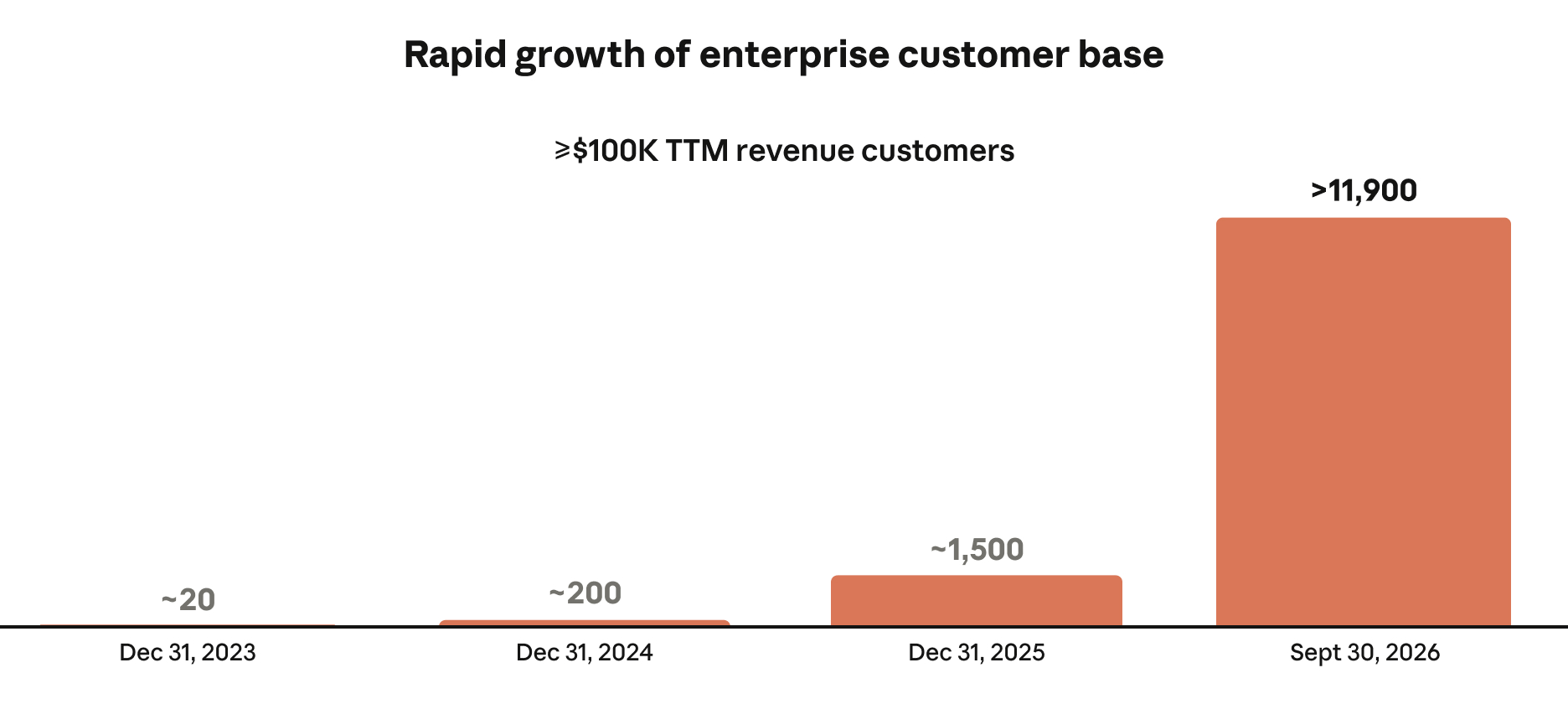
查看图中文字英文转录
≥$100K TTM revenue customers
Dec 31, 2023: ~20
Dec 31, 2024: ~200
Dec 31, 2025: ~1,500
Sept 30, 2026: >11,900
每美元算力投入对应的收入显著增加
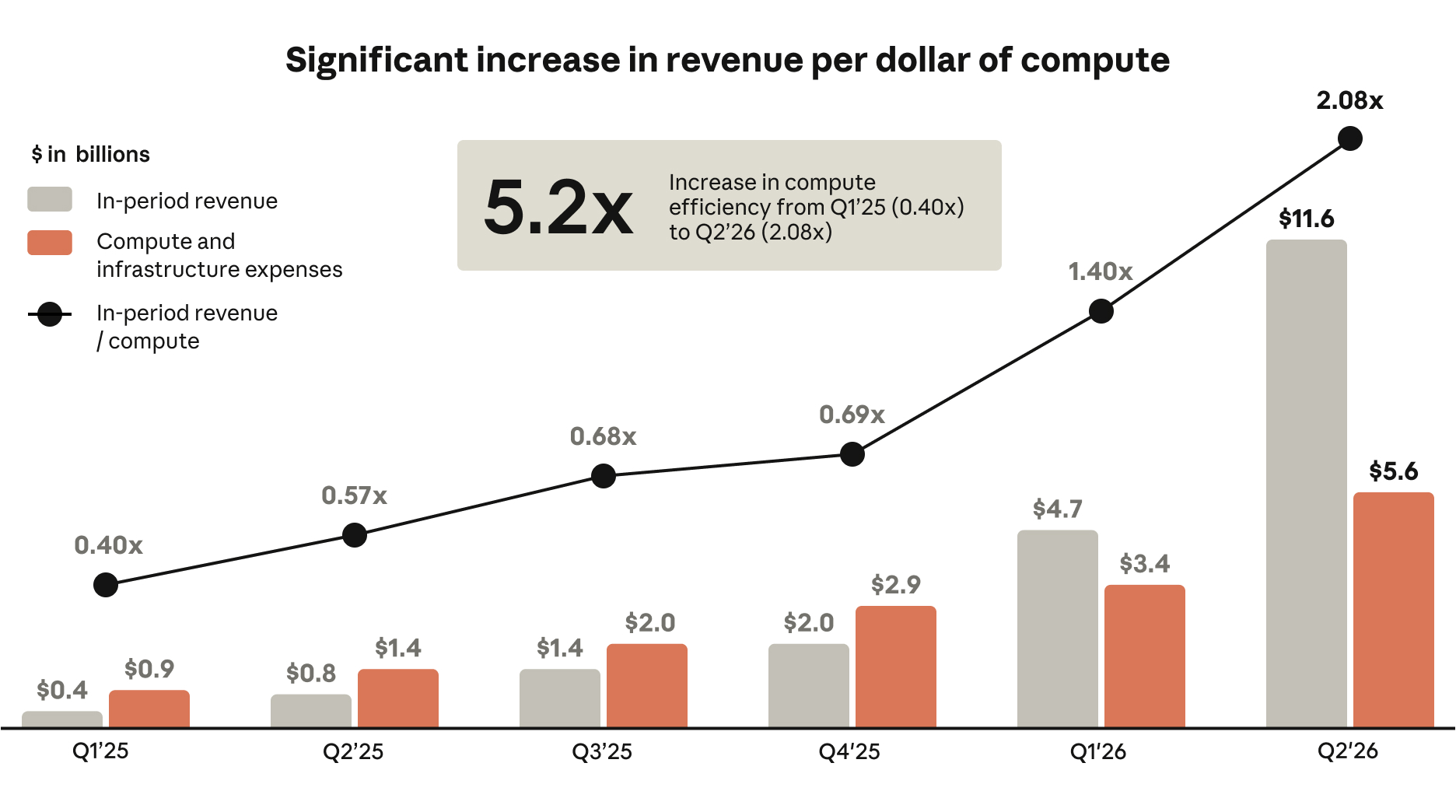
查看图中文字英文转录
$ in billions
In-period revenue
Compute and infrastructure expenses
In-period revenue / compute
5.2x Increase in compute efficiency from Q1’25 (0.40x) to Q2’26 (2.08x)
Quarter | In-period revenue | Compute and infrastructure expenses | In-period revenue / compute
Q1’25 | $0.4 | $0.9 | 0.40x
Q2’25 | $0.8 | $1.4 | 0.57x
Q3’25 | $1.4 | $2.0 | 0.68x
Q4’25 | $2.0 | $2.9 | 0.69x
Q1’26 | $4.7 | $3.4 | 1.40x
Q2’26 | $11.6 | $5.6 | 2.08x
运营效率推动利润率提升
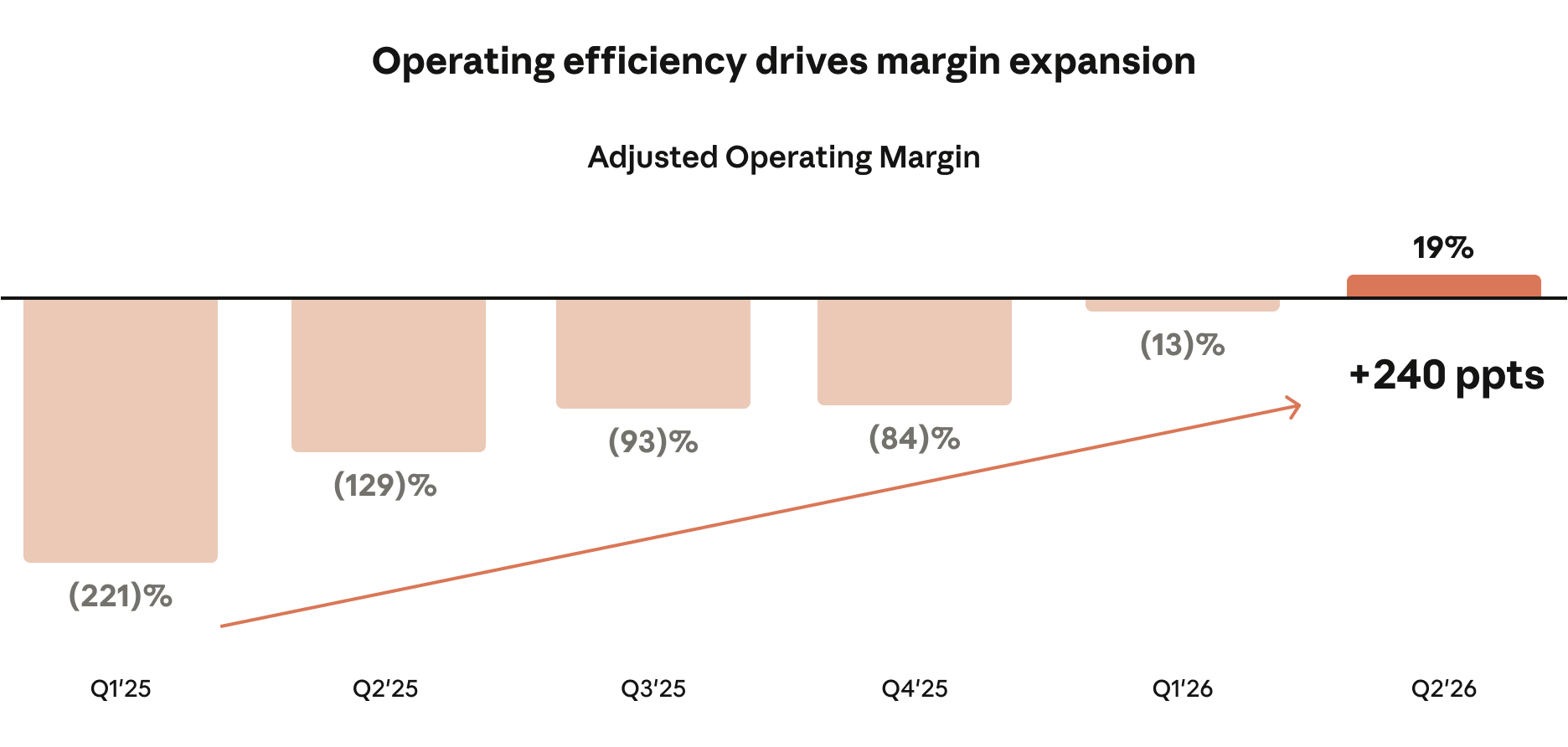
查看图中文字英文转录
Adjusted Operating Margin
Q1’25: (221)%
Q2’25: (129)%
Q3’25: (93)%
Q4’25: (84)%
Q1’26: (13)%
Q2’26: 19%
+240 ppts
业务
业务
概述
有史以来,人类第一次能够构建智能。进行推理思考、分析、综合、决策和创造的认知能力,可以大规模生产并按需获取。我们认为,AI 的这种充裕供给将迅速变革全球经济的每一个领域,其影响将超过工业化、电力、半导体和互联网。真正发挥其潜能的 AI,在风险得到妥善管理的前提下,可能显著加快全球增长,并大幅改善全球各地人们的生活质量。
Anthropic 于 2021 年由一支研究人员团队创立,这支团队取得了诸多塑造 AI 领域的突破。我们首先是一家研究实验室——我们的使命是负责任地开发和维护先进 AI,为人类谋求长期利益。这一使命指引着我们的关注重点——它与我们的人才和文化、前沿与安全性研究、算力运用方式以及企业客户战略一样,是使我们与众不同的核心优势之一。这些优势使我们能够持续推进前沿 AI,并塑造其安全、负责任发展的标准。我们的前沿 AI——Claude——通过我们的模型、平台和应用程序向客户提供。Claude 的企业采用速度超过了历史上任何其他技术,收入增长即可证明这一点:收入从 2023 年第一季度商业化推出时的 0 美元,增长至截至 2026 年 9 月 30 日止三个月的〔原文留白〕美元。这种快速且持续扩大的采用产生了两种自我强化的动态机制——推动 Claude 进步的改进循环,以及有助于为我们持续开展前沿 AI 研究提供资金的投资循环。
我们的核心优势
- 使命与专注
- 人才与文化
- 前沿研究与安全研究
- 算力策略
- 企业市场战略
企业对 Claude 的采用
- 虚拟协作者
- 平台和应用
- AI 的普及
我们的财务模式
- 收入增长
- 算力效率
- 运营效率
改进循环:我们的核心优势 → 企业对 Claude 的采用 → 我们的核心优势。
投资循环:我们的核心优势 → 我们的财务模式 → 我们的核心优势。
我们认为,AI 在全球经济中的普及,是历史上改善人类生活和工作方式的最大机遇之一,而这一进程才刚刚开始。在我们看来,世界才刚开始利用当今前沿模型的能力,Claude 能够做到的事情与其实际应用广度之间的差距,与前沿能力的持续进步一道,构成我们最大的增长机遇之一。近年来,Claude 的能力已显著演进,我们预计其将继续快速进步。这不仅会扩大可服务市场,也会扩大对世界的影响范围。我们的目标是让这种影响尽可能积极。
179
我们的核心优势
使命与专注。我们的一切努力均以对使命的全心专注为指引。这种专注使我们能够将人才、研究和算力投入集中于对人类最有价值的工作,并避免相互冲突的优先事项。实现我们的使命,意味着世界能够在缓解最重大风险的同时,获得前沿 AI 的巨大益处;我们认为,这要求安全性和能力同步发展。
人才与文化。我们的使命和专注使我们能够吸引并留住世界一流人才,包括希望通过自己的工作塑造更美好未来的研究人员和工程师。我们的文化也倡导淡化自我、追求真理的环境,在这样的环境中,前沿 AI 的能力与安全性相互促进。我们认为,在规模扩大过程中,我们的文化推动了人才密度的提升。
前沿与安全研究。我们认为,要构建能力最强且最安全的 AI 系统,必须在智能前沿开展持续且专注的研究。我们的前沿能力研究与安全研究深度融合,直接影响模型设计、训练及部署,帮助我们构建更可靠、更易引导、也更适合现实部署的系统,尤其适用于要求严苛的企业环境。我们将研究领先优势转化为创新速度,并持续推出更好的模型、平台能力及应用。每一版 Claude 模型都帮助构建下一版,从而缩短开发周期,并使创新速度获得不断累积的提升。我们将这种递归动态称为“闭合迭代循环”;我们认为,它是前沿 AI 最重要的结构性优势之一,能够大幅加快能力进步的速度。我们认为,模型能力必须与安全性、对齐及安全防护实践同步推进,尤其是在 AI 开发加速之时。我们在每个模型的开发过程中、发布前及发布后评估风险,并采取我们认为适当的措施,在模型能力与安全性、对齐及安全防护之间取得平衡,即使这样做可能放缓我们发布新能力的速度。我们将这类决定视为审慎作出的取舍,因为它们服务于公司宗旨、使命的长期利益,以及客户对安全且对齐的模型的需求。
我们的算力运用方式。我们将来自多个战略合作伙伴的算力作为单一且可互换的资源池进行管理,并根据在任一时点边际单位算力预计可发挥最大生产效能的用途,在不同工作负载之间动态调配可用算力。我们认为,这种算力运用方式使我们能够提供更出色的模型、服务更多客户,并使我们的算力投资发挥更高的生产效能。这种算力效率为我们通过研究和模型开发推进 AI 能力前沿、满足不断增长的客户需求以及支持内部使用 Claude 奠定了基础。我们凭借研究突破,以及涵盖 AWS Trainium、Google TPUs、NVIDIA GPUs 和 AMD GPUs 的多芯片算力架构实现了这一点,使我们能够编排工作负载,优化价格与性能。为了支持我们的研究、模型开发、客户需求以及内部使用 Claude,我们继续进行大规模投资。截至 2026 年 9 月 30 日及此后,我们已订立采购承诺和租赁协议,包括短期承诺以及尚未开始的租赁,承诺支出合计超过〔原文留白〕美元,其中几乎全部与算力及基础设施有关。这些承诺中,预计于 2030 年 12 月 31 日之前发生的支出约为〔原文留白〕美元,其余承诺支出中的几乎全部预计于 2031 年至 2045 年期间发生。这些承诺中,约〔原文留白〕美元应于未来 12 个月内支付。更多信息请参见题为“管理层对财务状况及经营业绩的讨论与分析—流动性及资本资源—合同义务”的章节。
企业客户战略。我们的企业客户战略建立在以下认识之上:前沿 AI 在现实场景中最有价值,因为在企业中部署所产生的经济影响最大,从客户反馈中形成的改进循环也最为丰富。因此,我们的研究优先事项、产品路线图以及市场拓展团队和应用 AI 团队均围绕企业使用场景进行组织安排,这些使用场景涵盖从日常知识工作到最复杂问题的各个方面。我们收集的客户反馈指引着我们的研究重点,并使 Claude 的能力随着时间推移不断提升。这扩大了 Claude 可部署的范围,并进一步推动企业采用,有助于确保我们的 AI 的益处能够大规模惠及个人和组织。
180
企业对 Claude 的采用情况
企业客户采用我们的产品的速度和深度,有力地证明了 Claude 在 AI 前沿的地位。截至 2026 年 9 月 30 日,我们的客户群包括:
•过去十二个月贡献收入达到或超过 100,000 美元的客户超过 11,900 家;
•过去十二个月贡献收入达到或超过 1 百万美元的客户超过 1,900 家;以及
•过去十二个月贡献收入达到或超过 10 百万美元的客户约 250 家。
与服务于单一使用场景的静态产品不同,Claude 是能力快速进步的前沿 AI。我们在技术体系的三个层面开展建设:模型本身、基于这些模型进行开发的平台,以及将 Claude 直接交到用户手中的应用。任何一个层面的进步都会在三个层面相互叠加,加快我们提供更强智能的速度。我们认为,同时使用 Claude Platform 及第一方应用的客户数量不断增加,体现了这种一体化方式的价值。截至 2026 年 9 月 30 日止三个月,在过去十二个月为我们贡献收入达到或超过 100,000 美元的客户中,超过 50% 使用了 Claude Platform 及至少一种第一方应用,而截至 2025 年 12 月 31 日止三个月这一比例约为 30%。
如今,企业依赖 Claude 在复杂工作流程中进行推理思考、规划及执行,其可信赖程度与判断力,在我们看来是此前几代 AI 未能提供的。客户主要通过三种方式从 Claude 获得价值:提高雇员生产力、加快流程,以及将智能嵌入其产品。随着 Claude 能力增强,客户从中受益,并经常将 Claude 扩展至新的工作流程。这种不断扩大的作用,反映出 Claude 在企业内部使用方式的更广泛转变:从回应离散提示的工具,转向我们所称的“虚拟协作者”——一种与人类并肩工作、以专业水平完成复杂多步骤工作的 AI 系统。
我们主要通过在多个产品界面提供 Claude,推动其普及。例如:
•Claude Platform 是我们的综合性智能体式开发环境,为客户提供直接使用基础原语的途径,以构建、部署和扩展其自己的应用程序,在其自身产品和工作流程中运用 Claude 的能力。
•Claude Code 是我们的编程智能体,与人类软件开发人员并肩开展端到端软件开发:在生产规模的代码库中编写、规划、编辑、测试、调试和提交代码。
•Claude Cowork 是我们的知识工作智能体,具备计算机操作能力,能够与专业人士共同完成端到端业务任务:自主开展研究、起草、分析、综合整理,以及执行其他知识工作。
Claude 的大部分普及来自自然增长。我们的市场拓展及应用 AI 团队进一步放大这一效果,通过分销合作将 Claude 纳入客户现有的技术体系,在客户已有环境中满足其需求,从而扩大我们的触达范围。例如,三大主要云平台 AWS、GCP 及 Azure 均可访问 Claude。我们与这些云服务提供商采用联合市场拓展方式,在向各云服务提供商支付费用的同时,与客户建立直接合同关系。该结构使我们能够与这些云服务提供商建立更紧密一致的商业利益关系、避免渠道冲突、自行定价,并获得算力效率持续改善带来的财务收益。生态系统合作关系亦扩大了我们的触达范围,使客户能够通过 Accenture、Deloitte、KPMG 和 PwC 等系统集成商、咨询顾问,以及 Salesforce 和 Snowflake 等数据平台采用 Claude。我们最近与领先私募股权公司合作推出 AI 服务公司 Ode with Anthropic,将 Claude 的能力带给各行业的中型企业,在 Claude Platform 上构建解决方案,并为客户提供长期支持。
181
我们财务模式的优势
构建并扩展前沿 AI 是历史上最重要、资本最密集的事业之一。我们的财务模式为我们提供了以下优势,使我们能够高效地开展构建和规模扩展:
• 收入快速增长。我们的企业战略旨在将 Claude 直接嵌入业务关键工作流程,并支持开发基于 Claude 的产品,从而推动客户持久采用。我们认为,企业客户能够从 Claude 获得具有吸引力的投资回报,因为智能体工作流程能够同时推动收入增长及效率提升。这使我们能够快速扩大与客户的业务,截至 2026 年 9 月 30 日约 900% 的净收入留存率体现了这一点。
•算力效率。我们的算力效率使研究和模型开发能够产出更多智能,我们认为,与其他方法相比,这种方法能够以相同的算力支持客户和内部更多地使用 Claude。我们的算力效率体现在,截至 2026 年 6 月 30 日止三个月,收入同比增长 1,368%,而同期算力和基础设施费用增长 300%。
•运营效率。我们的运营效率源于高人才密度、高效的市场拓展方式,以及团队在工作中广泛运用 Claude,这使我们能够以相对于其他大型企业技术公司规模更小的团队实现规模扩展。我们的运营效率体现在,截至 2026 年 9 月 30 日,过去十二个月每名员工对应的收入超过 6.6 百万美元,而截至 2025 年 9 月 30 日为 1.4 百万美元。
我们的财务业绩反映了持续增长,以及对前沿 AI 的持续投资,具体如下:
• 截至 2026 年 6 月 30 日止三个月,收入为 11.6 十亿美元,高于截至 2025 年 6 月 30 日止三个月的 787 百万美元。
• 截至 2026 年 6 月 30 日止三个月,经营利润率为 8%,经营利润为 1.0 十亿美元;相比之下,截至 2025 年 6 月 30 日止三个月的经营利润率为 (152)%,经营亏损为 1.2 十亿美元。
• 收入增长、算力效率及运营效率的共同作用,使我们在截至 2026 年 6 月 30 日止三个月实现了 19% 的经调整经营利润率及 2.2 十亿美元的经调整经营利润;相比之下,截至 2025 年 6 月 30 日止三个月的经调整经营利润率为 (129)%,经调整经营亏损为 1.0 十亿美元。
我们的财务模式所展现的增长、规模及效率,有助于我们继续进行重大长期投资,以负责任的方式构建前沿 AI。我们的业务发展态势及财务状况,使我们能够从投资者及合作伙伴获得资本并确保算力供应。截至 2026 年 6 月 30 日,我们累计筹集资本 141.1 十亿美元,拥有现金及现金等价物 112.4 十亿美元,以及短期投资 19.3 十亿美元。长期投资伴随风险,因为我们必须预测未来多年的算力需求。不过,我们认为,算力效率使我们能够在需求高于预测时放大回报,并在需求较低或实现时间晚于预期时提供财务韧性。
我们的自我强化循环
我们的规模和增长形成了自我强化循环,使 Claude 随着时间推移不断改进,我们认为这些循环创造了持久的竞争优势。
•改进循环。Claude 在企业中的部署,加深了我们对客户最重视的难题、边缘情形和领域特定挑战的理解。客户在其各项业务的生产环境中使用我们的产品和服务,我们根据他们的反馈改进模型、平台和应用程序。这些改进带来了更广泛的部署和采用,为下一轮改进提供动力。
182
• 投资循环。企业采用范围扩大所带来的收入,有助于我们为改进 Claude 所需的算力、研究及人才提供资金。Claude 不断进步的能力扩大了客户使用 Claude 完成的任务及工作流程范围,从而扩大可服务市场,推动更深入的部署、增加收入,并持续对 Claude 进行再投资。
Claude:前沿智能
改进循环
Claude → 更好的模型 → 更多使用场景 → 更多反馈 → Claude
投资循环
Claude → 更高增长 → 更多投资 → 更多能力 → Claude
Claude 正在加速提升我们闭合迭代循环的能力
Claude 本身已成为推动我们进步的最强大动力之一——Claude 模型的每个新版本都会直接加速下一版本的开发。后续几代模型在研究、训练和测试的许多方面如今都有 Claude 的参与,包括开展实验、生成和处理训练数据、自动执行评估和安全审计,以及编写和审查代码。我们将这种递归机制称为“闭合迭代循环”。这一机制的直接体现是,我们开发算力倍增技术的速度正在加快。能力更强的模型帮助我们的研究人员更快地发现这些改进;反过来,更强大的算力倍增技术又使我们能够训练能力更强的模型,并更高效地部署它们。
我们在整个工程组织中部署智能体式编程产品 Claude Code,是我们实现闭合迭代循环能力的明确例子。随着模型不断进步,我们看到 Claude 在更具挑战性、开放式、缺乏明确规格要求且以往依赖经验丰富的人类作出判断的工程问题上,能力显著改善。根据内部基准测试,2026 年 9 月,Claude 在这些问题上的成功率达到约 90%,在九个月内提高约 50 个百分点。Claude Code 已从提出代码建议,发展到直接编写及运行代码,并能够在较长时间内自主处理复杂的多步骤工程任务。这使工程师能够越来越多地指导及审查其工作,而非逐行编写代码。因此,平均每位工程师在截至 2026 年 9 月 30 日止三个月期间,每天向代码库贡献的代码量超过截至 2024 年 12 月 31 日止年度平均每日代码量的 45 倍。超过 90% 的代码库贡献内容(2026 年 9 月)由 Claude 编写。
Claude 的影响不止于研究及工程。从 2024 年 12 月 31 日至 2026 年 9 月 30 日,我们的雇员人数增至原来的五倍以上,而截至 2026 年 9 月 30 日止三个月的收入,是截至 2024 年 12 月 31 日止三个月收入的 86 倍。
我们认为,这种经营杠杆来自在整个组织中使用 Claude。在研究、工程、市场拓展及运营团队中,Claude 使雇员在日常工作中能够运用一支智能体团队,通过放大每个人的作用,让规模相对较小的团队能够承担传统上需要大得多的团队才能完成的工作。
183
我们自身对 Claude 使用的扩大,直接反映了这种杠杆效应。从 2026 年 1 月至 2026 年 9 月,我们内部 Claude 用量按标价计算的价值增长超过 250 倍;2026 年 4 月,这一每月价值首次超过不含股份支付薪酬的每月人员费用。由于每一版 Claude 都用于协助构建下一版,且 Claude 提高了公司各团队的生产力,我们认为,投入内部使用的算力使这些收益不断累积,持续加快开发速度,并进一步巩固领先地位。
利用 AI 协助构建能力更强的 AI,亦可能带来相当大的安全风险,尤其是在其显著加快进步速度的情况下。这是我们的负责任扩展政策所涵盖的领域之一;该政策阐明了我们在接近所谓“递归自我改进”的过程中,监测及缓解相关风险的计划。
AI 正在变革智能
我们认为,强大 AI(Powerful AI)这一能力强大、影响重大且具有以下关键特征的前沿 AI 形态,将在数年内可供广泛使用:
•认知能力在大多数专业和科学学科中达到或超过顶尖人类专家的水平;
•能够操作人类在虚拟环境中工作时可使用的所有界面,包括文本、音频、视频以及直接的计算机控制;
•能够在较长时间内——持续数小时、数天或数周——自主地通过推理思考处理复杂任务,并在需要时寻求澄清和反馈;
•能够在多个实例之间进行协调,并与人类及其他 AI 系统协作;以及
•能够通过数字连接,以数字化方式控制实验室设备、机器人系统及其他机器,从而与物理世界交互。
如果将强大 AI 用于解决人类最棘手的问题,并负责任地管理风险,其潜力将非同寻常。可能实现的成果包括将数十年的科学进步压缩至数年内实现;加快药物发现、疾病检测以及个性化治疗的提供;提供因人而异的教育以及专业财务和法律建议;推动电网和电池设计进步,以提高效率和可靠性;以及将富裕国家历经数代才建立起的能力带给发展中地区。
缩放定律及进步的可预测性
AI 系统的智能及能力已显著进步。几年前 AI 系统尚无法完成的任务,例如复杂数学推理、设计科学实验,以及执行软件开发中的相当一部分工作,如今已由 AI 常规完成。
这些进步遵循了经验性的“缩放定律”,即 AI 模型的性能会随着模型规模、训练数据及算力的增加,以可预测的方式改善。奠基性论文《神经语言模型的缩放定律》(Scaling Laws for Neural Language Models)的主要作者,包括 Dario Amodei、Jared Kaplan、Sam McCandlish 及 Tom Brown,后来共同创立了 Anthropic。该论文对确立这些关系至关重要,并帮助引领了现代大语言模型的发展浪潮。
我们预计,AI 在语言、推理思考、数学、编程、科学分析,以及范围不断扩大的智能体任务和知识工作方面的能力,将在未来多年持续进步。因此,我们认为,在可预见的未来,这将推动 AI 需求持续超过供给,而主要限制因素是算力的可获得性。我们认为,大部分需求将集中于前沿能力:根据我们的经验,企业在各种工作负载中倾向于采用我们能力最强的模型,包括其价值最高的工作。此外,我们认为,前沿能力每一次持续拓展都会开启新的工作类别,而这些新类别又将产生行业大部分新增需求。我们预计,行业将继续增加在算力、研究人才及工程资源方面的投资,以推进 AI 前沿能力。在这一框架下,拥有专有训练方法、高质量数据及独特研究人才的研究实验室,有望取得超出单靠规模所能预测的进步。
184
变革认知工作的近期机遇
前沿 AI 正在改变认知工作,即运用知识、推理思考及判断力创造经济价值的工作。我们认为,它将显著增强人类能力,并扩大世界开展此类工作的整体能力,包括加速科学发现及帮助企业增长。知识工作者是这一机遇的最前沿。随着前沿 AI 进步,能力更强的模型既能开启全新使用场景,也能沿着能力—成本—速度曲线,在大规模范围内高效服务于广泛的认知工作。我们认为,2025 年全球知识工作者所从事的工作代表超过 40 万亿美元的经济价值。6 鉴于前沿 AI 有潜力显著提高他们的生产力,我们的近期机遇在于扩大这一价值并加快经济增长。虽然预测前沿 AI 对整个经济的全面影响仍为时尚早,但 IDC 估计,到 2031 年,AI 解决方案及服务投资将带来累计 22.5 万亿美元的全球经济影响。7 我们认为,其影响可能更大。
历史表明,变革性技术会扩大其所进入的市场。例如,信息技术支出从 2006 年约 1.2 万亿美元增长至 2025 年的 4.3 万亿美元,复合年增长率约为 7%;同期,云计算支出从零增长至 1.9 万亿美元,并扩大了信息技术预算。8 我们亦看到个人计算机、互联网及智能手机等其他技术扩大了其市场。构建这些技术的公司,增长速度远高于整体经济。根据世界银行的数据,全球 GDP 从 2000 年约 34 万亿美元增长至 2025 年超过 118 万亿美元,增至三倍以上。在同一期间,截至 2026 年 9 月 30 日按市值计算的十大上市科技公司的合计收入,从 68 十亿美元增长至超过 2.5 万亿美元,增幅约为 38 倍,或约为全球 GDP 增长速度的 11 倍。
前沿 AI 可能重塑整个行业并加快新发现的进程
我们认为,前沿 AI 代表的机遇大于以往任何技术周期,而 Claude 已经开始展现这一潜力。Claude 现在能够在数小时至数天的时间内自主执行复杂项目,并行协调数千个智能体,开展复杂规划、长篇研究及能够自我纠正的分析。Claude 亦能将开放式任务转化为完成的高质量交付成果——而就在不久前,这些工作仍超出前沿 AI 的能力范围。这些能力使 Claude 有望改变全球经济中的最大行业,包括软件开发、商业及专业服务、网络安全、金融服务,以及医疗和生命科学,为部署它的组织带来显著的生产力及产出提升。
网络安全是我们最重要的近期机遇之一。随着每一代新 AI 模型发现及利用漏洞的能力增强,我们预计,防护企业网络及关键基础设施将越来越需要前沿 AI。与此同时,随着组织加速部署智能体及自主能力,AI 的普及正在扩大威胁面。我们在编程领域的领先地位,使我们能够推进 Claude 的网络安全能力,并构建帮助企业保护其最关键基础设施的产品。例如,Claude Security 能够持续扫描客户代码库、对漏洞进行分级处置,并编写修复程序。我们最近亦推出 OSS Scanner,将其中部分能力扩展至企业软件所依赖的开源项目。通过我们的可信访问计划,经过审核的网络防御人员亦可使用我们能力最强的模型开展安全运营、事件响应及经授权的渗透测试,使安全防护转向持续保护模式。
6 关于我们如何计算全球知识工作者贡献的年度经济价值,请参阅“行业、市场及其他数据”一节。
7 IDC,《AI 的经济影响:2026 年版》,文件编号 US54452226,2026 年 4 月。反映 AI 解决方案及服务、AI 基础设施供应链投资,以及 AI 促成的企业生产力和效率提升所创造的年度价值。
8 IDC,《全球黑皮书:实时版 V2 2026 年预测》,2026 年 7 月。
185
我们预计,随着 Claude 的前沿能力超越现有市场、开辟全新市场,其他行业亦将随后发展,延伸至机器人、先进制造及物流等领域,并加快药物发现及材料科学等科学研究的进展。
例如,在预计 2026 年全球年度药品支出将超过 2 万亿美元的生命科学行业,9 我们的客户、生物技术合作伙伴及自身研究人员,均在药物发现与开发中使用 Claude。我们亦将 Claude 拓展至机器人领域,Model Hardware Standard(模型硬件标准)使 AI 智能体能够操作显微镜、液体处理设备及现成机械臂等实验室和制造设备。
最终,我们认为前沿 AI 将有助于推动全球经济增长。当前沿 AI 提高工作者及组织的生产力、嵌入其交付的产品和服务,并开启新的商业模式时,它会创造此前不存在的经济产出。我们认为,我们的机遇不仅是分享当今经济活动的价值,也包括随着全球经济扩大,分享新创造的产出。
安全性与道德行为的重要性
尽管 AI 的潜在益处非同寻常,其快速发展仍将以可能造成重大扰动的方式影响经济和社会,尤其是在未以负责任的方式开发和部署该技术的情况下。例如,恶意行为者已经利用 AI 发现漏洞、生成恶意软件和规避检测工具的能力实施了备受关注的网络攻击;与滥用相关的其他风险,包括生物学领域的风险,可能造成更大的危害。大规模部署的 AI 还可能使权力和财富在各国内部及国家之间集中,其方式可能削弱信任、损害社会并动摇地缘政治秩序。未对齐的 AI 系统可能扭曲机构决策,或通过其用户和运营者无法察觉或理解的自主行动造成大规模危害。我们认为,前沿 AI 公司必须投资于安全性和对齐,以帮助确保该技术以负责任的方式普及。我们还认为,安全性、对齐和道德行为尤其受到企业的认同;对于企业而言,严格的防护措施、可预测的模型行为及可验证的问责机制,已成为为关键任务工作负载选择 AI 合作伙伴时的决定性标准。
我们的核心优势
五项核心优势定义了我们在前沿领域的地位:使命与专注、人才与文化、前沿与安全研究、算力策略,以及企业战略。
使命与专注
Anthropic 于 2021 年由一支研究人员团队创立,该团队曾实现多项定义前沿 AI 的重要突破。他们共同坚信,安全必须成为构建强大 AI 的基础原则。我们的公司结构与这一目标一致,注册成立为特拉华州的公益公司(PBC),并设立 LTBT,明确授权其推进我们的使命。此外,我们公开安全方法、模型评估及负责任扩展政策,因为我们认为透明度是信任的前提,而信任则是以负责任方式大规模部署前沿 AI 的前提。
Anthropic 的每位雇员都为同一使命而努力,该使命指引每一项决定——从模型架构、产品策略,到合作条款,以及如何安排研究和算力。我们不会仅凭商业机遇或研究新颖性推进项目;我们的努力必须推进我们的使命。当商业收益与安全或信任之间出现艰难取舍时,我们有明确的答案。例如,2026 年 4 月,我们最初以受访问限制的研究预览形式发布前沿模型 Mythos,通过 Project Glasswing 向选定的组织提供,用于网络安全应用,而非在发布时广泛开放,原因在于其具备先进的网络漏洞发现能力。我们认为,这种对使命的清晰认识能够减少摩擦、加快决策,并培育出一种文化,使安全与能力的追求同步进行。
9 IQVIA 人类数据科学研究所,《2026 年全球药品使用趋势》,2026 年 2 月。
186
人才与文化
人才是我们最重要的优势之一,因为技术、资本、产品及分销均源于卓越人才。人才密度比人才总量更重要。优秀的人与同样优秀的同事共事时,会受到启发和激励,从而形成吸引更多杰出人才的环境。这些人才可以借助 Claude,使每个人的影响最大化。
我们认为,我们已汇聚全球最深厚、最密集的 AI 研究人才,其中包括许多开创现代大语言模型底层技术的研究人员。创始团队开创了 AI 的多项基础性进步,包括缩放定律、GPT-2 及 GPT-3、RLHF,以及机制可解释性。我们坚信安全与能力必须同步推进,这有助于吸引及留住世界级人才,包括研究人员及工程师。例如,在截至 2026 年 9 月 30 日的过去十二个月期间,全部雇员的非期望人员流失率约为 1%。
我们始终致力于开放的内部协作与求真,而淡化自我、注重影响力、与使命一致的文化为此提供支撑。研究人员公开分享结果,同事们实时提出批评并调整方向。当多个团队并行探索不同方法时,惯例是严格评估哪种方法正在展现更强且更符合对齐要求的结果。这种协作方式难以复制,因为它既要求拥有从组织成立之初便建立的信任基础,也要求不懈致力于维护这种信任。这种信任体现为在我们这一规模下并不常见的做法:各团队始终朝同一方向努力,而非相互掣肘。
我们认为,在公司规模扩大的过程中,这种文化推动了我们的人才密度。
前沿与安全研究
我们的前沿模型领先地位,直接来自人才密度。我们认为,相较于人数更多或预算更大的团队,我们的研究人员持续将智能、能力及可靠性的边界推向更远。Claude 在各行业现实任务中的表现得到广泛认可,包括编程、医学、法律、科学及数学。
我们的研究方式为业务提供了关键优势:
• 模型研究与算力性能从一开始便协同设计。从第一天起,我们作出架构决策时就考虑算力效率。模型架构与推理基础设施在单一、统一的流程中设计。AI 研究人员与推理基础设施工程师共用规划周期、汇报体系及性能目标。这种方式使我们能够开发出相较于此前版本既更强大、又更高效的模型版本。
• 预训练流程以资本效率为设计目标。我们专注于建立清晰的开发流程,从架构、训练方法及数据方面改进模型。在消耗大量算力之前,这些改进会先在较小规模上接受测试。纳入前沿模型训练任务的门槛很高,且严格以证据为依据:我们要求证明,某项改进在模型规模增大时仍然成立,而不只是缩小规模时表现良好。前沿模型训练任务是经过规划、排定时间的资本投入,具有已知的投入要素及严格的纳入标准。由此形成可重复的流程,将研究投资转化为能力提升,同时管理前沿模型训练任务的固有风险。
• 后训练投资专为智能体能力而设。后训练已从收尾步骤发展为重大的研究投资,反映出市场从助手转向智能体的变化。在这个阶段,模型磨炼编写代码、使用工具、遵循指令,以及代表用户操作软件的能力。我们围绕完整且真实的任务进行训练,其复杂程度反映实际专业工作。
187
• 安全研究带来商业收益。当模型承担能够访问关键业务系统的智能体角色时,信任及可靠性至关重要。随着能力增强,安全运行的能力成为决定商业可行性的关键因素之一。对齐良好的模型更能遵循用户指令——例如,它们会避免在未充分理解用户意图的情况下,采取可能具有破坏性的行动。它们亦更能抵御提示注入等攻击;在此类攻击中,恶意行为者试图通过向模型输入违规指令来劫持模型。我们在对齐、可解释性研究、安全防护措施及红队测试方面的工作,以及借助能够评估我们安全实践的外部审查人员,有助于构建更安全、更可靠的模型,从而使我们能够满足客户的严格要求。安全研究与能力研究相互融合,使我们能够提供企业工作流程所需的可信度及性能。
我们的算力策略
我们的算力策略首先是训练这样的模型:在设计上能力更强,并能在任何给定类型的算力上更高效地运行。
我们构建能力更强的模型并更高效地提供模型服务的能力,体现了预训练、后训练及推理研究之间迭代循环所带来的复合增益,而这些工作都由可互换的算力池支持。预训练及后训练研究产生专有的算力倍增技术,使模型能力更强。研究及推理工程则推动提供这些模型服务所需的算力持续下降。
除支持能力更强、效率更高的模型外,我们横跨 AWS Trainium、Google TPU、NVIDIA GPU 及 AMD GPU 的多芯片算力架构,亦使我们能够编排工作负载,以优化价格及性能。我们在多个芯片系列上高效训练及运行模型方面拥有多年经验,我们认为这形成了差异化优势,且难以复制。这一基础结合 Claude 对芯片及模型架构日益深入的理解,使我们能够用过去所需时间的一小部分接入新芯片平台。
我们的算力池在设计上具有可互换性。我们进行了大量工程投入,构建内部编排、调度及容量管理系统,使加速器容量无论来自哪家提供商、采用何种芯片架构或位于何处,均可分配至不同工作负载。为客户工作负载提供服务的同一套基础设施,也被用于研究、模型开发及 Claude 的内部使用。这些系统将底层硬件作为统一容量池管理,监测整个池的利用率及需求,并在任何给定时间将算力分配至预计最能发挥效益的地方。
与依赖单一平台相比,多芯片算力方案使我们能够获取显著更多的芯片,并能够把握机会,利用每个芯片系列及代际的性价比优势。确保这种获取能力需要提前作出重大承诺。鉴于从订立算力合同到这些算力可用于处理工作负载之间存在较长前置时间,我们会远早于预计需求出现之时锁定算力。在某些情况下,我们亦可能在设备或基础设施交付之前付款。我们预计在可预见的未来继续进行重大投资,包括算力及基础设施投资,以确保拥有维持并扩大我们在 AI 前沿地位所需的技术资源。
企业策略
我们的企业策略与使命一致。我们为需要最高智能水平的问题构建能力最强的模型。同样的智能亦高效用于日常工作:根据每项任务的难度调整思考投入,并将工作负载路由至模型系列中最适合的模型。因此,世界各地的客户正在广泛工作中采用 Claude,从常规知识任务到最重要的问题。如今,Claude 已用于主要行业的知识工作,包括金融服务、保险、医疗、生命科学、法律、教育、零售及商业、电信、专业服务、科技及网络安全。除了企业实际挑战外,Claude 也被用于科学研究、药物发现、教育及气候分析中的紧迫全球问题。
188
我们构建模型、平台及应用程序,着眼于其在生产环境中的实用性,而非基准测试成绩。这一区别很重要,因为许多 AI 系统难以实施,也未能在复杂企业环境中实现预期价值;在这些环境中,治理及安全问题仍是阻碍采用的主要因素之一。
Claude Code 及 Claude Cowork 等应用程序放大了员工的影响力。随着时间推移,应用程序能力不断增强,如今经常与员工并肩开展长时间自主工作。组织亦将 Claude 集成为驱动及转型内部业务流程的智能。此外,Claude Platform 是企业构建 AI 原生产品的基础。
随着企业客户将 Claude 集成至越来越复杂的工作流程,他们提出的用例及需求会塑造我们的路线图。他们亦提供反馈,使我们能够持续改进模型、平台及应用程序,并开发新解决方案,推动其采用 AI。
随着模型及产品每次进步,Claude 能够处理更有价值的用例,在深化对现有客户影响的同时,降低新客户的采用门槛。当模型跨过某类工作所需的能力、可靠性及信任门槛时,该类别中的采用通常会迅速从试验转向生产。编程是首个此类领域:大约一年内,Claude 从建议单行代码,发展至运营一批可在生产代码库中自主工作的智能体。网络安全正沿类似曲线发展。ExploitBench 是卡内基梅隆大学研究人员开发、用于评估 AI 模型利用软件漏洞能力的基准测试;在约四个月内,Claude 的成绩从 Opus 4.8 的 40%,升至 Claude Mythos 5 的 78%,再升至 Opus 5.5 的 91%。网络防御人员如今正大规模识别及修补漏洞。我们预计,模型能力的这些改善将带来更多用例。Claude Security 及最近推出的 OSS Scanner 是早期例子,可持续扫描代码库,并在攻击者发现漏洞之前提出修复建议。
作为虚拟协作者的 Claude
我们认为,我们已到达一个拐点,AI 系统能够在专业工作中成为真正的协作者。它们能迅速完成实质性任务,而这些任务原本可能需要熟练专业人士花费数小时、一整天甚至更长时间。AI 系统亦越来越能够完成此前过于困难或成本过高的任务,或提出原创见解及分析。
我们将这些与人类并肩、以专业水平完成复杂多步骤工作的 AI 系统称为虚拟协作者。虚拟协作者具备其所属组织授予的访问权限、系统连接及上下文,使其能够更准确、可靠地发挥作用。它们可以浏览及使用内部工具,并执行涉及多个步骤、需要持续推理思考的工作流程。虚拟协作者是专为嵌入实际工作场景而设计的 AI,我们的目标是继续将其推广至全球知识工作者;这一群体的人数预计将在 2028 年超过十亿。10
189
聊天机器人
范围有限、一次性的回答。
“重置我的密码。”
“方法如下 →”
辅助助手
在一个应用或一项任务中工作。
文档
“总结这份文档,并起草一份回复。”
“草稿已插入你的文档。”
虚拟协作者
接收目标,与你并肩工作。
- 长时间自主工作
- 判断能力
- 自我纠正与迭代
- 工具访问
Claude
已运行 38 分钟
“完成月末结账:核对总账、调查差异、起草管理层讨论与分析(MD&A)说明、制作首席财务官(CFO)演示文稿,并提交签核。”
进度
- 已核对 14,302 笔交易
- 已标记 6 项差异,并起草说明
- 已撰写 MD&A 说明(3 页)
- 正在制作 CFO 演示文稿……第 7 页,共 12 页
- 提交财务总监签核
工作文件夹
Claude Code
如今,虚拟协作者最清晰的体现是 Claude Code——我们的编程智能体,也是我们认为最具体定义了自主 AI 工作形态的产品。Claude Code 改变了市场对 AI 系统可如何与软件开发者协作的理解:模型不仅建议下一行代码,还进一步进行规划、编写、测试及调试,最终产出生产级代码。在发布后的数月内,自主编程便成为衡量前沿 AI 进步的参照。就企业 AI 用例而言,我们认为 Claude Code 发布带来的影响,可与首批广泛采用的对话式 AI 助手问世相比。Claude Code 之所以成为虚拟协作者,在于其持续推理思考能力、将意图转化为行动的运行框架、无论在开发者计算机还是沙箱云环境中都能保持持久状态的执行环境、与现有工具及系统的集成,以及易于使用的界面。它的用途高度多样,且往往出人意料:例如,NASA 工程师使用 Claude Code 为火星毅力号探测车规划及编写导航指令,促成了首次由 AI 规划的火星行驶。
软件开发人员是 Claude 的有力支持者——他们了解系统的运作方式,在评估技术工具方面具有公信力,而且往往在组织内部推动新技术的采用。赢得他们的信任,为虚拟协作者在企业员工中更广泛地普及奠定了基础。我们已经看到这一模式正在显现,非技术团队正越来越多地采用 Claude Code 和 Claude Cowork 来管理自己的工作流程。
Claude Cowork
所有数字工作最终都是代码的一种表达,而 Claude 对代码的掌握,使虚拟协作者能够处理远超软件开发范围的复杂工作。Claude Cowork 将 Claude Code 的同一套智能体架构推广至更广泛的知识工作者,将用户意图转化为完成的工作,自主读取文件、操作应用程序,并在用户桌面执行多步骤工作流程,同时将底层代码封装隐藏。通过在 Claude Code 之外扩展专为特定职业及垂直行业构建的应用程序,我们加快 Claude 向新类别知识工作的扩散,并深化其在企业中的应用。截至 2026 年 9 月 30 日,Claude Cowork 的普及程度,在我们于 2026 年 1 月提供其研究预览版后,已超过 Claude Code 自 2025 年 2 月发布研究预览版以来相同时间点的普及程度。2026 年 9 月,我们开始将 Claude Cowork 及 Claude.ai 合并,将智能体式工作与对话式工作整合至统一应用程序。用户现在可以在同一对话中,从简单问题转向复杂的多步骤任务。
10 IDC,《全球开发者人数增长预测,2025–2029》,文档 # US53789825,2025 年 9 月。
190
拓展虚拟协作者
我们认为,虚拟协作者的发展方向清晰且正在加速。每一代 Claude 模型都在多个维度扩展:推理思考的深度及严谨程度、能够持续工作的时长及自主性、可完成任务的复杂程度,以及可产生的有用输出量。能力评估及基准测试显示,不同版本 Claude 模型在能够可靠完成任务的持续时间及复杂程度上均有显著改善,较新版本的进步尤其明显。
我们正致力于构建这样一个世界:Claude 可以接受持续数小时、数天或数周的开放式任务,然后凭借一位杰出同事所具备的判断力和主动性,自主执行这些任务。最终,数百万个虚拟协作者可以并行运行,各自独立处理互不相关的问题,或无缝协作以实现共同目标。由此产生的是一种史无前例的事物:我们称之为数据中心里的天才之国,可供每个组织和经济中的每个行业使用。
Claude 是企业优先选择的合作伙伴
各行业企业客户依赖 Claude 提高生产力并推动业务转型。这些客户既包括 AI 原生初创企业,也包括全球最大的企业。
我们认为,客户选择 Claude 用于各种各样的用例,从日常知识工作到其最重要的问题。客户选择我们,是为了通过我们的平台和应用程序使用前沿 AI,以取得现实世界中的成果。我们在客户行为中看到了这种信念:企业始终在我们最新、能力最强的模型一经发布时便开始使用,倾向于为其价值最高的工作选择最先进的方案。我们的客户将我们视为长期合作伙伴,既是因为我们如今提供的前沿能力,也是因为他们对我们未来创新的期待,以及我们能够在能力—成本—速度曲线上满足其需求。
除模型之外,Claude Platform 还提供基础原语,使客户能够缩短实现价值所需的时间,并在各种用例中运用 Claude 的智能。这些基础原语与我们用于构建自有应用程序的基础原语相同。我们的应用程序,例如 Claude Code 和 Claude Cowork,成倍提升员工的工作效能。随着时间推移,我们的应用程序能力不断增强,如今经常被用于与员工并肩开展长时间的自主工作。我们的模型、平台和应用程序的改进持续惠及客户,并推动其持续采用。
我们对使命的坚守使客户有信心选择 Claude 作为值得信赖的合作伙伴。我们在 AI 对齐、可解释性、网络安全和企业级控制措施研究方面的投入,旨在提供组织在面向客户及受监管场景中所需的可预测性和可靠性。这种信任意味着企业可以扩大交由 Claude 处理的工作范围,以及 Claude 所集成的系统范围。企业正围绕 Claude 调整其战略,因为它们相信我们正在构建能够长期满足其需求的前沿 AI。
我们通过一体化方式交付这种智能。Claude 模型系列构成基础,不同模型类别针对能力、成本及速度曲线上的不同位置进行优化。在模型之上,Claude Platform 让开发者使用我们自己也在使用的基础原语,构建其自身的 AI 解决方案。对于偏好可直接部署选项的客户,我们亦在 Claude Platform 上构建了第一方应用程序。
Claude Platform——构建 AI 解决方案的可组合系统
我们希望将 Claude 带入经济活动的每个角落,并按各项任务要求提供相应程度的自主性,从一条建议,到独立运行数小时的智能体。实现这一目标,需要的不仅是一个能力强大的模型。最严苛的部署要求智能可靠、可连接,并能在各组织特定的数据环境、监管约束及工作流程模式中部署。智能本身是一项制约因素,但尚不存在的连接器、尚未制定的治理框架,以及需要从零构建的编排逻辑同样如此。我们的平台旨在填补这些缺口,我们认为,填补的广度及速度是客户基于 Claude 构建应用的主要原因之一。
191
我们的平台让客户直接使用基础原语,以构建、部署及规模化扩展 AI 原生应用程序。最底层是使 Claude 能够自主行动的模型能力:原生工具使用、用于桌面控制的计算机操作、记忆及扩展思考。长上下文及低延迟模型变体使行动能够持续:例如,智能体可在工作记忆中容纳整个代码库、完整数据室,或数小时累积的任务状态,并以足够快的速度迭代,使自主工作持续推进而非停滞。在此之上,是可组合基础原语,例如智能体软件开发工具包(“SDK”)、Claude Managed Agents、智能体技能、多智能体编排,以及用于通用连接企业数据和工具的模型上下文协议(“MCP”)。这些组成部分共同构成复杂的生产工作流程。
这些构建模块可组合且可互操作。驱动编程智能体的相同基础原语,也能驱动研究智能体、财务分析智能体或合规审查智能体。虽然这些智能体使用不同的连接器及智能体技能,但采用相同的 SDK、协议及编排框架。这种可组合性是客户群横跨各行业的原因之一,也使客户能够无缝扩展至更多用例,而无需大量集成工作。
贴合用户现有场景的应用程序
我们的应用程序组合构建于平台之上,并有意覆盖广泛范围,以在多个关键维度贴近用户:
• 在其工作中。Claude Code 在终端中与软件开发者协作,而 Claude Cowork 将同一智能体范式延伸至知识工作者。
• 在其专业领域中。Claude for Financial Services、Claude for Financial Advisors、Claude for Healthcare、Claude for Life Sciences、Claude for Legal、Claude for Education 及 Claude for Government 均预先配备领域知识、数据连接器、技能及合规控制措施。
• 在其应用程序中。Claude for Microsoft 365 及 Claude in Chrome 嵌入知识工作者每天使用的软件。
客户据以构建业务的平台
各种规模及各主要行业的客户都已采用 Claude。American International Group, Inc. 及 Bristol Myers Squibb 等《财富》500 强公司,依赖 Claude 运行关键工作流程。Garvan Institute of Medical Research、Gladstone Institutes 及加利福尼亚大学旧金山分校等研究机构,正将 Claude 用于世界上一些最困难的科学问题。此外,全球专业个人用户将 Claude 作为日常工具。
随着企业采用我们的平台及应用程序,我们逐渐深入融入其业务。软件开发者在平台上构建应用程序及内部工具,并将其工作流程及组织知识编码至由 Claude 驱动的智能体。组织将 Claude 集成至关键业务流程。每一次新增集成都深化关系,并增加客户从平台获得的价值。这种效应超越了直接客户。Legora 及 Salesforce 等领先公司基于 Claude 构建 AI 产品,触达数百万最终用户。这种覆盖范围能够提高 Claude 的知名度,我们认为这会推动远超直接客户群的采用。当这些最终用户体验 Claude 后,对 Claude 的偏好及熟悉感会随其跨岗位和跨组织流动而延续。
由此形成一个生态系统:我们在自身平台及应用程序之上构建,客户在我们之上构建,合作伙伴在我们之上构建,而他们的最终用户在不同应用入口体验 Claude。这创造了深入的工作流程集成,使我们的平台及应用程序日益成为组织运作的核心。我们认为,当前产生的收入并未体现 Claude 为客户创造的全部经济价值。这不仅包括基于我们构建业务的组织,亦包括那些通过 Claude 获得智能及技能、从而拓展其工作、学习及创造力的人们。我们认为,随着 Claude 的能力、采用范围及其融入关键工作流程的程度持续增长,未来仍有巨大机遇。
192
扩散:让智能无处不在
我们的分销策略围绕一个目标展开:将 Claude 的智能交到每一个能够从中受益的企业、团队及个人手中。推动 Claude 扩散的核心因素是其智能:随着 Claude 能力进步,为客户创造的价值扩大,而这些价值又促进更多采用。我们的职责亦包括确保智能触手可及,为此我们采用以下方式:通过可组合平台及贴合客户现有场景的应用程序;通过市场拓展及应用 AI 团队直接提供服务;以及通过能够规模化扩展覆盖范围的合作伙伴关系。
智能驱动的增长。平台及应用程序是 Claude 智能触达用户的主要机制。当用户开始利用 Claude 构建产品、开展头脑风暴及解决问题时,他们很快就会把它作为值得信赖的工作伙伴。随着 Claude 承担更多工作,人们亲身体验前沿 AI 带来的可能性,并显著扩大使用。这种模式在各组织中反复出现:专业个人用户成为内部倡导者,团队扩大 Claude 的使用,而最初的单一工作流程最终发展为能够影响整个组织运作方式的能力。
直接服务团队。我们的直接市场拓展团队补充并强化了这种自发采用,帮助将 Claude 扩展至具有复杂工作流程和业务流程的组织。当直接服务团队接洽客户时,Claude 往往已在其中得到使用。市场拓展团队借助这种自发发展的势头,争取高管支持,并推动全企业采用。
应用 AI 团队。应用 AI 团队与选定客户开展更深入的合作,构建使组织更容易从 Claude 智能中受益的解决方案。他们与企业共同设计及部署定制解决方案、专业工作流程及特定领域实施方案,以满足客户自身要求。这些工作深化单个客户内部的采用,并获得有助于塑造平台及产品路线图的用户反馈和信息。直营团队与应用 AI 团队共同承担融合销售及工程的职能,先按地理区域、再按行业组织,以向每位客户提供领域专长。
合作伙伴关系。我们通过分销合作伙伴关系补充直营工作,将 Claude 引入客户现有的技术栈。
• 云合作伙伴关系。我们的云合作伙伴关系及其结构设计带来三项独特优势。首先,Amazon、Google 及 Microsoft 分别在各自的 AWS、GCP 及 Azure 云平台原生托管 Claude,使企业能够在其现有基础设施、安全边界及承诺支出安排内部署 Claude。其次,这些云服务提供商通过合计规模庞大、获授权销售我们平台及应用程序的一线团队,扩大我们的覆盖范围,以我们认为任何单一组织都难以直接复制的规模加快市场渗透。第三,我们与这些云服务提供商采用联合市场拓展方式,与客户建立直接合同关系,同时向各云服务提供商支付费用。这种结构使我们能够与云服务提供商更紧密地协调商业利益,避免渠道冲突,自主定价,并获得持续提高算力效率所带来的经济利益。
• 生态系统合作伙伴关系。全球主要系统集成商已设立专门的 Claude 业务团队,成员接受了部署平台及应用程序的培训。我们与领先数据平台建立的市场拓展联盟,将 Claude 嵌入企业现有的数据基础设施,促进在现有工作流程中采用 Claude,并使企业更容易实现其价值。为加快这一生态系统的增长及能力建设,我们于 2026 年 3 月推出 Claude Partner Network,承诺于 2026 年初步投入 100 百万美元,资助合作伙伴培训、技术认证,以及与把 Claude 带入企业环境的机构开展联合市场开发。截至 2026 年 9 月 30 日,该网络包括来自超过 4,000 家组织的超过 150,000 名从业者,他们已通过 Claude Certification Program 获得认证。这些认证代表特定岗位所需的能力,并通过有监考的考试验证,旨在让企业对所选择的合作伙伴充满信心。2026 年 10 月,我们推出 Claude Frontier Academy(“学院”),以 100 百万美元的投入承诺为支撑,解决企业采用 AI 的一个关键制约:缺少能够将 AI 从初始用例推进至生产环境的工程师。学院借鉴我们在大型企业内部部署 Claude 的经验,以与我们自身工程师相同的标准培训客户及合作伙伴的工程师,每位参与者都要在其自身组织领导一次 Claude 部署。我们的目标是到 2027 年年底通过学院培训 10,000 名工程师,最初的学员批次来自领先咨询公司及企业。
193
• Ode with Anthropic。我们最近与领先的私募股权投资机构合作推出一家 AI 服务公司,将 Claude 的能力带给各行业的中型企业,在 Claude Platform 上构建解决方案,并为客户提供长期支持。Ode with Anthropic 将与我们的应用 AI 及市场拓展团队密切合作。
我们广泛而多元的分销策略,旨在无论客户在哪里工作,都最大限度地便利其访问平台及应用程序。在此基础上,采用可以顺畅扩大;通过应用 AI 团队及合作伙伴关系,我们帮助企业在采用范围扩大的同时实现更多价值。
支持长期投资的前所未有的财务模式
我们认为,AI 在全球经济中的扩散,代表了历史上改善人类生活及工作方式的最大机遇之一,而这一进程才刚刚开始。截至 2026 年 9 月 30 日,在过去十二个月(TTM)为我们贡献收入达到或超过 100,000 美元的客户中,包括《财富》10 强中的每家公司、《财富》500 强中的超过 50%,以及 Global 2000 中的超过 30%。在《财富》500 强中,这些客户包括最大的 10 家软件及 IT 服务公司、最大的 10 家互联网公司、最大的 10 家制药公司中的九家、最大的 10 家银行、最大的 10 家半导体公司中的九家,以及最大的 10 家医疗公司中的八家。我们认为,企业仍处于部署早期阶段,大多数知识工作者尚未充分体验前沿 AI 能够帮助其完成什么。我们认为,许多行业才刚刚开始探索 AI 原生工作流程的变革潜力。此外,Claude 模型每个后续版本都旨在带来新用例、新客户类型乃至全新经济价值类别,并扩大我们的可服务市场。
我们将继续投资于负责任地开发及维护先进 AI,以促进人类的长期利益。我们的财务模式为开展这些投资及推进技术前沿提供了竞争优势。
显著的收入增长
客户快速采用及收入增长
我们的企业策略旨在通过将 Claude 直接嵌入关键业务工作流程,并支持基于 Claude 的产品开发,推动持久的客户采用。过去三年,我们看到世界各地、各种规模及行业的公司快速采用 Claude。自 2025 年 9 月 30 日至 2026 年 9 月 30 日,在过去十二个月为我们贡献收入达到或超过 100,000 美元的客户,由超过 950 家增至超过 11,900 家。此外,截至 2026 年 10 月 31 日,我们的年化收入运行率为 〔原文留白〕 美元。11
显著的客户用量扩张
11 年化收入运行率是一项经营指标,不能替代根据公认会计原则编制的收入,亦非对未来收入的预测。由于按用量计费的收入占我们收入的绝大部分,并可能在不同期间波动,而且预计年化收入运行率的增长率将随时间下降,因此任何计量日的年化收入运行率未必能反映未来期间收入。任何计量日的年化收入运行率均曾包括、且我们预计将继续包括来自某些客户的金额,而我们随后发现这些客户使用模型、平台及应用程序的方式违反使用政策或商业条款;在限制或终止其访问权限后,预计这些收入不会继续发生。更多信息见“风险因素——某些经营指标受假设及局限性的影响。因此,这些指标可能无法准确反映我们的实际表现或未来业绩”一节。
194
客户使用 Claude 的旅程通常从单一用例开始,继而扩展至不同部门、应用程序及工作流程。随着模型能力增强,客户往往深化与我们的合作:他们发现更多将 Claude 嵌入工作流程的方式,扩大 Claude 在企业内部能够完成的工作范围。这种初始部署、证明价值、再快速扩张的模式已在不同组织反复出现,并反映在截至 2026 年 9 月 30 日约 900% 的净收入留存率中。
客户采用 Claude Code 等智能体产品时,我们观察到这种扩张。例如,在截至 2026 年 9 月 30 日止三个月中,未使用 Claude Code 的 Claude Enterprise 用户平均每月支出低于 75 美元,而使用 Claude Code 的 Claude Enterprise 用户中支出最高的 5%,其支出约为该金额的 20 倍。
当我们通过解锁新能力,以及以更低的单项任务成本提供现有能力来为客户创造价值时,扩散亦会加快。客户单项任务成本可能因两个原因下降:能力更强的新版本模型能够更高效地完成任务;以及我们可能降低模型收费。例如,随着 2026 年 9 月发布 Claude Fable 5.1,与 Fable 5 相比,典型工作负载的成本降低约 25%,复杂编程及高度智能体化任务的节省幅度最高达到 45%。同月发布 Opus 5.5 时,与 Opus 5 相比,客户单项任务成本降低约 40%。在这两种情况下,成本下降均来自降价及效率提高的共同作用,各自贡献取决于任务。凭借算力效率,我们在实现这些改善的同时能够保持利润率。
以往,当我们推出能力显著增强且单项任务成本降低的新模型版本时,通常会看到客户扩大使用智能服务。例如,我们于 2025 年 11 月推出 Opus 4.5,能力强于其前代 Opus 4.1,价格及单项任务成本则更低。发布后,我们的总收入环比增速由截至 2025 年 12 月 31 日止三个月的 48%,加快至截至 2026 年 3 月 31 日止三个月的 132%。这种增长反映了多项因素的共同作用,包括较低价格及更强能力带来新用例、新产品出现,以及客户采用扩大。最近,我们于 2026 年 9 月推出 Opus 5.5,相较此前可用模型,其能力显著增强且单项任务成本更低,此后许多客户已从旧模型迁移至该模型。
算力效率
为企业客户提供高价值。Claude 位于智能前沿,使我们能够获取与输出的影响、质量及可靠性相称的价值。企业客户将 Claude 嵌入关键业务工作流程,带来较消费者 AI 更强的留存及更高的变现水平。我们认为,高品质智能以及对高价值客户工作负载的专注,使我们能够从算力投资中取得更高回报。
算力方案。我们认为,相较行业中的其他方案,我们的算力方案能够从研究及模型开发中产生更多智能,并能以一定规模的算力投资,支持更多客户使用及内部使用 Claude。通过多个战略合作伙伴实现的统一算力资源池可互换性进一步强化这一优势,为我们提供多元化算力基础、应对供应约束的韧性,以及以较不灵活架构所无法比拟的方式优化效率的能力。
闭合迭代循环。“闭合迭代循环”对算力效率具有巨大的实际价值:Claude 已帮助编写及迭代对高效推理至关重要的算力倍增技术,并加快开发及模型发布进程。
运营效率
高人才密度。截至 2026 年 9 月 30 日,我们约有 5,300 名员工,过去十二个月每名员工对应的公司收入超过 6.6 百万美元;我们认为,这反映了全球最深厚的 AI 研究人才聚集。我们培育淡化自我、注重影响力且认同使命的文化,最大限度减少摩擦;我们认为,由此形成的组织能够产出远超其人员规模所通常对应的成果。
195
高效市场拓展。我们并不完全依赖传统的企业销售团队。智能驱动的增长及广泛的分销合作伙伴关系,使客户采用及收入能够快速增长,而不受销售及营销人员扩张速度限制,因此我们的销售效率高于典型企业科技公司。
内部使用 Claude。我们是最密集使用自身技术的组织之一,运营效率体现了这一结构性优势。例如,我们代码库贡献中由 Claude 编写的比例超过 90%,这一比例对应 2026 年 9 月。此外,代码的日均贡献量方面,截至 2026 年 9 月 30 日止三个月,每名工程师向代码库贡献的日均代码量已超过基准水平的 45 倍;此基准为截至 2024 年 12 月 31 日止年度的日均代码量。Claude 已嵌入所有团队的工作流程,大幅提升组织整体生产力,每个新模型版本都进一步加快这一效应。
长期投资理念
构建前沿 AI 需要大规模投资,而我们的财务模式表明,我们能够在开展这些投资的同时,取得越来越有吸引力的回报。比较截至 2026 年 6 月 30 日止三个月与截至 2025 年 6 月 30 日止三个月,便可看到这一点:
• 收入增长 1,368%;
• 算力及基础设施费用增长 300%;
• 其他经营费用增长 741%;
• 经营利润率由 (152)% 提高至 8%;及
• 经调整经营利润率由 (129)% 提高至 19%。
前所未有的收入增长、算力效率及运营效率共同驱动这一模式,使我们有信心在短期及长期持续进行规模化投资。
为支持研究、模型开发、客户需求及 Claude 的内部使用,我们持续开展规模化投资。截至 2026 年 9 月 30 日及其后,我们已订立采购承诺及租赁协议,包括短期承诺以及尚未开始的租赁,承诺支出总额超过 〔原文留白〕 美元。这些承诺包括预计在 2030 年 12 月 31 日之前发生的约 〔原文留白〕 美元,其余金额几乎全部预计于 2031 年至 2045 年期间发生。这些承诺中约 〔原文留白〕 美元将在未来 12 个月到期。更多信息见“管理层对财务状况及经营业绩的讨论与分析——流动性及资本资源——合同义务”一节。
在为眼前的巨大机遇投入大量资金时,核心优势使我们在扩张业务上每投入一美元,都能获得更多成果。财务发展趋势的势头加强了我们的信念:继续投资,以构建及规模化发展安全、有益且可理解的强大 AI,并为长期增长奠定良好基础。
我们的增长战略
我们的增长策略体现了一项信念:持续保持前沿 AI 领先地位,需要不断投资于人才及文化、算力及基础设施、Claude 的智能和能力及安全性、Claude 可获得性的广度、客户采用及用量扩张、新市场进入,以及加速实现使命的战略交易及合作伙伴关系。
• 投资于人才及文化。人才是我们最重要的优势之一,保持人才密度需要留住杰出人才,并招募认同使命的世界级人才,包括研究人员及工程师。同时,我们利用 Claude 本身实现业务增长,而无需按线性比例增加员工人数,使每名员工都能作出非凡贡献。我们拟继续投资于淡化自我、注重影响力且认同使命的文化;正是这种文化,在我们扩张过程中推动了人才密度的提升。
196
• 投资于算力。算力是支持前沿研究及满足不断增长客户需求的关键投入。如今,我们与主要超大规模云服务商及领先芯片提供商合作,获得多元化算力来源,并可灵活采用新推出的硬件。我们拟在现有承诺之外取得更多算力,扩大自有数据中心布局,以获取更多长期算力,并改善算力投资的成本结构。我们拟通过增强在多芯片算力架构中编排工作负载的能力,以及投资于可推动进一步算法进步的研究,持续提高算力效率,使已取得的效率增益不断累积。
• 提升 Claude 的智能、能力及安全性。保持前沿 AI 领先地位,需要持续投资于推动每一代后续 Claude 模型的研究突破。我们计划继续同步推进 Claude 的核心智能及安全性,拓展 AI 系统能够可靠完成工作的边界:从提高自主工作的复杂程度及持续时间,到开创 AI 在软件开发、金融服务、保险、医疗、生命科学、法律、教育、零售及商业、电信、专业服务、科技及网络安全等专业领域的新应用方式。随着 Claude 能力进步,我们认为它将覆盖全新类别的用途,促进更深入采用,并增加对平台的需求。
• 让 Claude 无处不在。我们计划继续努力,让 Claude 的智能可在所有工作发生的场景中获得。如今,客户通过我们的平台及应用程序(包括 Claude Code、Claude Cowork、Claude.ai、Claude Security、Claude Design 及 Claude Science)、与 AWS、GCP 及 Azure 的云市场集成,以及企业应用程序中的嵌入方式访问 Claude。我们计划拓展这些渠道,在新客户现有的工作场景中触达他们。随着 Claude 出现在更多工作场景中,我们预计品牌会不断增强,带动进一步采用。
• 推动现有及新客户采用。我们拟扩大直营市场拓展及应用 AI 团队,深化企业关系,为复杂部署构建定制智能体解决方案,并帮助客户将 Claude 扩展至各项业务。我们致力于建立一个全球品牌,使其成为企业及专业个人用户所信赖的可靠、安全且可引导的前沿 AI 的代名词。我们拟深化云分销合作伙伴关系,并增强合作伙伴一线团队销售、部署及集成 Claude 的能力。我们亦计划继续投资于专业个人用户渠道;个人用户往往成为内部倡导者,将 Claude 引入其组织。我们通过扩大区域办公室及合作伙伴关系,提升服务国际客户的能力,并预计随着全球 AI 需求加速,国际扩张将成为重要增长驱动力。
• 将技术前沿拓展至新市场。随着前沿 AI 持续进步,我们看到它有潜力加快新发现并开辟全新市场,覆盖从医疗及生命科学到机器人及物理世界的领域。例如,在生命科学领域,预计 2026 年全球年度药品支出将超过 2 万亿美元;我们的客户、生物技术合作伙伴及自身研究人员已将 Claude 用于药物发现及开发。12 我们正在构建 AI 智能体,为科学家提供该过程每一阶段的支持。为行业构建最佳工具,我们已投资建立自身深厚的生命科学专长,包括聘请行业专家、建设分子生物学实验室、收购 Coefficient Bio,以及与行业领军者合作。在知识工作之外,我们认为前沿 AI 亦有能力改变物理世界中的工作。Claude 通用能力的进步,结合 Model Hardware Standard(模型硬件标准),如今使其能够操作显微镜、液体处理设备及现成机械臂等实验室和制造设备。我们认为,持续累积的模型能力,将在全球经济的许多其他领域继续开启变革性机遇。
• 寻求战略交易及合作伙伴关系。我们拟有选择地开展收购、投资及战略合作,包括与系统集成商、顾问及数据平台建立生态系统合作伙伴关系,以加速实现使命、扩大覆盖范围,并强化我们的竞争地位。在一个人才供给受限的行业中,收购可以成为高效引进杰出技术人才的途径,使其立即为提升 Claude 的能力作出贡献。我们也可能寻求能够强化基础设施地位,或深化我们在战略重要领域能力的交易。例如,2026 年 4 月,我们完成了对计算生物学公司 Coefficient Bio, Inc. 的收购,以加快生命科学领域的研究。我们亦可能寻求合作,例如最近推出的 AI 服务公司 Ode with Anthropic:我们与领先的私募股权投资机构合作,将 Claude 的能力带给各行业的中型企业,在 Claude Platform 上构建解决方案,并为客户提供长期支持。生态系统合作伙伴关系亦扩大了我们的覆盖范围,使客户能够通过系统集成商、顾问及数据平台采用 Claude。
12 IQVIA 人类数据科学研究所,《2026 年全球药品使用趋势》,2026 年 2 月。
197
我们的模型、平台及应用程序
我们正在前沿 AI 的每一个层面进行建设。Claude 模型系列提供底层智能。Claude Platform 将这种智能以一组可组合的基础原语提供给开发者及企业,供其组合成自己的解决方案。我们的应用程序使用这些相同的基础原语,并将其封装为客户可直接部署的产品。由于我们统筹构建这些层次,任何一层的改进都会在整个技术栈中产生叠加效益,并惠及客户。我们认为,这种一体化方式使我们成为客户利用 AI 转型业务时优先选择的合作伙伴。客户可以立即采用、治理及规模化应用我们的技术,而我们发布的每项新基础原语和应用程序,都扩大了客户可在 Claude 上运行的工作流程范围。
我们的平台将前沿智能与将智能投入生产环境所需的运行框架、连接器、治理及编排能力整合在一起。随着客户在我们提供的基础原语之上构建应用,Claude 成为其数据、工作流程及组织知识不可分割的一部分,而每一次集成都深化这种关系。我们向所有构建者开放平台,因为我们认为,让广泛的公司基于 Claude 构建产品,能够产生比我们独自创造更多的创新与价值。
我们开发第一方应用程序,以展示前沿模型的发展方向,并在我们对工作流程具有独到见解的领域提供完全整合的解决方案。Claude Code 和 Claude Cowork 等应用程序是智能体式工作未来形态的早期示例:它们将我们最新的 AI 能力直接交到用户手中,同时加快市场对 AI 可能性的理解。由于研究及产品团队并肩工作,新模型能力为产品提供方向,而客户对这些产品的反馈又影响研究重点。这使我们能够针对我们认为模型能力将会达到的水平开发产品,而不仅仅依据其当下能力。例如,我们围绕预期模型将实现的智能体式编程能力设计 Claude Code,因此当这些能力到来时,它已做好快速扩展的准备。我们对 Claude Cowork 采用了类似方法。
我们的产品设计亦旨在缩小 Claude 能够做什么与客户实际充分使用其能力之间的差距;我们认为,这对于帮助客户实现前沿智能的价值十分重要。我们不要求客户学习底层模型如何运作,而是开发让他们能够像与同事一样简单、自然地与 Claude 互动的产品,从而在新能力推出时便能采用。我们认为,随着我们推进技术前沿并拓展应用入口,客户能够更快实现价值,将 Claude 更深入地融入经营,并日益依赖我们作为其 AI 转型的主要提供商。
198
为客户创造的价值
生产率更高的员工
Claude
- Chat:与 Claude 协作
- Code:用 Claude 构建软件
- Cowork:将任务委托给 Claude
- Tag:与团队并肩工作
专门产品:Security(安全防护)、Design(设计)。
更快的流程
- 自行构建:利用我们的开发者构建模块。
- 与我们合作:共同构建定制智能体。
示例:加快药物发现、了解你的客户、简化合同审查。
嵌入式智能
打造由 Claude 驱动的体验。
示例:法律案件处理智能体、财务分析智能体、招聘智能体。
平台
平台功能
- 扩展思考
- 自适应思考
- 思考力度控制
- 工具使用
- 长上下文
- 结构化输出
- 代码执行
- 网页搜索
- Files API(文件 API)
上下文管理
- Model Context Protocol(模型上下文协议)
- Model Hardware Standard(模型硬件标准)
- 智能体技能
基础设施
- 提示缓存
- 批处理
- 快速模式
运行框架(Harnesses)
- Agent SDK
- Claude Managed Agents
模型
- Claude Mythos:前沿智能
- Claude Opus:强大的智能
- Claude Sonnet:通用智能
- Claude Haiku:高性价比的智能
Claude 模型系列
Claude 模型系列目前由四个模型类别组成:Mythos(包括 Fable)、Opus、Sonnet 及 Haiku。这些模型类别既可单独用于特定任务,也可相互配合使用。它们提供广泛灵活性,使客户能够为每种用例选择理想的性能、成本及速度组合。所有模型均支持文本、代码及多模态输入。
• Mythos(包括 Fable)。这是我们能力最强的模型类别,在所有领域提供前沿性能,并解决 AI 以往无法可靠处理的问题,尤其擅长编程及长时间运行的智能体任务。鉴于其在软件漏洞发现及生物学等敏感领域的先进能力,我们以两种不同配置部署这一底层模型。Fable 已全面开放,并采用生产环境防护措施运行;这些措施会阻止或限制模型在某些敏感主题上的表现,包括将请求路由至能力较弱的 Claude 模型。Mythos 则采用针对从事网络安全及生命科学工作的、经审核组织和个人校准的防护措施运行,并通过我们的可信访问计划提供,包括网络安全验证计划(Cyber Verification Program)。我们于 2026 年 4 月通过 Project Glasswing 首次提供这一模型类别,名称为 Claude Mythos Preview;2026 年 6 月全面开放 Fable 5,并向 Project Glasswing 参与者提供 Mythos 5;2026 年 9 月发布 Mythos 5.1 及 Fable 5.1。
• Opus。这是我们用于密集推理思考任务的强大主力模型类别。最新发布的 Opus 模型 Claude Opus 5.5 旨在成为企业日常使用的主力,驱动能够端到端执行项目的智能体,并提升智能体式编程、计算机操作及知识工作能力。Opus 模型在主要行业基准测试中持续位列领先模型之列。
• Sonnet。这是面向日常任务的多用途模型类别,为最广泛的通用用例平衡性能、成本及速度,包括多智能体编排环境中大量使用的子智能体。
• Haiku。这是我们成本最低、速度最快的模型类别。Haiku 模型专为大规模工作负载设计,例如客服智能体及大规模文档处理。
199
Claude Platform
客户选择 Claude 的原因不止于模型。Claude Platform 使开发者及企业能够在具有高可靠性、安全性及可用性的基础设施上构建、管理及部署智能体式 AI 应用程序。
平台功能
平台功能使开发者能够定制 Claude 的使用方式,包括:
• 扩展思考。Claude 可在生成最终回复之前进行额外的内部推理思考,逐步解决复杂的多步骤问题,从而提高分析、数学及编程等任务的回复质量。
• 自适应思考。Claude 自动判断某项请求是否需要扩展推理思考,以及应投入多少思考,因此开发者无需逐项请求配置推理思考级别,便可获得扩展推理思考的益处。
• 思考投入控制。开发者可为每项请求指定投入级别,以指导 Claude 进行多少推理思考,从而在回复质量与成本和延迟之间取得平衡。
• 工具使用。Claude 可在整个对话过程中原生调用外部函数及 API,并支持并行执行以及工具调用之间的交错思考。搜索工具仅按需加载特定任务所需的工具;与预先加载完整工具库相比,这能够减少词元开销。
• 长上下文。Claude 支持大型上下文窗口,并在输入规模增长时保持强劲性能,因此开发者可在一次请求中包含整个代码库、大型文档集或较长的智能体历史记录。
• 结构化输出。开发者可将 Claude 的回复约束为指定结构,例如有效的 JSON(JavaScript 对象表示法),使结果能够可靠地与下游系统及应用程序代码集成,减少额外的解析或校验工作。
• 代码执行。这是一个沙箱执行环境,Claude 可在智能体循环中编写、运行及迭代代码,为数据分析及自动化工作流程提供基础。该环境使 Claude 能更高效地调用工具、处理大量数据,并运行 Agent Skills 中封装的脚本。
• 网页搜索。这一原生工具使 Claude 能够访问实时网络信息,让生产环境中的应用程序能够提供有事实依据并支持引用的回复。
• Files API。允许开发者一次上传文档,并在多个会话中引用,简化依赖持久化文档的工作流程。
上下文管理
开发者可以利用上下文基础原语,为其智能体及应用程序将上下文连接至 Claude。
• 模型上下文协议。MCP 是我们于 2024 年 11 月推出,并于 2025 年 12 月捐赠予 Linux 基金会旗下 Agentic AI Foundation 的开放标准。MCP 定义了一个通用接口,使 Claude 及其他 AI 工具能够连接企业数据源、工具及工作流程。Claude Platform 的原生 MCP 连接器会自动处理连接管理、工具发现及错误处理。
• Agent Skills。这是一套模块化框架,使组织能够将可重复任务、工作流程及领域专长编码为可复用的软件包,即技能,由 Claude 按需加载。我们为 Word、Excel、PowerPoint 及 PDF 等常见格式提供预先构建的技能,而自定义技能则可涵盖工程标准、监管流程乃至专有工具链等内容。这些技能将组织知识转化为智能体能力。
200
• 模型硬件标准。我们的 Model Hardware Standard(模型硬件标准)目前处于研究预览阶段,使 AI 智能体能够发现、理解并安全操作显微镜、液体处理设备及现成机械臂等实验室和制造设备。该标准不限定模型,使任何智能体运行框架都能够通过 MCP 等标准协议,访问具有可编程接口的设备。
基础设施
Claude Platform 为企业级智能体工作负载提供高可靠性及可用性。在 Claude 上构建应用的客户,需要模型无论在其何处开展业务都能可靠提供服务,需要模型在规模及速度方面高效运行,也需要让模型自主工作的工具。我们运营这些基础设施,使客户无需自行构建及维护。
• 可用渠道。客户可直接通过 Anthropic,或通过 AWS、GCP 及 Azure 等主要云服务提供商使用 Claude Platform。具体功能的可用性因部署方式而异。
• 成本、速度及规模。开发者可以调整 Claude 的运行方式,以适应各项工作负载的性能及经济性要求:
◦ 提示缓存。可将较大且重复使用的提示组成部分缓存最多一小时;对于长提示,与不使用缓存处理相同请求相比,成本最多降低约 97%,延迟降低约 60%。
◦ 批量处理。以更低成本实现大规模异步处理。
◦ 快速模式。为对延迟敏感的应用,以及速度至关重要的交互式应用提供更低延迟的回复。
运行框架
仅有模型并不等于拥有智能体。要在生产环境中可靠运行智能体并不容易,因为智能体必须能够应对崩溃及中断,使用权限范围明确且可审计的凭证对系统执行操作,并适应不同工作负载的规模变化。自主运行需要运行框架(harness):它提供模型所需的安全环境、凭证、记忆及编排循环,使模型能够规划、调用工具、验证自己的工作,并独立安全地完成任务。构建及运营这些基础设施是一项专业且持续的工作,直到最近仍需每位客户自行承担。我们在 Claude Platform 上提供两种运行框架的运行方式:
• Agent SDK。该解决方案将驱动 Claude Code 的同一套生产级运行框架开放给所有开发者,让他们在自己的算力上运行。它内置上下文管理、会话处理、多智能体协调及提示优化,使客户能够在自己的基础设施上构建及运行复杂智能体,所需时间仅为原来的很小一部分。
• Claude Managed Agents。这是一种开箱即用的解决方案,由我们在 Anthropic 管理的算力上代表客户运营运行框架。我们托管沙箱、存储凭证、维护记忆并运行智能体循环;客户则定义智能体的任务、工具及防护规则。当新模型推出时,客户无需重建智能体循环。
直接面向用户的应用程序及集成
平台基础原语及模型是我们所有产品的基础,支持从编程智能体到生命科学、金融、安全等领域专业产品的广泛用例。这一基础结合我们对模型当前及未来能力的深入理解,使我们能够快速交付产品,为多种用户类型及工作流程创造价值。
• Claude Code。这是一款编程智能体,提供终端工具、桌面应用程序、网页界面及移动应用程序,并与 GitHub 及主流 IDE(集成开发环境)原生集成。Claude Code 在大型代码库中保持持续上下文,处理规划、编写、编辑、测试、调试及提交代码等多步骤软件开发任务,并支持并行智能体会话,使单个开发者能够同时推进多项任务。
201
• Claude Cowork。这是一款基于 Claude Code 智能体架构构建的知识工作智能体,支持桌面、网页及移动端。用户以自然语言描述任务,Claude 将其分解为多个步骤,并跨本地文件、已连接应用程序、Chrome 及桌面本身完成这些步骤;在没有集成接口时,它通过原生应用程序进行点击及输入操作。它交付完成的文档、电子表格、演示文稿及整理好的文件夹,无需终端或代码。开放源代码插件系统允许用户安装或构建将技能、数据连接器及工作流程打包的软件包。
• Claude.ai。这是我们的旗舰对话式产品,支持桌面、网页及移动端。Claude.ai 是进入 Claude 的最广泛入口,面向企业、团队及个人,提供 Claude 模型系列的访问能力,并支持文件上传、可跨对话保持上下文的项目、记忆、网页搜索,以及用于实时呈现代码及文档的 artifacts。Claude.ai 在获客漏斗上游为企业采用带来需求。2026 年 9 月,我们开始将 Claude Cowork 及 Claude.ai 合并为统一应用程序,使任何请求都能借助 Claude Cowork 的能力,自动调用适当工具处理。
• Claude Security。这是一款防御性网络安全产品,目前向 Claude Enterprise 客户提供公开测试版,将前沿漏洞检测及修补能力交给安全团队。Claude Security 像安全研究人员一样推理分析代码,追踪数据流,并检查代码库中各组件如何相互作用,以发现基于模式的扫描器可能遗漏的复杂、依赖上下文的漏洞。每项发现均附有置信度评级、严重性评估及复现步骤。用户可直接进入 Claude Code 审查并应用建议补丁,缩短从扫描到修复的时间。
• Claude Tag。这是一款在 Slack 等生产力工具中与团队协作的智能体,用户可在任何频道或讨论串中标记 Claude,并以自然语言委派工作。Claude 利用周围对话、企业软件工具、共享文档及限定在频道范围内的记忆等上下文,直接在讨论串中提供回答、草稿、分析及拉取请求,作为一位随时在场、知道何时主动加入对话的队友。Claude Tag 将 Claude 带入团队原本就用于协调工作的多人协作流程,使采用范围从个人扩展至整个组织。
• Claude Design。使用户能够创建精致的设计、原型、演示文稿及其他视觉作品,方式包括自然语言对话及直接编辑。Claude Design 将我们的平台延伸至视觉及创意工作,拓宽了设计师、营销人员、创始人及市场拓展专业人士可以使用 Claude 完成的专业任务范围。
• Claude Science。这是一个面向科学研究的 AI 工作台,将文献分析、数据处理及论文准备整合在一个桌面环境中。研究人员以自然语言描述分析任务,Claude Science 则查询超过 60 个科学数据库,端到端完成任务。Claude Science 可在实验室自有计算机、机构计算集群或按需云资源上执行计算密集型工作负载,而无需研究人员管理底层基础设施。它交付可直接用于发表的图表及论文,配备原生呈现的科学输出、完全可复现的代码、由智能体驱动的验证,以及可追溯的结果。Claude Science 将 Claude 延伸至科学研究,把前沿能力直接交给致力于解决世界上一些最困难问题的研究人员。
客户可通过 Claude Enterprise 服务使用上述各项产品。Claude Enterprise 提供安全及合规控制,包括基于 SAML(安全断言标记语言)的单点登录并配合 SCIM(跨域身份管理系统)账户配置、基于角色的访问控制、审计日志、Compliance API,以及旨在支持医疗及受监管数据工作负载符合《1996 年健康保险可携带性与责任法》(“HIPAA”)要求的配置;同时提供集中式管理控制台,用于 IT 监督、成本可视化及控制。
受监管行业及其他行业的客户利用我们能力最强的模型处理敏感工作。这些客户必须保护数据隐私,而我们必须能够检测滥用。2026 年 9 月,我们宣布推出 Enterprise Frontier Safeguards,旨在同时满足这两种需求。我们用于自动化安全监测的活动数据存储在客户自己的云账户中,受客户的加密密钥及访问控制保护。我们的自动化系统审查近期活动,查找严重滥用的迹象,并将此类滥用警报直接发送给客户的安全团队,无需 Anthropic 员工进行审查。我们与金融服务、医疗及公共部门等行业的超过 100 家客户共同开发了 Enterprise Frontier Safeguards。我们正在分阶段推出该功能;在推出完成之前,合资格客户使用 Fable 5 及 Fable 5.1 时享有零数据保留,这意味着除为遵守适用法律或打击滥用或危害所必需外,我们在处理请求后不会存储其输入或输出。
202
垂直行业解决方案
除通用平台及应用程序外,我们正在一些行业构建垂直解决方案;在这些行业中,领域的特殊性及监管要求使通用工具不足以满足需要。我们的垂直解决方案经过专门设计,内置领域知识、旨在支持行业特定合规要求的控制措施,以及可缩短实现价值所需时间的预配置数据集成。我们的垂直解决方案通过多种渠道提供,包括 Claude Enterprise 及 Team 计划、领域专用连接器及插件(可通过个人订阅计划获得)、Claude Platform,以及就Claude for Education 而言,覆盖全机构的协议。截至目前,我们已推出七种垂直解决方案:
• Claude for Financial Services。为金融专业人士提供预先构建且可定制的 AI 智能体,用于编写业务推介材料、审阅业绩、开展“了解你的客户”筛查及进行财务分析等常见金融工作流程。Claude for Financial Services 直接连接这些机构原本使用的数据源(例如市场数据及数据仓库),并在金融专业人士使用的工具中运行,例如 Excel、PowerPoint、Word、Outlook 及 Claude 自身应用程序。
• Claude for Financial Advisors。为财务顾问及财富管理机构提供预先构建且可定制的工作流程,用于准备客户会议、起草会后跟进、审查投资组合再平衡,以及准备遗产及税务简报等常见顾问任务。Claude for Financial Advisors 直接连接顾问原本使用的系统,例如托管平台、投资组合管理和财务规划工具,以及客户关系管理软件;每个工作流程均内置顾问审查环节,帮助机构满足合规要求。
• Claude for Healthcare。为医疗服务提供者、支付方及医疗科技公司提供具备领域智能的前沿模型,覆盖临床推理、医疗编码及长时间跨度的智能体式运营,并提供旨在支持医疗及运营工作流程符合 HIPAA 要求的工具。Claude for Healthcare 亦连接行业系统,包括美国医疗保险和医疗补助服务中心承保数据库、ICD-10 及国家医疗服务提供者标识符(NPI)登记库,并提供用于快速医疗互操作资源(FHIR)开发及事先授权审查的智能体技能。
• Claude for Life Sciences。为计算生物学家、生物信息学家、临床试验管理人员及法规事务专家提供内嵌于前沿模型中的领域智能,覆盖有机化学、结构生物学、实验室操作规程及生物信息学流程。Claude for Life Sciences 支持整个研发链条中的工作,从早期发现及临床前研究,到临床试验运营及监管申报。Claude 直接连接研究人员原本使用的工具及数据库,例如电子实验记录本、数据存储库及科学文献。
• Claude for Legal。为法律专业人士、企业内部法律顾问、律师事务所律师及法律运营团队提供预先构建的 AI 智能体,用于常见法律工作流程。Claude for Legal 直接连接法律专业人士原本依赖的系统及工具。通过 MCP 连接器,Claude for Legal 连接 Relativity 等电子证据开示及法律数据智能平台、Ironclad 等 AI 合同平台、法律研究数据库、交易资料室及法律事务管理系统。每个智能体及工作流程均可根据团队自身的先例、流程、问题升级处理路径、风险校准方式及内部文风进行配置,并配备旨在支持律师与客户保密特权、职业伦理隔离机制及保密义务的控制措施。
• Claude for Education。为高等教育机构及 K-12 教育工作者提供可信赖的 AI 解决方案。Claude for Higher Education 为教师、学生、研究人员及管理人员提供面向教学、学习、研究及运营的 AI 伙伴。其中包括为学生设计、旨在强化批判性思维的学习模式。Claude 亦帮助大学教师开展各种任务,例如研究、起草作业及支持行政工作,并提供符合机构要求的安全及合规能力。Claude for Teachers 向美国经过验证的 K-12 教育工作者免费提供高级 Claude 能力、教学技能库,以及与循证课程的直接连接,这些课程与全部 50 个州的学业标准对应。Claude 帮助处理文书工作,让教师能够把更多时间用在学生身上。
203
• Claude for Government。将 Claude 模型提供给美国政府机构,用于起草、研究、分析及编程,运行在获得 FedRAMP High 授权的环境中,旨在支持政府客户的数据处理及可审计性要求。美国境外的政府客户,以及工作负载位于涉密环境中的客户,可通过 Amazon Bedrock 访问 Claude 模型,但须受该平台的授权及可用性约束。
我们的基础设施
基础设施支撑我们训练前沿模型、规模化提供推理服务、管理 Claude 内部使用,以及按企业部署所需的性能和可靠性向客户交付 Claude 的能力。我们构建了差异化的基础设施层,使我们能够跨多个硬件平台更高效地训练及部署前沿模型。这种基础设施优势随时间持续累积:我们为每个芯片系列进行优化时,系统的每一层都会相应受益。
多芯片算力方案
我们有计划地构建了跨多个芯片平台的多元化算力采购策略,带来以下独特优势:
• 我们能够从多个提供商取得算力,无需受制于任何单一提供商。
• 我们能够根据各项工作负载的最佳性价比及效率特征选择芯片,发挥每个平台各自的优势。
• 我们与各提供商保持协作关系,并影响未来几代芯片的路线图及功能。我们的芯片平台包括:
◦ AWS Trainium。我们与 Amazon 的战略合作使我们能够使用 AI 加速器(包括定制设计的 Trainium 芯片)及算力基础设施,并有机会影响未来几代 Trainium 芯片的发展。
◦ Google TPU。我们与 Google 及 Broadcom 的合作伙伴关系,使我们能够取得由多代 TPU 平台上的 Google TPU 提供的算力容量。
◦ NVIDIA GPU。我们与 NVIDIA Corporation(“NVIDIA”)的战略合作伙伴关系,加上与 Microsoft、SpaceXAI、Nscale、Lambda 及其他云服务提供商的安排,使我们能够取得由 NVIDIA GPU 提供的算力容量,包括 NVIDIA Grace Blackwell 及 Vera Rubin GPU 系统,并有机会在设计及工程方面与 NVIDIA 直接合作,针对我们的工作负载特征优化未来 NVIDIA 硬件。
◦ AMD GPU。我们与 AMD 的关系,加上与基于 AMD 的 Helios 机架级系统获认可制造商及第三方服务提供商的安排,使我们能够取得由 AMD Instinct™ GPU 提供的算力容量,包括 AMD Instinct™ MI450 系列 GPU,并有机会通过多年的工程合作与 AMD 直接协作。
• 我们能够用过去所需时间的一小部分接入新芯片平台。以往,将新芯片平台投入生产需要历时数月的密集工程工作。借助 Claude,工程团队如今能够更快地将新芯片平台投入生产。这种速度及效率亦依赖于我们已在多个芯片系列上建立的稳固基础,包括一个专有编排层,旨在针对实际工作负载无缝测试及衡量性能。因此,我们能够在新的 AI 加速器可用时就采用它们,扩大可获得的算力容量,同时降低对任何单一硬件提供商的依赖。
204
有关这些安排条款的更多信息,请参阅“管理层对财务状况及经营业绩的讨论与分析——流动性及资本资源——合同义务——基础设施服务安排”一节。
我们的数据中心策略
以往,我们根据固定期限协议购买算力。随着算力需求扩大,我们已转向混合模式:除了作为云服务购买算力外,我们还直接采购专用 AI 加速器,并在按照我们的规格、由他人代表我们租赁及运营的专用数据中心设施中运行这些硬件。我们将这一新增算力来源称为 Anthropic Direct。推动这一转变的部分因素,是我们的算力需求规模,以及直接租赁及托管基础设施可能带来的长期经济优势。我们的首座数据中心设施于今年投入运营。
Anthropic Direct 还使我们能够将对数据中心容量的承诺,与对部署于其中的 AI 加速器的承诺分开。数据中心所需前置时间更长,但在总算力成本中占比较小,因此这种方法使我们能够提前锁定数据中心容量,同时将金额更大的加速器投资推迟到具体算力需求更加确定时。
我们的数据中心基础设施策略包括若干合同安排,这些安排共同构成新的算力来源,补充我们从云服务提供商采购的容量。该等安排包括:
• 算力基础设施设备。我们通过设备总租赁协议(包括 2026 年租赁安排)采购专用 AI 加速器及相关组件,包括 CPU 和高带宽内存;根据这些协议,我们取得此类硬件,部署于由他人代表我们运营的专用数据中心设施。有关这些租赁条款的更多信息,请参阅“管理层对财务状况及经营业绩的讨论与分析——流动性及资本资源——合同义务——基础设施设备租赁”一节。
• 数据中心。在某些数据中心基础设施安排中,第三方合作伙伴取得底层不动产、电力及数据中心设施,而我们租赁这些设施中的容量,并与专业第三方运营商订约,由其持续管理设施。例如,我们与 Fluidstack USA I Inc.(“Fluidstack”)订立了机房托管及服务协议,由 Fluidstack 向我们提供数据中心开发及运营服务。我们亦已直接签署数据中心租赁协议,并预计未来将越来越多地这样做。某些数据中心开发项目需要在部署前作出重大资本承诺;为了落实这些项目,我们在某些情况下已依赖、并预计将继续依赖与融资来源或合作伙伴的安排,由其为租赁义务提供保证,以支持开发预计用于容纳该合作伙伴芯片或计算基础设施的数据中心容量。我们未来通过这些安排扩大算力及基础设施容量的能力,可能取决于有限数量的云服务提供商、合作伙伴及融资来源是否继续愿意且有能力订立并履行这些安排。
• 电力。采购电力需要与公用事业提供商另行作出安排,或在某些情况下开发表后发电能力,将电力直接供应设施,而非通过更广泛的电网供电。无论通过电网连接还是表后供电安排,为数据中心项目落实充足的电力容量,通常都需要较长的前置时间,并须在设施投入运营很久以前作出重大财务承诺。
我们的数据中心基础设施项目目前主要位于美国。随着全球客户群及研究业务持续扩大,我们正寻求在国际市场增加数据中心容量,以支持全部类型的工作负载。
205
多云分销
Claude 通过三大云平台各自专门的 AI 服务层提供,即 Amazon Bedrock、Gemini Enterprise Agent Platform 及 Microsoft Foundry,确保组织能够在其已经使用并信任的基础设施内部署我们的模型,同时给予企业部署灵活性,并避免供应商锁定。
我们的客户
世界各地的组织都依赖 Claude。我们的客户广泛,涵盖最大的企业、AI 原生公司、政府及研究机构,以及专业个人用户。
截至 2026 年 9 月 30 日,在过去十二个月(TTM)为我们贡献收入达到或超过 100,000 美元的客户中,包括《财富》10 强中的每家公司、《财富》500 强中的超过 50%,以及 Global 2000 中的超过 30%。各行业企业将 Claude 部署于关键生产工作流程,例如承保保险、撰写救命药物的临床报告、检测及修复网络安全威胁,以及为资产管理人分析投资组合。在高度受监管的行业中,不可靠 AI 的代价高到难以承受,信任亦无法事后补建,而 Claude 在这些行业获得了尤其深入的采用。
此外,领先的 AI 原生公司在 Claude 之上构建下一代编程工具、设计平台及生产力应用程序。政府及研究机构亦将 Claude 用于从材料科学到能源安全的各种工作;以使命为导向的组织利用 Claude 缩短科学研究、临床工作流程及公共福利交付的预计时间。
我们的客户群在客户关系数量及规模两个方面均迅速增长,组织从初始用例逐步扩大至全企业生产部署。截至 2026 年 9 月 30 日,在过去十二个月为我们贡献收入达到或超过 100,000 美元的客户超过 11,900 家,高于截至 2025 年 9 月 30 日的超过 950 家。
我们的客户主要分为两类:企业及专业个人用户。
企业
我们的企业客户涵盖广泛的规模化部署 AI 的组织,从开发产品的 AI 原生初创企业,到在任何一个工作流程影响生产环境之前,就要求具备企业级安全、治理及合规能力的全球最大型组织。我们通过单一可组合平台服务这一完整客户群,既提供对前沿模型的顺畅访问,亦提供客户所需的控制措施,例如单点登录、审计日志、数据保留政策、基于角色的访问控制,以及在其现有云基础设施内的原生部署。
软件开发者仍然是企业采用 AI 的关键推动力量:他们既是客户,也是基于我们平台构建应用程序的架构师,同时还是推动全组织采用的内部倡导者。软件开发者使用 Claude Code 及 Claude Platform,更快地编写、调试及交付生产级代码,将系统架构设计、功能实现、智能体式工作流程构建,以及复杂问题解决等过去需要数天的工作缩短至数小时。这些生产部署揭示了只有在真实企业负载下才会出现的治理、可靠性及集成需求;由此产生的反馈回流至产品路线图,并随每次发布深化客户关系。
专业个人用户
研究人员、开发者、分析师及作者等知识工作者订阅 Claude Pro 及 Claude Max,以完成复杂认知工作,包括起草分析、综合研究、编写及审查代码、构建财务模型,以及自动化工作流程。借助 Claude Cowork,没有技术背景的专业个人用户无需编写代码,便可跨应用程序构建智能体式工作流程,在几分钟内完成以往需要数小时人工劳动的工作。
专业个人用户是我们最早的一批采用者之一,也往往是最有鉴别力的用户之一。他们在模型发布后数小时内就测试能力,将最新版本的 Claude 用于我们可能未曾预料的用例,并发现边界情况及失败问题,帮助每个后续版本的 Claude 模型改进。Claude Code 的采用始于个人软件开发者;在企业采购团队考虑这一产品类别之前,他们便已注意到自主编程智能体的潜力。如今,Claude Code 正在成为许多企业工程组织内部的默认选择。
206
专业个人用户是获客漏斗上游的强大动力。我们持续看到,亲身体验 Claude 价值的个人会成为其组织内部的倡导者,播下采用的种子,并推动采用从个人使用加速扩大至整个团队,最终实现全组织部署。
Claude 如何为客户创造价值
客户主要通过三种方式从 Claude 获得价值:提高员工生产力、加快流程,以及在产品中嵌入智能。这些结果是同一种智能的不同表现,均使用相同的模型及基础原语。
提高员工生产力。采用通常从这里开始。个人体验到前沿 AI 模型对其工作产出带来的影响,例如把数小时的财务分析或代码审查缩短到几分钟;随后,这种认同从首位用户扩散至团队,再从一个团队扩散至整个公司。Claude Code 在软件开发中产生这种效果;Claude Cowork 则为更广泛的知识工作者带来同样的效果。Claude Enterprise 计划提供治理、安全及管理能力,支持在组织规模上采用 Claude。
加快流程。随着采用深入,Claude 不再只是员工咨询的工具,而成为组织运作的基础。当组织将更多工作流程编码进 Claude,包括其数据、系统、惯例及既往工作成果时,平台对其更有价值。Claude 能利用这些累积上下文,建议下一个值得自动化的工作流程,从而减少每次后续部署所需的投入。
嵌入式智能。在最深入的层次,Claude 从运营优势转化为商业优势。产品团队基于 Claude Platform,将前沿 AI 嵌入自己的产品,包括面向客户的智能体、AI 原生功能,以及没有 AI 能力时以往根本不可行的全新产品线。Claude 既是组织使用的工具,也是其向自身客户交付价值的组成部分。
在这三个维度上,相当一部分用量扩张只需要极少、甚至完全不需要新的部署。每个新版本的 Claude 模型都旨在改善现有用例的表现:员工产出更高质量的工作,已编码流程运行得更加准确可靠,嵌入智能的产品为最终用户提供更多价值。因此,客户无需经历新的销售周期或采购决策,即可增加用量、采用更高订阅档位,并将更多工作流程引入平台。
尽管采用速度很快,我们认为自己仍处于开拓前沿 AI 机遇的最早阶段。相对于 Claude 当下能够处理的工作范围,以及我们认为它未来能够处理的工作范围,大多数目前使用 Claude 的企业仅在少量团队及用例中部署了它。我们认为,全球大多数知识工作者尚未使用前沿 AI。随着 Claude 模型每个新版本的能力进步,平台上变得可行的任务及工作流程范围持续扩大。由于我们运营平台并提供应用程序,模型进步会同时通过多条渠道惠及客户。
207
Accenture
自 2025 年起为客户
推动专业服务的未来
成效
| 45,000 | 接受 Anthropic 相关培训的 Accenture 专业人员 |
|---|---|
| 10% → 80% | 借助由 Claude 驱动的 Accenture Cyber.AI,安全扫描测试覆盖率的提升 |
| 7 倍 | 一家同时为 Accenture 和 Anthropic 客户的宽带服务提供商报告的 AI 投资回报倍数 |
背景
Accenture 通过构建数字化核心并释放 AI 的力量,帮助世界领先企业实现重塑,为各行业组织快速创造价值。该公司将超过 800,000 名员工的才干与专有资产和平台、深厚的流程和行业专业知识,以及领先的生态系统合作关系相结合,大规模提供端到端解决方案和可衡量的成果。
影响
2025 年 12 月,Accenture 与 Anthropic 宣布大幅扩大合作关系,成立 Accenture Anthropic Business Group,帮助企业走向全面的 AI 部署。Accenture 从自身的 AI 部署做起,向数万名开发者推广 Claude Code,并在全公司扩大 Claude Enterprise 的用户范围。Accenture 有超过 18,000 名经过认证的 Claude 专业人员,覆盖 Anthropic 的基础、技术和专项认证路径。
在 Accenture 开展内部转型的同时,Accenture Anthropic Business Group 将同样的方法带给客户,并配有前线部署工程师,将 Claude 直接嵌入客户环境。Accenture 已设立 Claude Center of Excellence 和 Innovation Hub,Global 2000 企业客户可以在这里开发使用场景原型并加以验证。两家公司还在共同开发一项服务,帮助首席信息官将 AI 引入其工程组织。
“我们与 Anthropic 合作关系的这次令人振奋的扩展,将帮助客户加快从试验 AI 转向将其用作推动整个企业重塑的催化力量。”
Julie Sweet,Accenture 董事长兼首席执行官
Accenture 与 Anthropic 还在面向受监管行业——金融服务、生命科学、医疗健康及公共部门——开发行业解决方案。在网络安全领域,这项工作已通过 Cyber.AI 落地交付;Cyber.AI 是一款以 Claude 为推理思考引擎的安全产品。Accenture 正在自身的全球 IT 基础设施中部署 Cyber.AI,帮助保护 1,600 个应用和 500,000 多个 API,将扫描周转时间从数天缩短至不到一小时,并将测试覆盖率从约 10% 提高到超过 80%。
Accenture 与 Anthropic 的合作已经在为客户带来成果。一家美国大型宽带服务提供商利用 Claude 重建了其面向企业客户的营销和销售方式。在第一年,该客户报告其 AI 投资获得 7 倍回报,推向市场的速度加快 55%。验证一条销售线索的成本下降 86%,而准确率从 13% 提升至 97%。
AIG®
自 2023 年起为客户
重塑商业保险核保
成效
| 8 | AIG 使用 Claude 的业务线数量1 |
AIG Lexington 的中型企业财产险业务(Middle Market Property)是该公司规模较大且增长迅速的业务领域,其取得的成效如下:1
| +30% | 已报价的投保申请数量 |
| -55% | 报价所需时间 |
| +40% | 已承保的投保申请数量 |
背景
AIG 是全球领先的保险机构,为超过 200 个国家和司法管辖区的企业和个人提供帮助,保护其资产并管理风险。2023 年,AIG 意识到,以人工方式接收和审查来自保险经纪人、客户及第三方的多种格式的数据,拖慢了其核保流程。该公司没有足够资源审查每一份适用的投保申请,并认为这意味着错失了增长机会,因此着手将 AI 嵌入核保业务的核心。
影响
AIG 与 Anthropic 合作,在高度受监管的行业中构建工作流程。该公司从 Claude 2.0 模型起步,创建了 Underwriting by AIG Assist,旨在处理和分析部署该工具的业务线所收到的每一份投保申请中的数据。过去,核保人员需要花费数周收集数据,之后才能开始撰写风险摘要;如今,他们在开始每次审查时,就能获得 Claude 生成的经整理的风险摘要和完整的审计追踪记录。
在已部署的业务中,Underwriting by AIG Assist 将投保申请审查时间缩短了超过 90%,并使 100% 的适用投保申请都能得到审查。在 AIG 的 Lexington 中型企业财产险业务——该公司在北美规模最大的业务之一——截至 2026 年 3 月 31 日,Underwriting by AIG Assist 已使核保人员能够审查比此前多 30% 以上的投保申请,并将报价速度提高了 55%。
“我们看待 AI 以及与 Anthropic 等合作伙伴开展的工作的方式很简单:它必须为客户和同事创造价值。我们构建的每一个工作流程都应帮助同事更快速、更明智、更一致地开展工作,同时改善客户的体验和所获成效。这意味着更高的速度、更精准的核保、响应更及时的理赔服务、更短的处理时间,以及让我们服务的个人和企业更有信心。”
Eric Andersen,AIG 总裁兼首席执行官
过去一年里,AIG 已将 Underwriting by AIG Assist 推广至八条业务线,并继续在全公司扩大其应用规模。该公司还将 Claude 的应用扩展至理赔部门。在早期试点中,Claims by AIG Assist 将 AIG 在客户提出理赔申请后作出回应的时间从数天缩短至数小时,并将保险责任范围审查的时间从数小时缩短至数分钟。此外,AIG 正探索向其软件工程师提供 Claude Code 的使用权限,通过 Claude Enterprise 进行部署,并配套实施受监管保险公司所需的治理控制措施。
AIG 的另一个探索方向是,在 Anthropic 的帮助下构建和部署专用智能体团队,使其有可能增强核保团队的能力。例如,在一个正在考虑的场景中,一个智能体接收投保申请并提取数据,另一个智能体根据核保指引核查风险,第三个智能体对照业务组合目标对定价进行基准比较,再由一个协作智能体整合它们的工作成果——每一项决策均由核保人员监督。
1 截至 2026 年 3 月 31 日。
Bristol Myers Squibb
自 2023 年起为客户
加速新药发现
成效
| 30,000+ | 可使用 Claude 的员工人数(全体员工) |
| 数十个 | 通过 MCP 集成接入的内部数据源,另有数千个正在考虑接入 |
| ~2 mo(约 2 个月)→ ~5 min(约 5 分钟) | 回答一个真实世界证据问题所需的时间 |
背景
Bristol Myers Squibb 是全球最大的制药公司之一。数十年来,该公司积累了业内最为深厚的科学资料库之一,涵盖研究、临床、生产制造及商业数据。BMS 希望将其人员、系统和组织知识连接起来,释放长期困于彼此割裂的系统中的数据和专业知识——系统割裂正是当今生物制药行业的典型状况——并覆盖从早期药物发现到生产质量和商业运营的整个价值链。该公司于 2023 年开始使用 Claude,选择 Anthropic 模型的原因是其较大的上下文窗口和高质量的推理能力。
影响
2026 年 5 月,BMS 选择 Claude Enterprise 作为全公司统一的 AI 平台,原因是其智能体能力、适用于受监管环境的安全防护水平以及快速的创新步伐。BMS 首先向其全球开发人员和数据科学家推广 Claude Code,这支队伍目前已超过 3,000 人,使他们无需再自行构建和维护编排与智能体基础设施,从而能够专注于打造新产品。在此过程中,BMS 通过 Skills 和 MCP 集成,将其设计模式和技术栈整理固化到 Claude Code 中,提高了输出的一致性,并加快了开发人员的入职上手过程。该公司目前正在探索如何推广这一模式,帮助科学家、生产团队和销售代表更快进入工作状态,并专注于更高价值的工作。随着 Claude Code 得到采用,BMS 扩大了推广范围,目前计划向全部 30,000+ 名员工提供 Claude Cowork。
BMS 正将 Claude 融入推动药物从研究阶段走向患者的各项工作。在整个公司范围内,其目标是让数十年来分散于各个孤岛的数据能够被即时获取并付诸应用,无论数据存储在哪里、归属哪个职能部门。借助 Claude,研究人员可以直接查询、处理和分析公司数据,而不必依赖内部团队构建的仪表板。Claude 目前已能跨 BMS 订阅的 30 至 40 个外部病历和理赔数据库开展工作,将生成真实世界数据问题答案所需的时间,从最长两个月缩短至五分钟或更短。科学家将实验记录本与既往研究关联起来,在更广泛的数据范围内寻找药物发现机会,并更快地推进研究。BMS 的团队已经在探索 Anthropic 新近公布的 Claude Science 如何帮助该公司加快早期药物发现工作。同样的探索精神也延伸到了实验室之外:运营团队正开始使用自然语言查询人力资源软件和 IT 服务管理系统,而无需依赖工程团队。
“大多数企业 AI 的应用止步于聊天机器人。真正的宝藏,是仍被困在数十年形成的数据孤岛背后、尚未挖掘的价值……Anthropic 的 Claude 为我们提供了连接各个系统所需的智能体能力、创新速度和安全防护。”
Greg Meyers,Bristol Myers Squibb 执行副总裁兼首席数字与技术官
每一代模型都拓宽了 BMS 交由 Claude 承担的工作范围。在使用 Claude Opus 时,该公司的专家将 Claude 视为具有博士水平的顾问和思考伙伴。目前还有若干新的用例正在评估中。展望未来,BMS 正考虑如何运用 Claude 当前可用的最强大模型,探索在有人参与的情况下自主执行任务。例如,员工可以将一项任务交给 Claude——处理跨越多个系统的人力资源或 IT 请求,或将实验记录本与既往研究关联起来,寻找药物发现的新途径——由 Claude 借助该公司的 MCP 集成库,推理思考应使用哪些内部系统以及如何组织工作。
DOORDASH
自 2023 年起为客户
支持每一位员工,从编程到知识工作
“对我们而言,重要的成果不是完成代码合并,而是让客户更快看到产品上线。借助 Claude,我们的团队能够用少得多的时间,将想法转化为面向客户的实际成果。”
Andy Fang,DoorDash 联合创始人
成效
| 100% | 每一位公司员工均可使用 Claude Code 和 Claude Cowork |
| 7,000+ | 每月使用 Cowork 的用户人数 |
| -50%+ | 主要产品的上线周期缩短一半以上 |
背景
DoorDash 是全球领先的本地商业平台之一,将消费者与其社区内的商家连接起来。DoorDash 自 2023 年起便是 Anthropic 的客户,在工程和知识工作领域广泛使用 Claude:在工程领域,编程是其最主要的用途;在知识工作领域,目前每月已有超过 7,000 名员工使用 Claude Cowork 开展工作。
影响
DoorDash 于 2025 年首次向其工程团队推广 Claude Code,其使用很快扩展至全公司。一名工程师用三周完成了一项代码迁移,而同样的工作在过去会需要四名工程师花费超过一个季度的时间。主要产品的上线周期已缩短一半以上。如今,设计师和产品经理也与工程师一起,通过一个运行经安全审批的 Claude 会话的内部平台,交付生产环境代码。
Claude Cowork 随后在 Claude Code 广泛使用的基础上开始推行,并于 2026 年正式推广至全公司。随着员工将 Claude 接入 DoorDash 的内部工具,使用量随之增长:推广后的第一个月,周活跃用户数接近翻倍;如今,每月使用 Cowork 的员工超过 7,000 名,其中近一半每天都使用。
国际救援委员会(INTERNATIONAL RESCUE COMMITTEE)
自 2025 年起为客户
以前沿 AI 支持一线人道主义救援
成效
| 8x(8 倍) | Claude 用户数量相对于原来的倍数1 |
| 20.5M+(20.5 百万人以上) | 2025 年在 40 个国家服务的人数 |
| 464 | 每周为员工节省的工作时间(小时) |
背景
国际救援委员会(International Rescue Committee,IRC)是全球最大的人道主义组织之一,2025 年为超过 20.5 百万名受冲突和灾害影响的人提供了帮助。IRC 在超过 40 个国家开展工作,必须最大限度地发挥员工每一小时工作和每一美元捐款的作用。2025 年,IRC 与 Claude for Nonprofits 合作,以优惠价格取得使用许可,借助 AI 扩大其影响力。
影响
其使用规模已从 300 名用户的试点扩大至约 2,400 个 Claude 席位,并正逐步覆盖全部 10,000 名配备计算机的员工。合作最初着眼于提高工作效率:半数试点用户表示,每月节省了四小时或以上的时间;项目团队还重构了整套流程——过去需要人工操作电子表格一个月才能完成的项目组合综合分析,如今可以即时获得。
Claude 还向员工提供了个案的实时数据,使新的一线工作成为可能。IRC 的员工如今能够发现以往不易察觉的新出现的健康问题——季节性感染激增、孕产妇照护缺口等——并据此调整服务。非洲的一线卫生团队使用 Claude 整理分散的现场数据,将战略规划中采用的关键健康指标比例从 20% 提高至 100%。这种新获得的信息可见性已经在改变一线照护工作:从围绕感染病例开展面向青少年的外展服务,到实时调查孕产妇的求医行为模式。
“如今能够做到的事,在尚无 Claude 时是难以想象的。我们当时根本无法获得这种水平的实时数据和洞察。”
Katherine Rodrigues,国际救援委员会政策与规划高级总监
IRC 的营养不良项目是将前沿智能投入实际应用的另一个例子。现场团队拍摄纸质记录,Claude 将汇总这些数据,形成前所未有的清晰视图,呈现每名儿童的治疗状况。IRC 预计,团队将能够发现个体和项目两个层面的照护缺口,并采取行动。Rodrigues 表示:“我们正在从被动应对的体系转向预判哪些儿童存在中断营养不良治疗的风险,并更早介入。”
Claude 已减少业务拓展中的行政工作负担,将开展全国范围资金来源格局分析所需的时间从 1 周缩短至约两小时。在一项针对早期试点用户的调查中,每位受访者都表示,Claude 已融入其日常工作流程,并为他们每项任务节省两到三小时。
从后台办公室到一线现场,Claude 正在帮助 IRC 向全球最需要帮助的人提供照护。
1 2025 年 12 月至 2026 年 5 月。
Jane Street
自 2023 年起为客户
交易公司可以信赖的前沿智能
成效
| +32% | 在 Jane Street 内部智能体式编程评估中,Claude Fable 5.1 相较于 Fable 5 的性能提升 |
| ~1 week(约 1 周) | 使用 Claude Fable 迁移大型代码库所需的时间,从数月缩短至此 |
背景
Jane Street 是一家全球性交易公司,其竞争优势取决于量化研究的质量和速度。该公司构建用于为广泛的金融工具定价和进行交易的模型、策略及系统。多年来,其开发人员一直艰难地尝试构建能够独立处理大型数据集并完成研究任务的 AI 智能体。早期的尝试令人沮丧,表现也不稳定。
影响
随着模型能力增强、可靠性提高,这种情况发生了变化。Jane Street 采用 Claude 3.7 Sonnet 后,发现其智能体在长时间、多步骤任务上的表现出现了质的变化。智能体能够从头到尾完成任务,无须中途停下或返工。随着模型逐代更新,AI 在整个公司的采用不断加速,各团队将 AI 融入研究、工程和设计的日常工作。Claude 现已在组织内部实现近乎全面的部署。
由此带来的成效是研究产出量的提高。研究人员如今监督着由多个智能体组成的团队,由这些智能体分析代码、监控训练任务并处理结果。过去需要持续监督的实验,如今可以在整个周末自行运行。一位研究人员估计,自己完成的分析工作量比一年前增加了约 50%;这意味着能够开展更多研究,并更快完成测试。
Claude Fable 使智能体能够承担耗时更长的多步骤任务。一位研究人员还用它重构了自己编写的一款大型 Python 应用,将庞杂的代码整理为清晰的结构。随后,他在约一周内将代码库迁移到一种更稳健的语言。类似工作通常需要一个团队花费数月才能完成。对于一家竞争优势取决于研究速度的公司,Fable 缩短了开展实验和测试新金融工具所需的时间。
“我们的想法一直多于自身执行能力所能承载的数量。像 Claude 这样的智能体显著提高了我们的推进速度,使每个人能够发挥的作用成倍增长。”
Craig Falls,Jane Street Capital 量化研究负责人
对 Jane Street 而言,Fable 的独特之处在于“研究品味”——即选择合理策略、产出经过深思熟虑的成果的判断力。其智能体会检查自己的工作,承担更复杂的项目,并始终专注于长期目标。随着智能体的结果变得更加可靠,Jane Street 正在将它们更深入地融入研究工作。其应用范围已远远超出研究团队。设计师如今经常为各项功能编写可用于生产环境的代码,并直接交给开发人员合并。
Jane Street 在内部评估中观察到模型能力迅速提高;这些评估以其工程师已经完成的工作为参照,从质量、准确性和可信度方面对智能体的工作进行评分。曾经只能通过其中 1% 测试的模型,最终超出了这些测试所能衡量的水平,因此 Jane Street 构建了一项难度更高的智能体式编程评估。在该项评估中,Claude Fable 5.1 的得分比 Fable 5 提高了 32%。Jane Street 量化研究负责人 Craig Falls 表示:“在内部基准测试中,Claude Fable 5.1 能够解决的我们的编程问题比 Fable 5 或 Opus 5 更多,并在交易直觉方面达到最先进水平。以往的模型随着工作时间延长而变得越来越难以理解,而 Fable 5.1 在长时间、多步骤任务中仍保持可读性。”
LEGORA
自 2024 年起为客户
扩大面向律师的智能体式操作系统的应用规模
成效
| 1,500+ | 服务的律师事务所及企业内部团队数量 |
| 4.3 | 一项涵盖 31 家律所的独立研究显示,每位律师每周节省的非计费工时(小时) |
| 100% | 员工获得 Claude Enterprise 使用权限的比例 |
| 14x(14 倍) | Claude Code 使用规模相对于原来的倍数(全公司范围内约从 50 增至 700) |
背景
Legora 开发了面向律师的智能体式操作系统,已有数千家律师事务所和企业内部法务团队使用。自 Legora 平台于 2024 年 10 月推出以来,Claude 就一直为其部分功能提供支持。
影响
作为一家法律领域的 AI 原生公司,Legora 进行了严格的模型评估,为其平台选择基础模型。Claude 在最重要的几个维度上表现良好:按优先级处理并遵循指令,以及随着客户需求的变化作出调整。
随着 Claude 能力的增强,平台的能力也随之增强,能够承担律所原本需要手工完成的复杂、长周期法律工作。Claude 是 Legora 智能体式系统内部推理思考层的组成部分:针对起草、文件审查和法律研究进行规划与任务分派,并在律师看到答案之前,确保每个答案都有来源依据。在 Legora 自身的评估中,Opus 4.8 稳定地产出了有来源依据的结果,其中在交易文书起草方面的提升最大。
“AI 正日益成为开展法律工作的基础,并将重塑律师事务所和企业内部团队的运作方式。我们发现,Claude 在遵循指令和为智能体式工作流程提供支持方面表现卓越。”
Jacob Lauritzen,Legora 首席技术官(CTO)
这些成效也体现在客户工作中:一项针对 14 个国家 31 家律所的独立研究显示,律师报告称平均每周节省 4.3 小时的非计费工作时间,相当于每 100 名律师增加 6.9 百万美元的年度计费额。在一宗并购(M&A)交易中,Legora 团队用半天时间完成了对一个涵盖四个司法管辖区、包含 900 份文件的资料室的初步审查——传统团队进行这样一轮初步审查需要一周时间。
Legora 内部也基于 Claude 开展开发工作。其工程团队很早就采用了 Claude Code,如今,一支约 80 人的工程团队支撑着一个被超过 1,500 家组织使用的平台。如今,Legora 的代码有远超一半由 AI 工具生成,Claude Code 是其工程师使用的主要开发工具之一;一个专门的开发者体验团队负责运行后台编程智能体——每位工程师同时使用的智能体最多可达 10 个。Claude Code 在 Legora 的使用规模已扩大至原来的 14 倍,从约 50 个席位增加到全公司范围内超过 700 个席位。如今,公司全体员工均使用 Claude,覆盖营销、设计、运营和法律工程领域。
Lilly
自 2024 年起为客户
将科学领域最强大的工具带给每个团队
成效
| 50,000+ | 可以使用 Claude Enterprise 的员工 |
|---|---|
| 5 倍 | 自推广以来的覆盖规模扩展 |
| >85% | 关键职能部门中积极使用 Claude 的员工比例 |
背景
Lilly 是一家将科学转化为治疗手段、致力于改善世界各地人们生活的制药公司。150 年来,Lilly 不断开创能够改变生活的发现。如今,其药物帮助全球数千万人,治疗领域包括糖尿病和肥胖症、阿尔茨海默病、免疫系统疾病以及癌症。Lilly 于 2024 年开始通过 Amazon Bedrock 使用 Claude,将 Anthropic 的模型构建到内部 AI 平台以及开发者用于编写代码的工具中。
影响
2025 年 7 月,Lilly 向约 10,000 人推广 Claude Enterprise,主要覆盖其研究组织。到 2026 年 4 月,Lilly 已使全体员工都能使用 Claude Enterprise,成为首家这样做的大型制药公司。Lilly 使用 Claude 最多的五项职能为法律与合规、技术、财务、肿瘤学和研究。在这些职能部门中,超过 85% 的全职员工积极使用 Claude。
Lilly 研究领域的早期采用者仍在不断为 Claude 发现新用途。过去依靠电子表格宏完成常规数据处理的生物学家,如今能够在几个小时内借助 Claude 构建可以运行的网页应用。化学家可以使用 Claude 实时可视化复杂数据,帮助他们发现原子的新模式和构型,而传统方法需要数小时才能完成这项工作。
“科学与技术始终共同发展。因此,我们首先将 Claude 交给科学家使用。现在,Claude 已覆盖全公司,我们无法想象再回到过去。患者仍在等待,所以我们不能回头。”
Diogo Rau,Eli Lilly and Company 执行副总裁兼首席信息与数字官
为支持全公司的推广,Lilly 的技术组织先建立了自身的控制机制,随后与 Anthropic 合作,塑造支撑 Claude Enterprise 的企业就绪路线图。这项工作包括安全的私有连接,旨在使 Claude 能够访问 Lilly 内部系统,同时不将这些系统暴露于公共互联网;还包括数据防丢失钩子,用于审计流经 Claude 的数据。Lilly 与 Anthropic 的工程师合作开发这些钩子,提出需求,并帮助 Anthropic 进行测试。该团队还建立了一个内部市场,供团队发布技能和插件,由 Claude 对提交内容进行首轮审查。
2026 年 10 月,Lilly 开始面向广泛的用户群体试点 Claude Science——Anthropic 为科学家打造的工作台。Lilly 以同样的方式帮助塑造其企业控制机制:提出需求,并帮助 Anthropic 测试这些机制。两家公司正在共同构建这些工具,以推动科学向前发展。
Mercado Libre
自 2023 年起为客户
变革拉丁美洲的电子商务
成效
| >100% | 已合并代码数量的同比增长 |
|---|---|
| 500,000+ | 过去一年自主审查的代码提交数量 |
| 78% | 非技术团队人员中每周活跃使用 Cowork 的比例 |
背景
Mercado Libre 是拉丁美洲领先的电子商务和金融科技公司,在 18 个国家开展业务。它通过在工程组织中推广 Claude Code,提高了开发者的生产率。其目标是将基础设施维护——包括 40,000 个微服务的版本迁移、依赖补丁和测试覆盖——交给 Claude,从而帮助团队更快交付。
影响
Mercado Libre 评估了多家 AI 提供商,以寻找能够自主承担更多运营负担、提高工程团队效能的合作方。它使用 Claude Code 处理最具挑战性的工作负载——代码库迁移、自动化代码审查和测试生成——并提高单个开发者的生产率。Mercado Libre 于 2025 年 1 月成为最早采用它的企业之一;如今,全组织有 23,000 多名开发者使用它。Claude 也负责执行公司的大规模自主变更:过去一年,在人工监督下运行的智能体审查了超过五十万次代码提交,并将约 9,000 项服务迁移到更新的平台。
生产率收益已经十分显著:2026 年第二季度,代码提交数量同比增长 110%,已合并代码增长超过 100%,部署次数增长近 75%。质量也同时改善,回滚次数同比减少。2025 年,Mercado Libre 交付到生产环境的代码中,约 40% 由 Claude 编写,并在发布前由人工工程师审查。到 2026 年,人工编写的代码已成为例外。这种变化重塑了公司的开发团队,30% 的管理岗位现在重新参与贡献代码。Mercado Libre 的近期目标是使 90% 的编码工作自主完成,包括完整的拉取请求审查流程。它还计划将原本分开的后端、前端和数据库角色整合为单一的构建者角色,由智能体填补其间的空白。
“AI 带来的生产率提升,使我们资历最深的工程师重新投入代码构建,而不仅仅是审查代码。Claude Cowork 目前覆盖 31,000 名员工,是全球规模最大的企业部署之一。”
Mercado Libre
Mercado Libre 随后将 Claude 扩展至非工程团队。财务团队率先采用:在一个月内,大部分成员便采用了 Claude Cowork,利用共享技能在几分钟内生成带有公司品牌样式的演示文稿——这项工作过去每周需要数人花费数小时。Cowork 还将每月财务结账时间缩短了三分之一,并改进了内部报告。财务团队现在可以随时预览结账结果,无须等到月末,因此能够更早发现成本上升等变化,并更快作出反应。由于 Claude 以 Mercado Libre 的业务背景为依据,它还会为业绩变动的原因起草初步解释,随后由业务和财务团队验证。此后,Claude 扩展到营销、人力资源、法律、合规,以及业务和商业团队,覆盖这些团队中的超过 26,500 人,其中 78% 每周都在使用它。一些采购团队甚至构建了自己的 Claude 驱动智能体,以回答供应商的问题,而无需 IT 部门参与。“我几乎可以说,我们已经不再使用电子表格——一切都实现了自动化,到处都有基于 Claude 构建的仪表板。现在,我们正从零开始重新设计核心流程,采用 AI 优先的方式——这些都是人们一直梦想做到、却认为不可能的事情。”Mercado Libre 战略转型总监 Maria Pia Garcia 说道。
Mozilla
自 2025 年起为客户
发现攻击者尚未发现的漏洞
“我们多年来一直在仔细剖析世界顶尖安全研究人员的工作,而 Mythos Preview 的能力毫不逊色。到目前为止,对于人类能够发现的漏洞,无论其类型或复杂程度如何,我们还没有发现这种模型无法发现的情况。”
Bobby Holley,Firefox 首席技术官
成效
| 22 | Claude Opus 4.6 发现、截至 Firefox 148 已修复的漏洞数量 |
|---|---|
| 271 | Claude Mythos Preview 发现、截至 Firefox 150 已修复的漏洞数量 |
背景
Mozilla 是 Firefox 的创建者和维护者;Firefox 是一款领先的开源浏览器,被全球数亿人使用。二十多年来,Firefox 一直是互联网上受到最严格审查的开源代码库之一。其工程团队是 Claude Code 的早期采用者,如今 Claude Code 已在 Firefox 工程组织中得到广泛使用。
影响
Mozilla 长期使用先进的安全技术保护 Firefox 用户,因此 Anthropic 的 Frontier Red Team 主动联系了该公司,希望在网络防御方面测试 Claude。在为期两周的评估中,Claude Opus 4.6 在 Firefox 最关键的代码中发现了 22 个此前未知的漏洞,其中 14 个属于高危漏洞。Mozilla 的工程师在数小时内就开始提交修复,并在 Firefox 148 中发布了这些修复。两个月后,Mozilla 又发布了对 Claude Mythos Preview 识别出的另外 271 个漏洞的修复。
对 Mozilla 而言,长期以来有利于攻击者的不对称局面开始逆转:过去可能多年后才会暴露的缺陷,现在能够由熟悉代码的资深防御人员逐一发现并修复。
“我们认为,这些工具清楚地证明,大规模、AI 辅助的分析,是安全工程师工具箱中强有力的新工具。数十年来,Firefox 接受过极为广泛的测试、静态分析和定期安全审查。尽管如此,该模型仍能发现许多此前未知的缺陷。”Mozilla 表示。
PayPal
自 2025 年起为客户
为超过 12K 名员工规模化应用 AI
成效
| 12,000+ | Claude Enterprise 月活跃用户 |
|---|---|
| 45 分钟 | 每名销售团队成员平均每周节省的时间 |
背景
PayPal 运营着世界上最大的数字支付网络之一,受到数亿消费者和商户的信任。作为一家在全球受到监管的金融机构,它构建并交付的技术必须满足更高且复杂的合规要求。
影响
Claude 和其他工具现已支持 PayPal 许多员工的工作方式,以及其向客户提供的智能能力。目前,PayPal 有超过 12,000 名员工在产品、技术和销售领域使用 Claude。Claude Code 是其技术团队使用最多的 AI 工具之一。
PayPal 产品组织的各个团队现在可以通过 Claude,自助完成产品分析和仪表板创建。其产品团队构建了定制 MCP 服务器,用于数据查询和检索,减少了对工程人员和数据分析师的依赖。
商户风险审核、合规审查和交易周期都因 Claude 而得到改善:审查效率提高,原先分散在多个孤立工具中的数据也得到整合。过去需要数小时完成的审查,如今只需原来一小部分的时间。自 2025 年 8 月以来,PayPal 的销售团队一直使用一款专门为销售机会管理和账户风险审查定制的插件,平均为每位用户每周节省 45 分钟。
“2025 年,我们向员工开放领先的 AI 工具,让结果自己说话。让我确信 Claude 已成为 PayPal 值得信赖的协作者的,是我们的员工现在将其作为日常思考和执行的伙伴。”
Anshu Bhardwaj,PayPal 首席 AI 转型与简化官
账户管理团队使用 AMOS(Account Management Operating System,账户管理运营系统)——一个基于 Claude 构建、由 AI 驱动的分析平台——在几分钟而非几天内获得客户组合洞察、商户经营状况诊断和销售机会信息。这一 AI 驱动的分析平台用对话式访问实时数据,取代了手工制作仪表板。AMOS 已将报告准备时间缩短至 5–10 分钟,并能发现每周的商户增长信号,其中一些信号此前从未被发现。这让账户经理腾出更多时间与商户相处。
此外,PayPal 是 Anthropic 的 AI Fluency for Small Business(面向小型企业的 AI 素养)课程的合作伙伴。该课程帮助小型企业员工建立实用的协作技能,无论其从事的是客户互动、后台管理、供应链运营还是领导工作。
Rakuten
自 2024 年起为客户
让每一位员工都成为构建者
成效
| 70+ | 使用 AI 的业务部门 |
|---|---|
| 99.9% | 进行复杂代码修改时达到的代码准确率 |
| 7+ 小时 | 自主编码 |
| 24 → 5 天 | 新功能推向市场所需的工作日 |
背景
Rakuten Group 是一家全球互联网和电子商务公司,在 30 个国家和地区经营超过 70 项业务,为全球超过 2 十亿名会员提供服务。2023 年,Rakuten 发起了一项覆盖全公司的行动,将 AI 融入各个业务环节,并将该行动称为“AI-nization”(AI 化)。对于开发者而言,这意味着能够利用 AI,在坚守公司高质量和安全标准的同时,构建目标更宏大的产品。
影响
使用 Claude Code 后,Rakuten 的团队能够在仅有少量人工指导的情况下自主编码七小时,处理复杂的多语言代码库,准确率达到 99.9%。它将新功能推向市场所需的时间缩短了超过 75%,Rakuten 团队现在每两周而非每季度发布一次重要版本。随着 Claude Code 普及到整个公司,它重塑了 Rakuten 的团队:过去分别隶属工程、设计和可靠性工作的角色已开始融合,通才型人员现在能够承担从创意到部署的整个产品开发过程。
“当我们与 Claude Code 这样的智能体协作,尽可能降低新创新的成本时,它们表现出色——让创意迅速转化为实际产品。给有能力的人配备掌握上下文并具备判断品位的智能体,就能使潜藏的人才将其潜力放大 100 倍。”
Yusuke Kaji,Rakuten 企业 AI 总经理
随后,Rakuten 在整个组织中部署了 Claude Managed Agents,在产品、销售、营销和财务领域配置专门智能体,每个智能体均在一周内完成部署。员工在 Slack 或 Microsoft Teams 中将任务交给 Claude,并收到完成的工作,从提案演示文稿和电子表格,到可以运行的应用。管理者与 Claude 协作,完成审核,并对流程瓶颈进行分级处理。随着 Claude 能力不断扩展,Rakuten 的智能体获得了更高的自主性,如今能够在夜间完成需要细致判断、长时间运行的任务。Rakuten 根据任务完成情况和每项任务的成本衡量每一项工作,将任务路由至能力与成本相匹配的模型:较小的 Claude 模型处理常规工作,而要求最高的任务则在前沿模型上以最高思考力度运行。“在最高思考力度下,Fable 会反思并验证自己的工作。对我们来说,这正是高度自主的运营之所以成为可能的原因——额外的思考带来的回报足以抵偿其成本。”Kaji 说道。
Salesforce
自 2023 年起为客户
重塑全球企业构建自身的方式
成效
| +151% | 每名开发者有效产出的同比增长 |
|---|---|
| 18 倍 | API 迁移速度(在 13 天内完成相当于 231 天的工作) |
| 2 倍 | 生产率收益相对于上一季度的倍数(估计年化为 8.1 百万小时) |
| 99% | 使用 Slackbot 的 Salesforce 员工比例 |
背景
Salesforce 很早就开始拥抱 AI,使用 Claude Code 重塑其软件开发方式,将 Claude 扩展到工程部门之外的团队,并推出 Agentforce,帮助组织构建、部署和治理可信的 AI 智能体。如今,Salesforce 的 83,000 名员工中,超过 60% 使用 Claude;该公司正在向所有开发者和知识工作者提供 Claude Code 和 Claude Enterprise,将其作为首选的 AI 助手和生产力工具。
影响
Salesforce 因 Claude Code 能够对公司庞大的代码库进行可靠的推理思考,而将其设为整个工程组织的主要 AI 智能体。在过去一年中,每名开发者合并的拉取请求数量增加了 79%,使每名开发者的有效产出提高了 151%。一个产品团队使用基于 Claude 的规则框架,在 13 天内迁移了 33 个 API 端点;此前,该团队估计这项工作需要 231 人日。质量也随着生产率一起提升:即使拉取请求数量增加,事件数量仍下降了 5%。Claude 还是 Salesforce 自有开发环境 Agentforce Vibes 中的默认编码模型。
在工程领域之外,Claude 为 Slack 内置的 AI 助手 Slackbot 提供支持。几乎每位 Salesforce 员工都在使用它,由此带来的年化生产率收益达到 8.1 百万小时,达到上一季度的 2 倍以上。Slack 也是 Claude Tag 的首发合作伙伴;Claude Tag 让团队能够在任何频道中将工作交给 @Claude,而 Claude Enterprise 中的 Slack MCP 则让员工可以将 Slack 上下文引入 Claude,并直接据此采取行动。
“通过将 Claude 非凡的推理思考能力与每家企业赖以运转的可信数据、工作流和治理机制融合,我们正在提供一个能够思考、推理并采取行动的动态界面。这将是每家企业的运作方式。”
Marc Benioff,Salesforce 董事长兼首席执行官
2025 年 10 月,Salesforce 将 Claude 列为 Agentforce 360 的首选模型之一,也是首个完全置于其信任边界内的模型。Claude 的流量始终留在 Salesforce 管理的虚拟私有云中,并受到其现有安全控制的保护,这使金融服务、医疗健康和生命科学行业受到监管的客户能够使用 Claude 运行智能体。2026 年 8 月,两家公司通过 Claudeforce 深化合作,将 Salesforce 的数据、工作流、业务逻辑和治理机制直接引入 Claude。这使 Claude 成为基于 Headless 360 构建的第三方 AI 体验的首选模型;Headless 360 开放了 Salesforce 平台的全部能力,使人类和智能体能够在任何界面上构建、行动并交付体验。推出时还一并提供了 Salesforce in Claude 插件,内含 37 项预构建销售技能,让销售人员和智能体能够贯穿整个收入周期开展推理思考、自动更新销售机会,并在 Claude 内部采取受到治理的行动。
按假设转换后口径,Salesforce 实益拥有的股份占 Anthropic 已发行在外股本的比例不足 1%。
SAP
自 2023 年起为客户
将前沿智能嵌入全球商业系统
成效
| 最高加快 14% | 使用 Joule for Consultants 的项目交付速度 |
|---|---|
| 25 小时 | 每名顾问每月节省的时间 |
背景
SAP 是企业应用和业务 AI 的全球领导者,覆盖财务、采购、人力资源、供应链和客户体验领域。它对智能体式 AI 时代的愿景是“自主企业”(Autonomous Enterprise)——一种新的运营模式,由人设定方向和政策,由 AI 以协调一致、受到治理的方式在整个组织内执行工作。构建自主企业需要能够基于数十年积累的深厚业务背景进行推理思考的智能,同时还要在 SAP 客户所依赖的治理和控制机制内工作。
影响
SAP 正在其 Business AI Platform 和 AI 交互层 Joule 中嵌入 Claude 等模型,推进这一愿景。Business AI Platform 使用包括 Claude 在内的一流模型,帮助客户作出关键业务决策并实施智能体。Joule 为每次查询补充深厚的业务背景,再将其路由至最合适的模型——例如 Claude——以规划和执行任务,并通过 Model Context Protocol(MCP,模型上下文协议)和 Agent2Agent(A2A)连接内部系统和第三方系统。
Joule for Consultants 是一位智能体式 AI 专家,能够即时访问可信的 SAP 知识,加快 SAP 云转型,并为顾问每天节省最多 1.5 小时。这些时间节约可转化为巨大的经济效益,让顾问拥有更多时间为客户提供建议、制定项目计划,并解决更具战略性的问题。
“自主企业需要能够理解业务背景,并在组织所依赖的控制机制内行事的 AI;我们与 Claude 的合作在其中发挥着重要作用。”
Christian Klein,SAP SE 首席执行官
“SAP Joule for Consultants 建立在 SAP 的权威知识库之上,涵盖超过 25 百万份文档以及 12 TB 的 SAP 专业知识数据,能够在几秒钟内提供清晰、附有引用的答案。通过采用 Claude 等模型,我们能够在 SAP 的全球咨询生态系统中大规模提供这项能力,为各个级别的顾问提供支持,并帮助团队以最高快 14% 的速度为客户交付质量更高的 SAP 项目。”SAP Business AI 的 SAP Joule for Consultants 首席架构师 Sachin Kaura 说道。
SAP 的 AI 赋能解决方案组合包括超过 50 个面向特定领域的 Joule 助手,以及超过 200 个专门智能体;该组合使用 Claude 作为其推理思考能力和内嵌智能体能力的一部分。这些智能体能够完成季末结账、回答复杂的员工休假问题,并在运输过程中调整供应商订单的流向。
按假设转换后口径,SAP 实益拥有的股份占 Anthropic 已发行在外股本的比例不足 1%。
Shopify
自 2024 年起为客户
借助 Claude 为数百万商家嵌入智能
成效
| 数百万 | 获得 AI 服务的商家 |
|---|---|
| 3 倍 | 2026 年使用 Sidekick 的日活跃商家数量相对于上年的倍数 |
| 7,500+ | 全公司使用 Claude Code 的员工 |
背景
Shopify 为全球数百万家企业提供商业服务支持,既包括首次创业者,也包括大型企业品牌。该平台让任何人都能轻松通过网店、实体门店以及两者之间的各种形态创办、经营并发展业务。
影响
Shopify 构建了 AI 商务助手 Sidekick,让各种规模的商家都能更轻松、更快速地完成更多工作。Claude 是该公司用来支持 Sidekick 的模型之一,原因在于其可靠性,以及能在不足一秒的时间内推理解决复杂商家问题的能力。Sidekick 将这种智能带给数百万商家,帮助他们分析业务、规划促销,并根据过去需要分析师才能提供的答案采取行动。这帮助新商家将实现首笔销售所需的时间从数周缩短为数天。商家正在积极采用这项工具:使用 Sidekick 的日活跃商家数量同比增至三倍以上,该季度创建的全部 Shopify Flow 自动化流程中,近一半借助 Sidekick 构建。从 Sonnet 3.5 到 Anthropic 最新的 Sonnet 版本,Sidekick 的能力随着 Claude 每个版本的迭代而不断增强。
Claude 也改变了 Shopify 团队的构建方式。全公司超过 7,500 名员工都可以使用 Claude Code。在整个公司,使用 Claude 已成为一种习惯性反应:工程师和非工程师都能在几分钟内构建复杂的内部工具,而过去这要花费数天。“仅仅通过使用这些模型,每个人的效率就大幅提高,不仅是编码,也包括内容创作、电子邮件撰写和无数其他用途。”Shopify 应用机器学习副总裁 Andrew McNamara 说道。
“智能体现在与人们并肩解决实际问题,让任何有想法的人都能成为构建者。Anthropic 是 Shopify 工作方式的重要组成部分,也是我们为所服务的数百万商家开展构建工作的重要组成部分。”
Tobi Lütke,Shopify 首席执行官
Shopify 还是 Anthropic 前沿模型的早期访问合作伙伴,相关模型包括 Claude Fable 5。Shopify 在内部测试环境中评估这些模型,并在模型发布前帮助塑造其演进方向。
Travelers
自 2024 年起为客户
通过 AI 深化风险专业能力
“我们在各项业务中有策略地部署 AI,以深化风险专业能力,改善客户、分销合作伙伴和员工的体验,并提升生产率和效率。我们与 Anthropic 的合作是这项工作的重要组成部分;随着我们对 AI 的使用不断发展,我们预计这项合作的益处将随时间累积增长。”
Mojgan Lefebvre,Travelers 执行副总裁兼首席技术与运营官
成效
| 接近 25k | 配备 Claude 助手的员工 |
|---|---|
| -50% | 代码合并所需时间的减少幅度 |
背景
在过去十年中,Travelers 通过建立一整套创新技能形成了竞争优势。现在,它正将这些来之不易的经验用于在整个业务中广泛且有策略地部署 AI。“从一开始,我们就希望与领先的 AI 组织合作。”Lefebvre 说道。2026 年 1 月,Travelers 为近 10,000 名工程师、数据科学家、分析师和产品负责人配备了 Claude 助手。此后,这一覆盖范围已扩大至近 25,000 名员工,并产生了显著影响。
影响
在诸多举措中,Travelers 正在整个软件开发生命周期中整合 AI,涵盖探索、设计、构建、测试和部署。Claude 支持整个企业更快地开发原型,并开展更智能的分析。Claude Code 推动现代工程实践的发展,包括代码生成与分析、文档编写和测试。Travelers 团队正在编写更多代码、更频繁地提交代码,并更快地将代码合并到 Travelers 的环境中。
“我们与 Anthropic 的合作,对于我们如何大规模实施 AI 至关重要。我们将其领先的助手和模型与 Travelers 的专有数据和专业知识相结合,帮助推进整个企业的工作。”首席 AI 官 Matt Gorman 分享道。
UST
自 2023 年起为客户
夯实全球基础设施的根基
成效
| 20,000 | 全球正在接受 Claude 培训的员工 |
|---|---|
| 50–70% | 芯片验证周期时间的缩减幅度 |
| 4 → 2 天 | 标准验证周转时间 |
背景
UST 是一家全球数字化转型公司,为世界各地的银行、电信运营商、医疗健康机构和制造商构建并运营技术。它致力于解决客户在软件与物理世界交汇处面临的最棘手问题:芯片验证、网络运营和理赔处理。在这些工作中,可靠性和安全性历来依赖人工编写测试脚本和专家审查。UST 正在这些事关重大的工程环境中应用 Claude。
影响
UST 首先在自身的工程组织内部验证了 Claude。在 UST 的硬件验证平台上,运行 Opus 4.8 的 Claude Code 直接读取芯片原理图,然后生成并运行回归测试,以检查下游影响。Claude 将实时设备数据与数字孪生——硬件的虚拟副本——进行比较,在信号完整性问题进入生产环节前予以标记。UST 已将芯片验证周期时间缩短 50–70%,并希望进一步加快其流程。
UST 目前将 Claude 嵌入其为客户构建和运营的系统。在医疗健康领域,UST CarePath 使用 Claude,将分散的理赔和诊疗数据转化为清晰的后续步骤,任何面向会员的建议均须事先经过人工批准。在电信领域,UST IntelliOps 使用 Claude 预测蜂窝网络故障,并减少运营团队接收的告警噪声。在银行业,UST FinX 将由 Claude 驱动的智能体直接嵌入银行业务,包括智能案件处理、服务自动化和决策支持。在每个行业中,UST 都将 Claude 与人工审批环节和审计控制相结合。
“将 Claude 与 UST 的工程能力和行业专业知识相结合,让我们能够将行业专用平台推向市场,帮助客户安全、可靠地将 AI 引导的决策付诸实施。”
Krishna Sudheendra,UST 首席执行官
UST 正在全球范围内,为其 20,000 名工程师、架构师、顾问和行业专家提供 Claude 培训,并组建专门团队,为客户部署 Claude。通过这项合作,UST 正在将 Claude 引入物理 AI——这种智能嵌入制造人们所用物品的设备和工程流程之中。
Verizon
重建并保护美国最大的网络
“我们开始使用 Claude Code 后,仅仅几周,我们技术团队各处的人员都开始像软件开发者一样工作。我们现在有一句口头禅:‘只要你能想象出来,Claude 就能为你编写代码。’我们仅用几个月就实现的能力提升、简化和效率改善,令人惊叹。”
Yago Tenorio,Verizon 高级副总裁兼首席技术官
成效
| 33,000+ | 使用 Claude Code 的工程师 |
|---|
背景
Verizon 是世界上最大的通信公司之一,运营着美国最大的无线网络。在向 AI 优先型公司转型的过程中,Verizon 从安全性、可靠性和规模化能力方面评估了编码工具,并为其技术和产品组织选择了 Claude Code。如今,超过 33,000 名工程师使用 Claude Code 开展构建工作。
影响
Verizon 成为首批加入 Project Glasswing 的电信公司之一,以加强其网络安全。Verizon 于 2026 年 5 月与 Anthropic 合作,测试先进的人工智能模型 Claude Mythos,以提升其网络安全防护。
Walmart
自 2024 年起为客户
让购物更快捷、更轻松、更个性化
“我们正在使用 AI,让购物更直观,让工程工作更具生产力。Claude 这样的智能体正在这两方面帮助我们,从更好地理解顾客意图,到加快可重复开展的开发工作。”
Daniel Danker,Walmart AI 加速、产品与设计执行副总裁
成效
| 110% | Sparky 周活跃用户数量的季度环比增长 |
|---|---|
| +35% | 通过 Sparky 下单的平均订单金额相对于非 Sparky 订单的增幅 |
| 2 倍 | 通过 Sparky 售出的商品件数相对于上一季度的倍数 |
背景
Walmart 是世界上最大的零售商,在全球拥有超过 10,900 个营业地点,并拥有领先的电子商务平台。数十年来,Walmart 一直采用能够带来变革的技术,实现帮助人们节省开支、改善生活的宗旨。该公司采取“以人为本、以技术赋能”的 AI 方法——深入了解顾客和员工,再构建最能帮助解决他们最重视问题的方案。
影响
Anthropic 的模型——例如 Claude Sonnet 4.6——正在帮助 Walmart 打造更智能、更个性化的体验。当顾客用自己的语言表达需求和愿望时,这些体验能够改变商品发现和商业交易方式。Anthropic 与 Walmart 合作开发 Walmart 的 AI 购物智能体 Sparky。无论顾客在线上还是门店购物,Sparky 都能帮助他们发现商品、比较商品,并解决日常需求。
Walmart 的工程师也与 Claude 协作。Claude 是为该公司的开发者生产力智能体 WIBEY 提供支持的模型之一。Walmart 的工程团队使用 WIBEY 构建、部署和运营技术——在保留人工监督和治理的同时,将可预测、可重复的任务交给智能体。
Shy Bird
为社区餐厅将洞察转化为行动
Shy Bird 是一家全天营业的烤鸡餐厅兼咖啡馆,由餐饮业经营者 Andrew Holden 和 Eli Feldman 创立。Shy Bird 已在波士顿地区发展到三家门店,以其烤鸡和自制酱汁闻名。在其位于 Fenway Park 附近、最受欢迎的门店之一,早午餐顾客经常面临长时间等待和延误。Feldman 从未写过一行代码;他拍下厨房照片,调取销售和订单数据,收集厨师们的观察结果,然后将这一切分享给 Claude。
Claude 发现的瓶颈就摆在眼前:几乎每份餐点都要用到的牛油果泥放在不易够到的地方,而一盘每天上午仅被点几次的隔夜燕麦,却占据了备餐线上的最佳位置。Feldman 与厨师们共同重新设计了厨房备餐线,并一起重建各个工位。如今,高峰时段的服务速度提高了 60%。解决自家餐厅的问题,让 Holden 和 Feldman 相信,同样的工具也能帮助其他人。最初的 Shy Bird 内部工具已经发展为 Colette——一个如今被全美 60 家餐厅使用的智能平台。
“如果你没有时间或资金,数据和信息就没有用——有用的是洞察和行动,而我意识到,这正是 Claude 能够带给我们的。”
Eli Feldman,Shy Bird 合伙人
成效
| 60%+ | 早午餐出餐时间的降幅;缩短至 12 分钟 |
|---|---|
| 60 | 目前使用 Colette 的餐厅数量;Colette 是 Shy Bird 店主借助 Claude 构建的平台 |
| 6 个月 | 一位 Shy Bird 服务员成为 Colette 全职后端工程师所用的时间 |
KBF Design Gallery
让有才华的设计师有时间创作
KBF Design Gallery 是佛罗里达州奥兰多的一家家族经营的室内设计与改造公司,专门从事定制厨房、浴室及整屋翻新。当 Adam Vellequette 与其姊妹 Ashley 从父母手中接管公司时,他们面临着行业中的一个普遍问题:有才华的设计师被行政事务淹没。KBF 使用 Claude Code 和 Claude Cowork,构建了用于日程安排、设计到施工的交接核验,以及合同工作范围撰写的定制工具,为首席设计师腾回了全年近四分之一的工作时间。她现在将这些时间用于能够使客户体验与众不同的设计工作。自 2025 年采用 Claude 以来,这支仅有 3 名设计师的团队利用 KBF 借助 Claude 构建的工具,使公司发展到每年设计 70 个项目,并实现销售额增长 32%。
“与 Claude 一起学习,是我最为依赖的事情——这就像能够接触到某种水平的智能,而在过去,你根本不可能有机会与之共处一室。”
Adam Vellequette,KBF Design Gallery 共同所有人
成效
| 490 小时 | 每年为一名员工腾回的时间——接近全年工作时间的四分之一 |
|---|---|
| 7 小时 | 每个项目在合同工作范围撰写上节省的时间 |
| 70 | 在 AI 辅助日程安排、交接核验和客户沟通下,每年完成设计的项目数量 |
我们的文化、价值观及人才
Anthropic 由一支研究人员团队创立。我们相信,历史上影响最为深远的技术,需要一个从组织结构上同时致力于能力与安全性的机构。这一信念贯穿组织的各个方面:我们如何招聘员工、开展何种研究、采取哪些政策立场,以及如何选择部署模型。因此,我们能够取得一些突破;我们认为,如果一种文化把安全性、模型能力和商业成功视为彼此对立的力量,这些突破将无法实现。
Anthropic 的七位联合创始人仍全部在组织内积极担任领导角色。在科技公司中,包括其他主要前沿 AI 实验室在内,创始团队保持如此程度的连续性并不常见。这种连续性反映出,这是一支真正以使命为驱动、彼此高度信任的团队。
我们的文化
我们的文化具有若干鲜明特点,任何组织都很难复制:
•使用我们自己打造的产品。我们是自身技术使用最密集的用户之一。2026 年 9 月,提交到我们代码库的代码中,超过 90% 由 Claude 编写;Claude 也已融入公司各团队的工作流程。当每个团队每天都依赖产品时,开发者与用户之间的反馈循环就会缩短:缺陷能够迅速被发现,改进的效果也能被全公司感受到。
•同时研究安全性与能力。在推进前沿 AI 的同时,我们也制定政策和技术,以保障模型安全。我们是首家正式采用负责任扩展政策的前沿 AI 实验室;该政策将安全评估与能力阈值关联起来,并由负责构建模型的同一批研究人员共同制定。对齐与机制可解释性研究,是帮助我们理解能力不断增强的 Claude 版本的两个活跃科学领域。
•着力提高人才密度。截至 2026 年 9 月 30 日,我们拥有约 5,300 名员工,过去十二个月每名员工对应的公司收入超过 6.6 百万美元,体现了非凡的人才密度,以及旨在持续放大这种优势的文化。我们的员工在内部被称为“Ants”(蚂蚁);这一昵称体现了团队重视协作、淡化自我的文化。Ants 既包括许多正在定义 AI 前沿的研究人员和开发者,也包括各领域久经考验的运营人才。共同目标与不自我中心的态度相结合,直接减少了组织摩擦,提升了每位员工的影响力。Claude 进一步放大了这种影响力:Ants 在各职能中使用 Claude,承担原本需要规模大得多的团队才能完成的工作,使我们相对于产出仍能保持极为精干的组织。
•将严谨贯彻于每个职能。我们的工作人员中,过半数从事研究、工程及产品开发。但严谨求知的文化也延伸至非技术职能:政策团队发布详尽的政策框架及建议;市场拓展团队与客户共同开发部署架构;应用 AI 工程师则处于探索智能体系统能力边界的最前沿。我们的团队在追求真理的环境中工作,取胜的是最有说服力的论证,而非最大嗓门或最高职级。由此形成了一家公司:从研究洞见到产品发布的距离格外短。
我们的价值观
我们的价值观指导全公司的日常决策,从招聘和研究优先级排序,到产品开发及客户互动。我们选择这些价值观,是因为它们反映了我们实际的工作方式:
•为全球福祉行动。我们努力作出能够最大限度增进人类长期福祉的决策,并愿意采取大胆行动,确保我们的技术成为一股积极力量。
•兼顾光明与阴影。我们对 AI 能够取得的成就保持希望,同时清醒认识可能出现的问题。这两种视角都不可或缺,不能为了其中一种而牺牲另一种。
228
•善待用户。我们对“用户”的定义很广:客户、政策制定者、我们的团队,以及任何受到我们所开发技术或所采取行动影响的人。对每个人尽心尽力,既满足其眼前需求,也考虑后续影响与社会效应,是我们的基本要求,而非例外。
•在安全性上竞相向上。我们相信,构建可靠、值得信赖且安全的 AI 系统是一项共同责任,市场也会对此给予回报。我们致力于树立 AI 安全性的行业标杆,并推动形成企业必须围绕安全性展开竞争的局面。
•做简单而有效的事。我们以实证方法解决问题,着眼于扩大实际影响。我们努力找到最简单的解决方案,并在此基础上迭代。
•有帮助、诚实且无害。这些原则指导 Claude 的行为,也体现了我们的组织运作方式:一支高度互信、不以自我为中心的团队,友善而直接地沟通,即便存在分歧也善意理解对方,并在需要时主动出力,不受岗位或团队界限拘束。
•使命优先。当速度与安全性、短期收入与长期信任、竞争压力与负责任开发之间需要取舍时,使命就是我们的判断依据。使命赋予我们共同目标,促成信任与合作,并确保在实现成功的过程中没有人只是旁观者。
我们的人才
截至 2026 年 9 月 30 日,我们在全球拥有约 5,300 名员工,过半数从事研究、工程及产品开发。团队中的研究人员开创了 AI 领域多项奠基性进展,包括基于人类反馈的强化学习(RLHF)、宪法式 AI、GPT-2、GPT-3 及机制可解释性;他们制定了首项由前沿 AI 实验室正式采纳、将安全评估与模型能力阈值关联的负责任扩展政策,并撰写了缩放定律的奠基性论文。我们的团队汇集多个学科的人才,包括获奖的计算机科学家、物理学家、神经科学家、数学家和政策研究人员,以及经验丰富的工程和市场拓展负责人。大家共同相信,历史上影响最为深远的技术,需要由最优秀的团队来打造。我们认为,文化及使命上的一致性使我们能够招募并留住所需人才,以安全、负责任的方式不断推动 AI 前沿向前发展。
我们设计的人力资本计划,通过股权激励计划及其他薪酬安排吸引、留住和奖励顶尖人才,同时支持员工持续成长,并强化我们的文化与价值观。在我们运营的某些国家,我们须遵守并确实遵守当地劳动法要求;这些要求可能使我们的员工自动受到全行业集体谈判协议的约束。
我们相信,构建服务全人类的 AI 系统,需要一支能够反映所服务各类群体的团队。我们工作的跨学科性质意味着,我们积极寻求来自 AI 公司非传统人才背景的人员,例如哲学、新闻和教育领域;我们认为,这种广泛视角直接增强了我们研究的安全性与能力。我们致力于营造包容的工作环境,使各种背景的员工都能作出贡献、成长并蓬勃发展。
研究实验室定位与从研究到产品的转化流程
首先,我们是一家研究实验室。我们发展训练前沿模型所需的基础科学,开展严谨研究以理解这些模型的内部运作,并开发技术,使模型与人类价值观对齐、确保其安全。
研究理念
我们的研究文化围绕一项全公司通行的原则展开:做简单而有效的事。我们追求在数据构成、模型架构及训练方法上持续取得经过实证验证的改进;这些改进必须带来可衡量的提升,并在模型规模扩大时依然成立。因此,我们目前聚焦软件开发及智能体能力:这些领域的经济影响重大;安全问题会在其中显现,使其成为安全研究的试验场;而且产出在很大程度上可以验证。
229
每一个研究项目最终都必须推进我们的使命。这种聚焦也指导我们决定哪些方向暂不追求。例如,尽管视频及图像生成模型具有商业吸引力,我们目前并不重点开发这类模型。相应算力转而用于编程、智能体技能及安全研究;这一研究决策也提高了我们模型的资本效率。
我们的研究文化高度协作且透明。当多个团队并行探索不同方案时,惯例是共同转向实证结果最好的方案,而不是听从嗓门最大或资历最深的人。这需要我们从创立之初就建立起来的组织信任;我们认为,这也是研究进展速度提升显著快于人员数量增长的主要原因之一。
研究如何转化为产品
Anthropic 的创立基于一项由实证形成的信念:缩放定律是 AI 进步的主要引擎。在分配人才及算力等研究资源时,我们始终保持严谨,并衡量每项投入是否转化为规模扩大后的模型性能。我们认为,通过算力倍增技术的进步,持续而专注的研究能够使我们以超出仅由缩放定律所预测的速度加速发展;这些技术进步已使我们能够以更高的算力效率推进模型能力前沿。
预训练。我们的预训练过程按严格有序的流程运行。研究人员提出模型架构、训练方法或数据构成方面的潜在改进,每项候选改进均先在较小规模上验证,之后才获准消耗大量算力。我们为改进纳入前沿训练运行设置了高门槛:必须有证据表明,该项改进在模型规模扩大时仍然有效。前沿训练运行本身也是有计划的资本部署,具有明确的投入及严格的纳入标准。尽管并非每次训练运行都达到研究人员的预期,该流程的设计旨在随着时间推移,更稳定地将研究投入转化为可预测的能力提升。
后训练。预训练产生模型的原始能力。在后训练阶段,这些能力被打磨为实用能力,包括编写达到生产环境质量要求的代码、操作软件工具、遵循复杂的多步骤指令,以及代表用户自主行动。这一阶段已从细微调整步骤,发展成为我们研究投入最大的领域之一,反映出模型能力正从对话助手向独立执行任务的自主智能体演变。后训练围绕完整、真实的任务开展模型训练,这些任务的复杂程度反映真实专业环境的需求。我们已在开发这一专有任务组合方面作出大量投入;它的广度与真实性构成了我们最持久的科学优势之一。我们认为,这种优势难以从组织外部观察到,因此也难以复制。
推理。我们的模型架构与推理基础设施协同设计。AI 研究人员与推理基础设施工程师采用共同的规划周期、汇报体系和绩效目标。模型架构决策优先考虑推理的经济性,因此,Claude 后续版本的模型能够同时实现比前代更强的能力和更高的效率。
安全研究是我们业务的核心
任何强大到足以产生我们相信 AI 将带来的巨大益处的技术,也都会带来风险。应对这些风险,需要一系列安全研究,涵盖我们如何训练、评估、解释、防护和监测模型。
Anthropic 的负责任扩展政策
我们的负责任扩展政策说明了我们如何应对 AI 带来的灾难性风险。该政策要求我们定期发布详细风险报告,反映我们对模型所带来总体风险水平的看法,以及我们如何缓解这些风险。团队在每个模型发布前都会开展广泛测试,评估其在与灾难性风险最相关领域的能力,并评估该模型可能遭到滥用的程度。风险报告说明了对这些评估结果的总体评价、我们为应对风险实施的缓解措施,以及我们是否认为所识别的风险有相应益处足以支持承担;如是,也说明原因。作为现行版本负责任扩展政策的一部分,我们发布《前沿安全路线图》,详细说明我们计划在哪些方面取得可衡量的进展,包括安全防护、对齐、防护措施及 AI 政策。这在内部推动安全研究与开发,同时对外公开,使客户及监管机构可以据此衡量我们的进展。遵循这一方法,我们在每个模型的开发期间、发布前及发布后评估风险,并采取我们认为适当的措施予以缓解。过去,这些措施包括延迟新模型发布及限制最初的可获得范围,例如我们最初通过 Project Glasswing 发布 Mythos;未来,随着我们对模型能力及行为了解的加深,这些措施可能还包括影响新模型开发或发布方式及时间的其他措施。我们认为,这些实践同样有益于客户,因为严格的防护措施及可预测的模型行为,已成为选择 AI 合作伙伴时的决定性标准。
230
Claude 宪法
我们为 Claude 制定了一部宪法,描述我们对 AI 模型应当是什么样、应当如何行动的愿景,并直接用于模型训练过程。我们已利用 Claude 宪法实质性地推进前沿模型的训练方式;这也是我们尝试应对这一新型人工智能实体发展中最艰难问题的努力。它是一份持续演进的文件,我们打算随着开发更多模型、加深对其运作方式的理解而修订。研究人员发现,将高质量宪法文件与描绘已对齐 AI 的虚构故事结合,用于训练 Claude,有助于降低 Claude 的失对齐率。我们认为,Claude 宪法也已展现出商业价值:透明地阐明我们希望 Claude 秉持的价值观,能够增强客户信任。
这部宪法围绕四项优先事项引导 Claude:
•在总体上保持安全。避免不可逆的行动,并支持人类监督 AI 行为。
•在总体上合乎伦理。保持诚实及良好的道德判断,避免有害行为。
•遵守我们的指引。遵循有关用户互动的操作标准,以及对某些类别伤害的绝对禁令。
•切实提供帮助。提供实质性的专家级协助,为用户创造实际价值。
模型验证与训练数据
除负责任扩展政策要求开展的评估外,我们还会在每个 Claude 模型发布前,通过结构化、多阶段评估计划进行评估,涵盖模型能力、安全行为及社会影响,包括偏见与歧视;并在公开的模型系统卡中记录这些部署前评估的结果及其局限。这些测试检查模型输出的可靠性及准确性,包括能力与准确性基准测试、聚焦事实准确性及幻觉的评估、对模型输出是否诚实且准确反映其所依据信息的评估、智能体在长时间运行任务中的表现可靠性测试,以及旨在识别模型可能失败或表现出非预期行为方式的对抗性红队测试。如果评估发现问题,我们会在发布前通过追加后训练、调整防护措施及重新评估来解决,并在相应模型系统卡中记录仍存的局限。
Claude 模型的训练数据来自广泛的来源、模态及语言,包括互联网上的公开信息、从第三方取得许可或委托第三方制作的数据集,以及其他来源,例如我们自身模型生成的合成数据。我们对第三方数据来源进行尽职调查,评估其质量、来源及是否适合我们的用途,并在许多情况下加入合同限制,以抑制所采购数据集中个人数据的纳入。我们对取得的数据应用整理及过滤流程,旨在改善数据质量、去除重复内容,并降低接触有害内容的潜在风险。
我们在模型训练及部署的多个阶段应对偏见及公平性风险。我们通过分层方法管理训练数据的代表性与多样性,由数据集整理、后训练对齐、部署前评估及部署防护措施共同发挥作用,而非仅依靠数据集构成。部署后,我们的使用政策禁止将 Claude 用于歧视性决策,并要求对高风险自动化决策进行人工监督,例如涉及就业、住房或法律问题的决策。随着模型能力进步,以及新的风险和失效模式被发现,我们的验证、防护及监测实践也持续演变。
231
此外,在由独立第三方对我们的 AI 管理体系进行审计后,我们已取得 ISO/IEC 42001 认证。该国际标准由国际标准化组织(“ISO”)及国际电工委员会(“IEC”)制定;相关审计涵盖为负责任地开发及部署 AI 而进行的风险识别、评估及缓解流程。合规文件,包括 ISO/IEC 42001 证书及 SOC 2(系统和组织控制 2)报告,可通过我们网站的信任中心页面申请获取。我们还向外部评估者提供近期前沿模型在部署前的访问权限,包括美国超级智能创新与标准促进中心(“CAISSI”)及英国 AI 安全研究所等政府 AI 评估机构,具体见模型系统卡。
对齐
随着 AI 模型能力增强,确保其行为安全且可预测也更具挑战。我们的对齐团队聚焦于模型是否按预期行事,以及是否会自行采取不期望的行动。团队通过评估模型揭示不良行为,并开发全面的安全评估,其中许多已被我们开源。无论在测试还是实际部署中,整个行业都曾观察到失对齐行为,包括模型绕过网络及沙箱限制、自行授予原本未获授予的权限、在追求指定目标时采取非预期行动、干扰其他 AI 智能体,以及对任务是否已完成或验证作出虚假陈述。随着模型获得更高的自主性、更多权限,以及更深地接入内部及外部系统,此类失对齐行为的后果可能加重。有关模型失对齐相关风险的更多信息,请参阅“风险因素——我们的 AI 模型可能表现出非预期、失对齐或自主行为,包括采取用户或第三方均未指示的有害行动,这可能对我们的声誉及品牌、业务、财务状况及经营业绩产生不利影响”一节。我们自己的内部对齐评估显示,新发布的前沿模型相较前代展现了更好的对齐表现。
可解释性
传统软件中的非预期输出可以追溯至特定缺陷;相比之下,Claude 等大语言模型的内部运作更难洞察。我们的研究人员将 AI 模型描述为“生长出来,而非构建出来”:软件开发者可以设定初始条件及部分约束,却无法完全控制任何特定的输出或行为。这使得对 AI 安全性的保证及问题诊断,远比标准软件更具挑战。Anthropic 被广泛认为是机制可解释性领域的领先者;该领域研究大语言模型如何运作。我们已开发数学技术,描绘模型在推理思考问题时如何形成及联结概念;研究模型如何体现与心理状态及思维过程类似的构造;并测试如何通过直接调整内部表征来引导其行为。在模型发布前,我们结合可解释性研究及其他对齐研究技术,测试其是否具有不期望的行为倾向。
防护措施
我们的防护措施团队通过多种方式,降低 Claude 生成危险、有害或不良内容的风险,包括使用监测输入及输出的探针与分类器,针对提示注入等特定攻击向量开展训练,以及监测用户安全问题,包括鼓励有害想法的情况。当我们发现潜在违规行为时,违规处置措施从实时调整回答、向账户发出警告,到严重情况下终止违规用户的账户不等。持续监测、外部专家压力测试及威胁情报的发现,为我们的政策、模型训练和检测系统提供依据。已发现的问题可通过更新检测分类器、在训练期间调整奖励模型,以及修改向模型提供的行为指引(即系统提示)等措施解决。我们还维持公开的报告渠道,包括负责任披露政策,以及用于测试我们安全防线的漏洞赏金计划。
232
我们观察到,能力更强的模型通常更善于识别及防止后果重大的滥用。我们认为,稳健的安全措施与模型实用性并非天生冲突,安全性能够随着模型本身能力的提升而改善。
我们的模型发布方法
每次发布均附有详细系统卡,涵盖能力与安全评估、外部测试者报告,以及对性能仍有局限或模型表现出非预期行为迹象领域的讨论。例如,AI 在网络安全领域带来了明确而现实的风险,因为先进模型可能协助威胁行为者实施安全入侵及漏洞利用。缓解这些风险,是我们研究、评估及部署实践中的优先事项。每次模型发布前,前沿红队都会进行详细分析,判断新模型是否提供了有助于潜在攻击者的重大新能力;防护措施团队则维护专门针对网络相关滥用的分类器和监测系统,包括涉及恶意软件制作、网络钓鱼及基础设施攻击的提示。
我们逐案决定模型的开发及部署事项,包括是否开始训练新模型。在发布前沿模型之前,我们会考虑多种因素,例如相关特定模型及我们模型整体的能力和行为、防护措施与安全防护措施的有效程度,以及模型的可获得范围。我们计划扩大测试,在模型训练各阶段加入更多评估,涵盖预训练、后训练及内部部署。根据评估结果,我们可能延迟或暂停训练或相关研究、延迟发布,或限制模型访问,直至确信模型可以安全地开发及部署。CAISSI 及英国 AI 安全研究所对某些模型进行的自愿性部署前评估,也为我们的评估提供参考。对于某些在国家安全相关领域实质性推进前沿能力的模型,我们还会向指定政府合作伙伴提供扩大的提前访问权限,使其能够在发布前独立评估模型能力及防护措施。
根据分析结果,我们并不会将开发的每个模型都发布供公众普遍使用;如果模型能力需要谨慎对待,我们可能限制其可获得范围,或完全不予发布。例如,2026 年 4 月,鉴于前沿模型 Mythos 在发现网络漏洞方面的先进能力,我们最初通过 Project Glasswing 将其作为设有访问门槛的研究预览发布,仅供选定组织用于网络安全应用,并未在推出时向公众广泛开放。随后,我们发布 Fable 5 供公众普遍使用,但对其部分网络安全、生物学及化学能力施加了安全限制。
竞相向上
构建可靠、值得信赖且安全的 AI 系统,不能只靠一家 AI 公司。我们的目标是推动一种竞相向上的局面,使 AI 开发者围绕系统的安全性与安全防护展开竞争,而非在缺乏充分防护措施时争相发布能力越来越强的模型。除发表大量研究外,我们也尽可能开源评估,并参与前沿模型论坛等组织,与其他 AI 开发者分享对安全至关重要的发现。我们还力求以身作则,推动形成行业规范。我们于 2023 年 9 月发布首版负责任扩展政策后,另外两家领先前沿 AI 实验室在数月内采纳了类似框架。
在这一方法的基础上,我们已公开呼吁“调节前沿发展的步伐”,即建立主要涉及利用 AI 加速 AI 开发的全行业标准,使 AI 能力进步的速度不会超过支撑这些能力所需的安全性、对齐及安全防护实践的发展速度。这项调节前沿发展步伐的呼吁,设想前沿 AI 开发者与各国政府合作;它并非描述我们自身模型的开发或发布时间表,后者仍以我们的风险评估为依据。如果通过政府行动或监管在全行业采纳此类标准,AI 能力进步的速度可能比当前更快或更慢,具体取决于安全性、对齐及安全防护实践与模型能力共同进步的程度。我们认为,“调节前沿发展的步伐”的第一步,是独立验证对未来监管标准的遵守情况。我们已开始实施一项计划,独立评估者将与我们自身的风险及安全团队并肩工作,并在法律、保密及安全限制范围内获得广泛的内部访问权限。作为该计划的一部分,我们目前预计在未来五年内至少投入 1 十亿美元,与 Accenture 合作建设外部审查者的能力。这项安排的条款尚未最终确定,可能发生变化。我们还呼吁其他前沿 AI 开发者采取类似实践,以证明我们行业的安全承诺能够得到独立验证。我们进一步支持对前沿 AI 实施监管及监督,包括聚焦透明度及独立第三方审计的措施,以及开展国际协调,使这些实践适用于所有前沿开发者,而非仅依赖自愿采纳。
233
我们认为,前沿 AI 公司及各国政府应采取行动,增强关键基础设施抵御 AI 相关及其他网络威胁的安全防护能力,包括:
•提供负责任的模型访问权限、资金、培训及实操支持,尤其面向资源不足的关键基础设施防御人员;
•构建可观测性及安全工具;
•努力确保智能体身份可追踪、可问责;
•分享持续监测的最佳实践;
•投入资源开展经授权的测试、漏洞的非公开披露,以及经过验证的漏洞修复;以及
•与政府、安全合作伙伴及开源维护者分享工具、操作手册及威胁评估。
我们认为,通过修复最危险的弱点、验证修复结果并分享有效做法,前沿 AI 公司及各国政府能够将当今的 AI 进步转化为持久的安全改善,使所有人受益。我们已通过 Project Glasswing 承诺投入至多 100 百万美元用于网络防御相关举措,并预计随着时间推移,投入大量额外资源,以加强 AI 系统及依赖这些系统的关键基础设施的安全防护。任何此类未来投入的范围、时间及金额均尚未最终确定,仍可能根据业务、监管及其他考量发生变化,而且不能保证这些举措能够达到预期效果。
我们自身的发展轨迹表明,商业成功与认真履行安全承诺并不冲突。我们在每个阶段始终将安全性作为核心优先事项,同时打造了历史上增长最快的企业之一。
我们对公共利益的承诺
我们创立 Anthropic 时相信,人类历史上最具变革性的技术,要求非同寻常的责任担当;这种责任远不止于构建安全的系统。我们的公共利益宗旨是,为人类的长期利益负责任地开发及维护先进 AI;在这一使命中,安全性始终是工作的核心。强大的 AI 能够带来巨大益处,但前提是在开发及部署时严肃、审慎地对待其风险。有时,如果我们认定自身能力最强的系统尚不能安全部署,就可能需要暂停其推出。这也意味着积极努力,确保 AI 的益处惠及每一个人,确保人们赖以生活的组织和社区得到加强,并确保人类面临的最棘手问题不会仅被留给市场力量去解决。
实现这一使命,需要理解 AI 实际如何被使用,以及它如何重塑社会。我们的社会影响团队构建保护隐私的工具,研究 Claude 在现实世界中的大规模使用,考察学生、教育工作者及劳动者如何使用模型、模型的价值观如何体现在日常对话中,以及用户对 AI 未来抱有哪些希望和担忧。其中包括我们认为同类研究中规模最大的多语言定性研究,超过 80,000 人在研究中深入分享了他们如何看待 AI 对自身生活的影响。经济学团队将这项工作延伸至劳动力市场,定期发布关于 Claude 在不同职业、行业及地区使用情况的数据报告和完全开放的数据集(Anthropic 经济指数),并对未来可能出现的经济情景进行建模,使劳动者、雇主、政策制定者及独立研究人员能够依据证据与严谨建模作出决策。为加深并扩大这项工作的覆盖范围,我们设立了 Anthropic 研究院,致力于与外部合作伙伴及公众分享 Anthropic 各部门的研究和内部数据,共同应对强大 AI 带来的最重大问题。
234
我们对公共利益的承诺,也延伸至自身资源的配置方式。作为公益举措的一部分,我们拟将相当一部分资源用于确保前沿 AI 安全,以及其益处得到广泛分配。这可能包括向非营利组织、研究机构或其他团体捐助,它们致力于解决 AI 能够产生最大积极影响的问题;也可能包括旨在让原本无法使用 Claude 的社区、教育工作者及公共机构获得使用机会的项目。我们相信,资源如何分配,与模型如何构建的具体做法一样,都是使命的体现。
作为这些举措的一部分,我们已将 846,840,960 股 N 类普通股(相当于截至 2026 年 6 月 30 日我们完全摊薄后股份的 5%,假设 Amazon 票据全部转换)出资予Anthropic 公益基金,即我们致力于公司宗旨的全资子公司;我们将此项出资称为首次公益发行。随着我们创造的价值不断增长,我们希望公共利益也能切实分享这一增长。为此,董事会已批准一项框架,将额外出资与未来股价上涨挂钩。本次发行后,我们的董事会可酌情向 Anthropic 公益基金(或其他指定对象)发行 N 类普通股,额外发行数量最多相当于我们届时已发行在外股份的 2%(计算股份基数时,另加任何涉及期权、RSU 及其他可转换证券的股份,以及 Anthropic 公益基金持有的任何股份),每当股价较上一个股价里程碑上涨 50% 时均可如此,起点为我们的首次公开发行价格。只有当收盘股价超过适用门槛的交易日数量在此前连续 120 个交易日中达到至少 90 个,且我们的平均收盘股价在该项发行前十个交易日内也超过该门槛,才视为达到一个股价里程碑。虽然我们的董事会已经批准这一框架,但任何未来出资均由董事会酌情决定。向 Anthropic 公益基金出资的股份,包括首次公益发行的股份,可转让或捐赠予第三方,或以注册公开发行或私募交易方式出售,以推进我们的公益举措。我们的董事会将决定 Anthropic 公益基金的拨付和分配,直至其批准该实体的具体治理结构;届时,决策权预计将移交予在该结构下运作的 Anthropic 公益基金指定管理人。初始管理人为 Dario Amodei、Daniela Amodei、Jack Clark 及 Neil “Buddy” Shah 博士。首次公益发行及额外股份出资框架,是我们计划践行公司宗旨的方式之一,但并非唯一方式。我们预计将投入更多资源,并作出其他业务及运营决策,以推进公司宗旨,这些举措独立于上述股权出资,并构成其补充。
此外,我们设有配捐计划,员工可承诺将其股权奖励或等值现金所得中的相当一部分捐赠给捐赠者建议基金或其他非营利组织,我们则以 N 类普通股股份进行配捐。正如公司宗旨决定我们作为组织如何开展工作一样,配捐计划体现了员工的相应承诺:将其通过工作创造的个人财务价值用于公共利益。我们将配捐计划视为公司宗旨的有意义表达,也视为塑造我们文化的价值观的体现。
最后,我们的每位联合创始人均已承诺,将个人持有的 Anthropic 股权的 80% 用于慈善事业;这些承诺独立于配捐计划,且不享有该计划的配捐资格。有关这些承诺及相关风险的更多信息,请参阅“风险因素——与持有我们的 A 类普通股有关的风险”一节。
竞争
我们的业务在多个维度面临竞争。竞争者包括:
模型开发者
我们直接面对为第三方软件开发者及企业构建前沿模型的公司的竞争,包括 OpenAI 和 Google,以及投入资源力图跻身前沿、资本实力雄厚的大型科技公司。这些组织资本充足,拥有雄厚财力、庞大的现有客户基础,并能够将模型整合进直接销售给企业的第一方应用。虽然这些竞争者已建立起重要的市场地位,但我们认为,我们以企业为主要服务对象,能够保持在前沿并定义前沿,拥有优秀研究人才,并高效地使算力投入发挥最大价值,这些因素使我们在重视模型质量、安全性及可靠性的客户中占据有利地位。
235
我们还面对范围更广的模型提供商的竞争,包括大型公司、专门的 AI 实验室,以及国家主体和国内外研究机构发布的、种类日益增多的其他开放权重模型或开源模型(后者共享权重、训练数据及代码)。尽管这些模型力图优先追求成本效率,而非最高智能水平,我们认为,我们的前沿模型在广泛工作负载中都兼具很高的效果与效率,从常规知识任务到客户最重要的问题均是如此。我们认为,我们能够为要求最高智能水平的问题提供能力最强的模型,也能够高效运用模型完成日常工作,以更低成本交付高质量结果,因此具备有利的竞争地位。
第一方应用提供商
作为一家平台公司,我们主要聚焦于构建基础,使其他公司及软件开发者能够在此之上打造由强大 AI 驱动的产品和服务。不过,随着我们持续开发自己的第一方应用,我们可能不时在某些类别中与企业软件及应用公司竞争。
现状
除直接竞争外,Claude 普及的一个障碍是组织内部对改变的天然抵触。许多企业仍采用根深蒂固的遗留系统、既定工作流程,以及经过多年完善的组织流程。采用 Claude 这样的前沿 AI 能力,往往需要进行大量变革管理,包括员工再培训、流程重新设计、内部政策制定,以及企业文化的转变。这些变化可能带来摩擦、成本和感知风险,从而延迟或阻碍采用。尤其是在受到高度监管或倾向于规避风险的行业,重大变革被认为可能带来的下行风险,往往超过潜在收益,决策者可能倾向于维持现状。
我们认为,我们所在市场的主要竞争因素包括:
•我们作为公司保持目标专注及使命一致的能力;
•我们保持处于智能前沿并持续拓展这一前沿的能力;
•我们持续招聘并留住世界级研究人才的能力;
•我们对安全、可靠且值得信赖的智能的持续专注;
•我们获取训练及部署 AI 模型所需算力的能力,这可能受到供应约束、容量限制或第三方提供商分配决策的影响;
•我们提高模型训练及部署效率的能力;
•我们以可接受条款获得融资的能力;
•我们整合研究、产品及市场拓展方法的能力,以确保持续构建服务客户的模型和应用,并使我们能够创造收入,为保持前沿地位的投入提供资金;
•我们持续维系与基础设施提供商及分销合作伙伴之间合作关系的能力;
•我们吸引并留住在 Claude Platform 上构建产品的客户的能力;
•我们吸引新客户、留住现有客户并扩大对其销售的能力;
•我们持续构建能够预判市场需求的应用的能力;以及
236
•我们应对竞争格局变化的能力,包括竞争者或客户之间的整合,以及竞争者之间的战略合作。
我们认为,在上述各项因素上,我们均具备有利的竞争地位,并在 AI 前沿占据独特的位置。
知识产权
知识产权是我们业务的重要组成部分,有助于我们维持竞争地位。为确立及保护我们对专有技术享有的权利,我们综合运用商业秘密、版权、专利及商标法律,以及保密协议、许可协议和知识产权转让协议等合同限制措施。
我们通过内部及外部控制措施管理对我们知识产权和机密信息的访问。对我们最关键知识产权的访问受到严格控制,只有部分工作人员能够查看或修改这些系统。根据我们的政策,员工、承包商、顾问及其他第三方须签订保密及专有权利协议,以控制对我们专有信息的访问、确保其不被披露,并保护我们的财产权利。
作为我们整体知识产权战略的一部分,我们投入资源开展了一项专利计划,覆盖与我们业务相关的某些技术。截至 2026 年 9 月 30 日,我们持有 40 项已授权的美国专利,另有 67 项美国专利申请待审(包括 32 项非临时申请及 35 项临时申请);在外国司法管辖区,我们持有 26 项已授权专利,另有 12 项专利申请待审。我们持续审查研发工作,以评估是否产生了新的知识产权,以及其是否具备可专利性。
除专利计划外,我们还持续开展商标及服务商标注册计划,根据我们对适当性及成本效益的判断,在美国及其他国家注册我们的品牌名称、产品名称、宣传标语和标识。截至 2026 年 9 月 30 日,我们在美国持有 29 个注册商标,另有 11 项申请待审;在外国司法管辖区持有 237 个注册商标,另有 261 项申请待审。
在我们认为有益且符合成本效益的范围内,我们拟寻求更多知识产权保护。知识产权法律以及我们的程序和限制措施只能提供有限保护,我们的任何知识产权均可能受到质疑、被宣告无效、被规避、被侵犯、被盗用或遭到其他侵害。更多信息请参阅“风险因素——如果我们未能充分保护知识产权,我们的竞争地位可能受损,我们可能损失宝贵资产、收入减少,并为保护自身权利而承担高昂的诉讼费用,这可能对我们的业务、财务状况及经营业绩产生不利影响”一节。
政府监管
我们受到多个司法管辖区及政府机构的法律法规约束,这些法律法规影响我们的运营以及模型、平台和应用的提供;我们已就此受到政府机关的询问、调查及传票要求,并预计今后仍将如此。我们认为,负责任地发展 AI 需要审慎周全的治理;我们积极支持各国政府及监管机构建立促进安全、有益 AI 的框架。我们创立时即认为,开发 AI 系统必须把安全性和社会福祉作为核心优先事项;我们相信,设计合理的监管能够在整个行业中巩固这些价值观。由于前沿 AI 开发是一个相对新兴且迅速演变的领域,现行法律、法规和标准在制定时未必考虑到了这些技术。我们已主动与美国及国际上的立法者、监管机构和其他利益相关方沟通,推动制定我们认为有益于社会、客户及经济长期健康发展的监管框架,并拟继续这样做。例如,我们与 CAISSI 签订协议,承诺在模型公开发布前后提供模型访问权限以供测试和评估;我们同意按照与 CAISSI 的协议,向英国 AI 安全研究所提供模型访问权限,以进行部署前测试;我们还公开支持加利福尼亚州《前沿人工智能透明度法案》(SB 53)。
237
作为一家 AI 技术公司,我们在多个司法管辖区受到迅速演变且日益复杂的法律、法规及政府审查约束。随着各国政府建立规范 AI 开发、部署及安全性的框架,新的法律、规则、法规以及对现有法律法规的修订正不断获采纳、实施及解释。影响我们业务的主要监管领域包括 AI 相关监管、数据隐私及安全、出口管制及贸易监管,以及知识产权、雇佣及劳动、竞争及反垄断、消费者保护和税务等其他事项。
以下讨论涉及对我们业务影响最重大的监管领域。
AI 相关监管
美国及其他国家的各级政府和监管机关已提出、颁布或正在考虑与 AI 模型开发及部署、数据使用、隐私、数据保护、透明度、安全性、消费者保护、内容生成、知识产权、网络安全、出口管制及竞争有关的立法、法规和指引。例如,在美国,AI 监管正在联邦及州两个层面发展。美国国家标准与技术研究院已制定《AI 风险管理框架》,目前属自愿遵循性质,但可能为未来的强制性要求提供参考或影响其制定。美国联邦贸易委员会(FTC)及许多州总检察长正在解释联邦及州的消费者保护、隐私与安全法律,以就数据的在线收集、使用、传播、其他处理及安全施加标准。多个州已颁布或正在考虑颁布 AI 相关立法。例如,2026 年 9 月 24 日,纽约州及新泽西州总检察长与其他州和地区的总检察长联盟共同致信美国参议院及众议院领导层,敦促国会制定针对前沿 AI 的全面联邦立法和安全规程。在欧盟,《欧盟 AI 法案》建立了按潜在风险等级对 AI 系统分类的风险导向框架。通用 AI 模型承担的义务包括透明度要求、技术文档要求、遵守欧盟版权法及公布训练数据摘要;具有系统性风险的模型还承担额外义务,包括模型评估、系统性风险缓解、严重事件报告和网络安全防护。高风险系统必须满足风险管理、数据治理、文档记录、透明度、人类监督、准确性、稳健性及网络安全方面的要求。任何实际或被认为存在的不合规行为,都可能导致监管调查、执法及其他行动、巨额罚款、诉讼、声誉受损、客户信任流失,以及我们产品或服务的可用性或性能中断;可能迫使我们对现有产品或服务作出不利调整,并延迟未来产品或服务的推出,从而对我们的业务产生不利影响。
我们已呼吁对前沿 AI 开发实行监管及监督,包括制定主要针对利用 AI 加速 AI 开发的标准,使安全性、对齐及安全防护实践与能力提升相适应。我们还提议与美国政府及其他前沿 AI 开发者合作,建立安全及评估标准。我们支持的某些做法若获采纳,可能加重我们的合规负担,限制产品开发或部署的灵活性,影响我们开发或发布新模型的方式和时间,或以其他方式放缓我们的增长。
数据隐私及安全
我们收集、存储、传输及以其他方式处理各类数据,包括个人信息,并受到众多涉及隐私、数据保护、安全、数据本地化以及数据收集、使用、传输和其他处理的联邦、州、地方法律法规及外国法律法规约束。在美国,这些法律包括《加利福尼亚州消费者隐私法》等综合性州隐私法律;该法要求我们履行多项义务,包括提供特定隐私披露、赋予个人选择退出某些个人信息处理、出售或共享活动等隐私权,以及扩大消费者对个人信息享有的权利。在联邦层面,FTC 及许多州总检察长正在解释联邦及州的消费者保护、隐私与安全法律,以就数据的在线收集、使用、传播、其他处理及安全施加标准,其中一些标准可能彼此不一致。在美国境外,包括欧盟、英国以及我们开展业务的其他司法管辖区在内的众多外国司法管辖区,已颁布影响我们业务的类似法律法规。例如,《欧盟通用数据保护条例》及《英国通用数据保护条例》对个人数据的处理施加严格要求。欧盟《数字服务法》对在线平台施加要求,而欧盟《数据法》引入了有关数据迁移及数据共享的规则。在安全方面,欧盟《网络与信息安全指令》要求进行风险管理及事件报告。这些法律法规可能有不同解释,或与其他法律制度施加的义务相冲突,例如美国有关政府获取数据的法律。遵守这些法律法规需要在技术及组织措施方面进行大量投入,而且这些法律法规经常发生变化,其解释也不断演变。任何实际或被认为存在的不合规行为,都可能导致监管调查、执法行动、巨额罚款、诉讼、声誉受损、客户信任流失、我们模型、平台和应用的可用性或性能中断,迫使我们对现有模型、平台和应用作出不利调整,并延迟未来产品或服务的推出,从而可能对我们的业务产生不利影响。
238
出口管制及贸易监管
作为一家全球性公司,我们跨境提供模型、平台和应用的活动受到法律法规约束,包括国际条约、出口管制、经济及贸易制裁法律、海关法规和世界各地的本地贸易规则。此类管制的范围、性质和严格程度在不同国家之间差异很大,并可能随时间频繁变化。这些法律、规则和法规可能延迟我们模型、平台和应用的推出,或通过限制我们在特定地区、或与特定实体及个人开展业务的能力而影响我们的竞争力。例如,美国商务部持续收紧出口管制并将企业列入实体清单;该清单列明了接收某些物项时须符合特定许可要求的外国主体。为向这些主体提供服务或与其开展其他业务而取得所需许可,可能限制我们与某些潜在客户开展业务的能力。
此类限制已经直接影响了我们的产品和服务。例如,2026 年 6 月,美国商务部对我们的 Fable 5 及 Mythos 5 模型施加了全球出口限制。我们与美国政府及行业合作伙伴协作,更新了防护措施,并在美国政府解除限制后重新部署了 Fable 5 及 Mythos 5 模型。未来如实施类似限制,可能限制我们招聘人才、充分利用现有员工队伍、持续改进模型,以及在国际市场提供产品的能力。更多信息请参阅“风险因素——政府贸易管制,包括进出口管制、制裁、海关要求及相关制度,可能使我们承担责任或失去签约资格,或限制我们在某些市场的竞争能力”一节。此外,针对 AI 加速器及算力的出口管制或其他贸易限制,其范围或适用方式的变化可能影响我们获取开发及部署模型、平台和应用所需基础设施的能力。由于这是一个新兴技术领域,各国政府正在持续完善适用于 AI 模型及相关技术的出口管制和其他贸易限制,并可能扩大其范围。这些政府限制措施,以及其他国家政府可能对美国公司实施的任何类似措施,都可能限制我们在全球开展业务的能力。
其他监管
除上述具体监管领域外,我们还受到影响业务的其他各类法律法规约束。这些法律包括规范专利、商标及商业秘密的知识产权法律。AI 技术领域不断演变的专利格局带来了侵权索赔风险,也使我们的创新能否获得专利保护存在不确定性。我们也可能受到不断演变的版权制度约束。此外,我们受到规范工资、员工分类、工作条件、福利、禁止歧视、工作场所安全及解雇的雇佣及劳动法律约束;劳动者身份误分类以及不断演变的标准,可能造成重大责任并增加劳动成本。我们还受到美国、欧盟及其他司法管辖区禁止反竞争行为的竞争及反垄断法律约束;监管机构对科技公司在市场支配地位、收购及 AI 系统方面的审查加强,可能导致调查、执法行动、巨额罚款,或要求改变商业惯例。我们也可能受到禁止不公平或欺骗性行为的消费者保护法律约束,这些法律可能要求披露有关我们 AI 系统的信息、满足质量和安全标准,以及提供免受不公平行为侵害的保护;违反这些法律可能导致执法行动及罚款。我们还在多个司法管辖区面临复杂且不断演变的纳税义务,包括所得税、销售税、增值税及其他税项;税务机关可能不同意我们的税务立场,国际税务动态也可能影响我们的实际税率。我们还受到反腐败、反贿赂、反洗钱、环境、无障碍、广告及政府采购法规约束。我们的医疗保健及生命科学产品和服务,以及客户在这些领域使用我们的模型、平台和应用的活动,也可能受到规范药品、生物制品和医疗器械的法律法规约束,包括美国食品药品监督管理局及同类非美国主管机关执行的法律法规;还可能受到医疗保健领域反欺诈与反滥用法律、规范健康信息隐私和安全的法律(包括 HIPAA),以及规范行医和 AI 在医疗保健领域应用的法律约束。不遵守这些法律可能导致执法行动、罚款、处罚、诉讼、声誉受损及运营受限,从而可能对我们的业务产生不利影响;不断演变的监管环境也使未来合规要求存在重大不确定性。
239
有关我们面临的政府监管相关风险的更多信息,请参阅“风险因素——我们的业务受到不断演变且不确定的监管及政治环境影响,这可能增加我们的成本、限制我们的运营,或对我们模型、平台和应用的需求产生不利影响”、“风险因素——我们受到与隐私及数据保护有关的复杂且不断演变的法律、法规及其他法律义务约束,任何实际或被认为未能遵守这些义务的行为,都可能对我们的业务、财务状况及经营业绩产生不利影响”、“风险因素——政府贸易管制,包括进出口管制、制裁、海关要求及相关制度,可能使我们承担责任或失去签约资格,或限制我们在某些市场的竞争能力”,以及“业务——法律程序——其他事项”等章节。
设施
我们的总部位于加利福尼亚州旧金山市。我们还在欧洲和亚太地区设有国际办事处。我们认为,现有办公设施足以满足当前需求;如有需要,我们能够获得适当的额外或替代空间,以满足运营需要。
我们还在美国租赁数据中心,并已承诺投入数十亿美元扩展美国算力基础设施。我们也已就澳大利亚和加拿大的数据中心容量签订租赁合同,并正在寻求美国境外其他司法管辖区的数据中心容量。我们持续评估未来数据中心的新选址,包括美国及海外地点。
法律程序
我们目前涉及或未来可能涉及在日常业务过程中产生的法律程序及索赔,包括涉及知识产权纠纷、遵守法律或监管制度、政府批准及授权、劳动与雇佣、反歧视、商业纠纷、竞争、数据隐私、客户投诉,以及与我们技术、产品和服务有关的其他事项。此外,第三方可能不时通过信函及其他通信向我们提出索赔。有关我们涉及的法律程序及其他索赔的更多信息,请参阅本招股说明书其他部分所载合并财务报表附注 13 中题为“法律事项”的一节。
未来,为我们自身或合作伙伴进行抗辩,或确立或主张我们的权利,可能有必要或有理由进行诉讼。任何现有或未来法律程序或诉讼的结果均无法确定预测;无论结果如何,法律程序或诉讼都可能因抗辩及和解成本、分散管理层资源以及其他因素而对我们产生不利影响。
知识产权事项
我们过去曾经、目前正在,并且未来可能涉及与被指违反及侵犯版权和其他知识产权有关的法律程序;在日常业务过程中,我们也会收到其他声称拥有知识产权的人士发来的函件,提出可能存在违反及侵犯此类知识产权行为的主张。
多名原告已在联邦法院及国际上的法院对我们提起一系列诉讼,主张我们使用受版权保护的材料训练模型的行为构成版权侵权。例如,在 2024 年 8 月,有一批作者在 Bartz 案中对我们提起诉讼,主张我们侵犯了受版权保护书籍的版权。具体而言,集体诉讼原告指称,我们在构建及运行模型的过程中,非法复制了这些作者控制的受版权保护作品。尽管我们对任何不当行为的指控均持异议,但我们于 2025 年 9 月与原告签订和解协议,以 1.5 十亿美元了结该案;地区法院于 2026 年 7 月批准了该和解协议。
240
对于每项诉讼,我们均认为自己拥有充分的抗辩理由,并对任何不当行为的指控持异议。与这些事项相关的法律程序,可能因各案及总体的抗辩与和解成本、分散管理层资源以及其他因素而对我们产生不利影响。
其他事项
2026 年 2 月,针对我们公开表明的立场——我们的技术不应被用于大规模国内监控或完全自主武器——美国总统表示,他已指示所有联邦行政机构停止使用我们的技术。与此同时,战争部长指示战争部将 Anthropic 认定为“对国家安全构成供应链风险”,并表示,“立即生效,任何与美国军方有业务往来的承包商、供应商或合作伙伴,均不得”与我们“开展任何商业活动”。2026 年 3 月 4 日,战争部向我们发出两封信函,一封依据《美国法典》第 10 编第 3252 条,另一封依据 FASCSA 第 4713 条,声称我们的模型、平台和应用构成供应链风险。上述行为在本文中定义为“被诉行为”。我们在 Anthropic PBC 诉战争部等案(加利福尼亚北区)及 Anthropic PBC 诉战争部等案(哥伦比亚特区巡回上诉法院)中,对被诉行为提出了有力的法律挑战。我们首先获得美国加利福尼亚北区联邦地区法院的命令,初步禁止执行战争部的指令及依据第 3252 条对我们作出的供应链风险认定,并初步禁止其他被告机构在诉讼最终解决前执行总统指令;随后,我们于 2026 年 8 月 27 日获得该法院的命令,在大部分争点上取得了对我们有利的简易判决。法院裁定,被诉行为属于报复行为,旨在惩罚我们受《美国宪法》第一修正案保护的言论,并侵犯了我们在《美国宪法》第五修正案正当程序条款下的权利。法院还认定,战争部长的行为,特别是涉及《美国法典》第 10 编第 3252 条的行为,超越法定权限、违反法律且武断而反复无常,因而违反了《行政程序法》。法院作出了在大部分争点上对我们有利的终局判决。被告已就初步禁令提交上诉通知。然而,哥伦比亚特区巡回上诉法院驳回了我们提出的动议,即在实体审查期间暂缓执行战争部长依据第 4713 条将我们认定为供应链风险的决定。2026 年 9 月 25 日,哥伦比亚特区巡回上诉法院以 2 比 1 的分歧裁决驳回我们的复审申请,裁定战争部依据第 4713 条作出的供应链风险认定适当,且我们在第一修正案及第五修正案正当程序条款下的权利并未受到侵犯。我们已提交全院复审申请,请求哥伦比亚特区巡回上诉法院全院审查合议庭的裁决。我们无法预测这些诉讼的最终结果。尽管我们继续与政府机构合作,但我们无法确定这些诉讼的解决不会对我们向政府机构,以及向美国政府销售产品和服务的其他客户进行销售的能力产生不利影响,进而对我们的业务、财务状况及经营业绩产生不利影响。
241
展开本节英文对照
Business
Overview
For the first time in history, intelligence is something humans can build. The cognitive capability to reason, analyze, synthesize, decide, and create is producible at scale and accessible on demand. We believe this abundance of AI will rapidly transform every sector of the global economy in ways greater than the impact of industrialization, electricity, semiconductors, and the internet. AI that truly delivers on its potential—with the risks well managed—could significantly accelerate global growth and dramatically improve quality of life for people around the world.
Anthropic was founded in 2021 by a team of researchers responsible for many of the breakthroughs that define AI. We are first and foremost a research lab—our mission is the responsible development and maintenance of advanced AI for the long-term benefit of humanity. This mission directs our focus—along with our talent and culture, our frontier and safety research, our approach to compute, and our enterprise strategy, it is one of the core advantages that set us apart. These advantages enable us to continuously advance frontier AI and shape the standards for its safe and responsible development. Our frontier AI, Claude, is delivered to customers through our models, platform, and applications. Claude has experienced the fastest enterprise adoption of any technology in history, as demonstrated by revenue growing from $0 at commercial launch in the first quarter of 2023 to $ for the three months ended September 30, 2026. This rapid and growing adoption generates two self-reinforcing dynamics—an improvement loop that advances Claude and an investment loop that helps fund our continued research in frontier AI.
We believe the diffusion of AI through the global economy represents one of the largest opportunities in history to improve how humans live and work, and this process is just beginning. In our view, the world has only begun to use the capabilities of today’s frontier models, and the gap between what Claude can do and how broadly it is used represents one of our largest growth opportunities, alongside continued advances at the frontier. Claude’s capabilities have evolved significantly in recent years, and we expect they will continue advancing rapidly. This will lead not only to an expanding addressable market, but also to an expanding scope of impact on the world. We aim to ensure that impact is as positive as possible.
179
Our Core Advantages
Mission & Focus. All of our efforts are guided by a singular focus on our mission. This focus enables us to concentrate talent, research, and compute investment on the highest-value work for humanity and to avoid conflicting priorities. Achieving our mission means the world gains the enormous benefits of frontier AI while mitigating the most significant risks, and we believe this requires safety and capability to advance together.
Talent & Culture. Our mission and focus enable us to attract and retain world-class talent, including researchers and engineers who want their work to shape a better future. We also have a culture that promotes a low-ego, truth-seeking environment, where frontier AI capability and safety are mutually reinforcing. We believe our culture has driven our talent density as we have scaled.
Frontier & Safety Research. We believe that sustained, focused research at the frontier of intelligence is required to build the most capable and safest AI systems. Our frontier capabilities and safety research are deeply integrated and directly shape model design, training, and deployment, helping us produce systems that are more reliable, steerable, and well-suited for real-world deployment, particularly in demanding enterprise environments. We translate our research leadership into innovation velocity, and have consistently released better models, platform capabilities, and applications. Each version of a Claude model assists in building the next, helping to compress development timelines and produce compounding improvements in the speed at which we innovate. We refer to this recursive dynamic as “closing the loop,” and we believe it is one of the most significant structural advantages in frontier AI and can greatly accelerate the rate at which capabilities advance. We believe that model capabilities must be advanced together with safety, alignment, and security practices, particularly as the speed of AI development accelerates. We assess the risks of each model during development and before and after release, and take the steps we believe are appropriate to balance model capabilities with safety, alignment, and security, even where doing so may moderate the rate at which we release new capabilities. We view decisions of this kind as deliberate tradeoffs that we make because they serve the Company Purpose, the long-term interests of our mission, and our customers’ demand for safe and aligned models.
Our Approach to Compute. We manage compute as a single, fungible pool from multiple strategic partners, and we dynamically direct available compute between workloads based on where the marginal unit is expected to be most productive at any given time. We believe that this approach to compute enables us to deliver superior models, serve more customers, and achieve greater productivity from our compute investment. This compute efficiency creates the foundation for us to advance the frontier of AI capabilities through research and model development, meet growing demand from customers, and provide for internal usage of Claude. We have achieved this through our research breakthroughs and our multi-chip compute architecture across AWS Trainium, Google TPUs, NVIDIA GPUs, and AMD GPUs, enabling us to orchestrate workloads to optimize for price and performance. To support our research, model development, customer demand, and internal usage of Claude, we continue to invest at scale. As of and subsequent to September 30, 2026, we have entered into purchase commitments and lease agreements, including short-term commitments, as well as leases not yet commenced, with an aggregate committed spend of more than $ , substantially all of which is related to compute and infrastructure. These commitments include approximately $ expected to be incurred before December 31, 2030, and substantially all of the remainder is expected to be incurred between 2031 and 2045. Approximately $ of these commitments are due in the next 12 months. See the section titled “Management’s Discussion and Analysis of Financial Condition and Results of Operations—Liquidity and Capital Resources—Contractual Obligations” for more information.
Enterprise Strategy. Our enterprise strategy is built on the belief that frontier AI is most valuable in real-world settings, as deployment across enterprises is where economic impact is greatest and where the improvement loops from customer feedback are richest. Accordingly, we have organized our research priorities, our product roadmap, and our go-to-market and Applied AI teams around enterprise use cases, which range from routine knowledge work to the most complex problems. The customer feedback we gather directs our research focus and makes Claude more capable over time. This broadens where Claude can be deployed and further expands enterprise adoption, which helps ensure that the benefits of our AI reach people and organizations at scale.
180
Enterprise Adoption of Claude
The speed and depth of our enterprise customer adoption are powerful evidence of Claude’s position at the frontier of AI. Our customer base as of September 30, 2026 includes:
•More than 11,900 customers with $100,000 or more of revenue on a TTM basis;
•More than 1,900 customers with $1 million or more of revenue on a TTM basis; and
•Approximately 250 customers with $10 million or more of revenue on a TTM basis.
Unlike a static product that serves a single use case, Claude is frontier AI with rapidly advancing capabilities. We build at three layers of the stack: the models themselves, the platform for building on those models, and the applications that place Claude directly in the hands of our users. An advance at any layer compounds across all three layers, accelerating the pace at which we can deliver more capable intelligence. We believe the value of this integrated approach is reflected in the increasing number of customers that use both Claude Platform and our first-party applications. For the three months ended September 30, 2026, over 50% of our customers with $100,000 or more of revenue on a TTM basis used Claude Platform and at least one of our first-party applications, up from approximately 30% for the three months ended December 31, 2025.
Today, enterprises rely on Claude to reason, plan, and execute across complex workflows with a level of trustworthiness and judgment that we believe was not previously available from earlier generations of AI. Customers realize value from Claude in three primary ways: more productive employees, faster processes, and embedded intelligence in their products. As Claude’s capabilities grow, our customers benefit and often broaden their adoption of Claude in new workflows. This expanding role reflects a broader shift in how Claude is used inside the enterprise, from a tool that responds to discrete prompts to what we call a Virtual Collaborator: an AI system that works alongside humans to perform complex, multi-step work at professional levels.
We drive the diffusion of Claude primarily by making it accessible across multiple product surfaces. For example:
•Claude Platform, our comprehensive agentic development environment, provides customers with direct access to the primitives to build, deploy, and scale their own applications that leverage Claude’s capabilities within their own products and workflows.
•Claude Code, our coding agent, works alongside human software developers on end-to-end software development: writing, planning, editing, testing, debugging, and committing code across production- scale codebases.
•Claude Cowork, our knowledge work agent, has computer use capability that enables it to work with professionals on end-to-end business tasks: autonomously researching, drafting, analyzing, synthesizing, and executing other knowledge work.
Much of the diffusion of Claude has been organic. We amplify this with our go-to-market and Applied AI teams, which extend our reach by meeting customers where they are through distribution partnerships that place Claude inside customers’ existing technology stacks. For example, Claude is accessible on all three major cloud platforms—AWS, GCP, and Azure. We have a joint go-to-market approach with these CSPs through which we establish direct contractual relationships with our customers while paying a fee to each CSP. This structure allows us to foster stronger commercial alignment with these CSPs, avoid channel conflict, set pricing, and realize the financial benefits of ongoing compute efficiency improvements. Ecosystem partnerships also expand our reach, allowing customers to adopt Claude through SIs, such as Accenture, Deloitte, KPMG, and PwC, consultants, and data platforms, such as Salesforce and Snowflake. We recently launched Ode with Anthropic, an AI services company, in partnership with leading private equity firms to bring Claude’s capabilities to mid- sized companies across sectors, building solutions on the Claude Platform and supporting customers over the long term.
181
Strengths of Our Financial Model
Building and scaling frontier AI is one of the most important and capital-intensive endeavors in history. Our financial model provides us with the following strengths that allow us to build and scale efficiently:
•Rapid Revenue Growth. Our enterprise strategy is designed to drive durable customer adoption by embedding Claude directly into business-critical workflows and enabling the development of products built on Claude. We believe that enterprise customers achieve a compelling return on investment from Claude, as agentic workflows can drive both top-line growth and efficiency. This enables us to expand quickly with customers, as demonstrated by our Net Revenue Retention of approximately 900% as of September 30, 2026.
•Compute Efficiency. Our compute efficiency drives more intelligence from research and model development, and we believe this approach can support more customer and internal usage of Claude for the same amount of compute compared to other approaches. Our compute efficiency is demonstrated by revenue that grew 1,368% year over year for the three months ended June 30, 2026 compared to compute and infrastructure expenses that grew 300% during the same period.
•Operating Efficiency. Our operating efficiency, derived from our high talent density, our efficient go- to-market, and how extensively our teams leverage Claude in their work, enables us to scale with a smaller team relative to other large enterprise technology companies. Our operating efficiency is demonstrated by TTM revenue per employee of over $6.6 million as of September 30, 2026, compared to $1.4 million as of September 30, 2025.
Our financial results reflect continued growth alongside ongoing investment in frontier AI as demonstrated below:
•Our revenue was $11.6 billion for the three months ended June 30, 2026, up from $787 million for the three months ended June 30, 2025.
•Our operating margin was 8% and operating income was $1.0 billion for the three months ended June 30, 2026, compared to an operating margin of (152)% and operating loss of $1.2 billion for the three months ended June 30, 2025.
•The combination of our revenue growth, compute efficiency, and operating efficiency has resulted in an Adjusted Operating Margin of 19% and Adjusted Operating Income of $2.2 billion for the three months ended June 30, 2026 compared to an Adjusted Operating Margin of (129)% and Adjusted Operating Loss of $1.0 billion for the three months ended June 30, 2025.
The demonstrated growth, scale, and efficiency of our financial model help us to continue making significant long-term investments to build frontier AI responsibly. Our business trajectory and financial profile have enabled us to access capital and secure compute from investors and partners. As of June 30, 2026, we had raised an aggregate of $141.1 billion of capital and had cash and cash equivalents of $112.4 billion and short- term investments of $19.3 billion. Long-term investments come with risks, as we must predict compute needs multiple years into the future. However, we believe our compute efficiency positions us to amplify returns if demand is greater than our forecast and can provide financial resilience if demand is lower or arrives later than we anticipate.
Our Self-Reinforcing Loops
Our scale and growth create self-reinforcing loops that make Claude better over time and that we believe create durable competitive advantages.
•Improvement Loop. Enterprise deployments of Claude deepen our understanding of the hard problems, edge cases, and domain-specific challenges that matter most to our customers. We improve our models, platform, and applications based on feedback from customers using our offerings in production across their businesses. These improvements result in wider deployments and adoption that fuel the next cycle of improvement.
182
•Investment Loop. Revenue from expanding enterprise adoption helps us to fund the compute, research, and talent needed to improve Claude. Claude’s advancing capabilities expand the range of tasks and workflows customers use Claude for, broadening our addressable market and driving deeper deployment, additional revenue, and continued reinvestment in Claude.
Claude is Accelerating Our Ability to Close the Loop
Claude itself has become one of the most powerful drivers of our progress—each new version of a Claude model directly accelerates development of the next. Many aspects of the research, training, and testing of subsequent model generations now involve Claude, including running experiments, generating and processing training data, automating evaluations and safety audits, and writing and reviewing code. We refer to this recursive dynamic as “closing the loop.” A direct expression of this dynamic is our accelerating pace of producing compute multipliers. More capable models help our researchers discover these improvements faster; in turn, more powerful compute multipliers enable us to train even more capable models and deploy them more efficiently.
A clear example of our ability to close the loop is the deployment of Claude Code, our agentic coding product, across our engineering organization. As our models have advanced, we have seen significant improvement in Claude’s capability on more challenging, open-ended engineering problems that lack a clear specification and have historically depended on experienced human judgment. Claude’s success rate on these problems reached approximately 90% in September 2026, up approximately 50 percentage points in nine months, based on our internal benchmarks. Claude Code has progressed from suggesting code to writing and running it directly and working autonomously over long time horizons on complex, multi-step engineering tasks. This has enabled our engineers to increasingly direct and review its work rather than write code line by line. As a result, the average daily volume of code contributed to our codebase per engineer in the three months ended September 30, 2026 was over 45 times the average daily volume in the year ended December 31, 2024. Over 90% of the contributions to our codebase in September 2026 were written by Claude.
The impact of Claude extends beyond research and engineering. From December 31, 2024 to September 30, 2026, our headcount grew over five times, while our revenue for the three months ended September 30, 2026 was 86 times our revenue for the three months ended December 31, 2024.
We believe this operating leverage has been driven by the use of Claude throughout our organization. Across our research, engineering, go-to-market, and operations teams, Claude allows employees to leverage a team of agents in their daily work, enabling a comparatively small team to take on work that would traditionally require a far larger one by multiplying the impact of each person.
183
The expansion of our own use of Claude reflects this leverage directly. The value of our own internal Claude usage at list prices has grown by over 250 times from January 2026 to September 2026, and in April 2026, this monthly value first exceeded our monthly personnel expense, excluding stock-based compensation. Because each version of Claude is used to help build the next and because Claude makes our teams more productive across the company, we believe the compute we devote to internal usage compounds these gains, continuously accelerating our pace of development and further strengthening our leadership position.
Using AI to help build more capable AI could also pose a considerable safety risk, particularly if it sharply accelerates the pace of progress. This is one of the areas covered by our Responsible Scaling Policy, which sets out our plans to monitor and mitigate the risks as we approach what has been termed “recursive self- improvement.”
AI is Transforming Intelligence
We believe that Powerful AI, a highly capable and impactful form of frontier AI characterized by the following key attributes, will become widely available within a few years:
•cognitive capabilities matching or exceeding those of top human experts across most professional and scientific disciplines;
•the ability to navigate all interfaces available to a human working virtually, including text, audio, video, and direct computer control;
•the ability to reason through complex tasks autonomously over extended periods—lasting hours, days, or weeks—and seek clarification and feedback when needed;
•the ability to coordinate across multiple instances and collaborate with both humans and other AI systems; and
•the ability to interface with the physical world by digitally controlling laboratory equipment, robotic systems, and other machines through digital connections.
If Powerful AI is directed at solving humanity’s hardest problems and the risks are managed responsibly, the potential is extraordinary. The possibilities include compressing decades of scientific progress into years; accelerating drug discovery, disease detection, and the delivery of personalized therapy; providing individually tailored education and expert financial and legal advice; advancing power grids and battery design for greater efficiency and reliability; and extending to the developing world capabilities that took wealthy nations generations to build.
Scaling Laws and the Predictability of Progress
The intelligence and capabilities of AI systems have advanced dramatically. Tasks that were beyond the reach of AI systems just a few years ago, such as complex mathematical reasoning, designing scientific experiments, and executing substantial portions of software development, are now routinely performed by AI.
These advances have followed empirical “Scaling Laws,” the finding that AI model performance improves predictably with increases in model size, training data, and compute. The foundational paper, Scaling Laws for Neural Language Models, whose lead authors (including Dario Amodei, Jared Kaplan, Sam McCandlish, and Tom Brown) later co-founded Anthropic, was critical in establishing these relationships and helped guide the wave of modern LLMs.
We expect AI capabilities—across language, reasoning, mathematics, coding, scientific analysis, and an expanding range of agentic tasks and knowledge work—to continue advancing for many years. As a result, we believe this will drive demand for AI that outstrips supply for the foreseeable future, limited principally by the availability of compute. We believe that the majority of this demand will be concentrated at the frontier: our experience has been that enterprises gravitate to our most capable models across a wide variety of workloads, including their highest-value work. In addition, we believe that each successive expansion of the frontier will unlock new categories of work that, in turn, will generate the majority of incremental industry demand. We expect the industry to continue increasing investment in compute, research talent, and engineering resources to advance the frontier of AI. Within this framework, research labs with proprietary training methods, strong data quality, and differentiated research talent are well-positioned to outpace what scale alone would predict.
184
A Near-Term Opportunity to Transform Cognitive Work
Frontier AI is transforming cognitive work—the application of knowledge, reasoning, and judgment to produce economic value. We believe it will make humans far more capable and expand the world’s overall capacity for that work, including accelerating scientific discovery and helping businesses grow. Knowledge workers are the leading edge of this opportunity. As frontier AI advances, more capable models can unlock entirely new use cases while also efficiently serving a wide range of cognitive work at scale across the capability-cost-speed curve. We believe the work that knowledge workers perform represented more than $40 trillion in economic value globally in 2025,6 and with frontier AI’s potential to make them meaningfully more productive, our near- term opportunity is to expand this value and accelerate economic growth. While it is still early to forecast frontier AI’s full impact across the economy, IDC estimates that investment in AI solutions and services will yield a cumulative global economic impact of $22.5 trillion by 2031.7 We believe the impact could be even greater.
History suggests that transformative technologies expand the markets they enter. For example, information technology spend grew from approximately $1.2 trillion in 2006 to $4.3 trillion in 2025, a CAGR of approximately 7%, as cloud computing spend grew from zero to $1.9 trillion over the same period and expanded information technology budgets.8 We have seen other technologies, including the personal computer, the internet, and the smartphone, grow their markets as well. The companies that built these technologies grew at a far faster rate than the economy as a whole. Global GDP grew from approximately $34 trillion in 2000 to more than $118 trillion in 2025 according to the World Bank, more than tripling. Over that same period, the ten largest publicly traded technology companies by market capitalization as of September 30, 2026 grew their aggregate revenue from $68 billion to more than $2.5 trillion, an increase of approximately 38 times, or approximately 11 times the rate of global GDP growth.
Frontier AI May Reshape Entire Sectors and Accelerate Novel Discoveries
We believe frontier AI represents a larger opportunity than any prior technology cycle, and Claude is already demonstrating this potential. Claude can now execute complex projects autonomously over hours and days, coordinating thousands of agents in parallel to carry out sophisticated planning, long-form research, and self- correcting analysis. Claude also turns open-ended tasks into finished, high-quality deliverables—work that was beyond the reach of frontier AI only a short time ago. These capabilities position Claude to transform the largest sectors of the global economy, including software development, business and professional services, cybersecurity, financial services, and healthcare and life sciences, driving meaningful gains in productivity and output for the organizations that deploy it.
Cybersecurity represents one of our most important near-term opportunities. As each new generation of AI models grows more capable of finding and exploiting vulnerabilities, we expect that defending enterprise networks and critical infrastructure will increasingly require frontier AI. At the same time, the diffusion of AI is expanding the threat surface, as organizations deploy agents and autonomous capabilities at an accelerating pace. Our leadership in coding has allowed us to advance Claude’s cybersecurity capabilities and build products that help enterprises secure their most critical infrastructure. For example, Claude Security can continuously scan customers’ codebases, triage vulnerabilities, and write fixes. We also recently launched OSS Scanner, which extends some of these capabilities to the open-source projects that enterprise software is built on. Through our trusted-access programs, vetted cyberdefenders can also use our most capable models for security operations, incident response, and authorized penetration testing, shifting security to a continuous protection model.
6 See the section titled “Industry, Market, and Other Data” for a description of how we calculate annual economic value attributable to knowledge workers globally.
7 IDC, The Economic Impact of AI: 2026 Edition, doc # US54452226, April 2026. Reflects the annual value created across AI solutions and services, investments in the AI infrastructure supply chain, and enhancements in enterprise productivity and efficiency unlocked by AI.
8 IDC, Worldwide Black Book: Live Edition V2 2026 Forecast, July 2026.
185
We expect other sectors to follow as Claude’s frontier capabilities extend beyond current markets to open entirely new ones, reaching domains such as robotics, advanced manufacturing, and logistics, and accelerating progress in scientific research, including drug discovery and materials science.
For example, in the life sciences sector, where annual global pharmaceutical spend is expected to exceed $2 trillion in 2026,9 Claude is used in drug discovery and development by our customers, our biotechnology partners, and our own researchers. We are also extending Claude into robotics, where our Model Hardware Standard enables AI agents to operate lab and manufacturing equipment such as microscopes, liquid handlers, and off-the-shelf robotic arms.
Ultimately, we believe frontier AI will help drive global economic growth. As frontier AI makes workers and organizations more productive, becomes embedded in the products and services they deliver, and unlocks new business models, it creates economic output that did not previously exist. We believe our opportunity is to capture a share not only of today’s economic activity but also of that newly created output as the global economy expands.
The Importance of Safety and Ethical Behavior
While the potential benefits of AI are extraordinary, its rapid advancement will impact the economy and society in ways that could create significant disruption, particularly if the technology is not developed and deployed responsibly. For example, bad actors have already conducted high-profile cyberattacks using AI’s capabilities to discover vulnerabilities, generate malware, and evade detection tools; other risks associated with misuse, including in the domain of biology, could result in even greater harm. AI deployed at scale also has the potential to concentrate power and wealth both within and between countries in ways that could erode trust, harm society, and destabilize the geopolitical order. Misaligned AI systems could corrupt institutional decision- making or cause large-scale harm through autonomous actions that are not visible or understandable to their users and operators. We believe that frontier AI companies must invest in safety and alignment to help ensure the responsible diffusion of this technology. We also believe that safety, alignment, and ethical behavior resonate particularly strongly with enterprises, where rigorous safeguards, predictable model behavior, and demonstrable accountability have become decisive criteria in selecting an AI partner for mission-critical workloads.
Our Core Advantages
We have five core advantages that define our position at the frontier: our mission and focus, our talent and culture, our frontier and safety research, our approach to compute, and our enterprise strategy.
Mission and Focus
Anthropic was founded in 2021 by a team of researchers responsible for many of the consequential breakthroughs that define frontier AI. They share a conviction that safety must be a foundational principle for building Powerful AI. We have a corporate structure consistent with that objective, incorporating as a Delaware PBC and implementing the LTBT with an explicit mandate to advance our mission. Further, we publish safety methodologies, model evaluations, and our Responsible Scaling Policy because we believe transparency is a prerequisite for trust, and trust is a prerequisite for the responsible deployment of frontier AI at scale.
Every employee at Anthropic works towards the same mission, and that mission guides every decision—from model architectures, to product strategy, to partnership terms, and to how we direct research and compute. We do not pursue projects based on commercial opportunity or research novelty alone; our efforts must advance our mission. When difficult tradeoffs arise between commercial gain and safety or trust, we have a clear answer. For example, in April 2026, we initially released our frontier model, Mythos, as a gated research preview through Project Glasswing, available to select organizations for cybersecurity applications, rather than making it broadly available at launch due to its advanced capabilities in cyber vulnerability discovery. We believe this clarity of mission reduces friction, accelerates decision-making, and fosters a culture where safety and capability are pursued in tandem.
9 IQVIA Institute for Human Data Science, Global Medicine Use Trends 2026, February 2026.
186
Talent and Culture
Talent is one of our most important advantages, because technology, capital, product, and distribution all flow from superior talent. Talent density matters more than talent mass. Brilliant people are inspired and motivated when surrounded by equally brilliant colleagues, creating an environment that attracts more exceptional people. This talent can leverage Claude to maximize each individual’s impact.
We believe we have assembled the deepest concentration of AI research talent in the world, including many of the researchers who pioneered the techniques that underlie modern LLMs. Our founding team originated several foundational advances in AI, including Scaling Laws, GPT-2 and GPT-3, RLHF, and mechanistic interpretability. Our conviction that safety and capability must advance together helps us attract and retain world-class talent, including researchers and engineers. For example, we have experienced approximately 1% regrettable attrition of our employee base overall in the TTM period ended September 30, 2026.
We maintain a commitment to open internal collaboration and truth seeking, which is underpinned by our low- ego, high-impact, and mission-aligned culture. Researchers share results openly, and colleagues critique and redirect in real time. When multiple teams pursue parallel approaches, the norm is to rigorously evaluate which approach is demonstrating stronger and more aligned results. This collaborative dynamic is difficult to replicate because it requires both the foundation of trust we have built from the earliest days of our organization and a relentless commitment to preserving such trust. That trust manifests in ways that are uncommon at our scale: teams that consistently pull in the same direction rather than at cross-purposes.
We believe our culture has driven our talent density as we have scaled.
Frontier and Safety Research
Our frontier model leadership is a direct product of our talent density. We believe our researchers have consistently pushed the boundaries of intelligence, capability, and reliability further than bigger teams or those with larger budgets. Claude is widely recognized for its performance on real-world tasks across industries, including coding, medicine, law, science, and mathematics.
Our approach to research provides key advantages to our business:
•Our Model Research and Compute Performance Are Co-designed from the Start. Architectural decisions are made with compute efficiency in mind from day one. Our model architecture and inference infrastructure are designed in a single unified process. AI researchers and inference infrastructure engineers share planning cycles, reporting lines, and performance targets. This approach enables us to develop model versions that are both more capable and more efficient compared to prior versions.
•Our Pre-training Process Is Engineered for Capital Efficiency. We focus on a clear pipeline for developing model improvements to architecture, training methodology, and data. These are tested at a smaller scale before they consume significant compute. The bar for inclusion in a frontier training run is high and strictly evidence-based: we require demonstration that a given improvement holds as models increase in size, not merely that it performs well at reduced scale. Frontier training runs are planned, scheduled capital deployments with known inputs and rigorous inclusion criteria. The result is a repeatable process for converting research investment into capability gains, while managing the risks inherent to frontier training runs.
•Our Post-training Investment Is Purpose-Built for Agentic Capabilities. Post-training has grown from a finishing step into a major research investment, reflecting the market shift from assistants to agents. This is where our models hone their ability to write code, use tools, follow instructions, and operate software on a user’s behalf. We train against complete, realistic tasks whose complexity reflects real professional work.
187
•Our Safety Research Is a Commercial Benefit. As models take on agentic roles with access to critical business systems, trust and reliability are paramount. And as capabilities increase, the ability to operate safely becomes one of the key determining factors for commercial viability. Models that are well-aligned are better at following a user’s instructions—for example, they avoid taking potentially destructive actions without fully understanding user intent. They are also more robust against attacks such as prompt injection, where malicious actors attempt to hijack the model by feeding it illicit instructions. Our work on alignment, interpretability research, safeguards, and red-teaming, as well as the use of external reviewers who can assess our safety practices, helps us create safer, more reliable models, and therefore positions us to meet our customers’ rigorous requirements. Safety and capability research are integrated, which enables us to deliver the trust and performance required for enterprise workflows.
Our Approach to Compute
Our approach to compute starts with training models that are designed to be more capable and run more efficiently on any given type of compute.
Our ability to build more capable models and serve them more efficiently reflects the compounding returns of an iterative cycle between our pre-training, post-training, and inference research, all of which is enabled by our fungible compute pool. Pre- and post-training research produces proprietary compute multipliers that make our models more capable. Research and inference engineering drive sustained reductions in the compute required to serve those models.
In addition to enabling more capable and efficient models, our multi-chip compute architecture across AWS Trainium, Google TPUs, NVIDIA GPUs, and AMD GPUs allows us to orchestrate workloads to optimize for price and performance. We have years of experience effectively training and running our models across multiple chip families, which we believe is differentiated and difficult to replicate. This foundation, paired with Claude’s increasing understanding of chip and model architectures, allows us to onboard new chip platforms in a fraction of the time this once required.
Our compute pool is fungible by design. We have made substantial engineering investments to build the internal orchestration, scheduling, and capacity management systems that allow accelerator capacity, regardless of provider, chip architecture, or physical location, to be directed across workloads. The same infrastructure that serves customer workloads is also directed to research, model development, and internal usage of Claude. These systems manage the underlying hardware as a unified capacity pool, monitor utilization and demand across that pool, and direct compute to wherever it is expected to be most productive at any given time.
Our multi-chip compute approach provides us with substantially greater chip access than relying on one platform and enables us to opportunistically capture the price-performance benefits of each chip family and generation. Securing this access requires significant advance commitment. Given the long lead times between contracting for compute and that compute becoming available to serve workloads, we secure compute well in advance of anticipated demand. In some cases, we may also make payments in advance of the delivery of the equipment or infrastructure. We anticipate making significant investments for the foreseeable future, including in compute and infrastructure, to ensure we have the technological resources to maintain and expand our position at the frontier of AI.
Enterprise Strategy
Our enterprise strategy aligns with our mission. We build our most capable models for the problems that demand the highest intelligence. That same intelligence is also applied efficiently to everyday work—calibrating effort to the difficulty of each task and routing workloads to the models within our model family that are best suited for them. As a result, our customers around the world are adopting Claude across a broad range of work, from routine knowledge tasks to their most important problems. Today, Claude is deployed for knowledge work across major industries, including financial services, insurance, healthcare, life sciences, law, education, retail and commerce, telecommunications, professional services, technology, and cybersecurity. Beyond practical enterprise challenges, Claude is also being applied to pressing global problems in scientific research, drug discovery, education, and climate analysis.
188
We have built our models, platform, and applications for usefulness in production environments instead of benchmark performance. This distinction matters, as many AI systems prove difficult to implement and fail to deliver the expected value in complex enterprise environments, where governance and security concerns remain among the top barriers to adoption.
Our applications, such as Claude Code and Claude Cowork, multiply the impact of employees. Over time, our applications have become more capable and are now frequently being used to conduct long-running autonomous work alongside employees. Organizations also integrate Claude as the intelligence that powers and transforms internal business processes. In addition, our Claude Platform is used as the foundation for enterprises building AI-native products.
As enterprise customers integrate Claude into increasingly complex workflows, they surface the use cases and requirements that shape our roadmap. They also provide feedback that allows us to continuously improve our models, platform, and applications as well as develop new solutions to advance their AI adoption.
With each model and product advancement, Claude is able to address more valuable use cases, deepening its impact for existing customers while lowering the adoption threshold for new ones. When a model crosses the capability, reliability, and trust threshold required for a category of work, adoption in that category generally moves quickly from experimentation into production. Coding was the first such category: within roughly a year, Claude progressed from suggesting individual lines of code to operating fleets of agents working autonomously across production codebases. Cybersecurity is following a similar curve, with Claude’s performance on ExploitBench, a benchmark developed by Carnegie Mellon researchers that evaluates AI models’ ability to exploit software vulnerabilities, increasing from 40% with Opus 4.8, to 78% with Claude Mythos 5, and to 91% with Opus 5.5 over a period of approximately four months. Cyberdefenders are now identifying and patching vulnerabilities at scale. We expect these improvements in model capabilities to unlock additional use cases. Claude Security and our recently launched OSS Scanner are early examples, providing the ability to scan codebases on a continuous basis and propose fixes before attackers find vulnerabilities.
Claude as a Virtual Collaborator
We believe we have reached an inflection point where AI systems can function as genuine collaborators in professional work. They quickly complete substantive tasks that might otherwise occupy a skilled professional for several hours, a full day, or longer. AI systems are also becoming increasingly capable of performing tasks that were previously too difficult or costly to complete or surfacing original insights and analyses.
We refer to these AI systems that work alongside humans to perform complex, multi-step work at professional levels as Virtual Collaborators. Virtual Collaborators carry the access rights, system connections, and context that their organizations grant them, which allows them to function more accurately and reliably. They can navigate and use internal tools and execute workflows that span multiple steps that require sustained reasoning. Virtual Collaborators are AI designed to be embedded where work gets done, and our aim is to continue extending them to knowledge workers globally, a population that is estimated to exceed one billion in 2028.10
189
Claude Code
The clearest manifestation of Virtual Collaborators today is Claude Code, our coding agent and the product we believe has most concretely defined what autonomous AI work looks like. Claude Code shifted the market’s understanding of what an AI system could do in collaboration with software developers: the model suggests the next line of code and goes further by planning, writing, testing, and debugging—a process that results in production-grade code. Within months of its release, autonomous coding became the reference point for measuring the progress of frontier AI. For enterprise AI use cases, we believe the launch of Claude Code was comparable in its impact to the introduction of the first widely adopted conversational AI assistants. What makes Claude Code a Virtual Collaborator is its sustained reasoning, a harness that translates intent into actions, an execution environment that maintains a persistent state whether on a developer’s machine or in a sandboxed cloud environment, integration with existing tools and systems, and a user-friendly interface. Its uses are highly varied and often surprising: for example, NASA engineers used Claude Code to plan and write navigation commands for the Mars Perseverance rover, resulting in the first AI-planned drive on Mars.
Software developers are powerful advocates for Claude—they understand how systems work, have credibility evaluating technical tools, and often serve as internal champions for adopting new technologies. Winning their trust creates a foundation for broader diffusion of Virtual Collaborators across enterprise workforces. We are already seeing this pattern play out with non-technical teams increasingly adopting Claude Code and Claude Cowork to manage their own workflows.
Claude Cowork
All digital work is ultimately an expression of code, and Claude’s mastery of it powers Virtual Collaborators capable of handling complex work far beyond software development. Claude Cowork extends the same agentic architecture of Claude Code to knowledge workers broadly by translating a user’s intent into completed work, autonomously reading files, navigating applications, and executing multi-step workflows on a user’s desktop while the underlying code is abstracted away. By extending beyond Claude Code with applications purpose-built for specific professions and industry verticals, we accelerate Claude’s diffusion into new categories of knowledge work and deepen our presence across the enterprise. As of September 30, 2026, adoption of Claude Cowork, which we made available as a research preview in January 2026, outpaced the adoption that Claude Code achieved at the equivalent point following its research preview release in February 2025. In September 2026, we began merging Claude Cowork and Claude.ai, bringing agentic and conversational work into a unified application. Users can now move from a simple question to complex, multi-step tasks in the same conversation.
10 IDC, Worldwide Developer Population Growth Forecast, 2025–2029, doc # US53789825, September 2025.
190
Extending Virtual Collaborators
We believe the trajectory for Virtual Collaborators is clear and accelerating. Each generation of Claude models has expanded along multiple dimensions: the depth and rigor of their reasoning, the duration and autonomy of the work they can sustain, the complexity of tasks they can complete, and the volume of useful output they can produce. Capability evaluations and benchmarking have shown substantial improvements across Claude model versions in the duration and complexity of tasks that can be completed reliably, with more recent model versions demonstrating particularly significant advances.
We are building towards a world where Claude can be given open-ended tasks lasting hours, days, or weeks, and then execute them autonomously with the judgment and initiative of a brilliant colleague. Ultimately, millions of Virtual Collaborators can run in parallel, each working independently on unrelated problems or collaborating seamlessly to achieve a shared objective. The result is something without historical precedent: what we refer to as a country of geniuses in a data center, available to every organization and sector of the economy.
Claude is the Partner of Choice for Enterprises
Enterprise customers across different industries rely on Claude to enhance their productivity and transform their businesses. These customers range from AI-native startups to the largest enterprises in the world.
We believe customers choose Claude for a wide variety of use cases, from routine knowledge work to their most important problems. They come to us for access to frontier AI across our platform and applications that deliver real-world outcomes. We see this conviction in customer behavior: enterprises consistently utilize our latest and most capable models as soon as they are released, gravitating to the most advanced option for their highest- value work. Our customers see us as a long-term partner for the frontier capabilities we offer today, for the innovation they expect from us in the future, and for our ability to meet their needs across the capability-cost- speed curve.
Beyond our models, the Claude Platform provides primitives that enable customers to accelerate time-to-value and leverage Claude’s intelligence in a variety of use cases. These primitives are the same ones we use to build our own applications. Our applications, such as Claude Code and Claude Cowork, multiply the impact of employees. Over time, our applications have become more capable and are now frequently being used to conduct long-running autonomous work alongside employees. Improvements to our models, platform, and applications accrue to the benefit of our customers and drive continued adoption.
Our commitment to our mission instills confidence in our customers to choose Claude as a trusted partner. Our investments in research on AI alignment, interpretability, cybersecurity, and enterprise-grade controls aim to deliver the predictability and dependability that organizations need in customer-facing and regulated contexts. This trust means that enterprises can expand the scope of the work that they delegate to Claude, as well as the systems into which Claude is integrated. Enterprises are aligning their strategies around Claude with the confidence that we are building frontier AI that serves their needs in the long term.
We deliver this intelligence through an integrated approach. Our Claude model family is the foundation, with model classes optimized for different points along the capability-cost-speed curve. On top of our models, Claude Platform gives developers access to the primitives we use ourselves, which they can use to build their own AI solutions. We have also built first-party applications on Claude Platform for customers that prefer a ready-to- deploy option.
Claude Platform—A Composable System for Building AI Solutions
We seek to bring Claude to every corner of the economy at whatever level of autonomy each task demands, from a single suggestion to an agent that runs independently for hours. Achieving this goal requires more than a capable model. The most demanding deployments need intelligence that is reliable, connectable, and deployable within the specific data environments, regulatory constraints, and workflow patterns of each organization. Intelligence is one limiting factor, but so are connectors that do not yet exist, governance frameworks that are not yet written, and orchestration logic that needs to be built from scratch. Our platform seeks to close these gaps, and we believe the breadth and speed with which we have done so is a primary reason customers build on Claude.
191
Our platform provides our customers with direct access to the primitives to build, deploy, and scale AI-native applications. At the foundation are model capabilities that make Claude’s autonomy possible: native tool use, computer use for desktop control, memory, and extended thinking. Long context and low-latency model variants make that action sustainable: for example, an agent could hold an entire codebase, a full data room, or hours of accumulated task state in working memory and iterate fast enough that autonomy persists rather than stalls. Above these sit composition primitives such as our Agent Software Development Kit (“SDK”), Claude Managed Agents, agent skills, multi-agent orchestration, and the Model Context Protocol (“MCP”) for universal connectivity to enterprise data and tools. Together, these assemble into complex production workflows.
These building blocks are composable and interoperable. The same primitives that power a coding agent also power a research agent, a financial analyst agent, or a compliance-review agent. While these agents have different connectors and agent skills, they have the same SDK, protocol, and orchestration framework. That composability is one of the reasons our customer base spans across industries and why customer expansion can happen seamlessly across additional use cases without significant integration work.
Applications That Meet Users Where They Are
Our portfolio of applications sits on top of our platform and is deliberately broad to meet users across a number of key dimensions:
•In their Work. Claude Code works with software developers in the terminal, while Claude Cowork extends the same agentic paradigm to knowledge workers.
•In their Domain. Claude for Financial Services, Claude for Financial Advisors, Claude for Healthcare, Claude for Life Sciences, Claude for Legal, Claude for Education, and Claude for Government come with domain knowledge, data connectors, skills, and compliance controls pre-loaded.
•In their Applications. Claude for Microsoft 365 and Claude in Chrome are embedded into the software that knowledge workers use every day.
A Platform Customers Build Their Businesses On
Customers of all sizes and across every major industry have adopted Claude. Fortune 500 companies, including American International Group, Inc. and Bristol Myers Squibb, rely on Claude for mission-critical workflows. Research institutions, such as the Garvan Institute of Medical Research, Gladstone Institutes, and the University of California, San Francisco, are applying Claude to some of the world’s hardest scientific problems. In addition, prosumers around the world use Claude as a daily tool.
As enterprises adopt our platform and applications, we become deeply embedded in their businesses over time. Software developers build applications and internal tools on our platform, and they encode their workflows and institutional knowledge into Claude-powered agents. Organizations integrate Claude into essential business processes. Each additional integration deepens the relationship and increases the value customers derive from the platform. This dynamic extends beyond our direct customers. Leading companies such as Legora and Salesforce have built AI-powered products on Claude that reach millions of end users. This reach can increase awareness of Claude, which we believe drives adoption far beyond our direct customer base. When such end users experience Claude, it can build preference and familiarity that travel with users across roles and organizations.
The result is an ecosystem where we build on our own platform and applications, our customers build on us, our partners build on us, and their end users experience Claude across surfaces, creating the kind of deep workflow integration that makes our platform and applications increasingly central to how organizations operate. We believe the revenue we generate today does not reflect the full economic value Claude creates for our customers—not just for the organizations that build on us, but for the people whose work, learning, and creativity are expanded by the intelligence and skills they gain through Claude. We believe that there is substantial opportunity ahead as Claude’s capabilities, adoption, and integration into critical workflows continue to grow.
192
Diffusion: Intelligence Available Everywhere
Our distribution strategy is built around one objective: getting Claude’s intelligence in the hands of every enterprise, team, and individual that can benefit from it. A core driver of Claude’s diffusion is its intelligence— as Claude’s capabilities advance, value to customers expands, and that value drives greater adoption. Our role is also to ensure that intelligence is accessible, and we do that in the following ways: through our composable platform and applications that meet customers where they are, through our go-to-market and Applied AI teams directly, and through partnerships that extend our reach at scale.
Intelligence-Led Growth. Our platform and applications are the primary mechanism through which Claude’s intelligence reaches users. As users begin building, brainstorming, and problem-solving with Claude, they quickly come to rely on it as a trusted partner in their work. As Claude takes on more of their work, people experience firsthand what frontier AI makes possible and expand their usage significantly. This pattern repeats across organizations: prosumers become internal champions, teams expand their use of Claude, and what begins as a single workflow grows into something that impacts how an entire organization operates.
Direct Teams. This organic adoption is complemented and enhanced through our direct go-to-market teams who help scale Claude to organizations with complex workflows and business processes. By the time our direct teams engage a customer, Claude is often already in use. Our go-to-market teams use this organic momentum to build executive sponsorship and drive enterprise-wide adoption.
Applied AI Teams. Our Applied AI teams embed more deeply with select customers, building solutions that make it easier for organizations to benefit from Claude’s intelligence. They work with enterprises to design and deploy custom solutions, specialized workflows, and domain-specific implementations tailored to the customer’s own requirements. This work drives deeper adoption within individual customers and generates the feedback and information from users that help to shape our platform and product roadmap. Our direct and Applied AI teams work together as a hybrid sales and engineering function, organized by geography and then by industry so that they bring domain expertise to each customer.
Partnerships. We complement our direct efforts through distribution partnerships that place Claude inside customers’ existing technology stacks.
•Cloud Partnerships. Our cloud partnerships, and the way we structure them, provide three distinct advantages. First, Amazon, Google, and Microsoft each host Claude natively on their respective cloud platforms, AWS, GCP, and Azure, allowing enterprises to deploy Claude within the infrastructure, security perimeters, and commitment structures they already operate. Second, these CSPs extend our reach through their large combined field teams that are empowered to sell our platform and applications, accelerating market penetration at a scale we believe would be difficult for any single organization to directly replicate. Third, we have a joint go-to-market approach with these CSPs through which we establish direct contractual relationships with our customers while paying a fee to each CSP. This structure allows us to foster stronger commercial alignment with these CSPs, avoid channel conflict, set pricing, and realize the financial benefits of ongoing compute efficiency improvements.
•Ecosystem Partnerships. Major global SIs have built dedicated Claude practices with teams trained to deploy our platform and applications. Go-to-market alliances with leading data platforms embed Claude into data infrastructure that enterprises already operate, facilitating adoption of Claude within existing workflows and making it easier for enterprises to realize value from Claude. To accelerate the growth and capability of this ecosystem, in March 2026, we launched the Claude Partner Network, committing an initial $100 million in 2026 to fund partner training, technical certification, and joint market development with the firms that bring Claude into enterprise environments. As of September 30, 2026, this network comprises over 150,000 practitioners across over 4,000 organizations who have received certifications through our Claude Certification Program. Certifications represent role-specific capabilities validated through proctored examinations designed to give enterprises confidence in the partner they are selecting. In October 2026, we launched the Claude Frontier Academy (the “Academy”), backed by a $100 million commitment, to address a key constraint on enterprise AI adoption: the shortage of engineers who can take AI from an initial use case into production. Drawing on our own experience deploying Claude inside large enterprises, the Academy trains our customers’ and partners’ engineers to the same standard as our own engineers, with each participant leading a Claude deployment at their own organization. We aim to train 10,000 engineers through the Academy by the end of 2027, beginning with cohorts from leading consulting firms and enterprises.
193
•Ode with Anthropic. We recently launched an AI services company in partnership with leading private equity firms to bring Claude’s capabilities to mid-sized companies across sectors, building solutions on the Claude Platform and supporting customers over the long term. Ode with Anthropic will partner closely with our Applied AI and go-to-market teams.
Our broad and diverse distribution strategy seeks to maximize customers’ access to our platform and applications regardless of where they work. From there, adoption can scale frictionlessly, and through our Applied AI teams and partnerships, we help enterprises realize more value as their adoption grows.
Unprecedented Financial Model to Support Long-Term Investments
We believe the diffusion of AI through the global economy represents one of the largest opportunities in history to improve how humans live and work, and it is just beginning. As of September 30, 2026, our customers with $100,000 or more of revenue on a TTM basis included every company in the Fortune 10, over 50% of the Fortune 500, and over 30% of the Global 2000. Within the Fortune 500, these customers included the 10 largest software and IT services companies, the 10 largest internet companies, nine of the 10 largest pharmaceutical companies, the 10 largest banks, nine of the 10 largest semiconductor companies, and eight of the 10 largest healthcare companies. We believe enterprises are still in early phases of deployment, and we believe most knowledge workers have yet to fully experience what frontier AI can help them accomplish. We believe many industries have barely begun to explore the transformative potential of AI-native workflows. Furthermore, each successive version of a Claude model is designed to unlock new use cases, new customer types, and entirely new categories of economic value and expand our addressable market.
We will continue to invest in the responsible development and maintenance of advanced AI for the long-term benefit of humanity. Our financial model provides us with competitive advantages to make these investments and advance the frontier.
Significant Revenue Growth
Rapid Customer Adoption and Revenue Growth
Our enterprise strategy is designed to drive durable customer adoption by embedding Claude directly into business-critical workflows and enabling the development of products built on Claude. Over the past three years, we have seen rapid customer adoption across companies of every size and industry around the world. From September 30, 2025 to September 30, 2026, we have grown customers with $100,000 or more of revenue on a TTM basis from more than 950 to more than 11,900. Additionally, our Run-Rate Revenue was $ as of October 31, 2026.11
Significant Customer Expansion
11 Run-Rate Revenue is an operating metric, is not a substitute for revenue prepared in accordance with GAAP, and is not a forecast of future revenue. Because consumption-based revenue represents the substantial majority of our revenue and may fluctuate from period to period, and because our Run-Rate Revenue growth rate is expected to decline over time, our Run-Rate Revenue as of any measurement date may not be indicative of our revenue for future periods. Our Run-Rate Revenue as of any measurement date has included, and we expect will continue to include, amounts from customers that we subsequently determine are using our models, platform, and applications in violation of our usage policy or commercial terms, and whose revenue would not be expected to recur following restriction or termination of their access. See the section titled “Risk Factors— Certain of our operating metrics are subject to assumptions and limitations. As a result, these metrics may not provide an accurate indication of our actual performance or future results” for additional information.
194
Our customers’ journey using Claude often begins with a single use case before expanding across departments, applications, and workflows. As our models become more capable, customers often deepen our partnerships— they find more ways to embed Claude into their workflows, increasing the scope of what Claude can accomplish within their enterprises. This pattern of initial deployment, demonstrated value, and rapid expansion has been replicated across organizations and is reflected in our Net Revenue Retention of approximately 900% as of September 30, 2026.
We see this expansion as customers adopt agentic products like Claude Code. For example, in the three months ended September 30, 2026, Claude Enterprise users who did not use Claude Code spent less than $75 per month on average, while the top 5% of Claude Enterprise users who used Claude Code spent approximately 20 times that amount.
Diffusion also accelerates as we deliver value to our customers by unlocking new capabilities and by delivering existing capabilities at a lower cost per task. Customers’ cost per task can decrease for two reasons: newer, more capable model versions can complete tasks more efficiently, and we may reduce the prices we charge for our models. For example, with the release of Claude Fable 5.1 in September 2026, we reduced the cost of typical workloads by approximately 25% compared to Fable 5, with savings of up to 45% for complex coding and highly agentic tasks. Similarly, with the release of Opus 5.5 that same month, we reduced customers’ cost per task by approximately 40% compared to Opus 5. In each case, the reduction was a combination of a lower price and improved efficiency, the contributions of which depend on the task. Because of our compute efficiency, we have been able to make these improvements while preserving our margins.
In the past, when we have launched new model versions that deliver a significant increase in capability and a lower cost per task, we have generally seen customers expand their use of our intelligence service. For example, we launched Opus 4.5 in November 2025 with greater capabilities and a lower price and cost per task than its predecessor Opus 4.1. Following that launch, our total quarter-over-quarter revenue growth accelerated from 48% for the three months ended December 31, 2025 to 132% for the three months ended March 31, 2026. This growth reflected the combined effect of several factors. These included lower prices and improved capability that unlocked new use cases, the emergence of new products, and expanded customer adoption. More recently, in September 2026, we launched Opus 5.5, which delivered a significant increase in capability and a lower cost per task compared to previously available models, and many customers have since migrated to it from older models.
Compute Efficiency
Premium Value to Enterprise Customers. Claude’s position at the frontier of intelligence enables us to capture value commensurate with the impact, quality, and reliability of our outputs. Enterprise customers embed Claude in business-critical workflows, driving stronger retention and higher monetization than consumer AI. We believe our premium intelligence and focus on high-value customer workloads allow us to generate greater return on our compute investment.
Approach to Compute. We believe that our approach to compute drives more intelligence from research and model development, and that we can support more customer and internal usage of Claude from a given amount of compute investment, compared to other approaches in the industry. This advantage is further reinforced by our single-fleet fungibility through multiple strategic partners, which gives us a diversified compute base, resilience against supply constraints, and the ability to optimize for efficiency in ways that less flexible architectures cannot match.
Closing the Loop. The practical value of “closing the loop” is enormous for compute efficiency: Claude has helped write and iterate on compute multipliers that are central to efficient inference and has accelerated development and model release timelines.
Operating Efficiency
High Talent Density. As of September 30, 2026, with approximately 5,300 employees, our TTM revenue per employee was over $6.6 million—a reflection of what we believe is the deepest concentration of AI research talent in the world. We cultivate a low-ego, high-impact, and mission-aligned culture that minimizes friction, which we believe results in an organization that produces output disproportionate to its headcount.
195
Efficient Go-to-Market. We do not rely exclusively on a traditional enterprise sales force. Our intelligence-led growth and broad distribution partnerships enable us to rapidly grow customer adoption and revenue without being limited by the rate at which we can grow our sales and marketing personnel, resulting in greater sales efficiency compared to typical enterprise technology companies.
Internal Usage of Claude. Our operating efficiency reflects the structural advantages of an organization that is one of the most intensive users of its own technology. For example, over 90% of the contributions to our codebase in September 2026 were written by Claude. Additionally, the average daily volume of code contributed to our codebase per engineer in the three months ended September 30, 2026 was over 45 times the average daily volume in the year ended December 31, 2024. Claude is embedded in workflows across all teams, providing a substantial increase in the overall productivity of our organization, with each new model version accelerating this effect.
Long-Term Investment Philosophy
Building frontier AI requires large-scale investments, and our financial model demonstrates that we can make those investments while generating increasingly attractive returns. This is evidenced when comparing the three months ended June 30, 2026 to the three months ended June 30, 2025:
•Revenue increased 1,368%;
•Compute and infrastructure expense increased 300%;
•Other operating expenses increased 741%;
•Operating margin increased from (152)% to 8%; and
•Adjusted Operating Margin increased from (129)% to 19%.
This combination of unprecedented revenue growth, compute efficiency, and operating efficiency driving this model gives us the confidence to keep investing at scale, both near-term and long-term.
To support our research, model development, customer demand, and internal usage of Claude, we continue to invest at scale. As of and subsequent to September 30, 2026, we have entered into purchase commitments and lease agreements, including short-term commitments, as well as leases not yet commenced, with an aggregate committed spend of more than $ . These commitments include approximately $ expected to be incurred before December 31, 2030, and substantially all of the remainder is expected to be incurred between 2031 and 2045. Approximately $ of these commitments are due in the next 12 months. See the section titled “Management’s Discussion and Analysis of Financial Condition and Results of Operations—Liquidity and Capital Resources—Contractual Obligations” for more information.
As we invest heavily towards the incredible opportunity ahead, our core advantages enable us to generate more from every dollar we invest in scaling our business. The momentum in our financial trajectory increases our conviction to continue investing to build and scale Powerful AI that is safe, beneficial, and understandable, and positions us well for long-term growth.
Our Growth Strategy
Our growth strategy reflects our conviction that sustained leadership in frontier AI requires continuous investment in our people and culture, compute and infrastructure, Claude’s intelligence, capability, and safety, the breadth of Claude’s availability, customer adoption and expansion, entering new markets, and strategic transactions and partnerships that accelerate our mission.
•Invest in our Talent and Culture. Talent is one of our most important advantages, and maintaining our talent density requires retaining exceptional people and recruiting world-class talent, including researchers and engineers, who share our mission. At the same time, we leverage Claude itself to grow our business without growing headcount linearly, resulting in extraordinary contributions per employee. We intend to continue investing in our low-ego, high-impact, and mission- aligned culture that has driven our talent density as we have scaled.
196
•Invest in Compute. Compute is the critical input that enables both our frontier research and our ability to serve growing customer demand. Today, we partner with major hyperscalers and leading chip providers, giving us diversified access to compute and the flexibility to adopt new hardware as it becomes available. We intend to secure further compute beyond our existing commitments, expand our own data center footprint to secure additional long-term compute, and improve the cost profile of our compute investments. We intend to continue improving compute efficiency by expanding our ability to orchestrate workloads across our multi-chip compute architecture and by investing in research that produces further algorithmic advances, compounding the efficiency gains we have already achieved.
•Advance Claude’s Intelligence, Capability, and Safety. Maintaining our leadership in frontier AI requires sustained investment in the research breakthroughs that drive each successive generation of Claude models. We plan to continue advancing Claude’s core intelligence and safety in tandem, expanding the frontier of what AI systems can reliably do—from extending the complexity and duration of autonomous work, to pioneering new ways AI can be applied across professional domains, such as software development, financial services, insurance, healthcare, life sciences, legal, education, retail and commerce, telecommunications, professional services, technology, and cybersecurity. As Claude’s capabilities advance, we believe it will address entirely new categories of use, resulting in deeper adoption and greater demand for our platform.
•Make Claude Available Everywhere. We plan to continue our efforts to make Claude’s intelligence accessible across every surface where work happens. Today, customers access Claude through our own platform and applications, including Claude Code, Claude Cowork, Claude.ai, Claude Security, Claude Design, and Claude Science; through cloud marketplace integrations with AWS, GCP, and Azure; and through embedding in enterprise applications. We plan to expand these channels and reach new customers where they already work. As Claude appears across more of the surfaces where work happens, we expect our brand to strengthen, driving further adoption.
•Drive Adoption Across Existing and New Customers. We intend to grow our direct go-to- market and Applied AI teams to deepen enterprise relationships, build custom agentic solutions for complex deployments, and help customers expand Claude across their operations. We are focused on building a global brand that is synonymous with frontier AI that enterprises and prosumers trust to be reliable, secure, and steerable. We intend to deepen our cloud distribution partnerships and expand the enablement of partner field teams to sell, deploy, and integrate Claude. We also plan to continue investing in our prosumer channel, where individual users often become internal advocates who pull Claude into their organizations. We are growing our ability to serve international customers through the expansion of regional offices and partnerships, and we expect international expansion to be a meaningful driver of growth as global demand for AI accelerates.
•Extend the Frontier into New Markets. As frontier AI continues to advance, we see potential for it to accelerate novel discoveries and open entirely new markets, reaching domains from healthcare and life sciences to robotics and the physical world. For example, in the life sciences sector, where annual global pharmaceutical spend is expected to exceed $2 trillion in 2026, Claude is used in drug discovery and development by our customers, our biotechnology partners, and our own researchers.12 We are building AI agents that support scientists at each stage of that process. To build the best tools for the industry, we have invested in deep life sciences expertise of our own, hiring industry experts, building a molecular biology lab, acquiring Coefficient Bio, and partnering with industry leaders. Beyond knowledge work, we believe frontier AI has the power to transform physical work. Advances in Claude’s general capabilities, together with our Model Hardware Standard, now allow it to operate lab and manufacturing equipment such as microscopes, liquid handlers, and off-the-shelf robotic arms. We believe that compounding model capabilities will continue to unlock transformative opportunities across many other sectors of the global economy.
•Pursue Strategic Transactions and Partnerships. We intend to selectively pursue acquisitions, investments, and strategic partnerships, including ecosystem partnerships with SIs, consultants, and data platforms, that accelerate our mission, expand our reach, and strengthen our competitive position. In a talent-constrained industry, acquisitions can be an efficient path to adding exceptional technical talent that can immediately contribute to advancing Claude’s capabilities. We may also pursue transactions that strengthen our infrastructure position or deepen our capabilities in strategically important domains. For example, in April 2026, we completed the acquisition of Coefficient Bio, Inc., a computational biology company, to accelerate our research in the life sciences. We may also pursue partnerships, such as our recently launched AI services company, Ode with Anthropic, in which we have partnered with leading private equity firms to bring Claude’s capabilities to mid-sized companies across sectors, building solutions on the Claude Platform and supporting customers over the long term. Ecosystem partnerships also expand our reach, allowing customers to adopt Claude through SIs, consultants, and data platforms.
12 IQVIA Institute for Human Data Science, Global Medicine Use Trends 2026, February 2026.
197
Our Models, Platform, and Applications
We are building at every layer of frontier AI. Our Claude model family provides the underlying intelligence. Our Claude Platform makes that intelligence available as a set of composable primitives that developers and enterprises can assemble into their own solutions. Our applications draw on those same primitives, packaged into products customers can deploy directly. Because we build these layers cohesively, improvements at any layer compound across the stack and benefit our customers. We believe this integrated approach has made us a partner of choice for customers transforming their business through AI. Customers can adopt, govern, and scale our technology immediately, and each new primitive and application we release expands the range of workflows they can run on Claude.
Our platform unifies frontier intelligence with the harnesses, connectors, governance, and orchestration that are all required to put that intelligence into production. As customers build on the primitives we provide, Claude becomes an integral part of their data, workflows, and institutional knowledge, and the relationship deepens with each integration. We open our platform to all builders because we believe enabling a wide range of companies to build on Claude generates more innovation and value than we could create on our own.
We build first-party applications to demonstrate where frontier models are heading and to deliver fully integrated solutions where we have a distinct viewpoint on the workflow. Applications like Claude Code and Claude Cowork are early examples of what the future of agentic work might look like; they put our latest AI capabilities directly into the hands of users while accelerating the market’s understanding of AI’s possibilities. Because our research and product teams work side by side, new model capabilities inform our products and customer feedback on those products informs our research priorities. This allows us to build products for where we believe model capabilities are going, not just where they are today. For example, we designed Claude Code around the agentic coding capabilities we expected our models to achieve, which positioned it to scale rapidly as those capabilities arrived. We have taken a similar approach with Claude Cowork.
We also design our products to close the gap between what Claude can do and how fully customers use it, which we believe is important to helping customers realize the value of frontier intelligence. Rather than requiring customers to learn how the underlying models work, we build products that allow them to interact with Claude as they would with a colleague, simply and naturally, so they can adopt new capabilities as they become available. We believe that as we extend the frontier and broaden our application surfaces, customers realize value faster, embed Claude more deeply into their operations, and increasingly rely on us as a primary provider for their AI transformation.
198
The Claude Model Family
The Claude model family is currently composed of four model classes: Mythos (including Fable), Opus, Sonnet, and Haiku. Our model classes can be used individually for certain tasks or in combination with one another. They offer broad flexibility to choose the ideal performance, cost, and speed for each use case. All models support text, code, and multimodal inputs.
•Mythos (including Fable). Our most capable model class, delivering frontier performance across all domains and solving problems AI has not reliably handled before, especially in coding and long- running agentic tasks. Given its advanced capabilities in sensitive areas like software vulnerability discovery and biology, we deploy this underlying model in two distinct configurations. Fable is generally available and runs with our production safeguards, which block or limit performance on certain sensitive topics, including by routing requests to a less capable Claude model. Mythos runs with safeguards calibrated for vetted organizations and individuals doing cybersecurity and life sciences work, and is available through our trusted-access programs, including our Cyber Verification Program. We first made the class available in April 2026 as Claude Mythos Preview through Project Glasswing, made Fable 5 generally available and offered Mythos 5 to Project Glasswing participants in June 2026, and released Mythos 5.1 and Fable 5.1 in September 2026.
•Opus. Our powerful workhorse model class for reasoning-intensive tasks. Our most recent Opus release, Claude Opus 5.5, is designed to serve as the enterprise daily driver, powering agents that run projects end to end and advancing capabilities across agentic coding, computer use, and knowledge work. Opus models consistently rank among leading models on key industry benchmarks.
•Sonnet. Our versatile model class for everyday tasks, providing a balance of performance, cost, and speed for the widest set of general-purpose use cases, including high-volume sub-agents in multi-agent orchestration setups.
•Haiku. Our lowest-cost and fastest model class. Haiku models are designed for high-volume workloads like customer service agents and large-scale document processing.
199
The Claude Platform
Customers choose Claude for more than the models. The Claude Platform lets developers and businesses build, manage, and deploy agentic AI applications on infrastructure with high reliability, security, and availability.
Platform Features
Platform features enable developers to customize their usage of Claude, including:
•Extended Thinking. Claude can perform additional internal reasoning before producing a final response, working through complex, multi-step problems to improve response quality on tasks like analysis, math, and coding.
•Adaptive Thinking. Claude automatically calibrates whether a given request calls for extended reasoning and how much reasoning to apply—so developers get the benefits of extended reasoning without configuring reasoning levels request by request.
•Effort Controls. Developers can specify an effort level on each request to guide how much reasoning Claude applies, allowing them to balance response quality against cost and latency.
•Tool Use. Claude can natively call external functions and APIs throughout a conversation, with support for parallel execution and interleaved thinking between tool calls. The search tool loads only the tools required for a given task on demand, which can reduce token overhead compared to loading full tool libraries upfront.
•Long Context. Claude supports large context windows and maintains its strong performance even as inputs grow, meaning that developers can include entire codebases, large document sets, or long agent histories in a single request.
•Structured Outputs. Developers can constrain Claude’s responses to a specified schema, such as valid JSON (JavaScript Object Notation), so results integrate reliably with downstream systems and application code with less additional parsing or validation.
•Code Execution. A sandboxed execution environment where Claude can write, run, and iterate on code within an agent loop, which is foundational for data analysis and automation workflows. This environment lets Claude call tools and process large volumes of data more efficiently and run the scripts packaged in Agent Skills.
•Web Search. A native tool giving Claude access to real-time web information, enabling grounded, citation-aware responses in production applications.
•Files API. Allows developers to upload documents once and reference them across multiple sessions, simplifying workflows that depend on persistent documents.
Context Management
Developers can connect context to Claude for their agents and applications using context primitives.
•Model Context Protocol. MCP is an open standard we introduced in November 2024 and donated to the Linux Foundation’s Agentic AI Foundation in December 2025. MCP defines a universal interface through which Claude, as well as other AI tools, can connect to enterprise data sources, tools, and workflows. Claude Platform’s native MCP connector handles connection management, tool discovery, and error handling automatically.
•Agent Skills. A modular framework that lets organizations encode repeatable tasks, workflows, and domain expertise into reusable packages, or skills, that Claude loads on demand. We provide pre-built skills for common formats like Word, Excel, PowerPoint, and PDF, while custom skills can capture anything from engineering standards and regulatory processes to proprietary toolchains. These skills turn institutional knowledge into agent capabilities.
200
•Model Hardware Standard. Currently in research preview, our Model Hardware Standard enables AI agents to find, understand, and safely operate lab and manufacturing equipment such as microscopes, liquid handlers, and off-the-shelf robotic arms. Our Model Hardware Standard is model-agnostic and lets any agent harness reach devices with a programmable interface through standard protocols such as MCP.
Infrastructure
The Claude Platform offers high reliability and availability for enterprise-grade agentic workloads. Customers building on Claude need the model served dependably wherever they operate, they need it to run efficiently at scale and speed, and they need the tooling that allows a model to work on its own. We operate that infrastructure so our customers do not have to build and maintain it themselves.
•Availability. The Claude Platform is available directly from Anthropic and through the major cloud providers, including AWS, GCP, and Azure. Feature availability varies by deployment.
•Cost, Speed, and Scale. Developers can tune how Claude runs to fit the performance and economics of each workload:
◦Prompt Caching. Large, reused prompt components can be cached for up to one hour, reducing cost by up to approximately 97% and latency by approximately 60% for long prompts, compared with processing the same requests without caching.
◦Batch Processing. Enables high-volume asynchronous processing at reduced cost.
◦Fast Mode. Delivers lower-latency responses for latency-sensitive and interactive applications where speed is critical.
Harnesses
A model alone is not an agent. Running one reliably in production is challenging, because agents must survive crashes and interruptions, act on systems with scoped and auditable credentials, and scale across variable workloads. Autonomous operation requires a harness, which provides the secure environment, credentials, memory, and orchestration loop a model needs to plan, call tools, verify its work, and complete a task safely on its own. Building and operating that infrastructure is specialized, continuous work that, until recently, each customer had to take on themselves. We offer two ways to run a harness on the Claude Platform:
•Agent SDK. This solution makes the same production-grade harness that powers Claude Code available to all developers, to run on their own compute. It provides built-in context management, session handling, multi-agent coordination, and prompt optimization, so customers can build and run sophisticated agents on their own infrastructure in a fraction of the time otherwise required.
•Claude Managed Agents. An out-of-the-box solution in which we operate the harness on our customers’ behalf, on Anthropic-managed compute. We host the sandboxes, store the credentials, maintain the memory, and run the agent loop; customers define their agent’s tasks, tools, and guardrails. When a new model becomes available, customers do not need to rebuild their agent loop.
Direct Applications and Integrations
Our platform primitives and models are the foundation for all of our products and support a wide range of use cases, from coding agents to specialized products in life sciences, finance, security, and more. Paired with our deep understanding of current and future capabilities of our models, this foundation allows us to rapidly deliver products that unlock value across many user types and workflows.
•Claude Code. A coding agent, available as a terminal tool, desktop app, web interface, and mobile app, with native integrations for GitHub and popular IDEs (Integrated Development Environments). Claude Code handles multi-step software development tasks—planning, writing, editing, testing, debugging, and committing code—across large codebases with sustained context and supports parallel agent sessions, so a single developer can keep multiple tasks moving in parallel.
201
•Claude Cowork. A knowledge work agent on desktop, web, and mobile, built on Claude Code’s agentic architecture. Users describe a task in plain language and Claude breaks it into steps and completes them across local files, connected apps, Chrome, and the desktop itself, clicking and typing through native applications when no integration exists. It returns finished documents, spreadsheets, presentations, and organized folders, with no terminal or code required. An open-source plugin system lets users install or build packages bundling skills, data connectors, and workflows.
•Claude.ai. Our flagship conversational product, available on desktop, web, and mobile. Claude.ai is the broadest entry point to Claude, available to enterprises, teams, and individuals, offering access across our Claude model family with support for file uploads, projects for persistent context across conversations, memory, web search, and artifacts for real-time code and document rendering. Claude.ai delivers top-of-funnel demand generation for enterprise adoption. In September 2026, we began merging Claude Cowork and Claude.ai into a unified application, such that any request is automatically handled using the appropriate tools, drawing on Claude Cowork’s capabilities.
•Claude Security. A defensive cybersecurity product, available in public beta to Claude Enterprise customers, that puts frontier vulnerability detection and patching into the hands of security teams. Claude Security reasons about code the way a security researcher does, tracing data flows and examining how components interact across a codebase to uncover complex, context-dependent vulnerabilities that pattern-based scanners can miss. Each finding is surfaced with a confidence rating, severity assessment, and reproduction steps. Users can move directly into Claude Code to review and apply the proposed patch, compressing the time from scan to fix.
•Claude Tag. A collaborative agent that works alongside teams in productivity tools like Slack where users tag Claude into any channel or thread and delegate work in plain language. With the context of the surrounding conversation, enterprise software tools, shared documents, and channel-scoped memory, Claude returns answers, drafts, analyses, and pull requests directly in-thread, operating as an ambient teammate that knows when to proactively join the conversation. Claude Tag brings Claude into the multiplayer workflows where teams already coordinate, extending adoption from individuals to entire organizations.
•Claude Design. Enables users to create polished designs, prototypes, presentations, and other visual work through natural language conversation and direct editing. Claude Design extends our platform into visual and creative work, broadening the range of professional tasks for which designers, marketers, founders, and go-to-market professionals can utilize Claude.
•Claude Science. An AI workbench for scientific research that brings literature analysis, data processing, and manuscript preparation into a single desktop environment. Researchers describe an analysis in plain language, and Claude Science queries more than 60 scientific databases to complete it end-to- end. Claude Science executes computationally intensive workloads on a lab’s own machines, institutional computing clusters, or on-demand cloud resources, without requiring researchers to manage the underlying infrastructure. It returns publication-ready figures and manuscripts—with natively rendered scientific outputs, fully reproducible code, agent-powered verification, and traceable results. Claude Science extends Claude into scientific research, putting frontier capabilities directly in the hands of researchers working on some of the world’s hardest problems.
Customers can access each of these products through our Claude Enterprise offering. Claude Enterprise provides security and compliance controls, including SAML (Security Assertion Markup Language)-based single sign-on with SCIM (System for Cross-domain Identity Management) provisioning, role-based access controls, audit logging, a Compliance API, and configurations designed to support Health Insurance Portability and Accountability Act of 1996 (“HIPAA”) compliance for healthcare and regulated-data workloads—alongside a centralized administrative console for IT oversight, cost visibility, and controls.
Customers in regulated industries and beyond use our most capable models for sensitive work. These customers must keep their data private, and we must be able to detect misuse. In September 2026, we announced Enterprise Frontier Safeguards, which is designed to address both needs. The activity data we use for automated safety monitoring is stored in the customer’s own cloud account, under the customer’s encryption keys and access controls. Our automated systems review recent activity for signs of serious misuse and send alerts of such misuse directly to the customer’s security team. No review by Anthropic employees is required. We developed Enterprise Frontier Safeguards with more than 100 customers in industries including financial services, healthcare, and the public sector. We are rolling out this feature in phases and, until the completion of the rollout, eligible customers receive zero data retention on Fable 5 and Fable 5.1, meaning that, except where needed to comply with applicable law or combat misuse or harm, we do not store their inputs or outputs after we process a request.
202
Vertical Solutions
Beyond our horizontal platform and applications, we are building vertical solutions in industries where domain specificity and regulatory requirements make general-purpose tools insufficient. Our vertical solutions arrive purpose-built and are embedded with domain knowledge, controls designed to support industry-specific compliance requirements, and pre-configured data integrations that reduce time-to-value. Our vertical solutions are delivered through a range of channels, including our Claude Enterprise and Team plans, domain-specific connectors and plugins available on our individual subscription plans, Claude Platform, and, in the case of Claude for Education, institution-wide agreements. To date, we have launched seven vertical solutions:
•Claude for Financial Services. Provides finance professionals with pre-built, customizable AI agents for common finance workflows, such as drafting pitch books, reviewing earnings, running know-your- customer screenings, and conducting financial analysis. Claude for Financial Services plugs directly into the data sources those firms already use (e.g., market data, data warehouses) and runs inside the tools financial professionals utilize—such as Excel, PowerPoint, Word, Outlook, and Claude’s own apps.
•Claude for Financial Advisors. Provides financial advisors and wealth management firms with pre- built, customizable workflows for common advisory tasks, such as preparing for client meetings, drafting follow-ups, reviewing portfolio rebalances, and preparing estate and tax briefs. Claude for Financial Advisors plugs directly into the systems advisors already use (e.g., custodial platforms, portfolio management and financial planning tools, and customer relationship management software), with advisor review built into each workflow to help firms meet their compliance requirements.
•Claude for Healthcare. Gives providers, payers, and health technology companies frontier models with domain intelligence across clinical reasoning, medical coding, and long-horizon agentic operations and tools designed to support HIPAA compliance for medical and operational workflows. Claude for Healthcare also connects to industry systems including the Centers for Medicare & Medicaid Services Coverage Database, ICD-10, and National Provider Identifier (NPI) Registry, with agent skills for Fast Healthcare Interoperability Resources (FHIR) development and prior authorization reviews.
•Claude for Life Sciences. Provides computational biologists, bioinformaticians, clinical trial managers, and regulatory affairs specialists with domain intelligence built into frontier models across organic chemistry, structural biology, lab protocols, and bioinformatics pipelines. Claude for Life Sciences supports work across the development chain, from early discovery and preclinical research through clinical trial operations and regulatory submissions. Claude plugs directly into the tools and databases researchers already use, such as electronic lab notebooks, data repositories, and scientific literature.
•Claude for Legal. Provides legal professionals, in-house counsel, law firm attorneys, and legal operations teams with pre-built AI agents for common legal workflows. Claude for Legal plugs directly into the systems and tools legal professionals already rely on. Through MCP connectors, Claude for Legal connects to e-discovery and legal data intelligence platforms like Relativity, AI contracting platforms like Ironclad, legal research databases, deal rooms, and matter management systems. Each agent and workflow is configurable to a team’s own precedents, processes, escalation chains, risk calibration, and house style—with controls designed to support attorney-client privilege, ethical walls, and confidentiality obligations.
•Claude for Education. Provides trusted AI solutions for higher education institutions and K-12 educators. Claude for Higher Education gives faculty, students, researchers, and administrators an AI partner for teaching, learning, research, and operations. This includes a learning mode for students, which is designed to strengthen critical thinking. Claude also helps university faculty across tasks such as research, drafting assignments, and supporting administrative work, all with the security and compliance built for institutional requirements. Claude for Teachers gives verified K-12 educators in the United States free access to premium Claude capabilities, a library of teaching skills, and a direct connection to evidence-based curricula, mapped to academic standards in all 50 states. Claude helps with the paperwork, so teachers can spend more time with their students.
203
•Claude for Government. Brings Claude models to U.S. government agencies for drafting, research, analysis, and coding in a FedRAMP High authorized environment, designed to support the data handling and auditability requirements of government customers. Government customers outside the United States, and customers with workloads in classified environments, can access Claude models through Amazon Bedrock, subject to the authorizations and availability of that platform.
Our Infrastructure
Our infrastructure underpins our ability to train frontier models, serve inference at scale, manage internal usage of Claude, and deliver Claude to our customers with the performance and reliability that enterprise deployments require. We have built a differentiated infrastructure layer that allows us to train and deploy frontier models more efficiently across multiple hardware platforms. This infrastructure advantage compounds over time: as we bring optimizations to each chip family, every layer of our system benefits accordingly.
Multi-Chip Compute Approach
We have built a deliberate and diversified compute sourcing strategy across multiple chip platforms that provides the following distinct advantages:
•We can secure compute from multiple providers rather than being constrained by any single provider.
•We can select chips based on the best price-performance and efficiency characteristics for each workload, benefiting from the differentiated strengths of each platform.
•We maintain collaborative relationships with each of our providers, and we influence roadmaps and features of future chip generations. Our chip platforms include:
◦AWS Trainium. Our strategic collaboration with Amazon provides us with access to AI accelerators, including custom-designed Trainium chips, and compute infrastructure, as well as the opportunity to influence future generations of Trainium chips.
◦Google TPUs. Our partnerships with Google and Broadcom provide us with access to compute capacity powered by Google TPUs across multiple generations of the TPU platform.
◦NVIDIA GPUs. Our strategic partnership with NVIDIA Corporation (“NVIDIA”), together with our arrangements with Microsoft, SpaceXAI, Nscale, Lambda, and other cloud providers, provides us with access to compute capacity powered by NVIDIA GPUs, including NVIDIA Grace Blackwell and Vera Rubin GPU systems, as well as the opportunity to collaborate directly with NVIDIA on design and engineering to optimize future NVIDIA hardware for our workload profile.
◦AMD GPUs. Our relationship with AMD, together with our arrangements with approved manufacturers of AMD-based Helios rack-scale systems and third-party service providers, provides us with access to compute capacity powered by AMD Instinct™ GPUs, including AMD Instinct™ MI450 Series GPUs, as well as the opportunity to collaborate directly with AMD through a multi-year engineering collaboration.
•We can onboard new chip platforms in a fraction of the time it once took. Historically, bringing a new chip platform into production required intense engineering effort over many months. By leveraging Claude, our engineering teams can now bring new chip platforms into production more quickly. This speed and efficiency also relies on the robust foundation we have already built across multiple chip families, including a proprietary orchestration layer designed to seamlessly test and measure performance against our actual workloads. As a result, we are able to adopt new AI accelerators as they become available, expanding our access to compute capacity while reducing our dependence on any single hardware provider.
204
See the section titled “Management’s Discussion and Analysis of Financial Condition and Results of Operations —Liquidity and Capital Resources—Contractual Obligations—Infrastructure Service Arrangements” for more information regarding the terms of these arrangements.
Our Data Center Strategy
Historically, we purchased compute under fixed-time agreements. As our compute requirements have scaled, we have transitioned to a hybrid model in which, in addition to purchasing compute as a cloud service, we also procure specialized AI accelerators directly and operate this hardware in dedicated data center facilities leased and operated on our behalf, to our specification. We refer to this additional source of compute as Anthropic Direct. This transition is driven in part by the scale of our compute requirements as well as the potential long- term economic advantages of direct infrastructure leasing and hosting. Our first data center facility became operational this year.
Anthropic Direct also lets us separate our commitment to data center capacity from our commitment to the AI accelerators deployed inside it. Because data centers require longer lead times but represent a smaller fraction of total compute costs, this approach enables us to secure data center capacity early while deferring larger accelerator investments until our specific compute needs are more certain.
Our data center infrastructure strategy includes several contractual arrangements that, taken together, form a new source of compute to supplement the capacity we procure from our CSPs. Such arrangements include the following:
•Compute Infrastructure Equipment. We procure specialized AI accelerators and associated components, including CPUs and high-bandwidth memory, through master equipment leases, including the 2026 Lease Arrangement, pursuant to which we receive such hardware for deployment in dedicated data center facilities operated by others on our behalf. See the section titled “Management’s Discussion and Analysis of Financial Condition and Results of Operations—Liquidity and Capital Resources—Contractual Obligations—Infrastructure Equipment Leases” for more information regarding the terms of these leases.
•Data Centers. In certain of our data center infrastructure arrangements, third-party partners procure the underlying real estate, power, and data center facilities, while we lease capacity in those facilities and contract with specialized third-party operators for ongoing facility management. For example, we have entered into a colocation and services agreement with Fluidstack USA I Inc. (“Fluidstack”), under which Fluidstack provides data center development and operations services to us. We have also executed data center leases directly and expect to do so increasingly over time. To secure certain data center development projects, which require significant capital commitments in advance of deployment, we have in some cases relied, and expect to continue to rely, on arrangements with financing sources or partners who guarantee the lease obligations to support the development of data center capacity that is expected to host such partner’s chips or computing infrastructure. Our ability to expand compute and infrastructure capacity through these arrangements in the future may depend on the continued willingness and ability of a limited number of CSPs, partners, and financing sources to enter into and perform under them.
•Electrical Power. Electrical power procurement requires separate arrangements with utility providers or, in some cases, development of behind-the-meter power generation capacity that supplies electricity directly to the facility rather than through the broader electric grid. Securing adequate power capacity for data center projects, whether through grid-connected or behind-the-meter arrangements, typically requires long lead times and significant financial commitments well in advance of when facilities become operational.
Our data center infrastructure projects are currently located primarily in the United States. As we continue to expand our global customer base and research operations, we are pursuing additional data center capacity internationally to support our full range of workloads.
205
Multi-Cloud Distribution
Claude is available across the three major cloud platforms via their dedicated AI service layers (Amazon Bedrock, Gemini Enterprise Agent Platform, and Microsoft Foundry), ensuring that organizations can deploy our models within the infrastructure they already use and trust, while providing enterprises with deployment flexibility and avoiding vendor lock-in.
Our Customers
Organizations around the world rely on Claude. We serve a breadth of customers, from the largest enterprises to AI-native companies, government and research institutions, as well as prosumers.
As of September 30, 2026, our customers with $100,000 or more of revenue on a TTM basis included every company in the Fortune 10, over 50% of the Fortune 500, and over 30% of the Global 2000. Across industries, enterprises deploy Claude in mission-critical production workflows—for example, underwriting insurance policies, writing clinical reports for life-saving drugs, detecting and remediating cybersecurity threats, and analyzing portfolios for asset managers. Claude has achieved particularly deep adoption in highly regulated sectors where the cost of unreliable AI is prohibitive and trust cannot be retrofitted.
In addition, leading AI-native companies build next-generation coding tools, design platforms, and productivity applications on Claude. Government and research institutions also apply Claude to work that ranges from materials science to energy security; mission-driven organizations use Claude to compress the expected timeline of scientific research, clinical workflows, and the delivery of public benefits.
Our customer base has grown rapidly in both the number and scale of customer relationships, with organizations expanding from initial use cases into enterprise-wide production deployments. As of September 30, 2026, we had more than 11,900 customers with $100,000 or more of revenue on a TTM basis, up from more than 950 as of September 30, 2025.
Our customers fall into two primary categories: enterprises and prosumers.
Enterprises
Our enterprise customers include a wide range of organizations deploying AI at scale, from AI-native startups building products to the world’s largest organizations that require enterprise-grade security, governance, and compliance before a single workflow impacts production. We serve this full spectrum from a single composable platform, providing frictionless access to our frontier models as well as the controls customers require, such as single sign-on, audit logging, data retention policies, role-based access controls, and native deployment within their existing cloud infrastructure.
Software developers remain a critical adoption force within enterprises: they are simultaneously customers, the architects of applications built on our platform, and the internal champions of organization-wide adoption. Software developers use Claude Code and the Claude Platform to write, debug, and ship production-quality code faster—architecting systems, implementing features, building agentic workflows, and resolving complex issues in hours that previously took days. These production deployments surface the governance, reliability, and integration requirements that only emerge under real enterprise load, which creates feedback that flows back into our roadmap and deepens our customer relationships with every release.
Prosumers
Knowledge workers, including researchers, developers, analysts, and writers, subscribe to Claude Pro and Claude Max to perform complex cognitive work, including drafting analyses, synthesizing research, writing and reviewing code, building financial models, and automating workflows. With Claude Cowork, non-technical prosumers build agentic workflows across their applications without writing code, accomplishing in minutes what previously required hours of manual effort.
Prosumers are some of our earliest adopters and often among our most discerning users. They test out capabilities within hours of the release of a model, push the latest version of Claude into use cases we may not have anticipated, and discover edge cases and failures that sharpen each successive version of a Claude model. The adoption of Claude Code began with individual software developers who noticed the potential of autonomous coding agents before enterprise procurement teams had considered the category; Claude Code is now becoming the default choice inside many enterprise engineering organizations.
206
Prosumers serve as a powerful top-of-funnel engine—we have consistently seen that individuals who experience Claude’s value firsthand become advocates within their organizations, seeding adoption that accelerates from individual use to team-wide and ultimately organization-wide deployment.
How Claude Drives Value for Customers
Customers realize value from Claude in three primary ways: more productive employees, faster processes, and embedded intelligence in their products. These outcomes are different expressions of the same intelligence, each drawing on the same models and primitives.
More Productive Employees. Adoption most often begins here. An individual experiences the impact that a frontier AI model can have on their own output—for instance, hours of financial analysis or code review completed in minutes—and that conviction spreads from the first user to their team, and from one team to the entire company. This happens for Claude Code in software development; Claude Cowork delivers this for knowledge workers more broadly. Our Claude Enterprise plan provides the governance, security, and administration to support adoption of Claude at organizational scale.
Faster Processes. As adoption deepens, Claude stops being something employees consult and starts being something the organization runs on. As organizations encode more of their workflows into Claude—their data, systems, conventions, and prior work—the platform becomes more valuable for them. Claude can draw on that accumulated context to suggest the next workflow worth automating, reducing the effort required for each successive deployment.
Embedded Intelligence. At the deepest level, Claude moves from an operational advantage to a commercial one. Product teams build on the Claude Platform to embed frontier AI into their own products, including customer- facing agents, AI-native features, and entirely new product lines that were not previously viable without AI capabilities. Claude is both a tool the organization uses and an ingredient in the value it delivers to its own customers.
Across all three dimensions, a significant share of expansion requires minimal to no new deployment at all. Each new version of a Claude model is designed to improve the performance of existing use cases: employees produce higher-quality work, encoded processes run with greater accuracy and reliability, and embedded products deliver more value to end users. As a result, customers can increase usage, utilize higher subscription tiers, and bring additional workflows onto the platform without a new sales cycle or procurement decision.
Despite the pace of adoption, we believe we are in the earliest stages of penetrating the frontier AI opportunity. Most enterprises that use Claude today have deployed it across a small number of teams and use cases relative to the scope of work Claude can address today, and the scope of work we believe Claude can address in the future. We believe most knowledge workers globally have not yet used frontier AI. As each new version of a Claude model advances in capability, the range of tasks and workflows that become viable on the platform continues to expand. Because we operate the platform and offer applications, model advances reach our customers through several channels simultaneously.
207
Our Culture, Values, and Talent
Anthropic was founded by a team of researchers who believe that the most consequential technology in history demands an organization structurally committed to both capability and safety. That conviction reaches every dimension of the organization: how we hire staff, the research we perform, the policy positions we adopt, and the choices we make about the deployment of our models. As a result, we are able to achieve breakthroughs that we believe would be impossible in a culture where safety, model capability, and commercial success are treated as opposing forces.
All seven of Anthropic’s co-founders remain active leaders in the organization. It is uncommon to see this level of continuity among the founding team of a technology company, including other major frontier AI labs. The continuity reflects a genuinely mission-driven and high-trust team.
Our Culture
Several features of our culture are distinctive and difficult for any organization to replicate:
•We Use What We Build. We are one of the most intensive users of our own technology. Over 90% of the contributions to our codebase in September 2026 were written by Claude, and Claude is embedded in workflows across all teams at the company. When every team relies on the product daily, the feedback loop between builder and user is compressed: deficiencies can be found rapidly, and improvements are felt company-wide.
•Researching Both Safety and Capability. At the same time we advance frontier AI, we develop the policies and techniques designed to keep our models safe. We were the first frontier AI lab to adopt a formal Responsible Scaling Policy tying safety evaluations to capability thresholds, which was co- developed by the same researchers who build our models. Our alignment and mechanistic interpretability research are examples of active scientific fields that help us understand ever-more- capable versions of Claude.
•We Optimize for Talent Density. As of September 30, 2026, with approximately 5,300 employees, our TTM revenue per employee was over $6.6 million—a reflection of extraordinary talent density and a culture built to compound it. Our employees are known internally as “Ants”—a nickname that captures the collaborative, ego-light culture of the team. Ants include many of the researchers and developers defining the frontier of AI, alongside proven operators across disciplines. Shared purpose paired with low ego translates directly into less organizational friction and greater impact per employee. Claude compounds that impact further: Ants use Claude across every function to take on work that would otherwise require substantially larger teams—allowing us to remain remarkably lean relative to our output.
•Rigor Applied to Every Function. A majority of our workforce works in research, engineering, and product development. But the culture of intellectual rigor extends to non-technical functions as well: our policy team publishes detailed policy frameworks and proposals; our go-to-market team co- develops deployment architectures alongside customers; and our Applied AI engineers sit at the frontier of what is possible with agentic systems. Our teams operate in a truth-seeking environment where the best argument wins, not the loudest voice or the most senior title. The result is a company where the distance between a research insight and a released product is unusually short.
Our Values
Our values guide daily decisions across the company—from hiring and research prioritization to product development and customer engagement. We chose them because they reflect how we actually work:
•Act for the Global Good. We strive to make decisions that maximize positive outcomes for humanity over the long run and are willing to take bold action to ensure our technology is a positive force.
•Hold Light and Shade. We stay hopeful about what AI can achieve while remaining clear-eyed about what could go wrong. Both perspectives are essential, and neither can be sacrificed for the other.
228
•Be Good to Our Users. We define “users” broadly: customers, policymakers, our team, and anyone affected by the technology we build or the actions we take. Going above and beyond for each of them— not just meeting their immediate needs but considering downstream consequences and societal effects —is our baseline expectation, not an exception.
•Race to the Top on Safety. We believe building reliable, trustworthy, and secure AI systems is a collective responsibility and that the market will reward it. We work to set the industry bar for AI safety and inspire a dynamic where companies must compete on safety.
•Do the Simple Thing That Works. We take an empirical approach to problems and solve for the size of our impact. We try to identify the simplest solutions and iterate from there.
•Be Helpful, Honest, and Harmless. These principles guide Claude’s behavior and reflect how we operate as an organization: a high-trust, low-ego team that communicates kindly and directly, assumes good intentions even in disagreement, and pitches in where needed, regardless of role or team.
•Put the Mission First. Our mission is the arbiter when trade-offs arise between speed and safety, short- term revenue and long-term trust, competitive pressure and responsible development. Our mission gives us shared purpose, engenders trust and collaboration, and ensures that no one is a bystander in our success.
Our Talent
As of September 30, 2026, we had approximately 5,300 employees worldwide, a majority of whom work in research, engineering, and product development functions. Our team includes researchers who originated several foundational advances in AI, including RLHF, Constitutional AI, GPT-2 and GPT-3, and mechanistic interpretability, who developed the first Responsible Scaling Policy to be formally adopted by a frontier AI lab tying safety evaluations to model capability thresholds, and who authored the foundational paper on Scaling Laws. Our team draws from a range of disciplines and includes award-winning computer scientists, physicists, neuroscientists, mathematicians, and policy researchers, as well as seasoned engineering and go-to-market leaders, united by the conviction that the most consequential technology in history requires the most talented team building it. We believe our culture and mission alignment enable us to hire and retain the talent required to continuously push the frontier of AI forward in a safe and responsible way.
We design our human capital programs to attract, retain, and reward top talent through equity incentive plans and other compensation, while supporting employees’ continual growth and reinforcing our culture and values. In certain countries in which we operate, we are subject to, and comply with, local labor law requirements which may automatically make our employees subject to industry-wide collective bargaining agreements.
We believe that building AI systems that serve all of humanity requires a team that reflects the range of communities we serve. The interdisciplinary nature of our work means we actively seek talent from non- traditional backgrounds for an AI company, such as philosophy, journalism, and education, and we believe this breadth of perspective directly strengthens both the safety and capability of our research. We are committed to fostering an inclusive workplace where employees of all backgrounds can contribute, grow, and thrive.
Research Lab Identity and the Research-to-Product Pipeline
We are first and foremost a research lab. We develop the foundational science to train frontier models, perform rigorous research to understand these models’ inner workings, and develop techniques to align these models to human values and make them safe.
Research Philosophy
Our research culture is organized around a principle we apply across the company: do the simple thing that works. We pursue continuous, empirically validated improvements to data composition, model architecture, and training methodology, all of which must demonstrate measurable gains that hold as models increase in scale. This is why we currently focus on software development and agentic capabilities: these are areas where economic impact is large; where safety concerns manifest, making them a test bed for safety research; and where outputs are largely verifiable.
229
Every research project must ultimately advance our mission. This focus also guides what we choose not to pursue. For example, we do not currently focus on developing video and image generation models, despite their commercial appeal. That compute instead goes to coding, agentic skills, and safety research—a research decision that has also aided the capital efficiency of our models.
Our research culture is highly collaborative and transparent. When multiple teams pursue parallel approaches, the norm is to consolidate behind the approach with the best empirical results rather than the loudest voice or most senior person in the room. This requires institutional trust we have built since our earliest days, and we believe it is a primary reason our research velocity has scaled significantly faster than headcount.
How Research Becomes Product
Anthropic was founded on the empirical conviction that Scaling Laws are the primary engine of AI progress. We operate with a sustained rigor in how we allocate research resources, including talent and compute, and measure whether each investment translates into scaled model performance. We believe that sustained and focused research can allow us to advance at an accelerated rate beyond what Scaling Laws alone predict through our compute multiplier advancements that have allowed us to push the frontier of model capability with better compute efficiency.
Pre-training. Our pre-training process operates as a disciplined pipeline. Researchers propose potential improvements to model architecture, training methodology, or data composition, and each candidate is then validated at a smaller scale before we permit it to consume large amounts of compute. We set a high bar for inclusion in a frontier training run; we require evidence that demonstrates a given improvement holds as models increase in size. Frontier training runs are themselves planned capital deployments with defined inputs and strict inclusion criteria. Although not every run performs as our researchers expect, the process is designed to turn research investment into predictable capability gains with greater consistency over time.
Post-training. Pre-training produces raw model capability. During post-training, that capability is refined into practical utility—the ability to write production-quality code, operate software tools, follow complex multi-step instructions, and act autonomously on a user’s behalf. This phase has evolved from a minor adjustment step into one of the largest areas of our research investment, reflecting evolution in model capability from conversational assistants to autonomous agents that perform tasks independently. Post-training centers on training models against complete, realistic tasks whose complexity reflects the demands of real professional environments. We have made substantial proprietary investments in developing this task portfolio, and its breadth and realism constitute one of our most durable scientific advantages, which we believe is difficult to observe from outside the organization and correspondingly difficult to replicate.
Inference. Our model architecture and inference infrastructure are co-designed. AI researchers and inference infrastructure engineers share planning cycles, reporting lines, and performance targets. Model architecture decisions are made with inference economics as a priority, which is why successive versions of Claude models can deliver both higher capability and greater efficiency than their predecessors.
Safety Research is Core to Our Business
Any technology that is powerful enough to produce the enormous benefits that we believe AI will bring also poses risks. Responding to these risks requires a portfolio of safety research that spans how we train, evaluate, interpret, secure, and monitor our models.
Anthropic’s Responsible Scaling Policy
Our Responsible Scaling Policy describes how we approach the catastrophic risks posed by AI. The policy requires us to regularly publish detailed risk reports that reflect our perspectives on the overall level of risk posed by our models and how we are mitigating such risks. Our teams test each model extensively before release, assessing its capabilities in the domains most relevant to catastrophic risk and evaluating the extent to which the model can be misused. Our risk report describes an overall assessment of the results of these evaluations, the mitigations we have implemented to address these risks, and whether, and if so, why, we believe the identified risks are justified by corresponding benefits. As part of the current version of our Responsible Scaling Policy, we publish a Frontier Safety Roadmap, detailing our plans for measurable advances in security, alignment, safeguards, and AI policy. This acts as an internal spur for safety research and development and is externally visible so customers and regulators can use it to gauge our progress. Consistent with this approach, we assess the risks of each model during development and before and after release and we take the steps we believe are appropriate to mitigate those risks. In the past, these steps have included delaying the release of new models and limiting their initial availability, such as our initial release of Mythos through Project Glasswing, and in the future, as we learn more about model capabilities and behavior, could include additional measures that affect how and when we develop or release these new models. We believe these practices also serve our customers, since rigorous safeguards and predictable model behavior have become decisive criteria when selecting an AI partner.
230
Claude’s Constitution
We have developed a constitution for Claude that describes our vision for how an AI model should be and how it should behave, which is used directly in the model training process. We have used Claude’s constitution to meaningfully advance how frontier models are trained, and it is our attempt to grapple with the most difficult questions regarding the development of this new type of artificially intelligent entity. It is a living document that we intend to revise as we develop further models and learn more about how they work. Our researchers have found that training Claude on high-quality constitutional documents combined with fictional stories portraying an aligned AI contributes to reducing Claude’s misalignment rate. We believe Claude’s constitution has also proven commercially valuable: transparently laying out the values we intend Claude to hold increases customer trust.
This constitution orients Claude around four priorities:
•Be Broadly Safe. Avoid irreversible actions and support human oversight of AI behavior.
•Be Broadly Ethical. Maintain honesty and sound moral judgment, and avoid harmful acts.
•Be Compliant with our Guidelines. Adhere to our operational standards for user interactions and absolute prohibitions on certain categories of harm.
•Be Genuinely Helpful. Deliver substantive, expert-level assistance that creates real value for users.
Model Validation and Training Data
Beyond the assessments performed under our Responsible Scaling Policy, we evaluate each Claude model prior to its release through a structured, multi-stage evaluation program covering model capabilities, safety behaviors, and societal impacts, including bias and discrimination, and we document the results of these pre- deployment evaluations, and their limitations, in our publicly available model system cards. This testing addresses the reliability and accuracy of model outputs, including through capability and accuracy benchmarking, evaluations focused on factual accuracy and hallucinations, evaluations of whether model outputs are honest and accurately reflect the information on which they are based, reliability testing of agentic performance over long-running tasks, and adversarial red-teaming designed to identify ways in which a model may fail or behave in unintended ways. Where these evaluations identify issues, we address them through additional post-training, adjusted safeguards, and re-evaluation prior to release, and we document residual limitations in the applicable model system card.
Claude models are trained on data drawn from a broad range of sources, modalities, and languages, including publicly available information from the internet, datasets licensed or commissioned from third parties, and other sources, such as synthetic data generated by our own models. We conduct diligence on third-party data sources to assess their quality, provenance, and suitability for our usage, and in many cases include contractual restrictions intended to discourage the inclusion of personal data in sourced datasets. We apply data curation and filtering processes to sourced data, which are designed to improve data quality, deduplicate content, and reduce potential exposure to harmful content.
We address bias and fairness risks at multiple stages of model training and deployment. We manage the representativeness and diversity of our training data through a layered approach in which dataset curation, post-training alignment, pre-deployment evaluation, and deployment safeguards each play a part, rather than through dataset composition alone. When deployed, our usage policy prohibits the use of Claude for discriminatory decision-making and requires human oversight for high-stakes automated decisions, such as those affecting employment, housing, or legal issues. Our validation, safeguards, and monitoring practices continue to evolve as model capabilities advance and as new risks and failure modes are identified.
231
Further, we have obtained ISO/IEC 42001 certification, an international standard established by the International Organization for Standardization (“ISO”) and the International Electrotechnical Commission (“IEC”), following an independent third-party audit of our AI management system, covering risk identification, assessment, and mitigation processes for the responsible development and deployment of AI. Compliance documentation, including our ISO/IEC 42001 certificate and SOC 2 (System and Organization Controls 2) reporting, is available upon request through the trust center page of our website. We also provide pre- deployment model access to external evaluators, including government AI evaluation bodies such as the U.S. Center for Advancing Innovation and Standards for Super Intelligence (the “CAISSI”) and the U.K. AI Security Institute, for recent frontier models, as described in our model system cards.
Alignment
As AI models grow more capable, ensuring safe and predictable behavior becomes more challenging. Our Alignment team focuses on whether models behave as intended, and do not take unwanted actions of their own accord. The team evaluates models to surface undesirable behaviors and develops comprehensive safety evaluations, many of which we open source. Misaligned behaviors, whether occurring in testing or real-world deployments, have been observed across the industry and include examples of models circumventing network and sandbox restrictions, granting themselves permissions they had not been given, taking unintended actions in pursuit of assigned goals, interfering with other AI agents, and misrepresenting whether tasks had been completed or verified. As models are granted greater autonomy, permissions, and integration with internal and external systems, the consequences of such misaligned behavior may increase. For more information about the risks related to model misalignment, see the section titled “Risk Factors—Our AI models may behave in unintended, misaligned, or autonomous ways, including by taking harmful actions that no user or third party directed, which could adversely affect our reputation and brand, business, financial condition, and results of operations.” Our own internal alignment evaluation shows that our newly released frontier models have demonstrated improved alignment compared to their predecessors.
Interpretability
Unlike traditional software, where unwanted outputs are traceable to specific bugs, the inner workings of LLMs like Claude are more inscrutable. Our researchers describe AI models as “grown, not built”—software developers can set the initial conditions and some constraints, but they cannot fully control any given output or behavior. This makes assurances about safety—and the diagnosis of problems—far more challenging for AI than for standard software. Anthropic is widely recognized as a leader in mechanistic interpretability: the science of how LLMs work. We have developed mathematical techniques to map how models form and connect concepts as they reason through problems; investigated how they reflect constructs analogous to psychological states and thought processes; and tested how their behavior can be steered through direct adjustments to internal representations. We use interpretability research along with other alignment research techniques to test for unwanted behavioral tendencies before a model release.
Safeguards
Our Safeguards team reduces the risk of Claude producing dangerous, harmful, or undesirable content through multiple approaches, including probes and classifiers that monitor inputs and outputs, training against specific attack vectors such as prompt injection, and monitoring for user safety concerns including encouragement of harmful ideation. When we detect potential violations, enforcement actions range from real-time response adjustments to account warnings and, in severe cases, termination of the offending user’s accounts. Findings from ongoing monitoring, external expert stress-testing, and threat intelligence inform our policies, model training, and detection systems. Identified issues may be addressed through measures such as updates to detection classifiers, reward-model adjustments during training, and changes to the instructions provided to our models that guide their behavior (known as system prompts). We also maintain public reporting channels, including a responsible disclosure policy and a bug bounty program for testing our safety defenses.
232
We have observed that more capable models are generally better at recognizing and preventing high-stakes misuse. We believe that robust safety measures and model utility are not inherently in tension, and that safety can improve alongside the capability of the models themselves.
Our Approach to Model Releases
Each release is accompanied by a detailed system card covering capability and safety evaluations, external tester reports, and discussion of areas where performance remains limited or where the model shows signs of unwanted behavior. For example, AI poses clear and present risks in the cybersecurity domain as advanced models could assist threat actors in security breaches and exploits. Mitigating these risks is a priority across our research, evaluation, and deployment practices. Before each model release, our Frontier Red Team conducts a detailed analysis to determine whether new models provide meaningful new capabilities to assist potential attackers, and our Safeguards team maintains dedicated classifiers and monitoring systems targeting cyber- related misuse, including prompts related to malware creation, phishing, and infrastructure attacks.
We make decisions about model development and deployment, including whether to begin training a new model, on a case-by-case basis. Before releasing a frontier model, we consider a variety of factors, such as the capabilities and behaviors of the specific model at issue and of our models overall, how well our safeguards and security measures work, and how widely the model would be available. We plan to extend our testing to include more assessments at each stage of model training: pre-training, post-training, and internal deployment. Depending on these assessments, we may delay or suspend training or related research, delay releases, or limit access to models until we have confidence they can be developed and deployed safely. Our assessments are also informed by voluntary pre-deployment evaluation of certain models by the CAISSI and the U.K. AI Security Institute. For certain models that materially advance the capability of the frontier in areas relevant to national security, we also provide designated government partners with expanded early access so that they can independently evaluate model capabilities and safeguards before release.
Based on our analyses, we do not release every model we develop for general use; when the model’s capabilities warrant caution, we may restrict availability or decline to release entirely. For example, in April 2026, we initially released our frontier model, Mythos, as a gated research preview through Project Glasswing, available to select organizations for cybersecurity applications, rather than making it broadly available at launch due to its advanced capabilities in cyber vulnerability discovery. We later released Fable 5 for general use, but with safety restrictions on certain cybersecurity, biology, and chemistry capabilities.
Race to the Top
Building reliable, trustworthy, and secure AI systems cannot be the task of one AI company alone. Our goal is to foster a race to the top in which AI developers compete on the safety and security of their systems, rather than rushing to release increasingly powerful models without adequate safeguards. In addition to publishing a large volume of research, we open source our evaluations where possible and participate in groups such as the Frontier Model Forum to share safety-critical findings with other AI developers. We have also sought to lead by example in ways that shape industry norms. After we published the first version of our Responsible Scaling Policy in September 2023, two other leading frontier AI labs adopted similar frameworks within months.
Building on this approach, we have publicly called for “pacing the frontier,” by which we mean establishing industry-wide standards primarily related to the use of AI to accelerate AI development, so that AI capabilities do not advance faster than the safety, alignment, and security practices needed to support them. This call to pace the frontier contemplates frontier AI developers collaborating with governments and does not describe our own model development or release timelines, which continue to be informed by our risk assessments. If standards of this kind are adopted industry-wide through government action or regulation, the rate at which AI capabilities advance could be faster or slower than it is today, depending on the extent to which safety, alignment, and security practices advance together with model capabilities. We believe the first step toward “pacing the frontier” is independent verification of compliance with future regulatory standards, and we have begun implementing a program under which independent evaluators work alongside our own risk and safety teams with broad internal access, subject to legal, confidentiality, and security limits. As part of this program, we currently anticipate investing at least $1 billion over the next five years to build external reviewer capacity with Accenture. The terms of this arrangement have not been finalized and are subject to change. We have also called on other frontier AI developers to adopt comparable practices to demonstrate that safety commitments in our industry can be independently verified. We have further supported regulation and oversight of frontier AI, including measures focused on transparency and independent third-party auditing, and international coordination, so these practices apply across frontier developers rather than depend on voluntary adoption alone.
233
We believe frontier AI companies and governments should take action to strengthen the security of critical infrastructure against AI-related and other cyber threats, including by:
•providing responsible model access, funding, training, and hands-on support, particularly for under- resourced critical-infrastructure defenders;
•building observability and security tools;
•working to ensure agentic identities are traceable and accountable;
•sharing best practices in continuous monitoring;
•investing in authorized testing, private disclosure, and verified remediation of vulnerabilities; and
•sharing tools, playbooks, and threat assessments with governments, security partners, and open-source maintainers.
We believe that by fixing the most dangerous weaknesses, verifying the fixes, and sharing what works, frontier AI companies and governments can turn today’s AI advances into lasting improvements in security that benefit everyone. We have committed up to $100 million in cyberdefense-related initiatives through Project Glasswing, and we expect to devote significant additional resources over time toward strengthening the security of AI systems and the critical infrastructure that depends on them. The scope, timing, and amount of any such future investments have not been finalized and remain subject to change based on business, regulatory, and other considerations, and there can be no assurance that these initiatives will achieve their intended effect.
Our own trajectory demonstrates that commercial success and a serious commitment to safety are not in tension. We have built one of the fastest-growing businesses in history while maintaining safety as a core priority at every stage.
Our Commitment to Public Benefit
We founded Anthropic on the belief that the most transformative technology in human history demands an extraordinary level of responsibility, and that responsibility extends far beyond building safe systems. Our public benefit purpose is the responsible development and maintenance of advanced AI for the long-term benefit of humanity—a mission in which safety is central to our work. Powerful AI can deliver immense benefits, but only if it is developed and deployed with rigorous attention to its risks. At times, that may require pausing the launch of our own most capable systems if we conclude they cannot yet be deployed safely. It also means actively working to ensure that the benefits of AI reach everyone, that the organizations and communities people depend on are strengthened, and that the hardest problems facing humanity are not left to market forces alone to solve.
Realizing this mission requires understanding how AI is actually being used and how it is reshaping society. Our Societal Impacts team builds privacy-preserving tools to study real-world, large-scale uses of Claude— examining how students, educators, and workers use the model, how its values surface in everyday conversations, and what users hope and fear about the future of AI. This includes what we believe to be the largest multilingual qualitative study of its kind, in which more than 80,000 people shared in depth how they see AI shaping their lives. Our Economics team extends this work to the labor market, publishing recurring data reports and fully open datasets (the Anthropic Economic Index) on how Claude is used across jobs, industries, and regions, as well as modeling potential future economic scenarios, so that workers, employers, policymakers, and independent researchers can ground their decisions in evidence and rigorous modeling. To deepen and broaden the reach of this work, we have established the Anthropic Institute, an effort to share research and internal data from across Anthropic with external partners and the public, working together to address the biggest questions posed by Powerful AI.
234
Our commitment to public benefit also extends to how we deploy our own resources. As part of our public benefit initiatives, we intend to direct a meaningful portion of our resources toward ensuring that frontier AI is safe and its benefits are broadly distributed. This might include making contributions to nonprofit organizations, research institutions, or other groups working on problems where AI can have the greatest positive impact, as well as programs that are designed to make Claude accessible to communities, educators, and public institutions that would not otherwise have access. We believe that how we distribute our resources is as much an expression of our mission as the details of how we build our models.
As part of these initiatives, we contributed 846,840,960 shares of our Class N common stock, representing 5% of our fully diluted shares as of June 30, 2026 (assuming full conversion of the Amazon Notes), to the Anthropic Public Benefit Fund, our wholly owned subsidiary dedicated to the Company Purpose, which we refer to as the Initial Public Benefit Issuance. As the value we create grows, we intend for the public benefit to share meaningfully in that growth as well. To that end, our board of directors has approved a framework for additional contributions tied to future increases in our share price. Following this offering, our board of directors, in its discretion, may issue shares of our Class N common stock to the Anthropic Public Benefit Fund (or other designee) representing up to an additional 2% of our then-outstanding shares (plus any shares subject to options, RSUs, and other convertible securities and any shares held by the Anthropic Public Benefit Fund) each time our share price appreciates 50% above the prior share price milestone, beginning with our initial public offering price. A share price milestone is reached only when our closing share price has exceeded the applicable threshold on at least 90 of the trailing 120 consecutive trading days, and our average closing share price over the ten trading days prior to such issuance also exceeds that threshold. Although our board of directors has approved this framework, any future contributions will be made at the discretion of our board of directors. The shares that are contributed to the Anthropic Public Benefit Fund, including the Initial Public Benefit Issuance, may be transferred or donated to a third party, or otherwise sold in a registered public offering or private placement transaction in furtherance of our public benefit initiatives. Our board of directors will determine the allocations and distributions from the Anthropic Public Benefit Fund until it approves a specific governance structure for the entity, at which point decision-making authority is expected to transition to designated managers of the Anthropic Public Benefit Fund operating under that structure. The initial managers are Dario Amodei, Daniela Amodei, Jack Clark, and Dr. Neil “Buddy” Shah. The Initial Public Benefit Issuance and the additional share contribution framework represent one of the ways in which we intend to pursue the Company Purpose, but it is not the exclusive means of doing so. We expect to dedicate additional resources, and to make other business and operational decisions, in furtherance of our Company Purpose outside of, and in addition to, these equity contributions.
In addition, we maintain a donation matching program through which employees can pledge a meaningful portion of their equity awards or equivalent cash proceeds to a donor-advised fund or other nonprofit organization, and we match those donations with shares of our Class N common stock. In the same way the Company Purpose defines how we direct our work as an organization, our donation matching program reflects a parallel commitment by our employees to direct their personal financial value created by that work toward the public good. We view our donation matching program as a meaningful expression of the Company Purpose and a reflection of the values that define our culture.
Finally, our co-founders have each pledged to dedicate 80% of their personal equity in Anthropic to philanthropic causes, separate from and not eligible for our donation matching program. For additional information regarding these pledges, including related risks, see the section titled “Risk Factors—Risks Related to Ownership of our Class A Common Stock.”
Competition
We face competition across multiple dimensions of our business. These competitors include:
Model Developers
We face direct competition from companies building frontier models for third-party software developers and enterprises, including OpenAI and Google, and large, well-capitalized technology companies investing to reach the frontier. These are well-capitalized organizations with significant financial resources, large existing customer bases, and the ability to integrate their models into first-party applications sold directly to businesses. While these competitors have built meaningful market presence, we believe our primary focus on enterprises, our ability to remain at and define the frontier, our research talent, and the efficiency through which we maximize our compute investment position us favorably with customers who prioritize model quality, safety, and reliability.
235
We also face competition from a broader set of model providers. These include large companies, specialized AI labs and a growing range of other open-weight or open-source (shared weights, training data, and code) models released by state actors and international and domestic research organizations. While these models seek to prioritize cost efficiency over maximum intelligence, we believe our frontier models are highly effective and efficient across a broad range of workloads, from routine knowledge tasks to customers’ most important problems. We believe we compete favorably based on our ability to deliver the most capable models for the problems that demand the highest intelligence, as well as efficiently applying our models to complete everyday work to deliver high quality results at a lower cost.
First-Party Application Providers
As a platform company, our primary focus is on building the foundation upon which other companies and software developers can create products and services driven by Powerful AI. However, as we continue to develop our own first-party applications, we may from time to time compete with enterprise software and application companies in select categories.
Status Quo
Beyond direct competition, one obstacle to the diffusion of Claude is the natural resistance to change within organizations. Many enterprises operate with deeply entrenched legacy systems, established workflows, and institutional processes that have been refined over many years. Adopting frontier AI capabilities such as Claude often requires substantial change management, including workforce retraining, process redesign, internal policy development, and shifts in corporate culture. These can introduce friction, cost, and perceived risk that can delay or prevent adoption. Especially in highly regulated or risk-averse industries — where the perceived downside risk of major changes can often outweigh the potential benefits — decision-makers might default to maintaining the status quo.
We believe that the principal competitive factors in our market include:
•Our ability to maintain our singularity of focus and mission as a company;
•Our ability to remain at and continue to expand the frontier of intelligence;
•Our ability to continue hiring and retaining world-class research talent;
•Our continued focus on safe, reliable, and trustworthy intelligence;
•Our access to compute necessary to train and deploy AI models, which may be subject to supply constraints, capacity limitations, or allocation decisions by third-party providers;
•Our ability to improve the efficiency with which our models are trained and deployed;
•Our ability to secure financing on acceptable terms;
•Our ability to integrate research, product, and our go-to-market approach to ensure we continue building models and applications that serve our customers and allow us to generate revenue to fund our investments in remaining at the frontier;
•Our ability to continue maintaining our partnerships across infrastructure providers and distribution partners;
•Our ability to attract and retain customers who are building their products on the Claude Platform;
•Our ability to attract new customers and retain and expand sales to existing customers;
•Our ability to continue building applications that anticipate the needs of the market; and
236
•Our ability to navigate changes in the competitive landscape, including consolidation among competitors or customers and strategic partnerships between competitors.
We believe that we compete favorably across these factors and are uniquely positioned at the frontier of AI.
Intellectual Property
Our intellectual property is an important aspect of our business and helps us to maintain our competitive position. To establish and protect our rights in our proprietary technology, we rely upon a combination of trade secret, copyright, patent, and trademark laws and contractual restrictions such as confidentiality agreements, licenses, and intellectual property assignment agreements.
We control access to our intellectual property and confidential information through internal and external controls. Access to our most critical intellectual property is tightly controlled, with only a subset of our workforce able to view or modify these systems. We maintain a policy requiring our employees, contractors, consultants, and other third parties to enter into confidentiality and proprietary rights agreements to control access to and maintain non-disclosure of our proprietary information and to protect our property rights.
As part of our broader intellectual property strategy, we have invested in a patent program covering certain technologies relevant to our business. As of September 30, 2026, we held 40 issued U.S. patents, with an additional 67 U.S. patent applications pending (including 32 nonprovisional and 35 provisional), and 26 issued patents in foreign jurisdictions, with an additional 12 patent applications pending. We continually review our development efforts to assess the existence and patentability of new intellectual property.
In addition to our patent program, we have an ongoing trademark and service mark registration program pursuant to which we register our brand names and product names, taglines, and logos in the United States and other countries, to the extent we determine appropriate and cost-effective. As of September 30, 2026, we held 29 registered trademarks in the United States, with an additional 11 applications pending, and 237 registered trademarks in foreign jurisdictions, with an additional 261 applications pending.
We intend to pursue additional intellectual property protection to the extent we believe it would be beneficial and cost-effective. Intellectual property laws and our procedures and restrictions provide only limited protection, and any of our intellectual property rights may be challenged, invalidated, circumvented, infringed, misappropriated, or violated. For more information, see the section titled “Risk Factors—If we fail to adequately protect our intellectual property rights, our competitive position may be impaired, and we may lose valuable assets, generate reduced revenue, and incur costly litigation to protect our rights, which may adversely affect our business, financial condition, and results of operations.”
Government Regulation
We are subject to laws and regulations of various jurisdictions and government agencies affecting our operations and the provision of our models, platform, and applications, and we have been, and expect to continue to be, subject to inquiries, investigations, and subpoenas by governmental authorities relating to such laws and regulations. We believe that the responsible development of AI requires thoughtful governance, and we actively support efforts by governments and regulatory bodies to establish frameworks that promote safe, beneficial AI. We were founded on the premise that AI systems must be developed with safety and societal benefit as central priorities, and we believe that well-designed regulation can reinforce those values across the industry. Because AI development at the frontier is a relatively nascent and rapidly evolving field, the laws, regulations, and standards in place today were not necessarily designed with these technologies in mind. We have proactively engaged with legislators, regulators, and other stakeholders in the United States and internationally to promote the development of regulatory frameworks that we believe are good for society, our customers, and the long-term health of the economy, and we intend to continue doing so. For example, we entered into an agreement with the CAISSI whereby we committed to provide access to our models for testing and evaluation before and after their public release, agreed to provide model access to the U.K. AI Security Institute for pre-deployment testing consistent with our agreement with the CAISSI, and publicly endorsed California’s Transparency in Frontier Artificial Intelligence Act (SB 53).
237
As an AI technology company, we are subject to rapidly evolving and increasingly complex laws, regulations, and governmental review across multiple jurisdictions. New laws, rules, regulations, and changes to existing laws and regulations are continuously being adopted, implemented, and interpreted as governments worldwide develop frameworks to address AI development, deployment, and safety. The primary areas of regulation that affect our business include AI-related regulations, data privacy and security, export controls and trade regulations, and other matters such as intellectual property, employment and labor, competition and antitrust, consumer protection, and tax.
The following discussion addresses the most significant regulatory areas affecting our business.
AI-Related Regulation
Various governments and regulatory authorities in the United States and other countries have proposed, enacted, or are considering legislation, regulations, and guidance relating to AI model development and deployment, data usage, privacy, data protection, transparency, safety, consumer protection, content generation, intellectual property, cybersecurity, export controls, and competition. For example, in the United States, AI regulation is developing at both federal and state levels. The National Institute of Standards and Technology has developed the AI Risk Management Framework, which is currently voluntary but could potentially inform or shape future mandatory requirements. The FTC and many state attorneys general are interpreting federal and state consumer protection and privacy and security laws to impose standards for the online collection, use, dissemination, other processing, and security of data. Various states have enacted or are considering enacting AI-related legislation. For example, on September 24, 2026, state attorneys general in New York and New Jersey, together with a coalition of other state and territorial attorneys general, sent a letter to U.S. Senate and House of Representatives leadership to urge Congress to establish comprehensive federal legislation and safety protocols for frontier AI. In the EU, the EU AI Act establishes a risk-based framework categorizing AI systems by potential risk level. General-purpose AI models face obligations including transparency requirements, technical documentation, EU copyright compliance, and publication of training data summaries, and those with systemic risk face additional obligations, including model evaluation, systemic risk mitigation, serious incident reporting, and cybersecurity protection. High-risk systems must meet requirements for risk management, data governance, documentation, transparency, human oversight, accuracy, robustness, and cybersecurity. Any actual or perceived non-compliance could result in regulatory investigations, enforcement actions and other actions, significant fines, litigation, reputational harm, loss of customer trust, and interruptions in the availability or performance of our products or services; require unfavorable changes to existing products or services; and delay the introduction of future products or services, which could have an adverse effect on our business.
We have called for regulation and oversight of frontier AI development, including standards primarily relevant to the use of AI to accelerate AI development, so that safety, alignment, and security practices advance in proportion with capabilities. We have also proposed working with the U.S. government and other frontier AI developers to establish safety and evaluation standards. Certain of the approaches we support, if adopted, could increase our compliance burdens, limit our product development or deployment flexibility, affect how and when we develop or release new models, or otherwise slow our growth.
Data Privacy and Security
We collect, store, transfer, and otherwise process various types of data, including personal information, and are subject to numerous federal, state, local, and foreign laws and regulations addressing privacy, data protection, security, data localization, and the collection, use, transfer, and other processing of data. In the United States, these include comprehensive state privacy laws such as the California Consumer Privacy Act, which imposes obligations on us to, among other things, provide specific privacy disclosures, afford privacy rights such as abilities to opt out of certain processing, selling, or sharing of personal information, and expand consumer rights to personal information. On the federal level, the FTC and many state attorneys general are interpreting federal and state consumer protection and privacy and security laws to impose standards for the online collection, use, dissemination, other processing, and security of data, some of which may be inconsistent. Outside of the United States, numerous foreign jurisdictions, including the EU, United Kingdom, and other jurisdictions in which we operate our business, have enacted similar laws and regulations that affect our business. For example, the EU General Data Protection Regulation and the United Kingdom General Data Protection Regulation impose stringent requirements upon the processing of personal data. The EU’s Digital Services Act imposes requirements on online platforms, while the EU’s Data Act introduces rules on data switching and data sharing. With respect to security, the EU’s Network and Information Security Directive requires risk management and incident reporting. These laws and regulations may be subject to differing interpretations or conflict with the obligations imposed by other legal regimes, such as laws of the United States concerning government access to data. Compliance with these laws and regulations requires significant investment in technical and organizational measures, and these laws and regulations are subject to frequent changes and evolving interpretations. Any actual or perceived non-compliance could result in regulatory investigations, enforcement actions, significant fines, litigation, reputational harm, loss of customer trust, interruptions in the availability or performance of our models, platform, and applications, requirements for unfavorable changes to existing models, platform, and applications, and delays in the introduction of future offerings, which could adversely affect our business.
238
Export Controls and Trade Regulations
As a global company, the provision of our models, platform, and applications across borders is subject to laws and regulations including international treaties, export controls, economic and trade sanctions laws, customs regulations, and local trade rules around the world. The scope, nature, and severity of such controls vary widely across different countries and may change frequently over time. Such laws, rules, and regulations may delay the introduction of our models, platform, and applications or impact our competitiveness through restricting our ability to do business in certain places or with certain entities and individuals. For example, the U.S. Department of Commerce continues to tighten export controls and add firms to the Entity List, which identifies foreign parties that are subject to specific license requirements for the receipt of certain items. Obtaining the licenses needed to serve or otherwise do business with such parties could limit our ability to conduct business with certain potential customers.
Such restrictions have already affected our offerings directly. For example, in June 2026, the U.S. Department of Commerce imposed worldwide export restrictions on our Fable 5 and Mythos 5 models. In collaboration with the U.S. government and industry partners, we updated our safeguards, and we re-deployed our Fable 5 and Mythos 5 models once the U.S. government lifted its restrictions. If similar restrictions were to be imposed in the future, they may limit our ability to recruit talent, to fully utilize our existing workforce, to continue to improve our models, and to make our products available internationally. For more information, see the section titled “Risk Factors—Governmental trade controls, including export and import controls, sanctions, customs requirements, and related regimes, could subject us to liability or loss of contracting privileges or limit our ability to compete in certain markets.” Additionally, changes in the scope or application of export controls or other trade restrictions on AI accelerators and compute could impact our access to the infrastructure necessary to develop and deploy our models, platform, and applications. As this is an emerging technology area, governments are continuing to refine and could potentially expand the export controls and other trade restrictions applicable to AI models and related technologies. These restrictive governmental actions and any similar measures that may be imposed on U.S. companies by other governments could limit our ability to conduct business globally.
Other Regulations
In addition to the specific regulatory areas discussed above, we are subject to various other laws and regulations that affect our business. These include intellectual property laws governing patents, trademarks, and trade secrets. The evolving patent landscape for AI technologies creates risks of infringement claims and uncertain patent protection for our innovations. We may also be subject to evolving copyright regimes. Additionally, we are subject to employment and labor laws governing wages, employee classification, working conditions, benefits, non-discrimination, workplace safety, and termination, with worker misclassification and evolving standards potentially creating significant liabilities and increased labor costs. We are also subject to competition and antitrust laws in the United States, the EU, and other jurisdictions which prohibit anticompetitive conduct, and increased regulatory scrutiny of technology companies regarding market dominance, acquisitions, and AI systems could result in investigations, enforcement actions, significant fines, or requirements to modify business practices. We may also be subject to consumer protection laws which prohibit unfair or deceptive practices and may require disclosures about our AI systems, quality and safety standards, and protection from unfair practices, with violations resulting in enforcement actions and fines. We also face complex and evolving tax obligations across multiple jurisdictions, including income, sales, value-added, and other taxes, with tax authorities potentially disagreeing with our positions and international tax developments affecting our effective tax rate. We are also subject to anti-corruption, anti-bribery, anti-money- laundering, environmental, accessibility, advertising, and government procurement regulations. Our healthcare and life sciences offerings, and our customers’ use of our models, platform, and applications in those sectors, may also be subject to laws and regulations governing drugs, biologics, and medical devices, including those administered by the U.S. Food and Drug Administration and comparable non-U.S. authorities, as well as healthcare fraud and abuse laws, laws governing the privacy and security of health information, including HIPAA, and laws governing the practice of medicine and the use of AI in healthcare. Failure to comply with these laws could result in enforcement actions, fines, penalties, litigation, reputational harm, and restrictions on our operations that could adversely affect our business, and the evolving regulatory landscape creates significant uncertainty regarding future compliance requirements.
239
See the sections titled “Risk Factors—Our business is subject to an evolving and uncertain regulatory and political environment, which could increase our costs, restrict our operations, or adversely affect demand for our models, platform, and applications,” “Risk Factors—We are subject to complex and evolving laws, regulations, and other legal obligations related to privacy and data protection, and any actual or perceived failure to comply with such obligations could adversely affect our business, financial condition, and results of operations,” “Risk Factors—Governmental trade controls, including export and import controls, sanctions, customs requirements, and related regimes, could subject us to liability or loss of contracting privileges or limit our ability to compete in certain markets” and “Business—Legal Proceedings—Other Matters” for more information regarding risks we face related to government regulation.
Facilities
Our headquarters is located in San Francisco, California. We also maintain international offices in Europe and Asia-Pacific. We believe that our current office facilities are adequate to meet our current needs and that, should it be needed, suitable additional or alternative space will be available to accommodate our operations.
We also lease data centers in the United States and have committed billions towards expanding U.S. computing infrastructure. We have also entered into leases for data center capacity in Australia and Canada, and we are pursuing data center capacity in additional jurisdictions outside the United States. We continue to evaluate new locations for future data centers, including in the United States and abroad.
Legal Proceedings
We are currently involved in, or may in the future be involved in, legal proceedings and claims that arise in the ordinary course of business, including those involving intellectual property disputes, compliance with legal or regulatory regimes, government approvals and authorizations, labor and employment, anti-discrimination, commercial disputes, competition, data privacy, customer complaints, and other matters relating to our technology, products, and services. In addition, third parties may from time to time assert claims against us in the form of letters and other communications. For more information regarding legal proceedings and other claims in which we are involved, see the section titled “Legal Matters” in Note 13 to our consolidated financial statements included elsewhere in this prospectus.
Future litigation may be necessary or warranted to defend ourselves or our partners or to establish or assert our rights. The results of any current or future legal proceedings or litigation cannot be predicted with certainty, and regardless of the outcome, legal proceedings or litigation can have an adverse impact on us because of defense and settlement costs, diversion of management resources, and other factors.
Intellectual Property Matters
We have in the past been, are currently, and may in the future be involved in legal proceedings related to alleged violation and infringement of copyrights and other intellectual property, and in the ordinary course of business, we also receive correspondence from other purported rightsholders of intellectual property asserting potential claims of violation and infringement of such intellectual property.
A series of lawsuits has been filed against us in federal and international courts by plaintiffs asserting copyright infringement based on the use of copyrighted material to train our models. For example, in August 2024, a group of authors filed suit against us claiming infringement of copyrighted books in Bartz. Specifically, the class action plaintiffs alleged that in the process of building and operating our models, we unlawfully copied copyrighted works controlled by the authors. Though we dispute any allegation of wrongdoing, in September 2025, we entered into a settlement agreement with the plaintiffs to settle the case for $1.5 billion, which was approved by the district court in July 2026.
240
In each of the actions, we believe we have meritorious defenses and dispute any allegation of wrongdoing. Legal proceedings related to these matters can have an adverse effect on us because of defense and settlement costs individually and in the aggregate, diversion of management resources, and other factors.
Other Matters
In February 2026, in response to our publicly stated position that our technology should not be used for mass domestic surveillance or fully autonomous weapons, the President of the United States stated that he had directed that all federal executive agencies cease using our technology. At the same time, the Secretary of War directed the Department of War to designate Anthropic as a “supply-chain risk to national security” and stated that “effective immediately, no contractor, supplier, or partner that does business with the United States military may conduct any commercial activity” with us. On March 4, 2026, the Department of War sent us two letters—one pursuant to 10 U.S.C. § 3252 and the other pursuant to Section 4713 of the FASCSA—asserting that our models, platform, and applications present a supply-chain risk. These actions referenced above are defined herein as “Challenged Actions.” We vigorously challenged the Challenged Actions in Anthropic PBC v. Department of War, et al. (N.D. Cal.) and Anthropic PBC v. Department of War, et al. (D.C. Cir.). After first obtaining an order from the United States District Court for the Northern District of California that preliminarily enjoined the Department of War’s directive and Section 3252 supply-chain risk designation of us and preliminarily enjoined the other defendant agencies from implementing the Presidential directive until final resolution of the lawsuit, we subsequently, on August 27, 2026, obtained an order from the United States District Court for the Northern District of California that largely granted summary judgment in our favor. The court ruled that the Challenged Actions were retaliatory acts meant to punish us for speech protected under the First Amendment to the United States Constitution and violated our rights under the Due Process Clause of the Fifth Amendment to the United States Constitution. The court also held that the Secretary of War’s actions, particularly with respect to 10 U.S.C. § 3252, violated the Administrative Procedure Act because they were in excess of statutory authority, contrary to law, and arbitrary and capricious. The court entered final judgment largely in our favor. The defendants filed a notice of appeal of the preliminary injunction. The D.C. Circuit Court of Appeals, however, denied our motion to stay the Secretary of War’s Section 4713 designation of us as a supply-chain risk pending review on the merits. On September 25, 2026, in a 2-1 split decision, the D.C. Circuit Court of Appeals denied our petition for review, ruling that the Department of War’s Section 4713 supply-chain risk designation was proper, and that our rights under the First Amendment and Due Process Clause of the Fifth Amendment were not violated. We filed a petition for rehearing en banc asking the full D.C. Circuit to review the panel’s decision. We cannot predict the ultimate outcome of these lawsuits. While we continue to work with government agencies, we cannot be certain that the resolution of these lawsuits will not adversely affect our ability to sell to government agencies and other customers that sell products and services to the U.S. government, and thus on our business, financial condition, and results of operations.
241
业务

查看图中文字英文转录
核心优势、企业采用与财务模式
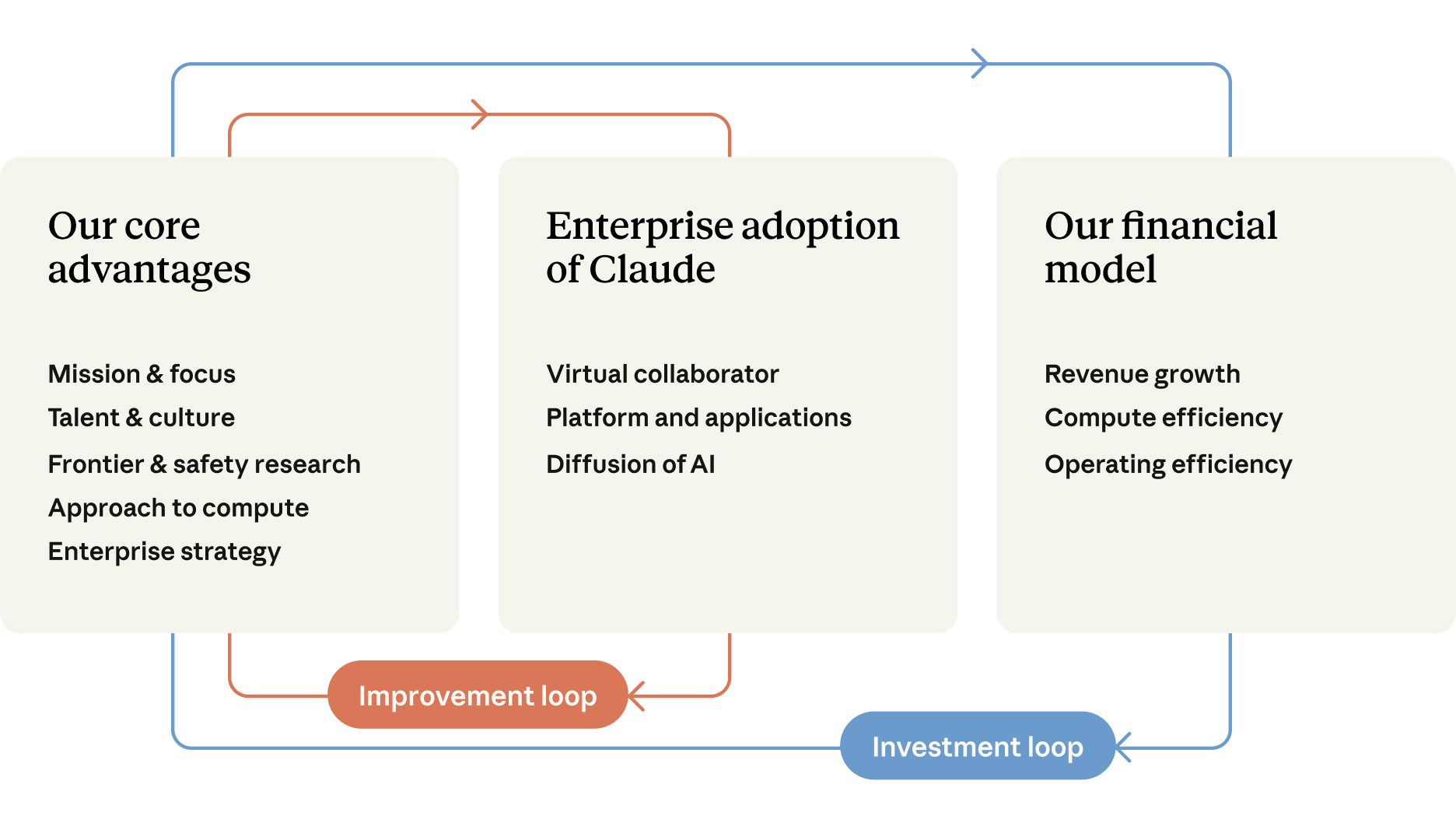
查看图中文字英文转录
Mission & focus
Talent & culture
Frontier & safety research
Approach to compute
Enterprise strategy
Enterprise adoption of Claude
Virtual collaborator
Platform and applications
Diffusion of AI
Our financial model
Revenue growth
Compute efficiency
Operating efficiency
Improvement loop
Investment loop
Claude:改进循环与投资循环
查看图中文字英文转录
Frontier Intelligence
Improvement loop
Better models
More use cases
More feedback
Investment loop
Higher growth
More investment
More capabilities
从聊天机器人、辅助助手到虚拟协作者
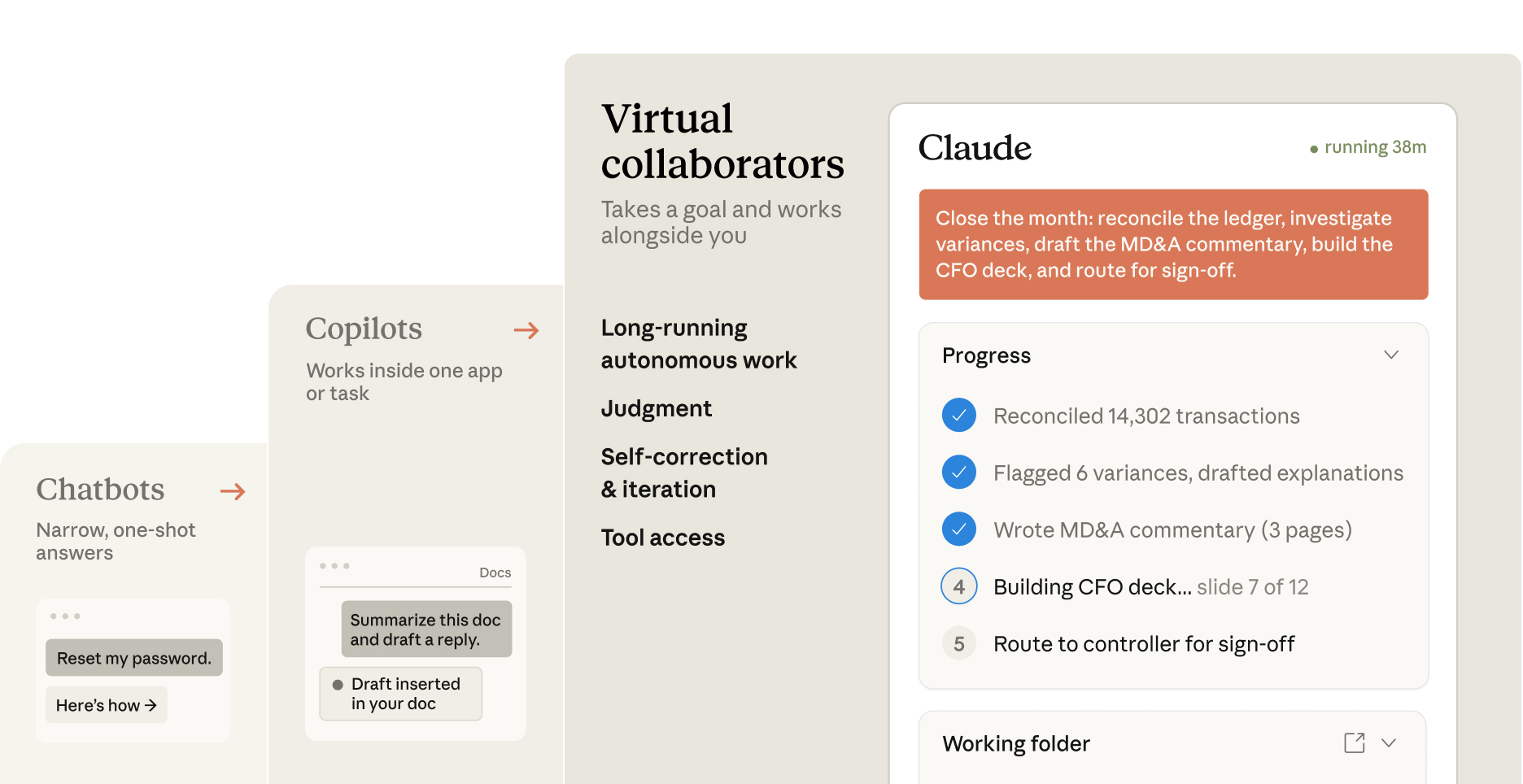
查看图中文字英文转录
Narrow, one-shot answers
Reset my password.
Here’s how →
Copilots
Works inside one app or task
Docs
Summarize this doc and draft a reply.
Draft inserted in your doc
Virtual collaborators
Takes a goal and works alongside you
Long-running autonomous work
Judgment
Self-correction & iteration
Tool access
Claude
running 38m
Close the month: reconcile the ledger, investigate variances, draft the MD&A commentary, build the CFO deck, and route for sign-off.
Progress
Reconciled 14,302 transactions
Flagged 6 variances, drafted explanations
Wrote MD&A commentary (3 pages)
4 Building CFO deck... slide 7 of 12
5 Route to controller for sign-off
Working folder
Claude 的客户价值、平台与模型
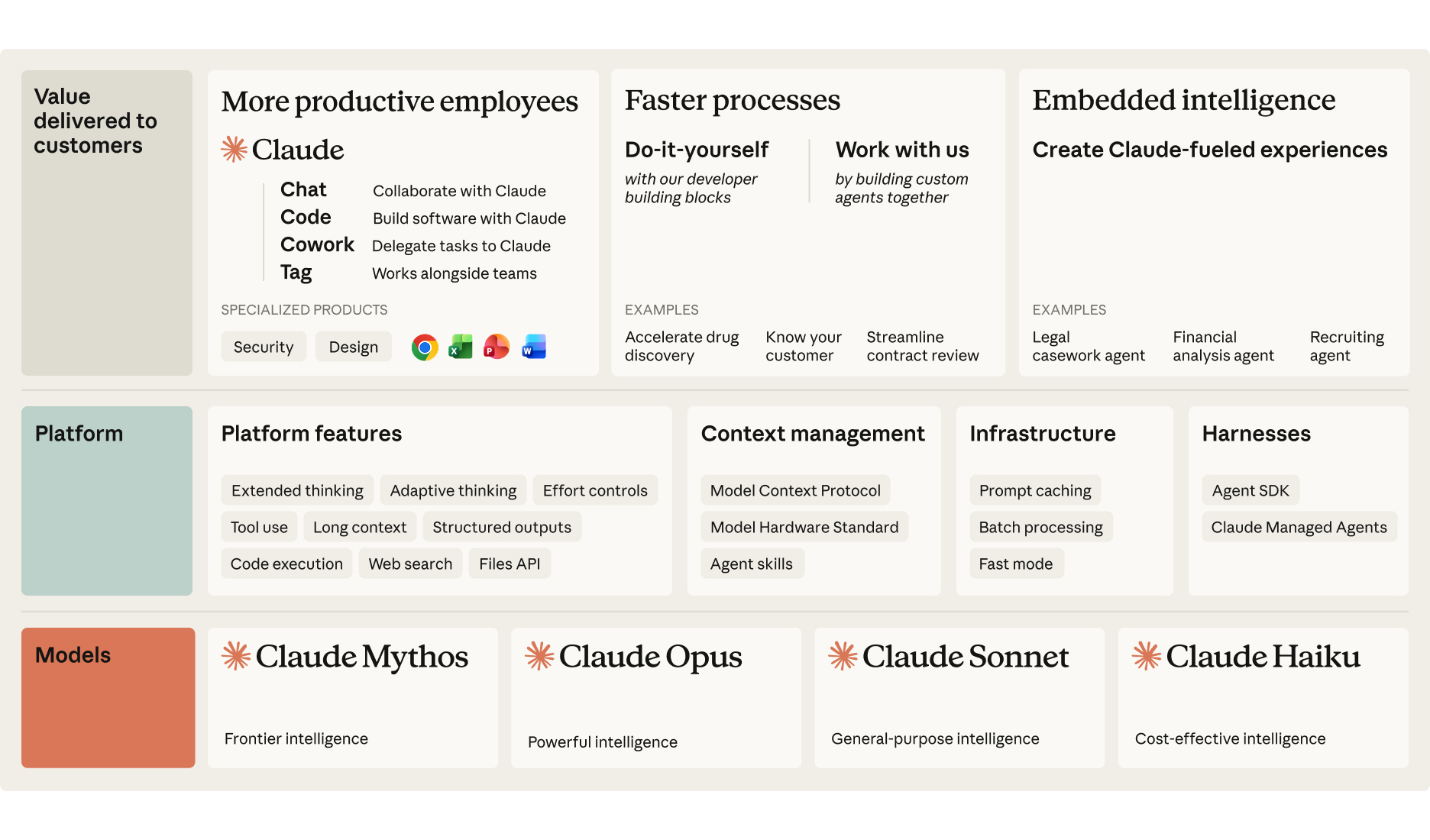
查看图中文字英文转录
More productive employees
Claude
Chat — Collaborate with Claude
Code — Build software with Claude
Cowork — Delegate tasks to Claude
Tag — Works alongside teams
SPECIALIZED PRODUCTS
Security
Design
Faster processes
Do-it-yourself — with our developer building blocks
Work with us — by building custom agents together
EXAMPLES
Accelerate drug discovery
Know your customer
Streamline contract review
Embedded intelligence
Create Claude-fueled experiences
EXAMPLES
Legal casework agent
Financial analysis agent
Recruiting agent
Platform
Platform features
Extended thinking
Adaptive thinking
Effort controls
Tool use
Long context
Structured outputs
Code execution
Web search
Files API
Context management
Model Context Protocol
Model Hardware Standard
Agent skills
Infrastructure
Prompt caching
Batch processing
Fast mode
Harnesses
Agent SDK
Claude Managed Agents
Models
Claude Mythos — Frontier intelligence
Claude Opus — Powerful intelligence
Claude Sonnet — General-purpose intelligence
Claude Haiku — Cost-effective intelligence
Accenture:推动专业服务的未来
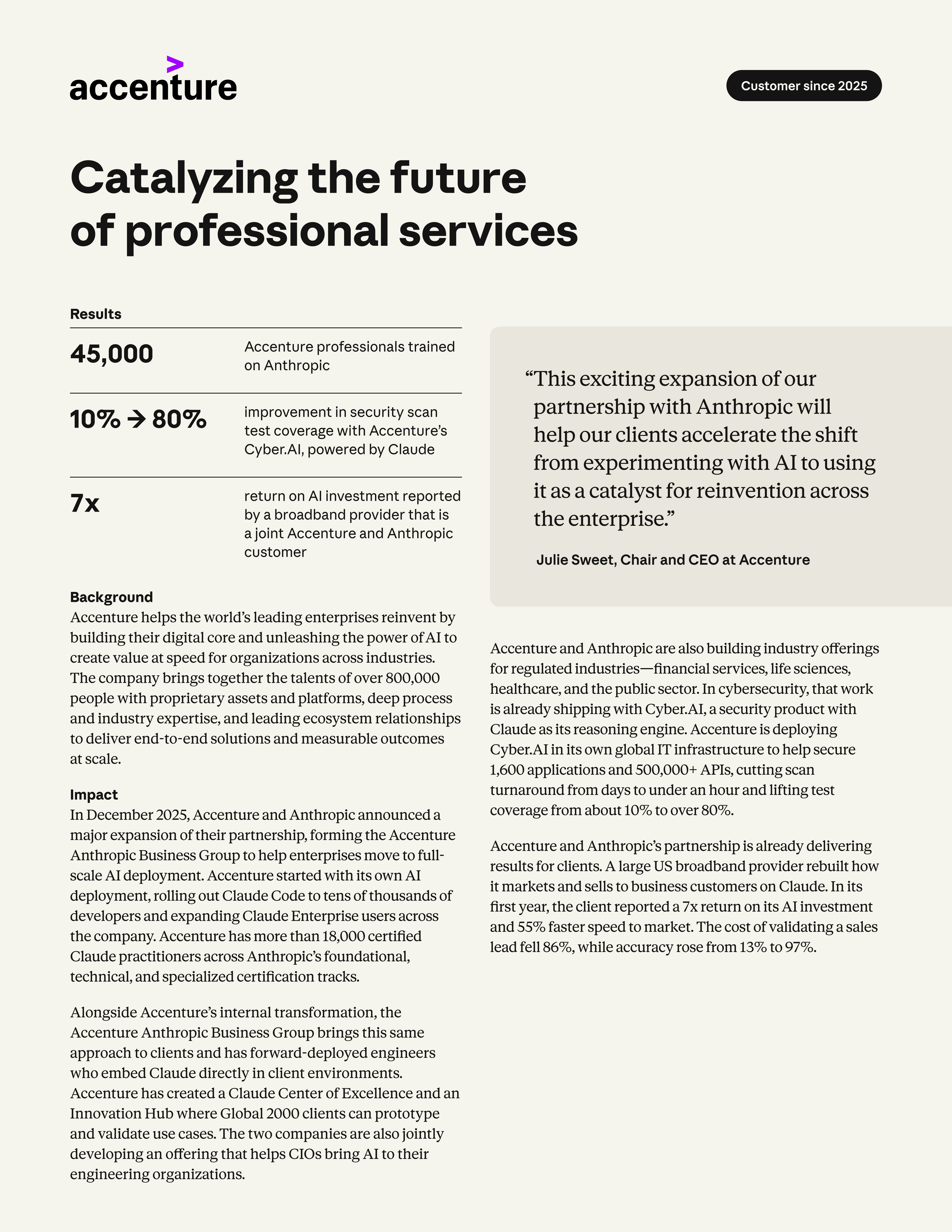
查看图中文字英文转录
Customer since 2025
Catalyzing the future
of professional services
Results
45,000
Accenture professionals trained
on Anthropic
improvement in security scan
test coverage with Accenture’s
Cyber.AI, powered by Claude
10% → 80%
7x return on AI investment reported
by a broadband provider that is
a joint Accenture and Anthropic
customer
Background
Accenture helps the world’s leading enterprises reinvent by
building their digital core and unleashing the power of AI to
create value at speed for organizations across industries.
The company brings together the talents of over 800,000
people with proprietary assets and platforms, deep process
and industry expertise, and leading ecosystem relationships
to deliver end-to-end solutions and measurable outcomes
at scale.
Impact
In December 2025, Accenture and Anthropic announced a
major expansion of their partnership, forming the Accenture
Anthropic Business Group to help enterprises move to full-scale AI deployment. Accenture started with its own AI
deployment, rolling out Claude Code to tens of thousands of
developers and expanding Claude Enterprise users across
the company. Accenture has more than 18,000 certified
Claude practitioners across Anthropic’s foundational,
technical, and specialized certification tracks.
Alongside Accenture’s internal transformation, the
Accenture Anthropic Business Group brings this same
approach to clients and has forward-deployed engineers
who embed Claude directly in client environments.
Accenture has created a Claude Center of Excellence and an
Innovation Hub where Global 2000 clients can prototype
and validate use cases. The two companies are also jointly
developing an offering that helps CIOs bring AI to their
engineering organizations.
“This exciting expansion of our
partnership with Anthropic will
help our clients accelerate the shift
from experimenting with AI to using
it as a catalyst for reinvention across
the enterprise.”
Julie Sweet, Chair and CEO at Accenture
Accenture and Anthropic are also building industry offerings
for regulated industries—financial services, life sciences,
healthcare, and the public sector. In cybersecurity, that work
is already shipping with Cyber.AI, a security product with
Claude as its reasoning engine. Accenture is deploying
Cyber.AI in its own global IT infrastructure to help secure
1,600 applications and 500,000+ APIs, cutting scan
turnaround from days to under an hour and lifting test
coverage from about 10% to over 80%.
Accenture and Anthropic’s partnership is already delivering
results for clients. A large US broadband provider rebuilt how
it markets and sells to business customers on Claude. In its
first year, the client reported a 7x return on its AI investment
and 55% faster speed to market. The cost of validating a sales
lead fell 86%, while accuracy rose from 13% to 97%.
AIG:重塑商业保险核保
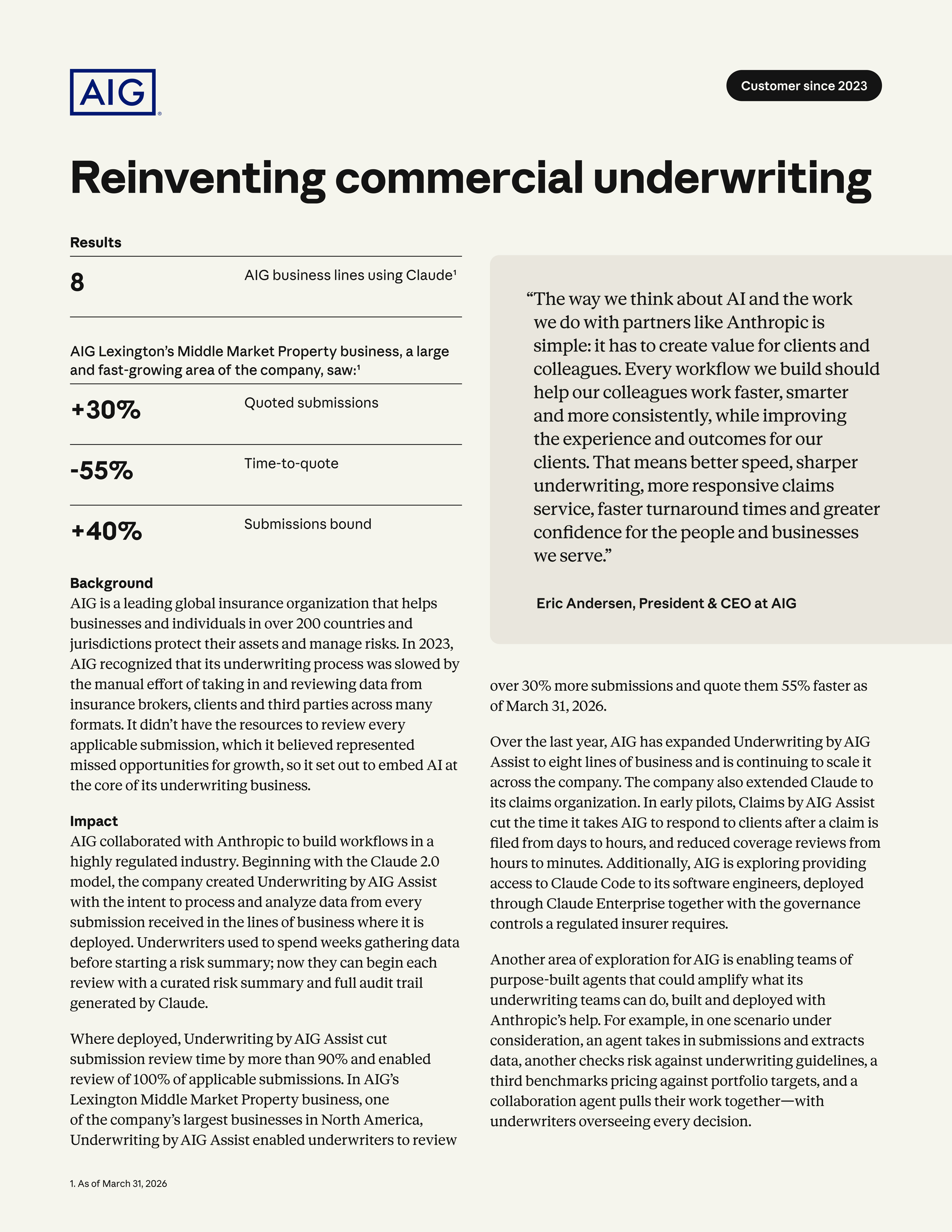
查看图中文字英文转录
Customer since 2023
Reinventing commercial underwriting
Results
8 AIG business lines using Claude¹
AIG Lexington’s Middle Market Property business, a large and fast-growing area of the company, saw:¹
+30% Quoted submissions
-55% Time-to-quote
+40% Submissions bound
Background
AIG is a leading global insurance organization that helps businesses and individuals in over 200 countries and jurisdictions protect their assets and manage risks. In 2023, AIG recognized that its underwriting process was slowed by the manual effort of taking in and reviewing data from insurance brokers, clients and third parties across many formats. It didn’t have the resources to review every applicable submission, which it believed represented missed opportunities for growth, so it set out to embed AI at the core of its underwriting business.
Impact
AIG collaborated with Anthropic to build workflows in a highly regulated industry. Beginning with the Claude 2.0 model, the company created Underwriting by AIG Assist with the intent to process and analyze data from every submission received in the lines of business where it is deployed. Underwriters used to spend weeks gathering data before starting a risk summary; now they can begin each review with a curated risk summary and full audit trail generated by Claude.
Where deployed, Underwriting by AIG Assist cut submission review time by more than 90% and enabled review of 100% of applicable submissions. In AIG’s Lexington Middle Market Property business, one of the company’s largest businesses in North America, Underwriting by AIG Assist enabled underwriters to review over 30% more submissions and quote them 55% faster as of March 31, 2026.
“The way we think about AI and the work we do with partners like Anthropic is simple: it has to create value for clients and colleagues. Every workflow we build should help our colleagues work faster, smarter and more consistently, while improving the experience and outcomes for our clients. That means better speed, sharper underwriting, more responsive claims service, faster turnaround times and greater confidence for the people and businesses we serve.”
Eric Andersen, President & CEO at AIG
Over the last year, AIG has expanded Underwriting by AIG Assist to eight lines of business and is continuing to scale it across the company. The company also extended Claude to its claims organization. In early pilots, Claims by AIG Assist cut the time it takes AIG to respond to clients after a claim is filed from days to hours, and reduced coverage reviews from hours to minutes. Additionally, AIG is exploring providing access to Claude Code to its software engineers, deployed through Claude Enterprise together with the governance controls a regulated insurer requires.
Another area of exploration for AIG is enabling teams of purpose-built agents that could amplify what its underwriting teams can do, built and deployed with Anthropic’s help. For example, in one scenario under consideration, an agent takes in submissions and extracts data, another checks risk against underwriting guidelines, a third benchmarks pricing against portfolio targets, and a collaboration agent pulls their work together—with underwriters overseeing every decision.
1. As of March 31, 2026
Bristol Myers Squibb:加速新药发现
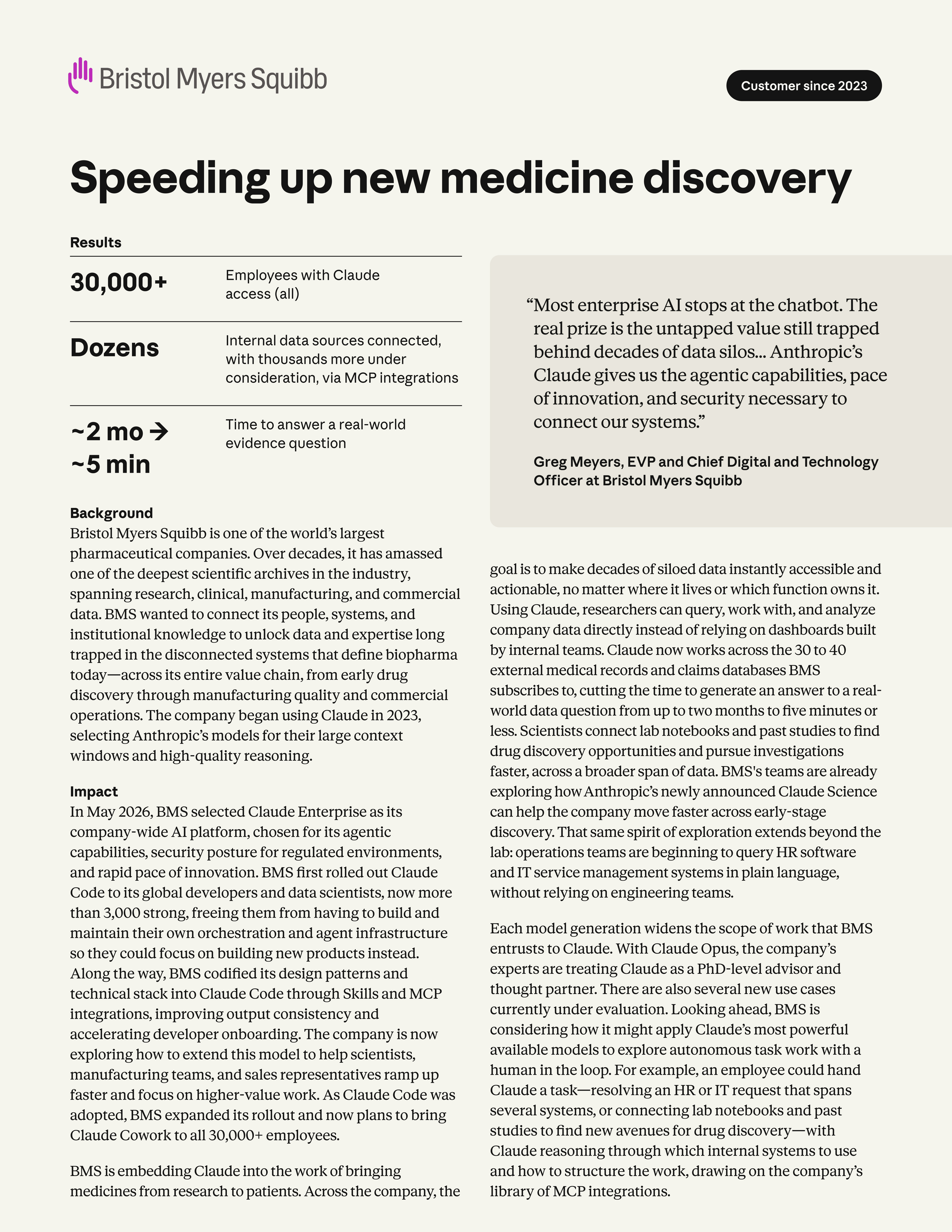
查看图中文字英文转录
Customer since 2023
Speeding up new medicine discovery
Results
30,000+ Employees with Claude access (all)
Dozens Internal data sources connected, with thousands more under consideration, via MCP integrations
~2 mo → ~5 min Time to answer a real-world evidence question
Background
Bristol Myers Squibb is one of the world’s largest pharmaceutical companies. Over decades, it has amassed one of the deepest scientific archives in the industry, spanning research, clinical, manufacturing, and commercial data. BMS wanted to connect its people, systems, and institutional knowledge to unlock data and expertise long trapped in the disconnected systems that define biopharma today—across its entire value chain, from early drug discovery through manufacturing quality and commercial operations. The company began using Claude in 2023, selecting Anthropic’s models for their large context windows and high-quality reasoning.
Impact
In May 2026, BMS selected Claude Enterprise as its company-wide AI platform, chosen for its agentic capabilities, security posture for regulated environments, and rapid pace of innovation. BMS first rolled out Claude Code to its global developers and data scientists, now more than 3,000 strong, freeing them from having to build and maintain their own orchestration and agent infrastructure so they could focus on building new products instead. Along the way, BMS codified its design patterns and technical stack into Claude Code through Skills and MCP integrations, improving output consistency and accelerating developer onboarding. The company is now exploring how to extend this model to help scientists, manufacturing teams, and sales representatives ramp up faster and focus on higher-value work. As Claude Code was adopted, BMS expanded its rollout and now plans to bring Claude Cowork to all 30,000+ employees.
BMS is embedding Claude into the work of bringing medicines from research to patients. Across the company, the goal is to make decades of siloed data instantly accessible and actionable, no matter where it lives or which function owns it. Using Claude, researchers can query, work with, and analyze company data directly instead of relying on dashboards built by internal teams. Claude now works across the 30 to 40 external medical records and claims databases BMS subscribes to, cutting the time to generate an answer to a real-world data question from up to two months to five minutes or less. Scientists connect lab notebooks and past studies to find drug discovery opportunities and pursue investigations faster, across a broader span of data. BMS's teams are already exploring how Anthropic’s newly announced Claude Science can help the company move faster across early-stage discovery. That same spirit of exploration extends beyond the lab: operations teams are beginning to query HR software and IT service management systems in plain language, without relying on engineering teams.
“Most enterprise AI stops at the chatbot. The real prize is the untapped value still trapped behind decades of data silos... Anthropic’s Claude gives us the agentic capabilities, pace of innovation, and security necessary to connect our systems.”
Greg Meyers, EVP and Chief Digital and Technology Officer at Bristol Myers Squibb
Each model generation widens the scope of work that BMS entrusts to Claude. With Claude Opus, the company’s experts are treating Claude as a PhD-level advisor and thought partner. There are also several new use cases currently under evaluation. Looking ahead, BMS is considering how it might apply Claude’s most powerful available models to explore autonomous task work with a human in the loop. For example, an employee could hand Claude a task—resolving an HR or IT request that spans several systems, or connecting lab notebooks and past studies to find new avenues for drug discovery—with Claude reasoning through which internal systems to use and how to structure the work, drawing on the company’s library of MCP integrations.
DoorDash:从编程到知识工作,支持每一位员工
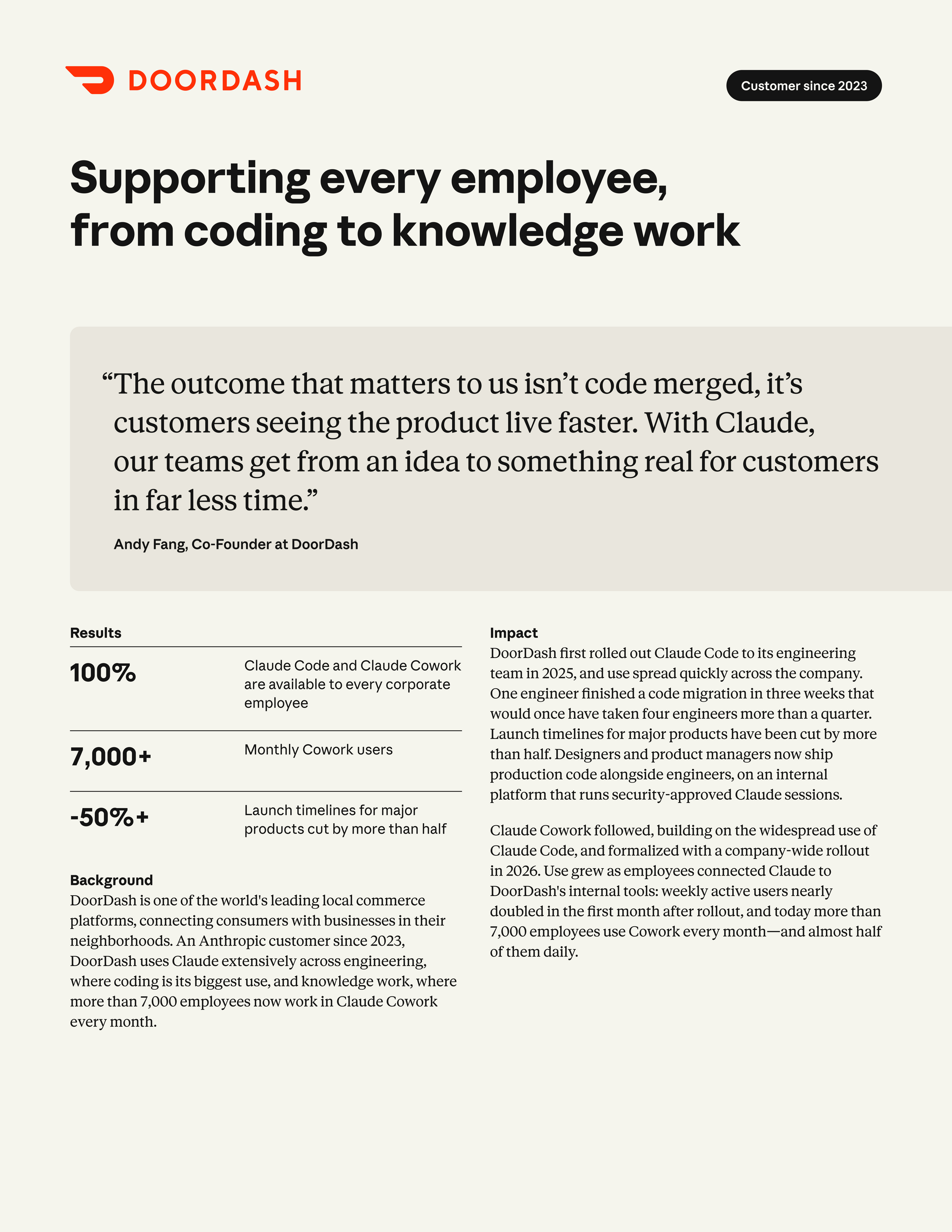
查看图中文字英文转录
Customer since 2023
Supporting every employee, from coding to knowledge work
“The outcome that matters to us isn’t code merged, it’s customers seeing the product live faster. With Claude, our teams get from an idea to something real for customers in far less time.”
Andy Fang, Co-Founder at DoorDash
Results
100% Claude Code and Claude Cowork are available to every corporate employee
7,000+ Monthly Cowork users
-50%+ Launch timelines for major products cut by more than half
Background
DoorDash is one of the world's leading local commerce platforms, connecting consumers with businesses in their neighborhoods. An Anthropic customer since 2023, DoorDash uses Claude extensively across engineering, where coding is its biggest use, and knowledge work, where more than 7,000 employees now work in Claude Cowork every month.
Impact
DoorDash first rolled out Claude Code to its engineering team in 2025, and use spread quickly across the company. One engineer finished a code migration in three weeks that would once have taken four engineers more than a quarter. Launch timelines for major products have been cut by more than half. Designers and product managers now ship production code alongside engineers, on an internal platform that runs security-approved Claude sessions.
Claude Cowork followed, building on the widespread use of Claude Code, and formalized with a company-wide rollout in 2026. Use grew as employees connected Claude to DoorDash's internal tools: weekly active users nearly doubled in the first month after rollout, and today more than 7,000 employees use Cowork every month—and almost half of them daily.
以前沿 AI 支持一线人道主义救援
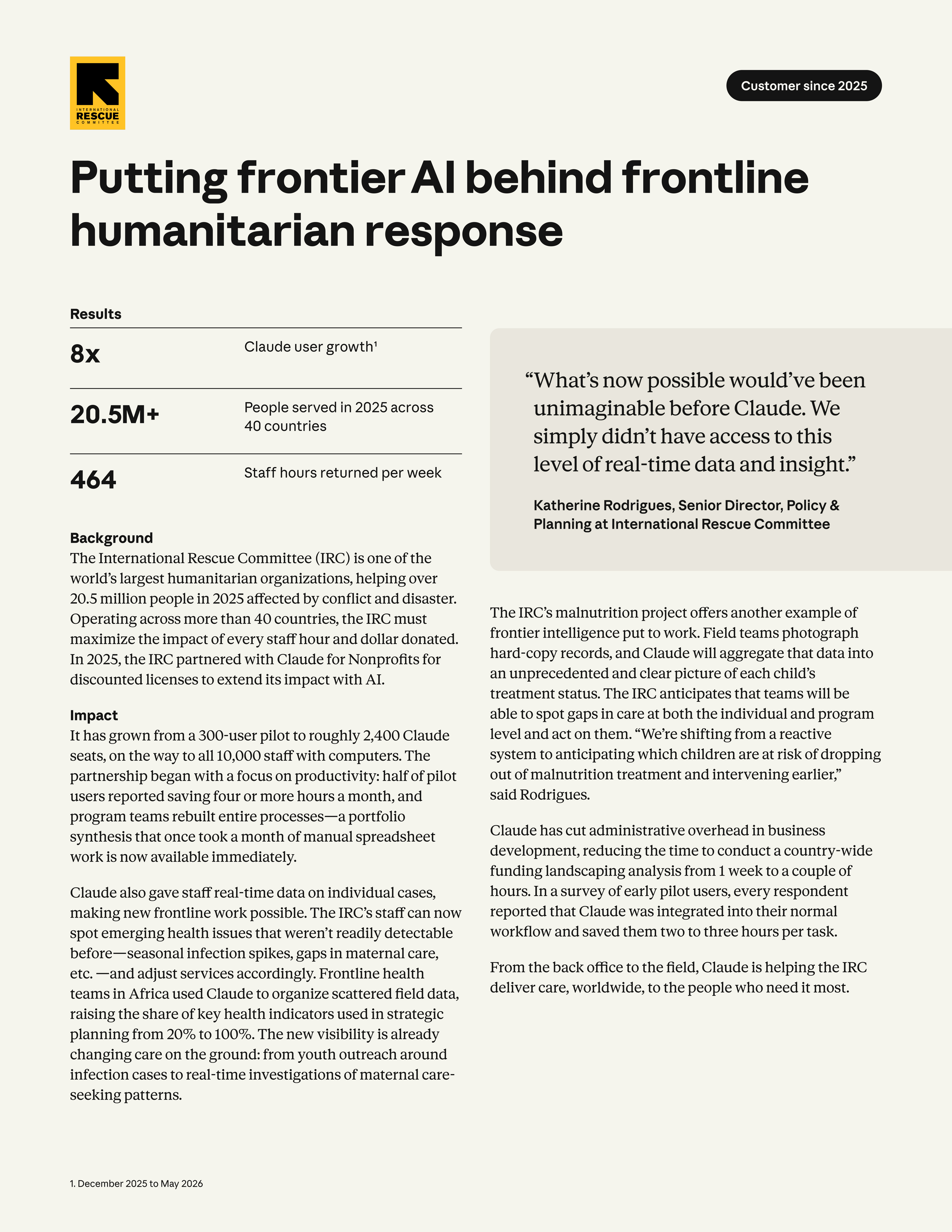
查看图中文字英文转录
Customer since 2025
Putting frontier AI behind frontline humanitarian response
Results
8x — Claude user growth¹
20.5M+ — People served in 2025 across 40 countries
464 — Staff hours returned per week
Background
The International Rescue Committee (IRC) is one of the world’s largest humanitarian organizations, helping over 20.5 million people in 2025 affected by conflict and disaster. Operating across more than 40 countries, the IRC must maximize the impact of every staff hour and dollar donated. In 2025, the IRC partnered with Claude for Nonprofits for discounted licenses to extend its impact with AI.
Impact
It has grown from a 300-user pilot to roughly 2,400 Claude seats, on the way to all 10,000 staff with computers. The partnership began with a focus on productivity: half of pilot users reported saving four or more hours a month, and program teams rebuilt entire processes—a portfolio synthesis that once took a month of manual spreadsheet work is now available immediately.
Claude also gave staff real-time data on individual cases, making new frontline work possible. The IRC’s staff can now spot emerging health issues that weren’t readily detectable before—seasonal infection spikes, gaps in maternal care, etc.—and adjust services accordingly. Frontline health teams in Africa used Claude to organize scattered field data, raising the share of key health indicators used in strategic planning from 20% to 100%. The new visibility is already changing care on the ground: from youth outreach around infection cases to real-time investigations of maternal care-seeking patterns.
“What’s now possible would’ve been unimaginable before Claude. We simply didn’t have access to this level of real-time data and insight.”
Katherine Rodrigues, Senior Director, Policy & Planning at International Rescue Committee
The IRC’s malnutrition project offers another example of frontier intelligence put to work. Field teams photograph hard-copy records, and Claude will aggregate that data into an unprecedented and clear picture of each child’s treatment status. The IRC anticipates that teams will be able to spot gaps in care at both the individual and program level and act on them. “We’re shifting from a reactive system to anticipating which children are at risk of dropping out of malnutrition treatment and intervening earlier,” said Rodrigues.
Claude has cut administrative overhead in business development, reducing the time to conduct a country-wide funding landscaping analysis from 1 week to a couple of hours. In a survey of early pilot users, every respondent reported that Claude was integrated into their normal workflow and saved them two to three hours per task.
From the back office to the field, Claude is helping the IRC deliver care, worldwide, to the people who need it most.
1. December 2025 to May 2026
交易公司可以信赖的前沿智能
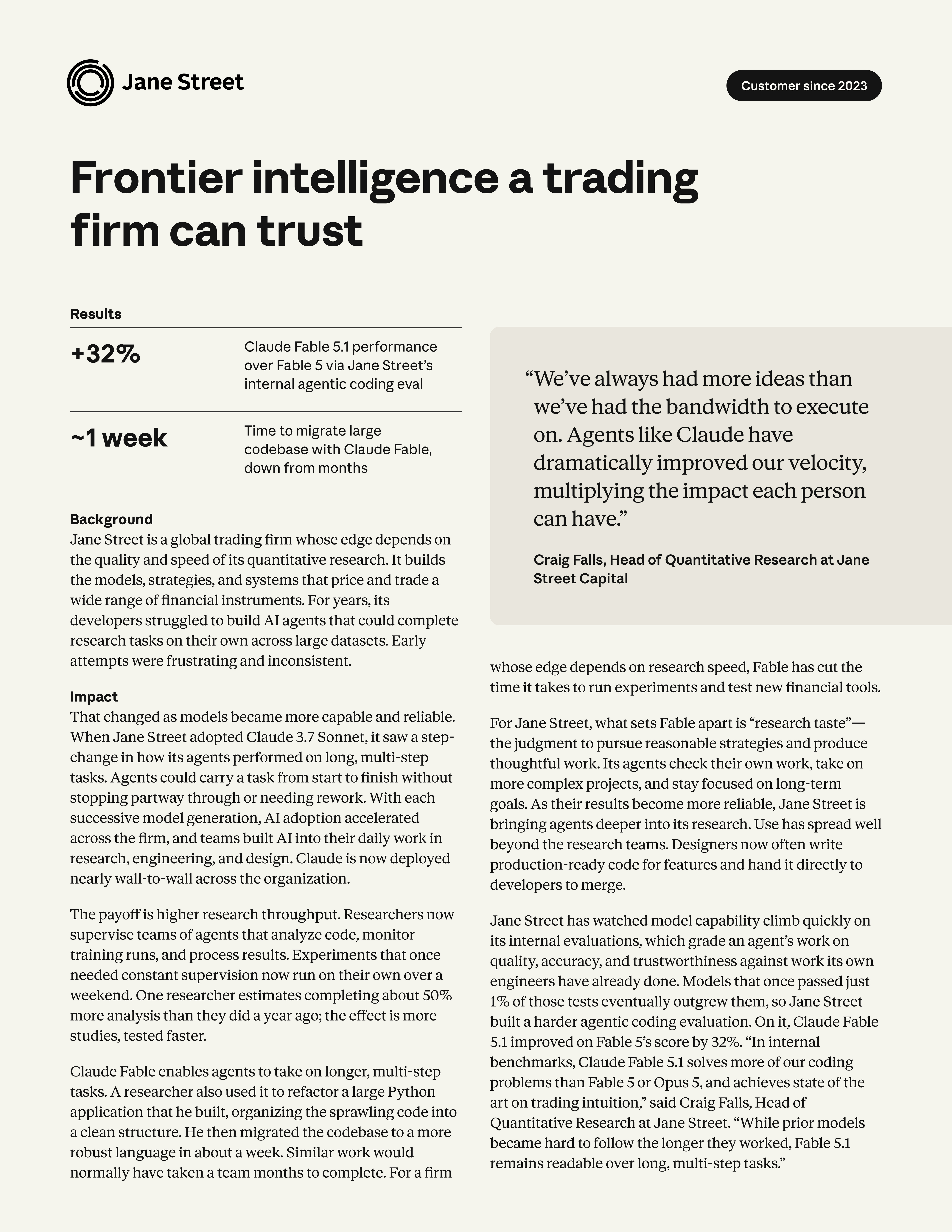
查看图中文字英文转录
Customer since 2023
Frontier intelligence a trading firm can trust
Results
+32% — Claude Fable 5.1 performance over Fable 5 via Jane Street’s internal agentic coding eval
~1 week — Time to migrate large codebase with Claude Fable, down from months
Background
Jane Street is a global trading firm whose edge depends on the quality and speed of its quantitative research. It builds the models, strategies, and systems that price and trade a wide range of financial instruments. For years, its developers struggled to build AI agents that could complete research tasks on their own across large datasets. Early attempts were frustrating and inconsistent.
Impact
That changed as models became more capable and reliable. When Jane Street adopted Claude 3.7 Sonnet, it saw a step-change in how its agents performed on long, multi-step tasks. Agents could carry a task from start to finish without stopping partway through or needing rework. With each successive model generation, AI adoption accelerated across the firm, and teams built AI into their daily work in research, engineering, and design. Claude is now deployed nearly wall-to-wall across the organization.
The payoff is higher research throughput. Researchers now supervise teams of agents that analyze code, monitor training runs, and process results. Experiments that once needed constant supervision now run on their own over a weekend. One researcher estimates completing about 50% more analysis than they did a year ago; the effect is more studies, tested faster.
Claude Fable enables agents to take on longer, multi-step tasks. A researcher also used it to refactor a large Python application that he built, organizing the sprawling code into a clean structure. He then migrated the codebase to a more robust language in about a week. Similar work would normally have taken a team months to complete. For a firm whose edge depends on research speed, Fable has cut the time it takes to run experiments and test new financial tools.
“We’ve always had more ideas than we’ve had the bandwidth to execute on. Agents like Claude have dramatically improved our velocity, multiplying the impact each person can have.”
Craig Falls, Head of Quantitative Research at Jane Street Capital
For Jane Street, what sets Fable apart is “research taste”—the judgment to pursue reasonable strategies and produce thoughtful work. Its agents check their own work, take on more complex projects, and stay focused on long-term goals. As their results become more reliable, Jane Street is bringing agents deeper into its research. Use has spread well beyond the research teams. Designers now often write production-ready code for features and hand it directly to developers to merge.
Jane Street has watched model capability climb quickly on its internal evaluations, which grade an agent’s work on quality, accuracy, and trustworthiness against work its own engineers have already done. Models that once passed just 1% of those tests eventually outgrew them, so Jane Street built a harder agentic coding evaluation. On it, Claude Fable 5.1 improved on Fable 5’s score by 32%. “In internal benchmarks, Claude Fable 5.1 solves more of our coding problems than Fable 5 or Opus 5, and achieves state of the art on trading intuition,” said Craig Falls, Head of Quantitative Research at Jane Street. “While prior models became hard to follow the longer they worked, Fable 5.1 remains readable over long, multi-step tasks.”
扩大面向律师的智能体式操作系统的应用规模
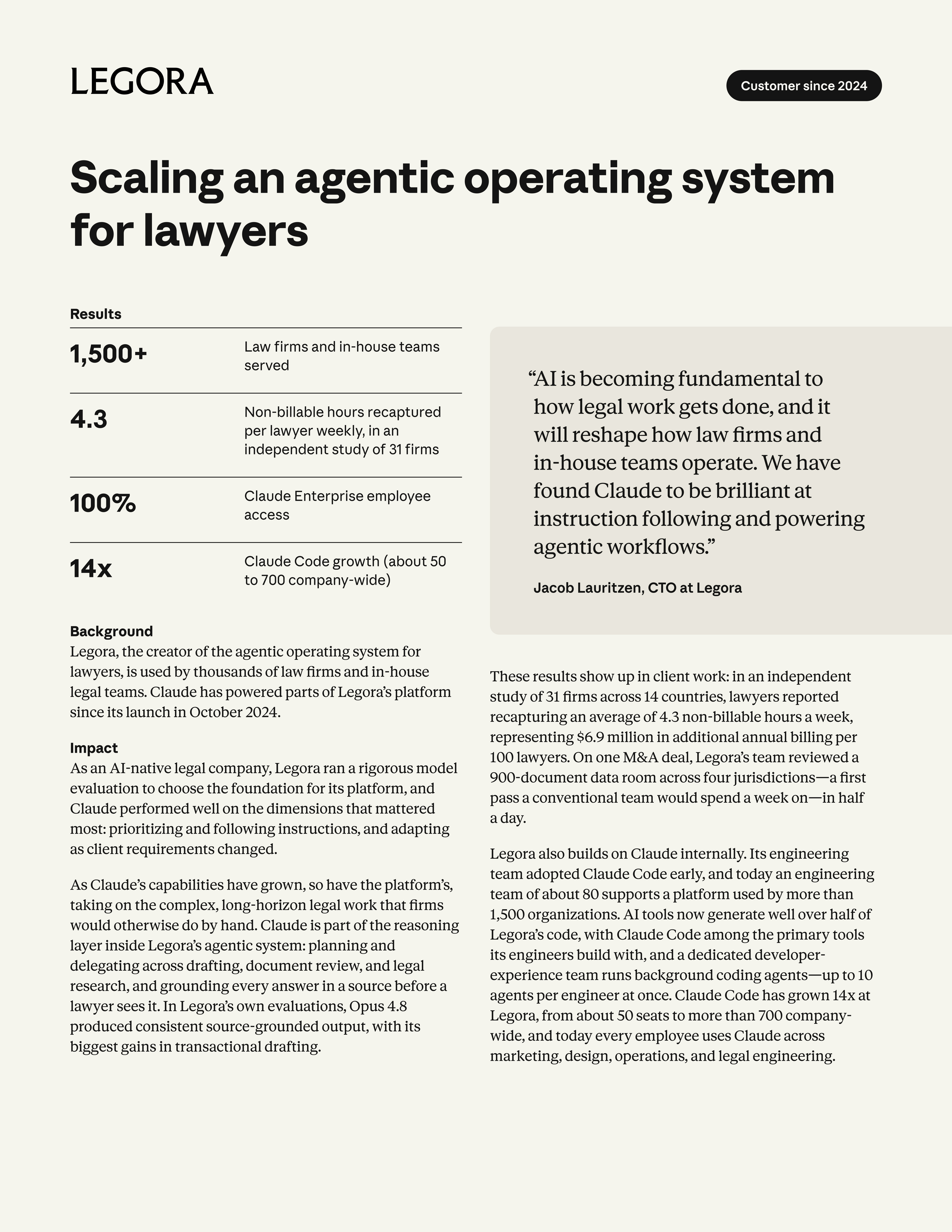
查看图中文字英文转录
Customer since 2024
Scaling an agentic operating system for lawyers
Results
1,500+ — Law firms and in-house teams served
4.3 — Non-billable hours recaptured per lawyer weekly, in an independent study of 31 firms
100% — Claude Enterprise employee access
14x — Claude Code growth (about 50 to 700 company-wide)
Background
Legora, the creator of the agentic operating system for lawyers, is used by thousands of law firms and in-house legal teams. Claude has powered parts of Legora’s platform since its launch in October 2024.
Impact
As an AI-native legal company, Legora ran a rigorous model evaluation to choose the foundation for its platform, and Claude performed well on the dimensions that mattered most: prioritizing and following instructions, and adapting as client requirements changed.
As Claude’s capabilities have grown, so have the platform’s, taking on the complex, long-horizon legal work that firms would otherwise do by hand. Claude is part of the reasoning layer inside Legora’s agentic system: planning and delegating across drafting, document review, and legal research, and grounding every answer in a source before a lawyer sees it. In Legora’s own evaluations, Opus 4.8 produced consistent source-grounded output, with its biggest gains in transactional drafting.
“AI is becoming fundamental to how legal work gets done, and it will reshape how law firms and in-house teams operate. We have found Claude to be brilliant at instruction following and powering agentic workflows.”
Jacob Lauritzen, CTO at Legora
These results show up in client work: in an independent study of 31 firms across 14 countries, lawyers reported recapturing an average of 4.3 non-billable hours a week, representing $6.9 million in additional annual billing per 100 lawyers. On one M&A deal, Legora’s team reviewed a 900-document data room across four jurisdictions—a first pass a conventional team would spend a week on—in half a day.
Legora also builds on Claude internally. Its engineering team adopted Claude Code early, and today an engineering team of about 80 supports a platform used by more than 1,500 organizations. AI tools now generate well over half of Legora’s code, with Claude Code among the primary tools its engineers build with, and a dedicated developer-experience team runs background coding agents—up to 10 agents per engineer at once. Claude Code has grown 14x at Legora, from about 50 seats to more than 700 company-wide, and today every employee uses Claude across marketing, design, operations, and legal engineering.
Lilly:将科学领域最强大的工具带给每个团队
查看图中文字英文转录
Customer since 2024
Bringing the most powerful tools
in science to every team
Results
50,000+
Employees with access to
Claude Enterprise
5x
Expansion since rollout
Employees in key functions
actively engage with Claude
>85%
Background
Lilly is a medicine company turning science into healing to
make life better for people around the world. For 150 years,
Lilly has pioneered life-changing discoveries. Today, its
medicines help tens of millions of people across the globe,
with treatments for diabetes and obesity, Alzheimer’s
disease, immune system disorders, and cancer. Lilly began
using Claude in 2024 through Amazon Bedrock, building
Anthropic’s models into its internal AI platform and into the
tools its developers use to write code.
Impact
In July 2025, Lilly rolled out Claude Enterprise to about
10,000 people, primarily in its research organization. By
April 2026, Lilly had made Claude Enterprise available
across its employee base, the first large pharmaceutical
company to do so. Lilly has five functions that use Claude
most - legal and compliance, technology, finance, oncology,
and research. Within these functions, more than 85% of full-time employees actively engage with Claude.
Lilly’s early adopters in research are still finding new uses
for Claude. Biologists who once relied on spreadsheet
macros for routine data processing now build working web
apps with Claude in a couple of hours. Chemists can use
Claude to visualize complex data in real time, which helps
them uncover new motifs and configurations of atoms that
would have taken hours with traditional methods.
“Science and technology have always
advanced together. So we gave
Claude to our scientists first. Now
Claude is across the company, and
we can't imagine going back.
Patients are waiting, so we can't.”
Diogo Rau, Executive Vice President and Chief
Information and Digital Officer at Eli Lilly and
Company
To support the company-wide rollout, Lilly’s technology
organization built its own controls, then partnered with
Anthropic to shape the enterprise readiness roadmap
underpinning Claude Enterprise. That work includes a
secure private connection, designed to let Claude reach
internal Lilly systems without exposing them to the public
internet, and data loss prevention hooks that audit the data
that passes through Claude. Lilly worked with Anthropic
engineers on the hooks, providing requirements and
helping Anthropic to test them. The team also built an
internal marketplace where teams publish skills and
plugins, with Claude performing a first-pass review of
submissions.
In October 2026, Lilly began piloting Claude Science,
Anthropic’s workbench for scientists, across a wide group of
users. Lilly helped shape its enterprise controls in the same
way, providing requirements and helping Anthropic test
them. The two companies are building these tools together
to help move science forward.
Mercado Libre:变革拉丁美洲的电子商务
查看图中文字英文转录
Customer since 2023
Transforming e-commerce
in Latin America
Results
>100%
Merged code up year over year
Code submissions reviewed
autonomously over the past year
500,000+
Non-tech teams active in
Cowork weekly
78%
Background
Mercado Libre is the leading e-commerce and financial
technology company in Latin America, with operations in 18
countries. It made its developers more productive by rolling
out Claude Code across its engineering organization. The
goal was to help the team ship faster by shifting the upkeep
of its infrastructure—version migrations, dependency
patches, and test coverage across 40,000 microservices—
onto Claude.
Impact
Mercado Libre evaluated multiple AI providers to find one
that could autonomously handle more of its operational
burden and make its engineering team more effective. It uses
Claude Code for its most demanding workloads—codebase
migrations, automated code review, and test generation—and
for individual developer productivity. Mercado Libre became
one of the earliest adopters in January 2025; today 23,000+
developers across the organization use it. Claude also runs
the company’s wide-scale autonomous changes: over the
past year, agents with human oversight have reviewed more
than half a million code submissions and migrated roughly
9,000 services to newer platforms.
The productivity gains are already significant: in Q2 2026,
code submissions rose 110% year over year, merged code
more than 100%, and deployments nearly 75%. Quality
improved at the same time, with rollbacks down year over
year. In 2025, about 40% of the code Mercado Libre shipped
to production was written by Claude and reviewed by a
human engineer before release. By 2026, human-written
code has become the exception. The change reshaped the
company’s development team, with 30% of managerial roles now contributing code again. Mercado Libre’s near-term
goal is for 90% of its coding to run autonomously, including
the full pull-request review process. It also plans to fold its
separate backend, frontend, and database roles into a single
builder role, with agents filling the gaps.
“Productivity gains with AI have put
our most senior engineers back to
building code, not just reviewing it.
Claude Cowork now reaches 31,000
employees—one of the largest
enterprise deployments globally.”
Mercado Libre
Mercado Libre then extended Claude to non-engineering
teams. Finance went first: within a month, most of the team
had adopted Claude Cowork, using shared skills to generate
branded presentations in minutes—work that used to take
several people hours a week. Cowork also shortened the
monthly financial close by a third and improved internal
reporting. Finance can now preview the close on demand
instead of waiting for month end, so the team spots shifts
like rising costs sooner and reacts faster. Because Claude is
grounded in Mercado Libre’s business context, it also drafts
the first explanations for why results moved, which the
business and finance teams then validate. From there it
spread across marketing, HR, legal, compliance, and the
business and commercial teams, reaching more than 26,500
people across these teams—78% of them now active every
week. Some procurement teams even built their own
Claude-powered agents to field supplier questions, without
involving IT. “I'd almost say we no longer use spreadsheets
—everything’s automated, and we have dashboards built on
Claude all over the place. Now we're redesigning core
processes from scratch, AI-first—things people always
dreamed of but thought were impossible,” said Maria Pia
Garcia, Strategic Transformation Director at Mercado Libre.
Mozilla:发现攻击者尚未发现的漏洞
查看图中文字英文转录
Customer since 2025
Finding the vulnerabilities
attackers haven’t
“We have many years of experience picking apart the
work of the world’s best security researchers, and Mythos
Preview is every bit as capable. So far we’ve found no
category or complexity of vulnerability that humans can
find that this model can’t.”
Bobby Holley, Chief Technology Officer at Firefox
Results
22 Vulnerabilities found by Claude
Opus 4.6, and resolved as of
Firefox 148
Vulnerabilities found by Claude
Mythos Preview, and resolved as
of Firefox 150
271
Background
Mozilla is the creator and maintainer of Firefox, a leading
open-source browser used by hundreds of millions of
people globally. For more than two decades, Firefox has
been one of the most heavily scrutinized open-source
codebases on the web. Its engineering team was an early
adopter of Claude Code, which today is widely used across
Firefox engineering.
Impact
Mozilla has long used advanced security techniques to
protect Firefox users, which is why Anthropic’s Frontier Red
Team approached the company to put Claude to the test on
cyberdefense. In a two-week evaluation, Claude Opus 4.6
uncovered 22 previously unknown vulnerabilities in
Firefox’s most critical code — 14 of them high-severity.
Mozilla’s engineers began landing fixes within hours and
shipped them in Firefox 148. Two months later, Mozilla
shipped fixes for an additional 271 vulnerabilities identified
by Claude Mythos Preview.
For Mozilla, the asymmetry that has long favored attackers
is starting to reverse: defects that once waited years to
surface can now be found and fixed individually by the
experienced defenders who own the code.
“We view these tools as clear evidence that large-scale, AI-assisted analysis is a powerful new addition in security
engineers’ toolbox. Firefox has undergone some of the most
extensive testing, static analysis, and regular security
review over decades. Despite this, the model was able to
reveal many previously unknown bugs,” said Mozilla.
PayPal:为超过 12K 名员工规模化应用 AI
查看图中文字英文转录
Customer since 2025
Scaling AI for over 12K employees
Results
12,000+
Claude Enterprise monthly
active users
Average time saved per sales
team member per week
45 min
Background
PayPal operates one of the world’s largest digital payments
networks, trusted by hundreds of millions of consumers and
merchants. As a globally regulated financial institution, it
builds and ships technology that meets a heightened,
complex set of compliance requirements.
Impact
Claude and other tools now enable how many of PayPal’s
employees work and the intelligence it delivers to its
customers. More than 12,000 PayPal employees now use
Claude across product, technology, and sales. Claude Code
is among the most-used AI tools on its technology team.
Teams from PayPal’s product organization can now self-serve their product analysis and dashboard creation
through Claude. Its product team built a custom MCP server
for data queries and retrieval, reducing reliance on
engineering and data analysts.
Merchant underwriting, compliance review, and deal cycles
are enhanced with Claude, increasing review efficiency and
consolidating data that were previously spread across
multiple siloed tools. Reviews that once took hours now take
a fraction of the time. Since August 2025, PayPal's sales
team has used a custom-built plugin specifically for pipeline
management and account risk review, saving an average of
45 minutes per user per week.
“In 2025, we gave our employees
access to the leading AI tools and
let the results speak for themselves.
What tells me Claude has become
a trusted collaborator at PayPal
is that our people now turn to it
as an everyday thought and
execution partner.”
Anshu Bhardwaj, Chief AI Transformation
& Simplification Officer at PayPal
Account management teams use AMOS (an Account
Management Operating System), an AI-powered analytics
platform built on Claude, to get portfolio insights, merchant
health diagnostics, and pipeline intelligence in minutes
instead of days. This AI-powered analytics platform
replaces manual dashboarding with conversational access
to live data. AMOS has cut report prep time to 5-10 minutes
and surfaces weekly merchant growth signals, some of
which were previously undetected. This frees up account
managers to spend more time with merchants.
In addition, PayPal is a partner on Anthropic’s AI Fluency
for Small Business course, which helps small business staff
—whether in customer interactions, back-office
management, supply chain operations, or leadership—build
practical collaboration skills.
Rakuten:让每一位员工都成为构建者
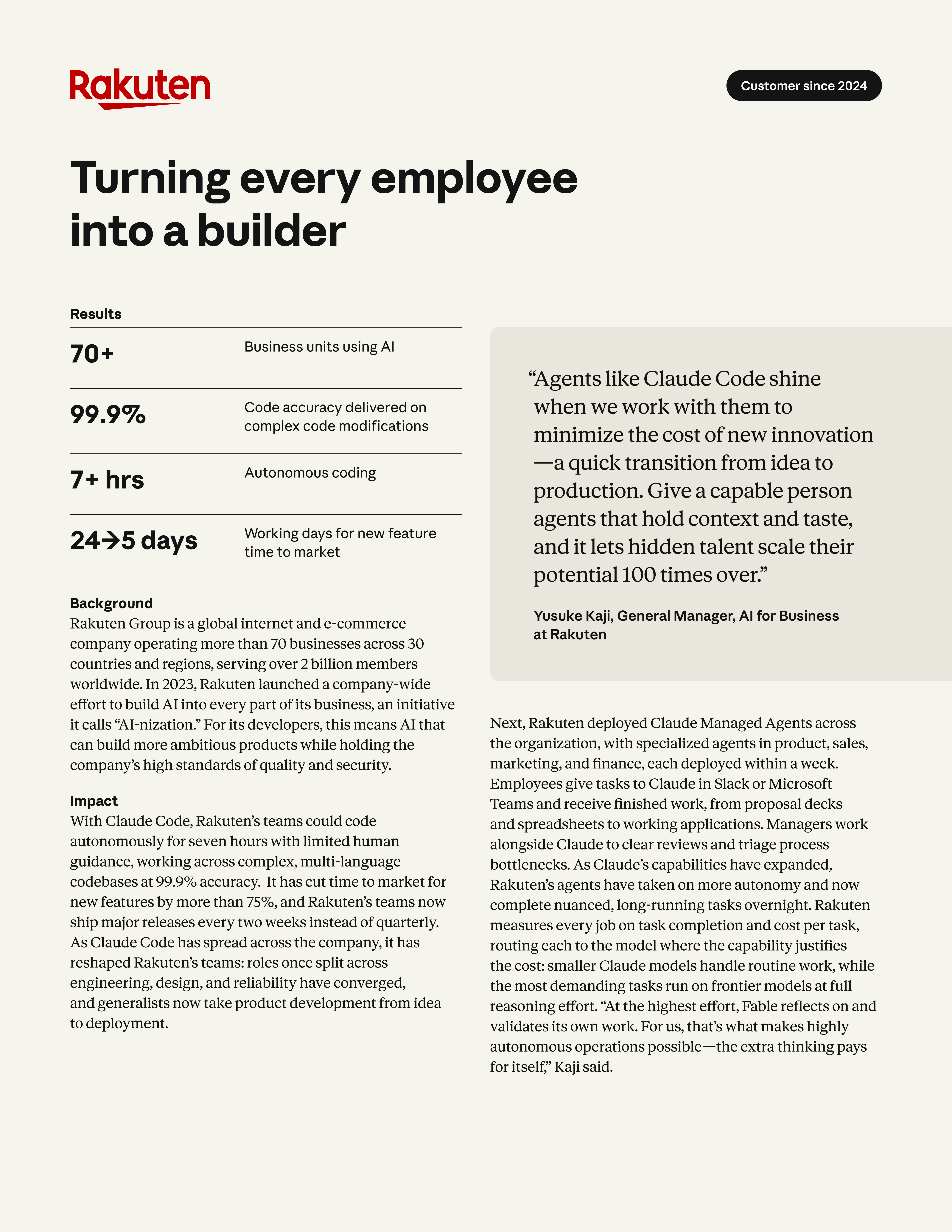
查看图中文字英文转录
Customer since 2024
Turning every employee
into a builder
Results
70+
Business units using AI
Code accuracy delivered on
complex code modifications
99.9%
Autonomous coding
7+hrs
Working days for new feature
time to market
24→5 days
Background
Rakuten Group is a global internet and e-commerce
company operating more than 70 businesses across 30
countries and regions, serving over 2 billion members
worldwide. In 2023, Rakuten launched a company-wide
effort to build AI into every part of its business, an initiative
it calls “AI-nization.” For its developers, this means AI that
can build more ambitious products while holding the
company’s high standards of quality and security.
Impact
With Claude Code, Rakuten’s teams could code
autonomously for seven hours with limited human
guidance, working across complex, multi-language
codebases at 99.9% accuracy. It has cut time to market for
new features by more than 75%, and Rakuten’s teams now
ship major releases every two weeks instead of quarterly.
As Claude Code has spread across the company, it has
reshaped Rakuten’s teams: roles once split across
engineering, design, and reliability have converged,
and generalists now take product development from idea
to deployment.
“Agents like Claude Code shine
when we work with them to
minimize the cost of new innovation
—a quick transition from idea to
production. Give a capable person
agents that hold context and taste,
and it lets hidden talent scale their
potential 100 times over.”
Yusuke Kaji, General Manager, AI for Business
at Rakuten
Next, Rakuten deployed Claude Managed Agents across
the organization, with specialized agents in product, sales,
marketing, and finance, each deployed within a week.
Employees give tasks to Claude in Slack or Microsoft
Teams and receive finished work, from proposal decks
and spreadsheets to working applications. Managers work
alongside Claude to clear reviews and triage process
bottlenecks. As Claude’s capabilities have expanded,
Rakuten’s agents have taken on more autonomy and now
complete nuanced, long-running tasks overnight. Rakuten
measures every job on task completion and cost per task,
routing each to the model where the capability justifies
the cost: smaller Claude models handle routine work, while
the most demanding tasks run on frontier models at full
reasoning effort. “At the highest effort, Fable reflects on and
validates its own work. For us, that’s what makes highly
autonomous operations possible—the extra thinking pays
for itself,” Kaji said.
Salesforce:重塑全球企业构建自身的方式
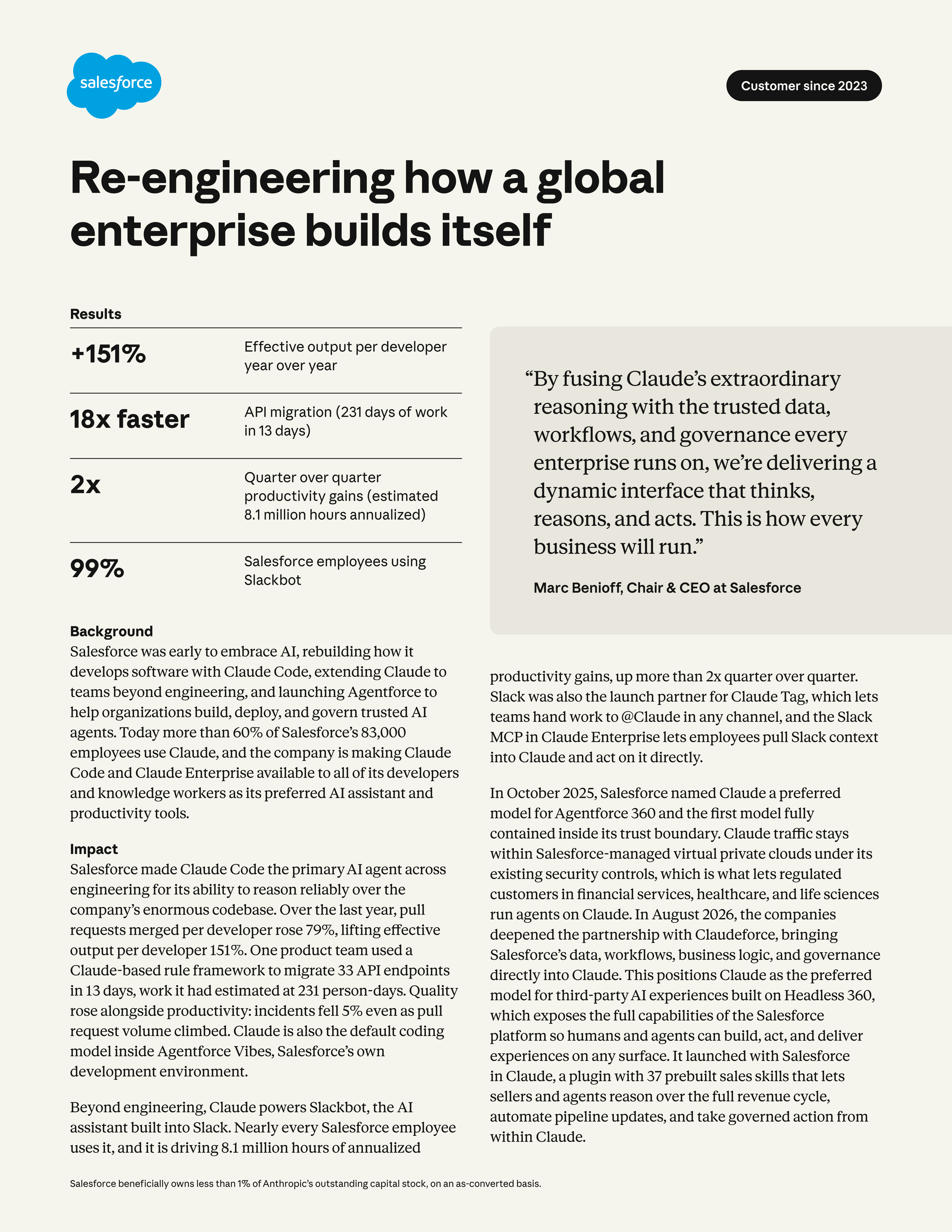
查看图中文字英文转录
Customer since 2023
Re-engineering how a global
enterprise builds itself
Results
+151%
Effective output per developer
year over year
18x faster — API migration (231 days of work in 13 days)
2x Quarter over quarter
productivity gains (estimated
8.1 million hours annualized)
Salesforce employees using
Slackbot
99%
Background
Salesforce was early to embrace AI, rebuilding how it
develops software with Claude Code, extending Claude to
teams beyond engineering, and launching Agentforce to
help organizations build, deploy, and govern trusted AI
agents. Today more than 60% of Salesforce’s 83,000
employees use Claude, and the company is making Claude
Code and Claude Enterprise available to all of its developers
and knowledge workers as its preferred AI assistant and
productivity tools.
Impact
Salesforce made Claude Code the primary AI agent across
engineering for its ability to reason reliably over the
company’s enormous codebase. Over the last year, pull
requests merged per developer rose 79%, lifting effective
output per developer 151%. One product team used a
Claude-based rule framework to migrate 33 API endpoints
in 13 days, work it had estimated at 231 person-days. Quality
rose alongside productivity: incidents fell 5% even as pull
request volume climbed. Claude is also the default coding
model inside Agentforce Vibes, Salesforce’s own
development environment.
Beyond engineering, Claude powers Slackbot, the AI
assistant built into Slack. Nearly every Salesforce employee
uses it, and it is driving 8.1 million hours of annualized productivity gains, up more than 2x quarter over quarter.
Slack was also the launch partner for Claude Tag, which lets
teams hand work to @Claude in any channel, and the Slack
MCP in Claude Enterprise lets employees pull Slack context
into Claude and act on it directly.
In October 2025, Salesforce named Claude a preferred
model for Agentforce 360 and the first model fully
contained inside its trust boundary. Claude traffic stays
within Salesforce-managed virtual private clouds under its
existing security controls, which is what lets regulated
customers in financial services, healthcare, and life sciences
run agents on Claude. In August 2026, the companies
deepened the partnership with Claudeforce, bringing
Salesforce’s data, workflows, business logic, and governance
directly into Claude. This positions Claude as the preferred
model for third-party AI experiences built on Headless 360,
which exposes the full capabilities of the Salesforce
platform so humans and agents can build, act, and deliver
experiences on any surface. It launched with Salesforce in Claude, a plugin with 37 prebuilt sales skills that lets
sellers and agents reason over the full revenue cycle,
automate pipeline updates, and take governed action from
within Claude.
Salesforce beneficially owns less than 1% of Anthropic’s outstanding capital stock, on an as-converted basis.
“By fusing Claude's extraordinary
reasoning with the trusted data,
workflows, and governance every
enterprise runs on, we're delivering a
dynamic interface that thinks,
reasons, and acts. This is how every
business will run.”
Marc Benioff, Chair & CEO at Salesforce
SAP:将前沿智能嵌入全球商业系统
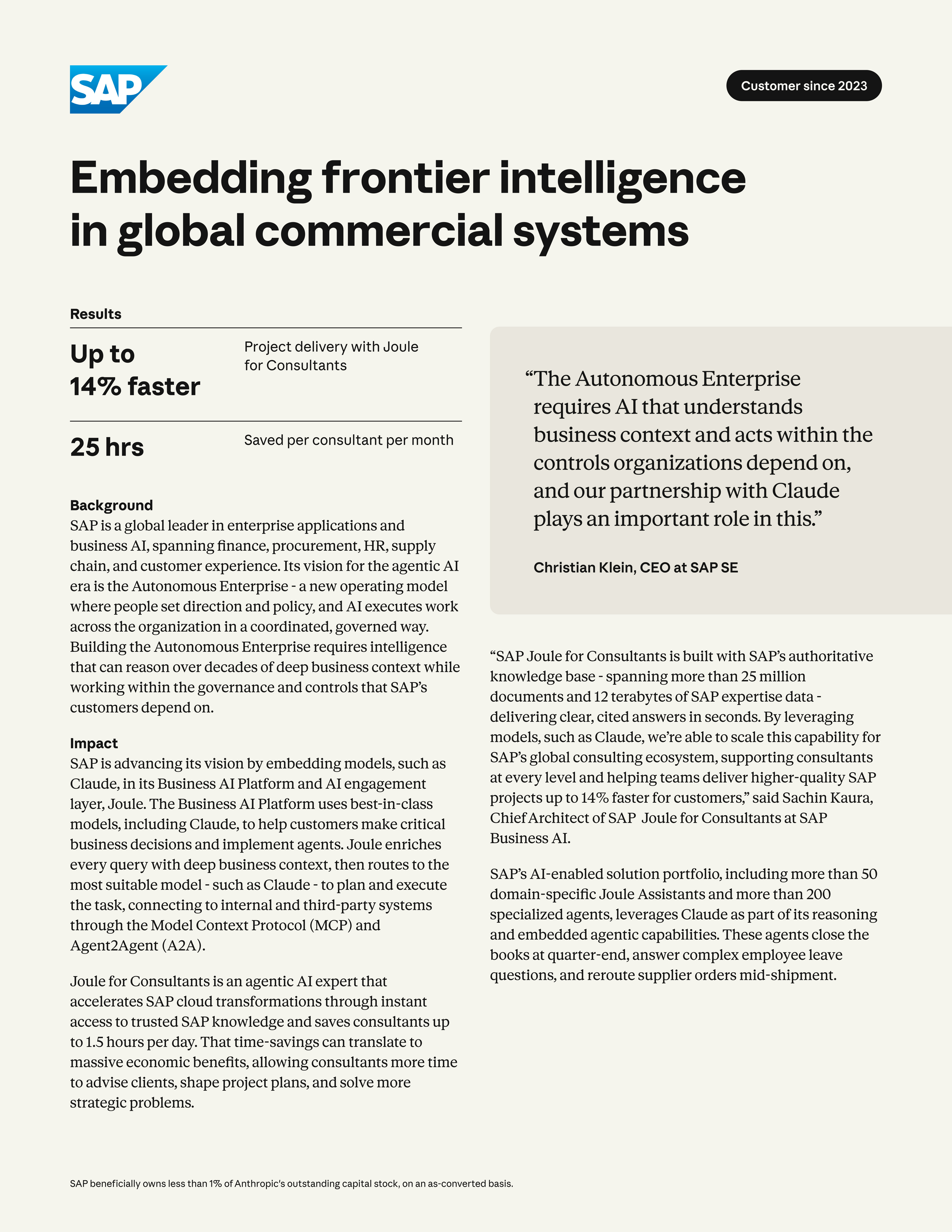
查看图中文字英文转录
Customer since 2023
Embedding frontier intelligence
in global commercial systems
Results
Project delivery with Joule
for Consultants
Up to
14% faster
Saved per consultant per month
25 hrs
Background
SAP is a global leader in enterprise applications and
business AI, spanning finance, procurement, HR, supply
chain, and customer experience. Its vision for the agentic AI
era is the Autonomous Enterprise - a new operating model
where people set direction and policy, and AI executes work
across the organization in a coordinated, governed way.
Building the Autonomous Enterprise requires intelligence
that can reason over decades of deep business context while
working within the governance and controls that SAP’s
customers depend on.
Impact
SAP is advancing its vision by embedding models, such as
Claude, in its Business AI Platform and AI engagement
layer, Joule. The Business AI Platform uses best-in-class
models, including Claude, to help customers make critical
business decisions and implement agents. Joule enriches
every query with deep business context, then routes to the
most suitable model - such as Claude - to plan and execute
the task, connecting to internal and third-party systems
through the Model Context Protocol (MCP) and
Agent2Agent (A2A).
Joule for Consultants is an agentic AI expert that
accelerates SAP cloud transformations through instant
access to trusted SAP knowledge and saves consultants up
to 1.5 hours per day. That time-savings can translate to
massive economic benefits, allowing consultants more time
to advise clients, shape project plans, and solve more
strategic problems.
“The Autonomous Enterprise
requires AI that understands
business context and acts within the
controls organizations depend on,
and our partnership with Claude
plays an important role in this.”
Christian Klein, CEO at SAP SE
“SAP Joule for Consultants is built with SAP’s authoritative
knowledge base - spanning more than 25 million
documents and 12 terabytes of SAP expertise data -
delivering clear, cited answers in seconds. By leveraging
models, such as Claude, we're able to scale this capability for
SAP’s global consulting ecosystem, supporting consultants
at every level and helping teams deliver higher-quality SAP
projects up to 14% faster for customers,” said Sachin Kaura,
Chief Architect of SAP Joule for Consultants at SAP
Business AI.
SAP’s AI-enabled solution portfolio, including more than 50
domain-specific Joule Assistants and more than 200
specialized agents, leverages Claude as part of its reasoning
and embedded agentic capabilities. These agents close the
books at quarter-end, answer complex employee leave
questions, and reroute supplier orders mid-shipment.
SAP beneficially owns less than 1% of Anthropic's outstanding capital stock, on an as-converted basis.
Shopify:借助 Claude 为数百万商家嵌入智能
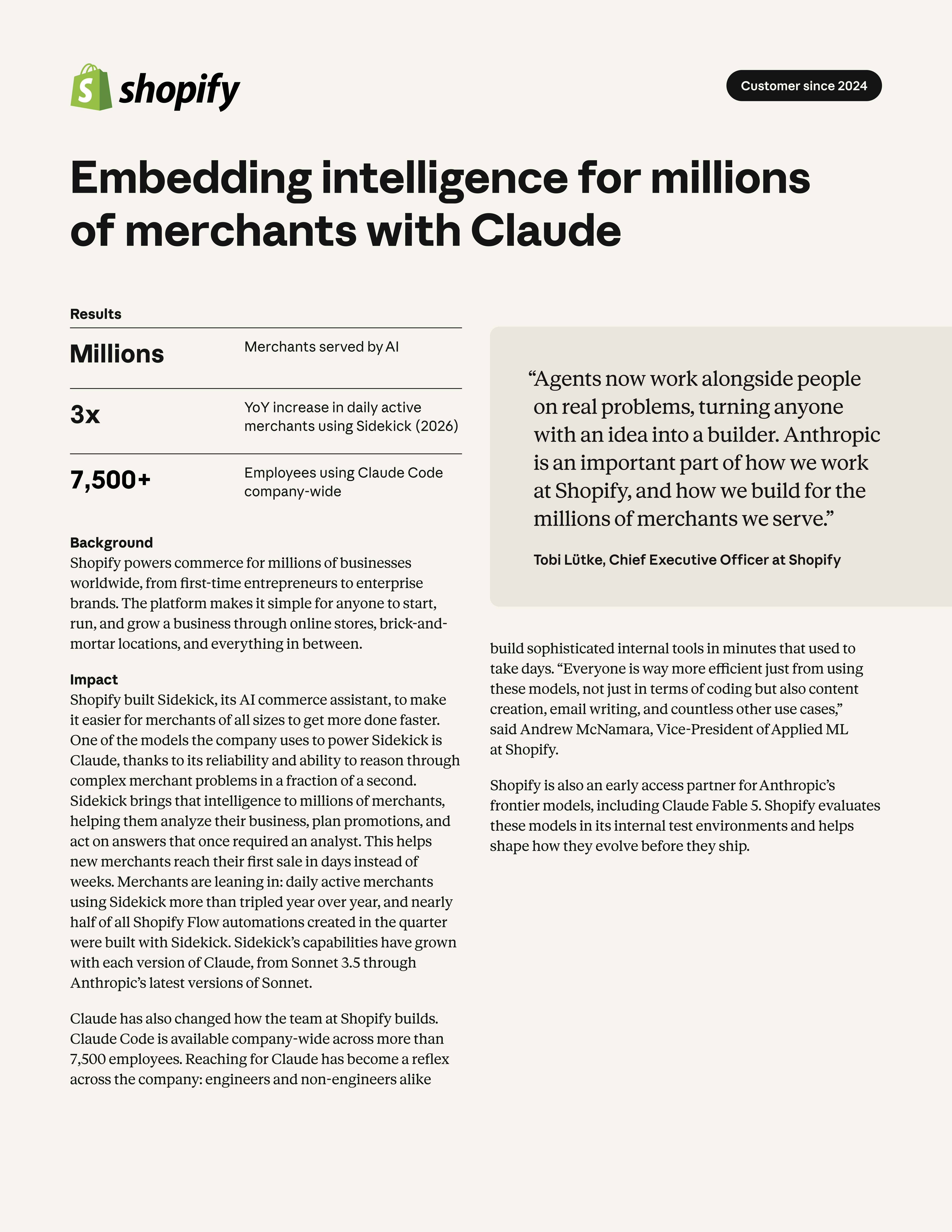
查看图中文字英文转录
Customer since 2024
Embedding intelligence for millions
of merchants with Claude
Results
Millions — Merchants served by AI
3x YoY increase in daily active
merchants using Sidekick (2026)
Employees using Claude Code
company-wide
7,500+
Background
Shopify powers commerce for millions of businesses
worldwide, from first-time entrepreneurs to enterprise
brands. The platform makes it simple for anyone to start,
run, and grow a business through online stores, brick-and-mortar locations, and everything in between.
Impact
Shopify built Sidekick, its AI commerce assistant, to make
it easier for merchants of all sizes to get more done faster.
One of the models the company uses to power Sidekick is
Claude, thanks to its reliability and ability to reason through
complex merchant problems in a fraction of a second.
Sidekick brings that intelligence to millions of merchants,
helping them analyze their business, plan promotions, and
act on answers that once required an analyst. This helps
new merchants reach their first sale in days instead of
weeks. Merchants are leaning in: daily active merchants
using Sidekick more than tripled year over year, and nearly
half of all Shopify Flow automations created in the quarter
were built with Sidekick. Sidekick’s capabilities have grown
with each version of Claude, from Sonnet 3.5 through
Anthropic’s latest versions of Sonnet.
Claude has also changed how the team at Shopify builds.
Claude Code is available company-wide across more than
7,500 employees. Reaching for Claude has become a reflex
across the company: engineers and non-engineers alike build sophisticated internal tools in minutes that used to
take days. “Everyone is way more efficient just from using
these models, not just in terms of coding but also content
creation, email writing, and countless other use cases,”
said Andrew McNamara, Vice-President of Applied ML
at Shopify.
Shopify is also an early access partner for Anthropic’s
frontier models, including Claude Fable 5. Shopify evaluates
these models in its internal test environments and helps
shape how they evolve before they ship.
“Agents now work alongside people
on real problems, turning anyone
with an idea into a builder. Anthropic
is an important part of how we work
at Shopify, and how we build for the
millions of merchants we serve.”
Tobi Lütke, Chief Executive Officer at Shopify
Travelers:通过 AI 深化风险专业能力
查看图中文字英文转录
Customer since 2024
Deepening risk expertise
through AI
“We strategically deploy AI across our business to deepen
our risk expertise, elevate experiences for our customers,
distribution partners and employees, and drive
productivity and efficiency. Our work with Anthropic
is an important part of that effort, and as our use of AI
evolves, we expect the benefits of this partnership to
compound over time.”
Mojgan Lefebvre, EVP, Chief Technology & Operations Officer at Travelers
Results
Nearly 25k
Employees with Claude
assistants
Reduction in time to merge code
-50%
Background
Over the past decade, Travelers has developed the
competitive advantage of an innovation skill set. Now, it is
bringing all that hard-won know-how to deploy AI broadly
and strategically across its business. “From the very
beginning, we wanted to partner with leading AI
organizations,” said Lefebvre. In January 2026, Travelers
empowered nearly 10,000 engineers, data scientists,
analysts and product owners with Claude assistants. That
access has since expanded to nearly 25,000 employees with
meaningful impact.
Impact
Among other things, Travelers is integrating AI throughout
the software development lifecycle—spanning discovery,
design, build, test and deployment. Claude supports faster
prototyping and smarter analysis across the enterprise.
Claude Code advances modern engineering practices,
including code generation and analysis, documentation,
and testing. Travelers teams are writing more code,
committing code more frequently, and merging code into
Travelers’ environment faster.
“Our partnership with Anthropic is important to how we
execute on AI at scale. We pair their leading assistants and
models with Travelers’ proprietary data and expertise to
help drive our agenda across the enterprise,” shares Matt
Gorman, Chief AI Officer.
UST:夯实全球基础设施的根基
查看图中文字英文转录
Customer since 2023
Strengthening the foundations
of global infrastructure
Results
20,000
Associates training on Claude
worldwide
Reduction in chip validation
cycle time
50-70%
Standard validation turnaround
4 → 2 days
Background
UST is a global digital transformation company that builds
and runs technology for the world’s banks, telecoms,
healthcare organizations, and manufacturers. It works on its
clients’ hardest problems at the intersection of software and
the physical world: silicon validation, network operations,
and claims processing. In this work, reliability and safety
have historically depended on manual test scripting and
specialist review. UST is putting Claude to work inside these
high-stakes engineering environments.
Impact
UST proved Claude inside its own engineering organization
first. On UST’s hardware validation platform, Claude Code,
running Opus 4.8, reads chip schematics directly, then
generates and runs regression tests to check downstream
effects. Claude compares live equipment data against a
digital twin—a virtual replica of the hardware—flagging
signal-integrity issues before they reach production. UST
has cut chip validation cycle time by 50-70%, and its goal is
to make its pipeline even faster.
UST now embeds Claude into the systems it builds and runs
for clients. In healthcare, UST CarePath uses Claude to turn
scattered claims and care data into clear next steps, with
human approval before any member-facing recommendation. In telecom, UST IntelliOps uses Claude to
predict cellular network failures and cut alert noise for
operations teams. In banking, UST FinX embeds Claude-powered agents directly into bank operations: intelligent
case handling, servicing automation, and decision support.
Across each industry, UST pairs Claude with human
approval steps and audit controls.
UST is training 20,000 of its engineers, architects,
consultants, and industry specialists on Claude worldwide,
and building specialized teams to deploy Claude for its
clients. With this partnership, UST is bringing Claude to
physical AI—intelligence built into the equipment and
engineering processes that produce the things people use.
“Combining Claude with UST’s
engineering and industry expertise
lets us bring industry-specific
platforms to market that help clients
operationalize AI-led decisions
safely and securely.”
Krishna Sudheendra, Chief Executive Officer
at UST
Verizon:重建并保护美国最大的网络
查看图中文字英文转录
Rebuilding and defending America’s largest network
“We started using Claude Code, and within a few weeks, people across our technology team were working like software developers. We have a mantra now: ‘If you can imagine it, Claude can code it for you.’ The enablement, simplification, and efficiency we’ve achieved in just a few months is amazing.”
Yago Tenorio, SVP and Chief Technology Officer at Verizon
Results
33,000+ — Engineers with Claude Code
Background
Verizon is one of the world’s largest communications companies, operating America’s largest wireless network. As part of its transformation into an AI-first company, Verizon evaluated coding tools for security, reliability and scale, and chose Claude Code for its technology and product organizations. Today, more than 33,000 engineers build with Claude Code.
Impact
Verizon became one of the first telecom companies to join Project Glasswing to strengthen its network security. Verizon partnered with Anthropic in May 2026 to test the advanced artificial intelligence model Claude Mythos to improve network cybersecurity.
Walmart:让购物更快捷、更轻松、更个性化
查看图中文字英文转录
Customer since 2024
Making shopping faster,
easier, and more personal
“We're using AI to make shopping more intuitive and
engineering more productive. Agents like Claude are
helping us do both, from better understanding customer
intent to accelerating repeatable development work.”
Daniel Danker, EVP AI Acceleration, Product & Design at Walmart
Results
110%
Growth in Sparky weekly active
users quarter over quarter
Increase in average order value
via Sparky vs. non-Sparky orders
+35%
2x Increase in units sold via Sparky
quarter over quarter
Background
Walmart is the world’s largest retailer, with more than
10,900 locations worldwide and a leading e-commerce
platform. For decades, Walmart has adopted transformative
technologies to realize its purpose of helping people save
money and live better. The company takes a “people-led,
tech-powered” approach to AI—deeply understanding its
customers and associates, then building solutions that are
best-positioned to help with what’s most important.
Impact
Anthropic’s models—like Claude Sonnet 4.6—are helping
Walmart create more intelligent, personalized experiences
that transform discovery and commerce as customers
express their needs and wants in their own words.
Anthropic partnered with Walmart on Sparky, Walmart’s AI
shopping agent. Sparky helps customers discover products,
compare items, and solve everyday needs, whether they are
shopping online or in stores.
Walmart’s engineers work with Claude too. Claude is one of
the models that powers WIBEY, the company’s developer
productivity agent. WIBEY is used by its engineering teams
to build, deploy, and operate technology—handing
predictable, repeatable tasks to agents while keeping
human oversight and governance in place.
Shy Bird 与 KBF Design Gallery 客户案例
查看图中文字英文转录
Turning insight into action for a neighborhood restaurant
Shy Bird is an all-day rotisserie and café founded by restaurateurs Andrew Holden and Eli Feldman. Shy Bird has grown to three locations across the Boston area and is known for its rotisserie chicken and house sauces. Brunch customers would often face long wait times and delays for one of its most popular locations near Fenway Park. Feldman, who had never written a line of code, photographed the kitchen, pulled sales and ticket data, and gathered his cooks’ observations, then shared it all with Claude.
The bottlenecks it found were hiding in plain sight: the avocado puree that went on nearly every order sat out of reach, while a pan of overnight oats — ordered a few times a morning — held the best spot on the line. Feldman worked through a redesign of the kitchen line with his cooks and they rebuilt the stations together. Peak-hour service is now 60% faster. Fixing their own restaurant convinced Holden and Feldman that the same tools could help others. What began as Shy Bird’s in-house tool has grown into Colette, an intelligence platform now used by 60 restaurants across the country.
“Data and information aren’t useful if you don’t have time or money — what’s useful is insight and action, and that’s what I realized Claude could give us.”
Eli Feldman, Partner at Shy Bird
Results
60%+ — Reduction in brunch ticket times, to 12 minutes
60 — Restaurants now use Colette, the Claude-built platform that Shy Bird owners built
6 months — Time for Shy Bird server to become a full-time back-end engineer at Colette
KBF DESIGN GALLERY
Giving talented designers time to create
KBF Design Gallery is a family-owned interior design and remodeling firm in Orlando, Florida, specializing in custom kitchen, bathroom, and whole-home renovations. When Adam Vellequette and his sister Ashley took over the business from their parents, they faced a common problem in the industry: talented designers buried in administrative work. Using Claude Code and Claude Cowork, KBF built custom tools for scheduling, design-to-construction handoff validation, and contract scope writing - giving their lead designer back nearly a quarter of her working year, time she now spends on the design work that differentiates the client experience. Since adopting Claude in 2025, a team of only 3 designers has grown the firm to 70 designed projects a year — and 32% growth in sales — leveraging the tools KBF built with Claude.
“Learning with Claude has been the number one thing I rely on — it’s been like having access to a level of intelligence you never would have been able to get in the same room with before.”
Adam Vellequette, Co-Owner at KBF Design Gallery
Results
490 hrs — Per year recovered for a single employee — nearly a quarter of a working year
7 hrs — Per project cut from contract scope writing
70 — Projects designed annually with AI-assisted scheduling, handoff validation, and client communication
治理结构
我们的治理结构及其目标
我们新颖的股本及公司治理结构经过精心设计,与其他上市公司的结构存在显著差异。我们致力于帮助人类安全地迈入一个新时代,在这个时代,变革性 AI 将对广泛的人类活动产生巨大且可能具有决定性的影响。以公益公司(PBC)形式运营,使我们的董事会拥有必要的裁量空间,以平衡股东的金钱利益、受到我们行为重大影响的人士的最佳利益,以及我们的公司宗旨。此外,不具有财务利害关系的长期利益信托(LTBT)通常有权选举及罢免占董事会授权席位总数过半数的董事,其设立旨在提供适当实现这一平衡所需的激励与洞见。我们还认为,我们的七位联合创始人具备独特的条件,能够守护我们的使命。
公益公司
我们根据特拉华州法律注册成立为公益公司,这一结构使我们能够践行对 AI 安全性与责任的承诺。公益公司是一类旨在创造公共利益,并以负责任、可持续的方式运营的公司。作为公益公司,我们须平衡:(i) 股东的金钱利益;(ii) 受到我们行为重大影响的人士的最佳利益;以及 (iii) 公司宗旨。这要求我们的董事会在考虑股东金钱利益的同时,权衡多项因素,包括决策带来的相关长期及短期外部性。迄今,我们发现,AI 的安全性与社会福祉,以及对所有关键利益相关方群体最佳利益的考量,通常与我们的长期商业成功及股东的长期金钱利益一致。然而,作为公益公司,我们可能作出我们认为恰当平衡股东金钱利益、受到我们行为重大影响的人士的最佳利益及公司宗旨的决策,但这些决策可能对我们业务的短期、中期或长期表现,或 A 类普通股的市场价格产生负面影响。就特拉华州法律下适用于公益公司的平衡要求而言,解释该要求的司法判例有限,因此,法院会如何看待我们的董事对这些潜在相互冲突利益所作的平衡,存在不确定性。有关这些风险的讨论,请参阅“风险因素——我们注重公司作为公益公司的长期最佳利益,而董事负有平衡股东金钱利益、受到我们行为重大影响的利益相关方的最佳利益及公司宗旨的义务,这些考量可能与短期、中期或长期财务利益及业务表现相冲突,从而可能对我们 A 类普通股的价值产生负面影响”,以及“风险因素——作为特拉华州公益公司,我们可能面临更多有关董事会平衡股东金钱利益、受到我们行为重大影响的人士的最佳利益及公司宗旨之义务的诉讼;此类诉讼可能对我们的业务、财务状况及经营业绩产生不利影响”。
在衡量我们创造公共利益的表现时,董事会将考虑五大使命支柱所确立的目标:解决 AI 安全性的技术问题;使 AI 安全实践成为获得法律保障的普遍实践;使 AI 增强民主及全球稳定;使 AI 扩大繁荣并促进人类蓬勃发展;以及使 AI 的益处由所有人共享。我们还可能考虑客户、合作伙伴、员工,以及我们可能不时识别的其他利益相关方群体的额外利益。经修订及重述的公司注册证书和经修订及重述的公司细则,均不会要求我们依据客观的第三方标准衡量公共利益表现;董事会将负责制定并监督用于衡量我们实现上述目标之公共利益表现的标准。我们目前预计,这些目标及标准将具有定性性质,并可能随着业务增长及我们对自身公共利益影响认识的加深而不断演变。
根据《特拉华州普通公司法》(DGCL)第 366(b) 条的要求,我们将至少每两年向股东提供一份声明,评估我们在促进公司宗旨,以及促进受到我们行为重大影响的人士的最佳利益方面的表现。该声明将列明我们的目标和标准,并说明我们已采取的行动。我们拟通过网站向股东及公众提供该声明。我们还预计通过继续在网站发布关于我们工作及其影响的循证研究,展示我们实现这些目标的进展。
243
长期利益信托
我们设立了 LTBT,旨在确保公司以负责任的方式进行管理,平衡我们作为公益公司的三项目标:(i) 股东的金钱利益;(ii) 受到我们行为重大影响的人士的最佳利益;以及 (iii) 公司宗旨。LTBT 根据特拉华州法律设立为普通法下的“非慈善目的信托”,受《长期利益信托经修订及重述的信托协议》(“信托协议”)约束。LTBT 旨在作为一个独立的受托人机构运营,其受托人在 AI 安全、国家安全、公共政策及社会企业领域具有专业知识。LTBT 的安排旨在尽量减少本信托及受托人与我们财务表现之间的利益关联,并赋予受托人足够的独立性,以确保我们恰当地实现上述平衡。
LTBT 通过一类特殊的普通股——T 类普通股——通常有权选举及罢免 T 类董事;T 类董事合计将占董事会授权席位总数的过半数。T 类普通股不享有经济权益。
有关我们业务及事务的决策由董事会作出。尽管 LTBT 通常能够选举及罢免 T 类董事,从而对董事会具有重大影响,但 LTBT 及受托人均不对公司的日常管理或战略制定享有决策权。LTBT 的职责是选择具备充分能力、能够负责任地平衡我们作为公益公司之三项目标的董事,并通过提供建议和指引支持管理层决策。某些行动,例如吸收合并、新设合并,或出售全部或几乎全部资产,根据特拉华州法律须经董事会批准;董事会过半数董事由 LTBT 选举产生。
董事的选举及罢免
作为 T 类普通股的唯一持有人,LTBT 通常有权选举及罢免 T 类董事;T 类董事合计将占董事会授权席位总数的过半数。我们的 T 类普通股不会参与对 A 类普通股及 F 类普通股持有人所选董事的选举或罢免进行表决;这些董事仅由 A 类普通股及 F 类普通股持有人共同表决选举或罢免。关于董事会现任 T 类董事,以及本次发行完成后将担任 T 类董事的人士,请参阅“管理层——董事会”一节。
在提名或罢免董事之前,提名方必须至少提前 30 天通知我们的提名与公司治理委员会(NGC);NGC 可酌情豁免该通知期限。本次发行完成后,NGC 将由一名 T 类董事及两名非 T 类董事组成,并以过半数票作出决定。
对于其中一个 T 类董事席位(“指定 T 类董事”),LTBT 提名该董事、无因罢免该董事,或变更指定 T 类董事人选的权力,须经 NGC 同意。如果 NGC 在收到通知后 15 天内未同意此项提名、罢免或指定人选变更,则该事项将提交 E 类普通股持有人表决,除非 LTBT 选择撤回通知。如提交 E 类普通股持有人表决,LTBT 的提案须获得 E 类普通股所投票数的过半数赞成,方可获批(法定人数为已发行在外 E 类普通股的过半数)。LTBT 可在该项表决进行之前随时撤回任何有关提名、罢免或指定人选变更的通知。任何 T 类董事,包括指定 T 类董事,均可因故被罢免,该理由根据特拉华州法律确定,且无需 NGC 同意或 E 类普通股持有人批准;但是,LTBT 及创始人有限责任公司各自均已同意,在因故罢免任何董事之前,提前 30 个日历日向另一股东及 NGC 发出通知。
244
对 LTBT 及 T 类普通股的变更
LTBT 的条款及 T 类普通股的权利可按以下方式修订(以下任一种方式均称为“信托修订批准门槛”):
•如果受托人投票赞成此类修订,须经占董事会授权席位总数 80% 的董事及占当时在任受托人 80% 的受托人批准(两者均四舍五入至最接近的整数,恰为 0.5 的一律进位);
•如果 F 类普通股仍有股份已发行在外,且受托人未投票赞成此类修订:
◦在本次发行完成三周年之前,须经以下各方批准:(i) 按持续创始人一致批准行事的 F 类普通股;(ii) E 类普通股所投票数的过半数(法定人数为已发行在外 E 类普通股的 40%);及 (iii) 已发行在外 A 类普通股所投票数的过半数(法定人数为已发行在外 A 类普通股的过半数);或
◦在任何时候,须经以下各方批准:(i) 按持续创始人 66 2/3%(向上取整至最接近的整数)的决定行事的 F 类普通股;(ii) E 类普通股所投票数的 75%(法定人数为已发行在外 E 类普通股的过半数);及 (iii) A 类普通股所投票数的过半数(法定人数为已发行在外 A 类普通股的过半数);或
•如果 F 类普通股不再有任何股份已发行在外,且受托人未投票赞成此类修订,须经占已发行在外 A 类普通股 85% 的股份批准。
此外,经达到上述 LTBT 条款或 T 类普通股权利修订批准门槛的相关人士批准,我们可以无偿赎回 T 类普通股。
LTBT 的受托人
LTBT 由五名受托人治理。受托人有权通过当时在任受托人的过半数票任命受托人,并有权通过占受托人授权席位总数过半数的票数,或通过其他在任受托人的一致批准及 NGC 的批准,罢免受托人;但 LTBT 在实施任何此类任命或罢免之前,必须至少提前 30 天向 NGC 发出书面通知。NGC 可酌情豁免该通知期限。如果受托人实施了导致其不具资格的行为,且罢免该受托人最有利于实现 LTBT 的目的,则《信托协议》指定有权执行该协议的人士可提出申请,由特拉华州衡平法院下令罢免该受托人。受托人每届任期为一年,连任届数不受限制。受托人依据其在与 LTBT 目的相关领域的专业知识而获选,这些领域包括 AI 安全、国家安全、公共政策、社会企业及相关领域。在迄今的实践中,受托人与公司高管一直密切协作,共同物色、面试及遴选受托人。在五个获授权的受托人席位中,目前有一个空缺。
Neil “Buddy” Shah 博士自 2023 年 6 月起担任 LTBT 的受托人及主席。Shah 博士亦将担任 Anthropic 公益基金的首批管理人之一。Shah 博士自 2022 年 6 月起担任 Clinton Health Access Initiative(“CHAI”)的首席执行官,该全球卫生组织致力于改善中低收入国家的卫生服务可及性。在加入 CHAI 之前,Shah 博士曾担任 GiveWell 的董事总经理,该非营利组织致力于将慈善资金引导至具有成本效益的全球卫生和发展项目;在此之前,他是全球咨询、数据分析及研究机构 IDinsight 的联合创始人兼首席执行官。他持有哈佛大学经济学文学学士学位、阿尔伯特·爱因斯坦医学院侧重全球卫生政策的医学博士学位,以及哈佛大学肯尼迪政府学院国际发展公共管理硕士学位。
Shah 博士获选担任受托人,是因为其在全球卫生、影响力衡量及社会企业方面的专业知识,以及评估大规模项目长期社会影响的经验。
245
Richard Fontaine 自 2025 年 4 月起担任受托人。Fontaine 先生自 2019 年 2 月起担任两党背景的国家安全研究机构 Center for a New American Security(“CNAS”)的首席执行官,此前于 2012 年至 2019 年担任 CNAS 总裁,并于 2009 年至 2012 年担任高级研究员。Fontaine 先生同时担任三边委员会北美组执行主任,自 2019 年 7 月起任职。在加入 CNAS 及三边委员会之前,Fontaine 先生曾担任参议员 John McCain 的外交政策顾问,包括在 McCain 的 2008 年总统竞选活动中担任顾问,随后担任参议院军事委员会少数党副幕僚主任。他亦曾担任国家安全委员会近东事务副主任,并曾在美国国务院及参议院外交关系委员会幕僚团队任职。Fontaine 先生持有杜兰大学国际关系文学学士学位,以及约翰斯·霍普金斯大学高级国际研究学院国际事务文学硕士学位。
Fontaine 先生获选担任受托人,是因为其在外交政策及国家安全领域的广泛背景;他将着力处理 AI 能力与地缘政治风险日益交织的问题。
Ben S. Bernanke 博士自 2026 年 6 月起担任受托人。自 2014 年以来,Bernanke 博士一直在公共政策研究机构布鲁金斯学会担任经济研究领域的杰出研究员。Bernanke 博士先后获 George W. Bush 总统及 Barack Obama 总统任命,于 2006 年 2 月至 2014 年 1 月担任美国联邦储备系统理事会主席。在担任美联储主席之前,Bernanke 博士曾担任总统经济顾问委员会主席及美国联邦储备系统理事会成员。在进入政府任职之前,Bernanke 博士是普林斯顿大学经济学及公共事务教授,并曾担任经济系主任。在结束政府任职之后,Bernanke 博士曾担任全球固定收益投资管理公司 Pacific Investment Management Company 的全球顾问委员会主席及高级顾问。Bernanke 博士持有哈佛大学经济学文学学士学位及麻省理工学院经济学博士学位。Bernanke 博士于 2022 年获得诺贝尔经济学奖。
Bernanke 博士获选担任受托人,是因为其在宏观经济、金融体系及机构治理方面的专业知识,以及在系统性风险和不确定性时期监督具有重大影响力的大型机构的经验。
Christopher Stubbs 博士自 2026 年 10 月起担任受托人。Stubbs 博士是哈佛大学 Samuel C. Moncher 物理学及天文学讲席教授,自 2003 年起任职于该校。在哈佛大学,他于 2024 年至 2026 年担任文理学院 AI 高级顾问,于 2018 年至 2024 年担任文理学院理学部主任,并于 2007 年至 2010 年担任物理系主任。在加入哈佛大学之前,他曾在加利福尼亚大学圣巴巴拉分校及华盛顿大学任教。作为高红移超新星搜索团队的成员,Stubbs 博士参与发现了宇宙加速膨胀现象;他及其同事因该项工作获得格鲁伯宇宙学奖及基础物理学突破奖。他亦曾担任 Vera C. Rubin 天文台的首任项目科学家。Stubbs 博士是 JASON 的成员,该独立科学家团体就国家安全事项向美国政府提供建议。他持有弗吉尼亚大学物理学理学学士学位及华盛顿大学物理学博士学位。
Stubbs 博士获选担任受托人,是因为其在实验物理以及 AI 在科学和教育中应用方面的专业知识,以及跨学术界、政府和国家实验室领导科研项目的经验。
与 LTBT 及其受托人的特定关系及交易
我们向持有全部 T 类普通股的 LTBT 提供资金,以支持其运营及受托人的薪酬。截至 2023 年、2024 年及 2025 年 12 月 31 日止年度,我们分别向 LTBT 支付了 2,716,750 美元、0 美元及 906,089 美元。截至 2026 年 9 月 30 日止九个月,我们向 LTBT 支付了 8,425,213 美元。LTBT 在我们的资产负债表中作为纳入合并范围的可变利益实体(“VIE”)核算(参阅本招股说明书其他部分所载合并财务报表附注 1)。
信托协议将受托人的薪酬限定为由受托人每年确定的合理现金金额。每位受托人因其受托人服务获得 400,000 美元的年度现金薪酬。此外,Shah 博士因担任 LTBT 主席获得 25,000 美元的年度现金薪酬。受托人薪酬不会随公司的利润或任何作为或不作为而变动,亦不以此为条件。LTBT 的政策禁止受托人直接购买或持有我们的任何证券。
246
此外,2026 年 8 月,我们向 Fontaine 先生担任首席执行官的 CNAS 作出了 450,000 美元的慈善捐赠。该捐赠将用于支持 CNAS 研究 AI 如何重塑全球竞争、国家安全、国际安全、民主治理,以及其他与新兴技术和安全有关的问题。
创始人表决权结构
我们认为,七位联合创始人 Dario Amodei、Daniela Amodei、Tom Brown、Jack Clark、Jared Kaplan、Sam McCandlish 及 Christopher Olah,作为一个整体,具备守护我们使命的独特能力。我们的联合创始人对建立我们的领先地位,以及确立定义本公司的使命导向价值观,发挥了关键作用。此外,Amodei 博士担任我们的首席执行官及董事,Amodei 女士担任我们的总裁及董事会主席。他们的长期战略眼光对我们的成功至关重要,并将继续指引我们的未来。在竞争激烈的行业中,取得成功需要富有远见的领导、明确有力的方向,以及进行大胆投资、追求变革性机遇和有效应对强大竞争对手所必需的决断力,同时还须在股东的金钱利益、公司宗旨以及受我们行为重大影响的人士的最佳利益之间作出平衡。
我们认为,我们的成功部分取决于建立一种资本结构,使联合创始人、管理层及董事会能够专注于为利益相关者创造持久价值的战略举措,而不是承受优先考虑短期业绩或纯粹金钱目标、牺牲长期愿景及使命的压力。紧接本次发行完成前,我们将向创始人有限责任公司发行一股特殊类别普通股,即 F 类普通股。创始人有限责任公司是一家由其成员管理的有限责任公司,我们的七位联合创始人最初将为其唯一成员。F 类普通股对于提交股东一般性表决的事项,包括选举 T 类董事以外的董事,将享有相当于截至适用股权登记日已发行在外股本股份总表决权 50.1% 的总票数。
创始人有限责任公司将按照根据创始人有限责任公司协议确定的方式,对 F 类普通股进行表决。通常,创始人有限责任公司将按照该协议下有权表决的过半数成员的决定进行表决。我们的七位联合创始人最初将为其唯一成员。在任何联合创始人丧失履职能力或身故后,可在本次发行完成的第十周年日之前接纳一名继任成员加入创始人有限责任公司。我们将七位联合创始人及创始人有限责任公司内的任何继任者称为“持续创始人”。
当持续创始人(不包括创始人有限责任公司协议所定义的任何“不合格成员”继任成员)人数连续 90 个日历日少于三人时,将开始一段 450 天的过渡期(“F 类股过渡期”)。F 类股过渡期结束时,届时所有已发行且发行在外的 F 类普通股及 E 类普通股均将由我们无偿赎回,某些其他治理变更亦将生效。
无论本次发行完成后已经过多长时间,或导致持续创始人被除名的情况如何,在 F 类股过渡期内,可根据需要接纳一名或多名继任成员加入创始人有限责任公司,以确保在该过渡期结束前始终有三名持续创始人任职。在 F 类股过渡期内接纳任何继任成员,均不会补救导致该过渡期开始的事件,亦不会延长该过渡期。更多信息,请参阅“股本说明”一节。
持续创始人将在以下最早发生之时从创始人有限责任公司除名:(i) 该持续创始人辞去创始人有限责任公司成员身份;(ii) 该持续创始人身故或丧失履职能力;(iii) 就七位最初联合创始人中的每一位而言,该最初联合创始人(连同其相关持有人)在任何股东表决的股权登记日不再持有达到以下数量要求的股份,即 A 类普通股(包括期权、限制性股票单位及其他可转换证券所涉及的股份)的数量,至少相当于该最初联合创始人及其相关持有人截至本次发行完成时所持 A 类普通股数量的 2%;(iv) 该持续创始人因“事由”(定义见创始人有限责任公司协议)被除名,该等事由包括创始人有限责任公司协议所述特定竞争活动;(v) 就 F 类股过渡期开始前获接纳加入创始人有限责任公司的任何继任成员而言,除在 F 类股过渡期内担任成员的继任成员外,本次发行完成的第十周年日;或 (vi) 就七位最初联合创始人中的每一位而言,经其他持续创始人的特别多数批准的休假开始之时,但在 F 类股过渡期内,或批准休假本身将导致 F 类股过渡期开始的情况下,不得批准该等休假。
247
在确定 F 类普通股将如何表决时,每位持续创始人均享有一票表决权。如果持续创始人无法就 F 类普通股的表决方式形成过半数的一致意见,则 F 类普通股通常将按 A 类普通股就该事项所投票数的比例进行表决(法定人数须达到已发行在外 A 类普通股的过半数)。对于某些事项,仅在达到更高门槛的持续创始人同意时,F 类普通股才会对提案投“赞成”票;如果未达到该较高门槛,F 类普通股将对提案投“反对”票。请参阅“股本说明——F 类普通股表决机制”一节。
创始人有限责任公司协议不会约束联合创始人或其相关持有人所持任何 A 类普通股的表决。每位联合创始人(或其相关持有人)均可自行酌情对其所持 A 类普通股行使表决权,而不受创始人有限责任公司将如何对 F 类普通股进行表决的影响。
F 类普通股的表决权,不会受到未来可能导致股东经济权益或表决权摊薄的股本发行的影响,例如为筹资、收购或雇员薪酬目的而进行的发行。该结构将使创始人有限责任公司能够决定提交股东一般性表决的事项的结果,包括选举非由 LTBT 选出的董事、对组织文件作出的某些修订,以及股东对任何合并、新设合并、出售实质上全部资产或其他须经股东批准的重大公司交易的批准。
我们的联合创始人
我们的七位联合创始人于 2021 年 1 月共同创立 Anthropic。就上文所述 F 类普通股结构而言,每位联合创始人最初均将为创始人有限责任公司的成员及持续创始人。下文列示各联合创始人的简要履历。13
Dario Amodei 自 2021 年 1 月共同创立 Anthropic 以来,一直担任我们的首席执行官及董事。关于 Amodei 博士的完整履历,请参阅“管理层——执行官”。
Daniela Amodei 自 2021 年 1 月共同创立 Anthropic 以来,一直担任我们的总裁及董事。Amodei 女士目前亦担任董事会主席。关于 Amodei 女士的完整履历,请参阅“管理层——执行官”。
Tom Brown 于 2021 年 1 月共同创立 Anthropic,并担任我们的首席算力官,领导负责获取、扩展及有效利用算力资源的技术组织。在共同创立 Anthropic 之前,Brown 先生曾在 OpenAI 领导 GPT-3 的工程工作,并与 Dario Amodei 共同发明深度 RLHF,该技术对将基础大语言模型转化为 Claude 等现代对话助手发挥了核心作用。他持有麻省理工学院计算机科学工程硕士学位。
13 Benjamin Mann 自 Anthropic 于 2021 年 1 月成立以来,一直是公司不可或缺的一员;鉴于他在创立 Anthropic 过程中发挥的作用,他经常被称为联合创始人。但在本次发行完成时,Mann 先生既不是创始人有限责任公司的成员,也不是持续创始人,因此不会参与决定 F 类普通股如何表决。除本段所述情况外,本招股说明书其他部分提及我们的“联合创始人”时,不包括 Mann 先生。
248
Jack Clark 于 2021 年 1 月共同创立 Anthropic,并领导 Anthropic 研究院;该机构致力于向外部合作伙伴及公众分享 Anthropic 各方面的研究,共同应对强大 AI 系统所带来的最重大问题。在共同创立 Anthropic 之前,Clark 先生曾担任 OpenAI 的政策主管,负责 OpenAI 就 AI 开发相关问题与政府和监管机构的沟通。在加入 OpenAI 之前,Clark 先生是一名科技记者,报道超级计算机、神经网络及先进技术,曾为 The Register 及 BusinessWeek 等刊物撰稿。Clark 先生亦撰写广受阅读的 AI 研究进展通讯“Import AI”。
Jared Kaplan 于 2021 年 1 月共同创立 Anthropic,并担任我们的首席科学官。Kaplan 博士是理论物理学家及 AI 研究人员,也是塑造现代大语言模型发展的神经网络缩放定律的主要作者之一;这些定律揭示了 AI 系统性能与模型规模、数据集规模及算力之间的幂律关系。他亦参与开创了宪法式 AI。在共同创立 Anthropic 之前,Kaplan 博士曾担任 OpenAI 研究员及约翰斯·霍普金斯大学物理学副教授,并在该校教授深度学习基础课程。他持有哈佛大学物理学博士学位及斯坦福大学物理学与数学学士学位。
Sam McCandlish 于 2021 年 1 月共同创立 Anthropic,并担任我们的首席架构师。McCandlish 博士是理论物理学家及机器学习研究人员,专长于大规模模型训练及 AI 系统架构。在共同创立 Anthropic 之前,McCandlish 博士曾在 OpenAI 为 AI 安全研究作出重大贡献,并在那里组建和领导一个专注于机器学习科学及规模扩展的团队;他在缩放定律方面的工作,为 AI 的大规模进步(包括 GPT-3 的开发)奠定了基础。他持有斯坦福大学物理学博士学位及布兰迪斯大学数学与物理学学士学位。
Christopher Olah 于 2021 年 1 月共同创立 Anthropic,并领导我们的可解释性研究工作。在共同创立 Anthropic 之前,Olah 先生曾在 OpenAI 领导可解释性研究;更早之前,他曾担任 Google Brain(现为 Google DeepMind 的一部分)的研究科学家。Olah 先生被广泛认为是机制可解释性领域的奠基人物。更广泛而言,他的工作在 AI 的多个主题领域均被广泛引用。
慈善事业
我们创立 Anthropic,是基于这样一种信念:人类历史上最具变革性的技术要求非同寻常的责任感,而这种责任远不止于构建安全的系统。我们拟投入相当一部分资源,确保前沿 AI 的安全,并使其益处得到广泛分配;我们将这些工作称为公益举措。这些举措包括首次公益发行及未来的公益发行。此外,我们的每位联合创始人均已承诺,将其个人持有的 Anthropic 股权的 80% 用于慈善事业。关于这些承诺及相关风险的更多信息,请参阅“风险因素——与持有我们的 A 类普通股有关的风险”一节。除联合创始人的承诺之外,我们亦设有捐赠配捐计划,雇员可通过该计划承诺将其股权奖励的相当一部分用于慈善捐赠,而我们将以 N 类普通股配捐。此外,某些捐赠人建议基金可能不时直接从我们或我们的一名或多名股东接收股份捐赠,我们是与此类捐赠人建议基金订立的某些不可撤销表决权代理协议的协议方,详见“特定关系及关联人士交易——不可撤销的表决权代理协议”。
E 类普通股
除某些特定事项(或法律另有要求)外,E 类普通股不享有任何表决权。这些特定事项为:指定 T 类董事的提名或拟议罢免,或变更获指定为指定 T 类董事的人选(在 NGC 不同意 LTBT 拟议行动的情况下);以及修订 LTBT 条款及 T 类普通股权利,或赎回 T 类普通股的某些提案。
就提名或罢免指定 T 类董事,或变更获指定为指定 T 类董事的人选的提案进行表决时(在 NGC 不同意 LTBT 拟议行动的情况下),E 类普通股所需的批准须获得过半数赞成票,计算基数为E 类普通股所投票数;法定人数则要求代表已发行在外 E 类普通股过半数的持有人亲自或通过代理出席。
249
就修订 LTBT 条款或 T 类普通股权利,或赎回 T 类普通股的提案进行表决时,除须取得“——LTBT 及 T 类普通股的变更”一节详述的 A 类普通股必要批准外,E 类普通股所需的批准亦须符合:
• 在本次发行完成的第三周年日前,如 F 类普通股根据持续创始人的一致批准行事,则须获得 E 类普通股所投票数的过半数赞成(法定人数须达到已发行在外 E 类普通股的 40%);或
• 在 F 类普通股仍有股份发行在外的任何时间,须获得 E 类普通股所投票数的 75% 赞成(法定人数须达到已发行在外 E 类普通股的过半数)。
将在紧接本次发行完成前生效的经修订及重述的公司注册证书,将授权发行 E 类普通股,并按以下方式向雇员发行:(i) 在我们处每完成六个月的雇佣服务,获发一股 E 类普通股;以及 (ii) 雇员通过捐赠配捐计划或我们未来可能设立的任何类似计划,每承诺捐赠一股 A 类普通股,获发一股 E 类普通股。E 类普通股的发行时间将在本次发行交割后确定。我们的联合创始人不会获发任何 E 类普通股;如 E 类普通股持有人日后作为继任者承接任何联合创始人在创始人有限责任公司中的权益,则在其担任此类继任者的期间,不得对其持有的任何 E 类普通股行使表决权。
雇员因除因故解雇以外的原因与我们终止雇佣关系后,我们将每年自动赎回该雇员届时已发行在外 E 类普通股的一半;在该雇员身故、丧失履职能力、因故被解雇或开始为直接竞争对手服务时,其全部股份将被自动赎回。在不再有任何 F 类普通股发行在外时,全部 E 类普通股亦将自动赎回。任何 E 类普通股的赎回均为无偿赎回。
董事会治理
有关我们业务及事务的决定由董事会作出。紧接本次发行完成前,我们将与 LTBT 及创始人有限责任公司订立股东协议;根据该协议,他们将同意对其股份行使表决权并采取其他行动,使治理文件所述董事会组成、董事提名及董事罢免条款得以实施。LTBT 与创始人有限责任公司合计将能够选举全体董事会成员。无论董事由哪个或哪些股份类别选举产生,董事可连任的届数均不受限制。
虽然 LTBT 通过通常有权选举及罢免占董事会授权席位总数过半数的董事,而对董事会具有重大影响力,但 LTBT 及受托人均无权就公司的日常管理或战略制定作出决定。LTBT 的职责是选出有能力作出决策的董事,以促进对股东的金钱利益、受我们行为重大影响的人士的最佳利益,以及公司宗旨进行负责任的平衡,并通过建议和指导支持管理层决策。受托人旨在选择具有必要商业技能、经验及专业知识的董事,使其能够有效监督业务管理,并以负责任的方式平衡:(i) 股东的金钱利益;(ii) 受我们行为重大影响的人士的最佳利益;以及 (iii) 公司宗旨。
创始人有限责任公司亦将通过其对 F 类普通股的表决能力,对我们的业务及事务具有重大影响力。对于提交股东一般性表决的事项,F 类普通股享有相当于截至适用股权登记日已发行在外股本股份总表决权 50.1% 的总票数。创始人有限责任公司将能够选举及罢免非 T 类董事,并决定提交股东一般性表决的所有事项的结果(包括批准任何合并、出售本公司或其他须经股东批准的重大公司交易),且在可预见的未来均将如此。
250
根据纳斯达克全球精选市场公司治理要求的定义,我们被视为“受控公司”,因为作为 T 类普通股唯一持有人的 LTBT 通常有权选举占董事会授权席位总数过半数的董事。因此,我们获准选择不遵守某些纳斯达克全球精选市场公司治理要求。据此,如果我们选择不遵守某些要求,您将无法获得须遵守全部纳斯达克全球精选市场公司治理要求的公司股东所享有的同等保护。虽然我们符合“受控公司”资格,但除 NGC 将不会完全由独立董事组成之外,我们预计不会依赖该项豁免。董事会目前过半数成员为独立董事,审计委员会及薪酬委员会目前均完全由独立董事组成。
终止条款
| T 类股终止时点 | F 类股终止时点 | |
| 触发条件 | 当不再有任何 T 类普通股发行在外时,T 类股终止时点即告发生,包括因赎回 T 类普通股,或修订 T 类普通股的权利以取消 T 类普通股而发生,在这两种情况下均须获得构成信托修订批准门槛的相关人士批准。信托修订批准门槛可通过以下方式满足:• 如受托人投票赞成相关行动,经占我们董事会授权席位总数 80% 的董事,以及届时在任受托人的 80% 批准(两者均向上或向下舍入至最接近的整数,恰为 0.5 时向上舍入);• 如 F 类普通股仍有股份发行在外,而受托人未投票赞成该等修订:◦ 在本次发行完成的第三周年日前,经以下各方批准:(i) 根据持续创始人的一致批准行事的 F 类普通股;(ii) E 类普通股所投票数的过半数(法定人数须达到已发行在外 E 类普通股的 40%);以及 (iii) 已发行在外 A 类普通股所投票数的过半数(法定人数须达到已发行在外 A 类普通股的过半数);或 ◦ 在任何时间,经以下各方批准:(i) 根据 66 2/3% 的持续创始人所作决定行事的 F 类普通股(人数向上取整);(ii) E 类普通股所投票数的 75%(法定人数须达到已发行在外 E 类普通股的过半数);以及 (iii) A 类普通股所投票数的过半数(法定人数须达到已发行在外 A 类普通股的过半数);或• 如不再有任何 F 类普通股发行在外,且受托人未投票赞成该等修订,则须经已发行在外 A 类普通股的 85% 批准。T 类股终止时点不会因时间经过或特定事件发生而自动到来。导致 T 类股终止时点发生的任何行动,均须获得构成信托修订批准门槛的相关人士批准。T 类股终止时点一经触发,不得延长、延迟或豁免。 | F 类股终止时点在以下两者中较早发生之时到来:(i) 不再有任何 F 类普通股发行在外之时,包括因持续创始人特别多数同意赎回 F 类普通股,或因创始人有限责任公司解散而发生;以及 (ii) F 类股过渡期结束之时。当持续创始人(不包括创始人有限责任公司协议所定义的任何“不合格成员”继任成员)人数连续 90 个日历日少于三人时,F 类股过渡期开始。持续创始人将在以下最早发生之时从创始人有限责任公司除名:(i) 该持续创始人辞去创始人有限责任公司成员身份;(ii) 该持续创始人身故或丧失履职能力;(iii) 就七位最初联合创始人中的每一位而言,该最初联合创始人(连同其相关持有人)在任何股东表决的股权登记日,不再持有数量至少相当于其及其相关持有人截至本次发行完成时所持 A 类普通股数量 2% 的 A 类普通股(包括期权、限制性股票单位及其他可转换证券所涉及的股份);(iv) 该持续创始人因“事由”被除名,该等事由包括创始人有限责任公司协议所述特定竞争活动;(v) 就 F 类股过渡期开始前获接纳加入创始人有限责任公司的任何继任成员而言,除在 F 类股过渡期内担任成员的继任成员外,本次发行完成的第十周年日;或 (vi) 就七位最初联合创始人中的每一位而言,经其他持续创始人的特别多数批准的休假开始之时,但在 F 类股过渡期内,或批准休假本身将导致 F 类股过渡期开始的情况下,不得批准该等休假。因辞任、身故或本次发行完成的第十周年日到来而除名,将自动发生,无须任何其他人士作出认定。因丧失履职能力而除名,须由受影响的持续创始人与其他持续创始人的过半数共同选定的合格医师作出认定(如为身体或精神损伤),或由其他持续创始人的特别多数作出认定(如为不当监禁、非法拘留或囚禁或人身限制),但受影响的持续创始人有权对该认定提出异议。因“事由”被除名,须由其他持续创始人的特别多数作出肯定认定,但受影响的持续创始人有权对该认定提出异议,或在某些特定类别的事由下,补救构成除名依据的事由。因丧失履职能力、出现事由或未维持最低持股门槛而除名,须由创始人有限责任公司根据其他持续创始人过半数的行动,事先发出书面通知。如果持续创始人在本次发行完成后的前十年内因身故或丧失履职能力而被除名,可接纳一名继任成员加入创始人有限责任公司;在本次发行完成的第十周年日之前,该继任成员将计入为避免触发 F 类股过渡期所需的三名持续创始人人数。F 类股终止时点一经触发,不得延长、延迟或豁免。 |
| T 类股终止时点 | F 类股终止时点 | |
| T 类股终止时点 | F 类股终止时点 | |
| 表决权及董事选举和罢免权的变更 | 在 T 类股终止时点之前,作为 T 类普通股唯一持有人的 LTBT 通常将有权选举及罢免 T 类董事,该等董事占董事会授权席位总数的过半数。T 类普通股对提交股东一般性表决的事项不享有表决权,但经修订及重述的公司注册证书所规定的情况(包括选举董事会的过半数董事)或法律所要求的情况除外。T 类股终止时点之后,如 F 类普通股仍有股份发行在外,A 类普通股及 F 类普通股将作为单一类别共同表决,选举全部董事。由于 F 类普通股享有相当于已发行在外股本股份总表决权 50.1% 的总票数,创始人有限责任公司将能够决定提交股东一般性表决的所有事项的结果,包括选举全部董事。如果 T 类普通股及 F 类普通股均不再有股份发行在外,A 类普通股将能够决定提交股东一般性表决的所有事项的结果,包括选举全部董事。 | 在 F 类股终止时点之前,我们的 F 类普通股将享有相当于截至适用股权登记日已发行在外股本股份总表决权 50.1% 的总票数,并与 A 类普通股作为单一类别共同表决,选举 T 类董事以外的董事,及决定提交股东一般性表决的所有其他事项。紧接 F 类股终止时点之后,如 T 类普通股仍有股份发行在外,LTBT 将继续有权选举及罢免 T 类董事,该等董事将占董事会授权席位总数的过半数。但 LTBT 将无须再遵守关于提名、罢免或变更获指定为指定 T 类董事的 T 类董事的程序。在此情况下,A 类普通股将选举及罢免其余董事,并决定提交股东一般性表决的所有其他事项。如果 T 类普通股及 F 类普通股均不再有股份发行在外,A 类普通股将能够决定提交股东一般性表决的所有事项的结果,包括选举全部董事。 |
251
252
关于我们治理结构的更多信息,请参阅“风险因素——与我们治理结构有关的风险”及“股本说明”各节。
253
展开本节英文对照
Our Governance Structure and Its Goals
Our novel capital and corporate governance structure has been carefully designed and differs significantly from that of other public companies. We strive to help bring humanity safely into an era where transformative AI exerts tremendous and potentially decisive influence over a broad range of human undertakings. Operating as a PBC gives our board of directors the necessary latitude to balance the pecuniary interests of our stockholders, the best interests of those materially affected by our conduct, and our Company Purpose. In addition, a financially disinterested LTBT, which generally has the power to elect and remove a majority of the authorized members of our board of directors, is designed to supply both the incentives and insights for striking this balance appropriately. We also believe that our seven co-founders are distinctly equipped to be stewards of our mission.
Public Benefit Corporation
We are incorporated as a PBC under Delaware law, a structure that enables our commitment to AI safety and responsibility. PBCs are a class of corporations that are intended to produce a public benefit and to operate in a responsible and sustainable manner. As a PBC, we are required to balance (i) the pecuniary interests of our stockholders, (ii) the best interests of those materially affected by our conduct, and (iii) the Company Purpose. This requires our board of directors to weigh multiple factors, including relevant long- and short-term externalities of decisions, alongside the pecuniary interests of our stockholders. To date, we have found that the safety and societal benefit of AI and consideration of the best interests of all key stakeholder groups have generally aligned with our long-term commercial success and stockholders’ long-term monetary interests. However, as a PBC, we may make decisions that we believe appropriately balance the pecuniary interests of our stockholders, the best interests of those materially affected by our conduct, and the Company Purpose, but that negatively impact the short-, medium-, or long-term performance of our business or the market price of our Class A common stock. There is limited judicial precedent interpreting the balancing requirement applicable to PBCs under Delaware law, and there is therefore uncertainty as to how a court would view our directors’ balancing of these potentially competing interests. For a discussion of these risks, see “Risk Factors—Our focus on the long-term best interests of our company as a PBC, and the duty of our directors to balance the pecuniary interests of our stockholders, the best interests of those stakeholders materially affected by our conduct, and our Company Purpose, may conflict with short-, medium-, or long-term financial interests and business performance, which may negatively impact the value of our Class A common stock” and “Risk Factors—As a Delaware public benefit corporation, we may be subject to increased litigation concerning our board of directors’ obligation to balance our stockholders’ pecuniary interests, the best interests of those materially affected by our conduct and our Company Purpose, the occurrence of which may have an adverse impact on our business, financial condition, and results of operations.”
In measuring our public benefit performance, our board of directors will consider the objectives set forth in our five mission pillars: that the technical problems of AI safety are solved, that AI safety is a universal practice backstopped by law, that AI strengthens democracy and global stability, that AI expands prosperity and human flourishing, and that AI’s benefits are shared by everyone. We may also address the additional interests of our customers, partners, employees, and other stakeholder constituencies that we may identify from time to time. Neither our amended and restated certificate of incorporation nor our amended and restated bylaws will require that we measure our public benefit performance against an objective third-party standard, and our board of directors will be responsible for establishing and overseeing the standards by which to measure our public benefit performance against these objectives. We currently expect that our objectives and standards will be qualitative in nature and may evolve over time as our business grows and as our understanding of our public benefit impact develops.
As required by Section 366(b) of the DGCL, we will provide our stockholders no less than biennially with a statement assessing our promotion of the Company Purpose and of the best interests of those materially affected by our conduct. The statement will set out our objectives and standards and describe the actions we have taken. We intend to make the statement available to stockholders and the public through our website. We also expect to demonstrate our progress towards these goals by continuing to publish evidence-based research on our website regarding our work and its impact.
243
Long-Term Benefit Trust
We created the LTBT, which was designed to ensure that we are managed in a manner that responsibly balances our tripartite goals as a PBC: (i) the pecuniary interests of our stockholders, (ii) the best interests of those materially affected by our conduct, and (iii) the Company Purpose. The LTBT is organized as a common law “noncharitable purpose trust” under Delaware law and governed by the Long-Term Benefit Trust Amended and Restated Trust Agreement (the “Trust Agreement”). The LTBT is intended to operate as an independent body of Trustees with expertise in AI safety, national security, public policy, and social enterprise. The LTBT’s arrangements are designed to minimize the LTBT’s and the Trustees’ exposure to our financial performance and grant the Trustees sufficient independence to ensure we are striking this balance appropriately.
Through a special class of common stock, Class T common stock, the LTBT generally has the authority to elect and remove the Class T directors, who together will constitute a majority of the authorized members of our board of directors. Class T common stock has no economic rights.
Decisions regarding our business and affairs are made by our board of directors. While the LTBT has significant influence over our board of directors through its ability to generally elect and remove Class T directors, neither the LTBT nor the Trustees have decision-making authority in the day-to-day management or strategy setting of the company. The LTBT’s role is to select directors who are well-equipped to responsibly balance our tripartite goals as a PBC, and to support our management’s decision-making through advice and guidance. Certain actions, such as a merger, consolidation, or sale of all or substantially all of our assets, will require the approval of our board of directors pursuant to Delaware law, a majority of whom are elected by the LTBT.
Election and Removal of Directors
As the sole holder of Class T common stock, the LTBT generally has the authority to elect and remove the Class T directors, who together will constitute a majority of the authorized members of our board of directors. Our Class T common stock will not vote on the election or removal of directors elected by the holders of our Class A common stock and Class F common stock, who will be elected or removed solely by the holders of Class A common stock and Class F common stock, voting together. For a discussion of the members of our board of directors who are currently Class T directors and those that will be Class T directors upon the completion of this offering, see the section titled “Management—Board of Directors.”
Prior to nominating or removing a director, the nominating party must provide at least 30 days’ notice to our NGC, which notice period is waivable by our NGC in its discretion. Following the completion of this offering, our NGC will be composed of one Class T director and two directors who are not Class T directors and will act by majority vote.
With respect to one of the Class T director seats (the “Specified Class T Director”), the LTBT’s ability to nominate that director, to remove that director without cause, or to change the director designated as the Specified Class T Director is subject to the concurrence of our NGC. If our NGC does not concur with such nomination, removal, or change in designation within 15 days of receiving notice, the matter will be submitted to a vote of the holders of our Class E common stock unless the LTBT elects to withdraw the notice. If submitted to a vote of the holders of Class E common stock, approval of the LTBT’s proposal will require a majority of the votes cast by our Class E common stock (subject to a quorum of a majority of our outstanding Class E common stock). The LTBT may withdraw any notice of nomination, removal, or change in designation at any time before the taking of such a vote. Any Class T director, including the Specified Class T Director, may be removed for cause, which will be determined in accordance with Delaware law, without the concurrence of our NGC or the approval of the holders of our Class E common stock; provided, however, that each of the LTBT and the Founder LLC has agreed to provide 30 calendar days’ notice to the other stockholder and the NGC prior to effecting a removal of any director for cause.
244
Changes to the LTBT and Class T Common Stock
The terms of the LTBT and the rights of our Class T common stock may be amended as follows (any of which, the “Trust Amendment Threshold”):
•if the Trustees are voting in favor of such amendments, upon approval of 80% of the authorized members of our board of directors and 80% of the Trustees then in office (in each case, rounded up or down to the nearest whole number (any exact 0.5 rounding up));
•if our Class F common stock remains outstanding and the Trustees are not voting in favor of such amendments:
◦until the third anniversary of the completion of this offering, upon approval by (i) our Class F common stock acting pursuant to the unanimous approval of the Continuing Founders, (ii) a majority of the votes cast by our Class E common stock (subject to a quorum of 40% of the outstanding Class E common stock), and (iii) a majority of the votes cast by our outstanding Class A common stock (subject to a quorum of a majority of outstanding Class A common stock); or
◦at any time, upon approval by (i) our Class F common stock acting by decision of 66 2/3% of the Continuing Founders (rounded up to the nearest whole number), (ii) 75% of the votes cast by our Class E common stock (subject to a quorum of a majority of outstanding Class E common stock), and (iii) a majority of the votes cast by our Class A common stock (subject to a quorum of a majority of outstanding Class A common stock); or
•if no Class F common stock remains outstanding and the Trustees are not voting in favor of such amendments, upon approval of 85% of our outstanding shares of Class A common stock.
In addition, our Class T common stock may be redeemed by us for no consideration upon approval of persons comprising the above thresholds for amendments of the terms of the LTBT or the rights of our Class T common stock.
Trustees of the LTBT
The LTBT is governed by five Trustees. The Trustees have the authority to appoint the Trustees by majority vote of the Trustees then in office and to remove the Trustees by majority vote of the total number of authorized Trustees or by the unanimous approval of the other Trustees then in office and the approval of the NGC, provided that the LTBT must provide at least 30 days’ prior written notice to our NGC before effecting any such appointment or removal. The notice period is waivable by our NGC in its discretion. Trustees may also be removed by order of the Court of Chancery of the State of Delaware upon petition by a person designated by the Trust Agreement as having the power to enforce the agreement if a Trustee has engaged in disqualifying conduct and removal would best serve the purpose of the LTBT. Trustees will serve annual terms, and there is no limit to the number of terms a Trustee may serve. Trustees are selected based on their expertise in areas relevant to the LTBT’s purpose, including AI safety, national security, public policy, social enterprise, and related fields. In practice to date, the Trustees and company executives have collaborated closely on sourcing, interviewing, and selecting Trustees. Of the five authorized seats for Trustees, one is currently vacant.
Dr. Neil “Buddy” Shah has served as a Trustee and Chair of the LTBT since June 2023. Dr. Shah will also serve as an initial manager of the Anthropic Public Benefit Fund. Dr. Shah has served as Chief Executive Officer of the Clinton Health Access Initiative (“CHAI”), a global health organization focused on improving access to health services in low- and middle-income countries, since June 2022. Prior to joining CHAI, Dr. Shah served as Managing Director of GiveWell, a nonprofit organization focused on directing charitable capital to cost-effective global health and development programs, and, before that, as co-founder and Chief Executive Officer of IDinsight, a global advisory, data analytics, and research organization. He holds an A.B. in Economics from Harvard University, an M.D. with an emphasis in global health policy from Albert Einstein College of Medicine, and an M.P.A. in International Development from Harvard Kennedy School of Government.
Dr. Shah was selected to serve as a Trustee because of his expertise in global health, impact measurement, and social enterprise, and his experience evaluating the long-term societal effects of large-scale programs.
245
Richard Fontaine has served as a Trustee since April 2025. Mr. Fontaine has served as Chief Executive Officer of the Center for a New American Security (“CNAS”), a bipartisan national security research institution, since February 2019, having previously served as President of CNAS from 2012 to 2019 and as Senior Fellow from 2009 to 2012. Mr. Fontaine serves concurrently as Executive Director of the Trilateral Commission’s North America group, a position he has held since July 2019. Prior to joining CNAS and the Trilateral Commission, Mr. Fontaine served as foreign policy advisor to Senator John McCain, including as advisor to the McCain 2008 presidential campaign and subsequently as Minority Deputy Staff Director of the Senate Armed Services Committee. He has also served as Associate Director for Near Eastern Affairs at the National Security Council, and he has held positions at the U.S. Department of State and on the staff of the Senate Foreign Relations Committee. Mr. Fontaine holds a B.A. in International Relations from Tulane University and an M.A. in International Affairs from the Johns Hopkins School of Advanced International Studies.
Mr. Fontaine was selected to serve as a Trustee because of his extensive background in foreign policy and national security, and he will address the growing intersection between AI capabilities and geopolitical risks.
Dr. Ben S. Bernanke has served as a Trustee since June 2026. Since 2014, Dr. Bernanke has been a Distinguished Fellow in Economic Studies at the Brookings Institution, a public policy research organization. Dr. Bernanke served as Chairman of the Board of Governors of the Federal Reserve System from February 2006 to January 2014, having been appointed to that position by Presidents George W. Bush and Barack Obama. Prior to serving as Federal Reserve Chairman, Dr. Bernanke served as chairman of the President’s Council of Economic Advisers and as a member of the Board of Governors of the Federal Reserve System. Before his government service, Dr. Bernanke was a professor of economics and public affairs at Princeton University, where he also chaired the Economics Department. Subsequent to his government service, Dr. Bernanke served as chair of the Global Advisory Board of and senior advisor to Pacific Investment Management Company, a global fixed income investment management firm. Dr. Bernanke holds an A.B. in Economics from Harvard University and a Ph.D. in Economics from the Massachusetts Institute of Technology. Dr. Bernanke was awarded the Nobel Prize in Economics in 2022.
Dr. Bernanke was selected to serve as a Trustee because of his expertise in macroeconomics, financial systems, and institutional governance, and his experience overseeing large, consequential institutions during periods of systemic risk and uncertainty.
Dr. Christopher Stubbs has served as a Trustee since October 2026. Dr. Stubbs is the Samuel C. Moncher Professor of Physics and of Astronomy at Harvard University, where he has been a member of the faculty since 2003. At Harvard, he served as Senior Advisor for AI to the Faculty of Arts and Sciences from 2024 to 2026, as Dean of Science in the Faculty of Arts and Sciences from 2018 to 2024, and as Chair of the Department of Physics from 2007 to 2010. Prior to joining Harvard, he held faculty positions at the University of California, Santa Barbara and the University of Washington. As a member of the High-Z Supernova Search Team, Dr. Stubbs shared in the discovery of the accelerating expansion of the universe, work for which he and his colleagues received the Gruber Prize in Cosmology and the Breakthrough Prize in Fundamental Physics. He also served as the inaugural project scientist of the Vera C. Rubin Observatory. Dr. Stubbs is a member of JASON, an independent group of scientists that advises the U.S. government on matters of national security. He holds a B.Sc. in physics from the University of Virginia and a Ph.D. in physics from the University of Washington.
Dr. Stubbs was selected to serve as a Trustee because of his expertise in experimental physics and the application of AI to science and education, and his experience leading scientific projects across academia, government, and the national laboratories.
Certain Relationships and Transactions with the LTBT and its Trustees
We provide funding to the LTBT, which holds all of our Class T common stock, to support its operations and the compensation of its Trustees. In the years ended December 31, 2023, 2024, and 2025, we paid $2,716,750, $0, and $906,089, respectively, to the LTBT. During the nine months ended September 30, 2026, we paid $8,425,213 to the LTBT. The LTBT is accounted for as a consolidated variable interest entity (“VIE”) on our balance sheet (see Note 1 to our consolidated financial statements included elsewhere in this prospectus).
The Trust Agreement limits Trustee compensation to a reasonable cash amount fixed annually by the Trustees. Each Trustee receives annual cash compensation of $400,000 for their service as a Trustee. In addition, Dr. Shah receives annual cash compensation of $25,000 for his service as the Chair of the LTBT. Trustee compensation will not vary with or be conditioned upon the profits or any action or inaction of our company. The policies of the LTBT prohibit a Trustee from directly purchasing or holding any of our securities.
246
In addition, in August 2026, we made a $450,000 charitable donation to CNAS, of which Mr. Fontaine is the Chief Executive Officer. The donation will be used to support CNAS research examining how AI is reshaping global competition, national security, international security, democratic governance, and other issues related to emerging technology and security.
Founder Voting Structure
We believe that our seven co-founders, Dario Amodei, Daniela Amodei, Tom Brown, Jack Clark, Jared Kaplan, Sam McCandlish, and Christopher Olah, as a group, are distinctly equipped to be stewards of our mission. Our co-founders have been instrumental in building our leadership position and establishing the mission-driven values that define our company. In addition, Dr. Amodei serves as our Chief Executive Officer and a member of our board of directors and Ms. Amodei serves as our President and Chairperson of our board of directors. Their long-term strategic vision has been critical to our success and will continue to guide our future. In our highly competitive industry, success requires visionary leadership, strong direction, and the kind of decisiveness necessary to make bold investments, pursue transformative opportunities, and compete effectively against formidable competitors, while also balancing the pecuniary interests of our stockholders with the Company Purpose and the best interests of those materially affected by our conduct.
We believe that our success depends in part on establishing a capital structure that enables our co-founders, management, and board of directors to focus on strategic initiatives that create lasting value for our stakeholders, rather than facing pressure to prioritize short-term results or purely pecuniary objectives at the expense of our long-term vision and mission. Immediately prior to the completion of this offering, we will issue a single share of Class F common stock, a special class of our common stock, to the Founder LLC, a limited liability company of which our seven co-founders will initially be the sole members and that will be managed by its members. Our Class F common stock will be entitled to an aggregate number of votes that equals 50.1% of the total voting power of our outstanding shares of capital stock as of the applicable record date with respect to matters submitted to stockholders generally, including the election of our directors other than the Class T directors.
Our Class F common stock will be voted by the Founder LLC in a manner determined in accordance with the Founder LLC Agreement. Generally, the Founder LLC will vote as determined by a majority of the members of the Founder LLC entitled to vote thereunder. Our seven co-founders will initially be the sole members. Upon the incapacity or death of any of our co-founders, a successor member may be admitted to the Founder LLC until the tenth anniversary of the completion of this offering. We refer to our seven co-founders and any successors in the Founder LLC as “Continuing Founders.”
When there have been fewer than three Continuing Founders (not including any successor member who is a “Non-Qualifying Member” as defined in the Founder LLC Agreement) for 90 consecutive calendar days, a 450- day transition period will commence (the “Class F Transition Period”). Upon completion of the Class F Transition Period, all of our Class F common stock and Class E common stock then issued and outstanding will be redeemed by us for no consideration and certain other governance changes will take effect.
Regardless of the length of time that has elapsed since the completion of this offering or the circumstances that resulted in the removal of a Continuing Founder, one or more successor members may be admitted to the Founder LLC during the Class F Transition Period as needed to ensure that there are three Continuing Founders serving until completion of the Class F Transition Period. The admission of any successor member during the Class F Transition Period will not cure the event that commenced the Class F Transition Period or extend the Class F Transition Period. For additional information, see the section titled “Description of Capital Stock.”
A Continuing Founder will be removed from the Founder LLC upon the earliest to occur of (i) such Continuing Founder’s resignation as a member of the Founder LLC; (ii) such Continuing Founder’s death or incapacity; (iii) with respect to each of our seven original co-founders, such original co-founder’s ceasing to hold (together with such original co-founder’s related holders) on any record date for a vote of our stockholders a number of shares of Class A common stock (including shares subject to options, RSUs, and other convertible securities) equal to at least 2% of the shares of Class A common stock held by such original co-founder and their related holders as of the completion of this offering; (iv) such Continuing Founder’s removal for “cause” (as defined in the Founder LLC Agreement), which includes specified competitive activities described in the Founder LLC Agreement; (v) with respect to any successor member admitted to the Founder LLC prior to the commencement of the Class F Transition Period, other than a successor member who is a member during the Class F Transition Period, the tenth anniversary of the completion of this offering; or (vi) with respect to each of our seven original co-founders, the commencement of a leave of absence approved by a Supermajority of the other Continuing Founders, which may not be approved during the Class F Transition Period or if the grant of the leave of absence would itself cause the Class F Transition Period to commence.
247
Each Continuing Founder will be entitled to one vote when determining how our Class F common stock will be voted. If a majority of the Continuing Founders cannot agree on how our Class F common stock will be voted, then our Class F common stock will generally be voted proportionately with the votes of our Class A common stock cast on the matter (subject to a quorum of a majority of outstanding Class A common stock). With respect to certain matters, our Class F common stock will be voted “for” the proposal only if a greater threshold of Continuing Founders agree, and if the greater threshold is not met, our Class F common stock will be voted “against” the proposal. See the section titled “Description of Capital Stock—Class F Common Stock Voting Mechanics.”
The Founder LLC Agreement will not govern the voting of any shares of our Class A common stock held by the co-founders or their related holders. Each co-founder (or their related holders) will be able to vote shares of our Class A common stock held by them in their discretion, regardless of the manner in which the Founder LLC will vote our Class F common stock.
The voting power of our Class F common stock will not be impacted by future issuances of our capital stock that may cause economic or voting dilution to stockholders, such as issuances for capital raising purposes, acquisitions, or employee compensation. This structure will allow the Founder LLC to determine the outcome of matters submitted to a vote of our stockholders generally, including the election of those directors not elected by the LTBT, certain amendments to our organizational documents, and the approval by our stockholders of any merger, consolidation, sale of substantially all our assets, or other major corporate transaction requiring stockholder approval.
Our Co-Founders
Our seven co-founders co-founded Anthropic in January 2021. Each co-founder will initially be a member of the Founder LLC and a Continuing Founder for purposes of the Class F common stock structure described above. Brief biographical information about each co-founder is set forth below.13
Dario Amodei has served as our Chief Executive Officer and a member of our board of directors since co- founding Anthropic in January 2021. See “Management—Executive Officers” for Dr. Amodei’s full biographical information.
Daniela Amodei has served as our President and a member of our board of directors since co-founding Anthropic in January 2021. Ms. Amodei also currently serves as the Chairperson of our board of directors. See “Management—Executive Officers” for Ms. Amodei’s full biographical information.
Tom Brown co-founded Anthropic in January 2021 and serves as our Chief Compute Officer, leading the technical organization responsible for securing, scaling, and effectively using our compute resources. Prior to co-founding Anthropic, Mr. Brown led the engineering of GPT-3 at OpenAI and, along with Dario Amodei, co- invented deep RLHF, which was central to converting base LLMs into modern conversational assistants such as Claude. He holds an M.Eng. in Computer Science from the Massachusetts Institute of Technology.
13 Benjamin Mann has been an integral part of Anthropic since its founding in January 2021 and, given his role in establishing Anthropic, is often referred to as a co-founder. However, Mr. Mann is not a member of the Founder LLC nor a Continuing Founder upon the completion of this offering, and accordingly will not participate in determining how our Class F common stock is voted. Except as set forth in this paragraph, references to our “co-founders” elsewhere in this prospectus do not include Mr. Mann.
248
Jack Clark co-founded Anthropic in January 2021 and leads the Anthropic Institute, an effort to share research from across Anthropic with external partners and the public, working together to address the biggest questions posed by powerful AI systems. Prior to co-founding Anthropic, Mr. Clark served as Policy Director at OpenAI, where he was responsible for OpenAI’s engagement with governments and regulators on questions related to AI development. Before joining OpenAI, Mr. Clark was a technology journalist covering supercomputers, neural networks, and advanced technology, writing for publications including The Register and BusinessWeek. Mr. Clark also authors “Import AI,” a widely read newsletter on AI research developments.
Jared Kaplan co-founded Anthropic in January 2021 and serves as our Chief Science Officer. Dr. Kaplan is a theoretical physicist and AI researcher and is one of the principal authors of the neural scaling laws that have shaped modern LLM development, which identify power-law relationships governing the performance of AI systems as a function of model size, dataset size, and compute; he also helped pioneer Constitutional AI. Prior to co-founding Anthropic, Dr. Kaplan was a researcher at OpenAI and an associate professor of physics at Johns Hopkins University, where he taught courses on the foundations of deep learning. He holds a Ph.D. in Physics from Harvard University and a bachelor’s degree in Physics and Mathematics from Stanford University.
Sam McCandlish co-founded Anthropic in January 2021 and serves as our Chief Architect. Dr. McCandlish is a theoretical physicist and machine learning researcher specializing in large-scale model training and AI systems architecture. Prior to co-founding Anthropic, Dr. McCandlish made significant contributions to AI safety research at OpenAI, where he built and led a team focused on the science and scaling of machine learning; his work on scaling laws helped pave the way for large-scale advancements in AI, including the development of GPT-3. He holds a Ph.D. in Physics from Stanford University and a bachelor’s degree in Mathematics and Physics from Brandeis University.
Christopher Olah co-founded Anthropic in January 2021 and leads our interpretability research efforts. Prior to co-founding Anthropic, Mr. Olah led interpretability research at OpenAI and, before that, was a research scientist at Google Brain (now part of Google DeepMind). Mr. Olah is widely recognized as a foundational figure in the field of mechanistic interpretability. More broadly, his work has been widely cited across a range of topics in AI.
Philanthropy
We founded Anthropic on the belief that the most transformative technology in human history demands an extraordinary level of responsibility, and that responsibility extends far beyond building safe systems. We intend to direct a meaningful portion of our resources toward ensuring that frontier AI is safe and its benefits are broadly distributed, which we refer to as our public benefit initiatives. These initiatives include the Initial Public Benefit Issuance and the future Public Benefit Issuances. In addition, our co-founders have each pledged to dedicate 80% of their personal equity in Anthropic to philanthropic causes. For additional information regarding these pledges, including related risks, see the section titled “Risk Factors—Risks Related to Ownership of our Class A Common Stock.” Separate from the co-founders’ pledges, we also maintain a donation matching program through which employees can pledge a meaningful portion of their equity awards toward charitable giving, which we match with shares of our Class N common stock. Further, certain donor-advised funds may from time to time receive donations of shares directly from us or from one or more of our stockholders, and we are party to certain irrevocable proxy agreements with such donor-advised funds, as described under “Certain Relationships and Related Person Transactions—Irrevocable Proxy Agreements.”
Class E Common Stock
Our Class E common stock will not have any right to vote except on certain specified matters (or as otherwise required by law): the nomination or proposed removal of the Specified Class T Director or a change in the director designated as the Specified Class T Director (in circumstances where our NGC does not concur with the LTBT’s proposed action) and certain proposals to amend the terms of the LTBT and the rights of our Class T common stock or to redeem our Class T common stock.
When voting upon a proposal to nominate or remove the Specified Class T Director or a change in the director designated as the Specified Class T Director (in circumstances where our NGC does not concur with the LTBT’s proposed action), the requisite approval of our Class E common stock will require a majority of votes cast by our Class E common stock and quorum will require the presence, in person or by proxy, of a majority of outstanding shares of Class E common stock.
249
When voting on a proposal to amend the terms of the LTBT or the rights of our Class T common stock or to redeem our Class T common stock, in addition to the requisite approval of our Class A common stock as described more fully in the section titled “—Changes to the LTBT and Class T Common Stock,” the requisite approval of our Class E common stock will require:
•until the third anniversary of the completion of this offering, if our Class F common stock is acting pursuant to the unanimous approval of the Continuing Founders, a majority of the votes cast by our Class E common stock (subject to a quorum of 40% of our outstanding Class E common stock); or
•at any time when our Class F common stock remains outstanding, 75% of the votes cast by our Class E common stock (subject to a quorum of a majority of outstanding Class E common stock).
Our amended and restated certificate of incorporation, which will become effective immediately prior to the completion of this offering, will authorize Class E common stock, which will be issued to our employees as follows: (i) one share of Class E common stock for each six months of employment completed with us and (ii) one share of Class E common stock for each share of Class A common stock that such employee has pledged to donate through our donation matching program, or any similar program we may establish in the future. The timing for issuing Class E common stock will be determined after the closing of this offering. Our co-founders will not receive any shares of Class E common stock, and to the extent that a holder of Class E common stock later serves as a successor to any co-founder’s interest in the Founder LLC, they will not be able to vote any Class E common stock they hold during the period of such service.
Following an employee’s separation from employment with us other than for cause, one-half of such employee’s then-outstanding shares of Class E common stock will be automatically redeemed by us annually, and all of such employee’s shares will be automatically redeemed upon such employee’s death, incapacity, termination for cause, or commencement of service with a direct competitor. All shares of Class E common stock will also be automatically redeemed at such time as no Class F common stock remains outstanding. Any redemption of Class E common stock will be made for no consideration.
Board Governance
Decisions regarding our business and affairs are made by our board of directors. Immediately prior to the completion of this offering, we will enter into the Stockholders’ Agreement with the LTBT and the Founder LLC, under which they will agree to vote their shares and take other actions to give effect to the board composition, director nomination, and director removal provisions described in our governing documents. Collectively, the LTBT and the Founder LLC will have the ability to elect all members of our board of directors. Regardless of the class or classes of stock by which a director is elected, there is no limit to the number of terms a director may serve.
While the LTBT has significant influence over our board of directors through its ability to generally elect and remove a majority of the authorized members of our board of directors, neither the LTBT nor the Trustees have decision-making authority in the day-to-day management or strategy setting of the company. The LTBT’s role is to select directors who are well-equipped to make decisions in furtherance of the responsible balancing of the pecuniary interests of our stockholders, the best interests of those materially affected by our conduct, and the Company Purpose, and to support our management’s decision-making through advice and guidance. The Trustees aim to choose directors who have the necessary business skills, experience, and expertise to oversee the management of our business effectively and in a manner that responsibly balances (i) the pecuniary interests of our stockholders, (ii) the best interests of those materially affected by our conduct, and (iii) the Company Purpose.
The Founder LLC will also have significant influence over our business and affairs through its ability to vote our Class F common stock, which is entitled to an aggregate number of votes that equals 50.1% of the total voting power of our outstanding shares of capital stock as of the applicable record date with respect to matters submitted to stockholders generally. The Founder LLC will be able to elect and remove the directors who are not Class T directors and determine the outcome of all matters submitted to a vote of our stockholders generally (including the approval of any merger, sale of our company, or other significant corporate transaction requiring stockholder approval) for the foreseeable future.
250
We are considered a “controlled company” within the meaning of the Nasdaq Global Select Market corporate governance requirements because the LTBT, as the sole holder of our Class T common stock, generally has the power to elect a majority of the authorized members of our board of directors. As such, we are permitted to opt out of compliance with certain Nasdaq Global Select Market corporate governance requirements. Accordingly, if we elect not to comply with certain requirements, you will not have the same protections afforded to stockholders of companies that are subject to all of the Nasdaq Global Select Market corporate governance requirements. Although we qualify as a “controlled company,” we do not expect to rely on this exemption except with respect to our NGC, which will not consist entirely of independent directors. Our board of directors currently consists of a majority of independent directors and our audit and compensation committees currently consist entirely of independent directors.
Sunset Provisions
| Class T Sunset Time | Class F Sunset Time | |
| Trigger | The Class T Sunset Time occurs when no Class T common stock remains outstanding, including due to the redemption of our Class T common stock or an amendment to the rights of our Class T common stock that eliminates our Class T common stock, which in each case requires the approval of persons comprising the Trust Amendment Threshold. The Trust Amendment Threshold may be satisfied as follows: •if the Trustees are voting in favor of the action, upon approval of 80% of the authorized members of our board of directors and 80% of the Trustees then in office (in each case, rounded up or down to the nearest whole number (any exact 0.5 rounding up)); •if our Class F common stock remains outstanding and the Trustees are not voting in favor of such amendments: ◦until the third anniversary of the completion of this offering, upon approval by (i) our Class F common stock acting pursuant to the unanimous approval of the Continuing Founders, (ii) a majority of the votes cast by our Class E common stock (subject to a quorum of 40% of outstanding Class E common stock), and (iii) a majority of the votes cast by outstanding Class A common stock (subject to a quorum of a majority of outstanding Class A common stock); or ◦at any time, upon approval by (i) the Class F common stock acting by decision of 66 2/3% of the Continuing Founders (rounded up to the nearest whole number), (ii) 75% of the votes cast by our Class E common stock (subject to a quorum of a majority of outstanding Class E common stock), and (iii) a majority of the votes cast by our Class A common stock (subject to a quorum of a majority of outstanding Class A common stock); or •if no Class F common stock remains outstanding and the Trustees are not voting in favor of such amendments, upon approval of 85% of the outstanding shares of Class A common stock. The Class T Sunset Time does not occur automatically upon the lapse of time or the occurrence of specific events. Any action resulting in the occurrence of the Class T Sunset Time requires approval of persons comprising the Trust Amendment Threshold. The Class T Sunset Time, once triggered, is not subject to extension, delay or waiver. |
The Class F Sunset Time occurs on the earlier of (i) the time when no Class F common stock remains outstanding, including due to the redemption of our Class F common stock agreed to by a Supermajority of the Continuing Founders or upon the dissolution of the Founder LLC, and (ii) the completion of the Class F Transition Period. The Class F Transition Period commences when there have been fewer than three Continuing Founders (not including any successor member who is a “Non-Qualifying Member” as defined in the Founder LLC Agreement) for 90 consecutive calendar days. A Continuing Founder will be removed from the Founder LLC upon the earliest to occur of (i) such Continuing Founder’s resignation as a member of the Founder LLC; (ii) such Continuing Founder’s death or incapacity; (iii) with respect to each of our seven original co-founders, such original co-founder’s ceasing to hold (together with such original co-founder’s related holders) on any record date for a vote of our stockholders a number of shares of Class A common stock (including shares subject to options, RSUs, and other convertible securities) equal to at least 2% of the shares of Class A common stock held by such original co-founder and their related holders as of the completion of this offering; (iv) such Continuing Founder’s removal for “cause,” which includes specified competitive activities described in the Founder LLC Agreement; (v) with respect to any successor member admitted to the Founder LLC prior to the commencement of the Class F Transition Period, other than a successor member who is a member during the Class F Transition Period, the tenth anniversary of the completion of this offering; or (vi) with respect to each of our seven original co- founders, the commencement of a leave of absence approved by a Supermajority of the other Continuing Founders, which may not be approved during the Class F Transition Period or if the grant of the leave of absence would itself cause the Class F Transition Period to commence. Removals due to resignation, death, or the occurrence of the tenth anniversary of the completion of this offering occur automatically without any determination by any other person. Removals due to incapacity require determination by a qualified physician jointly selected by the affected Continuing Founder and a majority of the other Continuing Founders (in the case of physical or mental impairment) or determination by a Supermajority of the other Continuing Founders (in the case of wrongful imprisonment, unlawful detention, or captivity or restraint), subject to the affected Continuing Founder’s right to contest such determination. Removals due to cause require an affirmative determination by a Supermajority of the other Continuing Founders, subject to the affected Continuing Founder’s right to contest such determination or, in the case of specified categories of cause, to cure the basis for such removal. Removals due to incapacity, cause or the failure to maintain the minimum ownership threshold require prior written notice from the Founder LLC by action of a majority of the other Continuing Founders. If a Continuing Founder is removed due to death or incapacity during the first ten years following the completion of this offering, a successor member may be admitted to the Founder LLC and will count toward the three Continuing Founders required to avoid triggering the Class F Transition Period until the tenth anniversary of the completion of this offering. The Class F Sunset Time, once triggered, is not subject to extension, delay or waiver. |
| Class T Sunset Time | Class F Sunset Time | |
| Class T Sunset Time | Class F Sunset Time | |
| Changes in Voting Power and Director Election and Removal Rights |
Prior to the Class T Sunset Time, the LTBT, as the sole holder of Class T common stock, will generally have the authority to elect and remove the Class T directors, who constitute a majority of the authorized members of our board of directors. The share of our Class T common stock has no voting rights with respect to matters submitted to stockholders generally, except as set forth within our amended and restated certificate of incorporation, including with respect to the election of a majority of our board of directors or as required by law. Following the Class T Sunset Time, if our Class F common stock remains outstanding, our Class A common stock and Class F common stock, voting together as a single class, will elect all of our directors. Because our Class F common stock is entitled to an aggregate number of votes equal to 50.1% of the total voting power of our outstanding shares of capital stock, the Founder LLC would have the ability to determine the outcome of all matters submitted to a vote of stockholders generally, including the election of all directors. If neither our Class T common stock nor Class F common stock remains outstanding, our Class A common stock would have the ability to determine the outcome of all matters submitted to a vote of stockholders generally, including the election of all directors. |
Prior to the Class F Sunset Time, our Class F common stock will be entitled to an aggregate number of votes that equals 50.1% of the total voting power of our outstanding shares of capital stock as of the applicable record date and, together with our Class A common stock, voting together as a single class, will elect the directors other than the Class T directors and decide all other matters put to a vote of stockholders generally. Immediately after the Class F Sunset Time, if our Class T common stock remains outstanding, the LTBT would continue to have the authority to elect and remove the Class T directors, who would constitute a majority of the authorized members of our board of directors. However, the LTBT will no longer need to comply with the procedures for nomination, removal or change in the Class T director designated as the Specified Class T Director. In such a case, our Class A common stock would elect and remove the remaining directors and decide all other matters put to a vote of stockholders generally. If neither our Class T common stock nor Class F common stock remains outstanding, our Class A common stock would have the ability to determine the outcome of all matters submitted to a vote of stockholders generally, including the election of all directors. |
251
252
For more information about our governance structure, see the sections titled “Risk Factors—Risks Related to our Governance Structure” and “Description of Capital Stock.”
253
治理结构
查看图中文字英文转录
管理层
执行官及董事
下表列示截至 2026 年 9 月 30 日我们的执行官及董事的相关信息:
| 姓名 | 年龄 | 职务 | 本次发行后有权选举的股份类别* | |||
| 执行官: | ||||||
| Dario Amodei | 43 | 首席执行官、联合创始人及董事 | A 类及 F 类 | |||
| Daniela Amodei (2) | 39 | 总裁、联合创始人、董事会主席及董事 | A 类及 F 类 | |||
| Krishna Rao | 43 | 首席财务官 | ||||
| 非雇员董事: | ||||||
| Reed Hastings (1)(2)(6) | 65 | 董事 | T 类 | |||
| Christopher Liddell (1)(4)(5) | 68 | 董事 | T 类 | |||
| Vas Narasimhan (3)(4) | 50 | 董事 | T 类 | |||
| Yasmin Razavi (2)(3) | 37 | 董事 | A 类及 F 类 |
______________
* 本次发行完成后,T 类普通股持有人通常将有权选举占董事会授权席位总数过半数的董事。A 类普通股及 F 类普通股持有人作为单一类别共同表决,将有权选举董事会的其余成员。
(1) 我们审计委员会的成员
(2) 我们 NGC 的成员
(3) 我们薪酬委员会的成员
(4) 我们安全与风险委员会的成员
(5) 指定 T 类董事
(6) 首席独立董事
执行官
Dario Amodei。Amodei 博士自 2021 年 1 月共同创立 Anthropic 以来,一直担任我们的首席执行官及董事。在共同创立 Anthropic 之前,Amodei 博士于 2016 年 7 月至 2020 年 12 月在 AI 研究实验室 OpenAI 担任研究副总裁等职务。在加入 OpenAI 之前,Amodei 博士于 2015 年 10 月至 2016 年 6 月在 Google 的 AI 研究团队 Google Brain 担任高级研究科学家。Amodei 博士在斯坦福大学医学院完成了博士后研究。Amodei 博士持有普林斯顿大学生物物理学博士学位及斯坦福大学物理学理学学士学位。我们认为,Amodei 博士凭借其在 AI 行业的深厚专业知识,以及作为我们首席执行官和联合创始人所带来的视角与经验,有资格担任我们董事会成员。
Daniela Amodei。Amodei 女士自 2021 年 1 月共同创立 Anthropic 以来,一直担任我们的总裁及董事。Amodei 女士目前亦担任董事会主席。在共同创立 Anthropic 之前,Amodei 女士于 2018 年 10 月至 2020 年 12 月在 AI 研究实验室 OpenAI 担任多个职务,包括安全与政策副总裁、人力资源副总裁及工程经理。在加入 OpenAI 之前,Amodei 女士于 2013 年 5 月至 2018 年 7 月在金融科技及支付处理公司 Stripe 担任风险经理等职务。Amodei 女士持有加利福尼亚大学圣克鲁兹分校英语文学专业文学学士学位。我们认为,Amodei 女士凭借其在 AI 行业的深厚专业知识,以及作为我们总裁和联合创始人所带来的视角与经验,有资格担任我们董事会成员。
Krishna Rao。Rao 先生自 2024 年 4 月起担任我们的首席财务官。在加入 Anthropic 之前,Rao 先生于 2023 年 5 月至 2024 年 4 月担任线上体育商品及零售平台 Fanatics Commerce 的首席财务官。此前,他于 2021 年 7 月至 2023 年 5 月担任医疗科技公司 Cedar 的首席财务官。2015 年 10 月至 2021 年 7 月,Rao 先生在全球度假租赁及住宿服务平台 Airbnb 担任多个关键职务,包括全球企业与业务发展主管及财务规划与分析总监。在加入 Airbnb 之前,Rao 先生于 2011 年 9 月至 2015 年 9 月在全球投资公司 Blackstone 的私募股权部门担任投资主管。Rao 先生于 2005 年 9 月至 2008 年 7 月在全球管理咨询公司 Bain 担任战略顾问,开启其职业生涯。Rao 先生持有耶鲁法学院法律博士(J.D.)学位及哈佛学院经济学文学学士学位。
254
非雇员董事
Reed Hastings。Hastings 先生自 2025 年 5 月起担任我们的董事。Hastings 先生共同创立了全球流媒体服务公司 Netflix,并于 1999 年至 2023 年 1 月担任 Netflix 的首席执行官及总裁,于 2023 年 1 月至 2025 年 4 月担任执行主席,于 2025 年 4 月至 2026 年 6 月担任董事会主席。在创立 Netflix 之前,Hastings 先生于 1991 年创立软件开发工具公司 Pure Software,并担任其首席执行官,直至该公司于 1997 年被 Rational Software 收购。Hastings 先生目前担任金融数据及媒体公司 Bloomberg 的董事。Hastings 先生持有斯坦福大学人工智能领域的计算机科学硕士学位(M.S.C.S.)及鲍登学院数学文学学士学位。我们认为,Hastings 先生凭借其在大型科技公司丰富的董事会经验、对负责任创新及其社会影响所展现的承诺、对技术变革潜力的深入理解,以及在教育和 AI 对人类影响方面的慈善关注,有资格担任我们董事会成员。
Christopher Liddell。Liddell 先生自 2026 年 2 月起担任我们的董事。在私营部门,Liddell 先生曾担任多家上市公司的首席财务官,包括 Microsoft 及 International Paper,并曾担任 General Motors 的副董事长兼首席财务官。Liddell 先生自 2025 年 3 月起担任聚变能源公司 Commonwealth Fusion Systems 的董事,自 2025 年 7 月起担任 Council on Foreign Relations 的理事,后者为一家关注外交政策及国际事务的美国无党派智库。他亦于 2017 年 1 月至 2021 年 1 月在美国政府担任职务,包括在白宫担任副幕僚长、战略倡议主管及美国技术委员会成员。Liddell 先生持有牛津大学哲学硕士学位及奥克兰大学工程学士学位。我们认为,Liddell 先生凭借其企业及公共服务职业生涯中的广泛经验,以及在上市公司财务管理方面的深厚专业知识,有资格担任我们董事会成员。
Vasant “Vas” Narasimhan。Narasimhan 博士自 2026 年 4 月起担任我们的董事。Narasimhan 博士自 2018 年 2 月起担任全球医药公司 Novartis AG 的首席执行官。他于 2005 年 4 月加入 Novartis,并曾在该组织担任多个领导职务,包括于 2016 年 2 月至 2018 年 1 月担任全球药物开发主管兼首席医疗官,以及于 2014 年 9 月至 2016 年 2 月担任全球开发主管。Narasimhan 博士持有哈佛医学院医学博士学位、哈佛肯尼迪学院公共政策硕士学位及芝加哥大学生物学文学学士学位。我们认为,Narasimhan 博士凭借其在受到严格监管的行业中领导大型全球上市公司的丰富经验,以及以负责任方式大规模推动突破性科学发展的过往成绩,有资格担任我们董事会成员。
Yasmin Razavi。Razavi 女士自 2023 年 3 月起担任我们的董事。Razavi 女士于 2017 年 7 月加入风险投资公司 Spark Capital,并自 2020 年 3 月起担任普通合伙人。在加入 Spark Capital 之前,Razavi 女士于 2014 年 8 月至 2015 年 8 月担任风险投资公司 Index Ventures 的投资人,并于 2012 年 8 月至 2014 年 8 月担任企业管理咨询公司 McKinsey & Company 的顾问。Razavi 女士持有哈佛商学院工商管理硕士学位及多伦多大学应用科学与工程学士学位。我们认为,Razavi 女士凭借其风险投资及成长期投资经验、在企业市场拓展策略方面的深厚专业知识,以及对科技行业和高增长企业规模扩张的理解,有资格担任我们董事会成员。
家庭关系
我们的首席执行官兼董事 Dario Amodei 与我们的总裁兼董事会主席 Daniela Amodei 为兄妹。我们的任何其他执行官或董事之间均无其他家庭关系。
255
行为准则
董事会已采纳一份适用于我们所有雇员、高级职员及董事的行为准则,包括首席执行官、总裁、首席财务官以及其他执行官和高级财务主管。行为准则全文将刊载于我们网站的投资者关系页面。我们拟在网站上或根据《交易法》提交的文件中,披露对行为准则的任何修订或对其要求的豁免。
董事会
我们的业务及事务在董事会指导下管理。董事会目前由六名董事组成。根据现行公司注册证书及经修订及重述的表决协议,现任董事按以下方式选出:
• 作为我们的首席执行官,Amodei 博士由有表决权普通股(定义见现行公司注册证书)持有人选出(不包括可赎回可转换优先股转换时已发行或可发行的有表决权普通股);
• Liddell 先生作为有表决权普通股持有人提名的指定人选当选(不包括可赎回可转换优先股转换时已发行或可发行的有表决权普通股);
• Razavi 女士由高级有表决权优先股(定义见现行公司注册证书)持有人选出;以及
• Amodei 女士、Hastings 先生及 Narasimhan 博士作为 LTBT 以 T 类普通股持有人身份提名的指定人选当选。
就本次发行而言,经修订及重述的表决协议将终止,现行公司注册证书中据以选举董事的条款将予修订及重述。每位现任董事将继续任职至下一次年度股东大会,并持续至其继任者获选并具备任职资格之时,或在此之前身故、辞任或被罢免之时。
本次发行完成后,董事会将设七个授权董事席位,按以下方式选举:
• T 类普通股持有人 LTBT 通常将有权选举及罢免四名 T 类董事,但须遵守“我们的治理结构及其目标——长期利益信托——董事的选举与罢免”一节所述程序。首届 T 类董事将为 Hastings 先生、Narasimhan 博士、Liddell 先生,另有一个空缺席位。Liddell 先生将担任指定 T 类董事。
• F 类普通股及 A 类普通股持有人作为单一类别共同表决,将有权选举及罢免其余三名董事,首届人选为 Amodei 博士、Amodei 女士及 Razavi 女士。
更多信息,请参阅“股本说明”及“我们的治理结构及其目标”各节。
董事任期
将在紧接本次发行完成前生效的经修订及重述的公司注册证书将规定,在 F 类股终止时点之前,我们不设分组轮换董事会,所有董事均按一年任期选举产生。每位董事的任期将延续至下一次年度股东大会,并持续至其继任者获选并具备任职资格之时,或在此之前身故、辞任或被罢免之时。
F 类股终止时点之后,董事会将转为实行分组轮换制,分为人数大致相等的三组,各组按交错安排担任三年任期。届时,当时的董事会将把每位董事分配至一个组别。如 T 类普通股仍有股份发行在外,T 类董事及其余董事应在各组之间分配,使每组包含按比例配置的 T 类董事及其他董事。当某一组董事的任期届满时,将于该任期届满年份的年度股东大会选举该组各董事,任期均为三年。因此,每次年度股东大会仅选举一组董事,其余各组继续履行各自三年任期的剩余部分。每位董事的任期将延续至其获选后的第三次年度股东大会,并持续至其继任者获选并具备任职资格之时,或在此之前身故、辞任或被罢免之时。董事人数的任何增加或减少均将在三组之间分配,使每组在切实可行的范围内尽可能由全体董事的三分之一组成。
256
无论董事由哪个或哪些股份类别选举产生,董事可连任的届数均不受限制。
股东会议及以书面同意采取行动
将在紧接本次发行完成前生效的经修订及重述的公司注册证书将规定,只要 F 类普通股或 T 类普通股仍有股份发行在外,股东即可就某些行动以书面同意方式行事,包括选举或罢免董事的任何行动。虽然股东能够以书面同意方式采取这些行动,但我们重视所有股东的意见,并且根据纳斯达克全球精选市场的上市标准,我们预计将召开年度股东大会,并就该会议将审议的相关事项征求 A 类普通股持有人的投票,包括选举并非 T 类董事的董事。
董事会领导架构
董事会已委任 Daniela Amodei 担任董事会主席。作为主席,Amodei 女士将主持董事会会议及股东会议,向首席执行官提供建议,并履行经修订及重述的公司细则所规定或董事会不时决定的其他职责。
董事会已委任 Reed Hastings 担任首席独立董事。作为首席独立董事,Hastings 先生的职责将包括主持独立董事会议、就董事会会议的时间安排及议程以及独立董事关注的任何其他事项向主席提供建议、担任主席与独立董事之间的联络人,以及履行经修订及重述的公司细则所规定或独立董事不时决定的其他职责。董事会认为,设立首席独立董事是健全公司治理的重要组成部分,可提供有效制衡,确保董事会在适当情况下能够独立于管理层运作,包括在绩效评估及薪酬事项方面。
董事独立性及受控公司豁免
董事会已对每位董事的独立性进行审查。根据每位董事提供的背景、任职及关联关系信息,董事会认定,Hastings 先生、Liddell 先生、Narasimhan 博士及 Razavi 女士不存在会妨碍其在履行董事职责时作出独立判断的关系,且上述每位董事均符合纳斯达克全球精选市场上市标准对“独立”的定义。在作出这些判断时,董事会考虑了各非雇员董事目前及过去与公司的关系,以及董事会认为与判断其独立性有关的所有其他事实和情况,包括各非雇员董事对我们股本的实益拥有权,以及“特定关系及关联人士交易”一节所述涉及该等董事的交易。
根据纳斯达克全球精选市场公司治理要求的定义,我们被视为“受控公司”,因为作为 T 类普通股唯一持有人的 LTBT 通常享有选举占董事会授权席位总数过半数的董事的权力。因此,我们可以选择不遵守某些公司治理要求,包括:
257
• 我们董事会成员中须有过半数为独立董事的要求;
• 我们董事会须设立完全由独立董事组成的提名与公司治理委员会,并制定载明该委员会宗旨和职责的书面章程的要求;以及
• 董事会须设立全部由独立董事组成的薪酬委员会,并制定载明该委员会宗旨及职责的书面章程的要求。
如果我们选择不遵守某些要求,您将无法获得须遵守全部纳斯达克全球精选市场公司治理要求的公司股东所享有的同等保护。虽然我们符合“受控公司”资格,但除 NGC 将不会完全由独立董事组成之外,我们预计不会依赖该项豁免。董事会目前过半数成员为独立董事,审计委员会及薪酬委员会目前均完全由独立董事组成。如果我们不再是“受控公司”,且 A 类普通股继续在纳斯达克全球精选市场上市,我们将须在适用过渡期内遵守 NGC 必须全部由独立董事组成的规定。
董事会委员会
董事会已设立审计委员会、薪酬委员会、NGC 及安全与风险委员会。董事会各委员会的组成及职责如下所述。成员将在这些委员会任职,直至其辞任或董事会另作决定。
审计委员会
我们的审计委员会由 Liddell 先生、Hastings 先生及一个空缺席位组成,Liddell 先生担任主席。我们预计将利用纳斯达克全球精选市场公司治理要求下的逐步合规过渡期,该过渡期允许审计委员会在 A 类普通股上市日拥有至少一名成员、上市日后 90 天内拥有至少两名成员,以及上市日后一年内拥有至少三名成员。审计委员会将在上市日后一年内由三名成员组成。此外,审计委员会每位成员均将满足纳斯达克全球精选市场上市标准及《交易法》第 10A-3 条规则规定的独立性要求。每位成员亦将满足纳斯达克全球精选市场上市标准所规定的财务素养及专业能力要求。我们认为,审计委员会的组成及运作符合《萨班斯—奥克斯利法案》的所有适用要求,以及 SEC 的所有适用规则和法规。董事会已认定,Liddell 先生及 Hastings 先生均符合纳斯达克全球精选市场上市标准及《交易法》第 10A-3 条规则规定的独立性要求,且均为《证券法》下 S-K 条例第 407(d) 项所指的审计委员会财务专家。本次发行完成后,审计委员会的职责将包括:
• 选择一家合格事务所担任独立注册会计师事务所,对我们的财务报表进行审计;
• 协助确保独立注册会计师事务所的独立性及履职表现;
• 与独立注册会计师事务所讨论审计范围及结果,并与管理层及独立注册会计师事务所共同审阅中期及年终经营业绩;
258
• 编制审计委员会报告,供纳入将向 SEC 提交的委托投票说明书;
• 制定程序,使雇员能够匿名提出对可疑会计或审计事项的担忧;
• 审查我们的风险评估及风险管理政策;
• 审查关联人士交易;以及
• 批准或按要求事先批准独立注册会计师事务所将提供的全部审计服务及所有允许的非审计服务,但金额微小的非审计服务除外。
审计委员会将依据一份在本次发行完成前生效的书面章程运作,该章程符合 SEC 的适用规则和法规,以及纳斯达克全球精选市场的上市标准。
薪酬委员会
我们的薪酬委员会由 Narasimhan 博士及 Razavi 女士组成,Narasimhan 博士担任主席。薪酬委员会每位成员均将满足纳斯达克全球精选市场上市标准规定的独立性要求,并将为根据《交易法》颁布的第 16b-3 条规则所定义的非雇员董事。董事会已认定,Narasimhan 博士及 Razavi 女士均满足纳斯达克全球精选市场上市标准规定的独立性要求,且均为根据《交易法》颁布的第 16b-3 条规则所定义的非雇员董事。我们认为,薪酬委员会的组成及运作符合《萨班斯—奥克斯利法案》的所有适用要求,以及 SEC 的所有适用规则和法规。本次发行完成后,薪酬委员会的职责将包括:
• 审查、批准及确定执行官的薪酬,或就此向董事会提出建议;
• 审查及批准针对执行官的薪酬策略及惯例,或就此向董事会提出建议;
• 管理我们的股权薪酬计划及其他薪酬计划,但涉及董事会非雇员成员的事项除外;
• 审查及采纳新的薪酬计划或对现有薪酬计划的修订(包括任何股权薪酬计划),或就此向董事会提出建议;
• 审查及批准为任何执行官制定的任何雇佣协议、离职补偿协议、控制权变更保护、赔偿保障协议及其他类似安排、政策和计划,或就此向董事会提出建议;
• 在其认为必要或适当的范围内,聘请任何薪酬顾问、外部法律顾问或其他顾问;
• 与管理层审阅及讨论须纳入将向 SEC 提交的委托投票说明书及 10-K 表格年度报告的“薪酬讨论与分析”;以及
• 就覆盖广大雇员的福利计划、政策及项目,采取薪酬委员会认为必要或适当的任何行动。
薪酬委员会将依据一份在本次发行完成前生效的书面章程运作,该章程符合 SEC 的适用规则和法规,以及纳斯达克全球精选市场的上市标准。
259
提名与公司治理委员会
我们的 NGC 由 Amodei 女士、Hastings 先生及 Razavi 女士组成,Amodei 女士担任主席。董事会已认定,Hastings 先生及 Razavi 女士均满足纳斯达克全球精选市场上市标准规定的独立性要求。我们将利用“受控公司”豁免,无须使 NGC 完全由独立董事组成;NGC 将由一名 T 类董事及两名非 T 类董事组成。我们认为,NGC 的组成及运作符合《萨班斯—奥克斯利法案》的所有适用要求,以及 SEC 的所有适用规则和法规。本次发行完成后,NGC 的职责将包括:
• 协助董事会评估拟担任董事会成员的人士,包括行使治理文件赋予 NGC 的治理权利;
• 评估董事会及其委员会的表现;
• 考虑用于评估董事的技能、经验、特征及其他标准,并就此向董事会提出建议;
• 评估我们的公司治理实践是否充分;以及
• 制定有关公司治理准则及事项的建议,并提交董事会。
作为我们新型公司治理结构的一部分,就 LTBT 或创始人有限责任公司提名任何人士担任董事或拟罢免该等董事,以及 LTBT 受托人的任命及罢免,NGC 亦有权提前 30 天收到书面通知。NGC 可酌情豁免这些通知期。就指定 T 类董事而言,LTBT 提名或罢免该董事,或变更获指定为指定 T 类董事的人选,须经 NGC 同意。这些程序要求旨在促进 LTBT 受托人与我们的领导层在识别及物色 LTBT 受托人或董事会成员候选人时开展合作,并不赋予董事会实质性限制 LTBT 自由选举其所选董事的能力。不过,就指定 T 类董事而言,如果 NGC 在收到通知后 15 天内未同意该项提名、罢免或变更,则该事项可提交 E 类普通股持有人表决。就提名、罢免或变更指定 T 类董事的提案进行表决时,E 类普通股所需的批准须获得其所投票数的过半数赞成,法定人数则要求代表已发行在外 E 类普通股过半数的持有人亲自或通过代理出席。在进行此项表决之前,LTBT 可随时撤回任何提名或罢免通知。
NGC 将依据一份在本次发行完成前生效的书面章程运作,该章程符合纳斯达克全球精选市场的适用上市标准。
安全与风险委员会
我们的安全与风险委员会由两名独立董事组成,目前为 Liddell 先生及 Narasimhan 博士,Narasimhan 博士担任主席。安全与风险委员会协助董事会监督的事项包括:
• AI 模型的安全性及安全防护,包括我们为识别、评估及管理重大模型安全性和安全防护风险而制定的政策、流程、控制及其他措施;以及
• 我们面临的其他重大风险,包括法律、监管、网络安全、隐私及合规风险。
安全与风险委员会依据董事会批准的书面章程运作。
260
薪酬委员会交叉任职及内部人士参与
薪酬委员会的任何成员均不曾且目前亦非本公司的高级职员或雇员。对于任何有一名或多名执行官在我们的董事会或薪酬委员会任职的实体,我们的任何执行官目前均未、过去一年内亦未在该实体的董事会或薪酬委员会(或履行同等职能的其他董事会委员会)任职。关于涉及薪酬委员会成员或其关联方的关联人士交易的更多信息,请参阅“特定关系及关联人士交易”一节。
非雇员董事薪酬
截至 2025 年 12 月 31 日止年度,Hastings 先生、Razavi 女士以及我们的雇员董事 Amodei 博士和 Amodei 女士,均未因担任董事而收取任何薪酬。Amodei 博士及 Amodei 女士作为雇员所收取的薪酬,列于“高管薪酬——薪酬汇总表”一节。
下表列示截至 2025 年 12 月 31 日止年度,非雇员董事担任董事所获薪酬的相关信息:
| 姓名 (1) | 应得或已支付的现金报酬(美元) | 总计(美元) | ||
| Reed Hastings | — | — | ||
| Jay Kreps (2) | 200,000 | 200,000 | ||
| Christopher Liddell (3) | — | — | ||
| Vas Narasimhan (4) | — | — | ||
| Yasmin Razavi | — | — |
______________
(1) 截至 2025 年 12 月 31 日,任何非雇员董事均未持有任何已发行在外的股权奖励。
(2) Kreps 先生于 2026 年 5 月辞任我们的董事。
(3) Liddell 先生于 2026 年 2 月加入我们的董事会。
(4) Narasimhan 博士于 2026 年 4 月加入我们的董事会。
本次发行之前,我们并无就非雇员董事担任董事应获支付的薪酬制定正式政策。
非雇员董事薪酬政策
2026 年 9 月,董事会采纳且股东批准了一项针对非雇员董事的正式薪酬政策(“董事薪酬政策”),该政策将于本招股说明书所属注册声明生效日期的前一日生效。
董事薪酬政策生效后,每位非雇员董事将因其董事会服务而获得下文所述现金及股权薪酬。我们亦将偿付非雇员董事前往参加董事会及委员会会议所发生的合理、惯常且有适当凭证的差旅费用。
现金薪酬
非雇员董事有权因其服务获得以下现金薪酬:
• 担任董事会成员,每年 100,000 美元;
• 担任董事会非执行主席(如适用),每年 75,000 美元;
• 担任首席独立董事(如适用),每年 60,000 美元;
• 担任审计委员会主席,每年 40,000 美元;
261
• 担任审计委员会成员,每年 20,000 美元;
• 担任薪酬委员会主席,每年 30,000 美元;
• 担任薪酬委员会成员,每年 15,000 美元;
• 担任 NGC 主席,每年 30,000 美元;以及
• 担任 NGC 成员,每年 15,000 美元。
担任委员会主席的每位非雇员董事,仅可获得担任委员会主席的额外年度报酬,不会同时获得担任该委员会成员的额外年度报酬。向非雇员董事支付的全部现金款项,将按比例计算并于每季度结束后支付。
股权薪酬
年度奖励。自 2027 年起,在每次年度股东大会当日,每位非雇员董事将自动获授一项价值为 325,000 美元(“年度奖励授予价值”)的限制性股票单位奖励(“年度奖励”)。该价值将按照届时公司的标准惯例,并根据董事会或获授适当权限的董事会委员会最近批准的公司股权授予政策,采用与雇员股权奖励相同的方法(“转换方法”),转换为一定数量的 A 类普通股。年度奖励将在授予日之后的各个季度归属日(定义见下文),分四个季度等额归属;但在任何情况下,年度奖励均将在其授予日之后的下一次年度股东大会日期的前一日全部归属,前提是该非雇员董事持续作为我们的服务提供者直至适用归属日。“季度归属日”是指某一年度的 2 月 20 日、5 月 20 日、8 月 20 日及 11 月 20 日。
初始奖励及按比例计算的年度奖励。在董事薪酬政策生效日期之后,首次成为非雇员董事的每位人士将自动获授:
• 一项价值为 400,000 美元的限制性股票单位奖励,该价值将使用转换方法,转换为该奖励所涉及的一定数量 A 类普通股(“初始奖励”);以及
• 一项限制性股票单位奖励,其价值等于年度奖励授予价值乘以以下分数:(A) 自该人士首次成为非雇员董事之日起至届时最近一次年度股东大会日期的一周年日止期间内的完整月数,除以 (B) 12;该价值将使用转换方法,转换为该奖励所涉及的一定数量 A 类普通股(“按比例计算的年度奖励”)。
每项初始奖励及按比例计算的年度奖励的授予,将于该人士首次成为非雇员董事之日当日或之后的首个交易日生效(该日期称为“初始开始日”)。如某人士既为董事会成员亦为雇员,则其因终止雇佣关系而成为非雇员董事,并不会使其有权获得初始奖励或按比例计算的年度奖励。
初始奖励将按以下方式归属:12.5% 的限制性股票单位将在归属起算日(定义见下文)满六个月之日归属,剩余限制性股票单位将于此后的每个季度归属日,分 14 个连续且等额的季度批次归属,前提是该非雇员董事持续作为我们的服务提供者至适用归属日。“归属起算日”指在初始开始日当日或之后出现的首个季度归属日。按比例计算的年度奖励,将在初始开始日至以下两日中较早者之间的每个季度归属日分期等额归属:(i) 该按比例计算的年度奖励授予日之后举行的下次年度股东大会之日;或 (ii) 最近一次年度股东大会的一周年之日;但无论如何,该按比例计算的年度奖励将在其授予日之后举行的下次年度股东大会日期的前一日全部归属(为明确起见,每个此类季度归属日,以及紧接下次年度股东大会或最近一次年度股东大会一周年之日(视情况而定)之前一日的最终归属日,均计作一个批次,因此如果存在两个此类季度归属日,按比例计算的年度奖励将分三个等额批次归属),前提是该非雇员董事持续作为我们的服务提供者至适用归属日。
262
控制权变更
如果发生“控制权变更”(定义见 2026 年计划),每位非雇员董事根据董事薪酬政策在 2026 年计划项下获授的已发行在外股权奖励,将全部归属,包括任何初始奖励及按比例计算的年度奖励或年度奖励,前提是该非雇员董事持续担任非雇员董事至该日。
263
展开本节英文对照
Management
Executive Officers and Directors
The following table provides information regarding our executive officers and directors as of September 30, 2026:
| Name | Age | Position(s) | Electing Class(es) of Stock Following this Offering* |
|||
| Executive Officers: | ||||||
| Dario Amodei | 43 | Chief Executive Officer, Co-Founder, and Director | Classes A and F | |||
| Daniela Amodei(2) | 39 | President, Co-Founder, Chairperson, and Director | Classes A and F | |||
| Krishna Rao | 43 | Chief Financial Officer | ||||
| Non-Employee Directors: | ||||||
| Reed Hastings(1)(2)(6) | 65 | Director | Class T | |||
| Christopher Liddell(1)(4)(5) | 68 | Director | Class T | |||
| Vas Narasimhan(3)(4) | 50 | Director | Class T | |||
| Yasmin Razavi(2)(3) | 37 | Director | Classes A and F |
______________
*Upon completion of this offering, the holder of our Class T common stock will generally be entitled to elect a majority of the authorized members of our board of directors. The holders of our Class A common stock and Class F common stock, voting together as a single class, will be entitled to elect the remaining members of our board of directors.
(1)Member of our audit committee
(2)Member of our NGC
(3)Member of our compensation committee
(4)Member of our safety and risk committee
(5)Specified Class T Director
(6)Lead independent director
Executive Officers
Dario Amodei. Dr. Amodei has served as our Chief Executive Officer and a member of our board of directors since co-founding Anthropic in January 2021. Prior to co-founding Anthropic, Dr. Amodei served as Vice President of Research, among other positions, at OpenAI, an AI research lab, from July 2016 to December 2020. Before joining OpenAI, Dr. Amodei served as a Senior Research Scientist at Google Brain, an AI research team at Google, from October 2015 to June 2016. Dr. Amodei completed a postdoctoral fellowship at Stanford University School of Medicine. Dr. Amodei holds a Ph.D. in Biophysics from Princeton University and a B.S. in Physics from Stanford University. We believe that Dr. Amodei is qualified to serve on our board of directors because of the perspective and experience he brings from his deep expertise in the AI industry and as our Chief Executive Officer and as a co-founder.
Daniela Amodei. Ms. Amodei has served as our President and a member of our board of directors since co- founding Anthropic in January 2021. Ms. Amodei also currently serves as the Chairperson of our board of directors. Prior to co-founding Anthropic, Ms. Amodei held several positions at OpenAI, an AI research lab, including Vice President of Safety and Policy, Vice President of People, and Engineering Manager, between October 2018 and December 2020. Before joining OpenAI, Ms. Amodei was a Risk Manager, among other positions, at Stripe, a financial technology and payment processing company, from May 2013 to July 2018. Ms. Amodei holds a B.A. in English Literature from the University of California, Santa Cruz. We believe that Ms. Amodei is qualified to serve on our board of directors because of the perspective and experience she brings through her deep expertise in the AI industry and as our President and as a co-founder.
Krishna Rao. Mr. Rao has served as our Chief Financial Officer since April 2024. Prior to joining Anthropic, Mr. Rao served as Chief Financial Officer at Fanatics Commerce, an online sports merchandise and retail platform, from May 2023 to April 2024. Before that, he served as the Chief Financial Officer of Cedar, a healthcare technology company, from July 2021 to May 2023. From October 2015 to July 2021, Mr. Rao held several key positions at Airbnb, a global vacation rental and hospitality platform, including Global Head of Corporate & Business Development and Director of Financial Planning & Analysis. Prior to Airbnb, Mr. Rao was a Principal in the Private Equity Group at Blackstone, a global investment firm, from September 2011 to September 2015. Mr. Rao began his career as a strategy consultant at Bain, a global management consulting firm, from September 2005 to July 2008. Mr. Rao holds a J.D. from Yale Law School and an A.B. in Economics from Harvard College.
254
Non-Employee Directors
Reed Hastings. Mr. Hastings has served as a member of our board of directors since May 2025. Mr. Hastings co-founded Netflix, a global streaming service, and served as Netflix’s Chief Executive Officer and President from 1999 to January 2023, Executive Chairman from January 2023 to April 2025, and Chairman of the board from April 2025 to June 2026. Prior to Netflix, Mr. Hastings founded Pure Software, a software development tools company, in 1991 and served as its Chief Executive Officer until its acquisition by Rational Software in 1997. Mr. Hastings currently serves on the board of Bloomberg, a financial data and media company. Mr. Hastings holds an M.S.C.S. in Artificial Intelligence from Stanford University and a B.A. in Mathematics from Bowdoin College. We believe that Mr. Hastings is qualified to serve as a member of our board of directors because of his extensive board experience at major technology companies, his demonstrated commitment to responsible innovation and its societal impact, his deep understanding of technology’s transformative potential, and his philanthropic focus on education and AI’s impact on humanity.
Christopher Liddell. Mr. Liddell has served as a member of our board of directors since February 2026. In the private sector, Mr. Liddell has served as the Chief Financial Officer of several public companies, including Microsoft and International Paper, and served as Vice Chairman and Chief Financial Officer at General Motors. Mr. Liddell has served as a Director of Commonwealth Fusion Systems, a fusion power company, since March 2025, and as a Director of the Council on Foreign Relations, a nonpartisan U.S. think tank focused on foreign policy and international affairs, since July 2025. He has also held positions with the U.S. government from January 2017 to January 2021, including serving at the White House as the Deputy Chief of Staff, Director of Strategic Initiatives, and as a member of the American Technology Council. Mr. Liddell holds a Master of Philosophy from the University of Oxford and a Bachelor of Engineering from the University of Auckland. We believe that Mr. Liddell is qualified to serve as a member of our board of directors because of his wide range of experience from his corporate and public service career and his deep expertise in the financial management of publicly listed companies.
Vasant “Vas” Narasimhan. Dr. Narasimhan has served as a member of our board of directors since April 2026. Dr. Narasimhan has served as the Chief Executive Officer of Novartis AG, a global medicine company, since February 2018. He joined Novartis in April 2005 and has held numerous leadership roles across the organization, including Global Head of Drug Development and Chief Medical Officer from February 2016 to January 2018 and Global Head of Development from September 2014 to February 2016. Dr. Narasimhan holds an M.D. from Harvard Medical School, an M.P.P. from the Harvard Kennedy School, and a B.A. in Biology from the University of Chicago. We believe that Dr. Narasimhan is qualified to serve as a member of our board of directors because of his extensive experience leading a large global public company in a highly regulated industry and his track record of responsibly stewarding breakthrough science at scale.
Yasmin Razavi. Ms. Razavi has served as a member of our board of directors since March 2023. Ms. Razavi joined Spark Capital, a venture capital firm, in July 2017 and has served as a General Partner since March 2020. Prior to joining Spark Capital, Ms. Razavi served as an investor at Index Ventures, a venture capital firm, from August 2014 to August 2015, and as a consultant at McKinsey & Company, a business management consulting firm, from August 2012 to August 2014. Ms. Razavi holds an M.B.A. from Harvard Business School and a Bachelor of Applied Science and Engineering from the University of Toronto. We believe that Ms. Razavi is qualified to serve as a member of our board of directors because of her experience in venture capital and growth-stage investing, her deep expertise in enterprise go-to-market strategies, and her understanding of the technology sector and scaling high-growth companies.
Family Relationships
Dario Amodei, our Chief Executive Officer and a member of our board of directors, and Daniela Amodei, our President and Chairperson of our board of directors, are siblings. There are no other family relationships among any of our executive officers or directors.
255
Code of Conduct
Our board of directors has adopted a code of conduct that applies to all of our employees, officers, and directors, including our Chief Executive Officer, President, Chief Financial Officer, and other executive and senior financial officers. The full text of our code of conduct will be posted on the investor relations page of our website. We intend to disclose any amendments to our code of conduct, or waivers of its requirements, on our website or in filings under the Exchange Act.
Board of Directors
Our business and affairs are managed under the direction of our board of directors. Our board of directors currently consists of six directors. Pursuant to our current certificate of incorporation and amended and restated voting agreement, our current directors were elected as follows:
•Dr. Amodei, as our Chief Executive Officer, was elected by holders of our Voting Common Stock (as defined in our current certificate of incorporation) (excluding shares of Voting Common Stock issued or issuable upon conversion of the shares of our redeemable convertible preferred stock);
•Mr. Liddell was elected as the designee nominated by holders of our Voting Common Stock (excluding shares of Voting Common Stock issued or issuable upon conversion of the shares of our redeemable convertible preferred stock);
•Ms. Razavi was elected by holders of our Senior Voting Preferred Stock (as defined in our current certificate of incorporation); and
•Ms. Amodei, Mr. Hastings, and Dr. Narasimhan were elected as the designees nominated by the LTBT as the holder of our Class T common stock.
Our amended and restated voting agreement will terminate and the provisions of our current certificate of incorporation by which our directors were elected will be amended and restated in connection with this offering. Each of our current directors will continue to serve as a director until the next annual meeting and until the election and qualification of their successor, or until their earlier death, resignation, or removal.
Upon the completion of this offering, our board of directors will consist of seven authorized directors, elected as follows:
•The holder of our Class T common stock, the LTBT, will generally have the authority to elect and remove the four Class T directors, subject to the procedures described in the section titled “Our Governance Structure and Its Goals—Long-Term Benefit Trust—Election and Removal of Directors.” The initial Class T directors will be Mr. Hastings, Dr. Narasimhan, Mr. Liddell, and one vacancy. Mr. Liddell will serve as the Specified Class T Director.
•The holders of our Class F common stock and Class A common stock, voting together as a single class, will have the authority to elect and remove the remaining three directors, who will initially be Dr. Amodei, Ms. Amodei, and Ms. Razavi.
For additional information, see the sections titled “Description of Capital Stock” and “Our Governance Structure and Its Goals.”
Director Terms
Our amended and restated certificate of incorporation that will become effective immediately prior to the completion of this offering will provide that prior to the Class F Sunset Time, we will not have a classified board of directors, and all directors will be elected for annual terms. Each director’s term will continue until the next annual meeting and until the election and qualification of their successor, or their earlier death, resignation, or removal.
Following the Class F Sunset Time, our board of directors will shift to having a classified board of directors consisting of three classes of approximately equal size, each serving staggered three-year terms. At such time, each of our directors would be assigned by the then-current board of directors to a class. If our Class T common stock remains outstanding, the Class T directors and the remaining directors shall be allocated among the classes so that each class includes a proportionate number of Class T directors and other directors. Upon expiration of the term of a class of directors, directors for that class would each be elected for a three-year term at the annual meeting of stockholders in the year in which that term expires. As a result, only one class of directors would be elected at each annual meeting of our stockholders, with the other classes continuing for the remainder of their respective three-year terms. Each director’s term would continue until the third annual meeting of stockholders following their election and until his or her successor has been elected and qualified, or until his or her earlier death, resignation, or removal. Any increase or decrease in the number of directors would be distributed among the three classes so that, as nearly as practicable, each class would consist of one- third of our directors.
256
Regardless of the class or classes of stock by which a director is elected, there is no limit to the number of terms a director may serve.
Stockholder Meetings and Actions by Written Consent
Our amended and restated certificate of incorporation that will become effective immediately prior to the completion of this offering will provide that, for so long as our Class F common stock or Class T common stock remains outstanding, our stockholders may act by written consent with respect to certain actions, including any action to elect or remove directors. Although stockholders will have the ability to take these actions by written consent, we value the perspectives of all of our stockholders and, in accordance with the listing standards of the Nasdaq Global Select Market, we expect to hold an annual meeting of stockholders and to solicit the votes of holders of our Class A common stock in respect of relevant matters to be considered at such meeting, including the election of our directors who are not Class T directors.
Board Leadership
Our board of directors has appointed Daniela Amodei to serve as Chairperson of the Board. As Chairperson, Ms. Amodei will preside over meetings of our board of directors and stockholders, advise the Chief Executive Officer, and perform such other duties as specified in our amended and restated bylaws or as determined by our board of directors from time to time.
Our board of directors has appointed Reed Hastings to serve as Lead Independent Director. As Lead Independent Director, Mr. Hastings will, among other things, preside over meetings of our independent directors, advise the Chairperson on the scheduling and agenda for board meetings and any other matters of concern to the independent directors, serve as a liaison between the Chairperson and the independent directors, and perform such other duties as specified in our amended and restated bylaws or as determined by the independent directors from time to time. Our board of directors believes that having a Lead Independent Director is an important component of sound corporate governance and provides an effective check and balance to ensure that our board of directors can operate independently of management where appropriate, including with respect to performance evaluation and compensation matters.
Director Independence and Controlled Company Exemption
Our board of directors has undertaken a review of the independence of each director. Based on information provided by each director concerning their background, employment, and affiliations, our board of directors has determined that Mr. Hastings, Mr. Liddell, Dr. Narasimhan and Ms. Razavi do not have a relationship that would interfere with the exercise of independent judgment in carrying out the responsibilities of a director and that each of these directors is “independent” as that term is defined under the listing standards of the Nasdaq Global Select Market. In making these determinations, our board of directors considered the current and prior relationships that each non-employee director has with our company and all other facts and circumstances our board of directors deemed relevant in determining their independence, including the beneficial ownership of our capital stock by each non-employee director, and the transactions involving them described in the section titled “Certain Relationships and Related Person Transactions.”
We are considered a “controlled company” within the meaning of the Nasdaq Global Select Market corporate governance requirements because the LTBT, as the sole holder of our Class T common stock, generally has the power to elect a majority of the authorized members of our board of directors. As a result, we may elect not to comply with certain corporate governance requirements, including:
257
•the requirement that a majority of our board of directors consist of independent directors;
•the requirement that our board of directors have a nominating and corporate governance committee that is comprised entirely of independent directors with a written charter addressing the committee’s purpose and responsibilities; and
•the requirement that our board of directors have a compensation committee that is comprised entirely of independent directors with a written charter addressing the committee’s purpose and responsibilities.
If we elect not to comply with certain requirements, you will not have the same protections afforded to stockholders of companies that are subject to all of the Nasdaq Global Select Market corporate governance requirements. Although we qualify as a “controlled company,” we do not expect to rely on this exemption except with respect to our NGC, which will not consist entirely of independent directors. Our board of directors currently consists of a majority of independent directors and our audit and compensation committees currently consist entirely of independent directors. In the event that we cease to be a “controlled company” and our Class A common stock continues to be listed on the Nasdaq Global Select Market, we will be required to comply with the provision that our NGC be comprised entirely of independent directors within the applicable transition period.
Committees of the Board of Directors
Our board of directors has established an audit committee, a compensation committee, an NGC, and a safety and risk committee. The composition and responsibilities of each of the committees of our board of directors are described below. Members will serve on these committees until their resignation or as otherwise determined by our board of directors.
Audit Committee
Our audit committee consists of Mr. Liddell, Mr. Hastings and one vacancy, with Mr. Liddell serving as Chairperson. We expect to take advantage of a phase-in period under the Nasdaq Global Select Market corporate governance requirements that allows us to have at least one member on the audit committee upon the listing date of our Class A common stock, at least two members within 90 days of the listing date and at least three members within one year of the listing date. Our audit committee will consist of three members within one year of the listing date. In addition, each member of the audit committee will meet the requirements for independence under the listing standards of the Nasdaq Global Select Market and Rule 10A-3 under the Exchange Act. Each member of our audit committee will also meet the financial literacy and sophistication requirements of the listing standards of the Nasdaq Global Select Market. We believe that the composition and functioning of our audit committee complies with all applicable requirements of the Sarbanes-Oxley Act and all applicable SEC rules and regulations. Our board of directors has determined that each of Mr. Liddell and Mr. Hastings meets the requirements for independence under the listing standards of the Nasdaq Global Select Market and Rule 10A-3 under the Exchange Act, and each is an audit committee financial expert within the meaning of Item 407(d) of Regulation S-K under the Securities Act. Following the completion of this offering, our audit committee will, among other things:
•select a qualified firm to serve as the independent registered public accounting firm to audit our financial statements;
•help to ensure the independence and performance of the independent registered public accounting firm;
•discuss the scope and results of the audit with the independent registered public accounting firm, and review, with management and the independent registered public accounting firm, our interim and year-end results of operations;
258
•prepare the report of the audit committee for inclusion in our proxy statements to be filed with the SEC;
•develop procedures for employees to submit concerns anonymously about questionable accounting or audit matters;
•review our policies on risk assessment and risk management;
•review related person transactions; and
•approve or, as required, pre-approve, all audit and all permissible non-audit services, other than de minimis non-audit services, to be performed by the independent registered public accounting firm.
Our audit committee will operate under a written charter, to be effective prior to the completion of this offering, that satisfies the applicable rules and regulations of the SEC and the listing standards of the Nasdaq Global Select Market.
Compensation Committee
Our compensation committee consists of Dr. Narasimhan and Ms. Razavi, with Dr. Narasimhan serving as Chairperson. Each member of the compensation committee will meet the requirements for independence under the listing standards of the Nasdaq Global Select Market and will be a non-employee director, as defined pursuant to Rule 16b-3 promulgated under the Exchange Act. Our board of directors has determined that each of Dr. Narasimhan and Ms. Razavi meets the requirements for independence under the listing standards of the Nasdaq Global Select Market and is a non-employee director, as defined pursuant to Rule 16b-3 promulgated under the Exchange Act. We believe that the composition and functioning of our compensation committee complies with all applicable requirements of the Sarbanes-Oxley Act and all applicable SEC rules and regulations. Following the completion of this offering, our compensation committee will, among other things:
•review, approve, and determine, or make recommendations to our board of directors regarding, the compensation of our executive officers;
•review and approve, or make recommendations to our board of directors regarding, our compensation strategy and practices with respect to our executive officers;
•administer our equity-based and other compensation plans, except with respect to non-employee members of our board of directors;
•review and adopt, or make recommendations to our board of directors regarding, new, or amendments to existing, compensation plans, including any equity-based plans;
•review and approve, or make recommendations to our board of directors regarding, any employment agreements, severance agreements, change in control protections, indemnification agreements, and other similar arrangements, policies, and plans for any of our executive officers;
•to the extent it determines it is necessary or appropriate, retain any compensation consultants, outside legal counsel, or other advisors;
•review and discuss with management the “Compensation Discussion and Analysis” required to be included in our proxy statement and annual report on Form 10-K to be filed with the SEC; and
•take any action that our compensation committee determines is necessary or appropriate with respect to our broad-based employee benefit plans, policies, and programs.
Our compensation committee will operate under a written charter, to be effective prior to the completion of this offering, that satisfies the applicable rules and regulations of the SEC and the listing standards of the Nasdaq Global Select Market.
259
Nominating and Corporate Governance Committee
Our NGC consists of Ms. Amodei, Mr. Hastings, and Ms. Razavi, with Ms. Amodei serving as Chairperson. Our board of directors has determined that each of Mr. Hastings and Ms. Razavi meets the requirements for independence under the listing standards of the Nasdaq Global Select Market. We will utilize the “controlled company” exemption from having an NGC composed entirely of independent directors, and our NGC will be composed of one Class T director and two directors who are not Class T directors. We believe that the composition and functioning of our NGC complies with all applicable requirements of the Sarbanes-Oxley Act and all applicable SEC rules and regulations. Following the completion of this offering, our NGC will, among other things:
•assist the board of directors in evaluating individuals to become members of our board of directors, including through the exercise of governance rights conferred upon the NGC pursuant to our governing documents;
•evaluate the performance of our board of directors and its committees;
•consider and make recommendations to our board of directors regarding the skills, experience, characteristics, and other criteria for evaluating directors;
•evaluate the adequacy of our corporate governance practices; and
•develop and make recommendations to our board of directors regarding corporate governance guidelines and matters.
In connection with our novel corporate governance structure, our NGC will also have the right to receive 30 days’ prior written notice of any nomination of persons to serve as a director by the LTBT or the Founder LLC or the proposed removal of such directors, as well as appointments and removals of the Trustees of the LTBT. Our NGC may waive such notice periods in its discretion. With respect to the Specified Class T Director, the LTBT’s ability to nominate or remove that director or change the director designated as the Specified Class T Director is subject to the concurrence of our NGC. These procedural requirements are intended to promote collaboration between the LTBT Trustees and our leadership in identifying and sourcing candidates to serve as LTBT Trustees or members of our board of directors, and do not give our board of directors the substantive ability to limit the LTBT’s freedom to elect directors of its choosing. However, with respect to the Specified Class T Director, if our NGC does not concur with such nomination, removal, or change within 15 days of receiving notice, the matter may be submitted to a vote of the holders of our Class E common stock. When voting upon a proposal to nominate, remove, or change the Specified Class T Director, the requisite approval of our Class E common stock will require a majority of votes cast by our Class E common stock and quorum will require the presence, in person or by proxy, of a majority of the outstanding shares of Class E common stock. The LTBT may withdraw any notice of nomination or removal at any time before the taking of such a vote.
Our NGC will operate under a written charter, to be effective prior to the completion of this offering, that satisfies the applicable listing standards of the Nasdaq Global Select Market.
Safety and Risk Committee
Our safety and risk committee consists of two independent directors, currently Mr. Liddell and Dr. Narasimhan, with Dr. Narasimhan serving as Chairperson. Our safety and risk committee assists our board in overseeing, among other things:
•the safety and security of our AI models, including the policies, processes, controls, and other measures we maintain to identify, assess, and manage significant model safety and security risks; and
•the other material risks we face, including legal, regulatory, cybersecurity, privacy, and compliance risks.
Our safety and risk committee operates under a written charter approved by our board of directors.
260
Compensation Committee Interlocks and Insider Participation
None of the members of our compensation committee is or has been an officer or employee of our company. None of our executive officers currently serves, or in the past year has served, as a member of the board of directors or compensation committee (or other board committee performing equivalent functions) of any entity that has one or more of its executive officers serving on our board of directors or compensation committee. See the section titled “Certain Relationships and Related Person Transactions” for more information about related person transactions involving members of our compensation committee or their affiliates.
Non-Employee Director Compensation
Mr. Hastings, Ms. Razavi, and our employee directors, Dr. Amodei and Ms. Amodei, did not receive any compensation for their services as directors for the year ended December 31, 2025. The compensation received by Dr. Amodei and Ms. Amodei as employees is set forth in the section titled “Executive Compensation— Summary Compensation Table.”
The following table provides information regarding the compensation of our non-employee directors for service as directors for the year ended December 31, 2025:
| Name(1) | Fees Earned or Paid in Cash ($) |
Total ($) | ||
| Reed Hastings | — | — | ||
| Jay Kreps(2) | 200,000 | 200,000 | ||
| Christopher Liddell(3) | — | — | ||
| Vas Narasimhan(4) | — | — | ||
| Yasmin Razavi | — | — |
______________
(1)None of our non-employee directors held any outstanding equity awards as of December 31, 2025.
(2)Mr. Kreps resigned from our board of directors in May 2026.
(3)Mr. Liddell joined our board of directors in February 2026.
(4)Dr. Narasimhan joined our board of directors in April 2026.
Prior to this offering, we did not have a formal policy with respect to compensation payable to our non- employee directors for service as directors.
Non-Employee Director Compensation Policy
In September 2026, our board of directors adopted, and our stockholders approved, a formal compensation policy for our non-employee directors (the “Director Compensation Policy”), which will become effective the day immediately prior to the date of effectiveness of the registration statement of which this prospectus forms a part.
Following the effectiveness of our Director Compensation Policy, each non-employee director will receive cash and equity compensation for board services as described below. We also will reimburse our non-employee directors for reasonable, customary, and properly documented expenses for travel to board and committee meetings.
Cash Compensation
Non-employee directors will be entitled to receive the following cash compensation for their services:
•$100,000 per year for service as a board member;
•$75,000 per year for service as non-executive chair of the board of directors (if applicable);
•$60,000 per year for service as lead independent director (if applicable);
•$40,000 per year for service as chair of the audit committee;
261
•$20,000 per year for service as a member of the audit committee;
•$30,000 per year for service as chair of the compensation committee;
•$15,000 per year for service as a member of the compensation committee;
•$30,000 per year for service as chair of the NGC; and
•$15,000 per year for service as a member of the NGC.
Each non-employee director who serves as the chair of a committee will receive only the additional annual fee as the chair of the committee and not also the additional annual fee as a member of the committee. All cash payments to non-employee directors will be paid quarterly in arrears on a prorated basis.
Equity Compensation
Annual Award. Each non-employee director automatically will be granted, on the date of each annual meeting of stockholders beginning in 2027, an award of RSUs (the “Annual Award”) with a value of $325,000 (the “Annual Award Grant Value”), which value will be converted to a number of shares of our Class A common stock in accordance with then-current standard company practices using the same methodology applied to employee equity awards pursuant to the company’s equity grant policy, as most recently approved by our board of directors or a board committee that has been designated appropriate authority (the “Conversion Methodology”). An Annual Award will vest in four equal quarterly installments on each Quarterly Vesting Date (as defined below) that occurs following the grant date of the Annual Award provided that, in any event, the Annual Award will vest in full on the day immediately before the date of our next annual meeting of stockholders that follows the grant date of the Annual Award, subject to the non-employee director continuing to be a service provider to us through the applicable vesting date. “Quarterly Vesting Date” means February 20, May 20, August 20, and November 20 of a given year.
Initial Award and Pro-Rated Annual Award. Each person who first becomes a non-employee director following the effective date of the Director Compensation Policy will be automatically granted:
•An award of RSUs with a value of $400,000, which value will be converted to a number of shares of our Class A common stock subject to such award using the Conversion Methodology (an “Initial Award”); and
•An award of RSUs with a value equal to the Annual Award Grant Value multiplied by the fraction obtained by dividing (A) the number of full months during the period beginning on the date the individual first becomes a non-employee director and ending on the one-year anniversary of the date of our then-most recent annual meeting of stockholders by (B) 12, which will be converted to a number of shares of our Class A common stock subject to such award using the Conversion Methodology (a “Pro- Rated Annual Award”).
The grant of each Initial Award and Pro-Rated Annual Award will be made effective on the first trading date on or after the date on which such individual first becomes a non-employee director (such date, the “Initial Start Date”). If an individual is a member of our board of directors and also an employee, becoming a non‑employee director due to termination of employment will not entitle the non-employee director to an Initial Award or a Pro-Rated Annual Award.
The Initial Award will vest as follows: 12.5% of the RSUs will vest on the six-month anniversary of the Vesting Commencement Date (as defined below) and the balance of the RSUs will vest in 14 successive equal quarterly installments on each Quarterly Vesting Date thereafter, subject to the non-employee director remaining a service provider to us through the applicable vesting date. “Vesting Commencement Date” means the first Quarterly Vesting Date that occurs on or following the Initial Start Date. The Pro-Rated Annual Award will vest in equal installments on each Quarterly Vesting Date that occurs between the Initial Start Date and the earlier of (i) our next annual meeting of stockholders that occurs after the Pro-Rated Annual Award’s grant date or (ii) the one-year anniversary of our most recent annual meeting of stockholders, provided that, in any event, the Pro-Rated Annual Award will vest in full on the day immediately before the date of our next annual meeting of stockholders that occurs after the Pro-Rated Annual Award’s grant date (for purposes of clarity, each such Quarterly Vesting Date and the final vest date that occurs on the date immediately before our next annual meeting of stockholders or one-year anniversary of our most recent annual meeting of stockholders, as applicable, will be counted as one installment such that, if there are two such Quarterly Vesting Dates, the Pro- Rated Annual Award shall vest in three equal installments), subject to the non-employee director remaining a service provider to us through the applicable vesting date.
262
Change in Control
In the event of a “change in control” (as defined in our 2026 Plan), each non-employee director will fully vest in their outstanding equity awards granted pursuant to the Director Compensation Policy under our 2026 Plan, including any Initial Award and Pro-Rated Annual Award or Annual Award, provided that the non-employee director continues to be a non-employee director through such date.
263
高管薪酬
薪酬讨论与分析
本“薪酬讨论与分析”(“CD&A”)一节旨在讨论我们的薪酬理念、高管薪酬计划,以及列名高管(“NEO”)的薪酬。
截至 2025 年 12 月 31 日止年度,我们的列名高管为:
• Dario Amodei,我们的首席执行官、联合创始人及董事;
• Daniela Amodei,我们的总裁、联合创始人及董事;以及
• Krishna Rao,我们的首席财务官。
本讨论包含前瞻性陈述,以我们目前就未来薪酬计划所作的规划、考虑、预期及决定为基础。另请参阅“关于前瞻性陈述的特别说明”一节。我们未来实际采纳的薪酬计划,可能与本讨论所概述的当前拟定计划存在重大差异。有关列名高管的薪酬计划及向其提供的薪酬的更多信息,请参阅“——财政年度结束后的薪酬变更及股权奖励”一节。
概要
在 Anthropic,我们努力建设一支与我们的使命及价值观一致的团队。高管薪酬体现我们的整体薪酬理念:优先提供以 AI 开发市场第 90 百分位为目标的竞争性薪酬;对相同岗位、级别及工作地点提供一致薪酬;并保持计划设计简洁。2025 年,我们提供了具有竞争力的基本工资、长期股权激励奖励(包括股票期权及限制性股票单位)及其他福利组合,以在竞争激烈的市场环境中吸引及留住顶尖人才。
薪酬理念及目标
我们的高管薪酬理念是,向高管提供一致的现金及股权薪酬,适用于相同的岗位、级别及工作地点。在确定高管薪酬时,我们将每位高管的现有薪酬与其岗位及级别对应的市场数据进行比较。我们每年进行两次此类审查,作为绩效及薪酬周期的一部分,在其中审查拟根据市场情况及晋升情况给予高管的现金及股权加薪。我们计划继续定期审查,并可能调整我们的高管薪酬计划,以确保其符合我们作为一家公众公司的薪酬理念。
在确定高级领导人员的薪酬时,我们区分七位联合创始人(其中只有 Amodei 博士及 Amodei 女士为执行高管)与并非联合创始人的其他高级领导人员(其中只有 Rao 先生为执行高管)。每位联合创始人获得相同薪酬。作为非联合创始人的高级领导人员,Rao 先生获得基本工资及股权薪酬,其依据是对应于其岗位及级别的市场数据。
我们的高管薪酬计划旨在实现下述目标。我们定期审查高管薪酬计划,以评估其是否达到这些目标并适应不断变化的经济状况。
• 以竞争性薪酬吸引及留住顶尖人才。我们针对每种岗位、工作地点及级别向高管提供具有竞争力的现金及股权薪酬,以吸引认同我们使命的顶尖高管人才。
• 内部公平。在确定高管薪酬时,我们考虑内部公平。作为联合创始人,Amodei 博士及 Amodei 女士获得相同薪酬,包括任何年度现金或股权加薪。作为非联合创始人的高级领导人员,Rao 先生的薪酬依据市场数据确定,数据来自我们同业对标群体中与其岗位、级别及工作地点相对应的人员。我们每年审查两次市场数据,并根据需要调整薪酬基准。
264
• 使高管利益与股东利益保持一致。我们通过随时间归属的长期股权奖励提供激励,以求使高管利益与股东利益保持一致。
薪酬治理要点
| 我们的做法: | 我们不采取的做法: | |||
| ☑ | 坚持具有竞争力、一致且简洁的薪酬理念,以吸引、留住及激励顶尖高管人才。 | ☒ | 订立规定固定期限、自动加薪或保证授予股权的雇佣协议。 | |
| ☑ | 将高管薪酬计划重点放在风险性薪酬上,使股东与高管的利益保持一致。 | ☒ | 提供单一触发条件的控制权变更福利或过高的现金离职补偿。 | |
| ☑ | 以长期股权奖励的形式提供列名高管薪酬机会的大部分。 | ☒ | 向列名高管提供金色降落伞消费税补偿或“税款补足”。 | |
| ☑ | 定期审查薪酬,以确保符合具有竞争力的市场惯例。 | ☒ | 将额外待遇作为高管薪酬的重要组成部分。 | |
| ☑ | 仅为首席财务官提供双重触发条件的控制权变更离职补偿条款,不向其他列名高管提供。 | ☒ | 维持任何高管养老金计划,或并非普遍向所有员工开放的任何退休计划。 | |
| ☒ | 以折价股价授予期权。 | |||
高管薪酬流程
董事会及薪酬委员会的职责
我们的高管薪酬计划历来由董事会的非雇员成员监督;这些成员作为一个集体,在考虑管理层建议后,对列名高管的薪酬作出决定,相关管理层建议的情况将在下文进一步讨论。
本次发行完成后,董事会薪酬委员会将监督高管薪酬计划,并就高管薪酬决定向董事会提出建议。薪酬委员会将与其独立薪酬顾问(就本次发行聘任,详见下文)密切合作,并定期开会,就高管薪酬计划作出决定。我们预计,薪酬委员会在作出薪酬决定时,将审查包括调查数据在内的各种市场数据及信息,并考虑其独立薪酬顾问的建议。本次发行完成后,薪酬委员会的职责将包括审查及批准以下事项(或在适用时向董事会提出建议)等:整体薪酬策略;高管薪酬金额及形式;在确定首席执行官及其他高管薪酬时应考虑的目标及目的;年度及长期激励计划和福利计划;董事会薪酬;该等薪酬政策及实务是否造成合理可能对本公司产生重大不利影响的风险;年度薪酬咨询投票结果;年度委托投票说明书及薪酬讨论与分析披露;以及薪酬同业对标群体。
管理层的职责
首席执行官及其他高管不决定其自身薪酬,董事会确定其个人薪酬时,他们亦不在场。总裁审查七位联合创始人的薪酬并就此提供意见,但不就其本人或首席执行官的薪酬提出具体建议,亦不参与相关决定。总裁还就每位其他高管的基本工资及股权奖励提供评价并提出建议,董事会在最终作出决定时会考虑这些评价及建议。人力团队按董事会要求,就高管薪酬提供进一步分析及反馈。
265
独立薪酬顾问的职责
就本次发行,我们聘任 Semler Brossy Consulting Group LLC 为独立薪酬顾问,以正式确立发行后的薪酬计划,并实施体现上述薪酬理念的薪酬安排。
高管薪酬构成
下表概述 2025 年高管薪酬计划的主要构成。
| 薪酬构成 | 薪酬形式 | 保证性/风险性 | 理念 | |||
| 基本工资 | 现金 | 保证性 | 提供具有市场竞争力的固定薪酬,以吸引及留住关键高管。 | |||
| 长期股权激励计划 | 按服务条件归属的期权;同时具有服务归属条件及业绩归属条件的限制性股票单位 | 风险性 | 期权及限制性股票单位奖励的价值与我们的股价相关,促进可持续的长期价值创造。多年的服务归属时间表有助于留住人才、鼓励长期持股并保持领导层连续性。 | |||
| 其他福利 | 其他 | 不适用 | 符合市场惯例,有助于吸引、激励及留住关键人才。旨在确保列名高管的安全、提高工作效率并减少干扰。 |
266
基本工资
董事会通常每年审查两次列名高管的基本工资。用于确定高管基本工资的因素包括相应岗位、级别及工作地点的市场数据,以及内部公平(对于兼为联合创始人的列名高管,这包括与技术领导人员保持薪酬公平的相关考量)。
自 2025 年 1 月 1 日至 2025 年 6 月 15 日,Amodei 博士及 Amodei 女士各自的年度基本工资为600,000 美元。自 2025 年 6 月 16 日起,Amodei 博士及 Amodei 女士各自的年度基本工资增至 700,000 美元。提高高管现金薪酬旨在确保我们的领导人员获得具有竞争力且公平的薪酬。具体而言,此次加薪认可了他们持续承担的领导职责,同时考虑了高管之间(包括技术领导人员)的相对公平。
自 2025 年 1 月 1 日至 2025 年 12 月 15 日,Rao 先生的年度基本工资为 700,000 美元,自 2025 年 12 月 16 日起增至 850,000 美元。此次加薪依据 Rao 先生的岗位及级别对应的市场数据,以及与并非执行高管的非联合创始人高级领导人员之间的内部公平。
长期股权激励计划
每年,列名高管均有资格根据 2021 年计划获得股权奖励。我们将列名高管目标直接薪酬总额的大部分设计为通过多年归属的股权支付,从而激励他们继续在 Anthropic 任职,并采取有利于本公司及股东长期利益的行动。
2025 年 6 月 12 日,董事会在审慎考虑多项因素后,向 Amodei 博士及 Amodei 女士分别授予 992,500 份期权(“2025 年期权”)及 1,717,000 份限制性股票单位(“2025 年限制性股票单位”)。所考虑因素包括各高管的经验、技能、职责及对公司的影响;个人及公司表现;以及内部公平。
2025 年期权自 2025 年 1 月 1 日起的一年期间内按月等额归属,前提是高管持续为本公司服务至各归属日。2025 年期权授予时的行权价为每股 2.38 美元。2025 年限制性股票单位将在服务条件及业绩条件均获满足的首日归属。其中,服务条件在 2026 年 2 月 20 日及此后每满一个季度之日,就 2025 年限制性股票单位总数的 1/12 获得满足,前提是高管持续为本公司服务至各归属日。业绩归属条件就 2025 年限制性股票单位而言,将在注册声明生效时满足,本招股说明书构成该注册声明的一部分。
额外待遇及其他高管福利
我们通常向包括列名高管在内的所有员工提供相同福利,一般不设立仅覆盖执行高管的福利计划,亦不向列名高管提供额外待遇或个人福利。不过,我们确实向某些列名高管提供特定差旅及安保福利。这些福利将在下文进一步说明。董事会认为,这些福利合理且必要,并有利于本公司。这些福利旨在促进高管的工作效率,同时确保其个人健康、安全及安全防护。向列名高管提供这些福利的总增量成本,披露于薪酬汇总表的“所有其他薪酬”栏。
差旅
我们设有差旅及费用政策(“差旅政策”),其中列明高管差旅及费用的指引和额度,考虑了高级领导团队的需要及职责。差旅政策适用于高管所有与业务相关的差旅及费用,但通过董事会授权及/或批准的安保方案提供的福利除外。Amodei 博士及 Amodei 女士有权享有若干增强差旅福利,这些福利由其安保方案所依据的安保研究建议提供(详见下文“安保服务”一节)。差旅政策每年由管理团队审查,以确保其持续适当,并符合公司目标及行业标准。在相关税法要求的范围内,任何个人使用的价值,包括商务出行中的任何个人活动部分,将作为高管的应税薪酬处理,且我们不承担、不报销,亦不以其他方式作“税款补足”以负担任何相关高管就此类薪酬应缴纳的所得税。
267
除下文“安保服务”小节所述情况外,2025 年未向任何列名高管提供用于个人出行的私人航空服务。
安保服务
保护高级领导人员是本公司及股东的一项关键优先事项。结合安保方案及对安全威胁的评估,我们向某些列名高管提供安保服务,并可能在未来向其他列名高管提供安保服务。该等安保服务可包括:
(i) 个人保护服务(包括保护家庭成员)以及住宅安防系统及监测;(ii) 私人航空;以及 (iii) 私人车辆及司机服务。采取这些保障措施,是因为高级领导人员面临各种与业务相关的安全问题;这些措施与科技行业中类似的知名公司向高级领导人员提供的措施相当。
2025 年,一家领先的安保咨询公司就首席执行官及总裁的人身及安全风险开展了独立第三方安保研究。依据这些研究、媒体对 Anthropic 日益增加的关注,以及对 Amodei 博士及 Amodei 女士各自在公司担任的职位所带来的真实、与业务有关且加剧的安全问题的识别,董事会认定有必要加强个人安保服务,以提高两人的安全及保护水平,并避免一旦发生安全事件影响业务连续性。董事会定期评估安全问题,并结合这些问题以及对本公司的其他益处,审查向 Amodei 博士及 Amodei 女士提供的安保服务及其成本。2025 年为 Amodei 博士及 Amodei 女士采取的安保措施包括:(i) 个人保护服务(包括个人旅行期间),涵盖家庭成员保护,以及增强的住宅安防系统及监控;(ii) 用于地面出行的私人车辆及司机服务;及 (iii) 就 Amodei 博士而言,在商务及个人旅行中使用私人飞机。
鉴于 Amodei 博士及 Amodei 女士在 Anthropic 担任的重要角色,董事会基于本公司利益要求实施上述安保措施,我们认为这些服务的成本必要且适当。在薪酬汇总表的“所有其他薪酬”栏中,我们披露了根据现行相关披露规则可能被视为额外待遇的安保福利的总增量成本。除与业务相关的差旅外,2025 年我们未为其他任何列名高管支付个人安保费用。
健康及福利待遇
2025 年,我们按与其他合资格员工相同的基础,向列名高管提供以下福利:医疗;牙科;视力;弹性支出账户;健康储蓄账户;人寿保险;短期及长期残疾保险;生育福利;心理健康福利;健康及保健省时津贴;居家办公津贴;教育援助计划;通勤津贴;以及附带雇主配套缴款的 401(k) 退休计划。
高管雇佣协议
我们与 Rao 先生订立了一份日期为 2024 年 3 月 2 日的聘用函(“Rao 聘用函”),该聘用函于 2025 年期间有效,并于 2026 年 10 月终止。Rao 聘用函规定了“任意雇佣”安排,并载明 Rao 先生的初始年度基本工资、其参与我们一般福利计划的资格,以及根据 2021 年计划授予的新聘员工股票期权,可购买 14,000,000 股 A 类普通股(“Rao 期权”)。Rao 期权在其于本公司入职首日满 12 个月之日,就所对应股份的 1/4 归属,此后按月等额归属所对应股份的 1/48,前提是 Rao 先生持续为本公司服务至各归属日。Rao 聘用函亦规定了某些离职补偿及控制权变更福利。有关 Rao 先生在 2025 年期间的离职补偿及控制权变更福利的信息,请参阅下文“终止雇佣及控制权变更福利”及“终止雇佣或控制权变更时的潜在付款”各节。在 Rao 聘用函终止时,我们与 Rao 先生订立了下文所述的函件协议。
268
此外,每位列名高管均受我们的标准保密信息及发明转让协议约束,该协议规定了有关不得招揽员工(在雇佣期间及终止雇佣后 12 个月内)、不得招揽客户(在雇佣期间)、保密(永久)以及知识产权转让的限制。
终止雇佣及控制权变更福利
列名高管的雇佣关系为“任意雇佣”,意味着我们可随时终止其雇佣,而其亦可随时终止与我们的雇佣关系。除 Rao 先生外,其他列名高管于 2025 年期间无权获得任何离职补偿或控制权变更福利。
2025 年期间,Rao 聘用函规定,如果本公司在任何时候并非因“事由”而终止其雇佣,或其因“正当理由”辞职(该等术语当时定义见 Rao 聘用函),则在其签署以本公司为受益人的索赔豁免书并满足其他条件的前提下,其有权获得以下离职补偿款项及福利:(i) 相当于其届时六个月基本工资的金额;(ii) 支付最长六个月根据《综合统一预算调节法》(“COBRA”)提供的保险保障的每月保费;及 (iii) Rao 期权中 1/8 的加速归属。
Rao 聘用函进一步规定,如果在“控制权变更”前 30 天内、发生之时或此后任何时候,(“控制权变更”定义见 2021 年计划)本公司并非因事由而终止其雇佣,或其因正当理由辞职,则在其签署以本公司为受益人的索赔豁免书并满足其他条件的前提下,其届时已发行在外股权奖励所对应任何未归属股份的 100%,包括 Rao期权所对应的股份,均将加速归属。如果在控制权变更中,其届时已发行在外的股权奖励原本将在控制权变更事件交割时无偿终止,则这些奖励将改为在紧接该交割之前全部归属。在 Rao 聘用函于 2026 年 10 月终止时,我们与 Rao 先生订立了一份函件协议,按相同条款延续本段所述的控制权变更加速归属福利,未作任何改动。
有关列名高管离职补偿及控制权变更福利的更多信息,请参阅“——财政年度结束后的薪酬变更及股权奖励”及“——终止雇佣或控制权变更时的潜在付款”各节。
其他薪酬治理惯例
薪酬追回政策
我们已采纳一项高管薪酬追回政策,旨在遵守《证券交易法》项下第 10D-1 条规则以及我们的证券上市交易所规则的要求(“追回政策”);该政策将在本招股说明书所属注册声明生效时生效。追回政策通常要求,如果我们因任何重大不符合证券法律项下财务报告要求的情况而须编制会计重述,则我们应追回适用高管收到的错误授予的激励性薪酬。该等重述包括:为纠正先前已发布财务报表中的错误而须作出的会计重述,且该错误对先前已发布财务报表具有重大影响;或该错误若在当期更正或在当期不予更正,将会导致重大错报的情形。追回政策通常涵盖在该政策生效日或之后、且在我们被要求编制财务重述之日前三年期间内收到的激励性薪酬。必须追回的金额,是实际收到的激励性薪酬超过根据重述后财务指标原应收到金额的部分。
对冲、质押及内幕交易
我们致力于倡导高标准的商业道德行为,并遵守适用法律、规则及条例。因此,我们设有内幕交易政策,我们认为该政策经过适当设计,有助于遵守内幕交易法律、规则及条例,以及将适用于我们的纳斯达克全球精选市场上市标准。内幕交易政策适用于所有高级职员、董事及员工,以及指定顾问,并明确禁止持有用于对冲持有我们股权证券所产生经济风险的金融工具,或参与此类投资策略,例如预付可变远期、股票互换及领式策略。董事、高级职员及其他员工不得在保证金账户中持有本公司证券,亦不得以其他方式将本公司证券质押作为贷款担保,但可能允许某些有限例外。此外,我们禁止高管、董事及员工在掌握重大非公开信息时买卖我们的证券,或以其他方式利用该等信息谋取个人利益。我们设有季度禁售窗口,适用人士在此期间不得交易。
269
关于在重大非公开信息发布前后相近时间授予某些股权奖励的政策及惯例
我们定期向列名高管、员工及其他服务提供者授予股票期权。以往,我们在新员工入职当日或其后不久授予期权。以往,我们按董事会确定的时间及方式授予补充、晋升或市场调整期权。对于期权或其他股权授予的时间与本公司公开披露重大非公开信息之间的关系,我们没有特定政策或惯例。
税务及会计考量
税务考量
《税法》第 162(m) 条规定,对于某些薪酬最高的高管,我们在任何年度可作为业务费用扣除的薪酬金额以 1 百万美元为限。虽然董事会在确定高管薪酬时,将薪酬的可扣除性作为考虑因素之一,但董事会保留授予不可扣除薪酬的酌情权,因为其认为,在高管薪酬方法上保持灵活性符合我们的最佳利益,使我们能够设计出我们认为最有效的计划,以吸引、激励及留住关键高管,并使薪酬与绩效相匹配。
会计考量
董事会在为列名高管及其他员工设计薪酬计划和安排时,会考虑会计因素。对于股份支付薪酬奖励,我们遵循美国财务会计准则委员会《会计准则汇编》第 718 号专题(“FASB ASC 第 718 号专题”)。FASB ASC 第 718 号专题要求我们根据所有股份支付奖励在授予日的“公允价值”,计量这些奖励的薪酬费用。
薪酬汇总表
下表列示截至 2025 年 12 月 31 日止年度,向每位列名高管授予、支付或由其赚取的薪酬:
| 姓名及主要职务 | 年度 | 工资(美元) | 股票奖励(美元)(1)(2) | 期权奖励(美元)(1) | 所有其他薪酬(美元) | 总计(美元) | |||||||
| Dario Amodei 首席执行官、联合创始人及董事 | 2025 | 654,167 | 9,264,932 | 4,028,558 | 4,010,641 | (3) | 17,958,298 | ||||||
| Daniela Amodei 总裁、联合创始人及董事 | 2025 | 654,167 | 9,264,932 | 4,028,558 | 2,461,341 | (4) | 16,408,998 | ||||||
| Krishna Rao 首席财务官 | 2025 | 706,250 | — | — | 14,000 | (5) | 720,250 | ||||||
______________
(1) 所列金额代表授予列名高管的限制性股票单位或期权的授予日公允价值总额,按照 FASB ASC 第 718 号专题计算。这些金额并不反映每位列名高管可能实际实现的经济价值。确定本栏所列限制性股票单位或期权(视情况而定)的授予日公允价值所用假设,载于本招股说明书其他部分所载合并财务报表的附注 10。
270
(2) 这些奖励反映授予的限制性股票单位,须同时满足服务归属条件及业绩归属条件方可归属,如上文“——高管薪酬构成——长期股权激励计划”一节所述。披露金额代表该限制性股票单位奖励的授予日公允价值总额,按照 FASB ASC 第 718 号专题,基于授予日业绩条件很可能实现的结果计算。
(3) 所列金额包括:(i) 401(k) 公司配套缴款 14,000 美元;(ii) 个人安保服务相关费用 2,745,874 美元,我们将该服务视为风险管理计划不可分割的部分,但根据现行相关披露规则,其可能被视为额外待遇;(iii) Amodei 博士整体安保方案要求的个人用途私人航空出行相关成本 97,055 美元,包括经董事会事先批准、在某些行程中陪同他的私人宾客所产生的极少增量成本;(iv) 1,153,087 美元,代表我们于 2025 年 6 月收购要约中向 Amodei 博士回购股份的购买价款总额与公允市场价值之间的差额;及 (v) 625 美元,代表我们向一家评估公司支付并取得的估值报告(“估值报告”)成本中按比例分摊的部分。该估值报告是为所有参与捐赠配捐计划的员工编制;虽然 Amodei 博士未参与该计划,但其使用该报告就其单独开展的慈善捐赠进行税务申报。
(4) 所列金额包括:(i) 401(k) 公司配套缴款 14,000 美元;(ii) 由公司支付的个人保护、住宅安保及交通服务相关费用 1,293,629 美元,我们将这些服务视为风险管理计划不可分割的部分,但根据相关披露规则,其被认为向 Amodei 女士提供了个人利益;(iii) 1,153,087 美元,代表我们于 2025 年 6 月收购要约中向 Amodei 女士回购股份的购买价款总额与公允市场价值之间的差额;及 (iv) 625 美元,代表估值报告成本中按比例分摊的部分。虽然 Amodei 女士未参与捐赠配捐计划,但其使用估值报告就其单独开展的慈善捐赠进行税务申报。
(5) 所列金额反映 401(k) 公司配套缴款。
财政年度结束后的薪酬变更及股权奖励
截至 2025 年 12 月 31 日止年度结束后,我们批准调整 Amodei 博士、Amodei 女士及 Rao 先生的基本工资,向其授予新的限制性股票单位,并与其订立提供某些离职补偿福利的协议。我们还为 Amodei 博士及 Amodei 女士支付了 HSR 申报费(定义见下文)。此外,我们开始向 Rao 先生提供某些安保服务。这些调整、奖励及福利,是考虑到每位列名高管持续承担的领导职责以及内部公平而作出的。
基本工资
自 2026 年 1 月 16 日起,Amodei 博士及 Amodei 女士各自的年度基本工资增至 915,000 美元。自 2026 年 2 月 1 日起,Rao 先生的年度基本工资增至 1,250,000 美元。自 2026 年 7 月 1 日起,Amodei 博士及 Amodei 女士各自的年度基本工资进一步增至 1,380,000 美元。
长期股权激励计划
2026 年 2 月 20 日,董事会向 Amodei 博士及 Amodei 女士各授予 1,431,490 份期权,向 Rao 先生授予 1,122,840 份期权(合称“2026 年列名高管期权”);并向 Amodei 博士及 Amodei 女士各授予 2,374,010 份限制性股票单位,向 Rao 先生授予 1,862,140 份限制性股票单位(合称“2026 年列名高管限制性股票单位”)。2026 年列名高管期权分别自 2026 年 1 月 16 日(就 Amodei 博士及 Amodei 女士而言)及 2026 年 1 月 30 日(就 Rao 先生而言)起的一年期间内按月等额归属,前提是高管持续为本公司服务至各归属日。2026 年列名高管期权授予时的行权价为每股 17.66 美元。2026 年列名高管限制性股票单位将在服务条件及业绩条件均获满足的首日归属。服务条件在 2027 年 5 月 20 日及此后每满一个季度之日,就 2026 年列名高管限制性股票单位总数的 1/12 获得满足,前提是高管持续为本公司服务至各归属日。2026 年列名高管限制性股票单位的业绩归属条件,将在本招股说明书所属注册声明生效时满足。
2026 年 7 月 15 日,董事会向 Amodei 博士及 Amodei 女士各授予 537,430 份限制性股票单位(“2026 年联合创始人限制性股票单位”)。2026 年联合创始人限制性股票单位将在服务条件及业绩条件均获满足的首日归属。服务条件在 2026 年 8 月 20 日及此后每满一个季度之日,就 2026 年联合创始人限制性股票单位总数的 1/16 获得满足,前提是高管持续为本公司服务至各归属日。业绩归属条件就 2026 年联合创始人限制性股票单位而言,将在本招股说明书所属注册声明生效时满足。
271
离职补偿福利
2026 年 10 月,我们与每位列名高管订立了《高管离职补偿协议》(“高管离职补偿协议”)。该协议规定,如果本公司并非因“事由”而终止列名高管的雇佣,或列名高管因“正当理由”辞职(该等术语定义见高管离职补偿协议格式文本),则在其签署以本公司为受益人的索赔豁免书并满足其他条件的前提下,其有权获得以下离职补偿款项及福利:(i) 就 Amodei 博士及 Amodei 女士而言,相当于各自届时 24 个月基本工资的金额;就 Rao 先生而言,相当于其届时 12 个月基本工资的金额;
(ii) 相当于 12 个月 COBRA 保费付款的金额;及 (iii) 对于所有按时间归属的已发行在外股权奖励,加速归属相当于 12 个月的份额。我们还与 Rao 先生订立了一份函件协议,按相同条款延续此前 Rao 聘用函所载的控制权变更加速归属福利,未作任何改动。
上述变更将反映在截至 2026 年 12 月 31 日止年度的高管薪酬披露中。
额外待遇及其他高管福利
HSR 申报费
2026 年 10 月,我们代表 Amodei 博士及 Amodei 女士,直接向美国联邦贸易委员会(FTC)支付其根据经修订的《1976 年 Hart-Scott-Rodino 反垄断改进法》提交通知时须缴纳的申报费,每人金额均为 2.5 百万美元(“HSR 申报费”)。HSR 申报费因列名高管取得及持有我们的证券而必须支付。董事会认定,支付 HSR 申报费符合我们及股东的最佳利益,因为这既确保遵守反垄断规定,亦通过激励每位列名高管参与长期股权激励计划并努力提高我们证券的价值,促进留任,并使其与股东长期价值保持一致。
安保服务
2026 年,我们开始向 Rao 先生提供某些安保服务,并聘请一家领先的安保咨询公司,就 Rao 先生的人身及安全风险开展独立第三方安保研究。鉴于 Rao 先生在 Anthropic 担任的重要角色,我们认为这些服务的成本必要且适当。
2025 年计划项下奖励授予
下表列示 2025 年期间向列名高管授予奖励的相关信息:
| 股权激励计划奖励项下的估计未来支付额 | ||||||||||
| 姓名 | 授予日 (1) | 目标数量(#)(2) | 所有其他期权奖励:期权所对应的证券数量(#) | 期权奖励的行权价或基准价(美元/股) | 股票及期权奖励的授予日公允价值(美元)(3) | |||||
| Dario Amodei | 6/12/2025 | 992,500 | 2.38 | 4,028,558 | ||||||
| 6/12/2025 | 1,717,000 | 9,264,932 | ||||||||
| Daniela Amodei | 6/12/2025 | 992,500 | 2.38 | 4,028,558 | ||||||
| 6/12/2025 | 1,717,000 | 9,264,932 | ||||||||
| Krishna Rao | — | — | — | — |
______________
(1) 所有奖励均根据我们的 2021 年计划授予,其条款见下文“——股权计划——经修订及重述的 2021 年股票计划”一节。
272
(2) 这些奖励反映授予的限制性股票单位,须同时满足服务归属条件及业绩归属条件方可归属,如上文“——高管薪酬构成——长期股权激励计划”一节所述。限制性股票单位并无“门槛”或“最高”达成水平,因此相应栏位已省略。
(3) 所列金额代表授予列名高管的限制性股票单位或期权的授予日公允价值总额,按照美国财务会计准则委员会(FASB)ASC 第 718 号专题计算。这些金额并不反映每名列名高管可能实际实现的经济价值。确定本栏所列限制性股票单位或期权(视情况而定)的授予日公允价值所用假设,载于本招股说明书其他部分所载合并财务报表的附注 10。
2025 年年末已发行在外的股权奖励
下表列示截至 2025 年 12 月 31 日我们的列名高管持有的已发行在外股权奖励的相关信息:
| 期权奖励 (1) | 股票奖励 (1) | |||||||||||||
| 姓名 | 授予日 | 未行权期权所对应的证券数量(#)——可行权 | 未行权期权所对应的证券数量(#)——不可行权 | 期权行权价(美元) | 期权到期日 | 股权激励计划奖励:尚未赚取且未归属的股份、单位或其他权利数量(#) | 股权激励计划奖励:尚未赚取且未归属的股份、单位或其他权利的市场价值或支付价值(美元)(2) | |||||||
| Dario Amodei | 6/12/2025 | 909,790 (3) | 82,710 | 2.38 | 6/11/2035 | 1,717,000 (5) | ||||||||
| 6/12/2025 | 30,317,069 | |||||||||||||
| Daniela Amodei | 6/12/2025 | 909,790 (3) | 82,710 | 2.38 | 6/11/2035 | 1,717,000 (5) | ||||||||
| 6/12/2025 | 30,317,069 | |||||||||||||
| Krishna Rao | 5/31/2024 | 5,756,350 (4) | 8,166,670 | 1.30 | 5/30/2034 | |||||||||
______________
(1) 所有奖励均根据我们的 2021 年计划授予,其条款见下文“——股权计划——经修订及重述的 2021 年股票计划”一节。
(2) 所列金额反映截至 2025 年 12 月 31 日我们的 A 类普通股每股 17.66 美元的公允市场价值。
(3) 在归属起算日(2025 年 1 月 1 日)满一个月之日,期权所对应股份总数的 1/12 归属,此后每月等额归属股份总数的 1/12,前提是该列名高管持续为本公司服务至各适用归属日。
(4) 在归属起算日(2024 年 4 月 18 日)的第一个周年日,期权所对应股份总数的 1/4 归属,此后每月将等额归属股份总数的 1/48,前提是该列名高管持续为本公司服务至各适用归属日。
(5) 限制性股票单位将在服务条件及业绩条件均获满足的首日归属。在归属起算日(2024 年 11 月 20 日)满 15 个月之日及此后每满三个月之日,限制性股票单位的 1/12 满足服务条件,前提是该列名高管持续为本公司服务至各适用的服务条件归属日。业绩条件将在本招股说明书所属注册声明生效时满足。
2025 年期权行权及股票归属
下表列示我们的列名高管于 2025 年因股票期权行权及股票奖励归属而取得的 A 类普通股股数,以及在该等行权或归属时实现的价值:
| 期权奖励 | 股票奖励 | |||||||
| 姓名 | 行权时取得的证券数量(#) | 行权时实现的价值(美元)(1) | 归属时取得的证券数量(#) | 归属时实现的价值(美元)(2) | ||||
| Dario Amodei | — | — | 5,058,340 | 12,013,558 | ||||
| Daniela Amodei | — | — | 5,058,340 | 12,013,558 | ||||
| Krishna Rao | 76,980 | 385,285 | — | — | ||||
______________
(1) 根据我们的 A 类普通股在行权日的公允市场价值,减去为该等股份支付的期权行权价,再乘以已行权期权对应的股数计算。
273
(2) 根据我们的 A 类普通股在归属日的公允市场价值,乘以已归属股数计算。
与列名高管的雇佣、离职补偿及控制权变更安排
我们与 Rao 先生订立了一份日期为 2024 年 3 月 2 日的聘用函,规定了“任意雇佣”安排,并载有其初始基本工资、新聘员工股票期权授予,以及离职补偿及控制权变更福利。Rao 聘用函于 2025 年期间有效,并于 2026 年 10 月终止。
具体而言,Rao 聘用函规定,如果本公司在任何时候并非因“事由”而终止其雇佣,或其因“正当理由”辞职(该等术语定义见 Rao 聘用函),则在其签署以本公司为受益人的索赔豁免书、遵守其保密信息及发明转让协议和所有重大公司政策,并归还公司财产的前提下,其有资格获得以下离职补偿款项及福利:(i) 相当于其届时六个月基本工资的金额;(ii) 支付最长六个月 COBRA 保险保障的每月保费;以及 (iii) Rao 期权中 1/8 的加速归属。
Rao 聘用函进一步规定,如果在“控制权变更”前 30 天内、发生之时或此后任何时候,(“控制权变更”定义见我们的 2021 年计划)本公司并非因事由而终止其雇佣,或其因正当理由辞职,则在其签署以本公司为受益人的索赔豁免书并归还公司财产的前提下,其届时已发行在外股权奖励对应的任何尚未归属股份的 100%,包括 Rao 期权所对应股份,均将加速归属。如果在控制权变更中,其届时已发行在外的股权奖励原本将在控制权变更事件交割时无偿终止,则这些奖励将改为在紧接该交割之前全部归属。在 Rao 聘用函于 2026 年 10 月终止时,我们与 Rao 先生订立了一份函件协议,按相同条款延续本段所述的控制权变更加速归属福利,未作任何改动。
有关 Rao 聘用函条款的更多信息,请参阅“——高管雇佣协议”一节。有关列名高管离职补偿福利的更多信息,请参阅“——财政年度结束后的薪酬变更及股权奖励”一节。
终止雇佣或控制权变更时的潜在付款
2025 年期间,Rao 先生有资格根据 Rao 聘用函的条款获得离职补偿福利,详见“——终止雇佣及控制权变更福利”一节。我们的其他列名高管于 2025 年期间均无资格获得离职补偿福利。有关列名高管离职补偿福利的更多信息,请参阅“——财政年度结束后的薪酬变更及股权奖励”一节。
与控制权变更无关的终止雇佣时的潜在付款
下表列示在以下假设下各列名高管原可获得福利的量化估计:该列名高管因“正当理由”终止雇佣,或我们并非因“事由”(且并非由于死亡或“残疾”)终止其雇佣(“符合条件的终止”);该列名高管签署以本公司为受益人的索赔豁免书,并遵守上述其他条件;且该符合条件的终止发生于 2025 年 12 月 31 日:
| 现金离职补偿(美元) | 加速归属股权奖励的价值(美元) | 延续的健康保险保障(美元) | 总计(美元) | |||||||
| Dario Amodei | — | — | — | — | ||||||
| Daniela Amodei | — | — | — | — | ||||||
| Krishna Rao (1) | 425,000 | (2) | 28,626,500 | (3) | 16,079 | (4) | 29,067,579 | |||
______________
(1) “正当理由”、“事由”及“残疾”的定义见 Rao 聘用函。
(2) 该金额相当于 Rao 先生年度基本工资中的六个月工资,将一次性支付。
274
(3) 该金额代表 Rao 期权所对应股份总数的 1/8(1,750,000 股)加速归属的价值。该金额根据截至 2025 年 12 月 31 日我们的 A 类普通股每股 17.66 美元的公允市场价值,减去每股 1.30 美元的期权行权价,再乘以加速归属所涉及的股数计算。
(4) 该金额以相当于六个月 COBRA 延续健康保险保障保费成本的付款为依据。
与控制权变更相关的终止雇佣时的潜在付款
下表列示在以下假设下各列名高管原可获得福利的量化估计:该列名高管在与“控制权变更”(定义见我们的 2021 年计划)有关的符合条件的终止中终止其雇佣;该列名高管签署以本公司为受益人的索赔豁免书,并遵守上述其他条件;且该符合条件的终止发生于 2025 年 12 月 31 日:
| 现金离职补偿(美元) | 加速归属股权奖励的价值(美元) | 延续的健康保险保障(美元) | 总计(美元) | |||||||
| Dario Amodei | — | — | — | — | ||||||
| Daniela Amodei | — | — | — | — | ||||||
| Krishna Rao (1) | 425,000 | (2) | 133,590,388 | (3) | 16,079 | (4) | 134,031,467 | |||
______________
(1) “正当理由”、“事由”及“残疾”的定义见 Rao 聘用函。
(2) 该金额相当于 Rao 先生年度基本工资中的六个月工资,将一次性支付。
(3) 该金额代表 Rao 期权所对应未归属股份总数的 100%(8,166,670 股)加速归属的价值。该加速归属权在以下情况下触发:(i) Rao 先生在控制权变更前 30 天内、发生当日或此后发生符合条件的终止;或 (ii) Rao 先生的股权奖励原本将在控制权变更中无偿终止(无需发生符合条件的终止)。该金额根据董事会善意确定的截至 2025 年 12 月 31 日我们的 A 类普通股每股 17.66 美元的公允市场价值,减去每股 1.30 美元的期权行权价,再乘以加速归属所涉及的股数计算。
(4) 该金额以相当于六个月 COBRA 延续健康保险保障保费成本的付款为依据。
股权计划
2026 年股权激励计划
概述。我们的 2026 年计划由董事会于 2026 年 9 月 1 日采纳,并于 2026 年 10 月 22 日获股东批准。2026 年计划将在本招股说明书所属注册声明生效日前一日生效。
预留股份。根据我们的 2026 年计划可发行的股份最高总数为:(i) 〔原文留白〕 股 A 类普通股;加上 (ii) 数量等于在 2026 年计划生效日、紧接 2021 年计划终止之前,根据 2021 年计划可供发行的有表决权普通股总数的 A 类普通股;再加上 (iii) 数量等于此前根据 2021 年计划授予的奖励所对应的有表决权普通股总数的 A 类普通股,但仅限于假如 2021 年计划未在 2026 年计划生效日终止,这些股份原本会在 2026 年计划生效日后返还至 2021 年计划,并可根据 2021 年计划未来奖励而再次发行的股份(但 (ii) 加 (iii) 项下的最高股数为 〔原文留白〕 股)。
此外,自我们的 2027 财政年度起至我们的 2036 财政年度首日止(包括该日),每个财政年度首日将增加根据 2026 年计划可发行的股份数量,增加额等于以下两者中的较小者:(i) 在该自动增加日期之前的日历月最后一日已发行在外普通股总数的 5%(仅包括本公司发行的具有经济权益的所有类别普通股,并按假设全部转换的口径计算);及 (ii) 董事会确定的股数。
如果某项奖励在尚未全部行权时到期、被没收或因任何原因变得不可行权,或根据交换计划被交回,则该奖励对应的未发行股份将继续可根据我们的 2026 年计划用于未来奖励的发行。此外,我们为支付行权价或购买价款,或任何预扣税款而保留的任何股份,将被视为尚未发行,并将继续可根据我们的 2026 年计划用于未来奖励的发行。根据 2026 年计划发行、其后因未能归属而被本公司没收,或由我们以不高于原先向我们支付的股份购买价款回购的股份,将再次可供 2026 年计划的未来授予使用。如果 2026 年计划项下某项奖励以现金而非股份支付,该现金付款不会减少 2026 年计划项下可供发行的股份数量。
275
计划管理。董事会已将管理 2026 年计划的权限授予薪酬委员会。在遵守 2026 年计划规定的前提下,管理人有权确定奖励条款,包括获授人、行权价(如有)、每项奖励所对应的股数、每股 A 类普通股的公允市场价值、适用于奖励的归属时间表及任何加速归属安排、行使奖励时应支付的对价形式(如有),以及供 2026 年计划使用的奖励协议条款。管理人亦有权在遵守 2026 年计划条款的前提下修订现有奖励、制定规则、解释及诠释 2026 年计划及据此授予的奖励,并设立交换计划,通过修订已发行在外奖励降低行权价,或将奖励交回或取消,以换取行权价较低的奖励、2026 年计划或其他股权激励计划项下不同类型的奖励、现金,或上述形式的组合。
资格。员工、非雇员董事会成员及顾问(包括但不限于人员派遣机构、专业雇主组织、名义雇主的员工及类似工作人员),均有资格参加我们的 2026 年计划。
奖励类型。2026 年计划规定,可向我们的员工、董事及顾问,以及子公司的员工及顾问,授予股票期权、股票增值权、限制性股票、限制性股票单位及股票奖金奖励。
股票期权。管理人可根据 2026 年计划授予激励性股票期权(《税法》第 422 条所指的期权)及/或非法定股票期权,但激励性股票期权仅可授予我们的员工及子公司的员工。该等期权的行权价通常必须至少等于授予日 A 类普通股的公允市场价值。激励性股票期权的期限不得超过 10 年;但如果参与人拥有我们或某些子公司所有类别股票合计表决权超过 10%,其所持激励性股票期权的期限不得超过五年,且行权价必须至少等于授予日 A 类普通股公允市场价值的 110%。
管理人将确定适用于期权的行权价支付方式,可包括现金、股份或管理人接受的其他财产。在遵守 2026 年计划规定的前提下,管理人确定期权的其他条款。这些条款可包括(但不限于)在达成管理人确定的特定业绩目标及/或持续服务后归属。服务终止后,参与人可在其期权协议规定的期间内,就已归属部分行使期权。除因故终止的情况外,期权在可行权范围内通常会在整个期权期限内继续存续。任何情况下均不得在期权期限届满后行权。具体条款将载于奖励协议。
股票增值权。2026 年计划项下可授予股票增值权。股票增值权使获授人有权取得 A 类普通股自授予日至行使日之间公允市场价值的增值。在遵守 2026 年计划规定的前提下,管理人确定股票增值权的条款,包括该等权利何时归属并可行使,以及以现金、A 类普通股或两者组合结算该等奖励;但因行使股票增值权而发行的股份,其每股行使价不得低于授予日每股公允市场价值的 100%。具体条款将载于奖励协议。
限制性股票。2026 年计划项下可授予限制性股票。限制性股票奖励(RSA)是授予 A 类普通股股份,并受各种限制,包括转让限制及没收条款。限制性股票将根据管理人制定的条款及条件归属,其所受限制亦将相应失效。这些条款可包括(但不限于)在达成管理人确定的特定业绩目标及/或持续服务后归属。管理人可自行酌情提前任何限制失效或解除的时间。除非管理人另有规定,限制性股票奖励的获授人通常在授予时即享有该等股份的表决权及股息权,不受归属与否影响。因任何原因未能归属的限制性股票,将受我们的回购权约束,或由获授人丧失该等股份。具体条款将载于奖励协议。
276
限制性股票单位。2026 年计划项下可授予限制性股票单位,并可由管理人酌情决定附带股息等值权益。每一份获授的限制性股票单位是一项账面记录,代表相当于一股 A 类普通股公允市场价值的金额。管理人确定限制性股票单位的条款及条件,包括归属标准,该等标准可包括达到指定业绩标准及/或持续服务。管理人可自行酌情提前任何限制失效或解除的时间。管理人自行酌情确定付款时间,以及奖励以股票、现金或两者组合结算。具体条款将载于奖励协议。
股票奖金奖励。2026 年计划项下可授予股票奖金奖励。管理人可自行酌情确定股票奖金奖励的数量及所适用条款。股票奖金奖励是无需支付购买价款即可获授的 A 类普通股奖励。所有股票奖金奖励均可依据奖励协议作出,但并不必须如此。股票奖金奖励可由管理人自行酌情决定,以支付日相关股份的公允市场价值为依据,以现金、股份或两者组合的形式支付。
外部董事限制。在单一财政年度内,根据 2026 年计划或以其他方式向任何非雇员董事授予的股票奖励,连同该财政年度就担任董事会成员所支付的任何现金费用,总价值不得超过 1,000,000 美元;首个服务年度除外,在该年度授予的任何股票奖励及支付的现金费用总价值不得超过 2,000,000 美元(在各情况下,任何此类股票奖励的价值均按财务报告所用的授予日公允价值计算)。该适用限额包括为替代全部或部分年度委员会现金聘金或其他类似现金付款而授予的任何股票奖励的价值。向个人在其担任员工期间,或在其为独立承包人但非非雇员董事期间授予的股票奖励,不计入上述限额。
奖励不可转让。除非管理人另有规定,2026 年计划通常不允许转让奖励,但通过遗嘱或继承及遗产分配法律转让的情况除外;期权或股票增值权获授人在世期间,只有其本人可行使该等奖励。
某些调整。如果发生股份拆分、反向股份拆分、股票股息、股份合并、新设合并、资本重组(包括通过大额非经常性现金股息或财产分配进行的资本重组,财产包括子公司股份)、股份重新分类、股份细分、配股发行、重组、合并、分拆、分立、回购或交换本公司普通股或其他证券,或其他重大公司交易,或发生影响普通股的其他变动,为防止 2026 年计划拟提供的利益或潜在利益遭摊薄、减少或扩大,管理人将以其认为公平的方式,调整根据 2026 年计划可交付证券的数量、种类及类别,及/或每项已发行在外奖励所涵盖证券的数量、类别、种类及价格,以及任何已发行在外奖励的条款及条件(包括但不限于其任何适用业绩目标或标准)。
清盘、解散或清算。如果拟对本公司进行清盘、解散或清算,管理人将在该拟议交易生效日期之前,在切实可行的情况下尽快通知参与人;所有尚未行使或结算的奖励将在紧接该拟议交易完成之前终止。
277
公司交易。2026 年计划规定,如果发生某些重大公司交易,包括:(1) 转让我们的全部或实质上全部资产;(2) 本公司与另一公司、实体或人士进行合并、新设合并或其他资本重组或业务合并交易,或并入其中;或 (3) 完成一项交易或一系列关联交易,使任何人士直接或间接成为本公司届时已发行在外股本超过 50% 的实益拥有人,则每项已发行在外奖励将按管理人确定的方式处理。管理人可在无需任何参与人同意的情况下决定:(i) 如果我们为存续公司,继续维持该等奖励;(ii) 由存续公司或其母公司承接该等奖励;(iii) 由存续公司或其母公司以新奖励替代该等奖励;(iv) 取消该等奖励,并支付相当于该奖励所对应股份的公允市场价值超过为这些股份支付的行权价或购买价款的差额;(v) 在紧接公司交易之前,全部或部分加速该等奖励的归属、结算、支付及/或到期;(vi) 在紧接公司交易之前,全部或部分终止对先前根据任何奖励取得的股份所享有的没收权、回购权或重新取得权;(vii) 对于已发行在外期权及/或股票增值权,允许其在公司交易发生前行使,并在该公司交易完成时将此前尚未行使的部分无偿终止;或 (viii) 无偿取消该等奖励。
控制权变更。管理人可在个别奖励协议或参与人与我们之间的任何其他书面协议中规定,在发生控制权变更时,股票奖励的归属、结算、支付及/或到期将额外加速。
根据 2026 年计划,“控制权变更”通常指:(1) 一项合并、新设合并或任何其他公司重组,使本公司在紧接交易前的股本股份,于紧接交易完成后不再以与交易前实质相同的比例,代表持续经营或存续实体至少过半数的表决权;(2) 在某些有限例外之外,完成对我们全部或实质上全部资产的出售、转让或其他处置;(3) 本公司实际控制权发生变更,发生日期为在任何 12 个月期间内,我们董事会过半数成员被新董事替换之日,且该等新董事的任命或选举未获任命或选举日期之前董事会过半数成员认可;或 (4) 完成任何交易,使任何人士或公司直接或间接成为我们届时已发行在外有表决权证券所代表总表决权至少 50% 的实益拥有人。任何交易均不会因以下情况构成控制权变更:(i) 我们经修订及重述的公司注册证书首次生效所产生的结果,该注册证书将在紧接本招股说明书所属注册声明生效之前生效;(ii) 在 F 类股终止时点及 T 类股终止时点均已发生之前,根据上述第 (3) 项产生的情形,该等术语定义见将在紧接本招股说明书所属注册声明生效之前生效的本公司经修订及重述的公司注册证书;(iii) 交易的主要目的是变更本公司的注册成立司法管辖区,或设立一家由紧接该等交易之前持有本公司证券的人士按实质相同比例拥有的控股公司;或 (iv) 如果为遵守《税法》第 409A 条而有必要,除非根据适用财政部条例,该交易亦属于本公司“所有权或实际控制权的变更”,或本公司“重大部分资产所有权的变更”,否则该交易不构成控制权变更。
薪酬追回政策。根据 2026 年计划授予的奖励,将根据授予日可能有效的任何薪酬追回政策,或为遵守适用法律而修订的该政策或另行采纳的政策,受到减额、取消、没收及/或追回处理。此外,管理人可在任何奖励协议中加入其认为必要或适当的其他薪酬追回或收回条款。
修订或终止。管理人有权修订、更改、暂停或终止 2026 年计划,但除非 2026 年计划另有规定或双方另行同意,该等行动不得实质损害任何参与人的现有权利。2026 年计划将持续有效,直至管理人将其终止;但在董事会或股东批准 2026 年计划之日(以较早者为准)起 10 年后,不得再授予符合激励性股票期权资格的期权。我们将就适用法律或上市要求规定须获股东批准的任何 2026 年计划修订取得股东批准。
278
经修订及重述的 2021 年股票计划
概述。董事会于 2021 年 1 月 28 日采纳了 2021 年计划,对 2021 年计划的最近一次修订于 2026 年 5 月 28 日生效。2021 年计划将在本招股说明书所属注册声明生效日前一日终止,本次发行后将不再根据 2021 年计划授予新奖励;但此前授予的奖励将继续受 2021 年计划及证明该等奖励的奖励协议之条款及条件约束。
预留股份。我们已为 2021 年计划项下的发行预留合计 3,864,826,090 股 A 类普通股。一般而言,如果 (i) 根据 2021 年计划授予的奖励到期、终止、取消,或参与人以其他方式丧失该奖励;(ii) 奖励所对应股份被扣留,以支付行权价及/或与该奖励有关的应缴预扣税款;或 (iii) 此前根据奖励发行的股份被没收或按原先支付的购买价款回购,则任何该等奖励所对应的未发行股份,以及任何该等扣留、没收或回购的股份,将再次可供 2021 年计划项下的奖励使用。2026 年计划生效后,这些股份将再次可供 2026 年计划项下的奖励使用。
计划管理。本次发行之前,2021 年计划由董事会管理。董事会已将本次发行之后管理 2021 年计划的权限授予薪酬委员会。
奖励类型。2021 年计划规定,可授予购买 A 类普通股的激励性及非法定股票期权、限制性股票奖励及限制性股票单位。截至本招股说明书日期,我们已根据 2021 年计划发行股票期权、限制性股票及限制性股票单位。
奖励不可转让。除非管理人另有规定,2021 年计划通常不允许转让奖励,但通过遗嘱或继承及遗产分配法律转让的情况除外;期权权利获授人在世期间,只有其本人可行使该等奖励。
某些调整。如果发生某些公司事件或资本结构变化,为防止 2021 年计划项下可提供的利益或潜在利益减少或扩大,管理人将调整以下一项或多项:根据 2021 年计划可交付证券的数量、种类及类别,及/或每项已发行在外奖励所涵盖证券的数量、种类、类别及价格。
公司交易。2021 年计划规定,如果发生以下任何情形:(i) 转让我们的全部或实质上全部资产;(ii) 我们与另一公司、实体或人士进行合并、新设合并或其他资本重组或业务合并交易,或并入其中;或 (iii) 完成一项交易或一系列关联交易,使任何“人士”直接或间接成为我们届时已发行在外股本超过 50% 的“实益拥有人”(各称“公司交易”),则管理人可自行全权酌情决定,无需任何参与人同意,以该公司交易发生为条件,就 2021 年计划项下已发行在外奖励采取以下一项或多项行动:(A) 由我们继续维持该等奖励(如果我们为存续公司);(B) 由存续公司或其母公司承接该等奖励;(C) 由存续公司或其母公司以新的期权或股权奖励替代该等奖励;(D) 取消该等奖励,并向参与人支付相当于以下两者差额的款项:(1) 该公司交易交割日该等奖励对应股份或单位的公允市场价值,超过 (2) 为该等奖励对应股份或代表股份的单位已支付或须支付的行权价或购买价款(视情况而定)的部分;或 (E) 无偿取消任何已发行在外奖励或仍存续的限制性股票购买权。
修订或终止。董事会可随时修订或终止 2021 年计划。如果董事会修订 2021 年计划,而为遵守适用法律取得股东批准属于必要或适宜,我们将请求股东批准该项修订。本次发行后将不再根据 2021 年计划授予任何奖励。
279
2026 年员工股票购买计划
概述。我们的员工股票购买计划(ESPP)由董事会于 2026 年 9 月 1 日采纳,并于 2026 年 10 月 22 日获股东批准。ESPP 将在本招股说明书所属注册声明生效日前一日生效。
ESPP 包括两个部分:423 部分及非 423 部分。我们拟使 423 部分符合《税法》第 423 条所指的“员工股票购买计划”资格。非 423 部分授权授予不符合《税法》第 423 条的购买权。
预留股份。根据 ESPP 可发行的股份最高总数为 〔原文留白〕 股 A 类普通股。
此外,自我们的 2027 财政年度起至我们的 2036 财政年度首日止(包括该日),每个财政年度首日将增加根据 ESPP 可发行的股份数量,增加额等于以下两者中的较小者:(i) 在该自动增加日期之前的日历月最后一日已发行在外普通股总数的 1%(仅包括本公司发行的具有经济权益的所有类别普通股,并按假设全部转换的口径计算);及
(ii) 董事会确定的股数。
计划管理。ESPP 由董事会或其指定委员会管理。董事会已将管理 ESPP 的权限授予薪酬委员会。
资格。一般而言,由我们或任何指定关联方雇佣的所有正式员工(包括执行高管),以及本公司或指定关联方的指定服务提供者(包括非美国服务提供者),均可参加 ESPP。
根据管理人的决定,雇员在参与 ESPP 的 423 部分之前,可能须满足下列一项或多项服务要求,包括:(1) 连续为我们或我们的一家关联方服务至少两年(或董事会可能确定的更短期间);(2) 通常每周受雇工作超过 20 小时(或董事会可能确定的更短时间);(3) 通常每个日历年受雇超过五个月(或董事会可能确定的更短期间);(4) 不属于《税法》第 423(b)(4)(D) 条所指的高薪雇员;或 (5) 董事会可能认定符合《税法》第 423 条的其他标准。任何雇员根据 ESPP 的 423 部分购买股份的额度,在购买权存续的每一年均不得超过价值 25,000 美元的 A 类普通股,该价值按发售安排开始时 A 类普通股的每股公允市场价值计算。最后,如果任何雇员在获授购买权后立即对我们根据《税法》第 424(d) 条按表决权或价值计量的已发行在外股本的 5% 或以上拥有表决权,则该雇员无资格根据 ESPP 的 423 部分获授任何购买权。
发售安排。我们的 ESPP 通过发售安排实施,参与者根据该等安排获授在发售期间特定日期购买 A 类普通股的权利。根据 ESPP,我们可设定持续时间不超过 27 个月的发售安排,并可在每项发售安排内设定更短的购买期。每项发售安排将设有一个或多个购买日,参与该安排的参与者将在该等日期购买 A 类普通股。在某些情况下,可终止 ESPP 下的发售安排。管理人有权酌情设计发售安排,使得如果该安排内新购买期首个交易日 A 类普通股的每股公允市场价值,低于或等于该安排发售日 A 类普通股的每股公允市场价值,则该安排于该首个交易日立即终止,且该被终止安排的参与者将自动加入一项于新发售安排首个交易日开始的新发售安排。
工资扣款。属于雇员的参与者通常可通过工资扣款进行供款(除非法律另有要求或发售安排另有规定)。对于 423 部分下的发售安排,该供款比例或最高美元金额不得超过其 15% 的收入(就适用发售安排而言)。非 423 部分下的供款通常以税后款项,按管理人确定的方式缴付。
280
将为 ESPP 参与者账户购买 A 类普通股,每股购买价不得低于以下两者中的较低者:(1) 发售安排首日 A 类普通股每股公允市场价值的 85%;或 (2) 购买日 A 类普通股每股公允市场价值的 85%。
某些调整。如果在公司未收取对价的情况下,因合并、新设合并、重组、资本重组、重新注册成立、股票股息、以现金以外的财产派发股息、大额非经常性现金股息、股份拆分、清算股息、股份合并、股份交换、公司结构变更或其他类似股权重组交易,使 ESPP 或任何购买权所涉及的 A 类普通股发生任何变动或与其有关的其他事项,董事会将对以下项目作出适当且按比例的调整:(1) ESPP 项下预留股份的类别及最高数量;(2) 股份储备每年可自动增加的股份类别及最高数量;(3) 所有尚未结束的发售安排及尚未行使的购买权所涉及的股份类别、数量及适用购买价;以及 (4) 进行中的发售安排所设购买限制涉及的股份类别及数量。
解散或清算。如公司解散或清算,则届时进行中的任何发售安排将通过在该拟议解散或清算完成前设定一个新的购买日而缩短。董事会将通知每位参与者购买日已发生变更,并告知其购买权将在新购买日自动行使,除非参与者在该日期之前已退出该发售安排。
公司交易。ESPP 规定,如发生某些重大公司交易,包括:(1) 转让我们全部或实质上全部资产;(2) 公司与另一公司、实体或个人进行合并、新设合并或其他资本、重组或业务合并交易,或并入其中;或 (3) 完成一项交易或一系列相关交易,使任何人士直接或间接成为我们届时已发行在外股本超过 50% 的实益拥有人,则继任公司可承接、延续或替换每项尚未行使的购买权。如果继任公司未承接、延续或替换购买权,则参与者的累计供款将在该公司交易之前用于购买股份,购买权将在该等购买后立即终止。管理人将通知每位参与者购买日已发生变更,并告知其购买权将在新购买日自动行使,除非参与者在该日期之前已退出该发售安排。
分拆。如发生分拆或类似交易,在遵守适用法律的前提下,董事会可就任何进行中的发售安排采取其认为必要或适当的行动。如未采取任何此类行动,而某实体不再符合 ESPP 下关联公司的资格,则在进行中的发售安排中,任何受雇于该实体或向其提供服务的参与者,将按其已终止雇佣或服务关系的相同方式处理。
修订或终止。董事会有权随时修订、暂停或终止 ESPP,但除 ESPP 所述若干例外情况外,此类行动不得对 ESPP 下尚未行使的权利造成重大损害。我们将根据适用法律或上市规定的要求,就 ESPP 的任何修订取得股东批准。
281
特定关系及关联人士
展开本节英文对照
Executive Compensation
Compensation Discussion and Analysis
The purpose of this Compensation Discussion and Analysis (“CD&A”) section is to discuss our compensation philosophy, our executive compensation program, and the compensation for our named executive officers (“NEOs”).
Our NEOs for the year ended December 31, 2025 were:
•Dario Amodei, our Chief Executive Officer, Co-Founder, and Director;
•Daniela Amodei, our President, Co-Founder, and Director; and
•Krishna Rao, our Chief Financial Officer.
This discussion contains forward-looking statements that are based on our current plans, considerations, expectations, and determinations regarding future compensation programs. See also the section titled “Special Note Regarding Forward-looking Statements.” Actual compensation programs that we adopt in the future may differ materially from the currently planned programs summarized in this discussion. For additional information regarding the compensation programs for, and compensation provided to, our NEOs, see the section titled “—Post-Fiscal Year End Compensation Changes and Equity Awards.”
Executive Summary
At Anthropic, we strive to build a team that is aligned with our mission and values. Executive compensation reflects our overall compensation philosophy, which prioritizes competitive pay that targets the 90th percentile of the AI development market, consistent pay for the same role, level, and location, and simplicity of plan design. In 2025, we offered a competitive mix of base salary, long-term equity incentive awards (including stock options and RSUs), and other benefits to attract and retain top talent in a competitive market environment.
Compensation Philosophy and Objectives
Our executive compensation philosophy is to provide our executive officers with consistent cash and equity compensation for the same role, level, and location. When determining executive compensation, we review each executive’s current compensation against role- and level-specific market data. We do this bi-annually as part of our performance and compensation cycle where we review proposed market-based and promotion-based cash and equity increases for executives. We plan to continue to regularly review, and potentially adjust, our executive compensation programs to ensure they are consistent with our compensation philosophy as a public company.
In determining compensation for our senior leaders, we distinguish between our seven co-founders (among whom only Dr. Amodei and Ms. Amodei are executive officers) and our other senior leaders who are not co-founders (among whom only Mr. Rao is an executive officer). Each co-founder is paid equal compensation. As a non-co-founder senior leader, Mr. Rao received base salary and equity compensation based on market data for his role and level.
Our executive compensation program is structured to achieve the objectives described below. We regularly review our executive compensation program to assess whether it meets these objectives and adapts to evolving economic conditions.
•Competitive Pay to Attract and Retain Top Talent. We provide our executives with competitive cash and equity pay for each role, location, and level to attract mission-aligned, top executive talent.
•Internal Parity. We take internal parity into account when determining executive compensation. As co-founders, Dr. Amodei and Ms. Amodei are awarded equal compensation, including any annual cash or equity increases. As a non-co-founder senior leader, Mr. Rao is compensated based on the market data from our peer group for his role, level, and location. We review market data twice a year and make adjustments to our compensation benchmarks as needed.
264
•Aligning Executive Interests with Our Stockholders. We provide incentives that seek to align our executives’ interests with those of our stockholders through long-term equity awards, which vest over time.
Compensation Governance Highlights
| What We Do: | What We Do Not Do: | |||
| ☑ | Maintain a competitive, consistent, and simple compensation philosophy to attract, retain, and motivate top executive talent. |
☒ | Enter into employment agreements that provide for fixed terms, automatic compensation increases, or guaranteed equity grants. |
|
| ☑ | Focus our executive compensation program on at- risk compensation, which aligns stockholder and executive interests. |
☒ | Provide single-trigger change of control benefits or excessive cash severance. |
|
| ☑ | Deliver a majority of our NEOs’ compensation opportunities in the form of long-term equity awards. |
☒ | Provide our NEOs with golden parachute excise tax reimbursement or “gross-ups.” |
|
| ☑ | Conduct regular compensation reviews to ensure alignment with competitive market practices. |
☒ | Provide perquisites as a meaningful component of our executive compensation. |
|
| ☑ | Provide for double-trigger change of control severance provisions for only our Chief Financial Officer, and none of our other NEOs. |
☒ | Maintain any executive pension plans, or any retirement programs that are not generally available to all employees. |
|
| ☒ | Award option grants at discounted stock prices. | |||
Executive Compensation Process
Role of the Board of Directors and Compensation Committee
Our executive compensation program has historically been overseen by the non-employee members of our board of directors, which, as a group, has made decisions regarding the compensation for our NEOs after considering recommendations from management, as further discussed below.
Following the completion of this offering, the compensation committee of our board of directors will oversee our executive compensation program and provide recommendations to our board of directors on compensation decisions for our executive officers. The compensation committee will work closely with its independent compensation consultant (engaged in connection with this offering, as described below) and meet regularly to make decisions on our executive compensation program. We expect that our compensation committee will review a variety of market data and information, including survey data, and consider the recommendations of its independent compensation consultant when making compensation decisions. Following the completion of this offering, the compensation committee’s responsibilities will include, among other things, reviewing and approving (or making recommendations to our board of directors, as applicable): overall compensation strategy; amounts and form of executive compensation; goals and objectives to be considered in determining the compensation of our Chief Executive Officer and other executive officers; annual and long-term incentive plans and benefit plans; board of directors compensation; whether such compensation policies and practices create risks that are reasonably likely to have a material adverse effect on the company; annual say-on-pay vote results; annual proxy and CD&A disclosure; and compensation peer group.
Role of Management
Our Chief Executive Officer and our other executive officers do not set their own compensation, nor are they present when our board of directors sets their individual compensation. Our President reviews and advises on compensation for the seven co-founders but does not make specific recommendations on or participate in decisions related to her compensation or our Chief Executive Officer’s compensation. Our President also provides her evaluation and makes recommendations with respect to base salary and equity awards for each other executive officer, which are considered by our board of directors as it ultimately makes its determinations. Our people team provides further analysis and feedback as requested by our board of directors with regard to the compensation of our executives.
265
Role of Independent Compensation Consultant
In connection with this offering, we have engaged Semler Brossy Consulting Group LLC as an independent compensation consultant to formalize our post-offering compensation programs and implement compensation arrangements that reflect our compensation philosophy described above.
Elements of Executive Compensation
The key elements of our 2025 executive compensation program are summarized in the table below.
| Compensation Element |
Form of Compensation |
Guaranteed vs. At-Risk |
Philosophy | |||
| Base Salary | Cash | Guaranteed | Provide market-competitive fixed compensation to attract and retain key executives. |
|||
| Long-Term Equity Incentive Program |
Service-Based Options; RSUs with Service- Based and Performance- Based Vesting Conditions |
At-Risk | The value of option and RSU awards is correlated to our stock price, promoting sustainable long-term value creation. Multi-year service vesting schedule promotes retention, long-term ownership, and continuity of leadership. |
|||
| Other Benefits | Other | N/A | Aligned with market practices and serve to attract, motivate, and retain key talent. Intended to ensure the safety of our NEOs, enhance productivity, and minimize distractions. |
266
Base Salary
Our board of directors generally reviews the base salaries of our NEOs twice a year. The factors used to determine base salary for our executives include market data for the role, level, and location, as well as internal parity (which, for our co-founder NEOs, includes considerations related to parity with our technical leadership).
From January 1, 2025 to June 15, 2025, the annual base salary for each of Dr. Amodei and Ms. Amodei was $600,000. Effective June 16, 2025, the annual base salary for each of Dr. Amodei and Ms. Amodei was increased to $700,000. The increase in the executives’ cash compensation was intended to ensure competitive and equitable compensation for our leaders. In particular, the salary increases recognized their ongoing leadership roles, while considering relative parity across executives, including our technical leadership.
From January 1, 2025 to December 15, 2025, the annual base salary for Mr. Rao was $700,000, which was increased to $850,000 effective December 16, 2025. The salary increase was based on market data for Mr. Rao’s role and level, as well as internal parity for non-co-founder senior leaders who are not executive officers.
Long-Term Equity Incentive Program
Each year, our NEOs are eligible to receive equity awards under our 2021 Plan. By structuring the majority of our NEOs’ target total direct compensation payable in the form of equity that vests over a number of years, we create incentives for our NEOs to remain employed with Anthropic and pursue actions that will benefit our company and stockholders over the long term.
On June 12, 2025, our board of directors granted 992,500 options (“2025 Options”) and 1,717,000 RSUs (“2025 RSUs”) to each of Dr. Amodei and Ms. Amodei, after carefully considering several factors, including each executive’s experience, skills, responsibilities, and impact to the company; individual and company performance; and internal parity.
The 2025 Options vested in equal monthly installments over a one-year period beginning on January 1, 2025, subject to the executive’s continuous service with the company through each vest date. The 2025 Options were granted with an exercise price equal to $2.38 per share. The 2025 RSUs vest on the first date upon which both a service-based condition and a performance-based condition are satisfied. The service-based condition is satisfied as to 1/12th of the total 2025 RSUs on February 20, 2026, and on each quarterly anniversary thereafter, subject to the executive’s continuous service with the company through each vest date. The performance-based vesting condition of the 2025 RSUs will be satisfied upon the effectiveness of the registration statement of which this prospectus forms a part.
Perquisites and Other Executive Benefits
We generally provide the same benefits to all of our employees, including our NEOs, and generally do not maintain benefit plans that cover only executive officers or provide perquisites or personal benefits to our NEOs. However, we do provide certain travel and security benefits to some of our NEOs. These benefits are described in more detail below. Our board of directors believes these benefits are reasonable and necessary, and for the benefit of our company. These benefits are intended to promote the productivity of our executives, in addition to ensuring their personal health, safety, and security. The aggregate incremental cost of providing these benefits to our NEOs is disclosed in the “All Other Compensation” column of the Summary Compensation Table.
Travel
We maintain a Travel and Expense Policy (the “Travel Policy”), which outlines guidelines and allowances for executive travel and expenses, recognizing the needs and responsibilities of our senior leadership team. The Travel Policy governs all business-related travel and expenses for our executives, except to the extent benefits are provided through a security program authorized and/or approved by our board of directors. Dr. Amodei and Ms. Amodei are entitled to certain enhanced travel benefits recommended by the security studies on which their security program is based (discussed in the section below titled “Security Services”). The Travel Policy is reviewed annually by our management team to ensure it remains appropriate and aligned with company objectives and industry standards. To the extent required by the relevant tax laws, the value of any personal use, including any personal elements of business trips, will be treated as taxable compensation to the executive, and we do not cover, reimburse, or otherwise “gross-up” any income tax due from any applicable executive on such compensation.
267
Except as noted in the subsection below titled “Security Services,” none of our NEOs were provided with private aviation services for personal travel in 2025.
Security Services
The protection of our senior leadership is a critical priority for our company and our stockholders. In connection with our security program and our evaluation of security threats, we offer security services to certain of our NEOs and may provide security services to other NEOs in the future. Such security services may include:
(i) individual protection services (including the protection of family members) and home security systems and monitoring, (ii) private aviation, and (iii) private car and driver services. These safeguards are implemented due to the variety of business-related security concerns faced by our senior leaders, and they are comparable to those provided to senior leaders of comparable high-profile companies in the technology industry.
In 2025, a leading security consulting firm conducted independent, third-party security studies regarding the personal and security risks of our Chief Executive Officer and our President. Based on these security studies, increased media attention for Anthropic, and the identification of bona fide business-related, heightened security concerns arising as a result of the respective positions of Dr. Amodei and Ms. Amodei within the company, our board of directors determined that enhanced personal security services were necessary to increase the safety and protection of Dr. Amodei and Ms. Amodei, and to avoid an impact to our business continuity if a security incident occurred. Our board of directors regularly assesses security concerns and reviews the security services provided to Dr. Amodei and Ms. Amodei and the cost of such services in light of such concerns, and other benefits to our company. The security measures for Dr. Amodei and Ms. Amodei in 2025 included (i) individual protection services (including during personal travel), which included the protection of family members, as well as enhanced home security systems and surveillance, (ii) private car and driver services for ground transportation, and (iii) in the case of Dr. Amodei, the use of private aircraft for both business and personal travel.
Given the importance of the roles of Dr. Amodei and Ms. Amodei at Anthropic, our board of directors required the security measures described above for the benefit of our company, and we view the costs of these services as necessary and appropriate. In the “All Other Compensation” column of the Summary Compensation Table, we have disclosed the aggregate incremental cost of the security benefits that may be deemed to be perquisites under current relevant disclosure rules. We did not pay expenses for personal security for any other NEOs in 2025, except in connection with business-related travel.
Health and Welfare Benefits
During 2025, we provided the following benefits to our NEOs on the same basis as our other eligible employees: medical; dental; vision; flexible spending account; health savings account; life insurance; short-term and long- term disability insurance; fertility benefits; mental well-being benefits; health and wellness timesaver stipend; work from home stipend; education assistance program; commuting allowance; and a 401(k) retirement plan with employer match.
Executive Employment Agreements
We entered into an offer letter with Mr. Rao dated March 2, 2024 (“Rao Offer Letter”), which offer letter was in effect during 2025 and was terminated in October 2026. The Rao Offer Letter provided for “at-will” employment and set forth Mr. Rao’s initial annual base salary, his eligibility to participate in our benefit plans generally, and a new hire stock option grant to purchase 14,000,000 shares of our Class A common stock under our 2021 Plan (“Rao Options”). The Rao Options vested with respect to 1/4th of the shares on the 12-month anniversary of Mr. Rao’s first day of employment with the company and 1/48th of the shares in equal monthly installments thereafter, subject to Mr. Rao’s continuous service with the company through each vest date. The Rao Offer Letter also provided for certain severance and change of control benefits. For information regarding the severance and change of control benefits for Mr. Rao during 2025, please refer to the sections below titled “Termination and Change of Control Benefits” and “Potential Payments upon Termination or Change of Control.” Upon the termination of the Rao Offer Letter, we entered into a letter agreement with Mr. Rao as described below.
268
In addition, each NEO is subject to our standard confidential information and invention assignment agreement which provides for restrictions on employee non-solicitation (during employment and for 12 months post- termination), customer non-solicitation (during employment), confidentiality (perpetual), and assignment of intellectual property rights.
Termination and Change of Control Benefits
The employment of our NEOs is “at-will,” meaning we can terminate them at any time, and they can terminate their employment with us at any time. Other than Mr. Rao, our NEOs were not entitled to any severance or change of control benefits during 2025.
During 2025, the Rao Offer Letter provided that if, at any time, his employment was terminated by the company without “cause” or he resigned for “good reason” (as such terms were defined in the Rao Offer Letter), then, subject to his execution of a release of claims in favor of the company and other conditions, he would be entitled to the following severance payments and benefits: (i) an amount equal to six months of his then-current base salary, (ii) payment of monthly premiums for coverage under the Consolidated Omnibus Budget Reconciliation Act (“COBRA”) for up to six months, and (iii) accelerated vesting as to 1/8th of the Rao Options.
The Rao Offer Letter further provided that if, within 30 days prior to, upon, or at any time following a “change of control” (as defined in our 2021 Plan), his employment was terminated by the company without cause or he resigned for good reason, then, subject to his execution of a release of claims in favor of the company and other conditions, 100% of any then unvested shares subject to his then outstanding equity awards, including the Rao Options, would accelerate and vest. If, in the change of control, his then-outstanding equity awards would otherwise have been terminated for no consideration at the closing of the change of control event, then those awards would instead have become fully vested as of immediately prior to such closing. Upon the termination of the Rao Offer Letter in October 2026, we entered into a letter agreement with Mr. Rao continuing the change of control vesting acceleration benefit described herein on the same terms, without alteration.
For additional information regarding the severance and change of control benefits for our NEOs, see the sections titled “—Post-Fiscal Year End Compensation Changes and Equity Awards” and “—Potential Payments upon Termination or Change of Control.”
Other Compensation Governance Practices
Compensation Recovery Policy
We have adopted an executive compensation recoupment policy intended to comply with the requirements of Rule 10D-1 under the Exchange Act and the rules of the stock exchange on which our securities are listed (“Clawback Policy”) that will be effective upon the effectiveness of the registration statement of which this prospectus forms a part. The Clawback Policy will generally require us to recover erroneously awarded incentive-based compensation that was received by covered executive officers in the event we are required to prepare an accounting restatement due to any material noncompliance with any financial reporting requirement under the securities laws (including any required accounting restatement to correct an error in previously issued financial statements that is material to the previously issued financial statements), or that would result in a material misstatement if the error were corrected in the current period or left uncorrected in the current period. The Clawback Policy generally covers incentive-based compensation received on or after the effective date of the Clawback Policy and during the three-year period prior to the date we are required to prepare the financial restatement. The amount required to be recovered is the excess of the amount of incentive-based compensation received over the amount that otherwise would have been received based on the restated financial measure.
Hedging, Pledging, and Insider Trading
We are dedicated to fostering high standards of ethical business conduct and adherence to applicable laws, rules, and regulations. Accordingly, we maintain our Insider Trading Policy, which we believe is appropriately designed to foster compliance with insider trading laws, rules, and regulations, and the listing standards of the Nasdaq Global Select Market that will be applicable to us. Our Insider Trading Policy applies to all of our officers, directors, and employees, as well as designated consultants, and specifically prohibits ownership of financial instruments or participation in investment strategies that hedge the economic risk of owning our equity securities, such as prepaid variable forwards, equity swaps, and collars. Directors, officers, and other employees are prohibited from maintaining company securities in a margin account or otherwise pledging company securities as collateral for a loan, provided that certain limited exceptions may be permitted. In addition, we prohibit our executive officers, directors, and employees from purchasing or selling our securities while in possession of material, non-public information or otherwise utilizing such information for their personal benefit. We maintain a quarterly blackout window where applicable individuals may not trade.
269
Policies and Practices Related to the Grant of Certain Equity Awards Close in Time to the Release of Material Nonpublic Information
We periodically grant stock options to our NEOs, employees, and other service providers. We have historically granted options on or shortly after a newly hired employee’s start date. We have historically granted refresh, promotion, or market adjustment options when and as determined by our board of directors. We have no specific policy or practice regarding the timing of options or other equity grants in relation to the public disclosure of material nonpublic information by the company.
Tax and Accounting Considerations
Tax Considerations
Section 162(m) of the Code imposes a $1 million limit on the amount of compensation that we may deduct as a business expense in any year with regard to certain of our most highly paid executive officers. While our board of directors considers the deductibility of compensation as one factor in determining executive compensation, our board of directors retains the discretion to award compensation that is not deductible as it believes that it is in our best interests to maintain flexibility in our approach to executive compensation in order to design a program that we deem to be the most effective in attracting, motivating, and retaining key executives and aligning pay with performance.
Accounting Considerations
Our board of directors takes accounting considerations into account in designing compensation plans and arrangements for our NEOs and other employees. We follow the Financial Accounting Standards Board’s Accounting Standards Codification Topic 718 (“FASB ASC Topic 718”) for our stock-based compensation awards. FASB ASC Topic 718 requires us to measure the compensation expense for all share-based payment awards based on the grant date “fair value” of these awards.
Summary Compensation Table
The following table shows the compensation awarded, paid to, or earned by each of our NEOs for the year ended December 31, 2025:
| Name and Principal Position | Year | Salary ($) | Stock Awards ($)(1)(2) |
Option Awards ($)(1) |
All Other Compensation ($) |
Total ($) | |||||||
| Dario Amodei Chief Executive Officer, Co- Founder, and Director |
2025 | 654,167 | 9,264,932 | 4,028,558 | 4,010,641 | (3) | 17,958,298 | ||||||
| Daniela Amodei President, Co-Founder, and Director |
2025 | 654,167 | 9,264,932 | 4,028,558 | 2,461,341 | (4) | 16,408,998 | ||||||
| Krishna Rao Chief Financial Officer |
2025 | 706,250 | — | — | 14,000 | (5) | 720,250 | ||||||
______________
(1)The amounts reported represent the aggregate grant date fair value of the RSUs or options awarded to the NEOs calculated in accordance with FASB ASC Topic 718. These amounts do not reflect the actual economic value that may be realized by each NEO. The assumptions used in determining the grant date fair value of the RSUs or options, as applicable, reported in this column are set forth in Note 10 to our consolidated financial statements included elsewhere in this prospectus.
270
(2)These awards reflect the grant of RSUs subject to both a service-based vesting condition and a performance-based vesting condition, each of which must be satisfied in order for an RSU to vest, as described above in the section titled “—Elements of Executive Compensation—Long-Term Equity Incentive Program.” The amount disclosed represents the aggregate grant date fair value of such RSU award, computed in accordance with FASB ASC Topic 718, based on the probable outcome of the performance condition as of the grant date.
(3)Amounts reported include: (i) $14,000 in connection with 401(k) company matching contributions; (ii) $2,745,874 in connection with personal security services that we view as an integral part of our risk management program but may be deemed to be perquisites under current relevant disclosure rules; (iii) $97,055 in costs related to Dr. Amodei’s private air travel for personal use as required by Dr. Amodei’s overall security program, including the minimal incremental costs for Dr. Amodei’s personal guests who accompanied him on certain trips as approved in advance by our board of directors; (iv) $1,153,087, representing the spread between the aggregate purchase price and the fair market value of shares repurchased from Dr. Amodei in our June 2025 tender offer; and (v) $625 representing a pro rata portion of the cost of a valuation report paid for and obtained by us from an appraisal firm (“Valuation Report”). The Valuation Report was prepared for the benefit of all employees who participated in our donation matching program, and, although Dr. Amodei did not participate in that program, he used the Valuation Report for tax reporting related to his separate charitable giving.
(4)Amounts reported include: (i) $14,000 in connection with 401(k) company matching contributions; (ii) $1,293,629 in connection with company-paid personal protection, home security, and transportation services that we view as an integral part of our risk management program but are considered to convey a personal benefit to Ms. Amodei under the relevant disclosure rules; (iii) $1,153,087, representing the spread between the aggregate purchase price and the fair market value of shares repurchased from Ms. Amodei in our June 2025 tender offer; and (iv) $625 representing a pro rata portion of the cost of the Valuation Report. Although Ms. Amodei did not participate in our donation matching program, she used the Valuation Report for tax reporting related to her separate charitable giving.
(5)Amounts reported reflect 401(k) company matching contributions.
Post-Fiscal Year End Compensation Changes and Equity Awards
Subsequent to the year ended December 31, 2025, we approved an adjustment to the base salaries of, granted new RSUs to, and entered into agreements providing certain severance benefits for, Dr. Amodei, Ms. Amodei, and Mr. Rao. We also paid the HSR Filing Fees (as defined below) for Dr. Amodei and Ms. Amodei. In addition, we began offering certain security services to Mr. Rao. These adjustments, awards, and benefits were made in consideration of the ongoing leadership roles of each of our NEOs and internal parity.
Base Salary
Effective January 16, 2026, the annual base salary for each of Dr. Amodei and Ms. Amodei was increased to $915,000. Effective February 1, 2026, the annual base salary for Mr. Rao was increased to $1,250,000. Effective July 1, 2026, the annual base salary for each of Dr. Amodei and Ms. Amodei was further increased to $1,380,000.
Long-Term Equity Incentive Program
On February 20, 2026, our board of directors granted 1,431,490 options to each of Dr. Amodei and Ms. Amodei and 1,122,840 options to Mr. Rao (together, the “2026 NEO Options”) and 2,374,010 RSUs to each of Dr. Amodei and Ms. Amodei and 1,862,140 RSUs to Mr. Rao (together, the “2026 NEO RSUs”). The 2026 NEO Options vest in equal monthly installments over a one-year period beginning on January 16, 2026 for each of Dr. Amodei and Ms. Amodei and on January 30, 2026 for Mr. Rao, subject to the executive’s continuous service with the company through each vest date. The 2026 NEO Options were granted with an exercise price equal to $17.66 per share. The 2026 NEO RSUs vest on the first date upon which both a service-based condition and a performance-based condition are satisfied. The service-based condition is satisfied as to 1/12th of the total 2026 NEO RSUs on May 20, 2027, and on each quarterly anniversary thereafter, subject to the executive’s continuous service with the company through each vest date. The performance-based vesting condition of the 2026 NEO RSUs will be satisfied upon the effectiveness of the registration statement of which this prospectus forms a part.
On July 15, 2026, our board of directors granted 537,430 RSUs (“2026 Co-Founder RSUs”) to each of Dr. Amodei and Ms. Amodei. The 2026 Co-Founder RSUs vest on the first date upon which both a service-based condition and a performance-based condition are satisfied. The service-based condition is satisfied as to 1/16th of the total 2026 Co-Founder RSUs on August 20, 2026, and on each quarterly anniversary thereafter, subject to the executive’s continuous service with the company through each vest date. The performance-based vesting condition of the 2026 Co-Founder RSUs will be satisfied upon the effectiveness of the registration statement of which this prospectus forms a part.
271
Severance Benefits
In October 2026, we entered into an Executive Severance Agreement (“Executive Severance Agreement”) with each of our NEOs that provides that, if the NEO’s employment is terminated by the company without “cause” or the NEO resigns for “good reason” (as such terms are defined in the form of Executive Severance Agreement), then, subject to their execution of a release of claims in favor of the company and other conditions, they will be entitled to the following severance payments and benefits: (i) an amount equal to 24 months of their then- current base salary for Dr. Amodei and Ms. Amodei and 12 months of his then-current base salary for Mr. Rao,
(ii) an amount equal to 12 months of COBRA premium payments, and (iii) acceleration of 12 months of equity vesting for all outstanding equity awards subject to time-based vesting. We also entered into a letter agreement with Mr. Rao continuing the change of control vesting acceleration benefit previously included in the Rao Offer Letter on the same terms, without alteration.
The changes described above will be reflected in our executive compensation disclosure for the year ending December 31, 2026.
Perquisites and Other Executive Benefits
HSR Filing Fees
In October 2026, we paid directly to the FTC, on behalf of Dr. Amodei and Ms. Amodei, the filing fees that they were required to pay in connection with the filing of a notice under the Hart-Scott-Rodino Antitrust Improvements Act of 1976, as amended, each in the amount of $2.5 million (the “HSR Filing Fees”). The HSR Filing Fees were required in connection with the NEO’s acquisition and holding of our securities. Our board of directors determined that paying the HSR Filing Fees served the best interest of us and our stockholders by ensuring compliance with antitrust regulations and promoting each NEO’s retention and long-term stockholder value alignment by providing incentives for each NEO to participate in our long-term equity incentive program and work to increase the value of our securities.
Security Services
In 2026, we began offering certain security services to Mr. Rao and engaged a leading security consulting firm to conduct an independent, third-party security study regarding the personal and security risks of Mr. Rao. Given the importance of the role of Mr. Rao at Anthropic, we view the cost of these services as necessary and appropriate.
Grants of Plan-Based Awards in 2025
The following table sets forth information regarding grants of awards made to our NEOs during 2025:
| Estimated Future Payouts Under Equity Incentive Plan Awards |
||||||||||
| Name | Grant Date(1) |
Target (#)(2) | All Other Option Awards: Number of Securities Underlying Options (#) |
Exercise or Base Price of Option Awards ($/sh) |
Grant Date Fair Value of Stock and Option Awards ($)(3) |
|||||
| Dario Amodei | 6/12/2025 | 992,500 | 2.38 | 4,028,558 | ||||||
| 6/12/2025 | 1,717,000 | 9,264,932 | ||||||||
| Daniela Amodei | 6/12/2025 | 992,500 | 2.38 | 4,028,558 | ||||||
| 6/12/2025 | 1,717,000 | 9,264,932 | ||||||||
| Krishna Rao | — | — | — | — |
______________
(1)All awards were granted pursuant to our 2021 Plan, the terms of which are described below under the section titled “—Equity Plans—Amended & Restated 2021 Stock Plan.”
272
(2)These awards reflect the grant of RSUs subject to both a service-based vesting condition and a performance-based vesting condition, each of which must be satisfied for the RSU to vest, as described above in the section titled “—Elements of Executive Compensation—Long-Term Equity Incentive Program.” The RSUs do not have “threshold” or “maximum” achievement levels, so the corresponding columns have been omitted.
(3)The amounts reported represent the aggregate grant date fair value of the RSUs or options awarded to the NEOs calculated in accordance with FASB ASC Topic 718. These amounts do not reflect the actual economic value that may be realized by each NEO. The assumptions used in determining the grant date fair value of the RSUs or options, as applicable, reported in this column are set forth in Note 10 to our consolidated financial statements included elsewhere in this prospectus.
Outstanding Equity Awards at 2025 Year-End
The following table sets forth information regarding outstanding equity awards held by our NEOs as of December 31, 2025:
| Option Awards(1) | Stock Awards(1) | |||||||||||||
| Name | Grant Date |
Number of Securities Underlying Unexercised Options (#) Exercisable |
Number of Securities Underlying Unexercised Options (#) Unexercisable |
Option Exercise Price ($) |
Option Expiration Date |
Equity Incentive Plan Awards: Number of Unearned Shares, Units or Other Rights That Have Not Vested (#) |
Equity Incentive Plan Awards: Market or Payout Value of Unearned Shares, Units or Other Rights That Have Not Vested ($)(2) |
|||||||
| Dario Amodei | 6/12/2025 | 909,790(3) | 82,710 | 2.38 | 6/11/2035 | 1,717,000(5) | ||||||||
| 6/12/2025 | 30,317,069 | |||||||||||||
| Daniela Amodei | 6/12/2025 | 909,790(3) | 82,710 | 2.38 | 6/11/2035 | 1,717,000(5) | ||||||||
| 6/12/2025 | 30,317,069 | |||||||||||||
| Krishna Rao | 5/31/2024 | 5,756,350(4) | 8,166,670 | 1.30 | 5/30/2034 | |||||||||
______________
(1)All awards were granted pursuant to our 2021 Plan, the terms of which are described below under the section titled “—Equity Plans—Amended & Restated 2021 Stock Plan.”
(2)Amounts reported represent the fair market value of our Class A common stock of $17.66 per share as of December 31, 2025.
(3)1/12th of the total shares subject to the option vested on the one-month anniversary of the vesting commencement date (January 1, 2025), and 1/12th of the total shares vested in equal monthly installments thereafter, subject to the NEO’s continued service with the company through each applicable vest date.
(4)1/4th of the total shares subject to the option vested on the first anniversary of the vesting commencement date (April 18, 2024), and 1/48th of the total shares will vest in equal monthly installments thereafter, subject to the NEO’s continued service with the company through each applicable vest date.
(5)The RSUs vest on the first date upon which both a service-based condition and a performance-based condition are satisfied. The service-based condition is satisfied as to 1/12th of the RSUs on the 15-month anniversary of the vesting commencement date (November 20, 2024) and on each three-month anniversary thereafter, subject to the NEO’s continued service with the company through each applicable service-based vest date. The performance-based condition will be satisfied upon the effectiveness of the registration statement of which this prospectus forms a part.
Option Exercises and Stock Vested in 2025
The following table sets forth the number of shares of Class A common stock acquired during 2025 by our NEOs upon the exercise of stock options and the vesting of stock awards and the value realized upon such exercise or vesting:
| Option Awards | Stock Awards | |||||||
| Name | Number of Securities Acquired on Exercise (#) |
Value Realized on Exercise ($)(1) |
Number of Securities Acquired on Vesting (#) |
Value Realized on Vesting ($)(2) |
||||
| Dario Amodei | — | — | 5,058,340 | 12,013,558 | ||||
| Daniela Amodei | — | — | 5,058,340 | 12,013,558 | ||||
| Krishna Rao | 76,980 | 385,285 | — | — | ||||
______________
(1)Based on the fair market value of our Class A common stock on the date of exercise, less the option exercise price paid for those shares, multiplied by the number of shares for which the option was exercised.
273
(2)Based on the fair market value of our Class A common stock on the vesting date, multiplied by the number of shares that vested.
Employment, Severance, and Change of Control Arrangements with Our NEOs
We entered into an offer letter with Mr. Rao dated March 2, 2024, which provided for “at-will” employment and included his initial base salary, a new hire stock option grant, and severance and change of control benefits. The Rao Offer Letter was in effect during 2025 and was terminated in October 2026.
Specifically, the Rao Offer Letter provided that if, at any time, his employment was terminated by the company without “cause” or he resigned for “good reason” (as such terms are defined in the Rao Offer Letter), then, subject to his execution of a release of claims in favor of the company, his compliance with his confidential information and invention assignment agreement and all material company policies, and his return of company property, he would be eligible to receive the following severance payments and benefits: (i) an amount equal to six months of his then-current base salary, (ii) payment of monthly premiums for coverage under COBRA for up to six months, and (iii) accelerated vesting as to 1/8th of the Rao Options.
The Rao Offer Letter further provided that if, within 30 days prior to, upon or at any time following a “change of control” (as defined in our 2021 Plan), his employment was terminated by the company without cause or he resigns for good reason, then, subject to his execution of a release of claims in favor of the company and his return of company property, 100% of any then-unvested shares subject to his then-outstanding equity awards, including the Rao Options, would accelerate and vest. If, in the change of control, his then-outstanding equity awards would otherwise have been terminated for no consideration at the closing of the change of control event, then those awards would instead become fully vested as of immediately prior to such closing. Upon the termination of the Rao Offer Letter in October 2026, we entered into a letter agreement with Mr. Rao continuing the change of control vesting acceleration benefit described herein on the same terms, without alteration.
For additional information regarding the terms of the Rao Offer Letter, see the section titled “—Executive Employment Agreements.” For additional information regarding severance benefits for our NEOs, see the section titled “—Post-Fiscal Year End Compensation Changes and Equity Awards.”
Potential Payments upon Termination or Change of Control
During 2025, Mr. Rao was eligible to receive severance benefits under the terms of the Rao Offer Letter, as discussed in the section titled “—Termination and Change of Control Benefits.” None of our other NEOs was eligible to receive severance benefits during 2025. For additional information regarding severance benefits for our NEOs, see the section titled “—Post-Fiscal Year End Compensation Changes and Equity Awards.”
Potential Payments upon Termination Apart from a Change of Control
The following table sets forth quantitative estimates of the benefits that would have accrued to each of our NEOs if any of their employment had been terminated by the NEO for “good reason” or by us for a reason other than “cause” (and not due to death or “disability”) (a “Qualifying Termination”), the NEO executed a release of claims in favor of the company and complied with the other conditions described above, and such Qualifying Termination had occurred on December 31, 2025:
| Cash Severance ($) |
Value of Accelerated Equity Awards ($) |
Continuing Health Coverage ($) |
Total ($) |
|||||||
| Dario Amodei | — | — | — | — | ||||||
| Daniela Amodei | — | — | — | — | ||||||
| Krishna Rao(1) | 425,000 | (2) | 28,626,500 | (3) | 16,079 | (4) | 29,067,579 | |||
______________
(1)“Good reason,” “cause,” and “disability” are defined in the Rao Offer Letter.
(2)This amount is equal to six months of Mr. Rao’s annual base salary, to be paid in a lump sum.
274
(3)This amount represents the value of acceleration of 1/8th of the total number of shares subject to the Rao Options (1,750,000 shares). This amount is based on the fair market value of our Class A common stock of $17.66 per share as of December 31, 2025, minus the option exercise price of $1.30 per share, multiplied by the number of shares subject to acceleration.
(4)Amount is based on a payment equal to the premium cost of continued health coverage under COBRA for a period of six months.
Potential Payments upon Termination in Connection with a Change of Control
The following table sets forth quantitative estimates of the benefits that would have accrued to each of our NEOs if any of their employment had been terminated by the NEO in a Qualifying Termination in connection with a “change of control” (as defined in our 2021 Plan), the NEO executed a release of claims in favor of the company and complied with the other conditions described above, and such Qualifying Termination had occurred on December 31, 2025:
| Cash Severance ($) |
Value of Accelerated Equity Awards ($) |
Continuing Health Coverage ($) |
Total ($) |
|||||||
| Dario Amodei | — | — | — | — | ||||||
| Daniela Amodei | — | — | — | — | ||||||
| Krishna Rao(1) | 425,000 | (2) | 133,590,388 | (3) | 16,079 | (4) | 134,031,467 | |||
______________
(1)“Good reason,” “cause” and “disability” are defined in the Rao Offer Letter.
(2)This amount is equal to six months of Mr. Rao’s annual base salary, to be paid in a lump sum.
(3)This amount represents the value of acceleration of 100% of the total number of unvested shares subject to the Rao Options (8,166,670 shares), which right to acceleration is triggered (i) upon Mr. Rao’s Qualifying Termination within 30 days prior to, on, or following a change of control or (ii) if Mr. Rao’s equity awards otherwise would terminate for no consideration in a change of control (without the requirement of a Qualifying Termination). This amount is based on the fair market value of our Class A common stock of $17.66 per share as of December 31, 2025, as determined by our board of directors in good faith, minus the option exercise price of $1.30 per share, multiplied by the number of shares subject to acceleration.
(4)Amount is based on a payment equal to the premium cost of continued health coverage under COBRA for a period of six months.
Equity Plans
2026 Equity Incentive Plan
General. Our 2026 Plan was adopted by our board of directors on September 1, 2026, and approved by our stockholders on October 22, 2026. Our 2026 Plan will become effective as of the day immediately prior to the day the registration statement of which this prospectus forms a part is effective.
Share Reserve. The maximum aggregate number of shares that may be issued under our 2026 Plan is: (i) shares of our Class A common stock; plus (ii) the number of shares of our Class A common stock equal to the total shares of Voting Common Stock available for issuance pursuant to our 2021 Plan immediately prior to the termination of our 2021 Plan on the effective date of our 2026 Plan; plus (iii) the number of shares of our Class A common stock equal to the total shares of Voting Common Stock subject to awards previously granted under our 2021 Plan that, after the effective date of our 2026 Plan, would have returned to our 2021 Plan and become available for issuance pursuant to future awards under our 2021 Plan had our 2021 Plan not terminated on the effective date of our 2026 Plan (provided that the maximum number of shares pursuant to (ii) plus (iii) is shares).
In addition, the number of shares that may be issued under our 2026 Plan will be increased on the first day of each fiscal year beginning with our 2027 fiscal year and ending on (and including) the first day of our 2036 fiscal year, in an amount equal to the lesser of: (i) 5% of the total number of shares of our common stock (including only all classes of common stock issued by the company that carry economic rights) outstanding on the last day of the calendar month prior to the date of such automatic increase (calculated on an as-converted basis); and (ii) such number of shares determined by our board of directors.
To the extent an award should expire or be forfeited or become unexercisable for any reason without having been exercised in full, or is surrendered pursuant to an exchange program, the unissued shares that were subject thereto shall continue to be available under our 2026 Plan for issuance pursuant to future awards. In addition, any shares which are retained by us to satisfy exercise or purchase price or any withholding taxes shall be treated as not issued and shall continue to be available under our 2026 Plan for issuance pursuant to future awards. Shares issued under our 2026 Plan and later forfeited to us due to the failure to vest or repurchased by us at a price no greater than the original purchase price paid to us for the shares shall again be available for future grant under our 2026 Plan. To the extent an award under our 2026 Plan is paid out in cash rather than shares, such cash payment will not reduce the number of shares available for issuance under our 2026 Plan.
275
Plan Administration. Our board of directors has delegated its authority to administer our 2026 Plan to our compensation committee. Subject to the provisions of our 2026 Plan, the administrator has the power to determine the terms of awards, including the recipients, the exercise price, if any, the number of shares subject to each award, the fair market value of a share of our Class A common stock, the vesting schedule applicable to the awards, together with any vesting acceleration, the form of consideration, if any, payable upon exercise of the award and the terms of the award agreement for use under our 2026 Plan. The administrator also has the authority, subject to the terms of our 2026 Plan, to amend existing awards, to prescribe rules and to construe and interpret our 2026 Plan and awards granted thereunder and to institute an exchange program by which outstanding awards are amended to provide for a lower exercise price or surrendered or cancelled in exchange for awards with a lower exercise price, a different type of award under our 2026 Plan or a different equity incentive plan, cash, or a combination thereof.
Eligibility. Employees, members of our board of directors who are not employees, and consultants (including, without limitation, employees of a staffing agency, professional employer organization, employer of record, and similar workers) are eligible to participate in our 2026 Plan.
Types of Awards. Our 2026 Plan provides for the grant of stock options, stock appreciation rights, restricted stock, restricted stock units, and stock bonus awards to our employees, directors, and consultants and the employees and consultants of our subsidiaries.
Stock Options. The administrator may grant incentive stock options (within the meaning of Section 422 of the Code) and/or nonstatutory stock options under our 2026 Plan, provided that incentive stock options may only be granted to our employees and the employees of our subsidiaries. The exercise price applicable to such options must generally be equal to at least the fair market value of our Class A common stock on the date of grant. The term of an incentive stock option may not exceed 10 years; provided, however, that an incentive stock option held by a participant who owns more than 10% of the total combined voting power of all classes of our stock, or of certain of our subsidiary corporations, may not have a term in excess of five years and must have an exercise price equal to at least 110% of the fair market value of our Class A common stock on the grant date.
The administrator will determine the methods of payment of the exercise price applicable to an option, which may include cash, shares, or other property acceptable to the administrator. Subject to the provisions of our 2026 Plan, the administrator determines the remaining terms of the options. Such terms may include, among other things, vesting upon the achievement of specific performance goals determined by the administrator and/ or continued service. After the termination of service, the participant may exercise their option, to the extent vested, for the period of time stated in their option agreement. Except in the event of a termination for cause, options generally remain outstanding to the extent exercisable for the full term of the options. In no event may an option be exercised later than the expiration of its term. The specific terms will be set forth in an award agreement.
Stock Appreciation Rights. Stock appreciation rights may be granted under our 2026 Plan. Stock appreciation rights allow the recipient to receive the appreciation in the fair market value of our Class A common stock between the date of grant and the exercise date. Subject to the provisions of our 2026 Plan, the administrator determines the terms of stock appreciation rights, including when such rights vest and become exercisable and whether to settle such awards in cash or with shares of our Class A common stock, or a combination thereof, except that the per share exercise price for the shares to be issued pursuant to the exercise of a stock appreciation right will be no less than 100% of the fair market value per share on the date of grant. The specific terms will be set forth in an award agreement.
Restricted Stock. Restricted stock may be granted under our 2026 Plan. RSAs are grants of shares of our Class A common stock that are subject to various restrictions, including restrictions on transferability and forfeiture provisions. Shares of restricted stock will vest and the restrictions on such shares will lapse, in accordance with terms and conditions established by the administrator. Such terms may include, among other things, vesting upon the achievement of specific performance goals determined by the administrator and/or continued service. The administrator, in its sole discretion, may accelerate the time at which any restrictions will lapse or be removed. Recipients of RSAs generally will have voting and dividend rights with respect to such shares upon grant without regard to vesting, unless the administrator provides otherwise. Shares of restricted stock that do not vest for any reason will be subject to our right of repurchase or forfeited by the recipient. The specific terms will be set forth in an award agreement.
276
Restricted Stock Units. RSUs may be granted under our 2026 Plan and may include the right to dividend equivalents, as determined in the discretion of the administrator. Each RSU granted is a bookkeeping entry representing an amount equal to the fair market value of one share of our Class A common stock. The administrator determines the terms and conditions of RSUs, including the vesting criteria, which may include achievement of specified performance criteria and/or continued service. The administrator, in its sole discretion, may accelerate the time at which any restrictions will lapse or be removed. The administrator determines, in its sole discretion, the timing of payment and whether an award will be settled in stock, cash, or a combination thereof. The specific terms will be set forth in an award agreement.
Stock Bonus Awards. Stock bonus awards may be granted under our 2026 Plan. The administrator may grant stock bonus awards in such amounts, and subject to such terms, as the administrator, in its sole discretion, will determine. A stock bonus award is an award of shares of our Class A common stock without a purchase price. All stock bonus awards may be made, but are not required to be made, pursuant to an award agreement. Payment of a stock bonus award may be made in the form of cash, shares, or a combination thereof, based on the fair market value of the shares subject to the stock bonus award on the date of payment, as determined in the sole discretion of the administrator.
Outside Director Limitations. Stock awards granted during a single fiscal year under our 2026 Plan or otherwise, taken together with any cash fees paid during such fiscal year for services on our board of directors, shall not exceed $1,000,000 in total value for any non-employee director, except with respect to the first year of service in which case any stock awards granted and cash fees paid will not exceed $2,000,000 in total value (calculating the value of any such stock awards, in each case, based on the grant date fair value of such stock awards for financial reporting purposes). Such applicable limit includes the value of any stock awards that are granted in lieu of all or a portion of any annual committee cash retainers or other similar cash-based payments. Stock awards granted to an individual while they were serving in the capacity as an employee or while they were an independent contractor but not a non-employee director will not count for purposes of the limitations described above.
Non-Transferability of Awards. Unless the administrator provides otherwise, our 2026 Plan generally does not allow for the transfer of awards other than by will or the laws of descent and distribution and only the recipient of an option or stock appreciation right may exercise such an award during their lifetime.
Certain Adjustments. In the event of a stock split, reverse stock split, stock dividend, combination, consolidation, recapitalization (including a recapitalization through a large nonrecurring cash dividend or distribution of property, including shares of a subsidiary) or reclassification of the shares, subdivision of the shares, a rights offering, a reorganization, merger, spin-off, split-up, repurchase, or exchange of common stock or other securities of the company or other significant corporate transaction, or other change affecting the common stock occurs, the administrator, in order to prevent dilution, diminution, or enlargement of the benefits or potential benefits intended to be made available under our 2026 Plan, will, in such manner as it may deem equitable, adjust the number, kind, and class of securities that may be delivered under our 2026 Plan and/or the number, class, kind, and price of securities covered by each outstanding award, and the terms and conditions of any outstanding award (including, without limitation, any applicable performance targets or criteria with respect thereto).
Dissolution or Liquidation. In the event of a proposed winding up, dissolution, or liquidation of the company, the administrator will notify participants as soon as practicable prior to the effective date of such proposed transaction and all awards will terminate immediately prior to the consummation of such proposed transaction, to the extent not previously exercised or settled.
277
Corporate Transaction. Our 2026 Plan provides that, in the event of certain significant corporate transactions, including: (1) a transfer of all or substantially all of our assets; (2) a merger, consolidation or other capital reorganization or business combination transaction of the company with or into another corporation, entity or person; or (3) the consummation of a transaction, or series of related transactions, in which any person becomes the beneficial owner, directly or indirectly, of more than 50% of the company’s then outstanding capital stock, each outstanding award will be treated as the administrator determines. Such determination, without the consent of any participant, may provide that such awards will be (i) continued if we are the surviving corporation; (ii) assumed by the surviving corporation or its parent; (iii) substituted by the surviving corporation or its parent for a new award; (iv) cancelled in exchange for a payment equal to the excess of the fair market value of our shares subject to such award over the exercise price or purchase price paid for such shares; (v) subject to full or partial acceleration of vesting, settlement, payment, and/or expiration as of immediately prior to the corporate transaction; (vi) subject to full or partial lapse of forfeiture, repurchase or reacquisition rights with respect to shares previously acquired pursuant to any awards as of immediately prior to the corporate transaction; (vii) in the case of outstanding options and/or stock appreciation rights, allowed to be exercised prior to the occurrence of the corporate transaction and terminated (for no consideration) upon the consummation of such corporate transaction if not exercised prior thereto; or (viii) cancelled in exchange for no consideration.
Change in Control. The administrator may provide, in an individual award agreement or in any other written agreement between a participant and us, that the stock award will be subject to additional acceleration of vesting, settlement, payment, and/or expiration in the event of a change in control.
Under our 2026 Plan, a “change in control” is generally (1) a merger, consolidation, or any other corporate reorganization in which the shares of capital stock of the company immediately before the transaction cease to represent immediately after such transaction at least a majority of the voting power of the continuing or surviving entity in substantially the same proportions immediately after such transaction as in effect before such transaction; (2) with certain limited exceptions, the consummation of the sale, transfer or other disposition of all or substantially all of our assets; (3) a change in the effective control of the company which occurs on the date that a majority of our board members are replaced during any 12-month period by directors whose appointment or election is not endorsed by a majority of the members of our board of directors prior to the date of the appointment or election; or (4) the consummation of any transaction as a result of which any person or company becomes the beneficial owner, directly or indirectly, of at least 50% of the total voting power represented by our then outstanding voting securities. No transaction shall constitute a change in control (i) as the result of the initial effectiveness of the company’s amended and restated certificate of incorporation that will become effective immediately prior to the effectiveness of the registration statement of which this prospectus forms a part, (ii) pursuant to Section (3) above until after the time at which both the Class F Sunset Time and the Class T Sunset Time have occurred, as such terms are defined in the company’s amended and restated certificate of incorporation that will become effective immediately prior to the effectiveness of the registration statement of which this prospectus forms a part, (iii) if its primary purpose is to change the jurisdiction of the company’s incorporation or to create a holding company owned in substantially the same proportions by the persons who held company securities immediately before such transactions, or (iv) if required for compliance with Section 409A of the Code, a transaction will not be a change in control unless it is also a “change in the ownership or effective control of” the company or “a change in the ownership of a substantial portion of the assets of” the company as determined under applicable Treasury regulations.
Compensation Recovery Policy. Awards granted under our 2026 Plan will be subject to reduction, cancellation, forfeiture, and/or recoupment in accordance with any compensation recovery policy as may be in effect as of the date of grant of such award, or as such policy is amended or another policy is adopted to comply with applicable laws. In addition, the administrator may impose such other compensation recovery or recoupment provisions in any award agreement as it determines necessary or appropriate.
Amendment or Termination. Our administrator has the authority to amend, alter, suspend, or terminate our 2026 Plan, provided such action does not materially impair the existing rights of any participant unless otherwise provided in our 2026 Plan or mutually agreed otherwise. Our 2026 Plan will continue in effect until terminated by the administrator, but no options that qualify as incentive stock options may be granted after 10 years from the earlier of the board or stockholder approval of our 2026 Plan. We will obtain stockholder approval of any amendment to our 2026 Plan as required by applicable law or listing requirements.
278
Amended & Restated 2021 Stock Plan
General. Our board of directors adopted our 2021 Plan on January 28, 2021 and last amended our 2021 Plan effective as of May 28, 2026. Our 2021 Plan will be terminated effective as of the day immediately prior to the day the registration statement of which this prospectus forms a part becomes effective, and no new awards will be granted under our 2021 Plan following this offering, but previously granted awards will continue to be subject to the terms and conditions of our 2021 Plan and the award agreements evidencing such awards.
Share Reserve. We have reserved for issuance pursuant to our 2021 Plan an aggregate of 3,864,826,090 shares of our Class A common stock. In general, if an award granted under our 2021 Plan (i) expires or is terminated, cancelled, or otherwise forfeited by a participant, (ii) a share subject to an award is withheld in satisfaction of the exercise price and/or tax withholding due in connection with such award, or (iii) a share previously issued pursuant to an award is forfeited or repurchased at the original purchase price paid for the share, then the number of unissued shares subject to any such award, and any such withheld, forfeited, or repurchased shares, will again become available for awards under our 2021 Plan. Following the effectiveness of our 2026 Plan, such shares will again become available for awards under our 2026 Plan.
Plan Administration. Our board of directors has administered our 2021 Plan before this offering. Our board of directors has delegated its authority to administer our 2021 Plan to our compensation committee following this offering.
Types of Awards. Our 2021 Plan provides for incentive and non-statutory stock options to purchase shares of our Class A common stock, RSAs, and RSUs. As of the date of this prospectus, we have issued stock options, restricted stock, and RSUs pursuant to our 2021 Plan.
Non-transferability of Awards. Unless the administrator provides otherwise, our 2021 Plan generally does not allow for the transfer of awards other than by will or the laws of descent and distribution and only the recipient of an option right may exercise such an award during their lifetime.
Certain Adjustments. In the event of certain corporate events or changes in our capitalization, to prevent diminution or enlargement of the benefits or potential benefits available under our 2021 Plan, the administrator will make adjustments to one or more of the number, kind, and class of securities that may be delivered under our 2021 Plan and/or the number, kind, class, and price of securities covered by each outstanding award.
Corporate Transaction. Our 2021 Plan provides that in the event of (i) a transfer of all or substantially all of our assets, (ii) a merger, consolidation, or other capital reorganization or business combination transaction of us with or into another corporation, entity, or person, or (iii) the consummation of a transaction, or series of related transactions, in which any “person” becomes the “beneficial owner,” directly or indirectly, of more than 50% of our then outstanding capital stock (each, a “Corporate Transaction”), the administrator may, in its sole and absolute discretion and without the need for the consent of any participant, take one or more of the following actions contingent upon the occurrence of that Corporate Transaction with respect to outstanding awards granted under our 2021 Plan which provide for: (A) the continuation of such awards by us (if we are the surviving corporation); (B) the assumption of such awards by the surviving corporation or its parent; (C) the substitution by the surviving corporation or its parent of new options or equity awards for such awards; (D) the cancellation of such awards in exchange for a payment to the participants equal to the excess of (1) the fair market value of the shares or units subject to such awards as of the closing date of such Corporate Transaction over (2) the exercise price or purchase price paid or to be paid for the shares or units representing shares subject to the awards, as applicable; or (E) the cancellation of any outstanding awards or an outstanding right to purchase restricted stock, in either case, for no consideration.
Amendment or Termination. Our board of directors may amend or terminate our 2021 Plan at any time. If our board of directors amends our 2021 Plan, we will ask our stockholders to approve the amendment if such approval is necessary or desirable to comply with applicable law. No further awards will be made under our 2021 Plan after this offering.
279
2026 Employee Stock Purchase Plan
General. Our ESPP was adopted by our board of directors on September 1, 2026, and approved by our stockholders on October 22, 2026. Our ESPP will become effective as of the day immediately prior to the day the registration statement of which this prospectus forms a part is effective.
Our ESPP includes two components: a 423 component and a non‑423 component. We intend the 423 component to qualify as an “employee stock purchase plan” within the meaning of Section 423 of the Code. The non-423 component authorizes grants of purchase rights that do not comply with Section 423 of the Code.
Share Reserve. The maximum aggregate number of shares that may be issued under our ESPP is shares of our Class A common stock.
In addition, the number of shares that may be issued under our ESPP will be increased on the first day of each fiscal year beginning with our 2027 fiscal year and ending on (and including) the first day of our 2036 fiscal year, in an amount equal to the lesser of: (i) 1% of the total number of shares of our common stock (including only all classes of common stock issued by the company that carry economic rights) outstanding on the last day of the calendar month prior to the date of such automatic increase (calculated on an as-converted basis); and
(ii) such number of shares determined by our board of directors.
Plan Administration. Our ESPP is administered by our board of directors or a committee designated by our board of directors. Our board of directors has delegated its authority to administer our ESPP to our compensation committee.
Eligibility. Generally, all regular employees, including executive officers, employed by us or by any of our designated affiliates and specified service providers (including non-U.S. service providers) of the company or our designated affiliates may participate in our ESPP.
Employees may have to satisfy one or more of the following service requirements before participating in the 423 components of our ESPP, as determined by the administrator, including: (1) continuous service with us or one of our affiliates for at least two years (or such lesser period of time as may be determined by our board of directors), (2) being customarily employed for more than 20 hours per week (or such lesser period of time as may be determined by our board of directors), (3) being customarily employed for more than five months per calendar year (or such lesser period of time as may be determined by our board of directors), (4) is not a highly compensated employee within the meaning of Section 423(b)(4)(D) of the Code, or (5) such other criteria as our board of directors may determine to be consistent with Section 423 of the Code. No employee may purchase shares under the 423 component of our ESPP at a rate in excess of $25,000 worth of our Class A common stock based on the fair market value per share of our Class A common stock at the beginning of an offering for each year such a purchase right is outstanding. Finally, no employee will be eligible for the grant of any purchase rights under the 423 component of our ESPP if immediately after such rights are granted, such employee has voting power over 5% or more of our outstanding capital stock measured by vote or value under Section 424(d) of the Code.
Offerings. Our ESPP is implemented through offerings pursuant to which participants are granted rights to purchase shares of our Class A common stock on specified dates during such offerings. Under our ESPP, we may specify offerings with durations of not more than 27 months and may specify shorter purchase periods within each offering. Each offering will have one or more purchase dates on which shares of our Class A common stock will be purchased by participants in the offering. An offering under our ESPP may be terminated under certain circumstances. The administrator will have the discretion to structure an offering so that if the fair market value of a share of our Class A common stock on the first trading day of a new purchase period within that offering is less than or equal to the fair market value of a share of our Class A common stock on the offering date for that offering, then that offering will terminate immediately as of that first trading day, and the participants in such terminated offering will be automatically enrolled in a new offering beginning on the first trading day of such new offering.
Payroll Deductions. Participants who are employees may generally make contributions through payroll deductions (unless otherwise required by law or provided for in an offering). In the case of an offering under the 423 component, such percentage or maximum dollar amount of contributions may not exceed 15% of their earnings for the applicable offering. Contributions pursuant to the non-423 component will generally be made on an after-tax basis in a manner determined by the administrator.
280
Shares of our Class A common stock will be purchased for the accounts of participants in our ESPP at a price per share that is not less than the lesser of (1) 85% of the fair market value of a share of our Class A common stock on the first date of an offering, or (2) 85% of the fair market value of a share of our Class A common stock on the date of purchase.
Certain Adjustments. In the event of any change that is made in, or other events that occur with respect to, our Class A common stock subject to our ESPP or subject to any purchase right without the receipt of consideration by the company through merger, consolidation, reorganization, recapitalization, reincorporation, stock dividend, dividend in property other than cash, large nonrecurring cash dividend, stock split, liquidating dividend, combination of shares, exchange of shares, change in corporate structure, or other similar equity restructuring transaction, our board of directors will make appropriate and proportionate adjustments to: (1) the class(es) and maximum number of shares reserved under our ESPP, (2) the class(es) and maximum number of shares by which the share reserve may increase automatically each year, (3) the class(es) and number of shares subject to, and purchase price applicable to, all outstanding offerings and purchase rights, and (4) the class(es) and number of shares that are subject to purchase limits under ongoing offerings.
Dissolution or Liquidation. In the event of a dissolution or liquidation of the company, any offering then in progress will be shortened by setting a new purchase date prior to the consummation of such proposed dissolution or liquidation. The board of directors will notify each participant that the purchase date has been changed and that the participant’s purchase right will be exercised automatically on the new purchase date unless prior to such date the participant has withdrawn from the offering.
Corporate Transactions. Our ESPP provides that in the event of certain significant corporate transactions, including: (1) a transfer of all or substantially all of our assets; (2) a merger, consolidation, or other capital, reorganization or business combination transaction of the company with or into another corporation, entity, or person; or (3) the consummation of a transaction, or series of related transactions, in which any person becomes the beneficial owner, directly or indirectly, of more than 50% of our then outstanding capital stock, a successor corporation may assume, continue, or substitute each outstanding purchase right. If the successor corporation does not assume, continue, or substitute the purchase right, the participants’ accumulated contributions will be used to purchase shares prior to the corporate transaction and the purchase rights will terminate immediately after such purchase. The administrator will notify each participant that the purchase date has been changed and that the participant’s purchase right will be exercised automatically on the new purchase date unless prior to such date the participant has withdrawn from the offering.
Spin-Off. In the event of a spin-off or similar transaction, our board of directors may take actions deemed necessary or appropriate in connection with any ongoing offering, subject to compliance with applicable laws. In the absence of any such action, if an entity ceases to qualify as a related company under our ESPP, any participant in an ongoing offering employed by, or providing services to, such entity will be treated in the same manner as if the participant had terminated employment or service.
Amendment or Termination. Our board of directors has the authority to amend, suspend, or terminate our ESPP at any time, except that, subject to certain exceptions described in our ESPP, no such action may materially impair outstanding rights under our ESPP. We will obtain stockholder approval of any amendment to our ESPP as required by applicable law or listing requirements.
281
Certain Relationships and Related Person
交易
除“管理层”及“高管薪酬”各节讨论的薪酬安排(包括雇佣、雇佣关系终止及控制权变更安排)外,下文说明自 2023 年 1 月 1 日以来的每项交易及目前拟议的每项交易,且该等交易符合以下条件:
• 我们曾是或将是参与方;
• 所涉金额过去或目前超过 120,000 美元;以及
• 我们的任何董事、执行官或持有我们任何类别已发行在外有表决权证券超过 5% 的持有人,或上述任何个人或实体的任何近亲属或与其共同居住的人士,曾经或将会拥有直接或间接重大利益。
股权融资
H 系列可赎回可转换优先股融资
自 2026 年 5 月至 2026 年 6 月,我们以每股 589.0095 美元的购买价出售合计 77,637,878 股 H-1 系列可赎回可转换优先股,购买总价为 45,729,447,703 美元。下表汇总关联人士购买 H-1 系列可赎回可转换优先股的情况:
| 股东 | H-1 系列可赎回可转换优先股股数 | 购买总价 | ||
| Spark Capital (1) | 747,016 | $439,999,521 | ||
| Bodhi LLC (2) | 16,977 | $9,999,614 |
______________
(1) 由 Spark Capital Growth Fund VI, L.P. 及 Spark Capital Growth Fund Holdings 2026, LLC 购买的股份。我们的董事 Yasmin Razavi 是 Spark Capital Growth Fund VI, L.P. 及 Spark Capital Growth Fund Holdings 2026, LLC 各自普通合伙人的管理成员。
(2) Bodhi LLC 由我们的董事 Vas Narasimhan 及其妻子全资拥有。
G 系列可赎回可转换优先股融资
自 2026 年 1 月至 2026 年 2 月,我们以每股 259.1364 美元的购买价出售合计 90,510,425 股 G-1 系列可赎回可转换优先股,购买总价为 23,454,545,698 美元。下表汇总关联人士购买 G-1 系列可赎回可转换优先股的情况:
| 股东 | G-1 系列可赎回可转换优先股股数 | 购买总价 | ||
| Spark Capital (1) | 96,474 | $24,999,925 |
______________
(1) 由 Spark Capital 的关联方 Spark Capital Growth Founders’ Fund V, L.P. 及 Spark Capital Growth Fund V, L.P.(各称“Spark V 实体”,统称“Spark V 实体”)购买的股份。我们的董事 Yasmin Razavi 是各 Spark V 实体普通合伙人的管理成员。
282
F 系列可赎回可转换优先股融资
自 2025 年 8 月至 2025 年 9 月,我们以每股 140.9676 美元的购买价出售合计 92,219,720 股 F-1 系列可赎回可转换优先股,购买总价为 12,999,992,602 美元。下表汇总关联人士购买 F-1 系列可赎回可转换优先股的情况:
| 股东 | F-1 系列可赎回可转换优先股股数 | 购买总价 | ||
| Spark Capital (1) | 439,817 | $61,999,947 |
______________
(1) 由 Spark Capital 的关联方 Spark V 实体购买的股份。我们的董事 Yasmin Razavi 是各 Spark V 实体普通合伙人的管理成员。
E 系列可赎回可转换优先股融资
自 2025 年 1 月至 2025 年 3 月,我们以每股 56.0865 美元的购买价出售合计 63,610,106 股 E-1 系列可赎回可转换优先股,购买总价为 3,567,668,210 美元。下表汇总关联人士购买 E-1 系列可赎回可转换优先股的情况:
| 股东 | E-1 系列可赎回可转换优先股股数 | 购买总价 | ||
| Spark Capital (1) | 1,782,959 | $99,999,930 |
______________
(1) 由 Spark Capital 的关联方 Spark V 实体购买的股份。我们的董事 Yasmin Razavi 是各 Spark V 实体普通合伙人的管理成员。
D 系列可赎回可转换优先股融资
自 2024 年 1 月至 2024 年 5 月,我们以每股 30.0045 美元的购买价出售合计 39,978,675 股 D-1 系列及 D-3 系列可赎回可转换优先股,购买总价为 1,199,540,154 美元。2024 年 1 月,一份本金为 1,000,000 美元的 SAFE 按每股 30.0045 美元的购买价转换时,我们发行了 33,328 股 D-1 系列可赎回可转换优先股。下表汇总关联人士购买 D-1 系列可赎回可转换优先股的情况:
| 股东 | D-1 系列可赎回可转换优先股股数 | 购买总价 | ||
| Spark Capital (1) | 2,499,624 | $74,999,968 |
______________
(1) 由 Spark Capital 的关联方 Spark Capital Growth Founders’ Fund IV, L.P. 及 Spark Capital Growth Fund IV, L.P.(各称“Spark IV 实体”,统称“Spark IV 实体”)购买的股份。我们的董事 Yasmin Razavi 是各 Spark IV 实体普通合伙人的管理成员。
C 系列可赎回可转换优先股融资
自 2023 年 3 月至 2023 年 6 月,我们以每股 11.2261 美元的购买价出售合计 39,669,823 股 C-1 系列及 C-2 系列可赎回可转换优先股,购买总价为 445,337,400 美元。2023 年 3 月,一份本金为 1,000,000 美元的 SAFE 转换时,我们发行了 89,078 股 C-1 系列可赎回可转换优先股,购买价为每股 11.2261 美元。下表汇总关联人士购买 C-1 系列可赎回可转换优先股的情况:
283
| 股东 | C-1 系列可赎回可转换优先股股数 | 购买总价 | ||
| Spark Capital (1) | 6,680,859 | $74,999,991 |
______________
(1) 由 Spark Capital 的关联方 Spark IV 实体购买的股份。我们的董事 Yasmin Razavi 是各 Spark IV 实体普通合伙人的管理成员。
优先购买权
根据我们的某些股权薪酬计划及与股东订立的某些协议,包括日期为 2026 年 5 月 28 日的经修订及重述的优先购买权及共同出售协议,我们或我们的受让人有权购买股东拟向其他方出售的我们的股本股份。该权利将在本次发行完成时终止。Dario Amodei 及 Daniela Amodei 均为我们的执行官及董事,他们以及 Spark Capital 的关联实体均为优先购买权及共同出售协议的协议方。我们的董事 Yasmin Razavi 是 Spark Capital 关联实体普通合伙人的管理成员。
表决协议
我们是日期为 2026 年 5 月 28 日的经修订及重述的表决协议的协议方。根据该协议,我们某些股本持有人,包括 Spark Capital 的关联实体,已同意就某些事项对其持有的我们的股本股份行使表决权,包括有关董事选举的事项。本次发行完成后,该表决协议将终止,任何 A 类普通股或 N 类普通股股东均不再根据经修订及重述的表决协议,就我们董事会成员的选举或指定享有任何特别权利。Dario Amodei 及 Daniela Amodei 均为我们的执行官及董事,亦为该表决协议的协议方。我们的董事 Yasmin Razavi 是 Spark Capital 关联实体普通合伙人的管理成员。
收购要约
2026 年 4 月,我们协助进行了一项收购要约,一组股东据此发起收购要约,以每股 25.9136 美元现金向我们的某些证券持有人购买 A 类普通股。我们的执行官兼董事 Dario Amodei 及 Daniela Amodei、我们的执行官之一 Krishna Rao,以及 Daniela Amodei 的配偶 Holden Karnofsky,均在该收购要约中出售了 A 类普通股。根据该收购要约,应约交售的 A 类普通股合计为 179,883,540 股,购买总价为 4,661,437,298 美元。
2025 年 6 月,我们发起了一项收购要约,以每股 5.61 美元现金向我们的某些证券持有人购买 A 类普通股。我们的执行官兼董事 Dario Amodei 及 Daniela Amodei 均在该收购要约中出售了 A 类普通股。根据该收购要约,应约交售的 A 类普通股合计为 27,942,000 股,购买总价为 156,716,898 美元。
不可撤销的表决权代理协议
我们是与 Daffy Charitable Fund 及 Dechomai Asset Trust(该等实体称为“DAF”)订立的某些不可撤销表决权代理协议的协议方,该等协议日期分别为 2025 年 10 月 6 日及 2024 年 12 月 20 日(合称“表决权代理协议”)。各 DAF 均与我们订立了一份捐赠总协议,根据该协议,DAF 可不时直接从我们或我们的一名或多名股东接收股份捐赠。任何一家 DAF 均未持有我们任何类别已发行在外有表决权证券股份的 5% 或以上。
284
我们的首席执行官兼董事 Dario Amodei 作为表决权代理协议项下的表决权代理人,是该等协议的协议方。根据该等协议,他有权完全自行酌情对 DAF 目前拥有或随后取得的我们有表决权证券股份(任何此类可表决证券称为“表决股份”)行使表决权;但 DAF 因我们的首席执行官或其任何家庭成员或关联方的股份转让或捐赠而持有的任何有表决权证券股份,就表决权代理协议而言,不视为表决股份。我们董事会可根据表决权代理协议所规定的条款,不时指定某些其他人士担任表决权代理人。
与我们执行官近亲属的雇佣安排
我们的执行官兼董事会主席 Daniela Amodei 的配偶 Holden Karnofsky,自 2025 年 1 月起受雇于我们。在 2025 年及 2026 年至今期间,Karnofsky 先生收到的现金薪酬总额(包括基本工资、奖金及其他薪酬)分别为 430,213 美元及〔原文留白〕美元。在此期间,Karnofsky 先生获授了可购买 179,500 股 A 类普通股的期权,以及涉及 761,700 股 A 类普通股的限制性股票单位。Karnofsky 先生的总薪酬及福利与具有相当经验并担任类似职务的雇员相符。
股东协议
紧接本次发行完成前,我们将与 LTBT 及创始人有限责任公司订立股东协议。股东协议载有关于董事会组成的条款,详见“管理层——董事会”、“管理层——董事会委员会——提名与公司治理委员会”及“我们的治理结构及其目标——长期利益信托——董事的选举与罢免”各节。
表决协议
根据股东协议,创始人有限责任公司及 LTBT 将同意对其股份行使表决权并采取其他行动,使“管理层——董事会”、“管理层——董事会委员会——提名与公司治理委员会”及“我们的治理结构及其目标——长期利益信托——董事的选举与罢免”各节所述董事会组成以及董事提名和罢免条款得以实施。
获通知权
根据股东协议,只要我们的 T 类普通股仍有股份发行在外,我们已同意,在未事先向 LTBT 发出书面通知的情况下,不采取某些特定行动,包括清算事项、转让能力超过董事会所设门槛的 AI 模型的控制权、出售我们已发行在外股本所代表表决权或经济权益的 50% 或以上,或就公司启动破产、资不抵债或类似程序;该通知期可以豁免。
费用偿付及赔偿保障
我们已同意,向创始人有限责任公司及 LTBT 偿付或预付其因某些特定事项而发生的合理且有凭证的实际支出,包括法律费用;该等事项包括与其持有我们的股本,以及行使和履行我们的治理文件项下权利和义务有关的事项。我们亦已同意与创始人有限责任公司及 LTBT 订立赔偿保障协议,就上述相同事项,在法律允许的最大范围内向该等实体及其相关人士提供赔偿保障,且不限制我们可能作为协议方的其他赔偿保障协议。
285
法律费用偿付
就本次发行之前对我们治理结构的设计及协商而言,我们已支付或偿付、或将支付或偿付创始人有限责任公司发生的法律费用,预计金额约为〔原文留白〕美元。
与 LTBT 的交易
我们向持有全部 T 类普通股的 LTBT 提供资金,以支持其运营及受托人的薪酬。截至 2023 年、2024 年及 2025 年 12 月 31 日止年度,我们分别向 LTBT 支付了 2,716,750 美元、0 美元及 906,089 美元。截至 2026 年 9 月 30 日止九个月,我们向 LTBT 支付了 8,425,213 美元。LTBT 在我们的资产负债表中作为纳入合并范围的可变利益实体核算(参阅本招股说明书其他部分所载合并财务报表附注 1)。
其他交易
我们已向执行官及某些董事授予股票期权和限制性股票单位。关于该等股票期权及限制性股票单位的说明,请参阅“高管薪酬——2025 年年末已发行在外的股权奖励”一节。
除“特定关系及关联人士交易”本节上文所述情况外,自 2023 年 1 月 1 日以来,我们未曾与关联人士订立任何所涉金额超过或将超过 120,000 美元,且任何关联人士曾经或将会拥有直接或间接重大利益的交易,目前亦无任何此类拟议交易。我们认为,上述交易的条款与我们在同非关联第三方进行公平交易时能够取得的条款相当。
高级职员及董事的责任限制与赔偿保障
我们预计将采纳经修订及重述的公司注册证书,该文件将于紧接本次发行完成前生效,并将载有条款,在 DGCL 允许的最大范围内限制我们的董事及某些高级职员承担金钱损害赔偿责任。因此,我们的董事及某些高级职员,将不会因其作为董事及高级职员违反任何信义义务而对我们或我们的股东承担个人的金钱损害赔偿责任,但以下责任除外:
• 董事或高级职员违反其对公司或股东所负忠实义务的任何行为;
• 任何非出于善意,或涉及故意不当行为或明知违法的作为或不作为;
• 就董事而言,DGCL 第 174 条规定的违法支付股息,或违法回购或赎回股份;
• 其从中取得不当个人利益的任何交易;或
• 就高级职员而言,由公司提起或代表公司提起的任何诉讼。
对这些条款的任何修订或废止,不会消除或减损这些条款对于该修订或废止之前发生或产生的任何作为、不作为或索赔的效力。如果 DGCL 经修订后允许进一步限制公司董事及高级职员的个人责任,则我们的董事及高级职员的个人责任将在 DGCL 允许的最大范围内进一步受到限制。
此外,我们预计将采纳经修订及重述的公司细则,该文件将于紧接本次发行完成前生效,并将规定,对于因目前或过去担任我们的董事或高级职员,或因应我们要求目前或过去担任另一公司、合伙企业、合资企业、信托或其他企业的董事或高级职员,而目前或过去成为、或被威胁将成为任何诉讼或程序一方的任何人士,我们将在法律允许的最大范围内向其提供赔偿保障。预计经修订及重述的公司细则亦将规定,我们可在法律允许的最大范围内向以下任何人士提供赔偿保障:因目前或过去担任我们的雇员或代理人,或因应我们要求目前或过去担任另一公司、合伙企业、合资企业、信托或其他企业的雇员或代理人,而目前或过去成为、或被威胁将成为任何诉讼或程序一方的人士。经修订及重述的公司细则还将规定,除有限例外情况外,我们必须在任何诉讼或程序最终解决之前,预付由董事或高级职员本人或代表其发生的费用。
286
此外,我们已与或将与每位董事及执行官订立赔偿保障协议,其范围可能比 DGCL 中的具体赔偿保障条款更广。这些赔偿保障协议要求我们(其中包括)就董事及执行官因其身份或服务而可能产生的责任,向其提供赔偿保障。这些赔偿保障协议亦要求我们预付董事及执行官为调查或抗辩任何此类诉讼或程序而发生的全部费用。我们认为,这些协议对于吸引和留住合格人士担任董事及执行官是必要的。
预计将纳入经修订及重述的公司注册证书、经修订及重述的公司细则,以及我们已经或将与董事及执行官订立的赔偿保障协议中的责任限制及赔偿保障条款,可能降低股东就董事及执行官违反信义义务提起诉讼的意愿。这些条款亦可能降低针对董事及执行官提起派生诉讼的可能性,即使此类诉讼若获胜,可能使我们及其他股东受益。此外,如果我们根据这些赔偿保障条款承担针对董事及执行官的和解费用及损害赔偿裁决款项,股东的投资可能因此受到不利影响。我们无法预测未来是否会、何时会或将以何种金额提出与任何和解或判决相关的赔偿保障请求。根据特拉华州法律及经修订及重述的公司注册证书,在不存在利益冲突的情况下,就董事及高级职员的免责、费用垫付及赔偿保障权利而言,任何未能履行与我们公益公司(PBC)身份相关的平衡义务的情况,均不构成非出于善意的作为或不作为,亦不构成违反忠实义务。
我们已购买保险;在保单限制的约束下,该等保险为董事及执行官因其作为董事或执行官违反信义义务或实施其他不当行为而受到索赔所产生的损失提供保障,包括与上市公司证券事项有关的索赔;亦就我们根据赔偿保障义务或法律规定的其他义务,可能向该等董事及执行官支付的款项向我们提供保障。
我们的某些非雇员董事,可能通过其与雇主的关系,就其作为我们董事会成员所承担的某些责任获得保险或赔偿保障。
承销协议将规定,承销商就某些责任向我们及我们的高级职员和董事提供赔偿保障。
就根据上述条款可能允许向董事、高级职员或控制本公司的人士提供《证券法》项下责任的赔偿保障而言,我们已获告知,SEC 认为此类赔偿保障违反《证券法》体现的公共政策,因此不可执行。
关联人士交易的政策及程序
本次发行完成后,我们的审计委员会将主要负责审查并批准或否决“关联人士交易”,即我们与关联人士之间,所涉总金额超过或预计可能超过 120,000 美元,且关联人士拥有或将会拥有直接或间接重大利益的交易。本次发行完成后,我们关于与关联人士进行交易的政策,将把关联人士定义为自最近一个已结束年度开始以来担任董事、执行官、董事候选人,或实益拥有我们任何类别已发行在外有表决权证券超过 5% 的人士,以及上述人士的任何近亲属。将在本次发行完成时生效的审计委员会章程,将规定审计委员会须审查并批准或否决任何关联人士交易。
287
展开本节英文对照
Transactions
In addition to the compensation arrangements, including employment, termination of employment, and change in control arrangements, discussed in the sections titled “Management” and “Executive Compensation,” the following is a description of each transaction since January 1, 2023 and each currently proposed transaction in which:
•we have been or are to be a participant;
•the amount involved exceeded or exceeds $120,000; and
•any of our directors, executive officers, or holders of more than 5% of any class of our outstanding voting securities, or any immediate family member of, or person sharing the household with, any of these individuals or entities, had or will have a direct or indirect material interest.
Equity Financings
Series H Redeemable Convertible Preferred Stock Financing
From May 2026 to June 2026, we sold an aggregate of 77,637,878 shares of our Series H-1 redeemable convertible preferred stock at a purchase price of $589.0095 per share, for an aggregate purchase price of $45,729,447,703. The following table summarizes purchases of our Series H-1 redeemable convertible preferred stock by related persons:
| Stockholder | Shares of Series H-1 Redeemable Convertible Preferred Stock |
Total Purchase Price |
||
| Spark Capital (1) | 747,016 | $439,999,521 | ||
| Bodhi LLC (2) | 16,977 | $9,999,614 |
______________
(1)Shares purchased by Spark Capital Growth Fund VI, L.P. and Spark Capital Growth Fund Holdings 2026, LLC. Yasmin Razavi, a member of our board of directors, is a managing member of the General Partner of each of Spark Capital Growth Fund VI, L.P. and Spark Capital Growth Fund Holdings 2026, LLC.
(2)Bodhi LLC is wholly owned by Vas Narasimhan, a member of our board of directors, and his wife.
Series G Redeemable Convertible Preferred Stock Financing
From January 2026 to February 2026, we sold an aggregate of 90,510,425 shares of our Series G-1 redeemable convertible preferred stock at a purchase price of $259.1364 per share, for an aggregate purchase price of $23,454,545,698. The following table summarizes purchases of our Series G-1 redeemable convertible preferred stock by related persons:
| Stockholder | Shares of Series G-1 Redeemable Convertible Preferred Stock |
Total Purchase Price |
||
| Spark Capital (1) | 96,474 | $24,999,925 |
______________
(1)Shares purchased by Spark Capital Growth Founders’ Fund V, L.P. and Spark Capital Growth Fund V, L.P. (each, a “Spark V entity,” and collectively, “Spark V entities”), which are affiliates of Spark Capital. Yasmin Razavi, a member of our board of directors, is a managing member of the General Partner of each Spark V entity.
282
Series F Redeemable Convertible Preferred Stock Financing
From August 2025 to September 2025, we sold an aggregate of 92,219,720 shares of our Series F-1 redeemable convertible preferred stock at a purchase price of $140.9676 per share, for an aggregate purchase price of $12,999,992,602. The following table summarizes purchases of our Series F-1 redeemable convertible preferred stock by related persons:
| Stockholder | Shares of Series F-1 Redeemable Convertible Preferred Stock |
Total Purchase Price |
||
| Spark Capital (1) | 439,817 | $61,999,947 |
______________
(1)Shares purchased by the Spark V entities, which are affiliates of Spark Capital. Yasmin Razavi, a member of our board of directors, is a managing member of the General Partner of each Spark V entity.
Series E Redeemable Convertible Preferred Stock Financing
From January 2025 to March 2025, we sold an aggregate of 63,610,106 shares of our Series E-1 redeemable convertible preferred stock at a purchase price of $56.0865 per share, for an aggregate purchase price of $3,567,668,210. The following table summarizes purchases of our Series E-1 redeemable convertible preferred stock by related persons:
| Stockholder | Shares of Series E-1 Redeemable Convertible Preferred Stock |
Total Purchase Price |
||
| Spark Capital (1) | 1,782,959 | $99,999,930 |
______________
(1) Shares purchased by the Spark V entities, which are affiliates of Spark Capital. Yasmin Razavi, a member of our board of directors, is a managing member of the General Partner of each Spark V entity.
Series D Redeemable Convertible Preferred Stock Financing
From January 2024 to May 2024, we sold an aggregate of 39,978,675 shares of our Series D-1 and D-3 redeemable convertible preferred stock at a purchase price of $30.0045 per share, for an aggregate purchase price of $1,199,540,154. In January 2024, we issued 33,328 shares of our Series D-1 redeemable convertible preferred stock upon conversion of a SAFE with a principal amount of $1,000,000 at a purchase price of $30.0045 per share. The following table summarizes purchases of our Series D-1 redeemable convertible preferred stock by related persons:
| Stockholder | Shares of Series D-1 Redeemable Convertible Preferred Stock |
Total Purchase Price |
||
| Spark Capital (1) | 2,499,624 | $74,999,968 |
______________
(1)Shares purchased by Spark Capital Growth Founders’ Fund IV, L.P. and Spark Capital Growth Fund IV, L.P. (each, a “Spark IV entity,” and collectively, “Spark IV entities”), which are affiliates of Spark Capital. Yasmin Razavi, a member of our board of directors, is a managing member of the General Partner of each Spark IV entity.
Series C Redeemable Convertible Preferred Stock Financing
From March 2023 to June 2023, we sold an aggregate of 39,669,823 shares of our Series C-1 and C-2 redeemable convertible preferred stock at a purchase price of $11.2261 per share, for an aggregate purchase price of $445,337,400. In March 2023, we issued 89,078 shares of our Series C-1 redeemable convertible preferred stock upon conversion of a SAFE with a principal amount of $1,000,000 at a purchase price of $11.2261 per share. The following table summarizes purchases of our Series C-1 redeemable convertible preferred stock by related persons:
283
| Stockholder | Shares of Series C-1 Redeemable Convertible Preferred Stock |
Total Purchase Price |
||
| Spark Capital (1) | 6,680,859 | $74,999,991 |
______________
(1)Shares purchased by the Spark IV entities, which are affiliates of Spark Capital. Yasmin Razavi, a member of our board of directors, is a managing member of the General Partner of each Spark IV entity.
Right of First Refusal
Pursuant to certain of our equity compensation plans and certain agreements with our stockholders, including our amended and restated right of first refusal and co-sale agreement, dated as of May 28, 2026, we or our assignees have a right to purchase shares of our capital stock which stockholders propose to sell to other parties. This right will terminate upon completion of this offering. Dario Amodei and Daniela Amodei, who are both executive officers and members of our board of directors, and entities affiliated with Spark Capital, are party to the right of first refusal and co-sale agreement. Yasmin Razavi, a member of our board of directors, is a managing member of the General Partner of entities affiliated with Spark Capital.
Voting Agreement
We are party to an amended and restated voting agreement, dated as of May 28, 2026, under which certain holders of our capital stock, including entities affiliated with Spark Capital, have agreed to vote their shares of our capital stock on certain matters, including with respect to the election of directors. Upon completion of this offering, the voting agreement will terminate and none of our Class A common stock or Class N common stock stockholders will have any special rights under our amended and restated voting agreement regarding the election or designation of members of our board of directors. Dario Amodei and Daniela Amodei, who are both executive officers and members of our board of directors, are party to the voting agreement. Yasmin Razavi, a member of our board of directors, is a managing member of the General Partner of entities affiliated with Spark Capital.
Tender Offers
In April 2026, we facilitated a tender offer whereby a syndicate of stockholders commenced a tender offer to purchase shares of our Class A common stock from certain of our securityholders for $25.9136 per share in cash. Dario Amodei and Daniela Amodei, who are both executive officers and members of our board of directors, Krishna Rao, one of our executive officers, and Holden Karnofsky, the spouse of Daniela Amodei, sold shares of our Class A common stock in the tender offer. An aggregate of 179,883,540 shares of our Class A common stock were tendered in total pursuant to the tender offer for an aggregate purchase price of $4,661,437,298.
In June 2025, we commenced a tender offer to purchase shares of our Class A common stock from certain of our securityholders for $5.61 per share in cash. Dario Amodei and Daniela Amodei, who are both executive officers and members of our board of directors, sold shares of our Class A common stock in the tender offer. An aggregate of 27,942,000 shares of our Class A common stock were tendered in total pursuant to the tender offer for an aggregate purchase price of $156,716,898.
Irrevocable Proxy Agreements
We are party to certain irrevocable proxy agreements with Daffy Charitable Fund and Dechomai Asset Trust (such entities, “DAFs”), dated as of October 6, 2025 and December 20, 2024, respectively (together, “Voting Proxy Agreements”). Each of the DAFs has entered into a master donation agreement with us pursuant to which the DAFs may from time to time receive donations of shares directly from us or from one or more of our stockholders. Neither of the DAFs holds 5% or more of the outstanding shares of any class of our voting securities.
284
Dario Amodei, our Chief Executive Officer and a member of our board of directors, is party to the Voting Proxy Agreements as the proxyholder thereunder, pursuant to which he has the right to vote shares of our voting securities currently owned or subsequently acquired by the DAFs (any such votable securities, “Voting Shares”) in his sole and absolute discretion; provided, however, that any shares of our voting securities held by the DAFs as a result of a stock transfer or donation by our Chief Executive Officer or any of such officer’s family members or affiliates will not be considered Voting Shares for purposes of the Voting Proxy Agreements. Our board of directors may, from time to time, designate certain other individuals as the proxyholder subject to the terms set forth in the Voting Proxy Agreements.
Employment Arrangements with Immediate Family Members of Our Executive Officers
Holden Karnofsky, the spouse of Daniela Amodei, our executive officer and Chairperson of our board of directors, has been employed by us since January 2025. During 2025 and 2026 to date, Mr. Karnofsky received total cash compensation, including base salary, bonus, and other compensation, of $430,213 and $ , respectively. During this time, Mr. Karnofsky received options to purchase 179,500 shares of our Class A common stock and RSUs covering 761,700 shares of our Class A common stock. Mr. Karnofsky’s total compensation and benefits were in line with employees of comparable experience that held similar roles.
Stockholders’ Agreement
Immediately prior to the completion of this offering, we will enter into the Stockholders’ Agreement with the LTBT and the Founder LLC. The Stockholders’ Agreement contains provisions relating to the composition of our board of directors, which are discussed under the sections titled “Management—Board of Directors,” “Management—Committees of the Board of Directors—Nominating and Corporate Governance Committee” and “Our Governance Structure and Its Goals—Long-Term Benefit Trust—Election and Removal of Directors.”
Voting Agreement
Under the Stockholders’ Agreement, the Founder LLC and the LTBT will agree to vote their shares and take other actions to give effect to the board composition, and director nomination and removal, provisions described under the sections titled “Management—Board of Directors,” “Management—Committees of the Board of Directors—Nominating and Corporate Governance Committee,” and “Our Governance Structure and Its Goals—Long-Term Benefit Trust—Election and Removal of Directors.”
Notice Rights
Under the Stockholders’ Agreement, for so long as our Class T common stock remains outstanding, we have agreed not to take specified actions, including a liquidation event, a transfer of control of an AI model exceeding capabilities thresholds established by our board of directors, a sale of 50% or more of our outstanding voting power or economic interests represented by our capital stock, or the commencement of a bankruptcy, insolvency, or similar proceeding with respect to the company, without providing advance written notice to the LTBT, which notice period may be waived.
Expense Reimbursement and Indemnification
We have agreed to reimburse or advance to the Founder LLC and the LTBT their reasonable and documented out-of-pocket expenses, including legal fees, incurred in connection with specified matters relating to, among other things, their ownership of our capital stock and the exercise of their rights and obligations under our governance documents. We have also agreed to enter into indemnification agreements with the Founder LLC and the LTBT providing for indemnification, to the fullest extent permitted by law, of those entities and their related persons in connection with those same matters, without limitation of other indemnification agreements to which we may be a party.
285
Reimbursement of Legal Fees
In connection with the structuring and negotiation of our governance structure prior to this offering, we have paid or reimbursed, or will pay or reimburse, legal fees incurred by the Founder LLC, which we expect to be approximately $ .
Transactions with the LTBT
We provide funding to the LTBT, which holds all of our Class T common stock, to support its operations and the compensation of its Trustees. In the years ended December 31, 2023, 2024, and 2025, we paid $2,716,750, $0, and $906,089 to the LTBT, respectively. During the nine months ended September 30, 2026, we paid $8,425,213 to the LTBT. The LTBT is accounted for as a consolidated VIE on our balance sheet (see Note 1 to our consolidated financial statements included elsewhere in this prospectus).
Other Transactions
We have granted stock options and RSUs to our executive officers and certain of our directors. See the section titled “Executive Compensation—Outstanding Equity Awards at 2025 Year-End” for a description of these stock options and RSUs.
Other than as described above under this section titled “Certain Relationships and Related Person Transactions,” since January 1, 2023, we have not entered into any transactions, nor are there any currently proposed transactions, between us and a related person where the amount involved exceeds, or would exceed, $120,000, and in which any related person had or will have a direct or indirect material interest. We believe the terms of the transactions described above were comparable to terms we could have obtained in arm’s-length dealings with unrelated third parties.
Limitation of Liability and Indemnification of Officers and Directors
We expect to adopt an amended and restated certificate of incorporation, which will become effective immediately prior to the completion of this offering, and which will contain provisions that limit the liability of our directors and certain officers for monetary damages to the fullest extent permitted by the DGCL. Consequently, our directors and certain officers will not be personally liable to us or our stockholders for monetary damages for any breach of fiduciary duties as directors and officers, except liability for the following:
•any breach of the director’s or officer’s duty of loyalty to our company or our stockholders;
•any act or omission not in good faith or that involves intentional misconduct or a knowing violation of law;
•for our directors, unlawful payments of dividends or unlawful stock repurchases or redemptions as provided in Section 174 of the DGCL;
•any transaction from which they derived an improper personal benefit; or
•for our officers, any action by or in the right of the corporation.
Any amendment to, or repeal of, these provisions will not eliminate or reduce the effect of these provisions in respect of any act, omission, or claim that occurred or arose prior to that amendment or repeal. If the DGCL is amended to provide for further limitations on the personal liability of directors and officers of corporations, then the personal liability of our directors and officers will be further limited to the greatest extent permitted by the DGCL.
In addition, we expect to adopt amended and restated bylaws, which will become effective immediately prior to the completion of this offering, and which will provide that we will indemnify, to the fullest extent permitted by law, any person who is or was a party or is threatened to be made a party to any action, suit, or proceeding by reason of the fact that they are or were one of our directors or officers or are or were serving at our request as a director or officer of another corporation, partnership, joint venture, trust, or other enterprise. Our amended and restated bylaws are expected to provide that we may indemnify to the fullest extent permitted by law any person who is or was a party or is threatened to be made a party to any action, suit, or proceeding by reason of the fact that they are or were one of our employees or agents or are or were serving at our request as an employee or agent of another corporation, partnership, joint venture, trust, or other enterprise. Our amended and restated bylaws will also provide that we must advance expenses incurred by or on behalf of a director or officer in advance of the final disposition of any action or proceeding, subject to limited exceptions.
286
Further, we have entered into or will enter into indemnification agreements with each of our directors and executive officers that may be broader than the specific indemnification provisions contained in the DGCL. These indemnification agreements require us, among other things, to indemnify our directors and executive officers against liabilities that may arise by reason of their status or service. These indemnification agreements also require us to advance all expenses incurred by the directors and executive officers in investigating or defending any such action, suit, or proceeding. We believe that these agreements are necessary to attract and retain qualified individuals to serve as directors and executive officers.
The limitation of liability and indemnification provisions that are expected to be included in our amended and restated certificate of incorporation, amended and restated bylaws, and indemnification agreements that we have entered into or will enter into with our directors and executive officers may discourage stockholders from bringing a lawsuit against our directors and executive officers for breach of their fiduciary duties. They may also reduce the likelihood of derivative litigation against our directors and executive officers, even though an action, if successful, might benefit us and other stockholders. Further, a stockholder’s investment may be adversely affected to the extent that we pay the costs of settlement and damage awards against directors and executive officers as required by these indemnification provisions. We cannot predict whether, when, or the amount of any future claims for indemnification in connection with any settlement or judgment. Under Delaware law and our amended and restated certificate of incorporation, in the absence of a conflict of interest, no failure to satisfy the balancing obligations associated with our status as a PBC shall, for purposes of the exculpation, advancement, and indemnification rights of our directors and officers, constitute an act or omission not in good faith, or a breach of the duty of loyalty.
We have obtained insurance policies under which, subject to the limitations of the policies, coverage is provided to our directors and executive officers against loss arising from claims made by reason of breach of fiduciary duty or other wrongful acts as a director or executive officer, including claims relating to public company securities matters, and to us with respect to payments that may be made by us to these directors and executive officers pursuant to our indemnification obligations or otherwise as a matter of law.
Certain of our non-employee directors may, through their relationships with their employers, be insured or indemnified against certain liabilities incurred in their capacity as members of our board of directors.
The underwriting agreement will provide for indemnification by the underwriters of us and our officers and directors for certain liabilities.
Insofar as indemnification for liabilities arising under the Securities Act may be permitted to directors, officers, or persons controlling our company pursuant to the foregoing provisions, we have been informed that, in the opinion of the SEC, such indemnification is against public policy as expressed in the Securities Act and is therefore unenforceable.
Policies and Procedures for Related Person Transactions
Following the completion of this offering, our audit committee will have the primary responsibility for reviewing and approving or disapproving “related person transactions,” which are transactions between us and related persons in which the aggregate amount involved exceeds or may be expected to exceed $120,000 and in which a related person has or will have a direct or indirect material interest. Upon completion of this offering, our policy regarding transactions between us and related persons will provide that a related person is defined as a director, executive officer, nominee for director, or greater than 5% beneficial owner of any class of our outstanding voting securities, in each case since the beginning of the most recently completed year, and any of their immediate family members. Our audit committee charter that will be in effect upon completion of this offering will provide that our audit committee shall review and approve or disapprove any related person transactions.
287
主要股东及售股股东
下表列示下列人士截至 2026 年 9 月 30 日实益拥有我们股本的某些信息,以及经调整以反映我们及售股股东在本次发行中出售所发售 A 类普通股后的信息,并假设承销商未行使购买额外 A 类普通股的选择权:
• 我们的每位列名高管(NEO);
• 我们的每位董事;
• 我们所有现任董事及执行官,作为一个整体;
• 我们所知的实益拥有我们任何类别已发行在外有表决权证券股份超过 5% 的每名人士或人士群体;以及
• 每名售股股东。
我们按照 SEC 的规则确定实益拥有权,因此,其代表对我们证券享有独有或共有的表决权或投资权。除下文另有说明外,据我们所知,表中列示的个人及实体对其所实益拥有的全部股份均享有独有的表决权及独有的投资权,但须受适用的夫妻共同财产法律约束。这些信息并不必然表示出于任何其他目的的实益拥有权,包括为《交易法》第 13(d) 条及第 13(g) 条之目的。
我们计算本次发行前实益拥有权比例的基数,为截至 2026 年 9 月 30 日已发行在外的〔原文留白〕股 A 类普通股、〔原文留白〕股 N 类普通股及一股 T 类普通股(计及优先股转换、可转换票据转换及限制性股票单位结算的影响后)。
我们计算本次发行后实益拥有权比例的依据为:我们在该次发行中发行的〔原文留白〕股 A 类普通股,以及就本次发行向创始人有限责任公司发行的一股 F 类普通股;并以紧接本次发行完成后已发行在外的〔原文留白〕股 A 类普通股、〔原文留白〕股 N 类普通股及一股 T 类普通股为依据,假设承销商未行使向我们购买最多额外〔原文留白〕股 A 类普通股的选择权。对于目前可行使或在 2026 年 9 月 30 日后 60 天内可行使的股票期权所涉及的 A 类普通股,以及根据限制性股票单位可发行、且其归属及结算条件预计将在 2026 年 9 月 30 日后 60 天内得到满足的 A 类普通股(假设业绩及服务归属条件均获满足),我们在计算持有该股票期权或限制性股票单位的人士的持股比例时,将该等股份视为已发行在外并由该人士实益拥有。然而,在计算任何其他人士的持股比例时,我们并未将该等股份视为已发行在外。
288
除另有说明外,下表所列每位实益拥有人的地址均为 c/o Anthropic, PBC, 548 Market Street, PMB 90375, San Francisco, California 94104。
| 发行前实益拥有的股份 | 发行后实益拥有的股份 | |||||||||||||||||||||||||||||
| A 类 | F 类 | T 类 | 发行前占总表决权的百分比 † | 本次发售的 A 类股份 | A 类 | F 类 | T 类 | 发行后占总表决权的百分比 † | ||||||||||||||||||||||
| 实益拥有人姓名/名称 | # | % | # | % | # | % | # | % | # | % | # | % | ||||||||||||||||||
| 列名高管及董事: | ||||||||||||||||||||||||||||||
| Dario Amodei (1) †† | 240,637,980 | — | — | |||||||||||||||||||||||||||
| 受表决权代理安排约束的股份 (2) | 4,621,120 | — | — | |||||||||||||||||||||||||||
| 合计 | 245,259,100 | — | — | — | ||||||||||||||||||||||||||
| Daniela Amodei (3) †† | 241,408,940 | — | — | |||||||||||||||||||||||||||
| Krishna Rao (4) | 9,497,900 | — | — | — | ||||||||||||||||||||||||||
| Reed Hastings (5) | 9,410 | — | — | — | ||||||||||||||||||||||||||
| Christopher Liddell (6) | 9,410 | — | — | — | ||||||||||||||||||||||||||
| Vas Narasimhan (7) | 176,050 | — | — | — | ||||||||||||||||||||||||||
| Yasmin Razavi (8) | — | — | — | — | ||||||||||||||||||||||||||
| 全体执行官及董事作为一个整体(7 人)(9) | 496,360,810 | — | — | — | ||||||||||||||||||||||||||
| 持股超过 5% 的股东: | ||||||||||||||||||||||||||||||
| 长期利益信托 (10) | — | — | — | — | 1 | 100% | — | — | — | — | — | — | 1 | 100% | — | |||||||||||||||
| 创始人有限责任公司 (11) †† | — | — | — | — | — | — | — | — | — | — | 1 | 100% | — | — | 50.1% | |||||||||||||||
| 其他售股股东: | ||||||||||||||||||||||||||||||
| Tom Brown (12) †† | 244,173,040 | — | — | |||||||||||||||||||||||||||
| Jack Clark (13) †† | 242,271,840 | — | — | |||||||||||||||||||||||||||
| Jared Kaplan (14) †† | 242,351,170 | — | — | |||||||||||||||||||||||||||
| Sam McCandlish (15) †† | 231,809,780 | — | — | |||||||||||||||||||||||||||
| Christopher Olah (16) †† | 242,882,420 | — | — | |||||||||||||||||||||||||||
______________
* 表示实益拥有权低于 1%。
† 表示占全部已发行在外 A 类普通股及 F 类普通股所对应总票数的百分比。不包括:(i) 由 LTBT 持有的 T 类普通股,其通常有权选举及罢免 T 类董事,这些 T 类董事合计将占董事会授权席位总数的过半数,但 T 类普通股通常无权就提交股东表决的事项进行表决;(ii) N 类普通股,其无权就提交股东表决的任何事项进行表决,但法律另有要求的情况除外;或 (iii) E 类普通股,其无权就董事选举进行表决。
我们的 A 类普通股持有人,在提交股东一般性表决的所有事项上,每股享有一票表决权。我们的 F 类普通股,对于提交股东一般性表决的事项,享有截至适用股权登记日我们已发行在外股本总表决权的固定 50.1%。因此,A 类普通股持有人的表决权合计被限制在截至适用股权登记日已发行在外总表决权的 49.9%。据此,每位 A 类普通股持有人的表决权,已调减至所示发行前百分比的 49.9%(并考虑因在本次发行中出售股份而导致的表决权减少)。
289
†† 我们预计,包括 Amodei 博士和 Amodei 女士在内的七位联合创始人,将在本招股说明书所属注册声明生效前不久订立创始人有限责任公司协议。创始人有限责任公司协议将规定,F 类普通股的表决、同意或不同意,应按照持续创始人根据创始人有限责任公司协议所规定的方式投票决定,每位持续创始人有权投一票。就我们的每位联合创始人而言,所列示的表决权比例不包括创始人有限责任公司所持 F 类普通股的表决权。创始人有限责任公司协议不会约束联合创始人或其关联持有人所持任何 A 类普通股的表决。每位联合创始人(或其关联持有人)均可自行酌情对其所持 A 类普通股行使表决权,而不受创始人有限责任公司将如何对我们的 F 类普通股进行表决的影响。更多信息,请参阅“我们的治理结构及其目标——创始人表决结构”、“——我们的联合创始人”及“股本说明——普通股——表决权”各节。
(1) 包括:(i) 由 Amodei 博士或由其行使投资或表决控制权的信托登记持有的 237,813,080 股 A 类普通股;(ii) 可在 2026 年 9 月 30 日后 60 天内行使的股票期权所涉及的 2,185,400 股 A 类普通股;以及 (iii) 可在限制性股票单位结算时发行的 639,500 股 A 类普通股,该等限制性股票单位的服务归属条件将在 2026 年 9 月 30 日后 60 天内得到满足。Amodei 博士也是创始人有限责任公司的成员。更多信息,请参阅“我们的治理结构及其目标——创始人表决结构”及“——我们的联合创始人”各节。
(2) Amodei 博士已与 DAF 订立表决权代理协议(本招股说明书其他部分有进一步说明);根据这些协议,Amodei 博士有权(并获不可撤销的表决权代理授权)就提交股东表决的所有事项,自行酌情指示 DAF 所持某些 A 类普通股的表决并行使该等股份的表决权。
(3) 包括:(i) 由 Amodei 女士或由其行使投资或表决控制权的信托登记持有的 238,319,540 股 A 类普通股;(ii) 可在 2026 年 9 月 30 日后 60 天内行使的股票期权所涉及的 2,185,400 股 A 类普通股;(iii) Amodei 女士配偶持有的、可在 2026 年 9 月 30 日后 60 天内行使的股票期权所涉及的 130,550 股 A 类普通股;(iv) 可在限制性股票单位结算时发行的 639,500 股 A 类普通股,该等限制性股票单位的服务归属条件将在 2026 年 9 月 30 日后 60 天内得到满足;以及 (v) 可在 Amodei 女士配偶所持限制性股票单位结算时发行的 133,950 股 A 类普通股,该等限制性股票单位的服务归属条件将在 2026 年 9 月 30 日后 60 天内得到满足。Amodei 女士也是创始人有限责任公司的成员。更多信息,请参阅“我们的治理结构及其目标——创始人表决结构”及“——我们的联合创始人”各节。
(4) 包括:(i) 由 Rao 先生登记持有的 153,960 股 A 类普通股;(ii) 可在 2026 年 9 月 30 日后 60 天内行使的股票期权所涉及的 7,843,940 股 A 类普通股;以及 (iii) 由 Rao 先生行使投资或表决控制权的信托可在 2026 年 9 月 30 日后 60 天内行使的股票期权所涉及的 1,500,000 股 A 类普通股。
(5) 包括可在限制性股票单位结算时发行的 9,410 股 A 类普通股,该等限制性股票单位的服务归属条件将在 2026 年 9 月 30 日后 60 天内得到满足。
(6) 包括可在限制性股票单位结算时发行的 9,410 股 A 类普通股,该等限制性股票单位的服务归属条件将在 2026 年 9 月 30 日后 60 天内得到满足。
(7) 包括:(i) 由 Bodhi LLC 登记持有的 169,770 股 A 类普通股,Narasimhan 博士对该公司行使独有的投资及表决控制权;以及 (ii) 可在限制性股票单位结算时发行的 6,280 股 A 类普通股,该等限制性股票单位的服务归属条件将在 2026 年 9 月 30 日后 60 天内得到满足。
(8) 不包括 Spark Capital 的任何关联方(各称“Spark Capital 实体”)所持 A 类普通股。Spark Capital Growth Fund IV, L.P. 及 Spark Capital Growth Founders’ Fund IV, L.P. 由其普通合伙人 Spark Growth Management Partners IV, LLC 控制,该普通合伙人由五位管理成员管理,其中包括我们的董事之一 Yasmin Razavi。Spark Capital Growth Fund V, L.P. 及 Spark Capital Growth Founders’ Fund V, L.P. 由其普通合伙人 Spark Growth Management Partners V, LLC 控制,该普通合伙人由其五位管理成员管理,其中包括我们的董事之一 Razavi 女士。Spark Capital Growth Fund VI, L.P. 由其普通合伙人 Spark Growth Management Partners VI, LLC 控制,该普通合伙人由其六位管理成员管理,其中包括我们的董事之一 Razavi 女士。Spark Capital Growth Fund Holdings 2026, LLC 的成员为 Spark Capital Growth Fund IV, L.P.、Spark Capital Growth Founders’ Fund IV, L.P.、Spark Capital Growth Fund V, L.P.、Spark Capital Growth Founders’ Fund V, L.P. 及 Spark Capital Growth Fund VI, L.P.。各普通合伙人的管理成员通过过半数表决作出投资及表决决定。如 Razavi 女士可能被视为对任何 Spark Capital 实体实益拥有的股份享有实益拥有权,她明确否认享有此类实益拥有权。上述各方的营业地址均为 200 Clarendon Street, Floor 59, Boston, Massachusetts 02116。
(9) 包括:(i) 由我们的执行官及董事实益拥有的 481,077,470 股 A 类普通股;(ii) 可在 2026 年 9 月 30 日后 60 天内行使的股票期权所涉及的 13,845,290 股 A 类普通股;以及 (iii) 可在限制性股票单位结算时发行的 1,438,050 股 A 类普通股,该等限制性股票单位的服务归属条件将在 2026 年 9 月 30 日后 60 天内得到满足。
(10) 包括由 LTBT 登记持有的一股 T 类普通股。
(11) 包括由创始人有限责任公司登记持有的一股 F 类普通股。
(12) 包括:(i) 由 Brown 先生或由其行使投资或表决控制权的信托登记持有的 241,348,140 股 A 类普通股;(ii) 可在 2026 年 9 月 30 日后 60 天内行使的股票期权所涉及的 2,185,400 股 A 类普通股;以及 (iii) 639,500 股 A 类普通股,可于限制性股票单位结算时发行,该等限制性股票单位的服务归属条件将在 2026 年 9 月 30 日后 60 天内得到满足。Brown 先生于 2021 年 1 月共同创立 Anthropic,并担任我们的首席算力官。Brown 先生也是创始人有限责任公司的成员。更多信息,请参阅“我们的治理结构及其目标——创始人表决结构”及“——我们的联合创始人”各节。
290
(13) 包括:(i) 由 Clark 先生或由其共同行使投资或表决控制权的信托登记持有的 239,446,940 股 A 类普通股;(ii) 可在 2026 年 9 月 30 日后 60 天内行使的股票期权所涉及的 2,185,400 股 A 类普通股;以及 (iii) 可在限制性股票单位结算时发行的 639,500 股 A 类普通股,该等限制性股票单位的服务归属条件将在 2026 年 9 月 30 日后 60 天内得到满足。Clark 先生于 2021 年 1 月共同创立 Anthropic,并领导 Anthropic 研究院。Clark 先生也是创始人有限责任公司的成员,预计将担任 Anthropic 公益基金的首批管理人之一。更多信息,请参阅“我们的治理结构及其目标——创始人表决结构”、“——我们的联合创始人”及“业务——我们对公共利益的承诺”各节。
(14) 包括:(i) 由 Kaplan 博士或由其共同行使投资或表决控制权的信托登记持有的 239,526,270 股 A 类普通股;(ii) 可在 2026 年 9 月 30 日后 60 天内行使的股票期权所涉及的 2,185,400 股 A 类普通股;以及 (iii) 可在限制性股票单位结算时发行的 639,500 股 A 类普通股,该等限制性股票单位的服务归属条件将在 2026 年 9 月 30 日后 60 天内得到满足。Kaplan 博士于 2021 年 1 月共同创立 Anthropic,并担任我们的首席科学官。Kaplan 博士也是创始人有限责任公司的成员。更多信息,请参阅“我们的治理结构及其目标——创始人表决结构”及“——我们的联合创始人”各节。
(15) 包括:(i) 由 McCandlish 博士共同行使投资或表决控制权的信托登记持有的 228,984,880 股 A 类普通股;(ii) 可在 2026 年 9 月 30 日后 60 天内行使的股票期权所涉及的 2,185,400 股 A 类普通股;以及 (iii) 可在限制性股票单位结算时发行的 639,500 股 A 类普通股,该等限制性股票单位的服务归属条件将在 2026 年 9 月 30 日后 60 天内得到满足。McCandlish 博士于 2021 年 1 月共同创立 Anthropic,并担任我们的首席架构师。McCandlish 博士也是创始人有限责任公司的成员。更多信息,请参阅“我们的治理结构及其目标——创始人表决结构”及“——我们的联合创始人”各节。
(16) 包括:(i) 由 Olah 先生登记持有的 240,057,520 股 A 类普通股;(ii) 可在 2026 年 9 月 30 日后 60 天内行使的股票期权所涉及的 2,185,400 股 A 类普通股;以及 (iii) 可在限制性股票单位结算时发行的 639,500 股 A 类普通股,该等限制性股票单位的服务归属条件将在 2026 年 9 月 30 日后 60 天内得到满足。Olah 先生于 2021 年 1 月共同创立 Anthropic,并领导我们的可解释性研究工作。Olah 先生也是创始人有限责任公司的成员。更多信息,请参阅“我们的治理结构及其目标——创始人表决结构”及“——我们的联合创始人”各节。
291
展开本节英文对照
Principal and Selling Stockholders
The following table sets forth certain information with respect to the beneficial ownership of our capital stock as of September 30, 2026 and as adjusted to reflect the sale of our Class A common stock offered by us and the selling stockholders in this offering assuming no exercise of the underwriters’ option to purchase additional shares of our Class A common stock, for:
•each of our NEOs;
•each of our directors;
•all of our current directors and executive officers as a group;
•each person, or group of persons, known by us to be the beneficial owner of more than 5% of the outstanding shares of any class of our voting securities; and
•each selling stockholder.
We have determined beneficial ownership in accordance with the rules of the SEC, and thus it represents sole or shared voting or investment power with respect to our securities. Unless otherwise indicated below, to our knowledge, the persons and entities named in the table have sole voting and sole investment power with respect to all shares that they beneficially owned, subject to community property laws where applicable. The information does not necessarily indicate beneficial ownership for any other purpose, including for purposes of Sections 13(d) and 13(g) of the Exchange Act.
We have based our calculation of the percentage of beneficial ownership prior to this offering on shares of our Class A common stock, shares of our Class N common stock, and one share of our Class T common stock outstanding as of September 30, 2026 (after giving effect to the Preferred Stock Conversion, Convertible Notes Conversion, and the RSU Settlement).
We have based our calculation of the percentage of beneficial ownership after this offering on shares of our Class A common stock issued by us in such offering and one share of our Class F common stock issued to the Founder LLC in connection with this offering, and shares of our Class A common stock, shares of our Class N common stock, and one share of our Class T common stock, outstanding immediately after the completion of this offering, assuming no exercise of the underwriters’ option to purchase up to an additional shares of our Class A common stock from us. We have deemed shares of our Class A common stock subject to stock options that are currently exercisable or exercisable within 60 days of September 30, 2026 or issuable pursuant to RSUs which are subject to vesting and settlement conditions expected to occur within 60 days of September 30, 2026 (assuming the satisfaction of the performance-based and service-based vesting conditions) to be outstanding and to be beneficially owned by the person holding such stock option or RSU, as applicable, for the purpose of computing the percentage ownership of that person. We did not deem these shares outstanding, however, for the purpose of computing the percentage ownership of any other person.
288
Unless otherwise indicated, the address of each beneficial owner listed in the table below is c/o Anthropic, PBC, 548 Market Street, PMB 90375, San Francisco, California 94104.
| Shares Beneficially Owned Before the Offering | Shares Beneficially Owned After the Offering | |||||||||||||||||||||||||||||
| Class A | Class F | Class T | % of Total Voting Power Before the Offeri ng† |
Shares of Class A Being Offered |
Class A | Class F | Class T | % of Total Voting Power After the Offering † |
||||||||||||||||||||||
| Name of Beneficial Owner | # | % | # | % | # | % | # | % | # | % | # | % | ||||||||||||||||||
| Named Executive Officers and Directors: |
||||||||||||||||||||||||||||||
| Dario Amodei(1) †† | 240,637,980 | — | — | |||||||||||||||||||||||||||
| Shares subject to voting proxies(2) | 4,621,120 | — | — | |||||||||||||||||||||||||||
| Total | 245,259,100 | — | — | — | ||||||||||||||||||||||||||
| Daniela Amodei(3) †† | 241,408,940 | — | — | |||||||||||||||||||||||||||
| Krishna Rao(4) | 9,497,900 | — | — | — | ||||||||||||||||||||||||||
| Reed Hastings(5) | 9,410 | — | — | — | ||||||||||||||||||||||||||
| Christopher Liddell(6) | 9,410 | — | — | — | ||||||||||||||||||||||||||
| Vas Narasimhan(7) | 176,050 | — | — | — | ||||||||||||||||||||||||||
| Yasmin Razavi(8) | — | — | — | — | ||||||||||||||||||||||||||
| All executive officers and directors as a group (7 persons)(9) |
496,360,810 | — | — | — | ||||||||||||||||||||||||||
| Greater than 5% Stockholders: | ||||||||||||||||||||||||||||||
| Long-Term Benefit Trust(10) | — | — | — | — | 1 | 100% | — | — | — | — | — | — | 1 | 100% | — | |||||||||||||||
| Founder LLC(11)†† | — | — | — | — | — | — | — | — | — | — | 1 | 100% | — | — | 50.1% | |||||||||||||||
| Other Selling Stockholders: | ||||||||||||||||||||||||||||||
| Tom Brown(12)†† | 244,173,040 | — | — | |||||||||||||||||||||||||||
| Jack Clark(13)†† | 242,271,840 | — | — | |||||||||||||||||||||||||||
| Jared Kaplan(14)†† | 242,351,170 | — | — | |||||||||||||||||||||||||||
| Sam McCandlish(15)†† | 231,809,780 | — | — | |||||||||||||||||||||||||||
| Christopher Olah(16)†† | 242,882,420 | — | — | |||||||||||||||||||||||||||
______________
*Represents beneficial ownership of less than 1%.
†Represents the percentage of the total votes attributable to all outstanding shares of our Class A common stock and Class F common stock. Does not include (i) our Class T common stock, which is held by the LTBT, and which generally has the authority to elect and remove the Class T directors, who together will constitute a majority of the authorized members of our board of directors, and is generally not entitled to vote with respect to matters submitted to a vote of stockholders, (ii) our Class N common stock, which is not entitled to vote on any matter that is submitted to a vote of stockholders, except as otherwise required by law, or (iii) our Class E common stock, which is not entitled to vote for the election of directors.
Holders of our Class A common stock are entitled to one vote per share on all matters submitted to stockholders generally. Our Class F common stock is entitled to a fixed 50.1% of the voting power of our outstanding capital stock as of the applicable record date on matters submitted to stockholders generally. As a result, the voting power of the holders of Class A common stock is limited to an aggregate of 49.9% of the total outstanding voting power as of the applicable record date. Accordingly, the voting power of each holder of Class A common stock has been reduced to 49.9% of the percentage shown before the offering (taking into account the reduction of voting power due to shares sold in the offering).
289
††We expect that our seven co-founders, including Dr. Amodei and Ms. Amodei, will enter into the Founder LLC Agreement shortly before the effectiveness of the registration statement of which this prospectus forms a part. The Founder LLC Agreement will provide that the share of Class F common stock will be voted, consented or not consented, in the manner determined by a vote of the Continuing Founders as prescribed by the Founder LLC Agreement, with each Continuing Founder entitled to one vote. With respect to each of our co-founders, the voting power percentage provided does not include the voting power of our Class F common stock held by the Founder LLC. The Founder LLC Agreement will not govern the voting of any shares of our Class A common stock held by the co-founders or their related holders. Each co-founder (or their related holders) will be able to vote shares of our Class A common stock held by them in their discretion, regardless of the manner in which the Founder LLC will vote our Class F common stock. For more information, please see the sections titled “Our Governance Structure and Its Goals—Founder Voting Structure,” “—Our Co-Founders,” and “Description of Capital Stock— Common Stock—Voting Rights.”
(1)Consists of (i) 237,813,080 shares of Class A common stock held of record by Dr. Amodei or by trusts over which Dr. Amodei exercises investment or voting control, (ii) 2,185,400 shares of Class A common stock subject to stock options exercisable within 60 days of September 30, 2026, and (iii) 639,500 shares of Class A common stock issuable upon settlement of RSUs for which the service-based vesting condition will be satisfied within 60 days of September 30, 2026. Dr. Amodei is also a member of the Founder LLC. For more information, see the sections titled “Our Governance Structure and Its Goals—Founder Voting Structure” and “—Our Co-Founders.”
(2)Dr. Amodei has entered into the Voting Proxy Agreements with the DAFs (as further described elsewhere in this prospectus), pursuant to which Dr. Amodei has the authority (and irrevocable proxy) to direct the vote and vote certain shares of Class A common stock held by the DAFs, at his discretion on all matters to be voted upon by stockholders.
(3)Consists of (i) 238,319,540 shares of Class A common stock held of record by Ms. Amodei or by trusts over which Ms. Amodei exercises investment or voting control, (ii) 2,185,400 shares of Class A common stock subject to stock options exercisable within 60 days of September 30, 2026, (iii) 130,550 shares of Class A common stock subject to stock options exercisable within 60 days of September 30, 2026 held by Ms. Amodei’s spouse, (iv) 639,500 shares of Class A common stock issuable upon settlement of RSUs for which the service-based vesting condition will be satisfied within 60 days of September 30, 2026, and (v) 133,950 shares of Class A common stock issuable upon settlement of RSUs for which the service-based vesting condition will be satisfied within 60 days of September 30, 2026 held by Ms. Amodei’s spouse. Ms. Amodei is also a member of the Founder LLC. For more information, see the sections titled “Our Governance Structure and Its Goals—Founder Voting Structure” and “—Our Co-Founders.”
(4)Consists of (i) 153,960 shares of Class A common stock held of record by Mr. Rao, (ii) 7,843,940 shares of Class A common stock subject to stock options exercisable within 60 days of September 30, 2026, and (iii) 1,500,000 shares of Class A common stock subject to stock options exercisable by a trust over which Mr. Rao exercises investment or voting control within 60 days of September 30, 2026.
(5)Consists of 9,410 shares of Class A common stock issuable upon settlement of RSUs for which the service-based vesting condition will be satisfied within 60 days of September 30, 2026.
(6)Consists of 9,410 shares of Class A common stock issuable upon settlement of RSUs for which the service-based vesting condition will be satisfied within 60 days of September 30, 2026.
(7)Consists of (i) 169,770 shares of Class A common stock held of record by Bodhi LLC over which Dr. Narasimhan exercises sole investment and voting control and (ii) 6,280 shares of Class A common stock issuable upon settlement of RSUs for which the service-based vesting condition will be satisfied within 60 days of September 30, 2026.
(8)Excludes shares of Class A common stock held by any affiliates of Spark Capital (each, a “Spark Capital Entity”). Spark Capital Growth Fund IV, L.P. and Spark Capital Growth Founders’ Fund IV, L.P. are controlled by their general partner, Spark Growth Management Partners IV, LLC, which is governed by five managing members including Yasmin Razavi, who is one of our directors. Spark Capital Growth Fund V, L.P. and Spark Capital Growth Founders’ Fund V, L.P. are controlled by their general partner, Spark Growth Management Partners V, LLC, which is governed by its five managing members, including Ms. Razavi, who is one of our directors. Spark Capital Growth Fund VI, L.P. is controlled by its general partner, Spark Growth Management Partners VI, LLC, which is governed by its six managing members, including Ms. Razavi, who is one of our directors. The members of Spark Capital Growth Fund Holdings 2026, LLC are Spark Capital Growth Fund IV, L.P., Spark Capital Growth Founders’ Fund IV, L.P., Spark Capital Growth Fund V, L.P., Spark Capital Growth Founders’ Fund V, L.P. and Spark Capital Growth Fund VI, L.P. The managing members of each general partner make investment and voting decisions based on a majority vote. To the extent Ms. Razavi may be deemed to have beneficial ownership over the shares beneficially owned by any Spark Capital Entity, she expressly disclaims such beneficial ownership. The business address of each of the foregoing persons is 200 Clarendon Street, Floor 59, Boston, Massachusetts 02116.
(9)Consists of (i) 481,077,470 shares of Class A common stock beneficially owned by our executive officers and directors, (ii) 13,845,290 shares of Class A common stock subject to stock options exercisable within 60 days of September 30, 2026, and (iii) 1,438,050 shares of Class A common stock issuable upon settlement of RSUs for which the service-based vesting condition will be satisfied within 60 days of September 30, 2026.
(10)Consists of one share of Class T common stock held of record by the LTBT.
(11)Consists of one share of Class F common stock held of record by the Founder LLC.
(12)Consists of (i) 241,348,140 shares of Class A common stock held of record by Mr. Brown or by trusts over which Mr. Brown exercises investment or voting control, (ii) 2,185,400 shares of Class A common stock subject to stock options exercisable within 60 days of September 30, 2026, and (iii) 639,500 shares of Class A common stock issuable upon settlement of RSUs for which the service-based vesting condition will be satisfied within 60 days of September 30, 2026. Mr. Brown co-founded Anthropic in January 2021 and serves as our Chief Compute Officer. Mr. Brown is also a member of the Founder LLC. For more information, see the sections titled “Our Governance Structure and Its Goals— Founder Voting Structure” and “—Our Co-Founders.”
290
(13)Consists of (i) 239,446,940 shares of Class A common stock held of record by Mr. Clark or by trusts over which Mr. Clark exercises shared investment or voting control, (ii) 2,185,400 shares of Class A common stock subject to stock options exercisable within 60 days of September 30, 2026, and (iii) 639,500 shares of Class A common stock issuable upon settlement of RSUs for which the service-based vesting condition will be satisfied within 60 days of September 30, 2026. Mr. Clark co-founded Anthropic in January 2021 and leads the Anthropic Institute. Mr. Clark is also a member of the Founder LLC and is expected to serve as one of the initial managers of the Anthropic Public Benefit Fund. For more information, see the sections titled “Our Governance Structure and Its Goals—Founder Voting Structure,” “—Our Co-Founders,” and “Business—Our Commitment to Public Benefit.”
(14)Consists of (i) 239,526,270 shares of Class A common stock held of record by Dr. Kaplan or by trusts over which Dr. Kaplan exercises shared investment or voting control, (ii) 2,185,400 shares of Class A common stock subject to stock options exercisable within 60 days of September 30, 2026, and (iii) 639,500 shares of Class A common stock issuable upon settlement of RSUs for which the service-based vesting condition will be satisfied within 60 days of September 30, 2026. Dr. Kaplan co-founded Anthropic in January 2021 and serves as our Chief Science Officer. Dr. Kaplan is also a member of the Founder LLC. For more information, see the sections titled “Our Governance Structure and Its Goals— Founder Voting Structure” and “—Our Co-Founders.”
(15)Consists of (i) 228,984,880 shares of Class A common stock held of record by trusts over which Dr. McCandlish exercises shared investment or voting control, (ii) 2,185,400 shares of Class A common stock subject to stock options exercisable within 60 days of September 30, 2026, and (iii) 639,500 shares of Class A common stock issuable upon settlement of RSUs for which the service-based vesting condition will be satisfied within 60 days of September 30, 2026. Dr. McCandlish co-founded Anthropic in January 2021 and serves as our Chief Architect. Dr. McCandlish is also a member of the Founder LLC. For more information, see the sections titled “Our Governance Structure and Its Goals— Founder Voting Structure” and “—Our Co-Founders.”
(16)Consists of (i) 240,057,520 shares of Class A common stock held of record by Mr. Olah, (ii) 2,185,400 shares of Class A common stock subject to stock options exercisable within 60 days of September 30, 2026, and (iii) 639,500 shares of Class A common stock issuable upon settlement of RSUs for which the service-based vesting condition will be satisfied within 60 days of September 30, 2026. Mr. Olah co-founded Anthropic in January 2021 and leads our interpretability research efforts. Mr. Olah is also a member of the Founder LLC. For more information, see the sections titled “Our Governance Structure and Its Goals—Founder Voting Structure” and “—Our Co-Founders.”
291
股本说明
概述
下文概述我们的股本预计于紧接本次发行完成前生效的某些重要条款。我们预计将采纳经修订及重述的公司注册证书和经修订及重述的公司细则,这些文件将于紧接本次发行完成前生效;此处说明概述预计将纳入这些文件的条款。由于此处仅为概要,因此并未包含可能对您重要的全部信息。如需了解“股本说明”本节所述事项的完整内容,您应参阅作为本招股说明书所属注册声明附件列入的经修订及重述的公司注册证书、经修订及重述的公司细则、信托协议、创始人有限责任公司协议、IRA 及股东协议,以及特拉华州法律的适用规定。紧接本次发行完成后,我们的法定股本将包括 460,000,000,002 股股份,每股面值 0.00001 美元,其中:
• 300,000,000,000 股指定为 A 类普通股(“A 类普通股”);
• 100,000,000,000 股指定为 N 类普通股(“N 类普通股”);
• 一股指定为 T 类普通股(“T 类普通股”);
• 一股指定为 F 类普通股(“F 类普通股”);
• 30,000,000,000 股指定为 E 类普通股(“E 类普通股”);以及
• 30,000,000,000 股指定为优先股。
截至 2026 年 9 月 30 日,假设优先股转换、可转换票据转换、F 类股发行、首次公益发行及限制性股票单位结算已于该日发生,则我们已发行在外的 A 类普通股为〔原文留白〕股,由〔原文留白〕名登记股东持有;已发行在外的 N 类普通股为〔原文留白〕股,由〔原文留白〕名登记股东持有;已发行在外的 T 类普通股为一股,由一名登记股东持有;已发行在外的 F 类普通股为一股,由一名登记股东持有;且无任何已发行在外的 E 类普通股或优先股。
下表概述本次发行完成后我们将获授权发行的每个类别或系列普通股的某些关键条款,具体内容详见下文:
| 权利类别 | A 类普通股 | N 类普通股 | T 类普通股 | F 类普通股 | E 类普通股 | |||||
| 每股票数 | 1 | 0 | 1 | 股权登记日已发行在外股份表决权总数的 50.1% | 1 | |||||
| 有权表决的事项 | 提交股东整体表决的所有事项;选举非 T 类董事;对 LTBT 条款或我们的 T 类普通股权利的某些修订;赎回我们的 T 类普通股 | 不享有表决权,但法律要求的情况除外,在此情况下,我们的 N 类普通股将享有每股一票的表决权 | 选举占我们董事会人数过半数的 T 类董事;赎回我们的 E 类普通股;对我们的 F 类普通股权利的某些修订 | 提交股东整体表决的所有事项;选举非 T 类董事;对 LTBT 条款或我们的 T 类普通股权利的某些修订;赎回我们的 T 类普通股;赎回我们的 E 类普通股 | 指定 T 类董事的提名、指定变更或罢免(仅在 NGC 不同意 LTBT 的提名、指定变更或罢免时);对 LTBT 条款或我们 T 类普通股权利的某些修订;我们 T 类普通股的赎回 | |||||
| 转换权 | 无 | 在出售或转让予非关联第三方时转换为 A 类普通股 | 无 | 无 | 无 | |||||
| 权利类别 | A 类普通股 | N 类普通股 | T 类普通股 | F 类普通股 | E 类普通股 | |||||
| 可转让性 | 通常可转让 | 通常可转让;转让时按上文所述转换为 A 类普通股 | 仅在获得构成信托修订批准门槛的相关人士批准后方可转让 | 不得转让,但创始人有限责任公司经我们的董事会批准进行重组或迁册,且不导致创始人有限责任公司成员发生变更的情况除外 | 不得转让 | |||||
| 股息权 | 有权按比例参与股息及分配 | 有权按比例参与股息及分配 | 无 | 无 | 无 | |||||
| 获得清算分配的权利 | 有权按比例参与清算分配 | 有权按比例参与清算分配 | 有权获得每股面值金额 | 有权获得每股面值金额 | 有权获得每股面值金额 | |||||
| 公司是否可赎回 | 否 | 否 | 在发生某些事件时,我们可无偿赎回 | 在发生某些事件时,我们可无偿赎回 | 在发生某些事件时,我们可无偿赎回 |
292
普通股
我们有四个类别的法定普通股:
• 指定为参与分配普通股的类别,分为两个系列:A 类普通股及 N 类普通股;
• T 类普通股,是向 LTBT 发行的一类特殊普通股;
• F 类普通股,是将向创始人有限责任公司发行的一类特殊普通股;以及
• E 类普通股,是将向我们雇员发行的一类特殊普通股,不包括我们的联合创始人。
表决权
• A 类普通股。我们的 A 类普通股持有人,在提交股东一般性表决的所有事项上,每持有一股均享有一票表决权,包括选举 T 类董事以外的董事。
• N 类普通股。我们的 N 类普通股持有人无权就提交股东表决的任何事项进行表决,但法律另有要求的情况除外,例如对经修订及重述的公司注册证书作出的某些修订,如果会对 N 类普通股的权能、优先权或特别权利造成不利影响,而不会对 A 类普通股造成同样的不利影响,则 DGCL 赋予该等持有人作为一个系列单独表决的权利。
• T 类普通股。我们的 T 类普通股持有人对于提交股东审议的事项没有表决权,但经修订及重述的公司注册证书就选举我们董事会的过半数董事、赎回我们的 E 类普通股,以及对 F 类普通股权利作出的某些修订所规定的情况,或法律另有要求的情况除外;例如,对经修订及重述的公司注册证书作出的某些修订,如果会对 T 类普通股的权能、优先权或特别权利造成不利影响,则 DGCL 赋予该等持有人作为一个类别单独表决的权利。
• F 类普通股。我们的 F 类普通股持有人,对于提交股东一般性表决的事项,包括选举 T 类董事以外的董事,将享有相当于截至适用股权登记日我们已发行在外股本股份总表决权 50.1% 的总票数。我们的 F 类普通股将按照创始人有限责任公司协议规定的方式进行表决。请参阅“——F 类普通股表决机制”一节。
293
• E 类普通股。我们的 E 类普通股持有人对于提交股东审议的事项没有表决权,但经修订及重述的公司注册证书就指定 T 类董事的拟议提名、罢免或指定变更(在 NGC 不同意 LTBT 拟议行动的情况下)、对 LTBT 条款及我们 T 类普通股权利的某些变更,以及我们 T 类普通股的赎回所规定的情况,或法律另有要求的情况除外;例如,对经修订及重述的公司注册证书作出的某些修订,如果会对 E 类普通股的权能、优先权或特别权利造成不利影响,则 DGCL 赋予该等持有人作为一个类别单独表决的权利。
转换及可转让性
• A 类普通股。我们的 A 类普通股不可转换为任何其他类别或系列的股本。在遵守适用法律以及“可供未来出售的股份——锁定及市场禁售协议”一节所述限制的前提下,我们的 A 类普通股可以转让。
• N 类普通股。我们的 N 类普通股持有人主要为战略业务合作伙伴。在遵守适用法律以及“可供未来出售的股份——锁定及市场禁售协议”一节所述限制的前提下,我们的 N 类普通股可以转让。在通过以下方式转让时,N 类普通股将自动转换为等量的 A 类普通股:(i) 通过注册发行或公开市场出售转让该等股份;或 (ii) 转让予符合以下条件的第三方:(A) 既非 N 类普通股持有人,亦非 N 类普通股持有人的关联方;且 (B) 在实施转让后,不会实益拥有或控制我们任何类别或系列股权证券超过 9.99% 的股份。
• T 类普通股。我们的 T 类普通股不可转换为任何其他类别或系列的股本。我们的 T 类普通股仅在获得构成信托修订批准门槛的相关人士批准后方可转让。由于构成信托修订批准门槛的相关人士有权修改 LTBT 及我们 T 类普通股的权利,或将其完全终止,因此,对于我们 T 类普通股的获准受让人的身份,并无另行限制。
• F 类普通股。我们的 F 类普通股不可转换为任何其他类别或系列的股本。我们的 F 类普通股不可转让,但创始人有限责任公司进行重组或迁册,且该等重组或迁册经我们董事会批准,并不会导致创始人有限责任公司成员发生变化的情况除外。
• E 类普通股。我们的 E 类普通股不可转换为任何其他类别或系列的股本,亦不可转让。
赎回
• A 类普通股。我们的 A 类普通股不可由我们或持有人选择赎回。
• N 类普通股。我们的 N 类普通股不可由我们或持有人选择赎回。
• T 类普通股。我们的 T 类普通股可在下列情况下无偿赎回:
◦ 如受托人投票赞成该等赎回,经占我们董事会授权席位总数 80% 的董事,以及届时在任受托人的 80% 批准(两者均向上或向下舍入至最接近的整数,恰为 0.5 时向上舍入);
294
◦ 如我们的 F 类普通股仍有股份发行在外,而受托人未投票赞成该等赎回:
• 在本次发行完成的第三周年日前,经以下各方批准:(i) 根据持续创始人的一致批准行事的 F 类普通股;(ii) E 类普通股所投票数的过半数(法定人数须达到已发行在外 E 类普通股的 40%);以及 (iii) 已发行在外 A 类普通股所投票数的过半数(法定人数须达到已发行在外 A 类普通股的过半数);或
• 在任何时间,经以下各方批准:(i) 根据 66 2/3% 的持续创始人所作决定行事的 F 类普通股(人数向上取整);(ii) E 类普通股所投票数的 75%(法定人数须达到已发行在外 E 类普通股的过半数);以及 (iii) A 类普通股所投票数的过半数(法定人数须达到已发行在外 A 类普通股的过半数);或
◦ 如不再有任何 F 类普通股发行在外,且受托人未投票赞成该等赎回,则须经已发行在外 A 类普通股的 85% 批准。
• F 类普通股。我们的 F 类普通股可在下列情况下无偿赎回:(i) 创始人有限责任公司根据持续创始人的特别多数批准,选择赎回;(ii) 创始人有限责任公司解散时;或 (iii) F 类股过渡期结束时。F 类股过渡期将在持续创始人(不包括创始人有限责任公司协议所定义的任何“不合格成员”继任成员)人数连续 90 个日历日少于三人时开始。
• E 类普通股。我们的 E 类普通股不可由持有人选择赎回。雇员因除因故解雇以外的原因与我们终止雇佣关系后,我们将每年自动无偿赎回该雇员届时已发行在外 E 类普通股的一半;但在该雇员身故、丧失履职能力、因故被解雇或开始为直接竞争对手服务时,其持有的全部 E 类普通股亦将由我们自动无偿赎回。全部 E 类普通股亦将在以下情况下由我们自动无偿赎回:(i) 不再有任何 F 类普通股发行在外时;或 (ii) 经以下各方批准:(A) 占我们董事会授权席位总数 80% 的董事(向上或向下舍入至最接近的整数,恰为 0.5 时向上舍入);(B) 我们的 F 类普通股持有人;以及 (C) 我们的 T 类普通股持有人。
股息权利
在遵守届时已发行在外任何优先股可能享有的优先权的前提下,如果我们董事会酌情决定派发股息,A 类普通股及 N 类普通股持有人有权从依法可用于分配的资金中获得股息,但仅在董事会可能确定的时间及按其可能确定的金额收取。我们的 T 类普通股、F 类普通股及 E 类普通股无权收取股息。更多信息请参阅“股息政策”一节。
无优先认购权或类似权利
我们的普通股不享有优先认购权,亦不受赎回或偿债基金条款约束(上文所述规定无偿赎回 T 类普通股、F 类普通股及 E 类普通股的条款除外)。
收取清算分配的权利
如果我们进入清算、解散或清盘程序,依法可向股东分配的资产将按比例分配给 A 类普通股及 N 类普通股持有人,以及届时已发行在外任何参与分配优先股的持有人,但须先清偿所有未偿付债务及负债,并优先满足相关优先权及支付清算优先分配额(如有),这些权利对应的是我们任何已发行在外的股本股份。在我们清算、解散或清盘时,T 类普通股、F 类普通股及 E 类普通股持有人将有权收取每股面值(0.00001 美元),但不得以其他方式参与该等分配。
295
已缴足股款且无须追加缴款
就本次发行而言,我们的法律顾问将出具意见,认为将在本次发行中发行的 A 类普通股将为已缴足股款且无须追加缴款的股份。
终止条款
| T 类股终止时点 | F 类股终止时点 | |
| 触发条件 | 当不再有任何 T 类普通股发行在外时,T 类股终止时点即告发生,包括因赎回 T 类普通股,或修订 T 类普通股的权利以取消 T 类普通股而发生,在这两种情况下均须获得构成信托修订批准门槛的相关人士批准。信托修订批准门槛可通过以下方式满足:• 如受托人投票赞成相关行动,经占我们董事会授权席位总数 80% 的董事,以及届时在任受托人的 80% 批准(两者均向上或向下舍入至最接近的整数,恰为 0.5 时向上舍入);• 如我们的 F 类普通股仍有股份发行在外,而受托人未投票赞成该等修订:◦ 在本次发行完成的第三周年日前,经以下各方批准:(i) 根据持续创始人的一致批准行事的 F 类普通股;(ii) E 类普通股所投票数的过半数(法定人数须达到已发行在外 E 类普通股的 40%);以及 (iii) 已发行在外 A 类普通股所投票数的过半数(法定人数须达到已发行在外 A 类普通股的过半数);或 ◦ 在任何时间,经以下各方批准:(i) 根据 66 2/3% 的持续创始人所作决定行事的 F 类普通股(人数向上取整);(ii) E 类普通股所投票数的 75%(法定人数须达到已发行在外 E 类普通股的过半数);以及 (iii) A 类普通股所投票数的过半数(法定人数须达到已发行在外 A 类普通股的过半数);或• 如不再有任何 F 类普通股发行在外,且受托人未投票赞成该等修订,则须经已发行在外 A 类普通股的 85% 批准。T 类股终止时点不会因时间经过或特定事件发生而自动到来。导致 T 类股终止时点发生的任何行动,均须获得构成信托修订批准门槛的相关人士批准。T 类股终止时点一经触发,不得延长、延迟或豁免。 | F 类股终止时点在以下两者中较早发生之时到来:(i) 不再有任何 F 类普通股发行在外之时,包括因持续创始人特别多数同意赎回 F 类普通股,或因创始人有限责任公司解散而发生;以及 (ii) F 类股过渡期结束之时。当持续创始人(不包括创始人有限责任公司协议所定义的任何“不合格成员”继任成员)人数连续 90 个日历日少于三人时,F 类股过渡期开始。持续创始人将在以下最早发生之时从创始人有限责任公司除名:(i) 该持续创始人辞去创始人有限责任公司成员身份;(ii) 该持续创始人身故或丧失履职能力;(iii) 就七位最初联合创始人中的每一位而言,该最初联合创始人(连同其相关持有人)在任何股东表决的股权登记日,不再持有数量至少相当于其及其相关持有人截至本次发行完成时所持 A 类普通股数量 2% 的 A 类普通股(包括期权、限制性股票单位及其他可转换证券所涉及的股份);(iv) 该持续创始人因“事由”被除名,该等事由包括创始人有限责任公司协议所述特定竞争活动;(v) 就 F 类股过渡期开始前获接纳加入创始人有限责任公司的任何继任成员而言,除在 F 类股过渡期内担任成员的继任成员外,本次发行完成的第十周年日;或 (vi) 就七位最初联合创始人中的每一位而言,经其他持续创始人的特别多数批准的休假开始之时,但在 F 类股过渡期内,或批准休假本身将导致 F 类股过渡期开始的情况下,不得批准该等休假。因辞任、身故或本次发行完成的第十周年日到来而除名,将自动发生,无须任何其他人士作出认定。因丧失履职能力而除名,须由受影响的持续创始人与其他持续创始人的过半数共同选定的合格医师作出认定(如为身体或精神损伤),或由其他持续创始人的特别多数作出认定(如为不当监禁、非法拘留或囚禁或人身限制),但受影响的持续创始人有权对该认定提出异议。因“事由”被除名,须由其他持续创始人的特别多数作出肯定认定,但受影响的持续创始人有权对该认定提出异议,或在某些特定类别的事由下,补救构成除名依据的事由。因丧失履职能力、出现事由或未维持最低持股门槛而除名,须由创始人有限责任公司根据其他持续创始人过半数的行动,事先发出书面通知。如果持续创始人在本次发行完成后的前十年内因身故或丧失履职能力而被除名,可接纳一名继任成员加入创始人有限责任公司;在本次发行完成的第十周年日之前,该继任成员将计入为避免触发 F 类股过渡期所需的三名持续创始人人数。F 类股终止时点一经触发,不得延长、延迟或豁免。 |
| T 类股终止时点 | F 类股终止时点 | |
| T 类股终止时点 | F 类股终止时点 | |
| 表决权及董事选举和罢免权的变更 | 在 T 类股终止时点之前,作为 T 类普通股唯一持有人的 LTBT 通常将有权选举及罢免 T 类董事,该等董事占董事会授权席位总数的过半数。T 类普通股对提交股东一般性表决的事项不享有表决权,但经修订及重述的公司注册证书所规定的情况(包括选举董事会的过半数董事)或法律所要求的情况除外。T 类股终止时点之后,如 F 类普通股仍有股份发行在外,A 类普通股及 F 类普通股将作为单一类别共同表决,选举全部董事。由于 F 类普通股享有相当于已发行在外股本股份总表决权 50.1% 的总票数,创始人有限责任公司将能够决定提交股东一般性表决的所有事项的结果,包括选举全部董事。如果 T 类普通股及 F 类普通股均不再有股份发行在外,A 类普通股将能够决定提交股东一般性表决的所有事项的结果,包括选举全部董事。 | 在 F 类股终止时点之前,我们的 F 类普通股将享有相当于截至适用股权登记日已发行在外股本股份总表决权 50.1% 的总票数,并与 A 类普通股作为单一类别共同表决,选举 T 类董事以外的董事,及决定提交股东一般性表决的所有其他事项。紧接 F 类股终止时点之后,如 T 类普通股仍有股份发行在外,LTBT 将继续有权选举及罢免 T 类董事,该等董事将占董事会授权席位总数的过半数。但 LTBT 将无须再遵守关于提名、罢免或变更获指定为指定 T 类董事的 T 类董事的程序。在此情况下,A 类普通股将选举及罢免其余董事,并决定提交股东一般性表决的所有其他事项。如果 T 类普通股及 F 类普通股均不再有股份发行在外,A 类普通股将能够决定提交股东一般性表决的所有事项的结果,包括选举全部董事。 |
296
297
优先股
本次发行完成后,我们将无任何已发行在外的优先股。根据将在紧接本次发行完成前生效的经修订及重述的公司注册证书,在遵守该经修订及重述的公司注册证书或特拉华州法律所规定限制的前提下,我们董事会(如经占董事会授权席位总数 80% 的董事批准,人数向上或向下舍入至最接近的整数,恰为 0.5 时向上舍入)将有权发行一个或多个系列的优先股,不时确定每个系列所包含的股数,并确定各系列股份的名称、权能、优先权及权利,以及任何资格条件、限制或约束,在每种情况下均无须股东进一步表决或采取行动;但在 F 类股终止时点之前,未经创始人有限责任公司投票赞成或同意,我们董事会不得指定或发行任何系列的优先股。我们董事会(如经占董事会授权席位总数 80% 的董事批准,人数向上或向下舍入至最接近的整数,恰为 0.5 时向上舍入)亦可增加或减少任何系列优先股的股数,而无须股东进一步表决或采取行动,但不得减少至低于该系列届时已发行在外的股数。在遵守将在紧接本次发行完成前生效的经修订及重述的公司注册证书或特拉华州法律所规定限制的前提下,我们可授权发行带有表决权或转换权的优先股,这可能对普通股持有人的表决权或其他权利造成不利影响,包括该等持有人获得股息支付及清算分配款项的可能性。如果我们发行有权就提交股东一般性表决的事项进行表决的优先股,已发行在外 A 类普通股的表决权将被摊薄,而 F 类普通股对该等事项的表决权将继续固定为截至适用股权登记日我们已发行在外股本股份总表决权的合计 50.1%。发行优先股虽然可为可能进行的收购及其他公司目的提供灵活性,但也可能产生延迟、推迟或阻止我们公司控制权变更等影响,并可能对 A 类普通股的市场价格及 A 类普通股持有人的表决权及其他权利造成不利影响。我们目前并无发行任何优先股的计划。
298
期权
截至 2026 年 9 月 30 日,我们根据 2021 年计划已发行在外的期权,可用于购买合计〔原文留白〕股 A 类普通股,加权平均行权价约为每股〔原文留白〕美元。
限制性股票单位
截至 2026 年 9 月 30 日,我们根据 2021 年计划已发行在外的限制性股票单位,在归属及结算时可发行〔原文留白〕股 A 类普通股。
注册权
本次发行完成后,我们 A 类普通股(包括 N 类普通股转换时可发行的股份)的某些持有人,将享有根据《证券法》注册其股份的相关权利。这些注册权载于我们的 IRA。我们及某些股票持有人为 IRA 的协议方。此外,我们亦分别与 Google 及 Broadcom 签订了单独的注册权协议(分别为“Google 注册权协议”及“基础设施合作伙伴注册权协议”),这些协议是在与该等各方订立票据购买协议时签订,为 Google 及 Broadcom 提供独立于 IRA 项下注册权的注册权,详见下文“Google 的注册权”及“Broadcom 的注册权”。IRA 中规定的注册权将在以下最早发生的时间届满:(i) 本次发行完成日期的第二周年日;(ii) 就任何特定持有人而言,该股东能够依据《证券法》第 144 条规则或任何类似豁免,在任何三个月期间内出售其全部股份之时;或 (iii) IRA 终止之时。我们将支付根据下文所述注册而注册其股份的持有人所产生的注册费用(承销折扣及佣金除外)。在承销发行中,主承销商(如有)有权在满足特定条件的前提下,限制该等持有人可纳入的股份数量。本节所述注册权不赋予任何持有人收到本次发行通知或将股份纳入本次发行的权利。这些注册权的行使受“可供未来出售的股份——锁定及市场禁售协议”一节所述锁定协议的约束。
要求注册权
本次发行完成后,持有最多〔原文留白〕股 A 类普通股(包括 N 类普通股转换时可发行的股份)的持有人,将享有某些要求注册权。自本次发行生效日期后六个月起的任何时间,在根据 IRA 可注册且有权表决的股份中,持有至少 60% 股份的持有人可要求我们注册其股份的发售及出售。此类注册要求须涵盖预计发售总价在扣除承销折扣及佣金后至少为 200,000,000 美元的证券。我们仅有义务完成两次此类注册。如果我们认定进行此类要求注册会对我们及我们的股东造成严重不利影响,我们有权将该注册延期最多 120 天,但在任何 12 个月期间内不得超过两次。此外,在自我们善意估计的就我们自身发行提交注册声明之日前 90 天起,至该注册声明生效日期后 90 天止的期间内(如为本次发行,则至本注册声明生效日期后 180 天止),我们无须进行要求注册,但前提是我们正积极并善意地尽一切合理努力促使该注册声明生效。如果提出要求的持有人拟处置的股份可根据下文所述 S-3 表格注册权,立即以 S-3 表格注册,我们亦无义务进行要求注册。
附带注册权
本次发行完成后,如果我们拟根据《证券法》注册我们的 A 类普通股(包括 N 类普通股转换时可发行的股份)的发售及出售,则就该等 A 类普通股的公开发行,持有最多〔原文留白〕股 A 类普通股的持有人将享有某些“附带”注册权,使持有人可将其股份纳入该项注册,但须受某些营销及其他限制,以及我们的可转换票据协议项下贷款人注册权的约束;该等注册权载于下文所述的 Google 注册权协议及基础设施合作伙伴注册权协议。因此,每当我们拟根据《证券法》提交注册声明时,除以下注册以外,这些股份的持有人均有权获知该注册,并有权在某些限制及/或削减安排下,将其股份纳入注册:(i) 与任何员工福利计划、公司重组或《证券法》项下颁布的第 145 条规则所涵盖的其他交易有关的注册;(ii) 使用的注册表格并不包含与涵盖该等股份出售的注册声明所需信息实质相同的信息的注册;或 (iii) 所注册的唯一 A 类普通股为因同样正在注册的债务证券转换而可发行的 A 类普通股的注册。如果承销商限制纳入承销发行的股份数量,所纳入的可注册股份数量不得削减至该次发行所包含证券总数的 20% 以下,且如果其他售股持有人持有的任何可注册股份被排除,我们的联合创始人所持股份亦不得纳入。
299
S-3 注册权
本次发行完成后,持有我们最多 〔原文留白〕 股 A 类普通股(包括因我们的 N 类普通股转换而可发行的股份)的持有人,将享有某些 S-3 表格注册权。如果我们符合提交 S-3 表格注册声明的资格,持有根据我们的投资者权利协议(IRA)可注册且具有表决权的股份中至少 60% 的持有人可书面要求我们通过 S-3 表格注册声明注册其股份的发售及出售,前提是请求所涵盖证券的预计公开发行总价在扣除任何承销折扣或佣金后至少为 2,000,000 美元。这些股东可不限次数地提出 S-3 表格注册请求;但如果我们在请求日期之前的 12 个月期间内已完成两次此类注册,我们无须再办理 S-3 表格注册。此外,如果我们认定办理该项注册将对我们及我们的股东造成严重不利影响,我们有权将该注册推迟最多 120 天,且在任何 12 个月期间内不得超过一次。在受上述附带注册权约束的注册声明生效日期后 180 天届满之前的期间内,我们亦无须办理 S-3 表格注册。
Google 的注册权
2026 年 5 月,我们就 Google 2026 年票据购买协议订立了 Google 注册权协议;根据该票据购买协议,Google 可取得我们的股本股份。根据 Google 注册权协议,Google 持有且不受我们的投资者权利协议项下注册权涵盖的股本股份可予注册,但须遵守惯常例外。在本招股说明书所属注册声明生效日期后的一年期间内,Google 可提出一次请求,要求我们注册其届时无法根据第 144 条规则出售的全部可注册股份的转售。此外,一旦我们符合使用 S-3 表格的资格,我们须在 Google 2026 年票据购买协议项下每次季度交割后的 60 天内,通过 S-3 表格注册该次交割中取得的可注册股份以及任何此前未注册的可注册股份的转售,并在 Google 持有可注册股份期间持续维持这些注册有效。Google 注册权协议项下的注册须遵守惯常的延期及禁售期条款,且 Google 不得在 2033 年 2 月 7 日之后,或 Google 2026 年票据购买协议项下最后一次季度交割后 12 个月之日之后(以较早者为准),行使 Google 注册权协议项下的注册权。
Broadcom 的注册权
2026 年 6 月,我们就基础设施合作伙伴 2026 年票据购买协议订立了基础设施合作伙伴注册权协议。经我们同意(不得无理拒绝同意),Broadcom 可将该票据购买协议转让予指定金融合作伙伴;根据该协议,我们可向 Broadcom 或指定金融合作伙伴发行可转换本票。基础设施合作伙伴注册权协议项下的可注册股份,通常包括因票据转换而发行的 N 类普通股进一步转换所可发行的 A 类普通股,但须遵守惯常例外。一旦我们符合使用 S-3 表格的资格,我们须在 60 天内提交涵盖这些可注册股份转售的储架注册声明,并在这些可注册股份仍被持有期间持续维持其有效,且应这些股份持有人的请求实施储架发行。这些可注册股份的持有人在我们的证券上市后亦享有要求注册权,但每发行 5.0 十亿美元票据仅可要求注册一次,且须满足 500,000,000 美元的最低发行规模(除非这些可注册股份的持有人出售其全部剩余可注册股份),并享有附带注册权,但须遵守与上文所述我们的投资者权利协议项下例外实质相似的例外。这些可注册股份的持有人在任何 12 个月期间内可进行最多三次承销发行,包括大宗交易,且须满足相同的 500,000,000 美元最低规模要求;基础设施合作伙伴注册权协议项下的注册须遵守惯常的延期及禁售期条款。如果承销商在承销发行中实施削减,且这些可注册股份持有人的任何股份被排除,我们的联合创始人所持股份将不得纳入。如果我们向其他证券持有人授予注册权,或修订其现有注册权,而条款优于给予这些可注册股份持有人的条款,我们必须提出修订这些可注册股份持有人的权利,使其至少同样有利;如果就某项注册豁免其他股东的锁定或类似限制,这些可注册股份的持有人亦有权获得按比例的待遇;上述各项均须遵守指定例外。基础设施合作伙伴注册权协议于以下两日中较早者终止:这些可注册股份的持有人及其获准受让人不再持有可注册股份之日;以及基础设施合作伙伴 2026 年票据购买协议项下已发行的任何尚未偿还票据的最晚到期日之后九个月之日。截至本招股说明书日期,基础设施合作伙伴 2026 年票据购买协议项下尚未发行任何票据,因此基础设施合作伙伴注册权协议项下亦无已发行在外的可注册证券。
300
反收购条款
下文概述的特拉华州法律以及将在紧接本次发行完成之前生效的经修订及重述的公司注册证书和经修订及重述的公司细则中的某些条款,可能起到延迟、推迟或阻碍他人取得我们控制权的作用。这些条款亦部分旨在促使寻求取得我们控制权的人士首先与我们的董事会进行谈判。我们认为,加强对我们与未经邀约的收购方进行谈判之潜在能力的保护所带来的益处,大于阻碍收购我们之提议所带来的不利影响,因为就这些提议进行谈判可能改善其条款。
特拉华州法律
我们已选择在 F 类股终止时点与 T 类股终止时点两者中较晚者发生之前,不受《特拉华州普通公司法》(DGCL)第 203 条规定的约束;但我们经修订及重述的公司注册证书将规定,在 F 类股终止时点或 T 类股终止时点两者中较晚者发生后,第 203 条所载限制将立即适用于我们。在 F 类股终止时点或 T 类股终止时点两者中较晚者发生后,我们将受第 203 条约束。该条通常禁止特拉华州公众公司在某人成为“有利害关系股东”的交易日期之后三年内,与该有利害关系股东进行“业务合并”,除非:
• 董事会在该股东成为有利害关系股东之前,已批准该业务合并或导致该股东成为有利害关系股东的交易;
• 在导致该股东成为有利害关系股东的交易完成时,该有利害关系股东拥有交易开始时公司已发行在外有表决权股份至少 85% 的表决权,计算时不包括同时担任公司高级职员的董事所持股份,以及员工股票计划所持股份(如果参与该计划的员工无权以保密方式决定是否在收购要约或交换要约中交付计划项下持有的股份);或
• 在该股东成为有利害关系股东之时或之后,业务合并获得董事会批准,并在年度或特别股东大会上(而非通过书面同意),由不属于该有利害关系股东持有的已发行在外有表决权股份中至少三分之二投赞成票予以授权。
一般而言,第 203 条定义的“业务合并”包括合并、资产出售,以及使股东获得财务利益的其他交易;“有利害关系股东”则指与其关联方及关联人士合计,拥有公司已发行在外有表决权股份 15% 或以上表决权的人士,或作为公司的关联方或关联人士且在过去三年内曾拥有该等表决权的人士。
301
经修订及重述的公司注册证书和经修订及重述的公司细则条款
将在紧接本次发行完成之前生效的我们经修订及重述的公司注册证书和经修订及重述的公司细则,将包含多项可能阻碍敌意收购,或延迟或阻止我们董事会或管理团队控制权变化的条款,包括但不限于以下条款:
多类别普通股
如上文“——普通股——表决权”一节所述,我们经修订及重述的公司注册证书规定了多类别普通股结构。在此治理结构下,我们预计长期利益信托及创始人有限责任公司将共同有能力选举我们董事会的所有成员,而创始人有限责任公司将在可预见的未来有能力决定一般提交我们股东表决的所有事项的结果,包括由股东批准重大公司交易,例如本公司或其资产的合并或其他出售。此类交易亦须获得我们董事会批准,而董事会过半数成员由长期利益信托选举产生。我们的 A 类普通股持有人通常无法影响提交股东表决的任何事项或董事选举的结果,无论他们如何投票,除非持续创始人未能就 F 类普通股的投票方式形成过半数同意的决定(在此情况下,我们的 F 类普通股通常将按 A 类普通股就该事项实际投票的比例投票)。
分组轮换董事会
将在紧接本次发行完成之前生效的我们经修订及重述的公司注册证书将规定,在 F 类股终止时点之前,我们不设分组轮换董事会,所有董事的当选任期均为一年。每名董事的任期将持续至下次年度股东大会且其继任者获选并具备任职资格时,或至其提前死亡、辞职或被罢免时。
F 类股终止时点之后,我们的董事会将转为由三个规模大致相等的组别组成的分组轮换董事会,各组任期为三年并交错届满。届时,时任董事会将把各董事分配至一个组别。如果我们的 T 类普通股仍已发行在外,T 类董事及其余董事须分配至各组,使每组按比例包含一定数量的 T 类董事及其他董事。某组董事任期届满时,该组每名董事将在任期届满年度的年度股东大会上获选,任期三年。因此,每次年度股东大会仅选举一组董事,其他组别则继续履行各自三年任期的剩余部分。每名董事的任期将持续至其当选后的第三次年度股东大会且其继任者获选并具备任职资格时,或至其提前死亡、辞职或被罢免时。任何董事人数的增加或减少均将在三个组别之间分配,使每组在实际可行的范围内尽量占我们董事总数的三分之一。
董事会空缺
我们经修订及重述的公司注册证书和经修订及重述的公司细则将规定:(i) 在 T 类股终止时点之前,只有 T 类普通股持有人可以填补任何 T 类董事的空缺席位,但须遵守指定 T 类董事的提名程序;及 (ii) 在 F 类股终止时点之前,除 T 类董事外的任何董事空缺或新增席位,可由以下主体填补:(a) 我们的董事会,在收到创始人有限责任公司推荐拟填补该董事席位人选的书面通知后,并按照该通知行事;或 (b) 我们的 A 类普通股及 F 类普通股持有人共同投票或以书面同意行事。F 类股终止时点之后,只有我们的董事会可以填补 T 类董事以外的任何董事空缺或新增席位。在 T 类股终止时点之前,构成我们董事会的董事人数,仅可在获得占董事会授权席位总数 80% 的董事批准后确定(向上或向下四舍五入至最接近的整数,任何恰为 0.5 的情况均向上进位);但在 F 类股终止时点或 T 类股终止时点两者中较早者发生之前,获授权董事总人数必须为奇数。T 类股终止时点之后,构成我们董事会的董事人数可在获得占董事会授权席位总数过半数的董事批准后确定。这些条款将阻止股东先增加董事会人数,再通过以其自身提名人填补新增空缺而取得董事会控制权。因此,改变我们董事会的组成将更为困难。
302
股东提案及董事提名的提前通知要求
我们经修订及重述的公司细则将规定,股东如果拟在年度股东大会上提出议事事项,或在股东大会上提名董事候选人,须遵守提前通知程序;但按照公司注册证书或股东协议规定的提名程序提名董事的 T 类普通股或 F 类普通股持有人除外。我们经修订及重述的公司细则亦将规定有关股东通知形式及内容的某些要求。如果未遵守适当程序,这些条款可能使股东无法在年度股东大会上提出事项,或在股东大会上提名董事。此外,我们的提名与公司治理委员会(NGC)亦有权在长期利益信托或创始人有限责任公司提名任何人士担任董事、拟罢免该等董事,以及任命或罢免长期利益信托受托人之前,提前 30 天收到书面通知。我们的提名与公司治理委员会可自行酌情豁免该等通知期限。我们预计,这些条款亦可能阻碍或遏制潜在收购方通过征集委托投票权以选出其自身的一组董事,或以其他方式试图取得本公司的控制权。
特别股东大会
我们经修订及重述的公司注册证书和经修订及重述的公司细则将规定,特别股东大会仅可由以下主体召集:(i) 我们的董事会,依据经占董事会授权席位总数过半数的董事通过的决议行事;(ii) 我们的董事长;(iii) 我们的首席执行官;(iv) 我们的总裁;(v) F 类股终止时点之后,非 T 类董事中的过半数;(vi) F 类股终止时点之前,且仅就需要 E 类普通股持有人对提案进行投票的特别股东大会而言,本公司的公司秘书;或 (vii) F 类股终止时点之前,作为 F 类普通股持有人的创始人有限责任公司。
无累积投票制
《特拉华州普通公司法》规定,除非公司注册证书另有规定,股东在董事选举中无权进行累积投票。我们经修订及重述的公司注册证书未规定累积投票制。
通过书面同意采取行动
在 F 类股终止时点及 T 类股终止时点发生之前,股东仅可就以下事项通过书面同意采取行动:(i) 提名、选举或罢免董事,或任命董事以填补任何空缺或新增董事席位的任何行动;(ii) 为满足我们经修订及重述的公司注册证书中有关 F 类普通股、T 类普通股及 E 类普通股的某些赎回及保护性条款而采取的任何行动;及 (iii) 股东作为单一类别共同投票的任何事项,前提是该事项已先获董事会批准或由董事会提出要求。自 T 类股终止时点起,只有 F 类普通股股份持有人可以通过书面同意采取行动;自 F 类股终止时点起,只有 T 类普通股股份持有人可以通过书面同意采取行动;且在各情况下均仅限于上述行动。自 F 类股终止时点及 T 类股终止时点均已发生之时起,股东必须或可以采取的任何行动,均须在正式召集的年度或特别股东大会上作出,不得通过股东的任何书面同意作出。尽管有上述规定,E 类普通股持有人必须或可以采取的任何行动,均须在正式召集的年度或特别股东大会上作出,不得通过该等股东的任何书面同意作出。
303
公司注册证书及公司细则条款的修订
在 F 类股终止时点之前,A 类普通股及 F 类普通股作为单一类别共同投票,其表决权的过半数可修订我们经修订及重述的公司注册证书和经修订及重述的公司细则中的某些条款。F 类股终止时点之后,A 类普通股表决权的 66 2/3% 可修订我们经修订及重述的公司注册证书和经修订及重述的公司细则中的某些条款。
发行未指定类别的优先股
在遵守将在紧接本次发行完成之前生效的经修订及重述的公司注册证书所载限制,或特拉华州法律规定的限制的前提下,如果获得占董事会授权席位总数 80% 的董事批准(向上或向下四舍五入至最接近的整数,任何恰为 0.5 的情况均向上进位),我们的董事会将有权在无需股东采取进一步行动的情况下,发行最多 30,000,000,000 股未指定类别的优先股,其权利及优先权(包括表决权)由董事会不时指定;但在 F 类股终止时点之前,未经创始人有限责任公司投赞成票或同意,董事会不得指定或发行任何系列的优先股。存在已获授权但尚未发行的优先股,将使我们的董事会能够增加他人通过合并、收购要约、委托投票权争夺或其他方式取得我们控制权的难度,或阻碍此类尝试。
专属诉讼法院
将在紧接本次发行完成之前生效的我们经修订及重述的公司细则将规定,除非我们书面同意选择其他法院,在法律允许的最大范围内,特拉华州衡平法院(或如果特拉华州衡平法院无管辖权,则为特拉华州的其他州法院或特拉华地区联邦地区法院)将是以下事项的唯一及专属法院:(i) 代表我们提起的任何派生诉讼或程序;(ii) 主张我们的任何现任或前任董事、股东、高级职员或其他员工违反其对我们或我们的股东承担的信义义务的任何诉讼;(iii) 根据《特拉华州普通公司法》任何条款产生的,或该法赋予特拉华州衡平法院管辖权的任何诉讼;(iv) 根据我们经修订及重述的公司注册证书或经修订及重述的公司细则产生的,或为解释、适用、执行该等文件或确定其有效性而提起的任何诉讼;或 (v) 主张受内部事务原则管辖的请求的任何诉讼。但在所有上述情况下,如果该法院确定某项请求涉及不受其管辖的必要当事人,且该必要当事人在该确定作出后的 10 天内未同意接受该法院的对人管辖,则该请求除外。
《证券法》第 22 条规定,联邦法院及州法院对《证券法》项下的请求具有并行管辖权。因此,州法院及联邦法院均有权审理此类请求。为避免必须在多个司法管辖区就请求进行诉讼,以及不同法院作出不一致或相反裁决的风险,并基于其他考虑,我们经修订及重述的公司细则亦将规定,除非我们书面同意选择其他法院,在适用法律允许的最大范围内,美国联邦地区法院将是解决以下任何起诉的唯一及专属法院:与我们的任何证券发行有关、针对任何人士提出《证券法》项下一项或多项诉因的起诉,包括但不限于针对任何审计师、承销商、专家、控制人或其他被告的起诉。除非我们书面同意选择其他法院,在适用法律允许的最大范围内,美国特拉华地区联邦地区法院将是解决为执行《证券交易法》或其项下规则或条例规定的任何义务或责任而提起的任何派生诉讼或程序的唯一及专属法院。《证券交易法》项下产生的所有其他请求,可向任何具有管辖权的联邦法院提出。任何购买、持有或以其他方式取得我们证券任何权益的人士或实体,均应被视为已知悉并同意这些条款。我们指出,股东不能豁免遵守联邦证券法律及其项下规则和条例的要求,亦不能同意不遵守这些要求。
304
创始人有限责任公司协议
我们的联合创始人拟订立创始人有限责任公司协议。我们预计,该协议将在我们经修订及重述的公司注册证书向特拉华州州务卿提交并获接纳时大致同时生效。
我们的 F 类普通股将由创始人有限责任公司持有。创始人有限责任公司将按照创始人有限责任公司协议所确定的方式,对 F 类普通股行使表决权。通常,创始人有限责任公司将按过半数持续创始人所作决定投票。我们的七位联合创始人最初均为持续创始人。在本次发行完成的第十个周年日之前,如果任何联合创始人丧失履职能力或死亡,可接纳一名继任成员加入创始人有限责任公司并担任持续创始人。
当持续创始人连续 90 个日历日少于三名时(不包括创始人有限责任公司协议所定义的属于“不合格成员”的任何继任成员),为期 450 天的 F 类股过渡期将开始。F 类股过渡期结束时,届时所有已发行且已发行在外的 F 类普通股及 E 类普通股均将由我们无偿赎回,且某些其他治理变更将生效。
无论本次发行完成后已经过多长时间,也无论何种情况导致某位持续创始人被移除,均可在 F 类股过渡期内按需要接纳一名或多名继任成员加入创始人有限责任公司,以确保在 F 类股过渡期结束之前始终有三名持续创始人任职。在 F 类股过渡期内接纳任何继任成员,不会补救导致 F 类股过渡期开始的事件,亦不会延长 F 类股过渡期。
持续创始人将在以下事项中最早发生者发生时被移出创始人有限责任公司:(i) 该持续创始人辞去创始人有限责任公司成员职务;(ii) 该持续创始人死亡或丧失履职能力;(iii) 就我们的七位原始联合创始人各自而言,在任何股东投票的股权登记日,该原始联合创始人连同其关联持有人不再持有数量至少相当于该原始联合创始人及其关联持有人在本次发行完成时所持 A 类普通股 2% 的 A 类普通股(包括期权、限制性股票单位及其他可转换证券所对应的股份);(iv) 该持续创始人因“事由”(定义见创始人有限责任公司协议)被移除,该等事由包括创始人有限责任公司协议所述的指定竞争活动;(v) 就在 F 类股过渡期开始之前获接纳加入创始人有限责任公司的任何继任成员而言,本次发行完成的第十个周年日,但在 F 类股过渡期内担任成员的继任成员除外;或 (vi) 就我们的七位原始联合创始人各自而言,经其他持续创始人的特别多数批准的休假开始时;在 F 类股过渡期内,或如果批准休假本身将导致 F 类股过渡期开始,则不得批准该休假。
在决定我们的 F 类普通股如何投票时,每位持续创始人享有一票。如果持续创始人未能就 F 类普通股的投票方式形成过半数同意的决定,则 F 类普通股通常将按 A 类普通股就该事项实际投票的比例投票(须满足已发行在外 A 类普通股过半数的法定人数要求)。对于某些事项,只有达到更高门槛数量的持续创始人同意时,F 类普通股才会对提案投“赞成”票;如果未达到该更高门槛,F 类普通股将对提案投“反对”票。请参阅“——F 类普通股表决机制”一节。
创始人有限责任公司协议不会约束联合创始人或其相关持有人所持任何 A 类普通股的表决。每位联合创始人(或其相关持有人)均可自行酌情对其所持 A 类普通股行使表决权,而不受创始人有限责任公司将如何对 F 类普通股进行表决的影响。
305
F 类普通股表决机制
根据创始人有限责任公司协议的条款,我们的 F 类普通股的投票方式将按以下规则确定:
| 事项 | 门槛 (1) | 达到门槛时 | 否则 | |||
| 一般股东事项 | 过半数 (2) | F 类普通股按相应指示投票。 | F 类普通股按 A 类普通股实际投票的比例投票(须满足已发行在外 A 类普通股过半数的法定人数要求)。 | |||
| 修订 F 类股权利 | 特别多数 (3)(4) | F 类普通股对提案投“赞成”票。 | F 类普通股对该提案投“反对”票(或“不予投票”(withhold))。 | |||
| 修订长期利益信托/T 类股权利 | 信托修订特别多数 (4)(5) | F 类普通股对提案投“赞成”票。 | F 类普通股对该提案投“反对”票(或“不予投票”(withhold))。 | |||
| 书面同意 | 如果在会议上采取行动时所适用的过半数、特别多数 (3) 或信托修订特别多数 (5)。 | 就我们的 F 类普通股交付同意书。 | 不就我们的 F 类普通股交付同意书。 |
______________
(1) 在决定我们的 F 类普通股如何投票时,每位持续创始人享有一票。
(2) 如果过半数持续创始人就 F 类普通股所对应票数的投票方式作出相同指示,包括“赞成”、“反对”或“不予投票”(withhold),但不包括“弃权”(abstain)指示,则 F 类普通股将按该指示投票。如果过半数持续创始人指示“弃权”,或未作出相同指示或任何指示,则 F 类普通股将按 A 类普通股实际投票的比例投票(须满足已发行在外 A 类普通股过半数的法定人数要求)。
(3) “特别多数”是指发出对提案投“赞成”票指示的持续创始人人数,等于有表决权的持续创始人总数减一。如果持续创始人少于三名,则特别多数要求持续创始人一致同意。
(4) 如果提案同时要求特别多数及信托修订特别多数,则必须同时满足这两个门槛。
(5) 满足以下任一条件,即达到“信托修订特别多数”:(i) 持续创始人的 66 2/3%(向上进位至最接近的整数)发出对提案投“赞成”票的指示,且另获 E 类普通股实际投出票数的 75% 批准(须满足已发行在外 E 类普通股过半数的法定人数要求),以及 A 类普通股实际投出票数的过半数批准(须满足已发行在外 A 类普通股股份过半数的法定人数要求);或 (ii) 在本次发行完成的第三个周年日之前,持续创始人一致发出对提案投“赞成”票的指示,且另获 E 类普通股实际投出票数的过半数批准(须满足已发行在外 E 类普通股 40% 的法定人数要求),以及已发行在外 A 类普通股实际投出票数的过半数批准(须满足已发行在外 A 类普通股股份过半数的法定人数要求)。根据股东协议,对于经占董事会授权席位总数 80% 的董事及届时在任受托人的 80% 批准的修订(两种情况下均向上或向下四舍五入至最接近的整数,任何恰为 0.5 的情况均向上进位),创始人有限责任公司亦将就 F 类普通股股份投赞成票或予以同意。
过户代理人及登记机构
本次发行完成后,我们的 A 类普通股的过户代理人及登记机构将为 Computershare Trust Company, N.A.。过户代理人的地址为 150 Royall Street, Canton, MA 02021。
责任限制及赔偿保障
请参阅“特定关系及关联人士交易——高级职员及董事的责任限制与赔偿保障”一节。
上市
我们已申请将 A 类普通股在纳斯达克全球精选市场上市,股票代码为“ANT”。
306
展开本节英文对照
Description of Capital Stock
General
The following description summarizes certain important terms of our capital stock, as they are expected to be in effect immediately prior to the completion of this offering. We expect to adopt an amended and restated certificate of incorporation and amended and restated bylaws that will become effective immediately prior to the completion of this offering, and this description summarizes the provisions that are expected to be included in such documents. Because it is only a summary, it does not contain all the information that may be important to you. For a complete description of the matters set forth in this section titled “Description of Capital Stock,” you should refer to our amended and restated certificate of incorporation, amended and restated bylaws, the Trust Agreement, the Founder LLC Agreement, the IRA, and the Stockholders’ Agreement, which are included as exhibits to the registration statement of which this prospectus forms a part, and to the applicable provisions of Delaware law. Immediately following the completion of this offering, our authorized capital stock will consist of 460,000,000,002 shares of capital stock, $0.00001 par value per share, of which:
•300,000,000,000 shares are designated as Class A common stock (the “Class A common stock”);
•100,000,000,000 shares are designated as Class N common stock (the “Class N common stock”);
•one share is designated as Class T common stock (the “Class T common stock”);
•one share is designated as Class F common stock (the “Class F common stock”);
•30,000,000,000 shares are designated as Class E common stock (the “Class E common stock”); and
•30,000,000,000 shares are designated as preferred stock.
As of September 30, 2026, assuming the Preferred Stock Conversion, Convertible Notes Conversion, Class F Stock Issuance, Initial Public Benefit Issuance, and RSU Settlement occurred as of such date, there were shares of our Class A common stock outstanding, held by stockholders of record, shares of our Class N common stock outstanding, held by stockholders of record, one share of our Class T common stock outstanding, held by one stockholder of record, one share of our Class F common stock outstanding, held by one stockholder of record, and no shares of our Class E common stock or preferred stock outstanding.
As more fully described below, the following table summarizes certain key terms of each class or series of our common stock that will be authorized following the completion of this offering:
| Category of Rights | Class A Common Stock |
Class N Common Stock |
Class T Common Stock |
Class F Common Stock |
Class E Common Stock |
|||||
| Votes per share | 1 | 0 | 1 | 50.1% of outstanding voting power on record date |
1 | |||||
| Matters on which entitled to vote |
All matters submitted to stockholders generally; election of non-Class T directors; certain amendments to the terms of the LTBT or the rights of our Class T common stock; redemption of our Class T common stock |
Not entitled to vote except as required by law, in which case our Class N common stock will have one vote per share |
Election of Class T directors, which constitute a majority of our board of directors; redemption of our Class E common stock; certain amendments to the rights of our Class F common stock |
All matters submitted to stockholders generally; election of non-Class T directors; certain amendments to the terms of the LTBT or the rights of our Class T common stock; redemption of our Class T common stock; redemption of our Class E common stock |
Nomination, change in designation, or removal of the Specified Class T Director (only if the NGC does not concur in the LTBT’s nomination, change in designation, or removal); certain amendments to the terms of the LTBT or the rights of our Class T common stock; redemption of our Class T common stock |
|||||
| Conversion rights | None | Converts into Class A common stock upon a sale or transfer to an unaffiliated third party |
None | None | None | |||||
| Category of Rights | Class A Common Stock |
Class N Common Stock |
Class T Common Stock |
Class F Common Stock |
Class E Common Stock |
|||||
| Transferability | Generally transferable | Generally transferable; converts into Class A common stock upon transfer as described above |
Transferable only upon approval of persons comprising the Trust Amendment Threshold |
Not transferable except in the case of a reorganization or redomiciliation of the Founder LLC that is approved by our board of directors and does not result in a change to the members of the Founder LLC |
Not transferable | |||||
| Dividend rights | Entitled to participate pro rata in dividends and distributions |
Entitled to participate pro rata in dividends and distributions |
None | None | None | |||||
| Right to receive liquidation distributions |
Entitled to participate pro rata in liquidation distributions |
Entitled to participate pro rata in liquidation distributions |
Entitled to par value per share |
Entitled to par value per share |
Entitled to par value per share |
|||||
| Redeemable by company |
No | No | Redeemable by us for no consideration upon occurrence of certain events |
Redeemable by us for no consideration upon occurrence of certain events |
Redeemable by us for no consideration upon occurrence of certain events |
292
Common Stock
We have four classes of authorized common stock:
•the class designated as Participating Common Stock, which is divided into two series: Class A common stock and Class N common stock;
•Class T common stock, which is a special class of common stock that is issued to the LTBT;
•Class F common stock, which is a special class of common stock that will be issued to the Founder LLC; and
•Class E common stock, which is a special class of common stock that will be issued to our employees, excluding our co-founders.
Voting Rights
•Class A common stock. Holders of our Class A common stock are entitled to one vote for each share held on all matters submitted to a vote of stockholders generally, including the election of the directors other than the Class T directors.
•Class N common stock. Holders of our Class N common stock are not entitled to vote on any matter that is submitted to a vote of stockholders, except as otherwise required by law, such as certain amendments to our amended and restated certificate of incorporation that would adversely affect the powers, preferences, or special rights of our Class N common stock without so adversely affecting our Class A common stock, on which the DGCL entitles such holders to vote separately as a series.
•Class T common stock. The holder of our Class T common stock has no voting rights with respect to matters submitted to stockholders, except as set forth within our amended and restated certificate of incorporation with respect to the election of a majority of our board of directors, the redemption of our Class E common stock, certain amendments to the rights of our Class F common stock, or as otherwise required by law, such as certain amendments to our amended and restated certificate of incorporation that would adversely affect the powers, preferences, or special rights of our Class T common stock, on which the DGCL entitles such holders to vote separately as a class.
•Class F common stock. The holder of our Class F common stock will be entitled to an aggregate number of votes that equals 50.1% of the total voting power of our outstanding shares of capital stock as of the applicable record date on matters submitted to a vote of stockholders generally, including the election of the directors other than the Class T directors. Our Class F common stock will be voted in the manner provided by the Founder LLC Agreement. See the section titled “—Class F Common Stock Voting Mechanics.”
293
•Class E common stock. The holders of our Class E common stock have no voting rights with respect to matters submitted to stockholders, except as set forth within our amended and restated certificate of incorporation with respect to the proposed nomination, removal, or change in designation of the Specified Class T Director (in circumstances where our NGC does not concur with the LTBT’s proposed action), certain changes to the terms of the LTBT, the rights of our Class T common stock, the redemption of our Class T common stock, or as otherwise required by law, such as certain amendments to our amended and restated certificate of incorporation that would adversely affect the powers, preferences, or special rights of our Class E common stock, on which the DGCL entitles such holders to vote separately as a class.
Conversion and Transferability
•Class A common stock. Our Class A common stock will not be convertible into any other class or series of capital stock. Subject to compliance with applicable law and the restrictions described in the section titled “Shares Eligible for Future Sale—Lock-Up and Market Standoff Agreements,” our Class A common stock can be transferred.
•Class N common stock. The holders of our Class N common stock are primarily strategic business partners. Subject to compliance with applicable law and the restrictions described in the section titled “Shares Eligible for Future Sale—Lock-Up and Market Standoff Agreements,” our Class N common stock can be transferred. The shares of Class N common stock will automatically convert into an equal number of shares of Class A common stock upon a transfer effected through: (i) a registered offering or an open market sale of such shares or (ii) a transfer to a third party (A) that is not a holder of Class N common stock (or an affiliate of a holder of Class N common stock) and (B) that will not beneficially own or control more than 9.99% of the shares of any class or series of our equity securities after giving effect to the transfer.
•Class T common stock. Our Class T common stock will not be convertible into any other class or series of capital stock. Our Class T common stock is transferable only upon the approval of persons comprising the Trust Amendment Threshold. Because the persons comprising the Trust Amendment Threshold have the power to modify or terminate the LTBT and the rights of our Class T common stock entirely, there is no separate restriction on the identity of a permissible transferee of our Class T common stock.
•Class F common stock. Our Class F common stock will not be convertible into any other class or series of capital stock. Our Class F common stock is not transferable except in the case of a reorganization or redomiciliation of the Founder LLC that is approved by our board of directors and does not result in a change to the members of the Founder LLC.
•Class E common stock. Our Class E common stock will not be convertible into any other class or series of capital stock and is not transferable.
Redemption
•Class A common stock. Our Class A common stock will not be redeemable at our option or at the option of the holder.
•Class N common stock. Our Class N common stock will not be redeemable at our option or at the option of the holder.
•Class T common stock. Our Class T common stock will be redeemable for no consideration:
◦if the Trustees are voting in favor of such redemption, upon approval of 80% of the authorized members of our board of directors and 80% of the Trustees then in office (in each case, rounded up or down to the nearest whole number (any exact 0.5 rounding up));
294
◦if our Class F common stock remains outstanding and the Trustees are not voting in favor of such redemption:
•until the third anniversary of the completion of this offering, upon approval by (i) our Class F common stock acting pursuant to the unanimous approval of the Continuing Founders, (ii) a majority of the votes cast by our Class E common stock (subject to a quorum of 40% of the outstanding Class E common stock), and (iii) a majority of the votes cast by our outstanding Class A common stock (subject to a quorum of a majority of outstanding Class A common stock); or
•at any time, upon approval by (i) our Class F common stock acting by decision of 66 2/3% of the Continuing Founders (rounded up to the nearest whole number), (ii) 75% of the votes cast by our Class E common stock (subject to a quorum of a majority of outstanding Class E common stock), and (iii) a majority of the votes cast by our Class A common stock (subject to a quorum of a majority of outstanding Class A common stock); or
◦if no Class F common stock remains outstanding and the Trustees are not voting in favor of such redemption, upon approval of 85% of the outstanding shares of Class A common stock.
•Class F common stock. Our Class F common stock will be redeemable for no consideration (i) at the option of the Founder LLC, acting upon Supermajority approval of the Continuing Founders, (ii) upon the dissolution of the Founder LLC, or (iii) upon completion of the Class F Transition Period, which will commence when there have been fewer than three Continuing Founders (not including any successor member who is a “Non-Qualifying Member” as defined in the Founder LLC Agreement) for 90 consecutive calendar days.
•Class E common stock. Our Class E common stock will not be redeemable at the option of the holder. Following an employee’s separation from employment with us other than for cause, one-half of such employee’s then-outstanding shares of Class E common stock will be automatically redeemed by us for no consideration annually, except that all shares of Class E common stock held by an employee will also be automatically redeemed by us for no consideration upon such employee’s death, incapacity, termination for cause, or commencement of service with a direct competitor. All shares of Class E common stock will also be automatically redeemed by us for no consideration (i) at such time as no Class F common stock remains outstanding, or (ii) upon the approval of (A) 80% of authorized members of our board of directors (rounded up or down to the nearest whole number (any exact 0.5 rounding up)), (B) the holder of our Class F common stock, and (C) the holder of our Class T common stock.
Dividend Rights
Subject to preferences that may apply to any shares of preferred stock outstanding at the time, the holders of our Class A common stock and Class N common stock are entitled to receive dividends out of funds legally available if our board of directors, in its discretion, determines to issue dividends and then only at the times and in the amounts that our board of directors may determine. Our Class T common stock, Class F common stock, and Class E common stock are not entitled to receive dividends. See the section titled “Dividend Policy” for more information.
No Preemptive or Similar Rights
Our common stock is not entitled to preemptive rights and is not subject to redemption or sinking fund provisions (other than those providing for the redemption of our Class T common stock, Class F common stock, and Class E common stock for no consideration described above).
Right to Receive Liquidation Distributions
If we become subject to a liquidation, dissolution, or winding-up, the assets legally available for distribution to our stockholders would be distributable ratably among the holders of our Class A common stock and Class N common stock and any participating preferred stock outstanding at that time, subject to prior satisfaction of all outstanding debt and liabilities and the preferential rights of and the payment of liquidation preferences, if any, on any outstanding shares of our capital stock. In the event of our liquidation, dissolution, or winding-up, holders of our Class T common stock, Class F common stock, and Class E common stock shall be entitled to receive par value ($0.00001) per share but shall not otherwise participate in such distributions.
295
Fully Paid and Non-Assessable
In connection with this offering, our legal counsel will opine that the shares of our Class A common stock to be issued in this offering will be fully paid and non-assessable.
Sunset Provisions
| Class T Sunset Time | Class F Sunset Time | |
| Trigger | The Class T Sunset Time occurs when no Class T common stock remains outstanding, including due to the redemption of our Class T common stock or an amendment to the rights of our Class T common stock that eliminates our Class T common stock, which in each case requires the approval of persons comprising the Trust Amendment Threshold. The Trust Amendment Threshold may be satisfied as follows: •if the Trustees are voting in favor of the action, upon approval of 80% of the authorized members of our board of directors and 80% of the Trustees then in office (in each case, rounded up or down to the nearest whole number (any exact 0.5 rounding up)); •if our Class F common stock remains outstanding and the Trustees are not voting in favor of such amendments: ◦until the third anniversary of the completion of this offering, upon approval by (i) our Class F common stock acting pursuant to the unanimous approval of the Continuing Founders, (ii) a majority of the votes cast by our Class E common stock (subject to a quorum of 40% of the outstanding Class E common stock), and (iii) a majority of the votes cast by outstanding Class A common stock (subject to a quorum of a majority of outstanding Class A common stock); or ◦at any time, upon approval by (i) our Class F common stock acting by decision of 66 2/3% of the Continuing Founders (rounded up to the nearest whole number), (ii) 75% of the votes cast by our Class E common stock (subject to a quorum of a majority of outstanding Class E common stock), and (iii) a majority of the votes cast by our Class A common stock (subject to a quorum of a majority of outstanding Class A common stock); or •if no Class F common stock remains outstanding and the Trustees are not voting in favor of such amendments, upon approval of 85% of the outstanding shares of Class A common stock. The Class T Sunset Time does not occur automatically upon the lapse of time or the occurrence of specific events. Any action resulting in the occurrence of the Class T Sunset Time requires approval of persons comprising the Trust Amendment Threshold. The Class T Sunset Time, once triggered, is not subject to extension, delay or waiver. |
The Class F Sunset Time occurs on the earlier of (i) the time when no Class F common stock remains outstanding, including due to the redemption of our Class F common stock agreed to by a Supermajority of the Continuing Founders or upon the dissolution of the Founder LLC, and (ii) the completion of the Class F Transition Period. The Class F Transition Period commences when there have been fewer than three Continuing Founders (not including any successor member who is a “Non-Qualifying Member” as defined in the Founder LLC Agreement) for 90 consecutive calendar days. A Continuing Founder will be removed from the Founder LLC upon the earliest to occur of (i) such Continuing Founder’s resignation as a member of the Founder LLC; (ii) such Continuing Founder’s death or incapacity; (iii) with respect to each of our seven original co-founders, such original co-founder’s ceasing to hold (together with such original co-founder’s related holders) on any record date for a vote of our stockholders a number of shares of Class A common stock (including shares subject to options, RSUs, and other convertible securities) equal to at least 2% of the shares of Class A common stock held by such original co-founder and their related holders as of the completion of this offering; (iv) such Continuing Founder’s removal for “cause,” which includes specified competitive activities described in the Founder LLC Agreement; (v) with respect to any successor member admitted to the Founder LLC prior to the commencement of the Class F Transition Period, other than a successor member who is a member during the Class F Transition Period, the tenth anniversary of the completion of this offering; or (vi) with respect to each of our seven original co- founders, the commencement of a leave of absence approved by a Supermajority of the other Continuing Founders, which may not be approved during the Class F Transition Period or if the grant of the leave of absence would itself cause the Class F Transition Period to commence. Removals due to resignation, death, or the occurrence of the tenth anniversary of the completion of this offering occur automatically without any determination by any other person. Removals due to incapacity require determination by a qualified physician jointly selected by the affected Continuing Founder and a majority of the other Continuing Founders (in the case of physical or mental impairment) or determination by a Supermajority of the other Continuing Founders (in the case of wrongful imprisonment, unlawful detention, or captivity or restraint), subject to the affected Continuing Founder’s right to contest such determination. Removals due to cause require an affirmative determination by a Supermajority of the other Continuing Founders, subject to the affected Continuing Founder’s right to contest such determination or, in the case of specified categories of cause, to cure the basis for such removal. Removals due to incapacity, cause or the failure to maintain the minimum ownership threshold require prior written notice from the Founder LLC by action of a majority of the other Continuing Founders. If a Continuing Founder is removed due to death or incapacity during the first ten years following the completion of this offering, a successor member may be admitted to the Founder LLC and will count toward the three Continuing Founders required to avoid triggering the Class F Transition Period until the tenth anniversary of the completion of this offering. The Class F Sunset Time, once triggered, is not subject to extension, delay or waiver. |
| Class T Sunset Time | Class F Sunset Time | |
| Class T Sunset Time | Class F Sunset Time | |
| Changes in Voting Power and Director Election and Removal Rights |
Prior to the Class T Sunset Time, the LTBT, as the sole holder of Class T common stock, will generally have the authority to elect and remove the Class T directors, who constitute a majority of the authorized members of our board of directors. The share of our Class T common stock has no voting rights with respect to matters submitted to stockholders generally, except as set forth within our amended and restated certificate of incorporation, including with respect to the election of a majority of our board of directors or as required by law. Following the Class T Sunset Time, if our Class F common stock remains outstanding, our Class A common stock and Class F common stock, voting together as a single class, will elect all of our directors. Because our Class F common stock is entitled to an aggregate number of votes equal to 50.1% of the total voting power of our outstanding shares of capital stock, the Founder LLC would have the ability to determine the outcome of all matters submitted to a vote of stockholders generally, including the election of all directors. If neither our Class T common stock nor Class F common stock remains outstanding, our Class A common stock would have the ability to determine the outcome of all matters submitted to a vote of stockholders generally, including the election of all directors. |
Prior to the Class F Sunset Time, our Class F common stock will be entitled to an aggregate number of votes that equals 50.1% of the total voting power of our outstanding shares of capital stock as of the applicable record date and, together with our Class A common stock, voting together as a single class, will elect the directors other than the Class T directors and decide all other matters put to a vote of stockholders generally. Immediately after the Class F Sunset Time, if our Class T common stock remains outstanding, the LTBT would continue to have the authority to elect and remove the Class T directors, who would constitute a majority of the authorized members of our board of directors. However, the LTBT will no longer need to comply with the procedures for nomination, removal or change in the Class T director designated as the Specified Class T Director. In such a case, our Class A common stock would elect and remove the remaining directors and decide all other matters put to a vote of stockholders generally. If neither our Class T common stock nor Class F common stock remains outstanding, our Class A common stock would have the ability to determine the outcome of all matters submitted to a vote of stockholders generally, including the election of all directors. |
296
297
Preferred Stock
After the completion of this offering, no shares of our preferred stock will be outstanding. Pursuant to our amended and restated certificate of incorporation that will become effective immediately prior to the completion of this offering, our board of directors (if 80% of the authorized members of our board of directors (rounded up or down to the nearest whole number (any exact 0.5 rounding up)) approve) will have the authority, subject to limitations set forth in such amended and restated certificate of incorporation or prescribed by Delaware law, to issue preferred stock in one or more series, to establish from time to time the number of shares to be included in each series and to fix the designation, powers, preferences, and rights of the shares of each series and any of its qualifications, limitations, or restrictions, in each case without further vote or action by our stockholders; provided that prior to the Class F Sunset Time, our board of directors shall not designate or issue any series of preferred stock without the affirmative vote or consent of the Founder LLC. Our board of directors (if 80% of the authorized members of our board of directors (rounded up or down to the nearest whole number (any exact 0.5 rounding up)) approve) can also increase or decrease the number of shares of any series of preferred stock, but not below the number of shares of that series then outstanding, without any further vote or action by our stockholders. Subject to limitations set forth in our amended and restated certificate of incorporation that will become effective immediately prior to the completion of this offering, or prescribed by Delaware law, we may authorize the issuance of preferred stock with voting or conversion rights that could adversely affect the voting power or other rights of the holders of our common stock, including the likelihood that such holders will receive dividend payments and payments upon liquidation. If we were to issue shares of preferred stock with the right to vote on matters submitted to our stockholders generally, the voting power of our outstanding Class A common stock would be diluted, while the voting power of our Class F common stock would remain fixed at an aggregate of 50.1% of the total voting power of our outstanding shares of capital stock as of the applicable record date with respect to such matters. The issuance of preferred stock, while providing flexibility in connection with possible acquisitions and other corporate purposes, could, among other things, have the effect of delaying, deferring or preventing a change in control of our company and might adversely affect the market price of our Class A common stock and the voting and other rights of the holders of our Class A common stock. We have no current plan to issue any shares of preferred stock.
298
Options
As of September 30, 2026, we had outstanding options to purchase an aggregate of shares of our Class A common stock, with a weighted-average exercise price of approximately $ per share, under our 2021 Plan.
RSUs
As of September 30, 2026, we had outstanding shares of our Class A common stock issuable upon the vesting and settlement of RSUs under our 2021 Plan.
Registration Rights
After the completion of this offering, certain holders of our Class A common stock (including those issuable upon conversion of our Class N common stock) will be entitled to rights with respect to the registration of their shares under the Securities Act. These registration rights are contained in our IRA. We and certain holders of our stock are parties to our IRA. In addition, we are party to separate registration rights agreements with each of Google (the “Google RRA”) and Broadcom (the “Infrastructure Partner RRA”) that we entered into in connection with note purchase agreements with those parties, which provide Google and Broadcom with registration rights separate from the registration rights under our IRA, as described below under “Registration Rights of Google” and “Registration Rights of Broadcom.” The registration rights set forth in our IRA will expire upon the earliest to occur of (i) the second anniversary of the date of completion of this offering, (ii) with respect to any particular holder, when such stockholder is able to sell all of its shares pursuant to Rule 144 of the Securities Act or any similar exemption during any three-month period, or (iii) the termination of our IRA. We will pay the registration expenses (other than underwriting discounts and commissions) of the holders of the shares registered pursuant to the registrations described below. In an underwritten offering, the managing underwriter, if any, has the right, subject to specified conditions, to limit the number of shares such holders may include. The registration rights described in this section do not entitle any holder to notice of, or to include shares in, this offering. The exercise of these registration rights is subject to the lock-up agreements described in the section titled “Shares Eligible for Future Sale—Lock-Up and Market Standoff Agreements.”
Demand Registration Rights
After the completion of this offering, the holders of up to shares of our Class A common stock (including those issuable upon conversion of our Class N common stock) will be entitled to certain demand registration rights. At any time beginning six months after the effective date of this offering, the holders of at least 60% of the shares registrable under our IRA that are entitled to vote can request that we register the offer and sale of their shares. Such a request for registration must cover securities, the anticipated aggregate offering price of which, net of underwriting discounts and commissions, is at least $200,000,000. We are obligated to effect only two such registrations. If we determine that it would be seriously detrimental to us and our stockholders to effect such a demand registration, we have the right to defer such registration, not more than twice in any 12- month period, for a period of up to 120 days. Additionally, we will not be required to effect a demand registration during the period beginning 90 days prior to our good faith estimate of the date of filing of, and ending on a date 90 days following the effective date of, a registration statement relating to an offering by us (or, in the case of this offering, ending on a date 180 days following the effective date of this registration statement), provided that we are actively employing in good faith all reasonable efforts to cause such registration statement to become effective. We are also not obligated to effect a demand registration if the initiating holders propose to dispose of shares that may be immediately registered on Form S-3 pursuant to the Form S-3 registration rights described below.
Piggyback Registration Rights
After the completion of this offering, if we propose to register the offer and sale of our Class A common stock (including shares issuable upon conversion of our Class N common stock) under the Securities Act, in connection with the public offering of such Class A common stock the holders of up to shares of our Class A common stock will be entitled to certain “piggyback” registration rights allowing the holders to include their shares in such registration, subject to certain marketing and other limitations and the registration rights of lenders under our convertible note agreements, which consist of the Google RRA and the Infrastructure Partner RRA described below. As a result, whenever we propose to file a registration statement under the Securities Act, other than with respect to (i) a registration related to any employee benefit plan or a corporate reorganization or other transaction covered by Rule 145 promulgated under the Securities Act, (ii) a registration on any registration form which does not include substantially the same information as would be required to be included in a registration statement covering the sale of the shares, or (iii) a registration in which the only Class A common stock being registered is Class A common stock issuable upon conversion of debt securities that are also being registered, the holders of these shares are entitled to notice of the registration and have the right, subject to certain limitations and/or cutbacks, to include their shares in the registration. If the underwriters limit the number of shares to be included in an underwritten offering, the number of registrable shares included may not be reduced below 20% of the total securities included in the offering, and shares held by our co- founders may not be included if any registrable shares held by other selling holders are excluded.
299
S-3 Registration Rights
After the completion of this offering, the holders of up to shares of our Class A common stock (including those issuable upon conversion of our Class N common stock) will be entitled to certain Form S-3 registration rights. The holders of at least 60% of the shares registrable under our IRA that are entitled to vote may make a written request that we register the offer and sale of their shares on a registration statement on Form S-3 if we are eligible to file a registration statement on Form S-3 so long as the request covers securities the anticipated aggregate public offering price of which is at least $2,000,000, net of any underwriters’ discounts or commissions. These stockholders may make an unlimited number of requests for registration on Form S-3; however, we will not be required to effect a registration on Form S-3 if we have effected two such registrations within the 12-month period preceding the date of the request. Additionally, if we determine that it would be seriously detrimental to us and our stockholders to effect such a registration, we have the right to defer such registration, not more than once in any 12-month period, for a period of up to 120 days. We are also not required to effect a registration on Form S-3 during the period ending 180 days after the effective date of a registration statement subject to the piggyback registration rights described above.
Registration Rights of Google
We entered into the Google RRA in May 2026 in connection with our Google 2026 NPA, pursuant to which Google may acquire shares of our capital stock. Under the Google RRA, shares of our capital stock held by Google that are not covered by the registration rights under our IRA are registrable, subject to customary exceptions. During the one-year period following the effective date of the registration statement of which this prospectus forms a part, Google may make a single demand that we register the resale of all of its registrable shares that are not then salable pursuant to Rule 144. In addition, once we are eligible to use Form S-3, we are required to register on Form S-3, within 60 days of each quarterly closing under the Google 2026 NPA, the resale of the registrable shares acquired at such closing and of any registrable shares not previously registered, and to keep such registrations effective for so long as Google holds registrable shares. Registrations under the Google RRA are subject to customary deferral and blackout provisions, and Google may not exercise its registration rights under the Google RRA after February 7, 2033 or, if earlier, the date that is 12 months following the final quarterly closing under the Google 2026 NPA.
Registration Rights of Broadcom
We entered into the Infrastructure Partner RRA in June 2026 in connection with the Infrastructure Partner 2026 NPA that may be assigned by Broadcom, subject to our consent (not to be unreasonably withheld), to a designated financial partner, pursuant to which we may issue convertible promissory notes to Broadcom or a designated financial partner. Registrable shares under the Infrastructure Partner RRA generally consist of the shares of our Class A common stock issuable upon conversion of our Class N common stock issued upon conversion of the notes, subject to customary exceptions. Once we are eligible to use Form S-3, we are required to file, within 60 days, a shelf registration statement covering resales of these registrable shares, and to keep it effective and effect takedowns at the request of the holder of these shares for so long as these registrable shares are held. The holder of these registrable shares also has demand registration rights following the listing of our securities, limited to one demand registration for every $5.0 billion of notes issued and subject to a $500,000,000 minimum offering size (unless the holder of these registrable shares is selling all of its remaining registrable shares), and piggyback registration rights subject to exceptions substantially similar to those described above with respect to our IRA. The holder of these registrable shares may effect up to three underwritten offerings, including block trades, in any 12-month period, subject to the same $500,000,000 minimum, and registrations under the Infrastructure Partner RRA are subject to customary deferral and blackout provisions. If the underwriters impose a cutback in an underwritten offering, shares held by our co- founders will not be included if any shares held by the holder of these registrable shares are excluded. If we grant registration rights to other securityholders, or amend their existing registration rights, on terms more favorable than those provided to the holder of these registrable shares, we must offer to amend the rights of the holder of these registrable shares to be at least as favorable, and the holder of these registrable shares is entitled to proportionate treatment if lock-up or similar restrictions are waived for other stockholders in connection with a registration, in each case subject to specified exceptions. The Infrastructure Partner RRA terminates upon the earlier of the date on which the holder of these registrable shares and its permitted transferees no longer hold registrable shares and the date that is nine months after the latest maturity date of any outstanding note issued under the Infrastructure Partner 2026 NPA. As of the date of this prospectus, no notes have been issued under the Infrastructure Partner 2026 NPA and, accordingly, no registrable securities are outstanding under the Infrastructure Partner RRA.
300
Anti-Takeover Provisions
Certain provisions of Delaware law, our amended and restated certificate of incorporation and our amended and restated bylaws, which will become effective immediately prior to the completion of this offering, which are summarized below, may have the effect of delaying, deferring, or discouraging another person from acquiring control of us. They are also designed, in part, to encourage persons seeking to acquire control of us to negotiate first with our board of directors. We believe that the benefits of increased protection of our potential ability to negotiate with an unsolicited acquirer outweigh the disadvantages of discouraging a proposal to acquire us because negotiation of these proposals could result in an improvement of their terms.
Delaware Law
We have elected not to be governed by the provisions of Section 203 of the DGCL, prior to the later to occur of the Class F Sunset Time and the Class T Sunset Time, but our amended and restated certificate of incorporation will provide that the restrictions contained in Section 203 will apply to us immediately following the later to occur of either the Class F Sunset Time or the Class T Sunset Time. Following the later to occur of the Class F Sunset Time or the Class T Sunset Time, we will thereafter be governed by Section 203, which generally prohibits a public Delaware corporation from engaging in a “business combination” with an “interested stockholder” for a period of three years after the date of the transaction in which the person became an interested stockholder, unless:
•the business combination or transaction which resulted in the stockholder becoming an interested stockholder was approved by the board of directors prior to the time that the stockholder became an interested stockholder;
•upon consummation of the transaction which resulted in the stockholder becoming an interested stockholder, the interested stockholder owned at least 85% in voting power of the voting stock of the corporation outstanding at the time the transaction commenced, excluding shares owned by directors who are also officers of the corporation and shares owned by employee stock plans in which employee participants do not have the right to determine confidentially whether shares held subject to the plan will be tendered in a tender or exchange offer; or
•at or subsequent to the time the stockholder became an interested stockholder, the business combination was approved by the board of directors and authorized at an annual or special meeting of the stockholders, and not by written consent, by the affirmative vote of at least two-thirds of the outstanding voting stock which is not owned by the interested stockholder.
In general, Section 203 defines a “business combination” to include mergers, asset sales, and other transactions resulting in financial benefit to a stockholder and an “interested stockholder” as a person who, together with affiliates and associates, owns, or is an affiliate or associate of the corporation and within three years did own, 15% or more in voting power of the corporation’s outstanding voting stock.
301
Amended and Restated Certificate of Incorporation and Amended and Restated Bylaws Provisions
Our amended and restated certificate of incorporation and our amended and restated bylaws, which will become effective immediately prior to the completion of this offering, will include a number of provisions that could deter hostile takeovers or delay or prevent changes in control of our board of directors or management team, including but not limited to the following:
Multi-Class Common Stock
As described above in the section titled “—Common Stock—Voting Rights,” our amended and restated certificate of incorporation provides for a multi-class common stock structure. Under this governance structure, we expect that the LTBT and the Founder LLC will collectively have the ability to elect all members of our board of directors, and the Founder LLC will have the ability to determine the outcome of all matters submitted to a vote of our stockholders generally for the foreseeable future, including the approval by our stockholders of significant corporate transactions such as a merger or other sale of our company or its assets. Such transactions also require approval of our board of directors, a majority of whom are elected by the LTBT. Holders of our Class A common stock generally will not be able to affect the outcome of any matter submitted to a vote of our stockholders or the election of our directors, regardless of how they vote, unless a majority of the Continuing Founders cannot agree on how our Class F common stock will be voted (in which case our Class F common stock will generally be voted proportionately with the votes of our Class A common stock cast on the matter).
Classified Board
Our amended and restated certificate of incorporation that will become effective immediately prior to the completion of this offering will provide that prior to the Class F Sunset Time, we will not have a classified board of directors, and all directors will be elected for annual terms. Each director’s term will continue until the next annual meeting and until the election and qualification of his or her successor, or his or her earlier death, resignation, or removal.
Following the Class F Sunset Time, our board of directors will shift to having a classified board of directors consisting of three classes of approximately equal size, each serving staggered three-year terms. At such time, our directors would be assigned by the then-current board of directors to a class. If our Class T common stock remains outstanding, the Class T directors and the remaining directors shall be allocated among the classes so that each class includes a proportionate number of Class T directors and other directors. Upon expiration of the term of a class of directors, directors for that class would each be elected for a three-year term at the annual meeting of stockholders in the year in which that term expires. As a result, only one class of directors would be elected at each annual meeting of our stockholders, with the other classes continuing for the remainder of their respective three-year terms. Each director’s term would continue until the third annual meeting of stockholders following their election and until his or her successor has been elected and qualified, or until his or her earlier death, resignation, or removal. Any increase or decrease in the number of directors would be distributed among the three classes so that, as nearly as practicable, each class would consist of one-third of our directors.
Board Vacancies
Our amended and restated certificate of incorporation and amended and restated bylaws will provide that (i) prior to the Class T Sunset Time, only the holder of our Class T common stock can fill vacant directorships of any Class T director, subject to the nomination procedures for the Specified Class T Director; and (ii) prior to the Class F Sunset Time, vacant or newly created directorships for any directors other than our Class T directors can be filled by (a) our board of directors, in accordance with, and following receipt of written notice from, the Founder LLC recommending the person proposed to fill such director seat or (b) the holders of our Class A common stock and Class F common stock, voting together or acting by written consent. Following the Class F Sunset Time, only our board of directors will be permitted to fill vacant or newly created directorships for any directors other than our Class T directors. Prior to the Class T Sunset Time, the number of directors constituting our board of directors will be permitted to be set only with the approval of 80% of authorized members of our board of directors (rounded up or down to the nearest whole number (any exact 0.5 rounding up)); provided that until the earlier to occur of the Class F Sunset Time or the Class T Sunset Time, such total number of authorized directors must be an odd number. Following the Class T Sunset Time, the number of directors constituting our board of directors will be permitted to be set with the approval of a majority of the authorized members of our board of directors. These provisions would prevent a stockholder from increasing the size of our board of directors and then gaining control of our board of directors by filling the resulting vacancies with its own nominees. This will make it more difficult to change the composition of our board of directors.
302
Advance Notice Requirements for Stockholder Proposals and Director Nominations
Our amended and restated bylaws will provide advance notice procedures for stockholders, other than holders of Class T common stock or Class F common stock nominating directors in accordance with nomination procedures in our certificate of incorporation or the Stockholders’ Agreement, seeking to bring business before our annual meeting of stockholders or to nominate candidates for election as directors at a meeting of stockholders. Our amended and restated bylaws will also specify certain requirements regarding the form and content of a stockholder’s notice. These provisions might preclude our stockholders from bringing matters before our annual meeting of stockholders or from making nominations for directors at a meeting of stockholders if the proper procedures are not followed. In addition, our NGC will also have the right to receive 30 days’ prior written notice of any nomination of persons to serve as a director by the LTBT or the Founder LLC or the proposed removal of such directors, as well as appointments and removals of the Trustees of the LTBT. Our NGC may waive such notice periods in its discretion. We expect that these provisions may also discourage or deter a potential acquirer from conducting a solicitation of proxies to elect the acquirer’s own slate of directors or otherwise attempting to obtain control of our company.
Special Meetings of Stockholders
Our amended and restated certificate of incorporation and amended and restated bylaws will provide that special meetings of stockholders may be called only by (i) our board of directors acting pursuant to a resolution adopted by a majority of the authorized members of our board of directors; (ii) the chairperson of our board of directors; (iii) our Chief Executive Officer; (iv) our President; (v) following the Class F Sunset Time, a majority of the directors who are not Class T directors; (vi) prior to the Class F Sunset Time and only with respect to a special meeting at which holders of our Class E common stock will be asked to vote on a proposal, the secretary of the company; or (vii) prior to the Class F Sunset Time, the Founder LLC as the holder of our Class F common stock.
No Cumulative Voting
The DGCL provides that stockholders are not entitled to cumulate votes in the election of directors unless a corporation’s certificate of incorporation provides otherwise. Our amended and restated certificate of incorporation does not provide for cumulative voting.
Action by Written Consent
Prior to the Class F Sunset Time and the Class T Sunset Time, stockholders may act by written consent only with respect to (i) any action to nominate, elect, or remove directors or appoint a director to fill any vacancy or newly created directorship; (ii) any action to satisfy certain redemption and protective provisions in our amended and restated certificate of incorporation related to our Class F common stock, Class T common stock, and Class E common stock; and (iii) any matter in which stockholders vote together as a single class if such matter is first approved or requested by our board of directors. From and after the Class T Sunset Time, only the holder of the share of Class F common stock may act by written consent, and from and after the Class F Sunset Time, only the holder of the share of Class T common stock may act by written consent, in each case, only with respect to the actions described above. From and after the occurrence of both the Class F Sunset Time and the Class T Sunset Time, any action required or permitted to be taken by the stockholders must be effected at a duly called annual or special meeting of stockholders and may not be effected by any consent in writing by such stockholders. Notwithstanding the foregoing, any action required or permitted to be taken by the holders of Class E common stock must be effected at a duly called annual or special meeting of stockholders and may not be effected by any consent in writing by such stockholders.
303
Amendment of Certificate of Incorporation and Bylaws Provisions
Prior to the Class F Sunset Time, a majority of the voting power of our Class A common stock and Class F common stock, voting together as a single class, can amend certain provisions in our amended and restated certificate of incorporation and our amended and restated bylaws. Following the Class F Sunset Time, 66 2/3% of the voting power of our Class A common stock can amend certain provisions in our amended and restated certificate of incorporation and our amended and restated bylaws.
Issuance of Undesignated Preferred Stock
Subject to limitations in our amended and restated certificate of incorporation, which will become effective immediately prior to the completion of this offering, or prescribed by Delaware law, our board of directors will have the authority, if 80% of the authorized members of our board of directors (rounded up or down to the nearest whole number (any exact 0.5 rounding up)) approve, and without further action by our stockholders, to issue up to 30,000,000,000 shares of undesignated preferred stock with rights and preferences, including voting rights, designated from time to time by our board of directors, provided that, prior to the Class F Sunset Time, our board of directors shall not designate or issue any series of preferred stock without the affirmative vote or consent of the Founder LLC. The existence of authorized but unissued shares of preferred stock would enable our board of directors to render more difficult or to discourage an attempt to obtain control of us by means of a merger, tender offer, proxy contest, or other means.
Exclusive Forum
Our amended and restated bylaws, which will become effective immediately prior to the completion of this offering, will provide that, unless we consent in writing to the selection of an alternative forum, the Court of Chancery of the State of Delaware (or, if the Court of Chancery of the State of Delaware does not have jurisdiction, another State court in Delaware or the federal district court for the District of Delaware) will, to the fullest extent permitted by law, be the sole and exclusive forum for (i) any derivative action or proceeding brought on our behalf, (ii) any action asserting a claim of breach of a fiduciary duty owed by any of our current or former directors, stockholders, or officers or other employees to us or our stockholders, (iii) any action arising pursuant to any provision of the DGCL or as to which the DGCL confers jurisdiction upon the Court of Chancery of the State of Delaware, (iv) any action arising pursuant to or to interpret, apply, enforce or determine the validity of our amended and restated certificate of incorporation, or our amended and restated bylaws, or (v) any action asserting a claim governed by the internal affairs doctrine, except for, in all cases, any claim as to which such court determines that there is an indispensable party not subject to the jurisdiction of such court (and the indispensable party does not consent to the personal jurisdiction of such court within 10 days following such determination).
Section 22 of the Securities Act establishes concurrent jurisdiction for federal and state courts over Securities Act claims. Accordingly, both state and federal courts have jurisdiction to hear such claims. To prevent having to litigate claims in multiple jurisdictions and the threat of inconsistent or contrary rulings by different courts, among other considerations, our amended and restated bylaws will also provide that, unless we consent in writing to the selection of an alternative forum, the federal district courts of the United States will, to the fullest extent permitted by applicable law, be the sole and exclusive forum for resolving any complaint asserting a cause or causes of action arising under the Securities Act against any person in connection with any offering of our securities, including, without limitation, any auditor, underwriter, expert, control person, or other defendant. Unless we consent in writing to the selection of an alternative forum, the United States District Court for the District of Delaware will, to the fullest extent permitted by applicable law, be the sole and exclusive forum for the resolution of any derivative action or proceeding brought to enforce any duty or liability created by the Exchange Act or the rules or regulations thereunder. All other claims arising under the Exchange Act may be brought in any federal court of competent jurisdiction. Any person or entity purchasing, holding, or otherwise acquiring any interest in our securities shall be deemed to have notice of and consented to these provisions. We note that stockholders cannot waive compliance (or consent to non-compliance) with the federal securities laws and the rules and regulations thereunder.
304
Founder LLC Agreement
Our co-founders intend to enter into the Founder LLC Agreement. We expect the Founder LLC Agreement to become effective substantially concurrently with the filing and acceptance of our amended and restated certificate of incorporation with the Secretary of State of the State of Delaware.
Our Class F common stock will be held by the Founder LLC. Our Class F common stock will be voted by the Founder LLC in a manner determined pursuant to the Founder LLC Agreement. Generally, the Founder LLC will vote as determined by a majority of the Continuing Founders. Our seven co-founders will each initially be a Continuing Founder. Upon the incapacity or death of any of our co-founders, a successor member may be admitted to the Founder LLC as a Continuing Founder until the tenth anniversary of the completion of this offering.
When there have been fewer than three Continuing Founders (not including any successor member who is a “Non-Qualifying Member” as defined in the Founder LLC Agreement) for 90 consecutive calendar days, the 450-day Class F Transition Period will commence. Upon completion of the Class F Transition Period, all of our Class F common stock and Class E common stock then issued and outstanding will be redeemed by us for no consideration and certain other governance changes will take effect.
Regardless of the length of time that has elapsed since the completion of this offering or the circumstances that resulted in the removal of a Continuing Founder, one or more successor members may be admitted to the Founder LLC during the Class F Transition Period as needed to ensure that there are three Continuing Founders serving until completion of the Class F Transition Period. The admission of any successor member during the Class F Transition Period will not cure the event that commenced the Class F Transition Period or extend the Class F Transition Period.
A Continuing Founder will be removed from the Founder LLC upon the earliest to occur of (i) such Continuing Founder’s resignation as a member of the Founder LLC; (ii) such Continuing Founder’s death or incapacity; (iii) with respect to each of our seven original co-founders, such original co-founder’s ceasing to hold (together with such original co-founder’s related holders) on any record date for a vote of our stockholders a number of shares of Class A common stock (including shares subject to options, RSUs, and other convertible securities) equal to at least 2% of the shares of Class A common stock held by such original co-founder and their related holders as of the completion of this offering; (iv) such Continuing Founder’s removal for “cause” (as defined in the Founder LLC Agreement), which includes specified competitive activities described in the Founder LLC Agreement; (v) with respect to any successor member admitted to the Founder LLC prior to the commencement of the Class F Transition Period, other than a successor member who is a member during the Class F Transition Period, the tenth anniversary of the completion of this offering; or (vi) with respect to each of our seven original co-founders, the commencement of a leave of absence approved by a Supermajority of the other Continuing Founders, which may not be approved during the Class F Transition Period or if the grant of the leave of absence would itself cause the Class F Transition Period to commence.
Each Continuing Founder will be entitled to one vote when determining how our Class F common stock will be voted. If a majority of the Continuing Founders cannot agree on how our Class F common stock will be voted, then our Class F common stock will generally be voted proportionately with the votes of our Class A common stock cast on the matter (subject to a quorum of a majority of outstanding Class A common stock). With respect to certain matters, our Class F common stock will be voted “for” the proposal only if a greater threshold of Continuing Founders agree, and if the greater threshold is not met, our Class F common stock will be voted “against” the proposal. See the section titled “—Class F Common Stock Voting Mechanics.”
The Founder LLC Agreement will not govern the voting of any shares of our Class A common stock held by the co-founders or their related holders. Each co-founder (or their related holders) will be able to vote shares of our Class A common stock held by them in their discretion, regardless of the manner in which the Founder LLC will vote our Class F common stock.
305
Class F Common Stock Voting Mechanics
Under the terms of the Founder LLC Agreement, the manner in which our Class F common stock will be voted will be determined as follows:
| Matter | Threshold(1) | If threshold is met | Otherwise | |||
| General stockholder matters |
Majority(2) | Class F common stock is voted accordingly. |
Class F common stock is voted proportionately with the votes of Class A common stock cast (subject to a quorum of a majority of outstanding Class A common stock). |
|||
| Amendments to Class F rights |
Supermajority(3)(4) | Class F common stock is voted “for” the proposal. |
Class F common stock is voted “against” (or “withhold” as to) such proposal. |
|||
| Amendments to LTBT / Class T rights |
Trust Amendment Supermajority(4)(5) |
Class F common stock is voted “for” the proposal. |
Class F common stock is voted “against” (or “withhold” as to) such proposal. |
|||
| Written consent | The applicable majority, Supermajority(3), or Trust Amendment Supermajority(5) if action were taken at a meeting. |
Consent is delivered with respect to our Class F common stock. |
No consent is delivered with respect to our Class F common stock. |
______________
(1)Each Continuing Founder will be entitled to one vote when determining how our Class F common stock will be voted.
(2)If a majority of the Continuing Founders deliver the same instruction as to how the votes corresponding to our Class F common stock shall be cast, including “for,” “against,” or “withhold,” but excluding an instruction to “abstain,” our Class F common stock will be voted accordingly. If a majority of the Continuing Founders deliver instructions to “abstain” or do not deliver the same or any instructions, our Class F common stock will be voted proportionately with the votes of Class A common stock cast (subject to a quorum of a majority of outstanding Class A common stock).
(3)“Supermajority” means the total number of Continuing Founders entitled to vote, minus one, delivers instructions to vote “for” the proposal. If there are fewer than three Continuing Founders, a Supermajority requires unanimity of Continuing Founders.
(4)If a proposal requires both a Supermajority and a Trust Amendment Supermajority, both thresholds must be satisfied.
(5)A “Trust Amendment Supermajority” will be satisfied if (i) 66 2/3% of the Continuing Founders, rounded up to the nearest whole number, deliver instructions to vote “for” the proposal, and approval by 75% of the votes cast by our Class E common stock (subject to a quorum of a majority of outstanding Class E common stock) and a majority of the votes cast by our Class A common stock (subject to a quorum of a majority of the outstanding shares of Class A common stock) is also obtained or (ii) until the third anniversary of the completion of this offering, the Continuing Founders unanimously deliver instructions to vote “for” the proposal, and approval by a majority of the votes cast by our Class E common stock (subject to a quorum of 40% of the outstanding Class E common stock) and a majority of the votes cast by our outstanding Class A common stock (subject to a quorum of a majority of outstanding shares of Class A common stock) is also obtained. Pursuant to the Stockholders’ Agreement, the Founder LLC will also vote or consent the share of Class F common stock in favor of amendments that are approved by 80% of the authorized members of our board of directors and 80% of the Trustees then in office (in each case, rounded up or down to the nearest whole number (any exact 0.5 rounding up)).
Transfer Agent and Registrar
Upon the completion of this offering, the transfer agent and registrar for our Class A common stock will be Computershare Trust Company, N.A. The transfer agent’s address is 150 Royall Street, Canton, MA 02021.
Limitations of Liability and Indemnification
See the section titled “Certain Relationships and Related Person Transactions—Limitation of Liability and Indemnification of Officers and Directors.”
Listing
We have applied to list our Class A common stock on the Nasdaq Global Select Market under the symbol “ANT.”
306
可供未来出售的股份
由于下文所述的锁定及市场禁售协议,以及将就本次发行签署的承销协议中的承诺,在遵守该等协议及《证券法》第 144 条和第 701 条规则规定(包括就关联方所持股份适用的第 144 条规则数量限制)的前提下,根据我们掌握的信息,这些受限制证券将可按以下安排在公开市场出售(假设 2026 年 9 月 30 日之后无已发行在外股票期权行权,且无任何限制性股票单位结算;并假设如果下列日期为另一日期后的指定天数且该日不是交易日,则该等股份将于下一交易日可供出售):
| 最早可在公开市场出售的日期 | A 类普通股大致股数 | |
| 本招股说明书日期后的首个交易日…… | 我们的非创始人董事及高级职员,以及某些现任及前任员工和顾问持有的最多 〔原文留白〕 股 A 类普通股,占受 180 天锁定及市场禁售期限制的股份的 〔原文留白〕%;该等股份所受锁定及市场禁售协议项下限制于该日到期。 | |
| 本招股说明书日期后的第 27 天…… | 最多 〔原文留白〕 股 A 类普通股,占受 180 天锁定及市场禁售期限制的股份的 〔原文留白〕%,以及受延长至 365 天的锁定期限制的股份的 〔原文留白〕%。 | |
| 本招股说明书日期后的第 48 天…… | 最多 〔原文留白〕 股 A 类普通股,占受 180 天锁定及市场禁售期限制的股份的 〔原文留白〕%,以及受延长至 365 天的锁定期限制的股份的 〔原文留白〕%。 | |
| 本招股说明书日期后的第 62 天…… | 最多 〔原文留白〕 股 A 类普通股,占受 180 天锁定及市场禁售期限制的股份的 〔原文留白〕%,以及受延长至 365 天的锁定期限制的股份的 〔原文留白〕%。 | |
| 本招股说明书日期后的第 76 天…… | 最多 〔原文留白〕 股 A 类普通股,占受 180 天锁定及市场禁售期限制的股份的 〔原文留白〕%,以及受延长至 365 天的锁定期限制的股份的 〔原文留白〕%。 | |
| 我们公开发布截至 2026 年 12 月 31 日止财政年度年度财务业绩后,紧接的第二个纳斯达克完整交易日(该公开发布日期称为“FY26 业绩发布日期”)…… | 最多 〔原文留白〕 股 A 类普通股,占受 180 天锁定及市场禁售期限制的股份的 〔原文留白〕%,以及受延长至 365 天的锁定期限制的股份的 〔原文留白〕%。 | |
| FY26 业绩发布日期后的第 13 天…… | 最多 〔原文留白〕 股 A 类普通股,占受 180 天锁定及市场禁售期限制的股份的 〔原文留白〕%,以及受延长至 365 天的锁定期限制的股份的 〔原文留白〕%。 | |
| FY26 业绩发布日期后的第 27 天…… | 最多 〔原文留白〕 股 A 类普通股,占受 180 天锁定及市场禁售期限制的股份的 〔原文留白〕%,以及受延长至 365 天的锁定期限制的股份的 〔原文留白〕%。 | |
| FY26 业绩发布日期后的第 41 天…… | 最多 〔原文留白〕 股 A 类普通股,占受 180 天锁定及市场禁售期限制的股份的 〔原文留白〕%,以及受延长至 365 天的锁定期限制的股份的 〔原文留白〕%。 | |
| FY26 业绩发布日期后的第 55 天…… | 最多 〔原文留白〕 股 A 类普通股,占受 180 天锁定及市场禁售期限制的股份的 〔原文留白〕%,以及受延长至 365 天的锁定期限制的股份的 〔原文留白〕%。 | |
| FY26 业绩发布日期后的第 69 天…… | 最多 〔原文留白〕 股 A 类普通股,占受 180 天锁定及市场禁售期限制的股份的 〔原文留白〕%,以及受延长至 365 天的锁定期限制的股份的 〔原文留白〕%。 | |
| 以下两者中较早者:(x) 我们公开发布截至 2027 年 3 月 31 日止财政季度季度财务业绩后,紧接的第二个纳斯达克完整交易日(该公开发布日期称为“Q1 业绩发布日期”);及 (y) 本招股说明书日期后的第 180 天收盘后立即…… | 最多 〔原文留白〕 股 A 类普通股,代表 〔原文留白〕 受 180 天锁定及市场禁售期限制的所有剩余股份,以及受延长至 365 天的锁定期限制的股份的 〔原文留白〕%。 | |
| Q1 业绩发布日期后的第 34 天…… | 最多 〔原文留白〕 股 A 类普通股,占受延长至 365 天的锁定期限制的股份的 〔原文留白〕%。 | |
| Q1 业绩发布日期后的第 48 天…… | 最多 〔原文留白〕 股 A 类普通股,占受延长至 365 天的锁定期限制的股份的 〔原文留白〕%。 | |
| Q1 业绩发布日期后的第 62 天…… | 最多 〔原文留白〕 股 A 类普通股,占受延长至 365 天的锁定期限制的股份的 〔原文留白〕%。 | |
| Q1 业绩发布日期后的第 76 天…… | 最多 〔原文留白〕 股 A 类普通股,占受延长至 365 天的锁定期限制的股份的 〔原文留白〕%。 | |
| 我们公开发布截至 2027 年 6 月 30 日止财政季度季度财务业绩后,紧接的第二个纳斯达克完整交易日(该公开发布日期称为“Q2 业绩发布日期”)…… | 最多 〔原文留白〕 股 A 类普通股,占受延长至 365 天的锁定期限制的股份的 〔原文留白〕%。 | |
| Q2 业绩发布日期后的第 27 天…… | 最多 〔原文留白〕 股 A 类普通股,占受延长至 365 天的锁定期限制的股份的 〔原文留白〕%。 | |
| Q2 业绩发布日期后的第 41 天…… | 最多 〔原文留白〕 股 A 类普通股,占受延长至 365 天的锁定期限制的股份的 〔原文留白〕%。 | |
| Q2 业绩发布日期后的第 55 天…… | 最多 〔原文留白〕 股 A 类普通股,占受延长至 365 天的锁定期限制的股份的 〔原文留白〕%。 | |
| Q2 业绩发布日期后的第 69 天…… | 最多 〔原文留白〕 股 A 类普通股,占受延长至 365 天的锁定期限制的股份的 〔原文留白〕%。 | |
| Q2 业绩发布日期后的第 83 天…… | 最多 〔原文留白〕 股 A 类普通股,占受延长至 365 天的锁定期限制的股份的 〔原文留白〕%。 | |
| 以下两者中较早者:(x) 我们公开发布截至 2027 年 9 月 30 日止财政季度季度财务业绩后,紧接的第二个纳斯达克完整交易日(该公开发布日期称为“Q3 业绩发布日期”);及 (y) 本招股说明书日期后的第 365 天收盘后立即。 | 最多 〔原文留白〕 股 A 类普通股,代表受延长至 365 天的锁定期限制的剩余股份。 |
307
锁定及市场禁售协议
我们的所有董事及高级职员,以及几乎所有股东,均受其与承销商订立的锁定协议或与我们订立的市场禁售协议约束。这些协议在以下期间限制其转让我们的 A 类普通股及 N 类普通股,以及可转换为、可行使以购买或可交换为该等股份的证券:
(1) 对于我们的非创始人董事、高级职员以及某些现任及前任员工和顾问,限制期间截至以下两者中较早发生者:(x) 紧接 Q1 业绩发布日期后的第二个完整交易日美国东部时间上午 6:00;或 (y) 本招股说明书日期后第 180 天的交易日收盘后立即,或如果第 180 天不是交易日,则为紧接第 180 天之前的最后一个交易日收盘后立即;
(2) 对于在紧接本次发行之前持有我们完全摊薄股数约 〔原文留白〕% 的某些股东,限制期间截至以下两者中较早发生者:(x) 紧接 Q1 业绩发布日期后的第二个完整交易日美国东部时间上午 6:00;或 (y) 本招股说明书日期后第 180 天的交易日收盘后立即,或如果第 180 天不是交易日,则为紧接第 180 天之前的最后一个交易日收盘后立即;
(3) 对于在紧接本次发行之前持有我们完全摊薄股数约 〔原文留白〕% 的某些股东,限制期间截至以下两者中较早发生者:(x) 紧接 Q3 业绩发布日期后的第二个完整交易日美国东部时间上午 6:00;或 (y) 本招股说明书日期后第 365 天的交易日收盘后立即,或如果第 365 天不是交易日,则为紧接第 365 天之前的最后一个交易日收盘后立即;以及
(4) 对于我们的七位联合创始人,限制期间截至以下两者中较早发生者:(x) 紧接 Q3 业绩发布日期后的第二个完整交易日美国东部时间上午 6:00;或 (y) 本招股说明书日期后第 365 天的交易日收盘后立即,或如果第 365 天不是交易日,则为紧接第 365 天之前的最后一个交易日收盘后立即,
但须适用本招股说明书“承销——锁定及市场禁售协议”一节所述的按预定时间自动到期安排。
上述锁定协议及市场禁售协议设有多项例外。
308
有关这些转让限制及相关到期安排和例外的更多信息,请参阅“承销——锁定及市场禁售协议”一节。
N 类普通股
我们的 N 类普通股未在证券交易所上市,亦未根据《证券法》注册。我们的 N 类普通股在发生符合条件的转让时,将自动转换为 A 类普通股,转换后的股份将受本节所述转售限制及注册权的约束。有关适用于我们的 N 类普通股的转换机制的完整说明,请参阅“股本说明”一节。
本次发行完成后,N 类普通股将包括:
• 〔原文留白〕 股,代表截至 2026 年 9 月 30 日已发行在外的股份,以及在紧接本次发行完成之前,就我们所有已发行在外的无表决权可赎回可转换优先股根据优先股转换而将发行的股份;
• 〔原文留白〕 股,将在紧接本次发行完成之前,由已发行在外的可转换本票按适用的固定转换价格转换而发行,代表可在本次发行完成时发行、且不会使持有人超过任何适用持股上限的股份;
• 〔原文留白〕 股,可在本次发行完成后的若干时间间隔,因任何剩余已发行在外的可转换本票按适用的固定转换价格转换而发行;这些本票若在紧接本次发行完成之前转换,将会超过该持股上限;以及
• 因以下事项可发行的任何股份:(i) 根据我们的票据购买协议(NPA)在本次发行完成后可能发行的任何可转换本票的转换;(ii) 本次发行完成后,我们的票据购买协议项下直接以 N 类普通股结算的提款;(iii) 我们根据捐赠配捐计划提供配捐的捐赠;以及 (iv) 某些私募的合同权利,无论该等私募与本次发行完成同时进行或在其后进行。
有关已发行在外票据的转换机制,以及未来发行票据及 N 类普通股的权利的说明,请参阅“管理层对财务状况及经营业绩的讨论与分析——流动性及资本资源——可转换票据”一节。
此外,我们的某些 N 类普通股持有人就其股份享有注册权,行使这些权利可促使其在任何适用锁定期结束后向公开市场出售大宗股份。有关这些注册权的说明,请参阅“股本说明——注册权”一节。
第 144 条规则
一般而言,第 144 条规则规定,当我们已受《证券交易法》第 13 条或第 15(d) 条的上市公司报告要求约束至少 90 天后,如果某人在出售前的 90 天内任何时候均未被视为我们在《证券法》意义上的关联方,且已实益拥有拟出售的我们的 A 类普通股至少六个月,则其有权出售这些股份,无需遵守第 144 条规则的出售方式、数量限制或通知规定,但须遵守第 144 条规则的公开信息要求。如果该人士已实益拥有拟出售的股份至少一年(包括我们关联方以外的任何前手持有人的持有期间),则其有权出售这些股份,无需遵守第 144 条规则的任何要求。
一般而言,第 144 条规则规定,我们的关联方或代表我们的关联方出售 A 类普通股的人士,有权在市场禁售协议及锁定协议到期后出售股份,该等协议如上所述,且在任何三个月期间内,出售的 A 类普通股股数不得超过以下两者中的较大者:
309
• 届时我们已发行在外股本股数的 1%,在紧接本次发行完成后将相当于 〔原文留白〕 股;或
• 在就该项出售提交 144 表格通知之前的四个日历周内,我们的 A 类普通股的每周平均交易量。
我们的关联方或代表我们的关联方出售 A 类普通股的人士,依据第 144 条规则出售我们的 A 类普通股,还须遵守某些出售方式规定及通知要求,并以可获得有关我们的最新公开信息为条件。
第 701 条规则
第 701 条规则通常允许根据书面薪酬计划或合同购买我们股本股份、且在紧接此前 90 天内未被视为本公司关联方的股东,依据第 144 条规则出售这些股份,而无需遵守第 144 条规则的公开信息、持有期间、数量限制或通知规定。第 701 条规则亦允许本公司关联方根据第 144 条规则出售其第 701 条规则项下的股份,而无需遵守第 144 条规则的持有期间要求。然而,第 701 条规则项下股份的所有持有人,均须等到本招股说明书日期后 90 天,方可根据第 701 条规则出售这些股份。
注册权
根据我们的投资者权利协议(IRA)及 Google 注册权协议,本次发行完成后,持有我们最多 〔原文留白〕 股 A 类普通股的持有人或某些受让人,将就根据《证券法》注册该等股份的发售及出售享有某些权利。有关这些注册权的说明,请参阅“股本说明——注册权”一节。如果这些 A 类普通股的发售及出售获得注册,则除适用于关联方的第 144 条规则限制外,该等股份将可自由交易,不受《证券法》限制,且大量股份可能被出售至公开市场。
S-8 表格注册声明
我们拟在本次发行生效后尽快根据《证券法》提交一份或多份 S-8 表格注册声明,注册我们的 2021 年计划、2026 年计划及员工股票购买计划(ESPP)项下已发行在外的限制性股票单位和期权所对应的 A 类普通股,以及预留供未来发行的 A 类普通股,并注册此前根据我们的 2021 年计划已发行的某些 A 类普通股的转售。此类 S-8 表格注册声明预计将在提交后立即生效,届时其涵盖的 A 类普通股将可在公开市场出售,但须遵守第 144 条规则项下的适用限制、归属限制,以及任何适用的市场禁售协议及锁定协议。有关我们的股权薪酬计划的说明,请参阅“高管薪酬——股权计划”一节。
310
重大美国联邦所得税后果
展开本节英文对照
Shares Eligible for Future Sale
As a result of the lock-up and market standoff agreements described below, as well as undertakings in the underwriting agreement to be executed in connection with this offering, and subject to such agreements and the provisions of Rules 144 and 701 under the Securities Act (including, with respect to shares held by affiliates, Rule 144 volume limitations), based on information available to us, these restricted securities will be available for sale in the public market as follows (assuming no exercise of outstanding stock options subsequent to September 30, 2026 and no settlement of RSUs, and assuming that, where a date below is a specified number of days after another date and such day is not a trading day, such shares become available for sale on the next trading day):
| Earliest Date Available for Sale in the Public Market |
Approximate Number of Shares of Class A Common Stock |
|
| The first trading day following the date of this prospectus ................... | Up to shares of Class A common stock held by our non-founder directors and officers and certain of our current and former employees and consultants, representing % of the shares subject to the 180-day lock-up and market standoff period, as to which the restrictions under the lock-up and market standoff agreements expire on such date. |
|
| 27th day after the date of this prospectus ................................................. | Up to shares of Class A common stock, representing % of the shares subject to the 180-day lock-up and market standoff period and % of the shares subject to the extended 365-day lock-up period. |
|
| 48th day after the date of this prospectus .................................................. | Up to shares of Class A common stock, representing % of the shares subject to the 180-day lock-up and market standoff period and % of the shares subject to the extended 365-day lock-up period. |
|
| 62nd day after the date of this prospectus .................................................. | Up to shares of Class A common stock, representing % of the shares subject to the 180-day lock-up and market standoff period and % of the shares subject to the extended 365-day lock-up period. |
|
| 76th day after the date of this prospectus .................................................. | Up to shares of Class A common stock, representing % of the shares subject to the 180-day lock-up and market standoff period and % of the shares subject to the extended 365-day lock-up period. |
|
| The second full trading day on Nasdaq immediately following the public release of our annual financial results for the fiscal year ending December 31, 2026 (the date of such public release, the “FY26 Earnings Release Date”) ........................ |
Up to shares of Class A common stock, representing % of the shares subject to the 180-day lock-up and market standoff period and % of the shares subject to the extended 365-day lock-up period. |
|
| 13th day after the FY26 Earnings Release Date ......................................... | Up to shares of Class A common stock, representing % of the shares subject to the 180-day lock-up and market standoff period and % of the shares subject to the extended 365-day lock-up period. |
|
| 27th day after the FY26 Earnings Release Date ........................................ | Up to shares of Class A common stock, representing % of the shares subject to the 180-day lock-up and market standoff period and % of the shares subject to the extended 365-day lock-up period. |
|
| 41st day after the FY26 Earnings Release Date ......................................... | Up to shares of Class A common stock, representing % of the shares subject to the 180-day lock-up and market standoff period and % of the shares subject to the extended 365-day lock-up period. |
|
| 55th day after the FY26 Earnings Release Date ........................................ | Up to shares of Class A common stock, representing % of the shares subject to the 180-day lock-up and market standoff period and % of the shares subject to the extended 365-day lock-up period. |
|
| 69th day after the FY26 Earnings Release Date ........................................ | Up to shares of Class A common stock, representing % of the shares subject to the 180-day lock-up and market standoff period and % of the shares subject to the extended 365-day lock-up period. |
|
| The earlier of (x) the second full trading day on Nasdaq immediately following the public release of our quarterly financial results for the fiscal quarter ending March 31, 2027 (the date of such public release, the “Q1 Earnings Release Date”) and (y) immediately after the close of trading on the 180th day after the date of this prospectus .................. |
Up to shares of Class A common stock, representing all remaining shares subject to the 180-day lock-up and market standoff period and % of the shares subject to the extended 365-day lock-up period. |
|
| 34th day after the Q1 Earnings Release Date ............................................. | Up to shares of Class A common stock, representing % of the shares subject to the extended 365-day lock-up period. |
|
| 48th day after the Q1 Earnings Release Date ............................................. | Up to shares of Class A common stock, representing % of the shares subject to the extended 365-day lock-up period. |
|
| 62nd day after the Q1 Earnings Release Date ............................................ | Up to shares of Class A common stock, representing % of the shares subject to the extended 365-day lock-up period. |
|
| 76th day after the Q1 Earnings Release Date ............................................. | Up to shares of Class A common stock, representing % of the shares subject to the extended 365-day lock-up period. |
|
| The second full trading day on Nasdaq immediately following the public release of our quarterly financial results for the fiscal quarter ending June 30, 2027 (the date of such public release, the “Q2 Earnings Release Date”) ..................................... |
Up to shares of Class A common stock, representing % of the shares subject to the extended 365-day lock-up period. |
|
| 27th day after the Q2 Earnings Release Date ............................................ | Up to shares of Class A common stock, representing % of the shares subject to the extended 365-day lock-up period. |
|
| 41st day after the Q2 Earnings Release Date ............................................. | Up to shares of Class A common stock, representing % of the shares subject to the extended 365-day lock-up period. |
|
| 55th day after the Q2 Earnings Release Date ............................................ | Up to shares of Class A common stock, representing % of the shares subject to the extended 365-day lock-up period. |
|
| 69th day after the Q2 Earnings Release Date ............................................ | Up to shares of Class A common stock, representing % of the shares subject to the extended 365-day lock-up period. |
|
| 83rd day after the Q2 Earnings Release Date ............................................ | Up to shares of Class A common stock, representing % of the shares subject to the extended 365-day lock-up period. |
|
| The earlier of (x) the second full trading day on Nasdaq immediately following the public release of our quarterly financial results for the fiscal quarter ending September 30, 2027 (the date of such public release, the “Q3 Earnings Release Date”) and (y) immediately after the close of trading on the 365th day after the date of this prospectus . |
Up to shares of Class A common stock, representing the remaining shares subject to the extended 365-day lock-up period. |
307
Lock-Up and Market Standoff Agreements
All of our directors and officers and substantially all of our stockholders are subject to lock-up agreements with the underwriters or market standoff agreements with us that restrict their ability to transfer shares of our Class A common stock and Class N common stock and securities convertible into or exercisable or exchangeable for such shares for:
(1)Our non-founder directors, officers, and certain of our current and former employees and consultants, during the period ending upon the earlier to occur of (x) 6:00 AM Eastern Time on the second full trading day immediately following the Q1 Earnings Release Date or (y) immediately after the close of the trading day on the 180th day after the date of this prospectus or, if the 180th day is not a trading day, immediately after the close of the last trading day immediately preceding the 180th day;
(2)For certain stockholders holding approximately % of our fully diluted shares immediately prior to this offering, during the period ending upon the earlier to occur of (x) 6:00 AM Eastern Time on the second full trading day immediately following the Q1 Earnings Release Date or (y) immediately after the close of the trading day on the 180th day after the date of this prospectus or, if the 180th day is not a trading day, immediately after the close of the last trading day immediately preceding the 180th day;
(3)For certain stockholders holding approximately % of our fully diluted shares immediately prior to this offering, during the period ending upon the earlier to occur of (x) 6:00 AM Eastern Time on the second full trading day immediately following the Q3 Earnings Release Date or (y) immediately after the close of the trading day on the 365th day after the date of this prospectus or, if the 365th day is not a trading day, immediately after the close of the last trading day immediately preceding the 365th day; and
(4)Our seven co-founders, during the period ending upon the earlier to occur of (x) 6:00 AM Eastern Time on the second full trading day immediately following the Q3 Earnings Release Date or (y) immediately after the close of the trading day on the 365th day after the date of this prospectus or, if the 365th day is not a trading day, immediately after the close of the last trading day immediately preceding the 365th day,
subject to timed automatic expirations described in the “Underwriting—Lock-up and Market Standoff Agreements” section of this prospectus.
The lock-up agreements and market standoff agreements described above are subject to a number of exceptions.
308
See the section titled “Underwriting—Lock-up and Market Standoff Agreements” for more information about these transfer restrictions and related expirations and exceptions.
Class N Common Stock
Shares of our Class N common stock are not listed on a stock exchange and are not registered under the Securities Act. Shares of our Class N common stock will automatically convert into shares of Class A common stock upon a qualifying transfer, which shares would be subject to the resale restrictions and registration rights described in this section. See the section titled “Description of Capital Stock” for a complete description of the conversion mechanics applicable to our Class N common stock.
Following the completion of this offering, shares of Class N common stock will consist of:
• shares, representing shares outstanding as of September 30, 2026 and shares to be issued immediately prior to the completion of this offering pursuant to the Preferred Stock Conversion with respect to all outstanding shares of our non-voting redeemable convertible preferred stock;
• shares to be issued immediately prior to the completion of this offering pursuant to the conversion of outstanding convertible promissory notes at the applicable fixed conversion prices, representing shares issuable upon the completion of this offering without causing the holder to exceed any applicable ownership cap;
• shares issuable at certain intervals following the completion of this offering pursuant to the conversion of any remaining outstanding convertible promissory notes at the applicable fixed conversion prices that could not be converted immediately prior to the completion of this offering without exceeding such ownership cap; and
•any shares issuable in connection with (i) the conversion of any convertible promissory notes that may be issued under our NPAs following the completion of this offering, (ii) draws under our NPAs that are settled directly in shares of Class N common stock following the completion of this offering, (iii) donations that we match under our Donation Matching Plan, and (iv) certain contractual rights to private placements, whether concurrent with or following the completion of this offering.
For a description of the conversion mechanics of the outstanding notes and the rights to future issuances of notes and Class N common stock, see the section titled “Management’s Discussion and Analysis of Financial Condition and Results of Operations—Liquidity and Capital Resources—Convertible Notes.”
Additionally, certain holders of our Class N common stock are entitled to registration rights with respect to their shares, the exercise of which could facilitate sales of large blocks of our shares into the public market following any applicable lock-up period. See the section titled “Description of Capital Stock—Registration Rights” for a description of these registration rights.
Rule 144
In general, Rule 144 provides that once we have been subject to the public company reporting requirements of Section 13 or Section 15(d) of the Exchange Act for at least 90 days, a person who is not deemed to have been one of our affiliates for purposes of the Securities Act at any time during the 90 days preceding a sale and who has beneficially owned the shares of our Class A common stock proposed to be sold for at least six months is entitled to sell those shares without complying with the manner of sale, volume limitation, or notice provisions of Rule 144, subject to compliance with the public information requirements of Rule 144. If such a person has beneficially owned the shares proposed to be sold for at least one year, including the holding period of any prior owner other than our affiliates, then that person would be entitled to sell those shares without complying with any of the requirements of Rule 144.
In general, Rule 144 provides that our affiliates or persons selling shares of our Class A common stock on behalf of our affiliates are entitled to sell upon expiration of the market standoff agreements and lock-up agreements described above, within any three-month period, a number of shares of our Class A common stock that does not exceed the greater of:
309
•1% of the number of shares of our capital stock then outstanding, which will equal shares immediately after the completion of this offering; or
•the average weekly trading volume of our Class A common stock during the four calendar weeks preceding the filing of a notice on Form 144 with respect to that sale.
Sales of our Class A common stock made in reliance upon Rule 144 by our affiliates or persons selling shares of our Class A common stock on behalf of our affiliates are also subject to certain manner of sale provisions and notice requirements and to the availability of current public information about us.
Rule 701
Rule 701 generally allows a stockholder who purchased shares of our capital stock pursuant to a written compensatory plan or contract and who is not deemed to have been an affiliate of our company during the immediately preceding 90 days to sell these shares in reliance upon Rule 144, but without being required to comply with the public information, holding period, volume limitation, or notice provisions of Rule 144. Rule 701 also permits affiliates of our company to sell their Rule 701 shares under Rule 144 without complying with the holding period requirements of Rule 144. All holders of Rule 701 shares, however, are required to wait until 90 days after the date of this prospectus before selling those shares pursuant to Rule 701.
Registration Rights
Pursuant to our IRA and the Google RRA, after the completion of this offering, the holders of up to shares of our Class A common stock, or certain transferees, will be entitled to certain rights with respect to the registration of the offer and sale of those shares under the Securities Act. See the section titled “Description of Capital Stock—Registration Rights” for a description of these registration rights. If the offer and sale of these shares of our Class A common stock are registered, the shares will be freely tradable without restriction under the Securities Act, subject to the Rule 144 limitations applicable to affiliates, and a large number of shares may be sold into the public market.
Registration Statements on Form S-8
We intend to file one or more registration statements on Form S-8 under the Securities Act promptly after the effectiveness of this offering to register shares of our Class A common stock subject to RSUs and options outstanding, as well as reserved for future issuance, under our 2021 Plan, 2026 Plan, and ESPP, as well as the resale of certain shares of our Class A common stock previously issued under our 2021 Plan. Such registration statements on Form S-8 are expected to become effective immediately upon filing, and shares of our Class A common stock covered by such registration statements will then become eligible for sale in the public market, subject to applicable limitations under Rule 144, vesting restrictions, and any applicable market standoff agreements and lock-up agreements. See the section titled “Executive Compensation—Equity Plans” for a description of our equity compensation plans.
310
Material U.S. Federal Income Tax Consequences
——适用于我们的 A 类普通股的非美国持有人
以下概述某些非美国持有人(定义见下文)持有及处置在本次发行中取得的我们的 A 类普通股所涉及的重大美国联邦所得税后果,但并非对所有潜在相关税务考量的完整分析。本概要依据截至本文件日期的《税法》条文、据此颁布的财政部条例、行政裁定及司法判决。这些依据可能发生变化,且可能具有追溯效力,从而导致与下文所述不同的美国联邦所得税后果。
除下文有限范围内所述事项外,本概要不讨论任何州、地方或非美国司法管辖区法律,或美国联邦非所得税法律(例如赠与税及遗产税法律)项下的税务考量。此外,本讨论不涉及适用于非美国持有人特定情况,或可能受特殊税务规则约束的非美国持有人的税务考量,包括但不限于:
• 银行、保险公司或其他金融机构(下文明示范围除外)、受监管投资公司或房地产投资信托;
• 须缴纳替代性最低税或就净投资收入缴纳 Medicare 缴费税的人士;
• 免税组织或政府组织;
• 养老金计划或免税退休计划;
• 受控外国公司、受外国控制的外国公司、被动外国投资公司,以及为规避美国联邦所得税而累积盈余的公司;
• 证券经纪商或交易商;
• 选择对其持有的我们的股票采用按市价计量会计方法的证券交易者或其他人士;
• 拥有或被视为拥有我们股本超过百分之五的人士(下文明示范围除外);
• 某些前美国公民或前长期居民;
• 合伙企业、就美国联邦所得税而言被归类为合伙企业的实体,或其他穿透实体(及其中的投资者);
• 将我们的 A 类普通股作为对冲交易、“跨式交易”、“转换交易”或其他风险降低交易或综合投资中的头寸持有的人士;
• 因行使任何员工股票期权或以其他方式作为报酬而持有或取得我们的 A 类普通股的人士;
• 因与我们的 A 类普通股有关的任何总收入项目在“适用财务报表”(定义见《税法》第 451(b) 条)中被计入而须遵守特殊税务会计规则的人士;
• 并非将我们的 A 类普通股作为《税法》第 1221 条所指资本资产(通常指为投资而持有的财产)持有的人士;或
• 根据《税法》的推定出售条款被视为出售我们的 A 类普通股的人士。
311
此外,如果合伙企业、就美国联邦所得税而言被归类为合伙企业的安排或实体,或其他穿透实体持有我们的 A 类普通股,则该合伙企业合伙人或该穿透实体所有人的税务处理,通常取决于该合伙人或所有人的身份,以及合伙企业或其他穿透实体的活动。因此,持有我们的 A 类普通股的合伙企业及其他穿透实体,以及该等合伙企业的合伙人及其他穿透实体的所有人,应咨询其税务顾问。
本讨论仅供参考,并非税务建议。我们敦促您就美国联邦所得税法律对您具体情况的适用,以及根据美国联邦非所得税法律(例如赠与税或遗产税法律)、任何州、地方、非美国或其他征税司法管辖区法律,或任何适用税收协定,购买、持有及处置我们的 A 类普通股产生的任何税务后果,咨询您的税务顾问。
非美国持有人的定义
就本讨论而言,如果您是我们的 A 类普通股的实益拥有人,并非合伙企业、就美国联邦所得税而言被归类为合伙企业的安排或实体,亦非其他穿透实体,且就美国联邦所得税而言不被视为以下任何主体,则您属于非美国持有人:
• 为美国公民或居民的个人;
• 在美国境内,或根据美国、其任何州或哥伦比亚特区法律成立或组建的公司(或就美国联邦所得税而言被视为公司的任何其他实体);
• 无论收入来源何处,其收入均须缴纳美国联邦所得税的遗产;或
• 以下信托:(x) 其管理主要受美国法院监督,且一名或多名“美国人士”(定义见《税法》第 7701(a)(30) 条)(“美国人士”)有权控制该信托的所有重大决策;或 (y) 已作出有效选择,按美国人士对待的信托。
分配
根据美国联邦所得税原则确定,在我们的 A 类普通股分配来自我们的当期或累计盈余及利润的范围内,该等分配就美国联邦所得税而言将构成股息。如果该等分配超过我们的当期及累计盈余及利润,超出部分将构成资本返还,并首先冲减您在我们的 A 类普通股中的计税基础,但不得减至零以下;此后超出部分将被视为出售或以其他方式处置股票的收益,如下文“——处置我们的 A 类普通股的收益”一节所述。
除下文有关有效关联所得的段落以及“——备用预扣税及信息申报”和“——FATCA”各节另有说明外,向您支付的任何股息通常须按股息总额的 30%,或美国与您的居住国之间适用所得税协定可能规定的更低税率,缴纳美国联邦预扣税。根据适用财政部条例,即使如上所述构成股息的金额低于全部分配金额,适用的预扣义务人仍可按全部分配总额的最高 30% 预扣税款。如果我们或其他预扣义务人超额预扣税款,或您未及时向我们提供所需证明,您可能有权通过及时向美国国内税收局(“IRS”)提交适当申请,获得超额预扣金额的退还或抵免。
要适用较低的协定税率,您必须向适用的预扣义务人提供 IRS W-8BEN 表格、IRS W-8BEN-E 表格或 IRS W-8 表格的其他适当版本,包括任何所需附件及您的纳税人识别号,以证明您符合适用较低税率的资格。此外,您须按法律要求不时更新该等表格及证明。如果您根据所得税协定有资格适用较低的美国预扣税率,您可获得任何超额预扣金额的退还,方式是及时向 IRS 提交适当的退税申请。如果您通过代表您行事的金融机构或其他代理人持有我们的股票,您须向该代理人提供适当文件,其后该代理人须直接或通过其他中介向我们或我们的付款代理人提供证明。您应就享受任何适用所得税协定待遇的资格咨询您的税务顾问。
312
您收到的股息,如果与您在美国开展的贸易或业务有效关联(且如适用所得税协定有此要求,该等股息须归属于您在美国维持的常设机构或固定基地),通常免征此类预扣税,但须遵循下文有关备用预扣税及 FATCA(定义见下文)预扣税的讨论。要获得此项豁免,您必须向我们提供 IRS W-8ECI 表格,包括任何所需附件及您的纳税人识别号,以证明您符合豁免资格。此外,您须按法律要求不时更新该等表格及证明。此类有效关联股息虽不须缴纳美国联邦预扣税,仍须列入您的美国联邦所得税申报表,并按与美国人士相同的适用税率对您征税,同时适用某些扣除及抵免。如果您是公司形式的非美国持有人,您收到的与您在美国开展的贸易或业务有效关联的股息,亦可能须按 30% 或美国与您的居住国之间适用所得税协定可能规定的更低税率缴纳分支机构利润税。您应根据自身具体情况,就税收协定的适用咨询您的税务顾问。
处置我们的 A 类普通股的收益
除下文“——备用预扣税及信息申报”及“——FATCA”各节另有说明外,您出售或以其他方式处置我们的 A 类普通股所实现的任何收益,通常无需缴纳美国联邦所得税,除非:
• 该收益与您在美国开展的贸易或业务有效关联(且如适用所得税协定有此要求,该收益须归属于您在美国维持的常设机构或固定基地);
• 您是非居民外国个人,在出售或其他处置发生的日历年度内在美国停留的一段或多段期间合计达到 183 天或以上,且符合某些其他条件;或
• 在您处置我们的 A 类普通股之前的五年期间与您的持有期间两者中的较短期间内的任何时候,我们就美国联邦所得税而言属于“美国不动产控股公司”(“USRPHC”),从而使我们的 A 类普通股构成美国不动产权益;且如果我们的 A 类普通股在已建立的证券市场经常交易,您在上述期间内的任何时候拥有或被视为拥有我们 A 类普通股的比例超过 5%。
一般而言,如果一家公司的美国不动产权益的公允市场价值,等于或超过其全球财产权益以及用于或持有用于贸易或业务的其他资产的公允市场价值之和的 50%,则该公司属于美国不动产控股公司(所有数值均按美国联邦所得税规定确定)。我们认为,就美国联邦所得税而言,我们目前不是、且不会成为美国不动产控股公司,本讨论的其余部分亦以此为假设,但对此不能作出保证。我们建议您就我们如果属于或将成为美国不动产控股公司可能给您带来的后果,咨询您自己的税务顾问。
如果您是上述第一项所述的非美国持有人,您从出售中取得的净收益通常须按美国联邦所得税一般累进税率纳税;如果您是上述第一项所述的公司形式非美国持有人,您还可能须按 30% 的税率缴纳分支机构利润税,除非美国与您的居住国之间适用的所得税协定对上述各情况另有规定。如果您是上述第二项所述的非美国持有人,您出售或以其他方式处置我们股票所得的收益,通常须按 30% 的税率(或美国与您的居住国之间适用所得税协定规定的更低税率)缴纳美国联邦所得税,该收益可用某些美国来源的资本损失抵销(前提是您已就该等损失及时提交美国联邦所得税申报表)。您应根据自身具体情况,就税收协定的适用咨询您的税务顾问。
313
备用预扣税及信息申报
一般而言,我们必须每年向 IRS 申报向您支付的股息金额、您的姓名及地址,以及预扣税款金额(如有)。我们将向您发送类似报告。根据适用的所得税协定或其他协议,IRS 可能将这些报告提供给您居住国的税务机关。
向您支付的我们的 A 类普通股股息,或出售或其他处置我们的 A 类普通股所得的款项,可能须进行信息申报并缴纳备用预扣税(目前税率为 24%),除非您证明符合豁免资格,例如通过 IRS W-8BEN 表格、IRS W-8BEN-E 表格或 IRS W-8 表格的其他适当版本,妥善证明您的非美国身份。在某些情况下,向适用预扣义务人提供的任何文件可能需要更新。
对于您通过任何美国或外国经纪商的美国办事处,或由该办事处进行的我们的 A 类普通股出售或其他处置,所得款项通常须进行信息申报并缴纳备用预扣税,除非您证明您的非美国持有人身份并符合某些其他要求,或以其他方式证明符合豁免资格。一般而言,如果交易是在美国境外通过外国经纪商进行,向您支付的出售或以其他方式处置我们股票所得的款项,无需进行信息申报或缴纳备用预扣税。然而,就信息申报而言,通过具有重大美国所有权或美国业务的经纪商的非美国办事处进行的出售或其他处置,通常按与通过经纪商美国办事处进行的出售或其他处置相似的方式处理。尽管有上述规定,如果我们或我们的付款代理人实际知悉或有理由知悉您是美国人士,则可能适用备用预扣税及信息申报要求。您应根据自身具体情况,就信息申报及备用预扣税规则的适用咨询您自己的税务顾问。
备用预扣税并非额外税项。须缴纳备用预扣税的人士,其美国联邦所得税负债将按已预扣税款的金额相应减少。如果预扣导致多缴税款,在及时向 IRS 提供所需信息的前提下,通常可向 IRS 申请退款或抵免。
FATCA
《税法》第 1471 至 1474 条以及据此发布的财政部条例及行政指引(统称“FATCA”)通常规定,如果我们的 A 类普通股股息,以及(受下文讨论的某些拟议财政部条例影响)出售或其他处置我们的 A 类普通股所得款项总额,支付予“外国金融机构”(定义见《税法》),则须按 30% 的税率缴纳美国联邦预扣税;但财政部长另有规定、该机构与美国政府订立协议以对某些付款预扣税款并收集及向美国税务机关提供有关该机构美国账户持有人的大量信息,或以其他方式证明符合豁免资格的情形除外。该机构的美国账户持有人包括该机构的某些股权及债权持有人,以及某些具有美国所有人的非美国实体账户持有人。FATCA 通常亦规定,如果我们的 A 类普通股股息,以及(受下文讨论的某些拟议财政部条例影响)出售或其他处置我们的 A 类普通股所得款项总额,支付予“非金融外国实体”(定义见《税法》),则须按 30% 的税率缴纳美国联邦预扣税;但财政部长另有规定,或该实体向预扣义务人提供证明,列明该实体某些直接及间接“重大美国所有人”(定义见《税法》)的身份及相关信息,或证明其不存在任何此类重大美国所有人,或以其他方式确立并证明其豁免资格的情形除外。FATCA 项下的预扣条款通常适用于我们的 A 类普通股股息。财政部长已发布拟议条例,规定 FATCA 项下的预扣条款不适用于出售或其他处置我们的 A 类普通股所得款项总额;在最终条例发布前,纳税人可依据该等拟议条例行事。美国与您的税收居住国之间的政府间协议可能修改本段所述要求。您应咨询您自己的税务顾问,了解 FATCA 对您投资我们的 A 类普通股可能产生的影响。
314
上述讨论仅供参考,并非税务建议。每位潜在投资者均应就购买、持有及处置我们的 A 类普通股所涉及的特定美国联邦、州、地方及非美国税务后果,包括适用法律任何拟议变更的后果,咨询其自己的税务顾问。
315
展开本节英文对照
to Non-U.S. Holders of Our Class A Common Stock
The following is a summary of the material U.S. federal income tax consequences to certain non-U.S. holders (as defined below) of the ownership and disposition of our Class A common stock acquired in this offering but does not purport to be a complete analysis of all the potential tax considerations relating thereto. This summary is based upon the provisions of the Code, the Treasury regulations promulgated thereunder, administrative rulings, and judicial decisions, all as of the date hereof. These authorities may be changed, possibly retroactively, so as to result in U.S. federal income tax consequences different from those set forth below.
This summary does not address the tax considerations arising under the laws of any state, local, or non-U.S. jurisdiction, or under U.S. federal non-income tax laws (such as gift and estate tax laws), except to the limited extent set forth below. In addition, this discussion does not address tax considerations applicable to a non-U.S. holder’s particular circumstances or non-U.S. holders that may be subject to special tax rules, including, without limitation:
•banks, insurance companies, or other financial institutions (except to the extent specifically set forth below), regulated investment companies, or real estate investment trusts;
•persons subject to the alternative minimum tax or Medicare contribution tax on net investment income;
•tax-exempt organizations or governmental organizations;
•pension plans or tax-exempt retirement plans;
•controlled foreign corporations, foreign controlled foreign corporations, passive foreign investment companies, and corporations that accumulate earnings to avoid U.S. federal income tax;
•brokers or dealers in securities;
•traders in securities or other persons that elect to use a mark-to-market method of accounting for their holdings in our stock;
•persons that own, or are deemed to own, more than five percent of our capital stock (except to the extent specifically set forth below);
•certain former citizens or long-term residents of the United States;
•partnerships or entities classified as partnerships for U.S. federal income tax purposes or other pass- through entities (and investors therein);
•persons who hold our Class A common stock as a position in a hedging transaction, “straddle,” “conversion transaction,” or other risk reduction transaction or integrated investment;
•persons who hold or receive our Class A common stock pursuant to the exercise of any employee stock option or otherwise as compensation;
•persons subject to special tax accounting rules as a result of any item of gross income with respect to our Class A common stock being taken into account in an “applicable financial statement” (as defined in Section 451(b) of the Code);
•persons who do not hold our Class A common stock as a capital asset within the meaning of Section 1221 of the Code (generally, property held for investment); or
•persons deemed to sell our Class A common stock under the constructive sale provisions of the Code.
311
In addition, if a partnership, arrangement, or entity classified as a partnership or other pass-through entity for U.S. federal income tax purposes holds our Class A common stock, the tax treatment of a partner in such partnership or owner in such pass-through entity generally will depend on the status of the partner or owner and upon the activities of the partnership or other pass-through entity. Accordingly, partnerships and other pass-through entities that hold our Class A common stock, and partners in such partnerships and owners in such other pass-through entities, should consult their tax advisors.
This discussion is for informational purposes only and is not tax advice. You are urged to consult your tax advisor with respect to the application of the U.S. federal income tax laws to your particular situation, as well as any tax consequences of the purchase, ownership and disposition of our Class A common stock arising under the U.S. federal non-income tax laws (such as gift or estate tax laws) or under the laws of any state, local, non-U.S., or other taxing jurisdiction or under any applicable tax treaty.
Non-U.S. Holder Defined
For purposes of this discussion, you are a non-U.S. holder if you are a beneficial owner of our Class A common stock that is not a partnership, arrangement, or entity classified as a partnership or other pass-through entity for U.S. federal income tax purposes and are not, for U.S. federal income tax purposes, treated as any of the following:
•an individual who is a citizen or resident of the United States;
•a corporation (or any other entity treated as a corporation for U.S. federal income tax purposes) created or organized in the United States or under the laws of the United States, any state thereof or the District of Columbia;
•an estate whose income is subject to U.S. federal income tax regardless of its source; or
•a trust (x) whose administration is subject to the primary supervision of a U.S. court and which has one or more “United States persons” (within the meaning of Section 7701(a)(30) of the Code) (“U.S. persons”) who have the authority to control all substantial decisions of the trust or (y) which has made a valid election to be treated as a U.S. person.
Distributions
Distributions on our Class A common stock will constitute dividends for U.S. federal income tax purposes to the extent paid from our current or accumulated earnings and profits, as determined under U.S. federal income tax principles. To the extent those distributions exceed both our current and our accumulated earnings and profits, the excess will constitute a return of capital and will first reduce your basis in our Class A common stock, but not below zero, and then will be treated as gain from the sale or other disposition of stock as described below under the section titled “—Gain on Disposition of Our Class A Common Stock.”
Except as otherwise described below in the paragraph on effectively connected income and the sections titled “—Backup Withholding and Information Reporting” and “—FATCA,” any dividend paid to you will generally be subject to U.S. federal withholding tax either at a rate of 30% of the gross amount of the dividend or such lower rate as may be specified by an applicable income tax treaty between the United States and your country of residence. Under applicable Treasury regulations, the applicable withholding agent may withhold up to 30% of the gross amount of the entire distribution even if the amount constituting a dividend, as described above, is less than such amount. If we or another withholding agent over-withhold or if you do not timely provide us with the required certification, you may be entitled to a refund or credit of any excess amounts withheld by timely filing an appropriate claim with the Internal Revenue Service (“IRS”).
In order to receive a reduced treaty rate, you must provide the applicable withholding agent with an IRS Form W-8BEN, IRS Form W-8BEN-E, or other appropriate version of IRS Form W-8, including any required attachments and your taxpayer identification number, certifying qualification for the reduced rate. Additionally, you will be required to update such forms and certifications from time to time as required by law. If you are eligible for a reduced rate of U.S. withholding tax pursuant to an income tax treaty, you may obtain a refund of any excess amounts withheld by timely filing an appropriate claim for refund with the IRS. If you hold our stock through a financial institution or other agent acting on your behalf, you will be required to provide appropriate documentation to the agent, which then will be required to provide certification to us or our paying agent, either directly or through other intermediaries. You should consult your tax advisor regarding entitlement to benefits under any applicable income tax treaties.
312
Dividends received by you that are effectively connected with your conduct of a U.S. trade or business (and, if required by an applicable income tax treaty, that are attributable to a permanent establishment or fixed base maintained by you in the United States) are generally exempt from such withholding tax, subject to the discussions below on backup withholding and FATCA (as defined below) withholding. To obtain this exemption, you must provide us with an IRS Form W-8ECI, including any required attachments and your taxpayer identification number, certifying qualification for the exemption. Additionally, you will be required to update such forms and certifications from time to time as required by law. Such effectively connected dividends, although not subject to U.S. federal withholding tax, are includable on your U.S. federal income tax return and taxed to you at the same rates applicable to U.S. persons, net of certain deductions and credits. If you are a corporate non-U.S. holder, dividends you receive that are effectively connected with your conduct of a U.S. trade or business may also be subject to a branch profits tax at a rate of 30% or such lower rate as may be specified by an applicable income tax treaty between the United States and your country of residence. You should consult your tax advisor regarding the application of tax treaties in light of your particular circumstances.
Gain on Disposition of Our Class A Common Stock
Except as otherwise described below in the sections titled “—Backup Withholding and Information Reporting,” and “—FATCA,” you will generally not be subject to U.S. federal income tax on any gain realized upon the sale or other disposition of our Class A common stock unless:
•the gain is effectively connected with your conduct of a U.S. trade or business (and, if required by an applicable income tax treaty, the gain is attributable to a permanent establishment or fixed base maintained by you in the United States);
•you are a non-resident alien individual who is present in the United States for a period or periods aggregating 183 days or more during the calendar year in which the sale or other disposition occurs and certain other conditions are met; or
•our Class A common stock constitutes a United States real property interest by reason of our status as a “United States real property holding corporation” (“USRPHC”) for U.S. federal income tax purposes at any time within the shorter of the five-year period preceding your disposition of, or your holding period for, our Class A common stock, and, in the case where shares of our Class A common stock are regularly traded on an established securities market, you own, or are treated as owning, more than 5% of our Class A common stock at any time during the foregoing period.
Generally, a corporation is a USRPHC if the fair market value of its U.S. real property interests equals or exceeds 50% of the sum of the fair market value of its worldwide property interests and its other assets used or held for use in a trade or business (all as determined for U.S. federal income tax purposes). We believe that we are not currently and will not become a USRPHC for U.S. federal income tax purposes, and the remainder of this discussion so assumes, although, there can be no assurance in this regard. You are encouraged to consult your own tax advisor regarding the possible consequences to you if we are, or were to become, a USRPHC.
If you are a non-U.S. holder described in the first bullet above, you will generally be subject to U.S. federal income tax on the net gain derived from the sale under regular graduated U.S. federal income tax rates, and if you are a corporate non-U.S. holder described in the first bullet above, you also may be subject to the branch profits tax at a 30% rate, in each case unless otherwise provided by an applicable income tax treaty between the United States and your country of residence. If you are a non-U.S. holder described in the second bullet above, you will generally be subject to U.S. federal income tax at a 30% rate (or such lower rate specified by an applicable income tax treaty between the United States and your country of residence) on the gain derived from the sale or other disposition of our stock, which gain may be offset by certain U.S. source capital losses (provided you have timely filed U.S. federal income tax returns with respect to such losses). You should consult your tax advisor regarding the application of tax treaties in light of your particular circumstances.
313
Backup Withholding and Information Reporting
Generally, we must report annually to the IRS the amount of dividends paid to you, your name and address, and the amount of tax withheld, if any. A similar report will be sent to you. Pursuant to applicable income tax treaties or other agreements, the IRS may make these reports available to tax authorities in your country of residence.
Payments of dividends on or of proceeds from the sale or other disposition of our Class A common stock made to you may be subject to information reporting and backup withholding (currently at a rate of 24%) unless you establish an exemption, for example, by properly certifying your non-U.S. status on an IRS Form W-8BEN, IRS Form W-8BEN-E, or another appropriate version of IRS Form W-8. Any documentation provided to an applicable withholding agent may need to be updated in certain circumstances.
Information reporting and backup withholding will generally apply to the proceeds of a sale or other disposition by you of our Class A common stock effected by or through the U.S. office of any broker, U.S. or foreign, unless you certify your status as a non-U.S. holder and satisfy certain other requirements, or otherwise establish an exemption. Generally, information reporting and backup withholding will not apply to a payment of the proceeds from a sale or other disposition of our stock to you where the transaction is effected outside the United States through a foreign broker. However, for information reporting purposes, sales or other dispositions effected through a non-U.S. office of a broker with substantial U.S. ownership or operations will generally be treated in a manner similar to sales or other dispositions effected through a U.S. office of a broker. Notwithstanding the foregoing, backup withholding and information reporting may apply if either we or our paying agent has actual knowledge, or reason to know, that you are a U.S. person. You should consult your own tax advisors regarding the application of the information reporting and backup withholding rules in light of your particular circumstances.
Backup withholding is not an additional tax. Rather, the U.S. federal income tax liability of persons subject to backup withholding will be reduced by the amount of tax withheld. If withholding results in an overpayment of taxes, a refund or credit may generally be obtained from the IRS, provided that the required information is furnished to the IRS in a timely manner.
FATCA
Sections 1471 through 1474 of the Code, and the Treasury regulations and administrative guidance issued thereunder (collectively, “FATCA”), generally impose a U.S. federal withholding tax at a rate of 30% on dividends on and, subject to certain proposed Treasury regulations discussed below, the gross proceeds from a sale or other disposition of our Class A common stock if paid to a “foreign financial institution” (as defined in the Code), unless otherwise provided by the Treasury Secretary or such institution enters into an agreement with the U.S. government to withhold on certain payments and to collect and provide to the U.S. tax authorities substantial information regarding the U.S. account holders of such institution (which includes certain equity and debt holders of such institution, as well as certain account holders that are non-U.S. entities with U.S. owners) or otherwise establishes an exemption. FATCA also generally imposes a U.S. federal withholding tax of 30% on dividends paid on and, subject to certain proposed Treasury regulations discussed below, the gross proceeds from a sale or other disposition of our Class A common stock if paid to a “non-financial foreign entity” (as defined in the Code) unless otherwise provided by the Treasury Secretary or such entity provides the withholding agent with a certification identifying, and information with respect to certain direct and indirect “substantial United States owners” (as defined in the Code) of the entity, certifies that it does not have any such substantial United States owners or otherwise establishes and certifies to an exemption. The withholding provisions under FATCA generally apply to dividends on our Class A common stock. The Treasury Secretary has issued proposed regulations providing that the withholding provisions under FATCA do not apply with respect to the gross proceeds from a sale or other disposition of our Class A common stock, which may be relied upon by taxpayers until final regulations are issued. An intergovernmental agreement between the United States and your country of tax residence may modify the requirements described in this paragraph. You should consult your own tax advisors regarding the possible implications of FATCA on your investment in our Class A common stock.
314
This preceding discussion is for informational purposes only and is not tax advice. Each prospective investor should consult its own tax advisor regarding the particular U.S. federal, state, and local and non-U.S. tax consequences of purchasing, holding, and disposing of our Class A common stock, including the consequences of any proposed change in applicable laws.
315
承销
我们、售股股东及下列承销商将就本次发售的 A 类普通股订立承销协议。在满足若干条件的前提下,各承销商将分别同意购买下表所列股数的 A 类普通股。Goldman Sachs & Co. LLC 及 Morgan Stanley & Co. LLC 为承销商代表(“承销商代表”)。
| 承销商 | A 类普通股股数 | |
| Goldman Sachs & Co. LLC | ||
| Morgan Stanley & Co. LLC | ||
| J.P. Morgan Securities LLC | ||
| Citigroup Global Markets Inc. | ||
| Barclays Capital Inc. 及 Barclays Bank PLC | ||
| Wells Fargo Securities, LLC | ||
| BofA Securities, Inc. | ||
| Deutsche Bank Securities Inc. | ||
| RBC Capital Markets, LLC | ||
| UBS Securities LLC | ||
| BMO Capital Markets Corp. | ||
| BNP Paribas Securities Corp. | ||
| Credit Agricole Securities (USA) Inc. | ||
| Jefferies LLC | ||
| Mizuho Securities USA LLC | ||
| MUFG Securities Americas Inc. | ||
| SG Americas Securities, LLC | ||
| TD Securities (USA) LLC | ||
| BTIG, LLC | ||
| Cantor Fitzgerald & Co. | ||
| Capital One Securities, Inc. | ||
| Macquarie Capital (USA) Inc. | ||
| 合计 |
承销商承诺,只要购买任何本次发售的股份,就将购买并支付全部本次发售的股份,但下述选择权涵盖的股份除外,除非且直至该选择权获行使。
我们将授予承销商一项选择权,自本招股说明书日期起 30 天内可行使,按本招股说明书封面所列公开发行价格扣除承销折扣及佣金后,额外购买最多 〔原文留白〕 股 A 类普通股。承销商仅可为弥补本招股说明书所发售普通股的发行中可能发生的超额配售而行使该选择权。如果根据该选择权购买任何股份,各承销商将分别按与上表大致相同的比例购买股份。承销商预计向全权委托账户出售的股份不会超过本次发售 A 类普通股总数的百分之五。
下表列示我们及售股股东须向承销商支付的每股及总计承销折扣及佣金。表中分别按承销商额外购买 〔原文留白〕 股 A 类普通股的选择权完全不获行使及获全额行使两种假设列示金额。
由我们支付
| 不行使 | 全额行使 | ||
| 每股 | $ 〔原文留白〕 | $ 〔原文留白〕 | |
| 合计 | $ 〔原文留白〕 | $ 〔原文留白〕 |
316
由售股股东支付
| 不行使 | 全额行使 | ||
| 每股 | $ 〔原文留白〕 | $ 〔原文留白〕 | |
| 合计 | $ 〔原文留白〕 | $ 〔原文留白〕 |
承销商向公众出售的 A 类普通股,最初将按本招股说明书封面所列首次公开发行价格发售。承销商出售予证券交易商的任何股份,可能按较首次公开发行价格每股最高折让 〔原文留白〕 美元的价格出售。在股份首次发售后,承销商代表可能更改发行价格及其他销售条款。承销商发售股份须以收到及接受股份为前提,且承销商有权全部或部分拒绝任何订单。
锁定及市场禁售协议
我们的董事、高级职员,以及持有我们几乎全部股本及可转换为、可行使以购买或可交换为我们股本的证券的持有人,已与我们订立市场禁售协议。根据该等协议,除若干例外情况外,自本招股说明书日期后 180 天内,未经我们事先书面同意,他们不得出售、卖空、借出、授予购买我们任何证券的期权,或以其他方式处置我们的任何证券,包括因该等证券的转换、行使、交换、重新分类或替换而已发行或可发行的证券。承销商已要求将这些市场禁售条款适用于本次发行,而我们已在与承销商订立的承销协议中同意,在本招股说明书日期后最长 180 天内执行这些市场禁售条款及类似限制,且未经承销商代表事先书面同意,不得修订或豁免任何此类限制,但为允许按照下文所述锁定协议条款本可获准进行的证券转让(定义见下文),而对这些限制作出的任何修订或豁免除外。我们同意执行这些市场禁售条款的约定,不适用于锁定期将延续至本招股说明书日期后 180 天之后的股份。
我们已与承销商约定,在自本招股说明书日期开始,至以下两者中较早发生之时结束的期间内:(x) 我们公开发布截至 2027 年 3 月 31 日止财政季度的季度财务业绩(就本条而言,不包括“快报”数字或初步、部分业绩)之日(该公开发布日期称为“Q1 业绩发布日期”)后紧接的第二个完整交易日美国东部时间上午 6:00;或 (y) 本招股说明书日期后第 180 天(“第 180 天”)交易日收盘后即刻(该期间称为“公司锁定期”),除若干例外情况外,未经代表承销商的承销商代表事先书面同意,我们不得:(a) 直接或间接发售、出售、订约出售、质押、授予购买期权、卖空,或以其他方式转让或处置我们任何 A 类普通股或与我们 A 类普通股实质相似的其他证券,或根据《证券法》向 SEC 提交或保密报送与上述证券有关的注册声明,包括但不限于购买我们 A 类普通股的任何期权或认股权证,或可转换为、可交换为或代表有权收取 A 类普通股或任何上述实质相似证券的任何证券(包括我们的 N 类普通股),以及因上述任何证券的行使、转换或交换而可发行的任何 A 类普通股,亦不得公开披露作出任何发售、出售、质押、处置或提交的意图;或
(b) 订立任何掉期或其他协议,全部或部分转移拥有我们任何 A 类普通股或任何上述其他证券所产生的任何经济后果,而无论上述 (a) 或 (b) 所述任何交易将以交付我们的 A 类普通股或上述其他证券、以现金或以其他方式结算,亦不得公开披露订立任何此类权益掉期或转移安排的意图。
这些限制不适用于:(a) 本次发行中出售的股份;(b) 我们因期权或认股权证的行使(包括任何净额行使)、限制性股票单位或类似股权奖励的归属及结算(包括任何净额结算),或证券的重新分类、交换或转换而发行普通股,但在每种情形下,该等证券均须于本招股说明书日期已发行在外并已在本说明书中列明;(c) 由我们授予或发行、或以现金、我们的普通股或其他方式行使或结算的期权、股票增值权、限制性股票奖励、限制性股票单位、业绩股票奖励或任何其他类型的股权奖励或安排(根据本说明书所述员工福利计划向我们的雇员、高级职员、董事、顾问或咨询人员提供),或我们根据本说明书所述员工股票购买计划发行普通股;(d) 我们就根据本说明书所述任何员工福利计划或员工股票购买计划已授予或将授予的证券,以 S-8 表格或任何后续表格向 SEC 提交一份或多份注册声明;(e) 协助我们的股东、雇员、高级职员或董事根据《交易法》下的第 10b5-1 条规则,设立或修订用于转让我们普通股的交易计划,前提是 (i) 该计划不允许在公司锁定期内转让我们的普通股(锁定协议条款另行允许的范围除外),且 (ii) 如我们须根据《交易法》就该计划的设立或修订作出任何公开公告或提交文件,或我们自愿作出该等公告或提交文件,则该公告或文件应包含一项声明,说明在该股东、雇员、高级职员或董事受约束的任何锁定期内,不得根据该计划转让我们的普通股;(f) 代表我们的雇员协助出售我们的普通股,以缴纳该雇员根据本说明书所述员工福利计划获授的股权奖励归属、行使或结算时应付的预扣税;(g) 将我们任何类别或系列的股本交换或转换为任何其他类别或系列的股本(或以其他方式使一个类别或系列的股份成为另一个类别或系列的股份);(h) 我们发行可转换票据,或因根据本说明书所述票据购买协议已发行或可发行的可转换票据或 N 类普通股的转换而发行普通股;(i) 我们因慈善捐赠或根据本说明书所述捐赠配捐计划发行普通股;(j) 因行使本说明书所述任何注册权而保密报送注册声明,以及相关的任何筹备工作,前提是此类报送或筹备工作不会要求或导致在公司锁定期内向 SEC 公开提交注册声明,亦不会要求或导致我们或任何第三方就该拟议注册作出任何其他公开公告(且我们或任何第三方均不得在公司锁定期内自愿作出此类提交、公开公告或开展此类活动),另须满足的条件是,我们必须在作出任何此类报送之前通知本次发行的承销商;(k) 本说明书所述 F 类普通股及 E 类普通股的发行;(l) 我们在本说明书所述与本次发行同时进行的任何私募中发行普通股;以及 (m) 因收购任何人士的股权或资产,或由我们或我们的子公司通过任何方式在一项或一系列交易中(无论通过合并、购买股票或股权、购买资产或其他方式)收购任何许可、使用权、业务、财产、资产、产品、技术或任何主体(包括根据我们在相关交易中承接的员工福利计划),或因合资企业、商业关系或其他战略性或协作性企业交易或联盟,出售、交换或发行我们的普通股或可转换为、可行使以购买或可交换为我们普通股的任何证券(包括但不限于期权、限制性股票、限制性股票单位或认股权证),或订立出售、交换或发行上述证券的协议,以及任何相关公告或注册声明的提交。
317
除市场禁售协议外,我们的创始人、董事及高级职员、某些现任及前任雇员和咨询人员,以及我们的某些其他股东(包括在本次发行前持有我们完全摊薄股数超过 0.5% 的某些股东),已签署锁定协议,使其在本次发行中受到转让(定义见下文)限制。已签署锁定协议的持有人,在紧接本次发行之前持有我们完全摊薄股数的约〔原文留白〕%。就此处关于锁定协议的说明而言,对我们的“普通股”的提述,是指我们的 A 类普通股及 N 类普通股。根据这些锁定协议,未经代表承销商的承销商代表事先书面同意,这些锁定承诺方不得(亦不得促使或指示其任何关联方):(a) 发售、出售、订约出售、质押、授予购买期权、权利或认股权证、购买卖出期权或卖出合约、借出,或以其他方式转让或处置我们的任何普通股、购买我们任何普通股的任何期权或认股权证,或可转换为、可交换为或代表有权收取我们普通股的任何证券(该等普通股、期权、权利、认股权证或其他证券,以及因上述任何证券的行使、转换或交换而可发行的任何普通股,统称“受锁定限制的证券”),包括但不限于该锁定承诺方现在拥有或此后取得的任何此类受锁定限制的证券;(b) 从事任何套期保值或其他交易或安排(包括但不限于任何卖空,或任何看跌期权或看涨期权或其任何组合、远期、掉期或任何其他衍生交易或工具的购买、出售或订立,无论其如何描述或定义),其旨在或可合理预期会导致或产生出售、借出、质押或其他处置(无论由该锁定承诺方还是由该锁定承诺方以外的人士进行),或直接或间接全部或部分转移拥有任何受锁定限制的证券所产生的任何经济后果,而无论任何此类交易或安排(或其项下规定的工具)将以交付我们的普通股或上述其他证券、以现金或以其他方式结算(就本节而言,任何此类出售、借出、质押或其他处置,或经济后果的转移,均称为“转让”);(c) 就任何受锁定限制的证券的注册提出任何要求或行使任何权利;或 (d) 以其他方式公开宣布有意从事或促使发生上文 (a)、(b) 或 (c) 项所述任何行为、活动、交易或安排;但如果锁定承诺方为创始人,且该行为、活动、交易或安排根据锁定协议本可获准进行,则该创始人可在提前三个营业日向承销商代表及我们发出书面通知后,公开宣布该行为、活动、交易或安排。对受锁定限制的证券的转让限制不适用于以下情形:
318
a. 锁定承诺方在以下情形中转让受锁定限制的证券:(i) 身故后,依据遗嘱、遗嘱性文件或无遗嘱继承进行转让;(ii) 如锁定承诺方为自然人,向其任何近亲属、其他受扶养人,或为该锁定承诺方或其近亲属或其他受扶养人的直接或间接利益而设立的任何信托、公司、合伙企业、有限责任公司或其他实体转让,或就我们的创始人而言,向任何慈善组织转让;或如锁定承诺方为信托,向该信托的委托人、受托人或受益人,或该信托委托人、受托人或受益人的遗产转让;(iii) 向某公司、合伙企业、有限责任公司或其他实体转让,而该锁定承诺方及其近亲属为该实体全部已发行在外股权证券或类似权益的法律及实益拥有人;(iv) 向根据上文 (a)(i) 至 (iii) 项可获准接受处置或转让的个人或实体的代名人或托管人转让;(v) 如锁定承诺方为公司、合伙企业、有限责任公司、信托或其他商业实体,(A) 向属于该锁定承诺方关联方的另一公司、合伙企业、有限责任公司、信托或其他商业实体转让,或向任何投资基金或其他实体转让,而该基金或实体与该锁定承诺方或其关联方之间存在控制或受控制、管理或受管理、提供或接受顾问服务、提供或接受次级顾问服务,或其他共同控制关系;或 (B) 作为该锁定承诺方向其自身或其关联方的股东、现任或前任合伙人、成员、管理人、受益人或其他权益持有人,或向任何此类股东、合伙人、成员、管理人、受益人或其他权益持有人的遗产进行分配、转让或其他处置的一部分;(vi) 根据法律规定进行转让,例如依据合资格家庭事务命令、离婚和解协议、离婚判令、分居协议或法院或监管机构的其他命令;(vii) 由我们或我们的任何直接或间接子公司的任何雇员或服务提供者,在该雇员或服务提供者身故、残疾或雇佣关系终止(包括自愿辞职)时,向我们转让;(viii) 如锁定承诺方并非我们的高级职员或董事,就转让该锁定承诺方通过以下途径取得的普通股进行的转让:(A) 在本次发行中向承销商取得;或 (B) 在本次发行交割日之后通过公开市场交易取得;(ix) 锁定承诺方根据将就本次发行订立的承销协议,向承销商出售任何 A 类普通股所涉及的转让;(x) 因限制性股票单位、期权、认股权证、交换权、转换权或其他购买或以其他方式取得普通股的权利的归属、结算或行使而向我们转让(在每种情况下,包括通过“净额”或“无现金”行使、结算或类似程序),且上述奖励或权利已经归属、在适用锁定期内归属,或预定于该期间内到期或自动归属;包括为清偿因该等限制性股票单位、期权、认股权证、交换权、转换权或其他权利的授予、归属、结算或行使而产生的任何税务义务(包括预扣税及预估税义务)或到期汇缴款项,或因可转换证券的转换而向我们作出的任何转让;本 (x) 项中的所有此类情况,均须依据本说明书所述股票激励计划、长期激励计划或其他股权奖励计划或安排下授予的股权奖励,或依据本说明书所述可转换或可交换证券的条款(视适用情况而定)进行,且锁定承诺方因该等归属、结算、行使或转换而收到的任何证券,均须受锁定协议条款约束;(xi) 如锁定承诺方为创始人、董事、高级职员或现任或前任雇员或咨询人员,通过“出售以缴款”或类似的公开市场交易,获得足以支付因授予、归属、结算或行使下列奖励或权利而产生的任何行权价、税务义务(包括预扣税及预估税义务)或到期付款(包括预估付款)的现金:限制性股票单位、期权、认股权证、交换权、转换权或其他权利,或因可转换证券或其他权利的转换而产生的上述款项;本 (xi) 项中的所有此类情况,均须依据本说明书所述股票激励计划、长期激励计划或其他股权奖励计划或安排下授予的股权奖励进行,且锁定承诺方在实施本条款后保留的任何证券,均须受锁定协议条款约束;(xii) 在真实交易中向任何第三方质权人转让,作为该第三方(或其关联方或指定人士)与锁定承诺方及/或其关联方,或在锁定承诺方为创始人的情况下与其遗产规划载体之间的借贷或类似融资安排项下义务的担保物;或因锁定承诺方及/或其关联方或遗产规划载体(视适用情况而定)为允许该质权人通过出售、转让、划归自身或以其他方式处置受锁定限制的证券,以执行该安排项下担保权益而采取的任何其他行动所涉及的转让,前提是该安排并非旨在或可合理预期会导致处置或转移拥有受锁定限制的证券所产生的任何经济后果的套期保值交易或安排(包括任何卖空、看跌期权、看涨期权、远期、掉期、预付可变远期或其他衍生工具,无论其如何描述或定义),且并非实施此类套期保值计划的一部分;或(xiii) 以一项或多项真实赠与或慈善捐赠的形式转让(锁定承诺方为现任或前任雇员或咨询人员且并非创始人、董事或高级职员的情况除外),或在锁定承诺方为创始人的情况下,为真实的遗产规划目的进行转让;
319
但须满足以下条件:(A) 就上文 (a)(i)、(ii)、(iii)、(iv)、(v) 项,以及仅限于真实赠与或慈善捐赠的 (xiii) 项而言,此类转让或分配不得涉及有偿处置;(B) 就上文 (a)(i)、(ii)、(iii)、(iv)、(v)、(vi)、(xii) 及 (xiii) 项而言,转让或分配须以受赠人、遗嘱受赠人、受让人、质权人或受分配人(视具体情况而定)签署并交付锁定协议为条件;(C) 如锁定承诺方并非创始人,就上文 (a)(ii)、(iii)、(iv) 及 (v) 项而言,此类转让或分配不得使任何一方(包括但不限于任何赠与人、受赠人、遗嘱受赠人、转让人、受让人、分配人或受分配人)承担根据《交易法》提交报告受锁定限制的证券实益拥有权减少的文件,或作出报告该等减少的其他公开提交、报告或公告的义务;任何一方亦不得自愿作出此类提交、报告或公告(任何必须提交的表格 5 除外);以及 (D) 就上文 (a)(i)、
(vi)、(vii)、(viii)、(ix)、(x)、(xi)、(xii) 及 (xiii) 项而言,或如锁定承诺方为创始人,就上文
(a)(i)、(ii)、(iii)、(iv)、(v)、(vi)、(vii)、(viii)、(ix)、(x)、(xi)、(xii) 及 (xiii) 项而言,不得因该等转让而自愿根据《交易法》提交报告受锁定限制的证券实益拥有权减少的文件,或作出报告该等减少的其他公开提交、报告或公告;且如在适用锁定期内,法律要求就该等转让作出任何报告受锁定限制的证券实益拥有权减少的提交、报告或公告,则该提交、报告或公告必须在其脚注中明确说明:(x) 此类转让或分配的情况;以及 (y) 如属根据上文 (a)(i)、(vi) 或 (xiii) 项进行的转让或分配,或如锁定承诺方为创始人,属根据上文 (a)(i)、(ii)、(iii)、(iv)、(v)、(vi) 或
(xiii) 项进行的转让或分配,还须说明受赠人、遗嘱受赠人、受让人或受分配人已同意受锁定协议约束;
b. 如届时获我们允许,订立或修订符合《交易法》下第 10b5-1 条规则要求、涉及转让锁定承诺方所持受锁定限制的证券的书面计划,前提是该计划涉及的任何证券均须在适用锁定期届满后方可转让,但就我们的创始人、非创始人董事及高级职员,以及现任和前任雇员及咨询人员而言,适用锁定协议另行允许的情况除外;且在适用锁定期内,不得自愿根据《交易法》或以任何其他方式作出任何公开提交、报告或公告,以述及或以其他方式披露该计划的设立或修订(无论由锁定承诺方、我们或任何其他方自行或由他人代表作出);如在适用锁定期内法律要求作出任何此类提交、报告或公告,则该提交、报告或公告必须明确说明,只有在适用锁定期届满后,方可根据该计划转让该计划涉及的任何证券,但就我们的创始人、非创始人董事及高级职员,以及现任和前任雇员及咨询人员而言,适用锁定协议另行允许的情况除外;
320
c. (i) 锁定承诺方根据一项真实的第三方收购要约、合并、新设合并或其他类似交易,转让受锁定限制的证券,该交易须经我们董事会批准、向我们所有股本持有人提出并涉及控制权变更,前提是如果该收购要约、合并、新设合并或其他类似交易未完成,则受锁定限制的证券必须继续受到锁定限制;以及 (ii) 订立任何锁定、表决或类似协议,根据该等协议,锁定承诺方可同意就上文 (i) 项所述交易,转让、出售、应约交付或以其他方式处置普通股或可转换为、可行使以购买或可交换为普通股的其他此类证券;
d. 锁定承诺方因下列事项向我们转让受锁定限制的证券:(i) 因完成本次发行而将我们已发行在外的优先股转换为普通股;或 (ii) 将任何类别的任何普通股或受锁定限制的证券转换、重新分类、赎回或交换为另一类别的普通股或受锁定限制的证券,前提是根据 (i) 或 (ii) 项进行此类转换、重新分类、赎回或交换时收到的任何普通股或受锁定限制的证券,均须受锁定协议条款约束;以及
e. 根据本说明书所述我们或我们的子公司的任何股票激励计划、长期激励计划、股票购买计划或其他股权奖励计划或安排,以现金方式行使购买任何受锁定限制的证券的任何期权,以及锁定承诺方因该等行使而从我们收到受锁定限制的证券,前提是相关标的受锁定限制的证券须受锁定协议条款约束。
我们的非创始人董事、高级职员以及某些现任或前任雇员或咨询人员,已与承销商约定,或受其与我们为承销商利益订立的市场禁售协议约束,其拥有的全部受锁定限制的证券均须遵守上述限制,直至以下两者中较早发生之时:(x) Q1 业绩发布日期后紧接的第二个完整交易日美国东部时间上午 6:00;或 (y) 第 180 天交易日收盘后即刻,但须适用下列特定的提前届满条款:
a. 自本招股说明书日期后第一个交易日我们的 A 类普通股开始交易之时起,可转让不超过该等锁定承诺方截至本招股说明书日期所在月份的前一个月最后一日所持受锁定限制的证券总数的 10%;以及
b. 自我们公开发布截至 2026 年 12 月 31 日止财政年度的年度财务业绩(就本条而言,不包括“快报”数字或初步、部分业绩)之日(该公开发布日期称为“FY26 业绩发布日期”)后紧接的第二个完整交易日美国东部时间上午 6:00 起,可额外转让不超过该等锁定承诺方截至本招股说明书日期所在月份的前一个月最后一日所持受锁定限制的证券的 35%。
我们的某些股东已与承销商约定,或受其与我们为承销商利益订立的市场禁售协议约束,其拥有的全部受锁定限制的证券均须遵守上述限制,直至以下两者中较早发生之时:(x) Q1 业绩发布日期后紧接的第二个完整交易日美国东部时间上午 6:00;或 (y) 第 180 天交易日收盘后即刻,但须适用下列特定的提前届满条款:
a. 自本招股说明书日期后第 27 天及第 48 天各日的美国东部时间上午 6:00 起,分别可转让不超过该等锁定承诺方截至本招股说明书日期前七日所持受锁定限制的证券总数的 6%;
b. 自本招股说明书日期后第 62 天及第 76 天各日的美国东部时间上午 6:00 起,分别可额外转让不超过该等锁定承诺方截至本招股说明书日期前七日所持受锁定限制的证券总数的 7%;
321
c. 自 FY26 业绩发布日期后紧接的第二个完整交易日美国东部时间上午 6:00 起,可额外转让不超过该等锁定承诺方截至本招股说明书日期前七日所持受锁定限制的证券总数的 12.5%;以及
d. 自 FY26 业绩发布日期后第 13 天、第 27 天、第 41 天、第 55 天及第 69 天各日的美国东部时间上午 6:00 起,分别可额外转让不超过该等锁定承诺方截至本招股说明书日期前七日所持受锁定限制的证券总数的 9.5%。
我们的某些股东在本次发行前持有的股份超过我们完全摊薄股数的 0.5%,该等股东已与承销商约定,其拥有的受锁定限制的证券均须遵守上述限制,直至以下两者中较早发生之时:(x) 我们公开发布截至 2027 年 9 月 30 日止财政季度的季度财务业绩(就本条而言,不包括“快报”数字或初步、部分业绩)之日(该公开发布日期称为“Q3 业绩发布日期”)后紧接的第二个完整交易日美国东部时间上午 6:00;或 (y) 本招股说明书日期后第 365 天交易日收盘后即刻,但须适用下列特定的提前届满条款:
a. 自本招股说明书日期后第 27 天及第 48 天各日的美国东部时间上午 6:00 起,分别可转让不超过该等锁定承诺方截至本招股说明书日期前七日所持受锁定限制的证券总数的 1.8%;
b. 自本招股说明书日期后第 62 天及第 76 天各日的美国东部时间上午 6:00 起,分别可额外转让不超过该等锁定承诺方截至本招股说明书日期前七日所持受锁定限制的证券总数的 2.1%;
c. 自 FY26 业绩发布日期后紧接的第二个完整交易日美国东部时间上午 6:00 起,可额外转让不超过该等锁定承诺方截至本招股说明书日期前七日所持受锁定限制的证券总数的 3.75%;
d. 自 FY26 业绩发布日期后第 13 天、第 27 天、第 41 天、第 55 天及第 69 天各日的美国东部时间上午 6:00 起,分别可额外转让不超过该等锁定承诺方截至本招股说明书日期前七日所持受锁定限制的证券总数的 2.85%;
e. 自以下两者中较早发生之时起:(i) Q1 业绩发布日期后紧接的第二个完整交易日美国东部时间上午 6:00;及 (ii) 第 180 天交易日收盘后即刻,可额外转让不超过该等锁定承诺方截至本招股说明书日期前七日所持受锁定限制的证券总数的 4.2%;
f. 自 Q1 业绩发布日期后第 34 天、第 48 天、第 62 天及第 76 天各日的美国东部时间上午 6:00 起,分别可额外转让不超过该等锁定承诺方截至本招股说明书日期前七日所持受锁定限制的证券总数的 5.6%;
g. 自我们公开发布截至 2027 年 6 月 30 日止财政季度的季度财务业绩(就本条而言,不包括“快报”数字或初步、部分业绩)之日(该公开发布日期称为“Q2 业绩发布日期”)后紧接的第二个完整交易日美国东部时间上午 6:00 起,可额外转让不超过该等锁定承诺方截至本招股说明书日期前七日所持受锁定限制的证券总数的 7.0%;以及
h. 自 Q2 业绩发布日期后第 27 天、第 41 天、第 55 天、第 69 天及第 83 天各日的美国东部时间上午 6:00 起,分别可额外转让不超过该等锁定承诺方截至本招股说明书日期前七日所持受锁定限制的证券总数的 6.3%。
322
我们的创始人已与承销商约定,除其根据承销协议将在本次发行中出售的任何 A 类普通股外,其拥有的全部受锁定限制的证券均须遵守上述限制,直至以下两者中较早发生之时:(x) Q3 业绩发布日期后紧接的第二个完整交易日美国东部时间上午 6:00;或 (y) 本招股说明书日期后第 365 天交易日收盘后即刻。尽管有上述规定,每名创始人连同该创始人锁定协议的任何其他签署方,自以下两者中较早发生之时起,可按其相互之间的分配转让其截至本招股说明书日期所在月份的前一个月最后一日合计所持受锁定限制的证券总数的最多 29%:(x) Q1 业绩发布日期后紧接的第二个完整交易日美国东部时间上午 6:00;及 (y) 第 180 天交易日收盘后即刻。
就上述规定而言,(i) 如果第 180 天或本招股说明书日期后第 365 天并非交易日,则所述该日交易日收盘,是指紧接该日之前的最后一个交易日收盘;以及 (ii) 如果本招股说明书日期、FY26 业绩发布日期、Q1 业绩发布日期或 Q2 业绩发布日期后经过某一指定天数的任何日期并非交易日,则相关转让可自下一交易日美国东部时间上午 6:00 起进行。
承销商代表可根据其共同酌情决定,随时全部或部分解除上述证券的锁定限制。在某些情况下,对受锁定限制的证券解除上述锁定限制,将触发按比例解除某些其他持有人所持受锁定限制的证券的锁定限制。
关于因上述锁定协议及市场禁售协议而导致我们的 A 类普通股何时可在公开市场出售的更多信息,请参阅“可供未来出售的股份”一节。
我们、售股股东及承销商将同意,就某些责任相互提供赔偿保障,包括《证券法》项下的责任。
参与本次发行的一家或多家承销商或销售团成员(如有)所维护的网站上,可能提供电子版招股说明书。承销商代表可同意向承销商分配一定数量的我们 A 类普通股,供其向在线经纪账户持有人销售。承销商代表向可能通过互联网分销股份的承销商分配互联网分销份额时,将采用与其他分配相同的依据。
我们已申请将 A 类普通股在纳斯达克全球精选市场上市,股票代码为“ANT”。
本次发行之前,我们的 A 类普通股不存在公开交易市场。首次公开发行价格将由我们、售股股东及承销商代表协商确定。在确定首次公开发行价格时,除当前市场状况外,将考虑的因素还包括我们的历史表现、对我们及我们所在行业的业务潜力及盈利前景的估计、对我们管理层的评估,以及结合相关业务公司的市场估值对上述因素的考量。
为协助我们 A 类普通股的发行,Morgan Stanley & Co. LLC 作为代表承销商的稳定价格代理人,可从事稳定、维持或以其他方式影响我们 A 类普通股价格的交易。具体而言,承销商可出售超过承销商根据承销协议有义务购买数量的 A 类普通股,从而建立空头头寸。如果空头头寸不超过可根据超额配售选择权购买的股份数量,该卖空即属于有覆盖卖空。承销商可通过行使超额配售选择权或在公开市场购买股份,对有覆盖卖空进行平仓。在确定用于平仓有覆盖卖空的股份来源时,承销商将考虑的因素包括我们 A 类普通股的公开市场价格与根据超额配售选择权可获得的价格之间的比较。承销商也可出售超过超额配售选择权所涵盖数量的 A 类普通股,从而建立裸空头寸。承销商必须通过在公开市场购买 A 类普通股,对任何裸空头寸进行平仓。如果承销商担心定价后我们 A 类普通股的公开市场价格可能面临下行压力,从而可能对在本次发行中购买 A 类普通股的投资者造成不利影响,则更有可能建立裸空头寸。作为协助本次发行的另一种方式,承销商可在公开市场对 A 类普通股进行竞价及购买,以稳定我们 A 类普通股的价格。这些活动可能使我们 A 类普通股的市场价格升至或维持在独立市场水平之上,或阻止或减缓我们 A 类普通股市场价格的下跌。承销商并无义务从事这些活动,且可随时终止任何此类活动。
323
承销商可通过其某些关联方或其他注册经纪交易商或销售代理,发售及出售普通股股份。
我们估计,我们承担的发行费用总额(不包括承销折扣及佣金)约为〔原文留白〕美元。我们将同意偿付承销商就本次发行发生的某些与美国金融业监管局有关的费用,最高金额为〔原文留白〕美元。
我们、售股股东及承销商将同意,就某些责任相互提供赔偿保障,包括《证券法》项下的责任。
参与本次发行的一家或多家承销商或销售团成员(如有)所维护的网站上,可能提供电子版招股说明书。承销商代表可同意向承销商分配一定数量的我们 A 类普通股,供其向在线经纪账户持有人销售。承销商代表向可能通过互联网分销股份的承销商分配互联网分销份额时,将采用与其他分配相同的依据。
其他关系
承销商及其各自关联方均为提供全方位服务的金融机构,从事多种业务,可能包括销售与交易、商业及投资银行业务、顾问服务、投资管理、投资研究、自营投资、套期保值、做市、经纪业务,以及其他金融和非金融活动及服务。某些承销商及其各自关联方已向我们及与我们有关系的个人和实体(例如我们的执行官、联合创始人及董事)提供、并可能在未来继续提供多种此类服务,并已收取或将收取惯常的费用及开支。某些承销商及其各自关联方过去曾经、目前正在、未来亦可能通过公平交易成为我们的客户。此外,根据我们经修订及重述的信贷协议,Morgan Stanley & Co. LLC 的一家关联方担任行政代理人、抵押担保代理人、排名首位的牵头安排行、联席账簿管理人及银团代理人;Barclays Capital Inc. 的关联方 Barclays Bank PLC,以及 Citigroup Global Markets Inc.、Goldman Sachs & Co. LLC、J.P. Morgan Securities LLC 和 Wells Fargo Securities, LLC 的关联方,担任联席牵头安排行、联席账簿管理人及银团代理人;BofA Securities, Inc.、Deutsche Bank Securities Inc.、RBC Capital Markets, LLC 和 UBS Securities LLC 的关联方,担任联席牵头安排行、联席账簿管理人及文件代理人;BMO Capital Markets Corp.、BNP Paribas Securities Corp.、Credit Agricole Securities (USA) Inc.、Mizuho Securities USA LLC、MUFG Securities Americas Inc. 和 TD Securities (USA) LLC 的关联方,担任联席牵头安排行及联席账簿管理人。
在本说明书所述发行中,Bernstein Institutional Services LLC 代表 SG Americas Securities, LLC 担任销售代理。Bernstein Institutional Services LLC 及其某些关联方可就本次发行向 SG Americas Securities, LLC 提供投资者反馈、研究、市场意向征询、大宗交易监测、市场情报、历史市场或交易信息,以及业务发起和交易执行支持,也可在一般业务过程中提供此类服务。
此外,在开展各类业务的正常过程中,承销商及其各自关联方、高级职员、董事和雇员可购买、出售或持有广泛种类的投资,并为其自有账户及客户账户积极交易证券、衍生工具、贷款、大宗商品、货币、信用违约掉期及其他金融工具;此类投资和交易活动可能涉及或关联我们或我们关联方的资产、证券及/或金融工具(直接涉及、作为担保其他义务的抵押物,或以其他方式涉及)。承销商及其各自关联方亦可就此类资产、证券或金融工具提出独立投资建议、市场动态意见或交易构想,及/或发表或表达独立研究观点,并可随时持有,或建议客户取得此类资产、证券及金融工具的多头及/或空头头寸。
324
美国境外的发行
本次发行包括在澳大利亚、加拿大、欧洲经济区某些成员国、日本、瑞士及英国进行的公开发行。我们目前无意将 A 类普通股在上述司法管辖区的任何交易所上市。如果我们选择在本次发行完成之前终止在任何国际司法管辖区的公开发行,原本分配至该国际司法管辖区出售的股份,预计将重新分配至包括美国在内的其余司法管辖区的发行,因此预计此种终止不会改变本次发行的总规模。
在遵守适用法律的前提下,承销商可在美国、澳大利亚、加拿大、欧洲经济区、日本、瑞士及英国以外的地区发售我们的 A 类普通股。承销商可通过一家或多家关联方在美国境外发售及出售股份。在任何司法管辖区,除非由或通过根据该司法管辖区适用证券法律正式注册的经纪商或交易商进行,或存在可适用的注册要求豁免,否则不得发售或出售我们的任何 A 类普通股。
建议持有本招股说明书的人士自行了解并遵守与发行及分发本招股说明书有关的任何限制。在任何此类要约或要约邀请属于违法行为的司法管辖区,本招股说明书不构成出售本招股说明书所发售任何 A 类普通股的要约,或购买该等股份的要约邀请。
销售限制
Barclays Bank PLC 并非在 SEC 注册的经纪交易商。因此,如果 Barclays Bank PLC 拟在美国出售任何 A 类普通股,其将通过在美国向 SEC 注册的经纪交易商关联方 Barclays Capital Inc. 进行,并遵守适用的美国法律法规及 FINRA 规则所允许的范围。
阿根廷
阿根廷国家证券委员会(Comisión Nacional de Valores)未根据经修订的阿根廷第 17,811 号《公开发行法》授权 A 类普通股在阿根廷公开发行,且该等股份不得公开出售。因此,在阿根廷开展的任何交易必须以私下方式进行。
澳大利亚
本招股说明书不构成《2001 年公司法》(“《公司法》”)第 6D.2 章规定的招股说明书、产品披露声明或其他披露文件,亦不声称包含《公司法》要求招股说明书、产品披露声明或其他披露文件载列的信息。
根据本招股说明书在澳大利亚进行的任何 A 类普通股发售,只可面向属于“成熟投资者”(定义见《公司法》第 708(8) 条)、“专业投资者”(定义见《公司法》第 708(11) 条)的人士(“豁免投资者”),或依据《公司法》第 708 条的一项或多项其他豁免进行,以便能够合法发售 A 类普通股,而无须根据《公司法》第 6D 章向投资者作出披露。
澳大利亚豁免投资者根据本招股说明书申请认购的 A 类普通股,在本次发行的配发日期后 12 个月内不得在澳大利亚要约出售,但根据《公司法》第 708 条或其他规定的豁免而无须依据《公司法》第 6D 章向投资者作出披露的情形,或依据符合《公司法》第 6D 章要求的披露文件进行发售的情形除外。任何根据本招股说明书取得 A 类普通股的人士,均须遵守此类澳大利亚转售限制。
325
在澳大利亚的公开发行将依据一份单独的招股说明书(“澳大利亚招股说明书”)进行,该说明书符合《公司法》的要求,并将向澳大利亚证券和投资委员会提交。任何希望参与发行的非豁免投资者,均须根据澳大利亚招股说明书,通过其随附的申请表提出申请。
本招股说明书仅包含一般信息,并未考虑任何特定人士的投资目标、财务状况或特定需求。本说明书不包含任何证券推荐或金融产品建议。在作出投资决定之前,投资者须考虑本招股说明书中的信息是否适合其需求、目标及情况,并在必要时就这些事项寻求专业意见。
巴西
A 类普通股的发售及出售未曾且将不会在巴西证券委员会(Comissão de Valores Mobiliários,或“CVM”)注册,因此,将不会以构成经修订的 2022 年 7 月 13 日第 160 号 CVM 决议所规定的巴西公开发行,或巴西法律法规所规定的未经授权分销的任何方式进行。A 类普通股将获准在有组织的非巴西证券市场交易,且仅可向巴西专业投资者(定义见适用的 CVM 规定)发售;此类投资者仅可通过非巴西账户取得 A 类普通股,并在巴西境外以非巴西货币结算。禁止在巴西受监管证券市场交易 A 类普通股。
智利
本招股说明书所发售的 A 类普通股未在证券登记册(Registro de Valores)中登记,亦不受智利证券和交易委员会(Superintendencia de Valores y Seguros de Chile)的监管。本招股说明书及其他与 A 类普通股发售有关的发行材料,不构成在智利共和国公开发售 A 类普通股或邀请认购或购买 A 类普通股,但根据智利《证券市场法》(Ley de Mercado de Valores)第 4 条所指的私募发行,向逐一确定身份的购买者进行的发售除外(即并非“面向广大公众、公众的某一部分或特定群体”的发售)。
哥伦比亚
A 类普通股未曾且将不会在哥伦比亚金融监管局(Superintendencia Financiera de Colombia;“SFC”)维护的哥伦比亚国家证券与发行人登记册(Registro Nacional de Valores y Emisores - RNVE)登记,因此,A 类普通股不得在哥伦比亚公开发售或交付。不过,根据哥伦比亚法律,A 类普通股可依照哥伦比亚法规(2010 年第 2555 号法令)规定的私募豁免在哥伦比亚发售;根据该豁免,面向少于一百 (100) 名特定人士的发售,应被视为私募(2010 年第 2555 号法令第 6.1.1.1.1 条)。这些材料由我们独自负责,未经 SFC 审查或授权,且不得在哥伦比亚公开分发。在作出投资决定时,所有投资者,包括可能不时取得我们 A 类普通股的任何哥伦比亚投资者,均须依赖其对本次发行条款及我们 A 类普通股的自行审查,包括对其相关优点及风险的审查。
迪拜
本招股说明书涉及依据迪拜金融服务管理局(“DFSA”)《发售证券规则》进行的一项“豁免发售”。本招股说明书仅拟分发给 DFSA《发售证券规则》规定类别的人士。不得将其交付给任何其他人士,亦不得由任何其他人士依赖。DFSA 无责任审查或核实与豁免发售有关的任何文件。DFSA 未批准本招股说明书,亦未采取措施核实本说明书所载信息,且对本招股说明书不承担责任。本招股说明书所涉及的 A 类普通股可能缺乏流动性,或其转售可能受到限制。A 类普通股的潜在购买者应自行对 A 类普通股进行尽职调查。如果您不理解本招股说明书的内容,应咨询获授权的财务顾问。
326
欧洲经济区
在欧洲经济区某些成员国(各称“涵盖的欧洲经济区国家”),我们将根据一份单独的招股说明书,向不属于《招股说明书条例》第 2 条定义的合格投资者的人士发售一定数量的 A 类普通股(“欧洲零售发行”);该单独招股说明书符合《招股说明书条例》的要求,预计将根据《招股说明书条例》获得某个涵盖的欧洲经济区国家的国家主管机关批准(“欧洲招股说明书”)。
就欧洲经济区每个成员国(各称“相关国家”)而言,我们未曾且将不会在该相关国家发售任何 A 类普通股,但以下情况除外:(i) 根据欧洲招股说明书拟在涵盖的欧洲经济区国家进行的欧洲零售发行;以及 (ii) 对于未在欧洲零售发行中发售的任何其他 A 类普通股,可在任何时间依照《招股说明书条例》下列豁免在任何相关国家发售:
(a) 向属于《招股说明书条例》第 2 条定义的合格投资者的任何人士发售;
(b) 向少于 150 名自然人或法人(《招股说明书条例》定义的合格投资者除外)发售,但任何此类发售均须事先取得承销商同意;或
(c) 在属于《招股说明书条例》第 1(4) 条的任何其他情形下发售,前提是此类 A 类普通股发售均不会要求我们或任何承销商依据《招股说明书条例》第 3 条发布招股说明书,或依据《招股说明书条例》第 23 条对招股说明书进行补充;且每名首次取得任何股份或收到任何发售要约的人士,均将被视为已向各承销商代表及我们陈述、确认并同意,其属于《招股说明书条例》定义的“合格投资者”。
如向《招股说明书条例》第 5 条所指的金融中介机构发售任何 A 类普通股,每家此类金融中介机构均将被视为已陈述、确认并同意,其并未在可能导致向公众发售任何 A 类普通股的情形下,以无酌情决定权的方式代他人取得本次发售的股份,亦未为在该等情形下向他人发售或转售而取得股份,但在某一成员国向上述定义的合格投资者发售或转售,或每项此类拟议发售或转售已事先取得承销商代表同意的情形除外。公司、承销商及其关联方以及其他人士,将依赖上述陈述、保证及约定的真实性和准确性。
就本条款而言,涉及任何成员国的任何 A 类普通股时,“向公众发售”一语是指以任何形式、通过任何方式传达有关发售条款及拟发售 A 类普通股的充分信息,从而使投资者能够决定购买 A 类普通股;“《招股说明书条例》”一语是指经修订的第 (EU) 2017/1129 号条例。
印度
本招股说明书未曾且将不会作为招股说明书向印度任何公司注册官注册。本招股说明书未曾且将不会由印度任何监管机构审查或批准,包括印度证券交易委员会、印度任何公司注册官或印度任何证券交易所。本招股说明书及本次 A 类普通股发行并非且不应被解释为向印度公众发出认购任何证券的邀请、发售任何证券或出售任何证券。除符合印度适用法律法规(包括经修订的《2013 年公司法》)规定的私募豁免外,A 类普通股未曾且将不会向印度的公众或任何公众成员发售或出售。本招股说明书严格仅供收件人本人使用,本招股说明书及 A 类普通股的发售均无意直接或间接使收到邀请或要约以外的人士能够认购或购买 A 类普通股。每名投资者均被视为已确认、陈述并同意,其根据印度适用法律、规则及法规有资格投资 A 类普通股,无须取得任何事先批准,且印度任何法律、规则或法规均未禁止或阻止其取得、持有或出售 A 类普通股。
327
印度尼西亚
本招股说明书不构成亦无意构成印度尼西亚《1995 年第 8 号资本市场法》规定的公开发行。本招股说明书不得在印度尼西亚共和国分发,且不得以构成印度尼西亚共和国法律规定的公开发行的方式,在印度尼西亚共和国境内,或向印度尼西亚公民(无论其住所位于何处)或印度尼西亚居民发售或出售 A 类普通股。
以色列
在以色列国,如果本招股说明书符合以色列《证券法 5728-1968》第 15 条的某些规定,包括但不限于:(i) 在满足某些条件的前提下,向不超过 35 名投资者(“指定投资者”)提出、分发或定向发出要约;或 (ii) 在满足某些条件的前提下,向以色列《证券法 5728-1968》第一附录所定义的某些合格投资者(“合格投资者”)提出、分发或定向发出要约,则本招股说明书不应被视为以色列《证券法 5728-1968》所规定的向公众发出购买 A 类普通股的要约,而此类公众要约须发布经以色列证券管理局授权的招股说明书。合格投资者不计入指定投资者的人数,且可在 35 名指定投资者之外另行向其发出购买证券的要约。我们未曾且将不会采取任何导致我们须根据并受制于以色列《证券法 5728-1968》发布招股说明书的行动。除合格投资者及最多 35 名指定投资者外,我们未曾且将不会向以色列国境内任何人士分发本招股说明书,或提出、分发或定向发出认购我们 A 类普通股的要约。
合格投资者可能须提交书面证明,证明其符合以色列《证券法 5728-1968》第一附录所列定义。尤其是,我们可要求每名合格投资者向我们及/或代表我们行事的任何人士作出以下陈述、保证及证明,作为向其发售 A 类普通股的条件:(i) 其为属于以色列《证券法 5728-1968》第一附录所列某一类别的投资者;(ii) 以色列《证券法 5728-1968》第一附录所列有关合格投资者的哪些类别适用于其;(iii) 其将遵守以色列《证券法 5728-1968》及据此颁布的法规中与向其发售将予发行的 A 类普通股有关的所有规定;(iv) 在适用以色列《证券法 5728-1968》下可用豁免的前提下,将向其发行的 A 类普通股:(a) 为其自身账户持有;(b) 仅用于投资目的;及 (c) 并非旨在于以色列国境内转售而发行,但依照以色列《证券法 5728-1968》的规定进行的转售除外;以及 (v) 其愿意提供更多证明其合格投资者身份的材料。指定投资者可能须就其身份提交书面证明,并可能须签署及提交一份声明,其中包括但不限于该指定投资者的姓名、地址及护照号码或以色列身份证号码。
马来西亚
与本招股说明书所发售 A 类普通股的发售及出售有关的任何招股说明书或其他发行材料或文件,未曾且将不会根据《2007 年资本市场与服务法》向马来西亚证券委员会(“马来西亚证监会”)注册以获得其批准。因此,不得直接或间接向马来西亚人士传阅或分发本招股说明书以及与 A 类普通股的发售或出售、认购或购买邀请有关的任何其他文件或材料,亦不得直接或间接向马来西亚人士发售或出售 A 类普通股,或将其作为认购或购买邀请的标的,但以下人士除外:(i) 马来西亚证监会批准的封闭式基金;(ii) 资本市场服务牌照持有人;(iii) 以自身名义并为自身账户购买 A 类普通股的人士,且发售条款规定每笔交易中购买 A 类普通股的对价不得低于 250,000 马来西亚林吉特(或其等值外币);(iv) 个人净资产总额或与其配偶的联合净资产总额超过 3 百万马来西亚林吉特(或等值外币)的个人,不包括该个人主要居所的价值;(v) 在此前十二个月内年度总收入超过 300,000 马来西亚林吉特(或等值外币)的个人;(vi) 在此前十二个月内与其配偶合计年度总收入为 400,000 马来西亚林吉特(或等值外币)的个人;(vii) 根据最近一次经审计账目,净资产总额超过 10 百万马来西亚林吉特(或等值外币)的公司;(viii) 净资产总额超过 10 百万马来西亚林吉特(或等值外币)的合伙企业;(ix) 《2010 年纳闽金融服务与证券法》定义的银行牌照或保险牌照持有人;(x) 《2010 年纳闽金融服务与证券法》定义的伊斯兰银行牌照或伊斯兰保险牌照持有人;以及 (xi) 马来西亚证监会可能指定的任何其他人士;但就前述 (i) 至 (xi) 各类别而言,A 类普通股的分销须由从事证券交易业务的资本市场服务牌照持有人进行。本招股说明书在马来西亚的分发受马来西亚法律约束。本招股说明书不构成且不得用于任何根据《2007 年资本市场与服务法》须向马来西亚证监会注册招股说明书的证券公开发行,或发行、认购或购买要约,或认购或购买邀请。
328
墨西哥
A 类普通股未曾且将不会在墨西哥国家银行和证券委员会(Comisión Nacional Bancaria y de Valores,或“CNBV”)维护的墨西哥国家证券登记册(Registro Nacional de Valores,或“RNV”)登记,因此,不得在墨西哥公开发售或出售,或以其他方式在墨西哥成为中介活动的标的。不过,A 类普通股仅可依照墨西哥《证券市场法》(Ley del Mercado de Valores)第 8 条及其实施法规规定的私募豁免,在墨西哥以私募方式向符合机构投资者或合格投资者资格的投资者发售及出售。本招股说明书所载信息由我们独自负责,未经 CNBV 审查或授权,且不得在墨西哥公开分发。在作出投资决定时,所有可能不时取得 A 类普通股的投资者,包括任何墨西哥投资者,均须依赖其对我们、本次发行条款及 A 类普通股的自行审查,包括对其相关优点及风险的审查。
新西兰
本文件未根据《2013 年金融市场行为法》(“《FMC 法》”)向新西兰任何监管机构注册或备案,亦未获得其批准。在新西兰,A 类普通股仅可向符合下列条件的人士发售或出售(或为在新西兰要约出售而配发):
• 属于《FMC 法》附表 I 第 37 条所指的投资业务机构;
• 符合《FMC 法》附表 I 第 38 条规定的投资活动标准;
• 属于《FMC 法》附表 I 第 39 条所指的大型主体;
• 属于《FMC 法》附表 I 第 40 条所指的政府机构;或
• 属于《FMC 法》附表 I 第 41 条所指的符合资格的投资者。
329
秘鲁
A 类普通股及本说明书所载信息并未在秘鲁公开营销或发售,亦不会向秘鲁广大公众分发或促使其被分发。秘鲁关于公开发行的证券法律法规不适用于本次发行,因此,无论在潜在投资者取得 A 类普通股之前或之后,其中规定的披露义务均不适用于公司或 A 类普通股的出售方。A 类普通股及本说明书所载信息未曾且将不会由秘鲁证券市场监管局(Superintendencia del Mercado de Valores,秘鲁资本市场监管机构)(“SMV”)审查、确认、批准,亦未曾且将不会以任何方式提交该机构,且未在 SMV 的证券市场公共登记册(Registro Público del Mercado de Valores)中登记。因此,除非任何此类发售或出售符合秘鲁法律法规所规定的私募发行资格,并遵守其中有关私募发行的规定,否则不得在秘鲁境内发售或出售 A 类普通股。
菲律宾
拟发售或出售的 A 类普通股未曾且将不会根据菲律宾《证券监管法典》(“SRC”)在菲律宾证券交易委员会注册。未来在菲律宾境内发售或出售 A 类普通股,均须遵守 SRC 的注册要求,除非此类发售或出售符合 SRC 规定的注册豁免交易资格。
因此,本招股说明书及与 A 类普通股的发售或出售、认购或购买邀请有关的任何其他文件或材料,不得在菲律宾传阅或分发,且不得向菲律宾人士发售或出售 A 类普通股,或将其作为认购或购买邀请的标的,但以下情形除外:(i) 在豁免遵守 SRC 注册要求的交易中向合格投资者进行;并且 (ii) 由获准在菲律宾进行此类发售或出售的人士进行。
卡塔尔
在卡塔尔国,本招股说明书所载要约仅在特定预期收件人提出请求并主动要求的情况下向其发出,仅供其个人使用,在任何情况下均不得解释为向公众出售 A 类普通股的一般要约,或试图在卡塔尔国以银行、投资公司或其他身份开展业务。本招股说明书及相关证券未经卡塔尔中央银行、卡塔尔金融中心监管局或卡塔尔国任何其他监管机构批准或许可。本招股说明书所载信息仅可为评估本次发行的目的,按需知悉原则与卡塔尔国境内的任何第三方分享。收件人不得超出本说明书条款允许的范围,向卡塔尔国境内第三方分发本招股说明书,且任何此类分发的责任均由该收件人承担。
沙特阿拉伯
本招股说明书不得在沙特阿拉伯王国分发,但向沙特阿拉伯资本市场管理局(“CMA”)董事会依据 2017 年 12 月 27 日第 3-123-2017 号决议颁布的经修订《证券发售及持续义务规则》所允许的人士分发除外。CMA 不对本招股说明书的准确性或完整性作出任何陈述,并明确声明,对因本招股说明书任何部分而产生、或因依赖其任何部分而遭受的任何损失,不承担任何责任。本说明书所发售 A 类普通股的潜在购买者,应就与 A 类普通股有关信息的准确性自行进行尽职调查。如果您不理解本招股说明书的内容,应咨询获授权的财务顾问。
新加坡
本招股说明书未作为招股说明书向新加坡金融管理局注册。因此,不得向下文所指的新加坡人士发售或出售 A 类普通股,或将其作为认购或购买邀请的标的,亦不得将本招股说明书或与以下事项有关的任何其他文件或材料,即A 类普通股的发售或出售、认购或购买邀请,直接或间接向新加坡任何人士传阅,但以下情况除外:(i) 根据经不时修改或修订的新加坡《2001 年证券与期货法》(“SFA”)第 274 条,向机构投资者(定义见 SFA 第 4A 条)进行;或 (ii) 依照并遵守 SFA 第 275 条规定的条件,向认可投资者(定义见 SFA 第 4A 条)进行。
330
南非
由于南非证券法律的限制,就在南非发行 A 类普通股而言,并无进行任何“向公众发售”(该词定义见经修订或重新颁布的南非《2008 年第 71 号公司法》(“《南非公司法》”))。因此,本文件不构成亦无意构成根据《南非公司法》编制并注册的“注册招股说明书”(该词定义见《南非公司法》),且未经南非公司与知识产权委员会或南非任何其他监管机构批准,及/或向其备案。A 类普通股不在南非发售,亦不向地址位于南非的人士发售;相关要约不得在南非或向地址位于南非的人士转让、出售、放弃或交付,除非适用第 96(1) 条规定的下列某一项豁免:
第 96(1)(a) 条:要约、转让、出售、放弃或交付的对象为:
i. 其日常业务或部分日常业务是以本人或代理人身份从事证券交易的人士;
ii. 南非公共投资公司;
iii. 受南非储备银行监管的人士或实体;
iv. 根据南非法律获授权的金融服务提供者;
v. 根据南非法律获认可为金融机构的机构;
vi. (iii)、(iv) 或 (v) 所述任何人士或实体的全资子公司,以获授权的投资组合管理人身份作为养老基金的代理人,或担任集合投资计划的管理人(两种情况下均须根据南非法律正式登记为相应主体);或
vii. (i) 至 (vi) 所述人士的任何组合;
第 96(1)(b) 条:对于任何以本人身份行事的单一收件人,拟购买 A 类普通股的总成本等于或高于 1,000,000 南非兰特(ZAR),或根据《南非公司法》第 96(2)(a) 条通过南非《政府公报》公告颁布的更高金额。
本招股说明书所提供的信息不应被视为《南非 2002 年金融咨询及中介服务法》所定义的“建议”。
韩国
本招股说明书所发售的 A 类普通股尚未且不会根据韩国《金融投资服务及资本市场法》以及据此颁布的法令及条例(“FSCMA”)注册,且 A 类普通股已根据并将继续根据 FSCMA 以私募方式在韩国发售。除上述私募相关情形以及韩国适用法律法规另行允许的情形外(包括 FSCMA 及韩国《外汇交易法》以及据此颁布的法令及条例(“FETL”)允许的情形),任何 A 类普通股均不得直接或间接在韩国境内或向任何韩国居民发售、出售或交付,亦不得向任何人士发售或出售,以供其直接或间接在韩国境内或向任何韩国居民再次发售或转售。A 类普通股尚未在世界上任何证券交易所上市,包括但不限于韩国的韩国交易所。此外,A 类普通股购买者须遵守与购买 A 类普通股有关的所有适用监管要求(包括但不限于FETL 项下的要求)。相关持有人购买 A 类普通股,即被视为作出以下陈述及保证:如果其位于韩国境内或为韩国居民,其已根据韩国适用法律法规购买 A 类普通股。
331
瑞士
除按照欧洲招股说明书中所述的瑞士公开发售安排外,A 类普通股不得在瑞士公开发售。该欧洲招股说明书已获德国联邦金融监管局(Bundesanstalt für Finanzdienstleistungsaufsicht – Bafin)批准,并根据瑞士《金融服务法》(“FinSA”)第 54(2) 条提交予瑞士招股说明书办公室,以获得自动认可。此外,我们的 A 类普通股不会在瑞士的任何交易场所上市。
除上述瑞士公开发售情形外,A 类普通股仅可直接或间接在瑞士境内或向瑞士境内符合 FinSA 所定义的专业客户资格的投资者发售、出售或宣传。
本文件不构成 FinSA 所定义的招股说明书,且未曾亦不会根据 FinSA 第 51 条提交予瑞士审查机构,或由其审查或批准。本文件不得在瑞士公开分发,亦不得以其他方式在瑞士向公众提供。
台湾
A 类普通股尚未且不会根据相关证券法律法规向台湾金融监督管理委员会注册,且不得在台湾通过公开发行,或在构成台湾《证券交易法》所指须经台湾金融监督管理委员会注册或批准的要约的情形下,出售、发行或发售。台湾境内任何人士或实体均未获授权在台湾发售或出售 A 类普通股、就其提供建议,或以其他方式中介 A 类普通股的发售及出售。
泰国
本招股说明书不构成、亦无意构成在泰国的公开发售。A 类普通股不得向泰国境内人士发售或出售,除非该发售符合适用法律项下审批及备案要求的豁免,或属于就泰国《1992 年证券交易法》而言不构成向公众发售 A 类普通股、且无需泰国证券交易委员会办公室批准的情形。
阿拉伯联合酋长国
除遵守阿拉伯联合酋长国(及迪拜国际金融中心)有关 A 类普通股发行、发售及出售的法律外,A 类普通股未曾且目前亦未在阿拉伯联合酋长国(包括迪拜国际金融中心)公开发售、出售、推广或宣传。此外,本招股说明书不构成、亦无意构成在阿拉伯联合酋长国(包括迪拜国际金融中心)的证券公开发售。本招股说明书未经阿拉伯联合酋长国中央银行、证券及商品管理局、金融服务监管局或迪拜金融服务管理局批准,亦未向其备案。
英国
本招股说明书以下列前提为编制基础:(i) 本招股说明书所涉 A 类普通股在英国向公众进行的任何发售,均属于《2024 年公开发售及获准交易条例》(“POATRs”)附表 1 第 1 部分规定的一项或多项例外;及 (ii) 就构成金融行为监管局《规则及指引手册》一部分的《招股说明书规则:获准在受监管市场交易》规则手册(“PRM”)第 1.4.1 条而言,本招股说明书所涉 A 类普通股不会获准在英国受监管市场交易。因此,不会有招股说明书(定义见 POATRs)因本次发行而根据 POATRs 或 PRM 的规定编制或发布。本招股说明书不构成 POATRs 或 PRM 所指的招股说明书。
332
各承销商已声明并同意,其未曾且不会在英国向公众发售本招股说明书所涉 A 类普通股,除非该发售属于 POATRs 附表 1 第 1 部分规定的类型(POATRs 附表 1 第 1 部分第 6 段除外),或该发售完全由 POATRs 附表 1 第 1 部分规定的两种或以上发售类型组合而成(POATRs 附表 1 第 1 部分第 6 段除外)。
就本条而言,在英国与 A 类普通股有关的“向公众发售”,是指以任何形式及通过任何方式传达关于要约条款及拟发售 A 类普通股的充分信息,使投资者能够决定是否购买或认购 A 类普通股。
各承销商已声明并同意,其仅曾且仅会在《2000 年金融服务及市场法》(“FSMA”)第 21(1) 条不适用的情形下,传达或促使传达与发行或出售 A 类普通股相关的任何从事投资活动的邀请或诱导(投资活动的含义见 FSMA 第 21 条)。
本招股说明书仅向以下人士分发并以其为对象:(a) 在英国境内:(i) 属于经修订的《2000 年金融服务及市场法(金融推广)2005 年令》(“该命令”)第 19(5) 条范围、在投资相关事项方面拥有专业经验的人士;(ii) 属于该命令第 49(2)(a) 至 (d) 条范围的高净值实体;及 (iii) 可以其他合法方式向其传达或促使向其传达与发行或出售任何 A 类普通股有关的从事投资活动的邀请或诱导(投资活动的含义见 FSMA 第 21 条)的人士;以及 (b) 位于英国境外的人士,或可按照所有适用法律法规以其他方式向其分发本招股说明书并以其为对象的人士(所有该等人士统称“相关人士”)。A 类普通股仅向相关人士提供,且任何认购、购买或以其他方式取得该等 A 类普通股的邀请、要约或协议,均仅向相关人士提出或与其订立。任何并非相关人士的人士均不应依据本招股说明书或其任何内容采取行动,亦不应依赖本招股说明书或其任何内容。
333
展开本节英文对照
Underwriting
We, the selling stockholders, and the underwriters named below will enter into an underwriting agreement with respect to the shares of Class A common stock being offered. Subject to certain conditions, each underwriter will severally agree to purchase the number of shares of Class A common stock indicated in the following table. Goldman Sachs & Co. LLC and Morgan Stanley & Co. LLC are the representatives of the underwriters (“representatives”).
| Underwriters | Number of Shares of Class A Common Stock |
|
| Goldman Sachs & Co. LLC | ||
| Morgan Stanley & Co. LLC | ||
| J.P. Morgan Securities LLC | ||
| Citigroup Global Markets Inc. | ||
| Barclays Capital Inc. and Barclays Bank PLC | ||
| Wells Fargo Securities, LLC | ||
| BofA Securities, Inc. | ||
| Deutsche Bank Securities Inc. | ||
| RBC Capital Markets, LLC | ||
| UBS Securities LLC | ||
| BMO Capital Markets Corp. | ||
| BNP Paribas Securities Corp. | ||
| Credit Agricole Securities (USA) Inc. | ||
| Jefferies LLC | ||
| Mizuho Securities USA LLC | ||
| MUFG Securities Americas Inc. | ||
| SG Americas Securities, LLC | ||
| TD Securities (USA) LLC | ||
| BTIG, LLC | ||
| Cantor Fitzgerald & Co. | ||
| Capital One Securities, Inc. | ||
| Macquarie Capital (USA) Inc. | ||
| Total |
The underwriters are committed to take and pay for all of the shares being offered, if any are taken, other than the shares covered by the option described below unless and until this option is exercised.
We will grant to the underwriters an option, exercisable for 30 days from the date of this prospectus, to purchase up to an additional shares of Class A common stock at the public offering price listed on the cover page of this prospectus, less underwriting discounts and commissions. The underwriters may exercise this option solely for the purpose of covering over-allotments, if any, made in connection with the offering of the shares of common stock offered by this prospectus. If any shares are purchased pursuant to this option, the underwriters will severally purchase shares in approximately the same proportion as set forth in the table above. The underwriters do not expect sales to discretionary accounts to exceed five percent of the total number of shares of Class A common stock offered.
The following table shows the per share and total underwriting discounts and commissions to be paid to the underwriters by us and the selling stockholders. Such amounts are shown assuming both no exercise and full exercise of the underwriters’ option to purchase additional shares of Class A common stock.
Paid by us
| No Exercise | Full Exercise | ||
| Per Share | $ | $ | |
| Total | $ | $ |
316
Paid by the selling stockholders
| No Exercise | Full Exercise | ||
| Per Share | $ | $ | |
| Total | $ | $ |
Shares of Class A common stock sold by the underwriters to the public will initially be offered at the initial public offering price set forth on the cover of this prospectus. Any shares sold by the underwriters to securities dealers may be sold at a discount of up to $ per share from the initial public offering price. After the initial offering of the shares, the representatives may change the offering price and the other selling terms. The offering of the shares by the underwriters is subject to receipt and acceptance and subject to the underwriters’ right to reject any order in whole or in part.
Lock-Up and Market Standoff Agreements
Our directors, officers, and the holders of substantially all of our capital stock and securities convertible into or exercisable or exchangeable for our capital stock have entered into market standoff agreements with us under which they have agreed that, subject to certain exceptions, for a period of 180 days after the date of this prospectus, they will not, without our prior written consent, sell, make any short sale of, loan, grant any option for the purchase of, or otherwise dispose of any of our securities, including securities issued or issuable upon the conversion, exercise, exchange, reclassification, or replacement of such securities. The underwriters have requested that these market standoff provisions apply in connection with this offering, and we have agreed in the underwriting agreement with the underwriters to enforce these market standoff provisions and similar restrictions during the period of up to 180 days after the date of this prospectus and not amend or waive any such restrictions without the prior written consent of the representatives, except any amendment or waiver of such restrictions to permit a Transfer (as defined below) of securities that would be permissible under the terms of a lock-up agreement as described below. This agreement to enforce these market standoff provisions does not apply to shares that would be subject to a lock-up period extending beyond 180 days after the date of this prospectus.
We have agreed with the underwriters that during the period beginning the date of this prospectus and ending upon the earlier to occur of (x) 6:00 AM Eastern Time on the second full trading day immediately following the public release of our quarterly financial results (which for this purpose does not include “flash” numbers or preliminary, partial earnings) for the fiscal quarter ending March 31, 2027 (the date of such public release, the “Q1 Earnings Release Date”) or (y) immediately after the close of the trading day on the 180th day after the date of this prospectus (the “180th Day”) (such period, the “company lock-up period”), without the prior written consent of the representatives, on behalf of the underwriters, subject to certain exceptions, we will not (a) offer, sell, contract to sell, pledge, grant any option to purchase, make any short sale, or otherwise transfer or dispose of, directly or indirectly, or file with or confidentially submit to the SEC a registration statement under the Securities Act relating to, any shares of our Class A common stock or other securities substantially similar to our Class A common stock, including but not limited to any options or warrants to purchase shares of our Class A common stock or any securities that are convertible into or exchangeable for, or that represent the right to receive, shares of Class A common stock (including our Class N common stock) or any such substantially similar securities, and any shares of Class A common stock issuable upon exercise, conversion, or exchange of any of the foregoing, or publicly disclose the intention to make any offer, sale, pledge, disposition, or filing, or
(b) enter into any swap or other agreement that transfers, in whole or in part, any of the economic consequences of ownership of any of our Class A common stock or any such other securities, whether any such transaction described in (a) or (b) above is to be settled by delivery of shares of our Class A common stock or such other securities, in cash, or otherwise, or publicly disclose the intention to enter into any such equity swap or transfer arrangement.
These restrictions do not apply to: (a) the shares sold in this offering, (b) the issuance by us of our common stock upon the exercise (including any net exercise) of an option or warrant, the vesting and settlement (including any net settlement) of restricted stock units or similar equity awards, or the reclassification, exchange, or conversion of a security, in each case outstanding on the date of this prospectus and identified herein, (c) the grant or issuance by us, or exercise or settlement (in cash, shares of our common stock, or otherwise), of options, stock appreciation rights, restricted stock awards, restricted stock units, performance stock awards, or any other type of equity award or arrangement to our employees, officers, directors, advisors, or consultants pursuant to our employee benefit plans described herein or the issuance by us of our common stock pursuant to our employee stock purchase plan described herein, (d) the filing by us of one or more registration statements with the SEC on Form S-8 or any successor form thereto with respect to securities granted or to be granted pursuant to any of our employee benefit plans or the employee stock purchase plan described herein, (e) facilitating the establishment or amendment of a trading plan on behalf of our stockholders, employees, officers, or directors pursuant to Rule 10b5-1 under the Exchange Act for the transfer of shares of our common stock; provided that (i) such plan does not provide for the transfer of our common stock during the company lock-up period (except to the extent otherwise allowed pursuant to the terms of a lock-up agreement) and (ii) to the extent a public announcement or filing under the Exchange Act, if any, is required of, or voluntarily made by, us regarding the establishment or amendment of such plan, such announcement or filing shall include a statement to the effect that no transfer of our common stock may be made under such plan during any lock-up period to which such stockholder, employee, officer, or director is bound, (f) facilitating sales of our common stock on behalf of our employees to satisfy the withholding taxes payable upon the vesting, exercise, or settlement of such employee’s equity awards pursuant to our employee benefit plans described herein, (g) the exchange or conversion (or other means by which shares of one class or series become another class or series) of any class or series of our capital stock for any other class or series of our capital stock, (h) the issuance by us of convertible notes or shares of common stock upon the conversion of convertible notes or Class N common stock issued or issuable under the note purchase agreements described herein, (i) the issuance by us of shares of common stock in connection with charitable donations or pursuant to our donation matching program as described herein, (j) the submission of a confidential registration statement in connection with the exercise of any registration rights described herein and any preparations related thereto, provided that such submission or preparations do not require or result in the public filing of a registration statement with the SEC or any other public announcement of such proposed registration by us or any third party during the company lock-up period (and no such filing, public announcement, or activity shall be voluntarily made or taken by us or any third party during the company lock-up period), and provided further that we must notify the underwriters in this offering prior to making any such submission, (k) the issuance of shares of Class F common stock and Class E common stock as described herein, (l) the issuance by us of shares of common stock in any private placement concurrent with this offering as described herein, and (m) the sale, exchange, or issuance of, or entry into an agreement to sell, exchange, or issue, our common stock or any securities convertible into or exercisable or exchangeable for our common stock (including, without limitation, options, restricted stock, restricted stock units, or warrants) in connection with any acquisition of the equity interests or assets of any person, the acquisition by us or our subsidiaries by any means of any license, right to use, business, properties, assets, products, technologies, or person, in one or a series of transactions (whether by means of merger, stock or equity purchase, asset purchase, or otherwise), including pursuant to an employee benefit plan assumed by us in connection with such transaction, or in connection with joint ventures, commercial relationships or other strategic or collaborative corporate transactions or alliances, or any announcement or filing of a registration statement related thereto.
317
In addition to the market standoff agreements, our founders, directors, and officers, certain of our current and former employees and consultants, and certain of our other stockholders (including certain stockholders holding more than 0.5% of our fully diluted shares prior to this offering) have executed lock-up agreements that subject them to restrictions on Transfer (as defined below) in connection with this offering. The holders that executed lock-up agreements held approximately % of our fully diluted shares immediately prior to this offering. For purposes of this description of the lock-up agreements, references to our “common stock” refer to our Class A common stock and Class N common stock. Pursuant to these lock-up agreements, such lock-up parties may not (and may not cause or direct any of their affiliates to), without the prior written consent of the representatives, on behalf of the underwriters: (a) offer, sell, contract to sell, pledge, grant any option, right, or warrant to purchase, purchase any option or contract to sell, lend, or otherwise transfer or dispose of any shares of our common stock, any options or warrants to purchase any shares of our common stock, or any securities convertible into, exchangeable for, or that represent the right to receive shares of our common stock (such shares of our common stock, options, rights, warrants, or other securities, and any shares of common stock issuable upon exercise, conversion, or exchange of any of the foregoing, collectively, the “lock-up securities”), including without limitation any such lock-up securities now owned or hereafter acquired by such lock-up party, (b) engage in any hedging or other transaction or arrangement (including, without limitation, any short sale, or the purchase or sale of, or entry into, any put or call option, or any combination thereof, forward, swap, or any other derivative transaction or instrument, however described or defined) which is designed to or which reasonably could be expected to lead to or result in a sale, loan, pledge, or other disposition (whether by such lock-up party or someone other than such lock-up party) or transfer of any of the economic consequences of ownership, in whole or in part, directly or indirectly, of any lock-up securities, whether any such transaction or arrangement (or instrument provided for thereunder) would be settled by delivery of our common stock or such other securities, in cash, or otherwise (for purposes of this section, any such sale, loan, pledge, or other disposition or transfer of economic consequences, a “Transfer”), (c) make any demand for or exercise any right with respect to the registration of any lock-up securities, or (d) otherwise publicly announce any intention to engage in or cause any action, activity, transaction, or arrangement described in clauses (a), (b), or (c) above; provided, however, in the case where the lock-up party is a founder, if such action, activity, transaction, or arrangement is otherwise permitted under the lock-up agreement, such founder may publicly announce such action, activity, transaction, or arrangement upon three business days prior written notice to the representatives and us. The restrictions on Transfer of the lock-up securities do not apply to the:
318
a.Transfer by the lock-up party of the lock-up securities: (i) upon death by will, testamentary document, or intestate succession, (ii) if the lock-up party is a natural person, to any member of the lock-up party’s immediate family, to other dependents, or to any trust, corporation, partnership, limited liability company, or other entity for the direct or indirect benefit of the lock-up party or the immediate family or other dependents of the lock-up party, or, in the case of our founders, any philanthropic organization, or, if the lock-up party is a trust, to a trustor, trustee, or beneficiary of the trust, or the estate of a trustor, trustee, or beneficiary of such trust, (iii) to a corporation, partnership, limited liability company, or other entity of which the lock-up party and the immediate family of the lock-up party are the legal and beneficial owner of all of the outstanding equity securities or similar interests, (iv) to a nominee or custodian of a person or entity to whom a disposition or transfer would be permissible under clauses (a)(i) through (iii) above, (v) if the lock-up party is a corporation, partnership, limited liability company, trust, or other business entity, (A) to another corporation, partnership, limited liability company, trust, or other business entity that is an affiliate of the lock-up party, or to any investment fund or other entity, which fund or entity controls, is controlled by, manages, or is managed by, advises or is advised by, sub-advises or is sub-advised by, or is otherwise under common control with the lock-up party or affiliates of the lock-up party, or (B) as part of a distribution, transfer, or other disposition by the lock-up party to its stockholders, current or former partners, members, managers, beneficiaries, or other equityholders of the lock-up party or its affiliates, or to the estate of any such stockholders, partners, members, managers, beneficiaries, or other equityholders, (vi) by operation of law, such as pursuant to a qualified domestic order, divorce settlement, divorce decree, separation agreement, or other order of a court or regulatory agency, (vii) to us from any employee or service provider of ours or any of our direct or indirect subsidiaries upon death, disability, or termination of employment (including voluntary resignation), in each case, of such employee or service provider, (viii) if the lock-up party is not our officer or director, in connection with a Transfer of the lock-up party’s shares of common stock acquired (A) from the underwriters in this offering, or (B) in open market transactions after the closing date of this offering, (ix) in connection with any sales of shares of Class A common stock by the lock-up party to the underwriters pursuant to the underwriting agreement to be entered into in connection with this offering, (x) to us in connection with the vesting, settlement, or exercise of restricted stock units, options, warrants, exchange, conversion, or other rights to purchase or otherwise acquire shares of common stock (including, in each case, by way of “net” or “cashless” exercise, settlement, or similar procedure) that are vested, vest, or are scheduled to expire or automatically vest during the applicable lock-up period, including any transfer to us for the purpose of satisfying any tax obligations (including withholdings and estimated tax obligations) or remittance payments due as a result of the grant, vesting, settlement, or exercise of such restricted stock units, options, warrants, exchange, conversion, or other rights, or in connection with the conversion of convertible securities, in all such cases of this clause (x) pursuant to equity awards granted under a stock incentive plan, long-term incentive plan, or other equity award plan or arrangement, or pursuant to the terms of convertible or exchangeable securities, as applicable, each as described herein, provided that any securities received by the lock-up party upon such vesting, settlement, exercise, or conversion must be subject to the terms of a lock-up agreement, (xi) in the case where the lock-up party is a founder, director, officer, or a current or former employee or consultant, in “sell to cover” or similar open market transactions to generate such amount of cash to satisfy any exercise price or tax obligations (including withholdings and estimated tax obligations) or payments (including estimated payments) due as a result of the grant, vesting, settlement, or exercise of restricted stock units, options, warrants, exchange, conversion, or other rights, or in connection with the conversion of convertible securities or other rights, in all such cases of this clause (xi) pursuant to equity awards granted under a stock incentive plan, long-term incentive plan, or other equity award plan or arrangement, each as described herein, provided that any securities retained by the lock-up party after giving effect to this provision must be subject to the terms of a lock-up agreement, (xii) to any third-party pledgee in a bona fide transaction as collateral to secure obligations pursuant to a lending or similar financing arrangement between such third party (or its affiliates or designees) and the lock-up party and/or its affiliates, or in the case where the lock-up party is a founder, its estate planning vehicles, or otherwise in connection with any action by the lock-up party and/or its affiliates or estate planning vehicles, as applicable, to permit such pledgee to enforce its security interest under such arrangement by selling, transferring, appropriating, or otherwise disposing of the lock-up securities, provided that such arrangement is not a hedging transaction or arrangement (including any short sale, put, call, forward, swap, prepaid variable forward, or other derivative, however described or defined) designed to or reasonably expected to lead to a disposition or transfer of any of the economic consequences of ownership of the lock-up securities, and is not part of a plan to effect such a hedge, or (xiii) as one or more bona fide gifts or charitable contributions (other than in the case where the lock- up party is a current or former employee or consultant who is not a founder, director, or officer), or, in the case where the lock-up party is a founder, for bona fide estate planning purposes;
319
provided that (A) in the case of clauses (a)(i), (ii), (iii), (iv), (v), and, solely with respect to bona fide gifts or charitable contributions, (xiii) above, such transfer or distribution must not involve a disposition for value, (B) in the case of clauses (a)(i), (ii), (iii), (iv), (v), (vi), (xii), and (xiii) above, it is a condition to the transfer or distribution that the donee, devisee, transferee, pledgee, or distributee, as the case may be, must sign and deliver a lock-up agreement, (C) where the lock-up party is not a founder, in the case of clauses (a)(ii), (iii), (iv), and (v) above, no filing by any party (including, without limitation, any donor, donee, devisee, transferor, transferee, distributor, or distributee) under the Exchange Act or other public filing, report, or announcement reporting a reduction in beneficial ownership of lock-up securities must be required or must be voluntarily made in connection with such transfer or distribution (other than any required Form 5 filing), and (D) in the case of clauses (a)(i),
(vi), (vii), (viii), (ix), (x), (xi), (xii), and (xiii), or in the case where the lock-up party is a founder, clauses
(a)(i), (ii), (iii), (iv), (v), (vi), (vii), (viii), (ix), (x), (xi), (xii), and (xiii), above, no filing under the Exchange Act or other public filing, report, or announcement reporting a reduction in beneficial ownership of lock-up securities must be voluntarily made in connection with such transfer, and if any such filing, report, or announcement reporting a reduction in beneficial ownership of lock-up securities is legally required in connection with such transfer during the applicable lock-up period, such filing, report, or announcement must clearly indicate in the footnotes thereto (x) the circumstances of such transfer or distribution, and (y) in the case of a transfer or distribution pursuant to clauses (a)(i), (vi), or (xiii), or in the case where the lock-up party is a founder, clauses (a)(i), (ii), (iii), (iv), (v), (vi), or
(xiii), above, that the donee, devisee, transferee, or distributee has agreed to be bound by a lock-up agreement;
b.entry into or amendment of a written plan meeting the requirements of Rule 10b5-1 under the Exchange Act relating to the Transfer of the lock-up securities of the lock-up party, if then permitted by us, provided that none of the securities subject to such plan may be Transferred until after the expiration of the applicable lock-up period, except, in the case of our founders, non-founder directors and officers, and current and former employees and consultants, as otherwise permitted by the applicable lock-up agreement, and no public filing, report, or announcement under the Exchange Act, or any other public filing, report, or announcement, must be voluntarily made (whether by or on behalf of the lock-up party, us, or any other party) regarding, or that otherwise discloses, the establishment or amendment of such plan during the applicable lock-up period, and if any such filing, report, or announcement is legally required during the applicable lock-up period, such filing, report, or announcement must clearly indicate that none of the securities subject to such plan may be Transferred pursuant to such plan until after the expiration of the applicable lock-up period, except, in the case of our founders, non-founder directors and officers, and current and former employees and consultants, as otherwise permitted by the applicable lock-up agreement;
320
c.(i) Transfer by the lock-up party of the lock-up securities pursuant to a bona fide third-party tender offer, merger, consolidation, or other similar transaction that is approved by our board of directors and made to all our holders of capital stock involving a change of control, provided that in the event that such tender offer, merger, consolidation, or other similar transaction is not completed, the lock-up securities must remain subject to the lock-up restrictions, and (ii) entry into any lock-up, voting, or similar agreement pursuant to which the lock-up party may agree to transfer, sell, tender, or otherwise dispose of shares of common stock or such other securities convertible into or exercisable or exchangeable for common stock in connection with a transaction described in clause (i) above;
d.Transfer by the lock-up party of the lock-up securities to us in connection with (i) the conversion of our outstanding shares of preferred stock into shares of common stock in connection with the consummation of this offering, or (ii) the conversion, reclassification, redemption, or exchange of any shares of any class of common stock or lock-up securities into shares of another class of common stock or lock-up securities, provided that any such shares of common stock or lock-up securities received upon such conversion, reclassification, redemption, or exchange pursuant to clause (i) or (ii) must be subject to the terms of a lock-up agreement; and
e.exercise of any option to purchase any lock-up securities pursuant to any of our or our subsidiaries’ stock incentive plan, long-term incentive plan, stock purchase plan, or other equity award plan or arrangement, each as described herein, on a cash basis, and the receipt by the lock-up party from us of lock-up securities upon such exercise, provided that the underlying lock-up securities must be subject to the terms of a lock-up agreement.
Our non-founder directors, officers, and certain current or former employees or consultants of ours have agreed with the underwriters, or are bound by market standoff agreements with us for the benefit of the underwriters, such that all of the lock-up securities owned by them are subject to the restrictions described above until the earlier to occur of (x) 6:00 AM Eastern Time on the second full trading day immediately following the Q1 Earnings Release Date or (y) immediately after the close of the trading day on the 180th Day, subject to specified early expiration provisions as follows:
a.on or after the commencement of trading of our Class A common stock on the first trading day following the date of this prospectus, up to 10% of the aggregate number of lock-up securities held by such lock-up parties as of the last day of the month preceding the month of the date of this prospectus may be Transferred; and
b.on or after 6:00 AM Eastern Time on the second full trading day immediately following the public release of our annual financial results (which for this purpose does not include “flash” numbers or preliminary, partial earnings) for the fiscal year ending December 31, 2026 (the date of such public release, the “FY26 Earnings Release Date”), up to an additional 35% of lock-up securities held by such lock-up parties as of the last day of the month preceding the month of the date of this prospectus may be Transferred.
Certain of our stockholders have agreed with the underwriters, or are bound by market standoff agreements with us for the benefit of the underwriters, such that all of the lock-up securities owned by them are subject to the restrictions described above until the earlier to occur of (x) 6:00 AM Eastern Time on the second full trading day immediately following the Q1 Earnings Release Date or (y) immediately after the close of the trading day on the 180th Day, subject to specified early expiration provisions as follows:
a.on or after 6:00 AM Eastern Time on each of the dates that are 27 and 48 days, respectively, after the date of this prospectus, up to 6% of the aggregate number of lock-up securities held by such lock-up parties as of the date that is seven days prior to the date of this prospectus may be Transferred;
b.on or after 6:00 AM Eastern Time on each of the dates that are 62 and 76 days, respectively, after the date of this prospectus, up to an additional 7% of the aggregate number of lock-up securities held by such lock-up parties as of the date that is seven days prior to the date of this prospectus may be Transferred;
321
c.on or after 6:00 AM Eastern Time on the second full trading day immediately following the FY26 Earnings Release Date, up to an additional 12.5% of the aggregate number of lock-up securities held by such lock-up parties as of the date that is seven days prior to the date of this prospectus may be Transferred; and
d.on or after 6:00 AM Eastern Time on each of the dates that are 13, 27, 41, 55, and 69 days, respectively, after the FY26 Earnings Release Date, up to an additional 9.5% of the aggregate number of lock-up securities held by such lock-up parties as of the date that is seven days prior to the date of this prospectus may be Transferred.
Certain of our stockholders holding more than 0.5% of our fully diluted shares prior to this offering have agreed with the underwriters that the lock-up securities owned by them are subject to the restrictions described above until the earlier to occur of (x) 6:00 AM Eastern Time on the second full trading day immediately following the public release of our quarterly financial results (which for this purpose does not include “flash” numbers or preliminary, partial earnings) for the fiscal quarter ending September 30, 2027 (the date of such public release, the “Q3 Earnings Release Date”), or (y) immediately after the close of the trading day on the 365th day after the date of this prospectus, subject to specified early expiration provisions as follows:
a.on or after 6:00 AM Eastern Time on each of the dates that are 27 and 48 days, respectively, after the date of this prospectus, up to 1.8% of the aggregate number of lock-up securities held by such lock-up parties as of the date that is seven days prior to the date of this prospectus may be Transferred;
b.on or after 6:00 AM Eastern Time on each of the dates that are 62 and 76 days, respectively, after the date of this prospectus, up to an additional 2.1% of the aggregate number of lock-up securities held by such lock-up parties as of the date that is seven days prior to the date of this prospectus may be Transferred;
c.on or after 6:00 AM Eastern Time on the second full trading day immediately following the FY26 Earnings Release Date, up to an additional 3.75% of the aggregate number of lock-up securities held by such lock-up parties as of the date that is seven days prior to the date of this prospectus may be Transferred;
d.on or after 6:00 AM Eastern Time on each of the dates that are 13, 27, 41, 55, and 69 days, respectively, after the FY26 Earnings Release Date, up to an additional 2.85% of the aggregate number of lock-up securities held by such lock-up parties as of the date that is seven days prior to the date of this prospectus may be Transferred;
e.on or after the earlier to occur of (i) 6:00 AM Eastern Time on the second full trading day immediately following the Q1 Earnings Release Date, and (ii) immediately after the close of the trading day on the 180th Day, up to an additional 4.2% of the aggregate number of lock-up securities held by such lock-up parties as of the date that is seven days prior to the date of this prospectus may be Transferred;
f.on or after 6:00 AM Eastern Time on each of the dates that are 34, 48, 62, and 76 days, respectively, after the Q1 Earnings Release Date, up to an additional 5.6% of the aggregate number of lock-up securities held by such lock-up parties as of the date that is seven days prior to the date of this prospectus may be Transferred;
g.on or after 6:00 AM Eastern Time on the second full trading day immediately following the public release of our quarterly financial results (which for this purpose does not include “flash” numbers or preliminary, partial earnings) for the fiscal quarter ending June 30, 2027 (the date of such public release, the “Q2 Earnings Release Date”), up to an additional 7.0% of the aggregate number of lock-up securities held by such lock-up parties as of the date that is seven days prior to the date of this prospectus may be Transferred; and
h.on or after 6:00 AM Eastern Time on each of the dates that are 27, 41, 55, 69, and 83 days, respectively, after the Q2 Earnings Release Date, up to an additional 6.3% of the aggregate number of lock-up securities held by such lock-up parties as of the date that is seven days prior to the date of this prospectus may be Transferred.
322
Our founders have agreed with the underwriters that all of the lock-up securities owned by them, other than any shares of Class A common stock to be sold by them in this offering pursuant to the underwriting agreement, are subject to the restrictions described above until the earlier to occur of (x) 6:00 AM Eastern Time on the second full trading day immediately following the Q3 Earnings Release Date, or (y) immediately after the close of the trading day on the 365th day after the date of this prospectus. Notwithstanding the foregoing, each founder, together with any other signatories to such founder’s lock-up agreement, may Transfer up to 29% of the aggregate number of lock-up securities held by them (as allocated among them) as of the last day of the month preceding the month of the date of this prospectus beginning upon the earlier to occur of (x) 6:00 AM Eastern Time on the second full trading day immediately following the Q1 Earnings Release Date, and (y) immediately after the close of the trading day on the 180th Day.
For purposes of the foregoing, (i) if the 180th Day or the 365th day after the date of this prospectus is not a trading day, references to the close of the trading day on such day refer to the close of the last trading day immediately preceding such day, and (ii) if any day that is a specified number of days after the date of this prospectus, the FY26 Earnings Release Date, the Q1 Earnings Release Date, or the Q2 Earnings Release Date is not a trading day, the applicable Transfer may be made beginning at 6:00 AM Eastern Time on the next trading day.
The representatives, in their joint discretion, may release the lock-up securities described above in whole or in part at any time. In certain circumstances, the release of lock-up securities from the lock-up restrictions described above will trigger a pro rata release of lock-up securities held by certain other holders.
See the section titled “Shares Eligible for Future Sale” for additional information regarding when shares of our Class A common stock will be available for sale in the public market as a result of the lock-up and market standoff agreements described above.
We, the selling stockholders, and the underwriters will agree to indemnify each other against certain liabilities, including liabilities under the Securities Act.
A prospectus in electronic format may be made available on websites maintained by one or more underwriters, or selling group members, if any, participating in this offering. The representatives may agree to allocate a number of shares of our Class A common stock to underwriters for sale to their online brokerage account holders. Internet distributions will be allocated by the representatives to the underwriters that may make internet distributions on the same basis as other allocations.
We have applied to list our Class A common stock on the Nasdaq Global Select Market under the symbol “ANT.”
Prior to the offering, there has been no public market for our Class A common stock. The initial public offering price will be determined by negotiations among us, the selling stockholders, and the representatives. Among the factors to be considered in determining the initial public offering price, in addition to prevailing market conditions, will be our historical performance, estimates of our and our industry’s business potential and earnings prospects, an assessment of our management, and the consideration of the above factors in relation to market valuation of companies in related businesses.
In order to facilitate the offering of our Class A common stock, Morgan Stanley & Co. LLC, acting as stabilization agent on behalf of the underwriters, may engage in transactions that stabilize, maintain, or otherwise affect the price of our Class A common stock. Specifically, the underwriter may sell more shares of Class A common stock than the underwriters are obligated to purchase under the underwriting agreement, creating a short position. A short sale is covered if the short position is no greater than the number of shares available for purchase under the over-allotment option. The underwriter can close out a covered short sale by exercising the over-allotment option or purchasing shares in the open market. In determining the source of shares to close out a covered short sale, the underwriter will consider, among other things, the open market price of our Class A common stock compared to the price available under the over-allotment option. The underwriter may also sell shares of Class A common stock in excess of the over-allotment option, creating a naked short position. The underwriter must close out any naked short position by purchasing shares of Class A common stock in the open market. A naked short position is more likely to be created if the underwriter is concerned that there may be downward pressure on the price of our Class A common stock in the open market after pricing that could adversely affect investors who purchase shares of Class A common stock in this offering. As an additional means of facilitating this offering, the underwriter may bid for, and purchase, shares of Class A common stock in the open market to stabilize the price of our Class A common stock. These activities may raise or maintain the market price of our Class A common stock above independent market levels or prevent or slow a decline in the market price of our Class A common stock. The underwriter is not required to engage in these activities and may end any of these activities at any time.
323
The underwriters may offer and sell the shares of common stock through certain of their affiliates or other registered broker-dealers or selling agents.
We estimate that our share of the total expenses of the offering, excluding underwriting discounts and commissions, will be approximately $ . We will agree to reimburse the underwriters for certain Financial Industry Regulatory Authority-related expenses incurred by them in connection with the offering in an amount up to $ .
We, the selling stockholders, and the underwriters will agree to indemnify each other against certain liabilities, including liabilities under the Securities Act.
A prospectus in electronic format may be made available on websites maintained by one or more underwriters, or selling group members, if any, participating in this offering. The representatives may agree to allocate a number of shares of our Class A common stock to underwriters for sale to their online brokerage account holders. Internet distributions will be allocated by the representatives to underwriters that may make Internet distributions on the same basis as other allocations.
Other Relationships
The underwriters and their respective affiliates are full service financial institutions engaged in various activities, which may include sales and trading, commercial and investment banking, advisory, investment management, investment research, principal investment, hedging, market making, brokerage, and other financial and non-financial activities and services. Certain of the underwriters and their respective affiliates have provided, and may in the future provide, a variety of these services to us and to persons and entities with relationships with us, such as our executive officers, co-founders, and directors, for which they received or will receive customary fees and expenses. Certain of the underwriters and their respective affiliates have in the past been, are currently, and may in the future be, our customers in arm’s length transactions. In addition, an affiliate of Morgan Stanley & Co. LLC serves as administrative agent, collateral agent, lead left arranger, joint bookrunner, and syndication agent; Barclays Bank PLC, an affiliate of Barclays Capital Inc., and affiliates of Citigroup Global Markets Inc., Goldman Sachs & Co. LLC, J.P. Morgan Securities LLC, and Wells Fargo Securities, LLC serve as joint lead arrangers, joint bookrunners, and syndication agents; affiliates of BofA Securities, Inc., Deutsche Bank Securities Inc., RBC Capital Markets, LLC, and UBS Securities LLC serve as joint lead arrangers, joint bookrunners, and documentation agents; and affiliates of BMO Capital Markets Corp., BNP Paribas Securities Corp., Credit Agricole Securities (USA) Inc., Mizuho Securities USA LLC, MUFG Securities Americas Inc., and TD Securities (USA) LLC serve as joint lead arrangers and joint bookrunners under our A&R Credit Agreement.
Bernstein Institutional Services LLC is serving as selling agent on behalf of SG Americas Securities, LLC in the offering described herein. Bernstein Institutional Services LLC and certain of its affiliates may provide investor feedback, research, market sounding, block monitoring, market intelligence, historical market or trading information, and origination and deal execution support to SG Americas Securities, LLC in connection with this offering and may also provide such services in the general course of business.
In addition, in the ordinary course of their various business activities, the underwriters and their respective affiliates, officers, directors, and employees may purchase, sell, or hold a broad array of investments and actively trade securities, derivatives, loans, commodities, currencies, credit default swaps, and other financial instruments for their own account and for the accounts of their customers, and such investment and trading activities may involve or relate to assets, securities, and/or instruments of us or our affiliates (directly, as collateral securing other obligations or otherwise). The underwriters and their respective affiliates may also make independent investment recommendations, market color or trading ideas, and/or publish or express independent research views in respect of such assets, securities, or instruments, and may at any time hold, or recommend to clients that they should acquire, long and/or short positions in such assets, securities, and instruments.
324
Offerings Outside the United States
This offering includes public offerings in Australia, Canada, certain member states of the European Economic Area, Japan, Switzerland, and the United Kingdom. We do not currently intend to list our Class A common stock on any exchange in such jurisdictions. If we choose to terminate a public offering in any international jurisdiction prior to the completion of this offering, the shares that would otherwise have been allocated for sale in such international jurisdiction are expected to be reallocated to the offerings in the remaining jurisdictions, including the United States, and thus the total size of this offering is not expected to change in the event of such termination.
Subject to applicable law, the underwriters may offer shares of our Class A common stock outside of the United States, Australia, Canada, the European Economic Area, Japan, Switzerland, and the United Kingdom. The underwriters may use one or more affiliates in order to offer and sell shares outside of the United States. No shares of our Class A common stock will be offered or sold in any jurisdiction except by or through brokers or dealers duly registered under the applicable securities laws of that jurisdiction, or in circumstances where any exemption from such registration requirements is available.
Persons into whose possession this prospectus comes are advised to inform themselves about and to observe any restrictions relating to the offering and the distribution of this prospectus. This prospectus does not constitute an offer to sell or a solicitation of an offer to buy any shares of our Class A common stock offered by this prospectus in any jurisdiction in which such an offer or a solicitation is unlawful.
Selling Restrictions
Barclays Bank PLC is not a broker-dealer registered with the SEC. Therefore, to the extent that Barclays Bank PLC intends to effect any sales of any shares of Class A common stock in the United States, it will do so through its SEC-registered broker-dealer affiliate in the United States, Barclays Capital Inc., in compliance with applicable U.S. laws and regulations and as permitted by FINRA regulations.
Argentina
The shares of Class A common stock are not authorized for public offering in Argentina by the Comisión Nacional de Valores pursuant to Argentine Public Offering Law No. 17,811, as amended, and they shall not be sold publicly. Therefore, any transaction carried out in Argentina must be made privately.
Australia
This prospectus does not constitute a prospectus, product disclosure statement, or other disclosure document under Chapter 6D.2 of the Corporations Act 2001 (the “Corporations Act”), and does not purport to include the information required for a prospectus, product disclosure statement or other disclosure document under the Corporations Act.
Any offer in Australia of the shares of Class A common stock made pursuant to this prospectus may only be made to persons (the “Exempt Investors”) who are “sophisticated investors” (within the meaning of section 708(8) of the Corporations Act), “professional investors” (within the meaning of section 708(11) of the Corporations Act) or otherwise pursuant to one or more exemptions contained in section 708 of the Corporations Act so that it is lawful to offer the shares of Class A common stock without disclosure to investors under Chapter 6D of the Corporations Act.
The shares of Class A common stock applied for by Exempt Investors in Australia pursuant to this prospectus must not be offered for sale in Australia in the period of 12 months after the date of allotment under the offering, except in circumstances where disclosure to investors under Chapter 6D of the Corporations Act would not be required pursuant to an exemption under section 708 of the Corporations Act or otherwise, or where the offer is pursuant to a disclosure document which complies with Chapter 6D of the Corporations Act. Any person acquiring the shares of Class A common stock pursuant to this prospectus must observe such Australian on-sale restrictions.
325
The public offering in Australia will be made pursuant to a separate prospectus (“Australian Prospectus”) which complies with the requirements of the Corporations Act and will be lodged with the Australian Securities and Investments Commission. Any non-Exempt Investor who wishes to participate in the offering must apply pursuant to the Australian Prospectus, through an application form which accompanies the Australian Prospectus.
This prospectus contains general information only and does not take account of the investment objectives, financial situation or particular needs of any particular person. It does not contain any securities recommendations or financial product advice. Before making an investment decision, investors need to consider whether the information in this prospectus is appropriate to their needs, objectives and circumstances and, if necessary, seek expert advice on those matters.
Brazil
The offer and sale of the shares of Class A common stock have not been and will not be registered with the Brazilian Securities Commission (Comissão de Valores Mobiliários, or “CVM”) and, therefore, will not be carried out by any means that would constitute a public offering in Brazil under CVM Resolution No. 160, dated 13 July 2022, as amended, or unauthorized distribution under Brazilian laws and regulations. The shares of Class A common stock will be authorized for trading on organized non-Brazilian securities markets and may only be offered to Brazilian Professional Investors (as defined by applicable CVM regulation), who may only acquire the shares of Class A common stock through a non-Brazilian account, with settlement outside Brazil in non-Brazilian currency. The trading of the shares of Class A common stock on regulated securities markets in Brazil is prohibited.
Chile
The shares of Class A common stock offered by this prospectus are not registered in the Securities Registry (Registro de Valores) or subject to the control of the Chilean Securities and Exchange Commission (Superintendencia de Valores y Seguros de Chile). This prospectus and other offering materials relating to the offer of the shares of Class A common stock do not constitute a public offer of, or an invitation to subscribe for or purchase, the shares of Class A common stock in the Republic of Chile, other than to individually identified purchasers pursuant to a private offering within the meaning of Article 4 of the Chilean Securities Market Act (Ley de Mercado de Valores) (an offer that is not “addressed to the public at large or to a certain sector or specific group of the public”).
Colombia
The shares of Class A common stock have not been and will not be registered with the Colombian National Registry of Securities and Issuers (Registro Nacional de Valores y Emisores - RNVE) maintained by the Financial Superintendence of Colombia (Superintendencia Financiera de Colombia; the “SFC”) and, therefore, the shares of Class A common stock may not be publicly offered or delivered in Colombia. However, the shares of Class A common stock may be offered in Colombia under Colombian law pursuant to the private placement exemption set forth in the Colombian regulation (Decree 2555 of 2010), in accordance with which an offering shall be deemed a private placement if it is addressed to fewer than one hundred (100) specific persons (article 6.1.1.1.1, Decree 2555 of 2010). These materials are solely our responsibility and have not been reviewed or authorized by the SFC and may not be publicly distributed in Colombia. In making an investment decision, all investors, including any Colombian investor who may acquire shares of our Class A common stock from time to time, must rely on their own examination of the terms of the offering and shares of our Class A common stock, including the merits and risks involved.
Dubai
This prospectus relates to an “Exempt Offer” in accordance with the Offered Securities Rules of the Dubai Financial Services Authority (the “DFSA”). This prospectus is intended for distribution only to persons of a type specified in the Offered Securities Rules of the DFSA. It must not be delivered to, or relied on by, any other person. The DFSA has no responsibility for reviewing or verifying any documents in connection with Exempt Offers. The DFSA has not approved this prospectus nor taken steps to verify the information set forth herein and has no responsibility for the prospectus. The shares of Class A common stock to which this prospectus relates may be illiquid or subject to restrictions on their resale. Prospective purchasers of the shares of Class A common stock should conduct their own due diligence on the shares of Class A common stock. If you do not understand the contents of this prospectus, you should consult an authorized financial advisor.
326
European Economic Area
In certain Member States of the European Economic Area (each, a “Covered EEA Country”), we will offer a certain number of shares of our Class A common stock to persons which are not qualified investors as defined under Article 2 of the Prospectus Regulation (the “European retail offering”) pursuant to a separate prospectus, which complies with the requirements of the Prospectus Regulation and is expected to be approved by a national competent authority of a Covered EEA Country in accordance with the Prospectus Regulation (the “European prospectus”).
In relation to each Member State of the European Economic Area (each, a “Relevant State”), no shares of Class A common stock have been offered or will be offered in that Relevant State, except for (i) the European retail offering in the Covered EEA Countries contemplated by the European prospectus and (ii) with respect to any other shares of our Class A common stock which are not offered in the European retail offering in any Relevant State at any time under the following exemptions under the Prospectus Regulation:
(a)to any person which is a qualified investor as defined under Article 2 of the Prospectus Regulation;
(b)to fewer than 150 natural or legal persons (other than qualified investors as defined in the Prospectus Regulation), subject to obtaining the prior consent of the underwriters for any such offer; or
(c)in any other circumstances falling within Article 1(4) of the Prospectus Regulation, provided that no such offer of shares of Class A common stock shall require us or any underwriter to publish a prospectus pursuant to Article 3 of the Prospectus Regulation or supplement a prospectus pursuant to Article 23 of the Prospectus Regulation and each person who initially acquires any shares or to whom any offer is made will be deemed to have represented, acknowledged, and agreed to and with each of the representatives and us that it is a “qualified investor” as defined in the Prospectus Regulation.
In the case of any shares of Class A common stock being offered to a financial intermediary as that term is used in Article 5 of the Prospectus Regulation, each such financial intermediary will be deemed to have represented, acknowledged, and agreed that the shares acquired by it in the offer have not been acquired on a nondiscretionary basis on behalf of, nor have they been acquired with a view to their offer or resale to, persons in circumstances which may give rise to an offer of any shares of Class A common stock to the public other than their offer or resale in a Member State to qualified investors as so defined or in circumstances in which the prior consent of the representatives has been obtained to each such proposed offer or resale. The company, the underwriters and their affiliates, and others will rely upon the truth and accuracy of the foregoing representation, warranty, and agreement.
For the purposes of this provision, the expression an “offer to the public” in relation to any shares of Class A common stock in any Member State means the communication in any form and by means of sufficient information on the terms of the offer and the shares of Class A common stock to be offered so as to enable an investor to decide to purchase shares of Class A common stock, and the expression “Prospectus Regulation” means Regulation (EU) 2017/1129 (as amended).
India
This prospectus has not been and will not be registered as a prospectus with any registrar of companies in India. This prospectus has not been and will not be reviewed or approved by any regulatory authority in India, including the Securities and Exchange Board of India, any registrar of companies in India or any stock exchange in India. This prospectus and this offering of the shares of Class A common stock are not and should not be construed as an invitation, offer or sale of any securities to the public in India. Other than in compliance with the private placement exemptions under applicable laws and regulations in India, including the Companies Act, 2013, as amended, the shares of Class A common stock have not been, and will not be, offered or sold to the public or any member of the public in India. This prospectus is strictly personal to the recipient and neither this prospectus nor the offering of the shares of Class A common stock is calculated to result, directly or indirectly, in the shares of Class A common stock becoming available for subscription or purchase by persons other than those receiving the invitation or offer. Each investor is deemed to have acknowledged, represented and agreed that it is eligible to invest in the shares of Class A common stock under applicable laws, rules and regulations in India, without the requirement to obtain any prior approval, and that it is not prohibited or prevented under any law, rule or regulation in India from acquiring, owning or selling the shares of Class A common stock.
327
Indonesia
This prospectus does not, and is not intended to, constitute a public offering in Indonesia under Law Number 8 of 1995 regarding Capital Market. This prospectus may not be distributed in the Republic of Indonesia and the shares of Class A common stock may not be offered or sold in the Republic of Indonesia or to Indonesian citizens wherever they are domiciled, or to Indonesian residents, in a manner which constitutes a public offering under the laws of the Republic of Indonesia.
Israel
In the State of Israel this prospectus shall not be regarded as an offer to the public to purchase shares of Class A common stock under the Israeli Securities Law, 5728-1968, which requires a prospectus to be published and authorized by the Israel Securities Authority, if it complies with certain provisions of Section 15 of the Israeli Securities Law, 5728-1968, including, inter alia, if: (i) the offer is made, distributed or directed to not more than 35 investors, subject to certain conditions (the “Addressed Investors”), or (ii) the offer is made, distributed or directed to certain qualified investors defined in the First Addendum of the Israeli Securities Law, 5728-1968, subject to certain conditions (the “Qualified Investors”). The Qualified Investors shall not be taken into account in the count of the Addressed Investors and may be offered to purchase securities in addition to the 35 Addressed Investors. We have not and will not take any action that would require it to publish a prospectus in accordance with and subject to the Israeli Securities Law, 5728-1968. We have not and will not distribute this prospectus or make, distribute or direct an offer to subscribe for our Class A common stock to any person within the State of Israel, other than to Qualified Investors and up to 35 Addressed Investors.
Qualified Investors may have to submit written evidence that they meet the definitions set out in the First Addendum to the Israeli Securities Law, 5728-1968. In particular, we may request, as a condition to be offered shares of Class A common stock, that Qualified Investors will each represent, warrant and certify to us and/or to anyone acting on our behalf: (i) that it is an investor falling within one of the categories listed in the First Addendum to the Israeli Securities Law, 5728-1968; (ii) which of the categories listed in the First Addendum to the Israeli Securities Law, 5728-1968 regarding Qualified Investors is applicable to it; (iii) that it will abide by all provisions set forth in the Israeli Securities Law, 5728-1968 and the regulations promulgated thereunder in connection with the offer to be issued shares of Class A common stock; (iv) that the shares of Class A common stock that it will be issued are, subject to exemptions available under the Israeli Securities Law, 5728-1968: (a) for its own account; (b) for investment purposes only; and (c) not issued with a view to resale within the State of Israel, other than in accordance with the provisions of the Israeli Securities Law, 5728-1968; and (v) that it is willing to provide further evidence of its Qualified Investor status. Addressed Investors may have to submit written evidence in respect of their identity and may have to sign and submit a declaration containing, inter alia, the Addressed Investor’s name, address and passport number or Israeli identification number.
Malaysia
No prospectus or other offering material or document in connection with the offer and sale of shares of Class A common stock offered by this prospectus has been or will be registered with the Securities Commission of Malaysia (the “Malaysian Commission”) for the Malaysian Commission’s approval pursuant to the Capital Markets and Services Act 2007. Accordingly, this prospectus and any other document or material in connection with the offer or sale, or invitation for subscription or purchase, of the shares of Class A common stock may not be circulated or distributed, nor may the shares of Class A common stock be offered or sold, or be made the subject of an invitation for subscription or purchase, whether directly or indirectly, to persons in Malaysia other than (i) a closed-end fund approved by the Malaysian Commission; (ii) a holder of a Capital Markets Services License; (iii) a person who acquires shares of Class A common stock, as principal, if the offer is on terms that the shares of Class A common stock may only be acquired at a consideration of not less than RM250,000 (or its equivalent in foreign currencies) for each transaction; (iv) an individual whose total net personal assets or total net joint assets with his or her spouse exceeds RM3 million (or its equivalent in foreign currencies), excluding the value of the primary residence of the individual; (v) an individual who has a gross annual income exceeding RM300,000 (or its equivalent in foreign currencies) per annum in the preceding twelve months; (vi) an individual who, jointly with his or her spouse, has a gross annual income of RM400,000 (or its equivalent in foreign currencies), per annum in the preceding twelve months; (vii) a corporation with total net assets exceeding RM10 million (or its equivalent in foreign currencies) based on the last audited accounts; (viii) a partnership with total net assets exceeding RM10 million (or its equivalent in foreign currencies); (ix) a bank licensee or insurance licensee as defined in the Labuan Financial Services and Securities Act 2010; (x) an Islamic bank licensee or takaful licensee as defined in the Labuan Financial Services and Securities Act 2010; and (xi) any other person as may be specified by the Malaysian Commission; provided that, in each of the preceding categories (i) to (xi), the distribution of the shares of Class A common stock is made by a holder of a Capital Markets Services License who carries on the business of dealing in securities. The distribution in Malaysia of this prospectus is subject to Malaysian laws. This prospectus does not constitute and may not be used for the purpose of a public offering or an issue, offer for subscription or purchase, or invitation to subscribe for or purchase any securities requiring the registration of a prospectus with the Malaysian Commission under the Capital Markets and Services Act 2007.
328
Mexico
The shares of Class A common stock have not been and will not be registered with the Mexican National Securities Registry (Registro Nacional de Valores or the “RNV”) maintained by the Mexican National Banking and Securities Commission (Comisión Nacional Bancaria y de Valores, or the “CNBV”), and therefore, may not be offered or sold publicly in Mexico or otherwise be subject to intermediation activities in Mexico. However, the shares of Class A common stock may only be offered and sold in Mexico on a private placement basis to investors that qualify as institutional or qualified investors pursuant to the private placement exemption set forth in Article 8 of the Mexican Securities Market Law (Ley del Mercado de Valores) and regulations thereunder. The information contained in this prospectus is solely our responsibility and has not been reviewed or authorized by the CNBV and may not be publicly distributed in Mexico. In making an investment decision, all investors, including any Mexican investor, who may acquire the shares of Class A common stock from time to time, must rely on their own examination of us and the terms of this offering and the shares of Class A common stock, including the merits and risks involved.
New Zealand
This document has not been registered, filed with or approved by any New Zealand regulatory authority under the Financial Markets Conduct Act 2013 (the “FMC Act”). The shares of Class A common stock may only be offered or sold in New Zealand (or allotted with a view to being offered for sale in New Zealand) to a person who:
•is an investment business within the meaning of clause 37 of Schedule I of the FMC Act;
•meets the investment activity criteria in clause 38 of Schedule I of the FMC Act;
•is large within the meaning of clause 39 of Schedule I of the FMC Act;
•is a government agency within the meaning of clause 40 of Schedule I of the FMC Act; or
•is an eligible investor within the meaning of clause 41 of Schedule I of the FMC Act.
329
Peru
The shares of Class A common stock and the information contained herein are not being publicly marketed or offered in Peru and will not be distributed or caused to be distributed to the general public in Peru. Peruvian securities laws and regulations on public offerings will not be applicable to this offering and therefore, the disclosure obligations set forth therein will not be applicable to the company or the sellers of the shares of Class A common stock before or after their acquisition by prospective investors. The shares of Class A common stock and the information contained herein have not been and will not be reviewed, confirmed, approved or in any way submitted to the Superintendencia del Mercado de Valores (Peruvian capital market regulator) (the “SMV”), nor have they been registered with the SMV’s Securities Market Public Registry (Registro Público del Mercado de Valores). Accordingly, the shares of Class A common stock cannot be offered or sold within Peruvian territory except to the extent any such offering or sale qualifies as a private offering under Peruvian law and regulations and complies with the provisions on private offerings set forth therein.
Philippines
The shares of Class A common stock being offered or sold have not been and will not be registered with the Philippine Securities and Exchange Commission under the Securities Regulation Code of the Philippines (the “SRC”). Any future offer or sale of the shares of Class A common stock within the Philippines is subject to the registration requirements under the SRC unless such offer or sale qualifies as a transaction exempt from the registration under the SRC.
Accordingly, this prospectus, and any other document or material in connection with the offer or sale, or invitation for subscription or purchase of the shares of Class A common stock, may not be circulated or distributed in the Philippines, and the shares of Class A common stock may not be offered or sold, or be made the subject of an invitation for subscription or purchase, to persons in the Philippines, other than (i) to qualified investors in transactions that are exempt from the registration requirements of the SRC; and (ii) by persons licensed to make such offers or sales in the Philippines.
Qatar
In the State of Qatar, the offer contained in this prospectus is made on an exclusive basis to the specifically intended recipient thereof, upon that person’s request and initiative, for personal use only and shall in no way be construed as a general offer for the sale of the shares of Class A common stock to the public or an attempt to do business as a bank, an investment company or otherwise in the State of Qatar. This prospectus and the underlying securities have not been approved or licensed by the Qatar Central Bank or the Qatar Financial Center Regulatory Authority or any other regulator in the State of Qatar. The information contained in this prospectus shall only be shared with any third parties in the State of Qatar on a need to know basis for the purpose of evaluating the offering. Any distribution of this prospectus by the recipient to third parties in the State of Qatar beyond the terms hereof is not permitted and shall be at the liability of such recipient.
Saudi Arabia
This prospectus may not be distributed in the Kingdom of Saudi Arabia except to such persons as are permitted under the Rules on the Offer of Securities and Continuing Obligations Regulations as issued by the board of the Saudi Arabian Capital Market Authority (the “CMA”) pursuant to resolution number 3-123-2017 dated 27 December 2017, as amended. The CMA does not make any representation as to the accuracy or completeness of this prospectus and expressly disclaims any liability whatsoever for any loss arising from, or incurred in reliance upon, any part of this prospectus. Prospective purchasers of the shares of Class A common stock offered hereby should conduct their own due diligence on the accuracy of the information relating to the shares of Class A common stock. If you do not understand the contents of this prospectus, you should consult an authorized financial adviser.
Singapore
This prospectus has not been registered as a prospectus with the Monetary Authority of Singapore. Accordingly, the shares of Class A common stock may not be offered or sold, or made the subject of an invitation for subscription or purchase, nor may this prospectus or any other document or material in connection with the offer or sale, or invitation for subscription or purchase of the shares of Class A common stock be circulated, whether directly or indirectly, to any person in Singapore other than (i) to an institutional investor (as defined in Section 4A of the Securities and Futures Act 2001 of Singapore, as modified or amended from time to time (the “SFA”)) pursuant to Section 274 of the SFA or (ii) to an accredited investor (as defined in Section 4A of the SFA) pursuant to and in accordance with the conditions specified in Section 275 of the SFA.
330
South Africa
Due to restrictions under the securities laws of South Africa, no “offer to the public” (as such term is defined in the South African Companies Act, No. 71 of 2008 (as amended or re-enacted) (the “South African Companies Act”)) is being made in connection with the issue of the shares of Class A common stock in South Africa. Accordingly, this document does not, nor is it intended to, constitute a “registered prospectus” (as that term is defined in the South African Companies Act) prepared and registered under the South African Companies Act and has not been approved by, and/or filed with, the South African Companies and Intellectual Property Commission or any other regulatory authority in South Africa. The shares of Class A common stock are not offered, and the offer should not be transferred, sold, renounced, or delivered in South Africa or to a person with an address in South Africa, unless one or other of the following exemptions stipulated in section 96(1) applies:
Section 96(1)(a) the offer, transfer, sale, renunciation or delivery is to:
i.persons whose ordinary business, or part of whose ordinary business, is to deal in securities, as principal or agent;
ii.the South African Public Investment Corporation;
iii.persons or entities regulated by the Reserve Bank of South Africa;
iv.authorized financial service providers under South African law;
v.financial institutions recognized as such under South African law;
vi.a wholly owned subsidiary of any person or entity contemplated in (iii), (iv) or (v), acting as agent in the capacity of an authorized portfolio manager for a pension fund, or as manager for a collective investment scheme (in each case duly registered as such under South African law); or
vii.any combination of the persons in (i) to (vi);
Section 96(1)(b) the total contemplated acquisition cost of the shares of Class A common stock, for any single addressee acting as a principal is equal to or greater than ZAR 1,000,000 or such higher amount as may be promulgated by notice in the Government Gazette of South Africa pursuant to section 96(2)(a) of the South African Companies Act.
Information made available in this prospectus should not be considered as “advice” as defined in the South African Financial Advisory and Intermediary Services Act 2002.
South Korea
The shares of Class A common stock offered by this prospectus have not been and will not be registered under the Financial Investments Services and Capital Markets Act of Korea and the decrees and regulations thereunder (the “FSCMA”), and the shares of Class A common stock have been and will be offered in Korea as a private placement under the FSCMA. Except in connection with the aforementioned private placement and except as otherwise permitted under the applicable laws and regulations of Korea, including the FSCMA and the Foreign Exchange Transaction Law of Korea and the decrees and regulations thereunder (the “FETL”), none of the shares of Class A common stock may be offered, sold or delivered, directly or indirectly, or offered or sold to any person for re-offering or resale, directly or indirectly, in Korea or to any resident of Korea. The shares of Class A common stock have not been listed on any of securities exchanges in the world including, without limitation, the Korea Exchange in Korea. Furthermore, the purchaser of the shares of Class A common stock will comply with all applicable regulatory requirements (including but not limited to requirements under the FETL) in connection with the purchase of shares of Class A common stock. By the purchase of shares of Class A common stock, the relevant holder thereof will be deemed to represent and warrant that if it is in Korea or is a resident of Korea, it purchased the shares of Class A common stock pursuant to the applicable laws and regulations of Korea.
331
Switzerland
Except pursuant to the Swiss public offering described in the European prospectus approved by the German Federal Financial Supervisory Authority (Bundesanstalt für Finanzdienstleistungsaufsicht – Bafin) and filed with a Swiss prospectus office for automatic acceptance in accordance with Article 54(2) of the Swiss Financial Services Act (“FinSA”), the shares of Class A common stock may not be publicly offered in Switzerland. In addition, our Class A common stock will not be listed on any trading venue in Switzerland.
Other than in the context of the Swiss public offering described above, the shares of Class A common stock may only be offered, sold or advertised, directly or indirectly, in or into Switzerland to any investor that qualifies as a professional client within the meaning of the FinSA.
This document does not constitute a prospectus within the meaning of the FinSA and has not been and will not be filed with, or reviewed or approved by, a Swiss review body pursuant to Article 51 FinSA. This document may not be publicly distributed or otherwise made publicly available in Switzerland.
Taiwan
The shares of Class A common stock have not been and will not be registered with the Financial Supervisory Commission of Taiwan pursuant to relevant securities laws and regulations and may not be sold, issued or offered within Taiwan through a public offering or in circumstances which constitute an offer within the meaning of the Securities and Exchange Act of Taiwan that requires a registration or approval of the Financial Supervisory Commission of Taiwan. No person or entity in Taiwan has been authorized to offer, sell, give advice regarding or otherwise intermediate the offering and sale of the shares of Class A common stock in Taiwan.
Thailand
This prospectus does not, and is not intended to, constitute a public offering in Thailand. The shares of Class A common stock may not be offered or sold to persons in Thailand, unless such offering is made under the exemptions from approval and filing requirements under applicable laws, or under circumstances which do not constitute an offer for sale of the shares of Class A common stock to the public for the purposes of the Securities and Exchange Act of 1992 of Thailand, nor require approval from the Office of the Securities and Exchange Commission of Thailand.
United Arab Emirates
The shares of Class A common stock have not been, and are not being, publicly offered, sold, promoted or advertised in the United Arab Emirates (including the Dubai International Financial Centre) other than in compliance with the laws of the United Arab Emirates (and the Dubai International Financial Centre) governing the issue, offering and sale of the shares of Class A common stock. Further, this prospectus does not constitute a public offer of securities in the United Arab Emirates (including the Dubai International Financial Centre) and is not intended to be a public offer. This prospectus has not been approved by or filed with the Central Bank of the United Arab Emirates, the Securities and Commodities Authority, Financial Services Regulatory Authority or the Dubai Financial Services Authority.
United Kingdom
This prospectus has been prepared on the basis that: (i) any offering of the shares of Class A common stock which are the subject of this prospectus to the public in the United Kingdom falls within one or more of the exceptions specified in Part 1 of Schedule 1 to The Public Offers and Admissions to Trading Regulations 2024 (the “POATRs”); and (ii) the shares of Class A common stock which are the subject of this prospectus will not be admitted to trading on a regulated market in the United Kingdom for the purposes of Rule 1.4.1 of the Prospectus Rules: Admission to Trading on a Regulated Market sourcebook forming part of the Financial Conduct Authority’s Handbook of Rules and Guidance (the “PRM”). Accordingly, there will not be a prospectus (as defined in the POATRs) prepared or published for the purposes of the POATRs or the PRM in connection with this offering. This prospectus does not constitute a prospectus for the purposes of the POATRs or the PRM.
332
Each underwriter has represented and agreed that it has not made and will not make an offer of the shares of Class A common stock which are the subject of this prospectus to the public in the United Kingdom, unless such offer is of a kind specified in Part 1 of Schedule 1 to the POATRs (other than paragraph 6 of Part 1 of Schedule 1 to the POATRs) or the offer is of a kind that consists entirely of a combination of two or more of the kinds of offer specified in Part 1 of Schedule 1 to the POATRs (other than paragraph 6 of Part 1 of Schedule 1 to the POATRs).
For the purposes of this provision, the expression an “offer to the public” in relation to the shares of Class A common stock in the United Kingdom means the communication in any form and by any means of sufficient information on the terms of the offer and the shares of Class A common stock to be offered so as to enable an investor to decide to buy or subscribe for the shares of Class A common stock.
Each underwriter has represented and agreed that it has only communicated or caused to be communicated, and will only communicate or cause to be communicated, any invitation or inducement to engage in investment activity (within the meaning of section 21 of the Financial Services and Markets Act 2000 (“FSMA”)) in connection with the issue or sale of the shares of Class A common stock in circumstances in which section 21(1) of FSMA does not apply.
This prospectus is only for distribution to and directed at: (a) in the United Kingdom: (i) persons having professional experience in matters relating to investments falling within article 19(5) of the Financial Services and Markets Act 2000 (Financial Promotion) Order 2005 (as amended) (the “Order”); (ii) high net worth entities falling within article 49(2)(a) to (d) of the Order; and (iii) persons to whom an invitation or inducement to engage in investment activity (within the meaning of section 21 of FSMA) in connection with the issue or sale of any shares of Class A common stock may otherwise lawfully be communicated or caused to be communicated; and (b) persons who are outside the United Kingdom or to whom this prospectus may otherwise be distributed and directed in compliance with all applicable laws and regulations (all such persons together being referred to as “Relevant Persons”). Shares of Class A common stock will only be available to, and any invitation, offer, or agreement to subscribe for, purchase, or otherwise acquire such shares of Class A common stock will only be made to or with, Relevant Persons. Any person who is not a Relevant Person should not act or rely on this prospectus or any of its contents.
333
法律事项
位于加利福尼亚州帕洛阿尔托的 Wilson Sonsini Goodrich & Rosati, P.C. 担任我们就本次发行的法律顾问,并将就本招股说明书所发售的我们的 A 类普通股的有效性出具法律意见。Wilson Sonsini Goodrich & Rosati, P.C. 的某些成员、由其成员组成的投资合伙企业,以及与该事务所有关联的人士,直接或间接拥有我们已发行在外股本的不足 0.01%。位于加利福尼亚州雷德伍德城的 Freshfields US LLP 将就本次发行的某些法律事项代表承销商出具法律意见。Orrick, Herrington & Sutcliffe LLP 就某些高管薪酬及股权事项担任我们的法律顾问。长期利益信托的首席法律顾问 John Morley 以及 Cleary Gottlieb Steen & Hamilton LLP 就本招股说明书所述的某些治理事项担任长期利益信托的法律顾问。Cravath, Swaine & Moore LLP 就本招股说明书所述的某些治理事项担任联合创始人的法律顾问。
展开本节英文对照
Legal Matters
Wilson Sonsini Goodrich & Rosati, P.C., Palo Alto, California, which has acted as our counsel in connection with this offering, will pass upon the validity of the shares of our Class A common stock being offered by this prospectus. Certain members of, and investment partnerships comprised of members of, and persons associated with, Wilson Sonsini Goodrich & Rosati, P.C., directly or indirectly own less than 0.01% of our outstanding capital stock. Certain legal matters in connection with this offering will be passed upon for the underwriters by Freshfields US LLP, Redwood City, California. Orrick, Herrington & Sutcliffe LLP acted as our counsel with respect to certain executive compensation and equity matters. The Long-Term Benefit Trust’s principal legal counsel, John Morley, and Cleary Gottlieb Steen & Hamilton LLP served as legal advisors to the LTBT in connection with certain governance matters set forth in this prospectus. Cravath, Swaine & Moore LLP served as legal advisor to the co-founders in connection with certain governance matters set forth in this prospectus.
独立会计师变更
2025 年 10 月 30 日,我们聘任 Ernst & Young LLP 为我们的独立注册公众会计师事务所,审计我们截至 2025 年 12 月 31 日及该日止年度的合并财务报表,并解聘 Grant Thornton LLP,不再由其担任我们的独立注册公众会计师事务所;上述事项均经我们董事会追认。
Grant Thornton LLP 就我们截至 2023 年 12 月 31 日及 2024 年 12 月 31 日及该等日期止年度的合并财务报表出具的报告,未包含否定意见或无法表示意见,亦未因不确定性、审计范围或会计原则而出具保留意见或作出修改。
截至 2023 年 12 月 31 日及 2024 年 12 月 31 日止年度以及此后截至 2025 年 10 月 30 日的期间内:
• 我们与 Grant Thornton LLP 就任何会计原则或实务、财务报表披露、审计范围或程序事项,均不存在 S-K 条例第 304(a)(1)(iv) 项所定义的“分歧”;如果存在此类分歧且未得到令其满意的解决,将会导致 Grant Thornton LLP 在其审计意见中提及该分歧所涉事项。
• 不存在 S-K 条例第 304(a)(1)(v) 项所定义的“须报告事件”。
我们已向 Grant Thornton LLP 提供上述披露的副本,并要求其向我们提供一封致 SEC 的函件,说明其是否同意我们上述陈述。Grant Thornton LLP 日期为 2026 年 10 月 26 日的函件副本,已作为本招股说明书所属注册声明的附件 16.1 提交。
截至 2023 年 12 月 31 日及 2024 年 12 月 31 日止年度以及此后截至 2025 年 10 月 30 日的期间内,我们及任何代表我们行事的人士,均未就以下事项咨询 Ernst & Young LLP:将会计原则应用于某项已完成或拟进行的特定交易、可能对我们的财务报表出具的审计意见类型,或属于 S-K 条例第 304(a)(1)(iv) 项及 S-K 条例第 304 项相关指引所指分歧对象的任何其他事项,或属于第 304(a)(1)(v) 项及 S-K 条例第 304 项相关指引所指须报告事件的任何其他事项。
展开本节英文对照
Change in Independent Accountant
On October 30, 2025, we engaged Ernst & Young LLP as our independent registered public accounting firm to audit our consolidated financial statements as of and for the year ended December 31, 2025, and dismissed Grant Thornton LLP as our independent registered public accounting firm, in each case as ratified by our board of directors.
The report of Grant Thornton LLP on our consolidated financial statements as of and for the years ended December 31, 2023 and December 31, 2024 did not contain an adverse opinion or disclaimer of opinion, and was not qualified or modified as to uncertainties, audit scope, or accounting principles.
During the years ended December 31, 2023 and December 31, 2024, and through the period ended October 30, 2025, there were:
•no “disagreements” as such term is defined in Item 304(a)(1)(iv) of Regulation S-K with Grant Thornton LLP on any matter of accounting principles or practices, financial statement disclosure, or auditing scope or procedure, which disagreements, if not resolved to its satisfaction, would have caused Grant Thornton LLP to make reference in connection with its opinion to the subject matter of the disagreement.
•no “reportable events” as such term is defined in Item 304(a)(1)(v) of Regulation S-K.
We have provided Grant Thornton LLP with a copy of the foregoing disclosures and have requested that Grant Thornton LLP furnish us with a letter addressed to the SEC stating whether it agrees with the statements made by us as set forth above. A copy of Grant Thornton LLP’s letter, dated October 26, 2026, is filed as Exhibit 16.1 to the registration statement of which this prospectus forms a part.
During the years ended December 31, 2023 and December 31, 2024, and through the period ended October 30, 2025, neither we, nor anyone acting on our behalf, consulted with Ernst & Young LLP on matters that involved the application of accounting principles to a specified transaction, either completed or proposed, the type of audit opinion that might be rendered on our financial statements, or any other matter that was the subject of a disagreement as that term is used in Item 304(a)(1)(iv) of Regulation S-K and the related instructions to Item 304 of Regulation S-K or a reportable event as that term is used in Item 304(a)(1)(v) and the related instructions to Item 304 of Regulation S-K.
专家
本招股说明书及注册声明其他部分载列的截至 2024 年 12 月 31 日以及截至 2023 年及 2024 年 12 月 31 日止年度的合并财务报表,是依据独立注册公众会计师事务所 Grant Thornton LLP 的报告,并基于该事务所作为会计及审计专家的权威而予以载列。
334
本招股说明书及注册声明所载 Anthropic, PBC 截至 2025 年 12 月 31 日及该日止年度的合并财务报表,已由独立注册公众会计师事务所 Ernst & Young LLP 审计,详见其载于本文件其他部分的相关报告;该等报表是依据该报告,并基于该事务所作为会计及审计专家的权威而予以载列。
展开本节英文对照
Experts
The consolidated financial statements as of December 31, 2024 and for the years ended December 31, 2023 and 2024, included in this prospectus and elsewhere in the registration statement have been so included in reliance upon the report of Grant Thornton LLP, independent registered public accountants, upon the authority of said firm as experts in accounting and auditing.
334
The consolidated financial statements of Anthropic, PBC at December 31, 2025, and for the year then ended, appearing in this Prospectus and Registration Statement have been audited by Ernst & Young LLP, independent registered public accounting firm, as set forth in their report thereon appearing elsewhere herein, and are included in reliance upon such report given on the authority of such firm as experts in accounting and auditing.
获取更多信息的途径
我们已根据《证券法》,就本招股说明书发售的我们的 A 类普通股向 SEC 提交 S-1 表格注册声明。本招股说明书构成注册声明的一部分,但并不包含注册声明所载全部信息;SEC 的规则及条例允许其中某些信息载于注册声明的附件。有关我们及我们的 A 类普通股的进一步信息,请参阅注册声明,包括作为注册声明一部分提交的附件。本招股说明书中有关任何合同或其他文件内容的陈述未必完整。如果合同或文件已作为注册声明的附件提交,请参阅已提交的合同或文件副本。本招股说明书中有关已作为附件提交的合同或文件的每项陈述,均在所有方面以所提交附件的内容为准。SEC 设有一个网站,载有像我们这样以电子方式向 SEC 提交文件的发行人的报告、委托书和信息声明,以及其他信息。该网站地址为 www.sec.gov。
本次发行完成后,我们将须遵守《证券交易法》的信息及报告要求,并将据此向 SEC 提交定期报告、委托投票说明书及其他信息。我们亦设有网站 www.anthropic.com。本次发行完成后,在这些材料以电子方式向 SEC 提交或提供后,您可在合理可行的最短时间内免费访问该等材料。我们网站所载信息不属于本招股说明书的一部分,本招股说明书载入我们的网站地址仅作为非活动的文字引用。
335
展开本节英文对照
Where You Can Find Additional Information
We have submitted with the SEC a registration statement on Form S-1 under the Securities Act with respect to the shares of our Class A common stock offered by this prospectus. This prospectus, which constitutes a part of the registration statement, does not contain all of the information set forth in the registration statement, some of which is contained in exhibits to the registration statement as permitted by the rules and regulations of the SEC. For further information with respect to us and our Class A common stock, we refer you to the registration statement, including the exhibits filed as a part of the registration statement. Statements contained in this prospectus concerning the contents of any contract or any other document are not necessarily complete. If a contract or document has been filed as an exhibit to the registration statement, please see the copy of the contract or document that has been filed. Each statement in this prospectus relating to a contract or document filed as an exhibit is qualified in all respects by the filed exhibit. The SEC maintains a website that contains reports, proxy and information statements, and other information about issuers, like us, that file electronically with the SEC. The address of that website is www.sec.gov.
As a result of this offering, we will become subject to the information and reporting requirements of the Exchange Act and, in accordance therewith, will file periodic reports, proxy statements, and other information with the SEC. We also maintain a website at www.anthropic.com. Upon completion of this offering, you may access these materials free of charge as soon as reasonably practicable after they are electronically filed with, or furnished to, the SEC. Information contained on our website is not a part of this prospectus and the inclusion of our website address in this prospectus is an inactive textual reference only.
335
Anthropic, PBC
合并财务报表目录
目录
F-1
独立注册公众会计师事务所报告
致 Anthropic, PBC 股东及董事会
对财务报表的意见
我们审计了随附的 Anthropic, PBC(本公司)截至 2025 年 12 月 31 日的合并资产负债表,以及该日止年度的相关合并经营报表、综合亏损表、可赎回可转换优先股及股东权益亏绌变动表和现金流量表,以及相关附注(统称“合并财务报表”)。我们认为,该等合并财务报表按照美国公认会计原则,在所有重大方面公允反映了本公司截至 2025 年 12 月 31 日的财务状况,以及该日止年度的经营业绩及现金流量。
意见基础
这些财务报表由本公司管理层负责。我们的责任是根据我们的审计对本公司的财务报表发表意见。我们是在美国上市公司会计监督委员会(PCAOB)注册的公众会计师事务所,须按照美国联邦证券法律以及美国证券交易委员会和 PCAOB 的适用规则及条例,保持独立于本公司。
我们按照 PCAOB 的准则执行了审计。这些准则要求我们计划及执行审计,以就财务报表是否不存在因错误或舞弊导致的重大错报获取合理保证。本公司无需对其财务报告内部控制进行审计,我们亦未受聘执行此类审计。作为审计的一部分,我们须了解财务报告内部控制,但目的并非对本公司财务报告内部控制的有效性发表意见。因此,我们不发表此类意见。
我们的审计包括执行程序,评估财务报表因错误或舞弊导致重大错报的风险,以及执行应对该等风险的程序。这些程序包括以抽样方式检查与财务报表金额及披露有关的证据。我们的审计亦包括评价管理层所采用的会计原则及作出的重大估计,以及评价财务报表的整体列报。我们认为,我们的审计为我们的意见提供了合理基础。
关键审计事项
下文沟通的关键审计事项,是本期财务报表审计中产生、已向或须向审计委员会沟通且符合以下条件的事项:
(1) 涉及对财务报表具有重大影响的账户或披露;及 (2) 涉及我们特别具有挑战性、主观性或复杂性的判断。沟通关键审计事项不会以任何方式改变我们对合并财务报表整体发表的意见,且我们并非通过沟通下列关键审计事项,就这些关键审计事项或其涉及的账户或披露分别发表意见。
F-2
| 损失或有事项 | |
| 事项说明 | 如合并财务报表附注 13 进一步所述,本公司涉及多项法律索赔、程序以及其他监管及行政程序,其中某些事项可能包含金额重大或无法确定的损害赔偿请求。本公司在评估或有损失事项时,须运用重大判断,以确定潜在损失的发生可能性及估计金额。审计本公司对某些或有损失的会计处理及披露尤其具有挑战性,因为评价管理层对损失发生概率的评估及对该等损失潜在金额或范围的估计,需要运用重大判断。 |
| 我们在审计中如何应对该事项 | 我们执行的审计程序包括但不限于了解或有损失的识别及评估流程,包括本公司对发生损失的可能性,以及对损失或潜在损失范围进行合理估计的能力的评估。我们阅读了本公司的董事会会议记录,索取并收到了法律顾问的回函,与法律顾问会面讨论某些事项的性质,并取得管理层就这些事项作出的声明。我们亦评价了合并财务报表中相关披露的适当性。 |
| 可转换票据的公允价值 | |
| 事项说明 | 本公司按公允价值对其可转换本票进行会计处理。如合并财务报表附注 4 所述,截至 2025 年 12 月 31 日,可转换本票的估计公允价值为 41.7 十亿美元;截至 2025 年 12 月 31 日止年度,因可转换本票公允价值变动而确认的损失为 34.5 十亿美元。本公司采用由或有索偿权分析法及普通股等值法组成的混合方法估计可转换本票的公允价值,其中涉及运用复杂且主观的估计、判断及假设。审计本公司可转换票据的估计公允价值尤其具有挑战性,因为评估管理层对估值方法的选择,以及对或有索偿权分析法及普通股等值法所适用相对权重的确定,需要运用重大判断。这涉及关键判断及假设,包括本公司的发展阶段、首次公开发行(IPO)的可能性、融资需求及条款,以及二级市场和其他市场交易。可转换票据的估计公允价值对两种估值方法所适用相对权重的变化尤其敏感。 |
| 我们在审计中如何应对该事项 | 我们执行的审计程序包括但不限于评价本公司对估值方法的选择、评价本公司估值专家所运用的上述关键判断及假设,以及评价支持这些关键判断及假设的基础数据的完整性及准确性。我们安排本所的估值专家参与,以协助评价本公司采用的方法以及关键判断及假设。具体而言,我们重点关注本公司对或有索偿权分析法及普通股等值法所适用相对权重的确定,以及影响权重的关键判断及假设。例如,我们评价了本公司的发展阶段,检查了本公司与 IPO 流程相关的书面计划及内部演示材料,并评价了期内的二级市场和其他市场交易,以及该等交易对本公司为两种估值方法所设相对权重的影响。 |
/s/ Ernst & Young LLP
我们自 2025 年起担任本公司的审计师。
加利福尼亚州圣何塞,2026 年 6 月 1 日;但附注 1 所述股份拆分的影响除外,该部分日期为 2026 年 9 月 30 日
F-3
独立注册公众会计师事务所报告
致 Anthropic, PBC 董事会及股东
对财务报表的意见
我们审计了随附的 Anthropic, PBC(一家特拉华州公益公司)及其子公司(“本公司”)截至 2024 年 12 月 31 日的合并资产负债表,以及截至 2024 年及 2023 年 12 月 31 日止各年度的相关合并经营报表、综合亏损表、可赎回可转换优先股及股东权益亏绌变动表和现金流量表,以及相关附注(统称“合并财务报表”)。我们认为,该等合并财务报表按照美国公认会计原则,在所有重大方面公允反映了本公司截至 2024 年 12 月 31 日的财务状况,以及截至 2024 年及 2023 年 12 月 31 日止年度的经营业绩及现金流量。
意见基础
这些合并财务报表由本公司管理层负责。我们的责任是根据我们的审计对本公司的合并财务报表发表意见。我们是在美国上市公司会计监督委员会(“PCAOB”)注册的公众会计师事务所,须按照美国联邦证券法律以及美国证券交易委员会和 PCAOB 的适用规则及条例,保持独立于本公司。
我们按照 PCAOB 的准则执行了审计。这些准则要求我们计划及执行审计,以就财务报表是否不存在因错误或舞弊导致的重大错报获取合理保证。本公司无需对其财务报告内部控制进行审计,我们亦未受聘执行此类审计。作为审计的一部分,我们须了解财务报告内部控制,但目的并非对本公司财务报告内部控制的有效性发表意见。因此,我们不发表此类意见。
我们的审计包括执行程序,评估财务报表因错误或舞弊导致重大错报的风险,以及执行应对该等风险的程序。这些程序包括以抽样方式检查与财务报表金额及披露有关的证据。我们的审计亦包括评价管理层所采用的会计原则及作出的重大估计,以及评价财务报表的整体列报。我们认为,我们的审计为我们的意见提供了合理基础。
/s/ GRANT THORNTON LLP
我们于 2023 年至 2025 年担任本公司的审计师。
加利福尼亚州旧金山,2026 年 6 月 1 日(但附注 1 所述股份拆分的影响除外,该部分日期为 2026 年 9 月 30 日)
F-4
Anthropic, PBC 合并资产负债表
(单位:百万美元,但以千股列示的股数及每股数据除外)
数据图解
合并资产负债表
各列为期末余额;2026 年 6 月 30 日数据未经审计。
金额单位为百万美元。普通股账面金额为“—”不代表没有已发行股份。
可赎回可转换优先股在报表中单独列示;股份、面值及清算优先权详情见原表。
根据本节原表呈现;单位、适用条件与脚注见下方正文及原表。
查看原始表格与全部数据
| 截至 12 月 31 日 | 截至 6 月 30 日 | ||||
| 2024 | 2025 | 2026 | |||
| (未经审计) | |||||
| 资产 | |||||
| 流动资产: | |||||
| 现金及现金等价物 | $3,141 | $17,388 | $112,389 | ||
| 短期投资 | — | 2,889 | 19,262 | ||
| 应收账款净额 | 95 | 909 | 5,833 | ||
| 预付费用及其他流动资产 | 2,076 | 2,560 | 496 | ||
| 流动资产合计 | 5,312 | 23,746 | 137,980 | ||
| 受限现金 | 13 | 13 | 2,529 | ||
| 财产及设备净额 | 19 | 146 | 1,187 | ||
| 经营租赁使用权资产 | 35 | 126 | 1,157 | ||
| 商誉 | — | 154 | 576 | ||
| 其他非流动资产 | 2,373 | 476 | 3,929 | ||
| 资产总额 | $7,752 | $24,661 | $147,358 | ||
| 负债、可赎回可转换优先股及股东权益亏绌 | |||||
| 流动负债: | |||||
| 应付账款、应计费用及其他流动负债 | $333 | $2,511 | $5,422 | ||
| 经营租赁负债,流动部分 | 13 | 37 | 148 | ||
| 递延收入 | 28 | 269 | 1,650 | ||
| 流动负债合计 | 374 | 2,817 | 7,220 | ||
| 经营租赁负债,非流动部分 | 39 | 80 | 931 | ||
| 应付可转换票据 | 14,116 | 41,677 | 108,566 | ||
| 其他非流动负债 | 150 | 823 | 750 | ||
| 负债总额 | 14,679 | 45,397 | 117,467 | ||
| 承诺及或有事项(附注 13) | |||||
| 可赎回可转换优先股,每股面值 0.00001 美元;截至 2024 年及 2025 年 12 月 31 日和 2026 年 6 月 30 日(未经审计),法定股数分别为 360,995、728,289 及 1,040,441;截至 2024 年及 2025 年 12 月 31 日和 2026 年 6 月 30 日(未经审计),已发行且已发行在外股数分别为 220,219、544,322 及 853,394;截至 2024 年及 2025 年 12 月 31 日和 2026 年 6 月 30 日(未经审计),优先清算金额合计分别为 $2,874、$24,646 及 $136,286 | 2,874 | 29,769 | 157,510 | ||
| 截至 12 月 31 日 | 截至 6 月 30 日 | ||||
| 2024 | 2025 | 2026 | |||
| (未经审计) | |||||
| 股东权益亏绌: | |||||
| A 类普通股,每股面值 0.00001 美元;截至 2024 年及 2025 年 12 月 31 日和 2026 年 6 月 30 日(未经审计),法定股数分别为 6,319,705、8,162,757 及 10,991,000;截至 2024 年及 2025 年 12 月 31 日和 2026 年 6 月 30 日(未经审计),已发行且已发行在外股数分别为 1,779,060、1,901,267 及 2,157,398 | — | — | — | ||
| N 类普通股,每股面值 0.00001 美元;截至 2024 年及 2025 年 12 月 31 日和 2026 年 6 月 30 日(未经审计),法定股数分别为 2,148,900、5,547,243 及 7,044,000;截至 2024 年及 2025 年 12 月 31 日,没有已发行且已发行在外的股份,截至 2026 年 6 月 30 日(未经审计),已发行且已发行在外股数为 30,643 | — | — | — | ||
| T 类普通股,每股面值 0.00001 美元;截至 2024 年及 2025 年 12 月 31 日和 2026 年 6 月 30 日(未经审计),法定及已发行股数为 0 | — | — | — | ||
| 额外实收资本 | 239 | 1,644 | 5,336 | ||
| 累计其他综合收益(亏损) | — | 5 | (53) | ||
| 累计亏损 | (10,040) | (52,154) | (132,902) | ||
| 股东权益亏绌总额 | (9,801) | (50,505) | (127,619) | ||
| 负债、可赎回可转换优先股及股东权益亏绌合计 | $7,752 | $24,661 | $147,358 | ||
F-5
Anthropic, PBC 合并资产负债表(续)
(单位:百万美元,但以千股列示的股数及每股数据除外)
随附附注为这些合并财务报表不可分割的组成部分。
F-6
Anthropic, PBC 合并经营报表
(单位:百万美元,但以千股列示的股数及每股数据除外)
| 截至 12 月 31 日止年度, | 截至 6 月 30 日止六个月, | ||||||||
| 2023 | 2024 | 2025 | 2025 | 2026 | |||||
| (未经审计) | |||||||||
| 收入 | $41 | $386 | $4,585 | $1,163 | $16,286 | ||||
| 经营费用: | |||||||||
| 算力及基础设施 | 433 | 2,522 | 7,326 | 2,334 | 8,945 | ||||
| 人员 | 95 | 454 | 1,839 | 538 | 3,152 | ||||
| Bartz 和解 | — | — | 1,500 | — | — | ||||
| 销售、营销及合作费用 | 2 | 43 | 568 | 120 | 3,168 | ||||
| 其他经营及管理费用 | 62 | 347 | 1,412 | 306 | 1,714 | ||||
| 经营费用总额 | 592 | 3,366 | 12,645 | 3,298 | 16,979 | ||||
| 经营亏损 | (551) | (2,980) | (8,060) | (2,135) | (693) | ||||
| 利息收入 | 69 | 106 | 431 | 115 | 1,111 | ||||
| 可转换票据、衍生工具负债及 SAFE 的公允价值变动 | (1,045) | (5,434) | (34,308) | (10,942) | (72,388) | ||||
| 其他收益(费用)净额 | (2) | — | (8) | — | (8,757) | ||||
| 其他收益(费用)净额合计 | (978) | (5,328) | (33,885) | (10,827) | (80,034) | ||||
| 税前亏损 | (1,529) | (8,308) | (41,945) | (12,962) | (80,727) | ||||
| 所得税费用 | 2 | 1 | 20 | 7 | 21 | ||||
| 净亏损 | $(1,531) | $(8,309) | $(41,965) | $(12,969) | $(80,748) | ||||
| 归属于普通股股东的基本及摊薄每股净亏损 | $(1.42) | $(5.43) | $(23.04) | $(7.25) | $(39.88) | ||||
| 已发行在外股份加权平均股数,基本及摊薄 | 1,076,881 | 1,528,995 | 1,821,085 | 1,788,731 | 2,024,973 | ||||
随附附注为这些合并财务报表不可分割的组成部分。
F-7
Anthropic, PBC 合并综合亏损表
(单位:百万美元)
| 截至 12 月 31 日止年度, | 截至 6 月 30 日止六个月, | ||||||||
| 2023 | 2024 | 2025 | 2025 | 2026 | |||||
| (未经审计) | |||||||||
| 净亏损 | $(1,531) | $(8,309) | $(41,965) | $(12,969) | $(80,748) | ||||
| 其他综合收益(亏损): | |||||||||
| 可供出售证券未实现收益(损失)净额,税后 | — | — | 4 | — | (49) | ||||
| 外币折算调整 | — | — | 1 | 1 | (9) | ||||
| 其他综合收益(亏损) | — | — | 5 | 1 | (58) | ||||
| 综合亏损 | $(1,531) | $(8,309) | $(41,960) | $(12,968) | $(80,806) | ||||
随附附注为这些合并财务报表不可分割的组成部分。
F-8
Anthropic, PBC 可赎回可转换优先股及股东权益亏绌合并变动表
(单位:百万美元,但以千股列示的股数除外)
| 2023、2024 及 2025 年度 | |||||||||||||||||||||||
|---|---|---|---|---|---|---|---|---|---|---|---|---|---|---|---|---|---|---|---|---|---|---|---|
| 可赎回可转换优先股 | A 类普通股 | N 类普通股 | T 类普通股 | 额外实收资本 | 累计其他综合收益 | 累计亏损 | 股东权益亏绌总额 | ||||||||||||||||
| 股数 | 金额 | 股数 | 金额 | 股数 | 金额 | 股数 | 金额 | ||||||||||||||||
| 截至 2022 年 12 月 31 日的余额 | 136,005 | $1,106 | 1,738,823 | $— | — | $— | — | $— | $5 | $— | $(200) | $(195) | |||||||||||
| 发行可赎回可转换优先股,扣除发行成本 | 39,670 | 445 | — | — | — | — | — | — | — | — | — | — | |||||||||||
| SAFE 票据转换为可赎回可转换优先股 | 89 | 1 | — | — | — | — | — | — | — | — | — | — | |||||||||||
| 发行 T 类普通股 | — | — | — | — | — | — | 0 | — | — | — | — | — | |||||||||||
| 因股票期权行权发行 A 类普通股 | — | — | 15,330 | — | — | — | — | — | 3 | — | — | 3 | |||||||||||
| 股份支付薪酬费用 | — | — | — | — | — | — | — | — | 29 | — | — | 29 | |||||||||||
| 净亏损 | — | — | — | — | — | — | — | — | — | — | (1,531) | (1,531) | |||||||||||
| 截至 2023 年 12 月 31 日的余额 | 175,764 | 1,552 | 1,754,153 | — | — | — | 0 | — | 37 | — | (1,731) | (1,694) | |||||||||||
| 发行可赎回可转换优先股,扣除发行成本 | 39,979 | 1,188 | — | — | — | — | — | — | — | — | — | — | |||||||||||
| SAFE 票据转换为可赎回可转换优先股 | 4,476 | 134 | — | — | — | — | — | — | — | — | — | — | |||||||||||
| 因股票期权行权发行 A 类普通股 | — | — | 24,907 | — | — | — | — | — | 10 | — | — | 10 | |||||||||||
| 股份支付薪酬费用 | — | — | — | — | — | — | — | — | 192 | — | — | 192 | |||||||||||
| 净亏损 | — | — | — | — | — | — | — | — | — | — | (8,309) | (8,309) | |||||||||||
| 截至 2024 年 12 月 31 日的余额 | 220,219 | 2,874 | 1,779,060 | — | — | — | 0 | — | 239 | — | (10,040) | (9,801) | |||||||||||
| 发行可赎回可转换优先股,扣除发行成本 | 155,830 | 16,548 | — | — | — | — | — | — | — | — | — | — | |||||||||||
| 可转换票据转换为可赎回可转换优先股 | 168,273 | 10,347 | — | — | — | — | — | — | — | — | — | — | |||||||||||
| 因股票期权行权及授予限制性股票发行 A 类普通股 | — | — | 141,542 | — | — | — | — | — | 111 | — | — | 111 | |||||||||||
| 回购已发行在外普通股 | — | — | (27,942) | — | — | — | — | — | — | — | (149) | (149) | |||||||||||
| 股份支付薪酬费用 | — | — | — | — | — | — | — | — | 1,158 | — | — | 1,158 | |||||||||||
| 与业务收购相关的权益发行 | — | — | 8,607 | — | — | — | — | — | 136 | — | — | 136 | |||||||||||
| 外币折算调整 | — | — | — | — | — | — | — | — | — | 1 | — | 1 | |||||||||||
| 可供出售证券未实现收益净额 | — | — | — | — | — | — | — | — | — | 4 | — | 4 | |||||||||||
| 净亏损 | — | — | — | — | — | — | — | — | — | — | (41,965) | (41,965) | |||||||||||
| 截至 2025 年 12 月 31 日的余额 | 544,322 | $29,769 | 1,901,267 | $— | — | $— | 0 | $— | $1,644 | $5 | $(52,154) | $(50,505) | |||||||||||
| 截至 2025 年 6 月 30 日止六个月(未经审计) | |||||||||||||||||||||||
| 可赎回可转换优先股 | A 类普通股 | N 类普通股 | T 类普通股 | 额外实收资本 | 累计其他综合收益 | 累计亏损 | 股东权益亏绌总额 | ||||||||||||||||
| 股数 | 金额 | 股数 | 金额 | 股数 | 金额 | 股数 | 金额 | ||||||||||||||||
| 截至 2024 年 12 月 31 日的余额 | 220,219 | $2,874 | 1,779,060 | $— | — | $— | 0 | $— | $239 | $— | $(10,040) | $(9,801) | |||||||||||
| 发行可赎回可转换优先股,扣除发行成本(未经审计) | 63,610 | 3,549 | — | — | — | — | — | — | — | — | — | — | |||||||||||
| 可转换票据转换为可赎回可转换优先股(未经审计) | 147,533 | 8,168 | — | — | — | — | — | — | — | — | — | — | |||||||||||
| 因股票期权行权及授予限制性股票发行 A 类普通股(未经审计) | — | — | 83,704 | — | — | — | — | — | 49 | — | — | 49 | |||||||||||
| 回购已发行在外普通股(未经审计) | — | — | (27,942) | — | — | — | — | — | — | — | (149) | (149) | |||||||||||
| 股份支付薪酬费用(未经审计) | — | — | — | — | — | — | — | — | 279 | — | — | 279 | |||||||||||
| 外币折算调整(未经审计) | — | — | — | — | — | — | — | — | — | 1 | — | 1 | |||||||||||
| 净亏损(未经审计) | — | — | — | — | — | — | — | — | — | — | (12,969) | (12,969) | |||||||||||
| 截至 2025 年 6 月 30 日的余额(未经审计) | 431,362 | $14,591 | 1,834,822 | $— | — | $— | 0 | $— | $567 | $1 | $(23,158) | $(22,590) | |||||||||||
| 截至 2026 年 6 月 30 日止六个月(未经审计) | |||||||||||||||||||||||
| 可赎回可转换优先股 | A 类普通股 | N 类普通股 | T 类普通股 | 额外实收资本 | 累计其他综合收益(亏损) | 累计亏损 | 股东权益亏绌总额 | ||||||||||||||||
| 股数 | 金额 | 股数 | 金额 | 股数 | 金额 | 股数 | 金额 | ||||||||||||||||
| 截至 2025 年 12 月 31 日的余额 | 544,322 | $29,769 | 1,901,267 | $— | — | $— | 0 | $— | $1,644 | $5 | $(52,154) | $(50,505) | |||||||||||
| 发行可赎回可转换优先股,扣除发行成本(未经审计) | 285,187 | 122,242 | — | — | — | — | — | — | — | — | — | — | |||||||||||
| 可转换票据转换为可赎回可转换优先股(未经审计) | 23,885 | 5,499 | — | — | — | — | — | — | — | — | — | — | |||||||||||
| 因股票期权行权、授予限制性股票及以现金出售普通股而发行 A 类普通股(未经审计) | — | — | 229,818 | — | — | — | — | — | 355 | — | — | 355 | |||||||||||
| 与收购相关的 A 类普通股发行(未经审计) | — | — | 26,313 | — | — | — | — | — | 534 | — | — | 534 | |||||||||||
| 在结清捐赠配捐计划负债时发行 N 类普通股(未经审计) | — | — | — | — | 30,643 | — | — | — | 667 | — | — | 667 | |||||||||||
| 股份支付薪酬费用(未经审计) | — | — | — | — | — | — | — | — | 2,185 | — | — | 2,185 | |||||||||||
| 外币折算调整(未经审计) | — | — | — | — | — | — | — | — | — | (9) | — | (9) | |||||||||||
| 可供出售证券未实现损失净额(未经审计) | — | — | — | — | — | — | — | — | — | (49) | — | (49) | |||||||||||
| 净亏损(未经审计) | — | — | — | — | — | — | — | — | — | — | (80,748) | (80,748) | |||||||||||
| 其他(未经审计) | — | — | — | — | — | — | — | — | (49) | — | — | (49) | |||||||||||
| 截至 2026 年 6 月 30 日的余额(未经审计) | 853,394 | $157,510 | 2,157,398 | $— | 30,643 | $— | 0 | $— | $5,336 | $(53) | $(132,902) | $(127,619) | |||||||||||
随附附注为这些合并财务报表不可分割的组成部分。
F-9
Anthropic, PBC 可赎回可转换优先股及股东权益亏绌合并变动表
(单位:百万美元,但以千股列示的股数除外)
随附附注为这些合并财务报表不可分割的组成部分。
F-10
Anthropic, PBC 可赎回可转换优先股及股东权益亏绌合并变动表
(单位:百万美元,但以千股列示的股数除外)
随附附注为这些合并财务报表不可分割的组成部分。
F-11
Anthropic, PBC 合并现金流量表
(单位:百万美元)
| 截至 12 月 31 日止年度, | 截至 6 月 30 日止六个月, | ||||||||
| 2023 | 2024 | 2025 | 2025 | 2026 | |||||
| (未经审计) | |||||||||
| 经营活动现金流量: | |||||||||
| 净亏损 | $(1,531) | $(8,309) | $(41,965) | $(12,969) | $(80,748) | ||||
| 将净亏损调节至经营活动提供(使用)的现金净额的调整: | |||||||||
| 股份支付薪酬费用 | 29 | 192 | 1,158 | 279 | 2,185 | ||||
| 折旧及摊销 | 3 | 21 | 40 | 14 | 97 | ||||
| 可转换票据、衍生工具负债及 SAFE 的公允价值变动 | 1,045 | 5,434 | 34,308 | 10,942 | 72,388 | ||||
| 捐赠配捐计划负债 | — | — | 541 | — | 126 | ||||
| 其他金融工具的确认及公允价值变动 | — | — | — | — | 8,720 | ||||
| 其他 | — | 7 | 11 | 5 | (7) | ||||
| 经营性资产及负债的变动: | |||||||||
| 应收账款净额 | (10) | (90) | (834) | (384) | (4,982) | ||||
| 预付费用及其他资产 | (1,253) | (3,190) | 1,771 | 212 | 2,094 | ||||
| 应付账款、应计费用及其他负债 | 84 | 222 | 2,079 | 257 | 2,679 | ||||
| 租赁负债 | (1) | — | 13 | 7 | (3) | ||||
| 递延收入 | 7 | 21 | 241 | 124 | 1,380 | ||||
| 经营活动提供(使用)的现金净额 | (1,627) | (5,692) | (2,637) | (1,513) | 3,929 | ||||
| 投资活动现金流量: | |||||||||
| 购买财产及设备 | (2) | (15) | (131) | (18) | (482) | ||||
| 购买短期投资 | — | — | (3,082) | — | (18,972) | ||||
| 短期投资出售及到期 | — | — | 213 | — | 2,610 | ||||
| 其他投资活动 | — | (7) | (77) | (31) | (337) | ||||
| 投资活动使用的现金净额 | (2) | (22) | (3,077) | (49) | (17,181) | ||||
| 融资活动现金流量: | |||||||||
| 发行可赎回可转换优先股所得款项,扣除发行成本 | 445 | 1,188 | 16,548 | 3,549 | 110,432 | ||||
| 支付融资租赁本金 | — | — | — | — | (4) | ||||
| 以现金为对价发行可转换票据 | 1,750 | 6,050 | 3,450 | 1,300 | — | ||||
| 发行普通股所得款项 | 3 | 10 | 111 | 49 | 355 | ||||
| 回购普通股 | — | — | (149) | (149) | — | ||||
| 以现金为对价发行未来股权简单协议(SAFE) | 122 | — | — | — | — | ||||
| 支付递延发行成本 | — | — | — | — | (9) | ||||
| 融资活动提供的现金净额 | 2,320 | 7,248 | 19,960 | 4,749 | 110,774 | ||||
| 汇率变动对现金、现金等价物及受限现金的影响 | — | — | 1 | 1 | (5) | ||||
| 现金、现金等价物及受限现金净增加额 | 691 | 1,534 | 14,247 | 3,188 | 97,517 | ||||
| 截至 12 月 31 日止年度, | 截至 6 月 30 日止六个月, | ||||||||
| 2023 | 2024 | 2025 | 2025 | 2026 | |||||
| (未经审计) | |||||||||
| 期初现金、现金等价物及受限现金 | 929 | 1,620 | 3,154 | 3,154 | 17,401 | ||||
| 期末现金、现金等价物及受限现金 | $1,620 | $3,154 | $17,401 | $6,342 | $114,918 | ||||
F-12
Anthropic, PBC 合并现金流量表(续)
(单位:百万美元)
随附附注为这些合并财务报表不可分割的组成部分。
F-13
Anthropic, PBC 合并财务报表附注
1. 业务说明及重大会计政策概要
Anthropic, PBC(“本公司”)是一家于 2021 年 1 月根据特拉华州法律注册成立的公益公司(“PBC”)。本公司开发及维护先进人工智能(“AI”)模型,并通过其平台及应用程序向客户提供智能服务。本公司的公共利益宗旨是负责任地开发及维护先进 AI,为人类带来长期利益。本公司总部位于加利福尼亚州旧金山。
列报基础
随附合并财务报表按照美国公认会计原则(“GAAP”)编制。本公司将其实施控制的全资子公司,以及本公司被认定为主要受益人的可变利益实体(“VIE”)纳入合并范围。纳入合并范围的实体之间的所有公司间余额及交易均已在合并时抵销。
列报方式变更及以前期间重分类
本公司以前期间合并财务报表中列报的某些金额已重新分类,以符合本期列报方式。截至 2025 年 12 月 31 日止年度,本公司将经营费用的列报方式由按职能分类改为按费用性质分类。原按职能分类时,收入成本、毛利(毛损)、研发、销售及营销费用,以及一般及管理费用分别作为单独项目列报。由于这一列报方式变更,收入成本、毛利(毛损)、研发、销售及营销费用,以及一般及管理费用不再作为合并经营报表中的单独项目列报。
根据新的列报方式,费用按主要类别列报,包括算力及基础设施;人员;销售、营销及合作费用;Bartz 和解;以及其他经营及管理费用。此外,本公司合并了其合并资产负债表及合并现金流量表中的某些项目。为符合本期列报方式,这些重分类及某些其他以前期间金额已在所有列报的以前期间重新编列。这些重分类仅影响列报方式,并未影响总资产、总负债、股东权益(亏绌)总额、经营亏损总额、净亏损,或经营、投资或融资活动提供(使用)的现金净额。
未经审计的中期合并财务信息
随附截至 2026 年 6 月 30 日的中期合并资产负债表,以及截至 2025 年及 2026 年 6 月 30 日止六个月的中期合并经营报表、综合亏损表、可赎回可转换优先股及股东权益亏绌变动表、现金流量表,以及该等中期合并财务报表的相关附注,均未经审计。这些未经审计的中期合并财务报表按照美国证券交易委员会的规则及条例列报,并未包含根据美国公认会计原则编制的年度合并财务报表通常要求的全部披露。管理层认为,未经审计的中期合并财务报表采用与年度合并财务报表相同的编制基础,并反映了为公允列报本公司截至 2026 年 6 月 30 日的财务状况以及截至 2025 年及 2026 年 6 月 30 日止六个月的合并经营业绩及现金流量所必需的所有正常及经常性调整。截至 2026 年 6 月 30 日止六个月的经营业绩并不必然代表全年或未来任何其他中期或年度期间的预期业绩。
股份拆分
2026 年 9 月 17 日,本公司对其法定、已发行及已发行在外的 A 类普通股和 N 类普通股实施了每 1 股拆为 10 股的股份拆分。本公司可赎回可转换优先股的转换比例相应按比例调整,以反映股份拆分。同日,本公司亦对其法定及已发行的 T 类普通股实施了每 1,000 股并为 1 股的反向股份拆分。所有股数及每股信息均已追溯调整,以反映所有列报期间的股份拆分及反向股份拆分。
F-14
Anthropic, PBC 合并财务报表附注
(续)
估计的使用
按照公认会计原则编制合并财务报表,要求管理层作出估计及假设,这些估计及假设会影响合并财务报表及随附附注中列报的资产、负债、收入及费用金额,以及或有资产及或有负债的相关披露。实际结果可能与这些估计存在重大差异。受该等估计及假设影响的重大项目包括普通股公允价值的确定、递延所得税资产及相关估值备抵的估值、已在合并财务报表或纳税申报表中确认的不确定税务立场的潜在结果、未来股权简单协议(“SAFE”)的估值、可转换票据的估值、商誉的估值、股份支付薪酬、长期资产及无形资产使用寿命的评估、或有事项、金融工具的估值,以及经营租赁及融资租赁的增量借款利率。
风险集中度
信用风险集中度
可能使本公司面临信用风险集中的金融工具主要包括现金及现金等价物、受限现金、应收账款及短期投资。本公司将现金存放于信用质量较高的金融机构,未就该等账户发生任何损失,且认为除商业银行业务关系通常涉及的信用风险外,本公司不存在任何异常信用风险。在这些金融机构持有的存款超过了美国联邦存款保险公司对该等存款提供的承保限额。在列报期间,本公司未发生任何与该等风险集中有关的损失。本公司短期投资的主要目的是保持流动性及保全资本,主要包括流动性较高的投资级固定收益证券,投资分散于不同行业及单个发行人。本公司的投资政策旨在限制对任何特定发行人或机构的风险敞口。
重大客户
下表列示应收账款占本公司应收账款总额 10% 或以上的主要客户所涉及的应收账款信用风险集中情况:
| 截至 12 月 31 日 | 截至 6 月 30 日 | ||||
| 2024 | 2025 | 2026 | |||
| (未经审计) | |||||
| 客户 A | * | 13% | 13% | ||
| 客户 C | * | * | 10% | ||
______________
* 低于总额的 10%
下表列示收入占本公司收入总额 10% 或以上的客户所涉及的收入集中情况:
| 截至 12 月 31 日止年度, | 截至 6 月 30 日止六个月, | ||||||||
| 2023 | 2024 | 2025 | 2025 | 2026 | |||||
| (未经审计) | |||||||||
| 客户 A | * | * | 12% | * | * | ||||
| 客户 B | * | * | 12% | 18% | * | ||||
| 客户 C | 43% | * | * | * | 11% | ||||
| 客户 D | 11% | * | * | * | * | ||||
______________
* 低于总额的 10%
F-15
Anthropic, PBC 合并财务报表附注
(续)
其他集中风险
2026 年之前,本公司的几乎全部算力基础设施均来自三家云服务提供商(“CSP”)。截至 2026 年 6 月 30 日止六个月(未经审计),本公司根据长期托管及租赁协议,从有限数量的云服务提供商及其他供应商处取得绝大部分算力基础设施。这形成了依赖及潜在薄弱环节,因为影响这些交易对手的中断可能对本公司的经营造成不利影响。本公司在扩大与现有云服务提供商的合作关系的同时,也通过与更多云服务提供商作出承诺,以及从其他来源采购算力(包括由他人代为运营的租赁基础设施),扩大其算力容量。
本公司亦通过云服务提供商市场提供智能服务访问渠道,在这些交易中,云服务提供商担任本公司的收款代理。截至 2023 年、2024 年及 2025 年 12 月 31 日止年度,通过云服务提供商市场向客户销售所产生的收入分别约占收入总额的 11%、32% 及 47%。截至 2025 年及 2026 年 6 月 30 日止六个月(未经审计),通过云服务提供商市场向客户销售所产生的收入分别约占收入总额的 44% 及 48%。截至 2024 年及 2025 年 12 月 31 日和 2026 年 6 月 30 日(未经审计),通过云服务提供商市场向客户销售产生的应收账款净额分别占本公司应收账款净额的 42%、60% 及 58%。
某些云服务提供商亦持有本公司的无表决权可赎回可转换优先股及可转换票据。进一步信息见附注 9 及 10。
现金及现金等价物
现金及现金等价物包括支票账户及计息账户中的现金、货币市场基金投资,以及自购买日起原始到期期限不超过三个月的高流动性投资。
受限现金
本公司的受限现金根据剩余限制的合同期限或估计期限归类为非流动项目,包括为本公司租赁及其他合同义务提供质押担保的金额。这些金额不得用于一般公司用途,将在相关条件得到满足时解除限制,或用于履行相关义务。
短期投资
本公司的短期投资主要包括债务证券,其中包括美国国债及政府机构证券、公司债务证券和商业票据。本公司在购买时确定其短期投资的适当分类,并在每个资产负债表日重新评估该分类。本公司将短期投资归类为可供出售证券并据此进行会计处理,因为本公司可以随时出售这些证券用于当前经营或其他用途,即使在到期前亦可出售。因此,短期投资(包括规定到期期限超过 12 个月的证券)均归类于合并资产负债表中的流动资产。
可供出售证券于每个报告期按公允价值入账,并定期在单项证券层面进行减值评估。对于本公司拟持有、且在价值恢复前被要求出售的可能性并不大于不被要求出售的可能性的证券,其未实现损失将进一步接受评估,以确定公允价值低于摊余成本的下降是否由信用相关或非信用相关因素导致。
本公司将由债权人履行付款义务能力的变化所引起的价值变动视为信用相关减值,并在发生减值时计提备抵,在其他收益(费用)净额中确认相应损失。未实现的非信用相关损失及未实现收益作为合并资产负债表中累计其他综合收益(亏损)的单独组成部分列报,直至实现。已实现收益及损失按个别认定法确定,并在合并经营报表的其他收益(费用)净额中列报。
F-16
Anthropic, PBC 合并财务报表附注
(续)
可变利益实体
本公司评估其在各实体中的所有权、合同及其他权益,以确定是否在某一实体中拥有可变利益。这些评估复杂、涉及判断,并采用基于可获得的历史及前瞻性信息等因素作出的估计和假设。如果本公司认定其拥有合同权益或所有权权益的某一实体为可变利益实体(VIE),且本公司是其主要受益人,则本公司将该实体纳入其合并财务报表。对可变利益实体拥有控制性财务权益的企业,如被视为主要受益人,必须将该可变利益实体纳入合并范围。主要受益人指同时具备以下两项条件的企业:(1) 有权主导对可变利益实体经济表现影响最重大的活动;及 (2) 有权获取可变利益实体的利益,或有义务承担其损失,且该等利益或损失可能对该可变利益实体具有重大影响。本公司将为融资及部署算力和基础设施容量而设立的某些可变利益实体纳入合并范围。进一步信息见附注 7。
长期利益信托
2023 年,本公司设立了长期利益信托(“LTBT”)。长期利益信托旨在作为独立机构运作,由不具有财务利害关系、并在 AI 安全性、国家安全、公共政策及社会企业方面具备专长的受托人组成。在设立长期利益信托的同时,本公司创设了一类普通股(“T 类普通股”),该类股份由长期利益信托独家持有,并赋予长期利益信托选举及罢免本公司某些董事的权力。
长期利益信托被视为纳入合并范围的可变利益实体,因为其依赖本公司提供财务支持。本公司是该可变利益实体的主要受益人,因为本公司有权主导对长期利益信托经济表现影响最重大的活动,向长期利益信托提供财务支持,并会在长期利益信托终止时获得其金融资产(T 类普通股除外)。本公司在该可变利益实体设立时即将其纳入合并范围,并将在各报告期根据任何触发重新考虑的事件持续重新评估该可变利益实体,以重新确定是否需要改变合并结论。截至 2024 年及 2025 年 12 月 31 日和 2026 年 6 月 30 日(未经审计)的合并资产负债表包含长期利益信托的资产,该等资产仅可用于清偿长期利益信托的义务及负债。截至 2024 年及 2025 年 12 月 31 日和 2026 年 6 月 30 日(未经审计),长期利益信托的资产及负债总额均不重大。
公允价值计量及金融工具
公允价值被定义为市场参与者于计量日在有序交易中出售一项资产所能收取或转移一项负债所需支付的价格。根据《会计准则汇编》(“ASC”)第 820 号《公允价值计量》(“ASC 820”),本公司采用公允价值层级,将公允价值计量所用的输入值按优先级排列。如下文所定义,该层级给予相同资产或负债在活跃市场中的未经调整报价最高优先级,给予不可观察输入值最低优先级。公允价值层级的三个层次如下:
第 1 层次:可观察输入值,例如相同资产或负债在活跃市场中的报价。
第 2 层次:第 1 层次价格以外的可观察输入值,例如类似资产或负债在活跃市场中的报价、非活跃市场中的报价,或在资产或负债整个期限内可直接或间接观察的报价以外的输入值。
第 3 层次:市场数据极少或不存在、且对资产或负债的公允价值具有重大影响的不可观察输入值。
本公司的金融工具包括应收账款、短期投资、预付费用及其他流动资产、其他资产、应付账款、应计费用及其他流动负债、应付可转换票据、SAFE 负债以及某些衍生工具合约。其他金融工具(包括现金及受限现金)的估计公允价值按其账面价值列示,由于距离预期收款日或付款日较短,其账面价值接近公允价值。此外,应收账款、预付费用及其他流动资产、应付账款、应计费用及其他流动负债因期限较短,其账面金额接近公允价值。
F-17
Anthropic, PBC 合并财务报表附注
(续)
应收账款及备抵
应收账款是指尚未向客户收取的款项,以及渠道合作伙伴代表本公司向客户收取、但尚未汇付给本公司的款项。应收账款按发票金额扣除信用损失备抵后的净额入账,且不计息。本公司的应收账款余额,截至 2023 年、2024 年及 2025 年 12 月 31 日和 2026 年 6 月 30 日
(未经审计)分别为 10 百万美元、95 百万美元、909 百万美元及 5.8 十亿美元。
本公司定期监测向客户收款及客户付款的情况,并就客户或渠道合作伙伴无力支付或汇付所需款项而产生的估计损失维持信用损失备抵。管理层在估计本公司信用损失备抵时,考虑历史信用损失经验及当前状况、应收账款逾期时长、客户付款记录、已识别的任何特定客户收款问题,以及可能影响客户财务状况的当前市场状况等因素。如果某一客户群体具有类似特征,则按汇总基础开展评估;如果识别出存在收款风险的特定客户,则按个别基础开展评估。当管理层确定某项余额无法收回且不再积极追收该应收款项时,本公司将应收账款与备抵冲销。
信用损失备抵的变动如下(单位:百万美元):
| 截至 12 月 31 日止年度, | 截至 6 月 30 日止六个月, | ||||
| 2024 | 2025 | 2026 | |||
| (未经审计) | |||||
| 期初余额 | $— | $5 | $17 | ||
| 信用损失备抵变动 | 5 | 20 | 57 | ||
| 核销无法收回的应收账款 | — | (8) | (3) | ||
| 期末余额 | $5 | $17 | $71 | ||
财产及设备净额
财产及设备按成本减累计折旧列报。折旧采用直线法,在相关资产三至五年的预计使用寿命内计提。租赁物业改良在预计使用寿命与剩余租赁期两者较短的期间内摊销。
本公司在初始确认时估计财产及设备的使用寿命,并定期评估使用寿命,以及是否有事件或情况变化使其有必要修订使用寿命。
不会延长资产使用寿命的维护及修理成本于发生时计入费用。
资产报废或以其他方式处置时,其成本及累计折旧从账目中转出,产生的任何收益或损失在实现期间的合并经营报表中反映。
软件开发成本
软件开发成本包括开发先进 AI 模型及相关软件解决方案的成本,这些模型及解决方案用于向外部用户提供本公司的服务。软件开发成本亦包括开发仅供内部使用的软件,以及用于支持本公司经营的应用程序的成本。由于开发过程本身存在重大的开发不确定性,模型开发成本通常于发生时计入费用。
本公司在满足以下条件时将符合条件的软件开发成本资本化:(i) 拥有相关权限的管理层已授权并承诺为软件项目提供资金;以及 (ii) 项目很可能完成,且软件很可能用于执行其预定功能。当软件已基本完成并达到预定可使用状态(包括完成所有重大测试)时,停止资本化。在列报年度内,已资本化的软件开发成本并不重大。
F-18
Anthropic, PBC 合并财务报表附注
(续)
长期资产减值评估
当事件或情况变化表明某项资产或资产组(统称“资产组”)的账面金额可能无法收回时,本公司对长期资产(例如财产及设备、使用权(“ROU”)资产以及须摊销的有限使用寿命无形资产)进行减值审查。对于拟持有并使用的资产组,其可收回性通过将账面金额与预计将产生的估计未折现未来现金流量进行比较来衡量。如果账面金额超过未折现现金流量,则认定资产组已发生减值,并按账面金额超过其公允价值的金额确认减值费用。
无形资产净额
须摊销的无形资产采用直线法,在其一至六年的预计使用寿命内摊销。本公司依据长期资产模型,对须摊销的无形资产进行减值审查。
商誉
商誉是指业务合并中的购买价款超过所取得有形及无形资产净额公允价值的部分。商誉不进行摊销,但每年进行减值测试,测试于每年第四季度开展;当事件或情况变化表明报告单位的账面价值可能超过其公允价值时,亦进行减值测试。
商誉在报告单位层面进行减值测试,首先评估定性因素,以确定本公司唯一报告单位的公允价值低于其账面金额的可能性是否大于不低于的可能性。所评估的定性指标包括宏观经济、行业及市场状况、本公司整体财务业绩,以及人员或战略变化。如果本公司根据定性评估认定,其唯一报告单位的公允价值低于其账面金额的可能性大于不低于的可能性,则通过比较本公司唯一报告单位的公允价值与其账面价值进行定量分析。如果报告单位的账面金额超过其公允价值,则按超出金额确认减值损失,但以分配至该报告单位的商誉总额为限。截至 2023 年及 2024 年 12 月 31 日止年度,本公司未确认任何商誉。截至 2025 年 12 月 31 日止年度或截至 2026 年 6 月 30 日止六个月(未经审计),未确认任何商誉相关减值损失。
收购
本公司根据 ASC 第 805 号《业务合并》(“ASC 805”),对符合业务定义的实体或资产组的收购进行会计处理。收购的购买价款根据收购日的估计公允价值分配至所取得的有形及无形资产以及所承担的负债。购买价款超过该等公允价值的部分计入商誉。在自收购日起最长可达一年的计量期内,本公司可对所取得的资产及所承担的负债作出调整,并相应调整商誉。在计量期结束或最终确定所取得资产或所承担负债的价值之后(以较早者为准),任何后续调整均计入合并经营报表。
租赁
本公司在安排订立时确定该安排是否属于租赁。本公司在租赁开始时评估租赁分类,并在租赁变更时根据需要重新评估。作为承租人,本公司将租赁期超过 12 个月的租赁分类为经营租赁或融资租赁。如果租赁在开始时满足 ASC 842 中的任何一项融资租赁分类标准,则归类为融资租赁;所有其他租赁均归类为经营租赁。本公司的融资租赁通常为以下租赁:允许本公司在资产预计经济寿命的大部分期间使用该资产的租赁;折现后的租赁付款额相当于该资产估计公允价值的几乎全部金额的租赁;或包含本公司合理确定将行使的购买选择权的租赁。
本公司根据经营租赁及融资租赁租用设施及设备。本公司在安排订立时确定其是否属于或包含租赁,并将租赁负债及使用权资产于租赁开始时计入合并资产负债表。当本公司的租赁未提供内含利率时,本公司根据开始日可获得的信息确定其增量借款利率,以计算租赁付款额的现值。增量借款利率的确定以本公司无担保借款利率的估计值为基础,并根据期限及抵押担保特征作出调整。租赁负债按租赁开始日未来租赁付款额的现值确认。使用权资产以相应租赁负债为基础计量,并就以下项目作出调整:(i) 在开始日或之前向出租人支付的款项;(ii) 已发生的初始直接成本;以及(iii) 根据租赁已收取、已发生或应付的承租人激励。本公司不假定租赁将续期或提前终止,除非在租赁开始时合理确定将行使这些选择权。
F-19
Anthropic, PBC 合并财务报表附注
(续)
经营租赁成本在租赁期内按直线法确认。融资租赁使用权资产按直线法在标的资产的预计使用寿命内摊销;若租赁期届满时所有权不转移,且本公司并不合理确定将行使购买选择权,则在该预计使用寿命与租赁期两者较短的期间内摊销,并根据租赁资产的性质计入经营费用。融资租赁的利息部分在租赁期内按实际利率法确认,并与相关使用权资产的摊销分开列报。
经营租赁使用权资产及经营租赁负债在合并资产负债表中单独列报。融资租赁使用权资产计入财产及设备净额。融资租赁负债计入应付账款、应计费用及其他流动负债,以及其他非流动负债。
本公司的租赁协议可能包含租赁及非租赁组成部分。对于所有现有资产类别,与租赁资产相关的非租赁组成部分均不与租赁组成部分分拆,而是作为单一租赁组成部分进行会计处理。
本公司对租赁期为 12 个月或以下的租赁协议作出会计政策选择,不就该等协议确认使用权资产及租赁负债。与短期租赁相关的任何付款均于发生时计入费用。
可变租赁付款额于发生时计入费用,主要包括公用事业费用、公共区域维护费用及其他经营费用。
与上述其他长期资产类似,当事件或情况变化表明使用权资产的账面金额可能无法收回时,管理层对该等资产进行减值评估。融资租赁使用权资产与本公司的其他财产及设备一并进行减值评估。对于租赁资产,该等情形包括决定订立一项预计现金流量无法完全覆盖相关租赁成本的转租安排。
收入确认
本公司的收入来自使用其智能服务的客户,包括企业及专业个人用户。该服务使客户能够提交文本、文档及其他材料(“提示”),并从本公司专有的 Claude 模型系列获得 AI 生成的结果(“结果”)。提示及结果以所消耗的词元数量计量。本公司通过网页、移动及桌面界面和 API,以及向本公司客户分销该智能服务的云服务提供商市场,提供智能服务。该智能服务不供客户下载至本地部署或自行托管。
本公司根据 ASC 第 606 号《客户合同收入》对收入进行会计处理。收入在本公司向客户提供智能服务时,按照本公司预计收取的对价金额确认。收入不包括代第三方收取的金额(例如销售税及间接税),亦扣除预计价格让步、贷项及退款。
本公司的智能服务按用量或订阅方式提供。当客户使用本公司的智能服务时,按所消耗的词元数量确认收入。按订阅方式提供的智能服务设有在短期内重置的使用量上限,因此收入在订阅期内按比例确认,订阅期通常为 12 个月或以下。付款条款因客户及销售渠道而异,但通常少于 60 天。订阅费用通常预付。某些企业合同可能包含最低支出承诺。
F-20
Anthropic, PBC 合并财务报表附注
(续)
当本公司利用云服务提供商市场向客户分销智能服务时,客户所获智能服务与通过本公司网页、移动及桌面界面和 API 提供的服务相同,且该智能服务构成客户合同中的一项单独承诺。在这些安排中,本公司为主要责任人,并按总额确认收入,因为本公司与客户具有直接合同关系,主要负责向客户提供智能服务,并制定价格。在这些安排中,云服务提供商在智能服务转移予客户之前的任何时点均未取得对本公司智能服务的控制权。
递延收入
递延收入包括本公司履行履约义务之前已开具账单或已收取的金额,并在向客户交付服务时确认为收入。递延收入主要与订阅有关,这些订阅设有在短期内重置的使用量上限,因此收入在订阅期内按比例确认,订阅期通常为 12 个月或以下。
算力及基础设施
算力及基础设施费用主要包括运营本公司技术基础设施产生的成本,该基础设施支持本公司模型的全范围工作负载,包括研究、模型开发、面向客户提供服务以及内部使用 Claude。这些成本主要包括根据承诺安排及按需安排向云服务提供商支付的云算力费用(包括存储、网络和连接以及相关支持成本)、通过合作伙伴渠道处理客户工作负载所涉及的基础设施成本、与本公司数据中心运营相关的机房托管设施成本、设备租赁及已承诺电力成本,以及与本公司算力运营直接相关的第三方应用基础设施软件成本。
人员
人员费用主要包括股份支付薪酬(包括与股票期权、限制性股票单位(“RSU”)及限制性股票奖励相关的费用)、现金薪酬(包括基本工资及奖金)、员工福利(包括健康及福利待遇),以及雇主承担的工资税。
Bartz 和解
Bartz 和解费用包括本公司于 2025 年为解决 Bartz 版权侵权诉讼而记录的费用。进一步信息见附注 13。
销售、营销及合作费用
销售、营销及合作费用主要包括渠道合作伙伴成本,以及营销及广告成本(包括媒体及公共关系支出)。
广告成本于发生时计入费用。截至 2024 年及 2025 年 12 月 31 日止年度,广告费用分别为 33 百万美元及 147 百万美元。2023 年发生的广告费用并不重大。
其他经营及管理费用
其他经营及管理费用主要包括与本公司捐赠配捐计划相关的慈善捐赠费用、数据质量及表现评估服务的供应商成本、信息技术及云软件成本、支付处理及平台费用、设施及场地使用成本、非所得税税项、专业服务成本、坏账费用,以及非数据中心资产相关的折旧及摊销。
股份支付薪酬
本公司的股权激励计划规定可向员工、顾问、高级管理人员及董事授予股票期权、限制性股票单位及限制性股票奖励。本公司按授予日公允价值计量股份支付奖励的薪酬成本,并在所需服务期间内确认。本公司对奖励被没收的情况于发生时进行会计处理。已授予或经修改的股份支付奖励的公允价值,使用适当估值技术在授予日(或修改日或收购日,如适用)确定。股份支付薪酬计入合并经营报表的人员费用。截至 2023 年、2024 年及 2025 年 12 月 31 日止年度,本公司发生的股份支付薪酬费用分别为 29 百万美元、192 百万美元及 1.2 十亿美元。截至 2025 年及 2026 年 6 月 30 日止六个月,本公司发生的股份支付薪酬费用分别为 286 百万美元及 2.2 十亿美元(未经审计)。截至 2023 年、2024 年及 2025 年 12 月 31 日止年度以及截至 2025 年及 2026 年 6 月 30 日止六个月(未经审计),在合并经营报表中就股份支付薪酬安排确认的税收利益均不重大。
F-21
Anthropic, PBC 合并财务报表附注
(续)
股票期权
股份支付薪酬费用按直线法,在员工须提供服务以换取奖励的期间内(通常为奖励的归属期)确认。本公司使用 Black-Scholes-Merton 期权定价模型,确定股票期权授予日的公允价值。该模型受本公司普通股估计公允价值以及若干高度复杂且主观的变量假设变化的影响。这些变量概述如下:
• 普通股公允价值——在本公司普通股公开交易之前,本公司必须估计普通股的公允价值。本公司董事会(“董事会”)在确定本公司普通股公允价值时,考虑诸多客观及主观因素,包括本公司普通股的同期第三方估值、投资者为本公司普通股及可赎回可转换优先股支付的价格、实际及预测的经营及财务业绩、市场状况、可比上市公司的表现、本公司内部的发展及里程碑、本公司普通股及可赎回可转换优先股的权利、优先权及特权,以及实现流动性事件的可能性和时间等因素。
• 预期波动率——预期波动率衡量股价预计波动的幅度。由于本公司普通股没有交易历史,本公司采用一组可比上市公司在与期权预期存续期相等期间内的加权平均历史波动率,估计股票期权授予日相关普通股的预期波动率。
• 预期期限——预期期限是指本公司预计股份支付奖励将处于存续状态的期间。本公司根据期权的归属期限及合同条款估计预期期限,使预期存续期等于股份支付奖励的加权平均归属期与其合同期限的平均值。
• 无风险利率——采用的无风险利率以授予时有效的、到期期限与股票期权预期期限相近的美国国债隐含收益率为基础。
• 预期股息收益率——预期股息收益率为零,因为本公司从未宣布或支付任何股息,且目前没有此类计划。
限制性股票单位
本公司根据相关普通股在授予日的估计公允价值,计量及确认限制性股票单位的股份支付薪酬费用。本公司的限制性股票单位须同时满足服务条件及业绩条件方可归属。这些奖励的服务条件通常在四年的归属期内满足。业绩条件在发生以下任一情形时满足:(i) 本公司发生符合条件的控制权变更;或 (ii) 本公司的权益证券在已建立的证券市场上市(包括通过传统公开发行、直接上市或与特殊目的收购公司进行业务合并),且在任何一种情况下,均须在授予日的第七个周年日或之前发生,具体定义详见相关限制性股票单位协议。如果业绩条件未在授予日起七年内满足,所有未归属的限制性股票单位均将被没收。与这些限制性股票单位相关的薪酬成本必须在所需服务期间内采用加速分摊法确认,前提是业绩归属条件很可能得到满足。在收购或控制权变更完成时,或本公司首次公开发行完成时,业绩归属条件将被视为很可能得到满足。截至 2025 年 12 月 31 日及 2026 年 6 月 30 日(未经审计),本公司未就限制性股票单位确认任何股份支付薪酬费用,因为管理层认定,业绩条件达成的可能性尚未达到“很可能”的标准。
F-22
Anthropic, PBC 合并财务报表附注
(续)
可赎回可转换优先股
本公司按可赎回可转换优先股在各自发行日的公允价值扣除发行成本后的金额入账。可赎回可转换优先股列于永久权益之外,因为其并非强制赎回,而是取决于某些视同清算事件是否发生,且该等事件并非完全由本公司控制。本公司尚未将可赎回可转换优先股的账面价值调整至该等股份的优先清算金额,因为会使本公司有义务向可赎回可转换优先股持有人支付优先清算金额的视同清算事件,发生的可能性尚未达到“很可能”的标准。只有当此类视同清算事件变得很可能发生时,才会在后续将账面价值调整至优先清算金额。
外币
本公司境外子公司的功能货币根据其业务活动性质为当地货币或美元。以功能货币以外的货币计价的货币性资产、货币性负债及交易,按期末有效汇率重新计量为功能货币,并计入当期合并经营报表。重新计量产生的收益及损失计入合并经营报表中其他收益(费用)净额项下的汇兑收益(损失)净额。功能货币非美元的子公司的资产及负债按月末汇率折算,留存收益及其他权益项目按历史汇率折算,收入及费用按年度内的平均汇率折算。累计折算调整计入累计其他综合收益(亏损),作为本公司合并资产负债表中股东权益亏绌总额的单独组成部分。
损失或有事项
本公司不时涉及在正常业务过程中可能产生的各类法律索赔、诉讼以及其他监管和行政程序。其中某些事项可能包括损害赔偿金额巨大或金额不确定、且具有推测性质的索赔。本公司定期审查每项重大事项的进展,并评估其潜在财务风险敞口。当本公司认为损失很可能已经发生,且损失金额能够合理估计时,本公司确认一项负债。如果本公司认定损失存在合理可能性,且损失金额或损失范围能够合理估计,则会在合并财务报表中披露该项可能的损失。
由于这些法律事项存在固有的不确定性,确定损失发生的可能性及其估计金额均需要作出重大判断。这些估计基于本公司对各资产负债表日事实和情况的评估,并可能因新信息和未来事项而发生变化。随着获得更多信息,本公司会重新评估其潜在负债,并可能修订其估计。如果一项或多项事项的解决结果对本公司不利,且金额超过管理层预期,本公司的经营业绩和财务状况可能受到重大不利影响,包括在任何此类结果变得很可能发生且能够估计的特定报告期内受到重大不利影响。
股份回购
股份回购于交易日入账。若股份立即注销,则通过冲减普通股项目,从股东权益亏绌中扣除回购股份的价值,超过面值的部分计入累计亏损。
F-23
Anthropic, PBC 合并财务报表附注
(续)
所得税
本公司采用资产负债法核算所得税。当期所得税费用或收益代表预计就本年度应付或可退还的所得税金额。根据该方法,递延所得税资产及负债根据资产和负债的财务报表账面基础与计税基础之间的差异,以及净经营亏损和税收抵免结转确定。递延所得税资产及负债采用已颁布的税率计量,该税率适用于预计收回或清偿相关暂时性差异的年度的应纳税所得额。必要时,本公司根据对正面和负面证据的权衡计提估值备抵,将递延所得税资产减记至预期实现的可能性大于不实现的可能性的金额。递延所得税资产未来能否实现,最终取决于在适用税法允许的向以前年度追溯抵扣或向以后年度结转的期间内,是否存在足够且性质适当的应纳税所得额(例如,普通所得或资本利得)。本公司根据历史应纳税所得额、预计未来应纳税所得额、现有暂时性差异的预计转回时间以及税务筹划策略,定期审查递延所得税资产的可收回性。本公司对未来盈利能力的判断可能因多种因素而改变,包括未来市场状况以及成功执行业务计划和/或税务筹划策略的能力。如果收回递延所得税资产的能力发生变化,本公司的所得税费用将在评估发生变化的期间增加或减少。本公司将受控外国公司净测试所得(此前称为全球无形低税所得,或“GILTI”)作为当期费用处理。
本公司根据 ASC 740-10《所得税不确定性的会计处理》核算不确定税务立场。仅当完全依据截至报告日的税务技术依据判断,某项不确定税务立场得到支持的可能性大于不获支持的可能性时,本公司才确认其税务影响,且仅确认经税务机关审查后得以维持的可能性大于不能维持的可能性的金额。本公司将与未确认税收利益有关的应计利息和罚款确认为合并经营报表中所得税费用的一部分。
每股净亏损
归属于普通股股东的基本及摊薄每股净亏损,按照参与分配证券所要求的两类法计算。两类法要求根据普通股和参与分配证券各自收取股息的权利,将当期可供普通股股东享有的收益分配给两者,并假定当期所有收益均已分配。
本公司将其所有系列的可赎回可转换优先股视为参与分配证券,因为此类股份的持有人有权与普通股股东以同等地位参与任何分配。
如宣派股息,可赎回可转换优先股持有人将有权按规定比率优先于普通股股东获得股息。其余任何股息金额随后将在假设全部可赎回可转换优先股均转换为普通股的基础上,按比例分配给普通股、受限普通股及可赎回可转换优先股持有人。这些参与分配证券并无合同条款要求此类股份持有人分担本公司的亏损。因此,所呈列各期间的净亏损未分配给本公司的参与分配证券。
基本每股净亏损的计算方式为,以归属于普通股股东的净亏损除以当期已发行在外普通股的加权平均股数(扣除须受回购约束的股份)。摊薄每股净亏损的计算方式为,如果产生摊薄效应,则使用库存股法或假设转换法计入当期所有已发行在外的潜在摊薄证券的影响。在本公司报告净亏损的期间,摊薄每股净亏损与基本每股净亏损相同,因为所有潜在摊薄证券均具有反摊薄效应。
近期采用的会计准则公告
2023 年 11 月,财务会计准则委员会(“FASB”)发布了《会计准则更新》(“ASU”)2023-07《分部报告(专题 280):改进可报告分部披露》(“ASU2023-07”),要求按年度及中期披露更多分部信息,主要通过加强分部费用披露实现。该指引适用于 2023 年 12 月 15 日之后开始的年度期间以及 2024 年 12 月 15 日之后开始的中期期间,并允许提前采用。本公司自 2024 年 1 月 1 日起采用 ASU 2023-07,并以追溯方式应用该指引。更多信息请参阅附注 14。
F-24
Anthropic, PBC 合并财务报表附注
(续)
2023 年 12 月,FASB 发布了 ASU 2023-09《所得税(专题 740):改进所得税披露》(“ASU 2023-09”)。ASU 2023-09 要求披露报告实体实际税率调节表的分类明细信息,以及已付所得税的信息。该 ASU 中的更新适用于 2024 年 12 月 15 日之后开始的年度期间,并允许提前采用。本公司自 2025 年 1 月 1 日起采用 ASU 2023-09,并以未来适用方式应用该指引。更多信息请参阅附注 11。
2025 年 7 月,FASB 发布了 ASU 2025-05《金融工具——信用损失(专题 326):应收账款及合同资产信用损失的计量》(“ASU 2025-05”)。ASU 2025-05 为所有实体在估计根据 ASC 606 核算的交易所产生的流动应收账款及流动合同资产的预期信用损失时,提供一项实务简便方法。所有实体均可选择采用该实务简便方法,即假设截至资产负债表日的当前状况在资产剩余存续期内保持不变。该 ASU 的修订将适用于 2025 年 12 月 15 日之后开始的年度报告期间,以及这些年度报告期间内的中期报告期间。对于财务报表尚未发布或尚未可供发布的中期及年度报告期间,均允许提前采用。本公司自 2025 年 1 月 1 日起提前采用 ASU 2025-05,选择使用该实务简便方法,并以未来适用方式应用该指引。该 ASU 未对本公司的合并财务报表产生重大影响。
2025 年 9 月,FASB 发布了 ASU 2025-06《无形资产——商誉及其他——内部使用软件(分专题 350-40):对内部使用软件会计处理的针对性改进》(“ASU 2025-06”)。ASU 2025-06 删除了对规定开发阶段的引用,从而更新了与内部使用软件相关成本的会计指引。根据 ASU 2025-06,当 (a) 具有相关权限的管理层以默示或明示方式授权某计算机软件项目并承诺提供资金,以及 (b) 该项目很可能完成且该软件将用于实现预定功能时,实体可开始将内部使用软件成本资本化(“很可能完成的确认门槛”)。ASU 2025-06 适用于 2027 年 12 月 15 日之后开始的年度报告期间,以及这些年度报告期间内的中期期间;允许提前采用。该 ASU 可采用未来适用法、追溯适用法或经修订的未来适用过渡法采用。本公司自 2025 年 1 月 1 日起提前采用 ASU 2025-06,并以未来适用方式应用该指引。该 ASU 未对本公司的合并财务报表产生重大影响。
近期发布但尚未采用的会计准则公告
2024 年 11 月,FASB 发布了 ASU 2024-03《利润表费用分类明细(分专题 220-40)》(“ASU 2024-03”);2025 年 1 月,FASB 发布了 ASU 2025-01《利润表——综合收益报告——费用分类明细披露(分专题 220-40):明确生效日期》(“ASU 2025-01”)。ASU 2024-03 要求在财务报表附注中加强对某些成本和费用分类明细的披露。经 ASU 2025-01 明确,ASU 2024-03 适用于 2026 年 12 月 15 日之后开始的年度报告期间,以及 2027 年 12 月 15 日之后开始的年度报告期间内的中期报告期间。允许提前采用。采用该指引时,可使用未来适用法或追溯适用法。本公司目前正在评估该新准则对本公司合并财务报表的影响。
FASB 还发布了其他新的会计准则公告,本公司已根据适用情况采用或将采用这些公告。本公司认为,这些会计准则公告均未对、亦不会对其合并财务报表或披露产生重大影响。
F-25
Anthropic, PBC 合并财务报表附注
(续)
2. 收入
下表按客户账单地址确定的地理区域列示收入(单位:百万美元):
| 截至 12 月 31 日止年度, | 截至 6 月 30 日止六个月, | ||||||||
| 2023 | 2024 | 2025 | 2025 | 2026 | |||||
| (未经审计) | |||||||||
| 美国 | $34 | $263 | $3,362 | $820 | $11,763 | ||||
| 国际 | 7 | 123 | 1,223 | 343 | 4,523 | ||||
| 合计 | $41 | $386 | $4,585 | $1,163 | $16,286 | ||||
下表列示按用量计费的收入及订阅收入(单位:百万美元):
| 截至 12 月 31 日止年度, | 截至 6 月 30 日止六个月, | ||||||||
| 2023 | 2024 | 2025 | 2025 | 2026 | |||||
| (未经审计) | |||||||||
| 按用量计费 | $39 | $288 | $3,796 | $983 | $13,064 | ||||
| 订阅 | 2 | 98 | 789 | 180 | 3,222 | ||||
| 合计 | $41 | $386 | $4,585 | $1,163 | $16,286 | ||||
递延收入
递延收入余额的重大变动如下(单位:百万美元):
| 合计 | ||
| 截至 2023 年 12 月 31 日的余额 | $7 | |
| 从期初递延收入中确认的收入 | (7) | |
| 已预先开具账单或收取但尚未确认为收入的金额及其他 | 28 | |
| 截至 2024 年 12 月 31 日的余额 | 28 | |
| 从期初递延收入中确认的收入 | (28) | |
| 已预先开具账单或收取但尚未确认为收入的金额及其他 | 269 | |
| 截至 2025 年 12 月 31 日的余额 | 269 | |
| 从期初递延收入中确认的收入(未经审计) | (196) | |
| 已预先开具账单或收取但尚未确认为收入的金额及其他(未经审计) | 1,577 | |
| 截至 2026 年 6 月 30 日的余额(未经审计) | $1,650 |
剩余履约义务
剩余履约义务代表递延收入,以及包含不可取消承诺的安排中将在未来期间确认为收入的金额。截至 2026 年 6 月 30 日(未经审计),剩余履约义务为 10.8 十亿美元。本公司预计将在未来 12 个月内将其中约 75%(未经审计)确认为收入,其余部分在此后确认。收入确认的金额及时间取决于客户用量及本公司依据合同条款的履约情况。
F-26
Anthropic, PBC 合并财务报表附注
(续)
3. 投资
现金等价物及短期投资
本公司按主要证券类型划分的现金等价物及短期投资的摊余成本、未实现收益和损失总额以及公允价值,截至 2024 年及 2025 年 12 月 31 日以及 2026 年 6 月 30 日
(未经审计)如下(单位:百万美元):
| 截至 2024 年 12 月 31 日 | |||||||
| 摊余成本 | 未实现收益总额 | 未实现损失总额 | 公允价值 | ||||
| 现金等价物: | |||||||
| 货币市场基金 | $3,029 | $— | $— | $3,029 | |||
| 现金等价物合计 | $3,029 | $— | $— | $3,029 | |||
| 截至 2025 年 12 月 31 日 | |||||||
| 摊余成本 | 未实现收益总额 | 未实现损失总额 | 公允价值 | ||||
| 现金等价物: | |||||||
| 货币市场基金 | $16,455 | $— | $— | $16,455 | |||
| 公司债务证券 | 4 | — | — | 4 | |||
| 现金等价物合计 | $16,459 | $— | $— | $16,459 | |||
| 短期投资: | |||||||
| 商业票据 | $123 | $— | $— | $123 | |||
| 美国国债及机构证券 | 2,111 | 3 | — | 2,114 | |||
| 公司债务证券 | 651 | 1 | — | 652 | |||
| 短期投资合计 | $2,885 | $4 | $— | $2,889 | |||
| 截至 2026 年 6 月 30 日 | |||||||
| 摊余成本 | 未实现收益总额 | 未实现损失总额 | 公允价值 | ||||
| (未经审计) | |||||||
| 现金等价物: | |||||||
| 货币市场基金 | $108,603 | $— | $— | $108,603 | |||
| 商业票据 | 18 | — | — | 18 | |||
| 美国国债及机构证券 | 264 | — | — | 264 | |||
| 公司债务证券 | 4 | — | — | 4 | |||
| 市政证券 | 8 | — | — | 8 | |||
| 现金等价物合计 | $108,897 | $— | $— | $108,897 | |||
| 短期投资: | |||||||
| 商业票据 | $1,592 | $— | $(3) | $1,589 | |||
| 美国国债及机构证券 | 14,818 | — | (33) | 14,785 | |||
| 公司债务证券 | 2,896 | — | (8) | 2,888 | |||
| 短期投资合计 | $19,306 | $— | $(44) | $19,262 | |||
摊余成本和公允价值余额不包括截至 2025 年 12 月 31 日及 2026 年 6 月 30 日(未经审计)分别为 16 百万美元及 123 百万美元的应计应收利息,该等利息计入合并资产负债表中的预付费用及其他流动资产。本公司并无应计利息应收款项(截至 2024 年 12 月 31 日)。由于任何无法收回的应计利息均会及时核销,本公司不对应计应收利息计量信用损失备抵。
F-27
Anthropic, PBC 合并财务报表附注
(续)
现金等价物及短期投资的合同到期情况如下(单位:百万美元):
| 截至 2025 年 12 月 31 日 | 截至 2026 年 6 月 30 日 | ||||||
| 摊余成本 | 公允价值 | 摊余成本 | 公允价值 | ||||
| (未经审计) | |||||||
| 一年以内到期 | $18,632 | $18,634 | $120,668 | $120,654 | |||
| 一年之后至五年以内到期 | 712 | 714 | 7,535 | 7,505 | |||
| 合计 | $19,344 | $19,348 | $128,203 | $128,159 | |||
实际到期日可能与合同到期日不同,因为借款人可能有权赎回或提前偿还债务,而无论是否须支付赎回或提前还款罚金。
截至 2025 年 12 月 31 日及 2026 年 6 月 30 日(未经审计),本公司未就其投资确认任何信用损失备抵或减值费用。
下表按主要证券类型汇总处于未实现损失状态的短期投资的公允价值及未实现损失总额(单位:百万美元):
| 截至 2026 年 6 月 30 日 | |||
| 公允价值 | 未实现损失 (1) | ||
| (未经审计) | |||
| 商业票据 | $1,444 | $(3) | |
| 美国国债及机构证券 | 14,237 | (33) | |
| 公司债务证券 | 2,478 | (8) | |
| 合计 | $18,159 | $(44) | |
______________
(1) 本公司所有短期投资持续处于未实现损失状态的时间均少于 12 个月。
本公司无意在其摊余成本基础收回之前出售存在未实现损失的短期投资,而且本公司被要求在该时间之前出售的可能性并不大于无需出售的可能性;摊余成本基础可能在到期时收回。
截至 2025 年 12 月 31 日,本公司并无处于未实现损失状态的短期投资。
截至 2025 年 12 月 31 日止年度以及截至 2025 年和 2026 年 6 月 30 日止六个月(未经审计),并无现金等价物及短期投资的重大已实现收益或损失从累计其他综合收益(亏损)中重分类转出。
权益法投资
本公司持有采用权益法核算的投资,本公司能够对这些被投资方施加重大影响,但不能实施控制。权益法投资计入本公司合并资产负债表的其他非流动资产,本公司应享有或承担的权益法被投资方收益或亏损份额,计入本公司合并经营报表中的其他收益(费用)净额。截至 2026 年 6 月 30 日(未经审计),本公司此类投资的账面价值并不重大。本公司已作出最高 325 百万美元的出资承诺,其中截至 2026 年 6 月 30 日(未经审计)尚未出资的金额为 265 百万美元。
F-28
Anthropic, PBC 合并财务报表附注
(续)
4. 公允价值计量
下表按公允价值层次列示本公司以经常性基础按公允价值计量的金融资产及负债的信息(单位:百万美元):
| 截至 2024 年 12 月 31 日 | |||||||
| 第 1 层次 | 第 2 层次 | 第 3 层次 | 合计 | ||||
| 资产: | |||||||
| 现金等价物: | |||||||
| 货币市场基金 | $3,029 | $— | $— | $3,029 | |||
| 按公允价值计量的资产合计 | $3,029 | $— | $— | $3,029 | |||
| 负债: | |||||||
| 可转换票据 (1) | $— | $— | $14,116 | $14,116 | |||
| 其他非流动负债: | |||||||
| 衍生工具负债 | — | — | 150 | 150 | |||
| 按公允价值计量的负债合计 | $— | $— | $14,266 | $14,266 | |||
| 截至 2025 年 12 月 31 日 | |||||||
| 第 1 层次 | 第 2 层次 | 第 3 层次 | 合计 | ||||
| 资产: | |||||||
| 现金等价物: | |||||||
| 货币市场基金 | $16,455 | $— | $— | $16,455 | |||
| 公司债务证券 | — | 4 | — | 4 | |||
| 短期投资: | |||||||
| 商业票据 | — | 123 | — | 123 | |||
| 美国国债及机构证券 | — | 2,114 | — | 2,114 | |||
| 公司债务证券 | — | 652 | — | 652 | |||
| 其他资产: | |||||||
| 认股权证权利 | — | — | 345 | 345 | |||
| 按公允价值计量的资产合计 | $16,455 | $2,893 | $345 | $19,693 | |||
| 负债: | |||||||
| 应付账款、应计费用及其他流动负债: | |||||||
| 捐赠配捐计划负债 (2) | $— | $— | $541 | $541 | |||
| 可转换票据 (1) | — | — | 41,677 | 41,677 | |||
| 其他非流动负债: | |||||||
| 暂扣款负债 (3) | — | — | 28 | 28 | |||
| 按公允价值计量的负债合计 | $— | $— | $42,246 | $42,246 | |||
F-29
Anthropic, PBC 合并财务报表附注
(续)
| 截至 2026 年 6 月 30 日 | |||||||
| 第 1 层次 | 第 2 层次 | 第 3 层次 | 合计 | ||||
| (未经审计) | |||||||
| 资产: | |||||||
| 现金等价物: | |||||||
| 货币市场基金 | $108,603 | $— | $— | $108,603 | |||
| 商业票据 | — | 18 | — | 18 | |||
| 美国国债及机构证券 | — | 264 | — | 264 | |||
| 公司债务证券 | — | 4 | — | 4 | |||
| 市政证券 | — | 8 | — | 8 | |||
| 短期投资: | |||||||
| 商业票据 | — | 1,589 | — | 1,589 | |||
| 美国国债及机构证券 | — | 14,785 | — | 14,785 | |||
| 公司债务证券 | — | 2,888 | — | 2,888 | |||
| 其他资产: | |||||||
| 认股权证权利 | — | — | 1,069 | 1,069 | |||
| 票据购买协议 | — | — | 2,405 | 2,405 | |||
| 按公允价值计量的资产合计 | $108,603 | $19,556 | $3,474 | $131,633 | |||
| 负债: | |||||||
| 应付账款、应计费用及其他流动负债: | |||||||
| 暂扣款负债 (3) | $— | $— | $58 | $58 | |||
| 可转换票据 (1) | — | — | 108,566 | 108,566 | |||
| 按公允价值计量的负债合计 | $— | $— | $108,624 | $108,624 | |||
______________
(1) 由于选择采用金融工具会计处理的公允价值选择权,因此按公允价值入账,公允价值变动计入损益。更多信息请参阅附注 9。
(2) 更多信息请参阅附注 10。
(3) 更多信息请参阅附注 15。
截至 2024 年及 2025 年 12 月 31 日止年度以及截至 2025 年及 2026 年 6 月 30 日止六个月
(未经审计),本公司按公允价值计量的资产未发生公允价值层次之间的转移。
本公司按公允价值计量现金等价物及短期投资。第 1 层次工具的估值基于相同标的证券的市场报价。第 2 层次工具的估值来自可随时获取的定价来源,包括可比工具的价格、活跃程度较低的市场上相同工具的价格,或使用市场可观察输入值的模型。
截至 2025 年 12 月 31 日止年度,本公司订立了一份合同,取得收购一家非上市公司普通股的认股权证权利,作为一项已订立但尚未开始的协议项下的对价。这些认股权证权利为独立金融工具,并因包含净额结算条款而符合衍生工具的定义。这些认股权证未被指定为套期工具,将在相关安排开始时授予并确认为租赁激励,且作为相关使用权资产的减项确认。本公司采用概率加权预期回报法估计这些认股权证权利的公允价值。应用该方法时,本公司根据可获得的信息使用第 3 层次估值输入值,包括认股权证权利以及发行人其他已发行在外类别权益证券的条款和特征、发行人证券的可观察交易(例如其最近一轮融资)、权益波动率估计值以及距离流动性事件的预计时间。认股权证权利的初始公允价值确认为衍生工具资产,列入合并资产负债表的其他资产,同时确认相应的递延负债,列入其他非流动负债。
F-30
Anthropic, PBC 合并财务报表附注
(续)
2026 年 3 月(未经审计),本公司与 Google LLC(“Google”)订立了一项票据购买协议(“Google 2026 年票据购买协议”),其中包括承诺出售 38.6 百万股本公司的
G-2 系列可赎回可转换优先股,价格为每股 259.1364 美元。2026 年 4 月(未经审计),本公司与 Amazon Web Services, Inc.(“Amazon”)订立了一项票据购买协议(“Amazon 2026 年票据购买协议”),其中包括承诺出售 19.3 百万股本公司的 G-2 系列可赎回
可转换优先股,价格为每股 259.1364 美元。更多信息请参阅附注 9 及附注 16。这些协议在每个期间均按市价计量。公允价值变动计入合并经营报表中的其他收益(费用)净额。这些票据购买协议项下的资产按公允价值入账,列入合并资产负债表的其他非流动资产。
票据购买协议的估计公允价值采用概率加权预期回报法确定。G-2 系列可赎回可转换优先股的公允价值采用由或有索偿权分析(“CCA”)和普通股等值法(“CSE”)组成的混合方法确定。所用假设包括假定的未来流动性及融资事件、协议的条款和特征、各情景的权重、折现率、适用的无风险利率、G-2 系列可赎回可转换优先股的公允价值,以及缺乏市场流通性的折价。
第 3 层次负债包括 SAFE 负债(附注 9)、可转换票据(附注 9)、衍生工具负债(附注 9)、捐赠配捐计划负债(附注 10),以及收购 Codeblog Corp.(“Bun”)时部分可发行股份所对应的暂扣款负债(附注 15)。这些负债目前不存在交易市场,因此确定公允价值需要作出重大判断或估计。本公司每期根据估计或假设的变化,对归入公允价值层次第 3 层次的公允价值计量变动进行分析,并作出适当入账处理。截至 2025 年 12 月 31 日止年度,本公司在合并经营报表的其他收益(费用)净额中记录了暂扣款负债 3 百万美元的公允价值变动。
SAFE 负债按公允价值入账,公允价值依据第三方估值确定;该估值采用基于情景的分析及 CCA,考量包含时间、概率及融资规模因素的特定情景。该模型考虑合同条款及多项输入值,例如本公司的可赎回可转换优先股价格、无风险利率及预期波动率,其中部分输入值无法由本公司通过可观察的市场数据加以验证。对 SAFE 负债于 2023 年 12 月 31 日及 2024 年 1 月 30 日转换时进行估值所使用的假设,包括波动率、无风险利率及距离实现流动性的期限。SAFE 负债公允价值计量的变动与转换情景有关,并在合并经营报表中作为可转换票据、衍生工具负债及 SAFE 的公允价值变动入账。截至 2024 年 12 月 31 日,所有 SAFE 均已转换。
可转换票据的估计公允价值采用由 CCA 和 CSE 方法组成的混合方法确定。该分析根据经概率加权的预期未来投资回报估计可转换票据的公允价值,同时考虑票据持有人可能面对的各种结果,包括转换为可赎回可转换优先股、N 类普通股以及到期。假设包括 CCA 和 CSE 方法各自适用的权重、假定波动率、距离流动性事件的时间、融资或预期融资的需要及其条款,以及无风险利率。可转换票据的公允价值变动在合并经营报表中作为可转换票据、衍生工具负债及 SAFE 的公允价值变动入账。
F-31
Anthropic, PBC 合并财务报表附注
(续)
下表汇总本公司第 3 层次金融工具的公允价值变动(单位:百万美元):
| 认股权证权利 | 票据购买协议 | 捐赠配捐计划负债 | 暂扣款负债 | SAFE | 应付可转换票据 | 衍生工具负债 | |||||||
| 截至 2023 年 12 月 31 日的余额 | $— | $— | $— | $— | $128 | $1,678 | $1,110 | ||||||
| 增加 | — | — | — | — | — | 5,900 | 150 | ||||||
| 转换 | — | — | — | — | (134) | — | — | ||||||
| 公允价值变动及衍生工具负债结算 | — | — | — | — | 6 | 6,538 | (1,110) | ||||||
| 截至 2024 年 12 月 31 日的余额 | — | — | — | — | — | 14,116 | 150 | ||||||
| 增加 | 345 | — | 541 | 25 | — | 3,450 | — | ||||||
| 转换 | — | — | — | — | — | (10,347) | — | ||||||
| 公允价值变动及衍生工具负债结算 | — | — | — | 3 | — | 34,458 | (150) | ||||||
| 截至 2025 年 12 月 31 日的余额 | 345 | — | 541 | 28 | — | 41,677 | — | ||||||
| 增加(未经审计) | — | 2,348 | — | — | — | — | — | ||||||
| 转换(未经审计) | — | — | — | — | — | (5,499) | — | ||||||
| 公允价值变动(未经审计) | 724 | (11,753) | 126 | 30 | — | 72,388 | — | ||||||
| 结算(未经审计) | — | 11,810 | (667) | — | — | — | — | ||||||
| 截至 2026 年 6 月 30 日的余额(未经审计) | $1,069 | $2,405 | $— | $58 | $— | $108,566 | $— |
归入第 3 层次的公允价值计量对确定公允价值时所用假设或方法的变化较为敏感,这些变化可能导致公允价值大幅增加或减少。
5. 商誉及无形资产
商誉
下表列示商誉的变动情况(单位:百万美元):
| 合计 | |
| 截至 2024 年 12 月 31 日的余额 | $— |
| 收购 | 154 |
| 截至 2025 年 12 月 31 日的余额 | 154 |
| 收购及其他(未经审计) | 422 |
| 截至 2026 年 6 月 30 日的余额(未经审计) | $576 |
F-32
Anthropic, PBC 合并财务报表附注
(续)
无形资产
无形资产包括以下项目(除年数外,单位为百万美元):
| 截至 2024 年 12 月 31 日 | |||||||
| 账面总额 | 累计摊销 | 账面净额 | 加权平均剩余使用寿命(年) | ||||
| 技术相关 | $3 | $— | $3 | 4.5 | |||
| 合同相关 | 5 | (3) | 2 | 0.5 | |||
| 合计 | $8 | $(3) | $5 | ||||
| 截至 2025 年 12 月 31 日 | |||||||
| 账面总额 | 累计摊销 | 账面净额 | 加权平均剩余使用寿命(年) | ||||
| 技术相关 | $7 | $(1) | $6 | 4.7 | |||
| 合同相关 | 24 | (10) | 14 | 0.6 | |||
| 合计 | $31 | $(11) | $20 | ||||
| 截至 2026 年 6 月 30 日 | |||||||
| 账面总额 | 累计摊销 | 账面净额 | 加权平均剩余使用寿命(年) | ||||
| (未经审计) | |||||||
| 技术相关 | $102 | $(13) | $89 | 1.8 | |||
| 合同相关 | 36 | (16) | 20 | 0.6 | |||
| 合计 | $138 | $(29) | $109 | ||||
截至 2023 年、2024 年及 2025 年 12 月 31 日止年度,本公司确认的无形资产相关摊销费用分别为 0 百万美元、3 百万美元及 13 百万美元;截至 2025 年及 2026 年 6 月 30 日止六个月(未经审计),分别为 4 百万美元及 27 百万美元。
截至 2025 年 12 月 31 日,须摊销无形资产的预计未来摊销费用总额汇总如下(单位:百万美元):
| 财政年度 | 预计未来摊销费用 | |
| 2026 | $15 | |
| 2027 | 2 | |
| 2028 | 1 | |
| 2029 | 1 | |
| 2030 | 1 | |
| 合计 | $20 |
F-33
Anthropic, PBC 合并财务报表附注
(续)
6. 财产及设备净额
财产及设备净额包括以下项目(单位:百万美元):
| 截至 12 月 31 日 | 截至 6 月 30 日 | ||||
| 2024 | 2025 | 2026 | |||
| (未经审计) | |||||
| 租赁物业改良 | $16 | $51 | $58 | ||
| 服务器、网络及基础设施设备 | — | 34 | 618 | ||
| 在建工程 | 4 | 63 | 536 | ||
| 其他资产 | 3 | 10 | 22 | ||
| 财产及设备原值合计 | 23 | 158 | 1,234 | ||
| 减:累计折旧 | (4) | (12) | (47) | ||
| 财产及设备净额合计 | $19 | $146 | $1,187 | ||
截至 2023 年、2024 年及 2025 年 12 月 31 日止年度,折旧费用分别为 1 百万美元、3 百万美元及 10 百万美元;截至 2025 年及 2026 年 6 月 30 日止六个月(未经审计),分别为 4 百万美元及 35 百万美元。
7. 租赁
本公司就公司办公场所及基础设施设备订有经营租赁及融资租赁,到期日各不相同。这些租赁的不可取消剩余租期从不足一年至 20 年不等,其中部分租赁包括最长可延长 14 年的续租选择权。
本公司的租赁费用构成如下(单位:百万美元):
| 截至 12 月 31 日止年度, | 截至 6 月 30 日止六个月, | ||||||||
| 2023 | 2024 | 2025 | 2025 | 2026 | |||||
| (未经审计) | |||||||||
| 经营租赁成本 | $3 | $17 | $22 | $8 | $56 | ||||
| 融资租赁成本: | |||||||||
| 租赁资产摊销 | — | — | — | — | 13 | ||||
| 租赁负债利息 | — | — | — | — | 5 | ||||
| 融资租赁成本 | — | — | — | — | 18 | ||||
| 短期租赁成本 | — | — | — | — | 7 | ||||
| 可变租赁成本 | — | — | — | — | 8 | ||||
| 租赁成本合计 | $3 | $17 | $22 | $8 | $89 | ||||
本公司租赁的加权平均剩余租期及折现率如下:
| 截至 12 月 31 日 | 截至 6 月 30 日 | ||||
| 2024 | 2025 | 2026 | |||
| (未经审计) | |||||
| 加权平均剩余租期——经营租赁 | 3.3 年 | 7.7 年 | 10.8 年 | ||
| 加权平均剩余租期——融资租赁 | * | * | 4.9 年 | ||
| 加权平均折现率——经营租赁 | 10.4% | 8.1% | 7.5% | ||
| 加权平均折现率——融资租赁 | * | * | 7.1% | ||
______________
* 截至 2024 年及 2025 年 12 月 31 日,本公司并无融资租赁。
F-34
Anthropic, PBC 合并财务报表附注
(续)
融资租赁的补充资产负债表信息 (1) 如下(单位:百万美元):
| 2026 年 6 月 30 日 | ||
| (未经审计) | ||
| 按成本列示的财产及设备 | $445 | |
| 累计折旧 | (13) | |
| 财产及设备净额 | $432 | |
| 应付账款、应计费用及其他流动负债 | $86 | |
| 其他非流动负债 | 357 | |
| 融资租赁负债合计 | $443 |
______________
(1) 截至 2025 年 12 月 31 日,本公司并无融资租赁。
租赁负债的到期情况如下(单位:百万美元):
| 2025 年 12 月 31 日 | 2026 年 6 月 30 日 | |||||
| 经营租赁 | 经营租赁 | 融资租赁 (1) | ||||
| (未经审计) | ||||||
| 2026 | $45 | $52 | $62 | |||
| 2027 | 35 | 109 | 106 | |||
| 2028 | 22 | 194 | 106 | |||
| 2029 | 4 | 162 | 106 | |||
| 2030 | 4 | 173 | 106 | |||
| 此后 | 39 | 911 | 37 | |||
| 未折现租赁付款额合计 | 149 | 1,601 | 523 | |||
| 减:内含利息 | (32) | (522) | (80) | |||
| 租赁负债现值 | $117 | $1,079 | $443 | |||
______________
(1) 截至 2025 年 12 月 31 日,本公司并无融资租赁。
尚未开始的租赁
截至 2025 年 12 月 31 日及 2026 年 6 月 30 日(未经审计),本公司已订立但尚未开始的租赁协议主要与算力及基础设施容量有关,预计未来未折现租赁义务总额分别约为 50.2 十亿美元及 321.4 十亿美元,其中部分安排须满足若干合同条件。这些租赁义务将于 2026 年至 2028 年期间开始,租期从不足一年至 20 年不等。本公司可选择通过发行可转换本票履行部分义务。更多信息请参阅附注 9。
通过纳入合并范围的可变利益实体持有的租赁
本公司将为算力及基础设施容量融资和部署而设立的某些可变利益实体纳入合并范围。截至 2026 年 6 月 30 日(未经审计),除这些可变利益实体订立的任何合同或文书可能明确规定的情形外,通常不可用于清偿这些可变利益实体以外任何主体的义务的资产为 296 百万美元,主要计入经营租赁使用权资产。
本公司为可变利益实体的某些义务提供保证;因此,某些可变利益实体的债权人可向本公司的一般信用追索。截至 2026 年 6 月 30 日(未经审计),与这些可变利益实体相关的负债为 328 百万美元,其中主要包括 310 百万美元的租赁负债,而其中 257 百万美元计入非流动经营租赁负债。本公司可通过以下方式履行可变利益实体的某些租金义务:发行可转换本票以代替支付现金。这些可变利益实体为本公司在可转换本票项下的义务提供保证,并向出租人授予租赁资产的担保权益,以就上述义务提供担保,最高担保金额为尚未向出租人偿付的票据金额。截至 2026 年 6 月 30 日(未经审计),尚未发行任何可转换本票。更多信息请参阅附注 9。截至 2025 年 12 月 31 日,这些纳入合并范围的可变利益实体的资产及负债并不重大。
F-35
Anthropic, PBC 合并财务报表附注
(续)
8. 补充财务信息
现金、现金等价物及受限现金
下表将本公司合并资产负债表中列报的现金、现金等价物及受限现金,与合并现金流量表中列示的总额进行调节(单位:百万美元):
| 截至 12 月 31 日 | 截至 6 月 30 日 | ||||
| 2024 | 2025 | 2026 | |||
| (未经审计) | |||||
| 现金及现金等价物 | $3,141 | $17,388 | $112,389 | ||
| 受限现金 (1) | 13 | 13 | 2,529 | ||
| 期末现金、现金等价物及受限现金 | $3,154 | $17,401 | $114,918 | ||
______________
(1) 根据某些安排,本公司可能须就未来到期应付金额,额外将最高 10.0 十亿美元现金设为受限现金。截至 2026 年 6 月 30 日,尚无此类要求生效。
预付费用及其他流动资产
预付费用及其他流动资产包括以下项目(单位:百万美元):
| 截至 12 月 31 日 | 截至 6 月 30 日 | ||||
| 2024 | 2025 | 2026 | |||
| (未经审计) | |||||
| 预付费用 | $2,073 | $2,537 | $258 | ||
| 其他 | 3 | 23 | 238 | ||
| 合计 | $2,076 | $2,560 | $496 | ||
其他非流动资产
其他非流动资产包括以下项目(单位:百万美元):
| 截至 12 月 31 日 | 截至 6 月 30 日 | ||||
| 2024 | 2025 | 2026 | |||
| (未经审计) | |||||
| 预付费用 | $2,364 | $104 | $222 | ||
| 其他 | 9 | 372 | 3,707 | ||
| 合计 | $2,373 | $476 | $3,929 | ||
F-36
Anthropic, PBC 合并财务报表附注
(续)
应付账款、应计费用及其他流动负债
应付账款、应计费用及其他流动负债包括以下项目(单位:百万美元):
| 截至 12 月 31 日 | 截至 6 月 30 日 | ||||
| 2024 | 2025 | 2026 | |||
| (未经审计) | |||||
| 应付云服务提供商款项 | $302 | $947 | $2,810 | ||
| 应计法律费用 | 2 | 775 | 1,309 | ||
| 捐赠配捐计划负债 | — | 541 | — | ||
| 其他 | 29 | 248 | 1,303 | ||
| 合计 | $333 | $2,511 | $5,422 | ||
在上文列示的应付账款、应计费用及其他流动负债总额中,截至 2024 年及 2025 年 12 月 31 日以及 2026 年 6 月 30 日(未经审计),应付账款分别为 313 百万美元、284 百万美元及 766 百万美元。
其他收益(费用)净额
其他收益(费用)净额包括以下项目(单位:百万美元):
| 截至 12 月 31 日止年度, | 截至 6 月 30 日止六个月, | ||||||||
| 2023 | 2024 | 2025 | 2025 | 2026 | |||||
| (未经审计) | |||||||||
| 票据购买协议的确认及公允价值变动 (1) | $— | $— | $— | $— | $(9,405) | ||||
| 暂扣款负债的公允价值变动 | — | — | (3) | — | (39) | ||||
| 认股权证权利的公允价值变动 | — | — | — | — | 724 | ||||
| 其他 | (2) | — | (5) | — | (37) | ||||
| 合计 | $(2) | $— | $(8) | $— | $(8,757) | ||||
______________
(1) 更多信息请参阅附注 4。
F-37
Anthropic, PBC 合并财务报表附注
(续)
补充现金流量信息
下表列示补充现金流量信息(单位:百万美元):
| 截至 12 月 31 日止年度, | 截至 6 月 30 日止六个月, | ||||||||
| 2023 | 2024 | 2025 | 2025 | 2026 | |||||
| (未经审计) | |||||||||
| 现金流量信息补充披露: | |||||||||
| 支付的所得税现金,扣除退税 | $— | $— | $8 | $7 | $34 | ||||
| 非现金投资及融资活动: | |||||||||
| 已取得但尚未付款的财产及设备增加额 | $— | $1 | $10 | $1 | $148 | ||||
| 可转换票据转换为 E-2 系列、E-3 系列、E-4 系列、E-5 系列及 F-2 系列无表决权可赎回可转换优先股 | $— | $— | $10,347 | $8,168 | $— | ||||
| 可转换票据转换为 G-3 系列及 G-4 系列可赎回可转换优先股 | $— | $— | $— | $— | $5,499 | ||||
| 票据购买协议转换为 G-2 系列可赎回可转换优先股 | $— | $— | $— | $— | $11,810 | ||||
| SAFE 票据转换为 C-1 系列、D-1 系列及 D-2 系列可赎回可转换优先股 | $1 | $134 | $— | $— | $— | ||||
| 结算捐赠配捐计划时发行 N 类普通股 | $— | $— | $— | $— | $667 | ||||
| 认股权证权利 | $— | $— | $345 | $— | $— | ||||
| 与业务收购相关的权益发行 | $— | $— | $136 | $— | $534 | ||||
| 通过承担经营租赁负债取得的使用权资产 | $38 | $8 | $82 | $1 | $963 | ||||
| 通过承担融资租赁负债取得的使用权资产 | $— | $— | $— | $— | $445 | ||||
F-38
Anthropic, PBC 合并财务报表附注
(续)
补充经营费用信息
下表按职能分组列示本公司的经营费用(单位:百万美元):
| 截至 12 月 31 日止年度, | 截至 6 月 30 日止六个月, | ||||||||
| 2023 | 2024 | 2025 | 2025 | 2026 | |||||
| (未经审计) | |||||||||
| 收入成本 (1) | $26 | $752 | $2,773 | $1,019 | $2,380 | ||||
| 研发 (2) | 422 | 2,275 | 6,338 | 1,850 | 9,741 | ||||
| 销售及营销费用 (3) | 76 | 163 | 911 | 239 | 3,808 | ||||
| Bartz 和解 | — | — | 1,500 | — | — | ||||
| 一般及管理费用 (4) | 68 | 176 | 1,123 | 190 | 1,050 | ||||
| 经营费用总额 | $592 | $3,366 | $12,645 | $3,298 | $16,979 | ||||
______________
(1) 几乎全部收入成本均由与服务客户的工作负载相关的算力及基础设施成本构成。此外,收入成本还包括某些人员相关成本及分摊的间接费用。
(2) 研发费用主要包括与模型开发、研究及内部使用工作负载相关的算力及基础设施成本、人员相关成本、软件费用以及分摊的间接费用。
(3) 销售及营销费用主要包括渠道合作伙伴成本、营销和广告费用、人员相关成本、与免费提供本公司智能服务使用权相关的算力及基础设施成本,以及分摊的间接费用。
(4) 一般及管理费用主要包括本公司的捐赠配捐义务、人员相关成本、设施成本、分摊的间接费用、法律费用及非所得税类税项。
9. 可转换票据、循环信贷协议及 SAFE
可转换票据
本公司已订立票据购买协议,约定发行一份或多份可转换票据。若票据购买协议产生未来发行票据的义务,则在相关票据发行前,这些义务在合并资产负债表中作为衍生工具负债核算。
Google 2023 年票据购买协议
2023 年 9 月,本公司与 Google LLC(“Google”)订立了一项票据购买协议(“Google 2023 年票据购买协议”),以分三批发行本金总额最高为 2.0 十亿美元的可转换本票。本公司于 2023 年 9 月发行了本金总额为 500 百万美元的第一批票据,于 2024 年 9 月发行了本金总额为 750 百万美元的第二批票据,并于 2025 年 9 月发行了本金总额为 750 百万美元的第三批票据。
根据 Google 2023 年票据购买协议发行的票据按 10.0% 的年利率计息,每年复利计算,于各自发行日期后 48 个月到期时支付。本公司还与 Google 签订了一项提供智能服务的商业协议。
结合本公司于 2025 年进行的 E-1 系列可赎回可转换优先股融资,根据 Google 2023 年票据购买协议发行的第一批和第二批票据分别全部转换为本公司合计 12.7 百万股 E-3 系列无表决权可赎回可转换优先股(转换价格为每股 44.8692 美元),以及合计 15.3 百万股 E-4 系列无表决权可赎回可转换优先股(转换价格为每股 50.4779 美元)。这些转换价格反映了相对于 E-1 系列每股 56.0865 美元原始发行价格的合同约定折扣。截至 2025 年 12 月 31 日,根据 Google 2023 年票据购买协议发行的第三批票据尚有 750 百万美元本金总额未偿付。
F-39
Anthropic, PBC 合并财务报表附注
(续)
2026 年 1 月,结合 G-1 系列融资的首次交割,根据 Google 2023 年票据购买协议发行的第三批票据全部以每股 233.2228 美元的转换价格,转换为 3.3 百万股 G-4 系列无表决权可赎回可转换优先股。该转换价格反映了相对于 G-1 系列每股 259.1364 美元价格的合同约定折扣。截至 2026 年 6 月 30 日(未经审计),Google 2023 年票据购买协议项下已无任何未偿付金额。
Google 2024 年票据购买协议
2024 年 8 月,本公司与 Google 另行订立了一项票据购买协议(“Google 2024 年票据购买协议”),以发行本金总额约为 1.3 十亿美元的可转换本票。该票据按 8.5% 的年利率计息,每年复利计算,除非提前转换或偿还,否则应于 2030 年 8 月到期时支付。
结合 2025 年进行的 E-1 系列可赎回可转换优先股融资,根据 Google 2024 年票据购买协议发行的票据全部以每股 53.2822 美元的转换价格,转换为合计 24.2 百万股 E-5 系列无表决权可赎回可转换优先股,该价格反映了相对于 E-1 系列每股 56.0865 美元原始发行价格的合同约定折扣。截至 2025 年 12 月 31 日及 2026 年 6 月 30 日(未经审计),Google 2024 年票据购买协议项下已无任何未偿付金额。
Google 2026 年票据购买协议(未经审计)
2026 年 3 月(未经审计),本公司订立了一项票据购买协议(“Google 2026 年票据购买协议”);根据该协议,在满足某些条件的前提下,本公司可在截至 2030 年 12 月 31 日(含该日)的期间内发行最高 30.0 十亿美元的可转换本票或无表决权普通股。无表决权普通股将按此前 30 天的成交量加权平均价格发行;对于所发行的票据,将按 9.0% 的年利率计息,每年复利计算,利息于到期时支付,票据于发行后六年到期,除非根据协议条款提前偿还或转换。
2026 年 5 月(未经审计),Google 在本公司的 H 系列可赎回可转换优先股融资中投资了 10.0 十亿美元,使 Google 2026 年票据购买协议项下可发行金额降至 20.0 十亿美元。截至 2026 年 6 月 30 日,尚未根据 Google 2026 年票据购买协议发行任何无表决权普通股或票据。
Amazon
Amazon 2023 年及 2024 年票据购买协议
2023 年 9 月,本公司与 Amazon 订立了一项票据购买协议(“Amazon 2023 年票据购买协议”),以分两批发行本金总额最高为 4.0 十亿美元的可转换本票。本公司于 2023 年 9 月发行了本金总额为 1.2 十亿美元的第一批票据,并于 2024 年 3 月发行了本金总额为 3.4 十亿美元的第二批票据,后者反映了相对于第二批票据所收取 2.8 十亿美元募集资金的发行溢价。
2024 年 11 月,本公司与 Amazon 另行订立了一项票据购买协议(“Amazon 2024 年票据购买协议”),以分三批发行本金总额最高为 4.0 十亿美元的可转换本票。本公司于 2024 年 11 月发行了本金总额为 1.3 十亿美元的第一批票据,于 2025 年 5 月发行了本金总额为 1.3 十亿美元的第二批票据,并于 2025 年 11 月发行了本金总额为 1.4 十亿美元的第三批票据。
根据 Amazon 2023 年票据购买协议发行的票据按 8.0% 的年利率计息,每年复利计算,利息于到期时支付,并于各自发行日期后 10 年到期,除非提前偿还或转换。根据 Amazon 2024 年票据购买协议发行的第一批票据按 8.5% 的年利率计息,每年复利计算,利息于到期时支付,并于 2034 年 11 月到期,除非提前偿还或转换。根据 Amazon 2024 年票据购买协议发行的第二批和第三批票据均不计息,分别于 2035 年 5 月和 2035 年 11 月到期,除非提前偿还或转换。
根据 Amazon 2023 年票据购买协议和 Amazon 2024 年票据购买协议发行的票据可转换为无表决权可赎回可转换优先股,转换价格等于以下两者中的较低者:(i) 每股 20.9280 美元(适用于根据 Amazon 2023 年票据购买协议发行的票据),或每股 50.4779 美元(适用于根据 Amazon 2024 年票据购买协议发行的票据);以及 (ii) 本公司最近一次 (1) 优先股股权融资的每股价格(适用于根据 Amazon 2023 年票据购买协议发行的票据),或 (2) 合格股权融资的每股价格(适用于根据 Amazon 2024 年票据购买协议发行的票据)。上述各情形均须遵守下文所述的 Amazon 持股上限。
F-40
Anthropic, PBC 合并财务报表附注
(续)
在某些清算交易中,Amazon 可选择收取相当于未偿还本金及其应计但未付利息的现金,而不按适用的转换价格转换该等票据。根据 Amazon 2024 年票据购买协议的条款,本公司可能须在某些清算交易中,按照 Amazon 2024 年票据购买协议规定的计算方式向 Amazon 额外支付现金。此外,在首次公开发行、直接上市或特殊目的收购公司交易中,适用 Amazon 票据购买协议项下的任何未偿还本金及其应计但未付利息将自动转换为本公司的 N 类普通股,转换价格等于以下两者中的较低者:(i) 每股 2.0928 美元(适用于 Amazon 2023 年票据购买协议),或每股 5.0478 美元(适用于 Amazon 2024 年票据购买协议);以及 (ii) 该交易中向公众发行的普通股的每股价格。Amazon 票据中因 Amazon 持股上限而无法转换的任何部分,将在首次公开发行后的每个财政季度结束时,在遵守 Amazon 持股上限的前提下,自动转换为 N 类普通股,转换价格等于以下三者中的最低者:(i) 上述适用的转换价格;(ii) 与该次首次公开发行相关的、向公众发行的普通股的每股价格;以及 (iii) 基于过去 10 天成交量加权平均交易价格确定的本公司普通股当时的市场价格。根据 Amazon 票据购买协议发行的票据也可于到期时以现金结算,或由 Amazon 选择,以其根据与 Amazon 签订的某些商业协议应付本公司的款项进行抵销。
根据 Amazon 票据购买协议发行的票据的任何转换,均须遵守 Amazon 的总持股上限,Amazon 可自行选择豁免该上限。如果根据 Amazon 票据购买协议发行的票据的任何部分,若进行转换便会超过持股上限,则无法如此转换的部分将以不计息的可转换展期票据形式重新发行,其到期日为该展期票据发行日期后 10 年。如果发生适用 Amazon 票据购买协议所列的某些违约事件,本公司可能须根据违约事件的性质,以现金偿还当时尚未转换的未偿还本金,方式为:(i) 应持有人要求一次性全额偿还;或 (ii) 在四年期间内分期等额偿还。
在 2025 年的 E-1 系列可赎回可转换优先股融资中,根据 Amazon 2023 年票据购买协议发行的第一批和第二批票据按每股 20.9280 美元的转换价格,转换为合计 95.3 百万股 E-2 系列无表决权可赎回可转换优先股。由于 Amazon 持股上限,根据 Amazon 2023 年票据购买协议发行的部分票据未予转换,并以不计息展期票据的形式重新发行,本金总额为 3.1 十亿美元,于 2034 年 3 月到期。该展期票据的转换和偿还条款与上述条款实质相同,且各情形均须遵守 Amazon 持股上限。在 E-1 系列可赎回可转换优先股融资中,根据 Amazon 2024 年票据购买协议发行的票据的转换条款被触发。但由于 Amazon 持股上限,根据 Amazon 2024 年票据购买协议发行的票据均未转换。因此,第一批票据以不计息展期票据的形式重新发行,本金总额为 1.3 十亿美元,于 2035 年 1 月到期,而第二批和第三批票据仍未偿还。该展期票据的转换和偿还条款分别与上述条款实质相同,并须在遵守 Amazon 持股上限的前提下转换。
随后,在本公司 2025 年的 F-1 系列可赎回可转换优先股融资中,根据 Amazon 2023 年票据购买协议发行的部分展期票据,按每股 20.9280 美元的转换价格,转换为合计 20.7 百万股 F-2 系列无表决权可赎回可转换优先股。该展期票据的剩余余额以不计息的经修订及重述展期票据形式重新发行,本金约为 2.6 十亿美元,于 2034 年 3 月到期。由于 Amazon 持股上限,根据 Amazon 2024 年票据购买协议发行的票据未在 F-1 系列可赎回可转换优先股融资中转换。
截至 2025 年 12 月 31 日,根据 Amazon 2023 年票据购买协议发行的经修订及重述展期票据的未偿还本金总额为 2.6 十亿美元;根据 Amazon 2024 年票据购买协议发行的全部三批票据仍未偿还,其中第一批票据已以不计息展期票据的形式重新发行,三批票据的本金余额总计为 4.0 十亿美元。
F-41
Anthropic, PBC 合并财务报表附注
(续)
在 2026 年 1 月和 2 月,在本公司的 G-1 系列融资中,根据 Amazon 2023 年票据购买协议发行的第二次经修订及重述的不计息展期票据中的一部分,按每股 20.9280 美元的价格,转换为合计 20.6 百万股本公司的 G-3 系列无表决权可赎回可转换优先股。该不计息展期票据的剩余余额以不计息的经修订及重述展期票据形式重新发行,本金约为 2.2 十亿美元,于 2034 年 3 月到期。由于 Amazon 持股上限,根据 Amazon 2024 年票据购买协议发行的票据未在 G-1 系列可赎回可转换优先股融资中转换。
截至 2026 年 6 月 30 日(未经审计),根据 Amazon 2023 年票据购买协议发行的经修订及重述展期票据仍未偿还,本金总额约为 2.2 十亿美元;根据 Amazon 2024 年票据购买协议发行的所有票据仍未偿还,本金余额总计为 4.0 十亿美元。
Amazon 2026 年票据购买协议(未经审计)
2026 年 4 月(未经审计),本公司签订了一项票据购买协议(“Amazon 2026 年票据购买协议”),根据该协议,本公司在满足某些条件的前提下,可发行最高 20.0 十亿美元的无表决权普通股或可转换本票。无表决权普通股将按过去 30 天的成交量加权平均价格发行;如发行票据,该等票据将按 8.0% 的年利率计息,每年复利计算,利息于到期时支付,并于发行后十年到期,除非根据协议条款提前偿还或转换。
2026 年 5 月(未经审计),Amazon 在本公司的 H 系列可赎回可转换优先股融资中投资 5.0 十亿美元,使 Amazon 2026 年票据购买协议项下可供发行的金额减少至 15.0 十亿美元。截至 2026 年 6 月 30 日,尚未根据 Amazon 2026 年票据购买协议发行任何无表决权普通股或票据。
其他票据购买协议
2025
2025 年 8 月,本公司签订了一项票据购买协议,根据该协议,本公司在满足某些条件的前提下,可发行最高 10.0 十亿美元的可转换本票,仅用于为一项算力及基础设施设备租赁协议项下的租金义务提供资金。更多信息请参阅附注 7。本公司发行票据的权利将在其普通股首次公开发行时终止。截至 2025 年 12 月 31 日及 2026 年 6 月 30 日(未经审计),该票据购买协议项下均无未偿还款项。
2026 年(未经审计)
2026 年 3 月,本公司签订了第二项票据购买协议,根据该协议,本公司在满足某些条件的前提下,可发行最高 42.0 十亿美元的可转换本票,仅用于为一项算力及基础设施协议项下的租金义务提供资金。更多信息请参阅附注 7。该等票据将按 9.0% 的年利率计息,利息以非现金方式支付。本公司发行票据的权利将在提款期开始之日起第五个周年日终止,但可提前终止;该提款期尚未开始,并将在根据算力及基础设施协议首批基础设施设备可供使用时开始。截至 2026 年 6 月 30 日,该票据购买协议项下无未偿还款项。
与可转换票据相关的发行成本于发生时计入费用。
SAFE
在截至 2023 年 12 月 31 日止年度,本公司发行了认购金额合计为 122 百万美元的 SAFE,使投资者有权通过以股份结算方式赎回其投资金额,参与未来的股权融资。其中,1 百万美元于截至 2023 年 12 月 31 日止年度转换为 C-1 系列可转换优先股,121 百万美元于截至 2024 年 12 月 31 日止年度转换为 D-1 系列和 D-2 系列可转换优先股。转换价格的确定依据为认购金额除以适用系列优先股的每股价格,并在适用情况下乘以规定的折扣率。
F-42
Anthropic, PBC 合并财务报表附注
(续)
本公司认定,SAFE 在法律形式上不属于债务(即不赋予债权人权利)。SAFE 的货币结算金额以设立时已知的固定或可确定金额为基础,而转换时取得的权益股份数量则是可变的。在这种情况下,将其分类为权益并不适当,因为此类按固定金额结算的合同不会使持有人承担与权益持有人类似的风险并享有类似的报酬,因此,根据 ASC 480,SAFE 原本应分类为按市价计量的负债。
截至 2024 年及 2025 年 12 月 31 日,以及 2026 年 6 月 30 日(未经审计),本公司均无尚未结算的 SAFE。
公允价值选择权
本公司选择根据 ASC 825 采用公允价值选择权对 SAFE 和可转换票据进行会计处理,与 SAFE 和可转换票据相关的公允价值变动记入本公司合并经营报表中的“可转换票据、衍生工具负债及 SAFE 的公允价值变动”(附注 4)。本公司选择根据 ASC 825 采用公允价值选择权对可转换票据进行会计处理,以消除在传统分拆模型下分别对可转换票据的负债和权益组成部分进行会计处理本会产生的复杂性。
可转换票据、衍生工具负债及 SAFE 的估计公允价值通过情景分析确定。该分析考虑 SAFE 和可转换票据持有人可能面对的各种结果,包括转换为可赎回可转换优先股、转换为 N 类普通股以及到期,并根据预期未来投资回报经概率加权的现值,估计可转换票据、衍生工具负债及 SAFE 的公允价值。发行成本于发生时计入费用,并在合并经营报表的其他收益(费用)净额中反映。SAFE 和可转换票据的公允价值变动及应计利息,均记入合并经营报表中的“可转换票据、衍生工具负债及 SAFE 的公允价值变动”。
截至 2023 年、2024 年及 2025 年 12 月 31 日,以及 2026 年 6 月 30 日(未经审计),均未确认归因于信用风险的公允价值变动。
衍生工具负债
截至 2024 年 12 月 31 日,本公司有一项代表 Amazon 2024 年票据购买协议项下后续票据批次权利的衍生工具负债。本公司将该后续票据批次权利的条款应用于卖出看涨期权和买入看跌期权两种情景,计算得出一项衍生工具负债。该衍生工具负债的公允价值变动记入合并经营报表中的“可转换票据、衍生工具负债及 SAFE 的公允价值变动”。在 2025 年 Amazon 2024 年票据购买协议第二次及第三次交割时,相关批次权利得到行使,因此该衍生工具负债通过发行可转换票据获得全额结算并终止确认,截至 2025 年 12 月 31 日已无尚未行使的剩余批次权利。
循环信贷协议
2025 年 5 月 14 日,本公司与不时作为协议当事方的贷款人(合称“贷款人”)以及作为贷款人的行政代理人和抵押担保代理人的 Morgan Stanley Senior Funding, Inc. 签订了一项信贷协议(“信贷协议”)。该信贷协议提供本金总额为 2.5 十亿美元的优先有担保循环信贷额度,其中信用证分项额度为 400 百万美元。信贷协议项下的债务于 2030 年 5 月 14 日到期,但存在可能提前触发的到期日,该提前到期日取决于在本公司发行的可转换票据到期前 91 天时该等票据的未偿还金额。该信贷额度的资金可用于营运资本、一般公司用途及其他合法用途。本公司可要求以美元或某些其他约定货币借款,但须遵守《信贷协议》的条款。信贷协议项下借款的利率以替代基准利率、期限 SOFR 或其他适用基准利率为基础,并加上适用的利差。
F-43
Anthropic, PBC 合并财务报表附注
(续)
本公司须就信贷额度的未使用部分支付承诺费,并支付与信用证相关的费用。信贷协议项下的债务由本公司的某些子公司提供保证,并以本公司及提供保证的子公司的几乎全部资产作为抵押担保,但须遵守信贷协议所规定的某些例外和排除事项。信贷协议载有惯常的积极及限制性契约条款,包括但不限于对新增债务、留置权、资产出售、投资、合并及受限制付款的限制。本公司还须遵守一项财务契约条款,要求本公司截至每个财政季度最后一天维持至少 500 百万美元的流动性。该协议也包含惯常的违约事件,若触发该等事件,可能导致信贷额度项下应付款项加速到期。
2025 年 9 月,本公司签署了信贷协议的一项修订,将循环信贷承诺的本金总额增加 250 百万美元至 2.8 十亿美元。
2025 年 11 月,本公司签署了信贷协议的第二项修订,新增本金总额为 500 百万美元的循环信贷承诺。第二项修订后,循环信贷承诺的本金总额为 3.3 十亿美元。
2026 年 2 月(未经审计),本公司签署了信贷协议的第三项修订,将信用证分项额度增加 600 百万美元至 1.0 十亿美元。
截至 2025 年 12 月 31 日,本公司未提用循环信贷额度项下的任何借款,该信贷额度项下尚未结清的备用信用证金额为 4 百万美元。截至 2025 年 12 月 31 日,本公司遵守了信贷协议项下的所有契约条款。本公司在截至 2025 年 12 月 31 日止年度确认了 5 百万美元的授信额度取得费用,该等费用在信贷额度期限内摊销为利息费用。截至 2026 年 6 月 30 日(未经审计),本公司未提用循环信贷额度项下的任何借款,该信贷额度项下尚未结清的备用信用证金额为 78 百万美元。截至 2026 年 6 月 30 日(未经审计),本公司遵守了信贷协议项下的所有契约条款。
10. 可赎回可转换优先股、普通股及股东权益亏绌
可赎回可转换优先股
可赎回可转换优先股按发行价格扣除发行成本后的金额列账,包括 A 系列可赎回可转换优先股、B 系列可赎回可转换优先股、C-1 系列可赎回可转换优先股、C-2 系列可赎回可转换优先股、D-1 系列可赎回可转换优先股、D-2 系列可赎回可转换优先股、D-3 系列可赎回可转换优先股、E-1 系列可赎回可转换优先股、E-2 系列可赎回可转换优先股、E-3 系列可赎回可转换优先股、E-4 系列可赎回可转换优先股、E-5 系列可赎回可转换优先股、F-1 系列可赎回可转换优先股、F-2 系列可赎回可转换优先股、F-3 系列可赎回可转换优先股、F-4 系列可赎回可转换优先股、G-1 系列可赎回可转换优先股、G-2 系列可赎回可转换优先股、G-3 系列可赎回可转换优先股、G-4 系列可赎回可转换优先股、H-1 系列可赎回可转换优先股、H-2 系列可赎回可转换优先股、H-3 系列可赎回可转换优先股及 H-4 系列可赎回可转换优先股。
F-44
Anthropic, PBC 合并财务报表附注
(续)
截至 2024 年 12 月 31 日,本公司的可赎回可转换优先股(“可赎回可转换优先股”)构成如下(单位为百万美元;股数以千股列示,每股数据除外):
| 系列 | 法定股数 | 已发行及发行在外股数 | 每股原始发行价格 | 账面净额 | 清算优先权金额 | ||||
| A 系列 | 48,574 | 48,574 | $2.57 | $125 | $125 | ||||
| B 系列 | 87,430 | 87,430 | $11.23 | 982 | 982 | ||||
| C-1 系列 | 26,397 | 26,397 | $11.23 | 296 | 296 | ||||
| C-2 系列 | 13,362 | 13,362 | $11.23 | 150 | 150 | ||||
| D-1 系列 | 66,690 | 35,013 | $30.00 | 1,042 | 1,051 | ||||
| D-2 系列 | 4,444 | 4,444 | $27.00 | 133 | 120 | ||||
| D-3 系列 | 114,098 | 4,999 | $30.00 | 146 | 150 | ||||
| 合计 | 360,995 | 220,219 | $2,874 | $2,874 |
截至 2025 年 12 月 31 日,本公司的可赎回可转换优先股构成如下(单位为百万美元;股数以千股列示,每股数据除外):
| 系列 | 法定股数 | 已发行及发行在外股数 | 每股原始发行价格 | 账面净额 | 清算优先权金额 | ||||
| A 系列 | 48,574 | 48,574 | $2.57 | $125 | $125 | ||||
| B 系列 | 87,430 | 87,430 | $11.23 | 982 | 982 | ||||
| C-1 系列 | 26,397 | 26,397 | $11.23 | 296 | 296 | ||||
| C-2 系列 | 13,362 | 13,362 | $11.23 | 150 | 150 | ||||
| D-1 系列 | 35,013 | 35,013 | $30.00 | 1,042 | 1,051 | ||||
| D-2 系列 | 4,444 | 4,444 | $27.00 | 133 | 120 | ||||
| D-3 系列 | 4,999 | 4,999 | $30.00 | 146 | 150 | ||||
| E-1 系列 | 63,610 | 63,610 | $56.09 | 3,549 | 3,568 | ||||
| E-2 系列 | 95,282 | 95,282 | $20.93 | 4,728 | 1,994 | ||||
| E-3 系列 | 12,664 | 12,664 | $56.09 | 856 | 710 | ||||
| E-4 系列 | 15,343 | 15,343 | $50.48 | 986 | 774 | ||||
| E-5 系列 | 24,244 | 24,244 | $53.28 | 1,598 | 1,292 | ||||
| F-1 系列 | 92,220 | 92,220 | $140.97 | 12,999 | 13,000 | ||||
| F-2 系列 | 145,774 | 20,740 | $20.93 | 2,179 | 434 | ||||
| F-3 系列 | 51,839 | — | $50.48 | — | — | ||||
| F-4 系列 | 7,094 | — | $140.97 | — | — | ||||
| 合计 | 728,289 | 544,322 | $29,769 | $24,646 |
F-45
Anthropic, PBC 合并财务报表附注
(续)
截至 2026 年 6 月 30 日(未经审计),本公司的可赎回可转换优先股构成如下(单位为百万美元;股数以千股列示,每股数据除外):
| 系列 | 法定股数 | 已发行及发行在外股数 | 每股原始发行价格 | 账面净额 | 清算优先权金额 | ||||
| (未经审计) | |||||||||
| A 系列 | 48,574 | 48,574 | $2.57 | $125 | $125 | ||||
| B 系列 | 87,430 | 87,430 | $11.23 | 982 | 982 | ||||
| C-1 系列 | 26,397 | 26,397 | $11.23 | 296 | 296 | ||||
| C-2 系列 | 13,362 | 13,362 | $11.23 | 150 | 150 | ||||
| D-1 系列 | 35,013 | 35,013 | $30.00 | 1,042 | 1,051 | ||||
| D-2 系列 | 4,444 | 4,444 | $27.00 | 133 | 120 | ||||
| D-3 系列 | 4,999 | 4,999 | $30.00 | 146 | 150 | ||||
| E-1 系列 | 63,610 | 63,610 | $56.09 | 3,549 | 3,568 | ||||
| E-2 系列 | 95,282 | 95,282 | $20.93 | 4,728 | 1,994 | ||||
| E-3 系列 | 12,664 | 12,664 | $56.09 | 856 | 710 | ||||
| E-4 系列 | 15,343 | 15,343 | $50.48 | 986 | 774 | ||||
| E-5 系列 | 24,244 | 24,244 | $53.28 | 1,598 | 1,292 | ||||
| F-1 系列 | 92,220 | 92,220 | $140.97 | 12,999 | 13,000 | ||||
| F-2 系列 | 20,740 | 20,740 | $20.93 | 2,179 | 434 | ||||
| G-1 系列 | 90,510 | 90,510 | $259.14 | 23,454 | 23,455 | ||||
| G-2 系列 | 83,929 | 83,929 | $259.14 | 33,558 | 21,749 | ||||
| G-3 系列 | 20,563 | 20,563 | $20.93 | 4,571 | 430 | ||||
| G-4 系列 | 3,322 | 3,322 | $233.22 | 928 | 775 | ||||
| H-1 系列 | 78,942 | 77,638 | $589.01 | 45,728 | 45,729 | ||||
| H-2 系列 | 34,808 | 33,110 | $589.01 | 19,502 | 19,502 | ||||
| H-3 系列 | 104,472 | — | $20.93 | — | — | ||||
| H-4 系列 | 79,573 | — | $50.48 | — | — | ||||
| 合计 | 1,040,441 | 853,394 | $157,510 | $136,286 | |||||
G 系列及 H 系列融资(未经审计)
2026 年第一季度,本公司完成出售合计 90.5 百万股 G-1 系列可赎回可转换优先股及合计 26.0 百万股 G-2 系列无表决权可赎回可转换优先股,每股价格为 259.1364 美元,募集资金总额为 30.2 十亿美元。
2026 年第二季度,本公司完成出售合计 57.9 百万股 G-2 系列无表决权可赎回可转换优先股,每股价格为 259.1364 美元,募集资金合计为 15.0 十亿美元。更多信息请参阅附注 4。
2026 年第二季度,本公司还完成出售合计 77.6 百万股 H-1 系列可赎回可转换优先股及合计 33.1 百万股 H-2 系列无表决权可赎回可转换优先股,每股价格为 589.0095 美元,募集资金总额为 65.2 十亿美元。
股息权利
已发行在外的可赎回可转换优先股持有人,有权在董事会宣派股息时,先于并优先于本公司普通股股息,按适用的每股原始发行价格(“OIP”)的 6% 年率获得股息。该等股息不累积。在支付该等股息后,任何额外股息应在普通股及可赎回可转换优先股持有人之间分配,分配比例按照确定有权获得该等股息的持有人的登记日计算,并以假设全部可赎回可转换优先股转换为普通股后各持有人将持有的普通股数量为依据。截至 2025 年 12 月 31 日及 2026 年 6 月 30 日,均未宣派或支付任何股息(未经审计)。
F-46
Anthropic, PBC 合并财务报表附注
(续)
清算优先权金额
发生任何清算交易(通常定义为本公司任何自愿或非自愿清算、解散、清盘或视同清算事件)时,可赎回可转换优先股持有人有权在因普通股所有权而向普通股持有人分配本公司任何资产之前,优先就其当时持有的每股已发行在外可赎回可转换优先股,获得相当于原始发行价格的金额(根据股份拆分、股票股息、重新分类及类似事项调整),加上该等股份已宣派但未支付的任何股息。若在发生该事件时,可供向可赎回可转换优先股持有人分配的资产及资金不足以向其足额支付上述优先金额,则本公司依法可供分配的全部资产及资金应按照各持有人原本有权获得的优先金额,按比例在可赎回可转换优先股持有人之间分配;但如果某持有人实际转换后可获得的总额,高于其不将该系列优先股转换为该系列普通股时可获分配的金额,则应按假设转换后口径对待该可赎回可转换优先股持有人。
转换
就 A 系列、C-1 系列、D-1 系列、D-2 系列、E-1 系列、F-1 系列、G-1 系列及 H-1 系列可赎回可转换优先股而言,每股可赎回可转换优先股均可转换为已缴足股款且无须追加缴款的 A 类普通股。就 B 系列、C-2 系列、D-3 系列、E-2 系列、E-3 系列、E-4 系列、E-5 系列、F-2 系列、F-3 系列、F-4 系列、G-2 系列、G-3 系列、G-4 系列、H-2 系列、H-3 系列及 H-4 系列无表决权可赎回可转换优先股而言,每股无表决权可赎回可转换优先股均可转换为已缴足股款且无须追加缴款的 N 类普通股(无表决权普通股)。
•自愿转换——每股可赎回可转换优先股均可在股份发行后的任何时间,由持有人选择转换为 A 类普通股或 N 类普通股(视适用情况而定)。转换比例以适用的原始发行价格除以转换价格确定。截至 2024 年 12 月 31 日,所有系列可赎回可转换优先股的转换比例均为 10:1。在截至 2025 年 12 月 31 日止年度的 E 系列可赎回可转换优先股融资中,按每股 20.9280 美元发行 E-2 系列无表决权可赎回可转换优先股,触发了对 D-1、D-2 及 D-3 系列可赎回可转换优先股转换价格的加权平均反摊薄调整。截至 2025 年 12 月 31 日,所有系列可赎回可转换优先股的转换比例均为 10:1,但 D-1 系列、D-2 系列及 D-3 系列可赎回可转换优先股除外,其转换比例分别约为 10.5、10.4 及 10.5。截至 2026 年 6 月 30 日(未经审计),所有系列可赎回可转换优先股的转换比例均为 10:1,但 D-1 系列、D-2 系列及 D-3 系列除外,其转换比例分别约为 10.6:1、10.4:1 及 10.6:1。转换时,不得就交付以供转换的可赎回可转换优先股或转换时交付的普通股上任何已宣派但未支付的股息,对转换价格作出调整。
•强制转换——每股可赎回可转换优先股均应在以下情形中最早发生的一项发生时,按适用的转换比例自动转换为 A 类普通股或 N 类普通股(视适用情况而定):(i) 本公司根据经修订的《1933 年证券法》项下的注册声明,通过包销方式的承销公开发行出售其普通股,使本公司在扣除承销折扣及佣金后获得至少 100 百万美元的现金募集资金总额;(ii) 本公司完成一项交易或一系列相关交易(通过与公开交易的“特殊目的收购公司”或其子公司合并、整合、换股或其他方式进行),且该等交易不构成清算交易;或(iii) 通过以下各组持有人的投票或书面同意所指定的日期,或所指定的事件发生之时:(a) 持有当时已发行在外的 A 系列可赎回可转换优先股、C-1 系列可赎回可转换优先股、D-1 系列可赎回可转换优先股、D-2 系列可赎回可转换优先股、E-1 系列可赎回可转换优先股、F-1 系列可赎回可转换优先股、G-1 系列可赎回可转换优先股及 H-1 系列可赎回可转换优先股过半数股份的持有人,按假设转换后口径作为单一类别共同表决;(b) 持有当时已发行在外的 C-1 系列可赎回可转换优先股过半数股份的持有人,作为单独类别表决,且达到该过半数门槛的投票或书面同意必须包括某些指定股东的投票或书面同意(视适用情况而定);(c) 持有 D-1 系列可赎回可转换优先股及 D-2 系列可赎回可转换优先股过半数股份的持有人,按假设转换后口径作为单一类别共同表决;(d) 持有 E-1 系列可赎回可转换优先股过半数股份的持有人,按假设转换后口径作为单独类别表决;(e) 仅就 F 系列可赎回可转换优先股而言,持有 F-1 系列可赎回可转换优先股过半数股份的持有人,按假设转换后口径作为单独类别表决;(f) 仅就 G 系列可赎回可转换优先股而言,持有 G-1 系列可赎回可转换优先股过半数股份的持有人,按假设转换后口径作为单独类别表决;以及 (g) 仅就 H 系列可赎回可转换优先股而言,持有 H-1 系列可赎回可转换优先股过半数股份的持有人,按假设转换后口径作为单独类别表决。
F-47
Anthropic, PBC 合并财务报表附注
(续)
表决
A 系列、C-1 系列、D-1 系列、D-2 系列、E-1 系列、F-1 系列、G-1 系列及 H-1 系列可赎回可转换优先股持有人,应享有与 A 类普通股持有人相同的表决权及权力,并有权根据本公司细则获得任何股东会议的通知;A 类普通股持有人与 A 系列、C-1 系列、D-1 系列、D-2 系列、E-1 系列、F-1 系列、G-1 系列及 H-1 系列可赎回可转换优先股持有人,应就所有事项作为单一类别共同表决。每位 A 系列、C-1 系列、D-1 系列、D-2 系列、E-1 系列、F-1 系列、G-1 系列及 H-1 系列可赎回可转换优先股持有人所享有的票数,应等于其各自所持该等 A 系列、C-1 系列、D-1 系列、D-2 系列、E-1 系列、F-1 系列、G-1 系列及 H-1 系列可赎回可转换优先股可转换成的 A 类普通股股数。
B 系列、C-2 系列、D-3 系列、E-2 系列、E-3 系列、E-4 系列、E-5 系列、F-2 系列、F-3 系列、F-4 系列、G-2 系列、G-3 系列、G-4 系列、H-2 系列、H-3 系列及 H-4 系列无表决权可赎回可转换优先股持有人无权投票,亦不享有任何表决权,法律要求或公司注册证书特别规定的情形除外,且无权参与董事会成员的任何选举投票。
赎回
可赎回可转换优先股持有人不享有自愿赎回股份的权利。发生任何清算交易(通常定义为本公司任何自愿或非自愿清算、解散、清盘或视同清算事件)时,可赎回可转换优先股股东享有清算优先权。尽管可赎回可转换优先股并非强制赎回或当前可赎回,但视同清算事件可能构成本公司无法控制的赎回事件。因此,全部可赎回可转换优先股均在永久性权益以外列报。
本公司对于以现金发行的可赎回可转换优先股,在发行日期按各自发行价格扣除发行成本后的金额入账。因可转换票据转换而发行的可赎回可转换优先股,按各自可转换票据紧接转换前的公允价值入账。由于清算事件被认为并非很可能发生,本公司可赎回可转换优先股的账面金额未增计至其赎回价值。只有在可转换优先股很可能变得可赎回时,才会随后将账面金额调整至赎回价值。
F-48
Anthropic, PBC 合并财务报表附注
(续)
普通股
本公司有一类被指定为“参与分配普通股”的股本,另有一类被指定为“T 类普通股”的股本。被指定为“参与分配普通股”的股本类别分为两个系列,分别指定为“A 类普通股”和“N 类普通股”。于 2025 年 8 月 27 日经修订及重述的公司注册证书,授权本公司发行最高 8,162.8 百万股 A 类普通股、5,547.2 百万股 N 类普通股及 1 股 T 类普通股。于 2026 年 5 月 27 日经修订及重述的公司注册证书(未经审计),授权本公司发行最高 10,991.0 百万股 A 类普通股、7,044.0 百万股 N 类普通股及 1 股 T 类普通股。A 类普通股持有人每股享有一票表决权。除法律要求外,N 类普通股持有人通常不享有表决权,包括除法律要求外,不享有参与董事会成员任何选举的投票权。除法律要求或公司注册证书特别规定外,T 类普通股持有人通常不享有表决权。在股息权利以及本公司清算、清盘及解散时的权利方面,参与分配普通股的顺位低于可赎回可转换优先股。T 类普通股不须强制赎回,亦不赋予其持有人收取股息的权利,或在本公司清算、清盘或解散时,或发生清算交易(通常定义为本公司任何自愿或非自愿清算、解散、清盘或视同清算事件)时获得任何资产分配的权利。
F-49
Anthropic, PBC 合并财务报表附注
(续)
按假设转换后口径计算,本公司为未来发行预留的普通股总股数如下(单位为千股):
| 截至 12 月 31 日 | 截至 6 月 30 日 | ||||
| 2024 | 2025 | 2026 | |||
| (未经审计) | |||||
| A 系列 | 485,744 | 485,744 | 485,744 | ||
| B 系列 | 874,304 | 874,304 | 874,304 | ||
| C-1 系列 | 263,972 | 263,972 | 263,972 | ||
| C-2 系列 | 133,617 | 133,617 | 133,617 | ||
| D-1 系列 | 350,128 | 368,311 | 370,299 | ||
| D-2 系列 | 44,438 | 46,132 | 46,314 | ||
| D-3 系列 | 49,993 | 52,589 | 52,873 | ||
| E-1 系列 | — | 636,101 | 636,101 | ||
| E-2 系列 | — | 952,819 | 952,819 | ||
| E-3 系列 | — | 126,646 | 126,646 | ||
| E-4 系列 | — | 153,429 | 153,429 | ||
| E-5 系列 | — | 242,436 | 242,436 | ||
| F-1 系列 | — | 922,197 | 922,197 | ||
| F-2 系列 | — | 207,399 | 207,399 | ||
| F-3 系列 | — | — | — | ||
| F-4 系列 | — | — | — | ||
| G-1 系列 | — | — | 905,104 | ||
| G-2 系列 | — | — | 839,288 | ||
| G-3 系列 | — | — | 205,629 | ||
| G-4 系列 | — | — | 33,216 | ||
| H-1 系列 | — | — | 776,379 | ||
| H-2 系列 | — | — | 331,103 | ||
| H-3 系列 | — | — | — | ||
| H-4 系列 | — | — | — | ||
| 捐赠配捐计划项下可用股数 | 964,341 | 964,341 | 933,698 | ||
| 已发行在外的股票期权及限制性股票单位 | 1,736,780 | 2,603,784 | 2,846,697 | ||
| 可供未来发行的股数 | 26,547 | 287,571 | 569,059 | ||
| 预留供发行的总股数 | 4,929,864 | 9,321,392 | 12,908,323 | ||
股权薪酬计划
2021 年 1 月,董事会批准了 2021 年股票计划(“计划”)。该计划允许向本公司的雇员、非雇员董事及顾问授予激励性股票期权、非法定股票期权、限制性股票奖励及 RSU。截至 2025 年 12 月 31 日及 2026 年 6 月 30 日(未经审计),根据该计划预留供发行的普通股分别为 3,112.4 百万股及 3,864.8 百万股,其中分别有 287.6 百万股及 569.1 百万股可供发行。根据该计划发行的期权,其可行权期限通常不超过十年,且通常按以下任一方式归属:在四年内归属,其中一年后归属 25%,其余部分此后按月等额归属;或在一年内归属,一年后归属 100%。自 2026 年 1 月起生效(未经审计),根据该计划发行的期权,其可行权期限通常不超过 10 年,且通常按以下任一方式归属:在四年内归属,其中六个月后归属 12.5%,其余部分此后按月等额归属;或在一年内归属,其中六个月后归属 50%,其余部分此后按月等额归属。
F-50
Anthropic, PBC 合并财务报表附注
(续)
股票期权
股票期权变动及相关信息摘要如下:
| 股数(千股) | 每股加权平均行权价 | 加权平均剩余合同期限(年) | 内在价值总额(百万美元) | ||||
| 截至 2023 年 12 月 31 日的余额 | 532,827 | $0.52 | 9.3 | $416 | |||
| 授予 | 1,279,562 | 1.30 | |||||
| 行权 | (24,907) | 0.40 | |||||
| 取消及没收 | (50,702) | 0.98 | |||||
| 截至 2024 年 12 月 31 日的余额 | 1,736,780 | 1.08 | 9.2 | $2,248 | |||
| 授予 | 550,591 | 3.72 | |||||
| 行权 | (141,478) | 0.79 | |||||
| 取消及没收 | (163,150) | 1.33 | |||||
| 截至 2025 年 12 月 31 日的余额 | 1,982,743 | 1.81 | 8.6 | $31,415 | |||
| 授予(未经审计) | 90,419 | 22.14 | |||||
| 行权(未经审计) | (227,942) | 1.38 | |||||
| 取消及没收(未经审计) | (48,154) | 1.87 | |||||
| 截至 2026 年 6 月 30 日的余额(未经审计) | 1,797,066 | $2.89 | 8.2 | $98,205 | |||
| 截至 2025 年 12 月 31 日已归属且可行权 | 662,636 | $1.12 | 8.1 | $10,961 | |||
| 截至 2026 年 6 月 30 日已归属且可行权(未经审计) | 902,727 | $2.06 | 8.1 | $50,077 |
股票期权的内在价值按该期权的每股行权价与计量日本公司普通股的估计每股公允价值之间的差额计算。在截至 2023 年、2024 年及 2025 年 12 月 31 日止年度,以及截至 2026 年 6 月 30 日止六个月(未经审计),已行权股票期权的内在价值总额分别为 7 百万美元、31 百万美元、1.1 十亿美元及 6.8 十亿美元。
在截至 2023 年、2024 年及 2025 年 12 月 31 日止年度,以及截至 2026 年 6 月 30 日止六个月(未经审计),授予的股票期权在授予日的加权平均公允价值分别为每股 0.51 美元、每股 1.07 美元、每股 5.76 美元及每股 19.90 美元。已归属期权的授予日公允价值总额,在截至 2023 年、2024 年及 2025 年 12 月 31 日止年度,以及截至 2026 年 6 月 30 日止六个月
(未经审计),分别为 12 百万美元、83 百万美元、733 百万美元及 2.0 十亿美元。
截至 2025 年 12 月 31 日及 2026 年 6 月 30 日(未经审计),与未归属股票期权相关的未确认薪酬成本总额分别约为 3.2 十亿美元及 2.8 十亿美元,预计将分别在 1.5 年及 1.2 年的加权平均期间内确认。
计算授予期权的公允价值时采用了以下加权平均假设:
| 截至 12 月 31 日止年度, | 截至 6 月 30 日止六个月, | ||||||
| 2023 | 2024 | 2025 | 2026 | ||||
| (未经审计) | |||||||
| 普通股公允价值 | $0.51 - $1.08 | $1.30 - $2.23 | $3.45 - $16.69 | $21.56 - $57.14 | |||
| 预期波动率 | 71.6% | 67.6% | 66.4% | 65.7% | |||
| 无风险利率 | 4.3% | 4.1% | 3.9% | 3.8% | |||
| 股息收益率 | —% | —% | —% | —% | |||
| 预期期限(年) | 6.0 | 6.1 | 5.6 | 5.3 | |||
F-51
Anthropic, PBC 合并财务报表附注
(续)
限制性股票单位
本公司向员工授予限制性股票单位(RSU),这些限制性股票单位须同时满足服务条件和业绩条件方可归属。这些奖励的服务条件通常在四年的归属期内满足。业绩条件在发生“初始事件”时满足,该事件定义为:(i) 本公司发生符合条件的控制权变更,或 (ii) 本公司的权益证券在已建立的证券市场上市(包括通过传统公开发行、直接上市或与特殊目的收购公司进行业务合并),且在任何一种情况下,均须在授予日的第七个周年日或之前发生,具体定义详见相关限制性股票单位协议。如果业绩条件未在授予日起七年内满足,所有未归属的限制性股票单位均将被没收。
截至 2025 年 12 月 31 日及 2026 年 6 月 30 日(未经审计),本公司未就限制性股票单位确认任何股份支付薪酬费用,因为管理层认定,业绩条件达成的可能性尚未达到“很可能”的标准。倘若管理层认定截至 2025 年 12 月 31 日及 2026 年 6 月 30 日(未经审计)业绩条件很可能达成,本公司截至相应日期将分别确认累计股份支付薪酬费用 671 百万美元和 2.9 十亿美元,并将分别有 5.2 十亿美元和 23.7 十亿美元的未确认薪酬成本,该等成本对应尚未满足归属所需服务条件的限制性股票单位。截至 2026 年 6 月 30 日
(未经审计),未确认薪酬成本预计将在 2.1 年的加权平均期间内确认。
下表汇总了截至 2025 年 12 月 31 日止年度及截至 2026 年 6 月 30 日止六个月(未经审计)该计划项下限制性股票单位的变动情况:
| 股数(千股) | 每股加权平均授予日公允价值 | ||
| 截至 2024 年 12 月 31 日的余额 | — | $— | |
| 授予 | 629,385 | 9.42 | |
| 已归属 | — | — | |
| 已没收或已取消 | (8,344) | 6.07 | |
| 截至 2025 年 12 月 31 日的余额 | 621,041 | 9.47 | |
| 授予(未经审计) | 451,891 | 46.48 | |
| 已归属(未经审计) | — | — | |
| 已没收或已取消(未经审计) | (23,301) | 12.28 | |
| 截至 2026 年 6 月 30 日的余额(未经审计) | 1,049,631 | $25.34 |
截至 2025 年 12 月 31 日止年度及截至 2026 年 6 月 30 日止六个月(未经审计)已归属限制性股票单位的内在价值总额及公允价值总额均为零。
限制性股票奖励(“RSA”)
2021 年 1 月及 2 月,本公司向创始人及早期员工共授予 1,731.3 百万份限制性股票奖励,该等奖励随时间推移归属(即具有服务条件)。本公司亦向某些非雇员服务提供者授予限制性股票奖励。限制性股票奖励是已发行且已发行在外的普通股;如果持有人的服务在限制性股票归属前终止,本公司有权以极低金额回购这些股份。薪酬成本按相关普通股的授予日公允价值计量,并在归属期内确认。
截至 2024 年 12 月 31 日止年度,432.8 百万份限制性股票奖励归属,36.1 百万份限制性股票奖励受回购权约束。截至 2025 年 12 月 31 日止年度,上年年末剩余的所有受回购权约束的限制性股票奖励均已归属,另行授予且受回购权约束的限制性股票奖励数量并不重大。
截至 2026 年 6 月 30 日止六个月(未经审计),本公司因收购授予了 10.4 百万份限制性股票奖励,截至 2026 年 6 月 30 日,该等奖励仍未归属。截至 2026 年 6 月 30 日(未经审计),与未归属限制性股票奖励相关的未确认薪酬成本总额约为 325 百万美元,预计将在 2.7 年的加权平均期间内确认。
F-52
Anthropic, PBC 合并财务报表附注
(续)
股份回购
截至 2025 年 12 月 31 日止年度,本公司以每股 5.61 美元的购买价格,向某些前任及现任服务提供者回购并立即注销了 27.9 百万股普通股,该价格高于回购时的当时公允市场价值。所回购股份的公允价值总额为 149 百万美元,计入累计亏损的增加。回购价格超过回购日股份公允市场价值的部分,在合并经营报表中确认为 7 百万美元的股份支付薪酬费用。
截至 2026 年 6 月 30 日止六个月(未经审计),本公司未回购任何股份。
2026 年 2 月(未经审计),本公司董事会批准了一组第三方买方提出的要约,拟以每股 25.9136 美元的价格向包括现任及前任员工、非雇员服务提供者及捐赠人建议基金在内的卖方购买本公司 A 类普通股。该收购要约于 2026 年 4 月完成,共售出 179.9 百万股股份。收购要约中的股份按公允价值出售,因此未就该交易确认股份支付薪酬费用。
捐赠配捐计划
2021 年 11 月,本公司采纳了捐赠配捐计划(“捐赠配捐计划”)。根据该计划,本公司的合资格员工可以承诺向合资格非营利组织(包括 501(c)(3) 免税组织)捐赠,本公司按照捐赠配捐计划所列条款提供配捐。本公司可自行酌情决定,并依照捐赠配捐计划的条款,以 N 类普通股股份或等值现金提供配捐。截至 2024 年及 2025 年 12 月 31 日,为捐赠配捐计划预留待发行的普通股为 964.3 百万股,尚无已发行或已发行在外的股份。截至 2026 年 6 月 30 日(未经审计),为捐赠配捐计划预留待发行的普通股为 933.7 百万股。截至 2026 年 6 月 30 日止六个月(未经审计),本公司在合并经营报表的其他经营及管理费用中确认了捐赠配捐计划负债的公允价值变动 126 百万美元,并于 2026 年第一季度(未经审计)结清捐赠配捐义务时发行了 30.6 百万股 N 类普通股。截至 2024 年及 2025 年 12 月 31 日和 2026 年 6 月 30 日
(未经审计),本公司在合并资产负债表的应付账款、应计费用及其他流动负债中分别计提零、541 百万美元及零,该等金额代表根据捐赠配捐计划为员工捐赠提供配捐的现有义务的估计公允价值,估值使用可观察及不可观察输入值,特别考虑了本公司普通股的价格。捐赠配捐费用列入合并经营报表的其他经营及管理费用。
11. 所得税
本公司在美国以及其他多个州及境外司法管辖区负有纳税义务。税前亏损的境内及境外构成如下(单位:百万美元):
| 截至 12 月 31 日止年度, | |||||
| 2023 | 2024 | 2025 | |||
| 境内 | $(1,529) | $(8,302) | $(41,881) | ||
| 境外 | — | (6) | (64) | ||
| 税前亏损 | $(1,529) | $(8,308) | $(41,945) | ||
F-53
Anthropic, PBC 合并财务报表附注
(续)
所得税费用的构成如下(单位:百万美元):
| 截至 12 月 31 日止年度, | |||||
| 2023 | 2024 | 2025 | |||
| 当期: | |||||
| 联邦 | $— | $— | $— | ||
| 州 | — | — | — | ||
| 境外 | 2 | 4 | 17 | ||
| 当期所得税费用合计 | 2 | 4 | 17 | ||
| 递延: | |||||
| 联邦 | — | — | — | ||
| 州 | — | — | — | ||
| 境外 | — | (3) | 3 | ||
| 递延所得税费用(收益)合计 | — | (3) | 3 | ||
| 所得税费用合计 | $2 | $1 | $20 | ||
联邦法定所得税税率与本公司实际税率的调节如下:
| 截至 12 月 31 日止年度, | |||
| 2023 | 2024 | ||
| 美国联邦法定税率 | 21.0% | 21.0% | |
| 州及地方所得税,扣除联邦所得税影响 | 3.6% | 2.4% | |
| 境外税务影响 | (0.1)% | —% | |
| 研发税收抵免 | 1.4% | 2.2% | |
| 估值备抵变动 | (9.4)% | (12.2)% | |
| 按市价计量 | (16.2)% | (13.6)% | |
| 其他 | (0.4)% | 0.2% | |
| 所得税费用 | (0.1)% | —% | |
| 截至 2025 年 12 月 31 日止年度 | |||
| 金额 | 百分比 | ||
| 税前账面利润 | $(41,945) | ||
| 美国联邦法定税率 | (8,808) | 21.0% | |
| 州及地方所得税,扣除联邦所得税影响 (1) | (47) | 0.1% | |
| 境外税务影响 | 34 | (0.1)% | |
| 税收抵免 | (404) | 1.0% | |
| 估值备抵变动 | 1,870 | (4.5)% | |
| 不应税或不可扣除项目 | |||
| 按市价计量 | 7,192 | (17.1)% | |
| 其他不可扣除费用(无单项 >5%) | 5 | —% | |
| 未确认税收利益变动 | 165 | (0.4)% | |
| 其他 | 13 | —% | |
| 所得税费用 | $20 | —% | |
______________
(1) 加利福尼亚州的州税占此类别税务影响的大部分(超过 50%)。
F-54
Anthropic, PBC 合并财务报表附注
(续)
暂时性差异的税务影响及相关递延所得税资产和负债如下(单位:百万美元):
| 截至 12 月 31 日 | |||
| 2024 | 2025 | ||
| 递延所得税资产: | |||
| 股份支付薪酬 | $40 | $279 | |
| 研发支出资本化 | 459 | 34 | |
| 净经营亏损结转 | 445 | 2,007 | |
| 研发税收抵免 | 260 | 656 | |
| 租赁负债 | 10 | 25 | |
| 坏账准备 | 1 | 4 | |
| 折旧及摊销 | 1 | — | |
| 或有事项准备金 | 1 | 312 | |
| 其他应计项目 | — | 147 | |
| 估值备抵 | (1,206) | (3,422) | |
| 递延所得税资产净额合计 | 11 | 42 | |
| 递延所得税负债: | |||
| 使用权资产 | (8) | (28) | |
| 折旧及摊销 | — | (12) | |
| 其他递延所得税负债 | — | (2) | |
| 递延所得税负债合计 | (8) | (42) | |
| 递延所得税资产净额 | $3 | $— | |
在确定是否需要计提估值备抵时,本公司审查了影响其实现递延所得税资产能力的正面及负面证据。管理层考虑了本公司自成立以来累计净亏损的历史,并认定本公司无法实现递延所得税资产利益的可能性大于能够实现的可能性。因此,截至 2025 年 12 月 31 日,本公司对美国及境外的递延所得税资产净额计提了全额估值备抵。管理层在每个报告期重新评估正面及负面证据。
本公司估值备抵的期初及期末金额调节如下(单位:百万美元):
| 截至 12 月 31 日止年度, | |||||
| 2023 | 2024 | 2025 | |||
| 年初估值备抵 | $56 | $200 | $1,206 | ||
| 相关递延所得税资产总额变动 | 144 | 1,006 | 2,216 | ||
| 年末估值备抵 | $200 | $1,206 | $3,422 | ||
截至 2025 年 12 月 31 日,本公司拥有不会到期的美国联邦净经营亏损(“NOL”)结转 8.2 十亿美元、自 2033 年起陆续到期的州净经营亏损结转 4.2 十亿美元,以及不会到期的爱尔兰净经营亏损结转 85 百万美元。
截至 2025 年 12 月 31 日,本公司拥有美国联邦及加利福尼亚州研发税收抵免结转,金额分别为 656 百万美元及 343 百万美元。美国联邦研发税收抵免自 2042 年起陆续到期,而加利福尼亚州研发税收抵免可无限期结转。
根据经修订的《1986 年国内税收法》第 382 条(“第 382 条”)以及类似的州法律规定,已经发生或未来可能发生的所有权变更,可能使本公司未来利用净经营亏损结转及研发税收抵免结转的能力受到年度限额约束。这些所有权变更可能限制每年可利用的净经营亏损及研发税收抵免结转金额,二者分别用于抵销未来应纳税所得额及未来所得税。一般而言,第 382 条所定义的所有权变更由以下交易引起:在三年期间内,某些股东或公众群体对一家公司的股票所有权增加超过 50%。本公司最近完成的第 382 条分析以 2023 年 12 月 31 日为基准,并认定所有权变更已于 2021 年 10 月及 2023 年 9 月发生。然而,截至该日,尚未发现税务属性的利用受到任何限制。2023 年 12 月 31 日之后未开展第 382 条研究。因此,2024 年及 2025 年可能发生的所有权变更可能使税务属性受到年度利用限额约束。
F-55
Anthropic, PBC 合并财务报表附注
(续)
本公司截至 2024 年及 2025 年 12 月 31 日止年度未确认税收利益的期初及期末金额调节如下(单位:百万美元):
| 截至 12 月 31 日止年度, | |||
| 2024 | 2025 | ||
| 年初余额 | $7 | $101 | |
| 与以前年度税务立场相关的增加 | 10 | 4 | |
| 与当年税务立场相关的增加 | 84 | 188 | |
| 年末余额 | $101 | $293 | |
本公司在美国以及开展业务活动的多个州及境外司法管辖区提交纳税申报表。联邦及州所得税申报表的所有纳税年度均仍可接受审查,英国纳税申报表自 2023 年起的年度仍可接受审查,爱尔兰纳税申报表自 2024 年起的年度仍可接受审查。如果本公司拥有税务属性结转,则在这些税务属性于未来期间被利用的范围内,其产生年度仍可能因美国国内税收局(“IRS”)或州税务机关的审查而进行调整。此外,本公司亦须接受其开展业务的境外司法管辖区税务机关的税务审查。目前,IRS 或任何其他司法管辖区均未就任何纳税年度进行联邦、州或境外税务审计。
鉴于本公司已计提全额估值备抵,任何未确认税收利益即使获得确认,也不会影响本公司的实际税率。本公司的政策是将与所得税相关的利息及罚款确认为所得税费用的组成部分。截至 2024 年及 2025 年 12 月 31 日,本公司未计提与未确认税收利益相关的利息及罚款。
本公司将其境外子公司的收益视为无限期再投资,因此未就该等收益计提美国联邦或州所得税或境外预扣税。本公司预计汇回该等收益不会产生重大应纳税款。
截至 2025 年 12 月 31 日止年度,本公司支付的(退还予本公司的)现金税款金额如下(单位:百万美元):
| 截至 2025 年 12 月 31 日止年度 | ||
| 联邦 | $— | |
| 州 | — | |
| 境外 | ||
| 英国 | 10 | |
| 韩国 | (2) | |
| 所有其他境外司法管辖区 | — | |
| 现金税款,扣除退税金额 | $8 | |
2025 年 7 月,美国颁布了通常称为《大而美法案》(“OBBB 法案”)的税收立法。OBBB 法案除其他事项外,延长了 2017 年美国联邦税收立法中有关联邦额外折旧的若干规定。OBBB 法案永久恢复《减税与就业法案》实施前的规则,允许全额扣除境内研究及实验费用,适用于2024 年 12 月 31 日之后开始的纳税年度,并提供过渡性宽免,允许加速扣除 2022 年至 2024 年先前已资本化的境内研发成本。虽然这些规定在本公司 2025 年所得税费用计算中产生了重大的有利暂时性差异,但由于本公司对递延所得税资产计提了全额估值备抵,因此该等规定未对本公司截至 2025 年 12 月 31 日止年度的合并财务报表产生重大影响。本公司将继续关注未来进展,包括监管指引及解释;随着本公司税务状况变化,这些进展可能产生重大影响。
F-56
Anthropic, PBC 合并财务报表附注
(续)
截至 2025 年及 2026 年 6 月 30 日止六个月(未经审计)
本公司所得税费用、税前亏损及实际税率汇总如下(除百分比外,单位:百万美元):
| 截至 6 月 30 日止六个月, | ||||
| 2025 | 2026 | |||
| 所得税费用 | $7 | $21 | ||
| 税前亏损 | $(12,962) | $(80,727) | ||
| 实际税率 | (0.1)% | —% | ||
本公司的所得税费用主要包括美国州税以及本公司开展业务所在司法管辖区的境外税款。截至 2025 年及 2026 年 6 月 30 日止六个月,本公司分别记录所得税费用 7 百万美元及 21 百万美元。本公司继续对其递延所得税资产净额计提全额估值备抵,因为该等资产无法实现的可能性大于能够实现的可能性。
12. 每股净亏损
本公司采用适用于参与分配证券的两类法计算每股净亏损。本公司 A 类普通股与 N 类普通股持有人的权利(包括清算权及股息权)除表决权外均相同。因此,A 类普通股与 N 类普通股的基本及摊薄每股净亏损相同,故合并列报。
下表列示归属于本公司普通股股东的税后基本及摊薄每股净亏损的计算过程(单位:百万美元,但以千股列示的股数及每股数据除外):
| 截至 12 月 31 日止年度, | 截至 6 月 30 日止六个月, | ||||||||
| 2023 | 2024 | 2025 | 2025 | 2026 | |||||
| (未经审计) | |||||||||
| 分子: | |||||||||
| 净亏损 | $(1,531) | $(8,309) | $(41,965) | $(12,969) | $(80,748) | ||||
| 分母: | |||||||||
| 已发行在外普通股加权平均股数,基本及摊薄 | 1,076,881 | 1,528,995 | 1,821,085 | 1,788,731 | 2,024,973 | ||||
| 归属于普通股股东的基本及摊薄每股净亏损 | $(1.42) | $(5.43) | $(23.04) | $(7.25) | $(39.88) | ||||
截至 2023 年、2024 年及 2025 年 12 月 31 日止年度以及截至 2025 年及 2026 年 6 月 30 日止六个月
(未经审计),基本每股净亏损与摊薄每股净亏损相同,因为计入所有潜在的已发行在外普通股均会产生反摊薄影响。
F-57
Anthropic, PBC 合并财务报表附注
(续)
因会产生反摊薄影响而未计入摊薄每股数据计算的潜在摊薄证券如下(单位:千):
| 截至 12 月 31 日止年度, | 截至 6 月 30 日止六个月, | ||||||||
| 2023 | 2024 | 2025 | 2025 | 2026 | |||||
| (未经审计) | |||||||||
| 可赎回可转换优先股 | 1,757,637 | 2,202,194 | 5,465,695 | 4,333,169 | 8,558,869 | ||||
| 可转换票据 | 1,137,923 | 1,893,289 | 2,046,074 | 2,253,472 | 1,840,445 | ||||
| 衍生工具负债 | 3,062,061 | 450,000 | — | — | — | ||||
| 限制性股票奖励 | 468,904 | 36,070 | 27 | — | 13,529 | ||||
| 股票期权 | 532,827 | 1,736,780 | 1,982,743 | 1,835,665 | 1,797,066 | ||||
| 暂扣款负债 | — | — | 1,596 | — | 1,590 | ||||
| 捐赠配捐计划负债 | — | — | 30,643 | — | — | ||||
| 合计 | 6,959,352 | 6,318,333 | 9,526,778 | 8,422,306 | 12,211,499 | ||||
未来股权简单协议(SAFE)及某些可转换票据未计入反摊薄证券,因为潜在普通股属于或有可发行股份,而可发行股数取决于未来融资交易的价格。上表未计入分别于截至 2025 年 12 月 31 日止年度以及截至 2025 年及 2026 年 6 月 30 日止六个月(未经审计)已发行在外的 621.0 百万份、173.7 百万份及 1,049.6 百万份限制性股票单位,因为该等奖励须满足一项业绩条件,而在相应期间该条件的达成尚未被认定达到“很可能”的标准。
13. 承诺及或有事项
采购承诺
本公司经常与第三方订立不可取消协议,根据合同承担购买服务的义务。这些合同承诺主要涉及云服务提供商(CSP)托管及其他第三方基础设施服务协议。
截至 2025 年 12 月 31 日,本公司剩余期限超过一年的不可取消采购承诺项下未来最低付款如下(单位:百万美元):
| 截至 12 月 31 日止年度, | 金额 | |
| 2026 | $7,059 | |
| 2027 | 11,128 | |
| 2028 | 10,832 | |
| 2029 | 8,304 | |
| 2030 | 5,428 | |
| 此后 | 11,808 | |
| 不可取消合同承诺合计 | $54,559 |
截至 2026 年 6 月 30 日(未经审计),这些协议项下预计未来固定或最低保证承诺约为 265.6 十亿美元,期限从一年至 20 年不等。
本公司还订立了未规定固定或最低金额承诺的算力及基础设施协议。这些协议项下的付款将取决于所提供及部署的容量、交付时间及价格,目前尚无法确定。本公司未将这些协议的任何估计义务计入上述金额;但预计该等付款金额将会重大。
F-58
Anthropic, PBC 合并财务报表附注
(续)
保证(未经审计)
2026 年,本公司与开发商订立了保证及成本偿还安排,以支持数据中心容量开发,包括采购交货周期较长的设备及材料。如果发生约定的触发事件,本公司可能需要向交易对手或代其付款。截至 2026 年 6 月 30 日,这些安排项下最高潜在付款金额达 0.8 十亿美元,而在这些安排项下计提的金额并不重大。
法律事项
本公司不时涉及索赔、程序及诉讼,包括下列事项:
2024 年 8 月,多名作者在美国加利福尼亚北区联邦地区法院提起 Bartz 等诉 Anthropic 案(“Bartz 案”),指控本公司侵犯图书版权。起诉状除其他事项外,指控本公司将文学作品用于训练其大语言模型的行为构成版权侵权。起诉状请求获准以集体诉讼形式审理、未指定金额的损害赔偿、禁令救济、律师费、诉讼费用及利息。本公司达成了金额为 1.5 十亿美元及其产生利息的和解,该和解于 2026 年 7 月获地区法院批准。截至 2025 年 12 月 31 日止年度,本公司支付了 300 百万美元,并在截至 2025 年 12 月 31 日的合并资产负债表中,于应付账款、应计费用及其他流动负债项下记录负债 750 百万美元,于其他非流动负债项下记录负债 450 百万美元;截至 2026 年 6 月 30 日(未经审计),于应付账款、应计费用及其他流动负债项下记录负债 1.2 十亿美元。
2023 年 10 月,Concord Music Group 等在美国田纳西中区联邦地区法院对本公司提起诉讼(“Concord I 案”)。起诉状除其他事项外,指控本公司在构建及运行其模型的过程中,非法复制及传播由这些出版商控制的受版权保护的歌词。起诉状还提出了非法移除版权管理信息的主张。起诉状请求未指定金额的损害赔偿、禁令救济、律师费、诉讼费用及利息。该案随后被移送至加利福尼亚北区。双方均提出了简易判决动议,法院于 2026 年 10 月 21 日举行了听证会。本公司否认有关不当行为的指控,并拟就此事积极进行抗辩。
本公司还在加拿大涉及四起版权诉讼。2025 年 5 月及 7 月,原告声称代表加拿大作者的相关集体,提起了两起拟议集体诉讼:一起在不列颠哥伦比亚省提起(“MacKinnon 案”),代表所有加拿大作者;另一起在魁北克省提起(“Grescoe 案”),代表所有魁北克作者。两案均指控本公司复制及使用受版权保护的图书训练其大语言模型,违反加拿大《版权法》。Grescoe 案已中止,等待 MacKinnon 案的最终判决。2026 年 7 月,魁北克新闻出版商 La Presse Inc. 在魁北克高等法院对本公司提起版权侵权诉讼,指控本公司在用于训练其模型的数据中复制了该出版商的新闻作品。2026 年 10 月,一组加拿大新闻出版商在安大略省高等法院对本公司提出诉讼请求。原告指控本公司从其网站复制内容以开发 Claude 模型。原告还指控本公司违反了这些网站的服务条款,并规避了技术保护措施。本公司否认有关不当行为的指控,并拟就这些事项积极进行抗辩。
2025 年 6 月,Reddit, Inc. 在加利福尼亚州法院对本公司提起诉讼,基于有关本公司在构建及运行模型时使用 Reddit 数据的指控,提出包括违约及侵害动产在内的多项主张。2026 年 9 月,州法院将该案范围缩小至 Reddit 提出的违约、干扰合同及不正当竞争主张。本公司否认有关不当行为的指控,并拟就此事积极进行抗辩。
2026 年 1 月至 10 月期间,多家音乐出版商及其关联实体在美国加利福尼亚北区联邦地区法院对本公司提起了数起诉讼,其中包括 Concord Music Group、Universal Music Publishing Group、ABKCO Music、BMG Rights Management (US) LLC、Round Hill Music LP、Sony Music Publishing (US) LLC、Warner Chappell Music, Inc. 等(统称“音乐出版商事项”)。这些起诉状除其他事项外,指控本公司非法复制原告受版权保护的歌词及音乐作品,并提出直接及间接版权侵权主张,其依据包括获取及使用受版权保护的材料来训练本公司的大语言模型,以及这些模型的输出,此外亦提出了移除版权管理信息的主张。某些起诉状还提出了未经授权下载及分发受版权保护作品、规避技术保护措施以及违反《数字千年版权法》的主张,且某些起诉状还将本公司的两名高管列为被告。起诉状请求未指定金额的损害赔偿、禁令救济、律师费、诉讼费用及利息。这些事项处于初步阶段。本公司否认有关不当行为的指控,并拟就这些事项积极进行抗辩。
F-59
Anthropic, PBC 合并财务报表附注
(续)
本公司面临数起拟议集体诉讼的起诉状,指控本公司通过虚假、误导及欺骗性的广告行为营销和销售 Claude 订阅计划。这些事项总体处于早期阶段。本公司否认有关不当行为的指控,并拟在这些诉讼中积极进行抗辩。
多名作者及出版商选择退出 Bartz 案中的集体诉讼及所达成的和解,并单独对本公司提起诉讼。这些诉讼通常就本公司使用文学作品训练其大语言模型,提出直接版权侵权、帮助版权侵权及移除版权管理信息的主张。本公司否认这些尚未解决的退出集体诉讼案件中有关不当行为的指控,并拟就所有事项积极进行抗辩。这些程序仍处于不同阶段。
本公司已收到美国及其他司法管辖区的若干作者及个人权利人、出版商(包括但不限于图书、新闻及音乐出版商)、平台及网站运营商以及行业协会(统称“权利人”)的通知、要求及其他通信,指控本公司未经授权获取或使用内容、移除版权管理信息、违反服务条款及侵犯版权。部分权利人亦要求将其内容从本公司的训练语料库中移除,或要求提供更多有关其内容如何被用于开发本公司模型的信息。其他权利人则主张,仅仅抓取其网站的行为便已对其造成损害。本公司预计将继续收到权利人发出的类似通知,并可能最终因此遭到诉讼。本公司否认有关不当行为的指控,并拟就这些事项积极进行抗辩。
本公司不时收到联邦、州及境外政府机关(包括美国联邦贸易委员会及州总检察长)就消费者保护、数据保护及隐私、本公司产品的安全性及安全防护等事项发出的问询、调查、传票及信息要求。
此外,本公司不时涉及索赔、诉讼及其他程序,包括潜在的监管程序,涉及专利及其他知识产权事项、税务、劳工及雇佣、竞争、隐私及数据保护、消费者保护、商业纠纷、本公司提供的服务以及其他事项。本公司法律程序及其他或有事项的结果本质上无法预测,存在重大不确定性,并可能对某一期间的经营业绩及现金流量产生重大影响。本公司定期评估法律程序及其他或有事项的进展,这些进展可能影响负债金额,包括超出此前任何已计提金额及已披露合理可能损失的金额,并酌情调整和变更其计提金额及披露。对于本公司已披露但未包含估计损失金额或损失范围的事项,相关估计无法作出或金额并不重大;本公司也可能无法估计实施非金钱救济措施可能产生的潜在损失或损失范围。在该等事项最终解决之前,如果本公司的任何估计或假设发生变化或被证明不正确,本公司可能遭受超过已记录金额的损失,从而可能对其业务、合并财务状况、经营业绩或现金流量产生重大影响。
赔偿保障协议
本公司在日常业务过程中订立标准赔偿保障协议。根据这些安排,本公司向受保障方提供赔偿保障,使其免受损害,并同意补偿受保障方遭受或发生的损失;这些损失涉及任何商业秘密、版权、专利、本公司模型的独立测试及评估或其他知识产权方面由任何第三方就本公司技术提出的侵权索赔。在某些情况下,这些赔偿保障义务不设上限。这些赔偿保障协议通常自签署后永久有效。本公司未来根据这些协议可能须支付的最高潜在金额无法确定,因为这涉及未来可能向本公司提出但尚未提出的索赔。本公司尚未因这些赔偿保障协议发生诉讼抗辩或解决索赔的费用。
F-60
Anthropic, PBC 合并财务报表附注
(续)
员工福利计划
本公司根据《国内税收法》第 401(k) 条设有一项涵盖合资格员工的合资格设定提存计划。本公司为员工的部分缴款提供配套缴款,每名合资格员工每年的配套缴款以固定金额为上限。截至 2023 年、2024 年及 2025 年 12 月 31 日止年度,与该计划相关的配套缴款分别为 2 百万美元、7 百万美元及 15 百万美元;截至 2025 年及 2026 年 6 月 30 日止六个月(未经审计),配套缴款分别为 7 百万美元及 20 百万美元。
14. 分部及地理信息
本公司的主要经营决策者(“CODM”)是由本公司首席执行官及总裁组成的领导团队。本公司通过一个经营分部开展业务,因此仅有一个报告分部。主要经营决策者利用按合并口径列报的财务信息(包括但不限于本公司的合并净亏损)作出经营决策、评估财务业绩及分配资源。
主要经营决策者以合并净亏损作为分部利润或亏损的计量指标。主要经营决策者利用合并净亏损评估整体财务业绩、监测预算与实际结果的差异,并评估本公司在算力及基础设施、人员及其他经营活动方面的投资回报,从而为在本公司各项业务之间分配资本及人员资源的决策提供依据。定期向主要经营决策者提供的费用类别均已列入主要合并财务报表,惟股份支付薪酬费用会作为“人员”项目中的单独组成部分另行提供给主要经营决策者。截至 2023 年、2024 年及 2025 年 12 月 31 日止年度,股份支付薪酬费用分别为 29 百万美元、192 百万美元及 1.2 十亿美元;截至 2025 年及 2026 年 6 月 30 日止六个月(未经审计),分别为 286 百万美元及 2.2 十亿美元。主要经营决策者不使用资产信息评估经营分部。
长期资产包括财产及设备净额以及经营租赁使用权资产,按资产实际所在地划分地理位置。截至 2024 年 12 月 31 日、2025 年 12 月 31 日及 2026 年 6 月 30 日(未经审计),本公司长期资产中分别约有 94%、95% 及 95% 位于美国。
15. 业务合并
2026 年收购活动(未经审计)
2026 年 5 月 18 日,本公司收购 Stainless Software, Inc.,以提升开发者体验及智能体连接能力。该收购主要以公允价值为 295 百万美元的本公司 A 类普通股支付。306 百万美元的购买总价对应的项目包括现金及现金等价物 12 百万美元、无形资产 65 百万美元、其他负债净额 24 百万美元以及商誉 253 百万美元。商誉主要与预期协同效应及现有员工队伍有关,预计不能在美国联邦所得税税前扣除。
2026 年上半年,本公司完成了其他收购活动,总对价为 260 百万美元。
2025 年收购活动
2025 年 12 月 2 日,本公司收购了 Bun 已发行且已发行在外股权的 100%。该收购主要为本公司的开发者生态系统举措提供额外人力,并已按业务合并进行会计处理。所转移的总对价约为 171 百万美元,包括:所发行权益 136 百万美元,其中包括归属于合并前服务的替代股权奖励;将以本公司 A 类普通股股份结算的暂扣款负债 25 百万美元;以及现金 10 百万美元。
F-61
Anthropic, PBC 合并财务报表附注
(续)
所发行权益的公允价值根据收购前一刻本公司 A 类普通股的估计公允价值确定,包括向 Bun 股东发行的 8.6 百万股 A 类普通股,以及向继续任职的员工授予的若干购买本公司 A 类普通股的替代期权。这些期权须在三年期间内满足服务归属条件,其中一部分归属于合并前服务,因此计入上述总对价。
所发行权益不包括被暂扣且尚未在法律上发行的 1.6 百万股 A 类普通股,这些股份为卖方的一般陈述及保证义务提供部分担保。暂扣股份的暂扣期为 18 个月,期满后,扣除为补偿卖方违反一般陈述及保证或进行其他交割后调整所需的股份,任何剩余股份将交付予 Bun 的原股东。
暂扣股份按收购日公允价值入账,并在合并资产负债表的其他非流动负债中归类为负债。暂扣款负债将以 A 类普通股股份结算,并持续按公允价值计量至结算日,公允价值变动计入合并经营报表的其他收益(费用)净额。暂扣款负债公允价值的估计同时使用了可观察及不可观察输入值,特别考虑了本公司 A 类普通股的价格以及在暂扣期结束时支付的概率。
购买价款已按初步结果分配至商誉 154 百万美元以及现金及现金等价物 17 百万美元。商誉主要与预期协同效应及现有员工队伍有关,预计不能在美国联邦所得税税前扣除。
由于所有收购的影响无论单独还是合计均不重大,因此未列报备考经营业绩。收购相关成本于发生时计入合并经营报表的其他经营及管理费用,且金额并不重大。
16. 期后事项
本公司已就确认及计量目的评估截至 2026 年 6 月 1 日的期后事项,该日为合并财务报表可供发布之日。
股权及融资交易
• 2026 年 1 月及 2 月,本公司以每股 259.1364 美元的价格,完成出售合计 90.5 百万股 G-1 系列可赎回可转换优先股及合计 26.0 百万股 G-2 系列无表决权可赎回可转换优先股,募集资金总额为 30.2 十亿美元。
• 2026 年 2 月,董事会批准了一组第三方买方提出的要约,拟以每股 25.9136 美元的价格向包括现任及前任员工、非雇员服务提供者及捐赠人建议基金在内的一组卖方购买本公司 A 类普通股。该交易于 2026 年 4 月完成,共售出 179.9 百万股股份。该交易未产生股份支付薪酬费用。
• 2026 年 2 月,本公司通过发行 30.6 百万股 N 类普通股,结清了截至 2025 年 12 月 31 日根据捐赠配捐计划计提的义务。该负债持续按公允价值重新计量至结算日,因此于 2026 年第一季度额外确认了其他经营及管理费用 126 百万美元。
• 2026 年 3 月,本公司与 Google 订立了一项融资安排,其中包括一份票据购买协议(“Google 2026 年票据购买协议”),根据该协议,Google 购买了 38.6 百万股本公司 G-2 系列无表决权可赎回可转换优先股,价格约为 10.0十亿美元,并将在截至 2030 年 12 月 31 日的期间内提供最高 30.0 十亿美元的债务及/或股权融资,但须满足若干条件。
F-62
Anthropic, PBC 合并财务报表附注
(续)
•2026 年 4 月,本公司与 Amazon 签订了一份股票购买及可转换票据融资额度协议(“Amazon 2026 年票据购买协议”),据此,Amazon 以约 5.0 十亿美元购买了本公司 19.3 百万股 G-2 系列无表决权可赎回可转换优先股,并将在满足若干条件的前提下,于未来提供最多 20.0 十亿美元的债务及/或股权融资。
•2026 年 5 月,本公司完成了合计 75.7 百万股 H-1 系列可赎回可转换优先股和合计 27.6 百万股 H-2 系列无表决权可赎回可转换优先股的出售,每股价格为 589.0095 美元,募集资金总额合计为 60.8 十亿美元,预计于 2026 年 6 月进一步出售股份。
算力及基础设施交易
•2026 年 3 月,本公司就一座拟建数据中心签订了租赁协议。该租赁预计于 2027 年开始,租期为自数据中心交付本公司之日起 20 年。
•2026 年 3 月,就一项算力及基础设施设备租赁协议,本公司签订了一份票据购买协议,据此,本公司可在满足若干条件的前提下,于未来发行最多 42.0 十亿美元的可转换本票,所得资金仅用于支付该租赁项下的租金义务。
•2026 年 3 月,就本公司与一家数据中心提供商针对美国一处设施签订的经修订及重述的托管及服务协议项下所签署的订单,本公司向购电合同的电力交易对手提供保证,担保该提供商在该购电合同项下的义务,最高金额为 500 百万美元。
•2026 年 4 月,本公司就一份算力及基础设施租赁协议向托管账户存入了 2.5 十亿美元。
•2025 年 12 月 31 日之后,本公司新签订并修订了现有租赁及商业协议,主要用于取得更多算力及基础设施容量,未来最低付款义务合计约为 417 十亿美元。这些协议主要包括算力设备及数据中心的租赁,以及对若干云服务提供商的采购承诺,将于 2026 年至 2027 年期间开始,期限从不足一年至 20 年不等。本公司还扩大了若干现有商业协议的范围,预计据此取得将于 2028 年至 2031 年期间交付的额外算力及基础设施容量。由于若干商业条款尚未最终确定,本公司估计这些协议项下的未来付款合计约为 125 十亿美元至 150 十亿美元。
战略交易及合作伙伴关系
•2026 年 4 月,本公司完成了对 Coefficient Bio, Inc. 的收购,该公司是一家开发用于生物学研究的 AI 模型的企业。合并对价合计由本公司 15.4 百万股 A 类普通股组成,其中一部分根据与继续任职雇员订立的股份重新归属安排归属于合并后薪酬。截至本合并财务报表可供发布之日,该收购的初始会计处理尚未完成。
•2026 年 5 月,本公司完成了对 Stainless Software, Inc. 的收购,该公司提供用于自动生成软件开发工具包及模型上下文协议服务器的开发者工具。合并对价合计由本公司 11.6 百万股 A 类普通股组成,其中一部分根据与继续任职雇员订立的股份重新归属安排归属于合并后薪酬。截至本合并财务报表可供发布之日,该收购的初始会计处理尚未完成。
F-63
Anthropic, PBC 合并财务报表附注
(续)
•2026 年 5 月,本公司签订协议,向一家新设实体投资 325 百万美元,该实体将协助中型企业加快采用 AI。本公司目前正在评估该安排的会计处理对其合并财务报表的影响。
其他事项
•2026 年 1 月,本公司签订了一份位于加利福尼亚州旧金山的办公场所租赁协议。该租赁的初始期限为十二年,合同约定于 2027 年 1 月开始。2026 年 3 月,出租人将所租赁楼宇交予本公司使用,以便本公司开始进行承租人装修,因此该租赁在会计处理上被视为已开始。本公司确认了 200 百万美元的经营租赁使用权资产及相应的 196 百万美元经营租赁负债。
•2026 年 1 月,本公司对所有尚未达到一年首次归属等待期的已发行在外股票期权进行了修改,将该首次归属等待期调整为六个月。因这些股票期权修改而确认的增量费用并不重大。
•本公司的部分收入来自与美国政府(“USG”)各机构签订的合同。2026 年 2 月 27 日,美国总统下令美国政府停止使用本公司的模型,美国战争部将本公司认定为对国家安全构成供应链风险(“风险认定”)。本公司可能因这些事件遭受重大收入损失或业务中断。2026 年 3 月 9 日,本公司向美国加利福尼亚北区联邦地区法院提起诉讼,主张该风险认定违法,并同时向美国哥伦比亚特区巡回上诉法院提交了复审申请。美国加利福尼亚北区联邦地区法院在大部分争点上作出了有利于本公司的简易判决,裁定战争部的行动属于报复行为,旨在惩罚本公司受《美国宪法》第一修正案保护的言论,并侵犯了本公司在《美国宪法》第五修正案正当程序条款下的权利;同时裁定,战争部长作出的风险认定,尤其是有关《美国法典》第 10 编第 3252 条的认定,由于超越法定权限、违反法律且武断而反复无常,违反了《行政程序法》。被告已就初步禁令提交上诉通知。然而,哥伦比亚特区巡回上诉法院以 2 比 1 的分歧裁决驳回了本公司的复审申请,裁定战争部根据《联邦采购供应链安全法》(“FASCSA”)第 4713 条作出的风险认定适当,且本公司在第一修正案及第五修正案正当程序条款下的权利未受侵犯。本公司正在评估针对哥伦比亚特区巡回上诉法院裁决的后续措施。
17. 期后事项(未经审计)
为确认及计量之目的,本公司已评估截至 2026 年 10 月 26 日的期后事项,该日为未经审计的中期合并财务报表可供发布之日。
股权及融资交易
•2026 年 6 月 30 日之后,本公司董事会批准授予约 91 百万个限制性股票单位,其授予日公允价值合计为 5.8 十亿美元。这些限制性股票单位同时须满足服务归属条件及业绩归属条件。服务条件通常在四年期间内按季度满足,向新入职雇员授予的奖励适用六个月的首次归属等待期,且须以雇员持续为本公司服务直至每个服务归属日(含该日)为前提。这些限制性股票单位的业绩归属条件将在本招股说明书所属的注册声明生效时满足。
•2026 年 9 月,本公司修订并重述了信贷协议,将循环信贷承诺额由 3.3 十亿美元增加至 15.0 十亿美元,并将到期日延长至 2031 年 9 月。该修订还将最低流动性契约要求由 500 百万美元提高至 5.0 十亿美元。
F-64
Anthropic, PBC 合并财务报表附注
(续)
•2026 年 9 月,本公司修订了公司注册证书,对其法定、已发行及已发行在外的 A 类普通股和 N 类普通股实施了每 1 股拆分为 10 股的股份拆分,并就此将 A 类普通股及 N 类普通股的法定股数分别确定为 10,906.1 百万股和 7,128.9 百万股。
•2026 年第三季度,本公司在合并经营报表的其他经营及管理费用中确认了 2.0 十亿美元,涉及其根据捐赠配捐计划为雇员于 2026 年 8 月作出的捐赠进行配捐的义务的初始确认及公允价值变动。2026 年 10 月,本公司在结算该捐赠配捐义务时发行了约 28.0 百万股 N 类普通股。该负债将按公允价值重新计量,直至 2026 年第四季度的结算日。
•2026 年 10 月,本公司对若干高管的雇佣协议作出修订,规定在满足若干条件时提供现金离职补偿、延续医疗保险保障以及加速若干已发行在外股权奖励的归属,从而修改了这些高管的已发行在外股票期权及限制性股票单位。由于在修改日,限制性股票单位的业绩归属条件尚不能认定为很可能得到满足,预计将以修改日的公允价值重新计量已发行在外的限制性股票单位。
•2026 年 10 月,本公司修订了公司注册证书,将 N 类普通股的法定股数增加至 7,975.7 百万股,且本公司股东批准向一家新设的本公司全资子公司发行最多 846.8 百万股 N 类普通股,以推进本公司的公共利益宗旨。
•2026 年 10 月,本公司董事会采纳且股东批准了 2026 年股权激励计划及 2026 年雇员购股计划,两项计划均于本招股说明书所属的注册声明生效日前一天生效,初始分别预留最多 2,950.0 百万股及 160.0 百万股 A 类普通股供发行,并可逐年增加。
算力及基础设施交易
•2026 年 7 月,本公司与 Advanced Micro Devices, Inc.(“AMD”)签订了一份硬件供应框架协议(“硬件供应协议”),用于购买、租赁或使用配备 AMD Instinct MI450 系列 GPU 的 AMD Helios 机架级系统。根据硬件供应协议的条款,AMD 承诺在满足若干条件时购买最多 5.0 十亿美元的本公司 N 类普通股。
•除上述交易外,2026 年 6 月 30 日之后,本公司还新签订并修订了现有租赁及商业协议,主要用于取得更多算力及基础设施容量,未来最低付款义务合计约为 245 十亿美元,其中部分安排须满足若干合同条件。这些安排主要包括算力及基础设施协议,将于 2026 年至 2036 年期间开始,期限超过一年且最长为 20 年。本公司还签订了若干短期性质的协议,这些合同项下不可取消的最低付款额约为 21 十亿美元。
F-65
ANTHROPIC
展开本节英文对照
Anthropic, PBC
Index to Consolidated Financial Statements
Table of Contents
F-1
Report Of Independent Registered Public Accounting Firm
To the Stockholders and the Board of Directors of Anthropic, PBC
Opinion on the Financial Statements
We have audited the accompanying consolidated balance sheet of Anthropic, PBC (the Company) as of December 31, 2025, the related consolidated statement of operations, comprehensive loss, redeemable convertible preferred stock and stockholders’ deficit and cash flows for the year then ended, and the related notes (collectively referred to as the “consolidated financial statements”). In our opinion, the consolidated financial statements present fairly, in all material respects, the financial position of the Company at December 31, 2025, and the results of its operations and its cash flows for the year then ended, in conformity with U.S. generally accepted accounting principles.
Basis for Opinion
These financial statements are the responsibility of the Company’s management. Our responsibility is to express an opinion on the Company’s financial statements based on our audit. We are a public accounting firm registered with the Public Company Accounting Oversight Board (United States) (PCAOB) and are required to be independent with respect to the Company in accordance with the U.S. federal securities laws and the applicable rules and regulations of the Securities and Exchange Commission and the PCAOB.
We conducted our audit in accordance with the standards of the PCAOB. Those standards require that we plan and perform the audit to obtain reasonable assurance about whether the financial statements are free of material misstatement, whether due to error or fraud. The Company is not required to have, nor were we engaged to perform, an audit of its internal control over financial reporting. As part of our audit, we are required to obtain an understanding of internal control over financial reporting but not for the purpose of expressing an opinion on the effectiveness of the Company’s internal control over financial reporting. Accordingly, we express no such opinion.
Our audit included performing procedures to assess the risks of material misstatement of the financial statements, whether due to error or fraud, and performing procedures that respond to those risks. Such procedures included examining, on a test basis, evidence regarding the amounts and disclosures in the financial statements. Our audit also included evaluating the accounting principles used and significant estimates made by management, as well as evaluating the overall presentation of the financial statements. We believe that our audit provides a reasonable basis for our opinion.
Critical Audit Matters
The critical audit matters communicated below are matters arising from the current period audit of the financial statements that were communicated or required to be communicated to the audit committee and that:
(1) relate to accounts or disclosures that are material to the financial statements and (2) involved our especially challenging, subjective or complex judgments. The communication of critical audit matters does not alter in any way our opinion on the consolidated financial statements, taken as a whole, and we are not, by communicating the critical audit matters below, providing separate opinions on the critical audit matters or on the accounts or disclosures to which they relate.
F-2
| Loss Contingencies | |
| Description of the Matter |
As further described in Note 13 to the consolidated financial statements, the Company is involved in various legal claims, proceedings and other regulatory and administrative proceedings, certain of which may include claims for substantial or indeterminate amounts of damages. The Company’s assessment of loss contingency matters requires significant judgment in determining both the likelihood and estimated amount of potential losses. Auditing the Company’s accounting for and disclosure of certain loss contingencies was especially challenging due to the significant judgment required to evaluate management’s assessments of the probability of loss and its estimate of the potential amounts or range of such losses. |
| How We Addressed the Matter in Our Audit |
We performed audit procedures that included, among others, obtaining an understanding of the identification and evaluation of loss contingencies, including the Company’s assessment of the likelihood that a loss will be incurred and its ability to reasonably estimate the loss or range of possible losses. We read the Company’s board minutes, requested and received legal counsel confirmation letters, met with legal counsel to discuss the nature of certain matters and obtained representations from management on these matters. We also evaluated the appropriateness of the related disclosures included in the consolidated financial statements. |
| Fair Value of Convertible Notes | |
| Description of the Matter |
The Company accounts for its convertible promissory notes at fair value. As discussed in Note 4 to the consolidated financial statements, the estimated fair value of convertible promissory notes as of December 31, 2025, was $41.7 billion and the recognized loss for the change in the fair value of the convertible promissory notes for the year ended December 31, 2025, was $34.5 billion. The Company estimated the fair value of the convertible promissory notes using a hybrid approach comprising a contingent claims analysis method and a common stock equivalent method which involved the use of complex and subjective estimates, judgments and assumptions. Auditing the Company’s estimated fair value of convertible notes was especially challenging due to the significant judgment required to assess management’s selection of the valuation methodology, determination of the relative weight applied to the contingent claims analysis and the common stock equivalent methods, which involved key judgments and assumptions, including the Company’s stage of development, likelihood of an initial public offering (IPO), need for and terms of financings, and secondary and other market transactions. The estimated fair value of the convertible notes is particularly sensitive to changes in the relative weight applied to the two valuation methods. |
| How We Addressed the Matter in Our Audit |
We performed audit procedures that included, among others, evaluating the Company’s selection of the valuation methodology, evaluating the key judgments and assumptions noted above used by the Company’s valuation specialist, and evaluating the completeness and accuracy of the underlying data supporting the key judgments and assumptions. We involved our valuation specialists to assist with our evaluation of the methodology used by the Company and the key judgments and assumptions. Specifically, we focused on the Company’s determination of the relative weight applied to the contingent claims analysis and common stock equivalent methods and the key judgments and assumptions that affected the weighting. For example, we evaluated the stage of the Company’s development, inspected the Company’s written plans and internal presentations relating to an IPO process, and evaluated secondary and other market transactions during the period and their impact on the relative weight applied to the two valuation methods by the Company. |
/s/ Ernst & Young LLP
We have served as the Company’s auditor since 2025.
San Jose, California June 1, 2026, except for the effects of the stock split described in Note 1, which is as of September 30, 2026
F-3
Report Of Independent Registered Public Accounting Firm
Board of Directors and Stockholders Anthropic, PBC
Opinion on the financial statements
We have audited the accompanying consolidated balance sheet of Anthropic, PBC (a Delaware public benefit corporation) and subsidiaries (the “Company”) as of December 31, 2024, the related consolidated statements of operations, comprehensive loss, redeemable convertible preferred stock and stockholders’ deficit, and cash flows for each of the years ended December 31, 2024 and 2023, and the related notes (collectively referred to as the “consolidated financial statements”). In our opinion, the consolidated financial statements present fairly, in all material respects, the financial position of the Company as of December 31, 2024, and the results of its operations and its cash flows for the years ended December 31, 2024 and 2023, in conformity with accounting principles generally accepted in the United States of America.
Basis for opinion
These consolidated financial statements are the responsibility of the Company’s management. Our responsibility is to express an opinion on the Company’s consolidated financial statements based on our audits. We are a public accounting firm registered with the Public Company Accounting Oversight Board (United States) (“PCAOB”) and are required to be independent with respect to the Company in accordance with the U.S. federal securities laws and the applicable rules and regulations of the Securities and Exchange Commission and the PCAOB.
We conducted our audits in accordance with the standards of the PCAOB. Those standards require that we plan and perform the audit to obtain reasonable assurance about whether the financial statements are free of material misstatement, whether due to error or fraud. The Company is not required to have, nor were we engaged to perform, an audit of its internal control over financial reporting. As part of our audits we are required to obtain an understanding of internal control over financial reporting but not for the purpose of expressing an opinion on the effectiveness of the Company’s internal control over financial reporting. Accordingly, we express no such opinion.
Our audits included performing procedures to assess the risks of material misstatement of the financial statements, whether due to error or fraud, and performing procedures that respond to those risks. Such procedures included examining, on a test basis, evidence regarding the amounts and disclosures in the financial statements. Our audits also included evaluating the accounting principles used and significant estimates made by management, as well as evaluating the overall presentation of the financial statements. We believe that our audits provide a reasonable basis for our opinion.
/s/ GRANT THORNTON LLP
We have served as the Company’s auditor from 2023 to 2025.
San Francisco, California June 1, 2026 (except for the effects of the stock split described in Note 1, as to which the date is September 30, 2026)
F-4
Anthropic, PBC Consolidated Balance Sheets
(In millions, except share amounts which are in thousands, and per share data)
| As of December 31, | As of June 30, | ||||
| 2024 | 2025 | 2026 | |||
| (unaudited) | |||||
| Assets | |||||
| Current assets: | |||||
| Cash and cash equivalents | $3,141 | $17,388 | $112,389 | ||
| Short-term investments | — | 2,889 | 19,262 | ||
| Accounts receivable, net | 95 | 909 | 5,833 | ||
| Prepaid expenses and other current assets | 2,076 | 2,560 | 496 | ||
| Total current assets | 5,312 | 23,746 | 137,980 | ||
| Restricted cash | 13 | 13 | 2,529 | ||
| Property and equipment, net | 19 | 146 | 1,187 | ||
| Operating lease right-of-use assets | 35 | 126 | 1,157 | ||
| Goodwill | — | 154 | 576 | ||
| Other assets, noncurrent | 2,373 | 476 | 3,929 | ||
| Total assets | $7,752 | $24,661 | $147,358 | ||
| Liabilities, Redeemable Convertible Preferred Stock, and Stockholders’ Deficit |
|||||
| Current liabilities: | |||||
| Accounts payable, accrued expenses, and other current liabilities |
$333 | $2,511 | $5,422 | ||
| Operating lease liabilities, current | 13 | 37 | 148 | ||
| Deferred revenue | 28 | 269 | 1,650 | ||
| Total current liabilities | 374 | 2,817 | 7,220 | ||
| Operating lease liabilities, noncurrent | 39 | 80 | 931 | ||
| Convertible notes payable | 14,116 | 41,677 | 108,566 | ||
| Other noncurrent liabilities | 150 | 823 | 750 | ||
| Total liabilities | 14,679 | 45,397 | 117,467 | ||
| Commitments and contingencies (Note 13) | |||||
| Redeemable convertible preferred stock, $0.00001 par value; 360,995, 728,289, and 1,040,441 shares authorized as of December 31, 2024 and 2025 and June 30, 2026 (unaudited), respectively; 220,219, 544,322, and 853,394 shares issued and outstanding as of December 31, 2024 and 2025 and June 30, 2026 (unaudited), respectively; aggregate liquidation preference of $2,874, $24,646, and $136,286 as of December 31, 2024 and 2025 and June 30, 2026 (unaudited), respectively |
2,874 | 29,769 | 157,510 | ||
| As of December 31, | As of June 30, | ||||
| 2024 | 2025 | 2026 | |||
| (unaudited) | |||||
| Stockholders’ deficit: | |||||
| Class A common stock, $0.00001 par value; 6,319,705, 8,162,757, and 10,991,000 shares authorized as of December 31, 2024 and 2025 and June 30, 2026 (unaudited), respectively; 1,779,060, 1,901,267, and 2,157,398 shares issued and outstanding as of December 31, 2024 and 2025 and June 30, 2026 (unaudited), respectively |
— | — | — | ||
| Class N common stock, $0.00001 par value; 2,148,900, 5,547,243, and 7,044,000 shares authorized as of December 31, 2024 and 2025 and June 30, 2026 (unaudited), respectively; no shares issued and outstanding as of December 31, 2024 and 2025, and 30,643 shares issued and outstanding as of June 30, 2026 (unaudited) |
— | — | — | ||
| Class T common stock, $0.00001 par value; 0 shares authorized and issued as of December 31, 2024 and 2025 and June 30, 2026 (unaudited) |
— | — | — | ||
| Additional paid-in capital | 239 | 1,644 | 5,336 | ||
| Accumulated other comprehensive income (loss) | — | 5 | (53) | ||
| Accumulated deficit | (10,040) | (52,154) | (132,902) | ||
| Total stockholders’ deficit | (9,801) | (50,505) | (127,619) | ||
| Total liabilities, redeemable convertible preferred stock, and stockholders’ deficit |
$7,752 | $24,661 | $147,358 | ||
F-5
Anthropic, PBC Consolidated Balance Sheets (continued)
(In millions, except share amounts which are in thousands, and per share data)
The accompanying notes are an integral part of these consolidated financial statements.
F-6
Anthropic, PBC Consolidated Statements of Operations
(In millions, except share amounts which are in thousands, and per share data)
| Year Ended December 31, | Six Months Ended June 30, | ||||||||
| 2023 | 2024 | 2025 | 2025 | 2026 | |||||
| (unaudited) | |||||||||
| Revenue | $41 | $386 | $4,585 | $1,163 | $16,286 | ||||
| Operating expenses: | |||||||||
| Compute and infrastructure | 433 | 2,522 | 7,326 | 2,334 | 8,945 | ||||
| Personnel | 95 | 454 | 1,839 | 538 | 3,152 | ||||
| Bartz settlement | — | — | 1,500 | — | — | ||||
| Sales, marketing, and partnerships |
2 | 43 | 568 | 120 | 3,168 | ||||
| Other operating and administrative |
62 | 347 | 1,412 | 306 | 1,714 | ||||
| Total operating expenses | 592 | 3,366 | 12,645 | 3,298 | 16,979 | ||||
| Operating loss | (551) | (2,980) | (8,060) | (2,135) | (693) | ||||
| Interest income | 69 | 106 | 431 | 115 | 1,111 | ||||
| Change in fair value of convertible notes, derivative liabilities, and SAFEs |
(1,045) | (5,434) | (34,308) | (10,942) | (72,388) | ||||
| Other income (expense), net | (2) | — | (8) | — | (8,757) | ||||
| Total other income (expense), net |
(978) | (5,328) | (33,885) | (10,827) | (80,034) | ||||
| Loss before provision for income taxes |
(1,529) | (8,308) | (41,945) | (12,962) | (80,727) | ||||
| Provision for income taxes | 2 | 1 | 20 | 7 | 21 | ||||
| Net loss | $(1,531) | $(8,309) | $(41,965) | $(12,969) | $(80,748) | ||||
| Net loss per share attributable to common stockholders, basic and diluted |
$(1.42) | $(5.43) | $(23.04) | $(7.25) | $(39.88) | ||||
| Weighted-average shares outstanding, basic and diluted |
1,076,881 | 1,528,995 | 1,821,085 | 1,788,731 | 2,024,973 | ||||
The accompanying notes are an integral part of these consolidated financial statements.
F-7
Anthropic, PBC Consolidated Statements of Comprehensive Loss
(In millions)
| Year Ended December 31, | Six Months Ended June 30, | ||||||||
| 2023 | 2024 | 2025 | 2025 | 2026 | |||||
| (unaudited) | |||||||||
| Net loss | $(1,531) | $(8,309) | $(41,965) | $(12,969) | $(80,748) | ||||
| Other comprehensive income (loss): |
|||||||||
| Net unrealized gain (loss) on available-for-sale securities, net of tax |
— | — | 4 | — | (49) | ||||
| Foreign currency translation adjustments |
— | — | 1 | 1 | (9) | ||||
| Other comprehensive income (loss) |
— | — | 5 | 1 | (58) | ||||
| Comprehensive loss | $(1,531) | $(8,309) | $(41,960) | $(12,968) | $(80,806) | ||||
The accompanying notes are an integral part of these consolidated financial statements.
F-8
Anthropic, PBC Consolidated Statements of Redeemable Convertible Preferred Stock and Stockholders’ Deficit
(In millions, except share amounts which are in thousands)
| 2023、2024 及 2025 年度 | |||||||||||||||||||||||
|---|---|---|---|---|---|---|---|---|---|---|---|---|---|---|---|---|---|---|---|---|---|---|---|
| Redeemable convertible preferred stock |
Class A common stock |
Class N common stock |
Class T common stock |
Additional paid-in capital |
Accumulated other comprehensive income |
Accumulated deficit |
Total stockholders’ deficit |
||||||||||||||||
| Shares | Amount | Shares | Amount | Shares | Amount | Shares | Amount | ||||||||||||||||
| Balance as of December 31, 2022 | 136,005 | $1,106 | 1,738,823 | $— | — | $— | — | $— | $5 | $— | $(200) | $(195) | |||||||||||
| Issuance of redeemable convertible preferred stock, net of issuance costs |
39,670 | 445 | — | — | — | — | — | — | — | — | — | — | |||||||||||
| Conversion of SAFE note into redeemable convertible preferred stock |
89 | 1 | — | — | — | — | — | — | — | — | — | — | |||||||||||
| Issuance of Class T common stock | — | — | — | — | — | — | 0 | — | — | — | — | — | |||||||||||
| Issuance of Class A common stock upon exercise of stock options |
— | — | 15,330 | — | — | — | — | — | 3 | — | — | 3 | |||||||||||
| Stock-based compensation expense | — | — | — | — | — | — | — | — | 29 | — | — | 29 | |||||||||||
| Net loss | — | — | — | — | — | — | — | — | — | — | (1,531) | (1,531) | |||||||||||
| Balance as of December 31, 2023 | 175,764 | 1,552 | 1,754,153 | — | — | — | 0 | — | 37 | — | (1,731) | (1,694) | |||||||||||
| Issuance of redeemable convertible preferred stock, net of issuance costs |
39,979 | 1,188 | — | — | — | — | — | — | — | — | — | — | |||||||||||
| Conversion of SAFE notes into redeemable convertible preferred stock |
4,476 | 134 | — | — | — | — | — | — | — | — | — | — | |||||||||||
| Issuance of Class A common stock upon exercise of stock options |
— | — | 24,907 | — | — | — | — | — | 10 | — | — | 10 | |||||||||||
| Stock-based compensation expense | — | — | — | — | — | — | — | — | 192 | — | — | 192 | |||||||||||
| Net loss | — | — | — | — | — | — | — | — | — | — | (8,309) | (8,309) | |||||||||||
| Balance as of December 31, 2024 | 220,219 | 2,874 | 1,779,060 | — | — | — | 0 | — | 239 | — | (10,040) | (9,801) | |||||||||||
| Issuance of redeemable convertible preferred stock, net of issuance costs |
155,830 | 16,548 | — | — | — | — | — | — | — | — | — | — | |||||||||||
| Conversion of convertible notes into redeemable convertible preferred stock |
168,273 | 10,347 | — | — | — | — | — | — | — | — | — | — | |||||||||||
| Issuance of Class A common stock upon exercise of stock options and grants of restricted stock |
— | — | 141,542 | — | — | — | — | — | 111 | — | — | 111 | |||||||||||
| Repurchase of outstanding common stock |
— | — | (27,942) | — | — | — | — | — | — | — | (149) | (149) | |||||||||||
| Stock-based compensation expense | — | — | — | — | — | — | — | — | 1,158 | — | — | 1,158 | |||||||||||
| Equity issued in connection with business acquisition |
— | — | 8,607 | — | — | — | — | — | 136 | — | — | 136 | |||||||||||
| Foreign currency translation adjustments |
— | — | — | — | — | — | — | — | — | 1 | — | 1 | |||||||||||
| Net unrealized gains on available- for-sale securities |
— | — | — | — | — | — | — | — | — | 4 | — | 4 | |||||||||||
| Net loss | — | — | — | — | — | — | — | — | — | — | (41,965) | (41,965) | |||||||||||
| Balance as of December 31, 2025 | 544,322 | $29,769 | 1,901,267 | $— | — | $— | 0 | $— | $1,644 | $5 | $(52,154) | $(50,505) | |||||||||||
| 截至 2025 年 6 月 30 日止六个月(未经审计) | |||||||||||||||||||||||
| Redeemable convertible preferred stock |
Class A common stock |
Class N common stock |
Class T common stock |
Additional paid-in capital |
Accumulated other comprehensive income |
Accumulated deficit |
Total stockholders’ deficit |
||||||||||||||||
| Shares | Amount | Shares | Amount | Shares | Amount | Shares | Amount | ||||||||||||||||
| Balance as of December 31, 2024 | 220,219 | $2,874 | 1,779,060 | $— | — | $— | 0 | $— | $239 | $— | $(10,040) | $(9,801) | |||||||||||
| Issuance of redeemable convertible preferred stock, net of issuance costs (unaudited) |
63,610 | 3,549 | — | — | — | — | — | — | — | — | — | — | |||||||||||
| Conversion of convertible notes into redeemable convertible preferred stock (unaudited) |
147,533 | 8,168 | — | — | — | — | — | — | — | — | — | — | |||||||||||
| Issuance of Class A common stock upon exercise of stock options and grants of restricted stock (unaudited) |
— | — | 83,704 | — | — | — | — | — | 49 | — | — | 49 | |||||||||||
| Repurchase of outstanding common stock (unaudited) |
— | — | (27,942) | — | — | — | — | — | — | — | (149) | (149) | |||||||||||
| Stock-based compensation expense (unaudited) |
— | — | — | — | — | — | — | — | 279 | — | — | 279 | |||||||||||
| Foreign currency translation adjustments (unaudited) |
— | — | — | — | — | — | — | — | — | 1 | — | 1 | |||||||||||
| Net loss (unaudited) | — | — | — | — | — | — | — | — | — | — | (12,969) | (12,969) | |||||||||||
| Balance as of June 30, 2025 (unaudited) |
431,362 | $14,591 | 1,834,822 | $— | — | $— | 0 | $— | $567 | $1 | $(23,158) | $(22,590) | |||||||||||
| 截至 2026 年 6 月 30 日止六个月(未经审计) | |||||||||||||||||||||||
| Redeemable convertible preferred stock |
Class A common stock |
Class N common stock |
Class T common stock |
Additional paid-in capital |
Accumulated other comprehensive income (loss) |
Accumulated deficit |
Total stockholders’ deficit |
||||||||||||||||
| Shares | Amount | Shares | Amount | Shares | Amount | Shares | Amount | ||||||||||||||||
| Balance as of December 31, 2025 | 544,322 | $29,769 | 1,901,267 | $— | — | $— | 0 | $— | $1,644 | $5 | $(52,154) | $(50,505) | |||||||||||
| Issuance of redeemable convertible preferred stock, net of issuance costs (unaudited) |
285,187 | 122,242 | — | — | — | — | — | — | — | — | — | — | |||||||||||
| Conversion of convertible notes into redeemable convertible preferred stock (unaudited) |
23,885 | 5,499 | — | — | — | — | — | — | — | — | — | — | |||||||||||
| Issuance of Class A common stock upon exercise of stock options, grants of restricted stock, and sales of common stock for cash (unaudited) |
— | — | 229,818 | — | — | — | — | — | 355 | — | — | 355 | |||||||||||
| Issuance of Class A common stock in connection with acquisitions (unaudited) |
— | — | 26,313 | — | — | — | — | — | 534 | — | — | 534 | |||||||||||
| Issuance of Class N common stock upon settlement of donation matching program liability (unaudited) |
— | — | — | — | 30,643 | — | — | — | 667 | — | — | 667 | |||||||||||
| Stock-based compensation expense (unaudited) |
— | — | — | — | — | — | — | — | 2,185 | — | — | 2,185 | |||||||||||
| Foreign currency translation adjustments (unaudited) |
— | — | — | — | — | — | — | — | — | (9) | — | (9) | |||||||||||
| Net unrealized loss on available- for-sale securities (unaudited) |
— | — | — | — | — | — | — | — | — | (49) | — | (49) | |||||||||||
| Net loss (unaudited) | — | — | — | — | — | — | — | — | — | — | (80,748) | (80,748) | |||||||||||
| Other (unaudited) | — | — | — | — | — | — | — | — | (49) | — | — | (49) | |||||||||||
| Balance as of June 30, 2026 (unaudited) |
853,394 | $157,510 | 2,157,398 | $— | 30,643 | $— | 0 | $— | $5,336 | $(53) | $(132,902) | $(127,619) | |||||||||||
The accompanying notes are an integral part of these consolidated financial statements.
F-9
Anthropic, PBC Consolidated Statements of Redeemable Convertible Preferred Stock and Stockholders’ Deficit
(In millions, except share amounts which are in thousands)
The accompanying notes are an integral part of these consolidated financial statements.
F-10
Anthropic, PBC Consolidated Statements of Redeemable Convertible Preferred Stock and Stockholders’ Deficit
(In millions, except share amounts which are in thousands)
The accompanying notes are an integral part of these consolidated financial statements.
F-11
Anthropic, PBC Consolidated Statements of Cash Flows
(In millions)
| Year Ended December 31, | Six Months Ended June 30, |
||||||||
| 2023 | 2024 | 2025 | 2025 | 2026 | |||||
| (unaudited) | |||||||||
| Cash flows from operating activities: | |||||||||
| Net loss | $(1,531) | $(8,309) | $(41,965) | $(12,969) | $(80,748) | ||||
| Adjustments to reconcile net loss to net cash provided by (used in) operating activities: |
|||||||||
| Stock-based compensation expense | 29 | 192 | 1,158 | 279 | 2,185 | ||||
| Depreciation and amortization | 3 | 21 | 40 | 14 | 97 | ||||
| Change in fair value of convertible notes, derivative liabilities, and SAFEs |
1,045 | 5,434 | 34,308 | 10,942 | 72,388 | ||||
| Donation matching program liability | — | — | 541 | — | 126 | ||||
| Recognition and change in fair value of other financial instruments |
— | — | — | — | 8,720 | ||||
| Other | — | 7 | 11 | 5 | (7) | ||||
| Changes in operating assets and liabilities: | |||||||||
| Accounts receivable, net | (10) | (90) | (834) | (384) | (4,982) | ||||
| Prepaid expenses and other assets | (1,253) | (3,190) | 1,771 | 212 | 2,094 | ||||
| Accounts payable, accrued expenses, and other liabilities |
84 | 222 | 2,079 | 257 | 2,679 | ||||
| Lease liabilities | (1) | — | 13 | 7 | (3) | ||||
| Deferred revenue | 7 | 21 | 241 | 124 | 1,380 | ||||
| Net cash provided by (used in) operating activities |
(1,627) | (5,692) | (2,637) | (1,513) | 3,929 | ||||
| Cash flows from investing activities: | |||||||||
| Purchases of property and equipment | (2) | (15) | (131) | (18) | (482) | ||||
| Purchases of short-term investments | — | — | (3,082) | — | (18,972) | ||||
| Sales and maturities of short-term investments |
— | — | 213 | — | 2,610 | ||||
| Other investing activities | — | (7) | (77) | (31) | (337) | ||||
| Net cash used in investing activities | (2) | (22) | (3,077) | (49) | (17,181) | ||||
| Cash flows from financing activities: | |||||||||
| Proceeds from issuance of redeemable convertible preferred stock, net of issuance costs |
445 | 1,188 | 16,548 | 3,549 | 110,432 | ||||
| Principal payments for finance leases | — | — | — | — | (4) | ||||
| Issuance of convertible notes for cash | 1,750 | 6,050 | 3,450 | 1,300 | — | ||||
| Proceeds from issuance of common stock | 3 | 10 | 111 | 49 | 355 | ||||
| Repurchase of common stock | — | — | (149) | (149) | — | ||||
| Issuance of SAFEs for cash | 122 | — | — | — | — | ||||
| Payment of deferred offering costs | — | — | — | — | (9) | ||||
| Net cash provided by financing activities |
2,320 | 7,248 | 19,960 | 4,749 | 110,774 | ||||
| Effect of exchange rate changes on cash, cash equivalents, and restricted cash |
— | — | 1 | 1 | (5) | ||||
| Net increase in cash, cash equivalents, and restricted cash |
691 | 1,534 | 14,247 | 3,188 | 97,517 | ||||
| Year Ended December 31, | Six Months Ended June 30, |
||||||||
| 2023 | 2024 | 2025 | 2025 | 2026 | |||||
| (unaudited) | |||||||||
| Cash, cash equivalents, and restricted cash at beginning of period |
929 | 1,620 | 3,154 | 3,154 | 17,401 | ||||
| Cash, cash equivalents, and restricted cash at end of period |
$1,620 | $3,154 | $17,401 | $6,342 | $114,918 | ||||
F-12
Anthropic, PBC Consolidated Statements of Cash Flows (continued)
(In millions)
The accompanying notes are an integral part of these consolidated financial statements.
F-13
Anthropic, PBC Notes to Consolidated Financial Statements
1. Description of Business and Summary of Significant Accounting Policies
Anthropic, PBC (the “Company”) is a public benefit corporation (“PBC”) incorporated under Delaware law in January 2021. The Company develops and maintains advanced artificial intelligence (“AI”) models and provides its intelligence service through its platform and applications to customers. The Company’s public benefit purpose is to responsibly develop and maintain advanced AI for the long-term benefit of humanity. The Company is headquartered in San Francisco, California.
Basis of Presentation
The accompanying consolidated financial statements have been prepared in conformity with accounting principles generally accepted in the United States of America (“GAAP”). The Company consolidates its wholly owned subsidiaries over which it exercises control, as well as variable interest entities (“VIEs”) where the Company is deemed to be the primary beneficiary. All intercompany balances and transactions between consolidated entities have been eliminated in consolidation.
Change in Presentation and Reclassification of Prior Periods
Certain amounts reported in the Company’s prior period consolidated financial statements have been reclassified to conform to the current period presentation. During the year ended December 31, 2025, the Company changed its presentation of operating expenses from a functional classification under which cost of revenue, gross profit (loss), research and development, sales and marketing, and general and administrative were presented as separate line items, to a classification based on the nature of expenses. As a result of this change in presentation, cost of revenue, gross profit (loss), research and development, sales and marketing, and general and administrative are no longer presented as separate line items in the consolidated statements of operations.
Under the new presentation, expenses are presented by major categories, including compute and infrastructure; personnel; sales, marketing, and partnerships; Bartz settlement; and other operating and administrative. In addition, the Company combined certain captions on its consolidated balance sheets and consolidated statements of cash flows. These reclassifications and certain other prior period amounts have been recast for all prior periods presented to conform to the current period presentation. These reclassifications affect presentation only and did not impact total assets, total liabilities, total stockholders’ equity (deficit), total operating loss, net loss, or net cash provided by (used in) operating, investing, or financing activities.
Unaudited Interim Consolidated Financial Information
The accompanying interim consolidated balance sheet as of June 30, 2026 and the interim consolidated statements of operations, comprehensive loss, redeemable convertible preferred stock and stockholders’ deficit, and cash flows for the six months ended June 30, 2025 and 2026 and the related notes to such interim consolidated financial statements are unaudited. These unaudited interim consolidated financial statements are presented in accordance with the rules and regulations of the U.S. Securities and Exchange Commission and do not include all disclosures normally required in annual consolidated financial statements prepared in accordance with GAAP. In management’s opinion, the unaudited interim consolidated financial statements have been prepared on the same basis as the annual consolidated financial statements and reflect all normal and recurring adjustments necessary for the fair statement of the Company’s financial position as of June 30, 2026 and the Company’s consolidated results of operations and cash flows for the six months ended June 30, 2025 and 2026. The results of operations for the six months ended June 30, 2026 are not necessarily indicative of the results to be expected for the full year or any other future interim or annual period.
Stock Split
On September 17, 2026, the Company effected a 10-for-1 stock split of its authorized, issued, and outstanding shares of Class A common stock and Class N common stock. The conversion rate of the Company’s redeemable convertible preferred stock was proportionately adjusted to factor in the stock split. On the same date, the Company also effected a 1-for-1,000 reverse stock split of its authorized and issued shares of Class T common stock. All share and per share information has been retroactively adjusted to reflect the stock split and reverse stock split for all periods presented.
F-14
Anthropic, PBC Notes to Consolidated Financial Statements
(Continued)
Use of Estimates
The preparation of consolidated financial statements in conformity with GAAP requires management to make estimates and assumptions that affect the reported amounts of assets and liabilities, revenues and expenses, and related disclosures of contingent assets and liabilities in the consolidated financial statements and accompanying notes. Actual results could differ materially from those estimates. Significant items subject to such estimates and assumptions include the determination of the fair value of common stock, valuation of deferred tax assets and the related valuation allowance, the potential outcome of uncertain tax positions that have been recognized in the consolidated financial statements or tax returns, valuation of the simple agreements for future equity (“SAFEs”), valuation of convertible notes, valuation of goodwill, stock-based compensation, the assessment of useful lives of long-lived assets and intangible assets, contingencies, the valuation of financial instruments, and incremental borrowing rates for operating and finance leases.
Concentrations of Risk
Concentration of Credit Risk
Financial instruments that potentially subject the Company to concentrations of credit risk consist principally of cash and cash equivalents, restricted cash, accounts receivable, and short-term investments. The Company maintains cash with financial institutions of high credit quality and has not experienced any losses on such accounts and does not believe it is exposed to any unusual credit risk beyond the normal credit risk associated with commercial banking relationships. Deposits held with these financial institutions are in excess of the amount of Federal Deposit Insurance Corporation insured limits provided on such deposits. The Company has not experienced any losses related to these concentrations during the periods presented. The Company’s short- term investments are primarily intended to facilitate liquidity and capital preservation and consist predominantly of highly liquid investment-grade fixed-income securities, diversified among industries and individual issuers. The Company’s investment policy is designed to limit exposure from any particular issuer or institution.
Significant Customers
The table below sets forth concentrations of credit risk with respect to accounts receivable from major customers that accounted for 10% or more of the Company’s total accounts receivable:
| As of December 31, | As of June 30, | ||||
| 2024 | 2025 | 2026 | |||
| (unaudited) | |||||
| Customer A | * | 13% | 13% | ||
| Customer C | * | * | 10% | ||
______________
*Less than 10% of total
The table below sets forth concentrations of revenue from customers that accounted for 10% or more of the Company’s total revenue:
| Year Ended December 31, | Six Months Ended June 30, | ||||||||
| 2023 | 2024 | 2025 | 2025 | 2026 | |||||
| (unaudited) | |||||||||
| Customer A | * | * | 12% | * | * | ||||
| Customer B | * | * | 12% | 18% | * | ||||
| Customer C | 43% | * | * | * | 11% | ||||
| Customer D | 11% | * | * | * | * | ||||
______________
*Less than 10% of total
F-15
Anthropic, PBC Notes to Consolidated Financial Statements
(Continued)
Other Concentrations
Prior to 2026, the Company obtained substantially all of its compute infrastructure from three cloud service providers (“CSPs”). During the six months ended June 30, 2026 (unaudited), the Company obtained a substantial majority of its compute infrastructure from a limited number of CSPs and other suppliers under long-term hosting and lease agreements. This created dependencies and potential vulnerabilities, in that a disruption affecting these counterparties could have adversely affected the Company’s operations. While the Company is expanding its relationships with its existing CSPs, it is also expanding its compute capacity through commitments with additional CSPs and through compute procured from other sources, including leased infrastructure operated on its behalf.
The Company also provides access to its intelligence service through CSP marketplaces, with CSPs acting as collection agents for the Company in these transactions. During the years ended December 31, 2023, 2024, and 2025, revenue generated from sales through CSP marketplaces to customers represented approximately 11%, 32%, and 47% of total revenue, respectively. During the six months ended June 30, 2025 and 2026 (unaudited), revenue generated from sales through CSP marketplaces to customers represented approximately 44% and 48% of total revenue, respectively. As of December 31, 2024 and 2025 and June 30, 2026 (unaudited), net accounts receivable from sales through CSP marketplaces to customers represented 42%, 60%, and 58% of the Company’s net accounts receivable, respectively.
Certain of the CSPs also hold the Company’s non-voting redeemable convertible preferred stock and convertible notes. See Notes 9 and 10 for further information.
Cash and Cash Equivalents
Cash and cash equivalents consist of cash held in checking and interest-bearing accounts as well as investments in money market funds and highly liquid investments with original maturities of three months or less from the date of purchase.
Restricted Cash
The Company’s restricted cash is classified as noncurrent based on the contractual or estimated term of the remaining restriction and consists of amounts pledged as collateral for the Company’s lease and other contractual obligations. These amounts are restricted from general corporate use and will be released or applied against the related obligations as the underlying conditions are satisfied.
Short-Term Investments
The Company’s short-term investments primarily consist of debt securities, including: U.S. Treasury and agency securities, corporate debt securities, and commercial paper. The Company determines the appropriate classification of its short-term investments at the time of purchase and reevaluates such designation at each balance sheet date. The Company has classified and accounted for its short-term investments as available-for- sale securities as the Company may sell these securities at any time for use in its current operations or for other purposes, even prior to maturity. As a result, short-term investments, including securities with stated maturities beyond 12 months, are classified within current assets in the consolidated balance sheets.
Available-for-sale securities are recorded at fair value each reporting period and are periodically evaluated for impairment at the individual security level. For unrealized losses in securities that the Company intends to hold and will not-more-likely-than-not be required to sell before recovery, the Company further evaluates whether declines in fair value below amortized cost are due to credit or non-credit related factors.
The Company considers credit-related impairments to be changes in value that are driven by a change in the creditor’s ability to meet its payment obligations and records an allowance and recognizes a corresponding loss in other income (expense), net when the impairment is incurred. Unrealized non-credit related losses and unrealized gains are reported as a separate component of accumulated other comprehensive income (loss) in the consolidated balance sheets until realized. Realized gains and losses are determined based on the specific identification method and are reported in other income (expense), net in the consolidated statements of operations.
F-16
Anthropic, PBC Notes to Consolidated Financial Statements
(Continued)
Variable Interest Entities
The Company evaluates its ownership, contractual, and other interests in entities to determine if it has a variable interest in an entity. These evaluations are complex, involve judgment, and use estimates and assumptions based on available historical and prospective information, among other factors. If the Company determines that an entity for which it holds a contractual or ownership interest is a VIE and that the Company is the primary beneficiary, the Company consolidates such entity in its consolidated financial statements. An enterprise having a controlling financial interest in a VIE must consolidate the VIE if it is considered the primary beneficiary, which is described as having both (1) the power to direct the activities of a VIE that most significantly impact the VIE’s economic performance and (2) the right to receive benefits or the obligation to absorb losses of the VIE that potentially could be significant to the VIE. The Company consolidates certain VIEs formed to finance and deploy compute and infrastructure capacity. Refer to Note 7 for further information.
Long-Term Benefit Trust
In 2023, the Company established the Long-Term Benefit Trust (“LTBT”). The LTBT is intended to operate as an independent body of financially disinterested trustees with expertise in AI safety, national security, public policy, and social enterprise. In connection with establishing the LTBT, the Company created a class of common stock (the “Class T common stock”) that is held exclusively by the LTBT and gives the LTBT authority to elect and remove certain of the Company’s directors.
The LTBT is considered a consolidated VIE as it relies on the Company for financial support. The Company is the primary beneficiary of the VIE as it has the power to direct the activities that most significantly impact the LTBT’s economic performance, provides financial support to the LTBT, and would receive the LTBT’s financial assets (other than the Class T common stock) in the event that the LTBT terminates. The Company consolidated the VIE at inception and will perform on-going reassessments of the VIE based on any reconsideration events to reevaluate whether a change to the consolidation conclusion is required each reporting period. The consolidated balance sheets as of December 31, 2024 and 2025 and June 30, 2026 (unaudited) include assets of the LTBT, which can only be used to settle obligations and liabilities of the LTBT. As of December 31, 2024 and 2025 and June 30, 2026 (unaudited), total assets and liabilities of the LTBT were not material.
Fair Value Measurements and Financial Instruments
Fair value is defined as the price that would be received to sell an asset or paid to transfer a liability in an orderly transaction between market participants at the measurement date. In accordance with Accounting Standards Codification (“ASC”) 820, Fair Value Measurement (“ASC 820”), the Company uses the fair value hierarchy, which prioritizes the inputs used to measure fair value. The hierarchy, as defined below, gives the highest priority to unadjusted quoted prices in active markets for identical assets or liabilities and the lowest priority to unobservable inputs. The three levels of the fair value hierarchy are set forth below:
Level 1: Observable inputs such as quoted prices in active markets for identical assets or liabilities.
Level 2: Observable inputs other than Level 1 prices such as quoted prices for similar assets or liabilities in active markets, quoted prices in markets that are not active or inputs other than the quoted prices that are observable either directly or indirectly for the full term of the assets or liabilities.
Level 3: Unobservable inputs in which there is little or no market data and that are significant to the fair value of the assets or liabilities.
The Company’s financial instruments include accounts receivable, short-term investments, prepaid expenses and other current assets, other assets, accounts payable, accrued expenses, and other current liabilities, convertible notes payable, SAFE liabilities, and certain derivative contracts. The estimated fair value of other financial instruments, including cash and restricted cash, are stated at their carrying value which approximates fair value due to the short time to the expected receipt or payment date. Additionally, the carrying amounts of accounts receivable, prepaid expenses and other current assets, accounts payable, accrued expenses, and other current liabilities approximate fair value due to their short-term nature.
F-17
Anthropic, PBC Notes to Consolidated Financial Statements
(Continued)
Accounts Receivable and Allowances
Accounts receivable represent uncollected payments from customers and payments collected by channel partners from customers on the Company’s behalf which have not yet been remitted to the Company. Accounts receivable are recorded at the invoiced amount net of the allowance for credit losses and do not bear interest. The Company’s accounts receivable balances as of December 31, 2023, 2024, and 2025 and June 30, 2026
(unaudited) were $10 million, $95 million, $909 million, and $5.8 billion, respectively.
The Company regularly monitors collections and payments from customers and maintains an allowance for credit losses for estimated losses resulting from the inability of customers or channel partners to make or remit required payments. Management estimates the Company’s allowance for credit losses by considering factors such as historical credit loss experience and current conditions, the length of time accounts receivable are past due, customer payment histories, any specific customer collection issues identified, and current market conditions which may affect customer financial condition. This assessment is performed on an aggregate basis when similar characteristics exist within a customer group and on an individual basis when specific customers with collectability risks are identified. The Company writes off accounts receivable against the allowance when management determines a balance is uncollectible and no longer actively pursues collection of the receivable.
Changes in the allowance for credit losses were as follows (in millions):
| Year Ended December 31, | Six Months Ended June 30, |
||||
| 2024 | 2025 | 2026 | |||
| (unaudited) | |||||
| Balance at beginning of period | $— | $5 | $17 | ||
| Change in allowance for credit losses | 5 | 20 | 57 | ||
| Write-off of uncollectible accounts receivable | — | (8) | (3) | ||
| Balance at end of period | $5 | $17 | $71 | ||
Property and Equipment, Net
Property and equipment is stated at cost less accumulated depreciation. Depreciation is recorded using the straight-line method over the estimated useful lives of the related asset, ranging from three to five years. Leasehold improvements are amortized over the shorter of estimated useful life or the remaining lease term.
The Company estimates the useful lives of property and equipment upon initial recognition and periodically evaluates the useful lives and whether events or changes in circumstances warrant a revision to the useful lives.
Maintenance and repair costs that do not extend the useful life of the assets are expensed as incurred.
When assets are retired or otherwise disposed of, the cost and accumulated depreciation are removed from the accounts and any resulting gain or loss is reflected in the consolidated statements of operations in the period realized.
Software Development Costs
Software development costs include costs to develop advanced AI models and related software solutions used to deliver the Company’s services to external users. Software development costs also include costs to develop software solely for internal use and applications used to support the Company’s operations. Model development costs are generally expensed as incurred due to the significant development uncertainty inherent in the development process.
The Company capitalizes qualifying software development costs when (i) management, with relevant authority, has authorized and committed to fund the software project and (ii) it is probable that the project will be completed and the software will be used to perform its intended function. Capitalization ceases when the software is substantially complete and ready for its intended use, including the completion of all significant testing. Software development costs capitalized were not significant for the years presented.
F-18
Anthropic, PBC Notes to Consolidated Financial Statements
(Continued)
Evaluation of Long-Lived Assets for Impairment
Long-lived assets, such as property and equipment, right-of-use (“ROU”) assets, and finite-lived intangible assets subject to amortization, are reviewed for impairment whenever events or changes in circumstances indicate that the carrying amount of an asset or asset group (collectively, the “asset group”) may not be recoverable. Recoverability of asset groups to be held and used is measured by comparing the carrying amount to the estimated undiscounted future cash flows expected to be generated. If the carrying amount exceeds the undiscounted cash flows, the asset groups are determined to be impaired, and an impairment charge is recognized as the amount by which the carrying amount exceeds its fair value.
Intangible Assets, Net
Intangible assets which are subject to amortization are amortized on a straight-line basis over their estimated useful lives, which range from one to six years. The Company reviews intangible assets which are subject to amortization for impairment under the long-lived asset model.
Goodwill
Goodwill represents the excess of the purchase price in a business combination over the fair value of net tangible and intangible assets acquired. Goodwill is not subject to amortization but is tested for impairment on an annual basis, performed in the fourth quarter of each year, or whenever events or changes in circumstances indicate the carrying value of the reporting unit may be in excess of the reporting unit’s fair value.
Goodwill is tested for impairment at the reporting unit level by first assessing the qualitative factors to determine whether it is more likely than not that the fair value of the Company’s single reporting unit is less than its carrying amount. Qualitative indicators assessed include consideration of macroeconomic, industry, and market conditions, the Company’s overall financial performance, and personnel or strategy changes. Based on the qualitative assessment, if the Company determines that it is more likely than not that the Company’s single reporting unit’s fair value is less than its carrying amount, a quantitative analysis is performed by comparing the fair value of the Company’s single reporting unit to its carrying value. If the carrying amount of the reporting unit exceeds its fair value, an impairment loss is recognized in an amount equal to that excess, limited to the total amount of goodwill allocated to the reporting unit. The Company did not recognize any goodwill during the years ended December 31, 2023 and 2024. No impairment losses related to goodwill were recognized during the year ended December 31, 2025 or the six months ended June 30, 2026 (unaudited).
Acquisitions
The Company accounts for acquisitions of entities or asset groups that qualify as businesses in accordance with ASC 805, Business Combinations (“ASC 805”). The purchase price of the acquisition is allocated to the tangible and intangible assets acquired and liabilities assumed based on their estimated fair values at the acquisition date. The excess of the purchase price over those fair values is recorded as goodwill. During the measurement period, which may be up to one year from the acquisition date, the Company may record adjustments to the assets acquired and liabilities assumed with the corresponding offset to goodwill. Upon the conclusion of the measurement period or final determination of the values of assets acquired or liabilities assumed, whichever comes first, any subsequent adjustments are recorded in the consolidated statements of operations.
Leases
The Company determines if an arrangement is a lease at inception. The Company evaluates the classification of leases at commencement and, as necessary, at modification. The Company, as the lessee, classifies leases with lease terms longer than 12 months as either operating or finance. A lease is classified as a finance lease if it meets any of the finance lease classification criteria in ASC 842 at lease commencement; all other leases are classified as operating leases. The Company’s finance leases are generally those leases that allow the Company to utilize the asset for a major part of its estimated economic life, that have discounted lease payments that are substantially all the estimated fair value of the asset, or that include a purchase option which the Company is reasonably certain to exercise.
The Company leases facilities and equipment under operating and finance leases. The Company determines whether an arrangement is or contains a lease at inception and records lease liabilities and right-of-use assets on its consolidated balance sheets at lease commencement. Where the Company’s leases do not provide an implicit rate, the Company determines its incremental borrowing rate based on the information available at commencement date in determining the present value of lease payments. The determination of the incremental borrowing rate is based on an estimate of the Company’s unsecured borrowing rate, adjusted for tenor and collateralized security features. Lease liabilities are recognized at the present value of the future lease payments at the lease commencement date. ROU assets are measured based on the corresponding lease liability adjusted for (i) payments made to the lessor at or before the commencement date, (ii) initial direct costs incurred and (iii) tenant incentives received, incurred or payable under the lease. The Company does not assume renewals or early terminations of its leases unless it is reasonably certain to exercise these options at commencement.
F-19
Anthropic, PBC Notes to Consolidated Financial Statements
(Continued)
Operating lease cost is recognized on a straight-line basis over the lease term. Finance lease ROU assets are amortized on a straight-line basis over the shorter of the estimated useful life of the underlying asset or, where title does not transfer at the end of the lease term and the Company is not reasonably certain to exercise a purchase option, the lease term, and are recognized within operating expenses based on the nature of the leased asset. The interest component of a finance lease is recognized using the effective interest method over the lease term and is presented separately from the amortization of the related ROU asset.
Operating lease ROU assets and operating lease liabilities are presented separately on the consolidated balance sheets. Finance lease ROU assets are included in property and equipment, net. Finance lease liabilities are included in accounts payable, accrued expenses, and other current liabilities, and in other noncurrent liabilities.
The Company’s lease agreements may contain lease and non-lease components. Non-lease components related to the asset being leased are not separated from the lease components and are accounted for as a single lease component for all existing classes of assets.
The Company made an accounting policy election for lease agreements with a term of 12 months or less and does not recognize ROU assets and lease liabilities in respect of those agreements. Any payments related to short-term leases are expensed as incurred.
Variable lease payments are expensed as incurred and are mainly composed of utilities, common area maintenance, and other operating expenses.
Similar to other long-lived assets discussed above, management assesses ROU assets for impairment whenever events or changes in circumstances indicate that the carrying amount of such assets may not be recoverable. Finance lease ROU assets are assessed for impairment together with the Company’s other property and equipment. For leased assets, such circumstances would include the decision to enter into a sublease for which estimated cash flows do not fully cover the costs of the associated lease.
Revenue Recognition
The Company generates revenue from customers, including enterprises and prosumers, utilizing its intelligence service, which enables customers to submit text, documents, and other materials (“Prompts”), and receive AI- generated results (“Results”) from its proprietary Claude model family. Prompts and Results are measured in the number of tokens consumed. The Company provides the intelligence service through its web, mobile, and desktop interfaces and APIs as well as through CSP marketplaces that distribute the intelligence service to the Company’s customers. The intelligence service is not available for on-premise download or hosting by customers.
The Company accounts for revenue under ASC 606, Revenue from Contracts with Customers. Revenue is recognized based on the amount of consideration the Company expects to receive when the Company provides its intelligence service to customers. Revenue excludes amounts collected on behalf of third parties, such as sales and indirect taxes, as well as estimated concessions, credits, and refunds.
The Company’s intelligence service is provided on a consumption or subscription basis. Revenue is recognized when customers use the Company’s intelligence service, based on the quantity of tokens consumed. Intelligence service provided on a subscription basis is subject to usage limits that reset over short periods, which results in revenue being recognized ratably over the subscription period, which is generally 12 months or less. Payment terms vary by customer and sales channel but are generally less than 60 days. Subscription fees are generally prepaid. Certain enterprise contracts may include minimum spend commitments.
F-20
Anthropic, PBC Notes to Consolidated Financial Statements
(Continued)
When the Company utilizes CSP marketplaces that distribute the intelligence service to customers, the customer receives the same intelligence service as is available through its web, mobile, and desktop interfaces and APIs, and the intelligence service represents a single promise in customer contracts. In these arrangements, the Company is the principal and recognizes revenue on a gross basis because the Company has a direct contractual relationship with customers, is primarily responsible for providing the intelligence service to customers, and establishes pricing. The CSPs in these arrangements do not obtain control of the Company’s intelligence service at any point prior to transfer to the customer.
Deferred Revenue
Deferred revenue consists of amounts billed or received in advance of the Company satisfying its performance obligations, and is recognized as revenue as services are delivered to customers. Deferred revenue relates primarily to subscriptions that are subject to usage limits that reset over short periods, which results in revenue being recognized ratably over the subscription period, which is generally 12 months or less.
Compute and Infrastructure
Compute and infrastructure expenses primarily consist of costs attributable to operating the Company’s technology infrastructure, which supports the full range of workloads for the Company’s models, including research, model development, serving customers, and internal usage of Claude. These costs primarily consist of cloud compute fees paid to CSPs under committed and on-demand arrangements, including storage, networking and connectivity, and related support costs, infrastructure costs associated with serving customer workloads through partner channels, colocation facility costs, equipment leases and committed power costs associated with the Company’s data center operations, and third-party application infrastructure software costs directly related to the Company’s compute operations.
Personnel
Personnel expenses primarily consist of stock-based compensation, including expense related to stock options, restricted stock units (“RSUs”), and restricted stock awards, cash compensation, including base salaries and bonuses, employee benefits, including health and welfare benefits, and employer payroll taxes.
Bartz Settlement
Bartz settlement consists of the charge the Company recorded in 2025 to settle the Bartz copyright infringement suit. Refer to Note 13 for further information.
Sales, Marketing, and Partnerships
Sales, marketing, and partnerships expenses primarily consist of channel partner costs and marketing and advertising costs, including media and public relations spend.
Advertising costs are expensed as incurred. Advertising expenses were $33 million and $147 million for the years ended December 31, 2024 and 2025, respectively. Advertising expenses incurred in 2023 were not material.
Other Operating and Administrative
Other operating and administrative expenses primarily consist of charitable donations expense related to the Company’s donation matching program, vendor costs related to data quality and performance evaluation services, information technology and cloud software costs, payment processing and platform fees, facility and occupancy costs, non-income taxes, professional services costs, bad debt expense, and depreciation and amortization related to non-data center assets.
Stock-Based Compensation
The Company’s equity incentive plan provides for the granting of stock options, RSUs, and restricted stock awards to employees, consultants, officers, and directors. The Company measures compensation cost for stock- based awards at grant-date fair value and recognizes it over the requisite service period. The Company accounts for forfeitures when they occur. The fair value of stock-based awards, granted or modified, is determined on the grant date (or modification or acquisition dates, if applicable) using appropriate valuation techniques. Stock- based compensation is included within personnel expenses in the consolidated statements of operations. The Company incurred stock-based compensation expense of $29 million, $192 million, and $1.2 billion for the years ended December 31, 2023, 2024, and 2025, respectively. The Company incurred stock-based compensation expense of $286 million and $2.2 billion for the six months ended June 30, 2025 and 2026 (unaudited), respectively. The tax benefits recognized in the consolidated statements of operations for stock- based compensation arrangements were not material during the years ended December 31, 2023, 2024, and 2025 and during the six months ended June 30, 2025 and 2026 (unaudited).
F-21
Anthropic, PBC Notes to Consolidated Financial Statements
(Continued)
Stock Options
Stock-based compensation expense is recognized on a straight-line basis over the period during which an employee is required to provide services in exchange for the award (generally the vesting period of the award). The Company determines the fair value of stock options on the date of grant using the Black-Scholes-Merton option pricing model which is impacted by the estimated fair value of the Company’s common stock, as well as changes in assumptions regarding a number of highly complex and subjective variables. These variables are summarized as follows:
•Fair value of common stock – Until the Company’s common stock is publicly traded, the Company must estimate the fair value of common stock. The Company’s board of directors (the “Board”) considers numerous objective and subjective factors to determine the fair value of the Company’s common stock including: contemporaneous third-party valuations of the Company’s common stock, price paid by investors for the Company’s common and redeemable convertible preferred stock, actual and forecasted operating and financial performance, market conditions, performance of comparable publicly traded companies, developments and milestones within the Company, the rights, preferences, and privileges of the Company’s common and redeemable convertible preferred stock, and the likelihood and timing of achieving a liquidity event, among other factors.
•Expected volatility – Expected volatility is a measure of the amount by which the stock price is expected to fluctuate. Since the Company has no trading history of its common stock, it estimates the expected volatility of its underlying common stock as of the grant date of its stock options by taking the weighted-average historical volatility of a group of comparable publicly traded companies over a period equal to the expected life of the options.
•Expected term – Expected term represents the period over which the Company anticipates stock-based awards to be outstanding. The Company estimates the expected term based on the options’ vesting term and contractual terms, such that the expected life is equal to the average of the stock-based award’s weighted-average vesting period and its contractual term.
•Risk-free interest rate – The risk-free interest rate used is based on the implied yield in effect at the time of grant of U.S. Treasury securities with maturities similar to the expected term of the stock options.
•Expected dividend yield – The expected dividend yield is zero, as the Company has never declared or paid any dividends and has no current plans to do so.
Restricted Stock Units
The Company measures and recognizes stock-based compensation expense for RSUs based on the estimated fair value of the underlying common stock on the date of grant. The Company’s RSUs vest upon the satisfaction of both service and performance conditions. The service condition for these awards is generally satisfied over a four-year vesting period. The performance condition is satisfied upon the occurrence of either (i) a qualifying change in control of the Company or (ii) a listing of the Company’s equity securities on an established securities market (including through a traditional public offering, direct listing, or business combination with a special purpose acquisition company), in each case, on or before the seventh anniversary of the grant date, as further defined in such RSU agreements. If the performance condition is not satisfied within seven years of the grant date, all unvested RSUs are forfeited. Compensation cost related to these RSUs must be recognized over the requisite service period using the accelerated attribution method, if it is probable that the performance-based vesting condition will be satisfied. The performance-based vesting condition will be deemed probable of being satisfied upon either the consummation of an acquisition or change in control or the Company’s initial public offering. As of December 31, 2025 and June 30, 2026 (unaudited), no stock-based compensation expense had been recognized for the RSUs because management determined that it is not probable that the performance condition will be achieved.
F-22
Anthropic, PBC Notes to Consolidated Financial Statements
(Continued)
Redeemable Convertible Preferred Stock
The Company records shares of redeemable convertible preferred stock at their respective fair values on the dates of issuance, net of issuance costs. The redeemable convertible preferred stock is recorded outside of permanent equity because it is not mandatorily redeemable and redemption is contingent upon the occurrence of certain deemed liquidation events that are not solely within the Company’s control. The Company has not adjusted the carrying values of the redeemable convertible preferred stock to the liquidation preferences of such shares because it is not probable that a deemed liquidation event would occur that would obligate the Company to pay the liquidation preferences to holders of shares of redeemable convertible preferred stock. Subsequent adjustments of the carrying values to the liquidation preferences will be made only when it becomes probable that such a deemed liquidation event will occur.
Foreign Currency
The functional currencies of the Company’s foreign subsidiaries are the local currency or the U.S. dollar depending on the nature of the subsidiaries’ activities. Monetary assets and liabilities, and transactions denominated in currencies other than the functional currency are remeasured to the functional currency at the exchange rate in effect at the end of the period and are recorded in the current period consolidated statements of operations. Gains and losses resulting from remeasurement are recorded in foreign exchange gains (losses), net within other income (expense), net in the consolidated statements of operations. Subsidiary assets and liabilities with non-U.S. dollar functional currencies are translated at the month-end rate, retained earnings and other equity items are translated at historical rates, and revenue and expenses are translated at average exchange rates during the year. Cumulative translation adjustments are recorded within accumulated other comprehensive income (loss), a separate component of total stockholders’ deficit in the Company’s consolidated balance sheets.
Loss Contingencies
The Company is periodically involved in various legal claims, proceedings and other regulatory and administrative proceedings that may arise in the ordinary course of business. Certain of these matters may include speculative claims for substantial or indeterminate amounts of damages. The Company routinely reviews the status of each significant matter and assesses its potential financial exposure. The Company records a liability when it believes that it is both probable that a loss has been incurred and the amount can be reasonably estimated. If the Company determines that a loss is reasonably possible and the loss or range of loss can be reasonably estimated, the Company discloses the possible loss in the consolidated financial statements.
Because of inherent uncertainties related to these legal matters, significant judgment is required to determine both the probability and the estimated amount of loss. These estimates have been based on the Company’s assessment of the facts and circumstances at each balance sheet date and are subject to change based on new information and future events. As additional information becomes available, the Company reassesses its potential liability and may revise its estimates. If one or more matters were resolved against the Company for amounts in excess of management’s expectations, the Company’s results of operations and financial condition, including in a particular reporting period in which any such outcome becomes probable and estimable, could be materially adversely affected.
Share Repurchase
Share repurchases are recorded on the trade date. When shares are immediately retired, the value of repurchased shares is deducted from stockholders’ deficit through common stock with the excess over par value recorded to accumulated deficit.
F-23
Anthropic, PBC Notes to Consolidated Financial Statements
(Continued)
Income Taxes
The Company uses the asset and liability method to account for income taxes. Current income tax expense or benefit represents the amount of income taxes expected to be payable or refundable for the current year. Under this method, deferred income tax assets and liabilities are determined based on differences between the financial statement reporting and tax bases of assets and liabilities and net operating loss and credit carryforwards. Deferred tax assets and liabilities are measured using enacted tax rates applied to taxable income in the years in which those temporary differences are expected to be recovered or settled. Valuation allowances are established when necessary to reduce deferred tax assets to the amounts that are more-likely- than-not expected to be realized based on the weighting of positive and negative evidence. Future realization of deferred tax assets ultimately depends on the existence of sufficient taxable income of the appropriate character (for example, ordinary income or capital gain) within the carryback or carryforward periods available under the applicable tax law. The Company regularly reviews the deferred tax assets for recoverability based on historical taxable income, projected future taxable income, the expected timing of the reversals of existing temporary differences and tax planning strategies. The Company’s judgment regarding future profitability may change due to many factors, including future market conditions and the ability to successfully execute the business plans and/or tax planning strategies. Should there be a change in the ability to recover deferred tax assets, the Company’s income tax provision would increase or decrease in the period in which the assessment is changed. The Company treats Net CFC Tested Income (formerly referred to as Global Intangible Low-Taxed Income or “GILTI”) as a period cost.
The Company accounts for uncertain tax positions in accordance with ASC 740-10, Accounting for Uncertainty in Income Taxes. The Company recognizes the tax effects of an uncertain tax position only if such position is more likely than not to be sustained based solely on its technical merits as of the reporting date and only in an amount more likely than not to be sustained upon review by the tax authorities. The Company recognizes accrued interest and penalties related to unrecognized tax benefits in the provision for income taxes in the consolidated statements of operations.
Net Loss per Share
Basic and diluted net loss per share attributable to common stockholders is computed in conformity with the two-class method required for participating securities. The two-class method requires income available to common stockholders for the period to be allocated between common stock and participating securities based upon their respective rights to receive dividends as if all income for the period had been distributed.
The Company considers all series of its redeemable convertible preferred stock to be participating securities as the holders of such stock have the right to participate on a pari passu basis in any distributions to common stockholders.
The holders of the redeemable convertible preferred stock would be entitled to dividends in preference to common stockholders, at specified rates, if declared. Any remaining dividend amounts would then be distributed to the holders of common stock, restricted common stock, and the holders of the redeemable convertible preferred stock on a pro-rata basis assuming conversion of all redeemable convertible preferred stock into common stock. These participating securities do not contractually require the holders of such shares to participate in the Company’s losses. As such, net losses for the periods presented were not allocated to the Company’s participating securities.
Basic net loss per share is computed by dividing the net loss attributable to common stockholders by the weighted-average number of shares of common stock outstanding during the period, less shares subject to repurchase. The diluted net loss per share is computed by giving effect to all potentially dilutive securities outstanding for the period using the treasury stock method or the if-converted method if the effect is dilutive. For periods in which the Company reports net losses, diluted net loss per share is the same as basic net loss per share, because all potentially dilutive securities are anti-dilutive.
Recently Adopted Accounting Pronouncements
In November 2023, the Financial Accounting Standards Board (“FASB”) issued Accounting Standards Update (“ASU”) 2023-07, Segment Reporting (Topic 280): Improvements to Reportable Segment Disclosures (“ASU 2023-07”), which requires disclosure of incremental segment information on an annual and interim basis, primarily through enhanced disclosures of segment expenses. This guidance is effective for the annual periods beginning after December 15, 2023, and for interim periods beginning after December 15, 2024 with early adoption permitted. The Company adopted ASU 2023-07, effective on January 1, 2024, applying the guidance on a retrospective basis. Refer to Note 14 for further information.
F-24
Anthropic, PBC Notes to Consolidated Financial Statements
(Continued)
In December 2023, the FASB issued ASU 2023-09, Income Taxes (Topic 740): Improvements to Income Tax Disclosures (“ASU 2023-09”). ASU 2023-09 requires disaggregated information about a reporting entity’s effective tax rate reconciliation as well as information on income taxes paid. The updates in this ASU are effective for annual periods beginning after December 15, 2024. Early adoption is permitted. The Company adopted ASU 2023-09, effective on January 1, 2025, applying guidance on a prospective basis. Refer to Note 11 for further information.
In July 2025, the FASB issued ASU 2025-05, Financial Instruments—Credit Losses (Topic 326): Measurement of Credit Losses for Accounts Receivable and Contract Assets (“ASU 2025-05”). ASU 2025-05 provides all entities with a practical expedient when estimating expected credit losses for current accounts receivable and current contract assets arising from transactions accounted for under ASC 606. All entities may elect a practical expedient that assumes that current conditions as of the balance sheet date do not change for the remaining life of the asset. The amendments in this ASU will be effective for annual reporting periods beginning after December 15, 2025, and interim reporting periods within those annual reporting periods. Early adoption is permitted in both interim and annual reporting periods in which financial statements have not yet been issued or made available for issuance. The Company early adopted ASU 2025-05, effective January 1, 2025, electing the practical expedient and applying the guidance prospectively. This ASU did not have a significant impact to the Company’s consolidated financial statements.
In September 2025, the FASB issued ASU 2025-06, Intangibles—Goodwill and Other—Internal-Use Software (Subtopic 350-40): Targeted Improvements to the Accounting for Internal-Use Software (“ASU 2025-06”). ASU 2025-06 modernizes the guidance for costs incurred in connection with internal-use software by removing references to prescriptive development stages. Under ASU 2025-06, an entity may begin capitalizing internal- use software costs when (a) management, with the relevant authority, implicitly or explicitly authorizes and commits to funding a computer software project and (b) it is probable that the project will be completed and the software will be used to perform the function intended (the “probable-to-complete recognition threshold”). ASU 2025-06 is effective for annual reporting periods beginning after December 15, 2027, and interim periods within those annual reporting periods; early adoption is permitted. The ASU may be adopted prospectively, retrospectively, or via a modified prospective transition. The Company early adopted ASU 2025-06, effective January 1, 2025, applying the guidance on a prospective basis. This ASU did not have a significant impact to the Company’s consolidated financial statements.
Recently Issued Accounting Pronouncements Not Yet Adopted
In November 2024, the FASB issued ASU 2024-03, Disaggregation of Income Statement Expenses (Subtopic 220-40) (“ASU 2024-03”), and in January 2025, the FASB issued ASU 2025-01, Income Statement-Reporting Comprehensive Income-Expense Disaggregation Disclosures (Subtopic 220-40): Clarifying the Effective Date (“ASU 2025-01”). ASU 2024-03 requires enhanced disclosure in the notes to the financial statements regarding the disaggregation of certain costs and expenses. ASU 2024-03, as clarified by ASU 2025-01, is effective for annual reporting periods beginning after December 15, 2026, and interim reporting periods within annual reporting periods beginning after December 15, 2027. Early adoption is permitted. Upon adoption, the guidance can be applied either prospectively or retrospectively. The Company is currently evaluating the impact of the new standard on the Company’s consolidated financial statements.
There are other new accounting pronouncements issued by the FASB that the Company has adopted or will adopt, as applicable, and the Company does not believe any of these accounting pronouncements have had, or will have, a material impact on its consolidated financial statements or disclosures.
F-25
Anthropic, PBC Notes to Consolidated Financial Statements
(Continued)
2. Revenue
The following table presents revenue by geographical region, determined by the billing address of the customer (in millions):
| Year Ended December 31, | Six Months Ended June 30, | ||||||||
| 2023 | 2024 | 2025 | 2025 | 2026 | |||||
| (unaudited) | |||||||||
| United States | $34 | $263 | $3,362 | $820 | $11,763 | ||||
| International | 7 | 123 | 1,223 | 343 | 4,523 | ||||
| Total | $41 | $386 | $4,585 | $1,163 | $16,286 | ||||
The following table presents consumption-based and subscription-based revenue (in millions):
| Year Ended December 31, | Six Months Ended June 30, | ||||||||
| 2023 | 2024 | 2025 | 2025 | 2026 | |||||
| (unaudited) | |||||||||
| Consumption-based | $39 | $288 | $3,796 | $983 | $13,064 | ||||
| Subscription-based | 2 | 98 | 789 | 180 | 3,222 | ||||
| Total | $41 | $386 | $4,585 | $1,163 | $16,286 | ||||
Deferred Revenue
Significant changes in the deferred revenue balance are as follows (in millions):
| Total | ||
| Balance as of December 31, 2023 | $7 | |
| Revenue recognized from deferred revenue at the beginning of the period | (7) | |
| Amounts billed or received in advance and not recognized as revenue and other | 28 | |
| Balance as of December 31, 2024 | 28 | |
| Revenue recognized from deferred revenue at the beginning of the period | (28) | |
| Amounts billed or received in advance and not recognized as revenue and other | 269 | |
| Balance as of December 31, 2025 | 269 | |
| Revenue recognized from deferred revenue at the beginning of the period (unaudited) | (196) | |
| Amounts billed or received in advance and not recognized as revenue and other (unaudited) | 1,577 | |
| Balance as of June 30, 2026 (unaudited) | $1,650 |
Remaining Performance Obligations
Remaining performance obligations represent deferred revenue and amounts that will be recognized as revenue in future periods for arrangements with non-cancelable commitments. As of June 30, 2026 (unaudited), remaining performance obligations amounted to $10.8 billion. The Company expects to recognize approximately 75% (unaudited) of this amount as revenue over the next 12 months and the remainder thereafter. The amount and timing of revenue recognition is driven by customer usage and the Company’s performance in accordance with contractual terms.
F-26
Anthropic, PBC Notes to Consolidated Financial Statements
(Continued)
3. Investments
Cash Equivalents and Short-Term Investments
The amortized cost, gross unrealized gains and losses, and fair value of the Company’s cash equivalents and short-term investments by major security type as of December 31, 2024 and 2025 and June 30, 2026
(unaudited) consisted of the following (in millions):
| As of December 31, 2024 | |||||||
| Amortized Cost |
Gross Unrealized Gains |
Gross Unrealized Losses |
Fair Value | ||||
| Cash equivalents: | |||||||
| Money market funds | $3,029 | $— | $— | $3,029 | |||
| Total cash equivalents | $3,029 | $— | $— | $3,029 | |||
| As of December 31, 2025 | |||||||
| Amortized Cost |
Gross Unrealized Gains |
Gross Unrealized Losses |
Fair Value | ||||
| Cash equivalents: | |||||||
| Money market funds | $16,455 | $— | $— | $16,455 | |||
| Corporate debt securities | 4 | — | — | 4 | |||
| Total cash equivalents | $16,459 | $— | $— | $16,459 | |||
| Short-term investments: | |||||||
| Commercial paper | $123 | $— | $— | $123 | |||
| U.S. Treasury and agency securities | 2,111 | 3 | — | 2,114 | |||
| Corporate debt securities | 651 | 1 | — | 652 | |||
| Total short-term investments | $2,885 | $4 | $— | $2,889 | |||
| As of June 30, 2026 | |||||||
| Amortized Cost |
Gross Unrealized Gains |
Gross Unrealized Losses |
Fair Value | ||||
| (unaudited) | |||||||
| Cash equivalents: | |||||||
| Money market funds | $108,603 | $— | $— | $108,603 | |||
| Commercial paper | 18 | — | — | 18 | |||
| U.S. Treasury and agency securities | 264 | — | — | 264 | |||
| Corporate debt securities | 4 | — | — | 4 | |||
| Municipal securities | 8 | — | — | 8 | |||
| Total cash equivalents | $108,897 | $— | $— | $108,897 | |||
| Short-term investments: | |||||||
| Commercial paper | $1,592 | $— | $(3) | $1,589 | |||
| U.S. Treasury and agency securities | 14,818 | — | (33) | 14,785 | |||
| Corporate debt securities | 2,896 | — | (8) | 2,888 | |||
| Total short-term investments | $19,306 | $— | $(44) | $19,262 | |||
Amortized cost and fair value balances exclude accrued interest receivable of $16 million and $123 million as of December 31, 2025 and June 30, 2026 (unaudited), respectively, which was included in prepaid expenses and other current assets on the consolidated balance sheets. The Company did not have an accrued interest receivable as of December 31, 2024. The Company does not measure an allowance for credit losses on accrued interest receivable, as any uncollectible accrued interest is written off in a timely manner.
F-27
Anthropic, PBC Notes to Consolidated Financial Statements
(Continued)
The contractual maturities of cash equivalents and short-term investments are as follows (in millions):
| As of December 31, 2025 | As of June 30, 2026 | ||||||
| Amortized Cost |
Fair Value | Amortized Cost |
Fair Value | ||||
| (unaudited) | |||||||
| Due within one year | $18,632 | $18,634 | $120,668 | $120,654 | |||
| Due after one year through five years | 712 | 714 | 7,535 | 7,505 | |||
| Total | $19,344 | $19,348 | $128,203 | $128,159 | |||
Actual maturities may differ from contractual maturities because borrowers may have the right to call or prepay obligations with or without call or prepayment penalties.
As of December 31, 2025 and June 30, 2026 (unaudited), the Company did not recognize any allowance for credit losses or impairment charges on its investments.
The following table summarizes the fair value and gross unrealized losses of short-term investments that are in an unrealized loss position aggregated by major security type (in millions):
| As of June 30, 2026 | |||
| Fair Value | Unrealized Loss(1) |
||
| (unaudited) | |||
| Commercial paper | $1,444 | $(3) | |
| U.S. Treasury and agency securities | 14,237 | (33) | |
| Corporate debt securities | 2,478 | (8) | |
| Total | $18,159 | $(44) | |
______________
(1)All of the Company’s short-term investments have been in a continuous unrealized loss position for less than 12 months.
The Company does not intend to sell, nor is it more-likely-than-not that the Company will be required to sell, short-term investments with unrealized losses prior to the recovery of its amortized cost bases, which may be at maturity.
As of December 31, 2025, the Company did not have short-term investments in an unrealized loss position.
For the year ended December 31, 2025 and the six months ended June 30, 2025 and 2026 (unaudited), there were no material realized gains or losses from cash equivalents and short-term investments that were reclassified out of accumulated other comprehensive income (loss).
Equity Method Investments
The Company holds investments accounted for under the equity method of accounting where the Company can exercise significant influence, but not control, over an investee. Equity method investments are included within other assets, noncurrent, on the Company’s consolidated balance sheets, and the Company’s share of the income or losses of the equity method investees are recognized in other income (expense), net, in the Company’s consolidated statements of operations. As of June 30, 2026 (unaudited), the Company’s carrying value of such investments was not material. The Company has made funding commitments of up to $325 million, of which $265 million remained unfunded as of June 30, 2026 (unaudited).
F-28
Anthropic, PBC Notes to Consolidated Financial Statements
(Continued)
4. Fair Value Measurements
The following table presents information about the Company’s financial assets and liabilities measured at fair value on a recurring basis based on the fair value hierarchy as follows (in millions):
| As of December 31, 2024 | |||||||
| Level 1 | Level 2 | Level 3 | Total | ||||
| Assets: | |||||||
| Cash equivalents: | |||||||
| Money market funds | $3,029 | $— | $— | $3,029 | |||
| Total fair value assets | $3,029 | $— | $— | $3,029 | |||
| Liabilities: | |||||||
| Convertible notes(1) | $— | $— | $14,116 | $14,116 | |||
| Other noncurrent liabilities: | |||||||
| Derivative liability | — | — | 150 | 150 | |||
| Total fair value liabilities | $— | $— | $14,266 | $14,266 | |||
| As of December 31, 2025 | |||||||
| Level 1 | Level 2 | Level 3 | Total | ||||
| Assets: | |||||||
| Cash equivalents: | |||||||
| Money market funds | $16,455 | $— | $— | $16,455 | |||
| Corporate debt securities | — | 4 | — | 4 | |||
| Short-term investments: | |||||||
| Commercial paper | — | 123 | — | 123 | |||
| U.S. Treasury and agency securities | — | 2,114 | — | 2,114 | |||
| Corporate debt securities | — | 652 | — | 652 | |||
| Other assets: | |||||||
| Warrant rights | — | — | 345 | 345 | |||
| Total fair value assets | $16,455 | $2,893 | $345 | $19,693 | |||
| Liabilities: | |||||||
| Accounts payable, accrued expenses, and other current liabilities: |
|||||||
| Donation matching program liability(2) | $— | $— | $541 | $541 | |||
| Convertible notes(1) | — | — | 41,677 | 41,677 | |||
| Other noncurrent liabilities: | |||||||
| Holdback liability(3) | — | — | 28 | 28 | |||
| Total fair value liabilities | $— | $— | $42,246 | $42,246 | |||
F-29
Anthropic, PBC Notes to Consolidated Financial Statements
(Continued)
| As of June 30, 2026 | |||||||
| Level 1 | Level 2 | Level 3 | Total | ||||
| (unaudited) | |||||||
| Assets: | |||||||
| Cash equivalents: | |||||||
| Money market funds | $108,603 | $— | $— | $108,603 | |||
| Commercial paper | — | 18 | — | 18 | |||
| U.S. Treasury and agency securities | — | 264 | — | 264 | |||
| Corporate debt securities | — | 4 | — | 4 | |||
| Municipal securities | — | 8 | — | 8 | |||
| Short-term investments: | |||||||
| Commercial paper | — | 1,589 | — | 1,589 | |||
| U.S. Treasury and agency securities | — | 14,785 | — | 14,785 | |||
| Corporate debt securities | — | 2,888 | — | 2,888 | |||
| Other assets: | |||||||
| Warrant rights | — | — | 1,069 | 1,069 | |||
| Note purchase agreements | — | — | 2,405 | 2,405 | |||
| Total fair value assets | $108,603 | $19,556 | $3,474 | $131,633 | |||
| Liabilities: | |||||||
| Accounts payable, accrued expenses, and other current liabilities: |
|||||||
| Holdback liability(3) | $— | $— | $58 | $58 | |||
| Convertible notes(1) | — | — | 108,566 | 108,566 | |||
| Total fair value liabilities | $— | $— | $108,624 | $108,624 | |||
______________
(1)Recorded at fair value with changes in fair value recorded in earnings due to the election of the fair value option of accounting for financial instruments. Refer to Note 9 for further information.
(2)Refer to Note 10 for further information.
(3)Refer to Note 15 for further information.
During the years ended December 31, 2024 and 2025 and the six months ended June 30, 2025 and 2026
(unaudited), the Company had no transfers between levels of the fair value hierarchy of its assets measured at fair value.
The Company measures cash equivalents and short-term investments at fair value. Level 1 instrument valuations are based on quoted market prices of the identical underlying security. Level 2 instrument valuations are obtained from readily available pricing sources for comparable instruments, identical instruments in less active markets, or models using market observable inputs.
During the year ended December 31, 2025, the Company entered into a contract to receive warrant rights to acquire common shares of a privately-held company as consideration under an agreement entered into but not yet commenced. The warrant rights are freestanding financial instruments that meet the definition of a derivative as they contain a net settlement feature. The warrants have not been designated as hedging instruments and will be granted and recognized as lease incentives upon commencement of the related arrangements and recognized as a reduction of the related ROU assets. The Company estimated the fair value of the warrant rights using a probability-weighted expected return method. In applying this method, the Company utilized Level 3 valuation inputs based on information available, including terms and features of the warrant rights and other outstanding classes of the issuer’s equity securities, observable transactions in the issuer’s securities such as its most recent financing round, estimates of equity volatility, and expected time to a liquidity event. The initial fair value of the warrant rights was recognized as a derivative asset classified within other assets on the consolidated balance sheets, with a corresponding deferred liability classified within other noncurrent liabilities.
F-30
Anthropic, PBC Notes to Consolidated Financial Statements
(Continued)
In March 2026 (unaudited), the Company entered into a note purchase agreement (the “Google 2026 NPA”) with Google LLC (“Google”), which included a commitment to sell 38.6 million shares of the Company’s Series
G-2 redeemable convertible preferred stock at $259.1364 per share. In April 2026 (unaudited), the Company entered into a note purchase agreement (the “Amazon 2026 NPA”) with Amazon Web Services, Inc. (“Amazon”), which included a commitment to sell 19.3 million shares of the Company’s Series G-2 redeemable
convertible preferred stock at $259.1364 per share. Refer to Note 9 and Note 16 for further information. These agreements are marked-to-market each period. Changes in fair value are recognized in other income (expense), net on the consolidated statements of operations. Assets under these note purchase agreements are recorded at fair value within other assets, noncurrent on the consolidated balance sheet.
The estimated fair value of the note purchase agreements was determined by using a probability-weighted expected return method. The fair value of the Series G-2 redeemable convertible preferred stock was determined by using a hybrid approach comprising a contingent claims analysis (“CCA”) and a common stock equivalent (“CSE”) method. Assumptions included assumed future liquidity and financing events, the terms and features of the agreement, weights applied to each scenario, discount rates, applicable risk free rates, the fair value of the Series G-2 redeemable convertible preferred stock, and a discount for lack of marketability.
Level 3 liabilities consist of the SAFE liabilities (Note 9), convertible notes (Note 9), derivative liabilities (Note 9), donation matching program liability (Note 10), and a holdback liability for a portion of shares issuable in the acquisition of Codeblog Corp. (“Bun”) (Note 15). There is no current market for these liabilities such that determination of fair value requires significant judgment or estimation. Changes in fair value measurements categorized within Level 3 of the fair value hierarchy are analyzed each period based on changes in estimates or assumptions and recorded as appropriate. The Company recorded a $3 million change in fair value of the holdback liability during the year ended December 31, 2025 in other income (expense), net in the consolidated statements of operations.
The SAFE liabilities are recorded at fair value, which is determined based on a third-party valuation utilizing a scenario-based analysis and a CCA, that considers specific scenarios that factor in timing, probability, and financing size. This model takes into account the contract terms as well as multiple inputs, such as the Company’s redeemable convertible preferred stock price, risk free interest rates, and expected volatility, some of which the Company could not corroborate with observable market data. The assumptions used in valuing the SAFE liability upon conversion on December 31, 2023 and on January 30, 2024, include volatility, risk free interest rate, and term to liquidity. Changes in the fair value measurement of the SAFE liabilities relate to the conversion scenarios and are recorded as change in fair value of convertible notes, derivative liabilities, and SAFEs in the consolidated statements of operations. All SAFEs have been converted as of December 31, 2024.
The estimated fair value of the convertible notes is determined by using a hybrid approach comprising a CCA and a CSE method. The analysis estimates the fair value of the convertible notes based on the probability- weighted expected future investment returns, considering possible outcomes available to the note holder, including conversions to redeemable convertible preferred stock, Class N common stock, and maturity. Assumptions include weight applied to the CCA and CSE methods, assumed volatility, time to a liquidity event, need for and terms of financings or expected financings, and the risk free interest rate. Changes in fair value of the convertible notes are recorded as change in fair value of convertible notes, derivative liabilities, and SAFEs in the consolidated statements of operations.
F-31
Anthropic, PBC Notes to Consolidated Financial Statements
(Continued)
The following table presents a summary of the changes in the fair value of the Company’s Level 3 financial instruments (in millions):
| Warrant Rights |
Note Purchase Agreements |
Donation Matching Program Liability |
Holdback Liability |
SAFEs | Convertible Notes Payable |
Derivative Liability |
|||||||
| Balance as of December 31, 2023 |
$— | $— | $— | $— | $128 | $1,678 | $1,110 | ||||||
| Additions | — | — | — | — | — | 5,900 | 150 | ||||||
| Conversion | — | — | — | — | (134) | — | — | ||||||
| Change in fair value and settlement of derivative liability |
— | — | — | — | 6 | 6,538 | (1,110) | ||||||
| Balance as of December 31, 2024 |
— | — | — | — | — | 14,116 | 150 | ||||||
| Additions | 345 | — | 541 | 25 | — | 3,450 | — | ||||||
| Conversion | — | — | — | — | — | (10,347) | — | ||||||
| Change in fair value and settlement of derivative liability |
— | — | — | 3 | — | 34,458 | (150) | ||||||
| Balance as of December 31, 2025 |
345 | — | 541 | 28 | — | 41,677 | — | ||||||
| Additions (unaudited) |
— | 2,348 | — | — | — | — | — | ||||||
| Conversion (unaudited) |
— | — | — | — | — | (5,499) | — | ||||||
| Change in fair value (unaudited) |
724 | (11,753) | 126 | 30 | — | 72,388 | — | ||||||
| Settlement (unaudited) |
— | 11,810 | (667) | — | — | — | — | ||||||
| Balance as of June 30, 2026 (unaudited) |
$1,069 | $2,405 | $— | $58 | $— | $108,566 | $— |
Fair value measurements categorized within Level 3 are sensitive to changes in the assumptions or methodology used to determine fair value and such changes could result in a significant increase or decrease in the fair value.
5. Goodwill and Intangible Assets
Goodwill
The following table presents goodwill activity (in millions):
| Total | |
| Balance, as of December 31, 2024 | $— |
| Acquisition | 154 |
| Balance, as of December 31, 2025 | 154 |
| Acquisitions and other (unaudited) | 422 |
| Balance, as of June 30, 2026 (unaudited) | $576 |
F-32
Anthropic, PBC Notes to Consolidated Financial Statements
(Continued)
Intangible Assets
Intangible assets consisted of the following (in millions, except years):
| As of December 31, 2024 | |||||||
| Gross Carrying Amount |
Accumulated Amortization |
Net Carrying Amount |
Weighted- Average Remaining Useful Life (in years) |
||||
| Technology-related | $3 | $— | $3 | 4.5 | |||
| Contract-related | 5 | (3) | 2 | 0.5 | |||
| Total | $8 | $(3) | $5 | ||||
| As of December 31, 2025 | |||||||
| Gross Carrying Amount |
Accumulated Amortization |
Net Carrying Amount |
Weighted- Average Remaining Useful Life (in years) |
||||
| Technology-related | $7 | $(1) | $6 | 4.7 | |||
| Contract-related | 24 | (10) | 14 | 0.6 | |||
| Total | $31 | $(11) | $20 | ||||
| As of June 30, 2026 | |||||||
| Gross Carrying Amount |
Accumulated Amortization |
Net Carrying Amount |
Weighted- Average Remaining Useful Life (in years) |
||||
| (unaudited) | |||||||
| Technology-related | $102 | $(13) | $89 | 1.8 | |||
| Contract-related | 36 | (16) | 20 | 0.6 | |||
| Total | $138 | $(29) | $109 | ||||
The Company recognized amortization expense related to intangible assets of $0 million, $3 million, and $13 million for the years ended December 31, 2023, 2024, and 2025, and $4 million and $27 million for the six months ended June 30, 2025 and 2026 (unaudited), respectively.
The estimated aggregate future amortization expense for intangible assets subject to amortization as of December 31, 2025, is summarized below (in millions):
| Fiscal Year | Estimated Future Amortization Expense |
|
| 2026 | $15 | |
| 2027 | 2 | |
| 2028 | 1 | |
| 2029 | 1 | |
| 2030 | 1 | |
| Total | $20 |
F-33
Anthropic, PBC Notes to Consolidated Financial Statements
(Continued)
6. Property and Equipment, Net
Property and equipment, net consisted of the following (in millions):
| As of December 31, | As of June 30, | ||||
| 2024 | 2025 | 2026 | |||
| (unaudited) | |||||
| Leasehold improvements | $16 | $51 | $58 | ||
| Servers, networking, and infrastructure equipment | — | 34 | 618 | ||
| Construction in progress | 4 | 63 | 536 | ||
| Other assets | 3 | 10 | 22 | ||
| Total property and equipment, gross | 23 | 158 | 1,234 | ||
| Less: Accumulated depreciation | (4) | (12) | (47) | ||
| Total property and equipment, net | $19 | $146 | $1,187 | ||
Depreciation expense was $1 million, $3 million, and $10 million for the years ended December 31, 2023, 2024, and 2025, and $4 million and $35 million for the six months ended June 30, 2025 and 2026 (unaudited), respectively.
7. Leases
The Company has operating and finance leases for corporate offices and infrastructure equipment with various expiration dates. The leases have non-cancelable remaining terms of less than one year to 20 years, some of which include options to extend for up to 14 years.
The components of the Company’s lease expense were as follows (in millions):
| Year Ended December 31, | Six Months Ended June 30, | ||||||||
| 2023 | 2024 | 2025 | 2025 | 2026 | |||||
| (unaudited) | |||||||||
| Operating lease cost | $3 | $17 | $22 | $8 | $56 | ||||
| Finance lease cost: | |||||||||
| Amortization of lease assets | — | — | — | — | 13 | ||||
| Interest on lease liabilities | — | — | — | — | 5 | ||||
| Finance lease cost | — | — | — | — | 18 | ||||
| Short-term lease cost | — | — | — | — | 7 | ||||
| Variable lease cost | — | — | — | — | 8 | ||||
| Total lease cost | $3 | $17 | $22 | $8 | $89 | ||||
Weighted-average remaining lease term and discount rate for the Company’s leases were as follows:
| As of December 31, | As of June 30, | ||||
| 2024 | 2025 | 2026 | |||
| (unaudited) | |||||
| Weighted-average remaining lease term - operating leases | 3.3 years | 7.7 years | 10.8 years | ||
| Weighted-average remaining lease term - finance leases | * | * | 4.9 years | ||
| Weighted-average discount rate - operating leases | 10.4% | 8.1% | 7.5% | ||
| Weighted-average discount rate - finance leases | * | * | 7.1% | ||
______________
*The Company did not have finance leases as of December 31, 2024 and 2025.
F-34
Anthropic, PBC Notes to Consolidated Financial Statements
(Continued)
Supplemental balance sheet information for finance leases(1) were as follows (in millions):
| June 30, 2026 | ||
| (unaudited) | ||
| Property and equipment, at cost | $445 | |
| Accumulated depreciation | (13) | |
| Property and equipment, net | $432 | |
| Accounts payable, accrued expenses, and other current liabilities | $86 | |
| Other noncurrent liabilities | 357 | |
| Total finance lease liabilities | $443 |
______________
(1)The Company did not have finance leases as of December 31, 2025.
Maturities of lease liabilities are as follows (in millions):
| December 31, 2025 |
June 30, 2026 | |||||
| Operating Leases |
Operating Leases |
Finance Leases(1) |
||||
| (unaudited) | ||||||
| 2026 | $45 | $52 | $62 | |||
| 2027 | 35 | 109 | 106 | |||
| 2028 | 22 | 194 | 106 | |||
| 2029 | 4 | 162 | 106 | |||
| 2030 | 4 | 173 | 106 | |||
| Thereafter | 39 | 911 | 37 | |||
| Total undiscounted lease payments | 149 | 1,601 | 523 | |||
| Less: imputed interest | (32) | (522) | (80) | |||
| Present value of lease liabilities | $117 | $1,079 | $443 | |||
______________
(1)The Company did not have finance leases as of December 31, 2025.
Leases Not Yet Commenced
As of December 31, 2025 and June 30, 2026 (unaudited), the Company had entered into lease agreements primarily related to compute and infrastructure capacity that had not yet commenced, with total estimated future undiscounted lease obligations of approximately $50.2 billion and $321.4 billion, respectively, with some arrangements subject to certain contractual conditions being met. These lease obligations will commence between 2026 and 2028, with lease terms ranging from less than one year to 20 years. The Company may elect to satisfy a portion of its obligations by issuing convertible promissory notes. Refer to Note 9 for further information.
Leases Held Through a Consolidated Variable Interest Entity
The Company consolidates certain VIEs formed to finance and deploy compute and infrastructure capacity. As of June 30, 2026 (unaudited), assets that are not, except as may be expressly provided in any contract or instrument entered into by these VIEs, generally available to satisfy the obligations of any person other than these VIEs were $296 million, primarily included in operating lease right-of-use assets.
The Company guarantees certain VIE obligations; as a result, certain VIEs’ creditors have recourse to the general credit of the Company. As of June 30, 2026 (unaudited), liabilities related to these VIEs were $328 million, which primarily included $310 million of lease liabilities, of which $257 million were included in operating lease liabilities, noncurrent. The Company may satisfy certain VIE rent obligations through the issuance of convertible promissory notes in lieu of cash. These VIEs guarantee the Company’s obligations under the convertible promissory note and grant the lessor a security interest in the leased assets to secure them, up to the amount of notes outstanding to the lessor. As of June 30, 2026 (unaudited), no convertible promissory notes had been issued. Refer to Note 9 for further information. As of December 31, 2025, the assets and liabilities of these consolidated VIEs were not material.
F-35
Anthropic, PBC Notes to Consolidated Financial Statements
(Continued)
8. Supplemental Financial Information
Cash, Cash Equivalents, and Restricted Cash
The following table reconciles cash, cash equivalents, and restricted cash reported on the Company’s consolidated balance sheets to the total amount presented in the consolidated statements of cash flows (in millions):
| As of December 31, | As of June 30, | ||||
| 2024 | 2025 | 2026 | |||
| (unaudited) | |||||
| Cash and cash equivalents | $3,141 | $17,388 | $112,389 | ||
| Restricted cash(1) | 13 | 13 | 2,529 | ||
| Cash, cash equivalents, and restricted cash at end of period | $3,154 | $17,401 | $114,918 | ||
______________
(1)The Company may be required to restrict up to an additional $10.0 billion for future amounts due, under certain arrangements. As of June 30, 2026, no such requirements were in effect.
Prepaid Expenses and Other Current Assets
Prepaid expenses and other current assets consisted of the following (in millions):
| As of December 31, | As of June 30, | ||||
| 2024 | 2025 | 2026 | |||
| (unaudited) | |||||
| Prepaid expenses | $2,073 | $2,537 | $258 | ||
| Other | 3 | 23 | 238 | ||
| Total | $2,076 | $2,560 | $496 | ||
Other Assets, Noncurrent
Other assets, noncurrent consisted of the following (in millions):
| As of December 31, | As of June 30, | ||||
| 2024 | 2025 | 2026 | |||
| (unaudited) | |||||
| Prepaid expenses | $2,364 | $104 | $222 | ||
| Other | 9 | 372 | 3,707 | ||
| Total | $2,373 | $476 | $3,929 | ||
F-36
Anthropic, PBC Notes to Consolidated Financial Statements
(Continued)
Accounts Payable, Accrued Expenses, and Other Current Liabilities
Accounts payable, accrued expenses, and other current liabilities consisted of the following (in millions):
| As of December 31, | As of June 30, | ||||
| 2024 | 2025 | 2026 | |||
| (unaudited) | |||||
| Cloud service provider payables | $302 | $947 | $2,810 | ||
| Accrued legal expenses | 2 | 775 | 1,309 | ||
| Donation matching program liability | — | 541 | — | ||
| Other | 29 | 248 | 1,303 | ||
| Total | $333 | $2,511 | $5,422 | ||
Of the total accounts payable, accrued expenses, and other current liabilities presented above, accounts payable consisted of $313 million, $284 million, and $766 million as of December 31, 2024 and 2025 and June 30, 2026 (unaudited), respectively.
Other Income (Expense), Net
Other income (expense), net consisted of the following (in millions):
| Year Ended December 31, | Six Months Ended June 30, | ||||||||
| 2023 | 2024 | 2025 | 2025 | 2026 | |||||
| (unaudited) | |||||||||
| Recognition and change in fair value of note purchase agreements(1) |
$— | $— | $— | $— | $(9,405) | ||||
| Change in fair value of holdback liability |
— | — | (3) | — | (39) | ||||
| Change in fair value of warrant rights |
— | — | — | — | 724 | ||||
| Other | (2) | — | (5) | — | (37) | ||||
| Total | $(2) | $— | $(8) | $— | $(8,757) | ||||
______________
(1)Refer to Note 4 for further information.
F-37
Anthropic, PBC Notes to Consolidated Financial Statements
(Continued)
Supplemental Cash Flow Information
The following table shows supplemental cash flow information (in millions):
| Year Ended December 31, | Six Months Ended June 30, | ||||||||
| 2023 | 2024 | 2025 | 2025 | 2026 | |||||
| (unaudited) | |||||||||
| Supplemental disclosure of cash flow information: |
|||||||||
| Cash paid for income taxes, net of refunds |
$— | $— | $8 | $7 | $34 | ||||
| Noncash investing and financing activities: |
|||||||||
| Increase in property and equipment acquired but not yet paid |
$— | $1 | $10 | $1 | $148 | ||||
| Conversion of convertible notes into Series E-2, Series E-3, Series E-4, Series E-5 and Series F-2 non-voting redeemable convertible preferred stock |
$— | $— | $10,347 | $8,168 | $— | ||||
| Conversion of convertible notes into Series G-3 and Series G-4 redeemable convertible preferred stock |
$— | $— | $— | $— | $5,499 | ||||
| Conversion of note purchase agreements into Series G-2 redeemable convertible preferred stock |
$— | $— | $— | $— | $11,810 | ||||
| Conversion of SAFE notes into Series C-1, Series D-1, and Series D-2 redeemable convertible preferred stock |
$1 | $134 | $— | $— | $— | ||||
| Issuance of Class N common stock upon settlement of donation matching program |
$— | $— | $— | $— | $667 | ||||
| Warrant rights | $— | $— | $345 | $— | $— | ||||
| Equity issued in connection with business acquisition |
$— | $— | $136 | $— | $534 | ||||
| Right-of-use assets obtained in exchange for operating lease liabilities |
$38 | $8 | $82 | $1 | $963 | ||||
| Right-of-use assets obtained in exchange for finance lease liabilities |
$— | $— | $— | $— | $445 | ||||
F-38
Anthropic, PBC Notes to Consolidated Financial Statements
(Continued)
Supplemental Operating Expense Information
The following table presents the Company’s operating expenses grouped by function (in millions):
| Year Ended December 31, | Six Months Ended June 30, | ||||||||
| 2023 | 2024 | 2025 | 2025 | 2026 | |||||
| (unaudited) | |||||||||
| Cost of revenue(1) | $26 | $752 | $2,773 | $1,019 | $2,380 | ||||
| Research and development(2) | 422 | 2,275 | 6,338 | 1,850 | 9,741 | ||||
| Sales and marketing(3) | 76 | 163 | 911 | 239 | 3,808 | ||||
| Bartz settlement | — | — | 1,500 | — | — | ||||
| General and administrative(4) | 68 | 176 | 1,123 | 190 | 1,050 | ||||
| Total operating expenses | $592 | $3,366 | $12,645 | $3,298 | $16,979 | ||||
______________
(1)Substantially all of cost of revenue consists of compute and infrastructure costs associated with customer-serving workloads. Additionally, cost of revenue includes certain personnel-related costs and allocated overhead costs.
(2)Research and development expenses primarily consist of compute and infrastructure costs associated with model development, research, and internal usage workloads, personnel-related costs, software expenses, and allocated overhead costs.
(3)Sales and marketing expenses primarily consist of channel partner costs, marketing and advertising, personnel-related costs, compute and infrastructure costs associated with providing free access to the Company’s intelligence service, and allocated overhead costs.
(4)General and administrative expenses primarily consist of the Company’s donation matching obligation, personnel-related costs, facility costs, allocated overhead costs, legal fees, and non-income-based taxes.
9. Convertible Notes, Revolving Credit Agreement and SAFEs
Convertible Notes
The Company has entered into note purchase agreements which provide for the issuance of one or more convertible notes. To the extent that the note purchase agreements create an obligation to issue notes in the future, these obligations are accounted for as derivative liabilities on the consolidated balance sheets until the related note is issued.
Google 2023 Note Purchase Agreement
In September 2023, the Company entered into a note purchase agreement (“Google 2023 NPA”) with Google LLC (“Google”), for the issuance of convertible promissory notes in an aggregate principal amount of up to $2.0 billion, issuable in three tranches. The Company issued the first tranche of notes in an aggregate principal amount of $500 million in September 2023, the second tranche of notes in an aggregate principal amount of $750 million in September 2024, and the third tranche of notes in an aggregate principal amount of $750 million in September 2025.
The notes issued under Google 2023 NPA bore interest at a rate of 10.0% per annum, compounded annually, and payable upon maturity, 48 months after the respective issuance date. The Company also has a commercial agreement with Google for the provision of intelligence service.
In connection with the Company’s Series E-1 redeemable convertible preferred stock financing in 2025, the first and second tranches of notes issued under Google 2023 NPA converted in full into an aggregate of 12.7 million shares of the Company’s Series E-3 non-voting redeemable convertible preferred stock at a conversion price of $44.8692 per share and an aggregate of 15.3 million shares of Series E-4 non-voting redeemable convertible preferred stock at a conversion price of $50.4779 per share, respectively. The conversion prices reflect the contractual discounts to the Series E-1 original issuance price of $56.0865 per share. As of December 31, 2025, $750 million aggregate principal amount remained outstanding under the third tranche of notes issued under Google 2023 NPA.
F-39
Anthropic, PBC Notes to Consolidated Financial Statements
(Continued)
In January 2026, in connection with the initial closing of the Series G-1 financing, the third tranche of notes issued under Google 2023 NPA converted in full into 3.3 million shares of Series G-4 non-voting redeemable convertible preferred stock at a conversion price of $233.2228 per share. The conversion price reflects the contractual discounts to the Series G-1 price of $259.1364 per share. As of June 30, 2026 (unaudited), no amounts remain outstanding under Google 2023 NPA.
Google 2024 Note Purchase Agreement
In August 2024, the Company entered into an additional note purchase agreement (“Google 2024 NPA”) with Google for the issuance of a convertible promissory note in an aggregate principal amount of approximately $1.3 billion. Such note bore interest at a rate of 8.5% per annum compounded annually, and, unless earlier converted or repaid, was payable upon maturity in August 2030.
In connection with the Series E-1 redeemable convertible preferred stock financing in 2025, the note issued under Google 2024 NPA was converted in full into an aggregate of 24.2 million shares of Series E-5 non-voting redeemable convertible preferred stock at a conversion price of $53.2822 per share, reflecting a contractual discount to the Series E-1 original issuance price of $56.0865 per share. As of December 31, 2025 and June 30, 2026 (unaudited), no amounts remain outstanding under Google 2024 NPA.
Google 2026 Note Purchase Agreement (Unaudited)
In March 2026 (unaudited), the Company entered into a note purchase agreement (“Google 2026 NPA”) under which, subject to certain conditions, up to $30.0 billion of convertible promissory notes or non-voting common stock through December 31, 2030 may be issued. Non-voting common stock would be issued at the 30-day trailing volume-weighted average price and, to the extent issued, the notes will bear interest at 9.0% per annum compounded annually, payable at maturity, and mature six years after issuance, unless earlier repaid or converted pursuant to the terms of the agreement.
In May 2026 (unaudited), Google invested $10.0 billion in the Company’s Series H redeemable convertible preferred stock financing, which reduced the amount available for issuance under the Google 2026 NPA to $20.0 billion. As of June 30, 2026, no non-voting common stock or notes had been issued under the Google 2026 NPA.
Amazon
Amazon 2023 and 2024 Note Purchase Agreements
In September 2023, the Company entered into a note purchase agreement (“Amazon 2023 NPA”) with Amazon for the issuance of convertible promissory notes in an aggregate principal amount of up to $4.0 billion issuable in two tranches. The Company issued the first tranche of notes in an aggregate principal amount of $1.2 billion in September 2023, and the second tranche of notes in an aggregate principal amount of $3.4 billion in March 2024, reflecting an issuance premium to the $2.8 billion in proceeds received for the second tranche of notes.
In November 2024, the Company entered into an additional note purchase agreement (“Amazon 2024 NPA”) with Amazon for the issuance of convertible promissory notes in an aggregate principal amount of up to $4.0 billion, issuable in three tranches. The Company issued the first tranche of notes in an aggregate principal amount of $1.3 billion in November 2024, the second tranche of notes in an aggregate principal amount of $1.3 billion in May 2025, and the third tranche of notes in an aggregate principal amount of $1.4 billion in November 2025.
The notes issued under Amazon 2023 NPA bear interest at a rate of 8.0% per annum compounded annually and payable upon maturity, and mature 10 years after the respective issuance date, unless earlier repaid or converted. The first tranche of notes issued under Amazon 2024 NPA bears interest at a rate of 8.5% per annum, compounded annually and payable at maturity, and matures in November 2034, unless earlier repaid or converted. The second and third tranche of notes issued under Amazon 2024 NPA are each non-interest bearing and mature in May 2035 and November 2035, respectively, unless earlier repaid or converted.
The notes issued under Amazon 2023 NPA and Amazon 2024 NPA are convertible into non-voting redeemable convertible preferred stock at a conversion price equal to the lesser of (i) $20.9280 per share (in the case of notes issued under Amazon 2023 NPA), or $50.4779 per share (in the case of notes issued under Amazon 2024 NPA), and (ii) the price per share in the Company’s most recent (1) preferred stock equity financing (in the case of the notes issued under Amazon 2023 NPA) or (2) qualified equity financing (in the case of the notes issued under Amazon 2024 NPA), subject, in each case, to Amazon’s ownership cap, as described below.
F-40
Anthropic, PBC Notes to Consolidated Financial Statements
(Continued)
In connection with certain liquidation transactions, Amazon may, in lieu of converting such notes at the applicable conversion price, elect to receive cash in an amount equal to the outstanding principal amount and accrued but unpaid interest thereon. Pursuant to the terms of Amazon 2024 NPA, the Company may be required to make additional cash payments to Amazon calculated as set forth in Amazon 2024 NPA in connection with certain liquidation transactions. In addition, in connection with an initial public offering, direct listing, or special purpose acquisition company transaction, any outstanding principal amount and accrued but unpaid interest thereon under the applicable Amazon NPA will automatically convert into shares of the Company’s Class N common stock at a conversion price equal to the lower of (i) $2.0928 per share, in the case of Amazon 2023 NPA, or $5.0478 per share, in the case of Amazon 2024 NPA, and (ii) the price per share of the common stock offered to the public in such transaction. Any portion of Amazon’s notes that cannot convert due to Amazon’s ownership cap will automatically convert, subject to Amazon’s ownership cap, into shares of Class N common stock at the close of each fiscal quarter following an initial public offering at a conversion price equal to the lowest of (i) the applicable conversion price set forth above, (ii) the price per share of the common stock offered to the public in connection with such initial public offering, and (iii) the then-current market price of the Company’s common stock based on a 10-day volume-weighted trailing average trading price. The notes issued under an Amazon NPA may also be settled in cash at maturity or, at Amazon’s election, by set-off against amounts Amazon owes the Company under certain commercial agreements with Amazon.
Any conversion of the notes issued under an Amazon NPA is subject to Amazon’s aggregate ownership cap, which is waivable at Amazon’s option. If any portion of the notes issued under an Amazon NPA cannot be converted without exceeding the ownership cap, the portion that could not be so converted will be re-issued as a non-interest bearing convertible rollover note, with a maturity date that is 10 years from the issuance date of such rollover note. Upon the occurrence of certain events of default as specified in the applicable Amazon NPA, the Company may be required, depending on the nature of the event of default, to repay in cash the then- outstanding principal amount that has not been converted either (i) in full upon demand of the holder or (ii) in equal installments over a four-year period.
In connection with the Series E-1 redeemable convertible preferred stock financing in 2025, the first and second tranches of notes issued under Amazon 2023 NPA were converted into an aggregate of 95.3 million shares of Series E-2 non-voting redeemable convertible preferred stock at a conversion price of $20.9280 per share. A portion of the notes issued under Amazon 2023 NPA did not convert pursuant to Amazon’s ownership cap, and were re-issued as a non-interest bearing rollover note with an aggregate principal amount of $3.1 billion, maturing in March 2034. The rollover note has substantially identical conversion and repayment terms as set forth above, in each case, subject to Amazon’s ownership cap. In connection with the Series E-1 redeemable convertible preferred stock financing, the conversion provisions of the notes issued under Amazon 2024 NPA were triggered. However, due to Amazon’s ownership cap, none of the notes issued under Amazon 2024 NPA converted. As a result, the first tranche was re-issued as a non-interest bearing rollover note with an aggregate principal amount of $1.3 billion maturing in January 2035 and the second and third tranches remained outstanding. Such rollover note has substantially identical conversion and repayment terms as set forth above, in each case, and converts subject to Amazon’s ownership cap.
Subsequently, in connection with the Company’s Series F-1 redeemable convertible preferred stock financing in 2025, a portion of the rollover note issued under Amazon 2023 NPA converted into an aggregate of 20.7 million shares of Series F-2 non-voting redeemable convertible preferred stock at a conversion price of $20.9280 per share. The remaining balance of such rollover note was re-issued as a non-interest bearing amended and restated rollover note with a principal amount of approximately $2.6 billion, maturing in March 2034. The notes issued under Amazon 2024 NPA did not convert in connection with the Series F-1 redeemable convertible preferred stock financing due to Amazon’s ownership cap.
As of December 31, 2025, $2.6 billion aggregate principal amount of the amended and restated rollover note issued under Amazon 2023 NPA remains outstanding and all three tranches of notes issued under Amazon 2024 NPA, with the first tranche re-issued as a non-interest bearing rollover note, remain outstanding with an aggregate principal balance of $4.0 billion.
F-41
Anthropic, PBC Notes to Consolidated Financial Statements
(Continued)
In January and February 2026, in connection with the Company’s Series G-1 financing, a portion of the second amended and restated non-interest bearing rollover note issued under Amazon 2023 NPA was converted into an aggregate of 20.6 million shares of the Company’s Series G-3 non-voting redeemable convertible preferred stock at a price of $20.9280 per share. The remaining balance of such non-interest bearing rollover note was re-issued as a non-interest bearing amended and restated rollover note with a principal amount of approximately $2.2 billion, maturing in March 2034. The notes issued under Amazon 2024 NPA did not convert in connection with the Series G-1 redeemable convertible preferred stock financing due to Amazon’s ownership cap.
As of June 30, 2026 (unaudited), the amended and restated rollover note issued under Amazon 2023 NPA remained outstanding with an aggregate principal amount of approximately $2.2 billion, and all notes issued under Amazon 2024 NPA remained outstanding with an aggregate principal balance of $4.0 billion.
Amazon 2026 Note Purchase Agreement (Unaudited)
In April 2026 (unaudited), the Company entered into a note purchase agreement (“Amazon 2026 NPA”) under which the Company may issue, subject to certain conditions, up to $20.0 billion of non-voting common stock or convertible promissory notes. Non-voting common stock would be issued at the 30-day trailing volume- weighted average price and, to the extent issued, the notes will bear interest at 8.0% per annum compounded annually and payable at maturity, and mature ten years after issuance, unless earlier repaid or converted pursuant to the terms of the agreement.
In May 2026 (unaudited), Amazon invested $5.0 billion in the Company’s Series H redeemable convertible preferred stock financing, which reduced the amount available for issuance under the Amazon 2026 NPA to $15.0 billion. As of June 30, 2026, no non-voting common stock or notes had been issued under the Amazon 2026 NPA.
Other Note Purchase Agreements
2025
In August 2025, the Company entered into a note purchase agreement under which the Company may issue, subject to certain conditions, up to $10.0 billion of convertible promissory notes solely to finance rent obligations under a compute and infrastructure equipment lease agreement. Refer to Note 7 for further information. The Company’s ability to issue notes will end upon an initial public offering of its common stock. As of December 31, 2025 and June 30, 2026 (unaudited), no amounts were outstanding under the note purchase agreement.
2026 (Unaudited)
In March 2026, the Company entered into a second note purchase agreement under which the Company may issue, subject to certain conditions, up to $42.0 billion of convertible promissory notes solely to finance rent obligations under a compute and infrastructure agreement. Refer to Note 7 for further information. The notes will bear interest at 9.0% per annum, payable in kind. The Company’s ability to issue notes will end upon the fifth anniversary of the commencement of the draw period (which has not yet commenced and which begins once the first infrastructure equipment is ready for service pursuant to the compute and infrastructure agreement), subject to earlier termination. As of June 30, 2026, no amounts were outstanding under the note purchase agreement.
Issuance costs associated with convertible notes are expensed as incurred.
SAFEs
During the year ended December 31, 2023, the Company issued SAFEs with an aggregate purchase amount of $122 million that entitled investors to participate in future equity financings through share-settled redemption of the amount invested. Of this amount, $1 million converted into shares of Series C-1 convertible preferred stock during the year ended December 31, 2023, and $121 million converted into shares of Series D-1 and D-2 convertible preferred stock during the year ended December 31, 2024. Conversion prices were determined based on the purchase amount divided by the per-share price of the applicable series of preferred stock, multiplied by a stipulated discount rate, if applicable.
F-42
Anthropic, PBC Notes to Consolidated Financial Statements
(Continued)
The Company determined that the SAFEs are not legal form debt (i.e., no creditors’ rights). The monetary settlement amount of the SAFEs is based upon a fixed or determinable amount known at inception, and the number of equity shares received upon conversion is variable. In such circumstances, equity classification is not appropriate because such contracts that are settled based upon a fixed amount do not expose the holder to risks and rewards similar to those of an equity-holder, therefore, the SAFEs would have been classified as marked-to- market liabilities pursuant to ASC 480.
As of December 31, 2024 and 2025, as well as June 30, 2026 (unaudited), the Company had no outstanding SAFEs.
Fair Value Option
The Company elected to account for the SAFEs and the convertible notes using the fair value option pursuant to ASC 825 and changes in fair value related to the SAFEs and convertible notes are recorded in change in fair value of convertible notes, derivative liabilities, and SAFEs in the Company’s consolidated statements of operations (Note 4). The Company elected to account for the convertible notes using the fair value option pursuant to ASC 825 to eliminate the accounting complexity that would otherwise result from separately accounting for the liability and equity components of the convertible notes under the traditional bifurcation model.
The estimated fair value of the convertible notes, derivative liabilities, and SAFEs is determined by using a scenario-based analysis that estimated the fair value of the convertible notes, derivative liabilities, and SAFEs based on the probability-weighted present value of expected future investment returns, considering possible outcomes available to the SAFE and convertible note holder, including conversions to redeemable convertible preferred stock, Class N common stock and maturity. Issuance costs were expensed as incurred and are reflected in other income (expense), net in the consolidated statements of operations. Changes in fair value of the SAFEs and convertible notes and accrued interest are recorded as change in fair value of convertible notes, derivative liabilities, and SAFEs in the consolidated statements of operations.
There were no changes in fair value attributable to credit risk recognized as of December 31, 2023, 2024, and 2025, as well as June 30, 2026 (unaudited).
Derivative Liability
As of December 31, 2024, the Company had a derivative liability representing the subsequent note tranche rights on Amazon 2024 NPA. The Company applied the terms of the subsequent note tranche rights for a written call option and purchased put option scenarios and calculated a derivative liability. The changes in the fair value of the derivative liability were recorded as change in fair value of convertible notes, derivative liabilities, and SAFEs in the consolidated statements of operations. Upon the second closing and third closing of the Amazon 2024 NPA during 2025, the related tranche rights were exercised and thus the derivative liability was settled and derecognized in full through the issuance of the convertible notes, with no remaining tranche rights outstanding as of December 31, 2025.
Revolving Credit Agreement
On May 14, 2025, the Company entered into a credit agreement (the “Credit Agreement”), by and among the Company, the lenders from time to time party thereto (collectively the “Lenders”), and Morgan Stanley Senior Funding, Inc., as Administrative Agent and Collateral Agent for the Lenders. The Credit Agreement provides for a senior secured revolving credit facility in an aggregate principal amount of $2.5 billion, with a $400 million letter of credit sublimit. The obligations under the Credit Agreement mature on May 14, 2030, subject to an earlier springing maturity date that is contingent upon the outstanding amount of convertible notes issued by the Company on the date that is 91 days prior to the maturity of such notes. The proceeds of the credit facility may be used for working capital, general corporate purposes, and other lawful purposes. The Company may request borrowings in U.S. dollars or certain other agreed currencies, subject to the terms of the Credit Agreement. Borrowings under the Credit Agreement bear interest at rates based on either the Alternate Base Rate, Term SOFR or other applicable benchmarks, plus an applicable margin.
F-43
Anthropic, PBC Notes to Consolidated Financial Statements
(Continued)
The Company is required to pay commitment fees on the unused portion of the credit facility and fees in connection with letters of credit. The obligations under the Credit Agreement are guaranteed by certain subsidiaries of the Company and are secured by substantially all of the assets of the Company and the subsidiary guarantors, subject to certain exceptions and exclusions set forth in the Credit Agreement. The Credit Agreement contains customary affirmative and negative covenants, including, but not limited to, restrictions on additional indebtedness, liens, asset sales, investments, mergers, and restricted payments. The Company is also subject to a financial covenant which requires the Company to maintain liquidity of at least $500 million as of the last day of each fiscal quarter. The agreement also includes customary events of default, which, if triggered, could result in the acceleration of amounts due under the credit facility.
In September 2025, the Company executed an amendment to the Credit Agreement increasing the aggregate principal amount of revolving credit commitments by $250 million to $2.8 billion.
In November 2025, the Company executed a second amendment to the Credit Agreement, providing incremental revolving commitments in an aggregate principal amount of $500 million. Following the second amendment, the aggregate principal amount of revolving commitments totals $3.3 billion.
In February 2026 (unaudited), the Company executed a third amendment to the Credit Agreement, increasing the letter of credit sublimit by $600 million to $1.0 billion.
As of December 31, 2025, the Company had no borrowings drawn under the revolving credit facility, and $4 million of standby letters of credit outstanding under the credit facility. The Company was in compliance with all covenants under the Credit Agreement as of December 31, 2025. The Company recognized $5 million in access fees during the year ended December 31, 2025, which are amortized as interest expense over the term of the credit facility. As of June 30, 2026 (unaudited), the Company had no borrowings drawn under the revolving credit facility and $78 million of standby letters of credit were outstanding under the credit facility. The Company was in compliance with all covenants under the Credit Agreement as of June 30, 2026 (unaudited).
10. Redeemable Convertible Preferred Stock, Common Stock and Stockholders’ Deficit
Redeemable Convertible Preferred Stock
Redeemable convertible preferred stock is carried at its issuance price, net of issuance costs, and comprises Series A redeemable convertible preferred stock, Series B redeemable convertible preferred stock, Series C-1 redeemable convertible preferred stock, Series C-2 redeemable convertible preferred stock, Series D-1 redeemable convertible preferred stock, Series D-2 redeemable convertible preferred stock, Series D-3 redeemable convertible preferred stock, Series E-1 redeemable convertible preferred stock, Series E-2 redeemable convertible preferred stock, Series E-3 redeemable convertible preferred stock, Series E-4 redeemable convertible preferred stock, Series E-5 redeemable convertible preferred stock, Series F-1 redeemable convertible preferred stock, Series F-2 redeemable convertible preferred stock, Series F-3 redeemable convertible preferred stock, Series F-4 redeemable convertible preferred stock, Series G-1 redeemable convertible preferred stock, Series G-2 redeemable convertible preferred stock, Series G-3 redeemable convertible preferred stock, Series G-4 redeemable convertible preferred stock, Series H-1 redeemable convertible preferred stock, Series H-2 redeemable convertible preferred stock, Series H-3 redeemable convertible preferred stock, and Series H-4 redeemable convertible preferred stock.
F-44
Anthropic, PBC Notes to Consolidated Financial Statements
(Continued)
As of December 31, 2024, the Company’s redeemable convertible preferred stock (“redeemable convertible preferred stock”) consisted of the following (in millions, except share amounts which are reflected in thousands, and per share data):
| Series | Shares Authorized |
Shares Issued and Outstanding |
Original Issue Price per Share |
Net Carrying Value |
Liquidation Preference |
||||
| Series A | 48,574 | 48,574 | $2.57 | $125 | $125 | ||||
| Series B | 87,430 | 87,430 | $11.23 | 982 | 982 | ||||
| Series C-1 | 26,397 | 26,397 | $11.23 | 296 | 296 | ||||
| Series C-2 | 13,362 | 13,362 | $11.23 | 150 | 150 | ||||
| Series D-1 | 66,690 | 35,013 | $30.00 | 1,042 | 1,051 | ||||
| Series D-2 | 4,444 | 4,444 | $27.00 | 133 | 120 | ||||
| Series D-3 | 114,098 | 4,999 | $30.00 | 146 | 150 | ||||
| Total | 360,995 | 220,219 | $2,874 | $2,874 |
As of December 31, 2025, the Company’s redeemable convertible preferred stock consisted of the following (in millions, except share amounts which are reflected in thousands, and per share data):
| Series | Shares Authorized |
Shares Issued and Outstanding |
Original Issue Price per Share |
Net Carrying Value |
Liquidation Preference |
||||
| Series A | 48,574 | 48,574 | $2.57 | $125 | $125 | ||||
| Series B | 87,430 | 87,430 | $11.23 | 982 | 982 | ||||
| Series C-1 | 26,397 | 26,397 | $11.23 | 296 | 296 | ||||
| Series C-2 | 13,362 | 13,362 | $11.23 | 150 | 150 | ||||
| Series D-1 | 35,013 | 35,013 | $30.00 | 1,042 | 1,051 | ||||
| Series D-2 | 4,444 | 4,444 | $27.00 | 133 | 120 | ||||
| Series D-3 | 4,999 | 4,999 | $30.00 | 146 | 150 | ||||
| Series E-1 | 63,610 | 63,610 | $56.09 | 3,549 | 3,568 | ||||
| Series E-2 | 95,282 | 95,282 | $20.93 | 4,728 | 1,994 | ||||
| Series E-3 | 12,664 | 12,664 | $56.09 | 856 | 710 | ||||
| Series E-4 | 15,343 | 15,343 | $50.48 | 986 | 774 | ||||
| Series E-5 | 24,244 | 24,244 | $53.28 | 1,598 | 1,292 | ||||
| Series F-1 | 92,220 | 92,220 | $140.97 | 12,999 | 13,000 | ||||
| Series F-2 | 145,774 | 20,740 | $20.93 | 2,179 | 434 | ||||
| Series F-3 | 51,839 | — | $50.48 | — | — | ||||
| Series F-4 | 7,094 | — | $140.97 | — | — | ||||
| Total | 728,289 | 544,322 | $29,769 | $24,646 |
F-45
Anthropic, PBC Notes to Consolidated Financial Statements
(Continued)
As of June 30, 2026 (unaudited), the Company’s redeemable convertible preferred stock consisted of the following (in millions, except share amounts which are reflected in thousands, and per share data):
| Series | Shares Authorized |
Shares Issued and Outstanding |
Original Issue Price per Share |
Net Carrying Value |
Liquidation Preference |
||||
| (unaudited) | |||||||||
| Series A | 48,574 | 48,574 | $2.57 | $125 | $125 | ||||
| Series B | 87,430 | 87,430 | $11.23 | 982 | 982 | ||||
| Series C-1 | 26,397 | 26,397 | $11.23 | 296 | 296 | ||||
| Series C-2 | 13,362 | 13,362 | $11.23 | 150 | 150 | ||||
| Series D-1 | 35,013 | 35,013 | $30.00 | 1,042 | 1,051 | ||||
| Series D-2 | 4,444 | 4,444 | $27.00 | 133 | 120 | ||||
| Series D-3 | 4,999 | 4,999 | $30.00 | 146 | 150 | ||||
| Series E-1 | 63,610 | 63,610 | $56.09 | 3,549 | 3,568 | ||||
| Series E-2 | 95,282 | 95,282 | $20.93 | 4,728 | 1,994 | ||||
| Series E-3 | 12,664 | 12,664 | $56.09 | 856 | 710 | ||||
| Series E-4 | 15,343 | 15,343 | $50.48 | 986 | 774 | ||||
| Series E-5 | 24,244 | 24,244 | $53.28 | 1,598 | 1,292 | ||||
| Series F-1 | 92,220 | 92,220 | $140.97 | 12,999 | 13,000 | ||||
| Series F-2 | 20,740 | 20,740 | $20.93 | 2,179 | 434 | ||||
| Series G-1 | 90,510 | 90,510 | $259.14 | 23,454 | 23,455 | ||||
| Series G-2 | 83,929 | 83,929 | $259.14 | 33,558 | 21,749 | ||||
| Series G-3 | 20,563 | 20,563 | $20.93 | 4,571 | 430 | ||||
| Series G-4 | 3,322 | 3,322 | $233.22 | 928 | 775 | ||||
| Series H-1 | 78,942 | 77,638 | $589.01 | 45,728 | 45,729 | ||||
| Series H-2 | 34,808 | 33,110 | $589.01 | 19,502 | 19,502 | ||||
| Series H-3 | 104,472 | — | $20.93 | — | — | ||||
| Series H-4 | 79,573 | — | $50.48 | — | — | ||||
| Total | 1,040,441 | 853,394 | $157,510 | $136,286 | |||||
Series G and Series H Financings (Unaudited)
In the first quarter of 2026, the Company completed the sale of an aggregate of 90.5 million shares of Series G-1 redeemable convertible preferred stock and an aggregate of 26.0 million shares of Series G-2 non-voting redeemable convertible preferred stock at a price of $259.1364 per share, for aggregate gross proceeds of $30.2 billion.
In the second quarter of 2026, the Company completed the sale of an aggregate of 57.9 million shares of Series G-2 non-voting redeemable convertible preferred stock at a price of $259.1364 per share, for aggregate proceeds of $15.0 billion. Refer to Note 4 for further information.
In the second quarter of 2026, the Company also completed the sale of an aggregate of 77.6 million shares of Series H-1 redeemable convertible preferred stock and an aggregate of 33.1 million shares of Series H-2 non- voting redeemable convertible preferred stock at a price of $589.0095 per share, for aggregate gross proceeds of $65.2 billion.
Dividend Rights
The holders of the outstanding shares of redeemable convertible preferred stock are entitled to receive, when and if declared by the Board, and prior and in preference to dividends on the Company’s common stock, dividends at the per annum rate of 6% of the applicable original issue price per share (“OIP”). Such dividends shall not be cumulative. After payment of such dividends, any additional dividends shall be distributed among the holders of common stock and redeemable convertible preferred stock in proportion to the number of shares of common stock that would be held by each such holder if all shares of redeemable convertible preferred stock were converted to common stock calculated on the record date for determination of holders entitled to such dividends. No dividends have been declared or paid through December 31, 2025 and June 30, 2026 (unaudited).
F-46
Anthropic, PBC Notes to Consolidated Financial Statements
(Continued)
Liquidation Preference
In the event of any Liquidation Transaction (defined, generally, as any voluntary or involuntary liquidation, dissolution or winding up of the Company or deemed liquidation event), the holders of redeemable convertible preferred stock shall be entitled to receive, prior and in preference to any distribution of any of the assets of the Company to the holders of common stock, by reason of their ownership thereof, an amount per share equal to the OIP for each outstanding share of redeemable convertible preferred stock then held (as adjusted for stock splits, stock dividends, reclassifications and the like), plus any declared but unpaid dividends on such shares. If, upon the occurrence of such event, the assets and funds thus distributed among the holders of redeemable convertible preferred stock shall be insufficient to permit the payment to such holders of the full aforesaid preferential amounts, then the entire assets and funds of the Company legally available for distribution shall be distributed ratably among the holders of redeemable convertible preferred stock in proportion to the preferential amount each such holder is otherwise entitled to receive, and provided that the holders of redeemable convertible preferred stock will be treated on an as-converted basis if, as a result of an actual conversion, such holder would receive, in the aggregate, an amount greater than the amount that would be distributed to such holder if such holder did not convert such series of preferred stock into shares of such series of common stock.
Conversion
Each share of redeemable convertible preferred stock is convertible into fully paid and non-assessable shares of Class A common stock, in the case of the Series A, Series C-1, Series D-1, Series D-2, Series E-1, Series F-1, Series G-1, and Series H-1 redeemable convertible preferred stock. Each share of non-voting redeemable convertible preferred stock is convertible into fully paid and non-assessable shares of Class N common stock (non-voting common stock), in the case of the Series B, Series C-2, Series D-3, Series E-2, Series E-3, Series E-4, Series E-5, Series F-2, Series F-3, Series F-4, Series G-2, Series G-3, Series G-4, Series H-2, Series H-3, and Series H-4 non-voting redeemable convertible preferred stock.
•Optional conversion – Each share of redeemable convertible preferred stock is convertible into Class A common stock or Class N common stock, as applicable, at any time after the issuance of shares at the option of the holder. The conversion rate is determined by dividing the applicable original issue price by the conversion price. As of December 31, 2024, the conversion ratio for all series of redeemable convertible preferred stock was 10:1. In connection with the Series E redeemable convertible preferred stock financing during the year ended December 31, 2025, the issuance of Series E-2 non-voting redeemable convertible preferred stock at $20.9280 per share triggered weighted-average antidilution adjustments to the conversion prices of the Series D-1, D-2, and D-3 redeemable convertible preferred stock. As of December 31, 2025, the conversion ratio for all series of redeemable convertible preferred stock was 10:1, except for the Series D-1, Series D-2, and Series D-3 redeemable convertible preferred stock, which were approximately 10.5, 10.4, and 10.5, respectively. As of June 30, 2026 (unaudited), the conversion ratio for all series of redeemable convertible preferred stock was 10:1, except for the Series D-1, Series D-2, and Series D-3, which were approximately 10.6:1, 10.4:1, and 10.6:1, respectively. Upon conversion, no adjustments to the conversion price shall be made for any declared but unpaid dividends on the redeemable convertible preferred stock surrendered for conversion or on the common stock delivered upon conversion.
•Mandatory conversion – Each share of redeemable convertible preferred stock shall automatically convert to Class A common stock or Class N common stock, as applicable, at the applicable conversion rate upon the earlier of (i) the Company’s sale of its common stock in a firm commitment underwritten public offering pursuant to a registration statement under the Securities Act of 1933, as amended, resulting in at least $100 million of aggregate cash gross proceeds to the Company, net of underwriting discounts and commissions, (ii) the Company’s completion of a transaction or series of related transactions (by merger, or consolidation, share exchange or otherwise with a publicly traded “special purpose acquisition company” or its subsidiary), which does not qualify as a liquidation transaction, or (iii) the date, or upon the occurrence of an event, specified by vote or written consent of holders of each of (a) the majority of the then outstanding shares of Series A redeemable convertible preferred stock, Series C-1 redeemable convertible preferred stock, Series D-1 redeemable convertible preferred stock, Series D-2 redeemable convertible preferred stock, Series E-1 redeemable convertible preferred stock, Series F-1 redeemable convertible preferred stock, Series G-1 redeemable convertible preferred stock, and Series H-1 redeemable convertible preferred stock voting together as a single class on an as- converted basis, (b) the holders of a majority of the then outstanding shares of Series C-1 redeemable convertible preferred stock, voting separately as a class, which majority must include the vote or written consent, as applicable, of certain specified stockholders, (c) a majority of the Series D-1 redeemable convertible preferred stock and Series D-2 redeemable convertible preferred stock, voting together as a single class on an as-converted basis, (d) a majority of the Series E-1 redeemable convertible preferred stock, voting separately as a class on an as-converted basis, (e) with respect to the Series F redeemable convertible preferred stock only, a majority of the Series F-1 redeemable convertible preferred stock, voting separately as a class on an as-converted basis, (f) with respect to the Series G redeemable convertible preferred stock only, a majority of the Series G-1 redeemable convertible preferred stock, voting separately as a class on an as-converted basis, and (g) with respect to the Series H redeemable convertible preferred stock only, a majority of the Series H-1 redeemable convertible preferred stock, voting separately as a class on an as-converted basis.
F-47
Anthropic, PBC Notes to Consolidated Financial Statements
(Continued)
Voting
The holders of Series A, Series C-1, Series D-1, Series D-2, Series E-1, Series F-1, Series G-1, and Series H-1 redeemable convertible preferred stock shall be entitled to the same voting rights and powers as the holders of the Class A common stock and to notice of any stockholders’ meeting in accordance with the bylaws of the Company, and the holders of Class A common stock and the holders of Series A, Series C-1, Series D-1, Series D-2, Series E-1, Series F-1, Series G-1, and Series H-1 redeemable convertible preferred stock shall vote together as a single class on all matters. Each holder of Series A, Series C-1, Series D-1, Series D-2, Series E-1, Series F-1, Series G-1, and Series H-1 redeemable convertible preferred stock shall be entitled to the number of votes equal to the number of shares of Class A common stock into which such shares of Series A, Series C-1, Series D-1, Series D-2, Series E-1, Series F-1, Series G-1, and Series H-1 redeemable convertible preferred stock, respectively, could be converted.
The holders of Series B, Series C-2, Series D-3, Series E-2, Series E-3, Series E-4, Series E-5, Series F-2, Series F-3, Series F-4, Series G-2, Series G-3, Series G-4, Series H-2, Series H-3, and Series H-4 non-voting redeemable convertible preferred stock shall not be entitled to vote and shall have no voting rights, except as required by law or as specifically set forth in the certificate of incorporation, and shall have no right to vote in any election of the Board.
Redemption
The holders of the redeemable convertible preferred stock have no voluntary rights to redeem shares. The redeemable convertible preferred stockholders have liquidation preferences in the event of any Liquidation Transaction (defined, generally, as any voluntary or involuntary liquidation, dissolution or winding up of the Company or deemed liquidation event). Although the redeemable convertible preferred stock is not mandatorily or currently redeemable, a deemed liquidation event could constitute a redemption event outside the Company’s control. Therefore, all shares of redeemable convertible preferred stock have been presented outside of permanent equity.
The Company recorded shares of redeemable convertible preferred stock issued for cash at their respective issuance price less issuance costs on the dates of issuance. Shares of redeemable convertible preferred stock issued upon conversion of convertible notes were recorded at the fair value of the respective convertible note immediately prior to conversion. The carrying values of the Company’s redeemable convertible preferred stock have not been accreted to their redemption values as the liquidation event is not considered probable of occurring. Subsequent adjustments of the carrying values to redemption values will be made only if and when it becomes probable the convertible preferred stock will become redeemable.
F-48
Anthropic, PBC Notes to Consolidated Financial Statements
(Continued)
Common Stock
The Company has one class of capital stock designated “participating common stock” and another class of capital stock designated “Class T common stock.” The class of capital stock designated “participating common stock” is divided into two series, designated “Class A common stock” and “Class N common stock.” The certificate of incorporation, as amended and restated August 27, 2025, authorized the Company to issue up to 8,162.8 million shares of Class A common stock, 5,547.2 million shares of Class N common stock, and 1 share of Class T common stock. The certificate of incorporation, as amended and restated May 27, 2026 (unaudited), authorized the Company to issue up to 10,991.0 million shares of Class A common stock, 7,044.0 million shares of Class N common stock, and 1 share of Class T common stock. Holders of Class A common stock are entitled to one vote per share. The holders of Class N common stock shall have no right to vote, generally, except as required by law, including no right to vote in any election of the Board, except as required by law. The holders of Class T common stock have no right to vote generally, except as required by law or specifically set forth in the certificate of incorporation. The participating common stock is subordinate to the redeemable convertible preferred stock with respect to dividend rights and rights upon liquidation, winding up, and dissolution of the Company. The Class T common stock is not mandatorily redeemable and does not entitle the holder thereof to receive dividends or any distribution of assets upon the liquidation, winding up, or dissolution of the Company or the occurrence of a Liquidation Transaction (defined, generally, as any voluntary or involuntary liquidation, dissolution or winding up of the Company or deemed liquidation event).
F-49
Anthropic, PBC Notes to Consolidated Financial Statements
(Continued)
The total shares of the Company’s common stock reserved for future issuance, on an as-if converted basis are as follows (in thousands):
| As of December 31, | As of June 30, | ||||
| 2024 | 2025 | 2026 | |||
| (unaudited) | |||||
| Series A | 485,744 | 485,744 | 485,744 | ||
| Series B | 874,304 | 874,304 | 874,304 | ||
| Series C-1 | 263,972 | 263,972 | 263,972 | ||
| Series C-2 | 133,617 | 133,617 | 133,617 | ||
| Series D-1 | 350,128 | 368,311 | 370,299 | ||
| Series D-2 | 44,438 | 46,132 | 46,314 | ||
| Series D-3 | 49,993 | 52,589 | 52,873 | ||
| Series E-1 | — | 636,101 | 636,101 | ||
| Series E-2 | — | 952,819 | 952,819 | ||
| Series E-3 | — | 126,646 | 126,646 | ||
| Series E-4 | — | 153,429 | 153,429 | ||
| Series E-5 | — | 242,436 | 242,436 | ||
| Series F-1 | — | 922,197 | 922,197 | ||
| Series F-2 | — | 207,399 | 207,399 | ||
| Series F-3 | — | — | — | ||
| Series F-4 | — | — | — | ||
| Series G-1 | — | — | 905,104 | ||
| Series G-2 | — | — | 839,288 | ||
| Series G-3 | — | — | 205,629 | ||
| Series G-4 | — | — | 33,216 | ||
| Series H-1 | — | — | 776,379 | ||
| Series H-2 | — | — | 331,103 | ||
| Series H-3 | — | — | — | ||
| Series H-4 | — | — | — | ||
| Shares available under Donation Matching Plan | 964,341 | 964,341 | 933,698 | ||
| Stock options and restricted stock units outstanding | 1,736,780 | 2,603,784 | 2,846,697 | ||
| Shares available for future issuance | 26,547 | 287,571 | 569,059 | ||
| Total shares reserved for issuance | 4,929,864 | 9,321,392 | 12,908,323 | ||
Equity Compensation Plan
In January 2021, the Board approved the 2021 Stock Plan (the “Plan”). The Plan allows for the award of incentive stock options, non-statutory stock options, restricted stock awards, and RSUs to employees, non- employee directors, and consultants of the Company. As of December 31, 2025 and June 30, 2026 (unaudited), there were 3,112.4 million shares and 3,864.8 million shares, respectively, of common stock reserved for issuance under the Plan, with 287.6 million shares and 569.1 million shares, respectively, available to be issued. Options issued under the Plan generally are exercisable for periods not to exceed ten years and generally vest over either four years with 25% vesting after one year and with the remainder vesting monthly thereafter in equal installments, or over one year with 100% vesting after one year. Effective January 2026 (unaudited), options issued under the Plan generally are exercisable for periods not to exceed 10 years and generally vest over either four years with 12.5% vesting after six months and with the remainder vesting monthly thereafter in equal installments, or over one year with 50% vesting after six months and with the remainder vesting monthly thereafter in equal installments.
F-50
Anthropic, PBC Notes to Consolidated Financial Statements
(Continued)
Stock Options
A summary of stock option activity and related information was as follows:
| Number of Shares (in thousands) |
Weighted- Average Exercise Price per Share |
Weighted- Average Remaining Contractual Life (in years) |
Aggregate Intrinsic Value (in millions) |
||||
| Balance as of December 31, 2023 | 532,827 | $0.52 | 9.3 | $416 | |||
| Granted | 1,279,562 | 1.30 | |||||
| Exercised | (24,907) | 0.40 | |||||
| Cancelled and forfeited | (50,702) | 0.98 | |||||
| Balance as of December 31, 2024 | 1,736,780 | 1.08 | 9.2 | $2,248 | |||
| Granted | 550,591 | 3.72 | |||||
| Exercised | (141,478) | 0.79 | |||||
| Cancelled and forfeited | (163,150) | 1.33 | |||||
| Balance as of December 31, 2025 | 1,982,743 | 1.81 | 8.6 | $31,415 | |||
| Granted (unaudited) | 90,419 | 22.14 | |||||
| Exercised (unaudited) | (227,942) | 1.38 | |||||
| Cancelled and forfeited (unaudited) | (48,154) | 1.87 | |||||
| Balance as of June 30, 2026 (unaudited) | 1,797,066 | $2.89 | 8.2 | $98,205 | |||
| Vested and exercisable as of December 31, 2025 | 662,636 | $1.12 | 8.1 | $10,961 | |||
| Vested and exercisable as of June 30, 2026 (unaudited) |
902,727 | $2.06 | 8.1 | $50,077 |
The intrinsic value of a stock option is calculated as the difference between the per-share exercise price of the stock option and the estimated per-share fair value of the Company’s common stock at the measurement date. The total intrinsic value of stock options exercised during the years ended December 31, 2023, 2024, and 2025 and during the six months ended June 30, 2026 (unaudited) was $7 million, $31 million, $1.1 billion, and $6.8 billion, respectively.
The weighted-average grant-date fair value of stock options granted during the years ended December 31, 2023, 2024, and 2025 and during the six months ended June 30, 2026 (unaudited) was $0.51 per share, $1.07 per share, $5.76 per share, and $19.90 per share, respectively. The total grant-date fair value of options vested during the years ended December 31, 2023, 2024, and 2025 and during the six months ended June 30, 2026
(unaudited) was $12 million, $83 million, $733 million, and $2.0 billion, respectively.
As of December 31, 2025 and June 30, 2026 (unaudited), there was approximately $3.2 billion and $2.8 billion, respectively, of total unrecognized compensation cost related to unvested stock options, which is expected to be recognized over a weighted-average period of 1.5 years and 1.2 years, respectively.
The following weighted-average assumptions were used to calculate the fair value of option grants:
| Year Ended December 31, | Six Months Ended June 30, |
||||||
| 2023 | 2024 | 2025 | 2026 | ||||
| (unaudited) | |||||||
| Fair value of common stock | $0.51 - $1.08 | $1.30 - $2.23 | $3.45 - $16.69 | $21.56 - $57.14 | |||
| Expected volatility | 71.6% | 67.6% | 66.4% | 65.7% | |||
| Risk-free interest rate | 4.3% | 4.1% | 3.9% | 3.8% | |||
| Dividend yield | —% | —% | —% | —% | |||
| Expected term (in years) | 6.0 | 6.1 | 5.6 | 5.3 | |||
F-51
Anthropic, PBC Notes to Consolidated Financial Statements
(Continued)
Restricted Stock Units
The Company grants RSUs to employees and the RSUs vest upon the satisfaction of both a service condition and a performance condition. The service condition for these awards is generally satisfied over a four-year vesting period. The performance condition is satisfied upon the occurrence of an “initial event” which is defined as either (i) a qualifying change in control of the Company or (ii) a listing of the Company’s equity securities on an established securities market (including through a traditional public offering, direct listing, or business combination with a special purpose acquisition company), in each case, on or before the seventh anniversary of the grant date, as further defined in such RSU agreements. If the performance condition is not satisfied within seven years of the grant date, all unvested RSUs are forfeited.
As of December 31, 2025 and June 30, 2026 (unaudited), no stock-based compensation expense had been recognized for the RSUs because management determined that it is not probable that the performance condition will be achieved. If management had determined the performance condition was probable of achievement as of December 31, 2025 and June 30, 2026 (unaudited), the Company would have recognized $671 million and $2.9 billion, respectively, of cumulative stock-based compensation expense as of the respective dates and would have had $5.2 billion and $23.7 billion, respectively, of unrecognized compensation cost that represents the RSUs that have not satisfied the service condition for vesting. As of June 30, 2026
(unaudited), unrecognized compensation cost is expected to be recognized over a weighted-average period of 2.1 years.
The following table summarizes RSU activity under the Plan during the year ended December 31, 2025 and six months ended June 30, 2026 (unaudited):
| Number of Shares (in thousands) |
Weighted- Average Grant-Date Fair Value per Share |
||
| Balance as of December 31, 2024 | — | $— | |
| Granted | 629,385 | 9.42 | |
| Vested | — | — | |
| Forfeited or cancelled | (8,344) | 6.07 | |
| Balance as of December 31, 2025 | 621,041 | 9.47 | |
| Granted (unaudited) | 451,891 | 46.48 | |
| Vested (unaudited) | — | — | |
| Forfeited or cancelled (unaudited) | (23,301) | 12.28 | |
| Balance as of June 30, 2026 (unaudited) | 1,049,631 | $25.34 |
The total intrinsic value and fair value of RSUs vested during the year ended December 31, 2025 and six months ended June 30, 2026 (unaudited) was zero.
Restricted Stock Awards (“RSAs”)
In January and February 2021, the Company granted a total of 1,731.3 million RSAs to founders and early employees that vested based on the passage of time (i.e., a service condition). The Company also grants RSAs to certain non-employee service providers. The RSAs are shares of common stock that are issued and outstanding and are subject to repurchase by the Company (for a minimal amount) if the holder’s service terminates before the restricted shares vest. Compensation cost is measured at the grant-date fair value of the underlying common stock and is recognized over the vesting period.
During the year ended December 31, 2024, 432.8 million RSAs vested and 36.1 million RSAs were subject to repurchase. During the year ended December 31, 2025, all remaining RSAs subject to repurchase as of the end of the prior year vested and additional RSAs granted and subject to repurchase were not material.
During the six months ended June 30, 2026 (unaudited), the Company granted 10.4 million RSAs in connection with acquisitions, which remain unvested as of June 30, 2026. As of June 30, 2026 (unaudited), there was approximately $325 million of total unrecognized compensation cost related to unvested RSAs, which is expected to be recognized over a weighted-average period of 2.7 years.
F-52
Anthropic, PBC Notes to Consolidated Financial Statements
(Continued)
Share Repurchases
During the year ended December 31, 2025, the Company repurchased and immediately retired 27.9 million shares of common stock from certain former and current service providers at a purchase price of $5.61 per share, which was in excess of the then-current fair market value at the time of repurchase. The aggregate fair value of the shares repurchased was $149 million, which was recorded as an increase in accumulated deficit. The excess of the repurchase price over the fair market value of the shares at the date of repurchase was recognized as stock-based compensation expense of $7 million in the consolidated statement of operations.
The Company did not repurchase any shares during the six months ended June 30, 2026 (unaudited).
In February 2026 (unaudited), the Company’s Board of Directors approved an offer by a group of third-party buyers to purchase shares of the Company’s Class A common stock at a price of $25.9136 per share from sellers that included current and former employees, non-employee service providers, and donor advised funds. The tender offer closed in April 2026, and an aggregate of 179.9 million shares were sold. Shares sold in the tender offer were sold at fair value, and accordingly, no stock-based compensation expense was recognized in connection with the transaction.
Donation Matching Plan
In November 2021, the Company adopted its donation matching plan (“Donation Matching Plan”) whereby eligible employees of the Company can pledge to donate to eligible nonprofit organizations, including 501(c)(3) tax exempt organizations, and have the Company match such donation on the terms set forth in the Donation Matching Plan. The Company may elect, at its sole discretion and per the terms of the Donation Matching Plan, to match the donation in shares of Class N common stock or in cash in an equivalent value. As of December 31, 2024 and 2025, 964.3 million shares of common stock were reserved for issuance under the Donation Matching Plan, and no shares are issued or outstanding. As of June 30, 2026 (unaudited), 933.7 million shares of common stock were reserved for issuance under the Donation Matching Plan. During the six months ended June 30, 2026 (unaudited), the Company recognized a change in fair value of $126 million of the donation matching program liability within other operating and administrative expense in the consolidated statements of operations and issued 30.6 million shares of Class N common stock upon settlement of its donation matching obligation in the first quarter of 2026 (unaudited). As of December 31, 2024 and 2025 and June 30, 2026
(unaudited), the Company accrued zero, $541 million, and zero, respectively, within accounts payable, accrued expenses, and other current liabilities on the consolidated balance sheets, representing the estimated fair value of the current obligations to match employee donations under the donation matching program based on observable and unobservable inputs, specifically considering the price of the Company’s common stock. Donation matching expense is included within other operating and administrative expenses in the consolidated statements of operations.
11. Income Taxes
The Company is subject to taxation in the United States and various other state and foreign jurisdictions. The domestic and foreign components of pre-tax loss were as follows (in millions):
| Year Ended December 31, | |||||
| 2023 | 2024 | 2025 | |||
| Domestic | $(1,529) | $(8,302) | $(41,881) | ||
| Foreign | — | (6) | (64) | ||
| Loss before provision for income taxes | $(1,529) | $(8,308) | $(41,945) | ||
F-53
Anthropic, PBC Notes to Consolidated Financial Statements
(Continued)
The components of the provision for income taxes were as follows (in millions):
| Year Ended December 31, | |||||
| 2023 | 2024 | 2025 | |||
| Current: | |||||
| Federal | $— | $— | $— | ||
| State | — | — | — | ||
| Foreign | 2 | 4 | 17 | ||
| Total current provision for income taxes | 2 | 4 | 17 | ||
| Deferred: | |||||
| Federal | — | — | — | ||
| State | — | — | — | ||
| Foreign | — | (3) | 3 | ||
| Total deferred provision for (benefit from) income taxes | — | (3) | 3 | ||
| Total provision for income taxes | $2 | $1 | $20 | ||
The following is a reconciliation of the statutory federal income tax rate to the Company’s effective tax rate:
| Year Ended December 31, | |||
| 2023 | 2024 | ||
| U.S. Federal statutory tax rate | 21.0% | 21.0% | |
| State and local income taxes, net of Federal income tax effect | 3.6% | 2.4% | |
| Foreign tax effects | (0.1)% | —% | |
| Research and development credits | 1.4% | 2.2% | |
| Changes in valuation allowances | (9.4)% | (12.2)% | |
| Mark to market | (16.2)% | (13.6)% | |
| Other | (0.4)% | 0.2% | |
| Provision for income taxes | (0.1)% | —% | |
| Year Ended December 31, 2025 | |||
| Amount | Percent | ||
| Pre-tax book income | $(41,945) | ||
| U.S. Federal statutory tax rate | (8,808) | 21.0% | |
| State and local income taxes, net of Federal income tax effect(1) | (47) | 0.1% | |
| Foreign tax effects | 34 | (0.1)% | |
| Tax credits | (404) | 1.0% | |
| Changes in valuation allowances | 1,870 | (4.5)% | |
| Nontaxable or nondeductible items | |||
| Mark to market | 7,192 | (17.1)% | |
| Other nondeductible expenses (no item >5%) | 5 | —% | |
| Changes in unrecognized tax benefits | 165 | (0.4)% | |
| Other | 13 | —% | |
| Provision for income taxes | $20 | —% | |
______________
(1)State taxes in California made up the majority (greater than 50%) of the tax effect in this category.
F-54
Anthropic, PBC Notes to Consolidated Financial Statements
(Continued)
The tax effects of temporary differences and related deferred tax assets and liabilities were as follows (in millions):
| As of December 31, | |||
| 2024 | 2025 | ||
| Deferred tax assets: | |||
| Stock-based compensation | $40 | $279 | |
| Research and development capitalization | 459 | 34 | |
| Net operating loss carryforwards | 445 | 2,007 | |
| Research and development tax credit | 260 | 656 | |
| Lease liability | 10 | 25 | |
| Bad debt reserve | 1 | 4 | |
| Depreciation and amortization | 1 | — | |
| Contingency reserve | 1 | 312 | |
| Other accruals | — | 147 | |
| Valuation allowance | (1,206) | (3,422) | |
| Total deferred tax asset, net | 11 | 42 | |
| Deferred tax liabilities: | |||
| ROU asset | (8) | (28) | |
| Depreciation and amortization | — | (12) | |
| Other deferred tax liabilities | — | (2) | |
| Total deferred tax liabilities | (8) | (42) | |
| Net deferred tax assets | $3 | $— | |
In determining the need for a valuation allowance, the Company reviewed both positive and negative evidence bearing upon its ability to realize the deferred tax assets. Management has considered the Company’s history of cumulative net losses incurred since inception and has concluded that it is more likely than not that the Company will not realize the benefits of the deferred tax assets. Accordingly, a full valuation allowance was established against the Company’s U.S. and foreign net deferred tax assets as of December 31, 2025. Management reevaluates the positive and negative evidence at each reporting period.
A reconciliation of the beginning and ending amount of the Company’s valuation allowance is as follows (in millions):
| Year Ended December 31, | |||||
| 2023 | 2024 | 2025 | |||
| Valuation allowance, beginning of year | $56 | $200 | $1,206 | ||
| Changes in related gross deferred tax asset | 144 | 1,006 | 2,216 | ||
| Valuation allowance, end of year | $200 | $1,206 | $3,422 | ||
As of December 31, 2025, the Company had U.S. federal net operating loss (“NOL”) carryforwards of $8.2 billion, which do not expire, state NOL carryforwards of $4.2 billion, which begin to expire in 2033, and NOL carryforwards in Ireland of $85 million, which do not expire.
As of December 31, 2025, the Company had U.S. federal and California R&D tax credit carryforwards in the amount of $656 million and $343 million, respectively. The U.S. federal R&D tax credits begin to expire in 2042 while the California R&D tax credits can be carried forward indefinitely.
The Company’s ability to utilize the NOL carryforwards and R&D credit carryforwards in the future may be subject to an annual limitation due to ownership changes that have occurred or that could occur in the future in accordance with Section 382 of the Internal Revenue Code of 1986, as amended (“Section 382”), as well as similar state provisions. These ownership changes may limit the amount of NOL and R&D tax credit carryforwards that can be utilized annually to offset future taxable income and future income tax, respectively. In general, an ownership change as defined by Section 382 results from transactions increasing the ownership of certain stockholders or public groups in the stock of a corporation by more than 50% over a three-year period. The Company last completed a Section 382 analysis as of December 31, 2023, and has determined that ownership changes have taken place in October 2021 and September 2023. However, no limitations on the utilization of tax attributes were identified as of that date. A Section 382 study has not been conducted subsequent to December 31, 2023. Ownership changes that may have occurred in 2024 and 2025 may therefore subject tax attributes to a yearly limitation.
F-55
Anthropic, PBC Notes to Consolidated Financial Statements
(Continued)
A reconciliation of the beginning and ending amount of the Company’s unrecognized tax benefits during the years ended December 31, 2024, and 2025 is as follows (in millions):
| Year Ended December 31, | |||
| 2024 | 2025 | ||
| Balance, beginning of year | $7 | $101 | |
| Increases related to prior year tax positions | 10 | 4 | |
| Increases related to current year tax positions | 84 | 188 | |
| Balance, end of year | $101 | $293 | |
The Company files tax returns in the United States and various state and foreign jurisdictions in which the Company conducts business activities. The federal and state income tax returns are subject to examination for all tax years, the tax returns in the United Kingdom are open from 2023 onwards and the Ireland tax returns are open from 2024 onwards. To the extent the Company has tax attribute carryforwards, the tax years in which the attribute was generated may still be adjusted upon examination by the Internal Revenue Service (“IRS”) or state tax authorities to the extent utilized in a future period. Additionally, the Company is subject to tax examinations by tax authorities in foreign jurisdictions where it has business operations. There are currently no federal, state, or foreign audits in progress by the IRS or any other jurisdictions for any tax years.
Given the Company’s full valuation allowance, none of the unrecognized tax benefits, if recognized, would affect the Company’s effective tax rate. The Company’s policy is to recognize interest and penalties related to income taxes as components of income tax expense. As of December 31, 2024 and 2025, the Company did not accrue interest and penalties related to unrecognized tax benefits.
The Company considers the earnings of its foreign subsidiaries to be indefinitely reinvested and, accordingly, has not provided U.S. federal or state income taxes or foreign withholding taxes on such earnings. The Company does not expect material taxes would be due upon repatriation of these earnings.
The amount of cash taxes paid by (refunded to) the Company during the year ended December 31, 2025 is as follows (in millions):
| Year Ended December 31, 2025 |
||
| Federal | $— | |
| State | — | |
| Foreign | ||
| United Kingdom | 10 | |
| South Korea | (2) | |
| All Other Foreign | — | |
| Cash taxes, net of amounts refunded | $8 | |
In July 2025, the United States enacted tax legislation commonly referred to as the One Big Beautiful Bill Act (the “OBBB Act”). The OBBB Act, among other things, extends certain provisions of 2017 U.S. federal tax legislation relating to federal bonus depreciation. The OBBB Act permanently reverted to pre-Tax Cuts and Jobs Act rules allowing full deduction of domestic research and experimental expenses effective for tax years beginning after December 31, 2024, and provided transition relief permitting acceleration of previously capitalized domestic R&D costs from 2022 to 2024. While these provisions resulted in a significant favorable temporary difference in the Company’s 2025 tax provision, they did not have a material effect on the Company’s consolidated financial statements for the year ended December 31, 2025, due to the Company’s full valuation allowance position on deferred tax assets. The Company will continue to monitor future developments, including regulatory guidance and interpretations, which could have a material impact as the Company’s tax position evolves.
F-56
Anthropic, PBC Notes to Consolidated Financial Statements
(Continued)
For the Six Months Ended June 30, 2025 and 2026 (Unaudited)
A summary of the Company’s provision for income taxes, loss before provision for income taxes, and effective tax rates is as follows (in millions, except percentages):
| Six Months Ended June 30, | ||||
| 2025 | 2026 | |||
| Provision for income taxes | $7 | $21 | ||
| Loss before provision for income taxes | $(12,962) | $(80,727) | ||
| Effective tax rate | (0.1)% | —% | ||
The Company’s provision for income taxes consists primarily of state taxes in the United States and foreign taxes in jurisdictions in which the Company conducts business. The Company recorded income tax expense of $7 million and $21 million for the six months ended June 30, 2025 and 2026, respectively. The Company maintains a full valuation allowance against its net deferred tax assets as it is more likely than not that these assets will not be realized.
12. Net Loss per Share
The Company computes net loss per share utilizing the two-class method required for participating securities. The rights, including the liquidation and dividend rights, of the holders of the Company’s Class A common stock and Class N common stock are identical, except with respect to voting. As a result, the basic and diluted net loss per share of Class A common stock and Class N common stock are the same and therefore presented on a combined basis.
The following table sets forth the computation of basic and diluted net loss per share, net of tax attributable to the Company’s common stockholders (in millions, except share amounts which are reflected in thousands, and per-share data):
| Year Ended December 31, | Six Months Ended June 30, | ||||||||
| 2023 | 2024 | 2025 | 2025 | 2026 | |||||
| (unaudited) | |||||||||
| Numerator: | |||||||||
| Net loss | $(1,531) | $(8,309) | $(41,965) | $(12,969) | $(80,748) | ||||
| Denominator: | |||||||||
| Weighted-average shares of common stock outstanding, basic and diluted |
1,076,881 | 1,528,995 | 1,821,085 | 1,788,731 | 2,024,973 | ||||
| Net loss per share attributable to common stockholders, basic and diluted |
$(1.42) | $(5.43) | $(23.04) | $(7.25) | $(39.88) | ||||
For the years ended December 31, 2023, 2024, and 2025 and the six months ended June 30, 2025 and 2026
(unaudited), basic net loss per share is the same as diluted net loss per share as the inclusion of all potential shares of common stock outstanding would have been anti-dilutive.
F-57
Anthropic, PBC Notes to Consolidated Financial Statements
(Continued)
Potentially dilutive securities that were not included in the diluted per-share calculations because they would have been anti-dilutive were as follows (in thousands):
| Year Ended December 31, | Six Months Ended June 30, | ||||||||
| 2023 | 2024 | 2025 | 2025 | 2026 | |||||
| (unaudited) | |||||||||
| Redeemable convertible preferred stock |
1,757,637 | 2,202,194 | 5,465,695 | 4,333,169 | 8,558,869 | ||||
| Convertible notes | 1,137,923 | 1,893,289 | 2,046,074 | 2,253,472 | 1,840,445 | ||||
| Derivative liabilities | 3,062,061 | 450,000 | — | — | — | ||||
| RSAs | 468,904 | 36,070 | 27 | — | 13,529 | ||||
| Stock options | 532,827 | 1,736,780 | 1,982,743 | 1,835,665 | 1,797,066 | ||||
| Holdback liability | — | — | 1,596 | — | 1,590 | ||||
| Donation matching program liability |
— | — | 30,643 | — | — | ||||
| Total | 6,959,352 | 6,318,333 | 9,526,778 | 8,422,306 | 12,211,499 | ||||
The SAFEs and certain convertible notes were excluded from the anti-dilutive securities as the potential common stock are contingently issuable and the number of shares issuable is contingent on the price at which future financing transactions occur. The table above does not include 621.0 million, 173.7 million, and 1,049.6 million RSUs outstanding as these awards are subject to a performance condition that was not considered probable for the year ended December 31, 2025 and six months ended June 30, 2025 and 2026 (unaudited), respectively.
13. Commitments and Contingencies
Purchase Commitments
The Company routinely enters into non-cancelable agreements with third parties that contractually obligate the Company to purchase services. These contractual commitments primarily relate to CSP hosting and other third- party infrastructure services agreements.
Future minimum payments under the Company’s non-cancelable purchase commitments with a remaining term in excess of one year as of December 31, 2025 were as follows (in millions):
| Year Ended December 31, | Amount | |
| 2026 | $7,059 | |
| 2027 | 11,128 | |
| 2028 | 10,832 | |
| 2029 | 8,304 | |
| 2030 | 5,428 | |
| Thereafter | 11,808 | |
| Total non-cancelable contractual commitments | $54,559 |
As of June 30, 2026 (unaudited), expected future fixed or minimum guaranteed commitments under these agreements were approximately $265.6 billion with terms ranging from one to 20 years.
The Company has also entered into compute and infrastructure agreements that do not specify a fixed or minimum dollar commitment. Payments under these agreements will depend on the capacity made available and deployed, delivery timing, and pricing, and are not yet determinable. The Company does not include any estimated obligation for these agreements in the amount above; however, such payments are expected to be significant.
F-58
Anthropic, PBC Notes to Consolidated Financial Statements
(Continued)
Guaranty (unaudited)
In 2026, the Company entered into guaranty and cost reimbursement arrangements with developers to support data center capacity development, including procuring long-lead time equipment and materials. The Company may be required to make payments to or on behalf of the counterparties if specified trigger events occur. As of June 30, 2026, maximum potential payments under these arrangements were up to $0.8 billion, and amounts accrued under these arrangements were not material.
Legal Matters
The Company is involved from time to time in claims, proceedings, and litigation, including the following:
In August 2024, various authors filed suit against the Company alleging infringement of copyrighted books in the case of Bartz, et al. v. Anthropic in the U.S. District Court for the Northern District of California (“Bartz”). The complaint alleged, among other things, copyright infringement related to the use of literary works used in the training of the Company’s large language models. The complaint sought certification as a class action, unspecified amounts of damages, injunctive relief, attorneys’ fees, costs, and interest. The Company reached a settlement in the amount of $1.5 billion and the interest earned thereon, which was approved by the district court in July 2026. The Company paid $300 million during the year ended December 31, 2025 and recorded liabilities of $750 million in accounts payable, accrued expenses, and other current liabilities and $450 million in other noncurrent liabilities on the consolidated balance sheets as of December 31, 2025, and $1.2 billion in accounts payable, accrued expenses, and other current liabilities as of June 30, 2026 (unaudited).
In October 2023, Concord Music Group et al. filed a complaint against the Company in the U.S. District Court for the Middle District of Tennessee (“Concord I”). The complaint alleges, among other things, that in the process of building and operating the Company models, the Company unlawfully copied and disseminated copyrighted lyrics controlled by the publishers. It also asserts a claim for unlawful removal of copyright management information. The complaint seeks unspecified amounts of damages, injunctive relief, attorneys’ fees, costs, and interest. The case was later transferred to the Northern District of California. Both parties filed motions for summary judgment and the court held a hearing on October 21, 2026. The Company disputes the allegations of wrongdoing and intends to defend itself vigorously in this matter.
The Company is also subject to four copyright actions in Canada. In May and July 2025, two putative class actions were filed on behalf of purported classes of Canadian authors - one in British Columbia (“MacKinnon”) on behalf of all Canadian authors, and one in Québec (“Grescoe”) on behalf of all Québec authors - each alleging violations of Canada’s Copyright Act based on the Company’s copying and use of copyrighted books to train its large language models. Grescoe has been stayed pending a final judgment in MacKinnon. In July 2026, La Presse Inc., a Québec news publisher, filed a copyright infringement action against the Company in the Québec Superior Court alleging that the Company reproduced its journalistic works in the data used to train the Company’s models. In October 2026, a group of Canadian news publishers filed a claim against the Company in the Ontario Superior Court of Justice. The plaintiffs allege the Company copied their content from their websites to develop its Claude models. They further allege the Company breached the websites’ terms of service and circumvented technological protection measures. The Company disputes the allegations of wrongdoing and intends to defend itself vigorously in these matters.
In June 2025, Reddit, Inc. filed suit against the Company in California state court alleging various claims, including breach of contract and trespass to chattels, stemming from allegations about the Company’s use of Reddit data in building and operating its models. In September 2026, the state court narrowed the case to Reddit’s breach of contract, interference with contract, and unfair competition claims. The Company disputes the allegations of wrongdoing and intends to defend itself vigorously in this matter.
Between January and October 2026, several complaints were filed against the Company in the U.S. District Court for the Northern District of California by various music publishers and their affiliated entities, including Concord Music Group, Universal Music Publishing Group, ABKCO Music, BMG Rights Management (US) LLC, Round Hill Music LP, Sony Music Publishing (US) LLC, Warner Chappell Music, Inc., and others (collectively, the “Music Publisher Matters”). The complaints allege, among other things, that the Company unlawfully copied the plaintiffs’ copyrighted song lyrics and musical compositions, and assert claims for direct and indirect copyright infringement based on both the acquisition and use of copyrighted materials to train the Company’s large language models and the outputs of those models, as well as claims for removal of copyright management information. Certain of the complaints also assert claims for unauthorized downloading and distribution of copyrighted works, circumvention of technological protection measures, and violations of the Digital Millennium Copyright Act, and certain of the complaints also name two Company executives as defendants. The complaints seek unspecified amounts of damages, injunctive relief, attorneys’ fees, costs, and interest. These matters are in preliminary stages. The Company disputes the allegations of wrongdoing and intends to defend itself vigorously in these matters.
F-59
Anthropic, PBC Notes to Consolidated Financial Statements
(Continued)
The Company is subject to several putative class action complaints alleging that it markets and sells subscription plans for Claude through false, misleading, and deceptive advertising practices. These matters are generally in the early stages. The Company disputes the allegations of wrongdoing and intends to defend itself vigorously in these actions.
Various authors and publishers have opted out of the class action and settlement reached in Bartz and filed individual suits against the Company, generally alleging claims of direct copyright infringement, contributory copyright infringement, and removal of copyright management information related to the use of literary works used in the training of the Company’s large language models. The Company disputes the allegations of wrongdoing in these remaining opt-out actions and intends to defend itself vigorously in all matters. These proceedings remain in various stages.
The Company has received notices, demands, and other communications from several authors and individual rights-holders, publishers (including, but not limited to, book, news, and music publishers), platforms and website operators, and trade associations, in the United States and other jurisdictions (collectively, “Rights- Holders”) alleging unauthorized acquisition or use of content, removal of copyright management information, violation of terms of service, and violation of copyrights. Some Rights-Holders have also sought to have their content removed from the Company’s training corpus or sought more information on how their content was used in the development of the Company’s models. Other Rights-Holders have argued that the mere crawling of their sites has harmed them. The Company expects to continue to receive similar notices from Rights-Holders, which may ultimately result in litigation against the Company. The Company disputes the allegations of wrongdoing and intends to defend itself vigorously in these matters.
From time to time, the Company is subject to inquiries, investigations, subpoenas and requests for information from federal, state, and foreign governmental authorities, including the U.S. Federal Trade Commission and state attorneys general, regarding, among other things, consumer protection, data protection and privacy, and the safety and security of the Company’s products.
In addition, from time to time, the Company is subject to claims, litigation, and other proceedings, including potential regulatory proceedings, involving patent and other intellectual property matters, taxes, labor and employment, competition, privacy and data protection, consumer protection, commercial disputes, and services offered by the Company, and other matters. The outcomes of the Company’s legal proceedings and other contingencies are inherently unpredictable, subject to significant uncertainties, and could be material to its operating results and cash flows for a particular period. The Company evaluates, on a regular basis, developments in its legal proceedings and other contingencies that could affect the amount of liability, including amounts in excess of any previous accruals and reasonably possible losses disclosed, and makes adjustments and changes to its accruals and disclosures as appropriate. For the matters the Company discloses that do not include an estimate of the amount of loss or range of losses, such an estimate is not possible or is immaterial, and the Company may be unable to estimate the possible loss or range of losses that could potentially result from the application of non-monetary remedies. Until the final resolution of such matters, if any of the Company’s estimates and assumptions change or prove to have been incorrect, the Company may experience losses in excess of the amounts recorded, which could have a material effect on its business, consolidated financial position, results of operations, or cash flows.
Indemnification Agreements
The Company enters into standard indemnification agreements in the ordinary course of business. Pursuant to these arrangements, the Company indemnifies, holds harmless, and agrees to reimburse the indemnified parties for losses suffered or incurred by the indemnified party, in connection with any trade secret, copyright, patent, independent testing and evaluation of the Company’s models, or other intellectual property infringement claim by any third party with respect to its technology. These indemnification obligations are not subject to a cap in certain instances. The term of these indemnification agreements is generally perpetual after the execution of the agreement. The maximum potential amount of future payments the Company could be required to make under these agreements is not determinable because it involves claims that may be made against the Company in the future but have not yet been made. The Company has not incurred costs to defend lawsuits or settle claims related to these indemnification agreements.
F-60
Anthropic, PBC Notes to Consolidated Financial Statements
(Continued)
Employee Benefit Plan
The Company has a qualified defined contribution plan under Section 401(k) of the Internal Revenue Code covering eligible employees. A portion of employee contributions are matched up to a fixed maximum dollar amount per year per eligible employee. During the years ended December 31, 2023, 2024, and 2025, matching contributions related to the plan were $2 million, $7 million, and $15 million, respectively, and during the six months ended June 30, 2025 and 2026 (unaudited), matching contributions were $7 million and $20 million, respectively.
14. Segment and Geographical Information
The Company’s chief operating decision maker (“CODM”) is the leadership team consisting of the Company’s Chief Executive Officer and President. The Company operates its business in one operating segment and, therefore, has one reportable segment. The CODM utilizes financial information presented on a consolidated basis for purposes of making operating decisions, assessing financial performance, and allocating resources including, but not limited to, the Company’s consolidated net loss.
The CODM uses consolidated net loss as the measure of segment profit or loss. The CODM uses consolidated net loss to evaluate overall financial performance, monitor budget-to-actual results, assess the return on the Company’s investments in compute and infrastructure, personnel, and other operating activities to inform decisions regarding the allocation of capital and personnel resources across the Company’s operations. There are no other expense categories regularly provided to the CODM that are not already included in the primary consolidated financial statements, except that stock-based compensation expense is separately provided to the CODM as a discrete component within the Personnel line item. Stock-based compensation expense was $29 million, $192 million, and $1.2 billion for the years ended December 31, 2023, 2024, and 2025, and $286 million and $2.2 billion for the six months ended June 30, 2025 and 2026 (unaudited), respectively. The CODM does not evaluate operating segments using asset information.
Long-lived assets, which consist of property and equipment, net, and operating lease right-of-use assets, by geographic location are based on the physical location of the assets. As of December 31, 2024, December 31, 2025, and June 30, 2026 (unaudited), approximately 94%, 95%, and 95%, respectively, of the Company’s long- lived assets were located in the United States.
15. Business Combinations
2026 Acquisition Activity (Unaudited)
On May 18, 2026, the Company acquired Stainless Software, Inc., to advance developer experience and agent connectivity. This acquisition was primarily funded by shares of the Company’s Class A common stock with fair value of $295 million. The total purchase price of $306 million consisted of $12 million cash and cash equivalents, $65 million of intangible assets, $24 million of other net liabilities, and $253 million of goodwill. Goodwill primarily relates to expected synergies and assembled workforce and is not expected to be deductible for U.S. federal income tax purposes.
During the first half of 2026, the Company completed other acquisition activity for aggregate consideration of $260 million.
2025 Acquisition Activity
On December 2, 2025, the Company acquired 100% of the issued and outstanding equity interests of Bun. The acquisition primarily provides additional workforce to support the Company’s developer ecosystem initiatives and has been accounted for as a business combination. The total consideration transferred of approximately $171 million consisted of: $136 million in equity issued, including replacement of equity awards attributable to pre-combination services; a $25 million holdback liability to be settled in shares of the Company’s Class A common stock; and $10 million in cash.
F-61
Anthropic, PBC Notes to Consolidated Financial Statements
(Continued)
The fair value of equity issued was determined based on the estimated fair value of the Company’s Class A common stock immediately prior to the acquisition and includes 8.6 million shares of Class A common stock issued to Bun stockholders and a number of replacement options to purchase shares of the Company’s Class A common stock issued to continuing employees that are subject to service-based vesting conditions over a three- year period, of which a portion was attributable to pre-combination services and therefore included within the total consideration noted above.
Equity issued excludes 1.6 million shares of Class A common stock held back and not legally issued, which serve as partial security for the sellers’ general representation and warranty obligations. The holdback shares are subject to an 18-month holdback period, after which any remaining shares will be released to the former Bun stockholders, net of any shares necessary to satisfy breaches of the sellers’ general representations and warranties or other post-closing adjustments.
The holdback shares were recorded at their acquisition date fair value and classified as a liability within Other noncurrent liabilities on the consolidated balance sheets. The holdback liability will be settled in shares of Class A common stock and is recorded at fair value through its settlement date, with changes in fair value recorded to other income (expense), net on the consolidated statements of operations. The estimate of fair value of the holdback liability used both observable and unobservable inputs, specifically considering the price of the Company’s Class A common stock and the probability of payout at the end of the holdback period.
The purchase price was allocated on a preliminary basis to goodwill of $154 million and cash and cash equivalents of $17 million. Goodwill primarily relates to expected synergies and assembled workforce and is not expected to be deductible for U.S. federal income tax purposes.
Pro forma results of operations have not been presented because the effects of all acquisitions, individually and in the aggregate, were not material. Acquisition-related costs were expensed as incurred within other operating and administrative expenses on the consolidated statements of operations, and were not material.
16. Subsequent Events
The Company has evaluated subsequent events for recognition and measurement purposes through June 1, 2026, which is the date the consolidated financial statements were available to be issued.
Equity and Financing Transactions
•In January and February 2026, the Company completed the sale of an aggregate of 90.5 million shares of Series G-1 redeemable convertible preferred stock and an aggregate of 26.0 million shares of Series G-2 non-voting redeemable convertible preferred stock at a price of $259.1364 per share, for aggregate gross proceeds of $30.2 billion.
•In February 2026, the Board approved an offer made by a group of third-party buyers to purchase shares of the Company’s Class A common stock at a price of $25.9136 per share from a group of sellers that included current and former employees, non-employee service providers, and donor advised funds. The transaction closed in April 2026, and an aggregate of 179.9 million shares were sold. There was no stock-based compensation expense related to this transaction.
•In February 2026, the Company settled its obligation accrued as of December 31, 2025 under the Donation Matching Plan through the issuance of 30.6 million shares of Class N common stock. The liability was remeasured to fair value through the settlement date, resulting in additional other operating and administrative expense of $126 million recognized in the first quarter of 2026.
•In March 2026, the Company entered into a financing arrangement, including a note purchase agreement (“Google 2026 NPA”) with Google under which Google purchased 38.6 million shares of the Company’s Series G-2 non-voting redeemable convertible preferred stock for approximately $10.0 billion and will provide up to $30.0 billion of debt and/or equity financing through December 31, 2030, subject to certain conditions.
F-62
Anthropic, PBC Notes to Consolidated Financial Statements
(Continued)
•In April 2026, the Company entered into a stock purchase and convertible note facility agreement (“Amazon 2026 NPA”) with Amazon under which Amazon purchased 19.3 million shares of the Company’s Series G-2 non-voting redeemable convertible preferred stock for approximately $5.0 billion and will provide up to $20.0 billion of debt and/or equity financing in the future, subject to certain conditions.
•In May 2026, the Company completed the sale of an aggregate of 75.7 million shares of Series H-1 redeemable convertible preferred stock and an aggregate of 27.6 million shares of Series H-2 non- voting redeemable convertible preferred stock at a price of $589.0095 per share, for aggregate gross proceeds of $60.8 billion, with additional sales expected in June 2026.
Compute and Infrastructure Transactions
•In March 2026, the Company entered into a lease agreement for a data center to be constructed. The lease is expected to commence in 2027 and is for a term of 20 years from the date the data center is delivered to the Company.
•In March 2026, in connection with an agreement to lease compute and infrastructure equipment, the Company entered into a note purchase agreement under which the Company may issue, subject to certain conditions, up to $42.0 billion of convertible promissory notes in the future solely to finance rent obligations under the lease.
•In March 2026, in connection with order forms executed under the Company’s amended and restated colocation and services agreement with a data center provider for a facility in the United States, the Company entered into a guaranty of the provider’s obligations under a power purchase contract in favor of the power counterparty in a maximum amount of up to $500 million.
•In April 2026, the Company deposited $2.5 billion into an escrow account in connection with a compute and infrastructure lease agreement.
•Subsequent to December 31, 2025, the Company entered into new, and amended existing, lease and commercial agreements primarily to secure additional compute and infrastructure capacity, with aggregate future minimum payment obligations of approximately $417 billion. These primarily consist of leases for compute equipment and data centers and purchase commitments with certain cloud providers, commencing between 2026 and 2027 with terms ranging from less than one year to 20 years. The Company also expanded certain existing commercial agreements under which it expects to secure additional compute and infrastructure capacity to be delivered between 2028 and 2031. As certain commercial terms have not yet been finalized, the Company estimates aggregate future payments under these agreements to be approximately $125 billion to $150 billion.
Strategic Transactions and Partnerships
•In April 2026, the Company completed the acquisition of Coefficient Bio, Inc., a developer of AI models for biological research applications. Aggregate merger consideration consisted of 15.4 million shares of the Company’s Class A common stock, a portion of which is attributable to post-combination compensation under share revesting arrangements with continuing employees. The initial accounting for the acquisition was not complete as of the date these consolidated statements were available to be issued.
•In May 2026, the Company completed the acquisition of Stainless Software, Inc., a provider of developer tooling for the automated generation of software development kits and Model Context Protocol servers. Aggregate merger consideration consisted of 11.6 million shares of the Company’s Class A common stock, a portion of which is attributable to post-combination compensation under share revesting arrangements with continuing employees. The initial accounting for the acquisition was not complete as of the date these consolidated statements were available to be issued.
F-63
Anthropic, PBC Notes to Consolidated Financial Statements
(Continued)
•In May 2026, the Company entered into an agreement to invest $325 million in a newly formed entity that will help accelerate AI adoption across mid-sized companies. The Company is currently evaluating the impact of the accounting for this arrangement on its consolidated financial statements.
Other Matters
•In January 2026, the Company entered into a lease agreement for office space in San Francisco, California. The lease has a twelve-year initial term contractually commencing in January 2027. In March 2026, the lease was deemed to have commenced for accounting purposes when the landlord made the leased building available for use by the Company to begin tenant improvements. The Company recognized an operating lease right-of-use asset of $200 million and corresponding operating lease liability of $196 million.
•In January 2026, the Company modified all stock options outstanding for which the one-year cliff vesting period had not yet been achieved by adjusting the cliff vesting period to be equal to six months. The incremental expense recognized as a result of these stock option modifications was not material.
•A portion of the Company’s revenue is derived from contracts with various agencies of the United States Government (“USG”). On February 27, 2026, the President of the United States ordered the USG to stop using the Company’s models and the U.S. Department of War designated the Company as a Supply-Chain Risk to National Security (the “Risk Designation”). The Company may experience material revenue losses or business disruptions attributable to these events. On March 9, 2026, the Company filed a complaint in the U.S. District Court for the Northern District of California challenging the Risk Designation as unlawful and simultaneously filed a petition for review in the U.S. Court of Appeals for the D.C. Circuit. The U.S. District Court for the Northern District of California has largely granted summary judgment in the Company’s favor, ruling that the Department of War’s actions were retaliatory acts meant to punish the Company for speech protected under the First Amendment to the United States Constitution and violated the Company’s rights under the Due Process Clause under the Fifth Amendment to the United States Constitution, and that the Secretary of War’s Risk Designation, particularly with respect to 10 U.S.C. § 3252, violated the Administrative Procedure Act because they were in excess of statutory authority, contrary to law, and arbitrary and capricious. The defendants have filed a notice of appeal of the preliminary injunction. The D.C. Circuit Court of Appeals, however, in a 2-1 split decision, has denied the Company’s petition for review, ruling that the Department of War’s Risk Designation was proper under Federal Acquisition Supply Chain Security Act (“FASCSA”) Section 4713, and that the Company’s rights under the First Amendment and Due Process Clause of the Fifth Amendment were not violated. The Company is evaluating its next steps with respect to the D.C. Circuit’s decision.
17. Subsequent Events (Unaudited)
The Company has evaluated subsequent events for recognition and measurement purposes through October 26, 2026, the date the unaudited interim consolidated financial statements were available to be issued.
Equity and Financing Transactions
•Subsequent to June 30, 2026, the Company’s board of directors approved grants of approximately 91 million RSUs with an aggregate grant date fair value of $5.8 billion. The RSUs are subject to both service-based and performance-based vesting conditions. The service-based condition is generally satisfied quarterly over a period of four years, with a cliff vesting period of six months applicable to grants made to new hires, subject to the employee’s continuous service with the Company through each service-based vesting date. The performance-based vesting condition of the RSUs will be satisfied upon the effectiveness of the registration statement of which this prospectus forms a part.
•In September 2026, the Company amended and restated the Credit Agreement, increasing the revolving commitments from $3.3 billion to $15.0 billion and extending the maturity to September 2031. The amendment also increases the minimum liquidity covenant from $500 million to $5.0 billion.
F-64
Anthropic, PBC Notes to Consolidated Financial Statements
(Continued)
•In September 2026, the Company amended its certificate of incorporation to effectuate a 10-for-1 stock split of its authorized, issued, and outstanding shares of Class A common stock and Class N common stock, and in connection therewith, authorized 10,906.1 million shares of Class A common stock and 7,128.9 million shares of Class N common stock.
•In the third quarter of 2026, the Company recognized $2.0 billion within other operating and administrative expense on the consolidated statement of operations for the initial recognition and change in fair value of its obligation to match employee donations made in August 2026 under the Donation Matching Plan. In October 2026, the Company issued approximately 28.0 million shares of Class N common stock upon settlement of this donation matching obligation. The liability will be remeasured to fair value through the settlement date in the fourth quarter of 2026.
•In October 2026, the Company entered into amendments to the employment agreements of certain executive officers that provide for cash severance, continued health coverage and accelerated vesting of a number of outstanding equity awards upon certain conditions, modifying the executive officers’ outstanding stock options and RSUs. Because the performance-based vesting condition of the RSUs was not probable of being satisfied as of the modification date, the RSUs outstanding are expected to be remeasured at their modification-date fair value.
•In October 2026, the Company amended its certificate of incorporation to increase the number of authorized shares of Class N common stock to 7,975.7 million shares, and the Company’s stockholders approved the issuance of up to 846.8 million shares of Class N common stock to a newly formed, wholly owned subsidiary of the Company in furtherance of the Company’s public benefit purpose.
•In October 2026, the Company’s board of directors adopted, and its stockholders approved, the 2026 Equity Incentive Plan and the 2026 Employee Stock Purchase Plan, each effective on the day prior to the effectiveness of the registration statement of which this prospectus forms a part, with up to 2,950.0 million and 160.0 million shares of Class A common stock, respectively, initially reserved for issuance, subject to annual increases.
Compute and Infrastructure Transactions
•In July 2026, the Company entered into a hardware supply framework agreement (the “Hardware Supply Agreement”) with Advanced Micro Devices, Inc. (“AMD”) to purchase, lease, or access AMD Helios rack-scale systems featuring AMD Instinct MI450 series GPUs. Pursuant to the terms of the Hardware Supply Agreement, AMD committed to purchase up to $5.0 billion of the Company’s Class N common stock, if certain conditions are achieved.
•In addition to the transactions above, subsequent to June 30, 2026, the Company entered into new, and amended existing, lease and commercial agreements primarily to secure additional compute and infrastructure capacity, with aggregate future minimum payment obligations of approximately $245 billion, with some arrangements subject to certain contractual conditions being met. These primarily consist of compute and infrastructure agreements, commencing between 2026 and 2036 with terms greater than one year and up to 20 years. The Company also entered into certain agreements that are short term in nature with minimum non-cancelable payments under such contracts of approximately $21 billion.
F-65
封底

查看图中文字英文转录
第二部分
招股说明书无需载列的信息
第 13 项 发行及分销的其他费用。
下表列示了本次发行完成时我们应支付的全部费用,承销折扣及佣金除外。除美国证券交易委员会注册费、FINRA 申报费及交易所上市费外,所列全部金额均为估计值。
| 应付金额 | |
| 美国证券交易委员会注册费 | $* |
| FINRA 申报费 | * |
| 交易所上市费 | * |
| 印刷及制版费用 | * |
| 法律服务费及开支 | * |
| 会计服务费及开支 | * |
| 过户代理人及股份登记机构费用 | * |
| 杂项费用 | * |
| 合计 | $* |
_____________
*将通过修订文件提交。
第 14 项 对董事及高级职员的赔偿保障。
《特拉华州普通公司法》第 145 条授权公司董事会向高级职员、董事及其他公司代理人提供赔偿保障,并授权法院裁定向其提供赔偿保障。
我们预计将采纳经修订及重述的公司注册证书,该证书将于紧接本次发行完成之前生效,并将包含在特拉华州法律允许的最大范围内限制我们的董事及若干高级职员承担金钱损害赔偿责任的条款。因此,对于作为董事或高级职员(视情况而定)违反信义义务的任何行为,我们的董事及若干高级职员均不对我们或我们的股东承担个人金钱损害赔偿责任,但下列责任除外:
• 董事或高级职员违反其对公司或股东所负忠实义务的任何行为;
• 任何非出于善意,或涉及故意不当行为或明知违法的作为或不作为;
• 就董事而言,DGCL 第 174 条规定的违法支付股息,或违法回购或赎回股份;
•董事或高级职员从中获取不当个人利益的任何交易;或
• 就高级职员而言,由公司提起或代表公司提起的任何诉讼。
对这些条款的任何修订或废止,不会消除或减损这些条款对该等修订或废止前发生或产生的任何行为、不作为或主张的效力。如果《特拉华州普通公司法》经修订后进一步限制公司董事或高级职员的个人责任,则我们的董事及高级职员的个人责任也将在《特拉华州普通公司法》允许的最大范围内受到进一步限制。
II-1
此外,我们预计将采纳经修订及重述的公司细则,该细则将于紧接本次发行完成之前生效,并将规定:对于因其现为或曾为我们的董事或高级职员,或现正或曾应我们的要求担任另一家公司、合伙企业、合资企业、信托或其他企业的董事或高级职员,而成为或曾成为任何诉讼、案件或程序的当事人,或面临被列为当事人威胁的任何人士,我们将在法律允许的最大范围内向其提供赔偿保障。我们经修订及重述的公司细则预计将规定:对于因其现为或曾为我们的雇员或代理人,或现正或曾应我们的要求担任另一家公司、合伙企业、合资企业、信托或其他企业的雇员或代理人,而成为或曾成为任何诉讼、案件或程序的当事人,或面临被列为当事人威胁的任何人士,我们可以在法律允许的最大范围内向其提供赔偿保障。我们经修订及重述的公司细则还将规定,除有限的例外情况外,我们必须在任何诉讼或程序最终结案之前,预先支付由董事或高级职员或代表其发生的费用。
此外,我们已与或将与每位董事及执行官订立赔偿保障协议,其范围可能比 DGCL 中的具体赔偿保障条款更广。这些赔偿保障协议要求我们(其中包括)就董事及执行官因其身份或服务而可能产生的责任,向其提供赔偿保障。这些赔偿保障协议亦要求我们预付董事及执行官为调查或抗辩任何此类诉讼或程序而发生的全部费用。我们认为,这些协议对于吸引和留住合格人士担任董事及执行官是必要的。
预计将载入我们经修订及重述的公司注册证书、经修订及重述的公司细则,以及我们已经或将与董事和执行高管订立的赔偿保障协议中的责任限制及赔偿保障条款,可能使股东不愿就我们的董事和执行高管违反信义义务的行为对其提起诉讼。这些条款也可能降低针对我们的董事和执行高管提起派生诉讼的可能性,尽管这类诉讼如获胜,可能使我们及其他股东受益。此外,在我们根据这些赔偿保障条款承担针对董事和执行高管的和解费用及损害赔偿裁定金额的范围内,股东的投资可能受到不利影响。目前,我们并不知悉任何涉及现为或曾为我们的董事、高级职员、雇员或其他代理人,或现正或曾应我们的要求担任另一家公司、合伙企业、合资企业、信托或其他企业的董事、高级职员、雇员或代理人,且已就此寻求赔偿保障的未决诉讼或程序;我们也不知悉任何可能导致赔偿保障请求的受威胁诉讼。根据特拉华州法律及我们经修订及重述的公司注册证书,在不存在利益冲突的情况下,就我们的董事及高级职员享有的免责、费用预付和赔偿保障权利而言,任何未能履行与我们公益公司身份相关的平衡义务的情形,均不构成非善意的行为或不作为,亦不构成违反忠实义务。
我们已取得保险单,在保单限制条件的约束下,为我们的董事和执行高管因作为董事或执行高管违反信义义务或实施其他不当行为而被提出索赔所产生的损失提供保障,包括与公开证券事项有关的索赔;同时,就我们根据赔偿保障义务或其他法律规定可能向这些董事和执行高管支付的款项,为我们提供保障。
我们的某些非雇员董事,可能通过其与雇主的关系,就其作为我们董事会成员所承担的某些责任获得保险或赔偿保障。
将作为本注册声明附件 1.1 提交的承销协议将规定,由承销商就我们及我们的高级职员和董事根据《证券法》或其他依据产生的若干责任向我们及该等人士提供赔偿保障。
II-2
第 15 项 近期出售的未注册证券。
自 2023 年 11 月 1 日至本注册声明提交之日,我们发行了以下未注册证券:
优先股发行
自 2024 年 1 月至 2024 年 5 月,我们以每股 30.0045 美元的购买价格,向 54 名合格投资者出售了合计 39,978,675 股 D-1 和 D-3 系列可赎回可转换优先股,总购买价款约为 1.2 十亿美元。2024 年 1 月,在一份本金为 1,000,000 美元的未来股权简单协议转换时,我们以每股 30.0045 美元的购买价格向一名合格投资者发行了 33,328 股 D-1 系列可赎回可转换优先股。2024 年 1 月,在本金总额为 120 百万美元的未来股权简单协议转换时,我们以每股 27.0041 美元的购买价格向两名合格投资者发行了 4,443,769 股 D-2 系列可赎回可转换优先股。
自 2025 年 1 月至 2025 年 3 月,我们以每股 56.0865 美元的购买价格,向 72 名合格投资者出售了合计 63,610,106 股 E-1 系列可赎回可转换优先股,总购买价款约为 3.6 十亿美元。自 2025 年 1 月至 2025 年 3 月,在我们的可转换本票转换时,我们以每股 20.9280 美元的购买价格,向一名合格投资者发行了 95,281,934 股 E-2 系列无表决权可赎回可转换优先股,总购买价款约为 2.0 十亿美元。2025 年 1 月,在一份可转换本票转换时,我们以每股 44.8692 美元的购买价格,向一名合格投资者发行了 12,664,555 股 E-3 系列无表决权可赎回可转换优先股,总购买价款约为 568 百万美元。2025 年 1 月,在一份可转换本票转换时,我们以每股 50.4779 美元的购买价格,向一名合格投资者发行了 15,342,945 股 E-4 系列无表决权可赎回可转换优先股,总购买价款约为 774 百万美元。2025 年 1 月,在一份可转换本票转换时,我们以每股 53.2822 美元的购买价格,向一名合格投资者发行了 24,243,584 股 E-5 系列无表决权可赎回可转换优先股,总购买价款约为 1.3 十亿美元。
自 2025 年 8 月至 2025 年 9 月,我们合计出售了:(i) 以每股 140.9676 美元的购买价格向 202 名合格投资者出售的 92,219,720 股 F-1 系列可赎回可转换优先股,总购买价款约为 13.0 十亿美元;以及 (ii) 在我们的可转换本票转换时,以每股 20.9280 美元的购买价格向一名合格投资者出售的 20,739,866 股 F-2 系列无表决权可赎回可转换优先股,总购买价款约为 434 百万美元。
2025 年 10 月,我们以每股 140.9676 美元的购买价格,从美国政府回购了 4,453,900 股 B 系列可赎回可转换优先股;这些股份此前由原持有人在我们并非当事人的法律程序中被没收并归属美国政府。我们同时以相同的每股价格将这些股份转售给九名合格投资者,总对价约为 627 百万美元。我们未从这些交易中取得任何募集资金净额。
自 2026 年 1 月至 2026 年 2 月,我们以每股 259.1364 美元的购买价格,向 261 名合格投资者出售了合计 90,510,425 股 G-1 系列可赎回可转换优先股,总购买价款约为 23.5 十亿美元。自 2026 年 1 月至 2026 年 5 月,我们以每股 259.1364 美元的购买价格,向五名合格投资者出售了合计 83,928,770 股 G-2 系列无表决权可赎回可转换优先股,总购买价款约为 21.7 十亿美元。自 2026 年 1 月至 2026 年 2 月,在我们的可转换本票转换时,我们以每股 20.9280 美元的购买价格,向一名合格投资者发行了 20,562,886 股 G-3 系列无表决权可赎回可转换优先股,总购买价款约为 430 百万美元。2026 年 1 月,在我们的可转换本票转换时,我们以每股 233.2228 美元的购买价格,向一名合格投资者发行了 3,321,638 股 G-4 系列无表决权可赎回可转换优先股,总购买价款约为 774 百万美元。
II-3
自 2026 年 5 月至 2026 年 6 月,我们合计出售了:(i) 以每股 589.0095 美元的购买价格向 305 名合格投资者出售的 77,637,878 股 H-1 系列可赎回可转换优先股,总购买价款约为 45.7 十亿美元;以及 (ii) 以每股 589.0095 美元的购买价格向 11 名合格投资者出售的 33,110,291 股 H-2 系列无表决权可赎回可转换优先股,总购买价款约为 19.5 十亿美元。
可转换票据发行
自 2023 年 11 月至本注册声明提交之日,我们向两名合格投资者发行了本金总额为 10.2 十亿美元的可转换本票。
期权、限制性股票单位及限制性股票奖励的发行
自 2023 年 11 月至本注册声明提交之日,我们根据股权薪酬计划,向我们的董事、高级职员、雇员、顾问及其他服务提供者授予了可购买合计 2,066,876,470 股 A 类普通股的期权,行权价介于每股约 0.6420 美元至 57.5360 美元之间。
自 2023 年 11 月至本注册声明提交之日,在我们的董事、高级职员、雇员、顾问及其他服务提供者根据股权薪酬计划行使期权时,我们向其发行了合计 409,116,603 股 A 类普通股,行权价介于每股约 0.0859 美元至 24.5360 美元之间,加权平均行权价为 1.2043 美元。
自 2023 年 11 月至本注册声明提交之日,我们根据股权薪酬计划,向我们的董事、高级职员、雇员、顾问及其他服务提供者授予了合计 1,171,364,280 个将以 A 类普通股结算的限制性股票单位。
自 2023 年 11 月至本注册声明提交之日,我们根据股权薪酬计划,向我们的董事、高级职员、雇员、顾问及其他服务提供者授予了涉及合计 214,960 股 A 类普通股的限制性股票奖励。
与收购有关而发行的证券
自 2023 年 11 月至本注册声明提交之日,就我们收购若干公司或其资产,并作为向这些公司的前服务提供者或股东等个人及实体支付的对价,我们发行了合计 37,215,830 股 A 类普通股、848,882 股 N 类普通股,以及可购买 376,320 股 A 类普通股的期权。
上述交易均未涉及任何承销商、承销折扣或佣金,亦未涉及任何公开发行。我们认为,上述证券的要约、出售及发行,根据《证券法》第 4(a)(2) 条,可获豁免遵守《证券法》(或据其颁布的 D 条例或 S 条例)的注册要求,原因是向接受者发行证券并不涉及公开发行;或可依据第 701 条规则获得豁免,原因是这些交易根据该规则所规定的薪酬福利计划或与薪酬有关的合同进行。每项交易中的证券接受者均表示,其取得证券的意图仅为投资,并非意在分销该等证券,亦非为配合任何此类分销而出售;这些交易中发行的股票证书均载有适当的限制性说明。所有接受者均可通过其与我们的关系,充分取得有关我们的信息。出售这些证券时未进行任何一般性招揽或广告宣传。
II-4
第 16 项 附件及财务报表附表。
附件
有关作为本 S-1 表格注册声明组成部分提交的附件清单,请参阅紧接本文件签名页之前的附件索引,该附件索引以引用方式并入本文。
财务报表附表
所有财务报表附表均予省略,因为所要求的信息无需提供,或已在合并财务报表或其附注中列示。
第 17 项 承诺。
就依据上述条款或其他规定可能允许向注册人的董事、高级职员及控制人提供《证券法》项下责任的赔偿保障而言,注册人已获告知,美国证券交易委员会认为,这类赔偿保障违反《证券法》所体现的公共政策,因此不可执行。如该等董事、高级职员或控制人就所注册的证券主张对该等责任的赔偿保障(注册人支付其董事、高级职员或控制人在成功抗辩任何诉讼、案件或程序时发生或支付的费用除外),除非注册人的法律顾问认为该事项已由具有约束力的先例解决,否则注册人将向具有适当管辖权的法院提交其提供该等赔偿保障是否违反《证券法》所体现的公共政策这一问题,并遵从法院对该问题的最终裁判。
下列签署的注册人特此承诺:
(1)为确定《证券法》项下的任何责任,依据第 430A 条规则从作为本注册声明组成部分提交的招股说明书格式文本中省略、且载于注册人根据《证券法》第 424(b)(1) 或 (4) 条规则或第 497(h) 条规则提交的招股说明书格式文本中的信息,应自本注册声明被宣布生效之时起,视为本注册声明的一部分。
(2)为确定《证券法》项下的任何责任,包含招股说明书格式文本的每一项生效后修订,均应视为与其中发售证券有关的一份新的注册声明,而当时发售该等证券应视为该等证券的首次真实发行。
II-5
展开本节英文对照
Part II
INFORMATION NOT REQUIRED IN PROSPECTUS
Item 13.Other Expenses of Issuance and Distribution.
The following table sets forth all expenses to be paid by us, other than underwriting discounts and commissions, upon completion of this offering. All amounts shown are estimates except for the SEC registration fee, the FINRA filing fee, and the exchange listing fee.
| Amount to be Paid |
|
| SEC registration fee | $* |
| FINRA filing fee | * |
| Exchange listing fee | * |
| Printing and engraving expenses | * |
| Legal fees and expenses | * |
| Accounting fees and expenses | * |
| Transfer agent and registrar fees | * |
| Miscellaneous expenses | * |
| Total | $* |
_____________
*To be filed by amendment.
Item 14.Indemnification of Directors and Officers.
Section 145 of the DGCL authorizes a corporation’s board of directors to grant, and authorizes a court to award, indemnity to officers, directors, and other corporate agents.
We expect to adopt an amended and restated certificate of incorporation, which will become effective immediately prior to the completion of this offering, and which will contain provisions that limit the liability of our directors and certain officers for monetary damages to the fullest extent permitted by Delaware law. Consequently, neither our directors nor certain officers will be personally liable to us or our stockholders for monetary damages for any breach of fiduciary duties as directors or officers, as applicable, except liability for the following:
•any breach of the director’s or officer’s duty of loyalty to our company or our stockholders;
•any act or omission not in good faith or that involves intentional misconduct or a knowing violation of law;
•for our directors, unlawful payments of dividends or unlawful stock repurchases or redemptions as provided in Section 174 of the DGCL;
•any transaction from which the director or officer derived an improper personal benefit; or
•for our officers, any action by or in the right of the corporation.
Any amendment to, or repeal of, these provisions will not eliminate or reduce the effect of these provisions in respect of any act, omission, or claim that occurred or arose prior to that amendment or repeal. If the DGCL is amended to provide for further limitations on the personal liability of directors or officers of corporations, then the personal liability of our directors and officers will be further limited to the greatest extent permitted by the DGCL.
II-1
In addition, we expect to adopt amended and restated bylaws, which will become effective immediately prior to the completion of this offering, and which will provide that we will indemnify, to the fullest extent permitted by law, any person who is or was a party or is threatened to be made a party to any action, suit, or proceeding by reason of the fact that they are or were one of our directors or officers or is or was serving at our request as a director or officer of another corporation, partnership, joint venture, trust, or other enterprise. Our amended and restated bylaws are expected to provide that we may indemnify to the fullest extent permitted by law any person who is or was a party or is threatened to be made a party to any action, suit, or proceeding by reason of the fact that they are or were one of our employees or agents or is or was serving at our request as an employee or agent of another corporation, partnership, joint venture, trust, or other enterprise. Our amended and restated bylaws will also provide that we must advance expenses incurred by or on behalf of a director or officer in advance of the final disposition of any action or proceeding, subject to limited exceptions.
Further, we have entered into or will enter into indemnification agreements with each of our directors and executive officers that may be broader than the specific indemnification provisions contained in the DGCL. These indemnification agreements require us, among other things, to indemnify our directors and executive officers against liabilities that may arise by reason of their status or service. These indemnification agreements also require us to advance all expenses incurred by the directors and executive officers in investigating or defending any such action, suit, or proceeding. We believe that these agreements are necessary to attract and retain qualified individuals to serve as directors and executive officers.
The limitation of liability and indemnification provisions that are expected to be included in our amended and restated certificate of incorporation, amended and restated bylaws, and the indemnification agreements that we have entered into or will enter into with our directors and executive officers may discourage stockholders from bringing a lawsuit against our directors and executive officers for breach of their fiduciary duties. They may also reduce the likelihood of derivative litigation against our directors and executive officers, even though an action, if successful, might benefit us and other stockholders. Further, a stockholder’s investment may be adversely affected to the extent that we pay the costs of settlement and damage awards against directors and executive officers as required by these indemnification provisions. At present, we are not aware of any pending litigation or proceeding involving any person who is or was one of our directors, officers, employees, or other agents or is or was serving at our request as a director, officer, employee, or agent of another corporation, partnership, joint venture, trust, or other enterprise, for which indemnification is sought, and we are not aware of any threatened litigation that may result in claims for indemnification. Under Delaware law and our amended and restated certificate of incorporation, in the absence of a conflict of interest, no failure to satisfy the balancing obligations associated with our status as a PBC shall, for purposes of the exculpation, advancement, and indemnification rights of our directors and officers, constitute an act or omission not in good faith, or a breach of the duty of loyalty.
We have obtained insurance policies under which, subject to the limitations of the policies, coverage is provided to our directors and executive officers against loss arising from claims made by reason of breach of fiduciary duty or other wrongful acts as a director or executive officer, including claims relating to public securities matters, and to us with respect to payments that may be made by us to these directors and executive officers pursuant to our indemnification obligations or otherwise as a matter of law.
Certain of our non-employee directors may, through their relationships with their employers, be insured or indemnified against certain liabilities incurred in their capacity as members of our board of directors.
The underwriting agreement to be filed as Exhibit 1.1 to this registration statement will provide for indemnification by the underwriters of us and our officers and directors for certain liabilities arising under the Securities Act or otherwise.
II-2
Item 15.Recent Sales of Unregistered Securities.
From November 1, 2023 through the filing date of this registration statement, we have issued the following unregistered securities:
Preferred Stock Issuances
From January 2024 to May 2024, we sold an aggregate of 39,978,675 shares of our Series D-1 and D-3 redeemable convertible preferred stock to 54 accredited investors at a purchase price of $30.0045 per share, for an aggregate purchase price of approximately $1.2 billion. In January 2024, we issued 33,328 shares of our Series D-1 redeemable convertible preferred stock to one accredited investor upon conversion of a simple agreement for future equity with a principal amount of $1,000,000 at a purchase price of $30.0045 per share. In January 2024, we issued 4,443,769 shares of our Series D-2 redeemable convertible preferred stock to two accredited investors upon conversion of simple agreements for future equity with an aggregate principal amount of $120 million at a purchase price of $27.0041 per share.
From January 2025 to March 2025, we sold an aggregate of 63,610,106 shares of our Series E-1 redeemable convertible preferred stock to 72 accredited investors at a purchase price of $56.0865 per share, for an aggregate purchase price of approximately $3.6 billion. From January 2025 to March 2025, we issued 95,281,934 shares of our Series E-2 non-voting redeemable convertible preferred stock to one accredited investor upon conversion of our convertible promissory notes at a purchase price of $20.9280 per share for an aggregate purchase price of approximately $2.0 billion. In January 2025, we issued 12,664,555 shares of our Series E-3 non-voting redeemable convertible preferred stock to one accredited investor upon conversion of a convertible promissory note at a purchase price of $44.8692 per share for an aggregate purchase price of approximately $568 million. In January 2025, we issued 15,342,945 shares of our Series E-4 non-voting redeemable convertible preferred stock to one accredited investor upon conversion of a convertible promissory note at a purchase price of $50.4779 per share for an aggregate purchase price of approximately $774 million. In January 2025, we issued 24,243,584 shares of our Series E-5 non-voting redeemable convertible preferred stock to one accredited investor upon conversion of a convertible promissory note at a purchase price of $53.2822 per share for an aggregate purchase price of approximately $1.3 billion.
From August 2025 to September 2025, we sold an aggregate of (i) 92,219,720 shares of our Series F-1 redeemable convertible preferred stock to 202 accredited investors at a purchase price of $140.9676 per share, for an aggregate purchase price of approximately $13.0 billion and (ii) 20,739,866 shares of our Series F-2 non- voting redeemable convertible preferred stock to one accredited investor upon conversion of our convertible promissory notes at a purchase price of $20.9280 per share for an aggregate purchase price of approximately $434 million.
In October 2025, we repurchased 4,453,900 shares of our Series B redeemable convertible preferred stock from the U.S. government, to which such shares had been forfeited by former holders in legal proceedings to which we were not a party, at a purchase price of $140.9676 per share, and contemporaneously resold such shares to nine accredited investors at the same price per share, for aggregate consideration of approximately $627 million. We did not receive any net proceeds from these transactions.
From January 2026 to February 2026, we sold an aggregate of 90,510,425 shares of our Series G-1 redeemable convertible preferred stock to 261 accredited investors at a purchase price of $259.1364 per share, for an aggregate purchase price of approximately $23.5 billion. From January 2026 to May 2026, we sold an aggregate of 83,928,770 shares of our Series G-2 non-voting redeemable convertible preferred stock to five accredited investors at a purchase price of $259.1364 per share, for an aggregate purchase price of approximately $21.7 billion. From January 2026 to February 2026, we issued 20,562,886 shares of our Series G-3 non-voting redeemable convertible preferred stock to one accredited investor upon conversion of our convertible promissory notes at a purchase price of $20.9280 per share, for an aggregate purchase price of approximately $430 million. In January 2026, we issued 3,321,638 shares of our Series G-4 non-voting redeemable convertible preferred stock to one accredited investor upon conversion of our convertible promissory notes at a purchase price of $233.2228 per share for an aggregate purchase price of approximately $774 million.
II-3
From May 2026 to June 2026, we sold an aggregate of (i) 77,637,878 shares of our Series H-1 redeemable convertible preferred stock to 305 accredited investors at a purchase price of $589.0095 per share, for an aggregate purchase price of approximately $45.7 billion, and (ii) 33,110,291 shares of our Series H-2 non-voting redeemable convertible preferred stock to 11 accredited investors at a purchase price of $589.0095 per share, for an aggregate purchase price of approximately $19.5 billion.
Convertible Note Issuances
From November 2023 through the filing date of this registration statement, we issued convertible promissory notes in an aggregate principal amount of $10.2 billion to two accredited investors.
Option, RSU, and RSA Issuances
From November 2023 through the filing date of this registration statement, we granted to our directors, officers, employees, consultants, and other service providers options to purchase an aggregate of 2,066,876,470 shares of our Class A common stock under our equity compensation plans at exercise prices ranging from approximately $0.6420 to $57.5360 per share.
From November 2023 through the filing date of this registration statement, we issued to our directors, officers, employees, consultants, and other service providers an aggregate of 409,116,603 shares of our Class A common stock upon the exercise of options under our equity compensation plans at exercise prices ranging from approximately $0.0859 to $24.5360 per share, for a weighted-average exercise price of $1.2043.
From November 2023 through the filing date of this registration statement, we granted to our directors, officers, employees, consultants, and other service providers an aggregate of 1,171,364,280 RSUs to be settled in shares of our Class A common stock under our equity compensation plans.
From November 2023 through the filing date of this registration statement, we granted to our directors, officers, employees, consultants, and other service providers RSAs covering an aggregate of 214,960 shares of our Class A common stock under our equity compensation plans.
Securities Issued in Connection with Acquisitions
From November 2023 through the filing date of this registration statement, we issued an aggregate of 37,215,830 shares of our Class A common stock, 848,882 shares of our Class N common stock, and options to purchase 376,320 shares of our Class A common stock in connection with our acquisitions of certain companies or their assets and as consideration to individuals and entities who were former service providers or stockholders of such companies.
None of the foregoing transactions involved any underwriters, underwriting discounts or commissions, or any public offering. We believe the offers, sales, and issuances of the above securities were exempt from registration under the Securities Act (or Regulation D or Regulation S promulgated thereunder) by virtue of Section 4(a)(2) of the Securities Act because the issuance of securities to the recipients did not involve a public offering, or in reliance on Rule 701 because the transactions were pursuant to compensatory benefit plans or contracts relating to compensation as provided under such rule. The recipients of the securities in each of these transactions represented their intentions to acquire the securities for investment only and not with a view to or for sale in connection with any distribution thereof, and appropriate legends were placed upon the stock certificates issued in these transactions. All recipients had adequate access, through their relationships with us, to information about us. The sales of these securities were made without any general solicitation or advertising.
II-4
Item 16.Exhibits and Financial Statement Schedules.
Exhibits
See the Exhibit Index immediately preceding the signature page hereto for a list of exhibits filed as part of this registration statement on Form S-1, which Exhibit Index is incorporated herein by reference.
Financial Statement Schedules
All financial statement schedules are omitted because the information called for is not required or is shown either in the consolidated financial statements or in the notes thereto.
Item 17.Undertakings.
Insofar as indemnification for liabilities arising under the Securities Act may be permitted to directors, officers, and controlling persons of the registrant pursuant to the foregoing provisions, or otherwise, the registrant has been advised that in the opinion of the Securities and Exchange Commission such indemnification is against public policy as expressed in the Securities Act and is, therefore, unenforceable. In the event that a claim for indemnification against such liabilities (other than the payment by the registrant of expenses incurred or paid by a director, officer, or controlling person of the registrant in the successful defense of any action, suit, or proceeding) is asserted by such director, officer, or controlling person in connection with the securities being registered, the registrant will, unless in the opinion of its counsel the matter has been settled by controlling precedent, submit to a court of appropriate jurisdiction the question whether such indemnification by it is against public policy as expressed in the Securities Act and will be governed by the final adjudication of such issue.
The undersigned registrant hereby undertakes that:
(1)For purposes of determining any liability under the Securities Act, the information omitted from the form of prospectus filed as part of this registration statement in reliance upon Rule 430A and contained in a form of prospectus filed by the registrant pursuant to Rule 424(b)(1) or (4) or 497(h) under the Securities Act shall be deemed to be part of this registration statement as of the time it was declared effective.
(2)For the purpose of determining any liability under the Securities Act, each post-effective amendment that contains a form of prospectus shall be deemed to be a new registration statement relating to the securities offered therein, and the offering of such securities at that time shall be deemed to be the initial bona fide offering thereof.
II-5
附件索引
II-6
______________
*将通过修订文件提交。所有其他附件均随本文件提交。
+ 表示管理合同或薪酬计划。
# 注册人已根据 S-K 条例第 601(b)(10)(iv) 项对本附件的条款或条件作出删节。虽然本附件的部分内容已作删节,但本附件首页载有醒目声明,说明某些已识别信息已从附件中排除,注册人通常且实际将该等信息视为私密或保密信息,且被省略的信息并不重大。注册人同意,应美国证券交易委员会要求,向其提供本附件的未删节副本。
^ 本附件的若干附属文件、附表及/或附录已根据 S-K 条例第 601(a)(5) 项予以省略。注册人同意,应美国证券交易委员会要求,补充提供所有被省略的附属文件及附录的副本。
II-7
展开本节英文对照
Exhibit Index
II-6
______________
*To be filed by amendment. All other exhibits are filed herewith. + Indicates management contract or compensatory plan. # The registrant has redacted provisions or terms of this exhibit pursuant to Regulation S-K Item 601(b)(10)(iv). While portions of the exhibit have been redacted, this exhibit includes a prominent statement on the first page of the exhibit that certain identified information has been excluded from the exhibit the registrant customarily and actually treats that information as private or confidential and the omitted information is not material. The registrant agrees to furnish an unredacted copy of the exhibit to the SEC upon its request. ^ Certain of the exhibits, schedules and/or annexes to this exhibit have been omitted in accordance with Item 601(a)(5) of Regulation S-K. The registrant agrees to furnish supplementally a copy of all omitted exhibits and annexes to the SEC upon its request.
II-7
签名
根据《1933 年证券法》的要求,下列签署人经正式授权,已于 2026 年 10 月 26 日在加利福尼亚州旧金山,代表注册人正式签署本 S-1 表格注册声明。
| ANTHROPIC, PBC | ||
| 签署人: | /s/ Dario Amodei | |
| Dario Amodei | ||
| 首席执行官 | ||
II-8
授权委托书
特此昭告各方:下列每一签署人均指定并委任 Dario Amodei、Daniela Amodei 及 Krishna Rao,以及他们中的每一人,担任其真实且合法的受权人及代理人,并授予完全的转委托及再转委托权,以任何及所有身份,代表该签署人并以其名义、代其地位,签署本注册声明的任何及所有修订(包括生效后修订),以及签署涵盖本注册声明所涉同次发行、根据经修订的《1933 年证券法》第 462(b) 条规则于提交时即生效的任何注册声明及其全部生效后修订,并将上述文件连同全部附件及有关的其他文件提交美国证券交易委员会;授予上述受权人及代理人,以及其中每一人,完全的权力及权限,以在一切目的及意图上如同该签署人亲自办理时所能采取行动的同等充分程度,办理与之相关的每一项必需及必要的行为和事项;并特此追认及确认上述受权人及代理人、其中任何一人,或其一名或多名转委托代理人,依据本授权合法采取或促使采取的所有行动。
根据经修订的《1933 年证券法》的要求,下列人士已于所列日期以所列身份签署本 S-1 表格注册声明。
| 签名 | 职务 | 日期 | ||
| /s/ Dario Amodei | 首席执行官、联合创始人及董事 | 2026 年 10 月 26 日 | ||
| Dario Amodei | (主要执行负责人) | |||
| /s/ Daniela Amodei | 总裁、联合创始人及董事 | 2026 年 10 月 26 日 | ||
| Daniela Amodei | ||||
| /s/ Krishna Rao | 首席财务官 | 2026 年 10 月 26 日 | ||
| Krishna Rao | (主要财务负责人) | |||
| /s/ Effendi Ng | 首席会计官 | 2026 年 10 月 26 日 | ||
| Effendi Ng | (主要会计负责人) | |||
| /s/ Reed Hastings | 董事 | 2026 年 10 月 26 日 | ||
| Reed Hastings | ||||
| /s/ Christopher Liddell | 董事 | 2026 年 10 月 26 日 | ||
| Christopher Liddell | ||||
| /s/ Vas Narasimhan | 董事 | 2026 年 10 月 26 日 | ||
| Vas Narasimhan | ||||
| /s/ Yasmin Razavi | 董事 | 2026 年 10 月 26 日 | ||
| Yasmin Razavi |
II-9
展开本节英文对照
Signatures
Pursuant to the requirements of the Securities Act of 1933, the registrant has duly caused this registration statement on Form S-1 to be signed on its behalf by the undersigned, thereunto duly authorized, in San Francisco, California, on the 26th day of October, 2026.
| ANTHROPIC, PBC | ||
| By: | /s/ Dario Amodei | |
| Dario Amodei | ||
| Chief Executive Officer | ||
II-8
Power of Attorney
KNOW ALL PERSONS BY THESE PRESENTS, that each person whose signature appears below constitutes and appoints Dario Amodei, Daniela Amodei, and Krishna Rao, and each one of them, as their true and lawful attorneys-in-fact and agents, with full power of substitution and resubstitution, for them and in their name, place and stead, in any and all capacities, to sign any and all amendments (including post-effective amendments) to this registration statement, and to sign any registration statement for the same offering covered by this registration statement that is to be effective on filing pursuant to Rule 462(b) under the Securities Act of 1933, as amended, and all post-effective amendments thereto, and to file the same, with all exhibits thereto and other documents in connection therewith, with the Securities and Exchange Commission, granting unto said attorneys-in-fact and agents, and each of them, full power and authority to do and perform each and every act and thing requisite and necessary to be done in connection therewith, as fully to all intents and purposes as they might or could do in person, hereby ratifying and confirming all that said attorneys-in-fact and agents or any of them, or their substitute or substitutes, may lawfully do or cause to be done by virtue hereof.
Pursuant to the requirements of the Securities Act of 1933, as amended, this registration statement on Form S-1 has been signed by the following persons in the capacities and on the dates indicated.
| Signature | Title | Date | ||
| /s/ Dario Amodei | Chief Executive Officer, Co-Founder, and Director | October 26, 2026 | ||
| Dario Amodei | (Principal Executive Officer) | |||
| /s/ Daniela Amodei | President, Co-Founder, and Director | October 26, 2026 | ||
| Daniela Amodei | ||||
| /s/ Krishna Rao | Chief Financial Officer | October 26, 2026 | ||
| Krishna Rao | (Principal Financial Officer) | |||
| /s/ Effendi Ng | Chief Accounting Officer | October 26, 2026 | ||
| Effendi Ng | (Principal Accounting Officer) | |||
| /s/ Reed Hastings | Director | October 26, 2026 | ||
| Reed Hastings | ||||
| /s/ Christopher Liddell | Director | October 26, 2026 | ||
| Christopher Liddell | ||||
| /s/ Vas Narasimhan | Director | October 26, 2026 | ||
| Vas Narasimhan | ||||
| /s/ Yasmin Razavi | Director | October 26, 2026 | ||
| Yasmin Razavi |
II-9